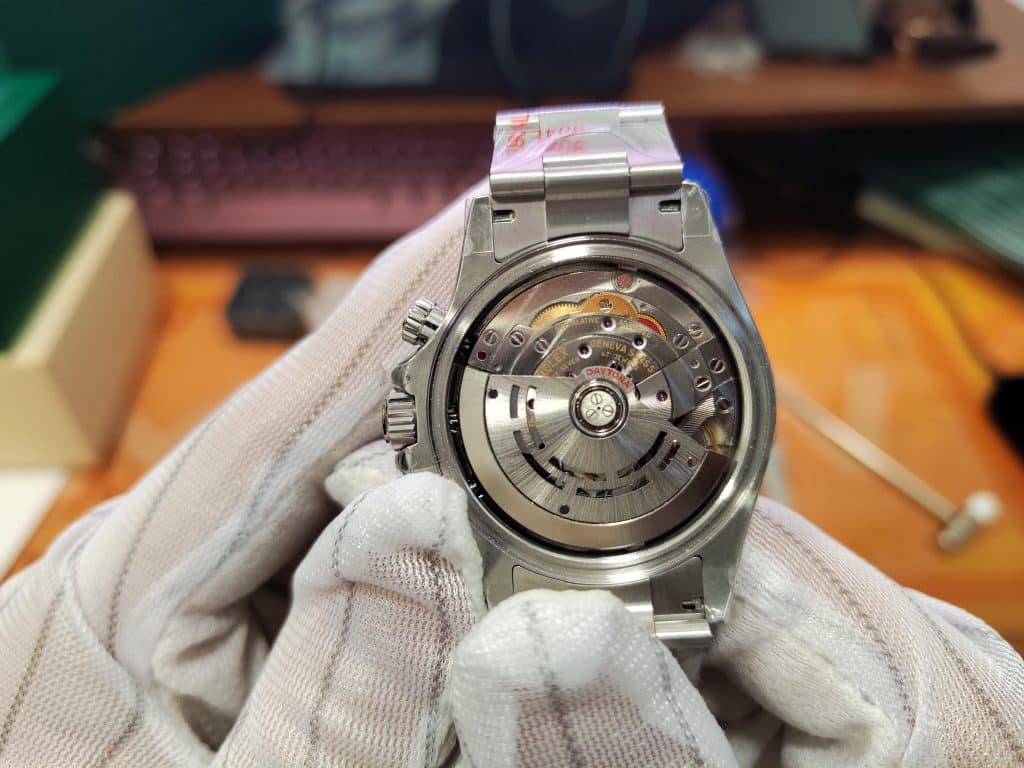
When people first search for a china replica watch movement, most of the attention still goes to logos, dials and bracelets. The problem is that none of those parts keep time. The movement is the only component that decides whether a watch behaves like a real mechanical instrument or just looks good on the table. If you ignore what is inside the case, you are basically choosing based on photography and marketing, not on engineering.
This page exists to flip that order of thinking. Instead of asking “Which factory is more famous?”, we start from a different question: “How is this movement built, and how close is its behavior to the genuine one?” Once you look at china replica watch movement design in that way, the gap between different factories, different calibers and different price levels becomes very clear. Two watches that look identical on social media can have completely different internal architecture, service life and accuracy.
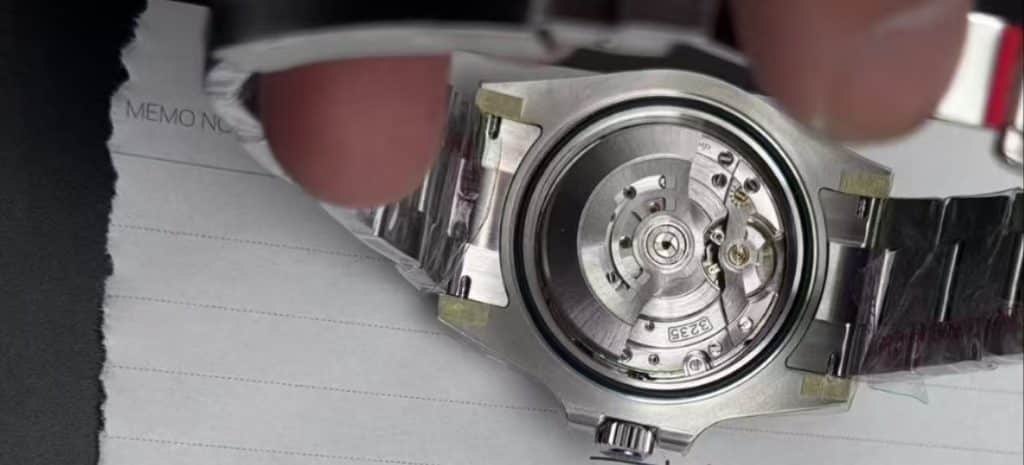
Our goal here is not to glorify any single factory or to promise “1:1 perfection.” That kind of language usually hides the important details. We want to break down how Rolex-style calibers like 3130, 3235 and 4130 are copied, what compromises are made, and how complex features such as tourbillons are simulated or truly implemented. We will also look at bridge-style movements, quartz bridge movements and full mechanical options from Chinese makers and Japanese suppliers, so you can understand where the value really comes from.
Throughout this hub, we will treat the china replica watch movement as an engineering object, not a piece of hype. We will talk about torque, power reserve, escapement design, stability over time and real-world failure points we see in daily use. At the same time, we will share our own observations from handling many different builds: which designs survive real wear, which ones only look convincing in macro photos, and which trade-offs are honest about what they can and cannot do.
If this page does its job, you will come away with a simple habit: before you care about the logo on the dial, you will first ask what is driving the hands underneath it. Once you learn to read movements and not only cases, it becomes much harder for low-grade builds to fool you, and much easier to decide when a higher-end china replica watch movement is actually worth paying for.
Why the Movement Matters More Than the Logo
The Movement Determines Value, Longevity and Accuracy
A logo is an emotional shortcut. It reminds people of a brand story, a lifestyle, a certain status. A movement is the opposite: it does not care about image, only about physics. When you compare one china replica watch movement to another, you are not comparing how “expensive” it looks, you are comparing how well it converts stored energy into stable, controlled timekeeping. Two watches can share the same dial, bezel and bracelet, yet behave completely differently on the wrist simply because their internal engines are not built to the same standard.
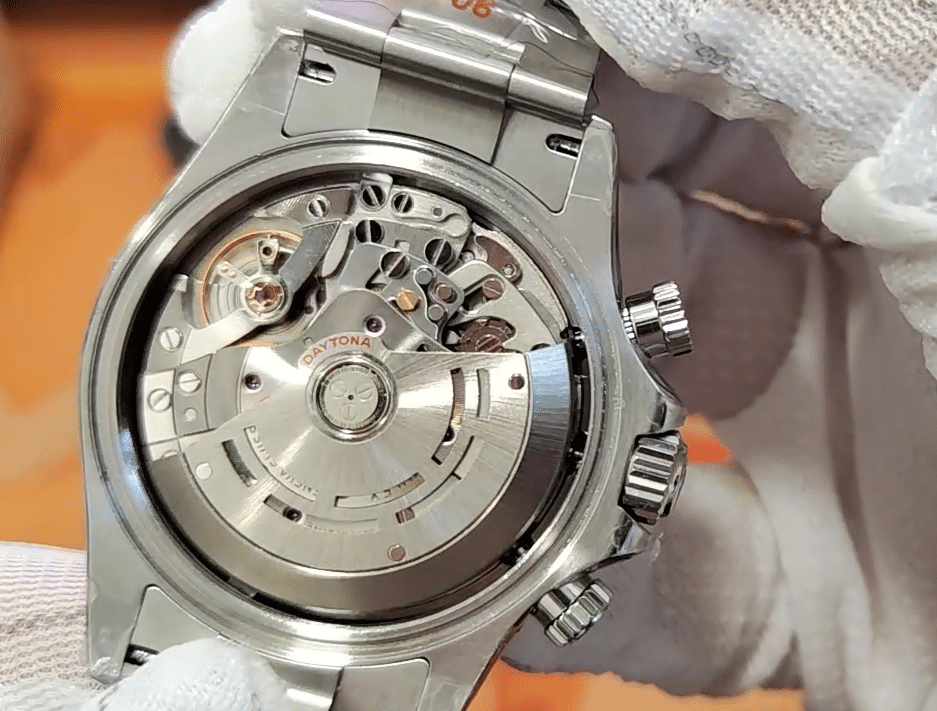
The first thing you can measure is accuracy. A basic low-end build might drift around ±10 seconds per day, sometimes worse when the power reserve drops or when the watch is worn in different positions. A well-designed movement, even in the replica world, can stay closer to ±2–4 seconds per day in normal use if the balance, escapement and regulation are done with care. Over a month that difference becomes minutes, not just a few seconds, and it directly affects whether the watch still feels “trustworthy” when you glance at it before a meeting or a flight.
Then comes torque and power delivery. A movement that was originally designed for a simple three-hand layout can struggle when a factory adds date, day or chronograph modules on top without adjusting the gear train and mainspring strength. When torque is marginal, you start to see problems like weak chronograph engagement, date wheels that hesitate or misalign at midnight, or hands that stutter when the power reserve is low. In contrast, a stronger, correctly calculated china replica watch movement can support these extra complications without sacrificing amplitude or stability, which is why some builds stay smooth while others feel fragile after a few months.
Finally, stability of the architecture determines how often you will be paying for repairs or replacements. Bridges that flex under shock, loose tolerances in pivots and cheap alloys in wear points do not always show up in the first week, but they show up in the first year. A movement with good structural design and tight machining can run for years with only basic cleaning and lubrication; a weaker design can start eating its own parts, leading to service costs that are many times the original price difference between two watches. Most broken replicas we see are not poorly assembled cases, but poorly engineered movements.
Understanding Rolex Movements in the Super Clone Market
When people compare different china replica watch movement options, the discussion often revolves around three calibers: 3130, 3235, and 4130. The debate is not about which factory has the loudest reputation, but about how accurately each movement’s engineering can be interpreted and reproduced. So instead of praising or criticizing any brand, it makes more sense to look at structure, energy efficiency, and long-term stability.
Cal. 3130 — The “Simple but Reliable” Architecture
The 3130 is a very straightforward movement: three hands, no date complications, and a clean bridge layout. Its simplicity is not a limitation—it is the reason the movement is so stable. Without a date module or load-sharing issues, torque management remains extremely linear, making the 3130 famous for its durability in everyday use.
This simplicity is also why the 3130 has become one of the most successful designs to replicate. For a china replica watch movement, fewer components mean fewer tolerances to get wrong, clearer dimensional mapping, and more room to reproduce the signature bridge curves and jewel placement. Factories can focus on machining accuracy rather than compensating for stacked complications or height mismatches.
How VSF Reproduces the 3130
VSF approaches the 3130 with a “stacked accuracy” mindset, focusing not on claiming perfection but on getting layout and geometry right. The automatic rotor shape, its bevels, and the cutout profile are engineered to visually resemble the genuine part more closely than most mass replicas. Even the micro-bearing layout follows the genuine architecture instead of using a generic oversized bearing.
It is not a one-to-one duplicate, and it should not be described as such. Surface treatment, alloy grades, and heat-hardening are still tuned toward industrial scalability, not luxury-brand precision. A more realistic statement is that VSF delivers one of the closest structural and visual interpretations of the 3130 found in a china replica watch movement, which gives it long-term stability without pretending to reinvent high-end watchmaking.
Cal. 3235 — Why It’s Harder to Clone
The 3235 increases the challenge dramatically. The introduction of the Chronergy escapement raises energy efficiency by roughly 15%, allowing a jump to around 70 hours of power reserve compared to the usual 40–48 hours of earlier calibers. Achieving the same efficiency is not simply about copying shapes—it depends on surface friction, material elasticity, shock behavior, and lubrication stability.
For a china replica watch movement, geometry can be copied, but maintaining efficiency over years is another story. Many clones show decent performance during early use but cannot maintain amplitude once friction points begin to wear. This is where the difference between copying a shape and copying a system becomes obvious.
Where Replica Makers Still Struggle
Replica factories can reproduce the Chronergy-style escapement visually, yet the alloy and surface finishing often behave differently under extended wear. Without high-grade heat treatment and optimized lubricants, the escapement’s micro-contact surfaces degrade faster, gradually reducing amplitude and shrinking power reserve. It is more honest to say that today’s china replica watch movement can imitate the architecture of the 3235 and perform well in the short term, but it is not engineered for decade-scale stability. This honesty helps buyers make informed decisions based on usage expectations instead of slogans like “perfect 1:1.”
Cal. 4130 — The Challenge of True Chronographs
The 4130 represents a different kind of difficulty. Its vertical clutch chronograph is not about adding more wheels—it is about transmitting power cleanly without stuttering engagement or amplitude drop. Smooth button feel, consistent reset force, and a stable chronograph seconds hand require extremely precise tolerances in the clutch disks and column wheel system. For any china replica watch movement, that precision comes at a high manufacturing cost. Slight variations in clutch friction or gear clearance can ruin engagement feel or cause uneven chronograph motion. Therefore, replicating the 4130 is not just expensive—it demands intelligent compromise.
VSF’s 4130 Clone Approach
VSF takes a “functional replication” route: instead of making a decorative chronograph with fake running hands, it reproduces the mechanical logic and actual timing function. Pressing start, stop, and reset feels closer to the genuine design, with realistic resistance and return speed. However, several components still differ from the real 4130. Balance wheel material, lubrication type, and long-term wear resistance follow industrial standards rather than the proprietary formulations used in genuine models. The result is a movement that performs well and behaves correctly but should not be judged by the same decade-length maintenance expectations.
A realistic conclusion is that VSF’s 4130 is not a re-created Rolex—as that would require high-end metallurgy—but it is one of the most thoughtfully engineered chronograph options in the china replica watch movement market.
Mechanical, Quartz, and Hybrid (Bridge) Movements — What Buyers Often Misunderstand
Most people first judge a watch by the dial and the logo, but the real story is written by the movement. A lot of confusion—and sometimes outright disappointment—comes from not knowing whether the watch uses a true mechanical caliber, a quartz engine dressed up to look mechanical, or a hybrid bridge system that only imitates the look of a high-end movement. Understanding the differences helps you decide what you are really paying for and whether the watch matches the description given by the seller.
True Mechanical Movements
A true mechanical movement stores energy in a mainspring and releases it through a gear train regulated by an escapement and balance wheel. There is no battery; everything you see on the timegrapher or on the wrist comes from wound spring power. In this category you will find in-house designs, generic Swiss-style clones, and well-known Japanese calibers such as Miyota from Citizen. Generic Swiss-style clones aim to copy the layout and functions of familiar Swiss designs. They often reproduce the bridge shapes, jewel positions, and rotor profile because many buyers want the movement to look similar to what is used in more expensive models. When done well, these movements can offer decent accuracy and a power reserve that feels close to what people expect from a modern automatic watch.
Japanese movements, especially from watches manufacturers like Citizen’s Miyota, take a different approach. They are usually not trying to match the appearance of any specific Swiss caliber. Instead, they focus on reliability, easy servicing, and stable timekeeping. They may look more “industrial” through a display back, but they have a strong track record in everyday watches. For someone who cares more about consistent performance and long-term durability than about visual imitation, a Japanese mechanical caliber is often the most rational choice.
Quartz Bridge Movements
A quartz movement is powered by a battery and regulated by a quartz crystal. The second hand typically jumps once per second, and the internal layout is very compact. To satisfy buyers who want the look of a mechanical watch without the cost, some makers use “bridge” plates on top of a quartz base, creating what is often called a quartz bridge movement.
From the back, this can look like a complex mechanical caliber: there are fake bridges, printed decorations, and sometimes non-functional gears. However, the timekeeping is pure quartz. The visual imitation can be very convincing in photos, but in terms of horological value it does not offer the engineering depth of a true mechanical movement. You are essentially paying for a battery-powered watch with an added layer of decoration.
How to Spot a Quartz Bridge Movement
There are a few simple checks that help you identify a quartz bridge setup even without opening the case completely. The first clue is the gear train. In a real mechanical movement, the center wheel, third wheel, fourth wheel, and escape wheel form a continuous path, and you can usually trace how power flows from the mainspring to the escapement. In many quartz bridge constructions, the “gears” on the decorative plate do not line up with any real functional parts. Some of them are fixed in place and never move at all.
Another sign is the absence of a true seconds drive train. On a mechanical movement, the wheel driving the seconds hand is part of the actual energy path. On a quartz bridge movement, the seconds hand is driven by the quartz module underneath, and the upper plate may only show static gears that do nothing. If you can observe the movement closely—ideally with a macro video—you will notice that the printed or applied bridge parts stay completely still, no matter how the watch runs.
Sound and feel give you more hints. A mechanical rotor has a distinctive, continuous spin and a certain weight when you gently shake the watch. On many quartz bridge designs, the “rotor” is light, turns less freely, or feels disconnected from the rest of the movement because it is only there to give the impression of an automatic system. The rotor sound is often too faint and irregular compared to a real mechanical build. This is a good place to embed your own comparison clips so readers can hear and see the difference.
On top of that, some bridge-style movements make the entire watch noticeably thicker. The decorative plate is simply stacked over a standard quartz module, increasing the overall height without adding any genuine horological content. If a watch feels unusually tall for the model it is imitating, that can be another warning sign that you are looking at a cosmetic bridge rather than a fully mechanical caliber.
Fake vs Real Tourbillon — Why Most Replicas Are Just Spinning Wheels
The tourbillon is one of the most misunderstood complications in modern watchmaking. In a genuine mechanical tourbillon, the balance wheel and escapement are mounted in a rotating cage, which turns at a constant speed—often once per minute. The idea is to average out positional errors in gravity, improving timekeeping performance in certain positions. It is a delicate, energy-hungry system that requires fine machining and careful adjustment.

In many lower-priced watches, what is sold as a “tourbillon” is not a true tourbillon at all. Instead, it is a decorative spinning element driven by a simple gear, sometimes even oscillating back and forth rather than rotating in one direction. It may look dramatic through an open heart dial, but it does not regulate the movement and does not justify the same expectations in terms of engineering.
A real tourbillon cage rotates smoothly and at a constant rate, and you can see the balance wheel and escapement clearly working inside it. The motion is continuous, not a hesitant wobble. A fake tourbillon often shows gears that move without any clear connection to the regulating organ, or a “cage” that swings, pauses, or even reverses direction in a way that would make no sense in a genuine regulating system.
Different Approaches to “Tourbillon Style” Watches
Different makers take different paths when they try to offer the look of a tourbillon. Some brands that concentrate on Richard-Mille-style designs focus on external motion and dramatic visual effects. Skeletonized bridges, large openings, and animated parts give the wearer a sense of complexity, even when the underlying regulation remains relatively simple. In these watches, the emphasis is on visual theatre rather than on traditional chronometry.
Other makers who focus on Patek-style pieces tend to prioritize bridge shapes, anglage, and surface finishing. The goal there is to create a movement that looks refined and coherent under magnification, even if the complication level is lower than what the dial might suggest. Finishing textures, polished edges, and consistent grain lines are where the effort goes, not necessarily into recreating every technical function of a haute horlogerie tourbillon.
In simple terms, one group excels at external motion theatrics, while the other pays more attention to finishing textures and overall visual harmony. For a buyer, the key is to decide whether you value real regulating complexity, reliable timekeeping, or simply a certain aesthetic. Knowing what each type of movement actually does helps you avoid paying mechanical-tourbillon prices for what is essentially a decorative spinning wheel.
How to Judge Super Clone Movement Quality — Practical Tools and Tests
You do not need to trust any seller’s slogan to understand whether a china replica watch movement is well built. With a bit of patience, your ears, your fingers, and a simple timing app can tell you far more than marketing language ever will. The goal of this section is to give you tests you can repeat yourself, not reasons to “believe” anyone.
Rotor Noise and Winding Resistance
A healthy automatic movement has weight and presence. When you gently move the watch, you should feel the rotor turning with a smooth, continuous motion. There is usually a soft, consistent sound as it swings, especially in quieter rooms. If the rotor feels weightless, barely audible, or strangely disconnected from the rest of the watch, that can be a sign that you are dealing with a thin decorative rotor or a quartz bridge design rather than a true automatic china replica watch movement.
Winding resistance is another useful indicator. When you turn the crown to wind the watch manually, you should feel a series of fine, even clicks as the mainspring tightens. Too much resistance, grinding, or sudden “free spinning” suggests poor machining or slipping components. On the other hand, almost no resistance at all can mean that the crown is not actually engaging a proper mainspring barrel. A real mechanical movement balances smoothness with a tangible sense that you are doing real work when you wind it.
Jewels and Decoration Patterns
Ruby jewels are often used as a selling point—some listings boast about jewel counts as if more is automatically better. In reality, the number printed on the movement tells you very little by itself. What matters is whether the jewels sit in mechanically sensible positions: supporting pivots, escape wheels, and high-friction points. A bridge covered in jewels that do not line up with any actual gear pivots is usually a sign of decoration, not engineering quality.
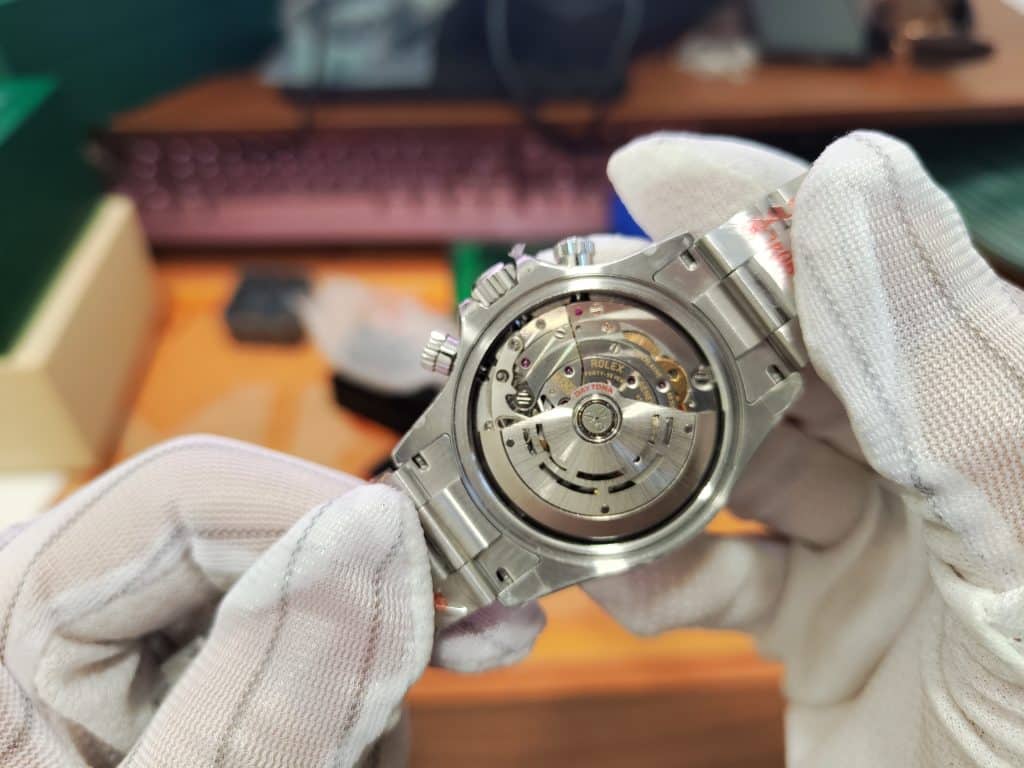
Decoration patterns tell their own story. Côtes de Genève, circular graining, and brushing on genuine high-end movements are applied with controlled variation; under magnification, you will see tiny irregularities and overlapping strokes. On many low-grade china replica watch movement plates, the patterns are too perfect—laser-printed or stamped textures that repeat with no natural variation. If every line is identical and every wave is mathematically precise, you are probably looking at surface cosmetics rather than time-consuming finishing work.
Timekeeping Tests That Matter
Colorful balance wheels, skeleton bridges, and dramatic rotors can be fun to look at, but timekeeping performance depends on more basic metrics: daily rate, stability over different positions, and how the watch behaves as the power reserve drops. A practical benchmark for a well-regulated super clone movement is within about ±5 seconds per day in normal use. More important than a single snapshot number is how consistent that rate is from one day to the next and between different wearing conditions.
Positional error is another key factor. A watch might keep good time dial-up on a desk but drift significantly crown-up or crown-down on the wrist if the balance and escapement are not balanced correctly. That is why a steady, repeatable rate matters more than the exact look or color of the balance assembly. A visually impressive china replica watch movement that swings wildly between positions is, in practical terms, less useful than a plainer caliber that holds a tight, stable line.
Real Data You Can Measure
You do not need a professional timing machine to get meaningful data. A smartphone app such as WatchAccuracy (or any similar time-tracking tool) can help you measure how your watch behaves over a couple of days. The process is simple: set the watch to a known reference time, log the difference at regular intervals, and note the position in which the watch has been resting or worn.
A useful routine is to test the watch in at least three positions—dial up on a table, crown up in a stand, and on the wrist during a normal day—for two days in a row. Record the gains or losses in each scenario. If the rate stays within a narrow band and does not swing wildly between positions, you are dealing with a more stable movement. If the numbers jump around unpredictably, no amount of pretty decoration on the bridges will change the underlying reality. These simple measurements give you an objective way to compare one china replica watch movement to another, based on behavior you can verify yourself rather than promises on a product page.
Our Perspective — What We Choose When Quality Matters
We work with more than one type of china replica watch movement, and over time you stop thinking in terms of hype and start thinking in terms of behavior. On the bench and on the wrist, movements either make sense as engineering or they do not. That is why we pay more attention to three things than to any factory nickname: the internal logic of the architecture, the stability we see from real-world feedback, and how difficult it is to service the movement when something eventually goes wrong.
When a caliber has clear torque paths, sensible bridge layouts, and enough space for proper lubrication, it is usually predictable to regulate and maintain. When the design is stacked with cosmetic plates, unnecessary height, or fragile modules, it might look impressive through a caseback but it tends to age badly. Over the years, the movements we trust most are the ones that behave like honest mechanical systems rather than stage sets. We do not worship factories. We judge movements the same way watchmakers do — by how they behave over time. In that context, VSF’s 3130- and 4130-style movements stand out because their working logic is closer to the genuine architecture. The 3130-style builds benefit from a simple, robust layout that is easy to regulate and relatively forgiving in daily wear. The 4130-style chronographs, when assembled and adjusted correctly, follow a real chronograph flow instead of using decorative sub-dials or fake running hands. That does not mean they are perfect copies; Chronergy-style escapements and 3235-level efficiency remain industry-wide challenges, and we are cautious about any claim that pretends otherwise.
Japanese movements, such as Miyota from Citizen, sit in a different category in our minds. They rarely try to imitate a specific Swiss layout visually, and the rotor shape or bridge design will not fool anyone who knows what a Rolex movement looks like. But they offer something else: repeatable accuracy, robust construction, and parts availability. For buyers who care more about stable timekeeping and low-maintenance ownership than about a one-to-one visual clone, a Japanese mechanical option is often the most rational choice.
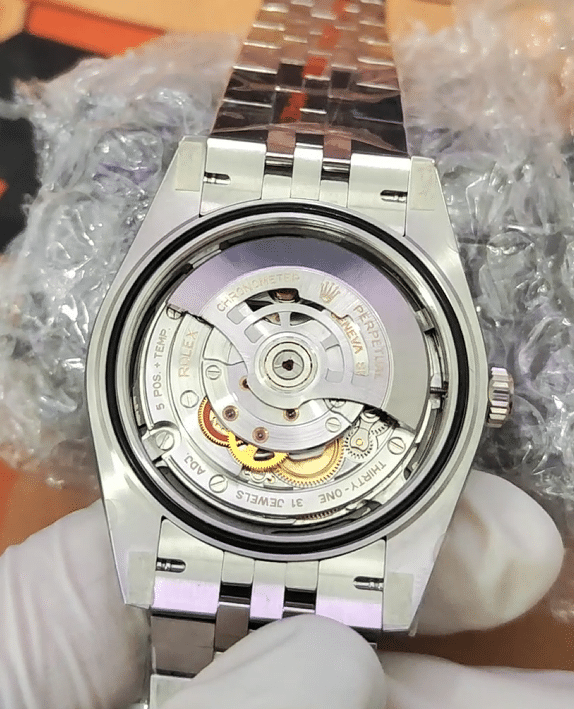
So when quality really matters, we do not start with factory names. We start by asking: does this movement’s structure make sense, has it shown stable results over time, and can it be serviced without turning into a parts donor? If the answer to those questions is yes, the logo on the rotor becomes much less important.
Conclusion — What Makes a Movement Worth Paying For
At the end of all the technical detail, the question is simple: what makes a china replica watch movement worth your money? The answer is not a factory nickname or a marketing slogan. Real value comes from things you can verify: how the movement is built, how it keeps time, how it behaves in different positions, and how it holds up after months and years of wear. Bridge layouts, torque paths, escapement design, power reserve, and measured daily rate tell you far more than any photo or “1:1” claim.
The industry behind these movements is clearly improving. Architectures inspired by 3130 and 4130 have become more coherent, power reserves are getting longer, and finishing has moved beyond crude decoration in many cases. At the same time, there are still hard limits. Chronergy-style escapements, genuine tourbillon performance, and decade-level durability are not things that can be mass-produced cheaply or copied perfectly just because the outside of the watch looks convincing. The gap between appearance and engineering is smaller than it used to be, but it has not disappeared.
So the responsibility ultimately sits with the reader. Instead of asking which factory is “the best,” it is more useful to ask which movement design matches your expectations and how much risk you are willing to accept. If you care about long-term stability, test rate and consistency over a few days. If you care about mechanical integrity, look closely at the gear train, jewels, and how the rotor and winding feel. Once you start judging any china replica watch movement by structure and data rather than by popularity, it becomes much easier to decide what is genuinely worth paying for—and much harder for weak movements to hide behind a famous name.