
When people search for Breitling replicas, they usually end up on polished pages full of big promises. This isn’t one of those.
My name is Aurora. I work on the front line with VS factory – checking Breitling replica pieces, talking to clients, and listening when something doesn’t feel right after a watch arrives. I see strong super clones, weak ones, and all the grey area in between.
This Breitling replica & super clone buying guide 2026 is just a structured version of what I explain every day in private chats. If you’re trying to figure out whether a Breitling super clone is worth your attention at all, you don’t need slogans. You need a realistic view of what these watches can and cannot do.
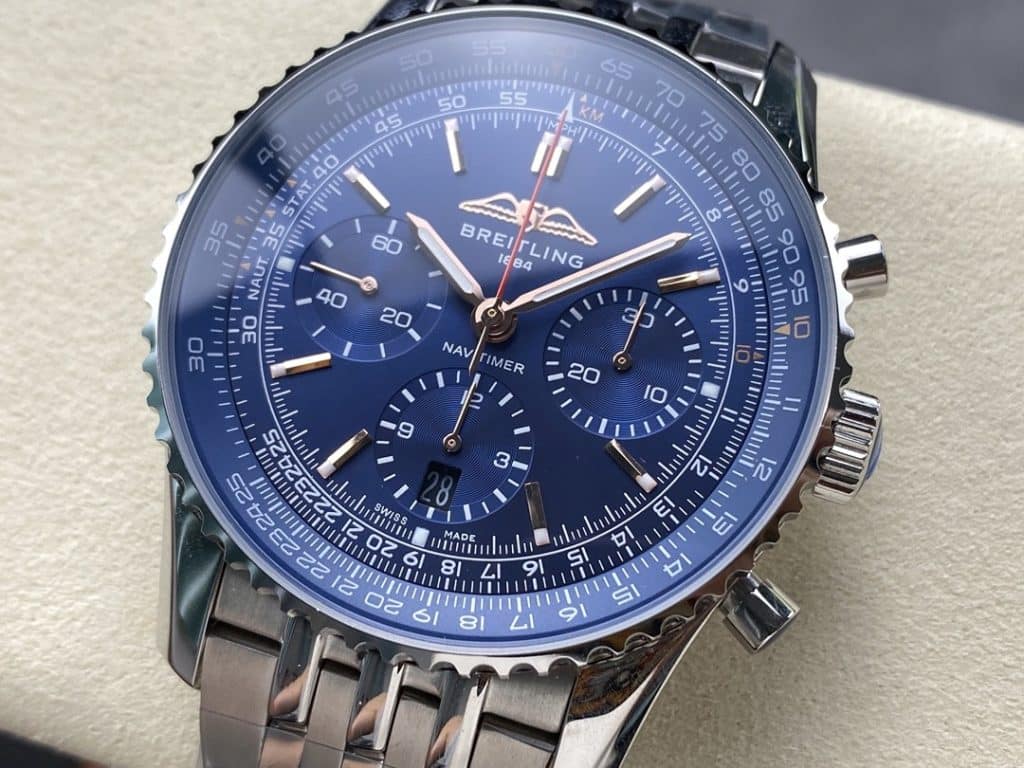
You’ll see model names here – Breitling Navitimer replica, Superocean super clone, Chronomat replica, Avenger 1:1 clone – but always tied to how they wear, how they’re put together, and how people actually live with them. Think of this page as a long, honest note from someone inside the VS factory supply chain, not a luxury brochure.
Who I Am & Who This Breitling Replica Guide Is For
Most days, my inbox looks the same. Wrist shots with big pilot dials. Screenshots of listings for “Breitling replica 1:1”. Links to three different Breitling Superocean replicas with three very different prices. Some people are excited about their first Navitimer super clone. Others are already disappointed by a watch they bought elsewhere and are trying to understand what went wrong.
I sit in the middle of all that.
On one side, there is the factory world: cases coming off CNC machines, movements on timing machines, lume being tested in dark rooms, water-resistance checks, bracelets being resized, and small adjustments from one production run to the next. On the other side are people like you, scrolling on a phone or laptop, trying to decide if a Breitling replica watch makes sense compared to another brand or compared to waiting longer for an authentic piece.
From that position, certain patterns are hard to ignore.
I see where Breitling super clones give a lot of watch for the money, and where corners are clearly cut. I see the difference between a well-finished VS factory Breitling and a generic “Swiss made” clone that leans heavily on good photos and vague descriptions.
This Breitling replica buying guide is meant for readers who:
- Care about how a watch feels on the wrist, not just how it looks in a studio shot.
- Want to understand why one Breitling super clone is much more expensive than another that looks similar in pictures.
- Are comparing options like a Navitimer replica, a Superocean super clone, or a safer, more mainstream style from another brand.
My aim here is simple: lay out what actually matters – case, dial, movement, reliability, factory differences – so you can make up your own mind. If you finish this guide and decide that a Breitling replica isn’t for you, that’s still a good result. At least the decision will be based on clear information rather than guesswork.
Aurora from VS Factory: Why I Wrote This Guide
After a while, the same questions and the same problems started repeating themselves. It made sense to put everything into one clear Breitling replica guide instead of explaining the same points in fragments to different people.
I often hear from buyers who ordered a “Breitling super clone” based only on glossy photos and big claims. The watch arrives and feels off: the case is lighter than they expected, the dial printing looks a little soft, the lume fades quickly, or the chronograph on a supposed Breitling Chronomat replica doesn’t behave the way a proper 7750-style movement should. By the time they reach out, they’re not just unhappy with that one watch; they’re questioning the whole idea of replicas.
From the factory side, I see the opposite as well.
I see VS factory Breitling Navitimer pieces with solid cases, clean dials, decent automatic movements, real sapphire crystal, and finishing that still looks good after daily wear. These watches are not flawless, but they are consistent, and they give a fairly honest impression of what a Breitling design feels like on the wrist. I also see cheaper Chronomat replicas that look convincing in photos but feel light, hollow, and rough the moment you pick them up.
This guide exists to close that gap between expectation and reality.
Rather than telling you to trust a label or avoid one, I want to break down the practical stuff: how the case should look and feel, what to expect from the dial and lume on a Breitling replica, what different movement types mean in real life, and how water resistance and reliability fit into the picture. The idea is that, next time you look at a listing for a Breitling super clone, you’ll have a calm checklist in your head and a realistic sense of what you’re paying for.
The Typical Questions People Ask About Breitling Replicas
If I scroll through a normal week of messages, three questions about Breitling replicas show up again and again.
The first one is usually:
“Is a Breitling super clone actually worth it, or should I just go for another style?”
Breitling designs have a strong, sometimes aggressive presence. A Breitling Navitimer replica with its busy slide-rule bezel, a bold Avenger replica, or a bright Superocean super clone makes a very different statement from a simple three-hand dress watch. Some people love that energy. Others realise it’s more than they want to live with every day. This guide won’t tell you what you have to like, but it will help you picture how these watches behave in normal life, not just in perfect lighting.
The second common question is:
“VS factory Breitling vs other factories – does it really matter?”
By the time someone asks this, they’ve usually seen several offers already: a cheap Breitling replica from a generic marketplace, a mid-priced “Swiss” piece with few technical details, and a more expensive listing for a VS factory Breitling Navitimer or VSF Superocean that actually talks about movement type, sapphire crystal, and testing. To an untrained eye, the photos are almost interchangeable. The differences are hiding in things like case finishing, the sharpness of the dial printing, the alignment of the indices, the strength and colour of the lume, and how the movement feels when you wind it or set the time.
The third question is very practical:
“Can I wear a Breitling replica every day, or is it only for occasional use?”
This is where reliability stops being a buzzword. People want to know if a Breitling Superocean replica can handle daily routines that involve sweat, rain, quick temperature changes, and the occasional knock on a door frame. They ask whether the crown and pushers feel secure, whether the bracelet stretches quickly, and whether an automatic movement in a Breitling super clone can keep sensible time over weeks, not just days. If any of these questions sound familiar, you’re exactly the kind of reader this guide was written for.
In the next sections, we’ll go step by step: what “replica” and “super clone” really mean, how different Breitling lines translate into replica form, what movement choices exist, how factory differences show up, and what simple checks you can do before committing to any Breitling replica watch.
What Exactly Is a Breitling Replica / Super Clone?
Before we go deeper into factories, movements, or model picks, we need to be clear on one thing: when people say Breitling replica, they don’t all mean the same product. In the market, you’ll see everything from very rough “fashion copies” to high-spec Breitling super clones that try to match the genuine watch in size, weight, and functions. If you don’t understand the difference, all the photos start to look the same and the prices just seem random.
At the low end, you have cheap fakes: lightweight cases, mineral glass, generic no-name movement, and dials that only loosely resemble a Navitimer or Superocean. They are made to catch the eye from a distance, not to hold up under close inspection. In the middle, there are normal replicas: the case shape is closer, the dial layout is more accurate, but the movement and finishing are still far from the real thing. At the top, there are 1:1 super clones – the “luxury replica” level – where the goal is simple: make a Breitling replica that, on the wrist and in the hand, feels like the original watch in dimensions, weight, and basic function. That’s the space where VS factory and other serious makers operate.
Replica vs Super Clone vs Cheap Fake
If you pick up one of each – a cheap fake, a mid-level replica, and a Breitling super clone – the contrast is obvious long before you look at the logo.
A cheap fake is built to hit the lowest possible cost. A “Navitimer-style” or “Chronomat-style” watch in this category might use a very simple quartz or basic automatic movement, a light alloy case, and hard mineral glass. The subdials are often fake or only loosely functional. The weight is usually far off: a real 43–46 mm Breitling on steel can be well over 150–180 grams with bracelet, while a cheap copy can feel almost hollow in comparison. Fonts are slightly wrong, markers are misaligned, and lume, if present at all, is weak and uneven.
A normal Breitling replica sits in the middle. The case shape is closer, the dimensions roughly match the genuine 41–44 mm Chronomat or 42 mm Superocean. You might see automatic movements based loosely on common architectures like 2813 or low-cost 2824-style clones. The watch has some presence on the wrist and basic function, but once you start paying attention to the bezel action, the smoothness of the hands, or the way the chronograph behaves, the gap shows. Lume may be applied, but not with the consistency you’d expect from a serious piece.
A Breitling super clone aims much higher. The case diameter and thickness are mapped closely to the original reference: for example, building a Breitling Navitimer replica around the classic 43 mm profile or a Breitling Superocean replica around its 42–44 mm diver case. The weight is intentionally tuned with solid 316L steel cases and bracelets so the watch sits on the wrist in a similar way to the real thing. You’ll often see automatic movements based on platforms like SW200 / ETA 2824, 2836, or 7750-style chronograph movements for multi-register models, so the sweep of the seconds hand and the feel of the pushers are closer to what people expect from a genuine piece.
On a super clone level, the dial printing is sharper, the date window is better aligned, and the lume plots on a Chronomat replica or Avenger 1:1 clone are applied with more care. Sapphire crystal with anti-reflective coating is common instead of mineral glass, and simple water-resistance tests are often done at the factory. It’s still a replica, not a genuine Breitling, but in terms of size, weight, and basic functionality, it sits in a completely different category from a cheap fake. When people talk about “high-quality fake Breitling” or “luxury replica”, this is usually what they mean, whether they use that language or not.
Why Breitling Is Popular in the Super Clone World
Breitling wasn’t the first brand to get copied, and it’s not as universally known as Rolex, but it has a strong place in the super clone world for a few practical reasons.
First, the designs are instantly recognisable. A Breitling Navitimer replica with its slide rule bezel and three subdials doesn’t look like anything else on the street. A Breitling Superocean replica with a chunky diver bezel and bold markers has the same effect. A Chronomat replica with a rider-tab bezel and integrated-style bracelet has a very distinct profile. These shapes and layouts make sense to replicate at a high level because they give the wearer a clear visual identity once the watch is on the wrist.
Second, Breitling’s genuine watches are usually substantial pieces. Many popular models sit in the 42–44 mm range with solid cases and bracelets, and real-world weights that feel like a piece of equipment, not jewellery. That plays well with the 1:1 super clone idea: if you build a Swiss Breitling super clone with the right steel, the right bracelet structure, and a reasonably heavy automatic movement inside, you can get surprisingly close to the original wrist feel. For a lot of buyers, that “bulk plus balance” is exactly what they want to experience without paying genuine prices.
Third, the movement layouts lend themselves to cloning. A three-register Navitimer-style chronograph can be built around a 7750-style automatic chronograph, giving running seconds, a 30-minute counter, and a 12-hour counter in the same positions as the original. A time-and-date Breitling Superocean replica can run on an SW200 / ETA 2824 / 2836-type layout, with central seconds and a date at three or six, depending on the reference it’s copying. The exact calibre numbers are not the same as Breitling’s in-house B01 or other proprietary movements, but for a buyer focused on function and feel rather than horological purity, the match is often close enough.
Finally, Breitling sits in an interesting spot in the enthusiast mind. Some people see it as a loud, tool-watch brand with strong pilot and diver roots; others see it as an under-appreciated alternative to more obvious choices. That tension makes the brand attractive to replica buyers: they search for Breitling Navitimer replica, Breitling Superocean replica, and Swiss Breitling super clone because they want something a bit different from the usual suspects, but still with enough name recognition that watch people will notice.
All of this explains why you see so many Breitling references showing up at the super clone level and not just in the cheap fake segment. The designs are bold, the genuine watches are substantial, and the basic architecture of the cases and movements gives factories something solid to work from. The rest of this guide will focus on how to tell when that potential has been used well, and when a “Breitling replica” is only using the name without doing the work.
Quick Overview of Key Breitling Lines (For Replica Buyers)
When people talk about Breitling watches in the replica world, they’re usually not thinking about the whole catalogue. They have a few specific lines in mind that dominate every Breitling review, every chat, every request: Navitimer, Superocean, Chronomat, Avenger. If you understand how these four behave on the wrist, you already understand most of what matters for Breitling replicas.
Below is a quick, buyer-focused map. Not brand history. Just how each line feels, who tends to wear it, and why the replica market keeps coming back to it.
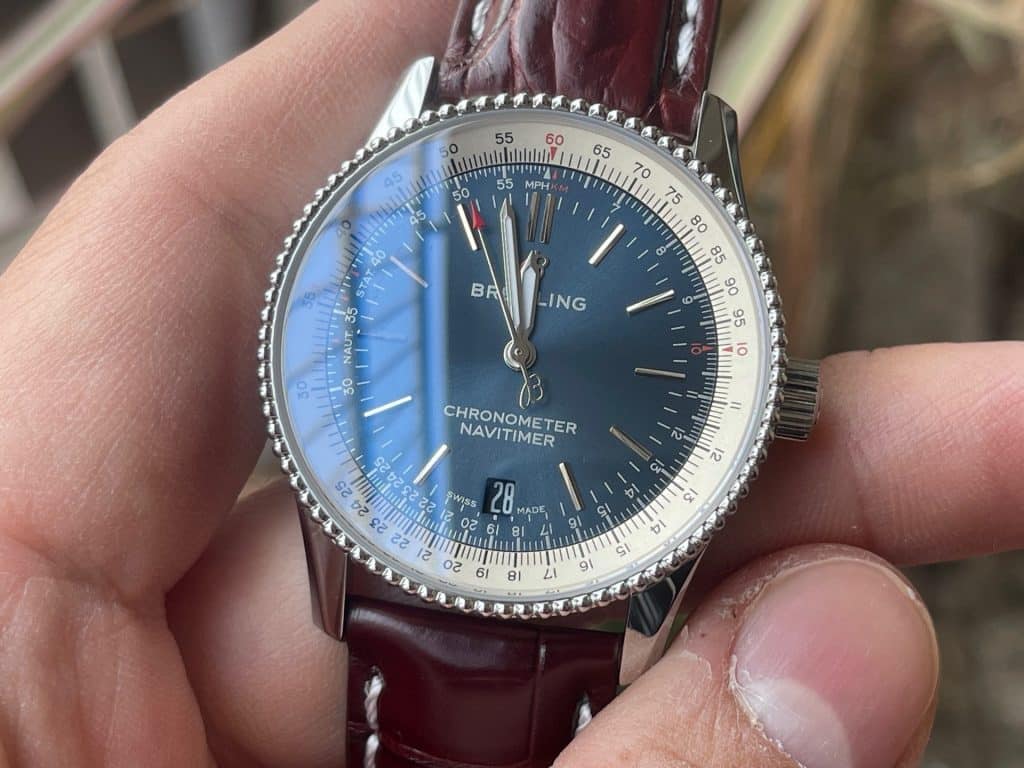
The Navitimer is the one everyone recognises first. Busy dial, slide-rule bezel, three subdials stacked into a classic pilot look. A Navitimer replica usually ends up on the wrist of someone who actually enjoys that complexity, who wants something to look at during a slow meeting or a long flight. It’s not subtle. It’s a statement that says “I like instruments” more than “I like jewellery.”
In replica form, the Navitimer is popular because it gives a lot of visual value for the money. Even mid-range pieces look dramatic in photos. Super clones that get the subdial spacing, bezel teeth, and 42–43 mm proportions right feel surprisingly close to the genuine watch on the wrist. That combination of icon status and high visual payoff is why you hear about the Navitimer in almost every Breitling review and every first contact message. Later in this guide, when we talk specific references and movement choices, a chunk of the “model picks” section will naturally revolve around different Navitimer-style builds.
Superocean: Tool Diver with Strong Replica Demand
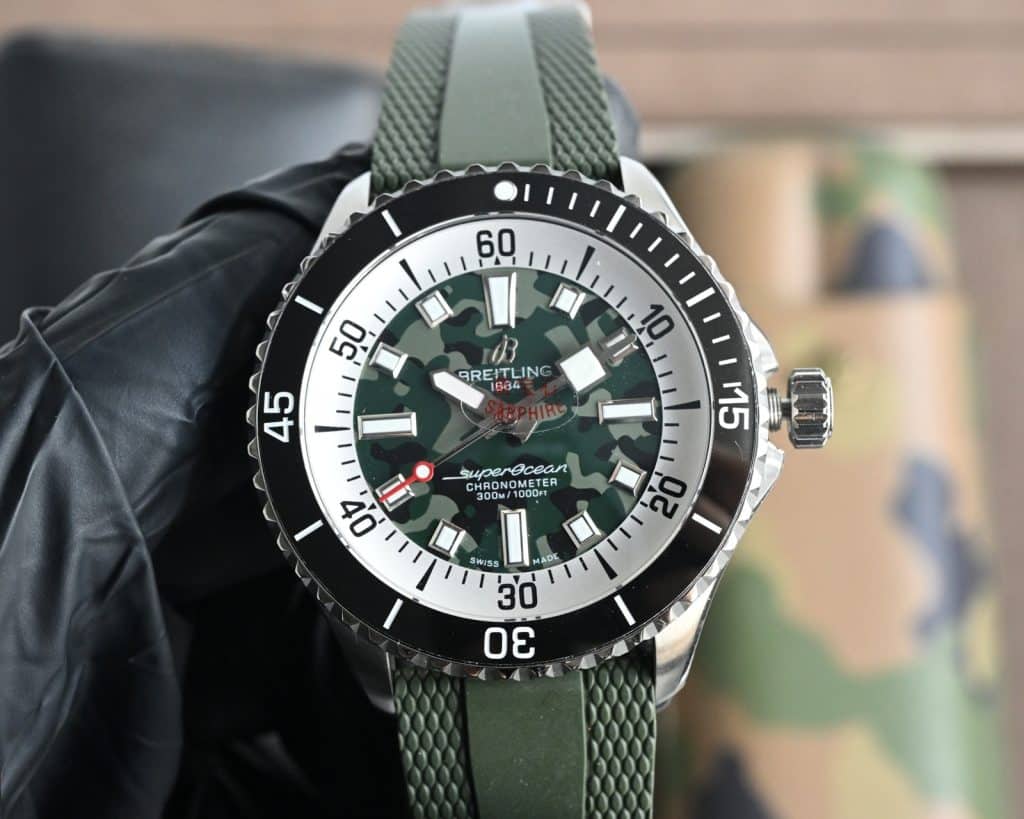
If the Navitimer is the pilot instrument, the Superocean is the straightforward tool diver. Clean hands, bold markers, rotating bezel, real-world water resistance on the genuine pieces, and a wrist presence that feels more practical than flamboyant. A Superocean super clone usually appeals to people who want a daily watch that can see water, sweat, and casual wear without feeling fragile.
In the replica world, Superocean models are strong sellers because they sit at a nice intersection: easier to wear than a huge pilot chronograph, but still clearly a Breitling. A 42–44 mm Superocean-style case with solid 316L steel, a reliable three-hand automatic movement, and good lume gives a very convincing “tool watch” experience. That’s why many buyers who start by asking about a Navitimer end up shortlisting a Superocean instead. When we get to the later section on recommended models, you’ll see several Superocean-based options come up as the “safe but still very Breitling” choice.
Chronomat & Avenger: Bold Cases, Strong Wrist Presence
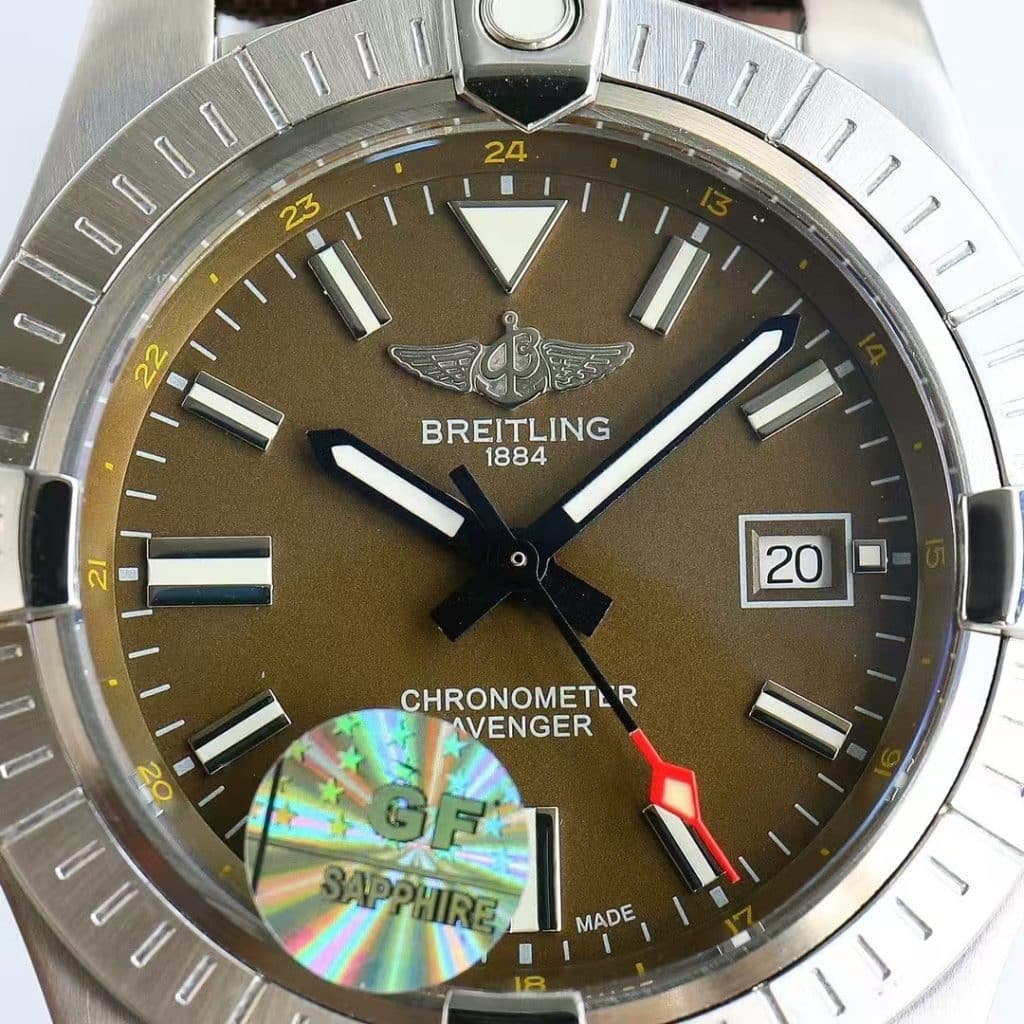
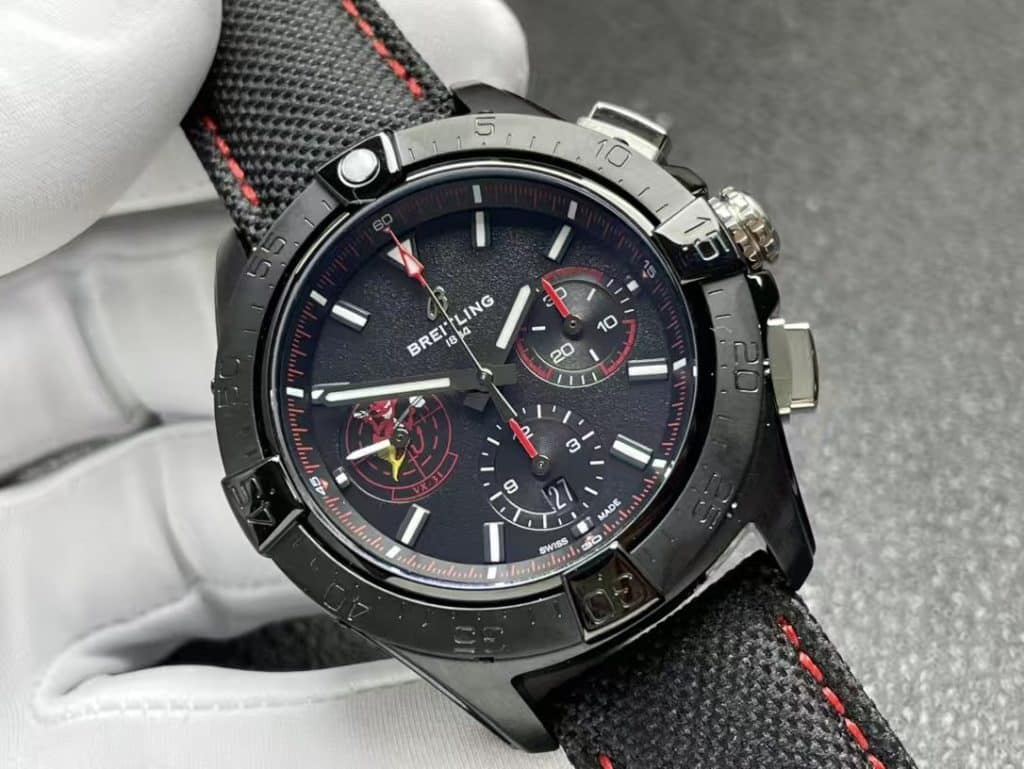
The Chronomat and Avenger lines sit in the louder corner of Breitling watches. Chunky bezels, wide lugs, screw-down pushers on many chronograph versions, and bracelets that look almost overbuilt on smaller wrists. A Chronomat replica or Avenger replica usually ends up with someone who already knows they like big, assertive cases. These are not watches that disappear under a shirt cuff without a fight.
Replica demand here comes from that attitude. For buyers who want maximum presence, a 42–44 mm Chronomat-style or Avenger-style build with proper weight and a 7750-style chronograph movement feels like serious hardware. Even simple three-hand Avengers have that blocky, purposeful look that makes them feel more like gear than accessory. In the later “best model” section, when we talk about who should consider which line, Chronomat and Avenger will show up as the choice for thicker wrists and for people who want their Breitling replica to be noticed from across a table, not just admired up close.
Quality Levels & Price Ranges for Breitling Replicas
If you browse around for a few days, you’ll see Breitling replica prices all over the place. One site offers something for under $100, another wants $300, a third wants $900+ and calls it a super clone 1:1 or “luxury replica”. Without a framework, it feels random. In reality, the market sits in three rough tiers, and once you understand them it’s much easier to judge Breitling replica quality, value, and price side by side.
This isn’t about exact numbers down to the dollar. It’s about what genuinely changes as you move from a $50 fake to a four-figure build that people put in the “best Breitling replica watches” category and actually wear long term.
From $50 Fakes to $1,000+ Super Clones: What Changes?
At the bottom of the ladder are the true budget pieces. Think roughly $50–$150. These are the easy-come, easy-go watches that just borrow the idea of a Breitling dial. A “Navitimer look” with printed subdials, a light case, a generic quartz or very basic mechanical movement. Mineral glass, stamped clasps, hollow links. From a distance it reads as “Breitling-ish”. Up close, everything feels thin. These are not Breitling replicas worth buying if you care about long-term wear or realism.
Move up into the mid-tier, roughly $200–$500, and you hit what many sellers call AAA replica. Here the case shape is closer to the real Navitimer, Superocean, Chronomat or Avenger. You start seeing proper applied markers, working subdials, automatic movements based on common architectures like 2813 or low-cost 2824-style clones. The watch has more weight, the bracelet feels less hollow, and the dial holds up better under casual inspection. But if you put it next to a genuine Breitling, or next to a serious super clone, the differences in finishing, lume, and movement smoothness are still obvious.
Above that, usually $600–$1,000+, live the higher-end builds: the super clone 1:1 level. This is where factories really try to recreate the genuine watch’s dimensions, weight, and behavior. A Breitling Superocean super clone in this range will use solid 316L steel, a sapphire crystal, a decently regulated automatic movement, real gasket work for basic water resistance, and dial printing that looks sharp even under magnification. A Navitimer replica here should get the subdial spacing, slide-rule bezel, and overall thickness close enough that people who know the watch need to look twice.
Are they perfect? No. But when people talk about the best Breitling replica watches in forums and private chats, this upper tier is usually what they mean. The price jump from mid-tier to super clone isn’t about a logo or a label; it’s about how much of the original watch’s presence and consistency you actually get on your wrist.
What You Actually Pay For in a Super Clone
When you pay super clone money for a Breitling replica, you’re not just buying a name like “VS” or “V3”. You’re paying for three clusters of things: materials, movement, and details. That combination is what separates a true high-end build from an average AAA replica that just looks good in a product shot.
On the materials side, a serious super clone will almost always use 316L stainless steel for the case and bracelet. That matters for scratch resistance, corrosion resistance, and the way the watch feels in the hand. The crystal should be sapphire, often with some form of anti-reflective coating, not basic mineral glass. A diver-style Superocean super clone or Avenger should have properly machined crown tubes, screw-down crowns or pushers where appropriate, and gaskets placed with some care, so simple water exposure isn’t a gamble every time. You’re paying for that heavier, denser, more “tool-like” feel that cheap fakes never manage.
Inside the case, the movement is the other big cost driver. Super clones typically use platforms based on SW200 / ETA 2824 or 2836 for three-hand and date models, and 7750-style chronograph clones for Navitimer, Chronomat and Avenger chronographs. These calibres beat at 28,800 vph in many builds, giving a smoother seconds hand sweep than low-beat budget movements. They’re also easier to regulate into a reasonable accuracy range and to service if something goes wrong. When you feel a chronograph start and reset cleanly on a good Chronomat replica, that’s the movement architecture doing its job, not just clever case design.
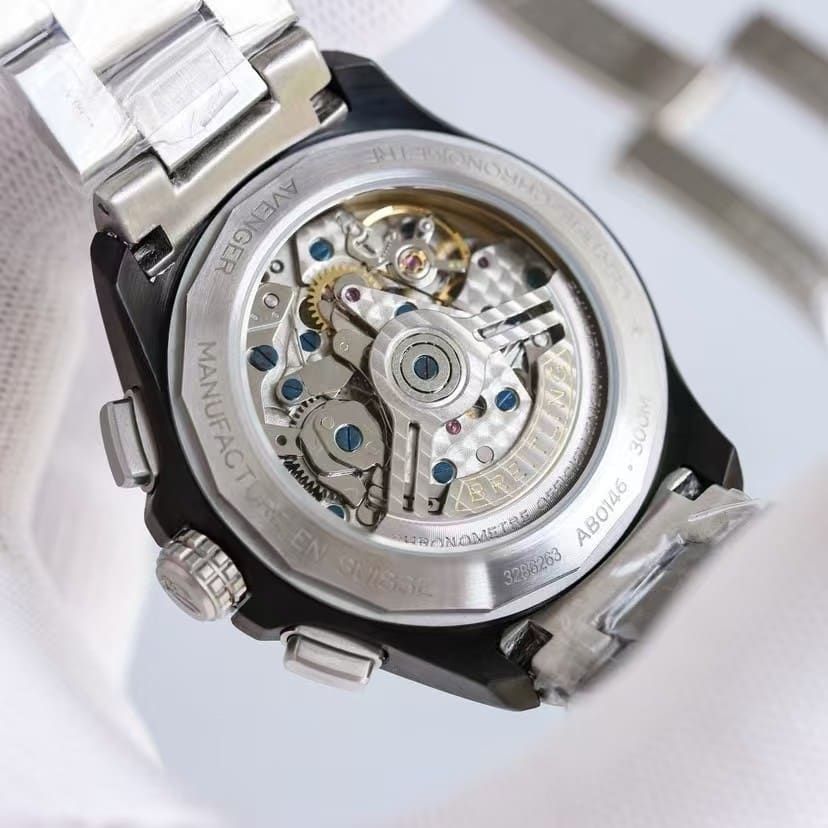
Then there are the details – the part most photos try to highlight, but that only really shows up when everything else is done right. On a decent super clone, the dial print on a Navitimer replica won’t blur at the edges. The indices are aligned, the date window is centered, and the hands sit correctly over the markers. Lume plots are applied with enough consistency that a night shot of a Breitling replica watch doesn’t look patchy. Bracelets use solid links and more precise end links, so the watch doesn’t rattle and the fit to the case is tight. Bezels on a Superocean style build should click cleanly through 120 or 60 positions without feeling spongy.
All of that together is what you’re actually paying for in a super clone 1:1 Breitling. Materials that make the watch feel right, movements that behave in a predictable way, and details that don’t fall apart the moment you look closer than a social-media post. When those pieces come together, the price stops being random and starts to track real, tangible quality – which is exactly what you want if you’re trying to separate Breitling replicas worth buying from everything else.
Movements & Reliability: Inside a Breitling Replica
When people ask about Breitling replica movement quality, they’re usually not asking for a spec sheet. They want to know if the watch will survive real life: being worn to work, bumped on a desk, left on a nightstand for two days, then picked up again. That’s what “reliability” really means in this world. The movement sitting behind the dial has more influence on that than anything else.
Most serious Breitling super clones use a small family of automatic movements. Some are based on Swiss designs like SW200 / ETA 2824 and 2836, others on the classic 7750 chronograph layout, and some use Chinese-built versions such as a Seagull 2824-style calibre. They all move hands around the dial, but they don’t behave exactly the same in accuracy, thickness, or ease of service. If you understand those differences, you’re already ahead of most buyers.
Common Movements Used in Breitling Super Clones
For three-hand and date Breitling replicas, the workhorse choice is usually a movement built on the SW200 / ETA 2824 idea. It’s a compact automatic movement, central seconds, with a quickset date. In a Breitling Superocean replica or a simple Avenger-style build, this type of movement gives a smooth seconds sweep and a comfortable case thickness. In practice, when regulated properly, it can sit in the range of a few seconds fast or slow per day, which is more than accurate enough for normal use. Service parts and know-how are widely available, which matters when you’re thinking about keeping a watch for several years.
Step sideways and you’ll find 2836-based movements. Mechanically, they’re very similar to 2824-style designs but with a slightly different calendar layout and usually a bit more height. In a Breitling replica watch that already has a tall case – like some Chronomat or Avenger references – that extra thickness isn’t a problem. In exchange, you get a robust, familiar architecture that most watchmakers have seen hundreds of times. From a buyer’s perspective, a well-built 2836 clone can deliver the same kind of day-to-day stability as an SW200-style build, with a similar heartbeat and automatic winding feel.
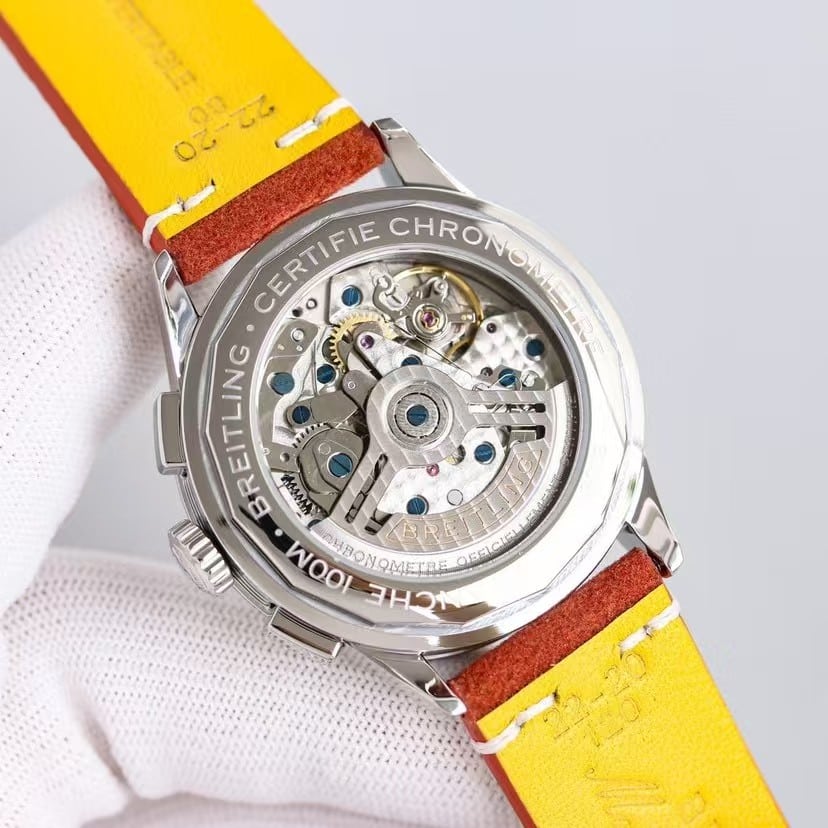
Chronograph versions are a different game. A serious Navitimer-style or Chronomat-style Breitling replica will usually be built around a 7750 chronograph clone: an automatic movement with running seconds, a 30-minute counter, and a 12-hour counter. That’s what allows a Breitling Navitimer replica to have live subdials instead of decorative circles. The trade-off is thickness. A 7750-based super clone will almost always be taller on the wrist than a simple three-hand Superocean. The payoff is real chronograph function and a familiar layout watchmakers understand. In my experience, when these movements are assembled cleanly and regulated, they can run reliably with day-to-day errors in a sensible range; but they do need a bit more respect, especially around shocks and magnetism.
On the Chinese side, you’ll often see Seagull 2824-type movements in Breitling replicas that aim for a balance between cost and performance. A good Seagull 2824 clone can give very decent accuracy and a smooth sweep, especially after regulation. The main difference is not that it’s “bad” by default, but that quality control can vary more between batches and factories. For a buyer who wants the feel of an automatic movement without paying for a Swiss-branded calibre, it can still be a reasonable choice. You’re trading some pedigree for lower cost, but if the build is done carefully, it doesn’t automatically mean poor reliability.
So: SW200 / ETA 2824-style for compact, clean three-hand models, 2836-style where a bit more height is acceptable, 7750 chronograph for full pilot or Chronomat layouts, and Seagull 2824-type movements where cost control matters. Different movements, different compromises. The important part is knowing what’s inside your Breitling super clone before you judge its price or expected behavior.
What “Reliability” Really Means for Daily Wear
When someone asks me, “Can I wear a Breitling replica every day?”, they’re not asking for lab numbers. They’re asking if the watch will cope with how they actually live. That means four things: timekeeping, water, shocks, and the invisible stuff like magnetism.
On the timekeeping side, a good automatic Breitling replica movement – whether SW200-style, 2836-style or a properly tuned Seagull 2824 clone – should sit in a range where you’re not constantly adjusting it. A few seconds fast or slow per day is normal. Ten to twenty seconds a day is still usable for many people, but it starts to feel less “set and forget”. A lot depends on how carefully the movement was regulated at the factory, not just which calibre family it belongs to. This is where super clones usually pull ahead of entry-level pieces: more attention is paid to getting the beat rate and balance under control before the watch leaves the bench.
Water resistance is another part of reliability that gets glossed over in listings. A genuine Breitling Superocean is built to be a dive watch; a Superocean super clone is not automatically a dive instrument just because it looks like one. On better builds, you’ll see screw-down crowns, visible gasket work, and basic pressure testing. That’s enough for hand-washing, rain, and normal day-to-day moisture. On cheaper pieces, crowns and pushers can feel loose, casebacks may not seal well, and even a shower can be risky. The rule of thumb is simple: if water resistance matters to you, treat it as a real spec, not a marketing word.
Shocks and magnetism sit in the background until they don’t. A 7750 chronograph-based Breitling Navitimer replica will never be as shock-tolerant as a chunky quartz beater, but it shouldn’t fall apart because you knocked it on a door frame. What you want to avoid are repetitive hard impacts and situations where the watch is exposed to strong magnetic fields – speakers, laptop magnets, certain phone cases. Any automatic movement, whether SW200, 2836, or Seagull 2824-style, can start running oddly if magnetised. The good news is that demagnetising is usually a quick fix for a competent watchmaker, but it’s still something to keep in mind if you want your Breitling replica to stay steady.
So when we say a Breitling super clone is “reliable”, we’re not promising perfection. We’re talking about a watch you can put on in the morning, wear through a normal day of work, commuting, maybe a bit of sport or travel, and take off at night without worrying about whether it has survived. A solid automatic movement, sensible case construction, and a bit of respect from the owner go a long way. If you keep those three pieces in mind – movement choice, basic water protection, and everyday handling – you’ll have a much clearer picture of which Breitling replicas are ready for daily wear and which ones are better left as occasional toys.
VS Factory vs Other Factories (From Someone Inside the System)
If you spend any time in replica watch circles, you’ll see factory names thrown around like brand names: VS, Clean, ZF, GF, and so on. On paper, it looks simple – just pick the “best” factory and you’re done. In reality, it’s more complicated, especially when you look at VS factory Breitling pieces from the inside of the supply chain. Factory labels help you navigate, but they don’t tell the whole story. To understand why one VSF Breitling super clone can feel very different from a random “Breitling replica” with a nice description, you have to understand how the China replica watch factory system actually works.
How China Replica Watch Factories Actually Work
From the outside, “factory” sounds like a single building with a big sign on the roof. Inside the system, it’s closer to a recipe. A typical Guangzhou watch supply chain is a network: one place makes cases, another makes dials, another does hands, another handles bracelets, and a different workshop does final assembly and QC.
When people say “VS factory” or “Clean factory”, they’re really talking about a specific way of combining that network: certain suppliers, certain quality checks, certain tolerances. The label is a shortcut for a recipe plus a team, not a single physical location. That’s why copying a name is easy, but copying the whole result is not.
This is also why two pieces that both claim to be the same model on paper can feel very different in the hand. A real VSF Breitling super clone will come from a consistent set of suppliers and an agreed set of standards. A random “VS style” piece might use the name but cut corners on dial printing, case finishing, or movement choice. On the surface, the photos look similar; inside, the build is not. So when you see factory labels in a listing, treat them as a starting point, not a guarantee. They tell you roughly which recipe someone is trying to follow. The real quality comes from the quieter pieces of the chain: who is actually making the parts, how strict the assembly QC is, and how honest the dealer is about which batch they’re selling.
Where VS Factory Stands in Breitling Replicas
VS made its name with certain Rolex and Omega builds, but the same mindset shows up in VS factory Breitling replicas as well. From the inside, the difference is less about slogans and more about how much effort goes into getting the overall watch to feel “finished” rather than just “similar”.
On a good VS factory Breitling replica, you usually notice three things right away: the case, the movement choice, and the dial work. Cases tend to stick close to genuine dimensions, so a VSF Navitimer super clone in 43 mm doesn’t suddenly feel like a 46 mm dinner plate on the wrist. Edges are cleaner, brushing and polishing transitions are more controlled, and the weight is tuned so the watch feels dense without being brick-heavy.
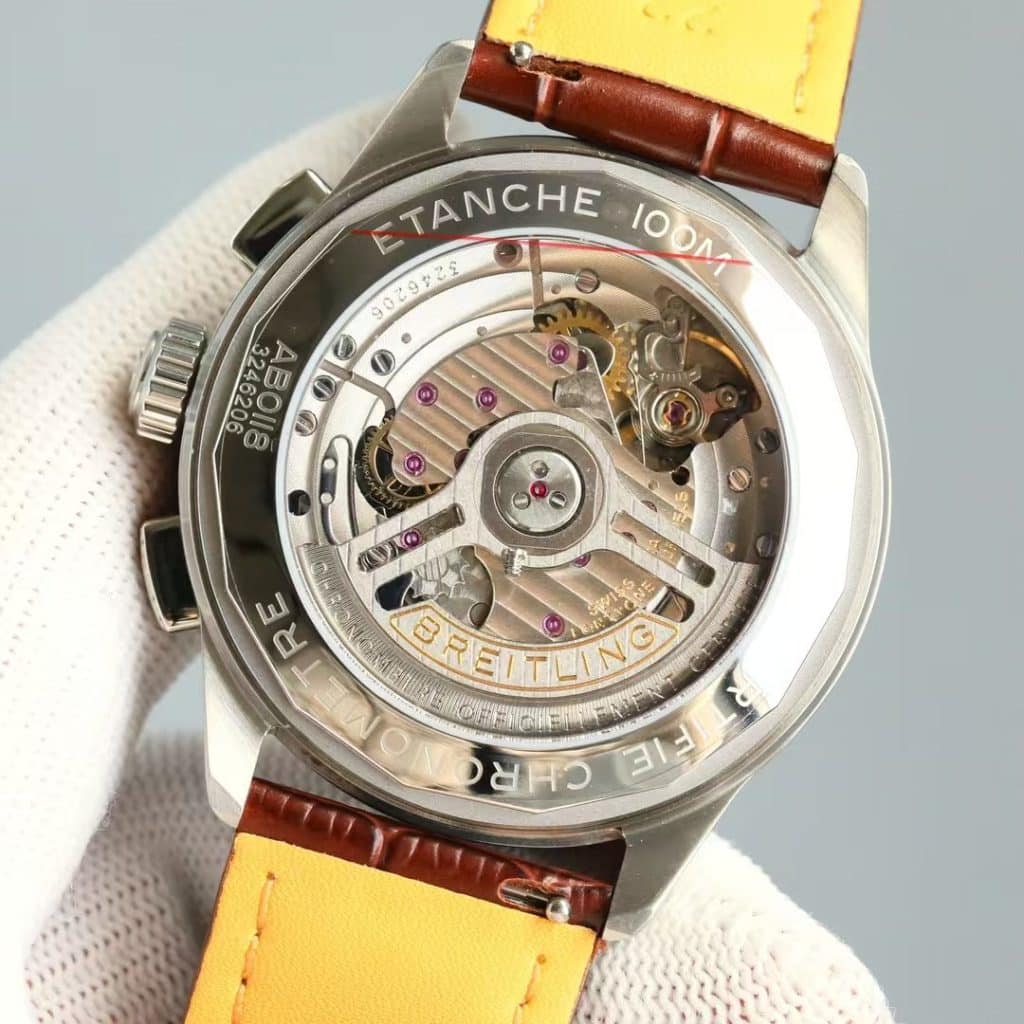
Movement choices follow the same logic. For three-hand and date models like some VS factory Breitling Superocean pieces, you’ll see automatic movements based on SW200 / 2824 / 2836-style layouts, giving a smooth sweep and realistic behaviour when you set the time or hack the seconds. For chronograph Navitimer or Chronomat builds, a 7750-style architecture is used so that the subdials are live, not just printed decorations. It’s not about claiming “in-house”; it’s about picking a movement that makes the watch behave in a way that fits the design.
Dial and crystal work are where many cheaper factories fall behind and VS usually tries harder. On a stronger VSF Breitling super clone, the logo printing is crisp, the subdial spacing looks right, the date window doesn’t sit awkwardly high or low, and the anti-reflective treatment on the sapphire crystal keeps the dial legible without constant glare. Lume on a Superocean-style build should be bright enough and even enough that the watch is useful in the dark, not just photogenic for a single long-exposure shot.
None of this means VS is perfect, or that other factories can’t produce good Breitling replicas. It does mean that when you see “VS factory Breitling replica” attached to a model, the expectation is that someone has tried to get the case, movement, and dial to work together as a complete package, not just as a look-alike shell.
Why Factory Label Alone Is Not Enough
From inside the system, one pattern is obvious: people give too much power to the factory name, and not enough to what’s in front of them.
A dealer can write “VSF Breitling super clone” in a description and still ship something that isn’t from the current VS supply chain at all – maybe an older batch, maybe a different factory entirely. Parts get mixed, leftovers move around, and labels get reused long after the original production run is finished. To the buyer, it still looks like a VS factory Breitling on paper. Only the physical watch tells the truth.
That’s why relying on the label alone is risky. A careful buyer looks past the name and checks for clues:
- Does the case finishing match what is known for that factory’s better work?
- Do the dial printing, hands, and subdials align with current reference photos of genuine watches?
- Is the movement type clear and consistent with what a proper super clone of that model should use?
- Are there real photos and videos of the actual watch, or just catalogue images?
Forums and long-running communities repeat the same advice in different words: don’t buy the label, buy the watch. Factory names like VS, Clean, ZF, and others are useful signals inside the China replica watch factory ecosystem, but they are not magic spells. A well-built Breitling replica from a known factory is the result of correct parts, careful assembly, and honest handling through the Guangzhou watch supply chain. The label by itself is only a hint.
If you treat the factory name as a starting point and then let the actual watch – photos, specs, behaviour – confirm or challenge that claim, you’ll avoid a lot of frustration. In other words: let the label guide you, but let the details make the final decision.
Best Breitling Replica Models to Consider in 2026
When people ask for the best Breitling replica, they’re usually not looking for one magic reference. They’re trying to choose between a few familiar shapes: the classic pilot look of the Navitimer, the cleaner lines of the Superocean and Avenger, and the more “engineered” style of the Chronomat.
Below isn’t a ranking. It’s a short map of which Breitling replicas most buyers end up considering, and what kind of wrist and lifestyle each one really suits.
If you ask ten replica buyers what comes to mind when they think of Breitling, at least half will say “Navitimer”. The slide-rule bezel, the three subdials, the way the dial seems to fill the entire watch – all of that makes a Breitling Navitimer replica feel like a full-on pilot instrument, even if it never sees a cockpit.
For super clones, the more convincing builds tend to stick close to the classic proportions:
- 41 mm versions for slightly smaller wrists,
- 43 mm “sweet spot” Navitimers,
- and occasional 46 mm monsters for people who genuinely like a lot of metal.
On the better pieces, you’ll see proper automatic chronograph movements (7750-style architecture), live subdials, applied markers, and a slide-rule bezel that actually turns. That combination is why Navitimer is often at the top of “best Breitling Navitimer replica” lists: when the dial, bezel and movement all work together, the watch feels more like a tool than a fashion copy.
Who This Replica Is For
A Navitimer-style super clone is for someone who:
- doesn’t mind a busy dial and actually enjoys looking at it,
- wears long sleeves or shirts often enough that a pilot watch looks at home,
- has at least a medium wrist (or is happy with a very full wrist presence in smaller sizes),
- likes the idea of a chronograph with real pushers and subdials rather than a simple three-hand diver.
If you want something you glance at quickly and forget, this probably isn’t it. If you want your best Breitling replica to feel like a small dashboard on your arm, the Navitimer is where most people start.
Superocean & Avenger: Tool Watch Super Clones
The Superocean and Avenger lines cover the tool-watch side of Breitling. Less calculator, more equipment. A Superocean super clone gives you a diver’s layout: bold markers, strong lume, a rotating bezel and a cleaner dial. An Avenger replica pushes the military/tool vibe harder with chunkier crowns, more angular cases, and often a slightly more aggressive bezel profile.
On the replica side, these watches are popular because they’re easier to live with day to day than a big chronograph dial. Most builds sit around 42–44 mm, with solid 316L steel cases, simple three-hand automatic movements (SW200 / 2824 / 2836-style), and straightforward date windows. You still get the “Breitling on the wrist” feeling, but in a layout that’s quicker to read and easier to match with T-shirts, hoodies, and casual jackets.
Who This Replica Is For
Superocean and Avenger-style super clones are a good fit if you:
- want a watch that can be your main daily piece without feeling too fragile,
- like the idea of water resistance and real lume more than a slide-rule bezel,
- wear casual or sporty clothes more often than suits,
- prefer a straightforward automatic movement with time and date over a full chronograph.
If your idea of the best Breitling replica is “something I can put on every morning and not think about too much”, a Superocean super clone or a clean three-hand Avenger is usually a safer bet than jumping straight into a thick pilot chronograph.
Chronomat & Others: When You Want Presence on the Wrist
The Chronomat sits in a different part of the map. It’s not as purely “instrumental” as a Navitimer, and not as stripped-back as a Superocean. It has that engineered bezel with rider tabs, a distinctive bracelet design on many references, and a case profile that gives a lot of wrist presence even in the low-40 mm sizes. A solid Chronomat replica combines that design language with either a three-hand automatic or a full chronograph build, depending on the reference. From a buyer’s point of view, Chronomat and related designs are the “I want it to be noticed” choice. A good Chronomat replica review usually talks about heft, bracelet comfort, and how the watch fills out the top of the wrist. In the super clone segment, the better builds pay attention to things like bezel feel, end-link fit, and the way the bracelet drapes. That’s what makes the watch feel expensive even if it isn’t genuine.
There are also other, less famous lines and limited-style designs that show up in best Breitling replica discussions – smaller dressier pieces, GMTs, or special editions – but Navitimer, Superocean/Avenger, and Chronomat cover the majority of serious interest. Everything else tends to be a variation on those core ideas.
Who This Replica Is For
Chronomat-style and similar “presence-first” replicas are for people who:
- like their watch to be seen across a table, not just appreciated up close,
- don’t mind extra weight and a slightly thicker case profile,
- enjoy industrial or technical design details in bracelets and bezels,
- already know they’re comfortable with larger, sportier watches.
If you’re looking for a low-profile piece that quietly disappears under a cuff, Chronomat and its cousins probably aren’t the right direction. If your version of the best Breitling replica is something that feels like a piece of hardware – and you’re okay with the extra metal that comes with it – this is where most people end up looking.
How to Check a Breitling Replica Before You Buy
A lot of people ask how to choose a Breitling clone as if there’s one magic photo or one magic spec that gives the answer. In reality, the best “quality check” is simple: imagine you’re standing there with the watch in your hand and you walk through three calm passes – first the case and dial, then the movement behaviour, then the weight and bracelet.
If a supposed super clone fails in any of these three passes, it doesn’t matter what the listing called it. A fake super clone is still just a dressed-up cheap replica.
Case, Dial, and Lume: The First 30 Seconds Check
When you first get a Breitling replica in front of you, don’t rush to start the chronograph or shake it around. Just look at it quietly for half a minute. This first pass is where most bad pieces already give themselves away.
Start with the case. Edges on a decent Breitling clone should feel crisp but not sharp. The brushing and polishing should transition cleanly, not fade into each other like someone wiped it with sandpaper. Bezel teeth on a Navitimer replica or a diver-style Superocean should look controlled and evenly cut, not rounded blobs. If it’s claiming to be a high-end piece and the case finishing already looks soft, that’s your first warning.
Then, look straight at the dial. Logos and text should be sharp, not fuzzy around the edges. Markers should line up with the minute track instead of drifting. Subdials on a chronograph shouldn’t look “squeezed” or pushed too close to the centre. Date windows should sit centred in their opening, not high on one side. This is the part of the quality check where a lot of fake super clones fall apart: the overall layout feels a little off once you stop staring at the brand name.
Finally, test the lume. Step into a dimmer area or cup your hand over the watch after giving it a moment under light. On a serious Breitling-style super clone, lume on the hands and markers should come up together and fade reasonably evenly. If the hands glow but the markers barely respond, or some plots are bright and others are almost dead, you’re not looking at top-tier work. Strong, consistent lume isn’t about showing off; it’s a quick, honest indicator of how much care went into the dial and hand set.
Movement, Sweep, and Chronograph Feel
Once the case and dial have passed your first 30 seconds, then you pay attention to the movement. You don’t need to open the caseback to get a lot of information.
Set the time slowly and feel the crown action. On a good Breitling replica movement – whether it’s SW200-style, 2836-style or a 7750-type chronograph – the hands should move cleanly without jumping or stuttering. Pulling the crown out should have clear, positive clicks between positions, not a vague, rubbery feel. If hacking is supposed to stop the seconds hand, see if it actually does. That tells you immediately whether the movement and the case were matched properly or just crammed together.
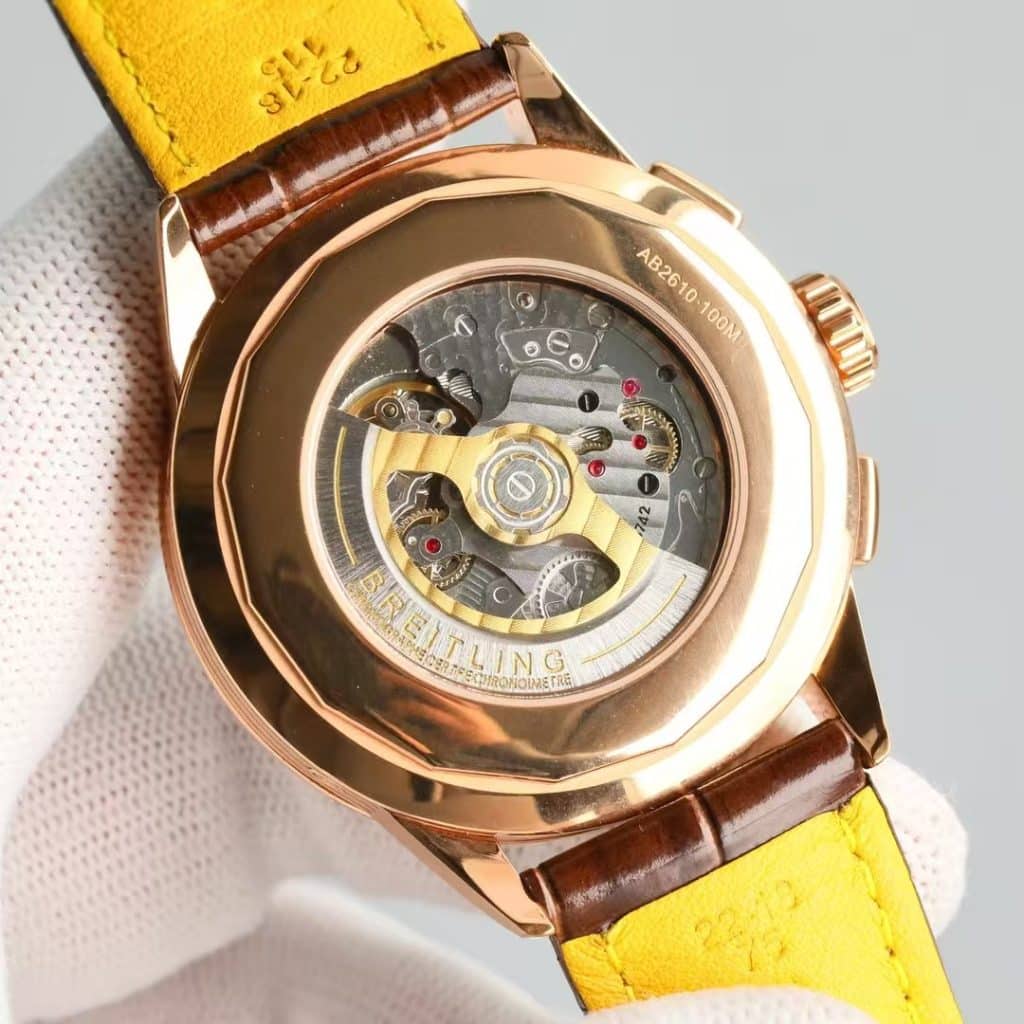
Watch the seconds hand. A well-built automatic will have a smooth, even sweep. It’s not going to look like a high-beat Grand Seiko, but it shouldn’t jerk like a cheap quartz either. If you see obvious, uneven jumps, that’s a sign of a very basic movement, no matter what the listing claimed. For chronograph models, start and stop the timer a few times. On a decent 7750 chronograph-based Navitimer replica or Chronomat-style build, the pushers should have a firm, positive click, and the chronograph seconds hand should reset neatly to zero instead of hunting back and forth.
You’re not trying to do a watchmaker’s test bench. You’re simply checking whether the movement behaves like a proper automatic or like a bargain bin special in a fancy case. If the seller is calling it a Breitling super clone but the sweep, setting, and chronograph feel say “cheap”, that’s all you need to know.
Weight, Bracelet, and Clasp: Does It Feel Like a Tool?
The last pass is about feel. Breitling designs have personality, and a big part of that is how the watch sits on the wrist. Even the best photos can’t fake that. Pick the watch up and let it sit in your palm. A serious Superocean super clone or Avenger-style piece with a steel bracelet should feel dense, not hollow. Too light, and you’re probably handling thin metal and a very basic movement. Too heavy, and it may be over-compensating with a blocky case that doesn’t match the genuine proportions. The goal is balance – enough mass that it feels like equipment, not so much that it feels like a wrist weight.
Then look at bracelet quality. Links on a better Breitling replica bracelet move smoothly without rattling like cutlery. End links should fit the case with minimal gap, sitting flush against the lugs instead of leaving visible daylight. Run a finger along the underside: sharp edges and noisy play are signs of cost cutting. A good clasp should close positively and open without a fight, with cleanly machined components, not tinny stamped metal that flexes when you squeeze it.
Finally, strap the watch on. Does it sit flat on the wrist, or does it tip forward because the head is too heavy for the bracelet or strap? Do the lugs dig in, or does the case shape follow the curve of your arm? A Breitling-style watch is supposed to feel like a tool – confident and solid – not like a costume piece you’re constantly aware of in a bad way. Taken together, these three passes – case/dial/lume, movement behaviour, and weight/bracelet/clasp – give you a far better answer to how to choose a Breitling clone than any single marketing line ever will. If a watch feels right in all three, you’re probably looking at a serious build. If it stumbles on one or more, “super clone” on the product page is just a label, not a reality.
Where to Buy Breitling Super Clones Safely (and What to Avoid)
Once you understand models, movements, and quality levels, the next big question is simple: where to buy a Breitling replica without getting burned. There are plenty of sites that look convincing at first glance. Some are careful, long-term operations. Some are one-season shops that disappear after a few months. The difference is rarely in the logo; it’s in how they work.
If you want a trusted Breitling replica seller, don’t start with “who shouts the loudest”. Start with “who behaves like someone who plans to be here next year”.
Red Flags: When a “Super Clone” Is Not Really Super
There are a few patterns that show up again and again when a supposed Breitling super clone online is nothing more than a dressed-up cheap fake. You don’t need to be an expert to spot them; you just need to slow down and check.
- Price that’s way out of line
If everyone serious is asking several hundred for a certain “super clone 1:1” and one site offers it for a tiny fraction of that, something has to give: movement, case, finishing, or after-sales. There are good deals, but there are no miracles. - No real photos, only catalogue images
A safe replica watch site will show actual photos of the real watch they handle: wrist shots, macro shots of the dial, side profiles of the case. If a seller only uses the same studio pictures you’ve seen on a dozen other pages, they might never have had the watch in hand at all. - No movement proof
If a listing screams “Swiss movement”, “7750 chronograph”, or “SW200 inside”, but there’s zero video of the movement beating, the chronograph running, or the caseback open, treat it carefully. For something positioned as one of the best Breitling replica builds, basic movement proof should not be a big ask. - Vague answers, heavy pressure
Ask direct questions: which movement is used, what testing is done, what the return or repair policy is. If the replies avoid details and jump straight back to “don’t worry, it’s the best, just buy now”, that’s information too — just not the kind you want.
When more than one of these red flags shows up together, it doesn’t matter how nice the website looks. The risk is built into the behaviour.
What a Trustworthy Seller Looks Like in 2026
A trusted Breitling replica seller doesn’t need to be perfect, but they do need to be predictable. The good ones tend to have a few habits in common.
- Clear, written policies
You should be able to see, in writing, what happens if the watch arrives damaged, not as described, or with a serious problem. Even if replicas don’t come with the same guarantees as genuine watches, a serious seller will still outline how they handle issues. - Real photos and videos, not just promises
For a Breitling super clone online, you should expect multiple angles: case, dial, caseback, bracelet, clasp. Short videos showing the seconds hand sweep, the chronograph starting and resetting, or basic lume behaviour are normal from someone who actually has the watch. This also lets you do your own quality check before money changes hands. - Specific, grounded answers
When you ask about movements, water resistance, or bracelet quality, a good seller answers in plain language: “This one uses a 7750-style automatic chronograph”, “I don’t recommend swimming with this batch”, “The clasp is milled, not stamped”. They don’t need to oversell. They just tell you what you’re really getting. - Consistency over time
Look at how long they’ve been around, how often they change names, and how their communication feels over a few days. A safe replica watch site or dealer behaves like someone who expects you to come back, not like someone who needs to grab one sale and vanish.
If a seller ticks most of these boxes, the chances of getting a Breitling replica that matches your expectations go up a lot. You’re not removing all risk, but you’re playing a much smarter game than just chasing the lowest price.
How Cleanvsfactory Fits into This Picture
From my side — working with VS factory and talking to buyers every day — I try to keep things simple. The focus is on explaining, then supplying, not the other way around.
When someone comes to me for a VS factory Breitling or another high-end build, I’ll usually share:
- real photos and short videos of the exact style or batch we’re discussing,
- honest notes about movement type, thickness, and what I would and wouldn’t do with that watch (for example, daily wear vs water exposure),
- basic QC checks before shipping: alignment, sweep, lume, bracelet function.
If you want that kind of China-side, VS-focused perspective, you can reach me directly on WhatsApp at +86 18206834823. That doesn’t make me the only option, or the “best in the world”. It just means you have one more channel where you can ask detailed questions about Breitling super clones, factories, and specific references before you decide whether to buy anything at all. However you choose to proceed — with me or with someone else — the process should feel calm, transparent, and grounded in real information. If a seller makes you feel rushed, confused, or unable to get straight answers, that’s usually your signal to walk away long before any money moves.
FAQ: Real Questions About Breitling Replica Watches
Are Breitling replicas any good in 2026?
Short answer: some are, many aren’t.
At the low end, Breitling replicas are just fashion copies – light cases, basic movements, weak lume, and dials that only vaguely follow the original design. They’re cheap, but they don’t give you a real sense of what a Breitling watch is like.
At the higher end, especially in the super clone tier, Breitling replica watches can be surprisingly solid: 316L cases, sapphire crystal, automatic movements, and proportions that match the genuine models closely. They won’t match the genuine brand in testing, finishing depth, or long-term support, but they can be “good enough” as a way to experience the design and wrist feel without the full retail price.
Whether they’re “good” for you depends on what you expect: if you want a robust daily tool with the Breitling look and you understand the trade-offs, a well-made replica can do the job. If you’re looking for perfect finishing, factory service, and long-term collectability, that’s still genuine territory.
What is the difference between a Breitling super clone and a normal replica?
Think of it as three layers: cheap replica, normal replica, and Breitling super clone.
A normal Breitling replica gets the broad strokes right: the logo, the general case shape, a similar layout. It might use a basic automatic movement, mineral glass, and simpler finishing. From a distance it reads as “Breitling style”, but up close you’ll see softer edges, off-centre dates, weaker lume, and lighter weight.
A Breitling super clone is built to be much closer:
- case size and thickness tuned to match the genuine reference,
- 316L steel and sapphire crystal,
- automatic movements based on SW200 / ETA 2824 / 2836 for three-hand pieces and 7750-style calibres for chronographs,
- sharper dial printing, better lume, and more precise bracelet fit.
The difference shows up most clearly on the wrist and in the hand. A super clone feels like a complete watch; a normal replica feels like a copy that tried.
Is a VS factory Breitling worth the extra money?
Sometimes yes, sometimes no. It depends what you care about.
A VS factory Breitling usually costs more than a generic replica because more work goes into the case finishing, movement choice, and dial layout. In many Navitimer, Superocean or Chronomat builds, VS focuses on getting the overall package right: correct or very close dimensions, stable automatic movements, decent lume, and consistent QC. If you want a Breitling replica that you can actually wear often and you notice details, that extra cost often makes sense.
If you mainly want a watch that looks like a Breitling from a distance and you don’t care about movement type, crystal material, or long-term wear, then a cheaper replica can scratch the itch. You’ll give up realism and reliability, but you’ll spend less.
So the honest answer is: a VS factory piece is “worth it” if you value build quality and reliability over just having a logo on the dial. If price is your only priority, the premium won’t feel justified.
Can I wear a Breitling replica every day?
You can, if you choose the right kind of replica and treat it reasonably.
A well-built Breitling replica movement with proper assembly – especially SW200 / 2824 / 2836-style or a good 7750-type chronograph – can handle normal daily routines: office work, commuting, light sport, casual knocks. Basic water resistance on better Superocean-style builds is usually enough for hand-washing and rain, though I still wouldn’t treat any replica like a professional dive instrument.
Where people run into trouble is expecting a cheap replica to behave like a tested luxury tool watch. Weak crowns, poor seals, and badly regulated movements don’t suddenly become tough just because the dial says “Breitling”.
If daily wear is your goal, look for:
- solid case and bracelet,
- sapphire crystal,
- clear movement information,
- honest guidance about water use.
Do that, and yes, you can wear a Breitling replica every day without babying it. Skip those checks, and you’re rolling dice.
How close can a 1:1 Breitling clone get to the real thing?
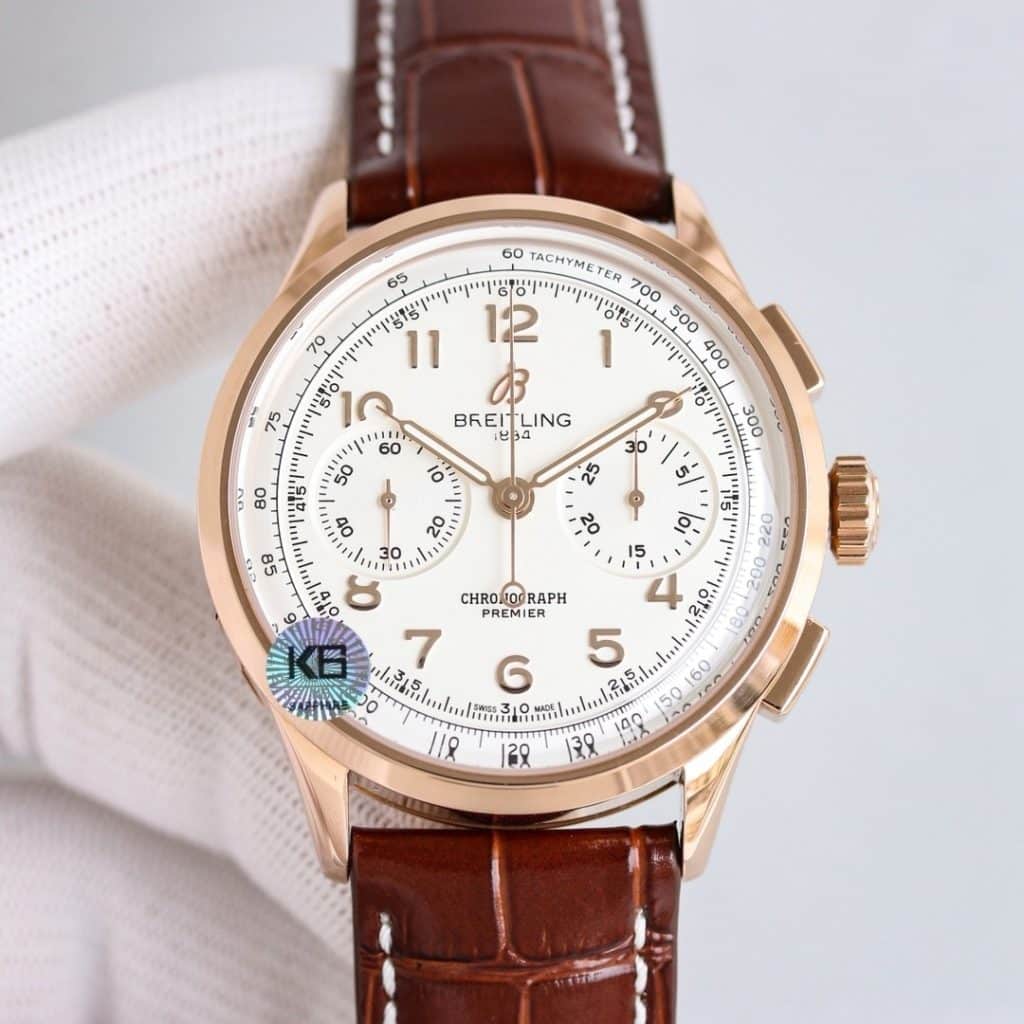
From arm’s length, a good 1:1 Breitling clone can be very close: size, weight, dial layout, bezel design, bracelet shape, even the way the seconds hand sweeps. For many people in normal social settings, that’s more than enough.
Up close, and especially under magnification, the differences remain:
- genuine Breitling cases have sharper transitions and more refined brushing and polishing,
- dial printing is crisper and more consistent,
- hands and indices are finished to a higher standard,
- lume quality and evenness are usually better,
- the movement inside a genuine piece — especially in-house calibres — is on another level in decoration, testing, and long-term support.
Then there’s resale and value: a high-end super clone, no matter how good, does not hold value like a genuine Breitling. You can enjoy it, but it won’t turn into a tradeable asset in the same way.
So a 1:1 clone can get very close in look and basic feel, particularly on the wrist. It does not replace the genuine watch in terms of finishing depth, brand backing, or collectability. If you go in understanding that, you’ll be far happier with whatever you choose.
Final Thoughts from Aurora (But You Decide)
As a whole, this page is my Breitling replica review from the inside: what these watches do well, where they fall short, and how the better ones balance value and reliability against the price and the compromises.
A Breitling super clone makes the most sense when you want the design and wrist experience – the busy Navitimer dial, the solid Superocean diver feel, the bold Chronomat case – but you’re not chasing brand-backed servicing, long-term resale, or perfect finishing under a loupe. If you treat it as a well-built tool with a familiar logo, not as an investment piece, it can be a satisfying choice.
On the other hand, if you’re sensitive to small finishing flaws, if you care a lot about official support and long-term value, or if you’re buying with the idea of passing the watch down or trading it in later, then it’s worth looking at genuine Breitling models instead. The upfront cost is higher, but you’re paying for more than just the look. My job at VS factory is to sell watches. But this guide is written so that even if you never buy from me, you’ll still avoid most of the expensive mistakes people make with Breitling replicas. What you do with the information is entirely up to you.