
The Nautilus 5711 is a difficult super clone to judge because its simple design leaves little room to hide small errors. Thickness, bezel contour, dial tone, bracelet integration, and case-to-bracelet flow all affect the watch more than a long feature list does. This comparison is not about naming one factory as the automatic winner; it is about understanding which compromise fits the buyer’s priority.
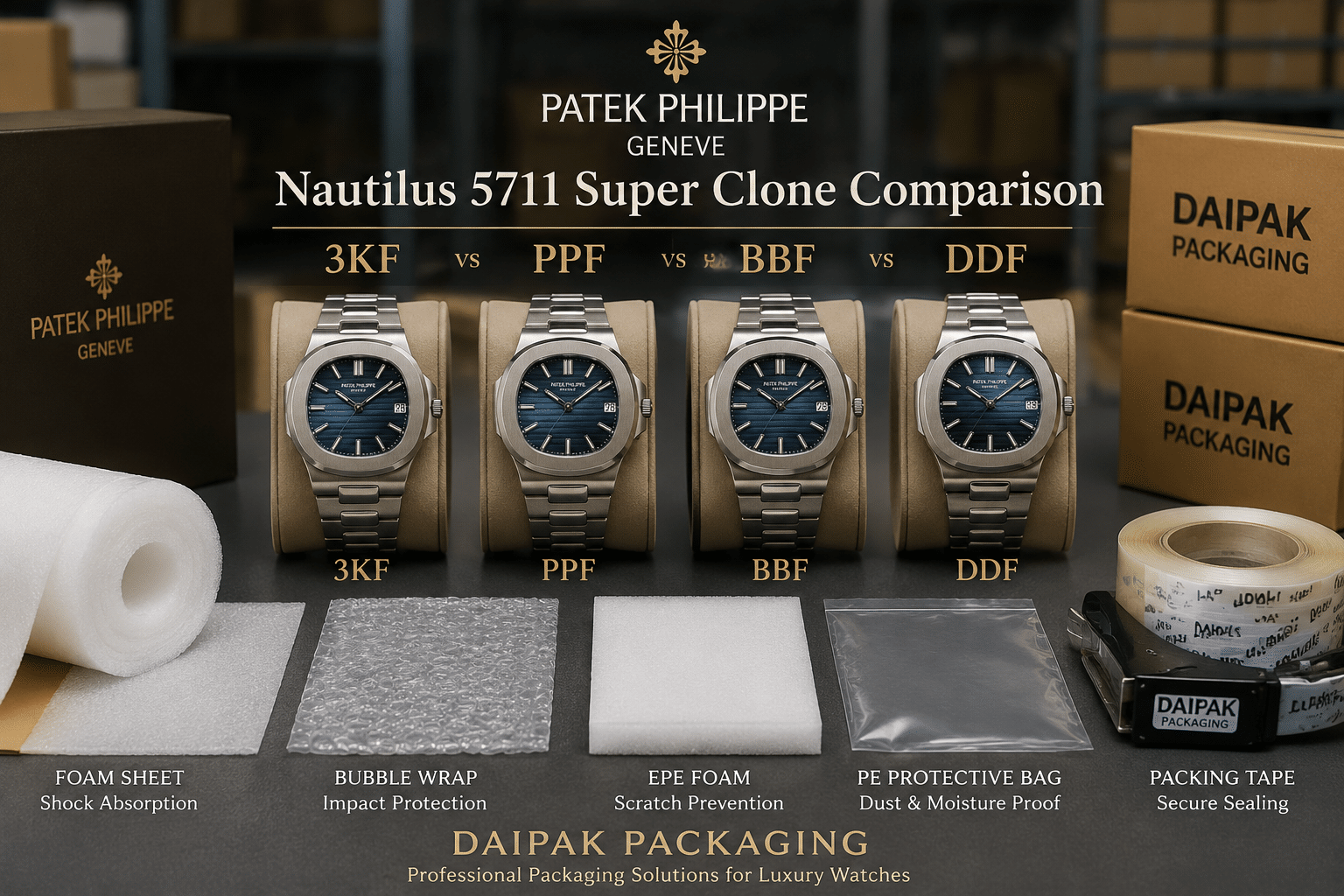
3KF, PPF, BBF, and DDF each approach the 5711 differently. 3KF leans toward a slimmer clone-movement ownership feel, PPF favors a calm front-facing look and easier daily use, BBF tries to offer stronger value when the current batch is good, and DDF focuses heavily on exterior proportions while accepting a clearer movement trade-off. The useful question is not which factory has the biggest reputation, but which version matches the detail you care about most.
| Factory Option | Best Fit | Key Check Before Choosing |
|---|---|---|
| 3KF | Buyers wanting slim feel and clone-style movement experience | Confirm current batch thickness, dial tone, and bracelet finish |
| PPF | Daily wearers prioritizing dial color and easier ownership | Accept the more practical movement route and weaker caseback realism |
| BBF | Value-focused buyers comparing price against execution | Verify batch consistency before treating it as a bargain |
| DDF | Case-focused buyers who care about proportions and wrist profile | Weigh exterior accuracy against movement compromise and batch risk |
| Any 5711 Version | Buyers comparing real wearability, not just factory name | Check bracelet flow, bezel shape, dial tone, and thickness together |
Quick Questions Before You Read
Q: Is 3KF automatically the best Nautilus 5711 choice?
No. It is the strongest all-around option for some buyers, especially those who value thickness and clone-style movement feel, but batch details still matter.
Q: Why would someone choose PPF instead of a clone-movement version?
PPF makes sense for buyers who care more about dial tone, front-facing presentation, and simpler daily ownership than caseback movement realism.
Q: Is BBF mainly a budget option?
It is a value challenger, not just a cheap alternative. Its appeal depends on whether the current batch is strong enough to justify the lower price.
Q: What is the biggest mistake when comparing 5711 factories?
Choosing by factory reputation alone. The 5711 needs checking across thickness, dial color, bracelet integration, case shape, and movement trade-off.
Why the Nautilus 5711 Is the Hardest Decision in the Patek Replica Market
The Nautilus 5711 super clone is one of those rare replica watches where the wrong factory choice is easy to see later, but not always easy to spot from a dealer photo. That is exactly why the 5711 creates so much debate. On paper it looks simple: a thin steel sports watch with a clean dial, an integrated bracelet, and a very restrained profile. In practice, that simplicity makes every small mismatch harder to forgive.
With a Nautilus 5711 replica, the usual “more features equals more value” logic does not work well. There is no busy dial to hide shape problems, no complicated chronograph layout to distract the eye, and no oversized case to absorb thickness errors. A small issue in dial color, bezel geometry, bracelet fit, or case contour shows up faster here than on most other replica watch models. That is why buyers end up comparing 3KF vs PPF vs BBF vs DDF instead of just picking the cheapest option.
For this reference, the real decision is not just which factory name sounds strongest. It is which version gives you the best mix of thickness, dial tone, movement route, bracelet feel, and batch stability for the way you plan to wear the watch. A “best 5711 factory” answer only makes sense if you define what you refuse to compromise on.
Replica watches also sit in a legal and disclosure gray area that buyers should not ignore. U.S. Customs and Border Protection warns that counterfeit and infringing goods can be detained or seized, and USPTO guidance defines counterfeit goods as unauthorized items that bear marks identical or substantially indistinguishable from a registered trademark.[1] That does not answer which factory is “best,” but it does explain why claims about legality, import safety, or resale should be stated cautiously rather than assumed.
Replica watches should be clearly understood as replica-market products, not genuine watches from the original luxury brands.
Why small differences matter more here
The 5711 has almost no visual clutter, so its proportions do most of the work. If the case sits too thick, the bezel reads too wide, or the bracelet does not flow naturally from the lugs, the watch loses its shape immediately. The same is true for the dial: a slightly off blue tone, a dull finish, or printing that looks too flat may not sound dramatic, but on a 5711 it changes the whole front-facing impression.
That is why buyers judge this model differently from many other Patek replicas. On a more complicated watch, a factory can hide behind extra information on the dial. On the 5711, there is nowhere to hide. Even bracelet articulation matters more than it would on a larger sports watch because the integrated design makes the transition from case to bracelet part of the visual identity, not just a comfort detail.
In other words, the 5711 is not hard because it has a complicated design. It is hard because it is so stripped down that every proportion becomes obvious.
Official Patek Philippe information helps define the authentic benchmark, but it should not be used to imply replica equivalence. The genuine Nautilus 5811/1G, for example, is presented by Patek Philippe as a white-gold Nautilus with a blue dial and a very different production context from any replica offering.[2] For buyers, that means the comparison should stay grounded in visual approximation and ownership trade-offs rather than “same as genuine” language.
Brand names are used here to identify the genuine reference design being discussed. Replica watches are not genuine products from the original luxury brands and should not be represented as authentic watches.
The buyer’s real decision problem
Most readers are not asking for a history lesson when they search for a Nautilus 5711 replica. They want to know which version is safest for their priorities and expectations. Some care most about movement credibility and want the most complete ownership feel. Others care more about dial presentation and wrist realism. A third group wants the safest daily wearer and would rather accept a simpler movement route if it lowers practical risk.
That is why this comparison matters more than a generic factory ranking. The same watch can make sense for one buyer and be the wrong choice for another, even if both are looking at the same reference. The decision changes depending on whether you value thickness, dial accuracy, bracelet comfort, or movement route more heavily.
At Clean VS Factory, we usually treat the 5711 as a version decision first and a factory decision second. That is the most useful way to avoid a wrong purchase.
Authentic reference points are useful, but narrow
It helps to know what the genuine model actually prioritizes. Patek Philippe describes the Nautilus family through a luxury sports-watch identity, and its current 5811/1G reference reinforces the line’s restrained case language and premium finishing expectations.[2] That background is useful for spotting obvious mismatches in silhouette or dial feel, but it does not tell you which replica batch is executing best today.
How to Read the Four Factories Without Falling for Reputation Bias
The easiest mistake in a 3KF vs PPF vs BBF vs DDF comparison is assuming the most familiar factory name is automatically the safest answer. That does not hold up well on the 5711. Reputation helps, but only if it is attached to the right model, the right batch, and the right trade-off profile. A factory can be strong in one area and still be the wrong fit for your priorities.
For this model, the comparison should stay anchored to a few practical checks: thickness, dial color, movement type, bracelet quality, case shape, and batch stability. Those are the factors that affect whether the watch looks right on the wrist and whether ownership feels comfortable over time. A flashy claim about being “the best” means very little unless it improves one of those six points in a way you actually care about.
The safest way to read the market is to ask what each factory is optimizing for. One may lean toward movement credibility, another toward front-facing appearance, another toward value, and another toward case architecture. None of that is useful unless you know which compromise you are willing to accept.
It is also worth separating “factory reputation” from “authentic-model facts.” Official brand sources can tell you what the real Nautilus line is supposed to be, but they cannot verify a replica factory’s quality control, movement sourcing, or batch consistency. That boundary matters because many replica listings blur the line between genuine-model description and seller-led interpretation.
Factory Name Clarification: Factory names such as 3KF, PPF, BBF, and DDF are buyer-facing labels used inside the replica watch market. They can help organize comparison research, but they should not be treated as official brand affiliations, audited manufacturer identities, or guarantees that every Nautilus 5711 batch will have the same case shape, dial tone, bracelet fit, or movement configuration.
Editorial Perspective: For cleanvsfactory.com, the Nautilus 5711 should be judged as a model-specific buying question, not a factory-name contest. Factory labels, QC photos, and seller descriptions are useful signals, but they are not final proof. A careful buyer should compare the claimed movement route, measured case thickness, dial tone under neutral light, bracelet drop, clasp feel, engraving depth, and current batch consistency before treating any 3KF, PPF, BBF, or DDF recommendation as settled.
Brand names are used for reference and comparison only; they do not imply authorization, endorsement, or affiliation with the original luxury watch brands.
The five criteria that actually decide the 5711
Thickness is the first filter because the 5711 is famous for its slim profile. If a version wears too tall, it loses one of the model’s most important cues. Dial color comes next because the blue Nautilus dial is judged constantly and the shade difference is obvious even in normal lighting. Movement type matters because some buyers care about the feel and architecture inside the watch, while others care more about service practicality and ownership risk.
Bracelet fit is just as important because the integrated bracelet is part of the 5711 identity, not an accessory. If the end-link transition or first link shape feels off, the watch can look expensive in photos but less convincing in motion. Batch stability completes the picture because the best factory reputation is only valuable if the current version still matches that reputation.
Once you use those five criteria, the comparison becomes much clearer. You stop asking which factory is “best” in the abstract and start asking which version is most sensible for your use case.
What reputation can and cannot tell you
Factory reputation is still useful because it tells you where a maker has usually been strong. It can point you toward the safer starting point. But it cannot tell you everything about the current 5711 batch in front of you. A factory can have a good name and still release a version with a slightly different dial tone, a changed bracelet feel, or a movement claim that does not match your comfort level.
That is why model-specific judgment matters more than logo-level loyalty. The better question is not “Which factory is famous?” It is “Which factory version gives me the right balance of accuracy, wearability, and risk for this specific Nautilus 5711?” Once you frame it that way, the market becomes easier to read and much harder to overbuy.
Factory names in the replica watch market are useful buyer-facing references, but they should not be treated as official luxury-brand affiliations or automatic guarantees of quality across every model.
3KF: The Clone-Movement Option for Buyers Who Want the Most Complete Package
3KF is usually the starting point for buyers who want the Nautilus 5711 super clone to feel mechanically complete rather than simply look good from the front. That matters more here than it would on a watch with a busier dial or more forgiving case shape. On the 5711, the appeal of 3KF is not just that it uses a clone movement route; it is that the whole watch is built around a more serious replica philosophy.
In practical terms, 3KF makes sense for buyers who want a balanced package and are willing to pay attention to the details that come with it. The case thickness is right in the range buyers care about, the movement architecture is a major part of its appeal, and the watch generally aims to feel like a fuller answer rather than a shortcut. That combination is why 3KF remains so heavily discussed in factory comparison threads.
The trade-off is that 3KF is not automatically the leader in every visible detail. Some buyers still prefer another factory for dial tone or a different value equation, and batch differences can change how convincing a specific piece feels. So 3KF should be read as the more complete route, not the flawless one.
Where 3KF looks strongest
The strongest argument for 3KF is the clone movement route paired with the correct slim profile. For buyers who care about the inside of the watch as much as the outside, that combination carries real weight. It is not just a technical talking point; it changes how the watch feels as a purchase.
3KF also tends to appeal to buyers who want the 5711 to feel like a serious daily wearer rather than a cosmetic showpiece. The balance of movement, case proportion, and overall presence is what gives it that reputation. When the batch is good, the watch can feel cohesive in a way that matters more than one isolated detail.
That said, the appeal is strongest for buyers who value a complete ownership experience. If your main obsession is dial tone under bright light, a different factory may look more attractive.
Where 3KF may not be the absolute leader
3KF is not the automatic winner for every buyer because the 5711 market is now too competitive for that kind of simple ranking. Some people will still prefer a factory that leans harder into dial accuracy. Others will care more about the price gap and decide that a slightly different compromise is more rational.
The more important point is that 3KF’s strengths are concentrated in the areas that matter to buyers who want movement credibility and a rounded overall package. If that is your priority, it stays near the top of the list. If your priority is a different one, the best answer may move.
What to Check Before You Decide
Before choosing 3KF, confirm the exact batch or current version, the movement route being claimed, and whether the watch you are being shown matches your expectations on dial tone and bracelet behavior. A 3KF 5711 is only as good as the version in front of you, not the factory name alone.
Movement descriptions in the replica market should be checked carefully because they may refer to layout, decoration, clone architecture, or seller terminology rather than an official brand-manufactured caliber.
PPF: The Dial-Focused and Reliability-Oriented Choice
The PPF Nautilus 5711 makes sense for buyers who care most about what they see straight on. That is the real reason PPF stays relevant: the front of the watch reads cleanly, the dial color is generally well judged, and the whole package feels more conservative and easier to live with than a movement-first build. If you are comparing replica watch options as a daily wearer rather than as a movement showcase, PPF is still a serious contender.
Where PPF usually wins buyer trust is in the way the dial presents under normal light. The blue tone tends to look controlled rather than flashy, and the surface texture is often convincing enough to carry the watch from a few feet away without calling attention to itself. On the wrist, that matters more than people admit. A 5711 lives or dies on balance and restraint, and PPF leans into that visual calm better than many buyers expect.
That does not mean PPF is the most technically ambitious route. The movement choice is simpler, and that is exactly why some buyers prefer it. A reliability-minded buyer may decide that a well-behaved, easier-to-service movement is the smarter trade if the goal is everyday use instead of chasing the most complete clone architecture. Clean VS Factory usually treats that as a real ownership decision, not a downgrade by default: if the watch is meant to be worn often, fewer surprises can matter more than having the most replica-accurate mechanical story.
Official movement references are useful here because they help explain the baseline behavior buyers often talk about. Miyota’s 9015 specification lists a 4 Hz beat rate, hand-winding, hacking, and a roughly 42-hour power reserve; the 8215 specification shows a more basic automatic architecture with a slower beat rate and similar power reserve range.[3] Those specifications do not prove what is inside any given replica, but they do explain why buyers view movement route as a real ownership trade-off rather than a cosmetic detail.
Water resistance should not be assumed unless the specific watch has been tested and the seller’s policy is clearly confirmed.
Where PPF wins buyer trust
PPF’s strength is front-facing realism. The dial presentation is the main event, and that gives the watch a cleaner first impression in photos and in normal wear. For buyers who judge the Nautilus 5711 mainly by dial color, dial texture, and general wrist presence, PPF remains attractive because it avoids overcomplicating the purchase. It is the kind of choice that can feel rational if you want the watch to look right without building the decision around movement bragging rights.
Where PPF gives up ground
The trade-off is obvious to buyers who care about replica movement architecture. PPF does not offer the same mechanical closeness as a clone-movement route, so the watch gives up some of the satisfaction that comes from opening the caseback and seeing a more faithful layout. That matters less if the watch is worn closed most of the time, but it matters a lot to buyers who want the full internal illusion to match the external one. In short, PPF is the better fit when the visible watch is the priority and the movement route is a practical compromise, not a point of pride.
BBF: The Newer Value Challenger Buyers Should Not Ignore
BBF is the interesting factory in this comparison because it forces the buyer to stop treating older reputation as the whole answer. The BBF Nautilus 5711 is relevant precisely because it can undercut more established options on price while still looking competitive enough to deserve attention. For a buyer searching for the best value 5711, that combination matters more than brand loyalty inside the replica market.
The key question is not whether BBF is “better” in some abstract sense. It is whether the current BBF version delivers enough execution to justify choosing it over a better-known factory. That means looking at the parts that actually shape the wearing experience: case shape, bracelet quality, dial finish, and how stable the current batch appears to be. A newer challenger can look strong in sample photos and still be a riskier purchase if version control is inconsistent, so BBF should be judged batch by batch, not by rumor alone.
BBF matters because it disrupts the old factory hierarchy. Once a new maker gets close enough in case execution and dial presentation, the premium for the most established name becomes harder to defend unless the buyer specifically wants the longest track record. That is the real BBF argument: it may not need to beat everyone on every detail if it can land in the middle ground where the watch feels convincing, the price is easier to justify, and the ownership risk is still acceptable.
Why BBF matters in this comparison
BBF should be read as a price-to-value challenger, not as a guaranteed replacement for the most established factory. That matters because many buyers overpay for comfort with a familiar name when the newer option may already be competitive enough for daily wear. If the current batch is solid, BBF can be the kind of choice that makes the rest of the market look a little overpriced.
What buyers should verify on newer batches
With BBF, batch confirmation matters more than with an older, better-known producer. Buyers should verify the exact version, not just the factory name, because newer factories can change dial tone, bracelet behavior, or overall fit from one run to the next. That is especially important on a model like the 5711, where small differences are visible immediately. If you are considering BBF, the safest approach is to judge the specific watch in front of you, not the factory story from a month ago.
DDF: The Case-Accuracy Challenger With a Real Movement Trade-Off
DDF exists for a narrower kind of buyer, and that is what makes it interesting. The DDF Nautilus 5711 tends to appeal to readers who care first about case shape and visual architecture, then accept that the movement route is not the cleanest part of the package. That is a legitimate buying position, but it is not the same as saying DDF is the safest all-around choice.
In practical terms, case accuracy here means more than a single measurement. It includes thickness, the contour of the case, how the bezel reads from the top, and whether the watch has the right wrist presence when viewed from a normal angle. DDF’s appeal is that those shape cues can be very convincing. For a case-first buyer, that can outweigh a lot of other concerns because the 5711 is a watch people notice by silhouette before they notice anything else.
The trade-off is that the movement route changes the recommendation. Some buyers are willing to accept a less reassuring internal setup if the exterior feels more faithful. Others are not. If you care about long-term ownership confidence, service comfort, and mechanical simplicity, a stronger movement path may still be the better decision even if the case is slightly less appealing. DDF is for the buyer who will notice the profile first and the movement second.
For authenticity-minded buyers, it is worth remembering that the real 5711’s value comes from an integrated design language and premium finishing standard, not from case shape alone. Patek Philippe’s official Nautilus pages show how much the genuine line depends on proportion and restraint, which is exactly why replica versions can look close in one angle and off in another.[2]
Where DDF can look most convincing
DDF can be especially strong when the buyer is looking at the watch as a shape object rather than a technical object. The profile, thickness, and wrist sit are the details that can make it feel more convincing than expected in normal wear. That is why some buyers prefer DDF for visual realism: the watch can project the right presence even before anyone starts comparing movement architecture or internal finishing.
Why the movement route changes the recommendation
If movement confidence matters more than case accuracy, DDF loses some of its appeal. That is the core issue, and it should not be minimized. A visually strong replica can still be the wrong purchase if the buyer wants lower-risk ownership and fewer questions later. DDF makes sense when you are willing to trade some mechanical comfort for a better exterior shape. If you are not comfortable with that compromise, another factory is the more sensible pick.
Movement Route to Verify
Before choosing DDF, confirm the exact movement claim and understand what that means for serviceability, reliability, and daily use. On a model like the 5711, the movement is not just a technical detail; it is part of the ownership risk. If the exterior is the reason you want DDF, make sure you are accepting that trade-off deliberately rather than discovering it after the fact.
Movement names in the replica market often describe layout, decoration, clone architecture, or seller terminology rather than an official brand-manufactured caliber.
Side-by-Side Comparison: Thickness, Dial Color, Movement, Bracelet, and Risk
For the Nautilus 5711, the factory choice only becomes useful once you separate the trade-offs. A buyer who cares most about case thickness will not rank these four the same way as a buyer who wants the best dial tone or the least ownership risk. That is why a 3KF vs PPF vs BBF vs DDF Nautilus 5711 comparison works best as a decision table, not a simple winner list.
| Factory | Thickness / Case Profile | Dial Color | Movement Route | Bracelet Fit | Batch Stability / Risk |
|---|---|---|---|---|---|
| 3KF | Very strong on thickness; one of the safest choices if the buyer wants the case to sit close to genuine proportions. | Good, but some batches lean slightly gray compared with the genuine blue tone. | Clone movement route; more convincing in architecture, but not the easiest watch to service casually. | Generally strong, though the first-link area can still be a weak spot. | More established and easier to judge from prior market examples, so ownership risk feels more controlled. |
| PPF | Slightly thicker than the most thickness-focused options, though still close enough for normal wear. | Usually the strongest front-facing dial choice, especially for buyers who care about the blue tone. | Miyota-based route; less ambitious, but often the more practical choice for reliability and serviceability. | Comfortable overall, with a wearable feel that many buyers find easy to live with. | Safer if you value simple ownership, but the movement route matters if visual authenticity through the caseback is a priority. |
| BBF | Competitive on thickness and built to stay in the same serious-clone lane as 3KF. | Often praised for a darker, more convincing tone than older reference points. | Clone movement route, which makes it more attractive than a budget option when movement realism matters. | Usually strong, but it still benefits from batch-by-batch checking because finishing and feel can shift. | Best viewed as a value challenger: promising, but you should verify the current batch instead of assuming every release is equal. |
| DDF | One of the main attractions is case shape and profile; it can look especially convincing from the side. | Strong when the case architecture is the buyer’s main concern, though dial judgment still depends on the batch. | Clone movement route with more technical ambition, but also the most caution required on stability. | Can feel excellent if the geometry lands right, but the overall package depends heavily on execution consistency. | Higher risk than the more established names; attractive for case-first buyers, less rational for buyers who want the safest all-around choice. |
Quick read: 3KF is the thickness-first and movement-first balance play. PPF is the safer front-facing dial choice if you value simplicity over movement ambition. BBF is the value challenger that deserves attention when its current batch is strong. DDF is the specialist pick for buyers who care most about visual architecture and are willing to accept more movement uncertainty.
If you want the shortest possible answer, the “best” factory changes by category: 3KF tends to win on overall balance, PPF often wins on dial tone, BBF can be the smarter value buy, and DDF is the most interesting case-first option. That is why this comparison is less about naming a champion and more about matching the watch to the risk you are willing to accept.
One useful reminder: the authentic Nautilus line is small and restrained, so even brand-level facts do not settle the replica debate. Patek Philippe’s official pages can confirm the style language of the genuine watch, but they cannot prove which replica factory is closest on any given batch.[2]
Factory names are useful market references, but they do not guarantee identical quality across every model or version.
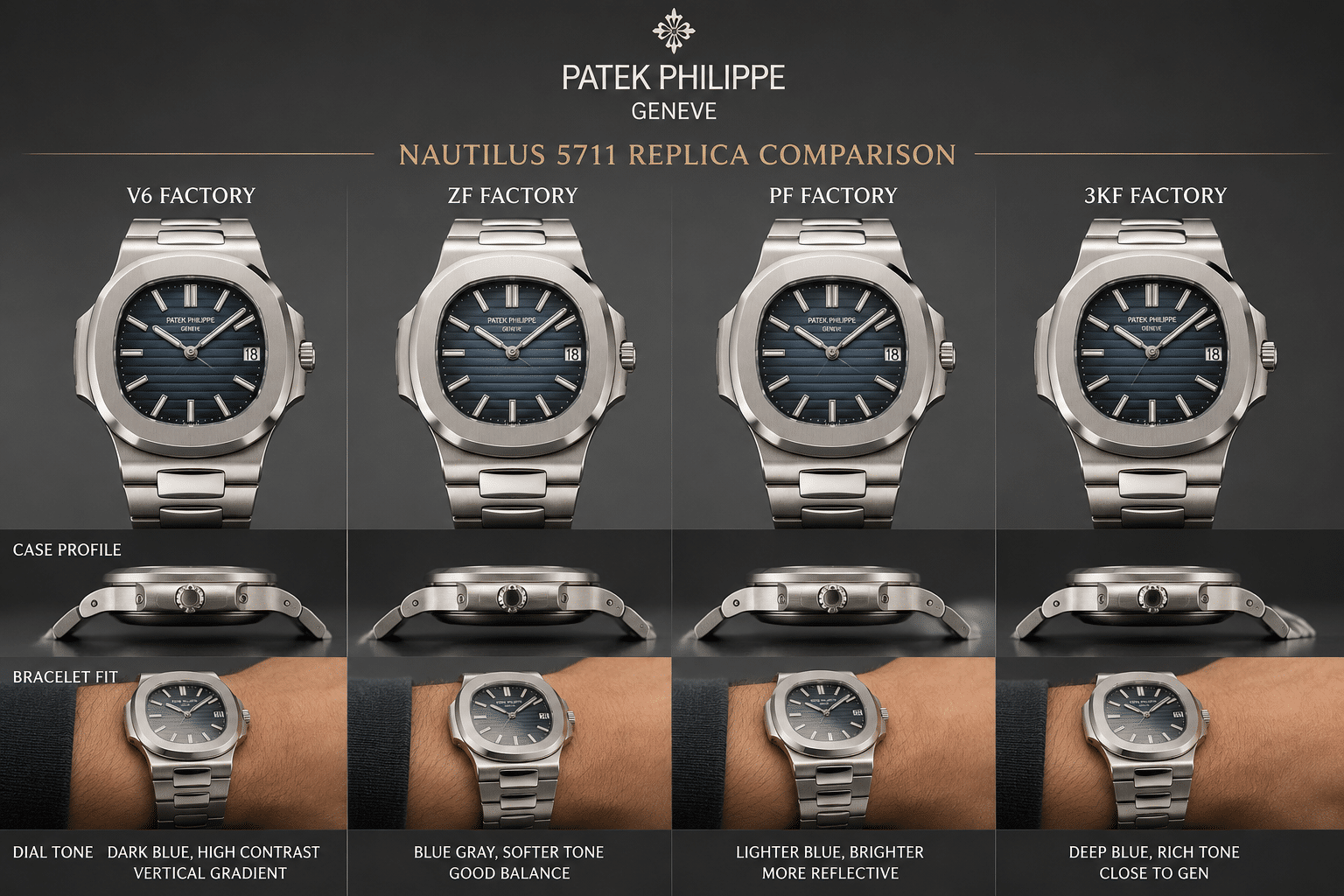
Quick read summary by category
Thickness: 3KF and BBF are the safer picks if case proportion is the first thing you notice. PPF is still close, but the slight difference can matter to buyers who know the reference well. DDF belongs in the same conversation, but it should be judged by current batch photos, not assumptions.
Dial color: PPF usually earns the most trust for buyers who stare at the dial first. BBF is the newer challenger here. 3KF remains strong overall, but its blue can read a little less natural in some lighting.
Movement: If you want a clone movement route, 3KF, BBF, and DDF are the more aggressive choices. If you want easier ownership and service simplicity, PPF is the more rational compromise.
Bracelet fit: This is not a small detail on the 5711. A good bracelet can make a replica feel expensive on wrist; a stiff or slightly awkward one can ruin the experience even if the dial looks excellent in photos.
Risk: PPF is easier to live with mechanically. 3KF is the most familiar all-around clone route. BBF is the value play that needs current verification. DDF is the highest-judgment option, because its appeal depends more on the specific release than on factory reputation alone.
Which category matters most for your use case
If you buy by photos, dial color probably matters most. If you wear the watch daily, bracelet feel and case comfort can matter more than a tiny dial-shade difference. If you want the safest long-term ownership experience, movement route and batch consistency should outrank everything else. The right factory is the one that matches the detail you will actually notice, not the one that wins the most categories on paper.
How the 5711 Bracelet and Case Feel Change the On-Wrist Decision
The Nautilus 5711 is a watch people often judge too quickly from pictures. On wrist, the story changes. Bracelet articulation, end-link fit, clasp tension, and case contour determine whether the watch feels like a natural part of the wrist or like a well-made object that never quite settles into place. For this model, comfort is not a side issue; it is part of the authenticity impression.
A 5711 can have a good dial and still disappoint if the bracelet feels rigid or the first link meets the case awkwardly. That is why bracelet fit and case shape matter so much here. The integrated design leaves less room to hide weak finishing, and a small issue in the transition from case to bracelet is easier to notice than on a watch with a conventional strap.
Official sports-watch references help explain why buyers keep focusing on this. Rolex, Omega, Audemars Piguet, and Vacheron Constantin all present their genuine sports models around proportions, integrated lines, and purpose-built construction rather than raw thickness alone.[4] That does not make any replica version “equivalent,” but it does explain why the on-wrist impression becomes such a central buying factor.
Bracelet feel versus visual finish
A bracelet can photograph beautifully and still wear poorly. Under light, polished links and brushed surfaces can look sharp and expensive, but what the buyer feels is articulation, drape, and how cleanly the bracelet moves with the wrist. If the links do not fall naturally, the watch feels stiffer than it should, even when the finishing looks respectable in macro shots.
That is the practical difference between visual finish and on-wrist quality. Visual finish is what makes the watch look good in QC photos. Bracelet feel is what decides whether you keep reaching for it after the novelty wears off. For a 5711 replica watch, that gap matters more than many buyers expect.
Case geometry and wrist presence
Case geometry affects more than thickness alone. The 5711 wears well when the profile stays low and the edges flow into the bracelet without looking bulky. If the case sits too tall, or if the side view looks too square, the watch starts to feel heavier and less elegant even if the diameter is correct.
Thickness on wrist is not only a measurement issue; it changes how the whole watch settles visually. A watch that is only a little thicker on paper can still wear noticeably different if the extra height changes the way the bracelet drops. Buyers who care about daily comfort should treat case shape and bracelet integration as one decision, not two separate ones.
In practice, the best on-wrist feel comes from the factory that gets the case-to-bracelet flow right, not the one with the most impressive spec sheet. That is why some buyers end up preferring a slightly less ambitious option if it wears more naturally day to day.
How to Read QC Photos for a 5711 Without Overtrusting Them
QC photos are helpful, but they can make a Nautilus 5711 look more settled than it will feel on the wrist. Strong lighting can hide a slightly heavy case side, exaggerate dial texture, or make brushing look cleaner than it is in normal light. A buyer should use QC images to confirm specific details, not to decide from the most flattering angle.
For this model, the most useful QC checks are not dramatic macro shots. Ask whether the side profile shows the real thickness, whether the bracelet falls naturally from the first link, whether the dial color is shown under neutral light, and whether the caseback claim matches the movement being sold. A straight-on photo may make 3KF, PPF, BBF, and DDF look closer than they are; side views and bracelet-angle photos often reveal more about the actual wearing experience.
Seller descriptions can also compress several different issues into one phrase such as “latest version” or “best batch.” Those words only become useful when connected to verifiable details: movement type, case measurement, dial version, bracelet finishing, clasp engraving, and whether the current watch matches recent buyer examples. A replica watch is not genuine, official, authorized, or brand-approved, so the buyer’s protection comes from checking the specific piece rather than relying on confident listing language.
Verification Note: When possible, buyers should review real watch photos rather than stock images alone, with attention to side thickness, dial printing, datewheel position, clasp engraving, bracelet drop, caseback structure, and the stated movement configuration. These checks can help reduce uncertainty, but they should be judged model by model and do not replace careful expectation management.
QC photos can reduce uncertainty, but they do not guarantee perfection. Buyers should still review visible details and confirm seller policies before ordering.
Batch Stability, Version Drift, and What Buyers Should Confirm
Factory reputation is useful, but it is not permanent. In the replica watch market, a strong name can still produce a weaker batch, and a newer challenger can improve faster than old forum rankings suggest. For the Nautilus 5711, that matters because a factory comparison only tells the truth if you know which version you are actually buying.
This is where many buyers make a mistake: they read an old review as if it describes the current watch. It often does not. Version drift can affect dial tone, engraving depth, bracelet feel, and even how convincing the case looks in normal light. A good reputation from a year ago is not enough if the current release moved in a different direction.
Why old forum rankings can mislead
Older rankings often reflect a specific batch, not a permanent factory identity. A factory may have had a strong release, then changed suppliers, adjusted finishing, or shifted movement sourcing. Once that happens, the old verdict becomes only partly relevant.
This is especially important for newer challengers like BBF and DDF, where current batch quality matters more than legacy reputation. Buyers who assume every recent release matches the first wave can end up paying for an idea of the watch instead of the watch itself. With a 5711, that is a bad trade because small differences are visible immediately.
What to confirm before choosing a version
Start with the movement route, because that affects both ownership comfort and how the case should be built. Then confirm the case version and dial version, since those are the details most likely to drift between batches. If the seller gives only a factory name and a stock photo, that is not enough information for this model.
Visible batch-specific cues matter too: engraving depth, dial tone under neutral light, first-link shape, and the way the bracelet meets the case. These are not abstract details. They are the things that decide whether the watch feels current and well executed or merely acceptable on paper.
The practical rule is simple: verify the version first, then compare the factory name. For the 5711, current batch quality often matters more than what people said about the same factory six months ago.
Which Factory Makes Sense for Each Buyer Type?
The cleanest way to choose a Nautilus 5711 super clone is to stop asking for a universal winner. On this model, the better question is which trade-off you are actually willing to live with: movement confidence, front-side accuracy, value, or case shape. Once you answer that honestly, the factory choice becomes much simpler.
If you are a movement-first buyer, 3KF is usually the most sensible place to start. The reason is not that every detail is perfect, but that the clone movement route gives the watch a more complete ownership feel and avoids the obvious “decorated base movement” compromise. For buyers who care about how the watch is built as much as how it looks, that matters more than a small dial or bracelet preference.
If you are a dial-first buyer, PPF is still the cleaner answer. The front-facing presentation is the point here: dial tone, overall visual calmness, and the kind of wrist impression that matters in normal wear. You give up some movement ambition, but if your eye goes straight to the dial and you want the watch to look right from arm’s length, PPF is easier to justify than chasing a movement headline.
If you are a value hunter, BBF is the option that deserves the closest look. It only makes sense if the current batch is strong, but that is exactly why it is interesting: it can sit in the middle of the market without forcing you into the highest price tier. For buyers who want a realistic 5711 without paying extra just for an older reputation, BBF is often the most rational value choice.
If you are a case-first buyer, DDF is the one to study. It is the factory that most clearly appeals to buyers who care about proportion, profile, and how the watch sits on the wrist. That said, it is not the safest all-around pick, because the movement trade-off is real. DDF makes sense only if you are comfortable prioritizing visual architecture over long-term ownership simplicity.
For a true beginner asking for the best 5711 for beginners, the answer is usually not the most complicated or the most technically impressive one. The safer choice is the factory that gives you the fewest surprises in daily wear and the least regret if you are comparing from photos rather than handling the watch in person. In practice, that usually means choosing the option whose strengths match your eye, not the one with the loudest forum reputation.
Clean VS Factory usually treats this kind of decision the same way: factory name matters, but model fit matters more. On the 5711, the wrong purchase usually happens when buyers chase the most famous answer instead of the factory that best fits their own priority list.
Price differences can shift by factory label, version, movement, seller channel, and availability, so exact comparisons should be verified at the time of purchase.
Legal and Trade Caution for Replica Buyers
Replica watches can raise trademark, customs, import, resale, and disclosure issues depending on jurisdiction, so it is safer to describe them as imitation products rather than authorized goods from the original brand. OECD reporting on counterfeit trade also shows that fakes are part of a broader cross-border enforcement problem, not just a niche buyer issue.[5] That background does not tell you which factory has the nicest finishing, but it does explain why legal certainty should never be assumed from seller language alone.
For buyers, the practical takeaway is simple: do not treat customs outcomes, brand approval, or resale acceptability as guaranteed. Those issues are jurisdiction-specific and can change with enforcement, shipment details, and local rules. Careful wording protects both the buyer and the article from overpromising what the market cannot safely promise.
The purpose of factory and movement information is to help readers understand quality and risk, not to represent a replica watch as genuine.
Final Verdict: The Best 5711 Factory Depends on What You Refuse to Compromise On
There is no single Nautilus 5711 best factory for every buyer. 3KF is the strongest all-round answer if you want the clone-movement route and a more complete super clone watch experience. PPF is the better pick if your priority is dial presentation and lower ownership friction. BBF is the value play when current batch quality supports the price. DDF is the specialist option for buyers who care most about case shape and are willing to accept more movement-related compromise.
The real decision is not “which one is best overall.” It is “which flaw bothers you least.” If movement confidence matters most, lean 3KF. If dial accuracy matters most, lean PPF. If price-to-execution matters most, BBF is worth serious attention. If case geometry matters most, DDF is the most interesting but also the least forgiving choice.
That is the practical answer to the 3KF vs PPF vs BBF vs DDF comparison: the right 5711 is the one whose trade-off you can accept without second-guessing it later. If you choose by priority instead of by hype, you are much less likely to end up with the wrong watch.
Disclosure: This article is for general educational and comparison purposes only. Replica watches are not genuine products from the original luxury brands, and brand names are used only to identify reference designs or comparison topics. Factory names, movement descriptions, prices, availability, QC details, seller policies, and version information can change, so readers should verify important details with the seller before making a purchase decision. Replica watches should not be represented, resold, or used as genuine watches.
References
[1] U.S. Customs and Border Protection / USPTO, counterfeit goods and intellectual property guidance for import and trademark enforcement concerns, available at U.S. CBP Intellectual Property Rights and USPTO Counterfeit Goods Basics.
[2] Patek Philippe, official Nautilus collection specifications and model descriptions for the Nautilus 5811/1G, available at Patek Philippe Nautilus 5811 Official Specs.
[3] Miyota, official caliber specifications for the 9015 and 8215 movements, available at Miyota 9015 Official Specs and Miyota 8215 Official Specs.
[4] Rolex, Omega, Audemars Piguet, and Vacheron Constantin, official sports-watch specifications used here as authentic-model reference points for proportion and integrated-bracelet discussion, available at Rolex Submariner 124060 Official Specs, Omega Seamaster Diver 300M Official Specs, Audemars Piguet Royal Oak 15510ST Official Specs, and Vacheron Constantin Overseas 4520V Official Specs.
[5] OECD, global counterfeiting trade and Swiss-watch counterfeit context, available at OECD Mapping Global Trade in Fakes 2025 and OECD Counterfeiting and Swiss Watches.