
Case Construction and Material Purity: The Foundation of 47mm Super Clone Weight
The sheer mass of a 47mm Panerai replica isn’t just a number on a spec sheet; it’s a constant physical presence on the wrist. For slim super clone solutions, this weight is fundamentally dictated by the manufacturing choices made in case material and construction. Understanding these decisions illuminates why some replicas feel like a solid block of steel, while others might betray their origins through an unsettling lightness or imbalance.
Stainless Steel Alloy and CNC Machining Tolerances in Replica Cases
Panerai, unlike Rolex, predominantly uses 316L stainless steel for its steel models. This is good news for replica manufacturers, as 316L is more readily available and easier to machine than 904L. Top-tier super clone factories like VS and XF are known for using genuine 316L steel, as confirmed by community XRF testing. This material choice is critical; it provides the correct density and corrosion resistance, contributing to the authentic heft.
However, material alone isn’t the whole story. The precision of CNC machining plays an equally vital role. Even with the correct alloy, imprecise machining can lead to cases that are either slightly thicker or thinner in critical areas, altering the overall weight and balance. More importantly, poor tolerances can result in sharp, unfinished edges, particularly on the underside of the lugs or the case flanks. These seemingly minor imperfections, born from rushed or less sophisticated manufacturing, are often the culprits behind long-term wearing discomfort, turning a bold statement piece into an irritant.
Internal Case Structure and Weight Reduction Strategies (or lack thereof)
Genuine Panerai cases are often engineered with subtle internal modifications to optimize weight distribution and maintain structural integrity. In the super clone world, the primary goal is often visual fidelity and perceived solidity. This typically means factories prioritize replicating the external dimensions and finish, often at the expense of internal refinements that might reduce weight in non-critical areas. Most super clone factories aim for a solid, weighty feel, which often translates to minimal or no weight reduction strategies internally. The movement ring materials and fit are crucial here; a precisely machined metal movement ring contributes to the watch’s perceived solidity and helps distribute the substantial weight of the case and movement evenly. Conversely, a poorly fitted or plastic spacer can introduce an unsettling hollowness or imbalance.
Bezel Integration and Sealing Mechanisms in Large Replica Cases
The bezel’s manufacturing and integration are key to the watch’s structural integrity and how it feels as a cohesive unit. For a 47mm case, a robustly integrated bezel contributes significantly to the overall perceived quality and rigidity. Super clone factories must achieve tight tolerances here, not just for water resistance (which relies on quality gaskets and proper compression) but for the tactile experience. A bezel that doesn’t sit flush, or one with uneven gaps, can create a visual and tactile disconnect. The quality of the sealing gaskets—their material, thickness, and fit—directly impacts water resistance but also contributes to the watch’s overall ‘tightness.’ A well-integrated bezel, secured with precise tolerances and quality gaskets, adds to the watch’s solid, almost monolithic feel on the wrist, which is a hallmark of the Panerai aesthetic.
Expert Authentication Insight
To truly understand the physical realities, grab a digital caliper and a jeweler’s scale. Measure the case thickness at the center, then at the lug ends, and finally the bezel edge. Compare these to documented genuine specifications; even small deviations (0.1-0.3mm) can alter how the watch sits. Then, weigh the watch (without the strap). A genuine steel Luminor Marina 44mm, for instance, weighs around 160-165g. Top-tier VS or XF super clones typically hit 155-160g. If your 47mm clone is significantly lighter (e.g., below 150g), it suggests either a lower-grade alloy or internal hollowing not present in the gen, which impacts the wearing experience. Feel along all edges for any unexpected sharpness; this is a common tell of less precise CNC finishing and a direct contributor to discomfort.
Crown Guard Replication: A Critical Factor in Wrist Interference
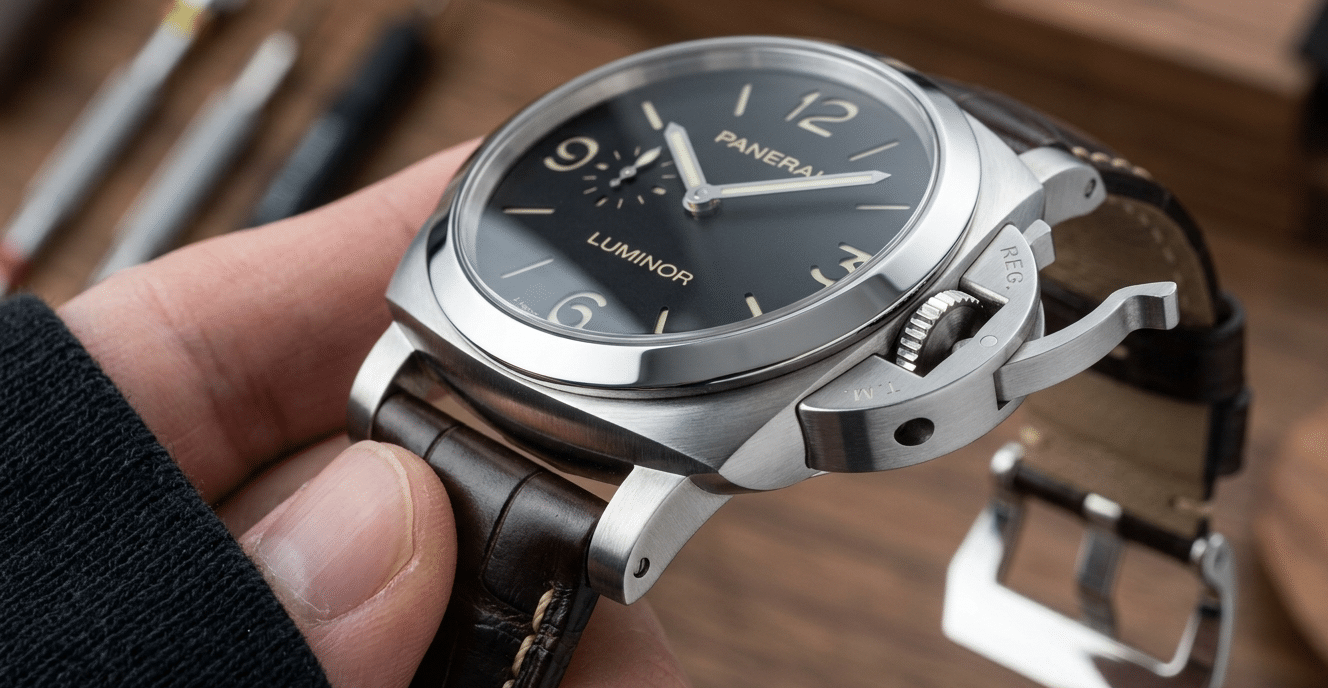
The Panerai crown guard is arguably the brand’s most distinctive design element, a bold visual statement that also serves a functional purpose. However, on a 47mm super clone, its replication quality directly dictates whether it’s an iconic feature or a constant source of wrist interference and discomfort. This isn’t just about aesthetics; it’s about the precision engineering required to make a large, protruding component wearable.
Crown Guard Lever and Pin Assembly Quality
The crown guard’s lever, its pivot pin, and the internal spring mechanism are a miniature marvel of engineering. For super clones, the manufacturing process for these components is a critical bottleneck. Inconsistencies in machining, such as an undersized pivot pin or a poorly formed lever, can lead to immediate issues: a stiff lever that’s difficult to operate, a loose lever that rattles, or, most critically, sharp edges on the lever or its housing that dig into the wrist. The material strength of these tiny components is also paramount; a weak spring or soft pin can lead to premature wear or failure, turning a signature feature into a liability and compromising the watch’s water resistance.
Crown Guard Curvature and Edge Finishing
The curvature of the crown guard is not arbitrary; it’s designed to protect the crown while ideally conforming to the natural curve of the wrist. On super clones, deviations from this curvature, or a lack of proper edge finishing, can create significant pressure points. A crown guard that is too flat, or one with unpolished, angular edges, will inevitably chafe or dig into the back of the hand or wrist during articulation, especially when bending the wrist upwards. This is particularly noticeable on a 47mm case, where the guard’s sheer size amplifies any ergonomic flaw. The difference between a properly finished, subtly rounded edge and a sharp, laser-cut one is the difference between all-day wearability and constant irritation.
Crown Engagement and Lever Action Smoothness
Beyond the physical comfort, the tactile experience of operating the crown and its guard contributes to the perceived quality of the replica. A smooth, crisp lever action that securely locks and unlocks the crown is a sign of good manufacturing. If the action is rough, sticky, or requires excessive force, it points to poor internal machining, misaligned components, or inadequate lubrication. This friction can not only be frustrating but can also indirectly affect comfort by making the wearer dread interacting with the watch, highlighting a fundamental flaw in the replication of a key functional element.
Expert Authentication Insight
Gently operate the crown guard lever. Does it move smoothly and consistently, or is there a noticeable stickiness or grating? Does it snap shut with precision, or does it feel loose or wobbly? Use a macro lens (10x minimum) to inspect the pivot pin and the inner edges of the guard. Look for tool marks, uneven brushing, or any edges that appear overly sharp or unfinished compared to high-resolution images of a genuine Panerai. Compare the action and finish to known high-tier super clones from factories like VSF, which generally excel in this area. Inconsistencies here are direct indicators of manufacturing shortcuts that will impact long-term wearability.
Lug Geometry and Integration: How It Shapes On-Wrist Proportions
For a watch as imposing as a 47mm Panerai, the lugs are not just attachment points for a strap; they are critical architectural elements that determine how the watch visually and physically interacts with the wrist. Their geometry and integration are paramount to achieving a wearable balance, preventing the watch from looking or feeling like a dinner plate strapped to the arm.
Lug Curvature and Downward Angle Replication
The most crucial aspect of lug geometry for a large watch is its downward curvature and angle. Genuine Panerai lugs are designed to curve downwards, allowing the watch case to hug the wrist more closely. This subtle but essential design choice prevents the watch from “floating” above the wrist, reducing the perceived bulk and improving stability. In super clones, deviations from this precise curvature—especially lugs that are too flat or extend too straight out—can be a significant comfort killer. Flat lugs create excessive gaps between the strap and the wrist, making the already large 47mm case appear even more enormous and prone to rotation. This isn’t just an aesthetic flaw; it directly impacts how securely and comfortably the watch sits.
Lug Hole Placement and Drilling Precision
The precision of lug hole placement and drilling might seem like a minor detail, but its impact on the ownership experience is substantial. Inaccurate or roughly drilled lug holes can make strap changes a frustrating ordeal, leading to scratched cases, bent spring bars, or even stripped screw-in bars. More critically, improperly positioned lug holes can cause the strap to sit awkwardly, creating uneven tension or an insecure fit. For a heavy 47mm watch, an insecure strap fit translates directly to instability and discomfort during wear, as the watch shifts and slides on the wrist.
Case-to-Lug Seam Finishing and Blending
The transition where the lugs meet the main case is a crucial area for both aesthetics and comfort. High-quality manufacturing ensures a seamless, well-blended finish, whether it’s a sharp transition between brushed and polished surfaces or a smoothly flowing curve. In super clones, poor blending, visible seams, or uneven polishing at this junction not only betray lower manufacturing standards but can also create uncomfortable contact points. Any rough edges or abrupt transitions here can chafe the skin, particularly with the constant movement of a large watch throughout the day. This area is often overlooked by casual inspection but reveals much about the factory’s attention to detail and commitment to a comfortable wearing experience.
Expert Authentication Insight
Place the 47mm super clone on a flat surface, caseback down. Observe the lug tips. Do they angle noticeably downwards, or do they appear to lift the watch off the surface? Use a protractor to estimate the downward angle and a digital caliper to measure the height of the lug tips relative to the caseback. Compare these measurements to high-resolution images or documented dimensions of genuine Panerai models, or even side-by-side with a known high-quality clone (e.g., comparing a P9000-based clone’s lug structure, which often allows for better curvature, to an older 7750-based clone that might have flatter lugs due to movement thickness). Any significant deviation—especially flatter lugs—will result in a less ergonomic fit, making the watch feel larger and less integrated on the wrist.
Caseback Profile and Engraving Quality: Impact on Stability and Skin Contact
The caseback of any watch is its primary point of contact with the skin. For a 47mm Panerai super clone, this isn’t just about aesthetics; it’s a critical ergonomic surface, as highlighted in a detailed Panerai size guide. Our investigation focuses on how the manufacturing execution of this often-overlooked component—from its profile to the depth and clarity of its engravings—directly influences the watch’s stability and comfort on the wrist.
Caseback Curvature and Ergonomic Design Replication
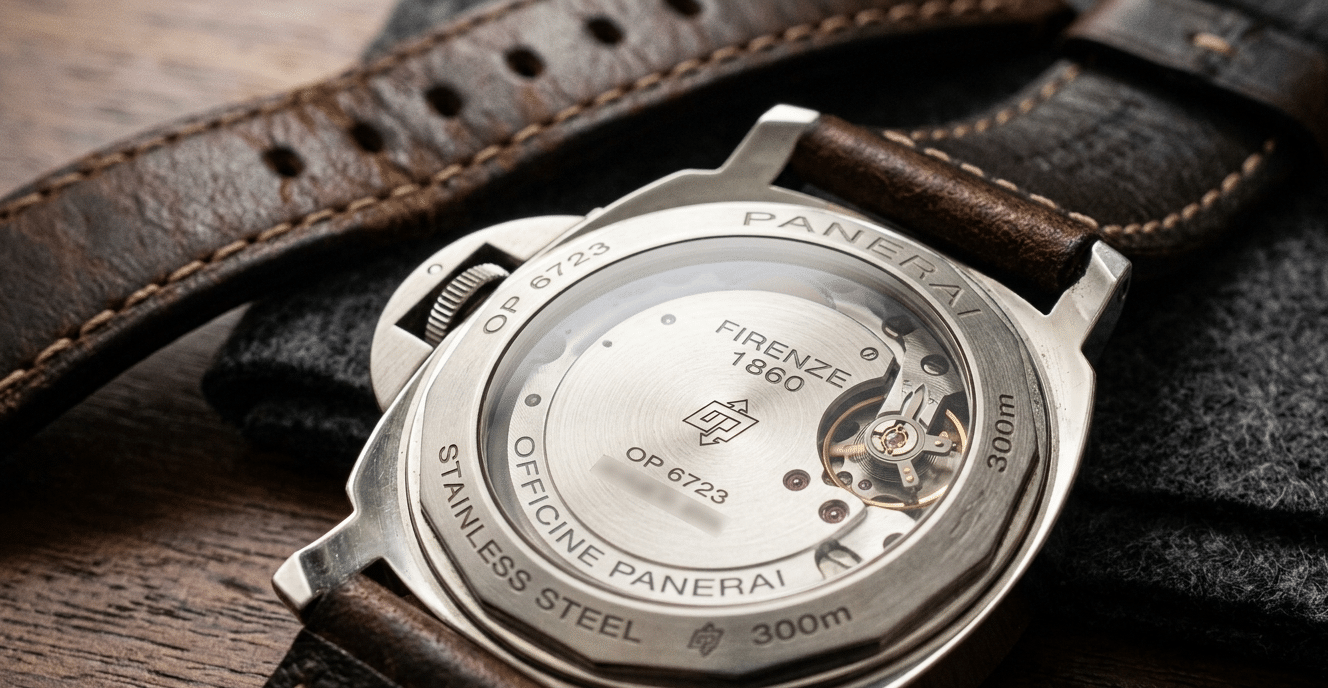
Genuine Panerai casebacks feature a subtle curvature, meticulously designed to allow the large case to sit more snugly on the wrist, distributing its considerable weight and preventing it from feeling like a brick. Super clone factories must replicate this ergonomic profile with precision. A common manufacturing shortcut involves producing casebacks that are too flat or have an improperly executed curve. This seemingly minor deviation reduces the essential skin contact area, leading to several practical issues for the wearer.
When a 47mm super clone with a flat caseback is worn, it tends to “float” higher on the wrist, increasing the perceived bulk. This lack of proper contact also makes the watch unstable, prone to rotating around the wrist, and creates uncomfortable pressure points. The result is a watch that, despite its impressive front-facing aesthetics, feels awkward and unwieldy, especially on smaller or flatter wrists. The subtle contours of the caseback are paramount to taming the inherent mass of a 47mm Panerai.
Engraving Depth, Clarity, and Fill Quality
Beyond the curvature, the manufacturing process for caseback engravings—including reference numbers, water resistance ratings, and brand insignia—offers a direct window into a factory’s precision. These engravings aren’t just decorative; they contribute to the tactile experience. Laser etching depth and consistency are key indicators of manufacturing quality. Shallow or inconsistent engraving, a common tell on lower-tier replicas, can feel rough or indistinct against the skin. Conversely, deep, crisp engravings, like those found on top-tier super clones from VS or XF, provide a smooth, premium tactile feel. The quality of any black enamel fill within the engravings is equally important; a sloppy fill or one that bleeds outside the lines not only looks cheap but can also introduce minor, irritating textures against the wrist. The provided reference notes that XF’s PAM005 sometimes had “caseback engraving depth slightly shallow,” highlighting a specific manufacturing compromise that affects this tactile aspect.
Gasket Sealing and Caseback Torque Specifications
The caseback isn’t merely a static component; it’s a critical part of the watch’s water resistance system. The manufacturing quality of the caseback gasket—its material, fit within the case groove, and the torque applied during assembly—directly impacts both the watch’s practical utility and its wearability. Poor quality gasket material can degrade quickly, and an improperly fitted gasket or insufficient torque during assembly can compromise water resistance, leading to potential moisture ingress. More subtly, an unevenly torqued caseback can create slight gaps or unevenness between the caseback and the mid-case. While often invisible to the naked eye, these microscopic irregularities can manifest as an uneven feel against the skin, contributing to discomfort during extended wear.
Expert Authentication Insight
To truly assess a 47mm Panerai super clone’s caseback, a hands-on approach is essential. Begin by running a finger slowly and deliberately across all caseback engravings. Notice the tactile depth and smoothness. Are the edges crisp, or do they feel rounded and indistinct? Any unexpected roughness or inconsistency is a red flag. Next, use a jeweler’s loupe (10x or 20x magnification) to examine the crispness of the engraving edges and the consistency of any black fill. Look for bleed-over, uneven lines, or shallow spots. For the curvature, place the watch on a flat surface and visually compare its dome or flatness against high-resolution images of genuine Panerai models. Pay close attention to how the edges of the caseback meet the wrist-facing side of the lugs. Deviations here can significantly impact how the watch sits and balances. For example, some XF PAM005 replicas were noted to have slightly shallow engraving depth, a detail that might not be visible at a glance but becomes apparent under a loupe and by touch, affecting the overall perceived quality and tactile comfort.
Crystal Thickness and Profile: Perceived Height and Visual Bulk
The crystal, often seen as a mere window to the dial, plays a disproportionately significant role in the perceived height, visual bulk, and overall wearing balance of a 47mm Panerai super clone. Its manufacturing specifics—material, thickness, and profile—can either enhance or detract from the watch’s wrist presence and comfort.
Sapphire Crystal Composition and Hardness
The vast majority of genuine Panerai watches, and all quality super clones, utilize synthetic sapphire crystals. The manufacturing process for these crystals involves precise growth and cutting, and variations in quality can be substantial. In super clones, the composition and hardness of the sapphire can affect several key attributes. High-quality sapphire, like that used by VS Factory, offers superior clarity and scratch resistance, influencing the overall perceived robustness and ensuring the dial remains legible and protected. Lower-grade synthetic sapphire, sometimes found in budget replicas, may exhibit subtle optical distortions, be more prone to micro-scratches, or feel less substantial. This impacts not only the watch’s long-term durability but also the user’s confidence in its daily wear, especially for a large timepiece that naturally experiences more bumps and knocks.
Crystal Dome/Flatness and Anti-Reflective Coating Application
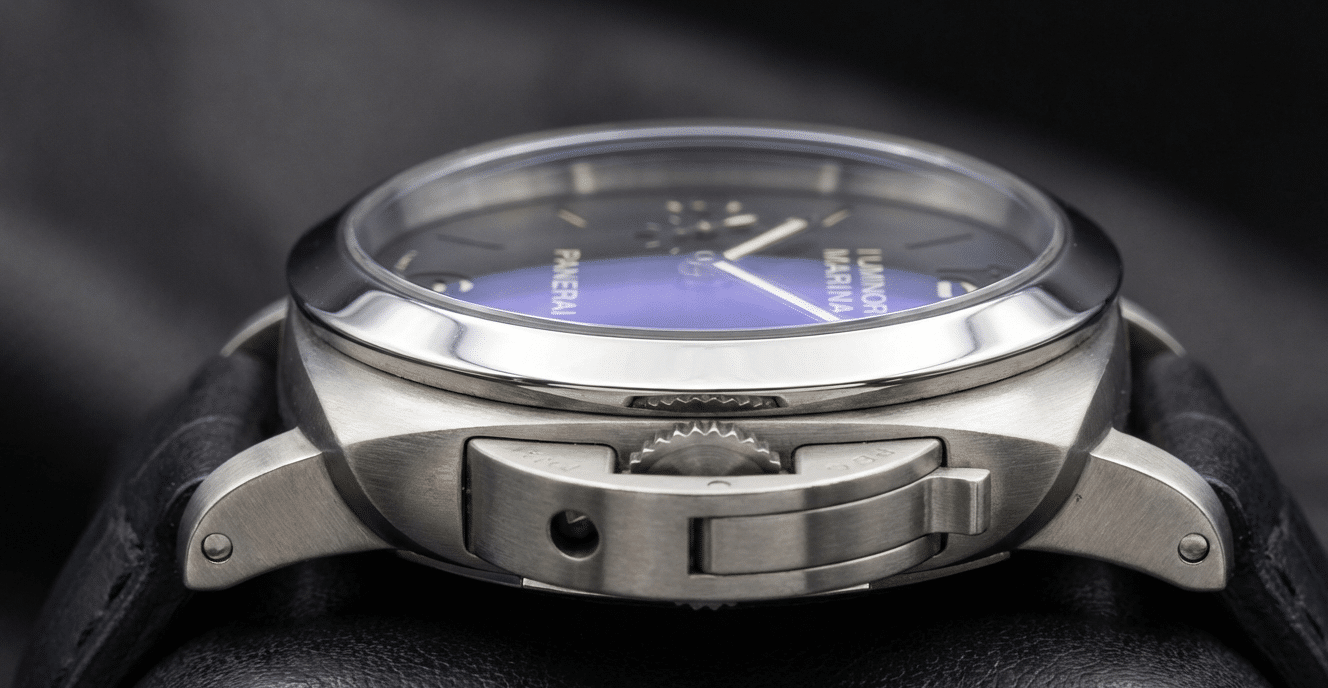
Panerai crystals often feature a specific dome or flatness, crucial for both visual appeal and managing reflections. The manufacturing challenge for super clone factories is to replicate this profile accurately. A poorly executed dome—too high, too flat, or uneven—can drastically alter the watch’s visual proportions, making the already large 47mm case appear even more cumbersome and top-heavy. Equally critical is the application of the Anti-Reflective (AR) coating. Genuine Panerai typically applies AR coating to the interior surface only, creating a distinctive subtle blue tint when viewed at an angle and minimizing reflections without compromising the exterior’s scratch resistance. Some older super clone batches, as noted in our reference, incorrectly applied AR to both sides, which, while reducing reflections, deviated from the gen aesthetic. Budget replicas often use inadequate or single-layer AR coatings, producing distracting rainbow reflections under direct light—an immediate visual giveaway that makes the dial harder to read and the watch appear less premium. VS Factory’s achievement with correct interior-only AR coating on Luminor Due models highlights the precision required here.
Crystal Gasket and Seating Precision
The crystal gasket and its seating precision are vital manufacturing details that connect the crystal to the bezel and case. The gasket’s material quality and its exact fit are paramount. An inconsistent gasket—too thin, too thick, or made from inferior material—can lead to several issues. It can result in uneven crystal height, where one side of the crystal sits slightly higher or lower than another, creating a visible flaw and potentially compromising water resistance. Moreover, poor seating precision can affect the visual alignment of the crystal within the bezel, detracting from the overall perceived quality and finishing of the watch. For a large watch, any visible misalignment or unevenness in the crystal is magnified, impacting the wearer’s perception of its quality.
Expert Authentication Insight
Assessing the crystal involves both precise measurement and visual observation. Start with a digital caliper to measure the crystal’s height above the bezel at multiple points around the circumference. Look for any variance that indicates poor seating or an uneven crystal. Next, observe reflections from various angles and under different lighting conditions. A high-quality interior-only AR coating, like that found on top-tier VS Factory models, will exhibit a subtle blue tint at an angle and minimize direct glare. Conversely, rainbow reflections or excessive glare are strong indicators of a budget crystal or poor AR application. A quick, gentle tap on the crystal with a fingernail can offer a subjective, but often telling, sense of its solidity and how well it’s seated. While not a scientific test, a loose or “plasticky” feel can indicate a lower-quality crystal or poor installation. Remember, the reference highlights that “Budget tell: Mineral glass or single-layer AR coating produces rainbow reflections under direct light — immediate giveaway,” so be particularly vigilant for these visual cues.
Strap Attachment and Spring Bar Quality: Security and Flexibility
For a watch as substantial as a 47mm Panerai super clone, the strap attachment system isn’t just a minor detail; it’s fundamental to both security and wearing comfort. Our investigation reveals how manufacturing standards for spring bars, screw-in bars, and lug holes directly impact the ease of strap changes, the long-term security of the watch, and the overall flexibility of the wearing experience.
Spring Bar or Screw-In Bar Manufacturing Materials and Tolerances
Panerai models often feature robust screw-in bars rather than traditional spring bars, particularly on larger cases. The manufacturing quality of these bars—their specific alloys and machining tolerances—is paramount. Substandard materials, such as softer metals, can lead to weak points, making the bars prone to bending or even snapping under stress, which is a significant risk for a heavy 47mm watch. Imprecise manufacturing tolerances can result in bars that are either too tight (difficult to install) or too loose (compromising security). For spring bar applications, cheap, thin spring bars are a common failure point; they bend easily, causing the watch to detach unexpectedly. The security of your substantial investment, even in a super clone, hinges directly on the quality of these small, critical components. The reference notes that “Replicas often show 0.5–1mm gaps at strap lugs due to imprecise spring bar positioning,” highlighting a common issue stemming from manufacturing tolerances.
Lug Hole Diameter and Internal Finish
The precision of the lug holes themselves is another manufacturing detail with significant consequences. The internal diameter and finish of these holes must be exact to ensure a secure and easy strap change experience. Irregularities, such as oversized, undersized, or roughly finished lug holes, can create a host of problems. Oversized holes allow bars to wobble, compromising security. Undersized holes make installation difficult, requiring excessive force and risking damage to the spring bars or the strap itself. A rough internal finish can abrade the ends of straps, leading to premature wear and tear on your investment. Moreover, for screw-in bar systems, imprecise drilling can lead to stripped screw threads, making future strap changes a nightmare and potentially requiring costly repairs. This area is a key indicator of a factory’s overall attention to detail.
Strap Keeper Loop Manufacturing and Integration
While often overlooked, the quality of the strap keeper loops—those small bands that secure the excess strap—significantly impacts comfort and aesthetics. In super clones, the manufacturing of these loops and their integration with the strap (via stitching or bonding) can vary widely. Low-quality material, weak stitching, or poor bonding can lead to loops that stretch out, break, or simply fail to hold the excess strap securely. For a large 47mm Panerai, an unsecured strap end can flap around, reducing comfort and detracting from the watch’s overall aesthetic appeal. This seemingly minor detail is crucial for a polished and comfortable wearing experience, especially when dealing with the longer, thicker straps often paired with Panerais.
Expert Authentication Insight
To evaluate the strap attachment system, perform a careful “strap change” simulation. If tools are provided, use them to remove and re-install a strap. Assess the smoothness of operation: do the spring bars or screws engage easily, or do they bind or require excessive force? Once installed, check the fit of the bars in the lugs; there should be minimal lateral play. Use a jeweler’s loupe to inspect the spring bar tips for evenness and strength. For screw-in bars, check the screw heads for clean, sharp slots and consistent thread pitch, which indicates precise machining. A common “tell” for replicas is a slight gap (0.5–1mm) between the strap and the case at the lugs, often due to imprecise lug hole placement or spring bar positioning. This gap not only looks off but can also affect the strap’s stability. For the keeper loops, flex the strap vigorously and observe how the loops hold up. Look for strong, consistent stitching or secure bonding, and ensure the material doesn’t feel flimsy or prone to stretching. This hands-on assessment will quickly differentiate a well-engineered attachment system from one that cuts corners.
Movement Integration and Weight Balance: Internal Influence on External Feel
For a watch as substantial as a 47mm Panerai super clone, the internal architecture plays a surprisingly significant role in its external feel. It’s not just about the raw weight, but how that weight is distributed and secured within the case. A comprehensive Panerai replica size and wearing guide will detail how factories that nail this often deliver a watch that feels more cohesive and less like a brick strapped to the wrist.
Movement Holder and Case Fit Precision
The movement holder, often called a spacer ring, is the unsung hero that cradles the movement within the case. In super clones, these are typically made from plastic or metal, and their machining precision is critical. An ill-fitting or poorly manufactured holder can lead to a host of subtle but irritating issues. Imagine the watch on your wrist, and with certain movements, you feel a slight shift or hear a faint rattle. That’s often the movement not sitting snugly. This looseness translates directly to an unbalanced feel, especially in a watch of this size. It means the weight isn’t consistently distributed, creating an impression of cheapness or fragility, which is the last thing you want from a “super clone” touting robust build quality.
Rotor Weight and Balance (for automatic movements)
If you’re dealing with an automatic 47mm Panerai super clone, the rotor’s weight and balance are key. A properly weighted and balanced rotor spins smoothly, efficiently winding the mainspring without drawing undue attention to itself. However, in less precise replicas, an improperly weighted or unbalanced rotor can cause noticeable vibrations or an uneven, almost “wobbly” feel during wear. This isn’t just an auditory annoyance; it can be tactile, creating a constant, subtle reminder that something isn’t quite right inside. It detracts from the seamless, solid impression a good replica should project.
Internal Dust Protection and Movement Securing
Beyond the primary movement holder, the internal dust covers and additional securing mechanisms are crucial for the watch’s long-term integrity and perceived robustness. These components, though rarely seen, ensure that the movement is protected from environmental ingress and secured against shocks. When these are well-made and properly fitted, they contribute to a watch that feels solid and dependable. Conversely, flimsy covers or weak securing points can lead to tiny gaps, slight movement shifts, or compromised water resistance, all of which chip away at the confidence a wearer has in their large timepiece.
Expert Authentication Insight
To gauge internal balance, place the watch flat on a desk. Gently rotate it, observing if the weight shifts unevenly, particularly if it’s an automatic. For automatic movements, listen closely for any faint rattling or uneven sounds. A well-integrated movement, like those typically found in VS Factory’s P.9000-based clones (e.g., the VS3255), will feel smooth and quiet, with a consistent, solid thud from the rotor. Contrast this with the older A7750-based movements, which often have a more pronounced rotor wobble and audible spin, indicating less precise balancing and integration.
Finishing Quality and Edge Comfort: The Tactile Experience of a Large Clone
The sheer size of a 47mm Panerai means that every surface and edge comes into more frequent and intimate contact with your skin and clothing. This makes finishing quality not just an aesthetic concern, but a paramount factor in daily wearing comfort. A watch can look perfect, but if it bites your wrist, it’s a non-starter.
Case Edge Chamfering and Polishing Consistency
The difference between a “good enough” replica and a genuinely comfortable one often comes down to the case edges. Panerai cases, especially the Luminor, have substantial profiles. In super clones, the manufacturing processes for chamfering (beveling) and polishing these edges are critical. Inconsistent or, worse, sharp edges—particularly on the underside or where the lugs meet the case—are a common comfort killer. During prolonged wear, or even just through everyday wrist articulation, these sharp points can dig into the skin, causing irritation and making the watch feel cumbersome rather than commanding. A truly premium replica will have edges that are crisp but subtly softened, preventing any unwanted tactile feedback.
Brushed vs. Polished Surface Transitions
Panerai cases often feature a mix of brushed and polished surfaces, creating visual depth and contrast. The precision and cleanliness of the transitions between these finishes are key indicators of manufacturing quality. Poorly executed transitions, where the polishing bleeds into the brushed areas or vice-versa, are not just visually unappealing. They can create subtle tactile imperfections—tiny ridges or unevenness—that you might not see but will certainly feel. This lack of seamlessness detracts from the overall “premium” feel, reminding the wearer that they’re not handling a finely crafted instrument, but a mass-produced item with shortcuts.
Crown and Push-piece Manufacturing Smoothness
The crown and any push-pieces (though less common on 47mm Panerais) are high-interaction points. Given the prominent crown guard design, the crown itself is a frequent point of contact. Rough knurling, sharp edges, or imprecise operation of the crown can cause significant discomfort. Winding the watch, setting the time, or even just having the crown guard press against your hand can become an unpleasant experience if these components aren’t manufactured with care. A smooth, tactile crown, free of burrs and operating with satisfying precision, is a small detail that makes a huge difference in the daily wearing experience of a large watch.
Expert Authentication Insight
To assess finishing quality and edge comfort, run your finger slowly and deliberately along all edges of the case, the underside of the lugs, and the crown guard. Pay particular attention to the areas that contact your skin. Any unexpected sharpness, snags, or inconsistency in the finish is a red flag. Use a macro lens to inspect the transition lines between brushed and polished surfaces. Look for crisp, clean lines without any “bleed-over.” High-tier super clones from factories like VS or XF generally exhibit excellent edge finishing, feeling smooth and refined, a stark contrast to budget replicas where edges often feel unfinished or poorly deburred.
Strap Material and Construction: Mitigating Bulkiness with Quality Replicas
For a 47mm Panerai super clone, the strap isn’t just an accessory; it’s a critical component that can either tame the watch’s inherent bulk or exacerbate it. The right strap, well-made and properly fitted, can transform the wearing experience, making a large watch feel surprisingly manageable and comfortable.
Leather Quality, Tanning Process, and Stitching Precision
Many Panerai enthusiasts prefer leather straps, and their quality in a replica is paramount. Stiff, low-quality leather, often a hallmark of budget replicas, struggles to conform to the wrist, causing the large watch to sit awkwardly and feel even bulkier. A poor tanning process can result in leather that cracks prematurely, feels plasticky, or even irritates the skin. Beyond the material, stitching precision is key. Inconsistent, uneven, or loose stitching not only looks cheap but can compromise the strap’s durability and comfort. A high-quality replica leather strap, much like a genuine one, should be supple, conform readily to the wrist, and feature neat, tight stitching that adds to the overall sense of quality and comfort.
Rubber Strap Composition and Flexibility
For those who opt for rubber straps, especially with Submersible models, the rubber compound’s quality, flexibility, and durability are crucial. Cheap rubber straps are often stiff, making the large watch feel rigid and uncomfortable. They can trap sweat, leading to skin irritation and an unpleasant wearing experience, particularly in warmer climates. A good rubber strap, mirroring genuine quality, should be soft, pliable, and comfortable against the skin, allowing for proper airflow and wrist movement without causing chafing or discomfort. Its flexibility is key to allowing the watch to sit correctly and not “float” on the wrist.
Buckle Design, Material, and Finishing
The buckle, though small, is another critical point of contact. In replicas, a sharp, poorly finished, or oversized buckle can create additional pressure points, digging into the wrist or catching on clothing. The material quality (e.g., ensuring it’s actual 316L steel and not a cheaper alloy) and its finishing—whether brushed or polished—must match the case. A buckle that feels cheap, lightweight, or has rough edges immediately undermines the perceived quality of the entire watch, no matter how good the case or movement might be. It’s a small detail, but one that significantly impacts daily comfort and overall satisfaction.
Expert Authentication Insight
To evaluate a strap, flex it vigorously. A quality leather strap should be pliable but resilient, returning to its shape without creasing excessively. Inspect the stitching under a loupe for evenness, consistent thread count, and the absence of loose ends. For rubber straps, check for any strong chemical odor, which often indicates lower-grade compounds, or a sticky residue. Compare the buckle’s weight and finish against high-resolution images of genuine examples or known high-tier replica buckles. A good super clone strap, whether leather or rubber, should feel substantial yet comfortable, not cheap or flimsy.
For those contemplating a 47mm Panerai super clone, the undeniable aesthetic appeal and wrist presence are often the primary draw. However, a truly satisfying ownership experience extends far beyond initial impressions. It hinges on a deep understanding of the manufacturing realities that influence daily wearability and comfort. Don’t be swayed solely by the replication of the movement or dial; prioritize super clones from factories renowned for their superior case finishing, accurate lug geometry, and, critically, high-quality strap components. Before committing, consider trying on a similar-sized genuine watch, or even a well-regarded replica in person, to gauge how such a substantial timepiece truly feels on your wrist. Furthermore, be prepared to invest in aftermarket straps tailored for comfort and flexibility. Often, an excellent quality aftermarket strap can be the single most effective upgrade to truly tame the bulk and enhance the comfort of these impressive replica timepieces, turning a bold statement into a daily pleasure.