
Why Overseas Qualifies as a Luxury Sports Watch (System Definition, Not Category Label)
The Overseas line from Vacheron Constantin does not behave like a conventional sports watch, and it does not behave like a dress watch either. It exists in the overlap where structural robustness and decorative precision are forced to coexist inside the same envelope. The case carries sport-grade thickness and impact tolerance, while the surfaces demand dress-level polish discipline and symmetry. That contradiction is not conceptual. It is mechanical, geometric, and visual, and it is the reason Overseas replicas fail more often than most watches that look equally simple at first glance.
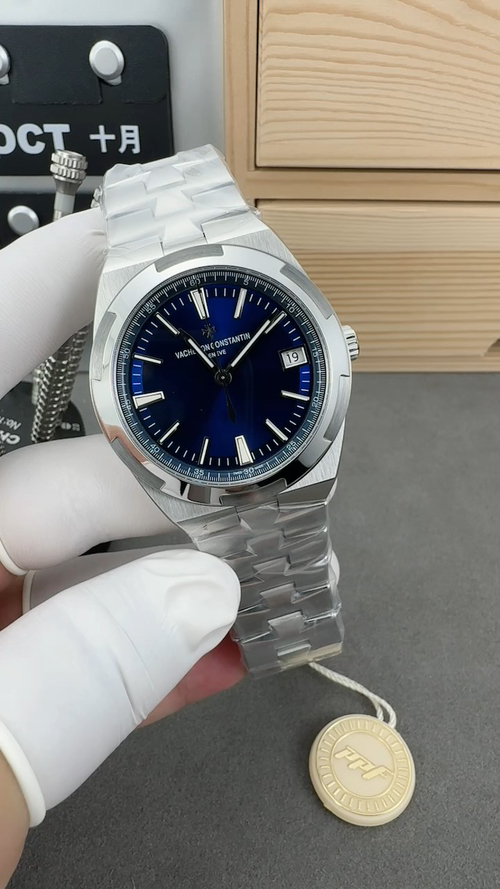
Most sports watches concentrate their engineering in shock resistance, water sealing, and bracelet strength, then relax finishing requirements to stay manufacturable at scale. Overseas does the opposite. It insists on integrated load paths through the bracelet while simultaneously enforcing mirrored bevels, reflective facets, and tight center-axis presentation. These demands collide inside one structure. Replication difficulty does not come from complexity of parts, but from incompatibility of requirements living in the same geometry.
What makes this especially unforgiving is that Overseas exposes every compromise immediately. There is no visual hiding place. The bezel, dial, case flanks, and bracelet all reference the same center and the same symmetry plane. Any drift introduced during assembly propagates outward across the entire watch. This is why even small tolerance losses become obvious in daily wear, and why Overseas acts less like a category of watch and more like a continuous geometry test.
Integrated Case + Bracelet as a Single Mechanical Unit
Overseas cannot be evaluated as a case with a bracelet attached afterward. The bracelet is structurally upstream of how the case presents itself on the wrist. Load transfers through the end links directly into the case flanks, and those flanks visually terminate into polished bevels that define the entire silhouette. If the bracelet enters the case at the wrong angle, even by a fraction, the distortion does not stay local. It reorients the watch’s stance and shifts how light travels across every surface.
In practical terms, this means tolerance stacking does not behave linearly. A slightly proud end link does not just create a small gap. It alters flank continuity, changes how the mid-case sits relative to the wrist, and disrupts symmetry between left and right sides. Because the Overseas case is not isolated from its bracelet, assembly errors amplify rather than dissipate. What looks like a bracelet issue becomes a full-watch geometry issue within seconds of inspection.
This is where system assembly discipline matters more than individual part quality. Perfectly machined components still fail visually if their interfaces are not controlled as a single unit. Overseas forces builders to think in continuous structures rather than modular pieces. Most replica assemblies still approach it as separable parts. The result is predictable: localized misalignment that spreads across the entire form.
Practical judgment tip: Inspect bracelet–case junction symmetry
Start with the junction, not the dial. View the watch from a shallow side angle under natural light and compare both end links at once. Look for equal gap width, mirrored curvature, and uninterrupted edge flow from bracelet into case. Then rotate the watch slightly and repeat, watching how highlights travel across both sides.
If one junction breaks highlight continuity earlier than the other, that asymmetry rarely comes from polishing alone. It usually traces back to fixture alignment or casing tolerance during assembly. When the bracelet enters the case unevenly, the watch never fully recovers downstream. Catching this early saves you from chasing surface defects that are only symptoms of deeper structural imbalance.
Maltese Cross Bezel: Structural Boundary, Not Decoration
The Overseas bezel does not function as an ornamental frame; it operates as a hard geometric boundary that locks the entire watch into eight reflective constraints — each lobe defines where polishing must stop, where brushing must resume, and where symmetry must be preserved — and because every facet participates in both structure and reflection, the bezel becomes the primary reference plane for the case, the dial, and the center axis simultaneously, a dimensional and reflection-based stability mechanism detailed in the Vacheron Constantin Overseas replica guide with geometry-based inspection methods.
This is why Overseas exposes tolerance faster than most sports watches. On a circular bezel, minor drift can hide inside continuous curvature. On the Maltese cross perimeter, there is no continuous curve to absorb error. Each facet introduces a reflection break, and each break becomes a checkpoint. When one facet leans even slightly out of plane, the eye does not read it as a small defect. It reads it as a global imbalance, because the remaining seven facets still obey the original geometry.
In real wear, this manifests as unstable light behavior. Highlights jump inconsistently from lobe to lobe. Reflections stall on one side and accelerate on the other. What looks like a polishing issue at first usually traces back to machining drift or fixture misalignment earlier in the process. The bezel is simply where those upstream errors become visible.
Facet Transitions as Error Multipliers
Facet transitions are where Overseas either holds together or collapses visually. Each transition carries three responsibilities at once: it must preserve the designed facet angle, terminate polish lines cleanly, and maintain a consistent edge radius. Losing control of any one of these does not stay local. It distorts how the adjacent facets present themselves, and that distortion propagates around the entire perimeter.
This is why polishing defects on Overseas should never be treated as cosmetic. Uneven polish line termination usually means the underlying facet plane is already compromised. Variable edge radius is rarely just hand-finishing inconsistency. It often indicates that the CNC pass did not land where it was supposed to, forcing the polisher to compensate afterward. Once compensation enters the process, symmetry is already gone.
Over time, repeated inspection makes this pattern obvious. Watches with true geometric control show predictable, mirrored transitions across all eight lobes. Watches built on drifting geometry show one or two “soft” facets, followed by cascading inconsistencies in the neighboring planes. The surface tells you what the structure already decided.
Practical judgment tip: Track highlight flow across bezel facets
Use moving light, not static inspection. Tilt the watch slowly and let a single highlight travel across all eight lobes. On a structurally sound bezel, the highlight advances at a steady rhythm, breaking and reforming symmetrically on opposite facets. On compromised assemblies, the highlight hesitates on certain lobes and skips prematurely on others.
When highlight continuity breaks, the cause is rarely simple polishing error. Asymmetric milling almost always precedes it. Once you learn to read this behavior, you stop arguing with surface appearance and start diagnosing geometry directly. That shift changes how quickly you can judge an Overseas case, and it prevents you from mistaking reflective noise for isolated finishing flaws.
Sport Proportions + Dress Polishing: A Controlled Contradiction
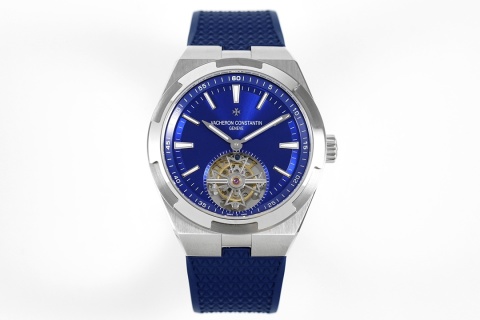
Overseas carries sport-grade mass through its mid-case while demanding dress-level polish discipline on every exposed edge. The body of the watch is deliberately thick, built to absorb shock and maintain rigidity across an integrated bracelet system. At the same time, its bevels are narrow, highly reflective, and visually dominant. These two requirements pull in opposite directions. One favors material and tolerance margin. The other punishes excess with immediate optical feedback.
This contradiction is where most replica failures originate. Guangzhou production can usually achieve robustness or refinement in isolation. Doing both at once inside a single geometry is a different problem entirely. The thick mid-case wants forgiving radii and broad transitions. The polished bevels require tight planes, sharp terminations, and mirrored symmetry across both case halves. When either side compromises, the whole watch announces it.
In wear, this conflict shows up as instability rather than obvious damage. The watch may feel solid, yet look unsettled. Or it may look glossy in photos but collapse under moving light. Overseas does not allow those traits to exist separately. Structural mass and surface precision must remain synchronized, and any divergence between them becomes visible within seconds.
Why Polished Bevels Reveal Case Geometry Drift
Polished bevels on Overseas function as tolerance indicators, not decoration. Their width, termination sharpness, and left–right symmetry depend entirely on the underlying case planes arriving at the polisher in correct alignment. When those planes drift even slightly during machining or casing, the polisher is forced into compensation. Compensation always leaves fingerprints.
Bevel width variance is the first signal. One side grows heavier while the other thins out. Termination points stop landing at consistent locations along the case flank. Edge radii soften unevenly. None of this originates at the polishing stage. These are downstream artifacts of upstream geometry instability. Once the base planes are off, every reflective surface becomes a witness.
Over repeated inspections, a pattern emerges. Structurally sound cases show bevels that read as quiet. They do not attract attention because they resolve evenly into the surrounding surfaces. Compromised cases feel busy. Highlights cling to one side, fade too quickly on the other, and refuse to settle into symmetry. The bevels are not misbehaving on their own. They are reporting what the case already lost.
Practical judgment tip: Compare left/right bevel thickness at 45°
Hold the watch at roughly forty-five degrees and compare both sides simultaneously. Do not isolate one edge at a time. Look for proportional parity in bevel width and for matched termination points where polish meets brushing. Then rotate slightly and repeat.
If one bevel consistently appears heavier or collapses earlier under light, you are not seeing a finishing mistake. You are seeing broader case distortion expressing itself through the most reflective surfaces. Once that asymmetry appears, it rarely exists in isolation. It usually predicts wider alignment instability across the watch.
Center Axis Sensitivity: Why Overseas Punishes Dial and Hand Errors
Overseas is unforgiving about center alignment because every major visual element references the same axis. The bezel geometry, the dial layout, and the case symmetry all converge on a single point. There is no offset architecture to diffuse error. When the center drifts, everything drifts with it.
This is why minute axis offsets become immediately visible. The eye does not need magnification. It senses imbalance through spacing changes between the minute track and bezel, through unequal distances between applied indices and the dial perimeter, and through the way hands sweep relative to the chapter ring. What might pass unnoticed on softer designs becomes obvious here because Overseas concentrates visual authority at the center.
Hand stack tolerance compounds the problem. If the stack height deviates, reflections change around the central pinion. Shadows fall differently across the dial. The watch starts to feel slightly cross-eyed, even when individual components appear acceptable in isolation. Overseas converts small axial errors into global visual tension.
Dial Spacing as a Geometric Feedback Loop
Dial spacing is not a graphic concern on Overseas. It is a geometric feedback system. Minute track concentricity and applied index radial consistency act as continuous reporters of center-axis health. When the axis is true, spacing reads even without effort. When it is not, the dial begins to argue with itself.
Uneven distances between the minute track and indices are rarely printing problems. They indicate that the dial is seated off-center or that the underlying axis has shifted. Once that happens, every applied marker becomes a measurement tool, and the pattern repeats around the circumference. The design does not allow the error to hide in one quadrant.
With experience, this becomes quick to read. You stop asking whether a marker is crooked and start asking why multiple markers are agreeing with each other. When spacing irregularities appear at several positions, the conclusion is structural. The dial is simply making it visible.
Practical judgment tip: Check minute track distance at 12 / 3 / 6 / 9
Use the four cardinal points as a fast structural scan. Compare the radial distance between the minute track and the dial edge at 12, then 3, then 6, then 9, keeping the watch flat and your viewing angle consistent. You are not hunting for perfection; you are looking for pattern.
When the center axis is true, those four distances read as functionally equal, even if printing or lume thickness varies slightly. When the axis has drifted, one or two quadrants tighten while the opposite side opens up. That asymmetry does not originate in graphics. It reflects off-center dial seating or axial displacement upstream, and once it appears at multiple points, it almost never resolves elsewhere on the watch.
Why Guangzhou Output Stratifies Sharply on Overseas
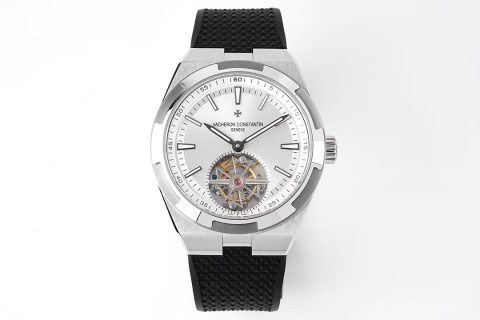
Overseas does not reward incremental improvements in parts quality. It rewards discipline in fixtures, sequencing, and cumulative tolerance control. Guangzhou production environments are capable of producing excellent components, but Overseas demands that those components arrive at final assembly in a precise order, under repeatable clamping geometry, and with minimal rework between stages. When any of those conditions loosen, the watch does not degrade gradually. It bifurcates into clearly acceptable and clearly unstable outcomes.
This is because Overseas behaves as a tolerance amplifier. Integrated bracelet geometry feeds into case stance. Case stance feeds into bezel symmetry. Bezel symmetry feeds into dial perception. Each stage compounds the previous one. Assemblies that stay inside narrow alignment windows survive and feel coherent. Assemblies that drift even slightly collapse visually across multiple surfaces at once.
This sharp stratification is not about access to better parts. It is about whether the production line treats the watch as a continuous system or as a collection of independent operations. Overseas only tolerates the former. Everything else becomes visible within minutes of handling. This is why china super clone vacheron is not defined by parts or price tiers, but by whether an assembly survives Overseas geometry without compensation.
Visible Defects as Upstream Manufacturing Signals
Most people read defects locally. A crooked bezel is treated as a bezel problem. A drifting dial is treated as a dial problem. A rough crown is treated as a crown problem. On Overseas, those interpretations miss the point.
Bezel asymmetry usually traces back to casing fixtures that failed to hold consistent planes. Dial drift often points to off-axis seating after hand installation. Crown feel inconsistencies commonly originate in stem alignment during movement insertion. These symptoms appear far downstream, but they are records of earlier process breakdowns.
Once you start reverse-reading defects, patterns emerge quickly. Watches with unstable bezel facets almost always show uneven dial spacing. Pieces with inconsistent crown resistance frequently carry subtle hand stack misalignment. The watch tells a coherent story if you let it. Every visible flaw is a timestamped artifact of assembly order and geometric control.
Practical judgment tip: Combine three signals before deciding quality
Do not anchor on a single imperfection. Instead, correlate center alignment, crown feel, and bezel symmetry. Evaluate how the minute track sits relative to the case, how the crown behaves through winding and setting, and how highlights travel across the Maltese cross facets.
One defect can mislead. Surface noise exists. Three correlated signals rarely do. When axial spacing, tactile feedback, and bezel geometry all agree, you are no longer guessing. You are reading system behavior, and system behavior is far more reliable than isolated appearance.
Closing Judgment: Overseas Is a Geometry Test Disguised as a Sports Watch
Overseas does not forgive assembly shortcuts, because its integrated case architecture, Maltese cross bezel geometry, and center-axis dominance convert small production drift into immediate visual instability, leaving you to decide whether you accept that reality or walk away.
