
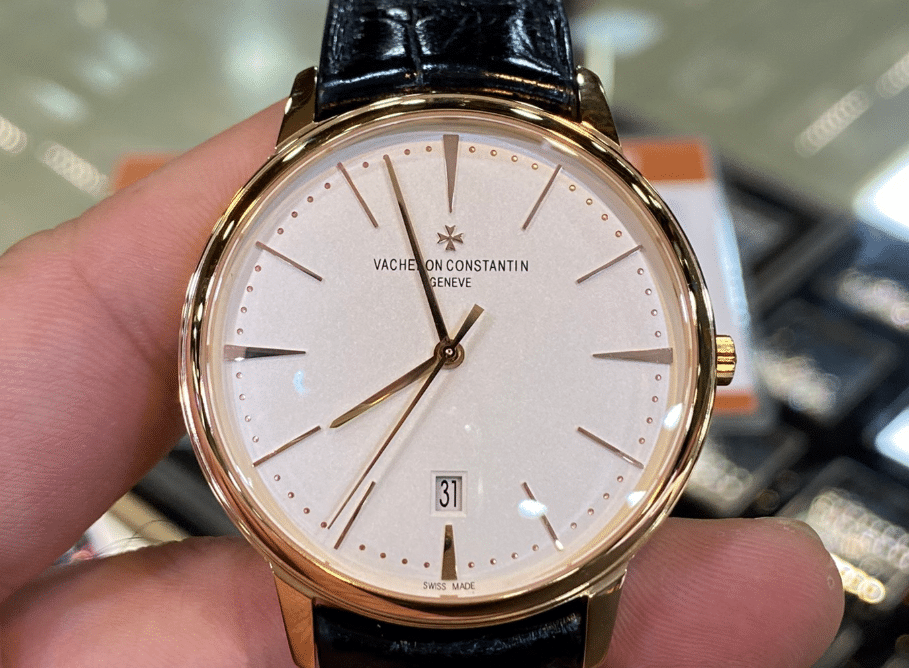
Both Patrimony and Traditionnelle look simple because they remove distraction. That simplicity is deceptive. In Guangzhou super clone production, these two layouts behave less like style variants and more like separate proportion systems, each exposing manufacturing weakness through a different geometric channel. Patrimony collapses attention toward the center plane, turning dial flatness and axis truth into primary failure points. Traditionnelle distributes attention outward, forcing polishing transitions, bezel steps, and applied markers to carry the visual load. What follows is not aesthetic comparison. It is an engineering reading of how two restrained designs amplify different tolerance errors, and why experienced inspection starts from geometry rather than appearance.
Minimalism vs Stratification: Why Two Simple Layouts Fail Differently
At a structural level, Patrimony is a planar system. Almost everything resolves back to one flat dial plane and one central axis. Traditionnelle is a stratified system. Its stepped bezel, raised markers, and layered case surfaces distribute alignment responsibility across multiple vertical interfaces. These layouts fail differently because they stack tolerances along different directions.
In Patrimony, tolerance accumulates radially. Dial flatness, central pinion perpendicularity, and hand stack height all converge at the same visual reference: the open dial. Even a small angular error at the center propagates evenly across the entire face. There is nowhere for it to hide. Traditionnelle accumulates tolerance vertically. Marker feet, bezel steps, and polish boundaries each introduce their own micro-offsets. Individually they may pass casual inspection. Together they create broken light paths and uneven relief that the eye reads as inconsistency.
The practical takeaway is straightforward. Patrimony magnifies center-axis truth. Traditionnelle magnifies surface transitions. Treating them as equivalent “dress watches” leads to missed defects because each demands a different inspection lens.
Patrimony: Flat Dial as a Center-Axis Amplifier
Patrimony’s defining feature is not its thin case or restrained typography. It is the uninterrupted dial field. That open space behaves like a geometric amplifier. Any deviation in central pinion perpendicularity or dial seating immediately becomes visible as asymmetry in hand spacing or minute-track alignment.
In Guangzhou builds, this usually shows up as hand stack tolerance rather than gross misassembly. The hour and minute hands may appear fine at first glance, but as they sweep, the distance between the minute hand and the applied minute track subtly changes. This is not cosmetic. It reflects axial drift or micro-tilt at the dial plane. Because Patrimony offers no applied indices or stepped bezel to distract the eye, that drift becomes legible within seconds of observation.
Over time, watches with this condition tend to develop secondary issues. Crown setting begins to feel uneven, calendar changes lose crispness, and hand clearance tightens. What starts as a barely visible alignment error often evolves into functional friction because everything references the same center stack.
Practical Judgment Tip: Radial Minute-Hand Sweep Test
Set the watch to a clean minute index and slowly advance the hands through a full 360°. Watch the gap between the minute hand tip and the minute track as it travels the dial.
If that gap breathes in and out instead of remaining constant, the center axis is not perpendicular to the dial plane. On Patrimony, variable gap equals axis misalignment. No amount of surface finishing compensates for this because the error originates at the structural core.
Traditionnelle: Layered Architecture as Transition Stress Test
Traditionnelle shifts the burden away from the center and onto transitions. Its stepped bezel, applied markers, and polished case bands create multiple visual boundaries. Each boundary demands precise stop-lines and consistent seating depth. When those controls weaken, the design exposes it immediately.
Most Guangzhou Traditionnelle failures do not originate at the pinion. They appear first at the edges. Bezel steps lose symmetry, marker feet sit at uneven heights, and polishing transitions blur instead of breaking cleanly. Under diffuse light these defects look minor. Under directional light they fracture into discontinuous reflections that the eye reads as disorder.
This is why Traditionnelle is less forgiving of inconsistent finishing discipline. You can sometimes live with a marginal center axis if the surfaces remain coherent. You cannot hide broken transitions. The architecture itself forces attention to every layered interface.
Practical Judgment Tip: Oblique Light Transition Pass
Use a single point light and sweep it slowly along the bezel steps and across the bases of the applied markers.
On a disciplined build, light lines remain continuous as they travel across surfaces. When those lines fragment or jump, it signals inconsistent polishing boundaries or uneven marker seating. Broken light paths are not cosmetic artifacts. They are evidence of uncontrolled transitions during assembly.
Dial Real Estate vs Marker Relief: Two Paths to Tolerance Exposure
Patrimony and Traditionnelle diverge in how they expose error through space, as the Patrimony utilizes negative space where any deviation in the Patrimony 81180 dial geometry and case tolerance execution reveals problems through surface flatness, whereas the Traditionnelle reveals them through the architectural relief of its height.
Patrimony offers large uninterrupted dial real estate. That openness punishes even sub-degree tilt because the human eye instinctively seeks a horizon across empty space. Traditionnelle fills that space with structure. Applied markers and stepped surfaces introduce vertical relief that replaces horizon perception with shadow comparison. Each approach stresses a different part of the build.
Understanding this distinction changes how you evaluate quality. With Patrimony, you read planes. With Traditionnelle, you read layers.
Patrimony’s Open Field and Micro-Gradient Drift
Large blank dials behave like spirit levels. Even minimal micro-gradients across the dial plane become visible as perceived tilt. This is why Patrimony often looks “off” long before any specific defect can be named.
In practice, the issue usually traces back to dial seating rather than printing. Adhesive thickness varies across the dial underside, or the dial plate itself carries a slight warp from handling. The result is a compound tilt that remains subtle in isolation but becomes obvious once the watch is worn and viewed from multiple angles.
Owners often describe this as a watch that never quite sits level, even after strap adjustments. That sensation originates at the dial plane. Open space exposes what layered designs conceal.
Practical Judgment Tip: Two-Axis Horizon Check
View the watch straight on, then rotate it ninety degrees and reassess the perceived horizon of the dial.
If the sense of tilt persists across rotation, the issue is not case fit or strap tension. It is dial-plane error. Open-field designs make this test brutally honest.
Traditionnelle’s Marker Feet and Seating Variance
Traditionnelle replaces open space with applied geometry. Each marker introduces a footing, adhesive layer, and vertical tolerance. When seating control weakens, markers sit at slightly different heights or angles, creating uneven relief.
This manifests first as inconsistent shadows under identical lighting. Over time it leads to tactile differences as well, with some markers feeling sharper or more pronounced during cleaning. These are not isolated defects. They point to upstream assembly discipline, particularly how marker holes are drilled and how adhesive spread is controlled.
Because Traditionnelle relies on relief for visual richness, uneven relief dominates perception far more than minor axis drift ever could.
Practical Judgment Tip: Marker Shadow Uniformity
Place the watch under fixed directional light and compare the shadow length beneath each applied marker.
Uniform shadows indicate consistent seating depth. Variance in shadow length equals variance in marker height. That variance reflects weak vertical tolerance control, not surface blemishes.
The essential distinction is simple: Patrimony teaches you to audit the center before anything else, while Traditionnelle teaches you to audit transitions before trusting the core, and which lesson you prioritize should be determined by geometry rather than preference.
Bezel Geometry vs Center Plane: Where Assembly Discipline First Breaks
Every build fails somewhere first. The difference between Patrimony and Traditionnelle is not whether failure appears, but where it surfaces before anything else becomes obvious. Patrimony concentrates risk at the center plane, where dial registration and hand stack geometry converge into a single reference point. Traditionnelle distributes that risk outward, letting bezel indexing and surface transitions act as early warning systems long before the movement itself feels compromised.
In Guangzhou production, this split shows up repeatedly. Patrimony units that look acceptable at arm’s length often carry latent center-plane errors that only reveal themselves once the hands begin cycling under load. Traditionnelle units, by contrast, tend to advertise trouble immediately through asymmetric bezel steps or broken polish boundaries, even when the central stack remains mechanically serviceable. The practical distinction is simple: Patrimony breaks at the center, while Traditionnelle breaks at the edge, and inspection order should follow that reality.
Patrimony: Center Stack as Primary Reference
Patrimony treats the center stack as the governing datum for the entire watch. Dial, hands, and crown all reference the same vertical column, so any deviation introduced at that axis propagates outward across every visible element. What begins as marginal hand stack tolerance often evolves into compound behavior: uneven crown feel, subtle horizon drift, and eventually reduced clearance between hands as vertical tolerances collapse.
This is why Patrimony failures rarely stay localized. A slightly tilted central pinion does not remain a cosmetic issue. It loads one side of the hand stack more than the other, accelerates wear at contact points, and increases friction during setting cycles. Over time, that imbalance migrates into calendar drag and inconsistent return, even though the original defect started as a barely perceptible alignment error.
The important judgment here is that Patrimony does not forgive center mistakes. Surface finishing can be excellent, printing can be crisp, and case geometry can look clean, but if the stack is not vertically true, the watch is already on a shortened lifecycle.
Practical Judgment Tip: Hand Parallelism Probe
Pull the crown to the setting position and advance the hands slowly through several full rotations. Watch the clearance between hour and minute hands as they pass each other, and pay attention to any momentary hesitation or visual convergence.
Consistent spacing indicates a healthy vertical stack. Contact, near-contact, or visible oscillation predicts early failure because it signals that tolerance has already been consumed at the center. Once this condition exists, downstream issues tend to appear even if the watch initially keeps time.
Traditionnelle: Bezel Steps as Alignment Anchors
Traditionnelle replaces the single central reference with multiple edge-based anchors. Its stepped bezel and layered case surfaces function as visual rulers, establishing symmetry through radial repetition rather than axial purity. When machining fixtures drift or polishing boundaries lose control, those errors manifest immediately at the perimeter.
In practice, this means Traditionnelle exposes assembly weakness through edge behavior first. Bezel steps lose mirror symmetry between twelve and six. Polish transitions soften or wander. Light no longer travels cleanly across adjacent surfaces. These are not isolated cosmetic slips. They indicate that positional control during case finishing has degraded, and once that happens, marker seating and case alignment usually follow the same pattern.
What makes Traditionnelle unforgiving is that the eye reads edges before it reads centers. Even a mechanically sound unit feels wrong when its perimeter geometry lacks coherence. Relief dominates perception, so edge errors outweigh minor axial imperfections in how quality is experienced.
Practical Judgment Tip: 12–6 Step Symmetry Check
Compare bezel step widths at twelve and six under the same lighting angle, then repeat at three and nine. Use reflected light rather than direct viewing to judge symmetry.
Matched widths and continuous reflection lines indicate stable fixturing during machining and polishing. Any mismatch flags fixture drift or uncontrolled boundary work, and once that appears, it usually correlates with uneven marker seating elsewhere in the build.
Crown feel is one of the few interactions that bypasses surface finish and speaks directly to internal geometry. Both Patrimony and Traditionnelle reveal problems through the crown, but they do so for different structural reasons. On Patrimony, the crown reports on axis truth. On Traditionnelle, it reports on how well the layered case stack has been seated and preloaded. The tactile symptom may feel similar, but the mechanical story underneath is not.
In Guangzhou production, this distinction matters because crown behavior often becomes the first dynamic signal a watch gives you. Visual inspection can miss early-stage errors, especially on fresh units. The crown rarely lies. Subtle resistance changes, delayed return, or inconsistent engagement usually appear before dial tilt becomes obvious or bezel transitions start breaking light. Learning to interpret that feedback correctly saves time and prevents misdiagnosis.
Patrimony: Crown Smoothness Mirrors Axis Health
On Patrimony, the crown is effectively an extension of the center stack. The stem, central pinion, and hand column all share the same alignment axis, so any loss of concentricity shows up immediately in setting feel. A healthy Patrimony crown turns with uniform resistance, returns cleanly, and does not change character across positions.
When axis alignment begins to drift, the crown develops texture. Rotation feels granular rather than fluid. Engagement depth varies slightly between positions. Over repeated cycles, this roughness correlates strongly with emerging dial-plane asymmetry and hand stack instability. The reason is simple: a tilted or offset axis loads one side of the stem interface more than the other, creating uneven friction that your fingers can detect long before your eyes do.
This is why experienced inspection treats crown smoothness on Patrimony as a leading indicator rather than a comfort feature. Roughness predicts dial drift. It is rarely an isolated inconvenience.
Practical Judgment Tip: Triple-Position Return Test
Cycle the crown slowly through all positions—neutral, date set if present, and time set—then return it to neutral each time. Pay attention to resistance entering and leaving each position, and note whether the feel changes across the sequence.
Uniform resistance and consistent return indicate concentric alignment. If one position feels heavier, lighter, or delayed compared to the others, that asymmetry usually traces back to axis deviation. Position-dependent feel is not random. It reflects a centerline that is no longer true.
Traditionnelle: Crown Feel as Case-Seat Proxy
Traditionnelle uses the crown differently. Here, crown feel is less about axis purity and more about how the layered case architecture has been seated and preloaded. The stem passes through multiple vertical interfaces, and those interfaces depend on controlled compression between case components. When that preload varies, the crown becomes the messenger.
In Guangzhou builds, inconsistent case-seat preload shows up as uneven crown engagement rather than outright roughness. The crown may feel fine while turning, yet exhibit slight slack after setting or a delayed response when reversing direction. This behavior points to vertical stack errors, where bezel, midcase, and movement are not held in stable relationship under load.
Unlike Patrimony, Traditionnelle can tolerate minor axis imperfection without immediately betraying it through the crown. What it cannot tolerate is loose or uneven seating. Once preload control weakens, tactile feedback becomes inconsistent, and that inconsistency usually aligns with other relief-based defects such as uneven marker height or softened polish boundaries.
Practical Judgment Tip: Micro-Backlash After Setting
After setting the time, reverse crown direction slightly and observe the minute hand before it begins to move. Watch for any micro-delay or visible play in the hand stack.
Immediate response indicates stable seating. Any perceptible backlash suggests that vertical compression has already been compromised upstream. That play does not resolve itself with wear. It typically expands, bringing additional alignment problems with it.
Why Guangzhou Outcomes Stratify by Execution, Not Parts
Across Guangzhou production, the same cases, dials, and movements routinely produce radically different results. This divergence is not driven by component sourcing. It emerges from execution order, fixture stability, and how tolerances are budgeted across the build. Two watches can leave the same supply chain with identical parts yet behave nothing alike once assembled, because sequencing determines whether tolerances accumulate coherently or collide.
What separates stable units from fragile ones is process discipline. Assembly is not additive. Each step constrains the next. When alignment is established early and protected through finishing, the system converges. When alignment is deferred or corrected late, errors propagate and multiply. This is why outcomes stratify so sharply in guangzhou replica watch production: same parts, radically different results, purely based on how those parts are brought together.
Patrimony Requires Axis-First Sequencing
Patrimony demands that the central axis be resolved before anything decorative is finalized. The dial plane, hand stack, and crown all depend on that axis remaining perpendicular and centered. If surface finishing or dial installation happens before axis truth is locked, every subsequent operation becomes a compromise layered on top of instability.
Late-stage axis correction is especially destructive because once the dial is seated and hands are fitted, any attempt to re-center the stack introduces new stresses into adhesive beds and hand tolerances. While the watch may look acceptable at completion, the internal geometry is already preloaded against itself—a state that compromises VC dress watch replica assembly integrity and movement alignment—leading to uneven relaxation over weeks of wear and resulting in drifting horizons, inconsistent crown feel, and tightening hand clearance.
This is why experienced builders treat axis alignment as a gating operation rather than a tuning step. Patrimony does not tolerate improvisation here. If the center is not resolved first, the entire system becomes a collection of compensations rather than a coherent structure.
Practical Judgment Tip: Pre-Finish Axis Verification
Before final dial installation, rotate the bare movement with temporary hands fitted and observe the stack from multiple angles. Look for consistent verticality and stable spacing as the hands pass each other.
If axis truth is not verified at this stage, any later correction will be superficial. Skipping this step predicts future drift because surface work will lock in misalignment that can no longer be addressed without destabilizing the whole assembly.
Traditionnelle Requires Transition-Controlled Finishing
Traditionnelle shifts the burden from the center to the boundaries. Its perceived quality is governed by how precisely polishing transitions and marker seating follow predefined stop-lines. Here, sequencing matters in a different way. Layered surfaces must be finished in strict order, and markers must be seated only after those boundaries are fully resolved.
When polishing overruns its intended limits or markers are installed before transition lines are stabilized, the watch loses visual coherence. Relief becomes uneven, light paths fracture, and symmetry collapses at the edges. These defects are not caused by poor materials. They arise when finishing steps bleed into one another without hard constraints.
Traditionnelle therefore rewards transition discipline more than axial perfection. A unit with modest center alignment can still feel solid if its surface hierarchy remains intact. Conversely, even a mechanically sound core feels cheap when boundary control is lost, because the eye reads every inconsistency in relief.
Practical Judgment Tip: Boundary Line Continuity
Use angled light to trace polish boundaries around the bezel steps and along case flanks. Follow each line slowly and watch for breaks, fades, or wandering edges.
Continuous lines indicate controlled sequencing. Broken or drifting lines reveal uncontrolled finishing, and once those appear, downstream seating errors are almost guaranteed to follow.
Closing Judgment: Two Dress Watches, Two Failure Maps
Patrimony and Traditionnelle ultimately teach the same lesson from opposite directions. Both are restrained dress watches, yet each exposes manufacturing weakness through a different dominance channel: Patrimony through the center axis, Traditionnelle through transition layers. Treating them with a unified inspection mindset guarantees missed defects, because what matters first in one layout is secondary in the other.
In china super clone vacheron production, this divergence becomes practical very quickly. Patrimony rewards axis-first thinking because every visible surface references the same vertical stack. Traditionnelle rewards transition-first thinking because perception is governed by relief, edges, and boundary coherence. The watches do not fail randomly. They follow predictable maps, and inspection only works when it mirrors those maps.
Patrimony Buyers Must Audit Axis Before Surfaces
With Patrimony, the center is the system. Dial printing, case finishing, and hand polish all sit downstream of axial truth, not alongside it. A watch can present a beautifully finished dial and still be structurally compromised if the center stack is even slightly off.
Axis-first diagnostics prevent this trap. You establish whether the vertical column is perpendicular and stable before assigning meaning to surface quality. When buyers reverse that order, they often approve visually clean units that later develop crown roughness, horizon drift, or tightening hand clearance. Flatness without axis truth is meaningless because the entire layout amplifies center error.
This is not about chasing perfection. It is about identifying whether the foundation is sound enough to support everything else that follows.
Practical Judgment Tip: Axis → Dial → Hands Sequence
Start by assessing center alignment through crown feel and hand spacing. Then evaluate dial plane flatness. Only after both pass should you judge hand finishing and surface detail.
This ordered flow prevents false positives. It stops you from being distracted by clean printing or polished indices when the structural core is already compromised.
Traditionnelle Buyers Must Audit Transitions Before Center
Traditionnelle inverts the logic. Here, the eye is governed by layers rather than by the center column. Bezel steps, marker relief, and polish boundaries establish the visual hierarchy long before minor axis imperfections register.
Transition-first diagnostics reflect that reality. You begin by reading the edges, then the applied components, and only afterward the crown and center stack. Relief errors dominate perception because they fracture light paths and symmetry at the perimeter. A mechanically decent unit with broken transitions still feels wrong on the wrist, while a slightly imperfect axis can remain tolerable if surface discipline holds.
Ignoring this order leads to misplaced confidence. Buyers who start at the center often miss uneven marker seating or wandering polish lines that permanently define how the watch presents itself.
Practical Judgment Tip: Transitions → Markers → Crown Flow
Trace bezel and case boundaries under angled light, then assess marker height consistency, and only afterward evaluate crown behavior.
This layered inspection path exposes hidden stack issues that a center-first approach routinely overlooks, and it aligns your judgment with how Traditionnelle actually communicates quality.
Patrimony demands axis-first discipline while Traditionnelle demands transition-first awareness, and choosing the wrong inspection lens for either guarantees that you will approve the wrong compromises.