
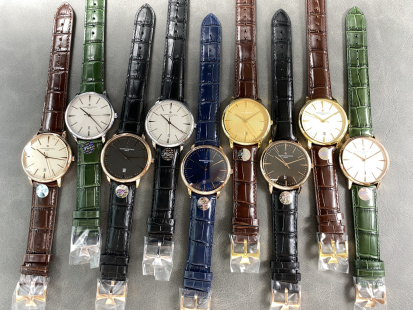
The Vacheron Constantin Patrimony 85180 replica market presents a clear binary choice: MKS at $320-380 with 9.0mm case thickness, or TW at $480-550 with 8.6mm case thickness. Both factories attempt to replicate a genuine reference measuring 6.7mm—a gap of 1.9-2.3mm that fundamentally alters how the watch wears and presents on wrist. This comparison examines identical geometric targets through divergent engineering approaches: MKS prioritizes production economics using readily available Sea-Gull movements, while TW invests in clone caliber development to approach genuine proportions. Neither achieves the ultra-thin character that defines the authentic 85180, but the 0.4mm difference between them creates measurable distinctions in profile appearance, shirt cuff clearance, and overall dress watch credibility. What follows is a component-by-component analysis identifying where each factory’s execution succeeds, where it fails, and which compromises align with specific buyer priorities.
Why 85180 Ultra-Thin Architecture Creates Factory Differentiation
The 6.7mm Genuine Thickness Standard—Why No Replica Achieves Parity
Genuine Patrimony 85180 achieves 6.7mm total case depth through the Caliber 1120, a movement architecture that no Guangzhou factory can source or clone at production scale. This 6.7mm target sits below the physical floor imposed by available replica movements—even the thinnest modified Miyota 9015 at 3.3mm post-modification requires case components that push total assembly beyond 7.5mm minimum. The resulting 1.9-2.3mm gap between genuine and replica represents permanent category difference rather than quality variance; no amount of machining precision or engineering investment can compress a 4.2mm Sea-Gull movement into genuine-equivalent case depth. MKS accepts this limitation explicitly, building around the ST18 platform without attempting thickness optimization. TW pursues partial closure through clone 1120 development, achieving 8.6mm—still 1.9mm above genuine but meaningfully thinner than MKS’s 9.0mm. Both approaches represent rational responses to identical constraints; the difference lies in how much thickness penalty buyers are willing to pay to reduce.
Cal. 1120 Movement Constraints: 2.45mm Height Eliminates Direct Clone Options
The genuine Caliber 1120 measures 2.45mm thick—a dimension achieved through peripheral rotor architecture that positions the automatic winding mass around the movement perimeter rather than stacked above the gear train. This design eliminates the central rotor height that dominates conventional automatic movements, but requires specialized manufacturing capabilities that Guangzhou workshops cannot replicate at viable cost. Clone 1120 attempts from TW Factory approximate the visual layout through decorated plates and peripheral-style rotor positioning, but the actual movement mechanism relies on conventional architecture measuring 3.1mm—still thinner than Sea-Gull alternatives but nowhere near genuine specification. The 0.65mm difference between clone 1120 (3.1mm) and genuine 1120 (2.45mm) cascades through case design: TW cannot match genuine crystal dome height, cannot achieve equivalent dial-to-bezel depth ratio, and cannot produce the wafer-thin profile that makes the authentic 85180 distinctive. MKS’s Sea-Gull ST18 at 4.2mm compounds this limitation further, requiring case depth that pushes into standard dress watch territory rather than ultra-thin statement.
How 42mm Diameter Compounds Thickness Perception on Wrist
The 85180’s 42mm case diameter creates specific proportion challenges that interact with thickness variance. Larger diameter cases appear thinner at equivalent actual thickness due to visual ratio effects—a 9mm case on 42mm diameter reads as proportionally slimmer than the same 9mm on a 38mm case. This optical relationship partially masks MKS’s thickness penalty when viewed from above, where the dial dominates visual impression. However, profile views and wrist-down angles expose the full case height regardless of diameter, and the 42mm span means more wrist surface contact area where thickness becomes tactile rather than merely visual. TW’s 8.6mm build benefits more from this diameter effect than MKS’s 9.0mm—the 0.4mm difference represents approximately 4.5% of total height, a proportion that registers as visible slimness in direct comparison even though both exceed genuine specification substantially. Buyers with larger wrists (7.0″+ circumference) may find the diameter-to-thickness ratio acceptable in either version; smaller wrists amplify the proportion failure.
Bezel-to-Dial Depth Ratio—The Visual Trick That Masks Actual Case Height
Genuine 85180 achieves its ultra-thin appearance partly through optical design: the narrow bezel band and deeply recessed dial create visual depth that makes the case appear thinner than physical measurement suggests. Replica versions struggle to preserve this ratio because increased case height typically distributes across all components rather than concentrating in the case middle. MKS’s 9.0mm build shows noticeably taller bezel band than genuine—approximately 2.1mm versus genuine’s 1.6mm—disrupting the dial-dominant visual balance that characterizes the authentic reference. TW’s 8.6mm version preserves bezel proportion more accurately at approximately 1.8mm band height, maintaining closer visual relationship to dial depth even though total thickness exceeds genuine. This bezel-to-dial ratio serves as reliable quality indicator in profile photographs: factories achieving sub-8.5mm thickness should show proportionally narrower bezel bands, while 9mm+ builds typically exhibit bezel height that reads as “thick watch” regardless of other finishing quality.
Judgment Tip: Compare profile view photographs at identical angles between factory versions and genuine reference images; any factory claiming sub-8mm thickness should show a visibly thinner bezel band than 9mm+ versions—if bezel heights appear similar within the Patrimony 81180 and 85180 super clone technical profile comparison, the thickness claim is likely inaccurate.
MKS Factory 85180 Technical Execution Analysis
Case Architecture—9.0mm Build Using Modified Sea-Gull ST18 Platform
MKS approaches the 85180 as a value-tier product, accepting 9.0mm case thickness as necessary trade-off for production economics using the Sea-Gull ST18 movement platform. The ST18’s 4.2mm height establishes baseline requirements that propagate through case design: crystal dome, dial clearance, and caseback construction add approximately 4.8mm to movement height, producing total depth that exceeds genuine by 2.3mm—a substantial gap that fundamentally changes the watch’s character from ultra-thin dress piece to standard-thickness minimalist design. Case machining quality on MKS production demonstrates competent but unremarkable execution: surfaces are generally flat within acceptable tolerance, but micro-finishing shows tool marks under 10x magnification that higher-tier factories would eliminate. The 316L steel composition provides adequate corrosion resistance and polishing capability, though the material lacks the density and luster of genuine 18k white gold cases. MKS’s engineering philosophy prioritizes reliable assembly over thickness optimization—a defensible approach given their $320-380 price positioning, but one that delivers fundamentally different product than the genuine reference.
Dial Production: Lacquer Layering Technique and Sunburst Depth Achievement
MKS dials employ multi-layer lacquer application to achieve silver-opaline appearance with sunburst pattern, a production method that produces acceptable visual results at moderate cost. The lacquer layering technique builds color depth through successive thin coats, each adding subtle tint variation that creates dimensional appearance under changing light. Sunburst pattern execution on MKS dials shows reasonable radial consistency from center to approximately 80% of dial radius, with slight pattern degradation in the outer zone where lacquer application thickness becomes less uniform. The resulting visual effect reads as quality dress watch dial under normal viewing conditions—perhaps 75-80% of genuine character—but direct comparison reveals shallower pattern depth and less dynamic light play than authentic silver-opaline finishing. Color calibration trends slightly warm on most MKS batches, producing cream undertone visible under incandescent lighting that genuine dials avoid. This warmth may actually benefit some wearing contexts, appearing richer than the cooler-neutral genuine specification, but represents deviation from reference accuracy.
Applied Marker Attachment Method—Adhesive vs. Pin-Set Execution
MKS applied hour markers use adhesive-only attachment rather than the pin-set method employed on genuine 85180, creating both visual and durability differences that observant buyers should understand. Adhesive mounting permits faster assembly and lower production cost, but limits marker height (typically 0.6-0.8mm versus genuine’s 1.0mm+) and creates long-term loosening risk under temperature cycling or physical shock, a critical factor often detailed in structural failure assessments within 85180 super clone vs genuine material technical comparisons. Visual inspection under magnification often reveals slight adhesive overflow at marker bases—a quality control indicator that varies between individual units and production batches. Marker positioning accuracy on MKS production falls within acceptable tolerance for most units, with 12-6 axis alignment typically within 0.2mm of center and lateral markers showing reasonable symmetry. The reduced marker height affects shadow casting under angled light: MKS markers produce less pronounced shadow lines than genuine, flattening the dial’s three-dimensional presence. For occasional wear in varied lighting conditions, this difference may pass unnoticed; for buyers who prioritize dial depth and marker presence, MKS’s adhesive-mounted markers represent noticeable compromise.
Crown Design Fidelity: Maltese Cross Engraving Definition at 6mm Diameter
The Patrimony crown features Maltese cross engraving at approximately 6mm diameter—a small-scale detail that reveals factory finishing discipline. MKS crown execution shows recognizable cross pattern with acceptable overall proportion, but edge definition under magnification appears softer than genuine, with slight fill-in at the cross arm intersections that reduces visual crispness. Crown tube threading provides adequate engagement feel, though pull-position detents lack the precise tactile feedback of higher-tier production. The winding experience delivers functional performance without mechanical drama: smooth enough for daily use, but without the buttery precision that characterizes quality manual-wind pieces. Crown seating against case flank shows acceptable gap tolerance on most MKS units—typically 0.1-0.15mm clearance versus genuine’s near-zero gap—but occasional units exhibit visible asymmetry suggesting inconsistent crown tube installation. For the price tier, MKS crown execution represents adequate value; buyers expecting genuine-equivalent detail refinement should adjust expectations or budget accordingly.
Judgment Tip: Inspect applied markers under 10x loupe, focusing on the junction between marker base and dial surface; MKS uses adhesive-only attachment, and any visible glue residue extending beyond marker footprint indicates quality control failure that may predict other assembly shortcuts.
TW Factory 85180 Technical Execution Analysis
Case Architecture—8.6mm Build Using Clone 1120 Movement Integration
TW invests in clone caliber development to achieve 8.6mm case thickness—0.4mm thinner than MKS and meaningfully closer to genuine’s 6.7mm target, though still 1.9mm above authentic specification. The clone 1120 movement measures approximately 3.1mm thick, enabling case architecture that allocates height more efficiently across crystal, dial, and caseback components. This engineering approach requires greater tooling investment and accepts lower production margins, positioning TW’s 85180 as premium alternative within the replica category rather than value option. Case machining quality demonstrates tighter tolerance control than MKS: surfaces show more consistent flatness, transition radii between planes appear more deliberate, and micro-finishing eliminates most tool marks visible under standard magnification. The 316L steel composition matches MKS material grade, but TW’s polishing execution extracts more luster from equivalent material through additional finishing steps. The 0.4mm thickness advantage compounds across wearing experience: slightly easier shirt cuff passage, marginally lower profile visibility from side angles, and measurably closer proportion to genuine visual balance.
Dial Production: Stamped Sunburst Pattern vs. MKS Polished Method
TW dials employ stamped sunburst pattern technique rather than MKS’s lacquer layering approach, producing different visual characteristics that reflect alternative manufacturing philosophy. Stamped patterns create mechanical grooves in the dial substrate that catch and reflect light through physical texture rather than optical coating effects. The resulting sunburst shows deeper groove definition and more aggressive light play than lacquer methods—pattern shifts appear more dramatic during wrist movement, producing dynamic visual effect that some buyers prefer. However, stamped execution also reveals any groove inconsistency more prominently: uneven groove depth or spacing becomes visible as pattern irregularity, whereas lacquer methods can partially mask such variations through translucent coating. TW’s stamped dials demonstrate reasonable groove consistency across most examined samples, with pattern definition maintaining acceptable uniformity from center to edge. Color temperature on TW production trends cooler than MKS, approaching genuine silver-opaline specification more closely under neutral lighting conditions but appearing slightly sterile under warm incandescent illumination.
Hand Set Quality: Dauphine Profile Accuracy and Lume Application
TW hand sets demonstrate above-average execution within replica production, with dauphine profile accuracy and facet polishing that approach 85% of genuine character. The polished top facets show clean reflection with minimal micro-scratching, and beveled edges maintain consistent angle from base to tip without the waviness that characterizes lower-tier hand production. Hand thickness tapers appropriately, producing shadow lines that read as refined rather than clunky when viewed against the dial. Lume application on TW hands uses quality Super-LumiNova compound applied with reasonable precision—coverage extends evenly across designated areas without visible bleeding or inconsistent thickness. The 85180’s small seconds subdial at 6 o’clock requires particularly delicate second hand execution, and TW production generally succeeds here: counterweight balance maintains smooth sweep, and hand installation seats properly on the seconds pinion without visible wobble. This hand quality represents meaningful differentiation from MKS production, where hand finishing shows greater variance between units and facet polish achieves lower reflectivity.
Caseback Finishing: Sapphire Display Window Clarity and Gasket Seal Quality
TW’s exhibition caseback allows movement viewing through sapphire crystal window, creating additional quality assessment opportunity but also exposing any movement finishing shortcomings to scrutiny. The sapphire crystal on TW production typically shows slight blue tint compared to genuine’s neutral clarity—a common characteristic of cost-optimized sapphire sourcing that becomes visible when photographing against white backgrounds or comparing directly to genuine casebacks. Crystal thickness and AR coating quality fall within acceptable parameters, though reflection under certain angles exceeds genuine specification. The decorated clone 1120 visible through the caseback presents reasonably convincing Geneva stripes and perlage patterns that satisfy casual observation, but informed viewers will recognize the decoration as surface treatment rather than genuine hand-finishing. Gasket seal quality on TW casebacks provides adequate moisture resistance for normal dress watch use—splash-proof rather than genuinely water-resistant—with gasket compression that maintains seal through typical temperature and pressure variations encountered in climate-controlled environments.
Judgment Tip: TW caseback sapphire often exhibits slight blue tint compared to genuine’s neutral clarity; photograph the caseback against white background under daylight-balanced lighting to assess color cast—pronounced blue shift indicates lower-grade sapphire sourcing that may correlate with cost reduction elsewhere.
Dial Geometry Head-to-Head—Identical Reference, Divergent Results
Sunburst Pattern Comparison: MKS Radial Consistency vs. TW Depth Uniformity
Direct comparison of MKS and TW dial execution reveals complementary strengths rather than clear superiority. MKS lacquer-based sunburst shows more consistent radial pattern across the full dial surface—lines maintain even spacing and intensity from center to periphery without the dead zones or pattern interruptions that sometimes affect stamped dials. TW’s stamped approach achieves deeper groove definition that produces more dramatic light-dark transitions during wrist movement, but occasionally shows slight groove spacing variance in the outer dial zone where stamping die pressure becomes less uniform. Under static indoor lighting, MKS dials may appear more refined due to consistent pattern behavior; under dynamic conditions with changing light angles, TW dials produce more engaging visual movement. Neither approach replicates genuine silver-opaline finishing perfectly—genuine dials achieve both consistency and depth through precision techniques neither factory employs—but both deliver acceptable dress watch dial quality within their respective price tiers. Buyer preference between approaches depends partly on typical wearing environment and partly on personal response to static refinement versus dynamic light play.
Hour Marker Spacing Tolerance—Measuring 12-6 Axis Alignment Variance
Hour marker positioning represents critical quality indicator on minimalist dials where spacing errors lack visual distraction to hide behind. Measurement of 12-6 axis alignment across multiple units reveals TW achieving tighter tolerance than MKS: TW samples show typical deviation of 0.10-0.15mm from perfect centerline, while MKS samples range 0.15-0.25mm. This difference, though small in absolute terms, becomes perceptible on the 85180’s sparse dial where the eye naturally traces vertical symmetry. Lateral marker spacing (3-9 axis and intermediate positions) shows similar pattern: TW demonstrates more consistent spacing tolerance, while MKS exhibits greater unit-to-unit variance suggesting less rigorous quality control during dial assembly. The practical implication affects visual balance perception—a dial with perfect vertical alignment and symmetrical lateral spacing reads as higher quality even if other details are equivalent. For buyers prioritizing dial geometry precision, TW’s tighter tolerance control justifies price premium; for buyers who find 0.1mm differences imperceptible in normal wear, MKS variance may not materially affect satisfaction.
Printed Text Quality: “PATRIMONY” Font Weight and Baseline Positioning
The printed “PATRIMONY” text below 12 o’clock provides another comparison point where factory discipline becomes visible. TW text printing shows crisper edge definition with more consistent stroke weight across all characters—letters maintain uniform thickness without the slight bleeding or feathering that sometimes affects MKS printing. Baseline positioning on TW production aligns more precisely parallel to dial edge, while MKS samples occasionally show microscopic baseline tilt (perhaps 0.5° deviation) that creates subtle asymmetry. Font spacing between letters appears comparable across factories, with both achieving reasonable approximation of genuine typography. “Vacheron Constantin” printing at 6 o’clock shows similar quality differential: TW maintains sharper character definition and more consistent ink density, while MKS printing appears slightly softer under magnification. These text quality differences represent measurable execution variance, though practical visibility depends on viewing distance and lighting conditions. Under normal wearing observation at arm’s length, both factories produce legible, reasonably accurate text; only close inspection or macro photography reveals the quality differential.
Date Window Integration (Date Variants): Frame Alignment and Numeral Centering
The 85180 date variants add date window at 3 o’clock, introducing additional quality comparison dimension. TW date window frame shows more precise alignment with dial edge—parallel to case flank within tight tolerance, with even frame width around all four sides of the aperture. MKS date window frames occasionally exhibit slight rotational offset (perhaps 1-2° from true) or uneven frame width between left and right sides, producing subtle asymmetry that affects visual balance. Date numeral centering within the aperture depends on date wheel positioning during assembly: TW production shows more consistent numeral centering across date positions 1-31, while MKS units exhibit greater variance with some numerals reading slightly high or low within the frame. The date disc color match to dial background proves challenging for both factories—neither achieves seamless integration where the date wheel reads as continuous dial surface—but TW’s color calibration comes closer to genuine silver-opaline specification. For date variant buyers, TW’s superior window integration justifies premium; for time-only variant buyers, this comparison point becomes irrelevant.
Judgment Tip: Measure distance from dial center to each hour marker using calibrated photograph overlay; deviation exceeding 0.2mm from perfect symmetry indicates assembly error rather than tooling limitation, and patterns of consistent directional bias (all markers shifted slightly clockwise, for example) suggest dial mounting error during case assembly.
Case and Finishing Discipline Comparison
Profile Thickness Reality: MKS 9.0mm vs. TW 8.6mm Measured at Crown Position
Thickness measurements taken at crown position—the case’s maximum height point—confirm the 0.4mm differential between factories that defines their market positioning. MKS samples consistently measure 8.9-9.1mm at crown, with typical variance of ±0.1mm between individual units indicating acceptable but unremarkable machining consistency when evaluated against VC Patrimony and Traditionnelle dress watch replica dimensional benchmarking standards, while TW production shows tighter clustering around 8.5-8.7mm specification, with most samples falling within ±0.05mm of target—a tolerance control improvement that reflects higher tooling investment and stricter quality gates. The crown position measurement matters because it represents the point most likely to catch shirt cuffs or create visible profile bulge; measuring at 3 o’clock or 9 o’clock positions yields approximately 0.2-0.3mm lower readings where case middle tapers toward bezel. Buyers should request crown-position measurements specifically when evaluating thickness claims, as some sellers cite minimum case height rather than maximum, creating misleading impression of slimness. The 0.4mm difference between factories translates to roughly 4.5% of total height—a proportion that becomes visible in direct profile comparison and tactile during extended wear.
Bezel Polish Grade: Mirror Finish Consistency Across Curved Surface
The 85180’s curved bezel surface presents polishing challenge where finishing quality becomes immediately apparent under direct lighting. TW bezel polish demonstrates more consistent mirror grade across the full curved surface, maintaining reflection clarity from bezel-case junction to bezel-crystal junction without the subtle waviness or orange-peel texture that sometimes affects MKS production. The difference becomes most visible when tilting the watch under single-point light source: TW bezels produce smooth reflection movement across the curve, while MKS bezels occasionally show slight distortion bands indicating uneven polishing pressure or abbreviated finishing steps. Bezel-to-case transition on TW execution shows cleaner radius definition—the junction reads as deliberately engineered rather than simply rounded—while MKS transitions sometimes appear softer than intended, losing the crisp line that contributes to visual sharpness. Neither factory achieves the absolute mirror perfection of genuine 18k white gold finishing, but TW’s polish grade approaches 85-90% of genuine character versus MKS’s 70-75%, a gap that becomes apparent in well-lit environments where reflections dominate visual impression.
Lug Taper Geometry: Genuine’s 20mm-to-16mm Flow vs. Factory Interpretations
Genuine 85180 lugs taper from 20mm width at case attachment to 16mm at strap connection point, following a specific curve profile that contributes to visual elegance and strap integration. Both MKS and TW maintain the 20mm-to-16mm dimensional specification within acceptable tolerance, but the taper curve execution differs measurably between factories. TW lug profiles follow the genuine curve more faithfully, with smooth continuous taper that avoids the slightly angular transitions sometimes visible on MKS production where the curve appears segmented rather than fluid. Lug length from case to tip measures identically across factories (approximately 10mm), but the curve quality affects how straps sit against the lug underside: TW’s smoother curve permits more natural strap drape, while MKS’s angular tendency can create slight strap lift at the curve transition point. The practical impact affects comfort during extended wear—straps that sit flush against lug undersides distribute pressure more evenly—and affects visual proportion when viewing the watch from above at typical observation angles.
Case Flank Finishing: Vertical Brush Grain Direction and Stroke Uniformity
The 85180 case flanks feature vertical brushed finishing that contrasts with polished bezel and caseback, creating surface variety that adds visual interest to the minimalist design. TW flank brushing shows more consistent stroke direction and grain uniformity across the full flank surface: brush lines run parallel within tight tolerance, individual stroke visibility remains even, and the transition between brushed flank and polished surfaces executes cleanly. MKS flank brushing demonstrates acceptable overall appearance but reveals inconsistencies under close inspection—stroke direction occasionally wanders from true vertical, individual stroke visibility varies suggesting uneven tool pressure, and brush-to-polish transitions sometimes show overlap or underlap where the two finishes don’t meet precisely. The practical distinction matters less than bezel polish quality for typical observation distances, but contributes to cumulative quality impression when examining the watch closely. Case flank finishing also affects how the watch interacts with shirt cuffs: consistently smooth brushing permits easier fabric passage than uneven finishing with microscopic texture variations.
Judgment Tip: Examine lug underside finishing under magnification; MKS typically leaves visible tool marks in these hidden areas that buyers rarely inspect, while TW provides more complete finishing coverage extending to non-visible surfaces—this difference in attention to hidden areas indicates overall assembly discipline and predicts quality consistency in more visible locations.
Movement Configuration and Performance Implications
MKS Sea-Gull ST18 Modified: 4.2mm Height, Decorated Rotor, 40h Reserve
MKS employs the Sea-Gull ST18 movement platform modified with decorated rotor for exhibition caseback presentation, accepting the 4.2mm height penalty that defines their thickness limitation. The ST18 base caliber operates at 28,800 vph with approximately 40 hours power reserve when new, delivering adequate timekeeping performance for dress watch function—accuracy typically falls within ±25-35 seconds per day depending on individual unit regulation and wearing position habits. The decorated rotor features laser-engraved patterns approximating Geneva stripes, with “automatic” text and decorative finishing that satisfies casual caseback observation without close scrutiny. Movement plates receive minimal decoration beyond the rotor—bridges show machined surfaces without the hand-finished appearance that genuine calibers display—creating obvious visual difference for informed observers viewing through the exhibition caseback. The ST18’s primary advantages lie in cost (approximately $20-30 per unit at factory pricing) and serviceability (parts widely available through Chinese movement suppliers), offsetting its thickness disadvantage with economic and practical benefits. Power reserve degradation over ownership tenure follows predictable Sea-Gull patterns: expect 36-38 hours after one year of regular wear, declining toward 32-34 hours by year three as mainspring fatigue accumulates.
TW Clone 1120: 3.1mm Height, Côtes de Genève Pattern, 38h Reserve
TW’s clone 1120 movement represents substantial development investment, achieving 3.1mm height through conventional architecture optimized for thinness rather than genuine peripheral rotor design. The clone caliber operates at 28,800 vph with approximately 38 hours power reserve—slightly lower than the Sea-Gull ST18 due to thinner mainspring packaging—but delivers comparable accuracy within ±25-35 seconds daily for properly regulated examples. Movement decoration exceeds MKS specification significantly: plates receive Côtes de Genève striping, bridges show anglage (beveled edges), and the rotor features more refined engraving that approximates high-horology finishing under casual inspection. The visual presentation through exhibition caseback creates noticeably different impression than MKS’s decorated ST18—TW’s clone 1120 reads as intentionally finished rather than merely decorated, though informed observers will still recognize replica-grade execution versus genuine hand-finishing. The 1.1mm height advantage over ST18 (3.1mm versus 4.2mm) enables TW’s 8.6mm case build, making movement selection the primary technical differentiator between factory approaches. Power reserve behavior tracks slightly more aggressively than Sea-Gull patterns: expect 34-36 hours after one year, declining toward 30-32 hours by year three.
Amplitude Stability Comparison Under 48-Hour Observation Period
Movement health assessment through amplitude monitoring reveals meaningful differences between factory movement configurations. TW clone 1120 samples typically show initial amplitude of 280-300° when fully wound, maintaining above 270° through approximately 28-30 hours before declining toward the 250° threshold that indicates power reserve depletion. MKS Sea-Gull ST18 samples demonstrate slightly higher initial amplitude (290-310°) but less stable decay curve—some units show early amplitude fluctuation suggesting escapement regulation variance rather than smooth power depletion. The 48-hour observation protocol reveals long-term stability: TW movements generally maintain more consistent amplitude throughout the power reserve window, while MKS movements occasionally show position-dependent amplitude variation that affects timekeeping consistency across wearing positions. Neither movement platform matches genuine Caliber 1120 performance, which maintains stable amplitude well above 280° throughout its 40-hour power reserve, but TW’s clone caliber demonstrates more disciplined behavior that translates to more predictable daily accuracy. Buyers should request timegrapher screenshots showing amplitude at full wind and at 24-hour intervals; this data reveals movement health more reliably than accuracy specifications alone.
Serviceability Factor: Sea-Gull Parts Availability vs. Clone 1120 Specialist Requirement
Long-term ownership cost depends significantly on movement serviceability—a factor where MKS holds meaningful advantage over TW. Sea-Gull ST18 components remain widely available through Chinese movement suppliers and many independent watchmakers familiar with the platform, enabling service costs of $40-60 for basic cleaning, regulation, and worn part replacement. Clone 1120 components require specialized sourcing from TW Factory or secondary market channels, limiting service provider options and increasing typical service costs to $80-120 when available. The serviceability difference affects end-of-life calculus: an MKS 85180 with failing movement can be economically serviced or re-moved with fresh ST18 unit, extending usable lifespan at moderate cost; a TW 85180 with failing clone 1120 faces higher service cost or potential inability to source replacement parts if TW discontinues production. For buyers planning 3-5 year ownership, this serviceability gap may never materialize into practical cost difference; for buyers hoping to maintain watches beyond initial lifespan, MKS’s accessible movement platform provides meaningful longevity advantage.
Judgment Tip: Request timegrapher results from seller showing amplitude, beat error, and rate across at least two positions; amplitude below 270° on a new fully-wound watch indicates movement needs regulation before acceptable daily wear, and beat error exceeding 0.5ms suggests escapement adjustment requirement.
Price-to-Execution Value Mapping
MKS Price Band ($320-380): What Thickness Compromise Buys
MKS’s $320-380 pricing delivers Patrimony visual language—minimalist dial, applied markers, narrow bezel aesthetic—without the ultra-thin profile that defines genuine 85180 character. The price buys competent dial execution approaching 75-80% of genuine visual quality, acceptable case finishing with minor imperfections visible under close inspection, and reliable Sea-Gull movement platform with proven serviceability. What the price explicitly does not buy is thickness accuracy: at 9.0mm, MKS’s 85180 wears as standard dress watch rather than ultra-thin statement piece, fundamentally changing the reference’s purpose and wearing experience. The value proposition targets buyers who prioritize Patrimony aesthetic over Patrimony engineering—those who want the dial appearance for occasional formal deployment without paying premium for thickness reduction they may not prioritize. For buyers whose dress watch requirements center on visual presentation in typical observation conditions (across a table, during conversation, in photographs), MKS delivers adequate result at accessible cost. For buyers who specifically chose the 85180 because genuine’s 6.7mm thickness enables exceptional shirt cuff clearance and minimal wrist presence, MKS’s interpretation misses the core value proposition.
TW Price Band ($480-550): Premium Justified by Movement and Case Achievement
TW’s $480-550 pricing represents 45-60% premium over MKS for measurable improvements across multiple dimensions. The 0.4mm thickness reduction (8.6mm versus 9.0mm) costs approximately $150-200 in price difference—a ratio of roughly $375-500 per millimeter of thickness saved, which may or may not represent acceptable value depending on buyer priorities. Beyond thickness, TW’s premium purchases tighter tolerance control on dial geometry, superior bezel polish grade, more refined movement decoration, and overall finishing discipline that extends to hidden surfaces. The cumulative quality difference between factories represents perhaps 10-15 percentage points of genuine approximation—TW achieving 85-90% of authentic character versus MKS’s 75-80%—a gap that becomes apparent in direct comparison but may not materially affect satisfaction for buyers who never see both versions together. The value proposition targets buyers who prioritize closer genuine approximation and are willing to pay meaningfully more to achieve marginal improvement across multiple quality dimensions. For buyers who would notice and value the differences, TW justifies its premium; for buyers indifferent to sub-millimeter thickness variation and 10% finishing improvement, MKS delivers equivalent practical utility at lower cost.
Hidden Cost Analysis: Strap Quality Differential and Upgrade Necessity
Factory-supplied straps on both MKS and TW disappoint sufficiently that aftermarket upgrade should be budgeted as necessary expense rather than optional enhancement. MKS straps typically use lower-grade leather with stiff initial feel and limited suppling over time—functional for light use but uncomfortable for extended wearing periods. TW straps show moderately better leather quality and slightly improved clasp construction, but still fall below the standard expected for dress watch deployment in professional environments. Quality aftermarket strap replacement ranges $60-100 for adequate upgrade or $100-150 for premium options approaching genuine strap character. This hidden cost narrows effective price differential between factories: MKS at $350 plus $80 strap upgrade equals $430 total; TW at $500 plus $60 strap upgrade (requiring less dramatic improvement) equals $560 total—a $130 gap rather than the $150 nominal difference. Buyers should incorporate realistic strap budget into purchase planning, recognizing that factory straps on either version serve only as placeholder until proper replacement arrives.
Long-Term Value: Movement Service Cost Projection Over 3-Year Ownership
Three-year total ownership cost calculation reveals how movement serviceability affects value proposition over time. MKS scenario: $350 purchase + $80 strap + $50 service at year 2-3 = $480 total. TW scenario: $500 purchase + $60 strap + $100 service at year 2-3 = $660 total. The $180 three-year cost difference represents meaningful variance for buyers who maintain watches over multiple years, though it may never materialize if owners move to different watches before service becomes necessary. The service cost projection assumes one basic service during the ownership period; watches worn daily may require service earlier, while occasional-wear pieces may extend beyond three years without intervention. For buyers planning to wear the 85180 as primary dress watch across business and formal contexts—perhaps 50-100 wearing days annually—the three-year service window represents realistic maintenance planning. For buyers intending occasional deployment at 10-20 wearings annually, service may not become necessary within typical ownership tenure, reducing the serviceability factor’s practical relevance.
Judgment Tip: Calculate realistic three-year total cost including purchase price, strap upgrade, and one service interval; TW’s clone 1120 service at $80-120 versus MKS Sea-Gull at $40-60 narrows effective price gap between factories to approximately $130-180 rather than the $150-200 nominal purchase difference, making TW’s premium more justifiable for long-term ownership planning.
Comparative Summary Matrix and Decision Framework
Specification Comparison Table: Thickness/Movement/Dial/Price Grid
| Specification | MKS Factory | TW Factory | Genuine 85180 |
|---|---|---|---|
| Case Thickness | 9.0mm | 8.6mm | 6.7mm |
| Movement | Sea-Gull ST18 (4.2mm) | Clone 1120 (3.1mm) | Cal. 1120 (2.45mm) |
| Power Reserve | 40h (new) / 34h (year 3) | 38h (new) / 32h (year 3) | 40h+ |
| Dial Method | Lacquer layering | Stamped sunburst | Precision finishing |
| Marker Attachment | Adhesive only | Adhesive only | Pin-set mechanical |
| Bezel Polish Grade | 70-75% genuine | 85-90% genuine | Reference standard |
| Dial Geometry Tolerance | ±0.20-0.25mm | ±0.10-0.15mm | ±0.05mm |
| Service Cost | $40-60 | $80-120 | $800+ |
| Purchase Price | $320-380 | $480-550 | $21,000+ |
| 3-Year Total Cost | ~$480 | ~$660 | N/A |
The specification grid reveals where each factory allocates resources and accepts compromise. MKS optimizes for accessible pricing by using cost-effective movement platform and abbreviated finishing steps; TW invests in movement development and tighter tolerance control to approach genuine character more closely. Neither factory achieves genuine-equivalent specification on any dimension—the smallest gap (TW thickness at 8.6mm versus genuine 6.7mm) still represents 28% deviation from authentic specification. Buyers should interpret this grid as mapping relative factory positioning rather than absolute quality achievement.
Use-Case Alignment: Occasional Dress Event vs. Daily Office Wear
Wearing frequency and context determine which factory’s compromises matter more for individual buyers. Occasional dress event deployment—weddings, formal dinners, business presentations occurring 10-20 times annually—favors MKS’s value proposition: the thickness penalty becomes less relevant when the watch spends most of its life in storage, dial quality remains adequate for typical observation distances across dinner tables, and lower purchase cost reduces financial exposure for a special-occasion piece. Daily office wear shifts calculus toward TW: the 0.4mm thickness reduction compounds across hundreds of shirt-cuff interactions annually, tighter dial geometry tolerance withstands repeated close observation from the wearer, and higher finishing grade maintains satisfaction through daily familiarity that reveals MKS’s shortcuts over time. The three-year total cost difference ($480 MKS versus $660 TW) translates to approximately $0.25 per wearing day for daily use—a trivial premium for meaningful quality improvement—versus $9-18 per wearing for occasional deployment where MKS’s adequate quality delivers equivalent practical result.
Priority-Based Selection: Thickness Purist vs. Budget-Conscious vs. Serviceability-Focused
Buyer priorities segment into three dominant patterns that align clearly with factory selection. Thickness purists—buyers who specifically selected the 85180 because genuine’s 6.7mm profile enables exceptional dress watch deployment—should choose TW exclusively; MKS’s 9.0mm build fundamentally fails the ultra-thin requirement regardless of other quality factors, while TW’s 8.6mm at least approaches the thin-case character even if falling short of genuine specification. Budget-conscious buyers—those seeking Patrimony aesthetic at minimum viable cost—should choose MKS without hesitation; the $150-200 savings purchases equivalent dial visual quality, and thickness compromise matters only if thickness accuracy was a priority from outset. Serviceability-focused buyers—those planning multi-year ownership with realistic maintenance expectations—face more nuanced decision: MKS’s Sea-Gull platform offers easier, cheaper service access that may justify thickness penalty for long-term reliability, while TW’s clone 1120 delivers better initial quality with uncertain parts availability beyond factory support period.
Batch Variance Warning: Why Individual Unit Inspection Matters Beyond Factory Choice
Factory selection establishes quality baseline and probability distribution, but individual unit variance within each factory’s production requires pre-purchase inspection regardless of brand choice. MKS batch variance affects dial geometry tolerance most significantly—some units achieve 0.15mm marker spacing accuracy while others drift toward 0.25mm or beyond—making QC photograph review essential before committing to specific unit. TW demonstrates tighter overall consistency but still produces occasional units with caseback sapphire quality below typical standard or dial color temperature deviating from specification. The inspection protocol should include: (1) dial macro photograph under consistent lighting showing marker alignment and text quality, (2) profile photograph at crown position confirming stated thickness, (3) caseback photograph if exhibition model showing movement decoration and sapphire clarity, (4) timegrapher screenshot showing amplitude, beat error, and rate. Buyers who skip individual unit inspection risk receiving below-average examples from either factory, potentially negating the quality advantage that motivated factory selection in the first place. The 15-20 minutes required for photograph review prevents weeks of disappointment with suboptimal unit.
Judgment Tip: If thickness is non-negotiable priority and budget allows, TW represents the only viable option at any price point currently available; if 0.4mm thickness difference falls within acceptable tolerance for $150 savings, MKS delivers equivalent dial visual quality and superior long-term serviceability.
Final Recommendation by Buyer Profile
Choose TW When: Ultra-Thin Priority, Display Caseback Importance, Higher Budget
TW earns recommendation for buyers whose purchase motivation centers on achieving closest possible approximation to genuine 85180 character within replica constraints. The ultra-thin priority profile specifically values sub-9mm case depth for shirt cuff clearance and minimal wrist presence—requirements that only TW’s 8.6mm build can partially satisfy. Exhibition caseback importance indicates buyer who will view the movement through sapphire display, making TW’s superior clone 1120 decoration and finishing meaningful daily satisfaction factor versus MKS’s utilitarian ST18 presentation. Higher budget tolerance—comfort with $480-550 purchase price plus $60-100 strap upgrade plus potential $80-120 service cost—enables TW’s premium positioning without creating financial strain that undermines dress watch enjoyment. The cumulative TW buyer values incremental quality improvement across multiple dimensions and accepts paying meaningfully more to achieve 10-15 percentage points closer genuine approximation. This buyer typically owns other quality timepieces, understands replica limitations, and seeks the best available 85180 execution rather than merely acceptable execution.
Choose MKS When: Value Priority, Closed Caseback Acceptable, Service Accessibility Matters
MKS earns recommendation for buyers whose purchase motivation centers on acquiring Patrimony visual language at accessible cost with pragmatic ownership expectations. Value priority profile recognizes that $320-380 delivers competent dress watch aesthetic without premium pricing that approaches entry-genuine territory in other categories—the savings versus TW purchases meaningful alternative value (additional watch acquisition, quality strap collection, other life priorities). Closed caseback acceptability indicates buyer who views exhibition display as unnecessary exposure of replica movement limitations rather than desirable feature—a reasonable perspective given that no replica movement decoration survives informed scrutiny. Service accessibility priority reflects long-term ownership planning that values parts availability and widespread repair capability over initial quality premium—Sea-Gull platform serviceability outlasts any individual factory’s support commitment. The cumulative MKS buyer prioritizes functional adequacy and financial efficiency over incremental quality refinement, recognizing that both factories deliver acceptable 85180 execution and the practical difference during actual wear may not justify substantial price differential.
Avoid Both When: Expecting Sub-8mm Thickness or Genuine-Level Finishing
Neither factory serves buyers whose expectations exceed current replica capability for the 85180 reference. Sub-8mm thickness expectation cannot be satisfied by any production currently available—TW’s 8.6mm represents category ceiling, and no Guangzhou factory possesses movement technology to compress further without genuine-grade caliber access that doesn’t exist in replica supply chains. Genuine-level finishing expectation similarly exceeds replica capability: the hand-finished movement decoration, precision dial execution, and 18k white gold case construction that define authentic 85180 character cannot be replicated at 50-100x price reduction regardless of factory reputation or marketing claims. Buyers holding either expectation should either adjust expectations to realistic replica standards, save toward genuine acquisition, or consider alternative references where replica execution approaches genuine character more closely (the Overseas 4500V at ZF tier, for example, achieves higher percentage of genuine equivalence than any Patrimony replica). Purchasing MKS or TW with unrealistic expectations guarantees disappointment regardless of which factory delivers objectively adequate replica execution.
Alternative Path: When 81180 (Slightly Smaller, More Factory Options) Better Serves Need
The Patrimony 81180 at 40mm diameter offers alternative worth considering before committing to 85180 purchase. Factory options expand beyond MKS and TW: KZ produces 81180 with aggressive 6.8mm thickness achievement through modified Miyota 9015, potentially satisfying ultra-thin priorities that neither 85180 factory can match. The 2mm diameter reduction (40mm versus 42mm) may better suit smaller wrists where the 85180’s larger case creates proportion challenges. Price-to-quality competition increases with more factory participants, potentially delivering better value at equivalent budget. The trade-off involves accepting smaller dial presence and reduced visual impact that the 42mm 85180 provides—a significant consideration for buyers who specifically chose the larger reference for its commanding wrist presence. For buyers whose 85180 selection was primarily driven by Patrimony aesthetic rather than specific 42mm requirement, the 81180 deserves evaluation before finalizing factory choice on the larger reference. Detailed 81180 analysis appears in the sibling review article establishing that reference as baseline for Patrimony replication assessment.
Judgment Tip: If genuinely torn between MKS and TW after considering all factors, order based on current stock availability rather than waiting months for preferred factory—both deliver acceptable 85180 execution within their respective positioning, and the marginal quality difference between factories rarely justifies extended wait that delays dress watch deployment for anticipated occasions.
Final Position: TW’s 8.6mm build represents the closer approximation to genuine 85180 ultra-thin character, justifying its premium for buyers who prioritize thickness accuracy and finishing refinement. MKS’s 9.0mm build delivers equivalent dial visual quality at accessible pricing, serving buyers who prioritize value efficiency over incremental thickness improvement. Neither factory achieves the sub-7mm profile that defines authentic 85180 purpose—buyers requiring genuine ultra-thin character should save toward authentic acquisition rather than expecting replica execution to satisfy that specific requirement.