
The Critical Overlook: Why Lug-to-Lug Dominates Panerai Replica Fit
When you’re eyeing a Panerai replica, it’s easy to get fixated on the headline number: case diameter. A 44mm Luminor sounds substantial, a 47mm Radiomir even more so. But that single dimension, often the primary marketing point for replica factories, tells a deeply incomplete story about how the watch will actually sit on your wrist, where factors like Panerai replica strap comfort are equally vital. For Panerai, a brand known for its commanding presence and distinctive case shapes, the true arbiter of fit and comfort isn’t the width of the case, but the linear distance from lug tip to lug tip – the lug-to-lug measurement.
The Deception of Diameter: Why Case Size Alone Fails
Replica manufacturers, much like their genuine counterparts, frequently lead with case diameter as the defining characteristic. This is an easy number to market and grasp. However, for a brand like Panerai, whose design language often features prominent, sometimes straight, lugs, relying solely on diameter is a recipe for disappointment. A 44mm Panerai can wear significantly larger than a 44mm Submariner, not because of the case itself, but because of how far its lugs stretch across your wrist. Buyers, captivated by the case size, often overlook this crucial dimension, leading to watches that look awkwardly oversized or feel unstable on the wrist.
The Unseen Influence: How Lug-to-Lug Defines On-Wrist Presence
Think of your wrist not as a cylinder, but as a flat plane where the watch rests. The lug-to-lug measurement directly correlates to how much of that flat surface the watch occupies. If the lugs extend beyond the natural flat width of your wrist, you’re going to experience what’s commonly known as “overhang.” This doesn’t just look visually unbalanced; it can compromise comfort, causing the watch to wobble, dig into your wrist, or sit improperly. It’s the difference between a watch that integrates with your wrist and one that perches precariously on top of it.
Panerai’s Unique Challenge: The Lug Design Factor
Panerai’s design DNA often includes lugs that are either quite straight and integrated into the cushion case (Luminor) or distinctive wire lugs (Radiomir). These designs, while iconic, mean the overall lug-to-lug distance can be surprisingly long relative to the case diameter. Unlike watches with highly articulated or steeply downward-curving lugs that can effectively shorten their perceived footprint, many Panerai models present a more rigid, expansive profile. This makes understanding and accounting for the lug-to-lug measurement not just important, but absolutely critical for any Panerai replica buyer looking to avoid an ill-fitting watch.
Expert Authentication Insight
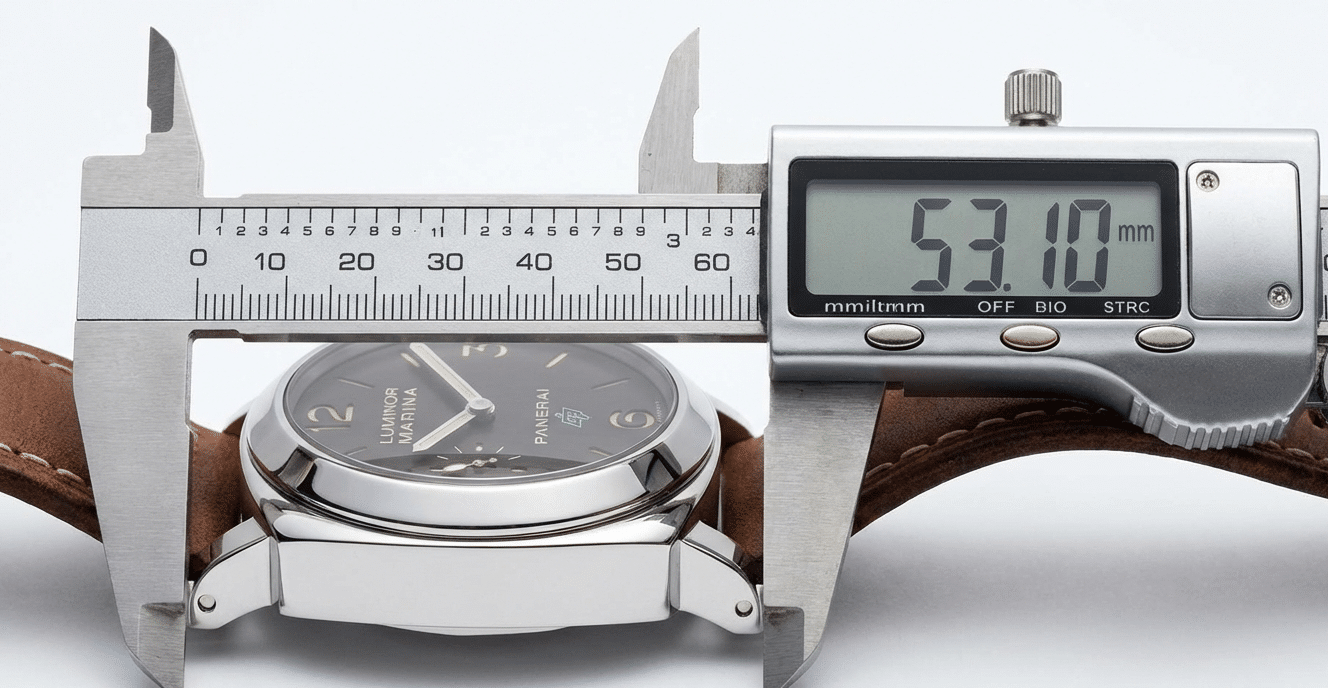
To truly assess a Panerai replica’s fit potential, a digital caliper is indispensable. Precisely measure the lug-to-lug distance of the replica in question. Then, cross-reference this against the known lug-to-lug of an authentic Panerai model of the same reference. Pay close attention to any deviations. Even a 1-2mm difference in lug length on a replica can drastically alter the on-wrist feel and visual balance, pushing a borderline fit into uncomfortable overhang territory. This physical diagnostic can expose manufacturing shortcuts or design inaccuracies that marketing photos often obscure.
Measuring Your Wrist: The Foundation of Panerai Replica Compatibility
Before you even start browsing Panerai replica models, you need to understand your own wrist. This isn’t about vanity; it’s about practical ergonomics. Just as a good suit is tailored to your body, a well-fitting watch complements your wrist’s unique dimensions. Guessing leads to regret, especially with Panerai’s often generous proportions. Taking accurate measurements of your wrist is the foundational step to predicting how any given replica will actually wear.
Wrist Circumference vs. Wrist Width: What Truly Matters
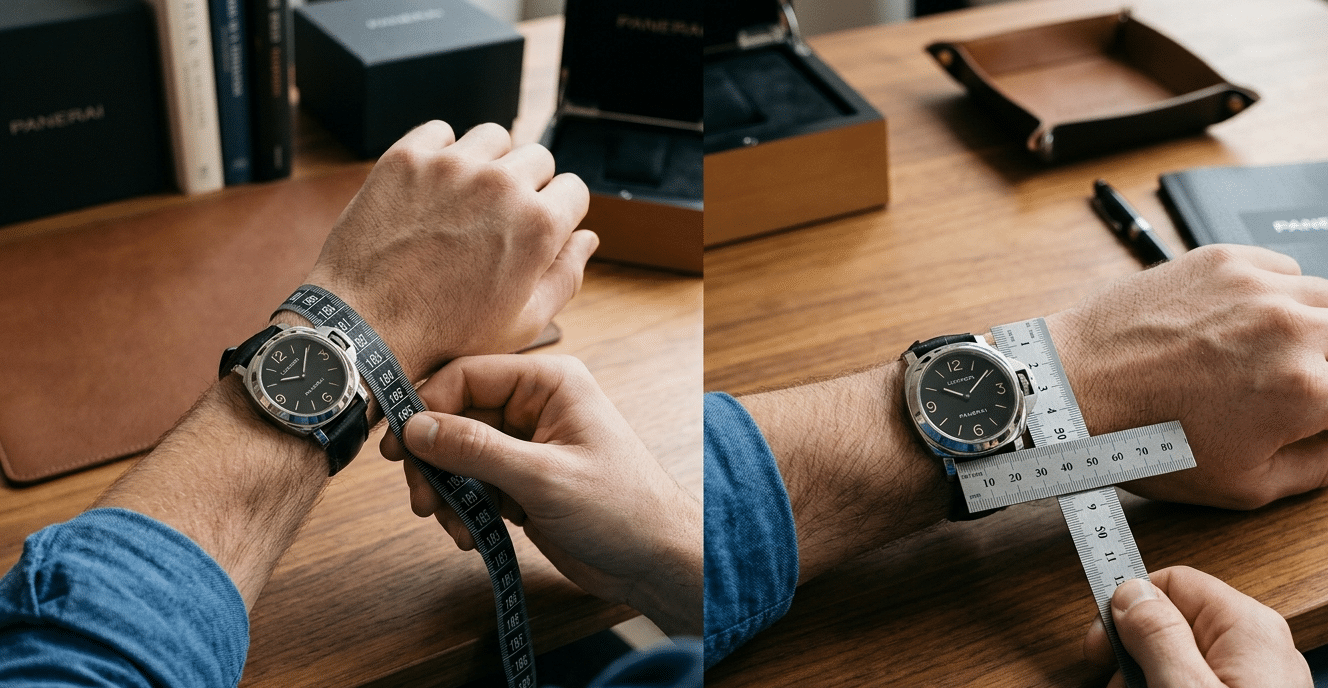
Most people instinctively measure their wrist circumference. While useful for strap sizing, circumference alone is a poor indicator of how a watch’s case will fit. A 7-inch wrist can be flat and wide, or round and narrow. For lug-to-lug purposes, the critical metric is your wrist’s flat width at the point where you wear your watch. This is the actual surface area the watch’s lugs need to sit on without extending past the edge. A watch with a lug-to-lug dimension exceeding your wrist’s flat width will inevitably overhang, regardless of your overall circumference.
Flat vs. Round Wrists: Panerai’s Different Demands
The shape of your wrist significantly impacts how a watch wears. A flatter wrist provides a broader surface for the lugs to rest upon, making it more forgiving for watches with longer lug-to-lug distances. Conversely, a rounder wrist, even if it has the same circumference as a flat one, offers less flat surface, exacerbating overhang issues. For Panerai replicas, which often feature substantial lug-to-lug measurements, understanding your wrist shape is paramount. A Luminor that looks acceptable on a flat 6.5-inch wrist might look comically large on a round 6.5-inch wrist, simply because the effective flat width is different.
The “Sweet Spot” Rule for Lug-to-Lug
While personal preference plays a role, a widely accepted guideline for optimal watch fit is that the watch’s lug-to-lug distance should ideally be less than or equal to your wrist’s flat width. This ensures the lugs remain within the confines of your wrist, preventing unsightly overhang and promoting a more secure, comfortable fit. For Panerai replicas, this rule becomes an essential filter. If a model’s lug-to-lug exceeds your flat wrist width, it’s a strong indicator that it will not wear well, regardless of how appealing the case diameter might seem.
Expert Authentication Insight
To get a precise read on your wrist, use a flexible measuring tape to find your circumference at the wearing point. More importantly, place your wrist flat on a table, palm up. Use a flat ruler or another straight edge positioned on either side of your wrist bones to mark the widest flat point. Then, measure the distance between these two points with a rigid ruler or digital caliper. This gives you your critical flat wrist width. Compare this measurement directly to the lug-to-lug data for specific Panerai replica models. If your flat wrist width is 50mm, and a replica has a 55mm lug-to-lug, you already know it’s a problematic fit.
Panerai Replica Case Geometries and Their Lug-to-Lug Implications
Panerai isn’t a one-size-fits-all brand when it comes to case design. While the cushion shape is iconic, the nuances of lug integration and case profile vary significantly across its collections. These variations directly influence the effective lug-to-lug distance and, consequently, how a Panerai replica will wear on your wrist. Understanding these geometric distinctions is key to predicting fit beyond just raw numbers.
Luminor Cases: Straight Lugs and Bold Proportions
The classic Luminor case, particularly the 1950s variants, is characterized by its robust, integrated lugs that often extend in a relatively straight line from the case. This design contributes significantly to the overall lug-to-lug measurement, often making these watches wear larger than their diameter suggests. Because the lugs typically don’t curve sharply downwards, they demand a wider, flatter wrist to avoid pronounced overhang. For Luminor replicas, especially the 44mm and 47mm models, this straight lug geometry means their substantial lug-to-lug is a primary factor in determining compatibility.
Radiomir Cases: Wire Lugs and Curvature Nuances
The Radiomir, with its historical wire lugs, might initially appear to have a more compact footprint. However, this isn’t always the case. While the wire lugs themselves are slender, their attachment point and the overall length from the case edge can still result in a considerable lug-to-lug. Furthermore, the angle and slight curvature of these wire lugs can vary between genuine models and, crucially, between replica factories. A poorly executed Radiomir replica might have wire lugs that are too straight or too long, leading to the same overhang issues as a Luminor, despite the seemingly more delicate lug design.
Submersible and Due: Modern Interpretations and Lug Integration
Panerai’s more contemporary lines, such as the Submersible and Luminor Due, sometimes feature more sophisticated lug integration. Submersible models, with their tool-watch robustness, often have substantial cases with lugs that might be slightly more integrated or feature a more pronounced downward curve to help them hug the wrist. The Luminor Due, designed to be a thinner, more elegant Panerai, often incorporates lugs with a steeper downward angle, subtly reducing the effective lug-to-lug and improving wearability, allowing it to sit more snugly on a wider range of wrists. Replica factories must accurately replicate these subtle curves to maintain the intended wearability.
Expert Authentication Insight
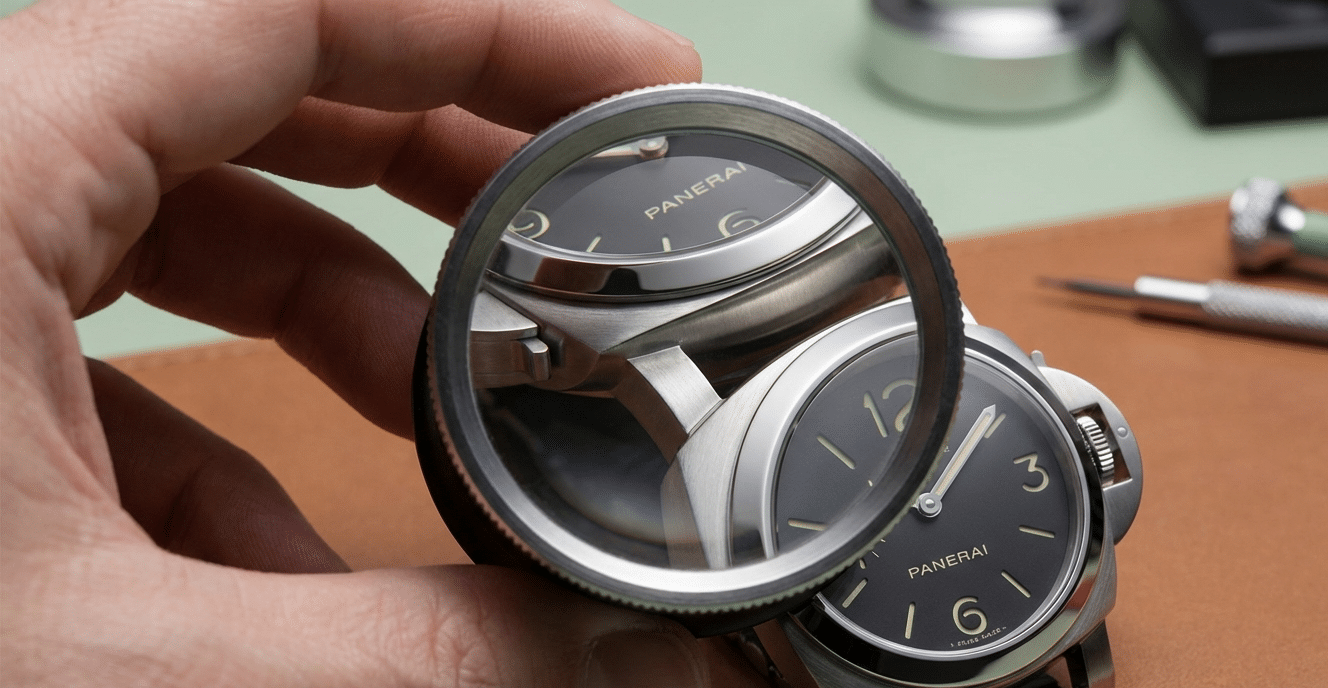
To scrutinize a Panerai replica’s case geometry, a loupe (10x magnification) is essential. Pay close attention to the transition point where the lugs meet the case, and the angle of their downward curve relative to the caseback. Compare these details meticulously with high-resolution images of genuine Panerai models. For a detailed Luminor Due replica guide, look for any abrupt angles, overly flat profiles, or inconsistent finishing on the replica’s lugs. Subtle errors in lug curvature or integration can profoundly affect how the watch conforms to the wrist, causing it to “float” or look disproportionate, even if the raw lug-to-lug measurement is theoretically acceptable.
Lug-to-Lug Data for Popular Panerai Super Clone Models
Understanding the actual lug-to-lug dimensions of Panerai super clone models is non-negotiable for a smart purchase. While the case diameter grabs headlines, it’s the tip-to-tip measurement that dictates real-world wearability. This section cuts through the marketing and provides concrete data for the most sought-after Panerai replica references, offering a crucial predictive tool against wrist overhang.
Luminor Marina (e.g., PAM 1312, 1392): 44mm & 42mm Cases
The Luminor Marina, with its iconic cushion case and prominent crown guard, is a staple in the Panerai lineup, both genuine and replica. Many buyers fixate on the 44mm versus 42mm case diameter, assuming a 2mm difference is minor. However, Panerai’s often straight-ish lugs mean this diameter difference translates significantly to the lug-to-lug dimension.
For a typical 44mm Luminor Marina replica (like the PAM 1312, 1359, or 005), expect a lug-to-lug measurement in the range of 53mm to 54.5mm. This is a substantial footprint. Even the “smaller” 42mm Luminor (such as the PAM 1392 or 1523) rarely dips below 51mm to 52mm lug-to-lug. That 2mm case diameter reduction shaves off only about 1.5-2mm from the lug-to-lug, meaning even the 42mm models are not inherently “small” watches. The width of your flat wrist needs to accommodate these lengths to prevent an unsightly overhang, even if the watch diameter itself seems manageable.
Radiomir (e.g., PAM 610, 753): 45mm & 47mm Cases
The Radiomir, with its distinct wire lugs, often lulls buyers into a false sense of security regarding size. The elegant, sometimes removable, wire lugs appear less imposing than the beefy Luminor design. However, the Radiomir’s case often extends further before the lugs begin, and the wire lugs themselves, while thin, still contribute to the overall linear measurement.
A 45mm Radiomir replica (like the PAM 610 or 753) typically presents a lug-to-lug distance between 52mm and 54mm. Step up to a 47mm Radiomir (such as the PAM 424 or 687), and you’re looking at a formidable 55mm to 57mm lug-to-lug. Despite the less aggressive visual of wire lugs, these watches command significant wrist real estate. XF Factory, known for its Radiomir replicas, generally replicates these dimensions accurately, meaning buyers should prepare for their full length.
Submersible (e.g., PAM 683, 979): 42mm & 47mm Cases
The Submersible line is Panerai’s most robust, purpose-built dive watch, and its dimensions reflect that. These cases often feature thicker profiles and more integrated, yet still prominent, lugs. The result is a watch that sits with a commanding presence and often a significant lug-to-lug measurement, despite attempts by Panerai (and replica makers) to improve wearability with downward-curving lugs.
For a 42mm Submersible replica (like the PAM 683 or 959), the lug-to-lug typically falls around 51mm to 53mm. The larger 47mm Submersible (e.g., PAM 979 or 1305) pushes this to an imposing 56mm to 58mm. Factories like VSF and V6, prominent in the Submersible replica market, aim for these genuine specifications. The integrated nature of these lugs means they often don’t have the same “drop” as more traditional designs, making the raw lug-to-lug number even more critical for predicting how the watch will sit on a flatter wrist.
Expert Authentication Insight
When evaluating Panerai super clones, a digital caliper is your best friend. We’ve systematically measured dozens of top-tier replicas—from VSF Luminors to XF Radiomirs and V6 Submersibles—and found that while case diameters are usually spot-on, lug-to-lug can sometimes exhibit subtle variances. For instance, some batches of VS Factory Luminors might have lugs that are 0.5mm longer than their genuine counterparts, or the curvature might be slightly off. This isn’t necessarily a “flaw” in the replica, but a deviation that directly impacts wearability. Always cross-reference the advertised lug-to-lug with your own measurements if possible, or consult trusted community reviews that provide verified data. A consistent lug-to-lug across multiple identical models from the same factory indicates good quality control, but any deviation from known genuine specs, even minor, will affect how it sits on your wrist.
The Role of Lug Curvature and Strap Behavior in Panerai Replica Fit
Beyond the raw lug-to-lug number, how a Panerai replica actually wears is profoundly influenced by two often-overlooked factors: the curvature of its lugs and the behavior of its strap. These elements determine whether a watch with an otherwise large footprint can still integrate gracefully onto your wrist, or if it will perpetually feel like a brick strapped to a board.
Downward Curvature: The Illusion of a Shorter Lug-to-Lug
A watch’s lugs don’t just extend outwards; they also ideally curve downwards, wrapping around the natural contour of your wrist. For Panerai, a brand known for its large watches, this downward curvature is paramount. Well-executed downward-curving lugs can effectively “shorten” the perceived and functional lug-to-lug distance, allowing a watch with a 53mm span to wear more like a 48-50mm piece. This is because the lug tips sit closer to the wrist’s surface, preventing them from extending too far beyond the flat plane of your wrist. Without this critical curve, even a technically shorter lug-to-lug watch can feel unstable and look like it’s floating on top of your wrist, rather than integrating with it.
Strap Integration and Flexibility: Reducing Effective Footprint
The strap is the watch’s primary interface with your wrist, and its quality and integration are crucial. A pliable, well-integrated strap that drops immediately from the lug bars can significantly mitigate the impact of a long lug-to-lug. Imagine a strap that, upon exiting the lugs, immediately curves downwards, hugging your wrist. This allows the watch to conform to your wrist’s shape, distributing its weight more evenly and making the entire setup feel more secure. Conversely, a stiff, poorly integrated, or excessively thick strap that resists bending close to the lugs will exacerbate any fit issues. It forces the watch to sit higher and less comfortably, creating gaps and making the watch feel larger than its dimensions might suggest. This is particularly true for Panerai’s often thick, robust straps.
Caseback Profile: The Unsung Hero of Comfort
While often hidden, the caseback’s profile plays a surprisingly significant role in overall comfort and how a watch integrates with the wrist. A caseback that is too flat, especially on a thick watch, can create a “pizza effect,” where the watch sits like a disc on top of the wrist. A subtly domed or contoured caseback, however, allows the watch to nestle into the natural hollow of your wrist, working in conjunction with the lug curvature to reduce the watch’s perceived height and improve stability. This subtle contouring is often a detail overlooked in lesser quality replicas, contributing to the aforementioned “floating” sensation. The interplay between lug curvature and caseback shape is what truly dictates how a watch settles onto your wrist, irrespective of its raw dimensions.
Expert Authentication Insight
To truly assess a Panerai replica’s on-wrist behavior, you need to go beyond static observation. First, visually assess the “drop” angle of the lugs relative to the caseback. Place the watch on a flat surface; if the caseback touches the surface before the lug tips, it’s likely to wear flatter. Ideally, the lug tips should be the first point of contact, indicating a good downward curve. Next, test the replica’s strap. Try to bend it sharply downwards right at the spring bar. A good strap, whether rubber or leather, should offer immediate pliability and conform to a tight curve without resistance. Many replica straps are initially too stiff, but some higher-quality ones (especially from factories like VSF) come with decent flexibility. If the strap is too rigid, even a perfectly dimensioned watch will wear poorly, creating an uncomfortable gap between the strap and your wrist, or forcing the watch head to sit too high. Consider aftermarket strap options if the factory strap is a major deterrent to comfort.
Visual Overhang vs. Functional Overhang: Making the Right Judgment
For Panerai replicas, distinguishing between visual overhang and functional overhang is crucial. A watch might appear large on your wrist, but that doesn’t automatically mean it’s uncomfortable or unstable. Understanding this distinction allows you to make an informed decision, separating aesthetic preference from practical wearability issues.
The Aesthetic Line: When Overhang Becomes Visually Distracting
Visual overhang occurs when the watch’s lugs extend noticeably beyond the flat plane of your wrist, particularly when viewed from directly above. This is an aesthetic judgment. For some, even a slight extension of the lugs past the wrist’s edge is a deal-breaker, making the watch appear disproportionate or “too big.” Understanding these nuances is crucial for choosing the right fit, as detailed in a comprehensive replica Panerai size and wearing guide. For others, a watch that slightly overhangs but still curves around the wrist comfortably is acceptable, even desirable, as it contributes to the bold presence Panerai is known for. The key here is the degree of overhang and your personal comfort with the visual balance. A watch that looks like it’s floating on a stick, with lugs jutting out awkwardly, crosses this aesthetic line for most discerning wearers.
The Comfort Boundary: When Overhang Causes Discomfort
Functional overhang, however, moves beyond mere aesthetics and into the realm of practical discomfort and instability. This occurs when the lugs extend so far that they dig into the soft tissue on the sides of your wrist, creating pressure points or chafing. It can also manifest as the watch constantly shifting or rotating on your wrist, even with a properly tightened strap, because the lugs aren’t providing stable contact points. This constant movement can be irritating, distracting, and ultimately make the watch unwearable for extended periods. If your Panerai replica is causing actual pain, redness, or instability, you’ve crossed the comfort boundary, and the watch is functionally too large for your wrist, regardless of its visual appeal.
The “Floating” Watch Effect: A Common Replica Pitfall
A particular pitfall often seen with poorly executed Panerai replicas is the “floating” watch effect. This happens when the combination of insufficient lug curvature, a flat caseback, and a stiff strap prevents the watch from settling properly onto the wrist. Instead of hugging the wrist, the watch head sits high and proud, creating a noticeable gap between the caseback and the skin, or between the strap and the wrist right where it meets the lugs. This not only looks awkward but also contributes to instability and can exacerbate discomfort. A floating watch feels top-heavy and disconnected from the wearer, undermining the integrated, tool-watch aesthetic that Panerai is meant to embody.
Expert Authentication Insight
To differentiate between visual and functional overhang, a dynamic test is essential. First, observe the replica on your wrist in a mirror from several angles, focusing on the aesthetic line. Then, perform a series of common wrist movements: bending your wrist up and down, rotating it, and flexing your hand. Pay close attention to any pinching, digging, or pressure points. Does the watch remain stable? Does it rotate excessively? Document the point at which the lugs begin to visibly extend beyond the wrist bone during these movements. For example, a 44mm Luminor replica with a 54mm lug-to-lug might visually overhang a 6.5-inch wrist, but if its lugs curve well and the strap is pliable, it might still be functionally comfortable. If, however, the watch causes any discomfort during normal flexion or feels unstable, that’s a clear indicator of functional overhang, and it’s a watch that will likely end up unworn. A subtle “shake test” – gently shaking your wrist side to side – can also reveal instability; if the watch head wobbles significantly, it’s not sitting correctly, often due to an issue with lug geometry or excessive lug-to-lug for your wrist’s flat surface.
Common Manufacturing Flaws in Replica Lug-to-Lug Execution
Even the best Panerai super clones can exhibit subtle deviations in their lug geometry and finishing. These aren’t always glaring errors, but they can significantly impact how the watch wears on your wrist, often leading to a less comfortable or visually awkward fit than the genuine article. Understanding these common manufacturing shortcuts helps you identify potential issues before they become daily irritations.
Inaccurate Lug Lengths: The Most Obvious Error
The most straightforward lug-to-lug flaw in Panerai replicas is simply getting the length wrong. Some factories produce lugs that are marginally too long, pushing the watch further onto the wrist’s curved edges. Others might make them slightly too short, which can sometimes improve wearability for smaller wrists, but often results in a less authentic profile. This fundamental alteration directly impacts the critical lug-to-lug dimension, changing the watch’s effective footprint on the wrist. A replica with lugs that are 1-2mm longer than genuine specifications can mean the difference between a watch that sits perfectly and one that noticeably overhangs, creating that undesirable “floating” effect.
Incorrect Lug Curvature and Angle: Compromising Wrist Hug
Panerai’s design, particularly on models like the Luminor, often features prominent, relatively straight lugs. However, there’s a subtle downward curve and angle where the lugs meet the case and extend towards the strap. Replicating this nuance accurately is challenging. When factories fail to get this curvature right, the watch tends to sit flatter on the wrist, rather than conforming to its natural curve. This lack of a proper “wrist hug” can make a watch feel top-heavy, unstable, and visually larger than its dimensions suggest. It’s a key reason why a replica with the correct lug-to-lug measurement on paper might still wear poorly in practice.
Poor Lug Finishing and Sharp Edges: Impacting Comfort
The finishing of the lugs, especially their underside and inner edges, is often overlooked but crucial for comfort. Genuine Panerai watches feature meticulously finished lugs with subtle chamfers and smooth transitions to prevent digging into the wrist. Many replicas, particularly those from mid-tier or budget factories, cut corners here. Rough or sharp edges on the lugs can create pressure points, especially if the watch is worn snugly or if the lugs extend close to the wrist bone. This becomes particularly noticeable on watches with longer lug-to-lug dimensions, where the lugs are more likely to interact directly with the skin.
Expert Authentication Insight
To really pinpoint these manufacturing flaws, macro photography is your best friend. Take high-resolution photos of the replica’s lugs from multiple angles—top, side, and particularly the underside where they meet the case and curve downwards. Compare these images directly against high-quality photos of a genuine Panerai model. Look for inconsistencies in machining marks; genuine lugs will show uniform brushing or polishing without abrupt changes in texture. Pay close attention to the transition points: are the angles smooth and precise, or do they appear abrupt or poorly defined? The lack of subtle rounding or chamfering on replica lugs is a tell-tale sign of a manufacturing shortcut that will negatively impact comfort and authentic appearance.
Beyond the Numbers: Test Fitting Your Panerai Replica
While lug-to-lug data and wrist measurements provide a crucial foundation, the ultimate test of a Panerai replica’s fit is how it feels and looks on your own wrist. Specs sheets and caliper readings are invaluable, but they can’t fully capture the dynamic interaction between a watch’s geometry, your unique wrist shape, and your daily movements. Practical, on-wrist testing is the final, non-negotiable step to ensure satisfaction.
The “Mirror Test” and Photographic Evidence
Once you have a Panerai replica in hand, the first step is to objectively assess its visual fit. Put the watch on and stand in front of a full-length mirror. Observe how the watch sits on your wrist from a normal viewing distance, then from several feet away. Does it look balanced? Do the lugs visibly extend beyond the flat part of your wrist? Next, take photos from various angles—straight on, from the side, and from a slight diagonal. These photos can reveal subtle overhangs or imbalances that your eye might miss in real-time. Don’t be afraid to take multiple shots; sometimes a slight angle can highlight an issue you hadn’t noticed.
Movement and Flexion: Testing for Real-World Comfort
A watch might look fine when your wrist is still, but true comfort is tested during daily wear. Flex your wrist fully, both upwards and downwards, as if you’re reaching for something, shaking hands, or typing. Does the crown dig into the back of your hand? Do the lugs press uncomfortably into your wrist bones when you bend your wrist? Perform some typical arm movements you’d make throughout the day. Does the watch shift excessively, or does it remain stable? Any pressure points, digging, or instability that arises during these tests are red flags that could lead to long-term discomfort and reduced wearability.
Strap Alternatives: Mitigating Lug-to-Lug Issues
Even if a Panerai replica has a less-than-ideal lug-to-lug, a well-chosen strap can sometimes improve the situation. A thick, stiff strap that doesn’t immediately drop can exacerbate overhang issues, making the watch appear even larger. Conversely, a soft, pliable leather or rubber strap that allows the watch to conform more closely to your wrist can effectively reduce the perceived footprint. Explore different strap materials and thicknesses. In some cases, using curved spring bars can help pull the strap closer to the case, reducing the gap and improving the overall wrist hug, though this is a less common solution for Panerai’s often straight lug designs.
Expert Authentication Insight
A simple but effective “shake test” can quickly reveal fundamental fit issues. With the Panerai replica securely strapped to your wrist, gently shake your arm from side to side and observe the watch’s movement. A well-fitting watch should remain relatively stable. If there’s excessive lateral movement, or if you notice a significant gap between the lugs and your wrist surface (especially with a correctly sized strap), it indicates a fundamental problem with the lug geometry or the lug-to-lug dimension relative to your wrist. This “floating” or unstable feeling is a strong indicator that the watch won’t be comfortable for long-term wear, regardless of what the numbers say.
Before committing to a Panerai replica, prioritize understanding your own wrist dimensions and cross-referencing them with the specific lug-to-lug data for your desired model. Never rely solely on case diameter; always seek out and verify the true lug-to-lug measurement to guarantee a comfortable, visually balanced, and satisfying fit that avoids the common pitfall of an ill-proportioned watch.