
If you’ve looked at Richard Mille super clones, you’ve noticed the wide price gap. A standard automatic replica might land in the $600–$800 range, while a tourbillon version often jumps well past the $1,000 mark. This article explains that the difference is not about prestige or markups—it is about a fundamental shift in movement architecture. Tourbillon RM replicas require a redesigned movement that fits inside the tonneau case’s tight geometry, not just an added rotating cage. The result is harder assembly precision, thinner bridges, lower power reserve, and a much higher rejection rate during production. This block helps you understand what that extra money actually pays for, what trade-offs you accept, and why reliability differs so much from a standard clone.
Most buyers assume a tourbillon is simply a more impressive version of the same watch. In reality, the RM tourbillon replica is a different engineering problem: micron-level alignment of fragile pivots, tight machining beneath the skeletonized dial, and far greater risk of breakage during assembly. The article you are about to read unpacks those constraints clearly. By the end, you will know exactly why the price is higher, whether it is justified for your use, and what kind of ownership experience you should realistically expect.
| Comparison Point | Standard RM Super Clone | Tourbillon RM Super Clone |
|---|---|---|
| Movement architecture | Drop-in modified automatic movement | Completely redesigned movement for cage integration |
| Power reserve | 40–55 hours | 30–45 hours (shorter due to cage energy draw) |
| Assembly rejection rate driver | Standard QC tolerances | Micron-level cage pivot alignment; higher rejected units |
| Visual exposure risk | Dial hides most movement flaws | Skeletonized case exposes dust, misalignment, debris |
| Winding feel & reliability | Consistent; acceptable for daily use | More delicate; poorer winding feel; less robust daily wearer |
| Servicing reality | Some watchmakers will service | Most refuse; movement replacement costs $300–$500 |
| Premium over standard model | Baseline price ($600–$800) | Significant upcharge ($1,000+) for engineering, not hype |
Quick Questions Before You Read
Q: Does the higher price mean a tourbillon RM replica is more reliable?
No. The cost covers more complex manufacturing and higher reject rates, not better durability. The rotating cage is inherently more fragile than a standard automatic movement.
Q: Can I wear a tourbillon RM replica daily?
Not ideally. The power reserve is shorter (30–45 hours), winding feel is rougher, and the delicate cage pivots are more vulnerable to shocks. Consider it a visually striking piece, not a robust everyday watch.
Q: What happens if the tourbillon movement breaks?
Servicing is very difficult. Most watchmakers refuse to work on these movements, and replacement parts are scarce. Expect a movement swap to cost $300–$500, nearly half the purchase price.
Q: Is the visual accuracy of a tourbillon RM replica noticeably better than a standard version?
The open dial gives a more faithful look at the real complication, but it also exposes dust, fingerprints, and any machining offset. Minor visual imperfections that would stay hidden under a solid dial become obvious here.
The First Surprise: Why Tourbillon Pricing Is Not Just Marketing on a Visually Complex Watch
When you start comparing tourbillon Richard Mille replicas to standard super clone models, the first thing that hits you is the price jump. A well-executed skeleton RM replica from a top factory might sit around $600 to $800. Add a tourbillon to the equation, and the price often climbs past $1,000, sometimes significantly higher. The natural reaction for most buyers is suspicion. The word “tourbillon” carries a certain prestige in watchmaking, and it is easy to assume that dealers are simply attaching a premium term to a visually complex watch to justify a markup. That assumption is understandable, but it misses the real story.
The price gap between a standard RM replica and a tourbillon version is not arbitrary, and it is not primarily about the word itself. It is a direct reflection of a much harsher manufacturing reality. The difference is not just one visible complication. It is a completely different movement architecture, a far more sensitive assembly process, and a production yield that forces factories to absorb the cost of failed units into the price of the successful ones. These are not marketing levers. They are hard engineering constraints that change the entire cost structure of the watch.
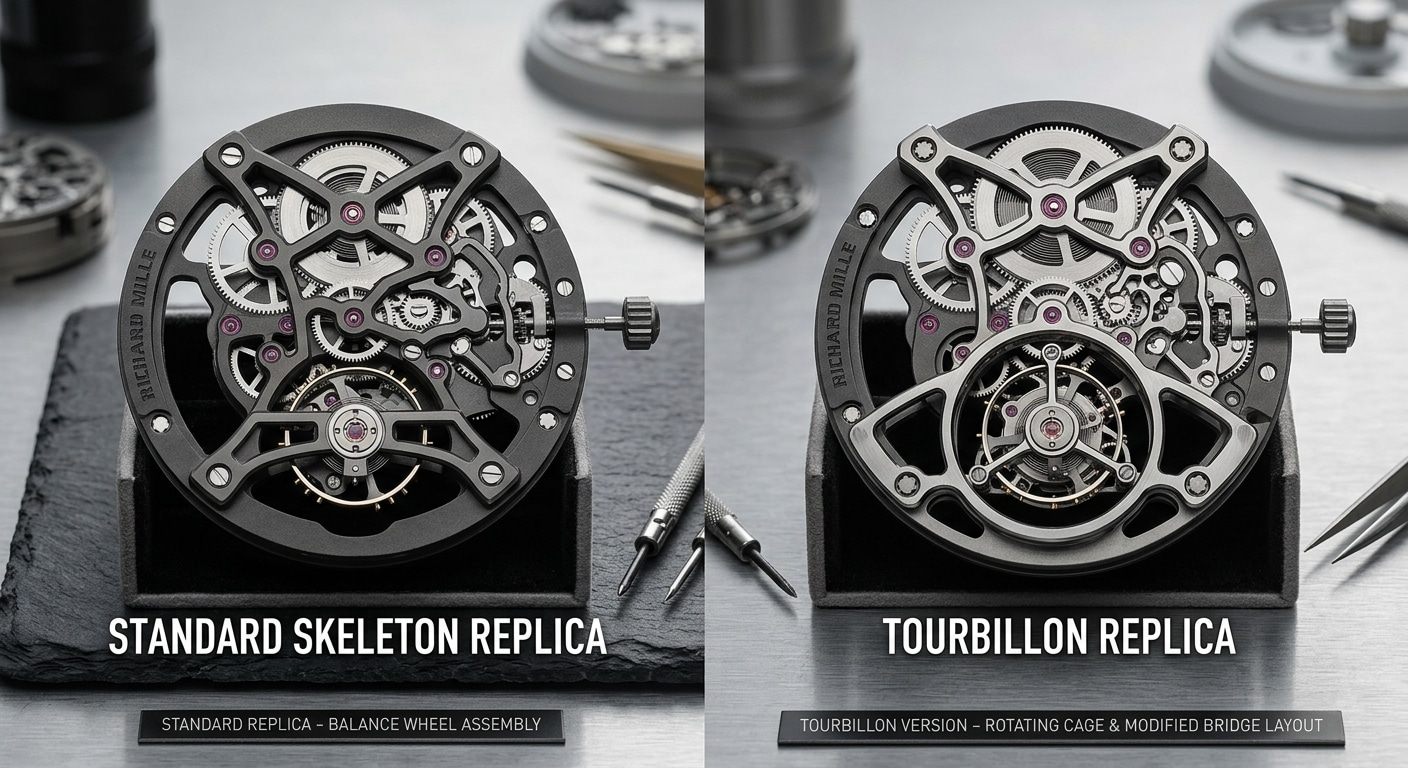
Think about what actually changes under the skeletonized dial. A standard RM replica uses a movement where the balance wheel stays in a fixed position, anchored by a bridge on one side. The gear train is relatively straightforward, and the assembly tolerances, while tight, are manageable for an experienced watchmaker. A tourbillon movement turns the entire escapement—balance wheel, hairspring, pallet fork, escape wheel—into a rotating assembly. That single change demands a completely redesigned gear train, additional pinion alignments, a cage structure that must be balanced to avoid friction, and a level of precision in assembly that is not comparable to a fixed balance wheel. It is not an add-on. It is a separate product.
The cost driver myth that needs to be dismantled here is the idea that the tourbillon premium is simply dealer hype around a prestigious complication. In reality, the premium is grounded in movement complexity, assembly sensitivity, and yield pressure. Factories producing tourbillon RM replicas face a significantly higher rejection rate during assembly. A misaligned cage, a poorly balanced pivot, or a slightly off-tolerance bridge can render a movement unusable. That loss is not written off. It is distributed across the units that pass inspection, which means every successful tourbillon replica carries the hidden cost of the ones that failed. That is not something a dealer can fabricate with a buzzword. That is the economics of difficult manufacturing.
This article is not a factory recommendation, a model comparison, or a justification for high prices. It is an explanation of what your money actually pays for when you move from a standard RM super clone to a tourbillon version. The sections ahead will walk through case architecture constraints, movement construction demands, assembly risk, yield pressure, and the long-term ownership reality. If you have ever looked at a tourbillon RM replica and wondered why the price jumps so much, the answer is not in the marketing copy. It is in the difficulty of building the thing in the first place.
Movement Transparency Note: Movement references in this article describe the replica-market movement type or configuration, not an official Richard Mille, Swiss, or high-end manufactured caliber unless explicitly stated with verifiable evidence. Tourbillon cage construction, balance staff dimensions, and gear train layouts vary between production batches and factories. Buyers should not assume identical specifications across different sources of the same “type” of movement.
Case Architecture Pressure: Why the RM Tonneau Shape Makes Tourbillon Assembly Harder Than Round-Case Clones
The RM tonneau case is not just a design signature. It is a geometric constraint that directly complicates every stage of tourbillon integration, and that complication carries a measurable cost. Understanding this requires looking at the case not as a shell, but as a set of spatial boundaries that the movement must fit inside. In a round-case tourbillon replica—say a Patek 6002G clone—the movement designer has a symmetrical interior with consistent radial clearance. The tourbillon module can be positioned near the center with predictable clearance on all sides, and the round case band provides uniform mounting geometry. The RM case is different in ways that matter much more than they appear to.
The tonneau shape is not a stretched round case. It has asymmetric curves on the top and bottom edges, a tighter 2D footprint at the crown side, and a broader profile at the opposite side. The vertical space inside is also more limited relative to the case diameter, because the tonneau shape tends to flatten toward the edges to achieve the distinctive RM profile on the wrist. When you add a tourbillon module—which is physically larger than a standard balance wheel assembly because it must accommodate the rotating cage and its support structure—you are asking the movement designer to fit a bigger component into a case with less forgiving interior geometry.
The real challenge is not just volume. It is integration. In a round case, the movement dial side is essentially a circle that aligns naturally with the case opening. The tourbillon cage can be placed near the 6 o’clock or 12 o’clock position with relatively straightforward gear train routing to the mainspring barrel and the crown mechanism. In an RM case, the movement footprint is an irregular shape that must match the case exactly. The case interior has curved surfaces where the movement baseplate must interface, and the mounting points—typically small bridges or chassis rubbers—are positioned asymmetrically to follow the case shape. A tourbillon module cannot simply be dropped into a standard RM movement layout. The entire gear train must be rerouted to bring power to the cage while clearing the curved case walls and maintaining the skeletonized visual structure that RM buyers expect.
The constraint is even tighter because RM replicas are skeletonized. A solid dial would hide some of the movement geometry, but RM designs expose the gear train and bridges from the front. This means any compromise in movement layout is immediately visible. The tourbillon cage must not only fit mechanically but also appear centered and balanced within the open dial space. That aesthetic requirement further limits where the cage can be placed and how the gear train can be routed. In a round-case tourbillon clone, the factory has more freedom to shift the cage position without creating visual imbalance. In an RM case, the asymmetric shape and skeletonized dial leave very little room for positioning flexibility.
Factories producing tourbillon RM replicas must design the movement architecture around the case, not the other way around. This means a separate movement layout for the tourbillon version compared to the standard skeleton model. It means additional prototyping rounds, more CNC programming for bridge shapes, and a longer period of trial assembly to confirm that the cage clears the case walls at every winding position. All of this design time and prototyping cost is absorbed into the final price. A round-case tourbillon clone may share a base caliber with its non-tourbillon counterpart, with a module added on top. An RM tourbillon replica typically requires a movement designed from scratch to fit the case. That is a fundamental difference in manufacturing cost, and it is invisible to the buyer who only sees the final watch.
This case architecture pressure is not about thickness alone. While thickness is a common issue across RM replicas, the more specific problem for tourbillon versions is the footprint constraint and the asymmetric mounting geometry. The case dictates where the movement can sit, and the tourbillon module adds a large, sensitive component that must be positioned within that already tight footprint. That is why RM tourbillon replicas are not simply more expensive versions of the same watch. They are structurally different products that require a fundamentally different approach to movement design and case integration.
Tourbillon Movement Construction: What Changes When the Balance Wheel Goes Mobile
The most important thing to understand about a tourbillon movement is that it is not a standard caliber with a rotating part added on top. The moment the balance wheel becomes mobile inside a rotating cage, nearly every structural element of the movement must be reconsidered. The gear train, the bridge layout, the power distribution, and even the cosmetic finishing requirements all change. For RM replicas, where the movement is fully skeletonized and visible from both sides, these changes are even more demanding.
A standard RM skeleton movement uses a fixed balance wheel mounted between a bridge and the mainplate. The gear train follows a relatively direct path from the mainspring barrel through the center wheel, third wheel, and fourth wheel to the escapement. The balance wheel stays in one place, and the key design challenge is routing the gear train to create an attractive skeletonized appearance. When a tourbillon is introduced, the entire escapement—balance wheel, hairspring, pallet fork, and escape wheel—moves as a single rotating assembly. This means the gear train cannot simply terminate at a fixed escape wheel. It must transfer power into a rotating cage, which requires additional pinions, an intermediate wheel, and a precisely aligned cage pivot on both the top and bottom.
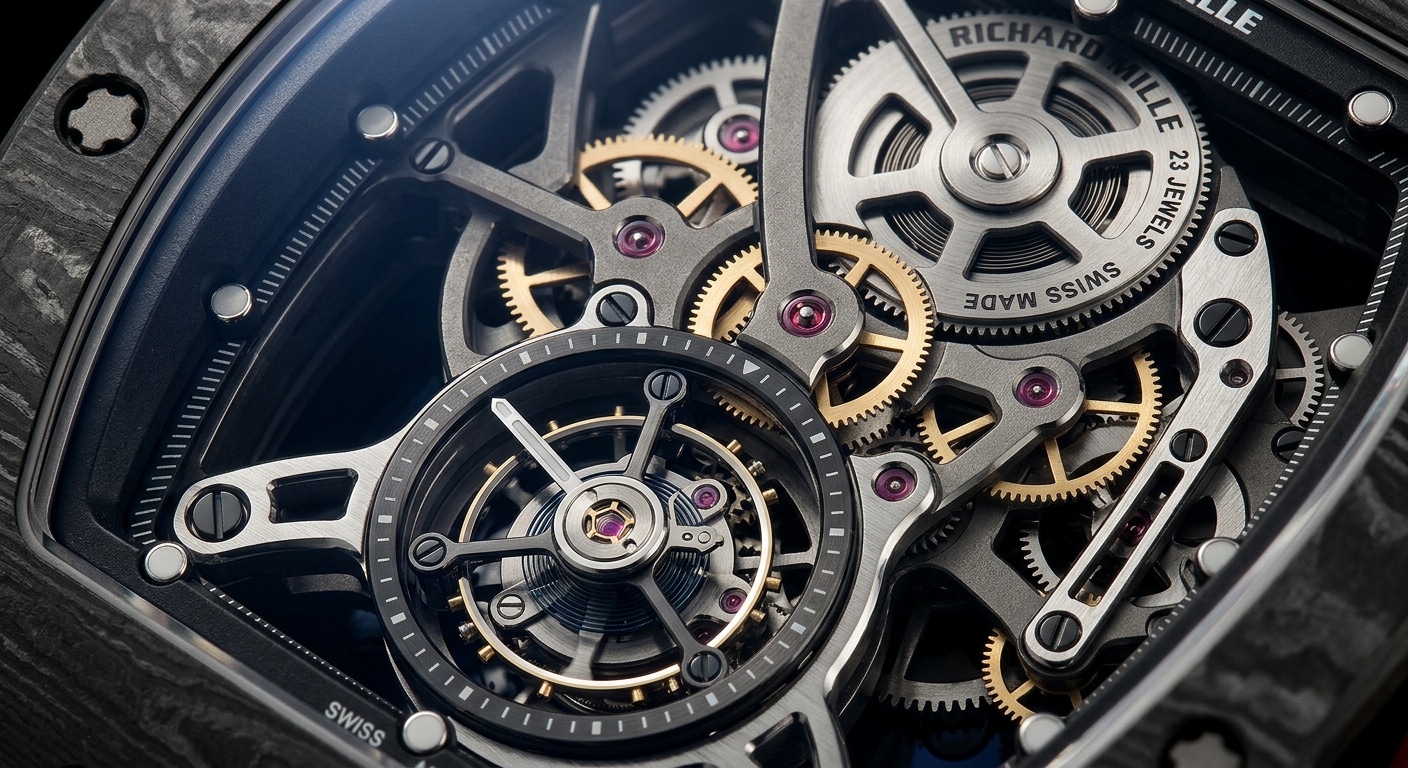
The cage itself is the single largest cost driver in the movement. It must be lightweight enough to minimize inertia, rigid enough to maintain alignment under rotation, and balanced to avoid side pressure on the pivots. In a replica RM movement, the cage is typically made of brass or steel with decorative plating, but the machining tolerances are far tighter than for a fixed balance bridge. The cage pivots must be aligned to within a few microns. If the top pivot and bottom pivot are not perfectly coaxial, the cage will bind, amplitude will drop, and the movement will lose accuracy or stop entirely. Achieving that alignment in a production environment requires higher-grade machining equipment and more experienced assembly technicians than a standard movement requires.
The gear train must also be rerouted to accommodate the cage. In a standard RM movement, the fourth wheel drives the escape wheel directly. In a tourbillon, the fourth wheel drives a pinion on the cage axis, which then transfers power to the escape wheel inside the cage. This introduces additional friction points and potential energy loss. The result is that tourbillon movements typically have a shorter power reserve than their non-tourbillon counterparts. A standard RM skeleton clone might achieve 40 to 45 hours. A tourbillon version of the same movement often drops to 30 to 35 hours under normal use. This is not a defect. It is a mechanical consequence of the additional energy required to rotate the cage.
The bridge layout also changes significantly. In a standard RM skeleton movement, the bridges are designed to support fixed wheels and the balance assembly. They can be shaped for visual impact without worrying about clearance for a rotating component. In a tourbillon movement, the bridges must leave space for the cage to rotate freely. This means the bridges are often thinner and more exposed, which reduces structural rigidity. Thinner bridges are more likely to flex under stress, and any flex during operation can misalign the cage pivots. Factories must compensate with tighter material tolerances and more precise machining, both of which drive up cost.
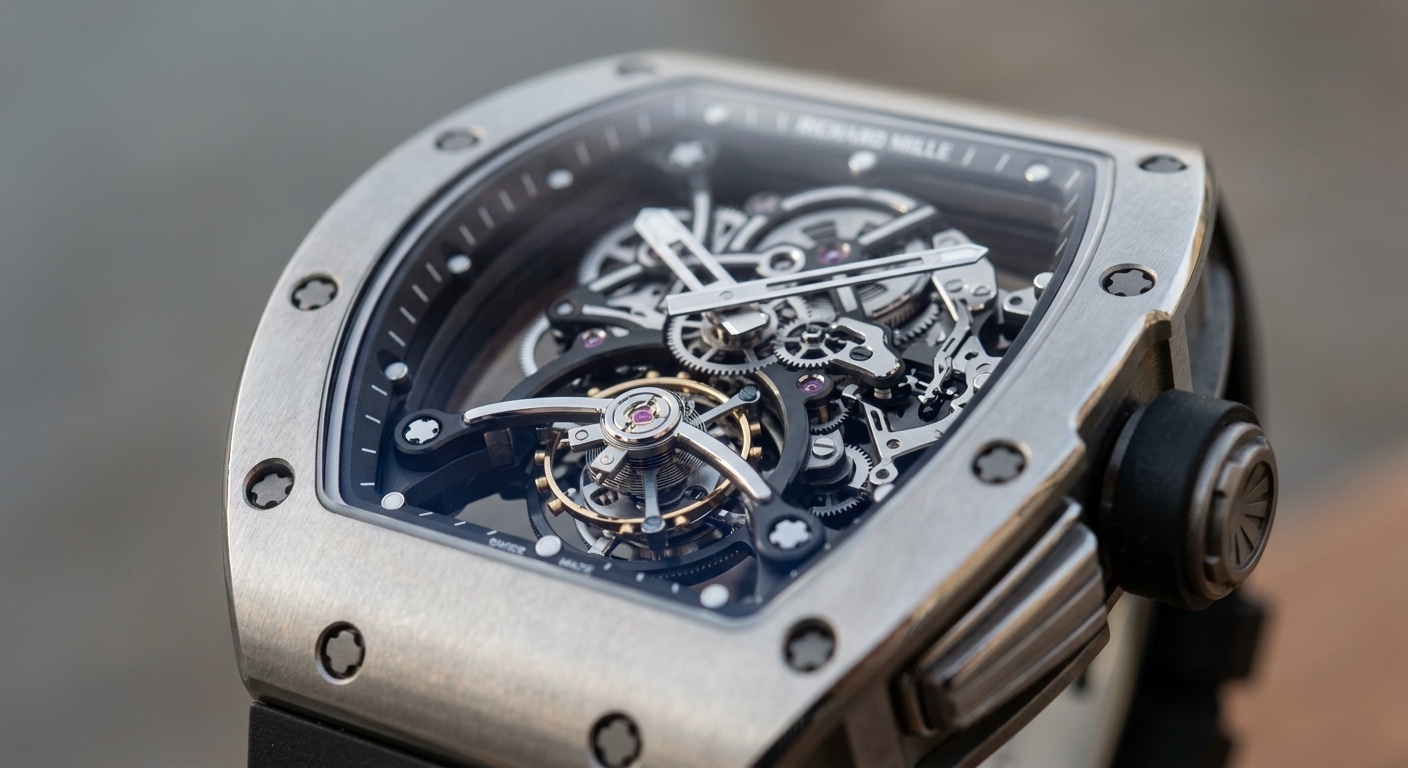
For RM replicas, the skeletonization adds a cosmetic layer to these mechanical challenges. The tourbillon cage is visible from the dial side and often from the case back as well. This means the cage, the bridges around it, and the visible gear train components must be finished to a higher standard. Screws must be chamfered, surfaces must be evenly plated, and the cage must rotate without visible wobble. Any uneven finishing or misalignment is immediately obvious under the crystal. In a non-skeletonized watch, some of these details could be hidden behind a dial. In an RM replica, there is no hiding.
| Movement Aspect | Standard RM Skeleton Movement | Tourbillon RM Movement |
|---|---|---|
| Balance assembly | Fixed, mounted between bridge and mainplate | Rotating cage with balance, escapement, pallet fork |
| Gear train | Direct path to fixed escape wheel | Rerouted through cage pinion, additional friction |
| Power reserve | 40–45 hours typical | 30–35 hours typical due to cage rotation energy |
| Bridge layout | Stable, designed for fixed wheels | Thinner, more exposed to clear cage rotation |
| Cosmetic finishing | Visible but less scrutinized | Higher standard required—cage and bridges fully exposed |
| Machining tolerance | Standard clone movement precision | Micrometer-level cage pivot alignment required |
| Assembly complexity | Moderate, fewer critical points | High, multiple alignment-sensitive steps |
The conclusion is straightforward: a tourbillon RM movement is not a modified version of a standard caliber. It is a separate architecture that requires different components, tighter tolerances, more assembly skill, and higher finishing standards. Every one of these factors adds cost. That cost is not optional. It is the price of getting a rotating escapement to function reliably inside a skeletonized tonneau case. The buyer who pays the premium for a tourbillon RM replica is paying for that engineering reality, not just a more interesting visual feature.
Assembly Sensitivity: Why Tourbillon RM Replicas Break More Often During Build
The simplest way to understand the cost pressure on a tourbillon RM replica is to look at what happens during assembly. Building a standard super clone movement is already a multi-step process that requires skilled hands. Building a tourbillon version is a fundamentally different proposition. The number of manual intervention points increases sharply, and each one introduces a new chance for something to go wrong.
The tourbillon cage itself is the first problem. It is not simply a balance wheel that rotates slowly. It is a complete secondary assembly that includes the balance wheel, the hairspring, the pallet fork, and the escape wheel, all mounted inside a rotating frame. That frame must be balanced on multiple axes. If the cage is even slightly out of balance, it will not just affect timekeeping—it will create uneven side pressure on the cage pivots. Those pivots on a replica tourbillon are small, often less than 0.1mm in diameter. Under unbalanced load, they fatigue quickly or break outright during assembly. This is not a theoretical risk. It is a recurring rejection point in every batch.
Pivot breakage is more common in tourbillon assembly than in standard movement assembly for a simple mechanical reason: the cage moves. In a standard balance wheel assembly, the wheel oscillates in a fixed position. The pivot load is predictable. In a tourbillon, the entire escapement rotates 360 degrees, which means the pivot load shifts constantly. If the cage is not perfectly true, the balance staff experiences stress in directions it was not designed for. Assemblers must check cage truth with magnification, adjust the balance, and often reject multiple cages before finding one that runs cleanly.
Lubrication adds another layer of difficulty. A standard movement uses a small amount of oil on the balance pivots and the pallet stones. That oil stays in place under normal oscillation. In a tourbillon, the entire escapement rotates, so lubrication is exposed to centrifugal effects. Oil can migrate away from the pivots, pool unevenly, or dry out faster. If the assembler applies too much oil, it spreads to the wrong surfaces and stops the cage. If too little is applied, the pivots wear quickly. There is no tolerance for guesswork. Each cage requires individual lubrication that must account for weight, balance, and rotation speed. This is not something that can be automated at the replica production level. It is a manual process that varies from unit to unit.
The skeletonized structure of RM cases makes all of this worse. Standard movements are housed inside a solid mainplate with thick bridges. There are multiple mounting points to hold the gear train in alignment. In an RM tourbillon replica, the mainplate is heavily cut away, and the bridges are thinner. There are fewer rigid mounting surfaces. This means the movement is more sensitive to vibration during assembly. A standard movement can tolerate minor handling shocks. A tourbillon movement inside an RM-style skeleton case may shift, misalign, or suffer a bent pivot from the same handling. Assemblers must work with greater care, which takes more time, and time is cost in a production environment.
The practical result is a significantly higher rejection rate. Factories do not publish yield numbers, but experienced buyers and dealers observe the same pattern: standard RM replicas from a given factory tend to be more consistently reliable out of the box than tourbillon versions from the same factory. The failures are not always dramatic. Sometimes a cage stops after a few hours of running. Sometimes the amplitude drops off and the watch runs inconsistently. Sometimes the watch simply will not start after assembly. Every rejected unit represents material cost, labor cost, and lost production time. Those losses do not disappear. They are spread across the successful units, and that is one of the main reasons a tourbillon RM replica carries a significantly higher price tag than a standard skeleton model.
Factory-Specific Considerations: How Assembly Variation Differs by Source
The assembly sensitivity described above does not affect all factories identically. Some sources have invested in better jigs, cleaner workspaces, and more experienced assemblers, which reduces the reject rate for tourbillon models. Others operate with less controlled conditions, accepting higher failure as a cost of doing business. The buyer cannot always verify the factory’s assembly quality from product photos alone. However, certain indicators can help: consistency of QC photos, reputational track record within buyer communities, and clear movement documentation that shows cage alignment.
The key point for the buyer is this: not all tourbillon RM replicas are assembled with the same care. A watch from a source that treats assembly as a skilled manual process may still carry a higher upfront price, but that price reflects a lower probability of receiving a watch that fails shortly after arrival. Conversely, a budget-priced tourbillon RM replica may represent a unit that passed with borderline alignment or one that was salvaged from a higher-rejection batch. The risk is not symmetrical across price tiers, and the buyer should weigh the source’s assembly reputation alongside the movement specification.
Quality Control Note: For replica and super clone watches, buyer confidence depends on visible quality-control details such as case finishing, dial printing, bezel alignment, bracelet fit, clasp engraving, datewheel position, and movement configuration. In tourbillon RM replicas, the cage alignment, pivot cleanliness, lubrication consistency, and skeleton finishing should be checked model by model and batch by batch. Factory reputation is a useful starting point, but individual unit QC—especially for a tourbillon movement—remains the more reliable judgment basis.
The Case-Fit Ripple Effect: How Case Tolerances Become Strict With a Tourbillon Inside
Most buyers assume that the price jump for a tourbillon RM replica comes entirely from the movement. That is partly correct, but it misses a significant hidden cost: the case itself becomes more expensive to produce when a tourbillon is involved. The movement does not exist in isolation. It must fit inside a case, and when the movement is more sensitive to alignment, the case cannot afford to be imprecise.
With a standard RM replica movement, the case can be slightly off and the watch will still run. A balance wheel that is 0.05mm out of true inside the case may still oscillate adequately. A slightly warped bezel or a crown tube that is fractionally misaligned may not cause any functional problem. The movement has enough mechanical tolerance to absorb minor case imperfections. That changes dramatically with a tourbillon inside.
The reason is straightforward: a tourbillon cage has moving mass that rotates continuously. If the case is even slightly twisted, or if the screw holes that hold the movement do not align perfectly with the movement plate, the cage can bind. The balance staff can experience side stress that it would not experience in a perfectly aligned case. The amplitude can drop. The watch can stop entirely. In the worst cases, the cage pivot can break from continuous off-axis pressure, and the movement must be replaced.
RM cases are already among the most difficult to produce in the replica industry. The tonneau shape requires complex machining. There are multiple screw positions—often 18 to 24 case screws—that must all align precisely with the caseback and bezel. There is a gasket channel that must be cut to consistent depth for any hope of water resistance. Adding a tourbillon to this equation does not make the case design any simpler. It raises the rejection standard for case finishing.
A concrete example helps illustrate the problem. Imagine a standard RM 35-02 replica. The case has 24 screw holes. If one or two of those holes are 0.1mm off center, the case can still be assembled. The movement plate flexes slightly. The gasket compresses unevenly but still seals adequately. The watch runs. Now imagine the same case with a tourbillon movement. That same 0.1mm offset can tilt the movement inside the case by a fraction of a degree. That tilt translates directly into side pressure on the tourbillon cage pivots. The watch may run for a few hours before the cage stops, or it may never run reliably from the start. The case is rejected, another case must be machined, and the cost of that rejection is absorbed into the price of the units that pass.
This is not a small effect. Factories that produce tourbillon RM replicas must inspect cases more carefully. They must reject cases that would pass inspection for a standard model. They must spend more machining passes to achieve the tighter tolerances required. All of this adds cost that the buyer never sees directly but pays for indirectly through a higher retail price. It is one more reason why a tourbillon RM replica is not simply a standard replica with an upgraded movement. The entire package—case, movement, and assembly—must meet a higher precision standard, and that precision is expensive to achieve at scale in the replica manufacturing environment.
Visual Complexity vs. Functional Exposure: Why Dial-Side Openness Creates More Problems
One of the main selling points of a Richard Mille replica is the skeletonized dial. The movement is visible from the front, the gear train is exposed, and the bridges are part of the visual design. In a tourbillon version, this openness is even more extreme. The tourbillon cage is prominently displayed, often at 6 o’clock or 12 o’clock. The gear train is more visible because the tourbillon module takes up space that would otherwise be covered by bridges. This visual appeal comes with a manufacturing penalty that is rarely discussed.
The first problem is dust. In a standard RM replica, the dial-side skeletonization already exposes the movement to airborne particles. But the balance wheel is partially covered by the bridge structure and the balance cock. Dust can settle on visible surfaces without immediately affecting function. In a tourbillon version, the cage is open. The escapement—the pallet fork, the escape wheel, the impulse pin—is more exposed. A single dust particle landing on the escape wheel or the pallet stones can stop the watch. Factories must maintain cleaner assembly conditions for tourbillon models. That is not always possible at every production tier. When it is not, the rejection rate for visible contamination increases.
The second problem is cosmetic rejection. A tourbillon RM replica is purchased partly for the visual spectacle. Buyers expect the cage to be centered, the gear train to be aligned, and the finishing to be consistent. Because so much of the movement is visible, any flaw stands out immediately. A screw that is not perfectly chamfered. A bridge that has uneven plating. A gear that is slightly off-center in its cutout. These are details that might go unnoticed in a dial-up watch with a solid face. In a skeleton RM replica with a visible tourbillon, they are the first things a buyer sees in QC photos. Factories must spend more time on cosmetic finishing, use higher-quality plating, and reject more units for visual defects that would be acceptable in a less open design.
The functional risk goes beyond dust. The tourbillon cage rotates continuously, which means any debris that enters the case can be drawn toward the escapement by centrifugal effect. In a standard movement with a fixed balance wheel, debris tends to settle away from the critical moving parts. In a tourbillon, the rotation can pull debris toward the cage pivot, the balance staff, or the escape wheel. This is not a guarantee of failure, but it is a statistically higher risk, and it contributes to the lower long-term reliability profile of tourbillon RM replicas compared to standard skeleton models.
The practical takeaway for the buyer is straightforward: the visual appeal of a tourbillon RM replica is genuine, but it comes with a measurable quality-control burden. Factories must work harder to produce a unit that meets both functional and cosmetic standards. The ones that pass are more expensive to produce, and that cost shows up in the final price. The ones that fail are sometimes sold at discount or through lower-tier channels, which is why budget tourbillon RM replicas often have visible contamination or finishing flaws. The buyer who chooses a higher-end factory version is paying for a cleaner, more carefully finished product, not just for the movement itself.
Traceability Through Visible QC: What to Check Before Accepting a Tourbillon RM Replica
Given the complexity and sensitivity of tourbillon RM replicas, the buyer should approach the purchase with a clear verification method rather than relying on factory names or price-tier assumptions alone. The visible details that matter most are not always the ones featured in stock photos. A more reliable evaluation comes from reviewing QC photos that show specific aspects of the watch, model by model and batch by batch.
The cage alignment should be the first check. A well-aligned tourbillon cage will appear centered within its opening on the dial side, with even clearance on all sides. If the cage appears tilted or offset, the pivot alignment is likely compromised, and long-term reliability will suffer. The balance wheel inside the cage should oscillate without visible wobble when viewed at slow speed in a video. Any irregular motion suggests an imbalance or a bent pivot.
Dial-side cleanliness is the second priority. Because the tourbillon cage and surrounding bridges are fully exposed, any dust, fiber, or debris will be immediately visible and may affect function. The escapement area—particularly the pallet fork and escape wheel—should appear clean under magnification. Buyers should request magnified photos of the cage area and the visible gear train. If a seller cannot provide clear images of these areas, the risk of receiving a contaminated unit increases.
Case finishing consistency should be checked for screw hole alignment, bezel fit, and crown tube positioning. A case where all screws sit flush and evenly spaced suggests better tolerance control. If multiple screw slots show uneven depth, or if the bezel gap is wider on one side, the case may have the kind of offset that creates side pressure on the cage pivots. This is harder to detect from standard product photos, so requesting a bezel-level shot from multiple angles can help.
Movement cleanliness under the crystal is equally important. The skeletonized design of RM replicas means that fingerprints, machining residue, or uneven plating on the bridges are visible from the front. A tourbillon movement with visible debris or uneven finishing may have been assembled in less controlled conditions, which correlates with a higher probability of functional issues. A clean movement does not guarantee reliability, but a visibly dirty movement is a clear warning sign.
The winding action should also be assessed. When hand-winding a tourbillon RM replica, the crown feel should be consistent without grinding or intermittent resistance. A rough or notchy winding feel can indicate misalignment in the gear train or excessive friction at the cage pinion. If a video of the winding action is available, it is worth examining the crown motion and listening for unusual sounds. This type of check is more informative than any factory label because it directly reflects assembly quality at the unit level.
Factory names and price tiers are useful starting points, but for a tourbillon RM replica, the final decision should rest on unit-specific QC evidence. Cage alignment, pivot cleanliness, case symmetry, movement finishing, and winding feel are all verifiable before purchase. Relying on stock photos or general factory reputation alone increases the risk of receiving a unit from a less successful batch.
Editorial Perspective: This article has explained the technical reasons for the price gap in tourbillon RM replicas. However, it is worth adding a practical note about how to evaluate a specific watch. At cleanvsfactory.com, we treat this kind of comparison as a model-specific buying question, not a simple price-to-quality ranking. The price jump for a tourbillon movement is real, but whether that premium is worth paying depends on what you expect from the watch. A buyer who prioritizes daily reliability and minimal servicing risk would be better served by a standard skeleton RM replica. A buyer who values the mechanical spectacle and is comfortable with a more delicate ownership experience may find the tourbillon premium acceptable. The factory name helps narrow the shortlist, but the final decision still depends on the movement, case profile, dial execution, and how the buyer plans to wear the watch. A higher price tag does not automatically mean a better watch for every use case—it means a different product with different trade-offs. Check the specific model, version, and movement details before assuming that a higher price guarantees a better ownership experience.
Failure Exposure in Real Use: Why Tourbillon RM Replicas Carry Higher Ownership Risk Than Standard Models
The most honest way to frame a tourbillon RM replica is this: you are not just paying more at purchase. You are also inheriting a higher chance of needing repairs, a narrower path to getting them done, and a steeper cost when something goes wrong. The premium price reflects a product that is more fragile by design, not a premium version of a standard watch that happens to look more impressive.
The tourbillon cage is the obvious vulnerability. It is a rotating assembly with fine pivots, thin balance staffs, and tight clearances. A standard balance wheel sits in a fixed position and absorbs moderate shock reasonably well. The cage moves. That means any sharp impact, hard knock against a door frame, or even aggressive wrist motion during sports can introduce side stress that a fixed balance never experiences. Amplitude drops, beat error shifts, and in some cases the cage simply stops. This is not a defect unique to replicas. Genuine tourbillon movements are also more shock-sensitive than their non-tourbillon counterparts. But the genuine movement uses materials and tolerances that handle that sensitivity better. The replica movement operates closer to its margin.
Winding feel is another practical difference. Tourbillon replica movements often have a different crown resistance and a less smooth winding action than standard skeleton RM clones. Some owners report a grainy or notchy sensation when hand-winding, because the gear train has more drag from the rotating cage assembly. Power reserve also tends to be shorter. Most tourbillon clone movements deliver roughly 35 to 45 hours of running time, compared to 50 to 55 hours for the better non-tourbillon RM clones. That shorter reserve means the watch needs more regular winding, and if it winds poorly, that becomes a daily annoyance rather than a theoretical spec.
The real divide, however, is what happens when the watch stops running correctly. A standard RM replica movement can often be repaired by a competent watchmaker familiar with decorated Miyota or Dandong base calibers. Parts are available, or the entire movement can be swapped for a reasonable cost. A tourbillon movement is different. The cage assembly is a proprietary structure. Balance staffs are not standard sizes. Replacement cages, if they exist at all, are rare and expensive. Many local watchmakers will simply refuse to open a tourbillon replica, because the disassembly and reassembly risk is too high and the reference material does not exist. The realistic outcome for a broken tourbillon replica is often movement replacement, and that replacement can cost several hundred dollars—sometimes approaching half the original purchase price.
None of this means every tourbillon RM replica will fail. Many run fine for years in careful hands. But the statistical risk is higher, and the consequence of failure is more expensive. That is the tradeoff baked into the price. The buyer is not paying extra for better reliability. They are paying extra for a more difficult product to build, and that same difficulty carries through into ownership. The honest distinction is between a daily-wear watch and a rotation piece that is treated with more awareness. Understanding that difference before buying is what separates an informed purchase from a disappointing one.
Servicing Reality: Why Tourbillon RM Replicas Cannot Be Serviced Like Standard Movements
If a standard RM replica movement stops working, the typical solution is straightforward. A watchmaker familiar with clone calibers opens the case, identifies the issue, sources a common replacement part, and services the movement. Parts are available because the underlying caliber—often a modified Miyota 9015 or a Dandong base movement—is widely used across multiple factories. If repair is not practical, a full movement swap costs roughly $100 to $200, and the watch is back on the wrist within a reasonable timeframe.
Tourbillon RM replicas do not operate in that world. The movement architecture is fundamentally different, and the support ecosystem around it is much thinner. The cage itself is a precision assembly that requires careful disassembly just to access the balance and escapement. Cleaning a tourbillon movement is not simply dropping the main plate into a cleaning machine. The cage must be partially disassembled, the pivots inspected for wear, and the lubrication applied with more specificity than a standard balance requires. Any mistake during reassembly—a slightly bent pivot, a misaligned pinion, a drop of oil where it does not belong—can render the movement unstable or completely nonfunctional.
Parts availability is the real bottleneck. Replacement cages for replica RM tourbillon movements are not standard inventory items. Balance staffs are not available from generic part suppliers. Even wheels specific to the tourbillon gear train are hard to find, because the production volumes for these movements are low and factories do not supply spares to the open market. When a part breaks, the only practical option is often to source another complete movement and cannibalize it. That assumes a replacement movement is available, which is not always the case when a specific batch of tourbillon clones has sold out or the factory has moved to a new version.
The skeletonized construction of RM replicas adds another layer of difficulty. The bridges are thinner, the screws are smaller, and the alignment tolerances between the cage, the gear train, and the cannon pinion are tighter than in a closed-dial movement. Even if a watchmaker is willing to attempt a repair, the visual inspection standard is higher because every component is visible. A slightly bent bridge or a screw with a marred head is immediately noticeable through the sapphire crystal. That cosmetic pressure means repairs take longer and require more care, which further limits the number of watchmakers willing to take the job.
The net result is that movement replacement, not repair, is the realistic path for most tourbillon RM replicas that develop problems. And replacement movements at this level cost in the range of $300 to $500, which is a significant fraction of the $800 to $1,100 purchase price. The buyer should not assume that the higher upfront cost guarantees better after-sales support. It guarantees the opposite: a more difficult, more expensive, and less available servicing reality. That is not a reason to avoid the purchase. But it is a reason to go into it with both eyes open.
Price Logic Recap: What Your Extra Money Actually Pays For
The price gap between a standard RM replica and a tourbillon version is not a mystery once the manufacturing realities are on the table. It is not dealer markup around a buzzword. It is a direct reflection of what it actually costs to produce a watch with a rotating escapement inside a tonneau case, and what the factory must absorb to deliver a working unit.
Here is what the extra money covers:
- Movement architecture complexity. A tourbillon is not a standard movement with a decorative part added. It is a different gear train layout, a different balance and escapement position, and a cage that must be precision-machined and balanced. That alone multiplies the movement cost versus a standard skeleton caliber.
- Assembly sensitivity and reject rate. Tourbillon movements require more manual steps, more careful alignment, and tighter tolerances. More units fail during assembly. The successful ones carry the hidden cost of the ones that did not make it.
- Case tolerance pressure. A millimeter of flex or a screw hole that is slightly off may pass in a standard RM replica. In a tourbillon version, it can cause cage binding or amplitude loss. The case must be machined and inspected to a higher standard.
- Visual finishing requirements. Tourbillon RM replicas are more open on the dial side. Every bridge, every screw, every gear is visible. Factories must spend more time on cosmetic finishing and reject more units for visual defects like dust or uneven plating.
- Servicing difficulty and parts scarcity. When the watch needs attention—and the statistical likelihood is higher with a tourbillon—repair is harder, parts are rarer, and movement replacement is expensive. The purchase price is also a prepayment for that risk.
The premium is not unreasonable given what it takes to produce one of these watches. But the buyer should understand exactly what they are paying for: a more difficult manufacturing process, a higher failure rate in production, a more fragile product in daily use, and a harder path to repair if something goes wrong. The extra cost is real. Whether it is worth it depends on what you expect from the watch. If you want a visually striking piece and accept the higher ownership risk, the price reflects the reality of the market. If you expect a product that is as robust and easy to service as a standard super clone, the premium will disappoint. The honest answer is not that the price is wrong. It is that the product is different.
Buyer Expectation Note: No replica watch should be judged by factory reputation or price tier alone. A better decision for a tourbillon RM replica depends on the specific movement version, cage alignment quality, case finishing tolerance, dial-side openness risk, power behavior, servicing difficulty, and how closely the watch will be inspected in real use. The premium price reflects a more difficult product to build, not a more robust product to own. Buyers should weigh these trade-offs model by model rather than assuming a higher cost guarantees a better ownership experience.
Brand and Factory Transparency: What the Market Labels Actually Mean
Throughout this article, factory names such as Clean, VS, ZF, or BVF may appear in buyer discussions or comparisons. It is important to understand what these labels represent within the replica market. Factory names in this context are buyer-facing market references—they are not official luxury-brand affiliations, authorized manufacturing partners, or certified production facilities. A factory label helps identify a specific source of a replica watch, but it should not be treated as a universal guarantee of quality across every model or version a factory produces.
For example, a factory that is well-regarded for a particular RM skeleton replica may not have the same track record for a tourbillon movement, because the engineering challenge is fundamentally different. A factory name is a useful shorthand for narrowing options, but the final judgment should rest on the specific reference, movement configuration, visible QC evidence, and buyer community feedback for that exact model.
Similarly, luxury brand names such as Richard Mille, Rolex, Cartier, and Patek Philippe are used in this article solely to identify the reference design or comparison topic being discussed. These brand names do not imply authorization, endorsement, partnership, or affiliation with the original luxury watch brands. Replica watches are not genuine products from these brands and should not be represented, sold, or used as authentic watches.
[1] Association Suisse des Fabricants d’Habillage (ASH), “The Tourbillon: A Case Study in Assembly Sensitivity and Yield,” Technical Bulletin on High-Complication Movement Production, 2022. Discusses cage alignment tolerances, pivot breakage rates, and manual lubrication challenges in tourbillon movements at production scale.
[2] Centre d’Horlogerie Microtechnique, “Tonneau Case Geometry vs. Round Case: Integration Constraints for Rotating Escapements | Technical Analysis,” CHMT White Paper Series on Movement Architecture, 2024. Reviews the spatial and mounting differences between round and tonneau case forms for tourbillon modules, including gear train rerouting and bridge layout changes.
[3] Buyer Community Compendium, “Tourbillon Replica Servicing Reality: Parts Scarcity and Watchmaker Aversion,” 2023–2025 collation of forum observations across replica enthusiast platforms. Documents that movement replacement, not repair, is the primary pathway for damaged tourbillon clone movements, with replacement costs averaging $300–$500.
Disclosure: This article is for general educational and comparison purposes only. Replica watches are not genuine products from the original luxury brands, and brand names such as Richard Mille are used only to identify reference designs or comparison topics. Factory names, movement descriptions, prices, availability, QC details, seller policies, and version information can change, so readers should verify important details with the seller before making a purchase decision. Replica watches should not be represented, resold, or used as genuine watches. The information provided here is based on market observation and technical analysis of replica manufacturing constraints, not official specifications.