
AP super clone pricing is often confusing because the Royal Oak design leaves very little room to hide shortcuts. A lower price may still give the general look, but flaws in case thickness, bezel edges, screw seating, bracelet comfort, dial texture, date placement, and movement behavior can become obvious on the wrist, especially when the Royal Oak or Offshore choice affects size expectations, case finishing standards, and daily wear comfort. At the same time, a higher price is not automatically safer unless it pays for visible construction improvements and better quality control.
This guide helps separate useful price differences from marketing labels. The main question is not simply whether a watch is “cheap” or “high-end,” but whether the movement route, case architecture, dial execution, bracelet feel, and model complexity match the price. For many buyers, a simpler mid-tier three-hand Royal Oak-style watch may be more sensible than a costly chronograph or skeleton model with more exposed risks.
Brand names are used here to identify the genuine reference design being discussed. AP replica watches and AP super clone watches are replica-market products, not genuine Audemars Piguet watches, and they should not be represented, resold, or used as authentic watches from the original luxury brand.
| Price Area | What to Check First | Practical Buyer Judgment |
|---|---|---|
| Cheap AP copies | Case thickness, bracelet edges, flat dial texture | Acceptable only if distant resemblance matters more than wrist feel |
| Mid-tier three-hand models | Stable automatic movement, date alignment, crown feel | Often a practical casual-wear choice if compromises are understood |
| High-end Royal Oak clones | Thin side profile, bezel finishing, bracelet articulation | Worth more only when exterior accuracy and comfort clearly improve |
| Clone movement versions | Movement layout, rotor noise, service risk | Can improve proportions, but may add cost and maintenance concerns |
| Offshore chronographs | Chronograph function, thickness, long-term repairability | Higher complexity can reduce beginner suitability |
| Skeleton or openworked models | Movement appearance, finishing consistency, exposed details | More expensive does not always mean fewer visible compromises |
Quick Questions Before You Read
Q: Is a high-end AP super clone always the better buy?
No. It only makes sense if the higher price brings clearer case, dial, bracelet, movement layout, and QC improvements.
Q: Are mid-tier AP replicas good enough for daily wear?
They can be, especially simple three-hand models, if you accept thicker cases, less refined dials, and possible rotor noise.
Q: What detail should buyers check before price?
Start with the case profile and bracelet fit, because Royal Oak-style designs expose poor proportions and weak finishing quickly.
Q: Are chronograph or skeleton AP replicas beginner-friendly?
Usually less so. Their added complexity exposes more flaws and can increase service or reliability concerns.
Editorial Perspective: This AP price guide treats factory names, seller descriptions, and QC photos as useful signals, not final proof. A replica watch is not genuine, official, authorized, or brand-approved, so the practical decision should be based on what can be checked: movement route, case thickness, bezel finishing, dial alignment, bracelet comfort, version consistency, and whether the model is suitable for the buyer’s intended use. For AP replicas in particular, a watch that photographs well may still be a poor daily-wear choice if the bracelet is sharp, the rotor is noisy, the case is too thick, or the movement is difficult to service.
Evidence Boundaries for This Price Guide
This article deliberately avoids exact price tables, factory production claims, waterproof ratings, and movement-certainty statements because those details can change by seller, batch, and individual watch. In the replica watch market, the same model name may be used for different versions, and seller descriptions can be inconsistent. For that reason, this guide uses cautious language such as “usually,” “often,” and “may” when discussing AP replica price tiers, factory claims, movement routes, and expected compromises.
Official Audemars Piguet information can help a buyer understand the authentic model family, design language, proportions, and complication type, but it cannot prove that a replica has the same case construction, movement performance, finishing quality, water resistance, or serviceability. Likewise, a movement specification sheet can explain what a genuine Miyota, ETA-style, Sellita-style, or clone-style movement architecture is supposed to do, but it does not prove what is inside a specific replica unless the individual watch is inspected and documented. The safest reading is that every price claim needs to be checked against the actual watch, not only the listing title.
A traceable price judgment should connect three layers of evidence: the advertised tier, the technical configuration, and the visible execution of the specific watch. If a listing calls a watch high-end but does not clarify the movement route, version, case thickness, bracelet construction, or actual QC basis, the buyer has less evidence than the label suggests. In this market, the most useful comparisons are not broad price promises; they are model-by-model checks that show why one version costs more and whether that difference can be seen or felt.
Price, Policy, and Water-Resistance Boundaries
Replica watch prices can vary by factory label, version, movement configuration, finishing quality, seller channel, availability, and after-sales support. For that reason, this guide treats price tiers as quality expectations rather than fixed shopping instructions. A buyer should compare like-for-like details before treating one AP replica as better value, especially when two listings use similar words but different movement routes, case dimensions, or QC evidence.
Buyers should also avoid assuming any return term, warranty, repair option, shipping outcome, customs result, or water-resistance performance unless the specific seller confirms it clearly. Water resistance should not be assumed from a Royal Oak or Offshore appearance, a screw-down crown, or a diver-style case design. Even if a replica watch has been tested by a seller, it should still be treated more cautiously around water than a genuine watch serviced through official brand channels.
Why AP Super Clone Prices Vary So Much
Price is a clue, not proof. That is the first rule of any useful AP super clone price guide. A higher Audemars Piguet replica price can reflect better parts, a more accurate movement route, cleaner case finishing, and stronger QC consistency. It can also reflect a seller using stronger language than the watch deserves. The problem is that two watches can both be called a “Royal Oak replica” while being built through very different routes.
AP replicas are more price-sensitive than many buyers expect because the Royal Oak design does not hide weakness well. A round sports watch with a simple oyster-style bracelet can disguise minor finishing shortcuts. A Royal Oak cannot. The flat octagonal bezel, exposed screw positions, sharp brushed surfaces, polished bevels, integrated bracelet, thin case profile, and patterned tapisserie dial all sit in plain view. If one of those areas is poorly executed, the watch may still look attractive in a small listing photo, but it often feels less convincing once it is on the wrist.
This is why AP clone quality should not be judged by the dial logo alone. The real cost difference usually comes from how the watch is constructed: whether the case was made around a generic automatic movement or a closer clone-style movement, whether the bracelet links are properly finished or just shaped to look similar, whether the dial texture has depth or looks flat, and whether the factory version is consistent enough that QC photos can confirm the example in front of you.
A useful price comparison should also separate observable evidence from seller language. Observable evidence includes side-profile photos, bracelet-link behavior, date alignment, bezel screw seating, dial printing, movement photos where available, and clear QC images of the specific watch being offered. Seller language includes phrases such as “latest,” “ultimate,” “1:1,” or “best factory.” Those words may point the buyer toward a watch worth checking, but they should not be treated as proof of build quality by themselves.
Price Is a Signal, Not a Guarantee
A buyer asking “why are AP replicas priced differently?” is usually asking the right question, but the answer is not simply “expensive is better.” Price should be treated as one piece of evidence alongside factory, version, movement route, model complexity, and QC photos. If those pieces do not support the price, the premium is weak.
For example, a higher-priced Royal Oak replica should normally offer more than a decorated caseback and confident product wording. The buyer should be able to identify what changed: a thinner or more accurate case profile, better bracelet articulation, cleaner brushing transitions, a more convincing tapisserie dial, or a movement route that helps the watch keep the correct proportions. If the seller cannot explain what the price is actually covering, the safer assumption is that part of the price may be marketing rather than construction.
This is especially true with AP because the word “super clone” is used loosely in the market. Some watches described that way are more developed replica-market builds with better movement architecture and exterior finishing. Others are basic appearance copies wearing a premium label. At CleanVSFactory, the safer approach is to separate the price claim from the technical claim: what movement is inside, what version is being offered, how the case sits, and whether the bracelet and dial support the tier being advertised.
How Factory Names Fit Into AP Price Tiers
Factory reputation can help narrow the search, but it should not be treated as a universal answer. A factory may be strong on one Royal Oak reference and less convincing on another, especially when the model changes from a simple three-hand layout to an Offshore chronograph, skeleton dial, or complicated calendar-style design. The same factory label can also cover different batches, updated versions, or watches using different movement routes, so the name alone does not prove that the price is justified.
For AP replicas, the more useful question is model-specific: does this factory version solve the problems that matter for this exact reference? On a thin Royal Oak, case profile and bracelet integration may matter more than a dramatic movement photo. On an Offshore chronograph, subdial spacing, pusher feel, thickness, and service risk become more important. On an openworked model, visible bridge depth and finishing consistency can outweigh ordinary dial-logo accuracy. A “best factory” claim is only meaningful when it is narrowed to the model, version, movement, and buyer goal.
A factory comparison is most useful when it is tied to the specific reference, version, movement, and visible execution details rather than treated as a universal ranking. Buyers should ask whether the factory name is being used to identify a known replica-market version, or whether it is simply being used as a premium-sounding label. The difference matters because a familiar factory name can guide research, but it cannot prove the case profile, bracelet finishing, datewheel position, or movement condition of the individual watch being offered.
Factory Name Clarification: Factory names in the replica watch market are commonly used buyer-facing labels. They should be treated as practical market references, not as official brand affiliations, audited manufacturer identities, or guarantees of identical quality across every AP model, version, or batch.
Why Royal Oak Designs Expose Quality Differences
The Royal Oak is difficult to replicate because its design is built on flat planes and sharp transitions. The bezel is not just an octagon; it has brushed top surfaces, polished edges, screw recesses, and a relationship to the crystal height that affects the whole face of the watch. If the bezel is too soft, too thick, or slightly unbalanced, the watch loses the crisp architectural look that makes the Royal Oak recognizable.
The bracelet is an even bigger test. On a strong AP replica, the integrated bracelet should feel like it flows out of the case. On weaker builds, the first links may look stiff, the gaps may appear uneven, the edges may feel sharp, and the brushing can look dull or inconsistent. This is one of the reasons a cheaper AP can disappoint more quickly than a cheaper replica of a simpler watch. The bracelet is not a secondary part of the Royal Oak; it is half the design.
The dial creates another price gap. A tapisserie-style dial can look acceptable in low-resolution photos, but in person the difference between a flat stamped texture and a deeper, more carefully executed pattern is easier to see. Logo placement, marker alignment, date window position, and print sharpness also matter because the dial is framed by a very clean bezel. There is less visual noise to hide mistakes.
So the practical answer to “what does AP clone price mean?” is this: it usually reflects how many of these visible and mechanical problems the watch is trying to solve. It does not mean every expensive example is excellent, and it does not mean every cheaper example is useless. It means the buyer should ask whether the price is backed by real improvements in case geometry, bracelet finishing, dial execution, movement route, and QC consistency.
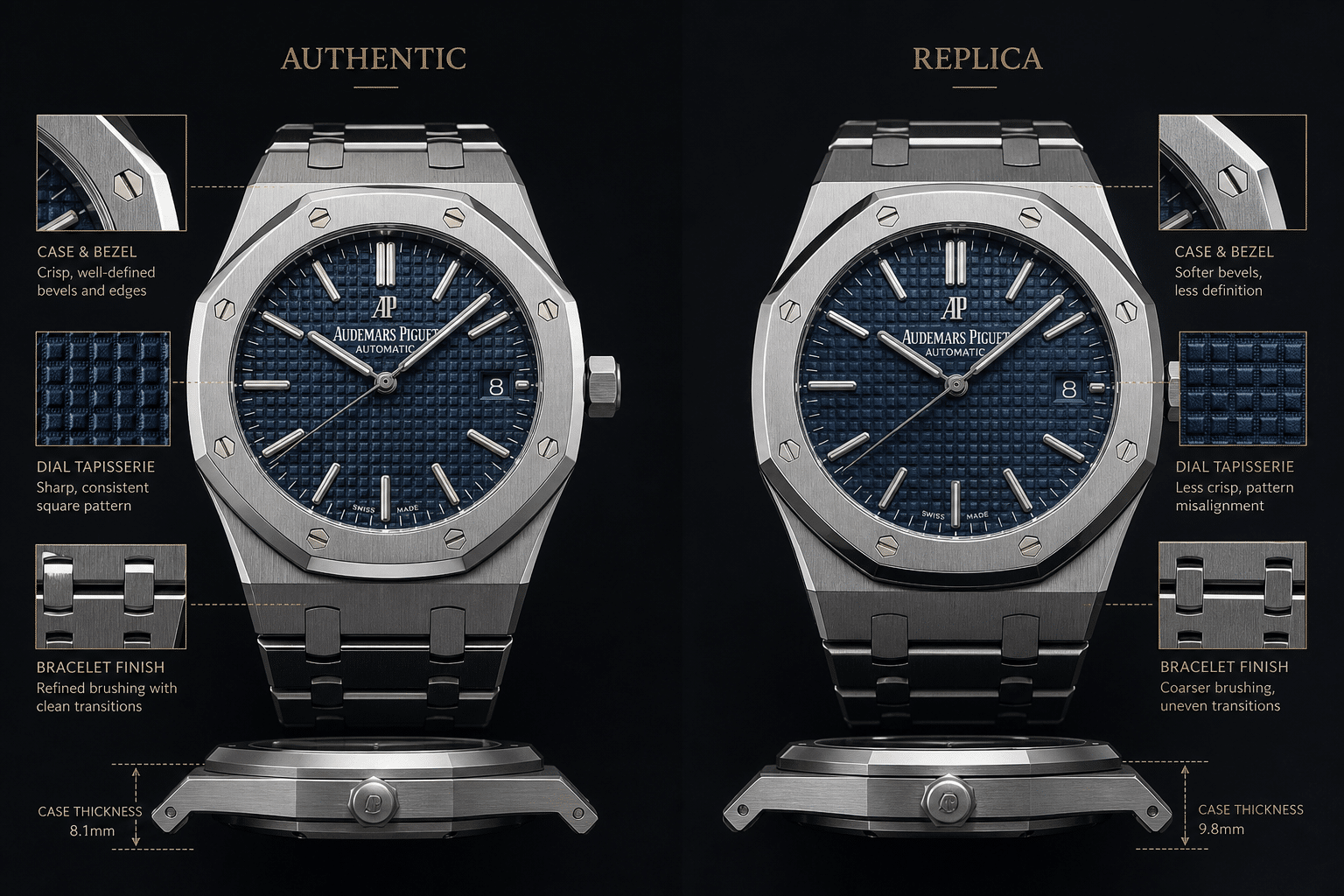
The Three Broad AP Replica Price Tiers
AP replica price tiers are best understood as build categories, not fixed shopping boxes. Exact cost changes by model, factory, version, movement, and seller channel, so a rigid price chart can become misleading quickly. A better approach is to ask what the watch is trying to be: a low-cost visual copy, a more wearable automatic build, or a high-end AP super clone with stronger movement and finishing alignment.
This distinction matters because “cheap vs high end AP replica” is not only about how close the watch looks in one front-facing photo. The tiers usually separate different construction decisions. A basic AP copy may focus on the outline. A mid-tier AP replica may improve wearability and finishing while still using a common automatic movement. A higher-end build should show more effort in case architecture, bracelet feel, dial detail, and movement layout. None of these categories guarantees a perfect watch, but they set different expectations.
Low-Cost Appearance Copies
A low-cost AP copy is usually built for basic visual resemblance from a distance. It may have the octagonal bezel, patterned dial, visible screws, and integrated-style bracelet, but the details often stop there. The case may be too thick, the bezel may lack sharpness, the dial texture may look shallow, and the bracelet may feel rough or light compared with better builds.
The key mistake is confusing “looks like an AP in a small photo” with “built like a convincing Royal Oak replica.” Cheap AP replica meaning is mostly about appearance, not accuracy. These watches can make sense only for buyers with very low expectations who want the general design language and do not care much about proportions, movement sound, bracelet comfort, or close-up detail.
Mid-Tier Automatic Builds
A mid-tier AP replica is often where the market becomes more interesting. These watches may use common automatic movements and better exterior parts, giving the buyer a more wearable object without moving into the most expensive clone movement category. Case finishing can be cleaner, bracelets can feel more solid, and dials may look more convincing at normal viewing distance.
The tradeoff is that mid-tier does not always solve AP-specific proportions. A generic automatic movement can influence case thickness, rotor sound, crown feel, and caseback layout. On a simple Royal Oak three-hander, that may be acceptable for many buyers. On an Offshore chronograph, openworked model, or complicated-looking layout, the same middle-tier approach can expose more compromises. This is why mid-tier Royal Oak replica value depends heavily on the exact model, not just the tier label.
High-End Clone Movement Builds
A high-end AP super clone should be priced around measurable improvements, not just a stronger name. The premium is usually supposed to cover a more accurate case structure, better bracelet finishing, improved dial work, and a movement route that supports the intended layout and thickness more convincingly. In practical terms, the watch should look more coherent as a full object, not only better in one isolated detail.
The movement is often the biggest dividing line. A clone movement route can help position the balance, date, caseback view, and overall case thickness closer to the intended reference. That does not make the watch identical to a genuine Audemars Piguet, and it does not remove service or reliability concerns. It simply means the construction route is more ambitious and usually more expensive to produce.
Even in the high-end tier, model complexity matters. A three-hand Royal Oak, an Offshore chronograph, a skeleton-style design, and a perpetual-calendar-style replica do not share the same risk profile. A higher price on a complicated model may be paying for complexity rather than safer daily ownership. That is an important distinction many buyers miss.
How to Read a Tier Claim
When a watch is described as cheap, mid-tier, or high-end, the useful question is not “what label did the seller use?” The useful question is “what does this tier actually include?” A serious tier claim should be supported by the stated movement type, case thickness, bracelet finishing level, dial execution, QC consistency, and version details.
If the claim is vague, slow down. “High-end” without a movement route is incomplete. “Super clone” without case and bracelet evidence is weak. “Best version” without batch or QC support tells you very little. The safer buyer reads the tier as a starting point, then checks whether the watch’s construction matches the promise.
What Cheap AP Replicas Usually Compromise First
A cheap AP replica is usually bought for appearance, not accuracy or long-term confidence. That is not automatically wrong if the buyer understands the compromise. The problem starts when a low-cost Audemars Piguet replica is described as though it belongs in the same conversation as a high-end super clone. The Royal Oak design is too unforgiving for that shortcut.
Cheap Royal Oak replica problems often show up in the areas that are expensive to get right: case shape, bracelet finishing, bezel execution, dial texture, and movement behavior. These flaws may not be obvious in seller photos because lighting, plastic wrapping, and straight-on angles can hide thickness, edge quality, and bracelet stiffness. In daily wear, those same shortcuts become much harder to ignore.
Case Thickness and Shape Are Often the First Giveaway
Case thickness is usually one of the first compromises in a cheap AP replica because inexpensive builds often rely on generic movement and case architecture. The result can be a watch that has the Royal Oak outline but not the Royal Oak posture. It may sit too tall, look too blocky from the side, or lose the thin, flat tension that makes the design work.
This matters more on AP than on many other sports watches. The Royal Oak is supposed to feel like a slim, angular bracelet watch, not a thick case attached to a bracelet. When the side profile is wrong, the watch can look acceptable from the top but feel visually heavy on the wrist. That is why buyers should not judge a cheap AP only from front-facing photos.
Bezel finishing also tends to suffer at the low end. The octagonal bezel may have soft edges, uneven brushing, loose-looking screw placement, or polished bevels that lack clean separation from the brushed surface. These are not tiny academic flaws. They affect the whole face of the watch because the bezel is the Royal Oak’s visual frame.
Bracelet Comfort Can Fall Behind the Photos
The integrated bracelet is where many cheap AP copies feel their price immediately. Photos can show the general shape of the links, but they rarely reveal how the bracelet moves, how the edges feel against the wrist, or whether the clasp closes with any confidence. A bracelet that looks fine online may feel sharp, rattly, stiff, or uneven in use.
Common low-cost issues include rough bracelet edges, loose link tolerances, weak taper, inconsistent brushing, and a clasp action that feels thin or insecure. Some bracelets also pull wrist hair more aggressively because the link gaps and edge finishing are not refined. Genuine Royal Oak bracelets are known for being highly precise; cheap replicas often copy the silhouette without achieving the same controlled articulation.
This is one of the clearest cases where a cheaper option can look like value but wear like a compromise. If the bracelet is uncomfortable, the buyer will notice it every time the watch is worn. For AP-style watches, bracelet finishing is not a luxury extra. It is central to whether the watch feels convincing at all.
Dial Texture and Printing May Look Flat
The tapisserie-style dial is another area where low-cost builds often cut corners. A cheap dial may show the square pattern, but the depth, alignment, and crispness can be weak. The texture may look stamped and flat, the pattern may not catch light naturally, and the dial can appear less dimensional than the Royal Oak design requires.
Printing and applied details can also reveal the tier. Logo placement may be slightly off, marker alignment may be uneven, date windows may sit awkwardly, and text can look too thick or soft. These problems are easy to underestimate because buyers often focus on the case shape first. On the wrist, however, the dial is what the eye returns to most often.
So is a cheap AP replica worth it? Only if the buyer wants a basic visual copy and accepts that thickness, bracelet comfort, dial depth, rotor noise, and finishing consistency may be compromised. It should not be treated as a discounted version of a high-end AP super clone. It is a different product category with a different purpose, and expecting more from it is the fastest way to be disappointed.
Mid-Tier AP Replicas: Where Value Can Make Sense
A mid-tier AP replica is often the most misunderstood part of the market. It is not just a “cheap watch with a better name,” but it is also not automatically a high-end AP super clone with the price lowered. The value comes from a practical compromise: better exterior construction than low-cost appearance copies, usually a more usable automatic movement, and enough Royal Oak design language to satisfy buyers who care about daily wear more than microscopic accuracy.
This is where Royal Oak replica cost can become rational, but only if the buyer understands what is being sacrificed. A mid-tier AP replica may look clean from normal wrist distance, especially in a simple three-hand layout, yet AP QC photo standards still expose the details that define a stronger build: thinner case architecture, deeper tapisserie texture, more precise date placement, quieter movement behavior, and smoother bracelet articulation. The mistake is expecting high-end clone movement proportions while paying for a watch built around a simpler movement route.
When a Mid-Tier Build Is Enough
A mid-tier build can make sense for a buyer who wants the Royal Oak look, wears the watch casually, and does not need the movement architecture to closely mirror the genuine reference. If the watch is a straightforward three-hand Royal Oak-style model with a closed or less scrutinized caseback, a common Asian automatic movement can be acceptable as long as the case is not overly thick and the dial alignment is clean.
The better mid-tier examples usually improve the areas that hurt cheap AP replicas most: the bracelet feels less sharp, the clasp closes with more confidence, the brushing is more consistent, and the dial printing does not look as toy-like. These improvements matter more in daily wear than a decorative movement plate that looks impressive in a listing photo. For many buyers, the most useful AP replica tier is not the one with the most ambitious claim, but the one with the fewest irritations on the wrist.
The strongest case for mid-tier is simple: if the buyer wants an AP replica for daily wear and is not studying the caseback, a stable automatic movement and decent exterior finishing may be more useful than paying extra for a complicated build that introduces more mechanical risk. This is especially true for buyers who are realistic about what a replica watch can and cannot deliver.
Where Mid-Tier Watches Still Show Their Limits
The limits usually appear in proportion before they appear in photographs. A mid-tier Royal Oak clone can look attractive from the front but feel slightly too thick or blocky from the side. The Royal Oak case is not forgiving because the bezel, mid-case, caseback, and integrated bracelet are supposed to flow as one flat, angular structure. If the movement route forces extra height, the watch may still look like an AP from across the room but lose the slim, architectural feel that makes the design work.
Dial execution is another common divider. Mid-tier dials may have acceptable color and layout, but the tapisserie pattern can look shallow, too stamped, or visually flat under direct light. Date windows can also expose the build level. A date that sits too high, too low, or too deep in the aperture is more distracting on an AP than on many round sports watches because the dial grid gives your eye a built-in alignment reference.
Movement sound is the less visible but more annoying compromise. Miyota movement routes and other Asian automatic movements can be reliable enough for casual use, but rotor noise is a real ownership issue. Some buyers tolerate the whirring; others notice it immediately and never stop hearing it. Crown feel can also be less refined, with winding that feels lighter, rougher, or less connected than expected. These are not always deal-breakers, but they are part of the mid-tier price logic.
Why Model Choice Matters More in the Middle Tier
Mid-tier makes the most sense when the model itself is forgiving. A simple Royal Oak three-hander gives the factory fewer chances to get the layout wrong. The buyer mainly judges the case profile, dial alignment, date position, bracelet finishing, and movement noise. That is already a lot, but it is manageable.
Complicated AP designs are less forgiving in the middle tier. Offshore chronographs add subdial spacing, pusher feel, chronograph function, thicker cases, and more service risk. Skeleton and openworked-style replicas expose the movement architecture, bridge depth, and finishing quality that mid-tier construction often cannot support convincingly. Perpetual-calendar-style layouts create another problem: even if the front looks busy and impressive, the spacing and functions may not align with what the design visually promises.
The practical judgment is clear: if a buyer is considering mid-tier, simpler is usually smarter. A restrained Royal Oak-style three-hander may deliver a more satisfying daily-wear experience than a dramatic openworked or chronograph model at the same tier. The more complicated the AP design, the less safe it is to assume that “mid-tier” still means good value.
High-End AP Super Clones: What the Premium Is Supposed to Cover
A high-end AP super clone should cost more for reasons the buyer can actually identify. The premium is not supposed to be paid for the word “best,” a stronger listing description, or a factory name used without context. It should show up in case geometry, bracelet finishing, dial execution, movement layout, version consistency, and QC quality.
For AP replicas, premium pricing has a harder job than it does on many simpler sports watches. The Royal Oak design exposes surfaces instead of hiding them. The flat bezel, polished bevels, brushed planes, integrated bracelet, and tapisserie dial all sit in the open. If these details are weak, a higher price does not save the watch. A more developed Royal Oak super clone should feel more coherent: thinner on the wrist, sharper at the bevels, smoother through the bracelet, and more disciplined in the dial and date layout.
Better Case Architecture and Thinner Wrist Presence
The first thing a premium AP build should improve is the way the case sits. A Royal Oak is not meant to feel like a generic round watch with an octagonal bezel attached to it. The bezel thickness, mid-case height, lug transition, and first bracelet link need to work together. When the case is too tall or the side profile is too slab-like, the watch loses the flat, integrated character that buyers are usually paying for.
High-end builds often justify their price by using a movement route that allows closer case dimensions. This matters because AP’s design language depends heavily on proportion. A small difference in thickness can be more noticeable than a tiny printing flaw on the dial, especially on a watch with such a wide, flat case shape. Buyers often over-focus on front-facing photos and under-check the side profile; for AP, that is backwards. The side view tells you whether the premium has real engineering behind it.
Sharper Bracelet and Clasp Finishing
The integrated bracelet is where many AP replicas separate themselves. On a higher-end build, the links should articulate more naturally, the edges should feel less harsh, and the brushing should follow the geometry rather than looking like a generic satin finish. Polished bevels should be present and controlled, not rounded into soft shiny strips.
Bracelet comfort is not a luxury detail here; it changes whether the watch is wearable. A Royal Oak-style bracelet with rough edges, uneven gaps, or stiff head links can look fine in photos but become irritating after an hour on the wrist. A better bracelet should drape with more fluidity and close with a clasp that feels secure rather than hollow or vague.
This is one area where paying more can be justified even if the movement is not the main concern. A buyer will interact with the bracelet every time the watch is worn. Weak bracelet finishing makes the watch feel lower-tier immediately, while a well-finished bracelet can make the whole build feel more convincing in daily use.
More Convincing Dial and Date Execution
At the high-end level, dial flaws become less acceptable because the buyer is no longer paying only for general resemblance. The tapisserie dial should have visible depth, clean grid alignment, and a texture that reacts to light rather than sitting flat. It still will not fully reproduce the character of a genuine guilloché-cut AP dial under close inspection, but it should avoid the dead, printed look that defines weaker builds.
Logo placement, marker alignment, hand length, and print sharpness all matter more on a Royal Oak because the dial is highly geometric. The date window is especially important. If the date sits off-center or appears too recessed, the eye catches it quickly against the patterned dial. A high-end AP super clone should reduce these distractions, not merely add a more expensive movement behind them.
Dial color also deserves caution. Blue AP dials are popular, but they are difficult to match because the effect depends on texture, sunburst behavior, and lighting. A premium claim should not be accepted just because the dial is the desirable color. The question is whether the color, texture, printing, and date position work together under normal light.
Premium Claims to Verify
Before accepting a high-end label, the buyer should verify what the premium is actually covering. The most useful confirmation points are practical, not promotional:
- Movement route: Is it a generic automatic movement with decoration, or a clone-style movement intended to support better layout and thickness?
- Case thickness and side profile: Does the watch look thin and balanced from the side, or does it carry extra height that the front photo hides?
- Version or batch: Is the watch described by a specific version, or only by a broad factory name and vague “latest” language?
- QC photos: Do the photos show the dial straight on, the side case, bracelet fit, clasp, and date alignment clearly?
- Bracelet finishing: Are the bevels, brushing direction, link gaps, and clasp action consistent with the claimed tier?
- Model complexity: Is it a simple three-hander, chronograph, skeleton, or complicated layout? The more complex the model, the more cautious the buyer should be.
The premium makes sense when these points improve together. If the seller cannot explain the movement route, version, case profile, or QC basis, the higher Royal Oak super clone cost may be paying for marketing rather than measurable quality.
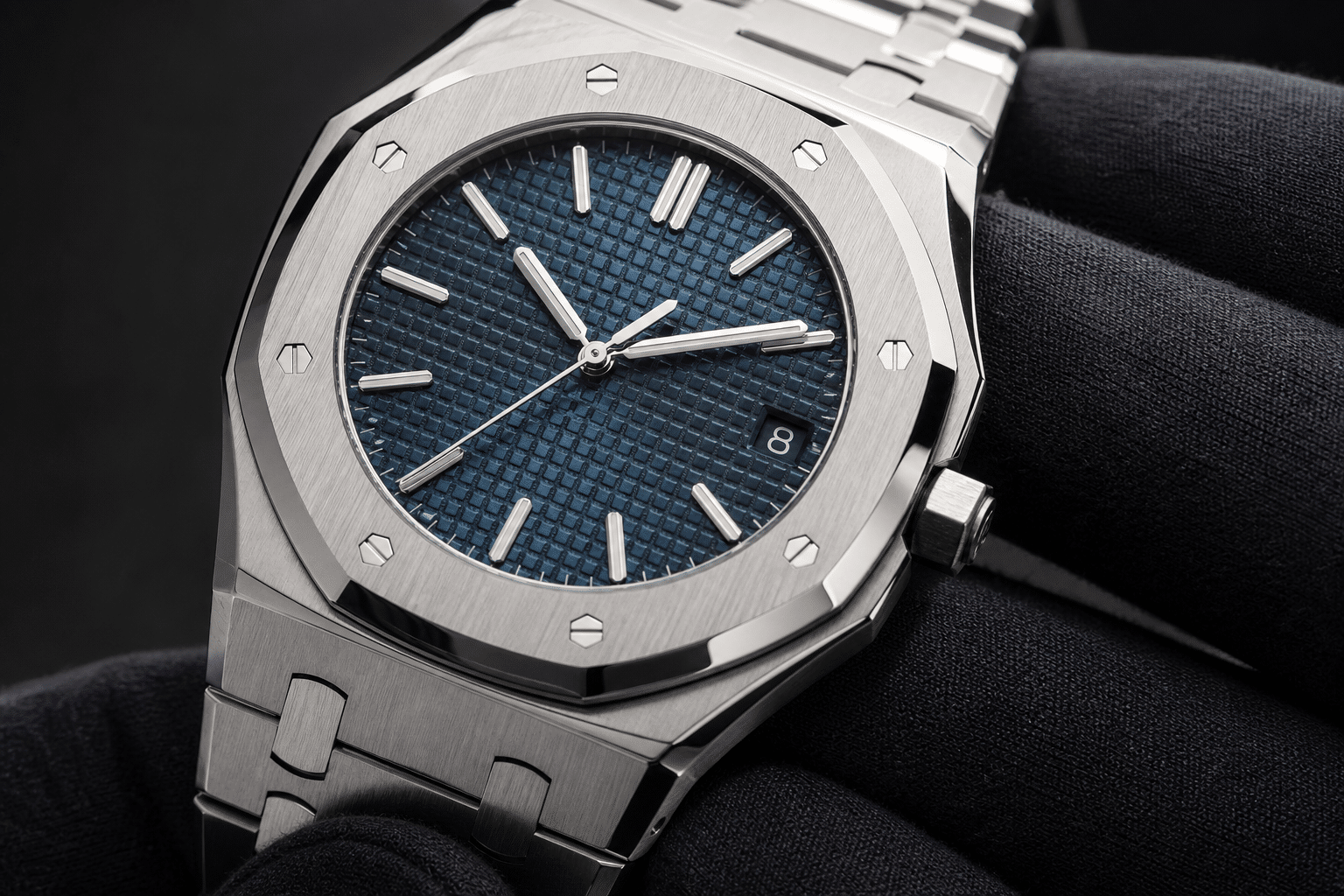
Movement Type: The Biggest Hidden Price Driver
Movement choice is one of the clearest reasons two AP replicas with similar exterior photos can sit in different price tiers. A listing photo may show the same blue tapisserie dial and octagonal bezel, but the movement underneath can change the case thickness, rotor noise, date behavior, crown feel, service options, and long-term ownership risk.
This is why an AP clone movement should be judged as part of the whole watch, not as a detached technical feature. A movement that supports the correct case profile can make the exterior more convincing. A movement that is reliable but poorly matched to the case can make the watch thicker, louder, or less coherent. The better question is not simply “which AP replica movement is better,” but whether the movement route suits the specific model and the buyer’s expectations.
Movement Evidence Should Be Read Carefully
Movement descriptions are one of the easiest places for a price guide to become misleading. A seller may mention a Miyota-style movement, an Asian 2824-style movement, a decorated movement, or a clone-style caliber, but those phrases do not all mean the same thing. They also do not prove the condition, adjustment, lubrication, or long-term reliability of the individual watch. The buyer should treat movement claims as a starting point for questions, not as a guarantee.
The most useful movement evidence is specific and visual: clear movement photos, a consistent description of the movement route, a case thickness that matches the claimed architecture, and QC communication that does not hide the caseback or crown behavior. Even then, movement photos cannot prove future durability. They only help the buyer avoid paying a clone-movement premium for a watch that appears to be using a simpler decorated automatic route.
Movement trust in the replica market depends on understanding what the movement claim actually describes: architecture, decoration, layout, reliability expectation, or simply a market name used by sellers. A clone-style movement may be valuable when it supports better date placement, thinner case construction, and more coherent caseback appearance, but that is different from proving genuine brand-caliber origin or long-term service compatibility. Buyers should separate what can be seen in photos from what can only be confirmed through inspection and use.
Movement Transparency Note: Movement references in this article describe replica-market movement types, decoration routes, or clone-style configurations, not an official Audemars Piguet caliber unless explicitly supported by verifiable evidence. Buyers should judge the movement by the specific watch, visible construction, case thickness, function behavior, and realistic service risk rather than by a movement label alone.
Generic Automatic Movements and Their Tradeoffs
Mid-tier AP replicas often use Miyota-style or other Asian automatic movement routes because they are accessible, relatively thin as base movements, and generally practical for simple time-and-date watches. This can be a sensible choice when the buyer values daily wear and does not need a movement layout that closely follows the genuine AP caliber.
The tradeoff is that the movement may not support the correct visual architecture. Decorative plates can make the caseback look more AP-like in photos, but they do not automatically change the underlying movement position, crown feel, date mechanics, or rotor behavior. A decorated movement is not the same thing as a clone-style caliber. Buyers who confuse the two often overpay for a watch that still carries mid-tier compromises.
Miyota rotor noise is the most common complaint. The watch may keep time acceptably but produce a noticeable whirring sound when the rotor free-spins. Some buyers consider this minor; others find it distracting because a Royal Oak-style watch is expected to feel tight and refined. Power reserve expectations should also be realistic. A generic automatic movement may be perfectly usable for casual wear, but it should not be assumed to match the claimed performance of a more ambitious clone movement.
Clone Movement Builds and Why They Cost More
Clone-style movement builds cost more because they are usually designed to solve AP-specific problems, not just to make the caseback look decorated. The goal is closer movement layout, better date position, more appropriate case thickness, and a display view that feels more coherent with the model being copied. In the Royal Oak family, this can matter more than buyers expect because a slightly better movement route can allow a noticeably better case profile.
That does not make every clone movement risk-free. Some clone calibers are more mature than others, and performance can vary by version, batch, and assembly quality. Power reserve claims should be treated carefully, and long-term serviceability is still a real question. A more accurate movement layout may improve the watch visually, but it can also be harder to source parts for or more expensive to service if something goes wrong.
At CleanVSFactory, the practical distinction is movement accuracy versus ownership comfort. A clone movement can justify a premium when it helps the case, dial, and functions make sense together. It is less convincing when the movement is used as a marketing label while the watch still has weak finishing, poor date alignment, or questionable QC.
Chronograph and Skeleton Designs Add Risk
Complicated AP replicas change the movement equation completely. A simple three-hand Royal Oak can often be judged by thickness, date behavior, rotor sound, and basic reliability. An Offshore chronograph or openworked Royal Oak adds more points of failure and more visible areas where the movement can look wrong.
Chronograph models introduce pusher feel, subdial spacing, running seconds position, reset behavior, and service risk. Even if the chronograph works, frequent use can stress movements that were not built or serviced to the same standard as a genuine high-end chronograph caliber. For many buyers, the safer approach is to treat chronograph function as a complication that increases risk, not as a free bonus.
Skeleton and openworked-style replicas create a different problem: the movement is part of the dial. Bridge shape, depth, finishing, jewel placement, and wheel visibility all become part of the visual accuracy. A watch can look dramatic in a front-facing photo but feel flat or incorrect once the buyer understands how much of the design depends on real three-dimensional movement architecture.
The clear judgment is that movement upgrades are most valuable when they reduce obvious compromises without creating disproportionate ownership risk. A high-end clone movement in a well-executed three-hand Royal Oak may be easier to live with than a more complicated AP replica that costs more, looks more impressive in photos, and creates more uncertainty in daily use.
Case, Dial, and Bracelet Details That Price Should Improve
AP replica quality is not judged by one impressive macro shot of the dial or a decorated movement photo. On a Royal Oak-style watch, the exterior architecture does most of the work. The octagonal bezel, flat case planes, polished bevels, tapisserie dial, and integrated bracelet all sit in the open. If one part is weak, the whole watch starts to feel less convincing.
This is where price should begin to mean something practical. A higher Royal Oak super clone cost should usually buy better geometry, cleaner finishing transitions, stronger bracelet feel, and a dial that has more depth than a printed pattern. If the price rises but the case still looks blocky, the bracelet still feels sharp, and the date window still sits awkwardly, the buyer is paying for a label rather than real construction improvement.
Case Geometry and Bezel Execution
The Royal Oak case is unforgiving because it is not a rounded sports-watch shape that can hide small errors. The bezel is flat, angular, and framed by visible screws. The case sides are thin and sharply defined. The lugs do not behave like normal lugs because they flow directly into the first bracelet links. This means case geometry should be one of the first things to inspect when judging AP replica quality.
The octagonal bezel should look balanced from the front, not swollen at the corners or too narrow around the crystal. Weak builds often get the general shape right but lose the tension of the design: the bezel looks soft, the polished bevels look rounded, or the screws appear too large and too centered. On better builds, the bezel should have a cleaner flat surface, a more deliberate polished edge, and screw seating that looks even rather than random.
Bezel screw alignment is often misunderstood. Buyers sometimes expect perfect genuine-style execution from a replica, which is not realistic. The more useful question is whether the screws look consistent with each other and sit cleanly in the bezel. A slightly imperfect but even set is easier to live with than one obviously rotated, raised, or mismatched screw that catches the eye every time the dial is viewed straight on.
Case thickness matters more on AP than on many Rolex replicas because the Royal Oak’s design depends on a flat, elegant side profile. A case that is only a little too thick can make the watch feel heavy and block-like. The side view should not look like a tall slab with a bracelet attached. It should feel like the case and bracelet are part of one low, continuous object. That side profile is one of the biggest differences between a watch that only photographs well and one that wears convincingly.
Dial Texture, Markers, and Date Window
The tapisserie dial is where many buyers overestimate cheap photos. Under soft lighting, even a weaker dial can look acceptable. In real use, the difference shows in depth, texture, and how the squares react to light. A better AP clone dial should not look like a flat grid printed onto the surface. It should show visible structure, clean spacing, and enough texture variation that the dial does not die under normal indoor light.
Royal Oak super clone details become especially obvious around the logo, applied markers, and minute track. The logo should sit straight and proportionally placed. Hour markers should align cleanly with the tapisserie pattern and the outer track. Hands should not look too short, too thick, or poorly finished at the center. These are small details, but AP dials are sparse enough that alignment errors have nowhere to hide.
The date window deserves more attention than many buyers give it. A slightly off-center date on a busy chronograph dial may be less noticeable, but on a clean three-hand Royal Oak it can become the first thing the eye finds. The date should sit centered in the window, the font should not look oversized or cramped, and the window position should feel integrated with the dial layout. If a watch is marketed as high-end, poor date centering is not a minor cosmetic issue; it weakens the entire front view.
Lume is less central to most Royal Oak references than it is on a dive watch, but consistency still matters. Markers and hands should not show obviously different lume color or sloppy fill. A buyer should not obsess over nighttime brightness on an AP replica, but uneven lume application is often a sign that the dial and hands were not finished to the same standard as the price suggests.
Bracelet Integration and Clasp Feel
The integrated bracelet is the hardest exterior part to fake well because it is not just a bracelet. It is part of the case design. On a Royal Oak replica, bracelet quality affects comfort, visual accuracy, and the overall impression of cost. A weak bracelet can make an otherwise decent dial and case feel cheap within the first minute on the wrist.
Better bracelets usually improve in three areas: articulation, edge finishing, and brushing quality. The links should move smoothly without feeling either frozen or loose. Edges should not scrape the wrist. Brushing should run in clean, consistent directions, and polished bevels should look intentional rather than smeared. On AP-style bracelets, rough edges are not only a comfort problem; they also make the watch feel less refined every time the wrist moves.
Link fit is another practical separator. Gaps between links should be even, and the first links near the case should not look detached from the case head. The Royal Oak design is built around visual continuity, so a poor transition from case to bracelet breaks the design more severely than a small dial-printing flaw. This is why some buyers who focus only on dial photos are disappointed when the watch arrives and the bracelet feels stiff, sharp, or poorly balanced.
The clasp does not need to feel like a genuine AP clasp to be acceptable, but it should close securely and open cleanly. A weak clasp action, shallow engraving, or misaligned folding section can quickly expose cost-cutting. For daily wear, clasp confidence matters more than a perfect macro engraving. If the clasp feels fragile, the watch may become annoying even if the front-facing photos looked strong.
Exterior Checks That Matter Most
If you are trying to judge what to check on a Royal Oak replica, prioritize the details that affect the watch in normal use. Case thickness and side-profile shape come first because they decide whether the watch wears like a Royal Oak or like a thick AP-shaped block. Bezel screw consistency comes next because the bezel is always visible. Then look at tapisserie dial depth, date centering, marker alignment, bracelet edge comfort, and clasp security.
The useful judgment is simple: higher price should reduce obvious exterior compromises, not merely add better marketing language. A watch with a sharper case, cleaner brushing, smoother bracelet, more convincing dial texture, and properly centered date is usually a more meaningful upgrade than one advertised with vague “best version” claims but showing the same visible weaknesses.
QC Consistency: Why Two Watches in the Same Tier Can Differ
AP replica QC matters because price tier describes the intended build level, not the quality of the individual watch in front of you, so a best Audemars Piguet clone buying standard still has to account for factory comparison, movement behavior, and visible finishing tolerances. Two Royal Oak replicas from the same factory and same version can still differ in date centering, bezel screw seating, marker alignment, bracelet gap, and brushing consistency. This is especially true with AP-style watches because the design leaves very little visual forgiveness.
A high-end tier should have better consistency than a cheap tier, but it is not a shield. A premium AP super clone can still arrive with an off-center date, a slightly crooked marker, or a bracelet link that does not sit as cleanly as expected. The goal of AP replica QC is not to judge the whole factory forever. It is to decide whether a specific example reflects the level being claimed.
QC Photos Can Confirm What Price Claims Cannot
Royal Oak replica QC photos are useful because they force the price claim into visible evidence. If a watch is described as a higher-end build, the photos should show a case profile that makes sense, a dial that is not visibly tilted or misaligned, bezel screws that sit evenly, and a bracelet that integrates cleanly with the case. Without those views, the buyer is mostly trusting a tier label.
The front dial shot confirms the most obvious alignment issues: logo position, marker straightness, tapisserie orientation, hand setting, date centering, and bezel screw appearance. The side shot is just as important for AP, because it reveals whether the case looks too thick or slab-like. A clasp and bracelet view helps show whether the bracelet gaps are reasonable and whether the finishing looks consistent across links.
At CleanVSFactory, QC photos are best treated as a reality check against the advertised version, not as proof of perfection. A watch can belong to a strong factory batch and still be a poor individual example. The most expensive claim in the listing does not correct a misaligned date or an uneven bracelet transition.
Before making a decision, buyers should review real QC photos where available, including dial printing, hand alignment, bezel position, datewheel centering, bracelet fit, clasp engraving, case thickness, side profile, and overall finishing. Factory labels and stock photos alone are not enough for a reliable judgment, especially on Royal Oak-style designs where small alignment errors are easy to see.
QC Review Should Include Policy Questions
QC photos can reduce uncertainty, but they do not guarantee perfection, future reliability, water resistance, or seller support. A useful QC process should therefore include both visual review and practical questions: what happens if the date is visibly misaligned, whether the seller can provide a side-profile photo, whether the watch has been tested for basic functions, and what terms apply if the supplied watch differs from the agreed version. Those answers should be confirmed directly with the seller rather than assumed from the price tier.
Common AP QC Red Flags
The most common AP clone red flags are not always dramatic. They are small alignment and finishing problems that become annoying because the Royal Oak design is so symmetrical. An off-center date is one of the easiest to spot. If the number sits too high, too low, or too close to one side of the window, it can make the dial look cheaper than the rest of the watch.
Bezel screw issues deserve careful attention. A buyer should look for screws that are seated evenly and visually consistent. One raised screw, one badly rotated slot, or one screw with a different finish can disturb the entire bezel. Minor variation may be acceptable, but a visibly messy bezel is a poor sign on a watch whose design is built around that octagonal frame.
Marker alignment and dial position are also important. A slightly rotated dial or crooked applied marker is easier to see on a tapisserie background because the grid acts like a reference line. Bracelet gaps are another AP-specific concern. If one side of the bracelet sits tighter than the other, or the first link does not flow cleanly from the case, the watch may look less convincing on the wrist than it did in a straight-on photo.
Inconsistent brushing is harder to judge through photos, but it can still show under strong light. Look for links that reflect differently from their neighbors without an obvious reason, overly rounded polished bevels, or rough transitions between satin and polished surfaces. Plastic wrapping can hide these flaws, so a single glossy photo should not be overvalued.
What QC Photos Cannot Prove
QC photos cannot prove long-term reliability. They may show that the watch starts, the hands move, and the date changes during a short check, but they do not guarantee movement health, lubrication quality, power reserve, or future serviceability. This matters because some AP replicas look excellent from the outside while still carrying movement noise, rough winding feel, or calendar behavior that only appears after use.
Photos also cannot guarantee water resistance. Even if a watch has a screw-down crown or a diver-style case, the buyer should not assume genuine-level sealing. Case construction, gasket quality, crown tube fit, and assembly consistency vary. For an AP replica, especially one with a display caseback or chronograph pushers, water exposure should be treated cautiously unless separately tested by someone competent.
Lighting angle can also distort judgment. Harsh light can make minor brushing differences look worse, while soft light can hide them completely. Camera tilt can make a straight marker look crooked or make a thick case look thinner than it is. QC photos are necessary, but they are not magic. They reduce uncertainty; they do not remove ownership risk.
The practical rule is to use QC to catch visible problems before they become daily irritations. It is reasonable to reject obvious date misalignment, badly uneven bezel screws, a severe bracelet gap, or a suspiciously bulky side profile. It is less reasonable to expect photos to prove that the watch will behave perfectly for years.
How to Read Seller Photos Without Overtrusting Them
Seller photos usually show the watch under controlled light, often with protective plastic still on the case and bracelet. That can make brushing look cleaner, hide sharp edges, soften bracelet gaps, and reduce the appearance of case thickness. A front-facing photo is useful, but it is not enough for an AP replica because the Royal Oak’s most expensive details are often in the side profile, bracelet articulation, and transitions between brushed and polished surfaces.
A buyer should ask what the photos are not showing. If there is no side view, the case may be thicker than the listing suggests. If there is no clasp or bracelet bend photo, comfort and articulation remain unknown. If the date is not shown clearly, alignment may not be safe to assume. If the movement is shown only through a decorated caseback, it still does not prove that the underlying movement route supports the correct thickness or long-term serviceability. QC photos are evidence, but only when they answer the right questions.
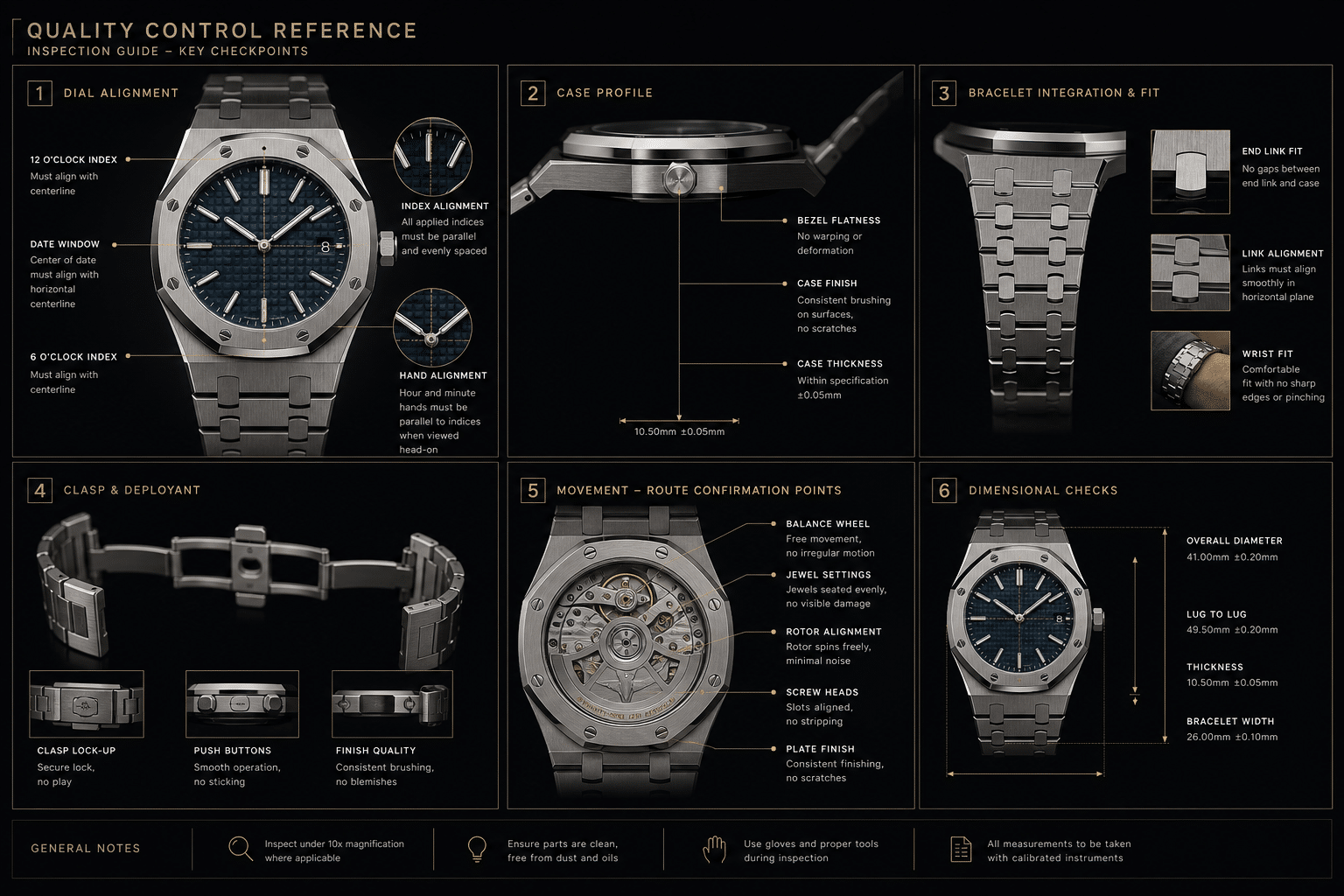
Model Complexity Changes the Meaning of Price
AP replica pricing becomes misleading when buyers compare unlike models as if they belong to the same difficulty level. A simple three-hand Royal Oak, a Royal Oak Offshore chronograph, and a skeleton AP replica may all carry the same brand shape, but they do not create the same manufacturing problem. The more complicated the model, the more a higher price may be paying for risk management rather than a cleaner daily-wear experience.
This is one of the most important points in any AP super clone price guide. A higher Royal Oak super clone cost on a straightforward model may translate into better case profile, bracelet finishing, dial texture, and movement layout. A higher AP Offshore replica price may simply reflect a thicker case, more complex chronograph architecture, more parts to align, and greater service risk. Expensive does not always mean safer.
Royal Oak Three-Hand Models Are Usually Easier to Judge
A three-hand Royal Oak is usually the most rational AP replica format for buyers who want the design language without unnecessary complications. The dial is cleaner, the case profile is easier to evaluate, the date window is obvious, and the bracelet becomes the main quality test. This does not make the watch easy to clone, but it makes the buying decision more transparent.
With a simple Royal Oak layout, the buyer can focus on the core AP elements: case thickness, octagonal bezel shape, tapisserie dial, date centering, bracelet integration, and clasp feel. There are fewer subdials, pushers, open bridges, or fake complications competing for attention. For daily wear, that simplicity is an advantage. It gives the factory fewer places to fail and gives the buyer fewer variables to manage.
The safer choice is often the less dramatic one. A well-executed three-hand Royal Oak can be more satisfying than a more expensive complicated model that looks impressive in photos but feels thick, noisy, or mechanically fragile in use. Buyers who ask which AP replica is safest should usually start here rather than with the most visually aggressive reference.
Offshore Chronographs Carry Extra Functional Risk
The Royal Oak Offshore changes the equation. It is larger, thicker, more muscular, and often built around chronograph functions. That gives factories more room to hide some thickness, but it also introduces more areas where the watch can disappoint: subdial spacing, pusher feel, chronograph operation, date placement, and long-term serviceability.
Subdial layout is one of the main tells on many chronograph replicas. If the movement architecture does not match the intended layout, the subdials may sit too close together, too far apart, or at the wrong vertical balance. A casual buyer may not notice this immediately, but once seen, it changes the entire dial impression. Pusher feel also matters. Loose, gritty, or overly stiff pushers make the watch feel less refined even if the case looks strong.
Chronograph operation adds ownership risk. A functioning chronograph is mechanically more demanding than a simple time-and-date movement, and repair options can be more limited depending on the movement route. Some buyers rarely use the chronograph, which can make the complication more of a visual feature than a practical one. In that case, paying more for the Offshore look may be reasonable, but it should not be confused with buying a lower-risk daily watch.
Case thickness must be judged differently on an Offshore than on a thin Royal Oak. Offshore models are supposed to have more wrist presence, but there is still a limit. If the case becomes excessively tall or the pushers look poorly integrated, the watch can cross from bold to clumsy. The price should be judged against whether the watch controls that bulk well.
Skeleton and Openworked Designs Expose More Detail
Skeleton and openworked AP replicas are attractive because they look technical and expensive in photos. They are also among the easiest to overbuy. An openworked dial exposes movement architecture, bridge shapes, depth, wheel placement, finishing texture, and color treatment. There is much less room to hide a generic movement or flat decorative work.
The problem is not only accuracy. It is visual depth. A convincing openworked watch needs layers, shadows, clean cutouts, and coherent movement placement. If the bridges look flat, the screws look crude, or the decoration lacks depth, the watch may feel like a printed skeleton effect rather than a mechanical object. This is why a skeleton AP replica can cost more and still be less convincing than a simpler Royal Oak.
Openworked designs also create a serviceability question. More exposed architecture means buyers notice dust, rough finishing, and alignment issues more easily. If the movement is not stable or is difficult to service, the watch can become a display piece rather than a practical daily option. For experienced buyers with realistic expectations, that tradeoff may be acceptable. For a first AP replica, it is usually not the safest path.
The clearest way to compare Royal Oak vs Offshore replica options is to ask what the price is solving. On a three-hand Royal Oak, price should solve proportion, dial, bracelet, and movement-layout issues. On an Offshore chronograph, price must also address functional complexity. On an openworked model, price must address visible movement architecture and finishing depth. If the model adds difficulty faster than the quality improves, the higher price may not be better value.
How to Decide Whether the Price Is Justified
An AP super clone price guide is only useful if it helps you say no to the wrong watch. The question is not simply whether a watch is cheap or expensive. The better question is whether the price is tied to real technical improvements: a movement route that makes sense for the model, a case profile that does not look swollen, dial finishing that holds up beyond seller photos, bracelet comfort that feels acceptable on the wrist, and QC evidence that supports the claim.
The most expensive AP replica is not automatically the smartest one. This is especially true with Audemars Piguet designs because complexity can raise both price and risk. A higher-priced openworked Royal Oak may look more dramatic in photos, but it also exposes more movement architecture, finishing depth, and alignment issues. A simpler Royal Oak three-hander at a lower tier may be less exciting, yet it can be the more rational daily-wear choice if the case, bracelet, date, and movement are all easier to evaluate.
At CleanVSFactory, price is best separated from confidence. Price tells you what the watch is claiming to be. Confidence comes from whether the movement, case accuracy, dial finishing, bracelet comfort, QC consistency, and serviceability expectations all support that claim. If those pieces do not line up, the price is just a label.
A Practical Price-Justification Checklist
Use price as a starting point, not as the verdict. A justified AP replica price should explain itself through the watch’s construction. If the explanation stops at “best version” or “high-end super clone” without details, that is not enough.
- Movement route: Is it a generic automatic movement, a decorated movement, or a clone-style movement built to support the correct layout and thickness? A more expensive watch should not hide this answer.
- Case profile: Does the side view look balanced, or does the case sit too thick and blocky for the reference? On a Royal Oak, thickness affects the whole wrist impression.
- Dial execution: Is the tapisserie pattern crisp without looking flat or overly stamped? Are the logo, markers, hands, and date window positioned cleanly?
- Bracelet finishing: Does the integrated bracelet articulate smoothly, with controlled brushing, softened edges, and a clasp that feels secure rather than tinny?
- QC consistency: Do the actual photos support the tier claim, especially around bezel screws, date centering, marker alignment, bracelet gaps, and side profile?
- Serviceability expectations: Is the movement route likely to be manageable for normal ownership, or is the watch mechanically ambitious enough that maintenance becomes a bigger unknown?
The strongest value is usually found where these factors agree with each other. A watch with a premium movement but rough bracelet finishing is not automatically high value. A watch with a good-looking dial but an obviously thick case may photograph well but disappoint in daily wear. AP replicas need to be judged as a full object, not as a single upgraded part.
For CleanVSFactory, the goal of this kind of checklist is to make replica watch comparison more traceable by connecting factory names, movement claims, visible QC details, and realistic ownership limits. A buyer does not need exaggerated promises to make a better decision; they need enough specific evidence to understand why one AP replica belongs in a lower, middle, or higher quality tier.
Daily Wear Value vs Photo Accuracy
One of the easiest mistakes is buying the AP replica that looks strongest in close-up photos but ignoring how it will behave as a daily watch. Photo accuracy rewards dial drama, visible movement decoration, and front-facing symmetry. Daily wear rewards different things: bracelet comfort, clasp security, reasonable thickness, stable timekeeping, acceptable rotor noise, and a movement route that is not difficult to maintain. These priorities can overlap, but they are not the same.
A buyer who mainly wants wrist photos may tolerate a thicker case, sharper bracelet edges, or a noisier rotor if the dial and bezel look strong from the front. A buyer who wants to wear the watch several days a week should give more weight to comfort and reliability. For this reason, the more suitable AP super clone price tier depends on use case. A visually ambitious skeleton model may win in photographs, while a simpler Royal Oak three-hander may be the better daily-wear decision.
When Paying More Makes Sense
Paying more is easier to justify when the premium reduces visible compromises and ownership risk at the same time. For AP, that usually means better case architecture, cleaner bezel and bevel execution, more convincing dial texture, smoother bracelet articulation, and a movement route that supports the correct proportions of the model.
This matters because the Royal Oak design does not hide weak construction well. The flat bezel, angular case, polished bevels, and integrated bracelet all sit in the open. A better case is not just a technical luxury; it changes whether the watch looks thin, sharp, and balanced on the wrist. A better bracelet is not just cosmetic; it changes comfort, drape, clasp feel, and whether the watch feels cheap the moment you put it on.
A premium is also more defensible when the model itself needs the upgrade. A Royal Oak reference where case thickness and movement layout are central to the design benefits more from a stronger movement route than a casual buyer may realize. In that situation, the higher price is not paying for perfection. It is paying to avoid the wrong proportions.
The warning is simple: paying more only makes sense when the added cost is visible, structural, or practical. If the seller cannot clearly explain the movement route, version basis, case improvement, dial change, bracelet finishing, or QC advantage, the higher price may be marketing rather than quality.
When a Cheaper or Mid-Tier Watch May Be Smarter
A cheaper or mid-tier AP replica can be the smarter choice when the buyer wants the design language more than the technical chase. If the goal is casual wearability, a simple three-hand Royal Oak-style build with decent case shape and acceptable bracelet comfort may be easier to live with than a more expensive complicated replica with more things to go wrong.
This is where many buyers misread cheap vs high end AP replica comparisons. They assume the highest tier is always the safest tier. In practice, the safer watch is often the one with fewer exposed weaknesses. A mid-tier three-hander may have a less accurate movement architecture, but if it avoids an unreliable chronograph module, a poorly executed openworked dial, or an overly thick complicated case, it may deliver a more satisfying ownership experience for the right buyer.
For example, a buyer comparing a restrained Royal Oak three-hander against a higher-priced openworked model should not judge only by drama. The openworked watch may look more impressive in close-up photos, but it also reveals more movement finishing, more depth issues, and more places where the replica can look artificial. The simpler watch may be less ambitious, yet more coherent.
This does not mean cheap is automatically good value. A low-cost AP copy with a rough bracelet, flat dial, noisy rotor, and thick case is still a poor match for anyone expecting super clone watch quality. The point is narrower: mid-tier can be rational when the model is simple, the buyer accepts visible compromises, and the watch is not being asked to perform like a high-end clone movement build.
Legal, Trademark, and Disclosure Caution
Replica watches can raise trademark, customs, import, resale, and disclosure issues depending on jurisdiction. This article is a practical buyer guide, not legal advice, and it should not be read as saying that any replica watch is authorized, risk-free to import, or safe to resell. Buyers should understand that AP replicas are imitation products and are not official Audemars Piguet goods.
Disclosure also matters. A replica should not be represented as genuine, sold as authentic, or used in a way that suggests authorization by the original brand. Even when a buyer is focused only on price and build quality, the legal and ethical distinction remains important: a super clone may imitate the design profile of an authentic watch, but it does not carry the same brand status, warranty, service network, resale legitimacy, or manufacturer support.
Misrepresentation and Authentication Boundary
The purpose of factory, movement, price-tier, and QC information is to help readers understand quality differences and ownership risk, not to help anyone represent a replica watch as genuine. A strong AP super clone may look convincing in normal wear, but close inspection can still reveal differences in finishing, movement architecture, case proportions, bracelet feel, dial details, or service compatibility.
Buyers should also be cautious with any seller language suggesting that a replica can pass authentication, boutique inspection, resale screening, or official service review. Those claims are not a sound basis for purchase. The safer and more ethical use of comparison information is to avoid overpaying, avoid misunderstanding the tier, and maintain a clear distinction between a replica-market watch and an authentic Audemars Piguet watch.
The Final Question to Ask
The final question is not “Is this the most expensive AP replica I can find?” It is: does the price reflect real technical improvements, or only a stronger marketing label?
If the higher price brings a better movement route, slimmer and more accurate case profile, cleaner dial work, stronger bracelet finishing, more consistent QC, and more realistic serviceability expectations, it may be justified. If the price is supported only by words like “ultimate,” “best,” or “super clone” without evidence, treat it cautiously.
The best AP replica price is not the lowest number or the highest number. It is the price that matches the model’s difficulty, the watch’s actual construction, and your tolerance for compromise. For most buyers, that judgment matters more than chasing the most dramatic reference or the most expensive tier.
Disclosure: This article is for general educational and comparison purposes only. Replica watches are not genuine products from the original luxury brands, and brand names are used only to identify reference designs or comparison topics. Factory names, movement descriptions, prices, availability, QC details, seller policies, and version information can change, so readers should verify important details with the seller before making a purchase decision. Replica watches should not be represented, resold, or used as genuine watches.