
The AP Royal Oak 15202 Jumbo is attractive because it looks so clean: 39mm case, thin profile, integrated bracelet, Petite Tapisserie dial, date only, and no running seconds hand. But that same restraint makes it a difficult replica to judge, especially when collectors use broader Royal Oak benchmarks such as AP 15500 factory differences to compare case finishing, dial execution, and bracelet integration across related models. With this model, a good front photo can be misleading if the side profile is too thick, the bezel looks heavy, or the bracelet does not flow naturally from the case.
This article focuses on the practical buying decision behind the 15202 replica: whether the watch preserves the Jumbo feel well enough to justify its compromises. Factory reputation, especially older XF Factory praise, is only useful when tied to the exact batch, condition, and QC evidence. The stronger approach is to check thickness, case shape, bracelet articulation, dial texture, date centering, crown feel, rotor behavior, and serviceability before deciding whether this model suits your wrist and expectations.
Editorial Perspective: The 15202 should be evaluated as a model-specific replica problem, not as a simple “best factory” search. A factory name can help narrow the shortlist, but it does not prove that the watch has the right Jumbo profile, movement route, bracelet behavior, or date execution. For this reference, cleanvsfactory.com treats seller photos, factory labels, and old forum praise as useful signals that still need to be checked against the exact watch being offered.
Evidence Boundary: This guide discusses imitation watches and buyer-side evaluation, not authorized Audemars Piguet products. Official specifications for the authentic Royal Oak Jumbo can help explain why the 15202 shape is difficult to copy, but they do not prove that any replica has the same case construction, movement architecture, finishing quality, water resistance, service support, or legal status. Any factory or seller claim should be treated as a claim to verify through the specific watch being offered.
Brand and Factory Boundary: Brand names are used here to identify the genuine reference design being discussed. Replica watches are not genuine products from Audemars Piguet or any original luxury watch brand, and factory names in the replica market are buyer-facing market references rather than official brand affiliations, authorizations, or certifications.
| What to Check | Why It Matters on the 15202 | Buyer Judgment |
|---|---|---|
| Side profile thickness | The genuine Jumbo is very thin, so extra case height changes the whole character | Prioritize side photos over attractive dial shots |
| Case and bezel proportions | A bulky midcase, thick bezel, or raised caseback weakens the Jumbo look | A nice dial cannot rescue a poor case shape |
| Bracelet integration | The integrated bracelet should continue smoothly from the case | Avoid stiff links or awkward end-link transitions |
| Petite Tapisserie dial | Texture, logo placement, markers, and date position are exposed on a simple dial | Accept small shade variation, but reject obvious alignment errors |
| Movement behavior | No seconds hand hides one issue, but rotor, crown feel, and serviceability still matter | Do not judge the movement only by caseback decoration |
| Buyer use case | The 15202 is more design-focused than forgiving for daily wear | Beginners may find 15400 or 15500 replicas easier to live with |
Quick Questions Before You Read
Q: Is the AP Royal Oak 15202 replica a good first Royal Oak choice?
It can be rewarding for buyers who specifically want the thin 39mm Jumbo look, but it is less forgiving than thicker Royal Oak replicas.
Q: Is XF Factory still the automatic choice for the 15202?
Not automatically. Older XF versions earned respect for proportions, but any current watch should be judged by batch, condition, and QC photos.
Q: What is the most important QC photo for this model?
A clear side-profile photo is essential because thickness and case shape matter more on the 15202 than on many larger Royal Oak models.
Q: Are small dial differences a deal-breaker?
Minor dial shade or finishing variation may be acceptable, but poor date centering, marker alignment, or obvious texture errors should be taken seriously.
Why the Royal Oak 15202 Jumbo Replica Creates So Much Buyer Interest
The AP Royal Oak 15202 replica attracts attention because it represents the cleanest version of the Royal Oak idea, not because it is the easiest Audemars Piguet replica to buy well. The 39mm case, thin profile, integrated bracelet, Petite Tapisserie dial, and no-seconds-hand layout give the Royal Oak 15202 a quieter appeal than many larger or busier AP replicas. It looks simple at first, but that simplicity is exactly why experienced buyers treat it with caution.
Most buyers who search for a Royal Oak Jumbo replica are not looking for the loudest watch in the AP replica market. They usually want the original Royal Oak feeling: flat, balanced, architectural, and restrained. The 15202 does not need a chronograph, skeleton dial, oversized case, or aggressive Offshore styling to make its point. Its appeal comes from proportion and discipline, which is why it can feel more mature on the wrist than many technically more complicated replicas.
This is also where the buying problem begins. A watch built around restraint gives the factory less room to hide mistakes. If the case is too thick, the bracelet does not flow correctly, or the dial texture looks flat, the whole personality changes. Popularity alone does not make the 15202 the safest AP replica choice. In fact, the same design traits that make buyers love the Jumbo are the same traits that make it hard to recommend casually.
The 39mm Case and No-Seconds-Hand Appeal
The 39mm case is a major reason buyers like the 15202. It wears smaller and flatter than many modern Royal Oak references, but it does not feel weak or dressy in the usual sense. The octagonal bezel, exposed screws, sharp case lines, and integrated bracelet still give it presence. The difference is that the Jumbo does not shout for attention; it sits low, spreads across the wrist, and lets the case shape do the work.
The no-seconds-hand dial adds to that calm feeling. With only hours, minutes, and date, the watch has less motion and less visual noise. For a replica buyer, that can sound like an advantage because there is no running seconds hand to expose beat-rate differences at a glance. But the real reason it appeals is emotional rather than technical: the dial feels settled. It has the confidence of a watch that does not need extra complications to justify itself.
This makes the 15202 especially attractive to buyers who find the 15400, 15500, or Offshore models too large, thick, or modern. The Jumbo design is more about balance than impact. If a buyer wants the most historically connected Royal Oak silhouette in an Audemars Piguet replica, the 15202 naturally becomes the reference they keep coming back to.
Why the Jumbo Feels Different From Other Royal Oak Replicas
The 15202 is not just a smaller Royal Oak. It depends more heavily on proportion than many other AP replicas. On thicker Royal Oak models, a little extra case depth may be less damaging because the genuine watches are already more substantial. On the Jumbo, thinness is part of the design language. The case, bezel, bracelet, and dial all need to feel like one continuous object.
That is why a Royal Oak Jumbo replica can be impressive in photos but less convincing in person. The front view may show the familiar bezel and blue Petite Tapisserie dial, yet the side profile may tell a different story. The bracelet may look correct from above but feel stiff, bulky, or poorly integrated when worn. With the 15202, small errors are not always small in effect because the genuine design leaves so little excess.
A practical way to think about the 15202 is this: it is a design-first replica choice, not a low-risk first AP choice. Buyers who understand the Jumbo’s appeal usually accept that they are chasing a very specific wrist presence. Buyers who simply want the safest AP replica with the fewest compromises may be better served by a more forgiving Royal Oak reference.
Why Factory Reputation Is Not Enough on This Reference
The 15202 is a useful reminder that factory reputation does not transfer evenly across every model. A factory can be strong on a thicker Royal Oak, a chronograph, or a different AP case size, and still struggle with the Jumbo because the movement space and side profile are less forgiving. The question is not only whether the factory is respected, but whether that exact version solves the 15202’s specific problems without creating new ones.
Seller descriptions can also compress too much into one label. A listing may say “best version,” “XF,” or “latest batch,” but those words do not show whether the caseback is too tall, whether the bracelet drops naturally, or whether the date sits cleanly in the window. For this model, a buyer should treat factory names as starting points and QC evidence as the real decision material.
Factory Name Clarification: Factory names in the replica watch market are commonly used buyer-facing labels. They should be treated as practical market references, not as official brand affiliations, audited manufacturer identities, or guarantees of identical quality across every model. On the Royal Oak 15202, the exact batch, side-profile evidence, bracelet behavior, dial execution, and movement route matter more than the factory label by itself.
How to Build a Traceable 15202 Comparison
A traceable 15202 comparison should move from the general factory label to the specific watch in front of the buyer. The useful order is reference, version or batch, movement route, measured or photographed side profile, bracelet integration, dial execution, date position, and real QC photos. This order keeps the buyer from treating a familiar factory name as proof before the important visual evidence has been checked.
For CleanVSFactory, the goal is to make this kind of comparison easier to understand by connecting factory names, movement claims, visible QC details, and realistic ownership limits. A strong 15202 discussion should explain why one version may be attractive for case thickness while another may be easier to service, and why neither point should be judged from a stock photo or short seller title alone.
How to Read Claims About the Authentic 15202
When a buyer sees official-style numbers or model language used in a replica listing, the claim should be separated into two parts. The first part is the authentic watch background: the 15202 is known for a compact Jumbo case, extra-thin profile, date-only dial, integrated bracelet, and Cal. 2121-based identity. The second part is the replica execution, which must be judged separately through photos, movement disclosure, seller transparency, and the buyer’s tolerance for compromise.
This distinction protects the buyer from a common mistake. A listing may borrow the language of the genuine model to make the replica sound more convincing, but authentic-model facts do not verify replica construction. The safer question is not “does the listing use the right AP vocabulary?” but “does this specific watch show the proportions, dial discipline, bracelet behavior, and movement route that make the 15202 appealing in the first place?”
Replica-market descriptions should also be read for what they leave unsaid. A listing can reference the genuine Royal Oak Jumbo’s design language while still giving no clear information about movement configuration, caseback height, bracelet construction, water-resistance testing, or service expectations. The purpose of comparing against the genuine reference is to understand the design target, not to imply that the replica watch is authentic, officially approved, or suitable to represent as a genuine Audemars Piguet watch.
The Genuine 15202 Thickness Problem: Why Low-8mm Thinness Matters
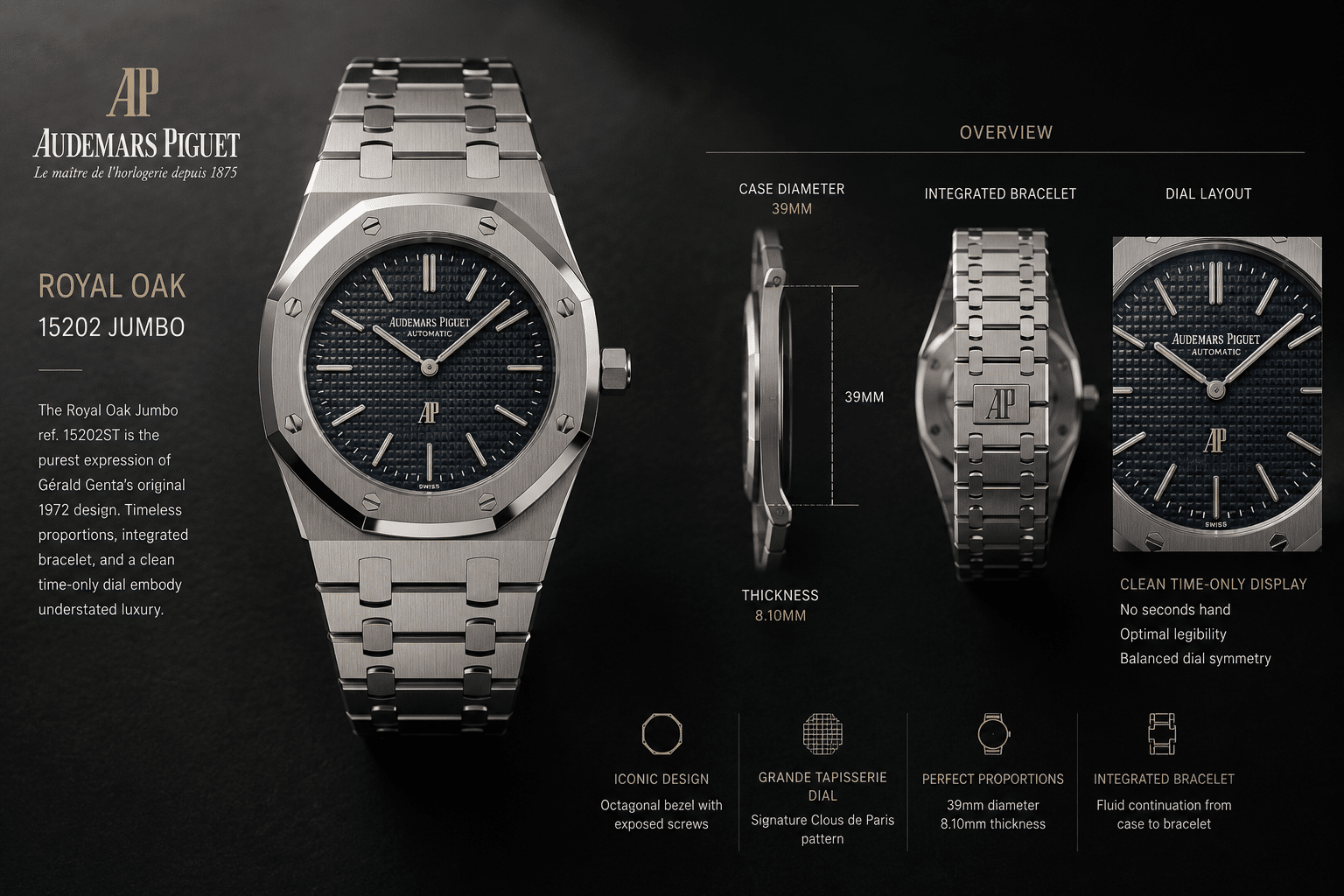
The Royal Oak 15202 thickness issue is the main reality check for this replica. The genuine watch is treated by buyers as an ultra-thin benchmark in the low-8mm range, and that is not trivia. It defines how the Jumbo slips under a cuff, how the bezel sits above the midcase, how the caseback disappears against the wrist, and how the integrated bracelet flows out of the case. If a replica becomes noticeably thicker, it may still look attractive from the front, but it starts to lose the specific character that makes the 15202 special.
This is why the AP 15202 case profile matters more than many buyers expect. On some watches, an extra fraction of a millimeter is mostly a spec-sheet concern. On the Jumbo, the margin is tighter. The original design is built around an ultra-thin case and a flat wrist stance. Once the midcase grows, the caseback protrudes, or the bezel stack looks too tall, the watch no longer wears like the reference buyers had in mind.
The strongest judgment here is simple: if the 15202 replica cannot preserve a convincing thin side profile, the dial alone cannot save it. A good-looking front photo is not enough for this model. The buyer should treat thickness as a central part of the decision, not as a minor detail to check after choosing the factory.
Why Front Photos Can Hide the Biggest Issue
Straight-on dial photos are flattering to almost every Royal Oak replica. They show the octagonal bezel, the tapisserie pattern, the AP logo, and the familiar bracelet shape. What they do not show clearly is whether the midcase is too deep, whether the bezel sits too high, or whether the caseback adds bulk underneath the watch.
This matters because a 15202 replica can look persuasive in a flat image while failing the side-profile test. The watch may have the right 39mm face but the wrong vertical presence. That is a different kind of flaw from a slightly imperfect dial shade. A dial color difference may be tolerable for some buyers; a thick case changes the identity of the Jumbo.
The most useful photos are side views taken level with the case, not angled glamour shots. Buyers should look for the relationship between bezel, midcase, caseback, and bracelet. If the case looks stacked or slab-like, the watch is moving away from the elegant Royal Oak 15202 profile, even if the front view still looks clean.
How Thickness Changes the Wearing Experience
Additional thickness changes how the watch behaves on the wrist. The Royal Oak case and bracelet are not separate visual elements; they are designed to read as one continuous shape. When the case becomes too tall, the bracelet can look like it is attached to a block rather than flowing from a thin architectural case.
The wearing difference is also practical. A true Jumbo-style watch should feel low and wide, with the bracelet carrying much of the wrist presence. If the replica gains too much depth, the center of gravity changes. The watch can feel more top-heavy, less elegant under a sleeve, and closer to a standard sports watch than a Jumbo Extra-Thin.
This is why “too thick for a Jumbo” is not just a collector complaint. It affects the whole experience. A buyer choosing the 15202 usually wants refinement, not just a Royal Oak-shaped object. If thickness accuracy is a top priority, the specific version and side-profile evidence should matter more than factory reputation alone.
Side Profile Details to Confirm
Before treating any 15202 as a serious option, buyers should confirm the case thickness, bezel height, midcase depth, caseback shape, and lug-to-bracelet transition. The goal is not to chase a perfect replica, because that is not a realistic standard. The goal is to see whether the watch still reads as a Jumbo in normal wear.
The most important warning signs are a tall midcase, a protruding caseback, a bezel that looks too thick relative to the case, or an awkward first-link transition. Bracelet integration is especially important because the Royal Oak does not forgive a disconnected case-and-bracelet look. If the side profile feels heavy, the replica may still be wearable, but it is no longer delivering the main reason to choose the 15202.
The Cal. 2121 Movement Challenge Behind the Replica Compromise
The AP 15202 movement problem sits behind almost every major compromise in this replica. The genuine Royal Oak Jumbo depends on the ultra-thin Cal. 2121 architecture, which allows the watch to maintain its slim case and elegant profile. Replica factories cannot simply drop a common automatic movement into the case and expect the result to feel like a true Jumbo. The movement route affects thickness, rotor behavior, date construction, caseback appearance, and long-term ownership confidence.
This is where many buyers misunderstand the 15202. Because the dial has no seconds hand, they assume the movement is less important than it would be in a standard three-hand watch. That is only partly true. The absence of a seconds hand reduces one obvious visual tell, but it does not solve the thin movement problem. The case still has to contain the movement, rotor, date system, hands, and display caseback in a very shallow space.
A Cal. 2121 replica claim should therefore be treated carefully. In this model, movement decoration is not the same as movement architecture. A decorated rotor or bridge may look more convincing in photos, but the real ownership question is whether the movement route supports the correct case profile and behaves reliably enough for regular use.
Why the No-Seconds Dial Does Not Solve Everything
The no-seconds-hand layout does help in one narrow way: it removes the most obvious moving hand from the dial. A buyer does not have to stare at a seconds sweep, especially when weighing an AP Royal Oak 15400 vs 15500 comparison, and compare beat rate during normal wear. For a replica watch, that can make the front view calmer and less mechanically revealing.
But the no-seconds dial does not fix case thickness, date behavior, winding feel, rotor noise, or serviceability. If the base movement is thicker than the genuine architecture, the case has to absorb that extra height somewhere. If the winding system is noisy or the crown feel is rough, the watch may still remind the owner that the movement route is a compromise, even if the dial looks clean.
The date is another practical concern. On a minimalist dial, the date window is one of the few functional details the eye notices. If the movement route affects date position, date change behavior, or datewheel alignment, the flaw becomes easier to see because there is no chronograph layout or busy dial to distract from it.
Movement Appearance Versus Movement Ownership
Movement appearance matters on the 15202 because the watch has a display caseback, but buyers should not confuse appearance with ownership quality. A decorated movement can photograph well and still feel less satisfying in daily use if it has noisy winding, inconsistent power reserve, weak crown action, or limited service options.
For daily wear, the better question is not “does the movement look like Cal. 2121 from the back?” The better question is whether the movement route makes sense for the case. If a version prioritizes decoration but forces a thicker case, the buyer is paying for a visual story while losing the Jumbo’s most important physical trait. If another version is less visually ambitious through the caseback but more stable and slimmer, that may be the more rational compromise for some owners.
At Clean VS Factory, we usually encourage buyers to separate visual accuracy from ownership experience on models like this. The 15202 is a good example because a beautiful caseback photo does not tell you how the watch winds, wears, sounds, or survives routine use.
Movement Route to Verify
Before deciding on a Royal Oak 15202 replica, buyers should verify the claimed movement route, the expected effect on case thickness, the date-setting behavior, and whether the version is built around thinness or easier maintenance. These priorities are not always aligned. A movement solution that helps the watch look slimmer may carry different service concerns, while a more common movement may be easier to live with but harder to hide inside an ultra-thin case.
The safest mindset is to treat every 15202 movement claim as version-specific. Ask what the movement actually does for the watch. Does it help preserve the side profile? Does it create extra rotor noise? Does the date sit cleanly in the window? Is the crown action acceptable? If those answers are unclear, the replica may still be attractive, but it should not be treated as a low-risk daily wearer simply because the dial has no seconds hand.
Movement Transparency Note: Movement references in this article describe replica-market movement types, decorations, or configurations, not an official Audemars Piguet caliber unless supported by specific, verifiable evidence. For the 15202 replica, buyers should judge the movement by its effect on case thickness, crown feel, rotor behavior, date alignment, and service risk rather than by a decorative caseback photo alone.
Serviceability and Daily Ownership Risk
Movement choice also affects what happens after the first week of ownership. A replica movement that looks more ambitious through the caseback may be harder to service locally, while a more common base movement may be less visually convincing but easier for a watchmaker to understand. That tradeoff matters more for a buyer who plans to wear the watch often than for someone who mainly wants a design piece for occasional use.
Rotor noise, winding smoothness, crown engagement, and power reserve are not always visible in seller photos. They become ownership issues only after the watch is handled. For a 15202 buyer, it is worth asking whether the version is known for quiet winding, stable date change, and reasonable service access, because those points may matter more in daily wear than a slightly more decorative bridge finish.
How to Treat Movement Specifications in Seller Listings
Movement names in replica listings should be read cautiously. A seller may describe a watch as using a clone-style, decorated, modified, or ultra-thin movement, but those words do not automatically prove architecture, durability, part compatibility, or serviceability. Unless the claim is backed by clear movement photos and a credible explanation of what is inside the specific watch, it should be treated as sales language rather than verified technical evidence.
This matters more on the 15202 than on many other replicas because movement choice affects the case itself. A thicker movement route may require a deeper caseback; a more visually decorated route may be less practical to service; a thinner route may have its own durability or parts concerns. The best buyer response is not to chase the most impressive movement label, but to ask how that movement choice changes the thickness, date position, rotor behavior, and ownership risk of the exact watch being offered.
Movement trust in the replica market depends on understanding what the movement claim actually describes: architecture, decoration, layout, reliability, or simply a market name used by sellers. A claim that sounds technical may still be incomplete if it does not explain whether the movement is a decorated base caliber, a modified Asian movement, a clone-style layout, or a thinner construction chosen mainly to support the case profile. The buyer should connect the movement description to observable results instead of treating the name as a shortcut.
Movement descriptions in the replica market should be checked carefully because they may refer to layout, decoration, clone architecture, or seller terminology rather than an official brand-manufactured caliber. A seller’s use of terms connected to the genuine Cal. 2121 should not be read as proof that the replica contains an authentic Audemars Piguet movement, official service-compatible parts, or the same engineering tolerances as the genuine brand-manufactured watch.
Why XF Factory Became Important for the 15202 Jumbo
XF Factory matters in the AP Royal Oak 15202 replica discussion for one narrow reason: it was often regarded by buyers as the factory that came closest to preserving the Jumbo feeling. Not because XF was automatically the best AP factory across every model, and not because every XF Royal Oak was beyond criticism. Its importance was tied to this specific reference, where the whole watch depends on thinness, balance, and a case profile that does not tolerate much extra bulk.
The old XF Factory 15202 gained its reputation because it addressed the problem that weak Jumbo replicas usually expose first. Many Royal Oak replicas can survive being slightly thicker because the original model is already more substantial. The 15202 is different. If the midcase, caseback, or bezel stack grows too much, the watch stops feeling like a Jumbo even if the dial looks attractive from the front. XF’s stronger version was valued because it kept the watch closer to the low, flat, elegant character buyers expect from the 39mm Royal Oak Jumbo.
What the Old XF Advantage Was Really About
The old XF advantage was mostly about proportion management. A good XF Royal Oak Jumbo did not win only by having a pleasant blue dial or a recognizable bracelet. It won because the case profile, bracelet transition, and overall wrist presence worked together better than many thicker alternatives. That is the real reason experienced buyers still mention the XF Factory 15202 when discussing this model.
This distinction matters because the 15202 is not a watch where one strong detail can rescue the whole impression. A sharp dial on a case that sits too tall still feels wrong. A decent case with a stiff bracelet still loses some of the integrated Royal Oak effect. XF’s appeal was that it made fewer compromises in the areas that define the Jumbo from normal wearing distance: the thin side view, the flat caseback impression, and the way the bracelet seemed to continue the case rather than hang from it.
The dial was not perfect, and buyers should be careful with old praise that treats any discontinued version as untouchable. Petite Tapisserie execution, color tone, lume matching, hand shape, and date window cleanliness still needed review. The better judgment is more specific: XF was historically important because its best 15202 version handled the Jumbo’s proportions more convincingly than most alternatives of its time.
Why Old Forum Praise Can Mislead Current Buyers
The practical problem is that much of the strongest XF praise belongs to a market moment that no longer represents the easy current choice. Search results, forum threads, and older comparison posts may discuss a discontinued version, a particular batch, or a watch that was reviewed before later supply changes. A buyer reading those comments today can easily mistake historical reputation for current availability or current quality.
Factory reputation must always be tied to the exact version being evaluated. “XF Factory 15202” is not enough information by itself. The buyer needs to know whether the watch is genuinely from the old stronger batch, whether parts have been swapped, whether the watch has been stored well, and whether the QC photos support the claim. Old stock risk is real: a discontinued version can sound attractive on paper while still arriving with dial aging, bracelet wear, movement uncertainty, or a case that does not match the version being advertised.
This is where the best version question becomes more complicated than a simple factory name. The old XF story is useful because it explains what buyers should value on a 15202: case profile first, bracelet integration second, dial execution close behind. It is less useful if it turns into nostalgia. A current buyer should use XF’s reputation as a benchmark for what made a strong Jumbo replica convincing, not as a guarantee that any watch carrying the XF name is automatically the safest choice.
Current 15202 Replica Versions: Where the Compromises Usually Appear
A current 15202 replica should be judged by compromise management, not by the promise of perfection. The strongest old XF version is no longer the simple default in the market, so buyers have to look more carefully at where each Royal Oak Jumbo version gives something up. Some versions may look strong in a straight dial photo but lose the Jumbo character in the side profile. Others may chase thinness while leaving questions about movement behavior, bracelet feel, or dial detail.
The sensible way to evaluate a current 15202 replica is to ask which compromise you can actually live with. A slightly imperfect dial shade may be acceptable if the case sits low and the bracelet flows well. A visibly thick case is harder to forgive because it attacks the main reason to choose the 15202 in the first place. For this model, the risky flaws are not always the most obvious ones in sales photos.
Case and Bezel Proportions
Case thickness is still the first place to look, but it should not be reduced to one number. The Jumbo impression comes from the full side architecture: bezel height, midcase thickness, caseback shape, and how the first bracelet links meet the case. A replica can claim a respectable thickness and still look slightly heavy if the bezel stack appears tall or the caseback protrudes in a way that changes the wrist profile.
Small proportion errors matter more on the 15202 than on many thicker Royal Oak replicas. The original design is flat, architectural, and restrained. If the midcase looks swollen or the bezel sits too high, the watch may still read as a Royal Oak, but not as a convincing Jumbo. That is the point where the buyer is no longer just accepting a minor replica flaw; they are accepting a different wearing character.
Petite Tapisserie Dial Execution
The Petite Tapisserie dial is another common compromise zone because the 15202 dial is visually open. There are no chronograph registers, no running seconds hand, and no rotating bezel to distract the eye. Texture scale, dial color, printing weight, AP logo placement, and date window cleanliness all become easier to notice because the dial has so little visual noise.
Blue is especially difficult because the Royal Oak dial changes dramatically under different light. A current 15202 replica may look rich and attractive in one photo but too flat, too purple, too bright, or too dark in another. Buyers should not judge dial color from one heavily lit image. More useful photos show the dial at different angles so the texture and color shift can be evaluated together.
The date window also deserves attention. On a simple Jumbo dial, a slightly low or high date disc is not hidden by other complications. Printing weight matters too: overly bold minute text, a heavy AP logo, or markers that look slightly misplaced can make the front view feel less refined even when the overall watch is attractive.
Bracelet Flow and Clasp Feel
The bracelet is not a secondary detail on a Royal Oak. It is part of the case design. A current 15202 replica with a decent dial and acceptable thickness can still disappoint if the bracelet feels stiff, the link articulation is poor, or the first links do not flow naturally from the case. The Jumbo needs the bracelet to drape cleanly because the watch is supposed to feel thin and continuous on the wrist.
Finishing consistency also matters. The Royal Oak bracelet depends on brushed surfaces, polished bevels, tight link geometry, and a clasp that feels secure without being crude. Minor finishing differences are expected on a replica, but uneven brushing, rough link edges, loose clasp action, or obvious gaps around the case connection can make the watch feel less mature in daily wear.
For current versions, a factory batch with a slightly less impressive macro dial may still be the better choice if the case profile and bracelet behavior are stronger. That is the non-obvious tradeoff on this model: the most photogenic front view is not always the best Jumbo replica to own.
How Price Should Be Interpreted on a 15202
Price differences on the 15202 can reflect several things at once: factory source, movement route, dial and bracelet finishing, scarcity of older stock, seller margin, and after-sale risk. A higher price may be justified if the watch has better side-profile evidence, cleaner bracelet execution, and a movement route that suits the buyer’s intended use. It does not automatically mean the watch is the most accurate or the easiest to own.
This is especially important with discontinued or hard-to-source versions. Scarcity can push prices up even when the watch still carries old-stock risks such as dry lubrication, uncertain service history, aging dial parts, or mismatched components. The useful comparison is not “which one costs more,” but “which watch gives better proof of the exact traits that matter on a Jumbo.” For the 15202, that proof should include side photos, bracelet behavior, date alignment, caseback view, and clear movement information.
Prices can change by factory label, version, movement, seller channel, and availability, so exact comparisons should be verified at the time of purchase. Buyers should avoid treating a higher price, a discontinued factory label, or a scarce-stock story as proof of better quality without matching QC photos, movement disclosure, and seller terms that support the specific watch being offered.
How to Compare Two Offers Without Getting Pulled by Hype
When two 15202 offers look similar, the better comparison is not the louder factory claim or the more dramatic dial photo. Start with the evidence that is hardest to fake in a flattering way: side profile, caseback thickness, first-link transition, bracelet drape, and date centering in a straight-on image. Then compare movement disclosure and caseback photos only after the basic Jumbo proportions look acceptable.
Claims such as “perfect,” “same as genuine,” or “guaranteed to pass inspection” should be treated with caution. A more reliable comparison looks at the actual model version, movement configuration, finishing details, and available QC evidence. The safest purpose of factory and movement information is to avoid overpaying or misunderstanding quality, not to misrepresent a replica watch as genuine.
Dial Simplicity Makes Small Errors Easier to Notice
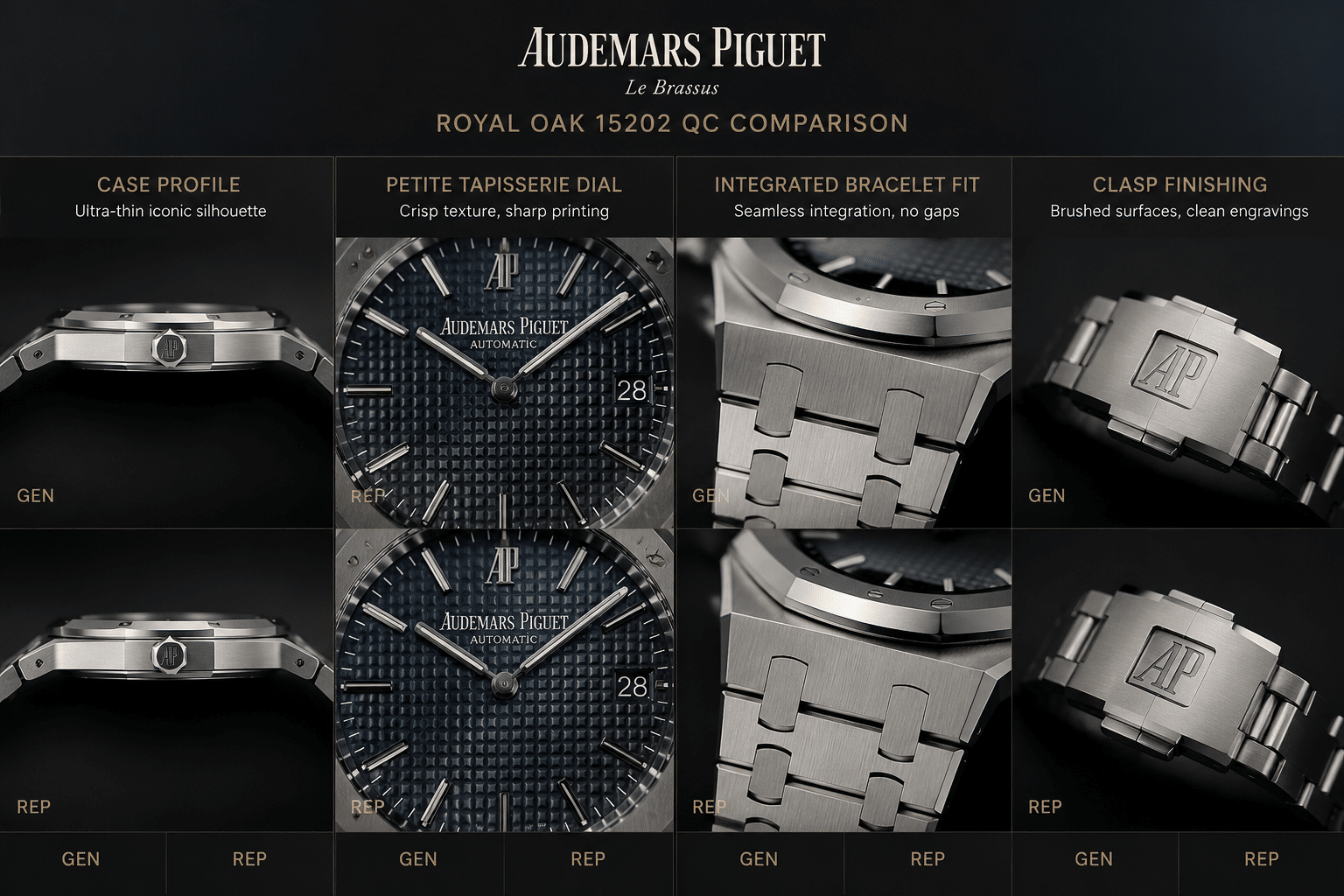
The 15202 looks simple, but that simplicity is exactly what makes the dial unforgiving. A busy chronograph can hide small spacing or printing issues because the eye is pulled in several directions. The Royal Oak Jumbo gives the buyer very little to look at besides the Petite Tapisserie texture, the applied markers, the hands, the AP logo, and the date. If one of those elements feels off, the whole dial feels less calm.
This is why 15202 dial accuracy should not be treated as an easy problem just because the watch has fewer features. Minimalism raises the standard. A clean dial only works when the details are disciplined. On a Petite Tapisserie replica dial, the common question is not whether the pattern exists, but whether the scale, sharpness, color, and light behavior support the elegant character of the Jumbo.
Petite Tapisserie Texture and Color
The Petite Tapisserie pattern should look fine, even, and controlled. If the squares appear too large, too flat, too sharply stamped, or inconsistent across the dial, the watch can lose the soft depth that makes the Jumbo appealing. Buyers often focus on dial color first, but texture is just as important because it affects how the color behaves under light.
A strong dial should not look like a printed grid sitting on the surface. It should create enough dimensional effect to keep the dial from feeling dead. Current replica dials can be attractive, but they still vary by factory batch and lighting. A dial that looks impressive under direct bright light may appear dull indoors, while a dial that looks accurate in a dark photo may simply be hiding weak texture. The safer judgment comes from multiple angles, not one flattering front shot.
Date Window, Logo, and Marker Alignment
The date window is one of the fastest places where a normal buyer can spot a weak front view. The date should sit cleanly inside the aperture, with no obvious crowding toward the top, bottom, or side. A slightly imperfect date may be tolerable if the rest of the watch is strong, but a badly centered date is difficult to ignore on a dial this open.
The AP logo, hour markers, and hand length also need calm alignment. The issue is not only whether each part is present. It is whether the dial feels balanced, especially when a Royal Oak replica models reference is used to judge proportions across the Jumbo layout. A logo that sits too high, markers that do not line up evenly, or hands that look slightly heavy can disturb the restraint that makes the 15202 attractive. These are not dramatic defects, but on a Jumbo they carry more visual weight than buyers expect.
Front Dial Checks Before You Decide
Before accepting a 15202, the front photo should be checked for dial square consistency, AP logo position, marker alignment, hand length, and date centering. The buyer should also pay attention to whether the lighting is helping the watch too much. Strong glare can hide printing weight, weak texture, and uneven color. A clean, straight dial shot plus an angled shot is more useful than a single dramatic photo.
The most acceptable dial differences are usually small shade variations or minor texture limitations that do not disrupt the overall Jumbo look. The more serious flaws are uneven printing, visibly misaligned markers, a poorly centered date, or a dial texture that looks flat enough to make the watch feel cheap. On the 15202, the dial does not need to be perfect to be enjoyable, but it does need to stay quiet, balanced, and consistent with the thin 39mm character of the watch.
QC Photos Matter More on the 15202 Than Many Buyers Expect
For the AP Royal Oak 15202 replica, QC photos are not a formality. They are the buyer’s best chance to catch the exact problems that make this model difficult: extra case height, weak bracelet flow, dial alignment issues, and date placement that looks acceptable in a cropped front shot but awkward once the watch is seen as a whole.
The mistake is treating 15202 QC photos like ordinary Royal Oak replica QC. A straight dial photo can make almost any decent Jumbo look tempting because the design is clean and balanced from the front. The more useful question is whether the watch still behaves like a Jumbo from the side. If the case looks thick, the caseback protrudes too much, or the bracelet does not leave the case naturally, the watch may lose the main reason buyers wanted the 15202 in the first place.
QC photos also have limits. They can help you judge visible execution, but they cannot prove long-term movement reliability, real water resistance, or how the rotor will sound after months of wear. Treat QC as a visual and construction check, not as a guarantee that the watch will behave like a genuine AP in daily use.
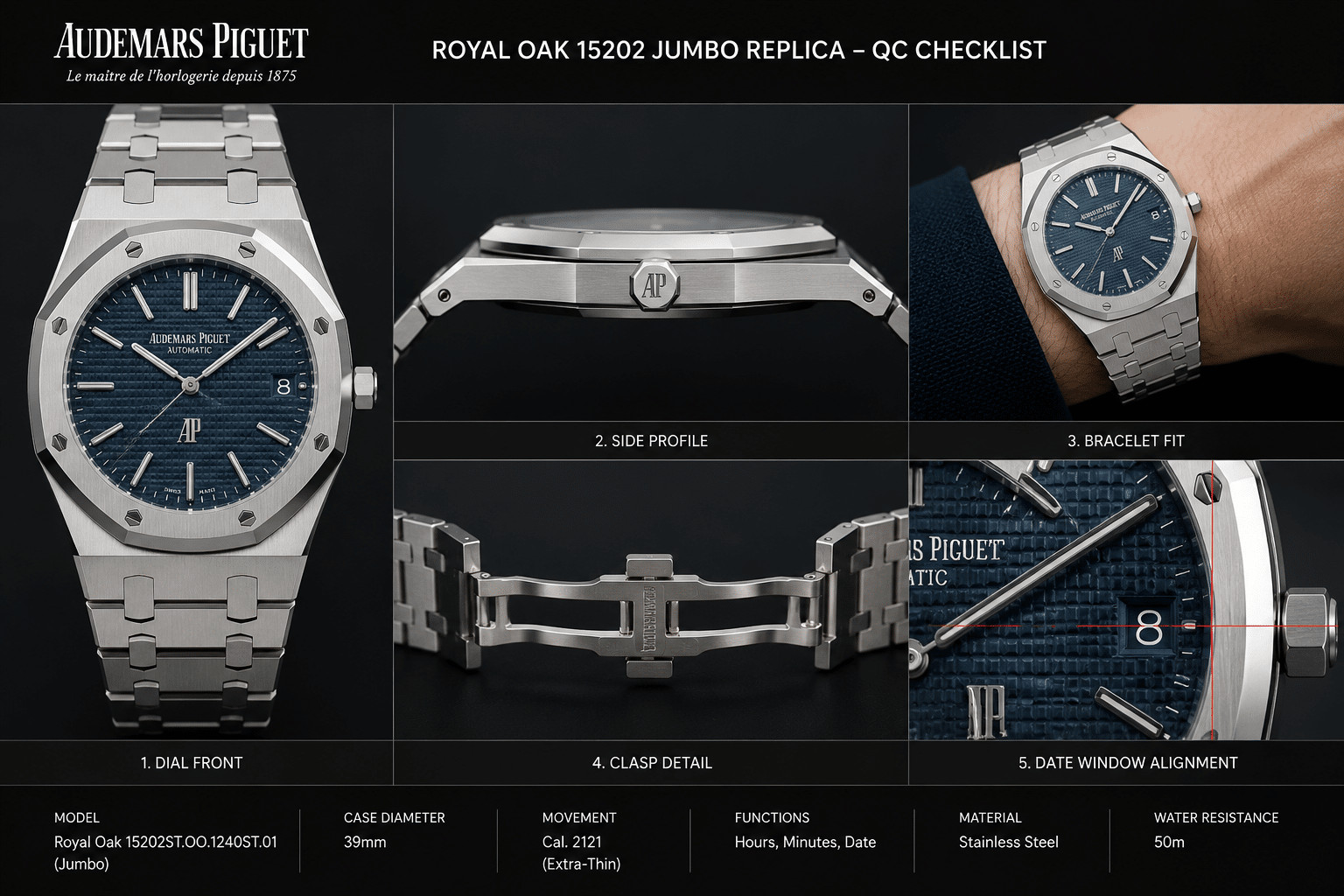
Before making a decision, buyers should review real QC photos where available, including dial printing, hand alignment, bezel position, datewheel centering, bracelet fit, clasp engraving, case thickness, side profile, caseback height, and overall finishing. Factory labels and stock photos alone are not enough for a reliable judgment on the 15202.
Photos That Actually Help on a Jumbo
The most useful Royal Oak replica QC set for the 15202 should include more than a clean dial shot. Ask for a straight-on dial photo to check marker alignment, logo position, hand length, and date centering. Then look for an angled dial photo, because the Petite Tapisserie texture and blue or grey dial color can change dramatically under different light. A dial that looks rich in one flat photo may look too flat, too bright, or too coarse once light moves across the surface.
The side profile photo matters even more. This is where the case thickness, bezel stack, midcase, caseback, and lug-to-bracelet transition become visible. A 15202 replica can look convincing from the front and still feel wrong if the side view shows too much height. For this model, side profile is not a secondary detail; it is part of the identity of the watch.
Bracelet fit deserves its own attention. The Royal Oak bracelet is not just a strap attached to a case. It should continue the geometry of the watch, with the first links dropping naturally instead of sitting stiffly or leaving awkward gaps. A clasp photo is also useful because weak engraving, rough finishing, or poor closure feel can make the watch feel cheaper than the dial photo suggests. A caseback photo helps confirm whether the movement decoration and rotor presentation match the version being claimed, but it should not distract from the more important wearing-side checks.
If available, a wrist shot or flat-lay profile photo can be revealing. It shows whether the watch sits low and elegant or rides taller than the Jumbo design should. Camera angles can flatter or punish a watch, so the best QC judgment comes from comparing several views rather than trusting one perfect image.
Flaws That Are Easier to Accept
Some imperfections are tolerable if the buyer understands the 15202’s limitations. Minor dial shade variation is common, especially on blue Royal Oak dials, and it may not bother a buyer who mainly wants the 39mm Jumbo proportions and quiet no-seconds-hand look. Tiny differences in brushing depth, clasp engraving sharpness, or lume tone are also less important than the broader case and bracelet impression.
A small amount of date variation can be acceptable if the date remains readable, centered enough, and not visibly pushed against one edge of the window. The 15202 dial is clean, so the date does draw the eye, but not every slight misalignment should trigger rejection. The better question is whether the flaw interrupts the calm balance of the dial during normal viewing.
At Clean VS Factory, we usually encourage buyers to separate macro-photo irritation from daily-wear disappointment. A tiny finishing mark that only appears under harsh close-up light may be livable. A thick case profile or stiff bracelet is different because it changes how the watch wears every time it is on the wrist.
Flaws That Undermine the 15202 Concept
Excessive thickness is the most serious red flag. The whole point of the 15202 is the thin, flat, elegant Jumbo presence. If the side profile looks bulky, the watch becomes less like a 15202 and more like a generic Royal Oak-style replica wearing a Jumbo dial. That may still be attractive, but it is not the same buying proposition.
Poor bracelet flow is another major concern. A Royal Oak with stiff first links, uneven gaps, rough articulation, or a bracelet that does not visually continue from the case loses much of its appeal. This matters more on the 15202 than on many sportier AP replicas because the Jumbo has fewer distractions. The case, bezel, dial, and bracelet all need to feel like one continuous object.
Visible dial errors are harder to excuse on this reference. Uneven AP logo placement, crooked hour markers, heavy dial printing, inconsistent Petite Tapisserie squares, or a badly centered date can stand out because the dial has no chronograph registers or seconds hand to absorb attention. If the front view looks unsettled before the watch even reaches your wrist, it is unlikely to become more satisfying with time.
Obvious case shape issues should also be treated seriously. A bezel that looks too tall, a midcase that appears slab-sided, or a caseback that protrudes aggressively can all weaken the Jumbo character. For the 15202, acceptable compromise means living with known replica limits, not ignoring the details that define the model.
What QC Cannot Prove
Even a strong QC set should not be treated as proof of waterproofing, shock resistance, long-term accuracy, or factory origin. Photos can show whether the visible watch matches the seller’s description, but they cannot confirm how the gasket system will perform, whether the movement has been lubricated correctly, or whether the watch will remain stable after regular wear. Water resistance should be treated as unverified unless the individual watch has been pressure-tested after purchase.
QC also cannot turn a replica into an authorized product. It can help a buyer avoid obvious visual mistakes, but it does not create brand warranty, official service access, trademark permission, or guaranteed import safety. That legal and practical boundary matters because the 15202 is a highly recognizable design, and buyers should understand that they are evaluating an imitation watch with imitation-watch risks.
QC photos can reduce uncertainty, but they do not guarantee perfection. Buyers should still review visible details and confirm seller policies before ordering, including return terms, repair options, water-resistance testing, shipping expectations, and after-sales support. If those terms are vague, the watch should be judged with extra caution no matter how attractive the photos look.
15202 Versus Safer Royal Oak Replica Choices
The 15202 may be the purer Royal Oak design, but it is not usually the safest AP replica choice. That is the uncomfortable truth. The Jumbo is loved because it is thin, balanced, historically important, and visually restrained. Those same qualities give factories very little room to hide movement and case compromises.
A buyer comparing the 15202 versus 15400 replica should not think only in terms of which model is more famous or more elegant. The better question is which model gives the replica manufacturer a more forgiving structure to work with. The 15400 and Royal Oak 15500 are larger and thicker by design, so a modern automatic movement route can fit the case more naturally. That does not make them perfect, but it makes the ownership risk easier to manage for many buyers.
This is why “best AP replica choice” depends heavily on the buyer’s priorities. If the goal is the cleanest historical Royal Oak silhouette, the 15202 has a unique pull. If the goal is a more practical daily wear replica with fewer proportion traps, a thicker Royal Oak reference is often easier to recommend.
Why Thicker Royal Oak Models Can Be More Forgiving
Thicker Royal Oak models give factories more mechanical space. That sounds simple, but it changes the whole replica problem. A Royal Oak 15400 or Royal Oak 15500 does not rely on the same ultra-thin personality as the Jumbo, so a slightly deeper case is less damaging to the watch’s identity. The case can house a more conventional automatic movement route without immediately breaking the visual promise of the model.
That extra case depth can also make bracelet integration and caseback shape less punishing. On the 15202, a little extra thickness is easy to notice because the genuine watch is defined by its low profile. On a 41mm Royal Oak with a naturally stronger wrist presence, the same kind of dimensional compromise may feel less disruptive.
There is also a daily-wear argument. Buyers looking for a beginner AP replica often do better with a model where the movement, case thickness, and dial layout are less specialized. The watch may not have the same Jumbo romance, but it can be easier to inspect, easier to accept, and less likely to disappoint someone who wants a straightforward ownership experience.
When the 15202 Still Makes Sense
The 15202 still makes sense for a specific buyer: someone who values design purity more than mechanical convenience. This buyer wants the 39mm case, the no-seconds-hand calm, the thin Royal Oak idea, and the direct connection to the original Jumbo language. For that person, a 15400 or 15500 may feel too large, too modern, or too ordinary, even if it is the safer replica path.
The buyer also needs to be tolerant of compromise. A sensible 15202 buyer checks the side profile carefully, accepts that current movement routes are not the same as the genuine Cal. 2121 architecture, and understands that the watch may require more patience during QC. This is not the AP replica to choose only because it looks beautiful in one photo.
The strongest case for the 15202 is emotional and design-led, not practical. If the Jumbo silhouette is the entire reason you want an Audemars Piguet replica, choosing a thicker model may feel like solving the wrong problem. But if reliability, easier QC, and daily-wear confidence are higher priorities, the safer choice is usually not the 15202.
Who Should Consider the 15202 Replica and Who Should Avoid It
Is the 15202 replica worth it? Yes, for the right buyer, but it is a conditional recommendation. The AP Jumbo replica is best understood as a design-first watch with technical baggage. It can be beautiful, restrained, and satisfying if the buyer accepts the case thickness risk, movement compromise, and need for careful QC. It is much harder to recommend as the safest first AP replica.
The most important distinction is admiration versus ownership fit. Many buyers admire the 15202 because it represents the cleanest Royal Oak idea. Fewer buyers are prepared for the reality that the same thinness and simplicity make the replica more vulnerable to visible flaws. A watch can be the most attractive option on paper and still be the less rational choice for daily wear.
A Good Fit for Design-First Buyers
The 15202 is a good fit for buyers who specifically want the 39mm Jumbo silhouette and would not be satisfied by a larger Royal Oak. These buyers usually care about the quiet wrist presence, the no-seconds-hand dial, the historical design connection, and the way the bracelet and case should sit flat as one integrated shape.
It also suits buyers who are comfortable judging a specific watch rather than relying only on a factory name. The right mindset is not “which factory makes the perfect 15202,” because that version of the question creates unrealistic expectations. The better mindset is “does this specific watch manage the known 15202 compromises well enough for my expectations?”
For this buyer, the AP Jumbo replica recommendation is cautious but not negative. Choose it because the design matters deeply to you. Accept it because you understand the technical tradeoff. Reject it if you need the watch to feel effortless, robust, and simple to approve.
A Poor Fit for Risk-Averse Beginners
The 15202 is a poor fit for buyers who want the easiest Royal Oak replica to approve from QC photos. It asks too much from a beginner: case profile judgment, dial texture evaluation, date alignment checks, bracelet flow assessment, and movement-route awareness. A first-time buyer who only wants a clean, convincing AP-style daily watch may be happier with a more forgiving Royal Oak direction.
It is also not ideal for buyers who prioritize movement confidence above design purity. The absence of a seconds hand may reduce one visible tell, but it does not remove questions about winding feel, rotor behavior, caseback presentation, serviceability, or long-term daily-wear stability. If those concerns will bother you, the Jumbo’s elegance may not be enough to offset the anxiety.
Buyers expecting the least complicated ownership experience should be especially careful. The 15202 rewards patience and realistic standards. It punishes the buyer who assumes a famous model and a clean dial automatically mean a safer replica watch.
Legal, Disclosure, and Resale Caution
Replica watches can raise trademark, customs, import, resale, and disclosure issues depending on jurisdiction. This article is buyer guidance, not legal advice, and it should not be read as reassurance that a replica watch is risk-free to buy, import, wear, sell, or ship. The safest language is also the clearest language: a 15202 replica is an imitation watch, not an authorized Audemars Piguet product.
Disclosure matters if the watch is ever shown, traded, repaired, or resold. A buyer should not describe a replica as authentic, factory-original, authorized, or equivalent to genuine. Even when a replica looks visually persuasive, it remains different in movement, finishing, service path, warranty status, and legal position. That boundary is part of responsible ownership and should be understood before the purchase, not after a problem appears.
The purpose of factory and movement information is to help readers understand quality and risk, not to represent a replica watch as genuine. A strong super clone may look convincing in normal wear, but close inspection can still reveal differences in finishing, movement architecture, case proportions, bracelet feel, dial details, or service compatibility.
Final Decision Filter
Choose the 15202 replica if the 39mm Jumbo profile, design purity, and quiet Royal Oak presence are the main reasons you want the watch. Hesitate if thickness accuracy, movement confidence, and easy QC approval are your top priorities. For a design-first buyer, the 15202 can still make sense. For a risk-averse beginner, a thicker and more forgiving Royal Oak replica is usually the more practical decision.
Disclosure: This article is for general educational and comparison purposes only. Replica watches are not genuine products from the original luxury brands, and brand names are used only to identify reference designs or comparison topics. Factory names, movement descriptions, prices, availability, QC details, seller policies, and version information can change, so readers should verify important details with the seller before making a purchase decision. Replica watches should not be represented, resold, or used as genuine watches.