
Choosing a Patek Philippe super clone is not mainly about finding the loudest factory name or the highest price. These watches are difficult because many Patek designs are thin, quiet, and proportion-sensitive, so small issues in case height, dial spacing, bracelet flow, clasp feel, or metal tone can stand out more than they would on a sportier replica watch. A front-facing photo can look convincing while the side profile, bracelet exit, or complication layout tells a different story.
This article focuses on the mistakes that lead buyers toward the wrong reference, outdated batch, risky movement route, or poorly checked QC set. It helps you judge whether a simpler Nautilus, Aquanaut, or Calatrava-style choice is safer than a complicated model, when steel may be more practical than gold tone, and why current photos of the actual watch matter more than old reviews or vague “clone movement” claims.
Brand names are used here to identify genuine reference designs and comparison topics. Replica watches and super clone watches are replica-market products, not genuine Patek Philippe watches or authorized products from the original luxury brand, and they should not be represented, resold, insured, serviced, or described as authentic watches.
Editorial Perspective: For Patek Philippe super clones, the useful question is not whether one factory is “the best” in general. The safer buying judgment is model-specific: whether the movement route, case thickness, dial execution, bracelet or strap fit, and QC evidence match the buyer’s intended use. At cleanvsfactory.com, factory labels and seller descriptions are treated as helpful signals, but they are not final proof until the exact reference, version, movement behavior, and actual watch photos support the claim.
Evidence Boundary: This guide discusses imitation watches and buyer-risk evaluation, not authorized Patek Philippe products. Factory names, batch labels, and movement descriptions in the replica market are often informal and seller-dependent, so they should be treated as claims to verify through current QC photos, clear movement-route explanation, and realistic ownership expectations. Official brand information can help identify the design language of authentic models, but it should not be used as proof that any replica has the same finishing, construction, water resistance, movement performance, warranty status, or service experience.
| Buyer Decision | What To Check First | Common Mistake To Avoid |
|---|---|---|
| Complicated model | Subdial spacing, moonphase, hand balance, function behavior | Choosing a 5712-style watch only from attractive front photos |
| Thin-case reference | Side profile, crystal height, bracelet exit, wrist-angle photos | Ignoring thickness because the dial view looks clean |
| Factory or version label | Exact reference, batch, dial color, movement route, actual QC photos | Assuming all watches with the same label are identical |
| Movement choice | Noise, winding feel, date behavior, serviceability, added thickness | Accepting vague “clone movement” wording without details |
| Gold-tone version | Color under different lighting, plating risk, weight expectations | Expecting rose gold or gold tone to behave like genuine precious metal |
| QC approval | Dial symmetry, marker alignment, date centering, clasp and strap fit | Treating QC as a formality instead of the final decision point |
Quick Questions Before You Read
Q: Is a complicated Patek Philippe super clone a good first choice?
Usually not. Extra displays increase the risk of poor spacing, added thickness, and awkward function behavior.
Q: Should I choose by factory name alone?
No. The exact reference, batch, movement route, dial color, and actual QC photos matter more than the label by itself.
Q: Why are side-profile photos so important?
They reveal thickness, crystal height, case flank shape, and bracelet exit issues that front photos often hide.
Q: Are steel versions safer than gold-tone versions?
Often yes for daily wear, because steel avoids many color, plating, lighting, and weight-expectation problems.
Why Patek Philippe Super Clones Are Easy to Choose Wrong
A Patek Philippe super clone is not impossible to choose intelligently, but it is less forgiving than many common sports replica watches. That is the point buyers often miss. A Rolex Submariner-style case, for example, has more visual mass, stronger bezel presence, and a tool-watch design that can hide small compromises. A Nautilus replica, Aquanaut replica, or slim Calatrava-style watch exposes those compromises much faster because the whole design depends on thinness, restraint, and balance.
Most Patek replica mistakes start before the buyer even looks at QC photos. The buyer sees a clean dial, a famous reference shape, and a factory name, then assumes the decision is simple. It rarely is. The real question is whether the reference, movement route, case thickness, bracelet or strap construction, dial layout, and buyer expectation all make sense together. If one part is mismatched, the watch may still look attractive in listing photos but feel wrong on the wrist.
This is why Patek-style replicas are often harder to choose than Rolex replicas for beginners. The designs look elegant because they are quiet. There is no large rotating bezel to distract the eye, no heavy case to absorb thickness, and no aggressive dial layout to hide spacing errors. Small details carry more weight. A slightly tall case flank, a date that sits low, a bracelet that leaves the case too stiffly, or a rose-gold tone that looks too orange can change the entire wearing impression.
The safest way to read any Patek Philippe comparison is to separate design reference from product origin. A genuine reference can be useful for understanding proportions, dial layout, and intended style, but it does not prove that a replica-market watch uses the same materials, movement architecture, finishing process, water-resistance standard, or service pathway as the authentic watch.
The Thin-Case Problem
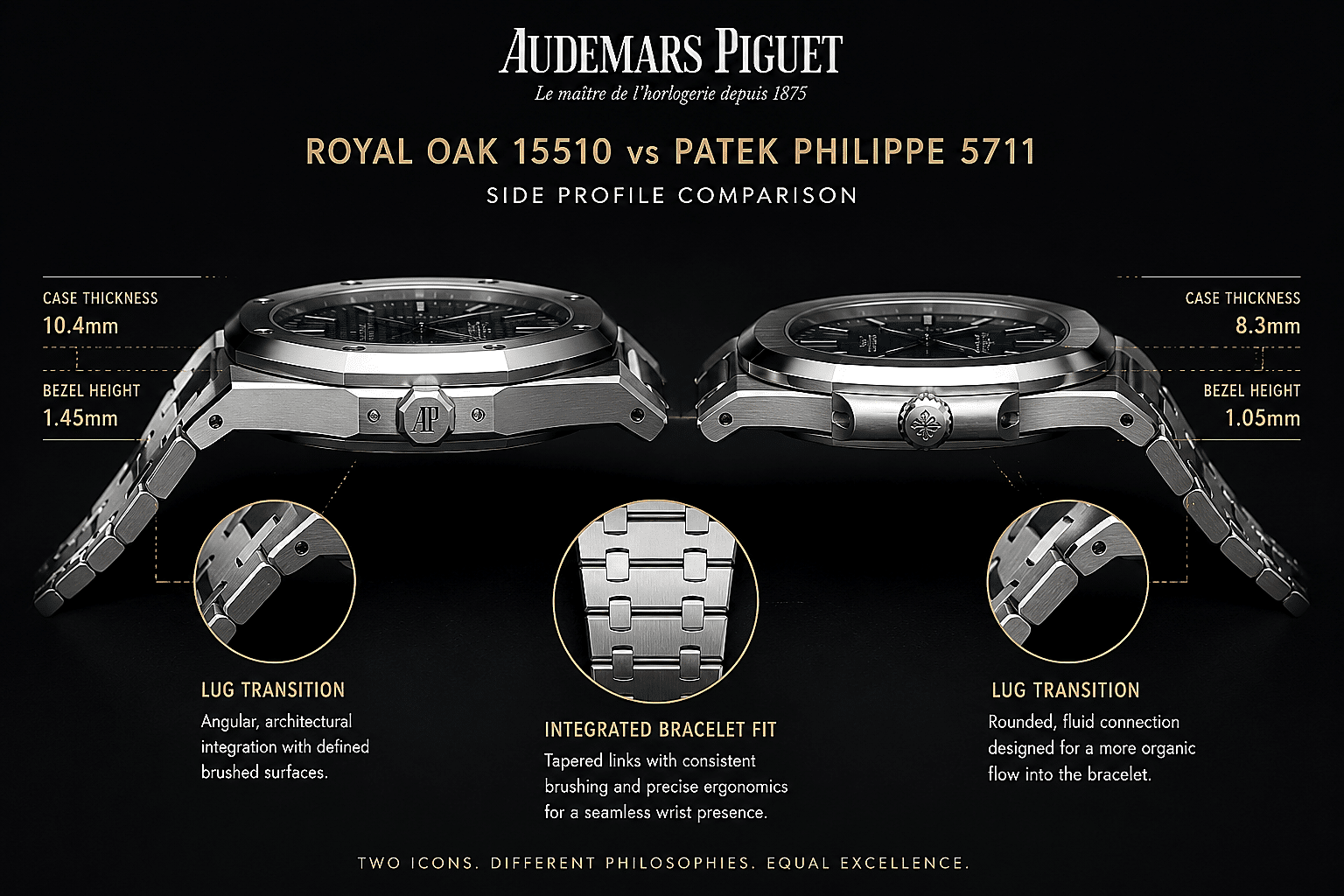
Thinness is not just a specification on many Patek designs; it is part of the identity. A Nautilus-style watch is supposed to sit low, flow from case to bracelet, and feel refined rather than bulky. When a replica movement or case construction adds extra height, the flaw may not be obvious from a straight-on dial photo. From the side, it can become the first thing the owner notices.
This matters most on references where the genuine design is known for a thin case profile. A simple three-hand Nautilus-style model can sometimes be executed more convincingly because the movement and dial layout are less demanding. A more complicated layout, such as a moonphase or multi-display version, may require a thicker movement route or additional construction compromises. The buyer is not only choosing a dial design; they are accepting the case architecture needed to support it.
The practical judgment is simple: if a Patek replica depends on elegance, side profile matters more than most beginners expect. A version that looks slightly better from the front but sits too tall on the wrist may be the worse daily-wear choice. Buyers should not treat thickness as a minor number buried in a listing. For Nautilus-style and dress-style references, it can be the difference between “close enough for casual wear” and “noticeably off every time the cuff catches it.”
Why Subtle Dials Leave Less Room for Error
Patek-style dials punish small mistakes because they do not give the eye much noise to hide behind. A restrained blue or grey Nautilus-style dial, a clean Aquanaut-style layout, or a slim dress-style dial relies on symmetry, marker placement, printing weight, and date-window balance. If the logo is too heavy, the minute track is uneven, or the applied markers do not sit cleanly, the flaw has nowhere to disappear.
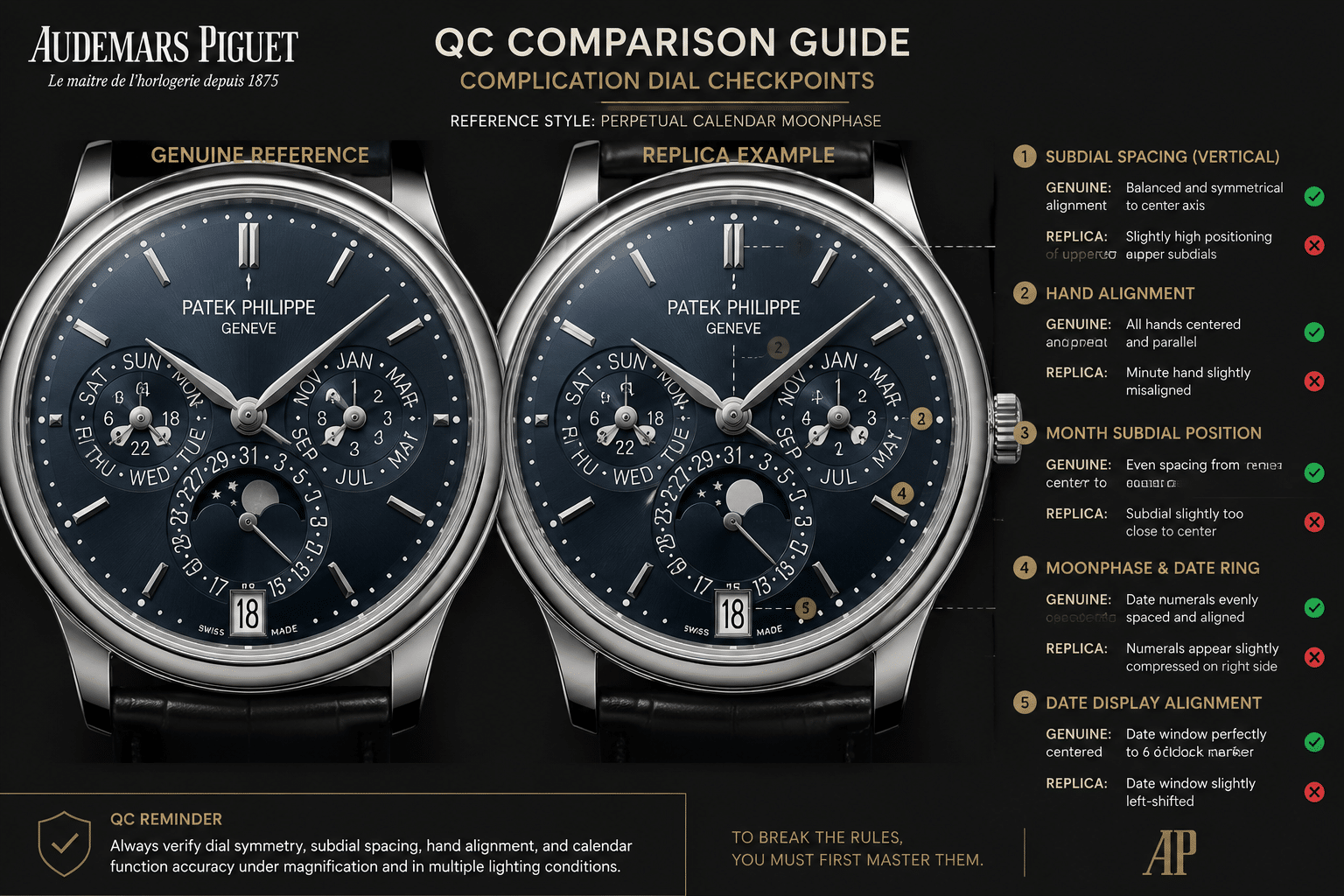
Complicated layouts increase the risk. A moonphase, power-reserve display, annual-calendar-style arrangement, or small subdial can look impressive in photos, but these details create more alignment points. Subdial spacing, hand length, date placement, and moonphase centering all need to work together. On a restrained Patek design, even a small shift can make the dial feel crowded or poorly balanced.
The non-obvious issue is that a busier dial is not always safer. Some buyers assume more complications make a replica look more convincing because there is more to look at. Often the opposite is true. More displays create more chances for incorrect spacing, limited function behavior, or a case that becomes thicker than the design can visually support.
Integrated Bracelets Make Fit More Important
An integrated bracelet is not just a bracelet attached to a case. On a Nautilus-style watch, the bracelet is part of the case design. The first links, end-link fit, case transition, clasp feel, and link articulation all affect whether the watch wears like a coherent object or like a case with a bracelet added afterward.
This is one reason Patek-style super clone watches can disappoint buyers who only study dial photos. A bracelet that looks acceptable in a flat image may feel too stiff, too loose, too sharp at the edges, or poorly balanced on the wrist. The first link should leave the case naturally. If it drops too abruptly or sticks outward, the watch can wear larger and less refined than expected.
Clasp feel also matters more than buyers assume. A weak clasp action, uneven finishing, or poor bracelet taper does not always show clearly in seller photos, but it affects the ownership experience every day. For an integrated-bracelet watch, the safest model choice is not always the one with the most attractive dial color. It is often the version where the case, bracelet, and clasp work together with the fewest distractions.
Precious-metal appearance adds another layer of risk. Rose-gold and yellow-gold Patek-style replicas can look dramatically different under warm indoor light, cool daylight, and harsh photography. The color tone may appear too pink, too coppery, or too flat depending on plating and finishing. On a slim, elegant watch, that color mismatch is more visible than it would be on a louder sports design.
The buyer takeaway is that Patek replica mistakes are usually not caused by one bad detail. They come from a mismatch between the model’s design language and the replica’s construction choices. A watch can have a respected factory name and still be the wrong version for a buyer who expects thinness, quiet elegance, soft bracelet flow, and low-risk daily wear.
Mistake 1: Choosing by Factory Name Instead of the Specific Reference
The most common factory-name mistake is asking, “What is the best Patek replica factory?” as if the answer applies to every reference. Factory reputation is useful, but it is only a starting clue. Patek Philippe replica factory discussions become meaningful only after the buyer names the exact reference, dial color, movement route, bracelet or strap setup, and current version being considered.
A factory may be strong on one Nautilus-style reference and less convincing on another because the problems are not the same. A simple 5711-style watch asks for a thin case profile, clean dial symmetry, and integrated bracelet execution. A 5712-style watch adds moonphase layout, asymmetric subdial balance, extra hand alignment concerns, and often a more difficult movement route. Treating both as the same factory decision is how buyers choose the wrong version.
At Clean VS Factory, we usually separate factory reputation from model suitability. A name like 3KF Patek, PPF Nautilus, or ZF Aquanaut can help narrow the search, but it does not answer whether the current batch, movement, thickness, dial color, and bracelet execution fit the buyer’s expectations. The better question is not which factory is famous, but which factory version is strongest for this exact watch.
A factory comparison is most useful when it is tied to the specific reference, version, movement, and visible execution details rather than treated as a universal ranking. For example, one factory-market label may be associated with a stronger three-hand Nautilus-style case, while another may be discussed more often for a particular Aquanaut strap fit or dial texture. That does not make either label universally safer; it only gives the buyer a starting map for checking the exact watch being offered.
Factory Name Clarification: Factory names in the replica watch market are commonly used buyer-facing labels. They should be treated as practical market references, not as official brand affiliations, audited manufacturer identities, or guarantees of identical quality across every model.
Why “Best Factory” Is Too Broad for Patek Models
Patek-style replicas vary too much for a single factory label to solve the buying decision. Nautilus, Aquanaut, Calatrava-style dress models, moonphase layouts, annual-calendar-style dials, and gold-tone versions each expose different weaknesses. A factory comparison that makes sense for a steel three-hand Nautilus replica may not transfer to a complicated rose-gold model or a rubber-strap Aquanaut-style watch.
Dial color alone can change the decision. Blue dials are popular, but they are also less forgiving because tone, texture, sunburst effect, and printing contrast are easy to compare in photos. A grey or white dial may hide some color issues but expose marker alignment or printing weight more clearly. Gold-tone versions add color and weight expectations. The factory name does not erase these reference-specific tradeoffs.
Version history also matters. A factory may improve a bracelet, update a dial, change a movement route, or revise case finishing without the market discussion catching up immediately. Older forum praise may refer to a batch that is no longer being supplied. Older criticism may also be outdated. Buyers who choose only by logo or factory initials are often using yesterday’s information to buy today’s watch.
How to Ask a Better Factory Question
A better factory question is specific: “Which factory version is safest for this exact reference, with this dial color, this movement route, and this bracelet or strap configuration?” That question forces the seller or reviewer to give useful information instead of a broad ranking.
For example, asking whether a 5711-style Nautilus replica is better from one factory than another is still incomplete. The buyer should also ask which version, whether the movement route affects thickness, how the bracelet is finished, whether the dial color matches recent QC examples, and whether the case profile is acceptable from the side. The answer may change if the buyer moves from a blue dial to a white dial, from steel to rose gold, or from a simple date model to a moonphase layout.
This approach also protects buyers from paying for reputation without proof. A listing can use a respected factory name while omitting the version, showing old photos, or avoiding movement details. That does not automatically mean the watch is bad, but it means the buyer does not yet have enough information to make a clean decision.
Factory Labels Are Signals, Not Final Proof
A factory label becomes useful only when it can be connected to the actual watch being offered. Buyers should compare the claimed label against the current QC photos, movement route, datewheel appearance, bracelet construction, clasp detail, and case profile. If the label says one thing but the photos do not show the details normally associated with that version, the buyer should treat the listing as unresolved rather than assume the factory name solves the risk.
Seller descriptions can also compress several different watches into one easy phrase. “Latest version,” “best edition,” or “clone movement” may be shorthand, but those phrases do not tell the buyer whether the watch is thin enough, whether the dial color is from the current batch, whether the complication behaves as expected, or whether the bracelet is the updated one. For a Patek-style replica, those missing details often matter more than the marketing term itself.
What Factory Evidence Can and Cannot Prove
Factory evidence should be handled carefully because replica-factory information is rarely as formal as official brand documentation. A seller may use a factory name consistently and may provide photos that appear to match a known version, but that still does not prove official production origin, internal factory specifications, waterproof construction, movement sourcing, or long-term reliability. The safest use of a factory label is narrow: it helps organize comparison, but it does not replace inspection of the actual watch.
Current QC photos are more useful than broad reputation claims because they show the specific unit being approved. Even then, photos have limits. They can reveal dial alignment, date position, case shape, bracelet fit, and visible finishing, but they cannot fully prove movement condition, pressure resistance, plating durability, shock resistance, or future service outcomes. Buyers should avoid treating any single label, photo set, or seller phrase as complete evidence.
Version Details to Confirm
Before treating any factory recommendation as useful, confirm the reference number or style, factory version, movement type, dial color, bracelet or strap type, and recent QC examples from the same claimed version. If the watch is a complicated model, confirm the displayed functions and whether the movement route changes case thickness or hand layout.
The strongest buying question is not “Which factory is safer?” It is “Which current version of this factory’s watch solves the most important problems for this reference?” That small change prevents one of the most expensive Patek replica mistakes: buying a factory reputation instead of buying the right watch.
Mistake 2: Buying the Cheapest Listing Without Understanding the Tradeoff
A cheap Patek replica is not automatically a bad choice, but a low price needs an explanation. If two listings appear to show the same Patek Philippe super clone and one is meaningfully cheaper, the buyer should ask what changed: movement route, batch age, bracelet finishing, case finishing, QC consistency, seller support, or simply missing version information.
The mistake is assuming the lowest Patek super clone price is a win before identifying the tradeoff. Sometimes the cheaper option is a fair-value version that fits casual expectations. Other times it is older stock, a lower-tier movement, a weaker bracelet, an outdated dial batch, or a listing using attractive photos that do not represent the actual watch being supplied. Price only becomes meaningful when it is tied to verifiable construction details.
The reverse mistake is also common. A higher price does not automatically mean the best version. Premium pricing should be supported by current factory version details, clear QC photos, and a specific reason the watch costs more. If the only explanation is “top quality” or “best factory,” the buyer has not learned enough.
Claims such as “perfect,” “same as genuine,” or “guaranteed to pass inspection” should be treated with caution. A more reliable comparison looks at the actual model version, movement configuration, finishing details, and available QC evidence. The safest use of price and factory information is to avoid overpaying or misunderstanding quality, not to misrepresent a replica watch as genuine.
Prices can change by factory label, version, movement configuration, seller channel, availability, and after-sales terms, so exact comparisons should be verified at the time of purchase. A useful price discussion should compare like-for-like details rather than assume that a lower or higher number proves quality by itself.
What a Lower Price May Actually Mean
A lower price often reflects one of five things. It may be an older batch, a less expensive movement route, simpler or rougher bracelet finishing, weaker case finishing, or a lower level of QC consistency. None of these are automatically unacceptable, but each changes the buying decision.
Older stock can be a hidden risk because Patek-style replicas are version-sensitive. A Nautilus-style listing may use photos from a newer dial batch while the actual watch has older marker finishing or a different datewheel. A cheaper Aquanaut-style watch may look fine from the front but have a strap that feels plasticky, a clasp that closes weakly, or case finishing that does not match the cleaner examples buyers saw online.
Movement route is another major reason for price difference. A decorated movement, a clone-style movement, and a simpler automatic base can all look acceptable to a casual buyer from the dial side, but they may affect thickness, rotor noise, winding feel, power reserve expectations, and serviceability. For Patek-style watches, the movement is not only a technical detail; it can change how the case wears.
When a Mid-Tier Version May Be Enough
A mid-tier version can be rational if the buyer understands what they are giving up. For a simple, casual-wear reference where the buyer mostly wants the look, a less expensive version may be acceptable if the dial is clean, the case is not obviously too thick, the bracelet or strap feels comfortable, and the movement route is not creating major ownership concerns.
This is especially true for buyers who are not chasing macro-level accuracy. If the watch will be worn casually, not compared side by side with a genuine example, and not expected to deliver refined precious-metal weight or ultra-thin case behavior, the most expensive version may not be necessary. The sensible choice is the version that matches the buyer’s tolerance, not automatically the highest-priced listing.
The caution is that Patek-style watches do not forgive rough finishing as easily as chunkier sports models. A cheaper Submariner-style replica may still feel solid if the bezel, bracelet, and dial are acceptable. A cheaper Nautilus-style watch with poor bracelet articulation or a tall case flank may feel wrong immediately. Mid-tier only makes sense when the compromises are in areas the buyer can live with.
Why Higher Price Still Needs Proof
Higher price should buy risk reduction, not vague confidence. A premium listing should be able to support the price with specific version details: factory, reference, movement route, dial batch, case profile, bracelet or strap construction, clasp execution, and recent QC examples. If those details are missing, the buyer may simply be paying more for the same uncertainty.
For Patek-style replicas, proof is especially important because the value difference between versions often sits in subtle areas. Better bracelet finishing, cleaner dial printing, improved date alignment, more convincing case thickness, or a more suitable movement route may justify paying more. But those advantages should be visible or explainable. A higher price without evidence is not a quality guarantee.
The safest approach is to treat price as a question, not an answer. If the listing is cheaper, ask what compromise makes it cheaper. If the listing is more expensive, ask what construction advantage makes it worth more. Buyers who cannot get clear answers should slow down rather than force the purchase, because uncertainty is where many Patek replica mistakes begin.
Mistake 3: Picking a Complicated Patek Model Too Early
A complicated Patek replica is tempting because it gives the most visual drama for the money. Moonphase windows, pointer dates, power-reserve displays, annual-calendar layouts, and chronograph subdials all make the watch look more “special” in listing photos. The problem is that those same features create more places for the replica to go wrong. For most first-time buyers, a complicated Patek-style model is usually not the safest starting point unless the buyer already accepts extra risk in thickness, dial spacing, adjustment behavior, and function limits.
This is not because every complicated Patek replica is automatically bad. Some are visually impressive. The real issue is expectation. A simple Nautilus-style three-hand watch asks the factory to solve case shape, dial finish, bracelet fit, and movement reliability. A complicated model asks for all of that plus subdial geometry, calendar display alignment, hand synchronization, correct case height, and a movement route that may not match the original architecture. That is a much harder buying decision.
Why the 5712-Style Watch Is a Common Trap
The Patek 5712 super clone is one of the easiest watches to want and one of the easiest to misjudge. The asymmetric dial looks elegant rather than busy, and the moonphase gives it a more refined personality than a plain 5711-style Nautilus. In photos, that layout can make the watch look like the smarter choice. In practice, it is also where the risk starts.
The 5712-style design depends on delicate balance. The moonphase window, small seconds, date scale, power-reserve display, and hands all need to sit in the right relationship to each other. If one subdial is slightly off, the whole dial can feel awkward because there is not much visual noise to hide it. On a restrained Patek dial, uneven spacing is more noticeable than buyers expect.
Case thickness is the second problem. A complicated Patek replica often needs a movement solution that adds height or requires case adjustments. Even if the dial looks acceptable from the front, the side profile can make the watch feel less like a slim Nautilus-style piece and more like a watch wearing a Nautilus costume. That matters because thinness is part of the design language, not just a specification.
The non-obvious mistake is assuming the 5712-style model is “better” because it has more features. For a buyer who mainly wants a convincing daily-wear Patek-style replica, the extra displays may reduce confidence rather than improve it. More complication can mean more charm, but it also means more things to inspect, more things to accept, and more chances for disappointment.
Annual Calendar and Chronograph Expectations
Annual-calendar-style and chronograph-style Patek replicas create a different problem: buyers often assume the displayed functions behave like the genuine complication. That assumption can be expensive in frustration. Some displays may be decorative, simplified, adjusted differently, or mechanically less refined than the original watch. Even when the basic function works, the adjustment sequence may be more delicate than a buyer expects.
Chronograph-style replicas deserve particular caution because the movement architecture can affect thickness and long-term comfort. A watch may look exciting in a front-facing photo, but if the case becomes noticeably thick or the pushers feel rough, the daily-wear experience changes quickly. A chronograph that looks good online is not automatically a good first Patek replica.
Annual calendar layouts also increase dial-risk. Date windows, month apertures, day displays, and subdial hands must all sit cleanly. If the printing is too heavy, the date is shifted, or the hands do not align well, the flaw is visible every time the buyer checks the time. These are not macro-only problems; they can affect the watch’s basic sense of order.
The practical rule is simple: do not choose a complicated Patek replica because it looks like the highest-value option in photos. Choose it only if you are comfortable checking the layout carefully and accepting that function behavior may be limited compared with the genuine complication.
What This Means for a First Patek Replica
For a first Patek replica, simpler is usually the more rational route. A straightforward Nautilus-style, Aquanaut-style, or Calatrava-style model gives the buyer fewer moving parts to worry about and makes QC easier to judge. The watch still needs a good case, dial, bracelet or strap, and movement route, but the decision is less exposed to complication-specific failure points.
At Clean VS Factory, we usually treat complicated Patek-style watches as expectation-management pieces, not beginner-safe defaults. If the buyer wants the moonphase look and understands the tradeoff, a 5712-style watch can make sense. If the buyer wants the least stressful first purchase, a simpler reference is usually the safer choice.
The mistake is not liking complications. The mistake is buying one before understanding what the extra displays cost in thickness, layout risk, and ownership confidence.
Mistake 4: Ignoring Case Thickness and Side Profile
Patek replica thickness is not a minor specification. On many Patek-style designs, especially Nautilus and slim dress-style references, the case profile is part of the watch’s identity. A replica can look strong from the front and still feel wrong on the wrist if the bezel height, case flank, crystal stack, or lug transition looks too heavy from the side.
This is where many buyers make a avoidable mistake. They judge a Nautilus super clone case by the dial photo, the blue color, or the bracelet brushing, then ignore the side view. That works better with some thicker sports watches, where visual mass is expected. It works poorly with Patek-style designs because elegance depends on restraint. If the case looks too tall, the watch loses the thin, flat, integrated feel that makes the original design appealing.
Why Front Photos Can Hide the Problem
A straight-on photo is the most flattering angle for almost any replica watch. It hides the case flank, compresses the bezel height, and makes the dial do most of the work. A thick case can look acceptable when the watch is lying flat under bright light. The same watch may look much less convincing once viewed from a wrist angle.
The 5711-style and 5712-style contrast shows the problem clearly. A simple 5711-style watch has fewer dial complications and, depending on the version, may be easier to keep visually slim. A 5712-style replica has more display demands and may require a different movement route or case construction, which can change how thick the watch feels. The front view may show the moonphase and dial layout; the side view tells you whether the watch still has the right Nautilus-style posture.
Buyers should not rely on a single thickness number either. Exact measurements should be verified for the specific reference and version, but thickness alone does not decide the result. A watch that is slightly thicker can still wear acceptably if the bezel height, case flank, and bracelet exit are well controlled. A watch with a poor side profile can look bulky even if the listed number seems close.
The Difference Between Acceptable and Distracting Thickness
Acceptable thickness is the kind you notice only when comparing specifications. Distracting thickness is the kind you notice every time the watch catches the light from the side. On a Patek-style replica, the second type matters more because it changes wrist presence. The watch stops looking thin, elegant, and integrated, and starts looking stacked.
Wrist size also changes the judgment. A slightly thicker Nautilus-style case may be tolerable on a larger wrist, especially if the bracelet drapes well. On a smaller wrist, the same case can sit high and make the first bracelet links angle downward too sharply. That makes the watch feel less fluid, even before anyone studies the dial.
Model type matters as well. A sportier Aquanaut-style watch on rubber can forgive a little more visual thickness because the strap and casual design already feel less formal. A Calatrava-style dress watch has far less tolerance. If a slim dress-style Patek replica becomes too thick, the entire reason for choosing that design is weakened.
The strongest judgment here is this: if thinness is central to why you want the watch, do not approve the watch from front photos alone. A Patek-style replica that looks good flat on a table can still be the wrong choice if the side profile fights the design.
QC Photos to Request
Before judging a Patek-style replica, side-view evidence should be treated as essential, not optional. The most useful photos are not always the prettiest; they are the ones that show how the case actually sits.
- Direct side profile: Check case flank height, bezel height, crystal rise, and whether the case looks stacked.
- Wrist-angle view if available: This shows whether the watch sits flat or rides high.
- Clasp-side view: Useful for judging bracelet flow, clasp thickness, and overall balance.
- Bracelet or strap exit photo: Check how the first links or rubber strap leave the case; a poor transition can make the watch feel stiff or bulky.
- Angled case photo: Helps reveal lug transition, brushing direction, and whether the side profile matches the model’s intended elegance.
If the available photos avoid the side profile entirely, slow down. That does not prove the watch is bad, but it does mean one of the most important Patek replica checks is missing.
Mistake 5: Forgetting That Rose Gold and Precious-Metal Looks Are Hard to Imitate
A rose gold Patek replica or gold Patek super clone carries a different kind of risk from a steel version. The issue is not only whether the case is polished neatly. Gold-tone watches are judged by color, weight, lighting behavior, and the confidence of the overall look. A steel Nautilus-style or Aquanaut-style replica can be judged mostly on shape, finishing, and bracelet feel. A precious-metal-style version adds a more difficult question: does the metal appearance feel believable in real use?
Buyers often underestimate this. In listing photos, a rose-gold Nautilus-style watch can look warm, rich, and impressive. On the wrist, the same color may appear too pink, too orange, too coppery, or inconsistent under different lighting. Full gold-tone bracelets also make the watch visually louder, which increases attention on the very details that are hardest to imitate.
Visual accuracy should be judged through specific details rather than broad claims. Case thickness, lug shape, dial texture, bezel tone, hand length, date magnification, bracelet construction, clasp finishing, and color behavior under different lighting can all affect how convincing a watch feels in real use. A watch may look persuasive in one controlled photo and still reveal proportion, tone, or finishing differences when worn normally.
Color Tone Changes Under Different Lighting
Gold tone is highly lighting-sensitive. Warm indoor lighting can make a rose-gold case look deeper and more convincing. Cool daylight can expose a pink or orange cast. Harsh LED light can make plating look flatter than expected. This is why one photo is not enough to judge a rose gold Patek replica.
The mistake is assuming the color in a seller photo is the color the watch will have in daily wear. Camera settings, background color, and white balance can all shift the appearance. A gold-tone case photographed beside a warm wooden desk may look more natural than the same case under office lighting or outside on an overcast day.
This matters especially on integrated bracelet watches. A rose-gold Nautilus-style bracelet has many brushed and polished surfaces, so the tone is repeated across the whole wrist. If the color is slightly off, it is not hidden on one small case surface; it is visible across every link. On rubber-strap Aquanaut-style models, the gold-tone case is more contained, but the contrast between warm metal and casual strap can still make the color more noticeable.
Why Weight Expectations Matter
Precious-metal-style watches create weight expectations. Buyers see a full rose-gold or yellow-gold Patek-style watch and expect it to feel heavier and denser than steel. Many replicas will not match that expectation, depending on construction. The result can be a strange mismatch: the watch looks visually expensive but feels lighter than the buyer’s mind expects.
This does not automatically make the watch a poor choice. Some buyers care more about appearance than weight. But if the buyer is choosing a full gold-tone bracelet model because they want the physical presence of a precious-metal watch, they should be realistic. Case weight and bracelet weight affect how convincing the watch feels even when the dial and case shape are good.
Daily wear also changes the risk. Gold-tone surfaces can show marks differently from steel, and high-friction areas such as bracelet edges, clasp contact points, and case corners deserve extra caution. No buyer should treat plating appearance as a permanent guarantee. Wear depends on use, finishing, and how often the watch is exposed to friction, moisture, and rough surfaces.
When Steel May Be the Safer Choice
For many buyers, stainless-steel-style Nautilus and Aquanaut references are the safer daily-wear choice. Steel is visually more forgiving, easier to match with casual or office clothing, and less dependent on perfect color tone. It also draws less attention than a full rose-gold bracelet watch, which can make small replica compromises feel less exposed.
This is especially true for a first Patek-style super clone. A steel version lets the buyer focus on the fundamentals: case profile, dial balance, bracelet fit, clasp feel, and movement behavior. A gold-tone version adds color accuracy, plating appearance, and weight expectation on top of those basics.
The better choice depends on the buyer’s tolerance. If the goal is a bold visual statement and the buyer accepts gold-tone limitations, a rose-gold or two-tone Patek-style replica can be enjoyable. If the goal is a lower-risk daily wearer with fewer things to second-guess, steel is usually the more sensible route.
Mistake 6: Assuming Every Batch Is the Same
A Patek replica batch is not a fixed object forever. A review from six months ago, a forum macro comparison, and a current seller photo may all show watches with the same factory name and reference, but not necessarily the same dial batch, bracelet update, clasp detail, or movement route. This is one of the easiest mistakes to make because buyers often research the “best” Patek super clone version, then assume every watch under that label is identical.
The practical risk is simple: you may be judging yesterday’s watch while approving today’s unit. Batch variation can be positive or negative. A factory revision may improve the date font, bracelet brushing, or dial tone. It may also introduce a new weakness, change the movement configuration, or ship alongside older stock that still circulates in the market. Factory name plus model name is not enough to confirm what is actually being offered.
Why Old Review Photos Can Mislead
Old review photos are useful for understanding the general direction of a Patek Philippe super clone, but they should not be treated as a promise. Lighting alone can make a blue Nautilus-style dial look deeper, flatter, greener, or more purple than it appears in real wear. Add batch changes on top of that, and the watch in current QC photos may not match the version that originally impressed the buyer.
This matters most on Patek-style watches because small tonal and proportion differences carry more weight than they do on many bulkier sports replicas. A slight dial color shift on a restrained Nautilus replica can change the entire wrist impression. A datewheel that looked centered in an older review may sit slightly high in a newer batch. A bracelet that was praised for clean brushing may arrive with different link tolerances or a clasp engraving that looks heavier than expected.
The mistake is not using old information. The mistake is stopping there. A strong older review should lead to better verification, not automatic confidence. If the current QC photos do not show the same dial texture, date position, bracelet fit, and clasp details you researched, the older review is background information, not proof.
What Usually Changes Between Versions
The most version-sensitive areas on a Patek super clone are usually the areas buyers notice too late. Dial color is the obvious one, especially on blue, grey, and warm-tone dials. Marker finishing can also change, with some batches showing cleaner edges and others looking slightly dull or uneven under close light. Date font and date centering are another common source of variation because a small shift inside a clean Patek-style dial can become more visible than buyers expect.
Bracelet and clasp changes deserve more attention than they usually get. On an integrated-bracelet Nautilus-style watch, the first link, bracelet drape, clasp closure, and brushing direction all affect how expensive or cheap the watch feels on the wrist. A bracelet update may improve comfort, but an older bracelet batch can make the same reference feel stiff, loose, or less refined even if the dial looks good.
Movement configuration is the least visible but often the most important version change. A listing may use broad language such as “clone movement” or “latest version,” but the actual movement route can affect case height, rotor noise, winding feel, date behavior, and serviceability. At Clean VS Factory, we treat version claims as something to verify against the exact watch, not as a fixed label that stays reliable across every batch.
Version Details to Confirm Before Final Approval
Before approving a specific watch, confirm the exact reference style, factory name, version name if available, movement route, dial color, and bracelet or strap configuration. If the watch is a Nautilus-style model, pay close attention to whether the bracelet, clasp, datewheel, and dial tone match the claimed Patek super clone version. If it is an Aquanaut-style model, strap fit, dial texture, and case-to-strap transition matter just as much as the front dial photo.
- Reference: Confirm the specific model style, not just “Patek Nautilus” or “Patek Aquanaut.”
- Factory and version: Ask for the claimed factory version, while remembering that naming can vary by seller and batch.
- Movement route: Confirm whether it is a claimed clone route, decorated base movement, or another configuration.
- Dial batch: Compare current QC photos with recent examples, especially for blue, grey, rose-gold, or complicated dials.
- Bracelet or strap: Check link fit, clasp detail, rubber strap integration, and whether the current watch matches the listing description.
- QC match: Make sure the photos show the actual watch clearly enough to confirm the claimed version, not just generic stock images.
The safest buying decision is not always the newest version. It is the version where the buyer can clearly see what has changed, what has improved, and what compromise still remains.
Mistake 7: Skipping Movement-Route Questions
A Patek replica movement is not just a hidden technical detail. It can shape the case thickness, hand layout, winding feel, rotor noise, power reserve expectation, date-change behavior, and long-term ownership experience. Buyers who only compare dial photos often miss the reason one Patek super clone movement feels smoother, another feels noisier, and a third forces a thicker case than the original design can visually tolerate.
The right question is not simply, “Does it have a clone movement?” That phrase is used too broadly in the replica watch market. A decorated movement, a modified base movement, and a purpose-built clone-style route can create very different ownership experiences. A movement may look impressive through a caseback but still have rough winding, limited function behavior, or a case profile that makes the watch feel less convincing on the wrist.
Movement Transparency Note: Movement references in this article describe the replica-market movement type or configuration, not an official Patek Philippe or Swiss-manufactured caliber unless explicitly stated with verifiable evidence.
Movement trust in the replica market depends on understanding what the movement claim actually describes: architecture, decoration, layout, reliability, or simply a market name used by sellers. A buyer should distinguish between a clone-style movement route, a decorated movement, a modified Asian movement, a Miyota-based configuration, an ETA-style configuration, and a display-back decoration that may not reflect deeper mechanical equivalence.
Appearance Is Not the Only Movement Question
Many buyers focus on whether the rotor, bridges, or engravings resemble the genuine movement. That matters if the watch has a display caseback, but it is not the whole issue. The more practical question is whether the movement supports the watch as a wearable object. Does it keep the case reasonably slim? Does the date advance cleanly? Does the rotor sound acceptable in daily use? Does the crown feel fragile, gritty, or overly stiff when winding or setting?
For a simple Nautilus-style or Aquanaut-style reference, a stable and serviceable movement route may be more valuable than a visually ambitious movement that creates extra risk. For a slim Calatrava-style watch, movement thickness can affect whether the case still has the elegant profile the design requires. A movement that is technically interesting on paper can still be the wrong choice if it makes the watch too thick, too noisy, or too delicate for the buyer’s use.
Buyers should also be realistic about power reserve claims. Unless the claimed reserve is verified for the specific movement route and current version, treat it as an expectation, not a guarantee. A watch that looks excellent in photos but runs inconsistently or feels unpleasant to wind will not feel like a smart purchase after the first week.
Visual Similarity and Daily Ownership Are Different Tests
A movement can pass the visual test and still create ownership compromises. Decorative plates, engraved rotors, and bridge layouts may make a display-back photo more persuasive, but they do not answer whether the rotor is noisy, the crown action feels stable, the calendar changes cleanly, or the movement can be serviced without replacing the whole unit. For many buyers, those practical issues matter more after the first few days than the movement decoration did in the listing photo.
This distinction is especially important for Patek-style watches because movement choice often affects proportions. A route that improves the rear view may add thickness, change hand height, or force a caseback shape that makes the watch sit less elegantly. A daily-wear buyer may be better served by the quieter, slimmer, more stable route even if it is less exciting to describe. A buyer who mainly wants display-back visual similarity may accept more risk, but that should be a conscious tradeoff rather than a surprise.
Complication Behavior Needs Extra Caution
Complicated Patek-style replicas require a stricter movement discussion because the dial display may not behave like the genuine mechanism. Moonphase, annual-calendar-style layouts, pointer dates, power-reserve displays, and multi-subdial designs can introduce compromises that are not obvious from a front photo. Some displays may be decorative, partially functional, adjusted differently, or more sensitive to improper setting.
This is where many buyers misunderstand the word “working.” A function can move and still not operate like the genuine complication. An annual-calendar-style display may not have the same calendar logic. A moonphase may require different adjustment behavior. A multi-display model may place extra demand on a movement architecture that was not originally designed for that exact layout. None of this automatically makes the watch unacceptable, but it changes who should buy it.
For a first Patek replica, a simpler movement route is usually the safer choice. Buyers who enjoy mechanical novelty and accept more limitations may still prefer a complicated model, but they should not buy it with the same expectations they would have for a simple three-hand or date model. The more functions on the dial, the more important it becomes to understand what is truly functional, what is approximate, and what may create serviceability concerns later.
Movement Specification Claims Are Not Unit Verification
Movement specifications, when available from an official manufacturer, can explain the baseline design of a movement family, such as dimensions, beat rate, jewel count, or power-reserve range. They do not prove that a specific replica contains that movement, that the movement is new, that it has been assembled well, or that decoration makes it mechanically equivalent to the genuine Patek movement. A seller’s movement claim should therefore be checked against the exact watch, not accepted only because the name sounds familiar.
This is especially important when descriptions use terms like “Swiss,” “clone,” “Asian,” “decorated,” or “custom.” Those words can mean different things across sellers and batches. If the movement route affects thickness, hand height, date behavior, or the function of a complication, the buyer should ask for plain-language confirmation and photos where possible. The goal is not to prove a factory’s internal supply chain; it is to avoid buying a watch whose mechanical expectations are vague.
Movement Route to Verify
Before final approval, confirm the movement route in plain language. The goal is not to become a watchmaker; the goal is to know what tradeoff you are accepting. A vague movement description is a warning sign, especially on complicated Patek-style references where movement layout affects both appearance and use.
- Movement type: Confirm whether the watch uses a claimed clone movement, decorated base movement, Miyota-based route, or another automatic movement.
- Function behavior: Ask which displays are fully functional, partially functional, or decorative on complicated references.
- Date adjustment: Confirm how the date or calendar is adjusted and whether there are sensitive time windows to avoid.
- Power reserve: Treat stated reserve as useful only if it is tied to the specific movement route and current version.
- Rotor and winding feel: Be aware that rotor noise and crown feel can vary by movement type and assembly quality.
- Case effect: Check whether the movement route changes case thickness, hand stack, subdial spacing, or caseback profile.
- Serviceability: Consider whether the movement is commonly serviceable or whether a failure would be harder to resolve.
A good movement choice is not the one with the most impressive description. It is the one that best matches the reference, keeps the case proportions believable, supports the functions honestly, and fits the buyer’s tolerance for maintenance risk.
Mistake 8: Ignoring Wrist Size, Dress Context, and Daily-Wear Reality
The best Patek replica on paper may be the wrong watch on your wrist. This is especially true with Patek-style designs because they carry a different social and visual presence than many tool-watch replicas. A steel Nautilus-style watch, a rubber-strap Aquanaut-style watch, a rose-gold bracelet model, and a slim Calatrava-style dress watch all communicate differently, wear differently, and attract different levels of attention.
Buyers often choose from the most dramatic online photos: the deepest blue dial, the warmest rose-gold tone, the most complicated layout, the brightest polished bezel. Those images may sell the dream, but they do not answer whether the watch fits your wrist, wardrobe, office environment, or tolerance for scrutiny. Patek replica daily wear is not just about accuracy. It is about whether the watch feels natural in the life you actually live.
The Watch That Looks Best Online May Not Fit Your Life
A rose-gold Nautilus-style replica can look impressive in product photos, but it may feel too loud for daily office wear, especially if the buyer normally dresses casually or prefers understated watches. Full gold-tone integrated bracelets create a strong visual signal. If the color tone is slightly off, the watch can draw more attention to that compromise than a steel version would.
Wrist size also changes the decision. A watch that appears balanced in close-up photos may wear wide because of an integrated bracelet, flat case shape, or broad dial opening. Nautilus wrist presence is not only about case diameter; it is also about how the bracelet leaves the case and how flat the watch sits across the wrist. If the bracelet does not drape well, even a visually accurate head can feel awkward.
The opposite problem happens with dress-style models. A Calatrava-style watch may look simple and safe, but it depends heavily on thinness, clean dial printing, and restrained proportions. If the case is too thick or the dial printing is heavy, the watch loses the quiet elegance that makes the design work. For buyers who want a forgiving first Patek super clone wrist fit, “simple” does not always mean “easy,” but it often means fewer moving parts and fewer daily-use surprises.
Nautilus, Aquanaut, and Calatrava-Style Choices
A Nautilus-style replica is usually the most recognizable Patek choice. It works best for buyers who want a luxury sports-watch presence and understand that bracelet fit, case profile, dial tone, and clasp feel all matter together. It is not always the quietest daily watch, especially in blue dial or gold-tone configurations, but a well-chosen steel version can be more versatile than many buyers expect.
An Aquanaut-style replica is often more casual and forgiving. The rubber strap reduces some of the bracelet-finishing risk, and the overall design can feel easier with casual clothing. Strap comfort and case-to-strap fit become the key checks. If the strap feels cheap, leaves the case awkwardly, or does not sit well on the wrist, the watch loses much of its practical advantage.
A Calatrava-style replica is the most understated option, but also the least forgiving of poor proportions. The dial has nowhere to hide rough printing, thick markers, awkward hand length, or a bulky case. It suits buyers who want a dressier watch and care more about restraint than visual impact, but it should be judged with side-profile and dial-balance photos, not just a clean front shot.
The smarter choice is the model that fits both your expectations and your daily context. If you want a casual strap option, an Aquanaut-style watch may be more realistic. If you want integrated-bracelet presence, a steel Nautilus-style model is often easier to live with than a full gold-tone version. If you want a dress watch, accept that thinness and dial restraint are not optional details; they are the whole design.
Mistake 9: Treating QC Photos as a Formality
Patek replica QC is not a courtesy step after the real decision is already made. It is the point where the actual watch, not the factory name or listing photo, has to prove it is acceptable. The mistake is approving Patek super clone QC photos too casually because the model “looks fine” at first glance.
This matters more with Patek-style watches than many buyers expect. A clean Nautilus-style dial gives crooked markers nowhere to hide. A slim case profile can look acceptable from the front but feel wrong from the side. An integrated bracelet can look sharp in a catalog photo yet show uneven fit where it leaves the case. QC does not make a replica perfect, but it can catch the avoidable problems that turn a good choice into a frustrating one.
The right way to read QC photos is to treat each angle as answering a different question. The front dial checks symmetry. The date window checks centering and font placement. The side profile checks thickness and case shape. Bracelet and clasp photos check fit, articulation, and finishing. If the photo set avoids one of those questions, the buyer is being asked to approve with missing information.
Before making a decision, buyers should review real QC photos where available, including dial printing, hand alignment, bezel position, datewheel centering, bracelet fit, clasp engraving, case thickness, side profile, crown guards where relevant, and overall finishing. Factory labels and stock photos alone are not enough for a reliable judgment.
QC photos can reduce uncertainty, but they do not guarantee perfection, authenticity, pressure resistance, movement condition, or long-term performance. They are most useful when the buyer uses them to confirm visible details and to identify missing information before ordering.
Dial and Date Checks
Start with the dial because Patek designs are usually restrained. On a busy sports replica, a small marker issue may disappear in the overall design. On a Nautilus, Aquanaut, or Calatrava-style replica, one tilted index or uneven printed minute track can stand out quickly because the dial is built around balance.
Marker alignment should be checked against the dial layout, not only against the camera angle. If every marker leans in the same direction, the photo may be tilted. If one marker is clearly different from the rest, that is a real QC concern. Pay special attention to 12, 3, 6, and 9 positions because the eye naturally uses those as reference points.
Date centering is another common place where buyers are too forgiving. A slightly high or low date may be acceptable depending on the model and batch, but a badly shifted date window changes the daily-wear impression every time the watch is checked. On Patek-style replicas, the date aperture is often small and clean, so poor date alignment looks less like a tiny flaw and more like poor execution.
Complicated dials need stricter review. On a 5712-style Patek replica, moonphase placement, power-reserve arc, subdial spacing, and hand alignment all need to look visually balanced together. The danger is approving the watch because the moonphase looks attractive while missing that one hand sits awkwardly, a subdial is slightly off, or the printed scale feels crowded. With these models, the dial should be judged as a whole composition, not as separate decorative features.
Case, Bracelet, and Clasp Checks
The side view is where many attractive Patek replica photos become less convincing. A straight-on dial shot can hide case thickness, bezel height, and how the bracelet or strap leaves the case. For Nautilus-style watches especially, the case flank and bracelet transition are part of the design identity. If the case looks blocky from the side, the watch may feel heavier and less elegant in real use even if the dial is clean.
Bracelet fit deserves more attention than most buyers give it. Integrated bracelet watches depend on the first links flowing naturally from the case. Uneven end-link gaps, stiff first-link articulation, or a bracelet that drops at an odd angle can make the watch feel cheaper than the dial suggests. This is not just a macro-photo issue; it affects how the watch sits on the wrist.
For Aquanaut-style models, strap fit matters in a similar way. The rubber strap should meet the case cleanly without obvious twisting, uneven spacing, or a loose-looking connection. A comfortable strap can make an Aquanaut-style replica more practical for daily wear, but poor strap integration makes the whole watch feel unfinished.
Clasp photos should show more than engraving. Check whether the clasp closes evenly, whether the folding parts sit flush, and whether finishing looks consistent with the bracelet or strap hardware. Deep macro perfection is not realistic, but rough edges, visibly uneven brushing, or a clasp that appears misaligned are worth questioning before approval.
Red Flags Before Final Approval
Not every flaw deserves rejection. Camera angle, harsh lighting, protective plastic, and reflections can exaggerate small issues. The buyer’s job is to separate normal replica limitations from problems that will bother them every time they wear the watch.
- Severely misaligned markers: especially at 12, 3, 6, or 9 where symmetry is easiest to notice.
- Badly shifted date: a date that sits clearly too high, too low, or too far to one side in the window.
- Obvious hand alignment issues: hands that do not stack cleanly, point incorrectly, or look visibly crooked in neutral positions.
- Moonphase or subdial imbalance: especially on complicated Patek-style replicas where the appeal depends on dial harmony.
- Missing side-profile photos: a major warning sign for slim Nautilus, Calatrava, or complicated references.
- Uneven bracelet or strap fit: visible gaps, awkward first-link drop, poor clasp closure, or strap ends that do not sit cleanly against the case.
- Unconfirmed movement route: especially when the model’s thickness, function behavior, or complication display depends on the movement used.
A good QC review is not about hunting for microscopic faults to feel expert. It is about avoiding the few problems that are obvious enough to affect ownership. If the photos do not show the angles needed to judge those problems, the safer move is to ask for clarification rather than approve out of impatience.
A Simple Pre-Purchase Confirmation Checklist for Patek Philippe Super Clones
Choosing a Patek replica becomes much less risky when the buyer slows the decision down into a few confirmations. The safest choice is not automatically the most expensive version or the factory name mentioned most often online. It is the watch where the reference, factory version, movement route, case profile, wearing context, and QC evidence all make sense together.
This Patek super clone checklist is intentionally practical. It is not meant to replace deeper model research, but it should prevent the most common avoidable mistake: approving a watch while too many important details are still vague.
Confirm the Exact Reference and Version
Before choosing a Patek replica, confirm the exact reference style being considered. A simple Nautilus-style three-hand model, a 5712-style moonphase layout, an Aquanaut-style rubber strap watch, and a Calatrava-style dress watch do not carry the same risk. Treating them as one category leads to poor decisions.
- Reference: confirm the exact model or reference style, not just “Patek Nautilus” or “Patek Aquanaut.”
- Factory and version: ask which factory version is being represented and whether it matches current QC examples.
- Batch context: avoid relying only on old review photos if the current batch may have changed.
- Dial color: confirm the exact color, especially for blue, grey, green, or warm-tone dials where lighting can mislead.
- Bracelet or strap: confirm whether the watch is on integrated bracelet, rubber strap, leather strap, or precious-metal-style bracelet.
- Gold-tone expectations: if choosing rose gold or yellow gold, judge color tone, weight expectation, and wear context before approving.
The clear judgment here is simple: if the reference and version are not clear, the buyer is not really comparing watches. They are comparing claims.
Confirm the Movement Route and Function Expectations
The movement route should be confirmed before final approval because it affects more than timekeeping. It can influence thickness, crown feel, rotor noise, winding feel, date behavior, power reserve expectations, and how complications operate. A decorated movement view is not the same as a low-risk ownership experience.
For simple models, the main questions are reliability, winding feel, rotor behavior, and whether the movement supports the intended case thickness. For complicated models, the buyer also needs to know what the displayed functions actually do. A moonphase, annual-calendar-style display, or multi-subdial layout may look impressive in photos, but function behavior and adjustment sensitivity can be different from what a new buyer expects.
- Movement type: confirm the claimed movement route and whether it is appropriate for the reference.
- Function behavior: understand which displays are functional, decorative, simplified, or adjusted differently.
- Date adjustment: confirm whether date setting is straightforward or requires caution.
- Rotor and winding feel: expect some replica movements to feel or sound different from luxury genuine watches.
- Serviceability: consider whether the movement route is common enough to be maintained if problems appear later.
- Thickness impact: make sure the movement route does not create a case profile that undermines the design.
At Clean VS Factory, we usually treat movement choice as part of the buying decision, not a hidden technical footnote. A Patek-style replica can look strong in front-facing photos and still be the wrong choice if the movement route makes the watch too thick, too noisy, or too delicate for the buyer’s expectations.
Confirm the QC Evidence Matches the Watch You Expect
QC should connect all earlier decisions to the actual watch being approved. The front dial should match the expected reference and dial color. The date, hands, moonphase, or subdials should match the claimed layout. The side profile should support the case-thickness expectations. The bracelet, strap, and clasp should look consistent with the model being purchased.
QC photos reduce uncertainty, but they do not remove every risk. They help buyers judge visible execution before shipment, especially when factory names or stock photos do not show the exact watch being supplied. If a photo set is incomplete, unclear, overly filtered, or inconsistent with the stated version, the buyer should treat that as missing evidence rather than fill the gaps with assumptions.
A useful QC set should answer these questions:
- Does the dial look balanced? Check marker alignment, printing weight, subdial spacing, and hand placement.
- Is the date acceptable? Check centering, font position, and whether the window looks clean.
- Does the side profile make sense? Check case flank, bezel height, and how thick the watch appears from real wearing angles.
- Does the bracelet or strap fit properly? Check first-link articulation, strap seating, end gaps, and clasp closure.
- Do the photos support the version claim? Compare the QC watch against the version details you were told.
- Is any important angle missing? Missing photos can matter as much as visible flaws.
The goal is not perfection. The goal is consistency between what the buyer thought they were choosing and what the QC photos actually show. If those two things do not match, approval should wait.
Water Resistance, Durability, and Service Claims Need Restraint
Buyers should not assume that a Patek-style replica has the same water resistance, shock resistance, durability, or service pathway as an authentic watch or as another replica from the same factory label. Unless the individual watch has been pressure-tested and the seller’s policy is clearly confirmed, water resistance should be treated as unverified. This is especially important for daily wear because a slim case, display back, crown construction, or complicated pusher layout can introduce practical risks that are not visible in normal QC photos.
Durability claims should be judged the same way. A clean dial photo, smooth case brushing, or attractive movement decoration does not prove long-term reliability. If the buyer plans to wear the watch frequently, the practical questions are simple: can the movement route be maintained, does the crown feel stable, does the bracelet or strap tolerate normal use, and is the buyer comfortable with the possibility that repair may be less predictable than with an authorized genuine watch?
Seller Claims and After-Sales Terms Should Be Confirmed Directly
Factory labels, movement descriptions, and attractive QC photos do not answer every practical buying question. Before ordering, buyers should confirm the seller’s return terms, repair options, water-resistance testing position, shipping expectations, customs risk, payment process, and after-sales communication directly with the seller. Unless those terms are clearly stated by the seller, they should not be assumed from the watch model, factory name, or price level.
This step is especially important when a listing uses broad promises such as “latest,” “top,” “perfect,” “waterproof,” or “factory direct.” Those phrases may be marketing shorthand rather than verifiable policy or technical evidence. A careful buyer should translate them into specific questions: which version, which movement route, which photos, what testing if any, what happens if the watch arrives with a visible issue, and what support is available if a mechanical problem appears later?
Weigh the Flaws by Use Case, Not by Macro Anxiety
A buyer choosing a daily-wear steel Aquanaut-style replica should not evaluate flaws in exactly the same way as a buyer choosing a rose-gold complicated Nautilus-style watch for occasional wear. Some issues are mostly visible in enlarged photos, while others affect the watch every day. A tiny brushing inconsistency may be easier to live with than a stiff strap, noisy rotor, poor clasp closure, or case profile that sits too high under a cuff.
The most useful final question is: “Will this flaw affect how I wear the watch, or only how I feel during photo comparison?” A slightly imperfect marker may be acceptable if the dial looks balanced at normal distance. A movement route that adds obvious thickness may be harder to accept because it changes the whole Patek-style impression. This is where careful buying becomes practical rather than obsessive.
Slow Down If These Details Are Missing
A rushed decision is the easiest way to buy the wrong Patek Philippe super clone. Slow down if the reference is vague, the factory version is unclear, the movement route is not confirmed, the side profile is missing, or the QC photos avoid the bracelet, clasp, date, or complicated dial functions.
This is especially true for buyers considering complicated Patek-style models, rose-gold versions, or slim dress references. These watches are more sensitive to proportion, color tone, and function expectations than many people realize. If too many details need to be assumed, the risk is already higher than it should be.
The better purchase is not the one that requires the buyer to ignore uncertainty. It is the one where the tradeoffs are visible, understood, and acceptable before approval. If the watch still makes sense after reference confirmation, movement-route review, case-profile inspection, and QC checking, the buyer is making a disciplined decision rather than reacting to a polished listing photo.
Legal, Disclosure, and Authenticity Boundaries
Replica watches can raise trademark, customs, import, resale, disclosure, and platform-policy issues depending on jurisdiction and use. This article is not legal advice and does not claim that purchasing, importing, transporting, reselling, or advertising replica watches is risk-free. Buyers should understand that these are imitation products, not authorized Patek Philippe goods, and they should not be represented as genuine watches in resale, gifting, insurance, appraisal, or service contexts.
The same caution applies to wording. A Patek Philippe super clone may be discussed as a replica based on the visual profile of an authentic model, but it should not be described as authentic, authorized, equivalent to genuine, or “the same as” the original watch. The more responsible approach is to keep the distinction clear: the buyer is evaluating an imitation watch for personal expectations, not purchasing a product approved by or affiliated with the trademark owner.
A replica watch should also be evaluated with realistic ownership expectations. Even a strong super clone can have limits in water resistance, long-term movement stability, servicing convenience, finishing consistency, and close inspection compared with a genuine reference. For CleanVSFactory, the useful editorial goal is to make those limits easier to see before purchase by connecting factory names, movement claims, visible QC details, and version-specific tradeoffs.
Disclosure: This article is for general educational and comparison purposes only. Replica watches are not genuine products from the original luxury brands, and brand names are used only to identify reference designs or comparison topics. Factory names, movement descriptions, prices, availability, QC details, seller policies, and version information can change, so readers should verify important details with the seller before making a purchase decision. Replica watches should not be represented, resold, or used as genuine watches.