
Daily wear is not a simple yes-or-no question for Patek Philippe super clone watches. The practical answer depends less on the Patek name and more on the specific model style, strap or bracelet setup, movement behavior, and how carefully the watch is used. A Nautilus, Aquanaut, and Calatrava can all look appropriate in different daily settings, but they do not handle scratches, moisture, sweat, or impact in the same way.
This article helps separate visual appeal from real ownership judgment. The main decision is whether a watch can tolerate your routine: office wear, commuting, dinners, casual weekends, or more demanding activity. It also explains why QC photos should be checked for clasp security, case thickness, strap fit, date position, crown seating, and movement consistency rather than only dial details. The safest daily choice is usually the one with fewer stress points, not necessarily the most recognizable design.
| Daily-Wear Choice | Where It Makes Sense | Main Point to Check |
|---|---|---|
| Aquanaut-style model | Casual wear, commuting, warmer weather | Rubber strap cut, softness, clasp position, moisture assumptions |
| Nautilus-style model | Office, dinners, careful social use | Bezel scratches, bracelet articulation, end-link fit, clasp security |
| Calatrava-style model | Dress settings, cuff wear, controlled environments | Leather strap condition, polished case marks, moisture exposure |
| Simple movement setup | Frequent use with fewer complications | Smooth winding, stable reserve, clean date change, low rotor noise |
| QC photo review | Before accepting any daily-wear piece | Alignment, crown seating, caseback fit, wrist sit, bracelet gaps |
| Water exposure | Rain, sinks, sweat, humid conditions | Avoid assumptions; pressure testing is needed before trust |
Quick Questions Before You Read
Q: Which Patek-style super clone is usually easiest for daily wear?
The Aquanaut-style model is usually the easiest because the rubber strap is lighter and more tolerant of casual use, but it still should not be treated as automatically water-safe.
Q: Is the Nautilus a good everyday option?
It can work for careful office and social wear, but the bezel and integrated bracelet tend to show scratches quickly.
Q: Should movement choice matter more than visual accuracy?
For daily wear, yes. Stable winding, power reserve, date behavior, rotor noise, and serviceability can matter more than small dial details.
Q: What is the biggest mistake before approving QC?
Checking only the front dial. Clasp fit, bracelet gaps, strap cut, crown seating, caseback fit, and wrist comfort can affect daily use more.
Editorial Perspective: For daily-wear Patek Philippe super clone watches, cleanvsfactory.com treats the decision as a practical ownership question rather than a simple factory ranking. A factory name, seller photo, or higher price can help narrow the shortlist, but it does not prove that the specific watch will feel comfortable, run consistently, resist moisture, or age well on the wrist. The more useful comparison is whether the movement route, case thickness, bracelet or strap feel, clasp security, and known model weaknesses fit the buyer’s actual routine.
Evidence Boundaries for This Daily-Wear Guide
This guide discusses imitation watches and buyer decision logic, not authorized Patek Philippe products. Official brand information can explain what the authentic Nautilus, Aquanaut, or Calatrava represents as a design family, but it cannot prove the finishing, movement behavior, water resistance, or durability of any replica watch. For that reason, the practical advice here focuses on what a buyer can inspect directly: QC photos, wrist fit, strap behavior, clasp confidence, crown seating, and movement symptoms.
Factory names and seller descriptions should be treated as informal market labels rather than guaranteed technical proof. A factory claim may help a buyer know what version is being offered, but it does not independently verify the steel grade, gasket quality, movement origin, pressure resistance, long-term serviceability, or exact construction method of the individual watch. When a claim cannot be checked through photos, movement confirmation, seller transparency, or post-purchase inspection, it should be treated as a risk factor rather than a settled fact.
The same restraint applies to words such as “same,” “1:1,” “waterproof,” “Swiss,” or “best.” These terms are common in replica-watch marketing, but daily wear requires narrower thinking. A watch can be visually convincing and still have different movement behavior, finishing tolerance, warranty status, legal status, service access, and moisture risk from the authentic model it imitates.
For CleanVSFactory, traceability means connecting each claim to something the buyer can actually evaluate. A useful daily-wear comparison should identify the model family, current version, movement configuration, strap or bracelet construction, visible QC details, and realistic ownership limits instead of relying on factory reputation or broad promotional language alone.
Brand, Factory, and Movement Boundaries
Brand names are used here to identify genuine reference designs and comparison topics. A Patek Philippe replica watch or super clone watch is not a genuine brand-manufactured Patek Philippe watch, and it should not be represented, resold, serviced, or described as an authentic watch from the original luxury brand.
Factory names in the replica watch market are buyer-facing references, not official brand affiliations, certifications, or approvals. A factory label can help narrow a comparison, but it should not be treated as proof that every unit has the same bracelet feel, case finishing, movement behavior, water resistance, or long-term reliability.
Movement descriptions also need careful reading. In the replica market, a movement name may refer to layout, decoration, clone architecture, Asian movement type, seller terminology, or a version category rather than an official Patek Philippe caliber. The more useful daily-wear question is whether the specific movement in the supplied watch winds smoothly, runs consistently, fits the case properly, and can be serviced with reasonable effort.
QC photos, factory labels, and seller descriptions can reduce uncertainty, but they do not guarantee perfection or authentication outcomes. Their purpose is to help buyers understand quality, comfort, and ownership risk, not to help anyone pass a replica watch as genuine.
Daily Wear Depends More on the Patek Model Than the Logo
A Patek Philippe super clone watch can be reasonable for daily wear, but only if the model matches the way you actually live. The mistake is assuming the Patek name automatically means the watch is either too delicate to wear often or refined enough to handle everything. Neither is true. Daily usability depends less on the logo and more on case design, strap or bracelet choice, movement stability, moisture exposure, and how much visible wear you are willing to accept.
For most buyers, “can I wear it every day?” really means something more specific: can it survive office wear, commuting, dinners, errands, warm weather, and normal wrist movement without becoming annoying or fragile-feeling? That is a different question from “does it look close in photos?” A replica watch can photograph well and still be a poor daily rotation choice if the clasp feels weak, the strap wears quickly, the case scratches easily, or the movement becomes inconsistent after regular use.
The broad orientation is simple. The Aquanaut is usually the easiest Patek Philippe super clone to wear often because its rubber-strap format and sportier personality reduce daily stress. The Nautilus can be excellent for office and social wear, but its integrated bracelet, polished edges, and exposed bezel make scratches and bracelet feel more important. The Calatrava is comfortable and elegant, but it is dress-oriented; leather, polished cases, and slim proportions do not love sweat, rain, or rough routines.
The clear judgment is this: a Patek super clone is not automatically a bad daily watch, but it should not be treated like a rugged sports watch. If your daily routine includes water, gym use, hard knocks, outdoor work, or careless handling, a Patek-style replica is usually the wrong category. If your use is mostly office, commuting, dinners, and controlled casual wear, the right model can make sense as part of a rotation.
The Difference Between Looking Wearable and Being Wearable
Patek designs often look easy to wear because they are slim, restrained, and not oversized. That visual elegance can hide practical weaknesses. Thin cases leave less room for movement compromises, polished surfaces show marks quickly, and refined bracelets or straps can expose small quality differences faster than thicker tool-style watches. A watch that looks smooth under a shirt cuff may still become frustrating if the clasp pinches, the bracelet has sharp edges, or the strap gets sticky in summer heat.
This is where many buyers misjudge Patek Philippe super clone watches. They compare dial color, logo printing, and case shape first, then treat comfort and durability as secondary. For daily wear, that order should change. Replica watch comfort, clasp feel, crown action, strap behavior, and movement consistency matter because they are what you notice after eight hours on the wrist. A tiny dial flaw may only bother you in macro photos; a stiff bracelet or noisy rotor bothers you every time you wear the watch.
Water resistance is another area where “looking wearable” creates false confidence. A Nautilus or Aquanaut may look sporty, but no replica watch should be assumed safe around water based only on a factory or seller claim. Rain, hand washing, sweat, and humidity are daily-wear problems, not extreme-use problems. If moisture exposure is part of your normal routine, that risk must shape the model choice from the beginning.
The Three Daily-Wear Questions Buyers Should Ask First
The first question is where the watch will actually be worn. A controlled office environment is very different from a warehouse, gym, airport, subway platform, or humid summer commute. For office wear and dinners, a Patek super clone can be realistic. For constant physical movement or frequent outdoor exposure, the same watch may feel too precious or vulnerable.
The second question is how much moisture and impact the watch will face. Sweat under a rubber strap is manageable with cleaning. Sweat under leather is a problem. A bracelet can handle moisture better than leather, but the case, crown, caseback, and crystal seals still determine real water risk. Impact matters too: door frames, laptop edges, desk surfaces, car interiors, and crowded public transit create the scratches and knocks that polished Patek-style cases show quickly.
The third question is whether visible aging will bother you. Daily wear means marks. On a brushed and polished bracelet, scratches become part of the look. On a polished dress case, they can stand out. On leather, creasing and darkening are normal. If you expect the watch to stay fresh while being worn often, you may be happier treating it as an occasional watch instead of a daily rotation piece.
At Clean VS Factory, we usually separate visual accuracy from ownership experience for this exact reason. A watch can be the more attractive replica in photos but still be the less sensible daily choice if the bracelet, strap, movement, or moisture tolerance does not match the buyer’s routine.
Match the Watch to Your Main Daily Priority
A useful way to choose between Nautilus, Aquanaut, and Calatrava is to name the priority first, then evaluate the watch. If the priority is comfort through a long commute and warm weather, the Aquanaut usually has the strongest argument because the rubber strap reduces weight and scratch anxiety. If the priority is a polished office look, the Nautilus may be more satisfying, but only if the buyer accepts bracelet marks and checks clasp quality carefully. If the priority is formal dress wear, the Calatrava is the natural choice, but it should be protected from sweat, rain, and rough handling.
This priority-based approach also prevents a common mistake: buying the model that looks best in seller photos instead of the model that fits the buyer’s week. A Nautilus may look more impressive in a tray shot, but if the wearer spends every day on crowded public transit, the Aquanaut may be less stressful. A Calatrava may look cleaner and simpler, but if the buyer walks in humid weather or wears short sleeves in summer, the leather strap becomes a real ownership issue. The “best” Patek-style replica is only best when the model’s weak points match what the buyer can realistically manage.
Price should be read through the same lens. A higher price may reflect a better movement route, improved bracelet finishing, limited availability, seller margin, or after-sale risk; it does not automatically prove better daily reliability. For a daily wearer, paying more only makes sense when the added cost improves the parts that affect ownership: movement stability, case profile, bracelet or strap comfort, clasp security, and QC consistency. Paying more for a version that only looks better in macro photos may not improve the actual wearing experience.
Prices can change by factory label, version, movement configuration, seller channel, availability, finishing quality, and after-sales support. Before treating one Patek-style super clone as better value, buyers should compare like-for-like details and confirm the current terms directly with the seller, including return rules, repair options, water-resistance testing expectations, shipping assumptions, and any after-sales support that is actually offered.
Before making a decision, buyers should review real QC photos where available, including dial printing, hand alignment, bezel position, datewheel centering, bracelet fit, clasp engraving, case thickness, crown seating, and overall finishing. Factory labels and stock photos alone are not enough for a reliable daily-wear judgment.
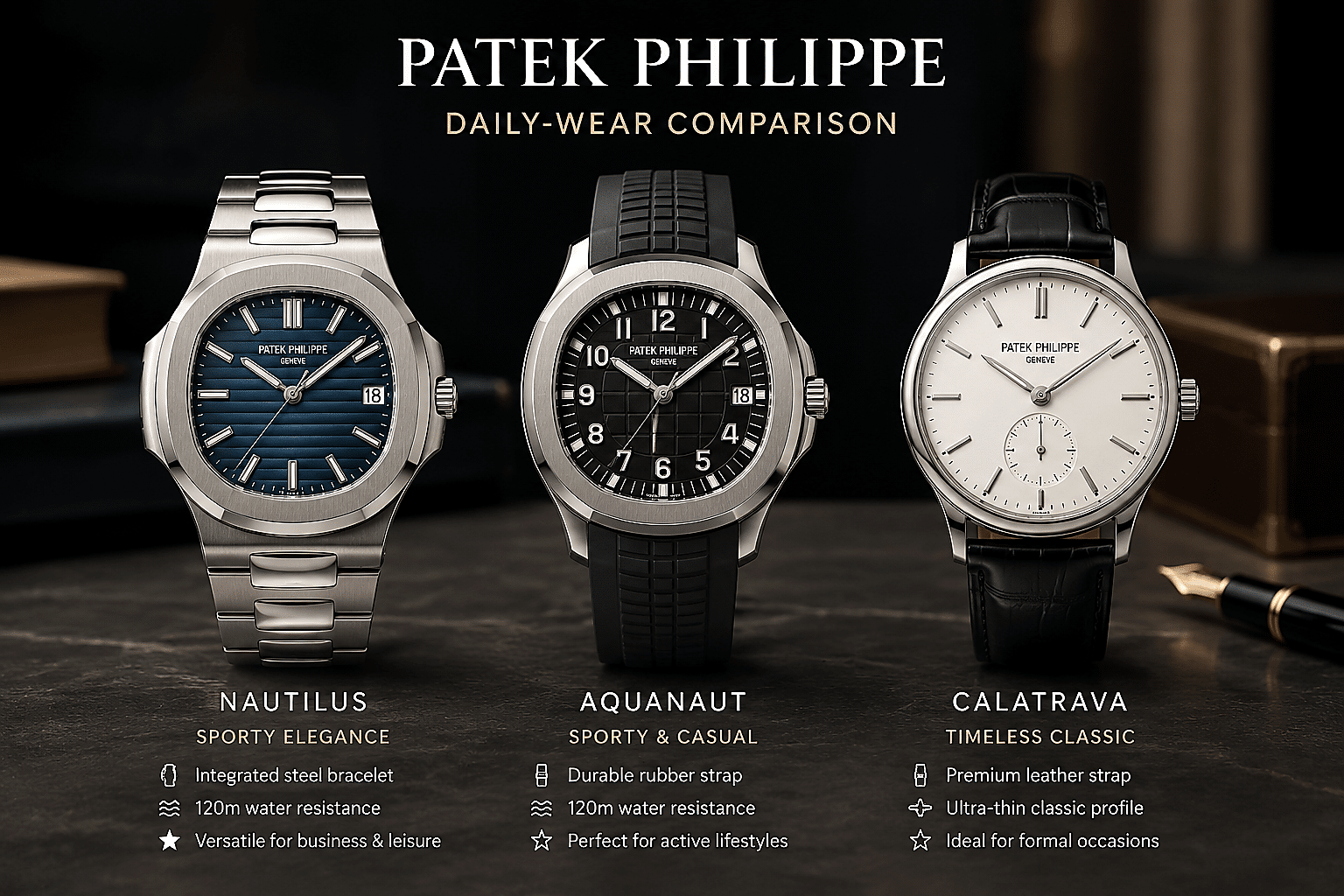
Why the Nautilus Is Attractive but Demanding as a Daily Super Clone
The Nautilus super clone is attractive as a daily watch because it has the right kind of presence for modern office and social use. It is flat, recognizable, and comfortable when the bracelet is sized correctly. It can sit well under a cuff, work with casual business clothing, and feel more versatile than a pure dress watch. For buyers asking about Patek Nautilus replica daily wear, the answer is not “too delicate,” but “not carefree.”
The Nautilus asks more from the buyer because its design exposes daily wear quickly. The bezel is broad and visible. The case has polished bevels that catch both light and scratches. The integrated bracelet is part of the whole design, so poor articulation, rough edges, loose links, or weak clasp feel are not minor issues. On a conventional strap watch, a mediocre strap can be replaced easily. On a Nautilus-style watch, the bracelet is the ownership experience.
This is also why factory reputation alone is not enough. A good Nautilus super clone should be judged by the specific version, bracelet execution, case profile, clasp feel, and QC consistency. A dial may look strong, but if the bracelet feels stiff or the side profile looks bulky, the watch loses much of what makes the Nautilus appealing for daily wear.
Where the Nautilus Works Best
The Nautilus works best in low-impact settings where the watch is visible but not abused. Think office wear, client dinners, casual business outfits, hotel lounges, restaurants, and weekend social settings where you are not dealing with water, tools, gym equipment, or constant wrist impact. In those conditions, the flat case and integrated bracelet can feel comfortable and balanced.
It is especially strong for buyers who want one watch that looks more refined than a typical sports replica but less formal than a leather-strap dress watch. The bracelet gives it daily practicality, while the case shape gives it enough polish for social use. If your weekdays are mostly desk work and your evenings are dinners or relaxed events, a Nautilus can make sense as an everyday office watch, provided you accept scratches as part of ownership.
The non-obvious point is that a Nautilus often feels more delicate visually than mechanically. The watch may run fine, but the brushed and polished surfaces record your habits quickly. Desk edges, laptop bodies, bracelets, jacket zippers, and door frames all leave evidence. Buyers who expect a permanently clean bezel and bracelet should not choose the Nautilus as their only daily watch.
Where the Nautilus Starts to Feel Risky
The Nautilus starts to feel risky when the environment becomes crowded, wet, or physically active. It is not the watch to wear at the gym, during rough travel days, in heavy rain, or while doing work that puts the wrist near hard surfaces. Even if the case looks sporty, the exposed bezel and bracelet finishing make frequent knocks more noticeable than on a simpler tool-style replica.
Commuting is a mixed case. A careful car commute or quiet office commute is usually fine. A crowded train, repeated bag contact, and tight public spaces increase the chance of bezel hits and bracelet scratches. “Desk-diving” is also real. The clasp and lower bracelet links can pick up marks quickly from laptops, metal desk edges, and office furniture.
Wet conditions deserve caution. A Nautilus-shaped case can give a sports-watch impression, but that does not make a replica water-safe. Crown seating, gasket condition, caseback fit, and assembly consistency matter more than the design language. Unless the watch has been pressure tested by a qualified watchmaker, avoid treating it as safe for swimming, showers, or careless sink use.
Case and Bracelet Checks
Before approving a Nautilus super clone for daily wear, the bracelet deserves as much attention as the dial. Check that the bracelet articulates naturally and does not appear rigid at the first links. Poor articulation makes the watch sit awkwardly, especially because the Nautilus case is wide and flat. If the bracelet does not wrap the wrist well, the watch may look correct in a tray photo but feel uncomfortable after a full day.
Clasp security is another priority. The clasp should close evenly, sit flush, and not look loose or misaligned in QC photos. A weak-feeling clasp is not just a luxury-detail problem; it affects confidence during commuting and daily movement. End-link fit should also be checked because visible gaps near the case interrupt the integrated look and can suggest sloppy assembly.
Ask for side-profile photos whenever possible. Case thickness and caseback shape matter on the Nautilus because the original design language depends on thinness and flat wrist presence. A slightly thick watch may still be wearable, but it changes the feel. Also check bezel alignment and the transition between brushed surfaces and polished bevels. Minor cosmetic variation may be acceptable, but crooked alignment, sharp bracelet edges, obvious gaps, or a clasp that does not sit properly are red flags for daily use.
Why the Aquanaut Often Feels Easier for Regular Wear
The Aquanaut super clone is usually the most forgiving Patek choice for regular wear. It is not because it is perfect or because the replica should be treated like a true water-sports watch. It is easier because the design is more relaxed. The rubber strap, lighter wrist feel, and casual sports-watch personality make the Patek Aquanaut replica daily wear experience less stressful than a Nautilus bracelet or a Calatrava leather strap.
For buyers who want the easiest Patek clone to wear often, the Aquanaut usually makes the most sense. It handles casual clothing better, feels less formal in social settings, and does not show bracelet scratches because there is no full steel bracelet. The case still needs careful QC, and water exposure still needs caution, but the overall ownership experience is more relaxed.
The main tradeoff is that the Aquanaut can feel less dressy. It is excellent for casual and smart-casual routines, warm-weather wear, errands, travel days, and low-key social use. It is less convincing as a formal dress watch. Buyers who wear suits daily may still prefer a Nautilus or Calatrava depending on environment, but for comfort-first daily rotation, the Aquanaut has the advantage.
Comfort Advantages of the Rubber Strap Format
A good rubber-style strap changes the whole daily-wear equation. It is lighter than a bracelet, more sweat-tolerant than leather, and often easier to wear for long hours. It also reduces the sharp-edge problem that can appear on some integrated bracelets. If the strap is soft enough and sized correctly, the watch feels secure without the weight and scratch anxiety of a steel bracelet.
This is why the Aquanaut can feel better for commuting and warm weather. The strap does not bang against desk surfaces the same way a bracelet clasp does, and it will not crease like leather after repeated bending. It can also make the watch feel less precious, which matters more than buyers expect. A daily watch should not make the wearer constantly aware of it.
Rubber is not maintenance-free, though. Some straps attract dust, feel stiff, or have a plastic-like texture that reduces comfort. Sweat still needs to be cleaned off, especially around the clasp and underside of the strap. A poorly cut or poorly fitted strap can create pressure points, and sizing mistakes are less forgiving if the strap has to be trimmed.
The Tradeoff: Casual Ease but Less Dress Versatility
The Aquanaut’s casual strength is also its limitation. The tropical-style strap and sportier case make it easy with polos, T-shirts, knitwear, casual jackets, and smart-casual office outfits. It looks natural in situations where a Nautilus might feel more noticeable and a Calatrava might feel too formal. That lower-key wearability is one reason many buyers find it more relaxed for real life.
It may not replace a dress watch, especially in formal offices, weddings, conservative business settings, or black-tie-adjacent events. The rubber strap communicates casual utility, not traditional dress elegance. If your daily life requires formal shirts, suits, and restrained wristwear, the Aquanaut may be comfortable but not always appropriate.
Buyers also need to avoid one common misunderstanding: rubber strap does not equal water safety. The strap may handle sweat and light moisture better than leather, but the case still controls water risk. A sporty look should never be treated as proof that the watch is safe for swimming, showers, or repeated sink exposure unless it has been properly tested.
What This Means for Daily Wear
For daily wear, the Aquanaut is usually the safest Patek Philippe super clone choice for buyers who value comfort, lower maintenance, and casual versatility. It is the most forgiving option for warm weather, commuting, weekend use, and relaxed office environments. It asks less from the wearer than a scratch-conscious Nautilus and less protection than a leather-strap Calatrava.
The better buyer for an Aquanaut is not someone expecting a rugged dive watch. It is someone who wants a comfortable, easy Patek-style replica for normal daily rotation and understands that water resistance, movement stability, clasp quality, and strap fit still need to be checked. If formal elegance is the priority, look elsewhere. If low-stress wearability is the priority, the Aquanaut is usually the most sensible starting point.
Why the Calatrava Is Better for Dress Wear Than Rough Daily Use
A Calatrava super clone can be one of the most comfortable Patek-style replicas to wear because the case is usually thin, light, and easy under a shirt cuff. That comfort is also the reason buyers misjudge it. A slim dress watch does not become a carefree daily watch just because it disappears on the wrist.
The Calatrava is best understood as a refined office and dinner watch, not a one-watch solution for every routine. A Patek Calatrava replica with a clean dial, polished case, and leather strap can look convincing in the right setting because there is less visual complexity to expose obvious flaws. But the same simple design has little tolerance for abuse. Scratches on a polished bezel, creases in the strap, moisture marks near the lugs, and small dents on a slim case are easier to notice than buyers expect.
The practical judgment is simple: choose a Calatrava if your daily wear means meetings, dress shirts, controlled indoor use, and occasional evening wear. Do not choose it if your normal day includes rain exposure, gym bags, rough commuting, outdoor work, or heavy sweat. It is a good office dress watch, but it is not the safest Patek super clone for rough use.
Where the Calatrava Makes Sense
The Calatrava works best in situations where the watch is protected by clothing, worn for shorter periods, and not exposed to moisture or impact. Formal offices, dinners, weddings, events, and business-casual settings are where this design feels natural. It does not fight the outfit, and it does not need a large case or loud bracelet to make its point.
For buyers who rotate watches, the Calatrava can be a very sensible occasional wear piece. It is comfortable for a long dinner, easy under a cuff, and less physically demanding than an integrated-bracelet sports watch. The lighter case can also make lower-cost finishing feel less distracting on the wrist because the watch is not constantly scraping against desks, laptop edges, or door frames.
The non-obvious advantage is that simplicity can help a Calatrava super clone age more gracefully if it is worn selectively. A clean dial and slim case do not create as many daily interaction points as a bracelet watch. The weak point is not usually the dial; it is the strap, the polished case, and the owner’s expectation that “dressy” also means durable.
Why It Should Not Be Treated Like a Sports Watch
The leather strap is the first limitation. Heat, sweat, bending, and moisture shorten strap life quickly, especially if the strap is worn tightly or used during warm-weather commuting. A leather strap may look fine in QC photos and still develop dark edges, odor, softened holes, or cracking after regular sweat exposure. Buyers who expect leather strap maintenance to be minimal usually end up disappointed.
The case is the second limitation. A polished case looks elegant because it reflects light cleanly, but that same surface shows hairline scratches, desk marks, and small knocks more clearly than a brushed sports case. A slim case can be comfortable, but it can also feel less forgiving if it takes a hard hit. On a dress watch, one dent on a polished lug can change the whole impression.
Water is the final reason the Calatrava should be treated carefully. Even if a seller describes a replica watch as water resistant, a leather-strap dress watch is still the wrong place to test that claim. Sink splashes, rain on a cuff, or sweat trapped under the caseback can create problems that are not obvious immediately. For daily use, the safer habit is to remove a Calatrava before washing hands, avoid wet weather when possible, and let the strap dry naturally after warm wear.
Water, Sweat, and Weather Are the Biggest Daily-Wear Risks
For daily wear, moisture is the risk buyers underestimate most. Replica watch water resistance is not something to assume from a product description, a factory claim, or the sporty look of the watch. A Patek super clone water risk depends on gasket condition, crown seal, caseback fit, assembly consistency, and whether the specific watch has been tested by someone qualified to test it.
This matters because real moisture exposure rarely looks dramatic. It is not only swimming. It is rain during a commute, hand washing at a restaurant, sweat under the strap in summer, humidity in a parked car, or a sudden temperature change that creates condensation risk. These are normal daily situations, and they are exactly where a buyer finds out whether a watch was assembled consistently.
The model differences are practical rather than absolute. An Aquanaut-style rubber strap handles sweat better at the strap level, but that does not make the watch safe for water sports. A Nautilus-style watch may feel sporty on bracelet, but the crown, caseback, and crystal seals still decide the real risk. A Calatrava on leather should be kept away from moisture whenever possible because even light exposure can damage the strap before the movement shows any problem.
Why “Sporty Design” Does Not Equal Water Safety
The Nautilus and Aquanaut create the biggest misunderstanding because they look more casual and athletic than a Calatrava. Buyers see a steel bracelet or rubber strap and assume the watch can handle rain, sink splashes, or poolside use. That assumption is risky. Sporty design language is not the same as verified sealing.
A replica may have a screw-down crown or a caseback that looks properly fitted, but visual inspection alone does not prove pressure resistance. A crown can thread unevenly, a gasket can be dry or pinched, and a caseback can appear closed while still failing under pressure. This is why factory or seller water-resistance claims should be treated as marketing information, not a guarantee.
The safest daily-wear rule is conservative: unless the exact watch has been pressure tested after purchase, avoid deliberate water exposure. Wearing it in light rain by accident is different from choosing to wash hands with it every day. Repeated small exposures are often what create trouble.
A Practical Moisture Protocol for Daily Wear
A cautious buyer should set a moisture rule before wearing the watch, not after a problem appears. If the watch has not been pressure tested after purchase, treat it as a dry-use watch: remove it before washing hands, avoid showers and swimming, do not leave it in a steamy bathroom, and dry the case and strap if sweat or rain reaches it. This is not about assuming every watch will fail; it is about avoiding a risk that is difficult to reverse once moisture enters the case.
After any unexpected wet exposure, the safest response is to dry the exterior, avoid operating the crown, and watch for fogging, dial discoloration, rotor noise changes, or stopping. Turning or pulling the crown while moisture is present can make a small problem worse. If the watch is meant to become a frequent daily wearer, an independent pressure test and gasket check are more useful than relying on a seller’s generic water-resistance phrase.
Pressure testing also has limits. It can give a clearer reading of the watch’s current sealing condition, but it does not prove future water safety after impacts, crown use, temperature changes, strap replacement, or case opening. Buyers should treat testing as a risk-reduction step, not a reason to use a Patek-style replica as a swimming or shower watch.
How Sweat Affects Rubber, Leather, and Bracelet Wear
Sweat affects each wearing format differently. Rubber is the most forgiving because it does not absorb moisture like leather, and it can usually be wiped clean more easily. But rubber straps still collect dust, skin oil, and residue around the clasp and underside. If the rubber is stiff or poorly fitted, sweat can also make the watch feel sticky or irritating during long wear.
Leather is the least forgiving. Sweat darkens the lining, softens the holes, weakens stitching, and can create odor. A Calatrava leather strap that looks elegant in winter office use can age quickly during summer commuting. This is not a replica-only issue, but lower-grade straps can show it faster.
Bracelets sit in the middle. A Nautilus-style bracelet does not absorb sweat, but sweat and grime collect between links, under the clasp, and around the caseback. Over time, that buildup can make the bracelet feel rougher, loosen the impression of quality, and increase skin irritation. The bracelet may still look fine from the top while feeling unpleasant underneath.
Red Flags Before Wearing in Wet Conditions
Do not treat a Patek super clone as wet-condition ready if the crown feels loose, gritty, or inconsistent when pushed and turned. Poor crown threading is one of the easiest warning signs because the crown is a direct moisture entry point. If it does not seat cleanly, the watch should stay away from water.
Fogging under the crystal is a serious red flag, even if it disappears later. It means moisture has already entered the case. Visible caseback gaps, uneven caseback seating, missing confidence in prior service history, or any sign that the watch has been opened without proper gasket care should also make the buyer cautious.
The most practical check is not whether the watch “should” be water resistant. It is whether this specific unit has verified pressure testing. Without that, the safer answer to “can I wash hands with it?” is no, especially for Calatrava leather straps and any watch with uncertain crown or caseback condition.
Movement Stability Matters More Than Complication Prestige
For a daily-wear Patek super clone, movement stability matters more than how impressive the model sounds. A watch that looks excellent in photos can still become frustrating if it has rough winding, weak automatic charging, noisy rotor behavior, inconsistent power reserve, or a date that does not change cleanly. Daily use exposes these problems faster than occasional wear.
This is where buyers need to separate visual appeal from ownership experience. A decorated movement plate or complication-style display may look closer to the idea of a high-end Patek, but that does not automatically make it better for regular wear. Thin cases, display backs, decorative bridges, and complication layouts can reduce serviceability or create expectations the movement cannot support reliably.
The practical judgment is that simpler time-only or time-and-date Patek replica movement routes are usually safer for frequent use than fragile complication-heavy versions. That does not make every simple movement excellent, and it does not make every complicated one bad. It means the daily-wear buyer should prioritize stability, service access, and predictable behavior over mechanical theater.
What Daily Wear Reveals About a Movement
Daily wear quickly reveals whether the movement is pleasant to live with. The first sign is winding feel. A crown that feels gritty, uneven, or too tight can make the watch annoying before any accuracy issue appears. A stable daily watch should wind smoothly enough that setting and restarting it do not feel like a risk.
Power reserve is another real-world test. If the watch stops overnight after a normal day of wrist time, the automatic winding may be inefficient, the mainspring reserve may be weaker than advertised, or the wearer’s activity may not be enough to keep it charged. Buyers often blame themselves first, but repeated stopping is a movement behavior worth questioning.
Date behavior also matters on models that include it. A misaligned date, slow date change, or date that hesitates around midnight can become a daily annoyance. Rotor noise is similar. Some automatic movements are naturally louder than others, but a loud scraping or loose-spinning rotor can make a refined dress or sports-luxury watch feel cheaper in use, especially in quiet office settings.
How to Treat Movement Claims Carefully
Movement names in replica listings should be read carefully because a name can describe an architecture, a decoration style, a seller category, or a claimed movement family without proving what is inside the individual watch. Terms such as “clone,” “Swiss,” “Asian,” “upgraded,” or “decorated” need follow-up questions. A buyer should ask for movement photos where appropriate, confirm whether the version is automatic or manual, check whether the date function is real or decorative, and understand whether the movement route affects case thickness or hand position.
For daily wear, the most useful movement evidence is practical rather than glamorous. Smooth winding, predictable setting, a clean date change, reasonable rotor sound, stable running after normal wrist time, and service access matter more than a plate that looks impressive through a display back. Decoration can improve presentation, but it should not be treated as proof of mechanical equivalence to the authentic watch or proof of long-term reliability.
Movement Transparency Note: Movement references in this article describe replica-market movement types, decoration routes, and practical behavior points rather than official Patek Philippe calibers unless verifiable evidence is provided. Buyers should judge movement suitability by the specific version, winding feel, date behavior, rotor sound, service access, and case thickness impact.
Why Simpler Patek Clones Can Be Easier to Live With
Complications are attractive in photos because they add visual depth and status, but they also add more user-facing failure points. More hands, more calendar functions, more pushers, and more movement modifications mean more things that can be misaligned, fragile, or difficult to service. For a regular rotation watch, that tradeoff is often not worth it.
A simple Calatrava-style watch may lack the excitement of a complicated Patek, but that is exactly why it can be easier to own. A Nautilus or Aquanaut with straightforward time-and-date functionality is usually more practical than a version trying to replicate complex mechanical behavior with uncertain long-term reliability. The safer daily choice is rarely the most complicated one.
At Clean VS Factory, we usually treat movement choice as part of daily-wear suitability, not just a specification line. If the movement route makes the case too thick, the rotor too noisy, or the functions too fragile, the watch may be less enjoyable even if the dial and case look strong at first glance.
Caseback Appearance and Service Reality
Many Patek-style super clones are judged through the display back because the movement decoration is easy to compare in photos. That can be useful, but it should not dominate a daily-wear decision. A more decorative movement appearance may improve the watch’s presentation when photographed, yet the owner usually notices winding smoothness, rotor noise, power reserve, and setting feel far more often than bridge engraving. For regular wear, visual movement similarity and long-term movement behavior are separate questions.
Serviceability is also part of the tradeoff. A familiar, more standard movement base may be less exciting through the caseback but easier for a watchmaker to regulate, clean, or repair. A more ambitious decorated or modified movement may look closer at first, but if parts access is limited or the construction is less stable, the watch can become harder to live with after months of use. Daily-wear buyers should not treat movement decoration as proof of ownership quality.
The practical check is whether the movement choice supports the model’s physical design. If a movement route makes the case too thick for a Nautilus, creates a noisy rotor in a quiet Calatrava, or causes a date position that looks awkward on an Aquanaut, the visual benefit may not be worth the compromise. A daily watch should feel predictable before it feels impressive.
Movement Route to Verify
Before choosing a Patek super clone for frequent wear, confirm the actual movement type used in the current version. Do not rely only on broad terms like “clone movement” or “upgraded movement.” Ask what the movement is meant to do, whether the date function is present and stable, and what power reserve expectations are realistic for that specific version.
It is also worth understanding whether the movement is a more standard reliable base with decoration or a more ambitious decorated movement appearance designed to look closer through the caseback. The first route may be less visually exciting but easier to service. The second may look better in photos but can carry more ownership risk if parts, adjustment, or service access are limited.
For daily wear, the best movement route is the one that supports the watch’s case thickness, winds consistently, keeps reasonable time, changes functions cleanly, and can be serviced without unusual difficulty. Prestige on paper matters less than whether the watch behaves predictably after a week on the wrist.
Bracelet and Strap Choice Shapes the Whole Ownership Experience
The bracelet or strap is not a secondary detail on a Patek Philippe super clone watch. It is often the part that decides whether the watch is comfortable all day, annoying after two hours, or too delicate for the way you actually live. A dial flaw may bother you in photos, but sharp bracelet edges, a loose clasp, stiff rubber, or sweaty leather will bother you every time the watch is on the wrist.
For daily wear, the simplest judgment is this: the Aquanaut-style rubber strap is usually the easiest to live with, the Nautilus bracelet is the most visually integrated but the most scratch-conscious, and the Calatrava leather strap is the most elegant but the least forgiving around sweat and moisture. A buyer who ignores the Patek replica bracelet or Patek replica strap quality is usually judging the watch too much like a display object and not enough like something worn through real days.
The non-obvious point is that strap and bracelet quality can change how “expensive” the whole watch feels more than the case does. A well-shaped case on a poorly fitted bracelet still feels cheap. A decent Aquanaut case on a soft, correctly cut rubber strap can feel more usable than a more visually impressive watch with a clasp that never closes cleanly. This is why QC should include clasp, fit, link behavior, and strap shape, not just the dial.
Nautilus Bracelet: Beautiful but Scratch-Prone
The Nautilus bracelet is the most satisfying option when it is done well because the case and bracelet are supposed to read as one continuous design. Good bracelet articulation lets the watch sit flat without feeling like a rigid cuff. Poor articulation does the opposite: the watch may look correct from the front but feel blocky, top-heavy, or uneven on smaller wrists.
The daily-wear weakness is finish exposure. Brushed links, polished bevels, and a wide clasp area all pick up desk scratches quickly. Laptop edges, metal desk frames, chair arms, and even shirt cuffs can mark the bracelet faster than many buyers expect. This is not only a replica issue; integrated luxury bracelets generally show wear. The difference is that on a Nautilus super clone, uneven brushing or softer edge definition may make new scratches look messier sooner.
Clasp quality matters more than many buyers assume. A clasp that feels loose, closes off-center, or opens with uneven pressure is not just a tactile disappointment; it changes daily confidence. Before accepting a watch, buyers should look for even bracelet gaps, clean end-link fit, secure clasp closure, and sizing that allows the watch to sit snugly without forcing the bracelet flat against the wrist.
The practical verdict: choose the Nautilus bracelet if you value the complete visual design and accept visible aging. Do not choose it if you expect the bracelet to stay showroom-clean through heavy desk work, public transit, or careless daily use.
Aquanaut Rubber Strap: Practical but Still Not Maintenance-Free
The Aquanaut-style rubber strap is usually the most forgiving Patek replica strap for frequent wear. It is lighter than a bracelet, more tolerant of sweat than leather, and less likely to look ruined after a few normal knocks. For warm weather, casual weekends, and long days outside the office, this format makes more sense than many buyers initially expect.
Still, rubber is not automatically good rubber. Buyers should check softness, dust attraction, edge finishing, cut quality, and how naturally the strap curves around the wrist. A strap that is too stiff can make the watch float above the wrist instead of settling into place. A strap cut too short or too long can make clasp positioning awkward, especially if the deployant sits toward the side of the wrist rather than centered underneath.
Rubber strap care is simple but not optional. Sweat, sunscreen, dust, and skin oil build up around the underside of the strap and clasp. If the watch is worn often, the strap should be wiped down regularly with a soft damp cloth and dried before storage. This matters because grime near the clasp and strap channels can make even a decent replica feel sticky, dull, or cheaper than it should.
The practical verdict: for buyers who want the easiest regular-wear Patek super clone experience, the Aquanaut strap format is usually the safest external setup. The mistake is treating it like a maintenance-free sports watch or assuming the strap quality is identical across every factory version.
Calatrava Leather Strap: Comfortable in the Right Setting
A Calatrava-style leather strap can be extremely comfortable in the right environment. It is light, flexible, and well suited to dress shirts, dinners, office meetings, and lower-impact indoor wear. For a buyer who wants a refined Patek replica watch that disappears under a cuff, leather still makes sense.
The limitation is moisture and bending fatigue. Leather absorbs sweat, reacts poorly to rain, creases at the buckle or deployant point, and can darken or smell if worn repeatedly in hot weather. Summer commuting is especially hard on leather because the strap is exposed to heat, humidity, and wrist movement before the buyer even reaches the office.
Replacement is also part of the ownership equation. A worn leather strap is easier to replace than a damaged integrated bracelet, but matching the right width, taper, stitching, color, and clasp compatibility can be more annoying than expected. Cheap replacement straps can make a good-looking Calatrava super clone feel visually wrong immediately.
The practical verdict: a Calatrava leather strap is best for controlled daily wear, not rough daily wear. If the buyer’s routine includes sweat, rain, walking commutes, gym bags, or frequent outdoor movement, leather becomes the weakest link long before the dial or movement does.
Daily Situations: Office, Commuting, Travel, and Social Wear
A daily wear replica watch should be judged by ordinary situations, not ideal photos. The same Patek super clone may be perfectly reasonable at a desk, annoying on a crowded train, too exposed during travel, and just right for dinner. This is where Nautilus, Aquanaut, and Calatrava separate clearly, because each one handles daily pressure differently.
Imagine a buyer choosing one Patek-style super clone for weekday office use and weekend casual wear. The Nautilus offers the strongest wrist presence and works well with business casual clothing, but it asks the buyer to tolerate bracelet scratches. The Aquanaut is easier for commuting and casual weekends, but it looks less formal. The Calatrava is the quietest under a cuff, but it is the least comfortable choice for heat, rain, and rough movement.
The best choice depends less on which model looks most prestigious and more on which daily problem you are willing to manage. Scratches, sweat, impact, and social visibility are not equal risks for every buyer.
Office Wear and Desk Scratches
Office wear sounds safe, but it creates its own type of damage. Desk edges, keyboards, laptop palm rests, metal chair arms, and filing cabinets all create small contact points. The Nautilus bracelet is especially exposed because the bracelet and clasp are part of the visual appeal. If the buyer rests the wrist on a desk all day, fine marks on the clasp and bracelet underside are almost guaranteed over time.
The Calatrava avoids bracelet scratches but has a different office risk: polished case surfaces. A polished dress case can show small sleeve, cufflink, and desk marks more clearly than expected. It may still be the better office watch for formal environments, but buyers should not confuse “dressy” with “scratch-proof.”
The Aquanaut is usually the most relaxed office option if the workplace allows a casual sports-watch look. Rubber avoids bracelet desk rash, and the watch is less formal than the Nautilus. The tradeoff is that it may not look as natural with suits, especially in conservative offices.
Commuting and Impact Risk
Commuting exposes weaknesses that QC photos do not show. Door frames, subway poles, seatbelt buckles, backpack straps, rain, and sudden knocks all test the case, clasp, and strap. A watch that feels fine at home can become stressful if the buyer is constantly protecting it in public spaces.
For commuting, the Aquanaut is usually the least stressful of the three because the rubber strap handles sweat and movement better. The Nautilus can work, but the bracelet and bezel are more exposed to scratches and knocks. The Calatrava is the least ideal for rough commuting because leather and polished dress cases do not enjoy moisture, impact, or crowded environments.
Travel adds another layer: unfamiliar conditions. Hotel sinks, luggage handling, airport trays, changing weather, and long walking days all increase the chance of moisture or impact. If a buyer wants one Patek super clone for travel, the safer daily choice is usually the most comfortable and least delicate-looking option, not the most formal one.
Social Situations and Wrist Presence
Patek designs can attract attention without being oversized. That matters because daily comfort is not only physical; it is also social. Some buyers enjoy a recognizable watch. Others feel uncomfortable when a watch invites questions in ordinary settings.
The Nautilus has the strongest recognition factor. It works well at dinners, business-casual events, and social settings where a visible watch feels natural, but it may be too noticeable for buyers who prefer low-profile wear. The Aquanaut is more casual and often easier to wear around friends, travel, and weekends because it does not feel as dressed-up. The Calatrava is quieter from a distance but dressier up close, making it better for formal social settings than casual ones.
The practical judgment is simple: if you want the watch to blend into normal life, the Aquanaut is usually easiest. If you want the watch to look sharp in office and social settings and you accept attention, the Nautilus makes sense. If your use is mostly dinners, events, and formal workdays, the Calatrava is more natural than trying to force it into rough everyday wear.
Factory and Version Claims Should Be Judged Through Daily-Wear Evidence
Factory names are useful, but they do not answer the daily-wear question by themselves. A Patek super clone factory may produce a strong-looking Nautilus in photos and still have bracelet comfort issues. Another Patek replica version may have a convincing dial but a rubber strap that feels stiff, a clasp that lacks confidence, or a movement route that becomes annoying after regular use.
For daily wear, the better question is not “which factory is best?” It is “which current version of this specific model gives the safest ownership experience?” That means judging bracelet execution, strap quality, case thickness, movement behavior, and QC consistency together. A visually impressive watch can still be the wrong daily choice if the parts the buyer touches every day are weak.
At Clean VS Factory, we usually separate factory reputation from model suitability. A factory name can point buyers in the right direction, but it should never replace model-specific evidence, especially with Patek Philippe super clone watches where bracelets, straps, and slim case proportions matter so much in real use.
A factory comparison is most useful when it is tied to the exact reference style, current version, movement route, case profile, bracelet or strap execution, and available QC coverage. The same factory-market name may perform well on one Nautilus version and less convincingly on another Aquanaut or Calatrava version because the design challenges are different.
Factory Name Clarification: Factory names in the replica watch market are buyer-facing reference labels, not official Patek Philippe affiliations or guarantees of identical quality across every unit. Buyers should treat them as useful starting points and still check the specific model version, bracelet or strap execution, movement route, clasp fit, case profile, and QC photos before judging daily-wear suitability.
What Evidence Can and Cannot Prove
QC photos can show alignment, visible fit, case thickness, strap shape, clasp seating, and some assembly clues, but they cannot prove pressure resistance, long-term movement reliability, metal composition, or how the watch will perform after months of daily wear. A seller video can demonstrate winding feel or rotor sound more clearly than a photo, but even that is only a short observation of one unit. The buyer should use each piece of evidence for what it can reasonably show and avoid turning it into proof of unrelated claims.
Likewise, factory reputation can explain why a version is being discussed, but it cannot guarantee the individual watch. Two watches from the same named source may still differ in bracelet feel, dust control, date alignment, crown action, or clasp confidence. For daily wear, the safest approach is to combine the factory label with current-version details, unit-specific QC photos, seller communication, and realistic assumptions about maintenance and risk.
Why Factory Reputation Is Not Enough
One factory can be strong on a Nautilus bracelet and less convincing on an Aquanaut strap. Another may handle a Calatrava dial cleanly but leave the case finishing too soft or the crown feel less reassuring. These differences happen because each Patek model creates a different pressure point. The Nautilus asks more from bracelet fit and case profile. The Aquanaut asks more from strap comfort and clasp integration. The Calatrava asks more from polished case execution, dial balance, and leather strap presentation.
Batch variation also matters. A version update may improve case thickness while changing clasp feel. A new batch may correct dial alignment but introduce a stiffer strap. This is why forum hype can age quickly. A recommendation from six months ago may still be useful context, but it should not override current QC evidence.
The most common buyer mistake is treating a factory label as a guarantee of daily reliability. It is not. It is only a starting point for checking whether the specific watch in front of you is assembled well enough for your use.
Daily-Wear Details That Matter More Than Forum Hype
For a watch that will be worn often, tactile details deserve more weight than dramatic macro comparisons. Bracelet comfort, clasp security, strap softness, crown seating, date alignment, and movement behavior will shape ownership more than a tiny dial-printing difference that only appears under heavy zoom.
On a Nautilus, daily-wear evidence should include bracelet articulation, clasp closure, end-link fit, side profile, and whether the bracelet appears evenly finished. On an Aquanaut, the strap should curve naturally, the clasp should sit comfortably, and the rubber should not look warped, overly glossy, or poorly cut. On a Calatrava, the strap holes, stitching, case polish, crown position, and dial alignment are more relevant than broad claims that the watch comes from a “top” source.
Movement behavior also belongs in this daily-wear evidence. A watch that winds roughly, has a loud rotor, stops after short rest periods, or shows inconsistent date behavior may still look good in photos but become frustrating quickly. Buyers who want daily reliability should give these symptoms more weight than factory marketing language.
How to Read Seller Claims Without Overvaluing Them
Seller descriptions can be helpful, but they should be read as starting signals rather than final proof. Phrases such as “latest version,” “best factory,” “upgraded movement,” or “water resistant” are only useful when they connect to buyer-verifiable details. For a Patek daily wearer, the follow-up should be specific: latest version of which model, upgraded in what part, which movement route, what case thickness, what clasp type, and whether the exact watch has been pressure tested after assembly.
Photos can also overstate confidence if they only show the watch from flattering angles. Bright front shots may hide case thickness, bracelet stiffness, strap flare, uneven clasp seating, or crown gaps. A strong seller listing should make the watch easier to judge as an object worn on the wrist, not only as a dial shown under good lighting. If the available evidence does not show the parts that affect daily use, the buyer is still guessing.
This is especially important with Patek-style replicas because the designs are not forgiving. A slightly bulky case can change the Nautilus profile, a stiff strap can ruin the Aquanaut’s comfort advantage, and a mediocre leather strap can make a Calatrava feel lower-grade immediately. Factory labels and seller descriptions matter, but the final judgment should come from the specific unit, current version, movement choice, and QC coverage.
Version Details to Confirm
Before judging any Patek replica version, confirm the current version being offered, not only the factory name. Ask what movement route is used, whether the case thickness matches the model’s expected profile, whether the bracelet or strap is the latest execution, and what clasp type is installed. These details affect comfort and ownership more than a generic “best edition” claim.
QC photo coverage should also match the intended use. For daily wear, buyers should look for front dial alignment, side thickness, crown side, bracelet or strap close-ups, clasp closure, caseback fit, and a wrist shot when possible. If the seller can only provide glamorous front photos, the buyer is missing the angles that reveal comfort and assembly risk.
The practical verdict: trust evidence over reputation. A safer daily Patek super clone is not always the one with the loudest factory claim; it is the one with a stable movement route, clean case proportions, secure clasp, comfortable strap or bracelet, and QC photos that show the watch as something meant to be worn, not only admired from one angle.
QC Photos Should Focus on Wearability, Not Just Dial Accuracy
Patek replica QC photos are often judged too narrowly. Buyers zoom in on the logo, the dial texture, or the date window, then miss the parts that decide whether the watch will actually feel good after three full days on the wrist. For a Patek Philippe super clone meant for daily wear, the better QC question is not only “does the face look correct?” It is “does this watch look properly assembled, comfortable, and unlikely to annoy me during normal use?”
This matters more on Patek-style replicas than many buyers expect. A Nautilus with a nice dial but uneven bracelet gaps can become irritating quickly. An Aquanaut with a strong front view but a stiff or poorly cut strap may never sit right. A Calatrava with clean printing but a raised caseback edge, crooked crown seating, or awkward strap fit can feel less refined than the photos suggested. Super clone watch QC should support ownership confidence, not just photo-based excitement.
Minor cosmetic variation is not always a reason to reject a watch. A tiny printing softness visible only under heavy zoom may not affect daily enjoyment. A crooked marker, noticeably off-center date, poorly closing clasp, large bracelet gap, misaligned strap, rough crown position, or obvious caseback problem is different. Those are red flags because they do not disappear when the watch is worn. They usually become more annoying.
Front View Checks for Everyday Annoyances
The straight dial shot still matters, but it should be judged through daily visibility rather than macro perfection. Check whether the dial alignment looks balanced at a normal viewing angle. On a Patek Nautilus or Aquanaut replica, look at the horizontal dial pattern, applied indices, hand alignment, logo placement, and date window if the model has one. If the dial pattern looks slightly different under lighting, that may be acceptable. If the markers are visibly tilted or the date sits high, low, or too far to one side, that will be noticed every time the buyer checks the time.
Hands deserve more attention than they usually get. They should sit cleanly, clear the dial properly, and line up in a way that does not make the watch look careless. A small dust speck may be tolerable depending on location and visibility. A hand that appears bent, scratched, or badly stacked is a more serious concern because it suggests weaker assembly control.
For Calatrava-style models, the front view is even less forgiving because there is less visual noise to hide mistakes. A simple dial makes printing weight, seconds-track alignment, and hand centering more obvious. This is why a plain Patek Calatrava replica can look safer in theory but still require careful QC. Simplicity does not hide crooked details; it exposes them.
Side and Clasp Photos for Comfort Risk
The side profile is one of the most useful QC photo angles for a daily-wear Patek super clone. It shows whether the case thickness looks reasonable, whether the crystal height appears awkward, whether the caseback sits cleanly, and whether the crown is seated properly. A front photo can make almost any watch look flatter than it really is. The side view tells the buyer whether the watch may feel elegant or bulky on the wrist.
For a Nautilus, side and bracelet photos should show the case-to-bracelet transition, first-link articulation, clasp closure, and visible bracelet gaps. The integrated bracelet is part of the whole watch, not a replaceable afterthought. If the links look uneven, the clasp sits proud, or the bracelet appears stiff at the end links, the watch may wear worse than its dial photo suggests. A Nautilus super clone with a slightly imperfect dial but a comfortable bracelet can be easier to live with than one with a better dial and a poor bracelet.
For an Aquanaut, the strap fit matters more than buyers expect. QC photos should show the rubber-style strap from the side and near the clasp. Look for uneven cutting, excessive flare near the lugs, poor clasp seating, and strap holes or clasp positions that may create sizing problems. A strap that looks too stiff in photos may soften with use, but a badly fitted strap is harder to ignore.
For a Calatrava, clasp and strap photos should confirm that the leather strap sits straight, the spring bar area looks clean, and the buckle or deployant closes evenly. Leather can crease naturally, but a strap that already looks twisted, poorly stitched, or badly matched to the case is not a good sign for frequent wear.
QC Photos to Request
A practical QC set should include enough angles to judge wearability, not just beauty. The minimum useful photo group is:
- Front dial photo taken straight on, with hands positioned so markers and date window can be judged clearly.
- Case side profile showing thickness, crystal height, caseback fit, and whether the watch looks awkwardly tall.
- Crown-side photo showing crown position, crown seating, and any obvious gap or threading concern.
- Bracelet or strap close-up showing end-link fit, strap fit, link gaps, stitching, or rubber cut quality.
- Clasp photo showing closure alignment, engraving position, clasp security, and whether it sits flush.
- Caseback photo showing obvious gaps, screws, movement display appearance where applicable, and general assembly cleanliness.
- Wrist shot or curved-surface shot showing how the watch sits when not photographed flat on a table.
- Movement photo or movement-route confirmation when the version depends on a specific movement choice.
QC photos cannot prove long-term durability, water resistance, or movement lifespan. They can, however, help avoid the wrong sample before it becomes the buyer’s daily problem. For daily wear, rejecting a watch because of an obvious comfort or assembly issue is more rational than rejecting one over a tiny macro flaw that will never be noticed on the wrist.
QC photos reduce uncertainty, but they do not remove every risk. They are most useful when they show the exact watch being supplied from practical angles, especially the side profile, crown seating, clasp closure, bracelet or strap fit, caseback assembly, and movement view where relevant.
Who Should Wear a Patek Super Clone Daily and Who Should Not
A Patek Philippe super clone daily watch can make sense, but only for the right wearer. The buyer who treats it as a refined daily rotation piece will usually have a better experience than the buyer who expects it to behave like a rugged sports watch. The best Patek replica for daily wear is not the one with the most impressive name or the most complicated appearance. It is the one that matches the buyer’s routine, moisture exposure, scratch tolerance, and maintenance expectations.
The simplest verdict is this: the Aquanaut is usually the easiest daily pick, the Nautilus is excellent for careful office and social use but more scratch-conscious, and the Calatrava is strongest as a dress-first watch. That recommendation can change by factory version, movement route, QC result, and personal lifestyle, but the model family still sets the baseline.
Best Fit: Careful Wearers With Realistic Expectations
The best daily-wear candidate is someone who understands that a Patek super clone is a refined replica watch, not a no-maintenance tool watch. This buyer avoids unnecessary water exposure, wipes sweat from straps or bracelets, accepts that polished surfaces will mark, and rotates the watch instead of wearing it through every activity. For this person, a good Aquanaut or Nautilus can be enjoyable in real life, not just in QC photos.
A careful office wearer is also a reasonable match. A Nautilus can work well with business casual clothing, meetings, dinners, and low-impact daily routines. The buyer must accept desk scratches on the bracelet and bezel, but the watch’s flat profile and integrated design can feel natural if the bracelet is sized correctly. It is not the lowest-maintenance option, but it can be a satisfying one for someone who pays attention to wear conditions.
A formal-dress wearer may prefer a Calatrava, especially if the watch is used for office days, dinners, events, and dress shirts rather than commuting in bad weather or weekend errands. The Calatrava’s strength is not toughness. Its strength is quiet elegance. Buyers who understand that distinction are less likely to be disappointed.
Occasional Wear Is Better for High-Risk Lifestyles
A Patek super clone is less suitable as a daily watch for buyers who face frequent water, physical work, heavy commuting stress, gym use, outdoor activity, or rough travel. If the watch will regularly meet rain, sink splashes, sweat-heavy days, door frames, luggage, and crowded public transit, the ownership risk rises quickly. A sporty-looking Aquanaut still should not be treated as a guaranteed swimming or water-sports watch unless it has been properly tested by a qualified watchmaker.
Buyers with very low tolerance for scratches should also be cautious. Nautilus bracelets and bezels can collect visible marks. Calatrava polished cases can show small scratches clearly. Leather straps can crease, darken, and weaken with moisture. If visible aging will bother the owner, occasional wear is more sensible than forcing the watch into daily duty.
The same applies to buyers who want zero maintenance. Rubber needs cleaning, bracelets need sizing and occasional care, leather needs protection from sweat and moisture, and automatic movements need reasonable handling. A visually convincing Patek replica can still be the wrong daily choice if the buyer wants a watch that can be ignored completely.
Disclosure and Social Clarity
Daily wear also raises a social and disclosure question. A replica watch should not be represented as an authentic Patek Philippe watch in resale, trade, warranty, service, or social situations where authenticity matters. Even when the buyer understands what the watch is, future handling can become complicated if the watch is passed to another person, photographed for sale, or discussed in a context where people may assume it is genuine.
Buyers should also avoid treating replica ownership as legally risk-free or universally accepted. Replica watches can raise trademark, customs, import, resale, and disclosure concerns depending on location and circumstances. This article is practical buyer guidance, not legal advice, and it does not imply authorization, affiliation, or endorsement by Patek Philippe or any trademark owner.
The safest use of factory, movement, and QC information is to understand quality and ownership risk, not to misrepresent a replica watch as genuine. A strong daily-wear choice should make sense for the buyer’s own use, routine, and expectations without relying on authentication-passability claims or official-brand assumptions.
Simple Model-Family Verdict
| Model Family | Daily-Wear Fit | Best For | Main Caution |
|---|---|---|---|
| Aquanaut | Often the easiest overall daily option | Casual wear, commuting with caution, warm weather, relaxed office use | Do not assume water safety; check strap fit and clasp quality |
| Nautilus | Good but more demanding | Office wear, dinners, social settings, careful daily rotation | Bracelet and bezel scratches show quickly; bracelet QC matters |
| Calatrava | Better as dress or occasional wear | Formal office, events, dinner use, low-impact settings | Leather strap and polished case dislike sweat, rain, and rough handling |
For most buyers asking which one should be worn daily, the safer choice is usually the Aquanaut. It is more relaxed, easier on the wrist, and less formal in social situations. The Nautilus is the stylish pick for someone who is comfortable managing scratches and bracelet wear. The Calatrava is the refined pick for controlled settings, not the practical one-watch answer for every day.
The right conclusion is conditional, not absolute. A well-chosen Patek super clone can be worn often if the buyer accepts its limits. It should be kept for occasional wear if the buyer expects ruggedness, verified water resistance, no visible aging, and no maintenance. Daily wear is possible, but only when the watch is chosen for the life it will actually live.
Disclosure: This article is for general educational and comparison purposes only. Replica watches are not genuine products from the original luxury brands, and brand names are used only to identify reference designs or comparison topics. Factory names, movement descriptions, prices, availability, QC details, seller policies, and version information can change, so readers should verify important details with the seller before making a purchase decision. Replica watches should not be represented, resold, or used as genuine watches.