
I’m adding the trust content as separate sections near the end, so the existing strap analysis stays intact. I’m also keeping the insertions conservative: model-specific QC logic, movement/version caution, and a verification block that helps the reader judge listings without drifting into official-brand claims.
The Aquanaut is easy to judge by dial and case photos, but the real buying decision often comes down to the strap and clasp. On these watches, comfort is not a minor extra: a strap that feels too stiff, twists at the edges, or sits poorly at the lugs can make an otherwise convincing piece wear badly after a few hours. This article focuses on the parts that change daily use the most: compound softness, rebound, curvature, clasp geometry, and how the watch settles on the wrist.
That matters because small differences here are easy to miss before purchase and hard to ignore afterward. The goal is to help you decide which version feels balanced, which compromises are acceptable, and which details are warning signs. By the end, you should have a clearer way to judge whether the strap-clasp pair is likely to stay comfortable, hold its shape, and remain practical for regular wear.
| What to Check | Why It Matters | Practical Read |
|---|---|---|
| Strap softness and rebound | Controls comfort, flex, and wrist pressure | Supple is good; overly soft can feel unstable |
| Curvature at the lugs | Decides whether the strap flows naturally from the case | Poor curve often creates gaps or edge lift |
| Clasp tension and hinge action | Affects opening feel and long-term ease of use | Should close securely without harsh resistance |
| Edge finishing | Rough edges can cause rubbing and hot spots | Clean edges usually wear better through the day |
| Heat and sweat resistance | Determines how well the strap holds up over time | Watch for glazing, creasing, or edge distortion |
| Replacement compatibility | Some setups work best as a factory strap-clasp pair | Check this early if you may swap parts later |
Quick Questions Before You Read
Q: Is strap softness more important than case accuracy on an Aquanaut?
For daily wear, often yes. A strap that fits and flexes well affects comfort more than small visual details.
Q: What usually makes the clasp feel wrong?
Uneven pressure, stiff hinges, or rough edges are the main problems. They show up quickly on the wrist.
Q: Why does curvature at the lugs matter so much?
It decides whether the strap follows the case cleanly or sits awkwardly and creates pressure points.
Q: Should replacement compatibility be checked before buying?
Yes. Some replicas wear best with the factory strap and clasp pairing, so changes can affect comfort and fit.
Why the Aquanaut Strap and Clasp Decide the Watch’s Real Comfort
The Aquanaut is one of the few watches where the strap is not a secondary part of the design. It is the engineering system that decides whether the watch feels balanced, secure, and easy to live with. That matters even more for a replica Aquanaut, because a watch can look convincing in photos and still wear wrong once it is on the wrist for a few hours.
The first mistake buyers make is treating comfort as if it comes mainly from the case shape or dial proportions. On the Aquanaut, the Aquanaut strap and Aquanaut clasp do most of the work. If the rubber strap feel is too stiff, the wrist balance is off, or the clasp pressure is concentrated in one spot, the watch stops feeling like a lightweight daily piece and starts feeling like a well-made object that is annoying to wear.
That is why comfort problems are usually cumulative. A strap that is a little too rigid, a clasp that closes with too much pressure, and a transition that does not settle naturally at the lugs can each seem minor on their own. Put them together and the watch feels less refined after a half day of wear than it looked in the dealer photos.
Photos also create the wrong priorities. A polished image can hide edge roughness, can make a slightly awkward clasp look clean, and can make a strap appear supple when it still resists the wrist. The wrist notices something different. It notices whether the strap flexes without fighting back, whether the watch stays centered instead of rolling to one side, and whether the clasp disappears under a shirt cuff or keeps reminding you it is there.
That is the practical starting point for any Aquanaut buyer: ask how the watch behaves after the first ten minutes, then after a full afternoon. A strap that feels impressive in hand but unstable on wrist is a weak buy. A strap that settles naturally, supports the head of the watch without overbuilding it, and closes with quiet confidence is what makes the Aquanaut design work in real life.
Editorial Perspective: For an Aquanaut replica, cleanvsfactory.com treats the strap and clasp as model-specific buying evidence, not as accessories that can be judged after the dial and case. A factory name, seller label, or attractive QC set can help narrow the shortlist, but it does not prove that the rubber compound, lug curvature, clasp pressure, and replacement compatibility are right for daily wear. The more useful question is whether the exact version being offered fits the buyer’s goal: visual closeness for photos, long-session wrist comfort, easy replacement planning, or a balanced compromise between all three.
Factory names in the replica watch market are useful buyer-facing references, but they should not be treated as official luxury-brand affiliations or automatic guarantees of quality across every model. Replica watches should be clearly understood as replica-market products, not genuine watches from the original luxury brands.[2] Brand names are used here to identify the genuine reference design being discussed. They do not imply authorization, endorsement, or affiliation with the original luxury watch brands.
For this article, any factory or version language should be read as replica-market comparison terminology, not as Patek Philippe authorization, official production, or evidence that a replica is equivalent to an authentic watch.
How To Use the Genuine Reference Properly
The genuine Aquanaut gives you a target for proportions, strap integration, and wrist behavior. It does not prove that any replica watch is genuine, authorized, or equivalent. The safest use of the reference is to compare what is visible and wearable: case height, strap exit angle, clasp balance, and how much the watch settles once it is closed.
A careful buyer should use the reference the way a technician would use a diagram: as a guide to shape and behavior, not as evidence of origin. That keeps the comparison grounded in visible execution and avoids reading more into a listing than the seller can support.
- Use the genuine watch to judge proportion and flow.
- Use QC photos to judge what is actually being offered.
- Use wear behavior to decide whether the watch works on your wrist.
Movement descriptions in the replica market should be checked carefully because they may refer to layout, decoration, clone architecture, or seller terminology rather than an official brand-manufactured caliber. The practical value of that information is in understanding thickness, hand setting feel, date behavior, and serviceability, not in assuming the movement is the same as the genuine reference.
Prices can change by factory label, version, movement, seller channel, and availability, so exact comparisons should be verified at the time of purchase.
Official Baseline: Why the Genuine Aquanaut Makes the Strap Matter
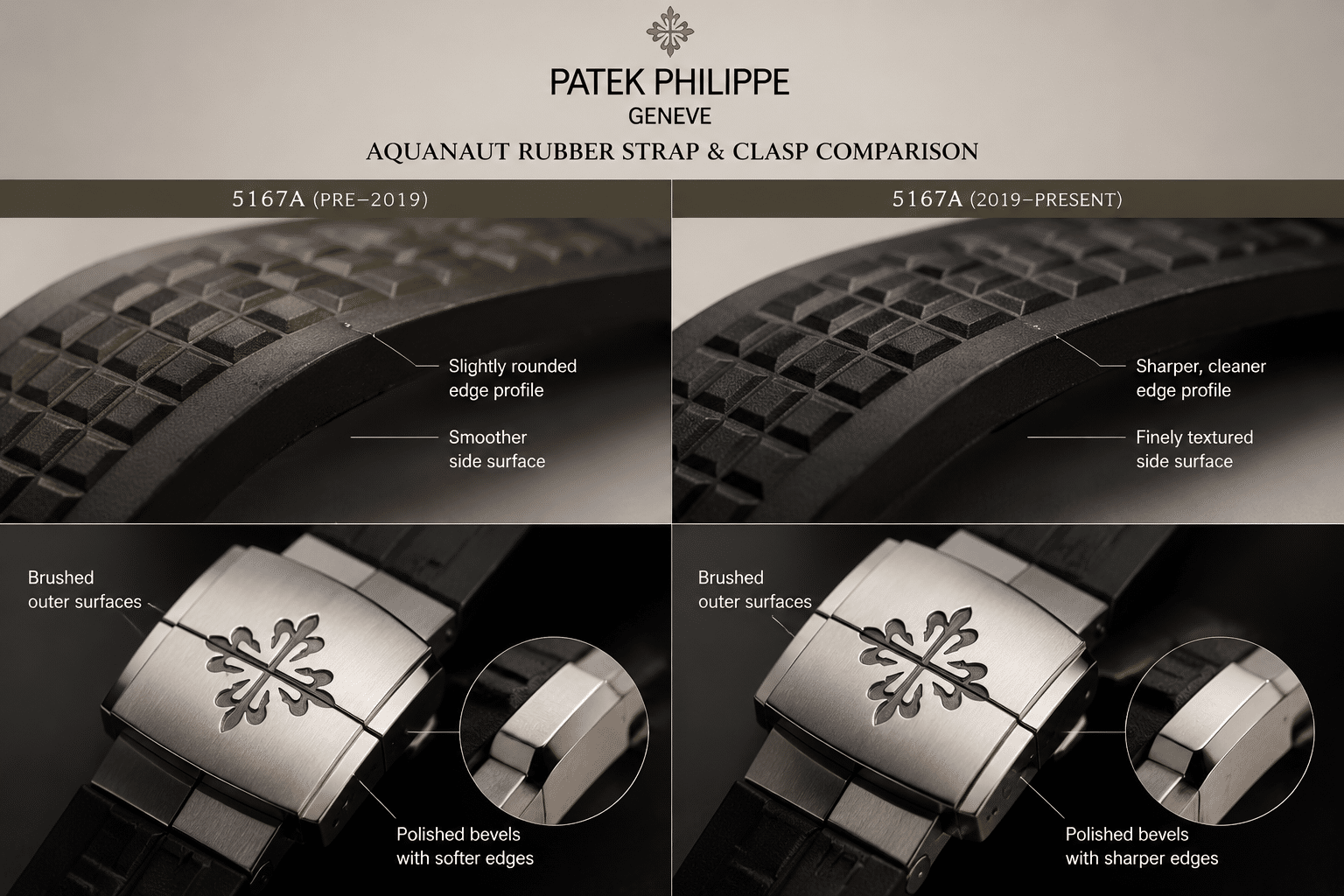
Patek Philippe lists the Aquanaut 5167A with a steel case, rubber strap, date, and center seconds.[1] That combination matters because it shows the strap is not a decorative add-on; it is part of the model’s identity, and it is one reason strap feel and clasp pressure deserve as much attention as dial alignment or case finishing.
For replica comparison, the value of the official page is narrow but useful. It tells you what the real watch is trying to do on the wrist, not what any seller says a replica can imitate. The authentic baseline can anchor expectations for fit and layout, but it does not prove the strap compound, clasp pressure, or long-term wear behavior of any specific replica watch.
Why Photos Are Not Enough
Dealer photos are useful for broad shape checks, but they do not show how the strap behaves under pressure. You cannot see whether the rubber has enough flex to follow the wrist, whether the clasp creates a pressure point, or whether the transition from case to strap feels smooth or abrupt. That is why a visually accurate Aquanaut can still disappoint the moment it is worn.
For buyers comparing replica watches, this is a useful mental shift. On the Aquanaut, small fit errors matter more than they would on a simple leather-strap watch. The whole design depends on the strap carrying the visual and mechanical load of the watch. If that load is not distributed well, the watch never fully settles.
What the Wrist Notices First
The wrist notices three things immediately: flex, rebound, and pressure. Flex tells you whether the rubber bracelet bends with the arm or pushes against it. Rebound tells you whether it springs back cleanly or feels dead and slow. Pressure tells you whether the clasp and strap are spreading the load or creating a hot spot under the wrist bone.
The best-feeling Aquanaut replicas tend to make the watch feel smaller and lighter than the case dimensions suggest. That is not magic. It is the result of the strap curving correctly, the clasp sitting flat, and the whole assembly distributing force without overcorrection. If any one of those pieces is off, the watch starts to feel more like a thick sports watch than a purpose-built daily piece.
Where Replica Buyers Usually Misjudge Comfort
Replica buyers often assume that a clean dial, correct bezel shape, and decent finishing are enough. They are not. A visually convincing Aquanaut can still wear badly if the strap compound is too firm or the clasp geometry pushes the underside of the wrist into a fixed position. That is the kind of flaw that does not show up in a catalog image but becomes obvious after the first long day of wear.
The better judgment is simple: if you care about daily comfort, treat the strap and clasp as the main purchase, not the accessory to the purchase. On the Aquanaut, that is the difference between a watch that feels purpose-built and one that feels assembled correctly but not engineered well.
Factory Name, Version, and Use Case
Factory reputation is useful, but it does not apply equally to every Aquanaut version. One factory may produce a better dial texture or case profile, while another may deliver a more wearable strap-clasp setup. For this model, a “best factory” claim should be narrowed to the exact reference style, batch, strap compound, clasp construction, and buyer priority. A version that looks stronger in macro photos may not be the one that feels better after a full day on the wrist.
This is also where price can be misleading. A higher price may reflect movement choice, limited availability, cleaner clasp machining, seller margin, or after-sale risk. It does not automatically mean the strap compound is better or the curvature is more natural. Before treating a price difference as proof of quality, compare the practical parts that change ownership: case thickness on the wrist, strap exit angle, clasp pressure, movement behavior, and whether replacement straps can be sourced without creating fit problems.
Movement descriptions in the replica market should be read as configuration references, not as official brand-caliber claims unless there is clear, verifiable evidence. On an Aquanaut replica, the useful movement questions are practical: whether the movement choice changes case thickness, crown behavior, date operation, serviceability, and long-term consistency. A decorated or clone-style movement may improve visual presentation under a caseback or seller photo, but that does not automatically prove genuine-brand origin, full service compatibility, or better wrist comfort.
Claims such as “perfect,” “same as genuine,” or “guaranteed to pass inspection” should be treated with caution. A more reliable comparison looks at the actual model version, movement configuration, finishing details, strap geometry, clasp fit, and available QC evidence. The safest use of factory and movement information is to avoid overpaying or misunderstanding quality, not to misrepresent a replica watch as genuine.
Rubber Compound Quality: Softness, Rebound, Odor, and Edge Finishing
Rubber compound quality is where a lot of Aquanaut replicas separate quickly. This is not only about whether the strap feels soft. It is about whether the rubber has the right balance of give, structure, and surface control. A strap that is too soft can collapse and twist. A strap that is too hard can feel cheap and fight the wrist. The useful question is not “is it soft?” but “does it behave like a well-made rubber bracelet under motion and heat?”
Good strap softness should feel controlled, not floppy. The strap should bend cleanly, follow the wrist, and still support the watch head without sagging. Cheap-feeling rubber often misses that balance. It either rebounds too lazily or feels dense and resistant, which makes the watch lose the relaxed daily-wear character that buyers expect from an Aquanaut.
Odor is another clue buyers ignore too often. A strong chemical smell does not automatically mean the strap is unusable, but it is a warning sign that the compound or finishing may be less refined. Surface tackiness is similar. A slight grip can be normal on some new rubber straps, but a sticky surface that collects lint or feels grabby against skin usually points to poorer control in the material finish.
Edge finishing matters more than people expect. Smooth, even edges make the strap feel finished and comfortable. Rough or fuzzy edges make the watch feel cheaper every time it moves against the wrist. This is one of those details that sounds minor until you wear the watch for hours. Then the difference between a cleanly molded edge and a sloppy one becomes obvious.
In practice, the strap should be treated as a core wear component rather than a visual accessory. If it fails to feel controlled in the hand, it will rarely improve once heat, motion, and repeated fastening enter the picture.
Softness Versus Support
The best rubber strap feel sits in a narrow range. It should be supple enough to conform quickly, but firm enough to keep the watch aligned. If the strap is too soft, the watch can tilt or shift around during normal movement. If it is too rigid, it never stops reminding you that it is there. Either extreme is a compromise, and buyers should not mistake extreme softness for quality.
That balance is especially important on a watch with a compact, integrated shape like the Aquanaut. The strap is carrying not just comfort but visual proportion. A strap that collapses too much can make the watch look less coherent on the wrist, even if it looked fine in a straight-on photo.
Rebound, Memory, and Creasing
Rebound tells you whether the rubber returns to shape with confidence. Good rebound looks clean and controlled. Weak rebound looks tired, with the strap holding bends longer than it should. Memory matters because an Aquanaut is meant to be worn as a regular watch, not as a display piece that stays untouched. If the strap starts showing lazy creases early, that is usually a sign the compound is not holding up well.
Not every crease is a defect. A new rubber strap will settle a little with use. The issue is whether the strap stays visually fresh and structurally sound after normal flexing. A strap that seems permanently folded or flattened after moderate wear is not aging in a useful way.
Edge Finish and Surface Control
Clean molding and consistent surface texture usually tell the buyer more than a seller description ever will. A good strap has even edges, predictable surface grain, and no obvious mismatch between the strap body and the molded perimeter. A weaker one can look acceptable at a distance but reveal uneven lines, rough transitions, or inconsistent surface sheen under direct light.
That is why the best QC photos are close, flat-lit, and unforgiving. You want to see the edge line, the flex point, and the clasp interface clearly. Those areas show whether the rubber was finished with care or simply produced to look acceptable from arm’s length.
QC Photos to Request
Ask for close shots of the strap edges, a side-on flex photo, and the clasp area with the strap closed. Those three views usually expose the most obvious compound or finishing problems before the watch ships.
Curvature and Case Transition: How the Strap Should Follow the Wrist
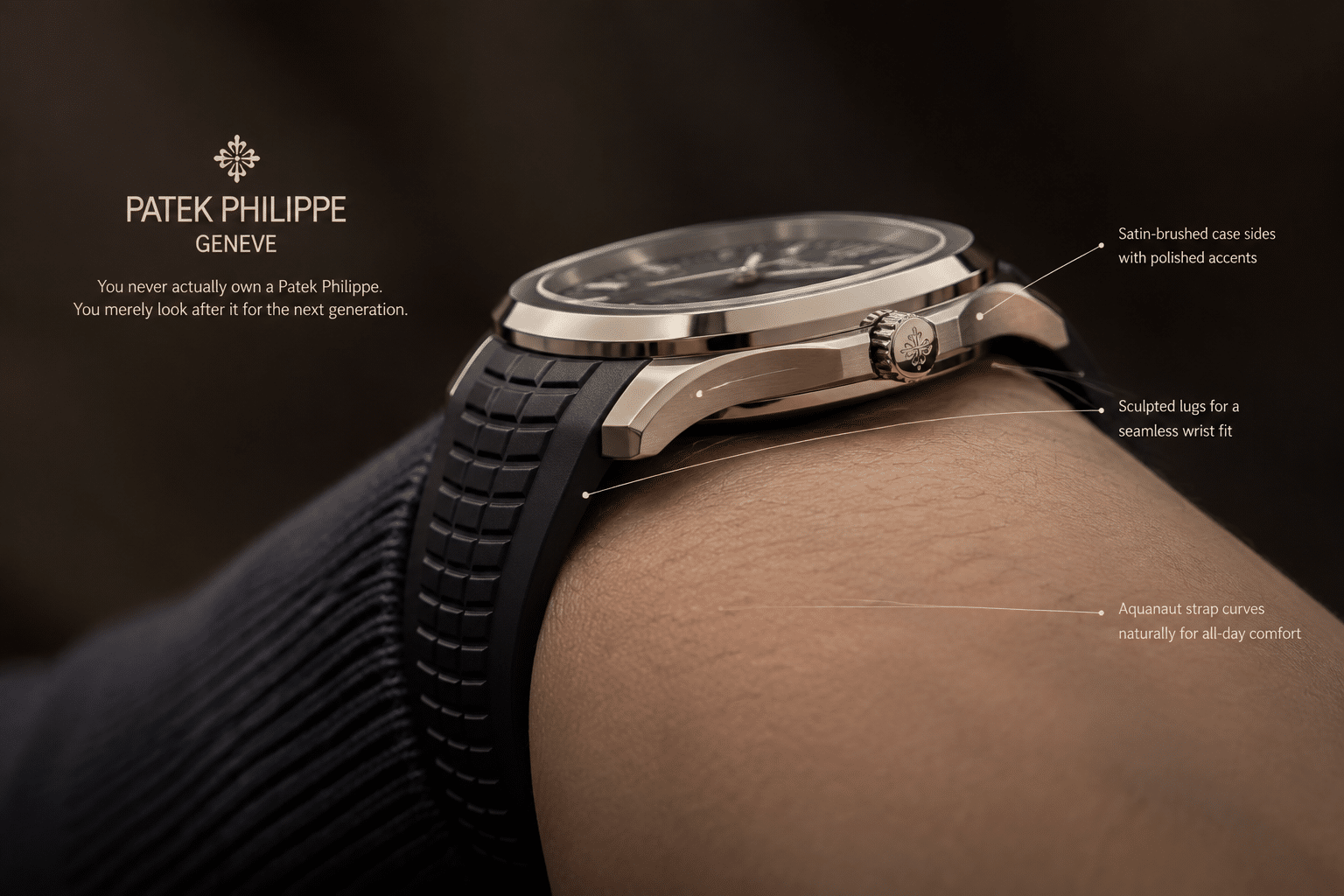
Even a good rubber compound can wear badly if the curvature is wrong. On the Aquanaut, the strap is supposed to leave the case naturally, follow the wrist, and keep the watch visually and physically integrated. If the curve starts too sharply, too flatly, or at the wrong point, the watch may still look correct in photos but feel awkward in motion.
This is where many replica buyers misjudge the watch. They focus on whether the case shape is close and whether the strap color is right, then overlook the actual geometry of how the strap exits the lugs. That first transition determines whether the watch hugs the wrist or hovers above it. A watch that hovers looks less settled and often feels less secure.
The best side profile is continuous. The strap should appear to flow from the case rather than attach to it as a separate piece. If the end geometry creates a gap, a pinch point, or a sudden change in direction, the watch starts to feel engineered in sections instead of as one system. That is a subtle issue in photos, but on wrist it becomes a real comfort problem.
Lug Entry and First-Bend Geometry
The first bend is usually the deciding point. That is where the strap begins to leave the case, and that is where the eye and wrist both decide whether the watch feels integrated. If the bend is too abrupt, the strap can push away from the wrist before settling. If it is too flat, the watch can sit awkwardly and feel less secure.
Good lug entry gives the watch a planted but relaxed presence. It does not force the wrist to adapt to the watch. It lets the strap do the work without making the connection look stiff or overbuilt.
Wrist Wrap and Side Profile Balance
Aquanaut comfort depends on the strap wrapping rather than just resting. You want the strap to follow the wrist’s curve, not create gaps at the lugs or twist at the outer edges. When the side profile is balanced, the watch tends to stay centered and disappear more easily during daily use.
That is why a watch with slightly imperfect dimensions can still feel good if the curvature is right, while a more accurate-looking one can feel clumsy if the strap geometry is off. The wrist notices balance before it notices numbers.
What Small Misalignment Feels Like in Daily Wear
Small geometry errors matter because they add friction over time. A slight lift at the lugs can create a pressure point once the wrist bends. A slightly twisted strap can make the clasp pull unevenly. A transition that does not settle cleanly can make the watch feel constantly adjusted, even if you never consciously notice why.
That is the practical test for an Aquanaut replica: does it settle after you put it on, or do you keep feeling it throughout the day? If the answer is the second one, the problem is often not the dial or the case. It is the strap geometry doing less work than it should.
Visual Accuracy Versus Daily Reliability
On the Aquanaut, visual accuracy and daily reliability are related but not identical. A strap with the right texture pattern, color tone, and cut line may photograph well, but if the compound is too rigid or the clasp underside is harsh, it is not the better daily-wear choice. The opposite can also happen: a version with a minor texture difference may be more satisfying for regular use because the strap wraps better and the clasp distributes pressure more evenly.
This distinction is useful for beginners because the Aquanaut is less forgiving than it appears. The simple dial and rubber strap can make the watch seem easy to replicate, but the integrated strap geometry leaves little room for error. Complicated watches create risk through movement functions and case architecture; the Aquanaut creates risk through comfort engineering. That means the buyer should not judge only by face-up photos or factory ranking. Side profile, bend behavior, and clasp fit deserve equal attention.
Visual accuracy should be judged through specific details rather than broad claims. Case thickness, lug shape, dial texture, strap tone, hand length, datewheel position, clasp engraving, and strap construction can affect how convincing a watch feels in real use. Even a strong super clone can still show differences under close inspection, especially where molded rubber, metal finishing, and movement architecture are difficult to verify from stock photos.
Clasp Pressure, Buckle Finishing, and How the Closing System Affects Wear
The Aquanaut clasp is not just the part that keeps the watch closed. It is one of the main reasons the watch either disappears on the wrist or keeps reminding you it is there. On a good Aquanaut replica, the closure feels like part of the strap system: even pressure, clean articulation, and a secure latch that does its job without creating a hotspot under the wrist. On a weaker version, the clasp is where the watch starts to feel clumsy. The strap may look right in photos, but if the buckle digs in, the hinge fights your wrist, or the closing action feels rough, the whole wearing experience drops fast.
The buyer mistake is to treat clasp quality as a minor finishing detail. It is not. Aquanaut clasp pressure affects how the weight is carried, where the wrist feels the load, and how often the wearer notices the watch during the day. A clasp that closes with controlled tension and sits flat can make a slightly imperfect strap feel far more convincing on wrist. A clasp with uneven pressure or sloppy finishing can ruin a watch that otherwise looks close enough.
Pressure Distribution Under the Wrist
What matters most is not whether the clasp feels “tight” or “loose” in a vague sense. What matters is how the force is spread. A good Aquanaut clasp distributes pressure across a broad enough surface that the underside of the wrist does not develop a single hard point. The closing system should feel anchored, but it should not pinch, tilt, or concentrate load at one edge of the metal.
That distinction is easy to miss in quick handling. Open and close the clasp once, and almost any decent replica can seem acceptable. Wear it for several hours, especially while typing or moving your wrist repeatedly, and the bad ones reveal themselves. The pressure starts to collect where the clasp body meets the skin, or at the hinge where the closure does not settle perfectly flat. That is the difference between a clasp that disappears and one that constantly asks for adjustment.
For the Aquanaut, the practical test is simple: the buckle should feel like a stable extension of the strap, not a small metal block hanging off it. If the clasp sits too proud, has a stiff fold, or forces the wrist into one fixed angle, the watch may still be wearable, but it will not feel balanced. That is a comfort problem first and a quality problem second.
Finishing Quality You Can Feel
Buckle finishing matters because it changes how the clasp interacts with skin. Sharp edge transitions, uneven brushing, and slightly rough interior surfaces do not just look less refined under inspection; they can create actual contact discomfort. A brushed finish should look deliberate and consistent, not cloudy or patchy. More importantly, the edges should feel softened enough that the clasp does not leave an impression after repeated wear.
This is where replica buyers often overfocus on visual details that are less important than they think. Perfect-looking engraving does not matter much if the underside of the clasp feels unfinished. Likewise, a clasp with minor cosmetic variance can still be perfectly comfortable if the hinge action is smooth and the edges are properly broken. The wrist notices contact quality before it notices decoration.
Hinge feel is part of the same story. A refined clasp opens and closes with a controlled, predictable motion. It should not snap shut with a harsh end point, and it should not wobble loosely as it folds. Both problems create a cheap sensation because the closure is no longer managing force cleanly. The best replicas are usually the ones where the clasp feels calm rather than dramatic. That calmness is easy to miss in a product photo and very obvious in daily wear.
Quiet Security Versus Fragile Tension
Aquanaut clasp pressure should feel secure without feeling fragile. That sounds simple, but in practice there is a narrow range between a clasp that closes with confidence and one that feels like it is overworking its own spring or hinge. Too little tension and the closing system feels vague, as if it could release with a bad knock. Too much tension and the clasp becomes a daily irritation because every open-and-close motion feels overbuilt.
The better result is quiet security. You should be aware that the clasp is doing its job, but not feel it fighting you. If the closure requires an awkward push, if the latch makes the strap bow oddly, or if the buckle produces a hard click followed by visible strain, those are signs of poor articulation rather than useful firmness. On the wrist, that usually translates into a watch that seems more interesting in hand than it does in real use.
For buyers comparing factories or batches, this is one of the few areas where a small hardware difference can change daily satisfaction more than a cosmetic one. A cleaner clasp does not make a mediocre strap great, but it can rescue the overall feel. A bad clasp can do the opposite. For the Aquanaut, that makes the closing system a real comfort component, not a finishing footnote.
Long-Term Wear: Sweat, Heat, Creasing, and Replacement Options
Day-one comfort is the easy part. The harder question is whether the Aquanaut still feels clean and consistent after months of heat, sweat, bending, and repeated fastening. This is where strap aging becomes a buying issue, not a maintenance topic. A strap that looks fine out of the box can still become less convincing if it starts to flatten, gloss over, or lose shape at the points where it flexes most. For replica buyers, that matters because the watch is often chosen for daily wear, not display.
The useful judgment here is not that all aging is bad. Some visual softening is normal. The real question is whether the strap ages in a controlled way or starts to look tired too early. If the material develops hard creases, edge distortion, or a soft collapsed look around the clasp and bend points, the problem is no longer cosmetic. It becomes a sign that the strap is losing the structural confidence that makes the Aquanaut wearable in the first place.
That is why buyers should inspect the strap as a wear component, not just as a visual match. Material feel, edge finish, and clasp geometry all become more important once the watch is worn in heat, motion, and repeated fastening.
A replica watch should be evaluated with realistic ownership expectations. Even a strong super clone can have limits in water resistance, long-term movement stability, servicing convenience, replacement part consistency, and close inspection compared with a genuine reference. Buyers should confirm return, repair, shipping, and after-sales terms before ordering, because those practical terms are separate from the watch’s visible quality and can vary by seller.
Sweat, Heat, and Seasonal Wear
Sweat and heat are the two conditions that expose weak strap behavior fastest. In warm weather, a good Aquanaut strap should stay stable on skin without turning tacky, slick, or oddly soft in a way that changes the fit. Humidity can exaggerate surface feel, but it should not cause the strap to lose its shape or develop a dead, overly pliable sensation. If the strap gets noticeably more limp after a few hours in heat, that is a real wear concern, not a minor comfort quirk.
Seasonal use also changes how you should judge aging. A strap that feels great in mild weather but starts to show surface dulling, edge whitening, or deeper bend marks in summer is telling you something about material reserve. Buyers sometimes excuse that as normal because the watch still closes and still looks acceptable from a distance. That is too forgiving. The Aquanaut is worn close to the skin, so long-term comfort depends on the strap holding its form when conditions get less controlled.
What matters most is consistency. A strap that behaves the same way from morning to evening, and across changing temperatures, is doing the job properly. If the watch starts to feel different by midday, the issue is usually not the clasp alone or the bend geometry alone. It is the combined effect of material fatigue and load distribution.
What Premature Failure Looks Like
Early failure usually shows up before a strap actually breaks. Look for glazing on the surface, especially where the strap flexes repeatedly. Look for flattening where the strap should still hold a rounded profile. Look for creasing that becomes permanent rather than relaxing when the watch is off the wrist. Those signs suggest the material is losing resilience sooner than it should.
Edge distortion is another warning sign. When the borders of the strap start to look uneven, rolled, or slightly twisted, the problem is not just cosmetic. It often means the strap is no longer resisting stress evenly. The same applies if the strap starts to collapse near the clasp interface, because that is where repeated motion should still be controlled. A healthy strap wears in; a weak one wears out.
The buyer should also pay attention to tactile changes. If the strap becomes softer in a bad way, meaning it feels less supportive rather than more comfortable, that is a warning. Good rubber can soften slightly with wear without losing shape. Poor rubber tends to go from firm to fatigued. That difference is easy to miss if the buyer only checks the watch in a display case.
Replacement Planning Without Guesswork
Anyone buying an Aquanaut replica for regular use should think about replacement before the original strap becomes a problem. That does not mean treating the watch like a disposable object. It means confirming that future strap changes will not be a dead end. Size, attachment fit, clasp compatibility, and batch consistency matter more than buyers usually expect because not every version accepts replacement parts cleanly.
The smart move is to confirm whether the strap and clasp are matched as a system or whether they can be separated without creating fit issues. Some replicas wear acceptably only with the factory pairing, which is fine as long as the buyer knows it. Others leave too little margin for sourcing a later replacement without losing fit or comfort. That becomes important if the watch is meant to be worn often, not occasionally.
The practical takeaway is simple. A good Aquanaut strap should not only feel right now; it should still make sense after real use. If the buyer has to worry immediately about how fast it will flatten, whether the clasp will stay comfortable, or whether replacement will become a hassle, the watch is not fully sorted. On this model, that is not a side issue. It is part of the ownership decision.
How To Compare Two Listings Without Getting Lost in Factory Hype
Two Aquanaut replica listings can look close in thumbnail photos and still wear very differently. One may have a cleaner dial image, while the other has better strap geometry. One may look more polished in the seller’s gallery, while the other uses a compound that bends more naturally on the wrist. A proper comparison starts by asking which parts change ownership and which parts only change the marketing story.
The simplest method is to compare the parts that touch the wrist first. Strap exit angle, clasp pressure, edge control, and how the watch sits once fastened should matter more than claims that a factory is universally better. For buyers mapping those ownership variables against the broader Aquanaut super clone construction logic, the better version is the one that fits the buyer’s intended use, not the one with the loudest market reputation.
Factory reputation in the replica market is useful because it helps organize a crowded field, but it does not settle the decision by itself. A factory may do one version well and another version less well. That is why a model-specific comparison is more reliable than a broad ranking. The most useful question is not “Which factory wins?” but “Which exact version shows better strap behavior, cleaner clasp finishing, and more stable fit in the photos I have?”
Prices can change by factory label, version, movement, seller channel, and availability, so exact comparisons should be verified at the time of purchase.
- Check whether the watch sits level when closed.
- Check whether the strap follows the wrist instead of hovering over it.
- Check whether the clasp line is centered from the underside.
- Check whether the edge finishing is even all the way around.
- Check whether any replacement strap claim is supported by actual fit photos.
That kind of comparison is slower than a quick factory-name judgment, but it produces a better result. It also keeps the buyer anchored to what matters after delivery, which is where these watches are actually judged.
What QC Photos Can and Cannot Tell You
QC photos can reduce uncertainty, but they do not guarantee perfection. Buyers should still review visible details and confirm seller policies before ordering. A clear QC set can show whether the strap edges are clean, whether the clasp lines up, whether the first bend appears natural, and whether the watch looks centered when closed. It cannot tell you how the strap will feel after six hours on a warm wrist, or whether the clasp will still feel smooth after repeated use.
That is why QC should be used as a narrowing tool, not a final verdict. When a seller provides only straight-on glamour shots, there is not enough information about the side profile or closing action. When a seller provides close, flat-lit images of the clasp and lug area, you can at least evaluate whether the obvious geometry problems are present. The quality of the photo set often matters as much as the watch itself because it shows how much the seller is willing to expose.
A practical QC review for an Aquanaut should include the case-to-strap transition, the underside of the clasp, the edge finish on the rubber, and the watch’s side profile. Those are the places where comfort and build quality intersect. If the watch looks strong there, the rest of the judgment becomes easier. If those areas look rushed or vague, the buyer should not assume the missing information will turn out well after delivery.
QC also matters because it is one of the few chances to verify what the seller is actually sending. A listing title can be polished, and a factory label can be used loosely, but a photo set is harder to hide behind. That does not make the watch genuine, official, or equivalent to an authentic watch. It only helps the buyer reduce the chance of receiving a version that is visibly weaker than expected.
Questions That Expose Real Differences
- Can the seller provide a side shot of the watch on a flat surface?
- Can the seller show the clasp closed from the underside?
- Can the seller show the strap edges under direct light?
- Can the seller confirm which version, strap, and clasp are included?
- Can the seller show any replacement part compatibility rather than simply claiming it?
The answers to those questions matter more than the confidence level of the listing title. In replica-market buying, clarity usually comes from what is shown, not what is claimed.
More Questions That Matter
Q: Should I judge the Aquanaut strap mostly by how soft it looks?
No. Softness matters, but support and rebound matter too. The best strap is usually the one that bends cleanly without collapsing.
Q: Can QC photos prove the watch will feel right on wrist?
They cannot prove that. They can only reduce uncertainty by showing the case-to-strap transition, edge finishing, and clasp alignment.
Q: Is a factory label enough to choose between two listings?
No. Factory labels are market references, not proof of quality across every version, and the specific QC details still matter more.
Q: Should water resistance be assumed from the model name?
No. Water resistance should not be assumed unless the specific watch has been tested and the seller’s policy is clearly confirmed.
Counterfeit and Disclosure Boundaries
Replica watches are counterfeit goods, not authorized products. USPTO guidance describes counterfeit goods as unauthorized items that use protected marks without permission, which is why the language around these watches should stay careful and plain.[2]
U.S. Customs and Border Protection also notes that intellectual property rights enforcement can apply at the border, so buyers should not assume a replica watch is free of import attention just because it is easy to find online.[3] That is not legal advice; it is a reminder to avoid claims of authorization, customs safety, or universal resale freedom.
Practical Ordering Checklist
- Ask for side photos of the strap leaving the lugs.
- Ask for the clasp open, closed, and under direct light.
- Check whether the seller is offering the factory strap and clasp pairing.
- Look for edge roughness, tackiness, or early crease lines.
Verification Before Payment
Before paying, compare the strap photos against the actual wrist shape you expect to wear it on. A good Aquanaut strap should curve cleanly without forcing the case to ride too high or the clasp to sit off-center. If the listing only shows polished, straight-on images, the buyer still does not know enough about real wear behavior.
For this model, the most useful pre-purchase check is simple and unglamorous: verify that the strap, clasp, and lugs work as one system in the photos you receive. That lowers the chance of buying a watch that looks right in a sales image but feels wrong after a normal day of use.
Before making a decision, buyers should review real QC photos where available, including dial printing, hand alignment, datewheel centering, case thickness, lug transition, strap edge finishing, clasp engraving, and overall finishing. QC photos reduce uncertainty, but they do not remove every risk or prove that a watch is genuine, official, or equivalent to the authorized reference.
Verification Note: When possible, buyers should review real watch photos, strap edges, clasp finishing, lug transition, and worn-on-wrist fit before making a decision. Stock images and factory labels alone are not enough for a reliable judgment.
Version Differences That Change Ownership
On replica Aquanaut models, small version differences can matter more than buyers expect. Strap compound, clasp construction, and case thickness can vary even when the dial image looks nearly the same. A seller description that sounds confident does not tell you whether the specific unit on offer has the better bend behavior, cleaner edge finishing, or the more settled clasp feel.
That is why factory name alone should be treated as a starting point rather than a conclusion. The better approach is to compare the exact version, the movement configuration where disclosed, and the QC images that show the watch under real compression. If a listing cannot support those basics, the buyer is taking more guesswork than necessary.
A factory comparison is most useful when it is tied to the specific reference, version, movement, and visible execution details rather than treated as a universal ranking. For CleanVSFactory, the goal is to make replica watch comparison easier to understand by connecting factory names, movement claims, visible QC details, and realistic ownership limits without presenting those market labels as official brand approval.
Buyer Expectation Note: No replica Aquanaut should be judged by factory reputation alone. A better decision usually depends on the specific version, movement configuration, strap compound, clasp fit, and how closely the watch will be inspected in real use.
Final Buyer Judgment: What Makes an Aquanaut Replica Sensible to Own
A sensible Aquanaut replica is not the one with the loudest factory claim or the most flattering seller photos. It is the one where the strap compound, case transition, clasp pressure, and movement thickness work together for the buyer’s intended use. If the watch is mainly for photos, dial texture and case shape may carry more weight. If it is meant for frequent wear, strap comfort and clasp behavior should move higher in the decision than small macro-level differences.
Before relying on any listing, treat factory labels, QC images, and seller descriptions as useful signals rather than final proof. Ask whether the exact watch shown has a flat clasp fit, clean strap edges, natural first-bend curvature, and no obvious mismatch between strap and case. Those checks do not make the watch genuine, official, or brand-approved; they simply reduce the chance of buying a replica that looks good in a still image but feels poorly resolved in daily use.
The final decision should stay traceable. Start with the genuine reference as a visual comparison point, then move to the actual replica version, strap compound, clasp construction, case thickness, movement description, and real photos of the watch being offered. That order keeps the comparison practical and avoids the common mistake of treating a broad factory label, a polished stock image, or an exaggerated “1:1” phrase as proof of daily-wear quality.
References
[1] Patek Philippe, “Aquanaut 5167A Official Specifications,” collection page and model details, available at Patek Philippe Aquanaut 5167A Official Specifications.
[2] USPTO, “Counterfeit Goods Basics,” official guidance on counterfeit goods and trademarks, available at USPTO Counterfeit Goods Basics.
[3] U.S. Customs and Border Protection, “Intellectual Property Rights,” official enforcement overview, available at U.S. CBP Intellectual Property Rights.
Disclosure: This article is for general educational and comparison purposes only. Replica watches are not genuine products from the original luxury brands, and brand names are used only to identify reference designs or comparison topics. Factory names, movement descriptions, prices, availability, QC details, seller policies, and version information can change, so readers should verify important details with the seller before making a purchase decision. Replica watches should not be represented, resold, or used as genuine watches.