
Most Aquanaut QC problems are not isolated to one detail. This article shows how to read the watch as a complete package, starting with the front view and then checking whether the dial, case shape, strap integration, clasp action, and movement notes all agree with each other. That matters because a single sharp macro can hide a watch that looks off on wrist, while a decent movement photo can distract from obvious dial or case issues.
The practical question is whether a given super clone is coherent enough to approve or whether the flaws point to a weak batch or the wrong version. The checklist helps you judge the checkerboard texture, date alignment, case thickness, strap taper, clasp feel, and on-wrist balance in the right order, so you can spot the differences that actually affect daily wear and avoid overreacting to noise.
| Check Area | What to Look For | When to Hesitate |
|---|---|---|
| Front photo | Overall balance and clean proportions | Watch looks awkward before zooming in |
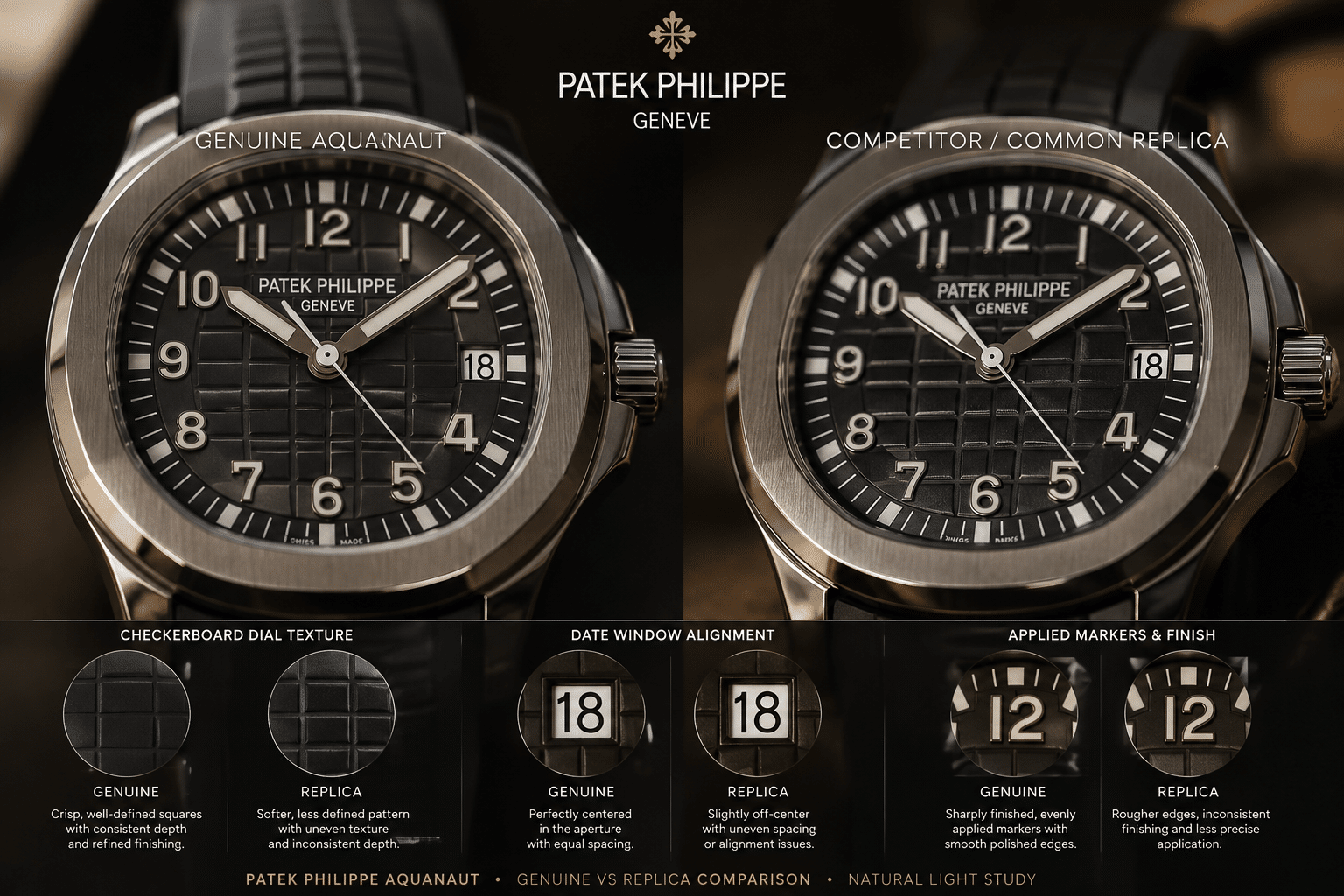
| Dial texture | Checkerboard depth and even surface detail | Texture looks flat, weak, or uneven |
| Date window | Centered opening and sensible font placement | Date sits off-center or looks cramped |
| Case profile | Reasonable thickness and smooth side flow | Height, bezel, or crown transitions look off |
| Strap and clasp | Clean hole alignment, taper, and controlled closure | Stiff strap, skewed clasp, or sloppy fit |
| Movement note | Supportive signs like smooth winding and steady timing | Use it to confirm, not to excuse visible flaws |
Quick Questions Before You Read
Q: Should I start with macros or the full front shot?
Start with the full front shot. It shows whether the watch looks coherent before you get distracted by small details.
Q: Which detail usually matters most on an Aquanaut QC?
Dial texture, date placement, and case proportions matter early because they change how convincing the watch looks overall.
Q: Is a good movement photo enough to approve the watch?
No. Movement notes help, but they do not cancel out obvious dial, strap, or case problems.
Q: What should I worry about more, clasp feel or dial finish?
Both matter, but a weak clasp or poor strap fit often points to broader build issues that affect daily wear.
Authentic Aquanaut Baseline
Patek Philippe’s Aquanaut 5167A-001 is presented as a steel model with an automatic movement, date display, central seconds, and a rubber strap, and the brand lists 30 m water resistance for the reference.[1] That official baseline matters because it shows why Aquanaut QC should stay focused on geometry, integration, and legibility rather than on one isolated detail.
For replica buyers, the useful comparison points are the ones you can actually inspect: case proportion, dial balance, strap integration, and the way the watch sits on wrist. A replica can borrow the general architecture of the model while still failing in the details that make the authentic watch coherent.
Editorial Perspective: On Aquanaut QC, factory reputation is useful only when it is tied to a specific version, movement route, and wear goal. At cleanvsfactory.com, this kind of comparison is treated as a model-specific buying question rather than a simple factory ranking. A stronger factory name does not automatically make a better Aquanaut if the case is too thick, the strap fit is rough, or the movement choice creates more day-to-day risk than the buyer wants.
Why Factory Names and Price Tags Are Not Enough
For the Aquanaut, a factory label should be read as a shortcut to likely strengths and likely weak points, not as proof that every version from that maker is the right answer. One factory may be stronger on the dial texture, while another may handle strap integration or movement stability better on a specific batch. That is why the useful comparison is not “which factory is best overall,” but whether the Aquanaut super clone craftsmanship profile matches this exact version and this buyer’s use case.
Price can also mislead if it is treated as a direct quality score. A higher price may reflect movement choice, lower availability, seller margin, or the risk the seller is taking on a harder-to-source batch. It does not automatically mean better case geometry or cleaner QC. For buyers comparing options, the real question is whether the extra cost buys a meaningful improvement in the parts that affect daily wear.
The same caution applies to seller photos. Well-lit images can make a watch look more finished than it is, especially on a model like the Aquanaut where the strap, bezel, and dial all need to agree. Use the photos to narrow the shortlist, then verify the watch from multiple angles before you approve it. A good listing is useful evidence, not final proof.
Factory Name Clarification: Factory names in the replica watch market are buyer-facing labels, not official brand affiliations or guarantees of uniform output. On an Aquanaut, the only reliable comparison is model by model, batch by batch, using visible QC details rather than assuming that a familiar factory name settles the decision.
Replica / Genuine Boundary in QC Notes
Brand names in this article are used to identify the genuine Aquanaut reference being discussed. Replica watches are replica-market products, not genuine Patek Philippe watches, and they should not be represented or resold as authentic pieces.[4][5]
That boundary matters when reading QC photos. A clean dial, tidy clasp, or polished caseback can reduce uncertainty, but it does not prove the watch is authentic, and it does not mean the watch will match the genuine reference under close inspection. The practical goal is comparison and risk control, not authentication theater.
When a listing mixes factory names, movement shorthand, and brand terms too loosely, slow down. Ask what the claim means in concrete terms: case height, dial texture, strap fit, movement layout, and any seller-specific policy the buyer actually needs to know. If the answer stays vague, treat the listing as incomplete rather than assuming the strongest interpretation.
What to confirm before approval
- the exact Aquanaut reference and version
- the stated movement route and what that wording is meant to describe
- the strap and clasp details shown in the QC set
- whether the seller has any stated water-resistance testing or handling note
- the seller’s return, repair, or exchange terms if they are explicitly provided
Traceability Rules for Factory and Version Checks
When two Aquanaut listings look similar, the safer comparison is usually version-specific. A factory can be stronger on one dial execution, weaker on another strap batch, or more consistent on a later run with a different movement configuration. That is why the buyer should compare the exact reference, visible execution, and QC evidence instead of assuming a familiar factory name settles the decision.
CleanVSFactory’s editorial approach is to connect factory labels to the details that can actually be checked: front-view balance, case thickness, strap integration, clasp behavior, and the movement route claimed in the listing. That gives the buyer a clearer way to judge the watch without turning a market name into a promise.
Before approving an Aquanaut, buyers should compare the factory claim with real QC photos, the exact version, the movement route, and the strap/case relationship. Factory labels can be useful shorthand, but they do not prove that one batch is stronger than another.
QC Evidence Standards Worth Using
A practical Aquanaut approval should rest on repeated visual agreement across the whole photo set. The front view should match the macro set, the macro set should match the wrist shot, and the movement note should not contradict what the exterior already shows. If one image looks strong but the others do not, the strongest frame is usually the least useful one.
Use the same standard for every seller. Ask whether the dial texture, date placement, strap fit, and clasp action still look correct when the watch is not being staged. On a reference like the Aquanaut 5167A-001, where the genuine watch is presented as a steel sports model with a rubber strap and 30 m water resistance, the useful QC question is whether the replica respects that restrained, integrated layout rather than simply looking glossy in a close-up.[1]
That approach also helps keep the approval process honest. It prevents buyers from treating a seller’s best photo as the whole story and makes it easier to reject watches that look acceptable in isolation but inconsistent as a set. In practice, that is where many poor approvals happen: the parts do not agree once the watch is examined in sequence.
How to Read Aquanaut QC Photos Before You Approve Anything
The safest way to read Aquanaut QC photos is to treat them like a sequence, not a gallery. Start with the broad, straight-on images in natural light, then move to the close macros, then use the wrist shot and any movement note as support. That order matters because a flattering front image can hide the problems that actually decide whether the watch is worth approving.
For a pre-approval inspection, the first question is simple: do the photos show a watch that already looks coherent before you zoom in? If the answer is no, there is no reason to get lost in surface detail. On the Aquanaut, the shape, dial texture, and strap integration are tight enough that one weak area usually shows up somewhere else too. The job of QC is to catch those links early, not to rationalize them after the fact.
Ask for a neutral photo set, not dealer marketing angles. You want a front shot in natural light, at least one close macro of the dial, one side profile, one wrist shot, and whatever basic movement information the seller can provide without forcing a full technical discussion. Compare like-for-like images. A wrist shot tells you how the watch sits; a macro shot tells you what the surface really looks like. They are not interchangeable, and they should never be judged as if they mean the same thing.
1. Review the front dial shot in natural light
The front dial image is the first gate because it tells you whether the watch has basic visual balance. In natural light, you can see whether the dial sits straight, whether the printing feels centered, and whether the overall face has the right weight from top to bottom. If the front shot already looks awkward, no amount of close-up detail will fix that.
This is also where you spot obvious seller problems: tilted framing, uneven reflection, or photos taken to flatter one angle only. A clean Aquanaut should look composed even in a plain shot. If the watch only looks good when the dealer uses heavy lighting or a narrow angle, that is usually a sign the batch is not strong enough to approve quickly.
2. Check the macro set before trusting surface detail
Once the front view passes the first filter, move to the macro set. This is where the real QC work begins, because surface quality on the Aquanaut lives in the details: the dial texture, the printing edges, the transition between raised and flat areas, and the clarity of the date window. Macro shots are useful only when they are neutral. Harsh glare can make a weak dial look acceptable, and soft focus can hide poor edges.
Ask for the macro angles that show the watch in the least forgiving light, not the prettiest light. You want enough enlargement to judge crispness, but not so much magnification that the image becomes meaningless. The goal is to see whether the watch still looks refined when the camera stops helping it. If the detail breaks down immediately under a normal macro, that is a real warning sign.
3. Use the wrist shot and movement note as context, not decoration
The wrist shot tells you whether the Aquanaut has the right presence, but it should not be used to excuse weak components. A watch can look convincing on wrist and still fail in the areas that matter most. Use the wrist image to confirm scale, sit, and overall proportion. If the watch twists awkwardly, sits too high, or looks visually dense on the wrist, that matters even if the front shot looked clean.
The movement note is the last piece of context, not a substitute for inspection. Basic movement information can confirm whether the seller’s claim matches the watch they are presenting, but it cannot rescue a bad dial or a poor case profile. Treat it as supporting evidence. A decent note is reassuring; a vague note is a reason to ask for more, not a reason to approve faster.
Model Difficulty: What Makes One Aquanaut Easier to Approve Than Another
Not every Aquanaut version deserves the same level of scrutiny. Simpler dials, cleaner date layouts, and stable case shapes are easier for factories to reproduce consistently. More complex variants, unusual colorways, or versions with stronger movement demands tend to expose weak batches faster. Beginners usually do better with the versions that look balanced in plain light and do not depend on a lot of visual tricks to pass QC.
That is also why movement choice matters more than many first-time buyers expect. A movement that looks correct in photos may still be noisier, less serviceable, or harder to live with if it adds thickness or rough winding feel. For daily wear, visual accuracy and reliability do not always point to the same watch, so the final call should reflect which risk matters more to the buyer.
Dial, Date, and Lume Checks That Catch the Most Aquanaut Mistakes
The Aquanaut can look simple from a distance and still fail where it matters most up close. The face-side checks are where the difference between a convincing piece and a merely acceptable one usually shows up. The right order is texture first, then date, then hands and lume. That sequence keeps you from overvaluing small cosmetic details while missing the more important surface problems.
The main judgment here is not whether the watch is “nice.” It is whether the dial reads with the right visual rhythm under natural light. A strong Aquanaut does not need dramatic lighting to look right. The surface should hold together on its own, and the calendar display should not distract you the moment you inspect it carefully.
4. Judge the checkerboard texture and surface depth
The checkerboard pattern is the foundation of the Aquanaut dial, and it should be the first thing you inspect. Under natural light, the surface should have depth, structure, and a consistent rhythm. If the pattern looks flat, muddy, or printed onto the dial instead of sitting inside it, the watch loses a major part of its identity immediately.
This is not just a cosmetic preference. A weak texture changes how the whole face behaves in photos and on the wrist. Good replicas can still show minor variation in how the pattern catches light, but the pattern itself should remain crisp and legible. If the dial only looks alive at one angle, the batch is weaker than it should be.
5. Verify the date window, font, and centering
Date checks should be separate from texture checks. A dial can have a decent overall face and still fail on the date. Look at the date window position first, then the centering of the numeral, then the font weight. The issue is not just whether the correct number appears; it is whether the number sits in the window with enough balance to look intended, not accidental.
Off-center dates are a practical problem because they show up fast in everyday wear. A slightly too-thin font is more subtle, but it still changes the character of the watch. If the date sits unevenly or the print looks inconsistent across multiple frames, that is stronger evidence of a weaker batch than one flattering photo can undo.
6. Check the hands, markers, and lume response together
Hands, markers, and lume should be judged as one face-side system. Hand length should feel proportionate to the dial, markers should line up cleanly with the overall layout, and the lume should behave evenly rather than patchily. None of these elements should look like they belong to a different watch.
Lume is not the first thing to obsess over, but it is useful as a confirmation check. If the dial and date already look weak, good lume does not improve the approval case. If the dial is already strong, even lume response is one more sign that the batch is reasonably controlled. Uneven lume, mismatched hand tone, or markers that feel visually off should be treated as real quality signals, not background noise.
Case Geometry, Crown Position, and Strap-to-Case Fit
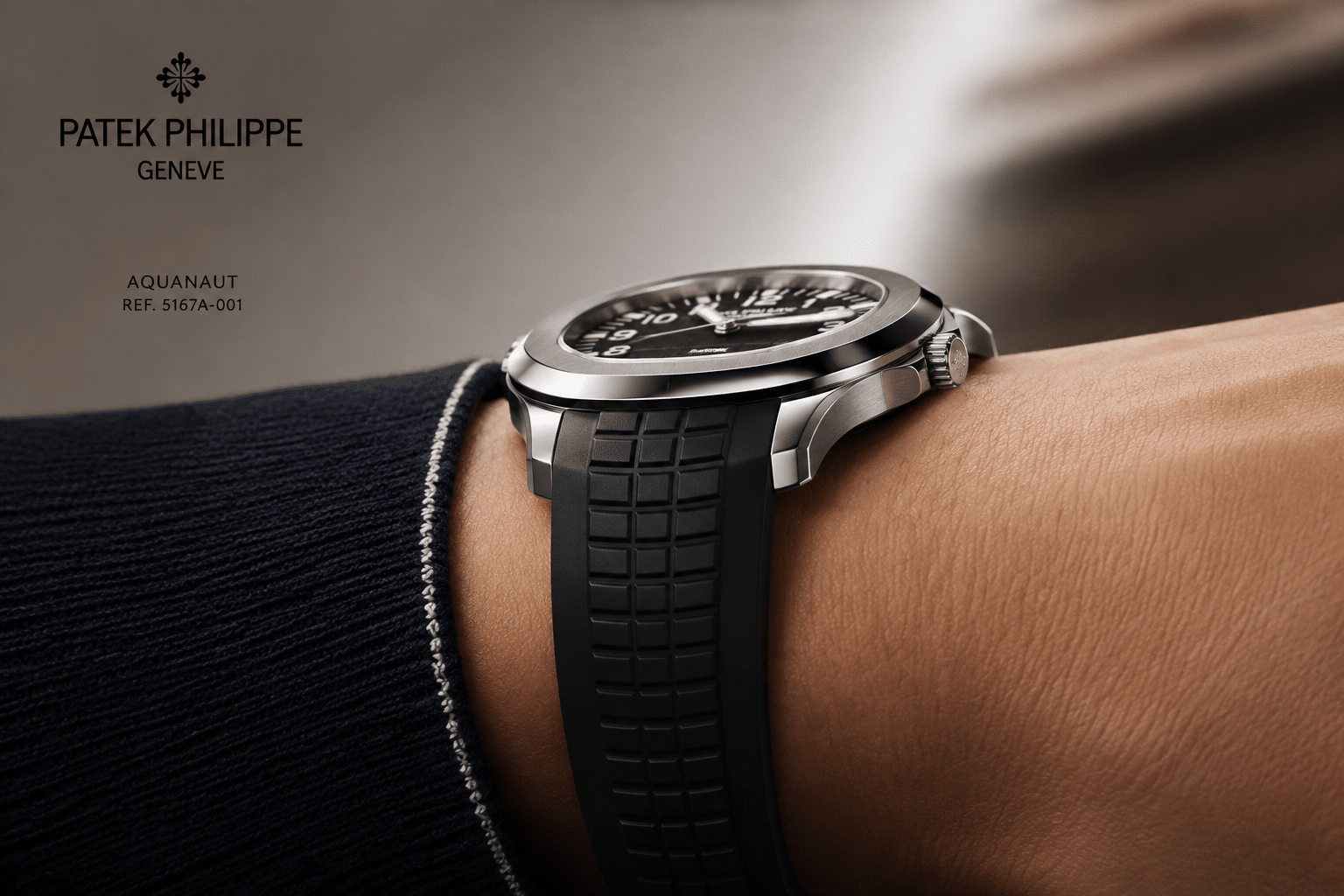
The Aquanaut lives or dies on silhouette. The case can be clean on paper and still look wrong if the profile is too tall, the crown sits awkwardly, or the strap integration feels forced. This is the part of QC where you stop looking at the watch as a dial and start looking at it as a shaped object. That shift matters because the biggest visual tells here are usually not dramatic; they are proportion problems.
A good Aquanaut should feel controlled from every angle. The transitions should be clean, the crown should sit where your eye expects it to sit, and the strap should meet the case without obvious gaps or clumsy molding. If the watch looks busy from the side, it is already working against the model’s design.
7. Measure the case thickness and side profile visually
Thickness is easier to miss in a front photo than almost anything else, which is why the side profile matters so much. Look at how high the case rises above the wrist, how much bulk is visible between the dial and the strap, and whether the watch feels compressed or tall in the frame. The best visual check is a clean side shot with no strong tilt or dramatic perspective.
An Aquanaut that sits too tall loses the elegance that makes the design work. Even if the dial is strong, excess height changes the whole character of the watch. The right question is not only whether the case looks thin enough in isolation, but whether it still looks balanced when the strap, bezel, and crown are all visible together.
8. Inspect the bezel, crown, and lug transitions
The handoff between bezel, case, crown, and lugs should look deliberate. If one area feels abrupt or rounded in the wrong place, the watch will look slightly off even when the photo quality is good. On the Aquanaut, those transitions matter because the design is already restrained. There is less visual clutter to hide a mistake.
Pay attention to whether the crown sits naturally in relation to the case line, and whether the bezel edge looks too soft or too wide in the photo. A clean transition should not draw attention to itself. When it does, that usually means the case shaping is less controlled than the seller wants you to believe.
9. Check the strap-to-case gap and rubber edge finish
The strap-to-case interface is one of the most useful approval checks on the Aquanaut. The strap should meet the case cleanly, sit evenly on both sides, and show crisp edge work rather than rough molding. If the strap looks like it was forced into place, the whole watch starts to feel less integrated.
Uneven gaps are more important than tiny surface imperfections because they affect the shape immediately. A slight molding mark may be tolerable if the rest of the watch is strong. A sloppy transition on both sides is harder to ignore because it changes the way the entire case reads. Clean strap edges and even seating are not decoration. They are part of the watch’s core geometry.
Clasp, Strap Behavior, and On-Wrist Comfort Checks
The Aquanaut can look right in a front photo and still fail the approval test once the strap and clasp are actually handled. That is why Aquanaut clasp pressure and strap flex deserve the same attention as dial details. On this model, comfort is not a soft extra. It is part of the build quality.
A good Aquanaut does not just close. It closes with controlled resistance, the strap bends without fighting the wrist, and the watch settles flat instead of rolling to one side. If any of those points feels off, the batch usually has a deeper problem than one uneven photo. A buyer should treat the clasp and strap as a real QC filter, not as a final afterthought once the “pretty” parts already look acceptable.
10. Judge the clasp pressure and closure feel
The deployant clasp should open with predictable resistance and close with a clean snap, not a loose flop or a stiff struggle. Too little resistance is a problem because it suggests sloppy tolerances, weak spring behavior, or a clasp that may not stay secure in daily use. Too much resistance is also a problem because it often points to rough finishing, poor alignment, or a clasp that feels overly forced when worn repeatedly.
The useful question is not simply whether the clasp closes. It is whether it closes cleanly. A good replica Aquanaut should feel controlled through the last few millimeters of closure, with no grinding sensation and no need to fight the mechanism. If the seller shows a clasp photo but gives no clear opening and closing shot, that is a gap in the QC set. The closure feel matters because it often exposes poor machining faster than cosmetic inspection does.
Also pay attention to how the clasp sits after closure. A clasp that appears slightly skewed, proud, or uneven across the fold line can still pass in a still image, but it usually announces itself the moment the watch is handled. On this model, that kind of inconsistency is not a minor nuisance. It is a sign that the bracelet and clasp were not brought together with enough precision.
11. Check strap flex, hole alignment, and taper
The Aquanaut strap should flex in a controlled way, especially near the lugs and at the first bend point off the clasp. If the strap feels stiff like molded plastic, or if it resists forming a natural curve, the watch will wear more like a block than a sport model. That matters more here than on many other watches because the Aquanaut’s whole identity depends on the strap integration feeling deliberate and light.
Hole alignment is another basic but revealing check. The adjustment holes should be evenly spaced, cleanly punched, and centered in the visible channel. If the holes drift, look ragged, or sit too close to one edge, the strap may still be wearable, but it suggests weak consistency in the batch. Buyers often dismiss this as a small detail because it does not show on the wrist from a distance. That is a mistake. Messy hole layout usually travels with other fit issues.
The taper should feel natural from case to clasp. A strap that keeps too much width all the way through often looks heavy and makes the watch wear thicker than it should. A strap that narrows too abruptly can look awkward and cheap. The best result is balanced: enough structure to hold shape, enough flexibility to disappear on the wrist.
Aquanaut straps can fail in a subtle way that is easy to miss in photos: one side of the strap may sit with a slightly different angle or firmness than the other. That asymmetry does not sound dramatic, but it usually means the integration is not clean. When both sides behave the same way, the wear experience is usually more trustworthy.
12. Evaluate wrist balance and real-wear comfort
The final comfort test is whether the watch wears centered, flat, and stable. A good Aquanaut should not twist toward the clasp side, roll off the wrist, or stand up awkwardly when the hand moves. If it does, the issue is rarely just the strap. It usually traces back to a combination of clasp geometry, strap stiffness, and how the case mass is distributed.
This is why wrist balance is more useful than a dealer’s “it wears great” claim. A watch that sits centered on the wrist tends to feel proportionate even if minor cosmetic flaws exist. A watch that shifts constantly will feel wrong no matter how good the dial looks. For approval purposes, the key question is simple: does the watch stay flat without needing to be adjusted every few minutes?
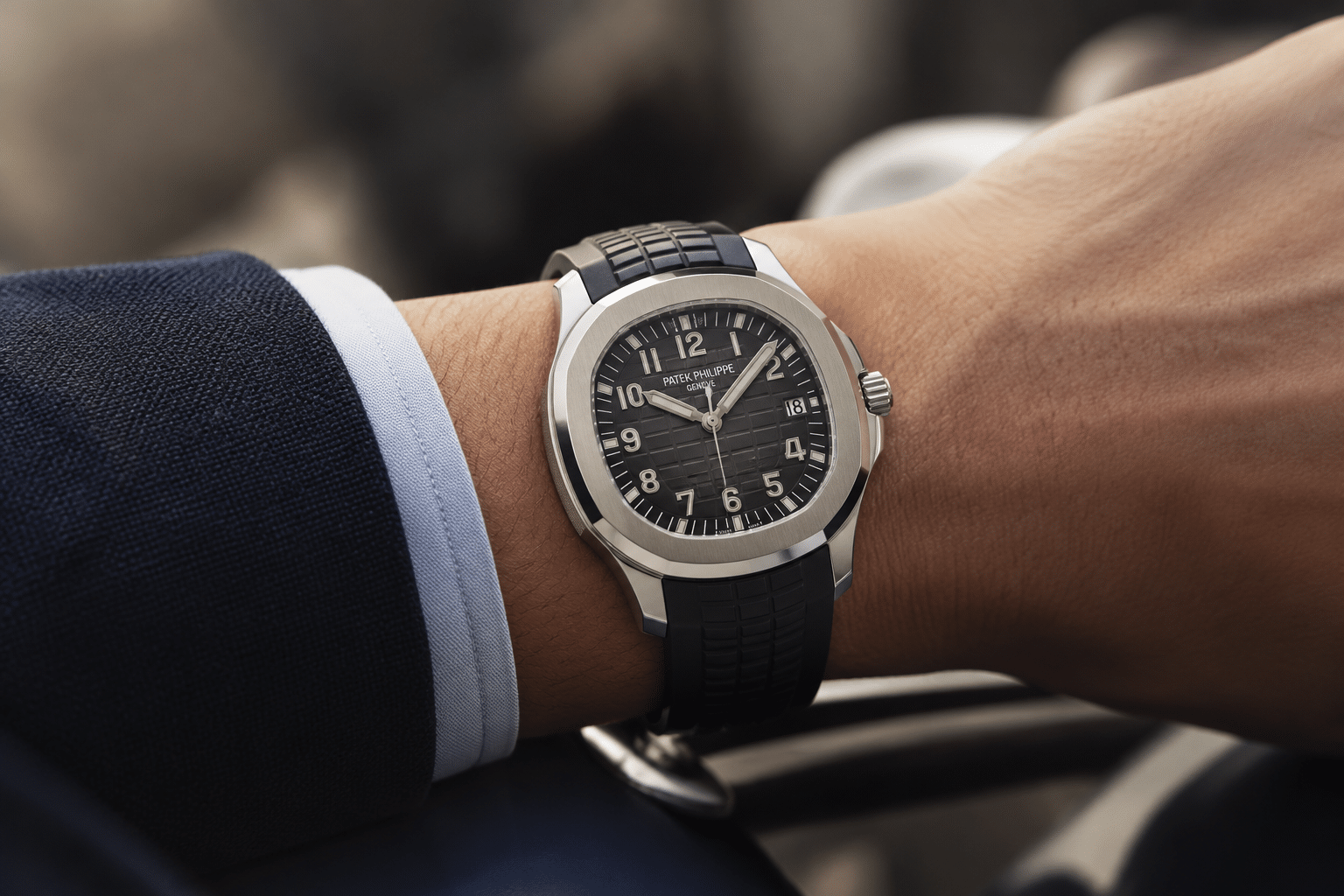
Comfort also helps reveal whether the batch was assembled with real attention or merely made to look good in photographs. A clean front image can hide a strap that is too rigid, a clasp that feels vague, or a fit that causes the watch to lean. If the on-wrist behavior feels rough, that usually deserves more weight than a flattering macro shot.
Movement, Rotor Noise, and Timegrapher Signals
Movement information is useful, but only within limits. For an Aquanaut super clone, the point is not to turn a movement photo into proof of quality. The point is to use it as one more approval filter. A decent Aquanaut movement route and a sensible timegrapher reading can support a decision, but they cannot rescue a watch with weak external finishing or poor wear behavior.
The biggest mistake buyers make here is overvaluing a tidy-looking movement image. A clean rotor engraving or attractive bridge finish says little about whether the watch is stable, quiet, or serviceable. The more practical signals are rotor noise, winding feel, rate consistency, and whether the claimed movement route matches the visible layout.
Movement Transparency Note: Movement references in this article describe the replica-market movement type or configuration, not an official Patek Philippe caliber unless explicitly verified with evidence. Buyers should treat the movement as one QC input, not as proof that external finishing, serviceability, or long-term stability will match the genuine watch.
What Movement Claims Can and Cannot Prove
Movement descriptions in the replica market should be read as configuration references, not as official caliber claims. A listing may describe the movement architecture, decoration, or seller shorthand, but that does not by itself establish serviceability, long-term stability, or equivalence to the genuine Patek Philippe caliber.
For practical QC, the movement should be used to check consistency: does the claimed route match the visible layout, does the winding feel clean, and do the basic functions behave as shown? If the movement language is vague or the photos do not match the claim, the safest response is to pause and ask for clearer evidence before approval.
Movement Route to Verify
Confirm that the seller’s claimed movement route matches the visible architecture and the stated behavior of the watch. The purpose is not to prove every internal part from a single photo. It is to catch obvious mismatches between what was promised and what is actually shown. If the visible layout, rotor style, or basic operation does not fit the claim, treat that as a warning sign and ask for more information before approval.
13. Listen for rotor noise and feel the winding action
Rotor noise is one of the most practical tells a buyer can get. If the rotor sounds loose, scratchy, or overly audible during normal wrist movement, that suggests a rougher build even when the watch looks clean in still photos. The issue is not sound alone. It is what the sound usually says about finishing and assembly quality.
Winding feel should be smooth and consistent. The crown should not feel gritty, uneven, or vaguely disconnected from the movement. A watch can have an acceptable-looking exterior and still feel cheap the moment the crown is turned. That matters because winding is one of the few tests a buyer can apply without special tools. If the crown action feels poor, do not let the visual polish override that signal.
Rotor noise and winding feel should be judged together. A quiet rotor with a rough crown is still a problem. A smooth crown with a noisy rotor is also a problem. The goal is not perfection, but coherence. The movement should feel like one controlled system, not a set of parts working against each other.
14. Read the timegrapher for consistency, not just one number
A timegrapher reading is useful because it shows whether the movement is behaving in a stable way under test conditions. It is not useful if the buyer treats one good screenshot as a warranty. Rate, amplitude, and beat error only matter if they remain reasonably consistent across the reading and do not swing wildly from one check to the next.
The cleanest way to read the result is to ask whether the movement looks calm or unstable. A stable amplitude is more important than a flashy rate number. A decent daily rate is useful, but if it comes with irregular behavior, the watch may still be a weak approval. Likewise, a single neat reading does not guarantee long-term performance. It only tells you the movement can behave well in that moment.
That is why the timegrapher should be treated as a support tool, not a final answer. It helps confirm whether the movement is reasonably tuned, but it does not tell you whether the watch will be quiet on the wrist, whether the rotor is rough, or whether the batch has broader consistency issues. One clean graph is reassuring. It is not decisive.
If a seller uses terms like chronometer or Master Chronometer, treat them as formal certification claims, not casual quality labels. COSC describes chronometer certification as a defined test process, and METAS describes Master Chronometer certification as whole-watch testing under specific conditions.[2][3] A timegrapher screenshot can still be useful, but it is not proof that a watch has passed either certification.
A replica watch should be evaluated with realistic ownership expectations. Even a strong super clone can have limits in water resistance, long-term movement stability, and servicing convenience compared with the genuine reference, so buyers should confirm after-sales terms and water-resistance testing before relying on daily use.
15. Confirm only the basic functions that the movement photos can support
Movement photos can support basic functional confirmation, not hidden durability claims. They can help verify that the watch runs, that the hands move correctly, that the date changes as expected when shown, and that the overall movement route matches the seller’s description. They cannot prove long-term reliability, water resistance, or service life.
That distinction matters because buyers sometimes approve a watch after seeing motion on a bench and assume the mechanical side is “done.” It is not. A watch that runs in a QC clip can still have a weak rotor, rough winding, or unstable behavior once it is worn daily. Basic function is the floor, not the finish line.
The practical standard is modest: the movement should behave consistently, match its claimed route, and avoid obvious signs of roughness. Anything beyond that requires more confidence than QC photos can honestly provide. If the seller is asking for approval based on a single movement shot, that is not enough. The movement should support the decision, not replace the rest of it.
Certification and Legal Boundaries
Replica watches can raise trademark and customs issues. USPTO explains counterfeit goods as unauthorized products that use protected marks or confusingly similar branding, and CBP identifies intellectual property rights enforcement as part of import screening.[4][5] That is why careful disclosure language matters. The article is about imitation products and pre-approval inspection, not a promise that a shipment is risk-free or legally equivalent to an authorized watch.
That does not mean every shipment is treated the same way, and this is not legal advice. It does mean the buyer should avoid casual language about “safe import,” “authorized quality,” or “genuine-equivalent” status when reviewing a watch for approval.
What a Clean QC Set Still Cannot Prove
A strong QC set can reduce uncertainty, but it cannot prove that a replica watch is authentic, officially approved, or identical to the genuine reference. It also cannot prove resale legitimacy, hidden movement origin, or long-term service outcomes. The best use of QC is to narrow risk, not to pretend the watch has passed a level of scrutiny it has not actually received.
That is why the most useful approval standard stays narrow and practical. If the front shot, macros, wrist shot, and movement notes all tell the same story, the watch may be worth approving. If they do not, the safer move is to pause. The goal is to buy a replica-market watch with clear eyes, not to upgrade it in your head into something it is not.
Batch-Level Warning Signs and the Final Approval Decision
By the time the checklist reaches the end, the buyer should stop thinking in isolated flaws and start thinking in patterns. Aquanaut batch variation is the real issue here. One small flaw may be tolerable. Two or three flaws that repeat across different angles usually mean the watch is not as strong as it first appeared.
The right final question is not “Does this watch have a flaw?” Every replica Aquanaut has some. The right question is whether the flaws are minor, whether they repeat, and whether they affect the same core area. If the watch looks good in one photo but weak in the strap, noisy in the movement, and uneven in the clasp, that is not a random mix of small issues. That is a batch signal.
Minor imperfection versus reject-worthy flaw
A minor imperfection is something that does not change the watch’s basic credibility in daily use. A slightly imperfect finish line, a small cosmetic inconsistency, or a barely visible alignment deviation may be acceptable if the rest of the watch is strong. Those are the kinds of issues a buyer can weigh against price and tolerance.
A reject-worthy flaw is different. If the clasp feels unstable, the strap sits badly, the watch rolls on the wrist, or the movement route appears inconsistent with what was promised, that is not just a cosmetic issue. It is a sign that the approval risk is too high. The buyer should not talk themselves into accepting a watch that fails in the areas the Aquanaut depends on most: integration, comfort, and controlled execution.
The useful rule is this: if the flaw changes how the watch wears, or if it raises doubt about the batch’s consistency, it matters more than a small visual blemish in a still photo.
Repeated batch warning signs
The strongest warning sign is repetition. If the same issue appears in the front shot, the wrist shot, and the close-up set, it is probably not bad luck. It is batch behavior. That is how buyers should read repeated flaws across multiple QC images: not as separate small problems, but as one larger quality signal.
Seller photo mismatch is especially important. When the dealer’s first images look cleaner than the follow-up shots, the buyer should pause. If the watch loses balance, consistency, or crispness as the photo set gets more honest, the safest move is to ask for more photos before approving. A serious batch should survive more than one angle.
This is where many approvals go wrong. Buyers focus on the best frame instead of the average frame. That is backward. The average tells you more about the batch than the single flattering shot.
The final pass, pause, or reject call
Use a simple verdict system. Pass only if the clasp closes cleanly, the strap flexes naturally, the watch sits centered and flat, the movement behaves consistently, and no core area shows a repeated defect pattern. Pause if one area looks uncertain but not clearly wrong, especially if the seller can provide better wrist or movement photos. Reject if the same weakness shows up across multiple checks, or if the watch feels rough in the one area that matters most for this model.
The final call should depend on the weakest core area, not the best-looking photo. That is the correct way to approve an Aquanaut. It is a watch that can look deceptively simple while hiding subtle execution problems. If the strap, clasp, and movement all support the same conclusion, approval is reasonable. If they do not, the safer decision is to wait.
References
[1] Patek Philippe, “Aquanaut 5167A-001 official specifications,” collection page for the Aquanaut reference, available at Patek Philippe Aquanaut 5167A official specifications.
[2] COSC, “Chronometer Certified,” official explanation of chronometer certification and ISO 3159 testing, available at COSC Chronometer official certification explanation.
[3] METAS, “Certification of watches,” official description of Master Chronometer testing and certification, available at METAS Master Chronometer official certification.
[4] U.S. Patent and Trademark Office, “Counterfeit Goods Basics,” guidance on counterfeit goods and trademark issues, available at USPTO Counterfeit Goods Basics.
[5] U.S. Customs and Border Protection, “Intellectual Property Rights,” guidance on import enforcement and infringing goods, available at U.S. CBP Intellectual Property Rights.
Disclosure: This article is for general educational and comparison purposes only. Replica watches are not genuine products from the original luxury brands, and brand names are used only to identify reference designs or comparison topics. Factory names, movement descriptions, prices, availability, QC details, seller policies, and version information can change, so readers should verify important details with the seller before making a purchase decision. Replica watches should not be represented, resold, or used as genuine watches.