
The Santos Split: Understanding the Core Divide
If you’re looking for a Cartier Santos, the first and most critical decision isn’t about size or color. It’s about choosing between two entirely different watches that happen to share a name. The most common and costly mistake in this category isn’t buying a bad replica; it’s buying a great replica of the wrong Santos, a risk well-documented in the Cartier Santos skeleton replica guide. This isn’t a choice between two flavors of the same thing. It’s a choice between two opposing watchmaking philosophies: one that prioritizes form and elegance above all else, and another that engineers for function and daily presence. Getting this wrong means ending up with a watch that feels fundamentally out of place on your wrist, no matter how perfect its replication.
Two Watches, One Name: A Brief Historical Context
The confusion starts with history. The original “Santos” from 1904 was a functional, pioneering pilot’s watch. The modern “Santos de Cartier,” revived in 1978 and updated in 2018, carries that legacy forward as a robust, integrated-bracelet sports watch. The “Santos-Dumont,” named for the aviator, is a later, purely elegant reinterpretation—a dress watch that echoes the aesthetics but abandons the tool-watch DNA. Replica factories understand this split perfectly and specialize accordingly. Factories like BVF (often linked to higher-end Cartier reps) focus laser-like on the Dumont’s defining trait: extreme thinness and flawless case finishing. Others, like GF and 3KF, target the Santos de Cartier, pouring their engineering budget into replicating the complex bracelet integration, bezel screw mechanics, and solid case construction. When you search for a “Santos replica,” you’re often funneled into two separate production streams, and mixing them up is the first step to disappointment.
The Fundamental Dichotomy: Dress vs. Daily Driver
The construction goals are diametrically opposed. For the Santos Dumont replica, the entire mission is to achieve a sub-7mm profile. Factories use quartz movements (like the Seiko PC21) or heavily modified, skeletonized automatic movements (based on the Miyota 9015) solely to hit that target. The case is a simple, elegant vessel; the leather strap is an afterthought. It’s an exercise in minimal mass. The Santos de Cartier replica, however, is built like a tank. Its goal is a robust ~8.5mm case that houses a reliable workhorse movement, a solid bracelet with a functioning “SmartLink” adjustment system, and a bezel where the screws aren’t just decor—they’re structural. One is designed to disappear under a cuff; the other is designed to be felt and seen all day.
Expert Authentication Insight
The most immediate, foolproof physical test to understand what you’re holding is with a digital caliper. For a Santos Dumont, measure the case thickness. A genuine and a high-tier replica will sit between 6.8mm and 7.2mm. Anything over 7.5mm is an immediate fail—it’s lost its entire reason for being. For the Santos de Cartier, forget thickness for a second. Look at where the first link of the bracelet meets the case. On a genuine (or top-tier replica like from GF), the integration is seamless, with a precise, flush fit and a polished bevel that flows uninterrupted from case to link. On lower-tier reps, you’ll see a gap, a misaligned finish, or a clumsy step. This junction is the heart of the watch’s engineering; if it’s wrong, the whole illusion collapses.
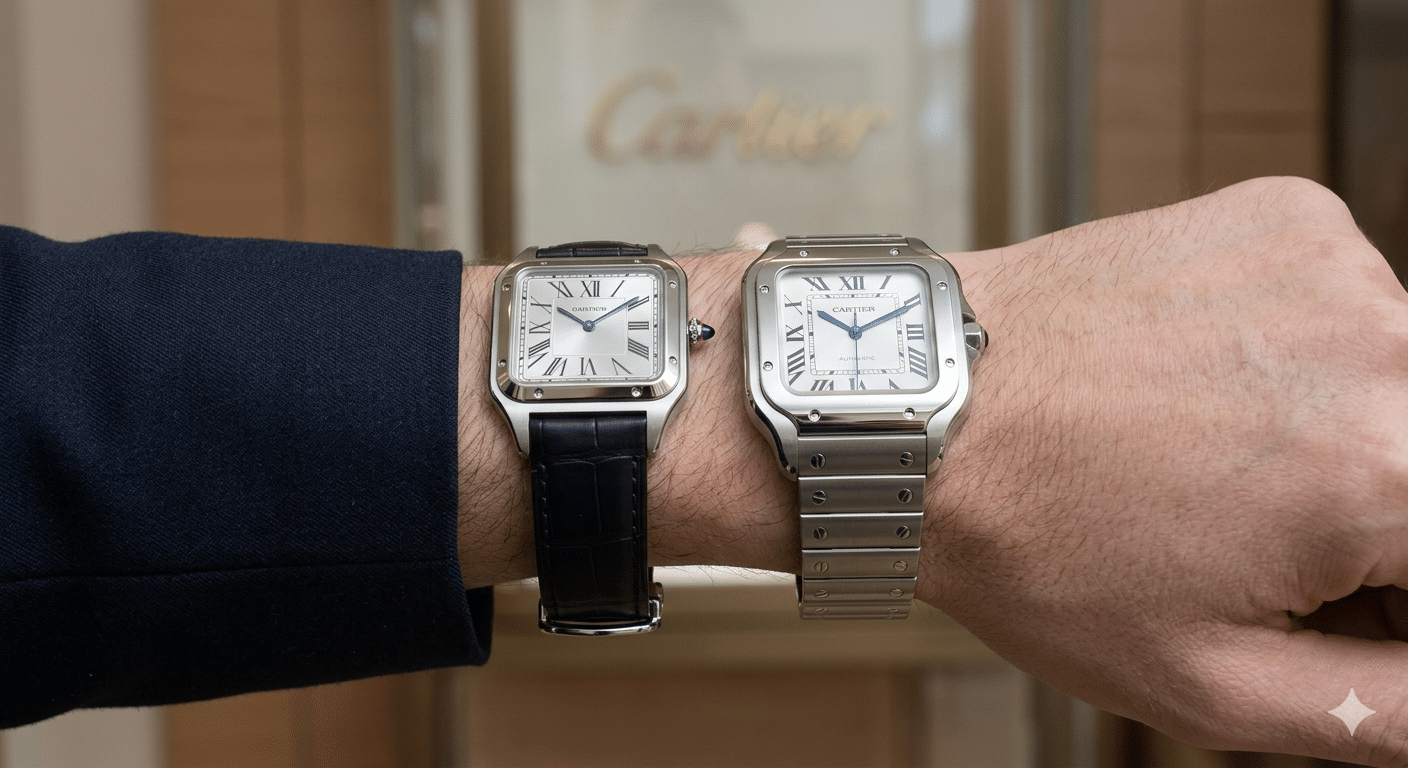
The Santos Dumont: The Art of Refinement
Choosing the Santos Dumont replica is a commitment to a specific kind of luxury: the luxury of absence. This is not a watch you wear to tell the time; it’s a piece of refined jewelry that happens to tell the time. Its value proposition in the replica world is singular: to deliver an experience of weightlessness and elegance that borders on the ethereal. It’s for the person who wants a Cartier not as a statement, but as a whisper.
The Pursuit of Thinness: How Factories (Try to) Nail It
The battle for the perfect Dumont replica is won or lost on the millimeter. The best executions, often from factories like BVF, use quartz movements. This is a strategic choice, not a compromise. A high-quality quartz (like a Seiko PC21) guarantees the correct, feather-light ~6.8mm profile, perfect accuracy, and no rotor noise. The alternative is an ultra-thin automatic clone, which introduces a minefield of potential issues: a noisy, wobbly rotor in a tiny case that amplifies the sound, reduced reliability, and often a slightly thicker caseback that ruins the silhouette. The caseback itself is a tell: a genuine Dumont has a specific, flat, snap-back case. A replica that uses a screw-down caseback to house a thicker auto movement is missing the point entirely.
The Wearing Experience: Slip-Under-the-Cuff Elegance
Putting on a well-made Dumont replica is a revelation if you’re used to sports watches. You barely feel it. The light weight (often under 40 grams on leather), the way the slim case and strap contour to your wrist without pressure—it creates a sensation of wearing nothing at all. There’s no heft, no pronounced wrist presence, no catching on shirt cuffs. Its beauty is passive; it’s for others to notice when your sleeve pulls back, not for you to feel with every movement. This is the antithesis of the typical “tool watch” experience.
Style Context: When the Dumont Works (and When It Doesn’t)
The Dumont’s natural habitat is a world of tailored cloth. It sings with a dress shirt, a suit, a blazer, or minimalist, structured casual wear. It is the ultimate “dress watch” replica. However, be brutally honest with yourself. With a t-shirt, jeans, or chunky knits, a Dumont can look and feel insubstantial—like a delicate piece of jewelry awkwardly strapped to a casual outfit. Its delicate nature also means it’s not built for rough daily use. Knocking it against a door frame feels catastrophic. It is a specialist, not a generalist.
Expert Authentication Insight
The Dumont’s entire claim to elegance rests on its dial. Under a 10x loupe, inspect the Roman numerals and the minute track. On a high-tier replica, the printing is razor-sharp, with crisp, opaque edges and perfect alignment. The guilloché or sunburst pattern on the dial (if present) should be fine, deep, and consistent, catching the light in a soft, shimmering wave. On a low-tier replica, the numerals will look fuzzy, the paint may appear thin or misapplied, and the guilloché will be shallow and poorly defined—a dead giveaway of a cheap stamping process, not fine engraving.
The Santos de Cartier: Engineered for Daily Presence
The Santos de Cartier replica is the opposite proposition. This is not jewelry; it’s wrist architecture. Its purpose is to be a versatile, durable, and ever-present companion. Choosing this model means you want a Cartier you can live with, not just admire. The replica’s challenge is to capture not just a look, but a feeling of solidity, integration, and mechanical satisfaction that works from the boardroom to the weekend.
The Integrated Bracelet: The Heart of the Experience
For the Santos de Cartier, the bracelet is the watch. A poor bracelet makes the entire replica fail, regardless of dial quality. Top factories like GF and 3KF invest heavily here. They replicate the patented “QuickSwitch” system (allowing tool-less strap changes) and the “SmartLink” system (for tool-less bracelet link removal) with surprising functionality. The heft is crucial—it should have a substantial, quality feel, not hollow or tinny. The links must articulate smoothly, following the curve of your wrist without gaping or pinching. The polish on the center links and brush on the outer links must be sharply defined. If the bracelet feels like an afterthought, you’ve bought the wrong version.
Robust Design: From Bezel Screws to Water Resistance
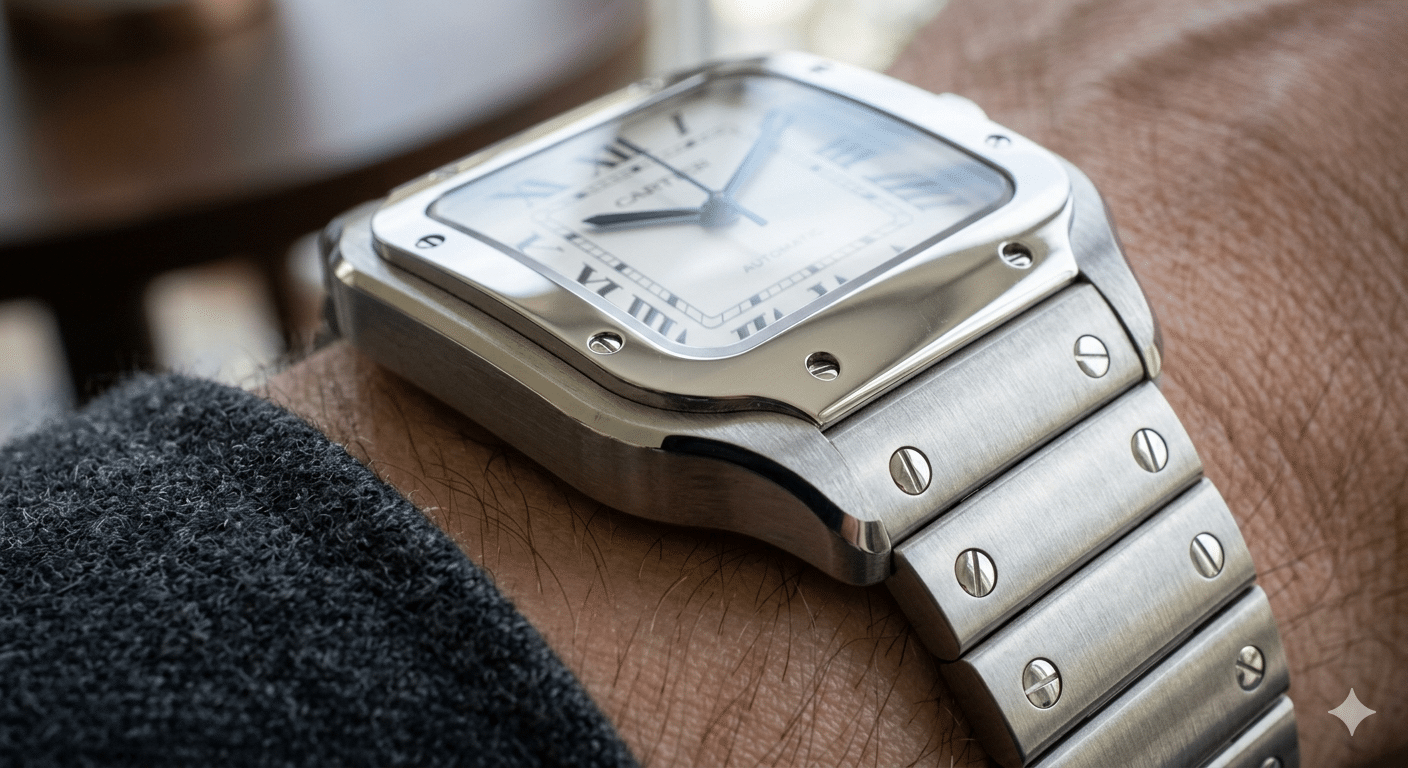
Every element here is beefier and more functional than on the Dumont. The bezel screws are the iconic feature. On a high-quality replica, they are perfectly aligned with the bezel grooves, sit perfectly flush, and their screw slots are clean with sharp edges. Lower-tier versions show misalignment, sloppy edges, or visible tool marks. The crown is larger and has more substantial guards. While no replica Santos is a dive watch, better versions from factories like GF pay some attention to gasket construction for basic splash resistance (30m at best), whereas cheaper reps offer virtually none. This is a watch built to handle the minor impacts of daily life.
The Daily-Wear Proposition: Versatility as a Feature
The genius of the Santos de Cartier’s design is its chameleon-like ability. On a well-made replica, the balance of brushed and polished surfaces gives it a smart-casual vibe that works seamlessly. It looks intentional with a t-shirt and jeans, yet perfectly at home under a blazer. The replica must achieve this look of solid, engineered elegance without appearing clumsy or top-heavy. The case should have a confident presence on the wrist—you should always be aware it’s there—but it should not be uncomfortable. Its value is in being the one watch you don’t have to think about changing.
Expert Authentication Insight
Two quick physical tests separate the good from the bad. First, the bezel screw test. Use a loupe. Every screw should be identically aligned (often alternating in a specific pattern), perfectly seated, and its slot should be crisp and free of burrs. Any deviation indicates poor machining. Second, the crystal tap test. Gently tap the sapphire crystal with your fingernail. A genuine sapphire (or a high-quality synthetic sapphire used in top reps) produces a clear, high-pitched “ping.” Cheap mineral glass, used in low-end replicas, produces a duller, lower-pitched “thunk.” It’s a simple, revealing auditory check.
The “Misbuy”: Why People Get It Wrong
Choosing between the Santos Dumont and the Santos de Cartier isn’t just a matter of taste—it’s a test of self-awareness. The most common and expensive mistake in this category isn’t buying a bad replica; it’s buying the wrong replica. Buyers fall for the allure of a photograph or the prestige of a name, only to discover the watch on their wrist feels alien to their life. This section dissects the psychological and perceptual traps that lead to this mismatch, framing your choice not as which watch is better, but which watch is better for you.
The “Photo Love” Trap: Falling for Aesthetics, Not Utility
Replica listings are masterclasses in seduction through macro photography. For the Dumont, this means extreme close-ups on its flawless guilloché dial, its blued sword hands, and its razor-thin profile against a dark backdrop. The image is one of pure, distilled elegance—a jewel. For the Santos de Cartier, photos highlight the geometric play of light on its bezel screws and the intricate mesh of its bracelet links. The problem is, these photos are lies of omission. They completely fail to communicate scale, weight, and physical presence.
The Dumont, in a macro shot, looks like wearable art. What the photo doesn’t show is how its ~35-gram weight (on leather) feels like almost nothing, how it can slide under any cuff, and how its visual impact is subtle and observational. Conversely, the Santos de Cartier’s ~120-gram heft, its 8.5mm thickness that gives it architectural substance, and the way its bracelet announces itself with every wrist movement are absent from the seller’s glamour shot. You’re buying a wearing experience, not a JPEG. Choosing based on which photo you find more beautiful is a direct path to regret.
Confusing “Cartier Style” with “Your Style”
Many buyers enter the market wanting “a Cartier.” They associate the brand with sophistication, luxury, and timeless design. Naturally, they gravitate toward the Santos Dumont, seeing it as the purest, most refined expression of that idea—the dress watch par excellence. This is where aspiration collides with reality. You must perform a ruthless audit of your actual life. Do you wear a dress shirt and tailored trousers more than three days a week? Is your social calendar filled with events where understated elegance is the uniform? Or do you live in Oxford shirts, polos, and jeans? The Dumont isn’t just a watch; it’s a context. Worn with casual wear, it can look oddly delicate, even frail—like wearing oxfords to a barbecue.
The Santos de Cartier, however, is Cartier style reinterpreted for a contemporary, dynamic life. Its “style” is versatility, robustness, and a confident, masculine presence. It bridges the gap between the boardroom and the weekend bar, a versatility further explored in detailed Cartier Santos bracelet vs leather strap comparisons that assess wearability and integration. Wanting “Cartier style” is not enough. You must define whose Cartier style you’re buying: the refined connoisseur’s or the modern urbanite’s.
The Bracelet Bias: Overvaluing the Strap
The Santos de Cartier’s integrated “SmartLink” bracelet is an icon for a reason. In photos and in store cases, it’s a masterpiece of engineering and design—the central reason many are drawn to the model. However, this attraction can be dangerously superficial. The bracelet is not an accessory; it is the primary determinant of the watch’s character. A well-made replica bracelet from factories like GF or 3K adds significant weight, creates a specific drape on the wrist, and produces a subtle, metallic soundtrack with movement. If you are someone who prefers the forgettable comfort of a leather strap or the lightness of a fabric NATO, the constant presence of this metal bracelet will become a nuisance, not a joy.
You might love the idea of the bracelet but hate the reality of it. Conversely, opting for the Dumont on its bracelet (a less common configuration) gives you a completely different feel—a light, flat link design that is more decorative than substantial. Don’t let the glamour of the Santos de Cartier’s bracelet blind you to the daily commitment it requires.
Expert Authentication Insight
The most effective pre-purchase test for avoiding a misbuy requires no watch at all. Find two objects that approximate the physical experience: a slim, lightweight fashion bracelet or even a stack of paper cut to ~35g for the Dumont; and a heavier, chunkier link bracelet or a small weight totalling ~120g for the Santos de Cartier. Wear one for a full day. Do you notice it constantly? Does it catch on your cuff? Does its weight feel substantial or burdensome? This crude simulation of heft and presence is more telling than a hundred product photos. The wrong weight on your wrist is a mistake you’ll feel every minute.
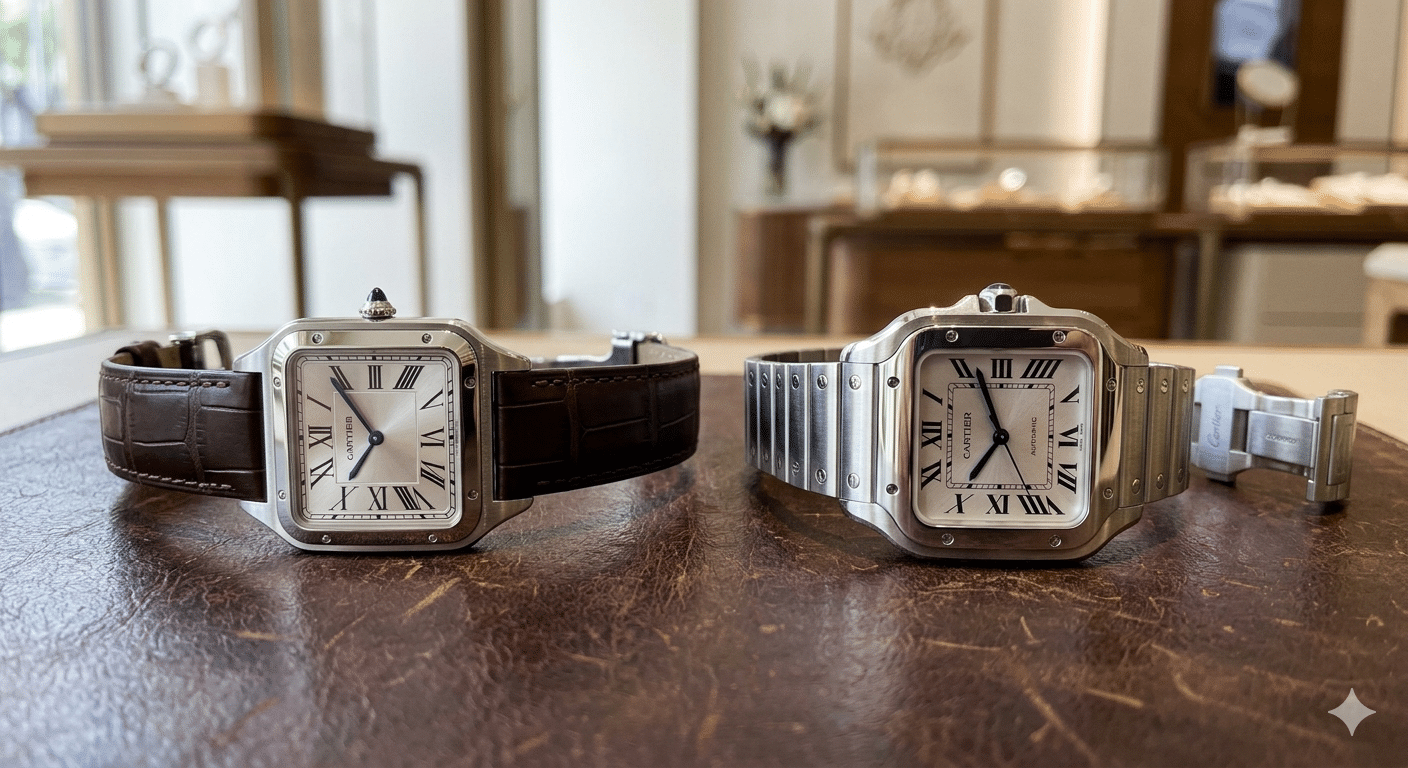
Side-by-Side Comparison: Beyond the Spec Sheet
Specifications tell a technical story, but your wrist lives an experiential one. Here’s what happens when you move from the product page to real life.
Wrist Profile & Silhouette: The Visual Impact
View the Dumont from the side: it’s a sliver of metal, a polished line that hugs the wrist. From above, it presents a clean, flat plane—the dial is the entire story. It’s designed to be seen in glimpses, a refined accent. The Santos de Cartier is architectural. From the side, you see layers: the bezel with its functional screws, the mid-case, the dramatic curvature of the first bracelet link. From above, it’s a complex play of brushed and polished surfaces, light-catching edges, and pronounced geometry. It doesn’t sit on the wrist; it constructs itself on the wrist. The Dumont is a painting; the Santos de Cartier is a sculpture.
Interaction & Sensation: Touch, Sound, and Heft
The experience of wearing these watches engages all the senses. The Dumont is quiet and smooth. Its slim case offers little to grip, its crown is small, and its presence is visual, not tactile. You forget it’s there. The Santos de Cartier is a tactile dialogue. You feel the sharp, precise edges of the bezel, the satisfying grip of its larger, guarded crown. Its bracelet links articulate with a soft, precise click. You hear it shift against a desk or a steering wheel. Its ~120g weight provides a constant, reassuring anchor. The Dumont is observed; the Santos de Cartier is felt and heard.
Versatility Scoring: A Real-World Report Card
- Business Formal (Suit & Tie): The Dumont scores a perfect 10. It is the definitive choice. The Santos de Cartier is a strong 8—it works, but its sportier edge is present.
- Business Casual (Blazer, Chinos): The Santos de Cartier takes the lead (9/10), seamlessly fitting the smart-casual code. The Dumont drops to a 7; it can feel a touch too delicate.
- Weekend Casual (Jeans, T-shirt): The Santos de Cartier is in its element (10/10). The Dumont struggles (5/10); the contrast can look intentionally dressy or accidentally mismatched.
- Active Weekend (Errands, Casual Outings): The Santos de Cartier’s robustness earns an 8. The Dumont’s delicacy makes it a poor fit (3/10); you’ll be overly conscious of protecting it.
The verdict is clear: the Santos de Cartier is the broader tool. The Dumont is the specialized instrument.
Expert Authentication Insight
Place the two watches on a flat, matte black surface under a single light source. Slowly rotate them. The Dumont’s highly polished surfaces will reflect light in a soft, uniform glow—its elegance is in subtlety. The Santos de Cartier will tell a different story: light will sharply delineate the brushed top surfaces from the polished bezel edges and screw heads, creating a dynamic, high-contrast play. A high-quality replica will maintain crisp, unbroken lines between these finishes. A lower-tier replica will show blurred edges, uneven brushing, or polished surfaces that are wavy or dull. This light behavior test is a quick, powerful indicator of finishing quality that separates premium replicas from mediocre ones.
Movement Realities: The Engine Inside
The movement choice in a replica isn’t just about “mechanical vs. quartz”; it’s about honoring the core design intention of each watch. Getting this wrong undermines the entire proposition.
Santos Dumont: The Quartz Advantage & Automatic Compromise
For the Santos Dumont replica, the pursuit of authentic thinness (sub-7mm) is paramount. Here, a high-quality quartz movement from a factory like BVF isn’t a compromise—it’s the strategically superior choice. A Miyota or Ronda quartz calibre guarantees the correct, ultra-slim profile, exceptional accuracy, and years of maintenance-free operation. This aligns perfectly with the genuine Dumont’s ethos of elegant, practical simplicity.
The “automatic” option for Dumont replicas often involves modified, ultra-thin mechanical movements like a decorated Seiko PC21 or a slim clone. This pursuit of thinness comes at a cost: increased rotor noise, potential reliability issues from tighter tolerances, and a higher price for a less robust movement. Choosing an automatic Dumont for the “sweep second hand” often means sacrificing the very thinness that defines the watch.
Santos de Cartier: The Need for Reliable Autonomy
The Santos de Cartier is built for daily wear, and its movement must be equally robust. Factories like GF and 3K typically use proven workhorse automatic clones—the Miyota 9015 or the Seagull ST2130 (a clone of the ETA 2824). The priority here is stability, serviceability, and power reserve, not mimicking the decoration of Cartier’s in-house calibre (which is hidden under a solid caseback anyway).
Avoid replicas that prioritize faux-perlage and engraved rotors over movement health. A reliable 9015 that runs within +15/-15 seconds per day is infinitely more valuable than a decorated movement that fails in six months. The Miyota 9015, while sometimes slightly noisier, is renowned for its durability. The Seagull ST2130 is a venerable, easily serviced clone. Both are correct choices for this model.
Service & Longevity: What You’re Really Signing Up For
Your movement choice is a long-term commitment. A quartz Dumont replica is essentially a “buy and forget” proposition. Its battery will last 2-3 years, and replacement is cheap and simple. An automatic Santos de Cartier replica is a mechanical device that will require servicing, likely within 3-5 years, to maintain accuracy and health. Factor an additional $150-$300 for a service into your total cost of ownership. This isn’t a drawback; it’s the reality of owning a mechanical watch, even a replicated one. Choose the movement that matches your desired level of engagement: set-and-forget convenience (quartz Dumont) or mechanical interaction with maintenance needs (automatic Santos de Cartier).
Expert Authentication Insight
For automatic replicas, a basic timegrapher test is revealing. A healthy movement should show an amplitude >250 degrees and a beat error <0.5ms in multiple positions (dial up, crown down). Low amplitude (<220°) can indicate need for service or poor lubrication. For quartz Dumont replicas, observe the second hand under magnification. It should jump crisply to each marker with no hesitation, stutter, or backward jitter. A stuttering second hand is a hallmark of a cheap quartz movement and a dead giveaway of a low-quality replica. The movement’s performance, even hidden, defines the long-term experience.
The Decision Matrix: Which Santos Replica Is For You?
This is where theory meets reality. The previous sections have laid out the technical and stylistic differences. Now, we translate that into a decision. Forget what you think you want; we’re going to figure out what you’ll actually wear and enjoy. This isn’t about picking the “better” watch—it’s about picking the watch that is better for you. The wrong choice here leads to a watch that lives in a box, a quiet reminder of a misjudged purchase.
Lifestyle Filter: Your Actual Week
Be brutally honest. Your fantasy self might attend galas, but your real self probably has a different calendar. Ask yourself these questions in order:
- Formality Dominance: Do you wear a suit, blazer, or sharp tailored clothing three or more days a week? If yes, the Santos Dumont immediately gains significant ground. Its entire design language thrives in that environment.
- Sensory Priority: Do you want to forget the watch is on your wrist, or do you enjoy feeling its presence as an object? The Dumont aims for the former (a whisper), the Santos de Cartier for the latter (a statement).
- Activity Level: Is your day primarily desk-based, or does it involve more physical movement, travel, or variable environments? The Santos de Cartier’s robust construction and integrated bracelet handle bumps and transitions far better.
- Collection Role: Is this intended to be your one and only watch? If the answer is “yes,” lean heavily toward the Santos de Cartier. Its versatility is its core strength. The Dumont is a sublime specialist, not a generalist.
If your answers point strongly in one direction, your path is clear, but for a comprehensive evaluation of models and their intricate details, consulting an authoritative Cartier Santos super clone guide can provide critical insights. If they’re mixed, the next filter is crucial.
Wardrobe Audit: What Are You Actually Wearing?
Stop thinking about watches for a moment. Open your closet. Look at the five outfits you wear most often. What are they?
- Sharp Tailoring, Dress Shirts, Wool Trousers: This is the Santos Dumont’s native habitat. Its slim profile slips under a cuff perfectly; its elegance complements rather than competes.
- Polo Shirts, Oxford Button-Downs, Knitwear, Casual Jackets: This is the Santos de Cartier’s sweet spot. It has the substance to stand up to thicker fabrics and a more relaxed silhouette without looking out of place.
- T-Shirts and Jeans: Here, the Santos de Cartier works as a confident, stylish accessory. The Dumont, however, can look oddly delicate and detached, like wearing dress shoes to a barbecue.
The visual mismatch is real. A Santos Dumont with a heavily textured knit or a field jacket creates a dissonance—the watch feels too refined for the cloth. Conversely, the heft and industrial detail of the Santos de Cartier can overpower a finely woven dress shirt. Match the watch to your actual canvas.
The “One Watch” Question
This is the ultimate tie-breaker. If you are building a collection, the Santos Dumont is a phenomenal dress or “occasion” piece. It’s the watch you wear when the context demands elegance above all else.
However, if you are seeking a single, do-it-all timepiece—your daily companion—the Santos de Cartier replica is the overwhelmingly pragmatic choice. Its design is built for durability, its bracelet allows for perfect fit and easy sizing, and its aesthetic bridges casual and smart-casual effortlessly. A Dumont as your only watch will leave you wanting on weekends, on trips, or on any day that doesn’t call for a jacket. The Santos de Cartier won’t.
Expert Authentication Insight
The most effective pre-purchase test costs nothing: the paper silhouette test. Print life-size, side-profile images of both the Santos Dumont and the Santos de Cartier. Cut them out, wrap them around your wrist, and secure them with tape. Wear these paper “watches” for an hour while you go about your normal routine—working at your desk, making coffee, moving around. This crude simulation bypasses marketing and pure aesthetics, forcing you to confront the physical reality of each watch’s presence. Do you notice the substantial wrap of the Santos de Cartier silhouette, or do you prefer the near-invisible strip of the Dumont? Your subconscious reaction to the profile on your own wrist is often more truthful than any list of pros and cons.
Final Verdict & Recommendations
The analysis is complete. The data is in. It’s time to choose.
The Core Trade-Off, Simplified
This entire decision boils down to one fundamental, binary choice:
Do you want an Elegant Object or a Wrist Companion?
The Santos Dumont is an Elegant Object. It is jewelry that tells time. Its value is in its refinement, its thinness, its ability to disappear into a formal context and elevate it subtly. It is observed, not felt.
The Santos de Cartier is a Wrist Companion. It is a machine for your wrist. Its value is in its engineered presence, its versatile durability, its satisfying heft and tactile interaction. It is felt, and then observed.
There is no hybrid. There is no perfect middle ground. Attempting to force the Dumont into a daily role will make it feel fragile and inadequate. Attempting to force the Santos de Cartier into a strict dress code will make it feel heavy and overt. You must pick a lane.
If You Choose Dumont: Specific Replica Guidance
You’ve chosen the path of refined elegance. Your priority is thinness and dial perfection.
- Target Factory: Seek out BVF (BV Factory). They have consistently focused on the Dumont, prioritizing the case profile and dial execution. For the ultimate in authenticity to the genuine watch’s purpose, their quartz models are highly recommended. A high-quality quartz movement here is not a compromise; it is the strategic choice that guarantees the correct, ultra-thin profile and worry-free reliability—aligning perfectly with the Dumont’s ethos of elegant practicality.
- Critical Warning: Avoid any “automatic” Santos Dumont replica that is advertised with a thickness over 7.5mm. This defeats the entire design premise. These are often built on standard automatic movements crammed into a Dumont-style case, resulting in a clumsy, misshapen watch that captures none of the genuine article’s magic.
- Price Expectation: A top-tier BVF Santos Dumont replica, with its impeccable finishing and correct proportions, will command a premium. Expect to invest in the range of $750 to $850 USD. This pays for the specialized tooling and attention to detail required to nail the slim elegance.
If You Choose Santos de Cartier: Specific Replica Guidance
You’ve chosen the path of daily utility and presence. Your priorities are bracelet quality, bezel finish, and overall solidity.
- Target Factories: Focus on GF (G Factory) or 3K Factory. Both have invested heavily in replicating the integrated bracelet and “SmartLink” system. The bracelet is the soul of this watch; a poorly articulated, light, or sharp-edged bracelet ruins the entire experience. These factories also excel at the bezel screw alignment and the balance of brushed and polished surfaces.
- Movement Priority: Opt for a model with a reliable workhorse clone movement like the Miyota 9015 or a well-tuned Seiko NH35 derivative. You want stability and serviceability for a daily wearer. Avoid overpaying for elaborately decorated rotors that mimic the in-house calibre; in a closed caseback model, it’s money better spent on the external finish.
- Size Selection: The Santos de Cartier typically comes in Medium (35.1mm width) and Large (39.8mm width). Choose based on your wrist size for proportional daily wear. The Large wears true to its size due to the square case; the Medium offers a more classic, versatile footprint.
- Price Expectation: A top-tier GF or 3K Santos de Cartier, with its complex bracelet and case construction, will also sit in the $800 to $900 USD range. The engineering required to replicate the bracelet integration and quick-change systems justifies this position.
Expert Authentication Insight
Once your chosen replica arrives, perform the final universal test: the Light Roll. Find a single, strong light source (a desk lamp is perfect). Hold the watch and slowly rotate it through 360 degrees, observing how light travels across every surface. On a high-quality replica, the light will glide sharply and consistently over polished bevels, creating crisp, unbroken lines. It will transition cleanly to brushed surfaces, showing even, fine-grained texture. On a mediocre replica, you’ll see waviness in the polish, dull or cloudy patches, and inconsistent, blurry brushing. The light doesn’t lie; it reveals every shortcut taken in the finishing process.
The Final Word: The Analogy
Think of the Santos Dumont as a bespoke suit. You wear it for specific, important occasions. It’s defined by its cut, its fabric, its quiet statement of intent. You admire it, you feel elevated in it, but you don’t live in it every day.
Think of the Santos de Cartier as a perfect leather jacket. It’s built for life. It gains character with wear, fits into countless scenarios, and provides a sense of rugged, dependable style. It becomes a part of your daily identity.
You don’t buy both for the same reason. You don’t wear them in the same way. The choice isn’t between two watches; it’s between two relationships with time and style.
So, look at your wrist right now. What’s missing?
The whisper, or the statement?
Choose.