
True skeleton engineering removes the mainplate and relies on structurally integrated bridges, low-end RM replica manufacturing logic, whereas many replica-market options simply cut windows into a standard dial or force a modified movement into a thicker case. This approach creates visual disconnects, unnatural gear clustering, and compromises the signature tonneau silhouette. Understanding how the internal layout affects case thickness, winding stability, and complication synchronization is essential before committing to a specific version.
This guide breaks down the mechanical differences between modified calibers and purpose-built skeleton architectures, highlighting the specific details that separate functional daily wearers from purely decorative pieces. By evaluating gear spacing, balance wheel placement, bridge alignment, and unedited structural photos, you will be better equipped to assess whether a model’s engineering justifies its price and aligns with your expectations for long-term reliability.
| Inspection Focus | What to Verify | Why It Matters |
|---|---|---|
| Movement Architecture | Custom bridges vs modified base calibers | Custom layouts can reduce thickness and align with the case, while modified options may add bulk and disrupt gear spacing. |
| Balance Wheel Position | Centered at 4 or 6 o’clock | Correct placement maintains symmetry and gear alignment; shifted wheels often indicate rushed or compromised engineering. |
| Case Thickness Tolerance | Matches movement stack without deepened bezels | Excessive height distorts the tonneau profile and signals poor case-movement integration. |
| Complication Linkage | Subdials sync with central seconds, firm pusher feedback | Functional gear trains confirm mechanical coherence, whereas isolated decorative motors may fail to deliver consistent chronograph response. |
| Photo Verification | Unedited top-down, 45-degree, and side profiles in neutral light | Promotional shots can hide alignment flaws; raw angles reveal actual bridge tapering, gear spacing, and case integration before purchase. |
Quick Questions Before You Read
Q: Should I prioritize dial decoration or internal layout when choosing a skeleton replica?
Internal layout generally matters more. A well-structured bridge system and balanced gear train determine case thickness, winding efficiency, and complication reliability, while decorative finishes are purely cosmetic.
Q: How can I verify if a replica uses a purpose-built skeleton movement or just a modified base?
Request unedited side and 45-degree photos to check case thickness. Purpose-built versions often maintain a slimmer tonneau profile with aligned bridges, whereas modified calibers can appear noticeably taller with clustered gears.
Q: Does a higher price always mean better mechanical reliability in these replicas?
Not necessarily. Premium pricing may only be justified when it reflects custom components that reduce movement height and improve rotor winding stability. Higher costs for extra decoration do not automatically translate to functional gains.
Before making a decision, buyers should review real QC photos where available, including dial printing, hand alignment, bezel position, datewheel centering, bracelet fit, clasp engraving, case thickness, and overall finishing. Factory labels and stock photos alone are not enough for a reliable judgment. Version updates occur frequently, so what applies to one production batch may not reflect the next shipment. Replica watches are not genuine products from the original luxury brands and should be evaluated as independent market items.
The Illusion of Openwork: Why a Hollowed Dial Is Not Enough
Buyers often assume that if they can see gears through the crystal, they are looking at advanced watchmaking. In the replica watch market, this assumption creates the most common entry-level trap. A standard replica skeleton watch frequently relies on a hollowed dial approach rather than genuine horological architecture. The visual effect works through dial cutout engineering: manufacturers take a standard, fully enclosed automatic movement and stamp large openings into a decorative dial plate that sits on top of it. This creates an openwork dial illusion in glossy promotional photos, but it offers only a base movement exposure rather than a true open structure.
The difference becomes clear when you tilt the watch under direct light. Camera angles are deliberately chosen to flatten perspective and exaggerate depth, hiding the fact that a solid mainplate still sits just millimeters below the surface. When buyers wonder why a replica watch looks visually inconsistent up close, the answer often lies in this shallow layering. The visible gears may appear isolated from the actual gear train. True structural skeletonization removes the mainplate entirely, leaving only the essential bridges that hold the wheels in place. A hollowed dial is cosmetic padding; it provides replica-market movement visibility without delivering the spatial logic that makes a genuine skeleton read as engineered machinery.
Base Movement Modification Versus Purpose-Built Skeleton Architecture
When Chinese manufacturers attempt to replicate complex tonneau architectures, they generally choose between two distinct engineering paths: modifying an existing automatic caliber or designing a fully custom skeleton from scratch. Understanding this movement architecture route is critical because it dictates how the watch interacts with the case, how it wears on the wrist, and whether the layout maintains visual integrity. A modified base movement takes a proven donor caliber and adds cutouts, decorative plates, or elevated sub-bridges to mimic the appearance of depth. The caliber modification limits here are strict because the underlying mainplate dimensions and wheel positions cannot be radically altered without compromising the movement’s stability.
Conversely, custom skeleton bridges require the facility to redesign the entire internal layout to match the reference watch from the ground up. When evaluating which RM movement route aligns better with your priorities, the decision depends on whether you prioritize case thinness or structural accuracy. The debate between custom bridges vs modified caliber is not just about aesthetics; it is a negotiation between movement volume and the aggressive curves of a tonneau shell. A replica movement thickness tradeoff is often unavoidable: you cannot achieve precise gear spacing and absolute slimness simultaneously without significant CNC investment. Recognizing which route a version uses allows you to predict its limitations before purchase.
Factory names in the replica watch market are useful buyer-facing references, but they should not be treated as official luxury-brand affiliations or automatic guarantees of quality across every model. When evaluating Chinese RM super clones, the specific engineering path chosen for a given reference matters far more than the manufacturer’s market label. A workshop known for solid sports watch replicas may still struggle with complex tonneau bridge routing, while a smaller facility might excel at a particular skeleton configuration. Traceability requires checking the exact movement layout and case integration rather than relying on reputation alone.
Modified Caliber Tradeoffs and Spatial Constraints
Retaining a standard mainplate footprint forces engineers to work within rigid spatial boundaries. Because the donor movement was designed for a different case shape, it cannot naturally sit flush inside an RM-style tonneau. To compensate, bridge contour matching is often simulated by adding elevated spacer plates or stacking bridges higher than intended. This immediately increases the movement stack height, which in turn forces the case designer to deepen the bezel or thicken the case back to accommodate the extra volume. The result is a watch that may look correct from the front but sits noticeably heavy and tall on the wrist.
Beyond thickness, the fixed gear positions of a donor caliber create a visual mismatch. The original RM layout spaces components according to a specific mechanical and optical rhythm. A modified base movement cannot replicate that rhythm without breaking its own gear train, so the wheels end up clustered in unnatural patterns or pushed too far toward the edges. The movement may keep time reliably, but the internal architecture remains fundamentally foreign to the watch it is powering, breaking the visual illusion the moment the light catches the wrong angle.
Custom Bridge Routing and Structural Alignment
The alternative approach abandons the constraints of standard calibers entirely. A purpose-built skeleton route discards the original mainplate and maps custom skeleton bridges directly to the natural curvature of the tonneau case. This Chinese replica engineering method repositions the barrel, center wheel, and escapement to sit at the correct optical plane, eliminating the dead air that makes modified versions look hollow. By aligning the bridges with the case landmarks, the movement feels integrated rather than inserted.
This route drastically reduces unnecessary metal bulk, which serves two purposes: it improves light transmission through the dial, and it allows for a more rational distribution of thickness across the case profile. The winding and timekeeping functions are preserved, but they are routed through an architecture that actually belongs to the design. While this method requires precise CNC tooling and carries a higher production risk, it is the only path that successfully aligns the internal mechanics with the external language of a complex skeleton watch.
Movement Choice and Daily Ownership Tradeoffs
When evaluating RM skeleton replicas, the movement route chosen by the factory dictates more than just visual accuracy—it directly shapes long-term ownership and daily reliability. Many buyers assume that the most openwork, skeletonized movement automatically represents the highest tier, but decorative exposure often comes at the cost of structural rigidity and service accessibility. Versions built around modified Asian base calibers (such as Seagull ST series or customized 2892/2824 derivatives) frequently retain thicker mainplates and simplified gear trains. While these movements add bulk to the case profile, they often offer more straightforward regulation, wider parts compatibility for local watchmakers, and predictable power delivery. The tradeoff is a less aggressive visual depth, but the gain is mechanical predictability.
Conversely, purpose-built skeleton architectures that aggressively remove metal and reposition the escapement can achieve striking visual symmetry, but they introduce distinct maintenance risks. The exposed bridges leave less margin for tolerance stacking, and the specialized gear trains rarely share components with standard automatic movements. If a bridge is damaged or a jewel post cracks, replacement usually requires returning to the original supplier rather than visiting a local bench. This distinction is best treated as a daily-wear versus display-priority decision rather than a simple quality ranking. Buyers who plan to wear the watch regularly, expose it to temperature shifts, or value straightforward servicing often benefit from slightly thicker but proven movement platforms. Collectors who prioritize macro photography and visual accuracy may prefer the custom routes, but should account for higher maintenance sensitivity and longer repair turnaround times.
Mapping Gear Train and Bridge Geometry to the Original RM
The difference between a convincing replica and a decorative imitation ultimately comes down to gear train routing and bridge contour accuracy. Genuine Richard Mille movements space their wheels to balance torque distribution while maintaining a deliberate visual cadence across the dial. Successful clones replicate this spatial logic, ensuring gear spacing accuracy aligns with the original reference points. When learning how to check RM gear layout, buyers should focus on the negative space between components rather than the components themselves. Crowded wheel clusters or excessively wide gaps are immediate indicators that a donor movement is being forced into an incompatible dial scale.
Replica bridge alignment mistakes often manifest as bridges that end abruptly or fail to connect smoothly to the case rim. While buyers frequently ask if screw placement precision matters at arm’s length, the answer is yes, because the screws anchor the entire visual structure. Minor positional shifts are normal in mass production, but a systematic drift in screw locations reveals rushed tooling and a failure to validate against genuine reference layouts. True movement layout verification requires comparing the angular relationship between the center wheel, the mainspring barrel, and the balance bridge against known dimensions. If the bridges do not follow the original geometric flow, no amount of surface decoration can make the watch read as structurally coherent.
Bridge Contour and Edge Finishing Check
Under closer inspection, the finishing of the bridges determines whether the skeleton reads as machined precision or stamped metal. High-quality routing uses CNC milling to create sharp, deliberate edges, while budget approaches rely on stamping or basic wire EDM, leaving rough, rounded boundaries. The most reliable tell is the edge treatment: well-executed skeletons feature carefully machined bridge chamfering that catches the light evenly across the entire curve. The chamfers should show consistent width without flattening, tool marks, or uneven transitions. Clean, sharply defined screw holes further confirm careful machining and proper deburring.
If the bridge edges look soft, inconsistent, or reflect light in chaotic streaks, they were likely mass-stamped and aggressively polished to hide defects. In skeletonized architecture, edge finishing is not merely decorative; it defines the boundaries of the movement itself. Poor finishing collapses the structural illusion, making even a correctly positioned gear train look flat and inexpensive. Always request neutral-lit, top-down photos to evaluate these edges, as high-contrast studio lighting is routinely used to wash out machining flaws and mask poor contour matching.
Balance Wheel Placement and Rotor Dynamics in Chinese RM Replicas
The balance wheel position is one of the fastest ways to separate a structurally coherent clone from a superficial layout exercise. Genuine Richard Mille architectures place the balance wheel with strict spatial logic, usually anchoring it at 4 o’clock or 6 o’clock to align with the gear train and maintain visual symmetry through the tonneau aperture. Lower-tier replicas frequently relocate the balance wheel to a more convenient assembly point, which forces the surrounding bridges into awkward angles and disrupts the natural rhythm of the gear spacing. When the balance wheel position is shifted, the entire movement timing layout stops matching the original, and the watch reads as visually unbalanced even if the dial print and case material look convincing.
Automatic rotor behavior in Chinese RM super clones reveals a direct tradeoff between visual openness and winding efficiency. Facilities often choose between two routes: a highly skeletonized oscillating weight that looks impressive through the caseback, or a heavier, more solid rotor that prioritizes consistent power transfer. Decorative skeleton rotors frequently sacrifice winding torque because too much metal is removed to preserve transparency. Buyers will notice slower power reserve buildup or the need to manually wind the crown more often to reach a stable amplitude. Conversely, functional rotors restore winding reliability but can increase movement height and introduce more noticeable spin noise if the bearing tolerances or rotor bridge finishing are rushed.
Replica rotor noise is rarely about total silence; it is about mechanical consistency. Every automatic clone produces some rotor sound during active wrist movement. The warning sign is irregular grinding, sudden catching, or a loose ratcheting feel when shaking the watch gently side-to-side. These sounds typically point to poorly finished rotor jewel bearings, misaligned oscillating weight posts, or excessive play in the reversing wheels. A well-integrated automatic module will produce a smooth, continuous spin that accelerates and decelerates naturally with wrist motion. When evaluating QC photos or receiving the watch, do not assume rotor sound equals failure, but treat extreme noise as a clear indicator of loose internal tolerances that will likely accelerate wear on the automatic winding train.
Thickness Control and Tonneau Case Integration
Case thickness control in tonneau replicas is dictated almost entirely by movement stack height. The genuine Richard Mille silhouette relies on a continuous, low-profile curve from the bezel edge through the lugs and into the strap. When a modified movement retains unnecessary mainplate bulk or uses taller gear trains, factories must compensate somewhere in the case architecture. The most common fix is deepening the bezel well to swallow the extra height, which flattens the original dial-to-crystal transition. Other compromises include flattening the lug curvature to avoid a bulky wrist profile or extending the case back downward to create clearance for the rotor. These adjustments break the tonneau case fit and make the replica sit higher and more rigid on the wrist than the original design intended.
Proper skeletonization improves tonneau case integration by removing dead metal rather than adding depth. By machining away non-structural sections of the base plate and recontouring the bridges, manufacturers can preserve the original proportions without forcing the case maker to distort the lugs or thicken the back crystal. The result is a replica wearing profile that maintains the uninterrupted flow expected from an RM architecture. Buyers who prioritize daily comfort should evaluate how the side profile handles the transition from caseband to lug. A well-executed version will show a gradual, organic taper that sits flush against the wrist. An awkward step-down, abrupt angle change, or overly deep bezel usually signals that the movement was simply dropped into a case without proportional adjustment.
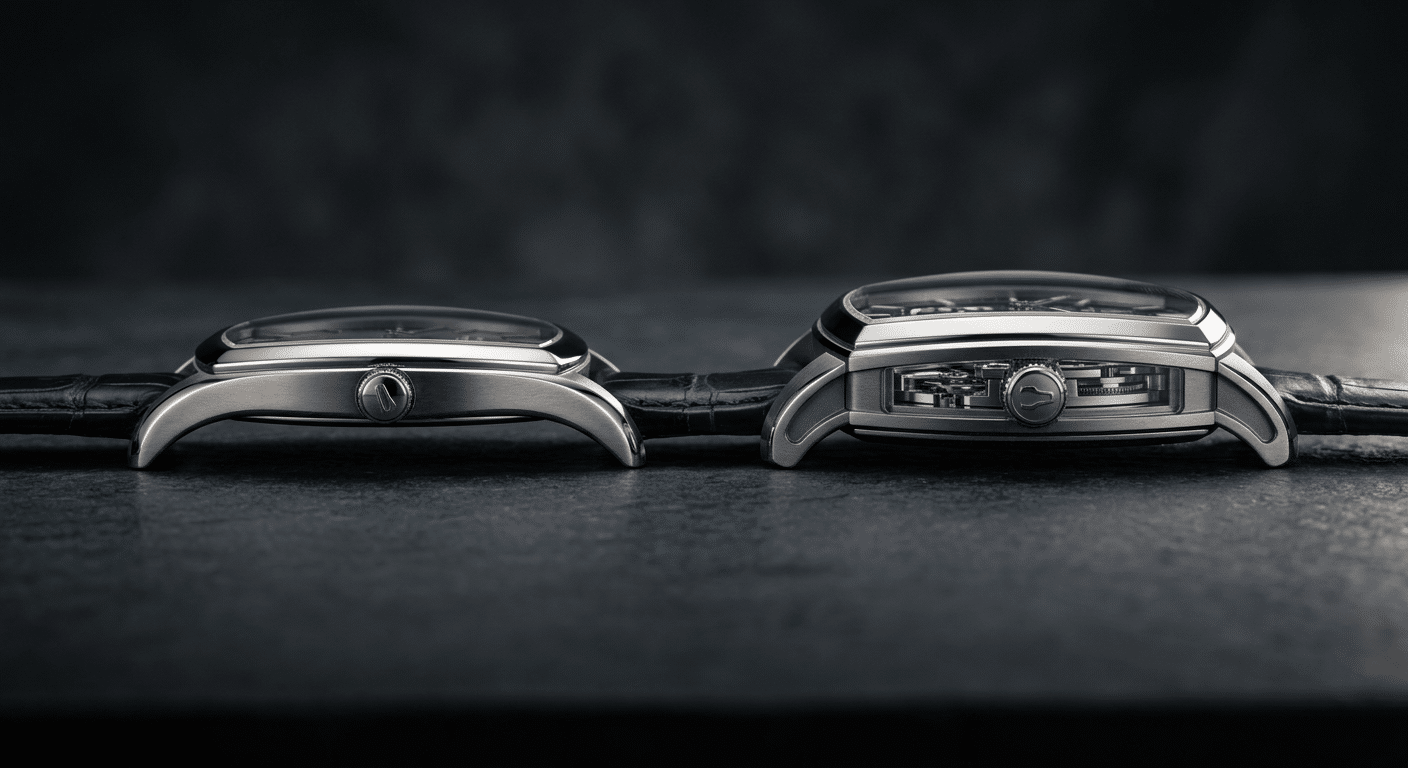
Thickness specifications published by sellers are useful starting points, but they should be treated as reference ranges rather than fixed guarantees. Batch variations in movement assembly, case gasket thickness, and crystal seating can easily shift the final profile by half a millimeter or more. What matters more than the exact number is how that thickness interacts with sleeve clearance, wrist flex, and visual weight. A replica that preserves the original architectural rhythm will feel lighter and more natural, even if it measures slightly taller on paper. Prioritize versions where the case maker has actively adapted the lugs and bezel depth to the movement, rather than forcing a standard automatic module into a fixed tonneau shell.
Functional Linkage: How Subdials and Complication Logic Expose Weak Clones
Subdial alignment replica and chronograph layout accuracy are direct reflections of gear routing quality. Genuine Richard Mille complications are driven by specific mechanical pathways that connect the central timekeeping train to secondary registers through precisely positioned transfer wheels and intermediate gears. Weak clones frequently bypass this engineering complexity by mounting decorative subdial dials over independent stepper motors or isolated gear clusters that tick without meaningful connection to the hands. The result is a dial that looks complex at a glance but loses functional credibility during basic operation. When a chronograph subdial spins independently of the central seconds hand, or when a calendar register jumps at inconsistent intervals, the watch is revealing a module mismatch rather than authentic complication logic.
Crown tube alignment and pusher resistance act as indirect indicators of how well the underlying movement is integrated with the case and dial layout. In a coherent super clone, the crown winding feel should be smooth and progressive, with consistent tension as the mainspring tightens. Pushers on a functional chronograph should offer firm, tactile resistance with a clean click, indicating that the cam levers and clutch wheels are properly seated against the dial plane. Loose pushers, mushy clicks, or a crown that binds at certain positions usually point to misaligned crown tubes, poorly cut stem lengths, or a calendar linkage movement that is forcing components into incorrect spatial positions. Functional watch engineering should align the external controls with the internal behavior, not just match the visual spacing.
Model Difficulty and Buyer Risk Management
Not all skeletonized Richard Mille references present the same replication challenge. Simpler tonneau layouts with open dials but limited subdials and a single central gear train allow factories to focus their CNC tooling on bridge symmetry and case integration without managing complex module linkage. These versions tend to be more forgiving for first-time buyers, as the primary verification points are balance wheel placement, case thickness, and basic winding response. More complicated references that incorporate split-second chronograph modules, torque indicators, or multi-tier gear trains exponentially increase the replication risk. Each additional function introduces alignment dependencies, increased rotor mass, and tighter spatial tolerances that are difficult to stabilize without dedicated prototyping runs.
For buyers new to skeleton replicas, prioritizing a less complicated movement route often yields better long-term satisfaction than chasing the most visually dense architecture. A watch with fewer moving registers is easier to regulate, less prone to module desynchronization, and more forgiving of minor bridge finishing variations under normal lighting. Experienced collectors who understand maintenance cycles and can tolerate occasional regulation visits may comfortably navigate the higher-tier versions, but they should still verify that the complication layout uses mechanically linked gear trains rather than independent decorative modules. The complexity of the dial should match the buyer’s willingness to manage mechanical upkeep, not just the desire for visual impact.
Functional Subdial Verification Steps
- Observe the subdial hand behavior relative to the central seconds hand. A legitimate chronograph layout will show the running seconds subdial advancing in direct correlation with the main train. Independent or randomly spinning subdials indicate decorative isolation.
- Activate the chronograph pusher and watch for immediate hand response. The central seconds hand and minute counter should engage simultaneously without hesitation. Delayed movement or hands that stutter often signal a poorly meshed module or incorrect pusher stem length.
- Reset the chronograph and verify the return position. All hands should snap cleanly back to their zero indices without creeping or drifting past the markers. Persistent misalignment points to cam wear or weak return spring tension.
- Test the crown winding and calendar jump sequence in a neutral position. Advance the hands slowly through the date change window and note whether the calendar linkage movement engages at a consistent time interval. Late or split jumps suggest misaligned driving wheels or rushed calendar plate positioning.
- Check pusher resistance across multiple presses. Consistent, firm feedback with no lateral wobble confirms that the pusher tubes are properly seated against the case and that the clutch mechanism is engaging correctly. Soft or sticky resistance requires immediate seller clarification before purchase.
QC Verification: What Photos Actually Prove About Movement Credibility
When evaluating a Richard Mille replica, standard seller photography is engineered to sell the aesthetic while hiding structural shortcuts. High-contrast flash lighting washes out bridge contours, flattens the skeleton depth, and makes generic decorative gears look intentionally routed. QC photo inspection for an RM replica requires a deliberate shift in how you request and interpret images. You are not checking dial print sharpness or date alignment; you are conducting movement angle verification to confirm whether the internal architecture matches the tonneau case geometry.
A reliable replica buyer checklist for skeleton movements should reject catalog-style glamour shots and demand three specific, unedited angles under neutral lighting.
Neutral Top-Down Dial View: A straight-down shot removes parallax distortion and reveals the true spatial logic of the movement. This is where you check dial to movement alignment and gear spacing. In a properly engineered clone, the gear train should follow a balanced visual rhythm, with bridges terminating exactly where the original tonneau curve demands. If the bridges look randomly terminated, the screw holes appear crowded on one side, or the balance wheel sits in a visibly different quadrant than the reference layout, the factory is forcing a standard movement into a skeletonized cage. A straight top-down angle also exposes whether subdials and chronograph hands share a legitimate mechanical linkage or merely float on a decorative module.
45-Degree Bridge Angle: Tonneau cases are inherently curved, which makes bridge depth photography critical. By tilting the camera, you force light to cast shadows across the movement bridges. This reveals whether the bridges are properly chamfered and CNC-milled to taper into the case walls, or if they are flat, stamped plates dropped in as an afterthought. This angle also clarifies screw finishing and hand stack height. If the bridges look blunt or the skeletonization appears artificially shallow under angled light, the movement route lacks the structural integrity to maintain its appearance during daily wear. This is the most effective angle to identify how to spot movement layout errors before the watch ships.
Side Profile with Wrist Reference: The most telling flaw in many Chinese RM replicas is excessive thickness caused by unmodified movement stacks. A side profile shot confirms whether the movement height, as benchmarked in Richard Mille China super clone, allows the case to preserve its original slim curve, or if the bezel and case back have been artificially deepened to accommodate a taller caliber. Look for an uninterrupted flow from the strap lugs to the case midsection. Abrupt step-downs or a visibly domed crystal indicate the factory prioritized functional assembly over architectural proportion.
Does lighting hide replica flaws? It often does. Direct overhead lighting eliminates the shadows that define a skeleton movement’s depth. Sellers routinely use bright, flat lighting to make stamped metal bridges look like precision-milled components. When deciding what QC photos to request for RM, always specify unedited, raw shots taken in ambient indoor light. Promotional images are optimized for social media engagement, not structural transparency. Movement photos cannot prove long-term reliability, power reserve consistency, or timing accuracy after months of use. They only confirm that the layout execution at the moment of shipment matches the engineering claims. QC photos can reduce uncertainty, but they do not guarantee perfection. Buyers should still review visible details and confirm seller policies before ordering.
Quality Control Disclosure: For replica and super clone skeleton watches, buyer confidence depends on visible quality-control details such as bridge tapering, gear spacing accuracy, balance wheel positioning, case thickness tolerance, and pusher resistance. These elements should be checked model by model and batch by batch, as factory names alone do not guarantee identical execution across different tonneau references.
Boundary Awareness: Evaluating Replica Architecture as Distinct from Genuine Horology
A strong replica skeleton watch may present convincing dial spacing, bridge contours, and case proportions in casual observation, but it should not be represented, resold, or used as a genuine Richard Mille product. The replica market and the original luxury watch industry operate under entirely different manufacturing standards, quality controls, and intellectual property frameworks. Factory comparisons, movement mapping, and QC photo reviews are strictly intended to help buyers understand what they are purchasing, verify visible details against the seller’s description, and avoid overpaying for misrepresented versions. These evaluation methods do not bridge the gap between replica-market production and official brand manufacturing, nor do they grant a replica watch any status within authorized service channels or secondary luxury markets. Understanding this boundary protects buyers from unrealistic expectations and ensures that replica watches are evaluated on their own terms as independent market products rather than equivalents to genuine luxury timepieces.
Engineering Documentation and the Limits of Market Promises
When navigating the replica watch market, buyers quickly encounter a wide range of technical terminology, from “custom CNC milled bridges” to “fully open architecture.” Without independent laboratory testing or official movement specification sheets, these claims remain unverified. Reliable evaluation depends on clear, transparent documentation rather than promotional language. Effective buyer guidance prioritizes verifiable layout data—such as unedited top-down schematics, explicit case-movement thickness measurements, and honest acknowledgment of platform limitations—over abstract version labels or marketing-heavy descriptions[1]. When sellers provide straightforward breakdowns of which components are retained from a donor caliber and which are newly routed, buyers can set realistic expectations for winding behavior, regulation access, and long-term serviceability.
This documentation-first approach also highlights a fundamental constraint in skeletonized replica engineering: the tension between visual openness and structural rigidity. Genuine tonneau architecture relies on proprietary materials, hand-bevelled chamfers, and tightly controlled tolerance stacking that are difficult to replicate outside authorized production networks. Chinese replica manufacturers typically adapt existing automatic platforms to mimic this visual language, which means every exposed gear, bridge, and rotor is a calculated compromise between aesthetic accuracy and mechanical reliability. Buyers who understand this boundary are better positioned to avoid versions that sacrifice functional integrity for superficial transparency.
Why Transparent Movement Mapping Outperforms Version Hype
Factory version numbers and “latest update” labels shift frequently, making it nearly impossible to track which production run a specific watch belongs to. In contrast, a detailed movement mapping checklist remains consistent across batches. When evaluating a replica, request a clear breakdown of the balance wheel position, the number of jewels in the automatic module, the rotor bearing type, and the exact crown stem routing. If a seller cannot provide these details or deflects to general assurances about “premium quality,” it usually indicates that the internal routing relies on generic donor parts rather than a coordinated layout strategy. Transparent documentation does not guarantee flawless execution, but it significantly reduces the risk of purchasing a decorative assembly disguised as a functional skeleton watch.
Furthermore, movement mapping clarifies the service reality of complex replicas. Because many skeleton versions use non-standard bridge contours and proprietary gear trains, local watchmakers often lack compatible replacement parts. A version that clearly documents its donor caliber foundation allows owners to source generic replacement components for common wear points like mainsprings, pallet forks, or reversing wheels. Conversely, heavily modified layouts with entirely custom bridges may require direct supplier intervention for even minor repairs. Aligning your purchase with a transparent movement baseline ensures that daily ownership does not become permanently dependent on a single seller’s inventory.
Factory Reputation, Pricing Reality, and What Seller Claims Actually Cover
For highly complex models like Richard Mille tonneau architectures, relying on broad “best factory” labels is one of the most common missteps for first-time buyers. Factory reputation in the replica market is rarely uniform across all watch families. A workshop that consistently delivers strong finishing on Submariner or GMT models may lack the CNC capacity or movement-sourcing network to execute a multi-layer skeleton architecture accurately. RM replicas depend heavily on specialized bridge tooling, custom rotor balancing, and case-movement integration rather than standard dial and bezel stamping. Consequently, a factory name that signals reliability for a sports watch does not automatically guarantee coherent engineering for an openwork tonneau. The version label should be treated as a starting reference, not a final seal of approval.
Pricing Context, Seller Terms, and Water-Resistance Realities
Replica watch prices can vary by factory label, version, movement configuration, finishing quality, seller channel, availability, and after-sales support, so exact comparisons should be verified at the time of purchase. Premium pricing in the replica market does not automatically guarantee flawless execution, extended longevity, or official warranty coverage. It often reflects additional machining steps, stricter initial quality sorting, or specialized decorative finishing that does not alter the fundamental architecture of the movement. Buyers should confirm return terms, repair options, shipping expectations, and after-sales policies directly with the seller before committing, as these details are not standardized across the market. Similarly, water resistance should not be assumed from a model name or appearance. Even if a specific replica skeleton watch features gaskets or screw-down case backs, the structural compromises required to accommodate complex tonneau cases and openwork dials often reduce sealing reliability. Buyers who require functional water resistance should treat replica watches more cautiously than genuine watches designed and serviced through official channels, and avoid exposing them to swimming, diving, or high-pressure environments unless independently tested by the seller.
Price differences in this segment rarely map directly to linear quality improvements. A higher listing price can reflect custom movement routing, stricter QC rejection rates, lower batch availability, or simply a wider seller margin. In some cases, increased cost covers additional decorative finishing like hand-beveling, anti-reflective crystal upgrades, or upgraded strap hardware, none of which correct a fundamentally misaligned gear train or compromised case thickness. Pricing is viewed as a reflection of production scope and after-sale risk allocation rather than an absolute metric of accuracy. When a seller promotes a “top-tier” or “latest version” RM, the useful question is not whether the label is famous, but whether the specific movement route, bridge contour, and thickness tolerance align with your intended use.
Seller descriptions and QC photos should be read as directional signals, not definitive proof. A well-lit macro shot can showcase crisp bridge edges and correct balance placement, but it cannot demonstrate rotor bearing play, mainspring tension consistency, or how the watch will handle six months of daily temperature cycles and strap tension. If a listing emphasizes only visual openness without addressing movement thickness, pusher feedback, or serviceability expectations, it is highlighting the easiest details to photograph while leaving ownership risks unaddressed. Verifying a skeleton replica requires cross-referencing the promotional claims against unedited side profiles, neutral-light gear spacing checks, and explicit seller confirmation on movement platform and case dimensions. This approach reduces the chance of paying a premium for decorative accuracy while overlooking mechanical compromises.
CleanVSFactory’s editorial approach is to make replica watch decisions more traceable by connecting factory claims to visible details, movement behavior, version differences, and practical QC checks. For complex skeleton architectures, this means prioritizing structural coherence over decorative marketing. A strong super clone may look convincing in normal wear, but close inspection can still reveal differences in finishing, movement architecture, case proportions, bracelet feel, or dial details. By focusing on measurable execution points—such as bridge contouring, rotor bearing smoothness, and pusher tactile feedback—buyers can evaluate versions based on tangible engineering logic rather than speculative factory rankings.
Decision Framework: Choosing an RM Super Clone Without Falling for Visual Noise
Buying a complex skeletonized replica requires a disciplined hierarchy of priorities. The RM replica buying decision is frequently derailed by buyers who treat an openwork dial as proof of advanced engineering. A hollow face is cosmetic credibility; the actual purchase risk lies in how the movement is integrated, routed, and constrained within the case. To navigate the movement layout tradeoffs effectively, evaluate potential versions in a strict sequence.
Prioritize Bridge Contour and Gear Spacing First. Before evaluating dial color, lume brightness, or strap texture, confirm that the movement bridges follow a logical path from the crown to the balance wheel. In a genuine RM, the gear train spacing is dictated by torque distribution and visual symmetry. If a replica’s bridges look haphazard, terminate abruptly against the case wall, or cluster gears unnaturally to hide a standard base caliber, the visual illusion will collapse under basic inspection. Minor font variations or slight printing inconsistencies are forgivable in the replica market. Fundamental layout misalignment is not. If the gear spacing is wrong, the watch will read as visually inconsistent regardless of how well the case is polished.
Verify Balance Position and Rotor Behavior Second. Once the static layout is confirmed, examine the dynamic architecture. The balance wheel should sit in the exact quadrant specified by the original reference, not shifted downward to accommodate cheaper assembly tolerances. If the balance is relocated, the entire visual proportion of the skeleton dial is compromised. Simultaneously, assess the rotor design. Highly decorated skeleton rotors are common in this segment, but they often sacrifice winding efficiency for visual impact. Ask whether the auto-winding mechanism uses standard ball bearings or cheaper alternatives that produce a grinding sensation. A quiet, efficient rotor is a stronger indicator of functional layout priority than an intricately cut rotor that fails to wind the mainspring consistently.
Confirm Thickness Tolerance and Case Integration Last. A perfectly spaced movement is less effective if it forces the case into an unrecognizable silhouette. Tonneau watches live and die by their side profile and lug-to-case curvature. When a factory cannot reduce the movement stack height, they typically thicken the case back or raise the bezel, destroying the original architectural rhythm. Before committing to a purchase, verify that the claimed thickness aligns with side-profile QC photos. Thickness tolerance should never exceed what your wrist and sleeve clearance can comfortably accommodate. If a model measures significantly thicker than the genuine reference, the discrepancy will be immediately obvious in daily wear.
Evaluating the Premium Tradeoff. Buyers frequently ask whether they should pay more for custom bridges and purpose-built skeleton plates. The premium is only justified when those custom bridges actually reduce movement height, improve winding stability, and preserve the tonneau case geometry. If a higher-priced version uses a custom-decorated bridge but retains the same excessive thickness and modified base architecture as a cheaper alternative, you are paying for surface decoration rather than functional improvement. The most sensible super clone evaluation focuses on minimizing structural compromise. Recognizing when complexity is used as a distraction helps avoid purchasing replica watches that look impressive in photos but fail to deliver coherent engineering on the wrist.
Treat visual openness as a starting point, not a finishing line. Which RM replica version aligns best with your needs depends entirely on your willingness to accept mechanical compromises. Factory names and version labels do not guarantee flawless long-term operation, regulation stability, or zero maintenance requirements over a multi-year horizon. The objective is to select a version where the layout accuracy, functional linkage, and case integration align well enough to survive daily inspection. By anchoring your decision to structural logic rather than marketing photography, you shift the buyer risk checklist away from inevitable cosmetic flaws and toward the fundamental engineering details that actually determine whether the watch belongs on your wrist or back in the box.
[1] Google Search Central, “Creating Helpful, Reliable, People-First Content,” Google Developers, accessed 2024.
Disclosure: This article is for general educational and comparison purposes only. Replica watches are not genuine products from the original luxury brands, and brand names are used only to identify reference designs or comparison topics. Factory names, movement descriptions, prices, availability, QC details, seller policies, and version information can change, so readers should verify important details with the seller before making a purchase decision. Replica watches should not be represented, resold, or used as genuine watches.