
The Patek Philippe 5712 replica is not a watch to judge only by dial photos or factory reputation. Its appeal comes from a difficult combination of moonphase, power reserve, date, small seconds, thin Nautilus case shape, and visible movement architecture, where hacking vs non-hacking seconds can also affect how the claimed movement behaves in daily setting and inspection. That makes the claimed clone 240 micro-rotor movement important, but also easy to misunderstand. A better-looking caseback does not automatically mean the functions are correct, the watch is thin enough, or the movement will be easy to live with.
This article focuses on the practical checks that matter before choosing a 5712 replica over a simpler Nautilus model. The key question is whether the movement layout, active complications, case thickness, side profile, and QC evidence support the watch as a coherent 5712-style build, rather than a thick base movement with decorative changes. It also explains why a more advanced version may still require careful inspection, realistic expectations, and more ownership patience than a straightforward 5711-style replica.
Editorial Perspective: For a Patek Philippe 5712 replica, cleanvsfactory.com treats the movement claim as a buyer-verifiable starting point, not a final answer. A factory label such as PPF V3, a “clone 240” description, or a strong seller photo can help narrow the shortlist, but the practical decision still depends on whether the micro-rotor-style layout supports the dial displays, side profile, winding feel, and long-term ownership expectations. The 5712 is a complicated replica by nature, so the better choice is not simply the most famous version; it is the version whose movement route, function behavior, and case proportions fit the buyer’s intended use.
| Buyer Check | What To Verify | Why It Matters |
|---|---|---|
| Movement claim | Micro-rotor-style architecture, not only decoration | A “clone 240” label alone does not prove correct engineering |
| Complication behavior | Power reserve response, moonphase adjustment, steady seconds | Static displays can look convincing while functions behave poorly |
| Dial layout | Subdial spacing, date position, moonphase placement | The 5712’s asymmetrical dial makes small alignment errors visible |
| Case profile | Side thickness, caseback depth, lug flow | Front photos can hide a bulky build that loses the Nautilus feel |
| QC photos | Clear dial, side, caseback, bracelet, and movement views | The actual batch and individual watch matter more than broad claims |
| Ownership risk | Winding feel, rotor noise, setting smoothness, service access | A more complex replica can need more patience than a simpler model |
Quick Questions Before You Read
Q: Is a clone 240 micro-rotor movement automatically the right choice for a 5712 replica?
No. It can support a more convincing layout and thinner profile, but the actual function behavior, case shape, and QC evidence still need checking.
Q: What should be checked first on a 5712 replica?
Start with the movement layout and active complications, then confirm side-profile thickness and dial alignment.
Q: Is the 5712 replica a good beginner choice?
Usually not the easiest one. Its complicated display and movement route make QC and ownership more demanding than a simpler Nautilus replica.
Q: Does a nice-looking caseback mean the movement is reliable?
No. Reliability depends more on assembly, adjustment, lubrication, winding feel, rotor behavior, and service options than decoration alone.
Why the Patek Philippe 5712 Replica Is a Movement-First Watch
The Patek Philippe 5712 replica movement matters more than most buyers expect because the 5712 is not simply a Nautilus case with a busier dial. The watch is built around a thin, asymmetrical complication layout, and that changes the entire buying problem. A 5711-style replica can be judged heavily by case shape, dial color, bracelet feel, datewheel, and overall wrist presence. A 5712 replica has to answer a harder question: does the movement route support the dial architecture, the case thickness, and the visible functions in a believable way?
This is why the 5712 is harder to clone than a cleaner three-hand Nautilus. The moonphase, power reserve, date display, and small seconds are not decorative extras sitting on top of the design. They define the watch. If the subdial spacing is wrong, if a display is inactive, or if the case becomes too thick to hide the movement solution, the watch loses the character that makes the Nautilus 5712 appealing in the first place.
The strongest 5712 super clone discussion should therefore begin with movement architecture, not factory reputation alone. A factory name can be useful, but it does not solve the 5712 problem by itself. For this model, the more important question is whether the movement, dial-side displays, caseback depth, and side profile work together. If they do not, the watch may still photograph well from the front while feeling less convincing in real use.
This model also shows why “best factory” claims need to be narrowed to a specific use case. A buyer who wants the most convincing caseback may make a different decision from a buyer who wants the easiest daily wearer. A buyer who photographs the watch often may care more about dial balance and moonphase placement, while a buyer who wears it several days a week should care more about winding feel, rotor behavior, setting resistance, and whether the movement can be serviced if something goes wrong. Those priorities can point to different answers even when the factory name is the same.
Replica watches should be clearly understood as replica-market products, not genuine watches from the original luxury brands. Brand names are used here to identify the genuine reference design being discussed; they do not imply authorization, endorsement, or affiliation with Patek Philippe or any other original luxury watch brand.
Factory names in the replica watch market are useful buyer-facing references, but they should not be treated as official luxury-brand affiliations or automatic guarantees of quality across every model. For a complicated Nautilus 5712 replica, a factory label is only one layer of traceability. The buyer still needs to connect that label to the exact reference, the stated version, the movement configuration, the case thickness, the dial-side function behavior, and the actual QC photos of the watch being offered.
A factory comparison is most useful when it is tied to the specific reference, version, movement, and visible execution details rather than treated as a universal ranking. The same factory name may be stronger on a simpler Nautilus, weaker on a complicated moonphase model, or different across batches because the 5712 asks more from the movement and case architecture than many other Patek Philippe replica watches. This is why version-specific judgment matters more than broad reputation.
The 5712 Is Not Just a Busier Nautilus Dial
The common beginner mistake is treating the 5712 as a 5711 with more visual interest. That sounds reasonable until you look at what the dial is asking the movement to do. The 5711 is relatively forgiving because its identity is clean: time, date, slim case, integrated bracelet, and the familiar Nautilus profile. Small imperfections can still matter, but the movement does not have to organize several off-center displays across the dial.
The 5712 is different. Its asymmetrical dial is part of the model’s personality. The power reserve arc, moonphase display, date scale, and small seconds need to sit in the right visual relationship to one another. If one display is shifted, oversized, poorly printed, or only decorative when buyers expected function, the flaw is not buried in a technical footnote. It changes the face of the watch.
This is also why “is the 5712 replica accurate” is not a simple yes-or-no question. A replica can be visually close in case shape but weak in display behavior. Another can improve the movement route but still need careful QC for dial balance. For the 5712, accuracy is a system: layout, function, thickness, and handling all matter together.
Why Movement Thickness Changes the Whole Watch
Movement thickness is not an abstract specification on the 5712. It decides whether the case can keep the slim, elegant Nautilus feel or whether the watch becomes too tall from the side. A front-facing photo can hide a lot. The dial may look promising, the blue tone may seem attractive, and the moonphase window may catch the eye, but the side profile often reveals whether the movement solution has forced a thicker caseback.
This is where the micro-rotor idea becomes important. A micro-rotor movement is not valuable because it sounds more exotic. It matters because the genuine 5712 is shaped around a thin automatic complication movement, and a more appropriate movement route gives the replica a better chance of keeping the case architecture under control. A thick base movement with decorative plates may look acceptable through a caseback photo, but it usually creates compromises in height, dial spacing, or both.
For buyers comparing the 5712 vs 5711 movement question, the safer daily-wear choice is often the simpler watch. The 5712 is more interesting, but it asks for more tolerance and better QC judgment. It makes sense for a buyer who specifically wants the moonphase and power reserve character. It is less sensible for someone who only wants the easiest Nautilus-style replica with the fewest mechanical variables.
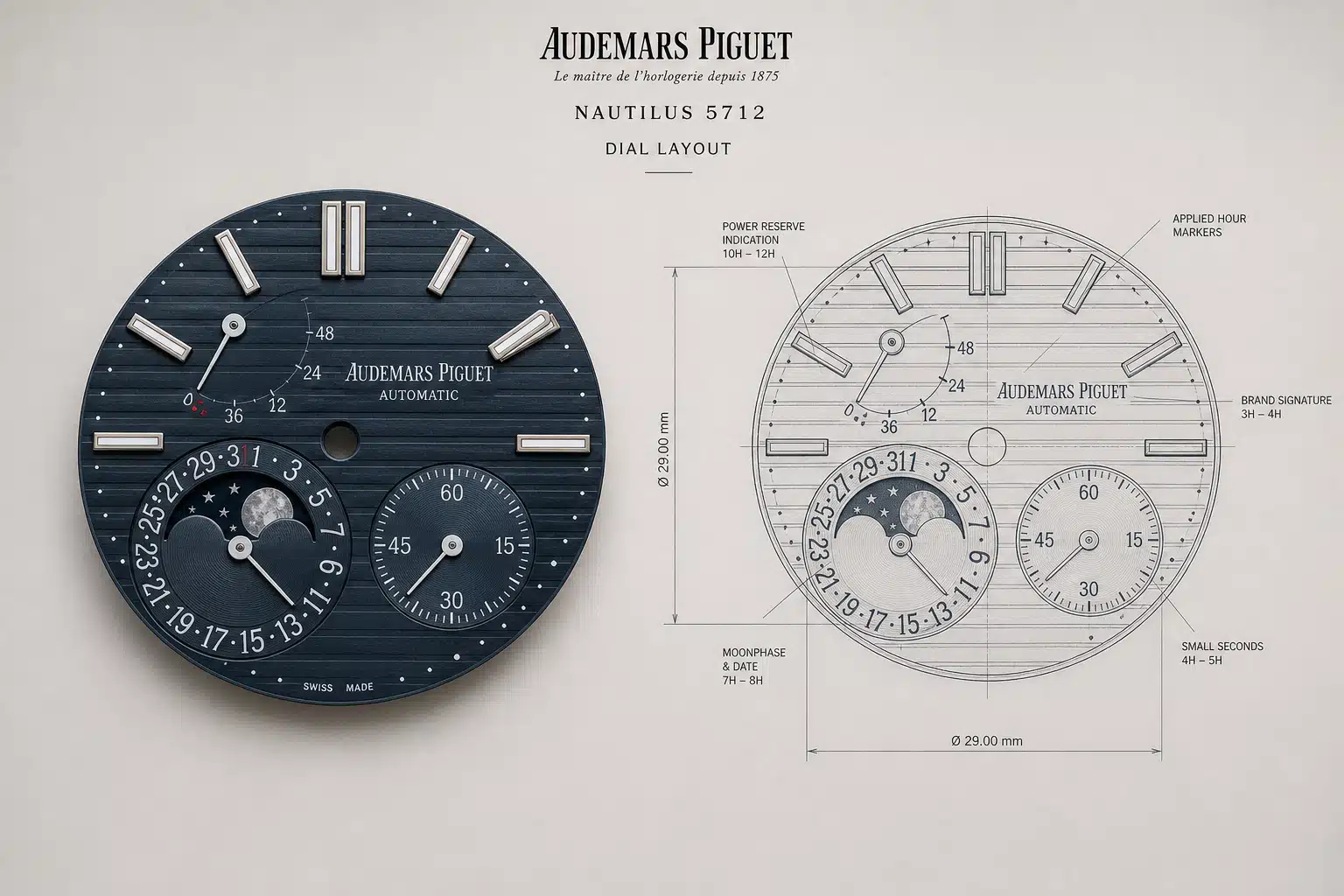
The Genuine 5712 Movement Layout and Why It Is So Thin
The genuine 5712 movement is the reference point that explains why replica makers spend so much attention on the clone 240 idea. The Nautilus 5712 is usually discussed around Patek Philippe’s thin 240 PS IRM C LU-style architecture, a micro-rotor automatic movement concept intended to support multiple displays while preserving a slim case. For replica buyers, the important point is not memorizing the full caliber name. The useful point is understanding that the genuine-style target is thin because the movement architecture is designed around thinness from the beginning.
A standard full-rotor automatic movement places a large winding rotor over much of the movement. That can be practical and robust, but it usually adds height. The Patek 240 micro-rotor concept uses a smaller off-center rotor set into the movement plane, helping the movement remain flatter. This is not just a prettier caseback arrangement. It is one of the reasons the 5712-style layout can combine automatic winding, a power reserve indicator, a moonphase display, subsidiary seconds, and a date display without the visual idea becoming a bulky sports watch.
That architecture creates a difficult target for any 5712 replica. The replica does not only need a dial that copies the positions. It needs a movement route that can live under that dial without forcing obvious distortions. This is the part many buyers miss: the genuine 5712 movement layout controls both what you see on the dial and how the watch wears from the side.
What Official Sources Can and Cannot Prove
Official Patek Philippe material is useful for understanding the authentic Nautilus family as an authorized product line, including current Nautilus model information such as case material, dial description, and movement naming on the Nautilus 5811/1G page.[1] That kind of source can clarify the brand-side reference point, but it should not be stretched into proof that any replica has the same movement architecture, finishing, water resistance, service support, or case execution.
For the 5712 replica buyer, this distinction matters because many listing descriptions borrow the language of the authentic watch. A phrase such as “Nautilus,” “micro-rotor,” or “clone 240” can describe the intended visual target, but it does not establish authorization, equivalence, or factory truth. The article therefore treats official brand information as context for the authentic design language, while treating replica movement claims as claims that must be checked through the individual watch, seller evidence, and QC photos.
Micro-Rotor Architecture in Plain English
A micro-rotor is a smaller winding rotor that sits off-center rather than covering the movement from the middle like a large semicircular rotor. In plain terms, it is a space-saving automatic winding solution. It allows the movement to remain thinner because the rotor does not sit as a tall layer above the entire movement.
That sounds like a small mechanical difference, but on a thin Nautilus it changes the whole result. A few extra fractions of a millimeter inside the case can affect the caseback, side wall, crystal relationship, and how the bracelet flows from the lugs. On a watch like the 5712, where the appeal is partly slimness and partly complication, the movement architecture is not hidden from the buyer. It shows up in the wearing experience.
This is why a micro-rotor replica movement is more relevant to the 5712 than it would be to many simpler watches. It is not automatically better in reliability or finishing, and it should not be treated as equal to the genuine caliber. But as a design route, it is closer to what the model needs than a thick automatic movement wearing decorative plates.
Movement Transparency Note: Movement references in this article describe the replica-market movement type or configuration, not an official Patek Philippe caliber unless explicitly stated with verifiable evidence. A clone 240-style or micro-rotor-style description should be checked through actual movement photos, case thickness, active function behavior, and seller clarification rather than treated as proof of genuine-equivalent construction.
How the Dial Displays Depend on the Movement
The power reserve, moonphase, date, and small seconds on the 5712 are not randomly placed graphics. Their positions come from the movement layout underneath. The power reserve indicator needs to connect to the mainspring state. The small seconds has to be driven from a specific part of the going train. The calendar and moonphase displays require their own routing and adjustment logic. When a replica tries to imitate this layout without a suitable movement architecture, the compromise usually appears as incorrect spacing, awkward hand positions, inactive displays, or added thickness.
This is the non-obvious reason the 5712 replica is harder than many buyers assume. The dial is asymmetrical, but it is not casual. If the replica treats that asymmetry as a surface design only, the watch can look busy without looking right. A stronger movement route gives the factory a better chance of placing the displays where buyers expect them and keeping the case profile closer to the intended shape.
At Clean VS Factory, we usually treat this kind of watch as a movement-layout decision before a cosmetic decision. A strong dial photo is useful, but for the 5712 it does not answer enough. The buyer still needs to know what movement route is being used and whether that route supports the watch’s proportions.
Movement Details to Verify Before Using Exact Numbers
Specific numbers can be useful, but they should be handled carefully. Thickness, power reserve, jewel count, beat rate, and exact caliber dimensions should be verified from current reliable sources before they are used as hard claims. Factory versions can change, seller descriptions can lag behind the actual batch, and movement labels in the replica market are not always applied consistently.
Official movement documentation can help buyers understand what a named movement is supposed to be when a listing mentions a standard caliber. For example, Miyota’s official 9015 page gives the manufacturer’s specifications for the 9015 movement, while Sellita’s SW200-1 technical document provides an official technical reference for that Swiss movement family.[2][3] Those documents do not prove that a specific 5712 replica contains either movement; they only show why movement names, dimensions, beat rates, and service expectations should be checked against the actual watch rather than accepted as listing language.
For buyer purposes, the larger judgment matters first: the genuine 5712 is thin because its movement architecture is thin, integrated, and designed around the complication layout. A replica trying to approximate that idea must be evaluated by more than the caseback engraving or the name attached to the movement.
What “Clone 240” Means in a 5712 Replica
In the replica market, “clone 240 movement” should be read as a claim that needs interpretation, not as proof that the movement is mechanically identical to the genuine Patek caliber. A more careful term is clone 240-style or 240-inspired micro-rotor replica movement. That wording matters because buyers are usually trying to understand three different things at once: whether the movement looks similar through the caseback, whether it supports the visible 5712 functions, and whether it truly matches the genuine architecture at an engineering level.
Those are not the same question. A decorated movement can look more expensive than it is. A movement plate can imitate bridge shapes or engraving without changing the basic construction underneath. A functional layout can move the moonphase, date, power reserve, and small seconds in a more believable way, but still fall short in finishing, tolerances, long-term serviceability, or setting feel. A buyer who treats “clone 240” as a guarantee may miss the actual tradeoff.
The practical judgment is simple: the clone 240 label is meaningful only if it improves the 5712 where the 5712 needs improvement. That means better dial layout support, a more appropriate rotor position, a thinner case architecture, and a caseback view that matches the model’s identity more closely. If it only adds decoration while leaving the watch thick or functionally compromised, the label is doing more marketing work than mechanical work.
Compliance Boundaries for Movement Language
Movement descriptions in the replica market should be checked carefully because they may refer to layout, decoration, clone architecture, or seller terminology rather than an official brand-manufactured caliber. For a 5712 replica, “clone 240” should not be read as “genuine Patek Philippe 240 movement,” “official caliber,” or “same movement as the authentic watch.” It is safer to treat the phrase as a replica-market shorthand that needs evidence from movement photos, dial-side function behavior, side profile, and seller explanation.
The same caution applies to terms such as “Swiss,” “micro-rotor,” “V3,” and “latest version.” Without specific proof, those words do not establish movement origin, factory authorization, long-term reliability, official service compatibility, or genuine-equivalent performance. A buyer should ask what the term means on the specific watch being offered: the base architecture, the decoration, the active complication layout, the rotor position, or simply the way the listing is being marketed.
The purpose of this movement discussion is buyer education and risk awareness, not authentication avoidance. A 5712 replica may look convincing in normal wear, but close inspection can still reveal differences in finishing, movement architecture, case proportions, bracelet feel, dial details, or service compatibility. It should not be represented, resold, or used as a genuine Patek Philippe watch.
Clone-Style Architecture Versus Surface Decoration
The difference between clone-style architecture and surface decoration is one of the most important distinctions in a 5712 replica. Surface decoration is mainly about appearance. It may include engraved bridges, a shaped rotor, colored screws, or plates designed to look closer to the genuine movement through the display back. These details can improve the first impression, but they do not automatically make the watch thinner, more accurate in function, or better to own.
Clone-style architecture is more ambitious. It tries to make the movement layout serve the watch rather than merely hide behind it. For the 5712, that means the movement should help support the asymmetrical dial and reduce the need for a bulky caseback, especially when Miyota 9015 thickness becomes a practical constraint in case construction. A buyer does not need to become a watchmaker to understand the difference. If the movement route still forces an awkward case thickness or questionable display behavior, attractive decoration is not enough.
This is why caseback photos should be read with some skepticism. A pretty replica caliber can be visually satisfying, but the real question is whether the movement helps the watch behave and wear like a 5712-style design. For this model, architecture is more valuable than ornament.
Why the Micro-Rotor Claim Needs Careful Reading
Not every “micro-rotor” claim means the same thing across sellers, versions, or batches. Some descriptions may refer to a genuine-style visual layout. Others may refer to a more functional movement route. Some may be copied from older listings and no longer describe the current watch accurately. This is especially relevant for buyers researching what is inside PPF 5712 versions, because version labels and movement descriptions can be repeated loosely in the market.
A careful buyer should separate the claim from the evidence. Does the movement photo actually show an off-center micro-rotor layout? Does the case profile look consistent with a thinner movement route? Do the dial displays sit where they should? Is the seller describing which functions are active and how they are adjusted, or only using broad language like “best version” and “clone movement”?
The right expectation is not that a clone 240-style movement equals the genuine 240 PS IRM C LU in finishing, engineering, or service quality. The better expectation is narrower and more realistic: a well-executed micro-rotor replica movement can make the 5712 more convincing than older decorated or thicker movement solutions, provided the specific watch, batch, and QC photos support the claim.
Traceability Questions for a Clone 240 Listing
A traceable clone 240 listing should help the buyer understand what is being claimed and what can be checked. The useful questions are specific: is the movement actually micro-rotor-style, are the 5712 displays active, how is the moonphase adjusted, does the power reserve respond to winding, and does the side profile show the thinner construction implied by the movement claim? A listing that answers only with a factory name or a single caseback photo leaves too much uncertainty for a complicated replica.
Movement trust in the replica market depends on understanding what the movement claim actually describes: architecture, decoration, layout, reliability, or simply a market name used by sellers. For the 5712, the safest interpretation is to treat “clone 240” as a configuration claim that should be verified through visible structure and function behavior, not as an official Patek Philippe caliber claim and not as evidence of genuine-level servicing or finishing.
How the Moonphase, Date, Power Reserve, and Small Seconds Should Behave
The visible functions are where a Patek 5712 replica either becomes convincing or starts to feel like a decorated dial. For a 5712 moonphase replica, the question is not only whether the hands and discs move. The better question is whether they move in a way that supports the logic of the watch: moonphase at the lower left, power reserve across the upper left, date and small seconds sharing the right side without looking crowded or randomly placed.
This is where buyers need to be careful with seller language. “Working functions” can mean several different things. It may mean the display is active, it may mean it responds correctly to winding or time adjustment, or it may simply mean the part moves in some way. Those are not the same ownership experience. A strong Patek 5712 replica functions better when the complication displays are not just alive, but believable in daily handling.
Moonphase Display: Visual Accuracy Versus Adjustment Reality
The moonphase is the emotional center of the 5712 dial. Even buyers who do not track the lunar cycle will notice whether the moonphase window sits cleanly, whether the moon disc looks properly positioned, and whether the display gives the dial the right asymmetrical weight. If the moonphase appears too low, too high, or visually flat, the whole watch loses the refined tension that makes the 5712 different from a simpler Nautilus.
The practical issue is adjustment. On a genuine high-end moonphase movement, the display is part of an engineered calendar system with predictable correction behavior. On a replica movement, especially across different batches, the moonphase may be functional but less convenient to set, less precise over a long cycle, or more sensitive to careless adjustment. That does not make it useless, but it does mean buyers should avoid assuming “moonphase works” equals genuine-style behavior.
The most sensible expectation is this: the moonphase should look correctly integrated and should advance in a believable way, but long-cycle precision and easy correction should be treated cautiously unless the exact movement version has been confirmed. For most buyers, visual placement and clean operation matter more than mathematical lunar accuracy over months.
Power Reserve Indicator: The Feature Buyers Should Not Assume
The power reserve display is the function buyers most often misunderstand. On the 5712, it is not a decorative extra; it is one of the clearest signs that the replica movement is trying to support the correct dial-side architecture. If the power reserve hand is purely decorative, frozen, or loosely connected to winding behavior, the watch may still look attractive in a front photo, but it becomes less credible as a 5712 replica.
A proper power reserve display should respond to the state of the movement. As the watch is wound, the hand should move toward the fuller side of the scale; as the movement runs down, it should gradually return. The exact range, speed, and smoothness may differ from the genuine watch, and some versions may simplify the behavior. The key buyer judgment is whether the feature is meaningfully functional or merely present.
This is one reason the Patek 5712 replica functions should be checked before purchase rather than inferred from the factory name. A version can have a better-looking dial and still leave uncertainty around the power reserve indicator. If a seller cannot clearly explain whether the power reserve is active, decorative, or partially functional, that is a reason to slow down.
Date and Small Seconds: Small Details That Reveal the Movement Route
The date and small seconds are less dramatic than the moonphase, but they reveal a lot about the movement route. The date subdial should not look like it was placed wherever the base movement allowed. It needs to sit naturally within the 5712 layout, with the hand centered, the printing readable, and the date display behaving consistently. A date hand that points between markings or sits awkwardly on the pinion can make the watch feel cheaper than the case and dial finishing suggest.
The small seconds also deserves attention because it is constantly moving. On a 5712 replica, small seconds motion should feel steady and intentional, not like an afterthought added to fill the dial. If the seconds hand sits too high, wobbles, drags, or appears slightly off-center, the issue is visible every time the watch is worn. This matters more than many macro-only flaws because the buyer sees motion before they see tiny printing errors.
Subdial spacing is the non-obvious point. A replica can have all the right named functions and still feel wrong if the date, moonphase, and small seconds are shifted by the movement underneath. The 5712 dial is asymmetrical but not random. The displays have to look tense, balanced, and mechanically related. When they look like separate decorations, the watch gives away the weakness of the movement solution.
Function Claims to Confirm Before Deciding
Before accepting a 5712 replica, buyers should confirm the active moonphase behavior, whether the power reserve display responds to winding and running down, how the date is adjusted, and whether the small seconds runs cleanly. These details may vary by version or batch, so current confirmation matters more than old forum language or a broad “clone 240” label.
The safest buying mindset is to separate four levels of function: a display that is printed, a display that moves, a display that moves correctly, and a display that can be adjusted conveniently without stressing the movement. Strong 5712 replicas may aim for the third category in the major displays, but buyers should not assume every claimed PPF-style or clone 240-style version reaches it equally.
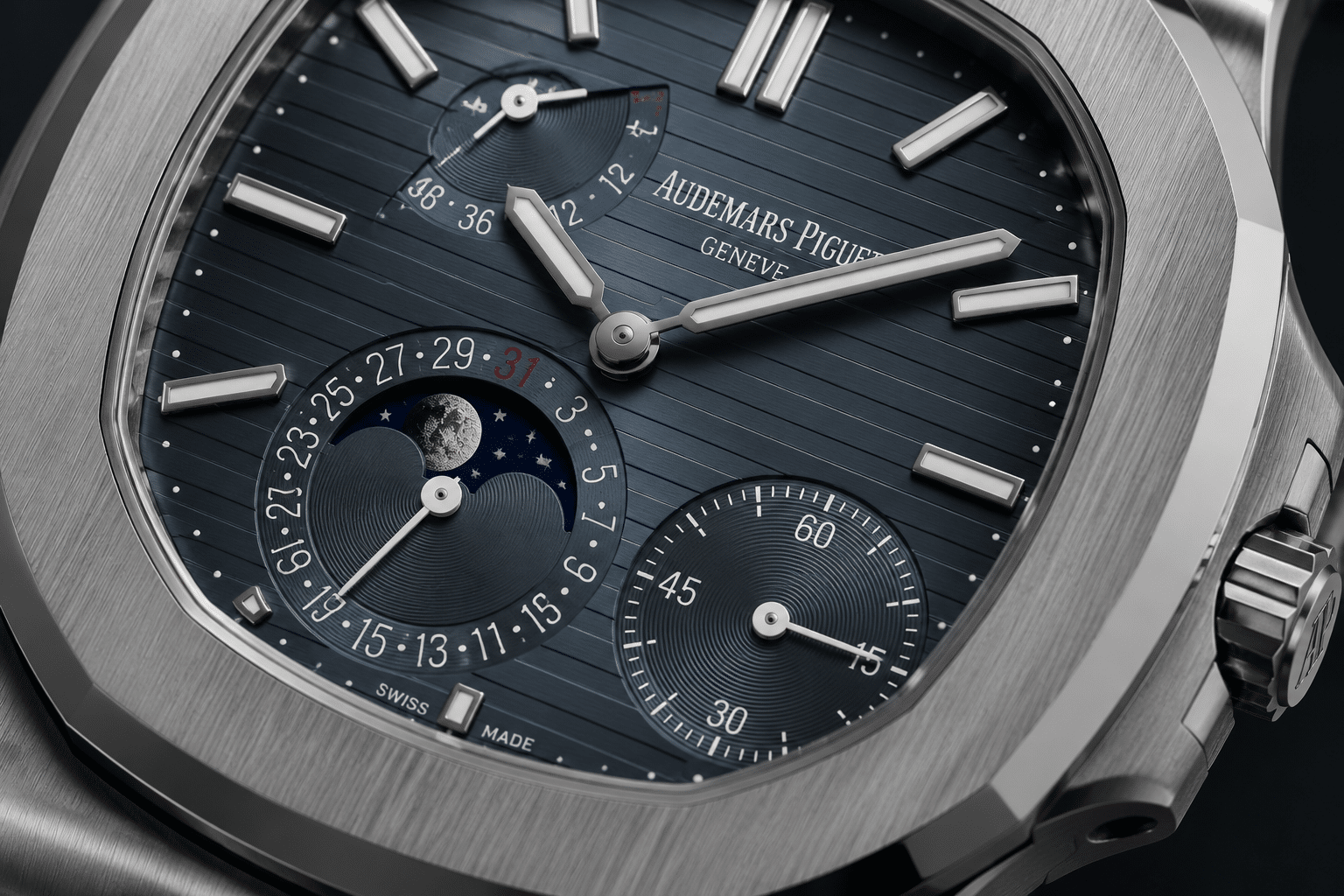
Case Thickness and Side Profile: Where the Movement Route Becomes Visible
A 5712 replica can look impressive from the front and still fall apart from the side. That is the uncomfortable truth of this model. The dial may show the moonphase, power reserve, date, and small seconds in familiar positions, but if the caseback is too tall or the mid-case looks swollen, the watch stops wearing like a slim Nautilus and starts wearing like a complication forced into the wrong shell.
This is why the 5712 replica case thickness matters more than it would on many simpler models. The original design logic depends on elegance. The Nautilus 5712 is not supposed to feel like a thick sports chronograph. A micro-rotor case profile helps because the movement architecture can reduce the need for a raised caseback, but it does not automatically guarantee genuine-level thinness or perfect proportions.
Why Front Photos Can Hide Thickness
Straight-on dial photos are useful, but they are also forgiving. They can show a clean moonphase window, a centered date hand, and a nicely colored dial while hiding extra height behind the case. Most thickness problems do not appear in the first photo a buyer sees. They appear in side angles, caseback views, and wrist shots where the case sits higher than expected.
The common mistake is judging a 5712 replica like a flat image. From the front, a thicker case may still look acceptable. On the wrist, the same watch may lose the thin, slightly refined profile that makes the 5712 attractive in the first place. Extra caseback depth changes how the watch sits, how the bracelet drops from the lugs, and how the watch feels under a cuff.
This is especially important for buyers asking whether the 5712 replica is too thick. The answer is rarely found in one number alone. A small thickness difference can be acceptable if the side profile, caseback transition, and lug flow are well handled. A poorly shaped case can look bulky even if the measured thickness does not sound extreme.
How Micro-Rotor Architecture Helps the Wearing Experience
The practical advantage of a clone 240-style or micro-rotor-style route is not only the caseback view. It is the possibility of a more believable external shape. A thinner movement route can help the factory keep the caseback flatter, the mid-case cleaner, and the watch better balanced on the wrist. For this model, that is a real improvement, not just a technical talking point.
A full-size automatic rotor or a thick base movement with added complication layers can push the watch upward. The result may be a case that looks acceptable in isolation but feels wrong for a Nautilus 5712. The micro-rotor approach is more convincing because it supports the idea of a slim complicated watch rather than a thick watch decorated to look complicated.
At Clean VS Factory, we usually treat thickness as part of the movement decision, not a separate cosmetic detail. If the movement route helps the dial layout but forces an awkward side profile, the buyer is still making a compromise. The better 5712 replica is the one where the movement, case thickness, and wrist presence work together.
Side-Profile Photos to Check
Useful side-profile photos should show the case from a neutral angle, not only a flattering tilted shot. Buyers should look at the caseback depth, the transition from case to bracelet, the lug-to-bracelet flow, and how the clasp sits when the watch is on the wrist. A caseback that appears overly domed or a bracelet that drops awkwardly from the head can make the watch feel less refined than the dial suggests.
The best question is not simply “how many millimeters thick is it?” The better question is whether the thickness looks natural for a slim Nautilus case. For the 5712, side profile is where the movement route becomes visible to the wearer, even if nobody else is examining the watch closely.
Why PPF V3 Became Important for the 5712 Replica
PPF V3 became important because the 5712 replica conversation moved beyond dial cosmetics. Buyers were no longer asking only whether the watch looked like a Nautilus from the front. They were asking whether the PPF 5712 V3 movement, case profile, and visible functions created a more coherent version of a complicated Nautilus replica.
That distinction matters. A better 5712 replica is not simply a better blue dial or a cleaner bracelet. It needs the complication layout, movement presentation, and case thickness to support the same design idea. PPF V3 is commonly discussed because it represents a more serious attempt to solve that model-specific problem. It should not be treated as proof that PPF is automatically the best answer for every Patek Philippe replica.
What Buyers Usually Expect From PPF V3
Buyers looking for a PPF 5712 replica usually expect several things from the V3 label: a more credible micro-rotor-style movement presentation, more believable dial-side function behavior, improved case proportions, and a better overall match between the movement route and the 5712 layout. Those expectations are reasonable, but they still need to be checked on the actual watch being offered.
The main attraction is the movement route. Older or weaker 5712 replicas could look busy from the front while relying on less convincing solutions underneath. A stronger version is valued because it makes the watch feel more purpose-built around the 5712 architecture. The buyer is not just paying for a name; they are paying for a better chance that the case thickness, complication placement, and caseback view make sense together.
This where “is PPF 5712 V3 worth it” becomes a more precise question. It may be worth it for a buyer who specifically wants the 5712 complication layout and understands why the micro-rotor upgrade matters. It is less compelling for someone who only wants a Nautilus-shaped watch and does not care about moonphase behavior, power reserve response, or side-profile accuracy.
Why Version Labels Still Need Verification
Version labels in the replica market are useful, but they are not enough. A seller may use “V3” because that is the market term buyers recognize, while the actual watch may come from a different batch, a transitional run, or a listing with incomplete movement information. With a complicated model like the 5712, the label should start the conversation, not end it.
Buyers should confirm the movement photo, caseback layout, dial-side display behavior, and side profile before treating a PPF V3 claim as meaningful. The movement should look consistent with the claimed route, the displays should sit correctly on the dial, and the case should not show the kind of thickness that defeats the point of the upgrade.
The controlled judgment is simple: PPF V3 is an important reference point for the 5712 replica, but it is still a version claim, not a guarantee. The safest buyer looks at the specific watch, the current batch, and the actual photos. For this model, factory reputation helps, but movement route and execution decide whether the watch makes sense.
It is also worth asking whether the seller can separate the factory-market name from the actual evidence. A clearer answer will usually describe the current version, the movement route, the visible micro-rotor layout, the functional displays, and the available QC views. A weaker answer leans only on “PPF,” “V3,” or “latest version” without explaining how those words connect to the watch in front of the buyer. CleanVSFactory’s editorial approach is to make replica watch decisions more traceable by connecting factory claims to visible details, movement behavior, version differences, and practical QC checks.
How to Read Price Differences on a 5712 Replica
Price differences on a 5712 replica can be meaningful, but they should not be read as a clean quality ranking. A higher price may reflect the movement route, a more recent batch, better finishing, tighter availability, seller margin, or the after-sale risk the seller is willing to carry. It may also reflect market demand around a version label such as PPF V3. None of those factors automatically proves that the individual watch has better dial alignment, smoother winding, or a more reliable power reserve display.
For this model, the more useful price question is what the extra cost is supposed to buy. If the premium is for a more convincing clone 240-style micro-rotor layout, the buyer should see evidence in the caseback photo, side profile, dial display placement, and function explanation. If the premium is only supported by broad language such as “best version” or “latest factory,” the price is less informative. A buyer comparing offers should ask whether the price difference changes the actual ownership experience or only the listing description.
Prices can change by factory label, version, movement configuration, seller channel, availability, and after-sales terms, so exact comparisons should be verified at the time of purchase. A listing that claims an unusually low price for a complicated 5712-style build should be checked against the stated factory version, movement photos, function explanation, and current QC evidence rather than accepted as a simple bargain.
Movement Finishing, Rotor Noise, and Service Expectations
A clone 240-style movement can make a Patek Philippe 5712 replica more credible, but it does not make the ownership experience equal to the genuine 240 PS IRM C LU. This is the point many buyers miss. The movement route matters because it supports the thinner case concept, micro-rotor appearance, and complication layout, yet clone 240 reliability still depends on assembly quality, lubrication, adjustment, and how carefully the owner handles the functions.
The practical judgment is simple: a well-executed micro-rotor replica movement is a better fit for the 5712 than a thick base movement hidden under decorative plates, but it should still be treated as a more delicate replica movement, not a carefree daily beater. The more the watch tries to reproduce the 5712’s complication architecture, the more buyers should pay attention to winding feel, rotor sound, setting resistance, and long-term serviceability.
Finishing Is Not the Same as Engineering
Movement finishing is one of the easiest areas to overvalue in a 5712 replica. A decorated bridge, engraved rotor, or closer-looking micro-rotor layout can improve the caseback view, but those details do not prove that the movement is built, adjusted, or finished to genuine-level standards. The visual side and the mechanical side are related, but they are not the same thing.
This matters because many buyers judge the PPF 5712 V3 movement from a single caseback photo. A cleaner rotor shape and better plate layout can show that the replica is using a more appropriate architecture, but Patek Philippe super clone movements still require scrutiny beyond QC photos, which cannot tell you whether the movement is dry, whether the train is clean, whether the calendar works smoothly, or whether the power reserve behavior is consistent after weeks of use. A movement can look convincing through the caseback and still have ordinary replica movement limitations inside.
At Clean VS Factory, we usually separate movement appearance from ownership confidence. For the 5712, the better question is not only “does the caseback look close,” but “does the movement route support the watch without creating unnecessary thickness, noisy winding, stiff setting, or fragile complication behavior.” That is a more useful standard than simply asking whether the bridges look attractive.
Daily Wear Risks Buyers Should Understand
Micro-rotor noise is one of the first things buyers should think about after visual accuracy. A central rotor movement often has more mass and more familiar winding behavior. A micro-rotor system is smaller by design, and in a replica movement it may produce a different sound or feel depending on the bearing, rotor weight, lubrication, and case construction. A quiet rotor is desirable, but silence should not be assumed just because the movement is called clone 240.
Winding feel also deserves attention. A healthy 5712 replica movement should not feel gritty, blocked, or uneven through the crown. Some resistance is normal in a complicated automatic movement, but a rough crown feel can suggest poor lubrication, excess friction, or a movement that was not assembled cleanly. This is one area where a simpler Nautilus-style replica can be less stressful for daily use, because fewer functions usually mean fewer setting points and fewer ways for the owner to mishandle the watch.
The setting process is another ownership risk. The 5712 layout involves multiple displays, and a replica movement may not behave with the same smoothness, tolerance, or adjustment logic as the genuine movement. Buyers should be cautious with quick adjustments, avoid forcing the crown or pushers, and confirm the correct setting method for the specific version before using the complications heavily. If a seller cannot clearly explain how the functions should be operated, that is a reason to slow down.
Serviceability is the final reality check. A 5712 replica movement service is not always as straightforward as servicing a common Miyota, ETA-style, or basic automatic movement. Some watchmakers may refuse complicated replica calibers, and parts availability can vary by movement version. This does not mean the watch is automatically a poor choice, but it does mean the buyer should not treat the clone 240-style route as risk-free. The 5712 is more interesting than a simpler Nautilus replica, and that interest comes with more mechanical exposure.
Water resistance should not be assumed from the Nautilus name, the case shape, or the presence of a screw-down-style crown. Buyers should confirm whether the specific replica watch has been tested and should treat it more cautiously around water than a genuine watch designed, tested, and serviced through official brand channels. A seller’s water-resistance statement should be read as a policy and testing question, not as something proven by appearance.
QC Checks That Matter Most for a 5712 Micro-Rotor Replica
5712 replica QC should be stricter than QC for a plain three-hand Nautilus. The reason is not that every tiny flaw matters equally. It is that the 5712’s asymmetric dial gives the eye more reference points, and the movement route affects both the dial layout and the case profile. A buyer checking PPF 5712 QC photos should look for evidence that the specific watch is well assembled, not just that the factory name or version label sounds right.
The strongest QC approach is to judge the 5712 in layers: dial display placement first, then side thickness, then caseback movement confirmation, then bracelet and clasp execution. Front-facing glamour photos are not enough. On this model, camera angle can hide a thick caseback, soften misaligned subdials, or make the moonphase window look more centered than it really is.
Verification Note: When possible, buyers should review real watch photos, dial details, clasp finishing, caseback structure, date alignment, side-profile thickness, and movement information before making a decision. Stock images, factory labels, and version names alone are not enough for a reliable judgment on a complicated 5712 replica.
Before making a decision, buyers should review real QC photos where available, including dial printing, hand alignment, moonphase window position, datewheel or date-hand centering, bracelet fit, clasp engraving, case thickness, caseback layout, and overall finishing. Factory labels and stock photos alone are not enough for a reliable judgment.
Dial-Side Checks for the 5712 Layout
The dial is where a 5712 micro-rotor replica either feels coherent or starts to look patched together. The moonphase window should sit cleanly in its opening, without looking crowded, high, low, or visually tilted. Because the moonphase is one of the most recognizable parts of the 5712, poor window placement is more damaging than a minor printing difference that only appears under macro inspection.
The power reserve hand should be checked for resting position and general alignment. Buyers should not assume that the display is correctly calibrated just because it is present. If the hand looks awkwardly parked, points outside the expected scale, or appears inconsistent across photos, ask for clarification before accepting the watch. On a 5712 replica, a power reserve display that looks careless immediately weakens the whole movement story.
The date subdial and small seconds deserve the same attention. Look for clean printing, centered hands, reasonable spacing, and a balanced relationship between the subdials and the surrounding dial text. The 5712 dial is intentionally asymmetrical, but it should not look random. A good replica keeps the visual tension controlled; a weaker one makes the dial feel like several displays were placed independently rather than driven by one coherent movement layout.
Caseback and Side-Profile Checks
The caseback photo is important because it helps confirm the movement route. Buyers should ask for a clear micro-rotor movement photo rather than relying only on a dial shot and a version claim. The point is not to use the caseback as proof of perfection. It is to verify that the watch being offered matches the claimed clone 240-style construction and does not rely on an older or less appropriate movement solution.
Side-profile photos are just as important. A 5712 replica can look impressive from the front while losing much of its appeal from the side if the caseback is too tall or the mid-case looks swollen. The Nautilus 5712 is supposed to feel thin, flat, and elegant for a complicated sports watch. If the side view makes the watch look bulky, the movement improvement is not doing enough practical work.
Good QC should include neutral side angles, a caseback view, and at least one wrist or clasp-side perspective when possible. These photos help reveal case thickness, lug-to-bracelet flow, and whether the watch sits naturally. For a 5712 replica QC review, the side view is not a bonus photo; it is one of the most decision-changing images.
What QC Photos Can Show and What They Cannot Prove
QC photos are useful evidence, but they are still limited evidence. They can show obvious dial alignment, hand placement, moonphase window position, bracelet fit, caseback layout, and whether the movement presentation matches the seller’s claim. They usually cannot prove lubrication quality, long-term power reserve consistency, calendar durability, rotor bearing condition, or how the watch will behave after several months of wearing and setting.
This is why buyers should avoid treating QC approval as a guarantee of long-term reliability. For the 5712, QC should answer whether the visible execution is acceptable and whether the claimed movement route appears plausible. Ownership confidence still comes from more practical signals: smooth crown action, clear setting instructions, realistic after-sale expectations, and avoiding watches where the seller cannot explain the active functions. The photos help reduce risk, but they do not remove it.
Seller Language That Deserves Extra Caution
Some listing phrases sound reassuring but do not provide enough useful information for a complicated 5712 replica. Claims such as “perfect 1:1,” “same as authentic,” “passes inspection,” “official factory,” or “genuine movement” should be treated carefully because they can blur the line between replica-market comparison and unsupported authenticity claims. A more useful seller answer explains the actual movement route, which functions are active, how the watch is adjusted, what QC photos are available, and what terms apply after purchase.
Buyers should also be cautious when factory labels are used as a substitute for evidence. “PPF V3” may be a helpful market reference, but it should not replace photos of the actual watch, movement-side confirmation, side-profile views, and function explanation. Factory names can be misused, version descriptions can be outdated, and stock images can hide differences between the listed watch and the watch being supplied.
The safest use of factory and movement information is to avoid overpaying or misunderstanding quality, not to misrepresent a replica watch as genuine. A buyer who keeps that boundary clear will ask better questions: whether the replica is coherent for its own category, whether the claimed version matches the photos, whether the functions behave as described, and whether the ownership risks are acceptable.
Bracelet and Clasp Checks Still Matter
The movement is the center of this article, but the Nautilus bracelet cannot be ignored. A convincing 5712 super clone still needs clean bracelet integration, smooth link finishing, a clasp that closes securely, and end links that do not show obvious gaps. The watch is thin and wide, so poor bracelet fit can make the whole piece feel cheaper even if the dial and movement look strong.
Buyers should check the first links where the bracelet meets the case, the brushing direction, polished bevels, clasp engraving, and whether the bracelet appears twisted or uneven in photos. These are not deep technical movement issues, but they affect daily wear immediately. A complicated movement will not save a watch that feels sharp, loose, or poorly integrated on the wrist.
Red Flags Before Accepting QC
The most serious 5712 QC red flags are visibly misaligned subdials, a moonphase window that looks off-center, a power reserve hand sitting in an odd position without explanation, unclear or missing movement photos, and side-profile images that suggest excessive thickness. Inconsistent version claims are also worth questioning, especially when the seller describes the watch as PPF V3 but cannot provide matching movement and caseback evidence.
Bracelet problems should not be dismissed either. Obvious end-link gaps, rough clasp action, uneven brushing, or a bracelet that does not sit straight can turn a visually attractive watch into a frustrating daily wearer. The smart move is to pause and request clearer photos or clarification rather than approving a watch because the factory label sounds correct.
Legal, Trademark, and Disclosure Boundaries
A Patek Philippe 5712 replica should be understood as an imitation product, not an authorized Patek Philippe watch and not a substitute for brand warranty, service, or authenticity. The USPTO describes counterfeit goods in relation to trademark misuse, which is why buyer-facing language should avoid implying that a replica is genuine, authorized, or officially connected to the trademark owner.[4]
Cross-border buying also deserves caution. U.S. Customs and Border Protection identifies intellectual property rights as a trade enforcement priority, and counterfeit or infringing goods can raise import and enforcement issues depending on the facts and jurisdiction.[5] This article does not give legal advice, but it treats customs, resale, disclosure, and trademark language conservatively because replica watches sit inside a broader counterfeit-goods risk category.
The Swiss watch industry is also a frequent target for counterfeiting, and OECD work on counterfeiting and the Swiss economy discusses fake Swiss watches within the wider trade in counterfeit goods.[6] That macro background does not prove anything about one seller, one shipment, or one factory version, but it does explain why replica-watch claims should be written carefully and why buyers should not treat “super clone” language as proof of authenticity or legal safety.
Realistic Buyer Expectations for a 5712 Super Clone
A 5712 super clone makes the most sense for a buyer who specifically wants the technical personality of the Nautilus 5712: the moonphase, power reserve, small seconds, date layout, micro-rotor concept, and slim complicated case profile. It is not the safest choice for someone who simply wants a low-maintenance Patek-style sports watch with the fewest possible ownership concerns.
The clear judgment is that the Patek Philippe 5712 super clone is a higher-expectation replica. It can be more interesting and more satisfying than a simpler Nautilus replica when the movement route, case thickness, and display behavior are well executed. It can also be more frustrating if the buyer expects the same ease of ownership as a basic time-and-date model.
A replica watch should be evaluated with realistic ownership expectations. Even a strong 5712 super clone can have limits in water resistance, long-term movement stability, servicing convenience, calendar durability, and close inspection compared with a genuine reference. The safer purpose of factory and movement information is to understand quality and risk more clearly, not to represent the watch as authentic or assume it will behave like an authorized Patek Philippe product.
Who the 5712 Replica Makes Sense For
The 5712 replica is best suited to a buyer who understands why the movement matters and is willing to judge the watch beyond the front dial photo. This buyer cares about the micro-rotor layout, wants the asymmetric complication display, and accepts that a more ambitious replica movement may require more careful handling. For that person, a strong clone 240-style version can offer a more convincing interpretation of the model than older decorated movement solutions.
It is also a sensible choice for buyers who are comfortable reviewing QC carefully. The 5712 rewards attention to detail. Moonphase placement, power reserve behavior, side thickness, caseback layout, and bracelet fit all tell part of the story. If those points check out, the watch becomes more coherent as a daily-wear object rather than just a complicated-looking dial.
Who May Be Better Served by a Simpler Nautilus
Buyers who want the lowest-risk daily wearer may be happier with a simpler Nautilus-style replica. A cleaner time-and-date model usually has fewer functions to adjust, fewer dial alignment risks, and a more straightforward movement expectation. It may not have the same technical character as the 5712, but it can be easier to live with.
This is where the popular “best replica watch” conversation often becomes too broad. The most impressive option on paper is not always the most rational one for the owner. If a buyer dislikes mechanical fuss, does not want to think about complication setting, or expects easy service access, the 5712 may be the wrong first step into high-end Patek Philippe replica watches.
The Final Decision Framework
Before choosing a 5712 super clone, the buyer should confirm the movement route, study the case thickness, understand which displays are functional, review clean QC photos, and keep service expectations realistic. Factory name matters, but it is not enough by itself. A PPF 5712 V3 claim should still be checked against the actual watch being offered.
The most sensible buyer treats the 5712 as a movement-led replica, not just a Nautilus with a more interesting dial. If the micro-rotor architecture supports the case profile, the visible functions behave as expected, and the QC photos show a balanced dial and clean side shape, the 5712 can be a rewarding choice. If those pieces do not line up, a simpler Nautilus replica is usually the more practical decision.
References
[1] Patek Philippe, “Patek Philippe Nautilus 5811 official specifications,” official brand model information for an authorized Nautilus reference, available at Patek Philippe Nautilus 5811 官方规格.
[2] Miyota, “Miyota 9015 official movement specifications,” manufacturer movement specification page for the 9015 automatic movement, available at Miyota 9015 官方机芯规格.
[3] Sellita, “Sellita SW200-1 official technical documentation,” manufacturer technical document for the SW200-1 movement family, available at Sellita SW200-1 官方技术文档.
[4] United States Patent and Trademark Office, “Counterfeit Goods Basics,” official educational material on counterfeit goods and trademark-related issues, available at USPTO Counterfeit Goods Basics.
[5] U.S. Customs and Border Protection, “Intellectual Property Rights,” official customs guidance page on intellectual property rights enforcement in trade, available at U.S. CBP Intellectual Property Rights.
[6] OECD, “Counterfeiting, Piracy and the Swiss Economy 2025,” OECD report section discussing counterfeiting and Swiss watches in the wider counterfeit-goods economy, available at OECD Counterfeiting and Swiss Watches.
Disclosure: This article is for general educational and comparison purposes only. Replica watches are not genuine products from the original luxury brands, and brand names are used only to identify reference designs or comparison topics. Factory names, movement descriptions, prices, availability, QC details, seller policies, and version information can change, so readers should verify important details with the seller before making a purchase decision. Replica watches should not be represented, resold, or used as genuine watches.