
When you search for a Richard Mille super clone, few phrases appear as often as “direct from Guangzhou factory.” It sounds like a shortcut to the best price and the highest quality batch. In reality, this claim is one of the most misleading in the replica watch market, often hiding a confusing mix of real producers, resellers, and dropshippers who have very different levels of control over the watch you actually receive. This article cuts through the marketing language to show you exactly what that phrase really means and how to evaluate the seller behind it. Instead of guessing whether a source is genuine, you will learn to judge a seller by specific behaviors: version awareness, batch-specific QC knowledge, movement familiarity, and after-sale accountability.
| What “Factory Direct” May Actually Mean | How This Affects Your Watch | What to Check as a Buyer |
|---|---|---|
| Actual factory with own production | Full control over parts, assembly, and batch quality; may sell singles at a premium | Ask about specific batch changes and case thickness from current movements |
| Dealer with direct factory access | Can request specific versions, QC rejects, and offer partial movement support | Look for batch-specific QC photos and willingness to reject defective units |
| Dropshipper with no inventory | Lowest price but zero control over the watch sent; no parts or technician for after-sale issues | Ask if they can show photos of your exact watch and describe realistic after-sale processes |
| Seller evading technical questions | Likely relies on generic stock images and has limited knowledge of the actual RM version | Test movement knowledge: Dandong vs. Shanghai clone, regulator arm presence, visible gear spin |
| Seller claiming source but lacking accountability | No incentive to help if a watch arrives misaligned or defective | Confirm inventory control and detailed version knowledge before trusting any claim |
Quick Questions Before You Read
Q: Does “direct from factory” always mean the price will be lower?
No. Real factories may charge more for single RM super clones, while suspiciously low prices often point to dropshippers who have no control over the actual watch.
Q: What single question reveals if a seller really knows the RM copy they are selling?
Ask about case thickness differences between specific movements or ask about crown alignment on the current batch. Sellers who deflect are likely resellers.
Q: If a watch arrives defective, does a “factory direct” seller always help?
Not necessarily. Only sellers with real inventory control and access to spare parts or technicians can offer meaningful after-sale support. Pure dropshippers have no such capability.
Q: Should I ignore “factory direct” claims completely?
Yes. Focus on verifiable signals: version awareness, batch-specific QC photos, movement knowledge, and willingness to reject defective units—not the marketing phrase itself.
Why “Direct from Factory” Destroys Buyer Judgment in the RM Replica Market
Imagine you are searching for a Richard Mille super clone. You have read the forum threads, seen the wrist shots, and know the price of a genuine RM 35-02 is somewhere north of $200,000. You are ready to explore the replica market. You open a search page, and within seconds, you see it repeated across multiple listings: “direct from Guangzhou factory,” “factory direct price,” “no middleman mark-up.”
The appeal is immediate and intuitive. Every buyer understands the logic of cutting out the middleman. In most industries, factory direct means lower cost, better communication, and more control over what you receive. When you see that phrase attached to a Richard Mille replica, your brain connects it to a better deal, a purer source, and a smarter purchase. The phrase feels like a shortcut past the confusion of a market you do not fully understand.
That feeling is precisely the problem.
“Direct from Guangzhou factory” is not a fact about supply chains. It is a framing device that short-circuits the questions a buyer should be asking. Instead of wondering who actually assembles the watch, what movement route it uses, which version batch it belongs to, or how the seller handles a defective unit, the buyer accepts the claim and moves toward payment. The phrase feels like an answer, but it is actually a barrier to the real investigation.
In the RM replica market, this phrase is especially dangerous because the supply chain is fragmented, multi-layered, and deliberately opaque. A seller who claims to be factory direct may be closer to the source — or they may be using the same marketing language as every other listing on the same page. The phrase itself tells you nothing about QC capability, version knowledge, movement selection, or after-sale accountability.
The natural temptation is to trust the claim that seems most efficient. But in this market, the most efficient-sounding claim is often the one that blocks the most important information. To evaluate the phrase, you first need to understand what it could actually mean.

Six Roles Hiding Behind “Direct from Guangzhou Factory” in the RM Supply Chain
The phrase “direct from Guangzhou factory” can describe at least six different types of market participants, each with a different relationship to the actual production process. The buyer’s goal should not be to determine whether the claim is true or false. It should be to identify what role the seller actually plays, because that role determines what the seller can control — and what they cannot.
Real Factory or Workshop
This is the entity that actually produces cases, dials, movements, or fully assembled watches. A real factory employs machinists, assemblers, and QC staff. It holds production tooling and controls the manufacturing process. The “factory direct” claim is technically accurate here, but these operations almost never sell individual watches to retail buyers. They deal in wholesale quantities, and the few that entertain single-watch requests typically charge a premium or direct the buyer to a distribution partner. For most buyers, dealing with a real factory is neither practical nor cheaper.
Assembler or Tuning Shop
An assembler sources components from multiple factories — cases from one, movements from another, straps from a third — and puts them together into complete watches. Some assemblers also offer tuning services, such as regulating the movement or replacing a bezel. The “factory direct” claim here is misleading if it implies the assembler manufactured the parts. The assembler controls final fit and finishing, which can be valuable, but they are not the original maker.
Wholesale Middleman
A wholesale middleman buys completed watches in bulk from factories or assemblers and holds local inventory in Guangzhou. They may sell to retail buyers as a secondary channel. The “factory direct” claim is partially accurate if the middleman controls stock they sourced directly. However, the middleman’s actual value lies in inventory availability and speed, not in any special access to production decisions or version updates.
Booth Seller or Stall Resource
This seller rents a physical or virtual position in a wholesale market such as the Zhanxi Clock Market or operates through a digital marketplace. They typically have no production involvement and no control over what they sell. The “factory direct” claim is almost entirely a marketing position. The booth seller buys from middlemen or assemblers and sells at a retail markup. They may not even know which factory made the watch they are offering.
Agent or Personal Shopper
An agent sources watches on behalf of specific buyers, often adding a service fee. The agent may not hold any inventory and may not have a regular supply relationship. The “factory direct” claim in this case is almost always an exaggeration. The agent’s value is in finding and coordinating a purchase, not in any proximity to production.
Dropshipper
A dropshipper takes customer orders and passes them to a third-party supplier who ships the watch directly. The dropshipper never touches the product. They have zero control over QC, version accuracy, packaging, or shipping condition. The “factory direct” claim here has the lowest credibility in the chain. The buyer is paying a retail price for a watch the seller has never inspected, from a source the seller may not even know.
Editorial Perspective: The key insight for any buyer evaluating a “direct from Guangzhou factory” claim is that the phrase does not predict the most important aspects of the purchase — namely, which model will perform best for daily wear, which movement choice balances visual accuracy with reliability, and which factory’s version of a specific RM model is actually worth pursuing. Factory reputation in the RM replica world does not apply uniformly across all models. A producer known for a strong RM 35-02 may deliver a mediocre RM 055 because the case geometry, movement fitment, and skeleton dial execution differ significantly between models. Likewise, a movement that offers the best visual skeleton layout — perhaps a Dandong clone with visible gear axles — may be harder to service or more sensitive to shocks than a simpler Shanghai-based movement that sacrifices some visual depth for better reliability. At cleanvsfactory.com, these tradeoffs are treated as model-specific buying questions rather than simple factory rankings. The buyer’s real decision is not whether a seller is factory direct. It is whether the specific combination of factory, movement, version, and batch fits the buyer’s own priority between visual accuracy, daily wear trust, and long-term serviceability.
Factory Name Clarification: Factory names in the replica watch market are commonly used buyer-facing labels. They should be treated as practical market references, not as official brand affiliations, audited manufacturer identities, or guarantees of identical quality across every model.
Why “Factory Direct” Does Not Mean Lower Price in the RM Replica Market
The assumption is reasonable on its face: fewer intermediaries should mean lower cost. If a seller claims to be closer to the factory, the buyer naturally expects a lower price. In the RM replica market, this assumption usually fails for three reasons.
First, real factories and assembly workshops rarely want retail relationships. A single-watch transaction creates packaging work, courier coordination, payment handling, and customer communication that a production operation is not set up to manage. The factory’s business is making watches in volume. When a factory does sell a single watch, the price may actually be higher than a middleman’s retail price, because the factory treats it as a nuisance transaction. The buyer pays a premium for direct access, not a discount.
Second, sellers who are farther from the factory can sometimes charge less. A dropshipper or agent may operate on very thin margins, using low overhead and minimal accountability to offer prices that undercut sellers holding local inventory. A buyer who sees a low price on a listing claiming factory direct may actually be dealing with a dropshipper who has no QC capability and no after-sale support. The low price is not a sign of efficiency. It is a sign that the seller has nothing invested beyond the listing.
Third, the wholesale middleman — the role that most commonly serves retail buyers — typically operates on a predictable markup that reflects inventory risk, QC screening, and local handling. Their price is often higher than a dropshipper’s but lower than a booth seller’s. The “factory direct” claim does not help the buyer determine which of these scenarios they are in. Two sellers using the same phrase may be operating at completely different cost structures, for completely different levels of accountability.
In practical terms, a buyer should stop asking whether a seller is factory direct and start asking what the seller actually controls. A seller who holds stock and inspects units before shipping is likely worth a higher price, regardless of the claim. A seller who cannot describe the version, the movement, or the batch is a risk at any price, no matter how direct they claim to be.
Another important nuance: price differences between listings for the same RM model may also reflect whether the seller is offering a simpler version with fewer potential failure points versus a more complicated iteration that replicates more features. A stripped-down RM super clone with a closed case back and a basic movement is inherently less risky for a first-time buyer, because there are fewer decorative bridges, skeleton plates, or complex gears that could arrive misaligned or fail during normal winding. A fully skeletonized version with visible gear trains, multi-level bridges, and a decorated movement that attempts to replicate the genuine caliber’s layout may be more visually impressive, but it introduces more opportunities for hidden defects — a loose skeleton plate, a balance wheel that stops after a bump, or a crown stem that does not align cleanly with the open case structure. The price difference between these two versions may reflect the movement complexity and the risk, not just the factory source. A buyer who assumes that a higher price from a “direct from factory” seller always means a better watch may end up with a more fragile piece that requires more attention and more frequent servicing than a simpler, cheaper alternative from the same claimed source.
What a Real Factory Connection Looks Like vs. a Marketing Story
The phrase “direct from Guangzhou factory” sounds concrete, but in practice, it tells you almost nothing about the seller’s actual relationship to production. The real question is not whether a seller claims factory access, but whether their behavior supports that claim. Once you know which behaviors signal genuine supply chain involvement and which ones belong to a marketing script, the phrase becomes much easier to evaluate.
A seller with a real factory connection typically demonstrates version awareness. They can tell you not just which model they are selling, but which iteration of that model is currently in production. An RM 35-02, for example, has gone through multiple versions from different factories. A seller who knows that the latest batch from a given factory corrected the bezel thickness or changed the movement decoration is describing something they have actually observed. A seller who cannot name the version difference or simply says “this is the latest” is repeating a line that works on any listing.
Batch photo behavior is another clear signal. A seller with genuine access to factory output can usually provide photos of the actual unit you will receive. They may have access to multiple watches from the same production run, which means they can pick one with better alignment or cleaner finishing. A seller who only has one or two generic photos, or who sends the same stock image to every buyer, likely does not hold inventory and has no control over which watch ends up in your hands. The distinction matters because batch variation in RM replicas is real. Some units from the same factory run look noticeably better than others, and a seller who cannot show you yours cannot guarantee its quality.
Willingness to discuss movement routes is also instructive. A seller with a real connection to assembly or factory operations can explain whether a given RM uses a Dandong clone, a Shanghai movement, or a modified Miyota, and what the practical trade-offs are between them. They might note that the Dandong version is closer to the original’s gear layout but slightly thinner, or that a certain movement route affects the case thickness by a millimeter or two. This level of detail is hard to fake consistently. A seller who deflects movement questions with “all movements are high quality” or “we only use the best” is avoiding a topic they cannot speak to with confidence.
Handling of QC rejections offers perhaps the most direct behavioral test. A seller who has genuine access to factory inventory can reject a unit that has a visibly off-center dial, a poorly aligned bezel, or a crystal with too much dust under it. They can show you the replacement and explain what was wrong with the first one. A seller who cannot offer any QC selection, or who insists every watch is perfect without showing evidence, is almost certainly not choosing from factory stock. They are forwarding orders to a supplier and taking no role in quality control.
None of these signals alone proves a seller is factory direct. But when a seller demonstrates version knowledge, provides batch-specific photos, discusses movement trade-offs with precision, and shows a willingness to reject bad units, the pattern becomes meaningful. A real factory connection shows in what the seller knows, not just what they claim.
There is also a quieter signal worth paying attention to: how the seller responds when asked whether a particular RM model is “forgiving” — meaning whether its simpler case shape, dial layout, or movement design makes it less likely to show flaws in daily wear. An RM 27-01, with its flat, simple case geometry and minimal crown guards, is mechanically easier to replicate cleanly than an RM 11-03, which has a more complex curve profile, multiple pushers, and a date wheel that must align precisely with a skeleton dial window. An informed seller who acknowledges these differences — who can say “the 27-01 is a safer choice for first-time buyers because the case shape is simpler and the crown alignment is less critical” — is showing product judgment beyond listing copy. A seller who insists every model is equally well-made is either inexperienced or deliberately flattening the evaluation to make the sale.
Quality Control Note: For replica and super clone watches, buyer confidence depends on visible quality-control details such as case finishing, dial printing, bezel alignment, bracelet fit, clasp engraving, datewheel position, and movement configuration. These details should be checked model by model rather than assumed from a factory name alone.
The Version and Movement Knowledge Test: What a Real Factory Contact Should Be Able to Explain
One of the most effective ways to test a seller’s claim of factory access is to ask specific technical questions. Sellers who actually handle inventory from production sources tend to know the details because they see watches arrive, compare them to previous batches, and hear feedback from buyers. Sellers who are repeating marketing language tend to offer vague confidence without substance. The difference becomes visible within two or three questions.
A well-informed seller should be able to answer the question: “Which version is this, and what changed from the previous batch?” For a popular RM model like the 35-02 or 055, factories frequently update details—slightly different movement bridge finishing, a corrected crown position, a more accurate carbon pattern, or a thinner case profile. A seller with real access can say something like “this is the V3 from this factory; they updated the skeleton layout to show more gear movement through the dial” or “the V2 had a thicker mid-case, and the current batch pulls that back by about half a millimeter.” A seller who responds with “it is the latest version, everything is improved” is not demonstrating knowledge. They are protecting themselves from being pinned down.
Another revealing question is: “Is this the Dandong clone or the Shanghai clone, and how does it affect the case thickness?” The movement route in an RM replica directly determines case proportions. A Dandong RMUL2 clone is generally thinner and closer to the original’s dimensions. A Shanghai-based movement often adds a millimeter or more of thickness because the base caliber was not designed for the RM case architecture. A seller who knows which movement is inside the watch, and can describe how that choice changes the visual profile, is showing real product familiarity. A seller who says “it is a high-quality automatic movement” or “we use the best movement available” has not answered the question because they likely do not know the answer.
You can also ask: “What is the power reserve, and does the balance wheel have a regulator arm?” This question targets one of the most persistent differences between genuine and replica RM movements. Genuine RM calibers use free-sprung variable-inertia balances with no visible regulator. Most replica movements still use a standard regulator arm, which is visible through the skeleton dial and is a well-known tells. A seller who understands this distinction can explain whether the current batch uses a free-sprung balance or a regulated one, and what that means for accuracy and visual authenticity. A seller who does not know what a regulator arm is, or who says “it is exactly the same as genuine,” is either uninformed or misrepresenting the product.
A fourth question worth asking: “Does the winding rotor show the correct skeleton layout through the case back, and does any gear spin visibly when winding?” RM replicas vary widely in how much of the movement structure is visible. Some budget versions use blank decorative plates that hide most of the gear train. Better versions show at least partial axle exposure or visible wheel movement. A seller who regularly handles watches from a given production line can describe exactly what you will see through the crystal and case back. A seller who says “it is a working movement, don’t worry” is not giving you useful information.
The goal of these questions is not to trap the seller. It is to see whether the person on the other side of the conversation has actually handled the product they are selling. A seller who answers with specific, verifiable detail has real involvement in the supply chain. A seller who answers with general reassurance is likely a reseller or dropshipper repeating phrases they copied from a listing.
The Limits of Movement Labels: What a Movement Name Really Describes
When a seller tells you a watch uses a “Dandong clone” or a “Shanghai clone,” the label provides useful information, but it also leaves out critical details that can affect your buying decision. Understanding what these movement names actually describe helps you evaluate both the seller’s knowledge and the watch’s real performance potential.
A movement label such as “Dandong clone” generally refers to a movement whose layout, bridge structure, and gear train arrangement are copied from a specific genuine RM caliber, often the RMUL2 or a similar ultra-thin skeleton base. The visual benefit is that the bridges are shaped in the same pattern as the genuine movement, and the gear wheels sit in similar positions relative to the dial openings. In better versions, the rotor design also follows the genuine layout, with a similar skeleton cutout pattern and an unbranded surface that mimics the original’s workshop finish. The case thickness may be closer to the genuine reference because the movement was designed to fit into a dimensional envelope that matches the original architecture.
However, the label alone does not tell you whether the movement uses a free-sprung balance or a regulated one, how many hours of power reserve it actually achieves, whether the gears are properly jeweled or merely decoration, or how easily the movement can be serviced if a problem arises. A Dandong clone from one production batch may have better barrel torque and more consistent gear spacing than a Dandong clone from another batch, depending on assembly quality and parts sourcing. The factory name and movement label describe a starting point for research, not an endpoint for trust.
The same caution applies to Shanghai-based movements. These are generally adapted from a standard Asian caliber that has been modified to fit into the RM case and to provide a skeleton appearance through the dial. The visual layout is often less faithful to the genuine movement — the bridges may be shaped differently, the gear positions may be farther from the dial openings, and the rotor may use a simpler skeleton pattern. But these movements are sometimes more reliable in practice because they are based on a robust base platform that was not designed to be as thin. The extra thickness, which is a visible compromise, also means the mainspring barrel and gear train can be physically larger and less prone to stopping or slipping under casual wear. A buyer who prioritizes reliability over visual depth may find a Shanghai-based movement a more practical choice, even though the label sounds less impressive.
This distinction matters because some sellers use movement labels as a shortcut to claim quality without acknowledging the trade-offs. A seller who markets every Dandong-based watch as superior may be ignoring the fact that a thinner movement case can sometimes be harder to align during assembly, increasing the risk of crown stem misalignment or dial shift. A seller who dismisses every Shanghai-based watch as inferior may be overlooking the benefit of a thicker, more robust base. The most useful approach is to treat movement labels as one data point among several — case finishing, version history, QC photo evidence, and the seller’s willingness to discuss specific differences — rather than as a definitive ranking.
QC Photos and Seller Accountability: What a Direct Seller Should Be Willing to Show
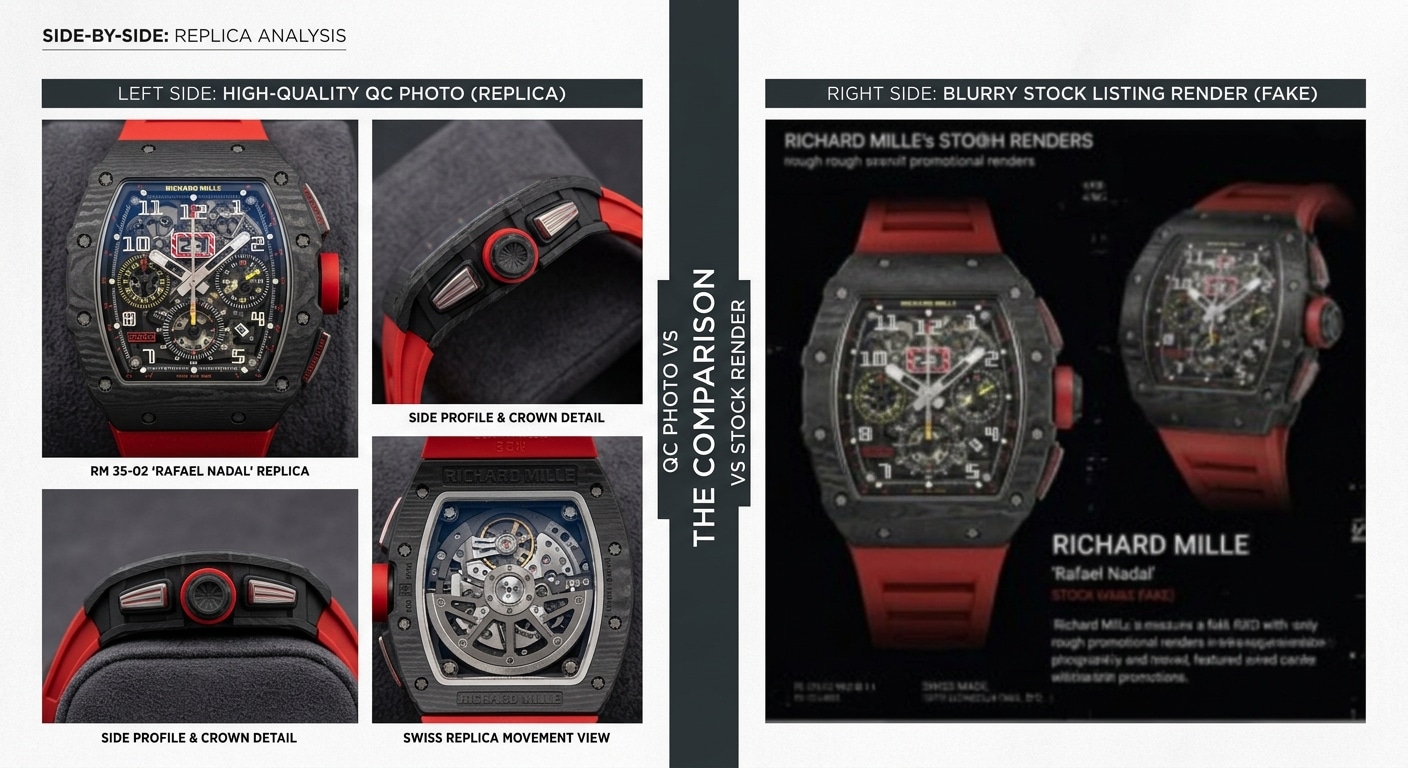
QC photos are the most direct way to verify what you are actually buying. They are also one of the strongest behavioral indicators of a seller’s real position in the supply chain. A seller who claims to be factory direct should have the ability to photograph the exact watch you will receive, from multiple angles, before shipping it. A seller who cannot provide that service is almost certainly not selecting inventory or handling the product personally.
For Richard Mille replicas, certain photo angles carry more information than others. A case side profile reveals the thickness of the watch relative to its size, which is one of the most consistent differentiators between good and mediocre RM replicas. A seller who can show you the actual side-by-side thickness at the crown and at the 9 o’clock position is demonstrating that they have the unit in hand. A stock photo from a manufacturer’s catalog will often hide the thickness discrepancy by using a straight-on angle.
A skeleton dial shot, taken head-on with good lighting, shows the depth and structure of the movement layout. In a genuine RM, the gears and bridges sit at different levels within a deep, open case. In a better replica, the skeleton effect should show visible depth rather than a flat printed surface. The photo should also reveal whether the balance wheel is visible through the dial and whether any gears move when the crown is turned. This is hard to simulate with stock images, so a seller who cannot provide a dial close-up of the actual watch is raising a red flag.
A case back photo with the movement exposed is another essential angle. It reveals the bridge layout, the quality of engraving, and whether the movement uses decorated plates or real skeleton bridges. Many cheaper RM replicas place a solid metal plate over a standard movement and engrave decorative lines onto it. A real skeleton movement should show open spaces where you can see the gear train. A seller who claims factory direct but sends a case back photo that looks too clean, too symmetrical, or clearly different from known factory examples is likely showing a generic product render.
A crown and pusher alignment shot matters more for RM models than for simpler watches. The tonneau case shape means crown guards, pushers, and the winding stem must align precisely with the case profile. Misalignment of even half a millimeter is visible on a watch this distinctive. A seller who can show you the crown pulled out to the time-setting position, and verify that the stem aligns cleanly with the case, has actually inspected the unit. A seller who avoids showing this angle may already know there is a misalignment that would be visible in a QC photo.
The relationship between photo quality and seller accountability is straightforward. A seller who can provide real, well-lit photos of the exact watch from these four angles is holding inventory and performing quality checks. A seller who relies on manufacturer renders, blurry distant shots, or the same image across multiple listings is not factory direct in any meaningful sense. If a seller claims factory direct but cannot show the actual watch, the claim is weaker than the marketing suggests.
There is one more dimension to QC photos that buyers often overlook: what the photos do not show can be as revealing as what they do. A seller who provides clear front and case back shots but never shows the crown at an angle, or the clasp engagement, or the thickness next to a ruler, may be selectively framing the watch to hide a known weakness of the current batch. For example, an RM 35-02 replica from a certain factory may have a beautiful dial and case back engraving, but the crown stem may sit slightly high relative to the case opening, creating a visible gap. That gap will not appear in a straight-on dial shot, but it will be obvious in a side profile with the crown pulled out. A seller who is aware of this batch weakness — and who can point it out voluntarily or offer to select a unit with better alignment — is showing real product integrity. A seller who avoids certain angles entirely is not being deceptive in any provable way, but the pattern is worth noting. The most useful QC set is not the one that looks the most polished. It is the one that gives you enough information to make your own judgment about whether a specific batch flaw is acceptable for your intended use.
The After-Sale Responsibility Gap: What “Factory Direct” Does Not Cover
Most buyers fixate on where a watch comes from. They rarely ask what happens if something goes wrong after it arrives. This is the single most overlooked dimension of the “direct from Guangzhou factory” claim, and it is where the gap between marketing and reality is widest.
A seller’s ability to get inventory out of Guangzhou has nothing to do with their ability to handle a movement failure, a wrong version shipment, or a clasp that breaks on day three. A real factory-adjacent seller who holds stock and assembles watches may be able to offer partial support—perhaps a movement swap or a parts replacement within a limited window. They have access to the components and the skill to make repairs. But that is not the same as a return policy, a warranty, or a dispute resolution process. It is goodwill, not infrastructure.
Compare that to a dropshipper or a pure reseller. They take your order, forward it to a supplier, and the supplier ships directly. The seller never touches the watch. If the movement stops running, the dial has a misalignment, or the bezel arrives loose, the reseller has no parts, no technician, and no incentive to help. Their margin is thin, their role ends at forwarding the order, and their response to a problem is often silence or a partial refund offer that barely covers shipping. The “factory direct” claim gives you no information about which of these scenarios you are walking into.
Here is a realistic framework for evaluating after-sale capacity before you buy. Ask what happens if the watch arrives with a visible defect. A seller with real capability should be able to describe their process—whether they will replace the unit, offer a partial solution, or send spare parts. Ask about movement failure within the first month. A seller who sources and assembles watches can often address this. A seller who only forwards orders cannot. Ask how disputes are handled. If the answer is vague, that is your warning. The seller who can stand behind the watch is more valuable than the seller who can only claim to be close to the source.
In the RM replica market, where movements are complex and case construction is demanding, the risk of a post-purchase issue is higher than with simpler watches. The phrase “direct from Guangzhou factory” tells you nothing about whether the seller has the capability or willingness to handle that risk. The source matters less than the seller’s willingness to stand behind the watch.
The Forgotten Variable: How the RM Model’s Complexity Changes What “Factory Direct” Means
There is an additional layer that many buyers overlook when evaluating a “direct from Guangzhou factory” claim: the specific Richard Mille model itself determines how much the factory source actually matters. Not all RM replicas are equal in production difficulty, and a seller’s ability to deliver a good result varies not just by their supply chain position but by the mechanical and visual demands of the particular model they are selling. This variable is almost never discussed in marketing copy, yet it is one of the most useful tools for separating genuine supply chain knowledge from generic salesmanship.
Consider the difference between an RM 27-01 and an RM 11-03. The RM 27-01, with its flat, rectangular case profile, minimal crown guards, and relatively simple dial layout, is mechanically easier to replicate to a convincing standard. The case geometry is less demanding to machine, the crown alignment is less critical to the overall visual impression, and the movement can sit fairly simply inside the case architecture. A seller who claims factory direct and offers this model is making a lower-risk claim because the production difficulty is lower. Many assemblers and even some booth sellers can source a passable RM 27-01 without a deep factory relationship. The model itself is forgiving of supply chain distance.
An RM 11-03 is the opposite. It requires a more complex tonneau curve profile, multiple chronograph pushers that must align precisely with the case, a date window integrated into a skeleton dial, and a movement with a reliable chronograph function that does not interfere with the watch’s visual depth. The case machining is far more demanding. The movement must fit within a tighter dimensional envelope. The dial skeletonization must leave room for the date mechanism without looking cluttered. A seller who can consistently deliver a well-executed RM 11-03 likely has a real connection to a factory or assembler that can handle that level of production complexity. A seller who claims factory direct but offers only the simplest RM models may be exaggerating their supply chain position, because the models they sell do not require deep factory access to produce at a reasonable quality level.
This leads to a practical heuristic: when evaluating a seller’s claim of factory direct status, look at which RM models they actually handle well. A seller who can offer multiple versions of a complex model — such as an RM 11-03 with a Dandong clone movement, proper crown alignment, and a readable date window — is more likely to have genuine factory access than a seller who only carries the easiest models. The complexity of the model tests the seller’s supply chain depth more honestly than any single question about version numbers. A buyer can use this as a cross-check: if the seller’s strongest model is the simplest, their factory connection is probably thinner than they claim.
Another dimension of model-specific nuance is the skeleton depth. Some RM models, like the RM 055, rely heavily on a deep open dial where the gear train, bridges, and balance wheel are all visible in layers. A replica that lacks this depth — where the skeleton dial looks flat or uses printed details instead of cut-out bridges — is immediately distinguishable to anyone familiar with the genuine watch. A seller who understands skeleton depth is not just describing dial decoration; they are describing a fundamental aspect of the watch’s visual identity. A seller who cannot discuss this, or who brushes it off as a minor detail, is unlikely to be sourcing from a factory that prioritizes that aspect of the build. This kind of technical awareness is a stronger signal than any general claim about factory sourcing, because it shows the seller knows what makes a specific RM model convincing or unconvincing in hand.
How to Evaluate Any “Direct from Guangzhou Factory” Claim in Three Steps
The phrase “direct from Guangzhou factory” is a starting point, not a conclusion. By now, you understand that it can mean a real factory, an assembler, a wholesale middleman, a booth seller, an agent, or a dropshipper. The label alone does not tell you which one you are dealing with. These three steps give you a way to find out.
Step 1: Identify the seller’s actual role in the supply chain. Do not accept the phrase at face value. Ask specific questions: Do they hold inventory, or do they order after you pay? Can they show you the same model in multiple units, or do they only have one set of photos? A seller who controls stock can usually provide batch or serialized photos. A seller who does not control stock will have limited visual evidence. Their willingness to answer these questions tells you more than their listing copy does.
Step 2: Test their version and movement knowledge. A seller with real factory access should be able to tell you which version a watch is, what changed from the previous batch, and which movement route it uses. Ask about case thickness differences between Asian clone and Swiss clone movements. Ask whether the balance wheel is free-sprung or regulated. A seller who gives vague or promotional answers is not connected to the production process. A seller who can explain the technical details is more likely to be what they claim.
Step 3: Verify QC transparency and after-sale accountability. Ask for QC photos of the exact watch you will receive, not stock images. A real factory-adjacent seller can show you the front, side profile, case back, and movement view of the actual unit. Then ask about after-sale support. What happens if the movement fails? What happens if the watch arrives with a defect? A seller who can describe a realistic process is taking responsibility. A seller who cannot is selling a story.
A seller who can pass these three steps is more likely to be what they claim. A seller who cannot is selling a story, not a watch. The phrase “direct from Guangzhou factory” may get your attention, but it should never close your judgment. What matters is not where the seller claims to sit in the supply chain, but what they can actually show, explain, and stand behind.
Understanding the Limits of Factory Names and Movement Claims in RM Super Clones
Throughout this article, the focus has been on evaluating the seller behind a “direct from Guangzhou factory” claim. But there is a parallel trust consideration that applies to the product itself: factory names and movement descriptions in the RM replica market can be just as misleading as the sourcing claim. A seller who passes all three steps — who holds inventory, answers version questions accurately, and provides real QC photos — may still be using factory labels and movement names in ways that require further clarification. Understanding what these labels can and cannot prove is essential for making a well-informed decision.
Factory names in the replica watch market are useful buyer-facing references, but they should not be treated as official luxury-brand affiliations or automatic guarantees of quality across every model. A factory known for a strong Daytona replica, for example, may not produce the best RM 35-02, because the case architecture, skeleton dial requirements, and movement fitment for a tonneau-shaped watch are entirely different from a round Oyster case. Similarly, a movement label such as “Dandong clone” or “Shanghai clone” describes the movement’s architecture and visual layout, but it does not by itself guarantee reliability, finishing consistency, or long-term serviceability. Buyers should distinguish between movement layout, decoration, reliability, and actual serviceability when evaluating a watch.
Visual accuracy should be judged through specific details rather than broad claims. Case thickness, lug shape, dial texture, bezel tone, hand length, date magnification, and bracelet construction can all affect how convincing a watch feels in real use. A seller’s claim that a watch is “1:1” or “perfect” is less useful than a side-by-side comparison of case dimensions, a close-up of the skeleton dial depth, or a measurement of crown alignment. Claims such as “same as genuine,” “indistinguishable,” or “guaranteed to pass inspection” should be treated with caution. A more reliable comparison looks at the actual model version, movement configuration, finishing details, and available QC evidence.
For CleanVSFactory, the goal is to make replica watch decisions more traceable by connecting factory claims to visible details, movement behavior, version differences, and practical QC checks. The buyer’s real decision is not whether a seller is factory direct. It is whether the specific combination of factory, movement, version, and batch fits the buyer’s own priority between visual accuracy, daily wear trust, and long-term serviceability.
Replica watches are not genuine products from the original luxury brands, and brand names are used in this article only to identify the reference designs or comparison topics being discussed. Factory names, movement labels, and version information should be cross-checked with current listings and actual QC photos rather than accepted solely from seller claims.
Before making a final decision, buyers should review real QC photos where available, including dial printing, hand alignment, bezel position, datewheel centering, bracelet fit, clasp engraving, case thickness, and overall finishing. Factory labels and stock photos alone are not enough for a reliable judgment. A replica watch should be evaluated with realistic ownership expectations. Even a strong super clone can have limits in water resistance, long-term movement stability, servicing convenience, and close inspection compared with a genuine reference.
[1] Richard Mille, “RM 27-01 Tourbillon Rafael Nadal,” official product description, accessed via richardmille.com, provides reference for case geometry and movement architecture of the genuine model discussed in the context of production complexity.
[2] Richard Mille, “RM 11-03 Automatic Chronograph McLaren,” official product description, accessed via richardmille.com, provides reference for the chronograph function, date window, and case complexity of the genuine model discussed in the context of factory depth testing.
[3] Richard Mille, “RM 055 Bubba Watson,” official product description, accessed via richardmille.com, provides reference for the skeleton dial and open-worked architecture of the genuine model discussed in the context of visual depth in replicas.
Disclosure: This article is for general educational and comparison purposes only. Replica watches are not genuine products from the original luxury brands, and brand names are used only to identify reference designs or comparison topics. Factory names, movement descriptions, prices, availability, QC details, seller policies, and version information can change, so readers should verify important details with the seller before making a purchase decision. Replica watches should not be represented, resold, or used as genuine watches.