
Shopping for a Richard Mille replica often begins with selecting a “factory,” yet the reality is far more complex. Production operates as a modular supply chain where specialized suppliers independently manufacture tonneau cases, curved sapphire crystals, carbon fiber composites, straps, and movements before final assembly. The intricate designs demand this approach, but it naturally creates variations in geometry, edge quality, component fit, texture, NTPT carbon authenticity, and integration—even for watches sold under identical factory names.
This system explains why replicas can differ significantly despite shared labels. Understanding it shifts your focus from factory reputation to practical evaluation of the specific watch. This article details the key variables in the supply chain, common inconsistencies buyers encounter, and how to assess real-world quality through targeted questions and detailed QC photos. It equips you to set realistic expectations and make more informed replica purchasing decisions based on your priorities for appearance, comfort, and long-term ownership.
| Element | Supply Chain Reality | What to Evaluate |
|---|---|---|
| Tonneau Case | Produced by dedicated case specialists | Side profiles, edge sharpness, and lug fit in QC photos |
| Curved Sapphire Crystal | Sourced separately from crystal makers | Bezel integration, curvature uniformity, and light clarity |
| Carbon Fiber Elements | Different composite suppliers per batch | Pattern depth, texture consistency, and layering quality |
| Movement | Specialized clone movements (RM-inspired or modified base calibers) | Power reserve, winding feel, rotor noise, and finishing |
| Final Assembly | Multi-supplier modular batches | Overall component alignment and recent QC comparisons |
Quick Questions Before You Read
Q: Is there really just one factory for Richard Mille replicas?
No. Production relies on a network of specialized suppliers rather than a single self-contained facility.
Q: Why do watches sold under the same factory name still vary?
Component suppliers, materials, and assembly batches differ, creating natural inconsistencies in fit, finish, and performance.
Q: Should I base my choice mainly on the factory label?
No. Focus instead on specific component details, movement version, and detailed QC photos from sellers.
Q: What movements are common and what trade-offs do they have?
Common clone movements for popular models; expect shorter power reserves, firmer winding, and more rotor noise than genuine Richard Mille watches.
The “Factory Direct” Myth That Misleads Richard Mille Replica Buyers
You compare several Richard Mille replica listings for the same reference. Sellers label them as coming from a specific factory. The photos look promising, but when pieces arrive or when you study more QC shots, differences appear: one has crisper case edges, another shows subtle variations in material texture or how the strap integrates with the tonneau shape.
This is where the factory direct Richard Mille replica story creates confusion. The common claim suggests a single, self-contained operation that produces every super clone watch end-to-end under tight control. It sets an expectation of uniformity—if it’s the same factory, the watches should perform and look the same.
In reality, the Guangzhou RM replica system rarely works that way. What sellers call a “factory” is often a label for coordinated production involving multiple specialized partners. The single factory claim simplifies a more complex supply chain, which explains why RM super clones from the same seller label can differ in construction and details.
Buyers run into this mismatch because RM designs—with their distinctive tonneau cases, skeleton elements, and advanced materials—are particularly hard to produce in one location. Understanding the actual system instead of relying on factory labels helps set better expectations from the start.
Factory names in the replica watch market are useful buyer-facing references but should be treated as practical market labels rather than official brand affiliations or guarantees of uniform quality across models and batches.
Mapping the Real Guangzhou Richard Mille Replica Supply Chain
The Guangzhou Richard Mille replica supply chain operates as a modular network rather than a traditional single-factory model. Component specialists create individual parts, assemblers bring them together, and sales channels handle final distribution to buyers.
It typically begins with raw component sourcing. Different workshops focus on specific elements suited to RM’s demanding designs. These parts flow to assembly points where integration and finishing happen. From there, completed watches move through distributors or direct seller networks.
This structure exists because no single operation has the full capability or economic incentive to handle every complex step for low-volume, high-complexity watches like Richard Mille clones. The system is flexible, allowing specialists to perfect their area while the overall watch comes together through coordination.
Imagine ordering an RM super clone. The case might originate from one supplier known for tonneau geometry, the carbon elements from another with material expertise, and final assembly from a third party. This movement through multiple hands in the Chinese supply chain creates natural variation, which is why RM super clone quality varies even when production is described the same way.
Recognizing this high-level flow prepares you to evaluate offers based on how well the components work together rather than assuming uniform output from one source.
Specialized Component Suppliers: Cases, Crystals, Carbon Fiber, and Straps
Richard Mille replicas rely heavily on specialized component suppliers because the original designs demand precision in shape, materials, and integration that general production cannot easily deliver. The tonneau case, skeletonized dial, and distinctive material choices create technical challenges that favor dedicated makers.
Case suppliers focus on the signature barrel-shaped architecture, including the complex curves and multi-part construction. Sapphire crystal makers handle the highly curved glass that must fit the bezel precisely while maintaining clarity. Carbon fiber specialists work on layered composites meant to capture the visual depth of the genuine Richard Mille material. Strap and bracelet producers develop the flexible rubber or integrated bands that complete the lightweight, sporty feel.
These separate sources make sense for RM clones. A supplier excelling at carbon fiber layering may not have the equipment for perfect crystal curvature. This division allows higher quality in each area but introduces points where variation can appear in the final product.
For example, one case supplier might deliver better overall geometry and lug flow for wrist presence, while another prioritizes a particular finish. The difference becomes noticeable when you wear the watch—the way the case sits, how light plays across surfaces, or how securely the strap attaches can vary based on which suppliers were chosen for that batch.
Case and Crystal Sourcing Realities
Tonneau case architecture and sapphire crystal curvature are typically sourced from different specialists in the Guangzhou system. The case requires exact milling for the distinctive RM proportions, screw placements, and structural strength, while the crystal must match the compound curves and edge details perfectly.
When these parts come from separate suppliers, final fit depends on tight tolerances during assembly. Small mismatches in curvature or bezel seating can affect how light reflects, create subtle gaps, or change the overall case profile under normal lighting. Buyers notice this in daily wear more than in flat product photos, where the watch’s visual presence and seamlessness matter for realism.
This separation is practical for the market but means buyers should consider how well the crystal integrates with the case rather than assuming perfect compatibility across every piece labeled the same way.
Movement Routes Commonly Used in Richard Mille Super Clones
In the Guangzhou supply chain, movements arrive from specialized makers separate from the workshops handling cases or final sales. This separation creates distinct technical routes that directly shape what you experience on the wrist, especially in Richard Mille’s heavily skeletonized designs where the caliber is on full display.
The dominant option for many popular models is a clone movement family approximating the RM style. These movements come in evolving versions, with differences in bridge finishing, gear linkage, and attempts to approximate the genuine free-sprung balance. Newer iterations often offer more convincing visible motion through the dial when winding or running, but even advanced versions typically deliver shorter power reserves than genuine Richard Mille watches. Winding feel can be firmer, and rotor noise is more noticeable because the open architecture leaves little to hide mechanical sounds.
For chronograph models like the RM011, assemblers often use modified base movements for the chronograph function. This allows working subdials and flyback function, but it brings higher risk of long-term issues with the more complex chronograph module and adds noticeable bulk that affects overall proportions. Tourbillon-specific routes from specialists use cage mechanisms for certain complicated pieces, though these remain niche and carry even greater serviceability concerns.
The practical tradeoff is straightforward: routes that prioritize impressive visible gears and balance behavior often sacrifice some day-to-day reliability and easier serviceability down the road. A movement that looks spectacular under the crystal today may prove more temperamental after a year or two of regular wear. Buyers chasing more advanced RM replica calibers are accepting higher ownership risk in exchange for better initial visual impact through the skeleton dial.
Movement descriptions in the replica market refer to clone or RM-inspired configurations and should be read as such rather than as official brand-manufactured calibers.
Assembly, Finishing, and Batch Creation in the System
Once components from different suppliers reach the assembly workshops, the pieces are brought together, adjusted, and given their final finishing touches. This stage determines how well the movement sits in the case, how evenly the hands align with markers, and how consistently the visible skeleton elements appear through the crystal.
Small decisions during integration—such as movement seating tolerance, screw alignment, or bridge polishing level—create noticeable differences between batches. Because workshops typically produce in limited runs using whatever quality stock is available from their suppliers at the time, one batch may pair a strong movement with average finishing while the next uses slightly better-adjusted parts.
This explains why two watches sold under the same “factory” label can feel and look different in hand. A short example: one assembly run might achieve tighter tolerances on the visible gear train alignment, making the motion appear smoother, while another run shows minor play or uneven screw head finishing that catches light differently. Batch creation is a normal outcome of this flexible, multi-supplier system rather than a sign of poor control.
Understanding this prepares you to expect natural variation instead of perfect uniformity across orders.
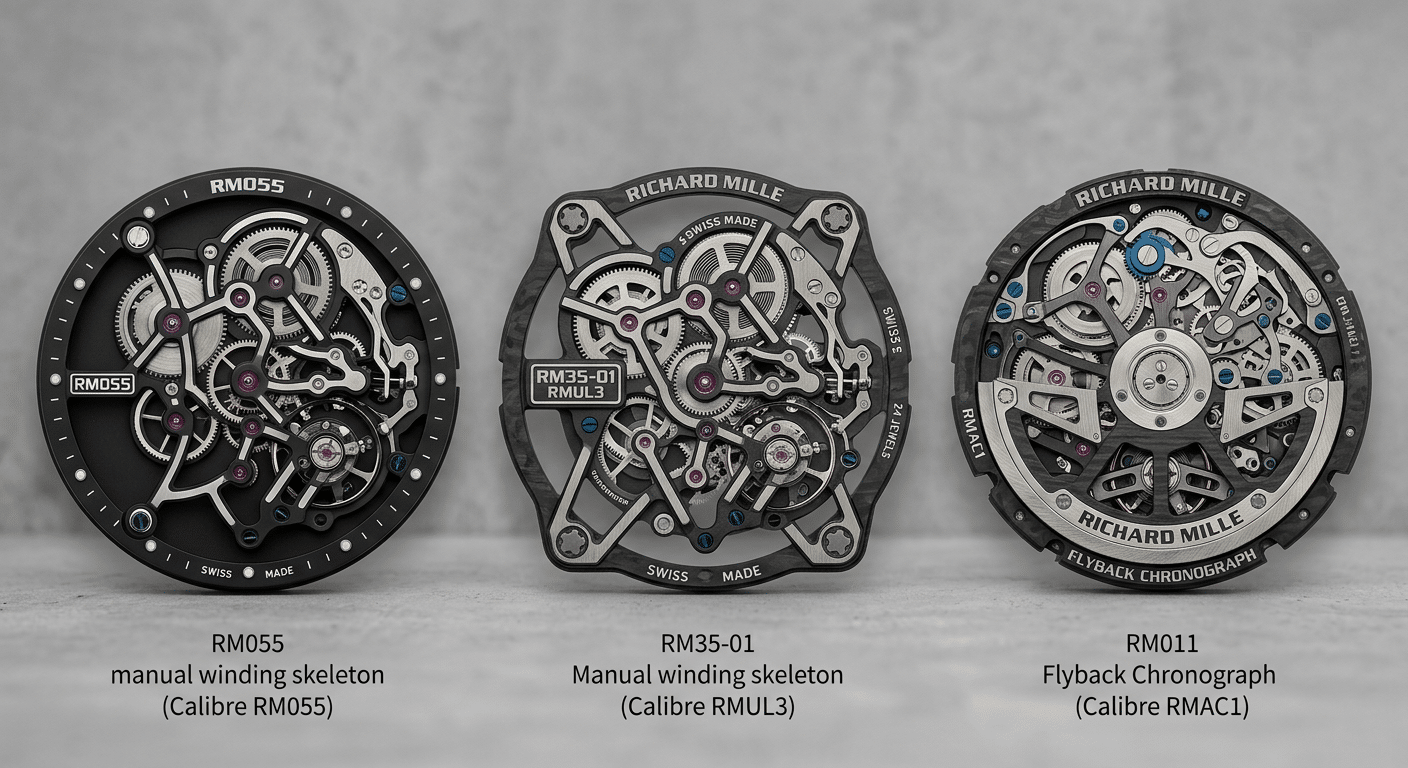
Why the Same RM Model Shows Variations: RM055, RM35, and RM011 Examples
With the RM055, differences often trace to the combination of carbon fiber supplier and movement route. Some batches use a version that delivers smoother power reserve behavior and more convincing balance wheel motion visible through the skeleton, while others show a more obvious regulator index and slightly shorter reserve in daily use. Assembly variations can further affect how evenly the open-worked bridges sit.
The RM35 shows similar effects. Certain batches from the same claimed source feel more integrated because the chosen movement route better supports visible rotating gears during winding, paired with tighter finishing during assembly. Others present minor discrepancies in how the skeleton elements catch light or how the power reserve winds down, making the watch feel subtly different on the wrist.
RM011 examples highlight movement-driven variation most sharply. The modified base movement route necessary for the chronograph function leads to more pronounced batch differences in pusher firmness and overall functional reliability. Some runs exhibit crisper chrono operation and better hand alignment, while others show the expected limitations of integrating a bulkier caliber into the tonneau layout.
In each case, the variation is structural—stemming from which suppliers fed the assembly line for that particular batch—rather than random inconsistency.
Evaluating RM Replicas Beyond the Factory Name
Factory names dominate conversations about Richard Mille replicas, yet they rarely tell the full story in the Guangzhou production system. The same label can cover watches built with different case suppliers, carbon composites, movement routes, and assembly batches. This is why two seemingly identical offers can deliver noticeably different results on the wrist.
A smarter evaluation framework starts with the specific components rather than the broad factory claim. Look for evidence of how the watch was put together: the quality of the tonneau case shaping, the depth and pattern of the carbon elements, how the crystal sits in relation to the bezel, and any visible movement finishing through the skeletonized areas. These details reveal more about the actual build than any single name.
Take the common situation of a buyer comparing RM35 or RM055 listings from dealers citing the same source. On paper the watches appear equivalent. In practice, one may show tighter case transitions and a more convincing layered carbon appearance while the other feels slightly bulkier or has a flatter material effect. The difference usually traces back to which suppliers were chosen for that particular batch. Asking the right questions lets you separate marketing consistency from construction reality.
CleanVSFactory’s editorial approach focuses on model-specific evaluation rather than simple factory rankings. By connecting factory labels to specific movement configurations, case profiles, visible finishing details, and QC evidence, buyers can make more traceable decisions suited to their priorities.
Key Questions to Ask About Components
Focus your questions on the details that matter in practice:
- What type of carbon fiber composite or material is being used for the case and bezel, and from which supplier?
- Which movement route or specific version is installed in this watch?
- Can you provide details or photos showing the case construction, including any inner frame or layering?
- What is the current batch or version of this piece, and how recently was it assembled?
Not every seller will answer with equal specificity. Clear, photo-supported responses are helpful signals, but treat them as information about one particular configuration within a variable system. No response can eliminate every risk, but these questions shift the conversation from vague claims to practical tradeoffs.
Once you accept that Richard Mille replicas are the product of a multi-vendor supply chain, your buying process becomes more effective and less frustrating.
Prioritize transparency over reputation. When comparing offers, ask the same component-focused questions across different sellers. The responses—and the supporting QC photos—will highlight meaningful differences even when the factory label stays the same.
Request targeted photos that show case profile from the side, carbon weave close-up, crystal and bezel fit, and any visible movement details. Recent, well-lit images from multiple angles give you a good opportunity to assess the actual batch.
Match the watch to your real expectations and usage. If visual presence and wrist comfort matter most, weigh how the case and strap integrate. If you care about mechanical behavior, press for clearer movement information. Recognize that some compromises are structural to this production model.
Finally, choose sellers who engage constructively with component questions. While the system itself results in some natural variation, working with transparent partners reduces unnecessary disappointment.
The Guangzhou RM system is not going to deliver perfect uniformity. By focusing on components, batches, and honest tradeoffs instead of factory names alone, you gain practical control over your decision. That knowledge turns a confusing market into one where better-informed choices are possible.
Disclosure: This article is for general educational and comparison purposes only. Replica watches are not genuine products from the original luxury brands, and brand names are used only to identify reference designs or comparison topics. Factory names, movement descriptions, prices, availability, QC details, seller policies, and version information can change, so readers should verify important details with the seller before making a purchase decision. Replica watches should not be represented, resold, or used as genuine watches.