
Hacking seconds can look like a simple quality test, but in Patek Philippe clone movements it is more useful as a consistency check. The important question is not whether the seconds hand stops in every watch, but whether that behavior matches the movement route, movement thickness accuracy, and reference generation being claimed. A DD324-style clone used for an older 324-based Nautilus or Aquanaut may reasonably be non-hacking, while a DD330-labeled or 26-330-style claim should make hacking behavior more relevant during QC.
This article helps buyers avoid judging the wrong detail in isolation. Instead of treating hacking as a pass-or-fail sign, it explains how to compare crown-setting behavior with the advertised movement, display-back layout, case thickness, date operation, and seller pricing logic. That matters most when a specific movement label is used to justify a higher price or when a buyer wants the functional behavior to align with the model generation being represented.
| Movement Route | Seconds Behavior to Check | Buyer Judgment |
|---|---|---|
| DD324-style clone | Often non-hacking when crown is pulled | Not automatically a defect if sold as a 324-style route |
| DD330-labeled clone | Hacking should be tested closely | Non-hacking needs seller clarification before accepting the claim |
| Miyota 9015 route | Normally hacks during time setting | Practical and serviceable, but less faithful to Patek architecture |
| Older Nautilus or Aquanaut reference | Compare behavior with 324-style expectations | Do not reject solely because the seconds hand keeps running |
| QC video request | Crown fully pulled with seconds hand visible | Confirms function better than photos alone |
| Higher movement price | Behavior should match the advertised label | A mismatch matters more when the label supports the premium |
Evidence matters here because official brand pages can verify authentic collection names and reference information, while movement manufacturer documents can verify the specifications of a base caliber such as Miyota 9015. Those sources do not verify what is inside a particular replica watch. For clone movement decisions, citations should define the boundary: official Patek information helps identify the authentic Nautilus or Aquanaut model family, and Miyota information helps explain the 9015 baseline, but the buyer still needs QC media to connect a seller’s claim to the individual watch being offered.
Brand names are used here to identify genuine reference designs and movement-generation context. A Patek Philippe replica watch, Nautilus clone, Aquanaut clone, DD324-style movement, or DD330-labeled movement is not a genuine Patek Philippe product and should not be described, sold, or used as an authentic brand-manufactured watch. The purpose of this comparison is buyer education and risk awareness, not misrepresentation.
Quick Questions Before You Read
Q: Is non-hacking seconds always a problem in a Patek clone?
No. It depends on whether the watch is being sold as an older 324-style route or a newer 26-330-style route.
Q: What should I ask for during QC?
Ask for a short video showing the crown fully pulled to time-setting position with the seconds hand clearly visible.
Q: Should a DD330-labeled movement hack?
It should be checked carefully because the label suggests newer 26-330-style behavior. If it does not hack, ask for clarification.
Q: Are photos enough to verify the movement route?
No. Photos help with decoration and layout, but only crown testing confirms the actual setting behavior.
Editorial Perspective: For Patek Philippe clone movements, hacking seconds should be treated as one buyer-verifiable signal rather than proof of overall quality. At cleanvsfactory.com, this kind of comparison is best handled as a movement-route question: DD324, DD330, and Miyota 9015 can each make sense in different watches, but the final judgment depends on whether the claimed caliber style, crown behavior, case thickness, display-back appearance, and daily-use expectations agree with each other. A factory name or seller label helps frame the question, but it does not replace a careful QC video and a clear understanding of the reference generation being copied.
What Hacking Seconds Means on a Patek Philippe Clone
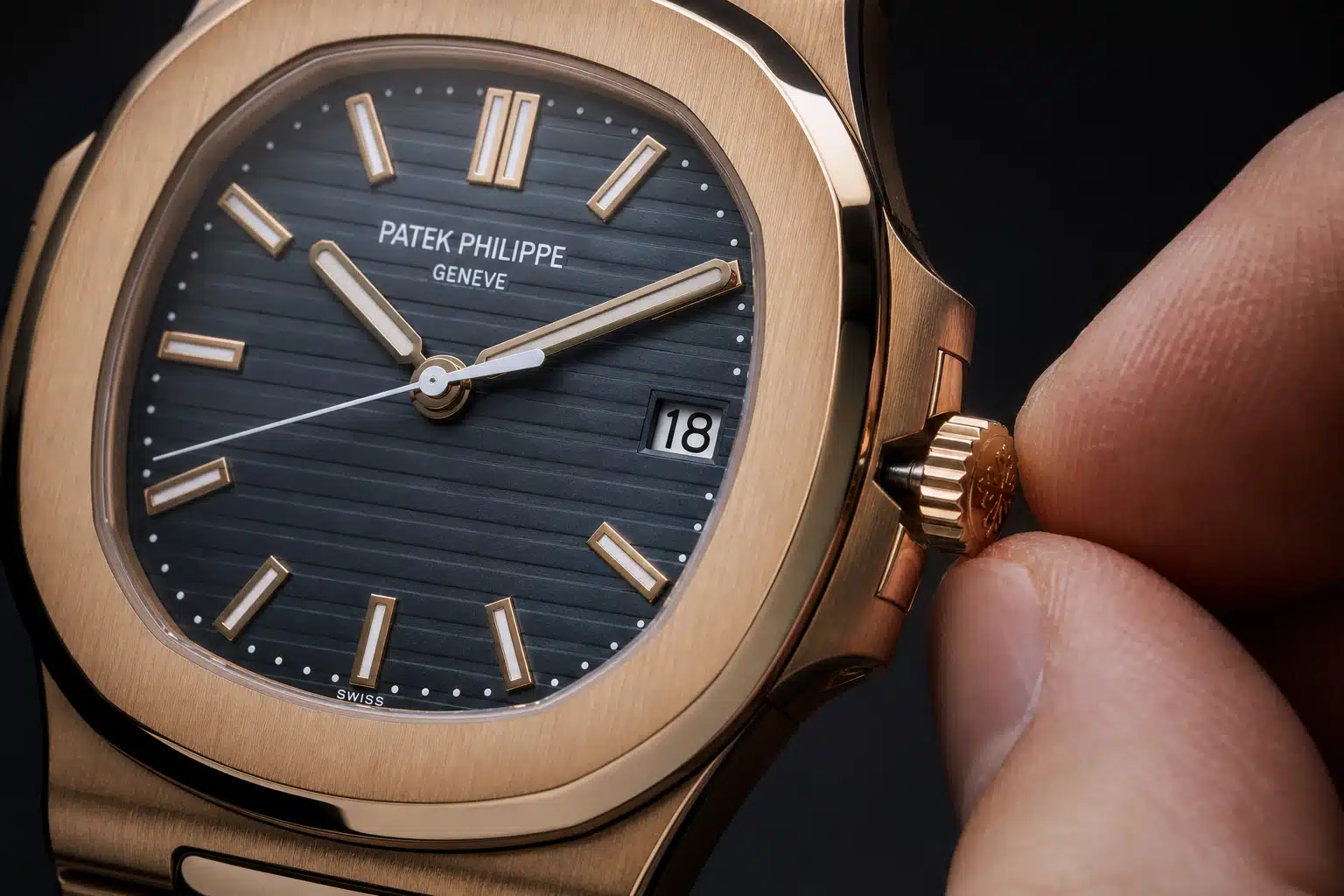
Hacking seconds means the seconds hand stops when the crown is pulled to the time-setting position. Non-hacking seconds means the seconds hand keeps running while you set the hour and minute hands. That is the whole visible behavior, but on a Patek Philippe clone it can become more than a convenience feature because it gives the buyer a small clue about the movement route being used.
The practical test is simple: pull the crown out to the position where the hands can be adjusted, then watch the seconds hand. If it pauses immediately, the movement has a hacking function. If the seconds hand continues to sweep, it is non-hacking. This is not the same as power reserve, beat rate, rotor noise, or overall movement quality. A movement can hack and still feel rough at the crown; another can be non-hacking and still be stable for daily wear.
The mistake buyers make is treating hacking seconds as a universal sign of a better replica watch. It is not. The better question is whether the behavior matches the movement generation the watch is trying to copy. On a Patek clone, the seconds hand stop can be useful evidence, but it should not become a single pass-or-fail test without knowing the claimed caliber style.
Hacking Seconds in One Sentence
A hacking movement stops the seconds hand when the crown is pulled for time setting; a non-hacking movement lets the seconds hand keep moving while the hands are adjusted.
For normal ownership, hacking seconds makes precise time setting easier. You can wait for the seconds hand to reach 12, pull the crown, set the minute hand exactly, and push the crown back in when your reference time reaches zero. Non-hacking movements require a looser approach because the seconds hand continues running during adjustment. For most daily-wear buyers, this is a small inconvenience rather than a serious defect.
Why Buyers Notice It During QC
Still photos cannot show hacking seconds. A dial photo may show good printing, aligned hands, and a centered date, but it tells you nothing about what happens when the crown is pulled. That is why a short QC video can reveal movement behavior that the best macro photos miss.
This matters because sellers may describe a Patek clone movement using a familiar label, while the actual crown behavior may tell a more specific story. If a buyer sees the seconds hand keep moving in a QC clip, the right reaction is not automatic rejection. The right reaction is to ask: is this behavior expected for the claimed movement route?
At Clean VS Factory, we usually separate visual accuracy from ownership behavior when reading QC media. A movement can look more convincing through a display back but still behave differently at the crown, and that difference only becomes obvious when someone actually operates the watch.
Quick Behavior Check
For a clean hacking-seconds check, the crown should be pulled to the time-setting position, not only to the date-setting position. Then the seconds hand should be observed for several seconds. If it stops, note that the movement hacks. If it continues sweeping, note that it is non-hacking. After that, compare the behavior with the claimed movement route instead of judging it in isolation.
The useful QC question is not simply “does the seconds hand stop?” It is “does the seconds hand behavior match what this Patek clone movement is supposed to represent?” That distinction prevents buyers from rejecting an expected non-hacking movement or accepting a movement claim that does not match the observed behavior.
Older 324-Style Behavior vs Newer 26-330-Style Behavior
The reason hacking seconds becomes confusing in Patek Philippe clone movements is that genuine Patek behavior is discussed by buyers in relation to movement generation. Older Caliber 324-based references are commonly associated with non-hacking behavior, while later Caliber 26-330-based references are commonly discussed with stop-seconds expectations. So the question is not whether all Patek-style movements should hack. The question is which genuine movement generation the replica is trying to follow.
This is where many buyers mix up expectations. They hear that modern automatic watches often hack, then assume a non-hacking Patek clone must be wrong. That logic is too broad. For Patek 324 hacking seconds discussions, non-hacking can be consistent with the older reference logic. For Patek 26-330 hacking seconds discussions, hacking becomes more relevant because the newer genuine movement discussion changed the standard.
The practical judgment is simple: correct behavior for the model depends on the reference being copied. A 324-style expectation and a 26-330-style expectation should not be treated as interchangeable, especially when the replica is sold with a specific movement claim.
Official Patek Philippe pages are useful for anchoring the authentic model context, not for proving replica execution. Patek lists the Nautilus 5811/1G-001 within the Nautilus collection and the Aquanaut 5167A-001 within the Aquanaut collection, which helps buyers separate authentic reference background from seller language around imitation watches.[1][2] Those official pages should not be used as evidence that a DD324, DD330, or Miyota-based clone has the same construction, finishing, water resistance, or movement behavior as the genuine watch.
Factory and movement names in the replica market should be read as buyer-facing reference labels, not as official Patek Philippe affiliations or proof of a specific internal construction. A DD324, DD330, or factory-version label can help organize the comparison, but the label is only useful when it is tied to the exact reference being copied, the stated batch or version, the visible caseback layout, and a crown-setting video that confirms the claimed behavior.
Factory names are useful market references, but they do not guarantee identical quality across every model or version. A factory comparison is most helpful when it is tied to the specific Nautilus or Aquanaut reference, the claimed movement route, case thickness, dial execution, bracelet or strap construction, and the actual QC photos or videos for the individual watch being offered.
Why 324-Style References Create Different Expectations
Caliber 324 belongs to the older automatic movement family many buyers associate with earlier Nautilus and Aquanaut-era expectations. In that context, non-hacking seconds should not automatically be treated as a defect. If the crown is pulled and the seconds hand keeps moving, that may be consistent with the behavior the clone is attempting to represent.
This is the non-obvious point: a non-hacking movement can feel less convenient but still be more generation-appropriate for certain 324-style interpretations. Buyers who only think “hacking equals better” may accidentally reject a watch for doing something that makes sense for the claimed older movement style.
That does not mean every non-hacking Patek clone is correctly described. It only means the behavior must be judged against the movement route and the reference logic. A vague seller claim should carry less weight than a clear match between claimed movement style, visible movement layout, and crown-setting behavior.
Why 26-330-Style References Changed the Conversation
Caliber 26-330 changed buyer expectations because it is associated with newer genuine Patek behavior discussions. Once a replica claims to represent a newer 26-330-style movement, the seconds hand stopping during time setting becomes a more meaningful detail to verify.
This is why a buyer should be more cautious when a watch is advertised as a newer-generation Patek clone movement but behaves like an older non-hacking route. The issue is not that non-hacking is always bad. The issue is that the behavior may not match the story being sold with the watch.
For practical QC, the strongest position is to avoid universal rules. Older versus newer movement behavior matters because Patek-style hacking expectations are not treated as one fixed feature across all relevant automatic generations. A replica buyer should not treat them that way either.
DD324 Clone Movements and the Non-Hacking Expectation
The DD324 movement is usually discussed as a 324-style clone movement route, so non-hacking behavior should not surprise buyers in many cases. If the crown is pulled to the time-setting position and the seconds hand keeps moving, that can be consistent with a DD324 non-hacking expectation rather than an immediate QC failure.
The key word is “consistent,” not guaranteed. DD324 naming can vary by supplier, factory description, and batch. Some sellers use movement labels loosely, and buyers should not assume that a name alone proves the exact architecture or behavior. A Patek clone movement should be judged by the claimed route, visible movement execution where available, crown positions, and setting behavior together.
The useful way to read DD324 is this: it may be a more reference-conscious route for buyers who want older 324-style behavior and appearance, but it still needs basic movement QC. Non-hacking can be expected; rough operation, unclear crown positions, or a claim that does not match the watch should still be questioned.
Why Non-Hacking Can Be Correct for a 324-Style Clone
If a replica is trying to follow an older 324-style movement expectation, non-hacking seconds can make sense. The seconds hand continues running because the movement does not stop the balance when the crown reaches the hand-setting position. For buyers used to modern hacking movements, that can feel odd the first time they see it in a QC video.
This is where the buyer’s expectation has to be calibrated. DD324 non-hacking is not automatically a sign of a cheaper or worse watch. It may simply reflect the movement route chosen for that model. The more important concern is whether the seller presented the watch honestly and whether the behavior lines up with the claimed 324-style route.
A DD324 movement can also appeal because of display-back appearance and Patek-style decoration, but visual closeness and crown behavior are separate checks. The movement may look more appropriate than a generic base movement in photos, yet the buyer still needs to confirm how it sets, winds, and changes date.
Where DD324 Still Needs QC Attention
For DD324 QC, do not stop at the question “is DD324 supposed to hack?” A better check includes crown feel, hand-setting smoothness, date-change behavior, and whether the seconds hand keeps moving in a way that matches the seller’s description, especially when comparing it with a clone 240 micro rotor movement standard for similar 5712 replica evaluations. If the crown feels gritty, if the hands jump when pushed back in, or if the date behavior is inconsistent, those issues matter more in daily ownership than the non-hacking detail alone.
Buyers should also be cautious when a listing uses the DD324 label but provides no useful movement information. A decorated movement under a display back can look persuasive, but the label should still be supported by actual behavior and clear communication. Factory and supplier language in this segment is not always precise enough to trust without verification.
The strongest judgment here is that DD324 non-hacking should usually be treated as an expected route characteristic, not a defect by itself. It becomes a concern only when it contradicts the movement claim, comes with other setting problems, or is being sold as something it is not.
Movement Route to Verify
Before approving a DD324-equipped Patek clone, confirm the stated movement route and ask for a short time-setting clip if the behavior matters to you. The video should show the crown pulled fully to the hand-setting position, the seconds hand continuing or stopping, and the hands moving normally when adjusted.
Also check that the crown positions make sense: winding position, date-setting position if applicable, and time-setting position should feel distinct rather than vague. A non-hacking seconds hand is not a reason to reject a DD324-style watch on its own. A mismatch between the advertised route and the observed movement behavior is the more important warning sign.
DD330 Clone Movements and the Hacking-Seconds Claim
The DD330 movement matters because it is usually presented as the newer-generation route in a Patek Philippe clone, closer in concept to the genuine 26-330 family than to the older 324-style expectation. That changes how buyers should read the seconds hand. With a DD330 hacking seconds claim, the question is no longer just “does the watch run well?” It becomes “does the crown setting behavior match the movement generation being advertised?”
For a 26-330 clone movement, hacking seconds should carry more weight than it does on a 324-style route. If the watch is sold as newer-generation, and the seller specifically describes it as DD330, buyers are reasonable to expect the seconds stop when the crown is pulled to the time-setting position. A non-hacking result does not automatically make the whole watch unusable, but it does create a movement-claim problem that should be clarified before approval.
When Hacking Seconds Should Matter More
Hacking seconds matters most when the replica is trying to represent a reference associated with the newer Patek movement generation. In that situation, the seconds stop is not just a convenience feature for setting the time. It becomes part of the correct movement behavior. A buyer comparing DD330 vs DD324 should not treat both routes with the same expectation, because the DD330 is often chosen precisely to move closer to 26-330-style behavior.
This is where many buyers misjudge the detail. They either dismiss hacking seconds as too small to matter, or they treat it as a universal pass-or-fail test. The better judgment is narrower: DD330 hacking seconds matters because the movement label creates an expectation. If a clone is advertised as a DD330 movement but behaves like an older non-hacking route, the issue is not only the seconds hand. The issue is whether the stated movement route is accurate.
That does not mean DD330 is automatically the better choice for every buyer. A newer-style movement route can still have batch variation, uneven decoration, uncertain long-term serviceability, or crown feel that is less refined than the label suggests. The practical advantage is not the name itself. The advantage is when the movement route, visible construction, and crown setting behavior all point in the same direction.
Movement Transparency Note: Movement references in this article describe replica-market movement routes such as DD324, DD330, and Miyota 9015 configurations, not official Patek Philippe calibers unless the discussion is clearly limited to authentic reference background from cited brand or manufacturer sources. Buyers should judge each watch by the specific version, visible movement layout, crown-setting behavior, and QC media rather than assuming a movement label proves official construction or identical performance.
Why the DD330 Label Still Needs Confirmation
The DD330 label should be treated as a claim to verify, not a guarantee. In the replica watch market, movement names can be used loosely, especially when factories or sellers want to signal a newer Patek movement without showing enough supporting detail. A movement may have newer-style decoration on the rotor or bridges, yet still need confirmation through crown behavior and caseback inspection.
The most useful QC request is simple: ask to see the crown pulled into the time-setting position while the seconds hand is visible. If the seconds stop cleanly, the behavior supports the DD330 hacking seconds claim. If the seconds keep moving, the buyer should ask whether the watch is actually using a different route, an older batch, or a movement described with loose naming. The answer matters more than the inconvenience of setting the time.
For buyers who care about reference-correct behavior, this is a detail worth checking before approving QC. For buyers who mainly want a stable daily-wear Patek clone, it still matters, but not above basic movement health. Rough crown action, slipping hand setting, strange date behavior, or an unclear movement explanation are stronger warnings than a seconds-hand question viewed in isolation.
Price Premiums and Movement Claims
When a DD330-labeled version costs more than a DD324-style or Miyota-based version, the premium should be connected to something the buyer can verify. A higher price may reflect a newer movement route, better decoration, lower availability, factory batch differences, seller margin, or added after-sale risk. It does not automatically prove that the watch is more accurate or more reliable.
The practical price question is whether the extra cost buys the behavior and presentation being claimed. If the seller uses “DD330” or “26-330 style” to justify a higher price, a crown-setting video becomes more important, not less. If the watch does not hack, the buyer should ask for a clear explanation before accepting the premium. If the explanation is vague, the buyer may be paying for a label rather than a better-matched movement route.
A version-specific comparison is safer than a broad factory ranking in this situation. One batch may improve movement decoration or caseback appearance while another may be better for crown feel, date action, or case thickness, so the useful question is not simply which name is more famous. The useful question is whether this exact watch, in this exact version, supports the movement claim through visible construction and repeatable setting behavior.

Miyota 9015 Routes: Reliable Base, Different Patek Behavior
A Miyota 9015 Patek clone sits in a different category from a DD-style movement. The Miyota 9015 is a slim Japanese automatic movement known for practicality, availability, and relatively familiar service options. That can make it a sensible base for some replica watches, especially when the buyer values daily usability over movement-layout accuracy. The tradeoff is that it is not a Patek-specific movement architecture.
Miyota 9015 hacking seconds is normally expected from the base caliber, but that does not automatically mean the behavior is correct for every Patek reference being copied. This is the non-obvious point: a Miyota-based watch can behave like a modern hacking movement even when the genuine reference being represented may belong to an older non-hacking 324-style expectation. In that case, the movement is practical, but not behaviorally reference-specific.
Miyota’s official 9015 specifications list it as an automatic movement with hand-winding, second stop, 24 jewels, a 28,800 vibrations-per-hour frequency, and an approximate 42-hour power reserve.[3] That documentation supports the baseline characteristics of the 9015 caliber itself; it does not prove that a specific Patek-style replica contains a genuine Miyota 9015, has been assembled correctly, or will perform to the same standard after casing, decoration, and modification.
Why Miyota Can Be Practical but Less Reference-Specific
The strongest argument for Miyota is ownership logic. It is thin enough for many dress-sports cases, parts knowledge is broader than with some niche clone movements, and many watch repairers are more comfortable with it than with a decorated clone movement of uncertain sourcing. For a buyer asking “is Miyota 9015 good enough,” the honest answer is: it can be good enough if the buyer accepts that serviceability and dependability are being prioritized over Patek movement resemblance.
The weakness is visible and behavioral matching. A decorated Miyota can be made to look more Patek-like through a display back, but the bridge layout, rotor construction, and movement depth are still compromises. Rotor noise is also a common ownership complaint, because the 9015’s winding character can feel louder or more mechanical than buyers expect from a thin Patek-style watch. That does not make it a bad movement; it makes it a less convincing Patek movement.
At Clean VS Factory, we usually separate movement reliability from movement accuracy when explaining this choice. Miyota versus DD movement is not simply “cheap versus better.” It is a choice between a reliable clone movement base with known compromises and a more reference-focused route that may look and behave closer but can carry its own batch and service risks.
Movement trust in this category depends on knowing what the movement claim actually describes. A seller may be referring to the base caliber, a decorated version, a modified configuration, or simply a market name used to describe a familiar route. Buyers should avoid reading “Miyota 9015,” “DD324,” or “DD330” as a complete reliability promise and instead separate architecture, decoration, crown behavior, serviceability, and daily-use expectations.
How Hacking Behavior Can Create a Mismatch
The Miyota route can confuse buyers because hacking seconds may appear as a positive feature even when it creates a reference mismatch. If a replica is copying an older 324-era Patek reference, and the seconds hand stops because the Miyota base hacks, the watch may be easier to set precisely but less faithful in movement behavior. That is not a disaster for daily wear, but it is a detail a movement-focused buyer should understand before choosing the route.
The reverse problem can also happen in buyer expectations. Some buyers assume every expensive Patek clone should hack because many modern automatic watches do. That assumption is too broad. Correct movement behavior depends on the genuine caliber generation being represented and the clone movement route used inside the watch. A Miyota-based watch may be reliable, but it should not be judged as if it were a true 324 or 26-330-style architecture.
The practical decision is straightforward. Choose a Miyota 9015 Patek clone if you value a slimmer, serviceable, familiar Japanese automatic movement and can live with weaker movement authenticity cues. Choose a DD-style route if the display back, movement layout, and generation-correct behavior matter more to you. Do not choose Miyota because it hacks and assume that makes it more correct.
Why Visual Accuracy and Functional Behavior Do Not Always Match
Clone movement accuracy has two separate layers: what the movement looks like and what the movement does. Buyers often focus on the first layer because QC photos make it easy. A display caseback can show bridge decoration, rotor design, engraving style, screw position, and overall movement layout. Hacking seconds sits in the second layer. It only appears when someone pulls the crown and observes the crown behavior during time setting.
This is why a Patek clone movement can look correct but behave differently. A decorated bridge can imitate a newer movement visually, while the keyless works and setting behavior still follow another base architecture. The reverse can also be true: a practical base movement may hack cleanly and set time well, but look much less convincing through the caseback. Visual versus functional accuracy is not one score. It is a set of tradeoffs.
Visual accuracy should also be judged through specific details rather than broad replica-market language. For Nautilus and Aquanaut-style watches, case thickness, lug transition, bezel shape, dial texture, datewheel centering, hand length, bracelet or strap fit, clasp engraving, and caseback finishing can all affect whether the watch feels coherent. A strong caseback photo does not compensate for poor dial alignment, and a clean dial photo does not prove the claimed movement route.
What Photos Can Show
Photos are useful for checking the visual claims. They can show whether the rotor shape is roughly correct, whether the bridge decoration matches the claimed movement route, whether the engraving looks crude, and whether the movement layout seems consistent with what the seller described. For Patek replicas with display backs, this matters because the caseback is part of the ownership experience, not just a hidden technical area.
Still photos are weak at confirming behavior. They cannot tell you whether the seconds stop, whether the crown has a clean setting position, whether the hands jump when the crown is pushed back in, or whether the date changes cleanly. A watch can photograph well and still feel wrong at the crown. That is one reason movement detail buyers miss problems when they judge only caseback images.
What Only a Crown-Setting Test Shows
A crown-setting test shows what the movement does under use. Pulling the crown to the time-setting position can reveal whether the seconds hand stops, whether the hands move smoothly, and whether the crown position feels defined rather than vague. For a DD330 movement claim, this is especially useful because DD330 hacking seconds should be part of the expected newer-generation behavior.
This test should be interpreted calmly. If a movement is supposed to be non-hacking, a running seconds hand may be normal. If a movement is advertised as a 26-330 clone movement and the seconds hand keeps moving, that deserves a follow-up question. The goal is not to use hacking seconds as a single authenticity test. The goal is to check whether the claimed movement route and observed Patek movement behavior agree with each other.
Behavior Details Worth Separating
Do not blend every crown-related issue into one complaint. Hacking seconds only answers whether the seconds hand stops during time setting. Date change behavior is a separate issue. Hand jump when pushing the crown back in is separate. Loose crown feel, rough winding, rotor noise, and calendar hesitation are also separate ownership signals.
This separation matters because one small mismatch may be an accepted route compromise, while several rough behaviors together suggest a weaker movement sample. A non-hacking seconds hand on the right older-style route may be acceptable. A DD330-labeled watch with non-hacking behavior, vague crown positions, and inconsistent seller explanation is a different concern. The strongest QC judgment comes from matching the behavior to the claim, not from treating every movement feature as equally important.
How This Affects Nautilus and Aquanaut Replica Buyers
Hacking seconds becomes more noticeable on Nautilus and Aquanaut replicas because these are not thick, closed-back sports watches where the movement can hide in the background. Many versions have a display back, a thin case profile expectation, and a buyer base that often knows whether the watch is trying to represent a 324-era or 26-330-era reference. That is why the question is not simply “does the seconds hand stop?” The better question is whether the Nautilus clone movement or Aquanaut clone movement behaves consistently with the reference generation being copied.
This is also where some buyers make the wrong comparison. They ask for the “best movement for Nautilus replica” as if one answer covers every 5711 clone, 5811-style replica, or later-generation interpretation. It does not. A movement route that makes sense for an older 324-style reference may feel incorrect if the watch is being sold as a newer 26-330-style version. The same is true in reverse: a hacking movement can be convenient, but if the genuine reference being copied belongs to a non-hacking generation, the behavior may be practical rather than reference-correct.
Nautilus Buyers and Reference-Generation Expectations
For Nautilus buyers, hacking seconds is most useful as a reference-generation clue. A 5711-style replica associated with the older 324 movement conversation should not be judged by the same expectation as a newer 5811-style replica linked to the Patek Philippe clone movements context around the 26-330 generation. If the seconds hand keeps moving on a 324-style route, that may be consistent with the intended movement behavior. If a watch is advertised as a newer 26-330-style or DD330 route and the seconds hand does not stop, the buyer has a more legitimate reason to ask questions.
The non-obvious point is that Nautilus buyers often focus on the case and bracelet first, but movement behavior can expose a mismatch that photos do not. A display back may show attractive bridge decoration, and the dial may look clean in still images, yet the crown-setting behavior can still tell you whether the movement claim has been simplified, renamed, or overstated. That does not automatically make the watch a bad replica, but it changes how seriously you should take the movement description.
For a Nautilus clone movement, case thickness still matters more on the wrist than hacking seconds alone. A movement that hacks but forces a thicker or awkwardly proportioned case is not automatically the smarter choice. The strongest versions are the ones where the movement route, case profile, display-back appearance, and claimed reference generation do not fight each other. If one of those signals is inconsistent, the buyer should treat the watch as a tradeoff rather than a clean upgrade.
Aquanaut Buyers and Movement-Route Tradeoffs
Aquanaut buyers face a slightly different problem. The 5167 clone and related Aquanaut-style replicas often attract buyers who want something thinner, lighter, and easier for daily wear than a Nautilus on bracelet. In that context, the Aquanaut clone movement has to be judged not only by whether it hacks, but also by whether it supports the right case feel and daily-use practicality.
A Miyota-based Aquanaut can be a rational choice if the buyer accepts that the movement is more of a practical base than a close Patek-specific movement route. It may offer familiar serviceability and dependable daily running, but the behavior and caseback impression may not match a DD324 or DD330-style route as closely. A DD-style movement may look more convincing through the display back, but the buyer should still check whether the crown positions, date setting, and hacking or non-hacking behavior match the claimed route.
For Aquanaut QC movement check purposes, hacking seconds should be treated as one signal, not the whole verdict. If the case wears thin, the dial spacing looks acceptable, the date sits cleanly, and the movement route is honestly described, a small behavior difference may be acceptable for a daily-wear buyer. If the seller claims a specific newer movement route and the crown-setting behavior contradicts it, the issue is not the absence of hacking alone. The issue is that the watch may not be what the movement label says it is.
How to Treat Hacking Seconds During QC
Hacking seconds QC should be handled calmly. It is useful because a short QC video can show movement behavior that still photos cannot, but it is not a universal pass-or-fail test. The right sequence is simple: confirm the claimed movement route, compare the seconds-hand behavior to that route, then decide whether the result is expected, mismatched, or unclear.
The mistake is reacting to the seconds hand before identifying the movement. DD324, DD330, and Miyota 9015 routes do not carry the same expectations, and a Patek clone QC decision should not treat them as interchangeable. A non-hacking DD324-style watch may be normal. A non-hacking watch sold as a DD330 or newer 26-330-style route deserves more scrutiny. A Miyota-based version may hack because of the base caliber, even if that does not make it more reference-correct for every Patek-style application.
Step One: Confirm the Claimed Movement Route
Before asking “should I reject QC,” first ask what movement route the watch is supposed to have. The seller’s label matters because it sets the expectation. A DD324 claim, a DD330 claim, and a Miyota 9015 claim should each be judged against different behavior logic. If the description only says “super clone movement” or “Patek movement” without detail, the hacking behavior becomes harder to interpret.
A useful QC request is not complicated. Ask for a short crown-setting video showing the crown pulled to the time-setting position while the seconds hand is visible. This does not need to be dramatic or long. The goal is simply to see whether the seconds hand stops, whether the hands move smoothly when setting, and whether the crown action appears controlled rather than loose or rough.
Step Two: Match Behavior to the Reference Being Copied
Once the movement route is identified, compare the behavior to the genuine caliber generation the replica is trying to represent. Older 324-style expectations and newer 26-330-style expectations should not be mixed together. If the seconds hand does not stop on a route that is meant to follow older 324-style behavior, that may be a known characteristic rather than a defect. If the watch is presented as a newer 26-330-style or DD330 version, hacking seconds becomes a more meaningful detail to verify.
This matters because many buyers judge the watch against a generic idea of a modern automatic movement. That is the wrong standard for this topic. The correct movement for reference accuracy is not always the one with the most convenient feature. In Patek clone movement comparison, behavior should be measured against the claimed reference, not against what feels modern or familiar from other brands.
Step Three: Decide Whether It Is a Mismatch or a Known Tradeoff
If the observed behavior matches the claimed route, hacking seconds should not dominate the QC decision. Continue checking the usual movement-adjacent signs: date alignment, hand alignment, crown position, and whether the watch winds and sets cleanly. If the seconds hand does not stop but the watch is a DD324-style route, the buyer may simply be seeing expected non-hacking behavior.
If the observed behavior contradicts a specific movement claim, the concern is stronger. A watch advertised as a DD330 route but behaving like a non-hacking 324-style movement may still run fine, but the buyer is no longer evaluating the watch described in the listing. That is where hacking seconds becomes useful evidence: not because it proves everything, but because it catches a mismatch between claim and function.
Verification Note: When possible, buyers should review a real QC video along with clear photos of the dial, date position, caseback structure, clasp finishing, and movement decoration before approving a Patek Philippe clone. Stock images, factory labels, and movement names alone are not enough to confirm whether the specific watch being offered matches the claimed DD324, DD330, or Miyota 9015 route.
What Seller Photos and Descriptions Cannot Prove
Seller photos, factory labels, and movement descriptions are useful starting points, but they are not final proof of the movement route. A photo can show a decorated rotor, bridge shape, or display-back layout, but it cannot show whether the crown reaches the correct setting position or whether the seconds hand stops under operation. A seller description can say “DD330,” but the buyer still needs behavior that supports that claim.
This is especially important when the listing uses strong language such as “latest movement,” “upgraded version,” or “same function.” Those phrases may point to a real improvement, but they can also compress several tradeoffs into one attractive claim. A buyer should translate that language into checkable questions: does it hack if it is supposed to, does the case stay within the expected profile, does the date change cleanly, and does the movement explanation remain consistent after a QC video request?
QC photos and short videos reduce uncertainty, but they do not remove every risk. For a Patek Philippe clone, buyers should review the actual watch being offered, including dial printing, hand alignment, datewheel centering, case thickness, strap or bracelet fit, caseback finishing, movement decoration, and crown-setting behavior before accepting a movement claim.
QC media should not be treated as a promise of perfection or as evidence that a replica watch can pass authentication. It is a practical screening tool for the specific watch being offered. Buyers should also confirm seller terms directly, including return conditions, repair options, shipping expectations, water-resistance testing, and after-sales support, because those details cannot be assumed from a factory label, movement name, or attractive QC set.
Red Flags Before Approval
- A specific DD330 or 26-330-style claim, but the seconds hand does not stop and no clear explanation is provided.
- A vague movement description that changes after the buyer asks for a crown-setting video.
- Rough crown action, slipping crown positions, or hands that jump noticeably during time setting.
- Date behavior that looks inconsistent with the claimed movement route, especially when paired with unclear hacking behavior.
- A seller treating hacking seconds as irrelevant while also using a very specific movement label to justify a higher price.
None of these points should be used to claim a replica is genuine or to support deceptive resale. They are buyer-protection checks. The purpose is to understand whether the watch matches the version being offered and whether the movement behavior is acceptable for ownership.
When Hacking Seconds Should Influence the Final Decision
Hacking vs non-hacking seconds should influence the final decision most when the watch is being sold around a specific movement route or reference generation. If a Patek clone movement comparison presents DD330 as the reason for choosing one version over another, then DD330 hacking seconds is a fair detail to check. If the buyer knowingly chooses a DD324-style or Miyota-based route with different behavior expectations, hacking seconds should be weighed more lightly.
The strongest judgment is this: hacking seconds is useful evidence, not a complete verdict. It can reveal whether a movement claim deserves confidence, but it should not outweigh every other practical factor. Case fit, stable timekeeping, crown feel, date behavior, rotor noise, and QC consistency often affect ownership more than whether the seconds hand pauses during setting.
For Detail-Focused Buyers
Detail-focused buyers should care more about hacking behavior because it helps separate movement routes that look similar in photos. If the goal is reference accuracy, then a 324-style watch and a 26-330-style watch should not behave the same by accident. A seconds-hand stop can be a small but meaningful sign that the movement route is trying to follow the newer generation more closely.
This is especially relevant for buyers who pay extra for a claimed DD330 route. If the price difference is justified by newer-generation behavior and movement presentation, the crown-setting test becomes part of the value check. Paying more for a label that does not show the expected behavior is harder to justify.
For Daily-Wear Buyers
Daily-wear buyers should be more practical. If the watch keeps stable time, sets cleanly, has acceptable rotor noise, and does not create crown or date-setting frustration, a hacking mismatch may be less important than movement reliability and overall execution. A reliable Miyota 9015 route, for example, may be less Patek-specific in behavior, but it can still make sense for a buyer who values serviceability and predictable use over display-back accuracy.
Beginners are often better served by avoiding overreaction to one technical behavior. If the seconds hand does not stop, that does not automatically mean the watch is defective. If the seconds hand does stop, that does not automatically mean the movement is superior. The better ownership question is whether the movement route is honest, the watch is coherent for the reference, and the known tradeoff is acceptable.
A replica watch should also be evaluated with realistic ownership expectations. Even a strong super clone can have limits in water resistance, long-term movement stability, servicing convenience, rotor noise, and close inspection compared with an authorized genuine reference. Buyers should confirm return, repair, shipping, and after-sales terms before ordering rather than assuming those terms from a movement label or factory-market name.
The Balanced Rule
The balanced rule is straightforward: judge hacking seconds against the claimed movement route and reference generation first, then weigh it against the rest of the watch. For a 324-style route, non-hacking behavior may be normal. For a 26-330-style or DD330 claim, hacking seconds should matter more. For a Miyota-based route, the buyer should understand that practical reliability and Patek-specific behavior are not the same thing.
At Clean VS Factory, we treat this as a movement-route tradeoff rather than a single winning feature. Hacking seconds can improve reference accuracy in the right context, but the better final choice is the watch where behavior, case profile, movement claim, and daily-wear expectations line up. If those pieces do not line up, the buyer should not ignore the issue just because the photos look good.
Legal and Disclosure Boundary
This article discusses imitation watches and buyer-side QC checks, not authorized Patek Philippe products. The USPTO describes counterfeit goods in relation to trademark use on goods that are not authorized by the trademark owner, and that distinction is important when reading any replica-watch guide.[4] Buyers should also treat customs, import, resale, and disclosure issues cautiously because U.S. Customs and Border Protection identifies intellectual property rights enforcement as a trade priority involving counterfeit and infringing goods.[5]
That legal context should not be turned into broad advice about any individual shipment or jurisdiction. The practical point is narrower: do not describe a replica as authentic, do not resell it as genuine, and do not assume that a movement label, factory name, or successful QC video removes trademark or import risk. Hacking seconds can help evaluate a seller’s movement claim, but it does not change the watch’s non-authorized status.
Final Buyer Takeaway
The safest way to use hacking seconds as a buying signal is to narrow the question before judging the watch. For an older 324-style Patek clone, non-hacking behavior may be a normal part of the route. For a DD330 or 26-330-style claim, hacking should be checked because it supports the newer-generation story. For a Miyota 9015 route, hacking may be useful for setting time but does not make the movement more Patek-specific.
A good final decision does not come from the most famous factory name, the highest price, or the most attractive caseback photo alone. It comes from a coherent match between the reference being copied, the movement route being sold, the behavior shown in QC, and the buyer’s intended use. A watch that looks strong in photos but carries a movement-claim mismatch should be treated with caution, while a watch with an expected route compromise may still be reasonable if the tradeoff is clear before purchase.
References
[1] Patek Philippe, “Patek Philippe Nautilus 5811/1G-001 official specifications,” official collection reference for the Nautilus model family and authentic reference context, available at Patek Philippe Nautilus 5811 official specifications.
[2] Patek Philippe, “Patek Philippe Aquanaut 5167A-001 official specifications,” official collection reference for the Aquanaut model family and authentic reference context, available at Patek Philippe Aquanaut 5167A official specifications.
[3] Miyota, “Miyota 9015 official movement specifications,” manufacturer specification page for the Miyota 9015 automatic movement, including second-stop, jewel count, frequency, and power-reserve information, available at Miyota 9015 official movement specifications.
[4] United States Patent and Trademark Office, “Counterfeit Goods Basics,” official educational material explaining counterfeit goods and trademark-related boundaries, available at USPTO Counterfeit Goods Basics.
[5] U.S. Customs and Border Protection, “Intellectual Property Rights,” official CBP trade priority page covering intellectual property enforcement and counterfeit-goods concerns, available at U.S. CBP Intellectual Property Rights.
Disclosure: This article is for general educational and comparison purposes only. Replica watches are not genuine products from the original luxury brands, and brand names are used only to identify reference designs or comparison topics. Factory names, movement descriptions, prices, availability, QC details, seller policies, and version information can change, so readers should verify important details with the seller before making a purchase decision. Replica watches should not be represented, resold, or used as genuine watches.