
Miyota 9015 is not automatically a bad choice in a Patek Philippe-style replica, but it creates one decision buyers often underestimate: reliability versus case thickness. The movement is available, serviceable, and easier to replace than many clone calibers, which makes it attractive for daily wear, especially when compared with a clone 240 micro rotor architecture that better matches ultra-thin 5712 case expectations. The problem is its 3.9mm height. In slim designs, that extra movement height can force a thicker caseback, taller mid-case, raised crystal, or awkward spacer construction.[1]
This article helps judge when that tradeoff is acceptable and when it changes the character of the watch. The key is not the movement name alone, but how the finished case handles it. Nautilus and Calatrava-style replicas are less forgiving because their appeal depends heavily on thin side profiles, while Aquanaut-style builds can sometimes tolerate the movement better. Side-profile QC photos, caseback shape, lug flow, and strap or bracelet fit matter as much as the movement choice.
Replica watches should be clearly understood as replica-market products, not genuine watches from the original luxury brands. Patek Philippe names are used here to identify the genuine reference designs being compared, not to suggest authorization, endorsement, official production, authentic movement origin, or service compatibility. The purpose of movement and factory discussion is buyer education: understanding tradeoffs, avoiding exaggerated claims, and choosing a version with realistic expectations.
| Buyer Question | What To Check | Practical Judgment |
|---|---|---|
| Is Miyota 9015 suitable? | Case profile, not just movement listing | Sensible if the case stays balanced |
| Nautilus-style model | Mid-case height and protruding caseback | Least forgiving of added thickness |
| Aquanaut-style model | Strap seating and side slab effect | More tolerant, but still needs side photos |
| Calatrava-style model | Lug curve, cuff fit, caseback thickness | Extra height can weaken the dress-watch feel |
| Miyota vs DD324-style clone | Repair ease versus visual layout and thinness | Miyota favors low-stress use; DD324 may suit profile-sensitive builds |
| Rotor noise concern | Normal whirring versus scraping or rattling | Some sound is expected; rough noise needs QC attention |
Quick Questions Before You Read
Q: Does Miyota 9015 mean the replica is low quality?
No. It can be reliable and practical, but the case must be designed well around its height.
Q: Which Patek-style replicas are most affected by Miyota thickness?
Nautilus and Calatrava-style models are the most sensitive because their proportions depend strongly on a thin side profile.
Q: Is Aquanaut a safer choice with Miyota 9015?
Usually it is more forgiving, especially with a rubber strap, but side-view QC photos are still important.
Q: Should buyers choose DD324 instead?
Only when thinner proportions or display-back layout matter more than easier servicing and lower repair stress.
Editorial Perspective: A Miyota-based Patek Philippe replica should be judged as a model-specific tradeoff, not as a simple downgrade or automatic value choice. At cleanvsfactory.com, the more useful question is whether the movement route fits the case architecture, buyer’s wearing habits, and repair expectations. A Miyota 9015 can make ownership easier because replacement and servicing are more realistic, but it may also force thickness compromises that matter on Nautilus and Calatrava-style designs. Factory labels, seller descriptions, and QC photos are useful signals, but they should be checked against the exact watch being offered: movement confirmation, side profile, caseback height, bracelet or strap fit, rotor behavior, and whether the price reflects a practical Miyota build or a higher-spec clone-movement version.
Why Miyota 9015 Appears in Many Patek Philippe Replicas
A Miyota 9015 Patek replica exists for a simple reason: factories need a movement that can be sourced consistently, assembled predictably, and replaced without turning every repair into a hunt for rare clone parts. The 9015 is not used because it is a Patek Philippe replica movement in any authentic sense. It is used because it is a practical automatic movement route that solves production and ownership problems.
This is where buyers often misread the situation. Seeing Miyota inside a Patek-style replica does not automatically mean the watch is low quality. It means the factory chose stability, movement availability, and service simplicity over a more complex clone architecture. The tradeoff becomes important only when the watch design depends on very thin proportions. In a thicker sport-watch case, the same movement may be easy to accept. In a Patek-style case, the movement choice can start shaping the whole watch.
Evidence Boundaries for Patek-Style Replica Comparisons
Official brand pages are useful for anchoring what the authentic model is, but they should not be used to prove that a replica has the same execution. For example, Patek Philippe lists the Nautilus 5811/1G with a white-gold case and blue gradated dial, while the Aquanaut 5167A is presented with a steel case, date display, and composite strap.[2][3] Those facts help buyers understand the design references being imitated, but they do not verify a replica’s case material, movement, finishing, water resistance, or strap quality.
The same caution applies to movement specifications. Miyota’s official 9015 specification can support baseline facts such as movement height, jewel count, power reserve, beat rate, hand-winding, and second-hand stop function.[1] It does not prove that a specific Patek Philippe-style replica actually contains a genuine Miyota 9015, nor does it prove that the movement was installed, regulated, or cased well. That still has to be checked through seller documentation, movement photos when available, and the behavior of the specific watch being offered.
Replica watches also sit outside authorized brand distribution. Counterfeit-goods guidance from the USPTO explains the trademark issue in general terms, and U.S. Customs and Border Protection identifies intellectual property enforcement as a trade priority.[4][5] This article is therefore using Patek Philippe names only to describe design inspiration and buyer comparison context, not to imply authorization, authenticity, or legal advice.
Compliance Boundaries for Buyer Comparisons
Factory names, movement names, and model nicknames can make replica-watch comparison easier, but they should not be treated as official proof. A buyer-facing factory label is a market reference, not an affiliation with Patek Philippe or any other luxury brand. A movement label such as Miyota 9015, DD324, clone movement, or decorated movement should be checked against the actual watch being supplied rather than accepted as a guarantee of quality, origin, or long-term performance.
The same boundary applies to inspection language. A well-made super clone may look convincing in normal wear, but close inspection can still reveal differences in finishing, case proportions, movement architecture, bracelet feel, dial details, or service compatibility. Buyers should use QC and movement information to avoid misunderstanding quality and risk, not to represent a replica watch as genuine or to support resale claims.
The Factory Logic Behind Miyota-Based Builds
Factories use Miyota because it reduces uncertainty. The movement is widely available, familiar to assemblers, and easier to regulate or replace than many decorative clone calibers. For a factory building multiple batches across different Patek-style models, that matters. A movement that arrives consistently and fits a known production process is less risky than a more specialized movement that may look better but create more after-sales problems.
The appeal is also financial, but not only in the cheap sense. Lower movement cost allows a factory to put the watch into a more accessible price tier, but the larger advantage is replacement risk. If a common automatic movement fails, replacing it is usually more realistic than repairing an obscure clone movement with limited parts access. For buyers, that can make the difference between a frustrating dead watch and a manageable repair decision.
The strongest judgment here is this: Miyota is not the enemy. A poorly built case around a Miyota is the problem. A buyer should be less concerned with the name alone and more concerned with whether the movement route fits the case design, price, and intended use.
Why Factory Name Alone Does Not Settle the Movement Question
Factory reputation can help narrow a shortlist, but it does not apply equally to every Patek-style model or every movement version. A factory may do a strong Aquanaut case while still offering a less convincing Nautilus profile, or it may release both Miyota and DD324 versions under similar listing language. The buyer should treat the factory name as the start of the comparison, not the final proof.
Price can also mislead if it is read too quickly. A higher price may reflect a clone movement, better finishing, limited availability, seller margin, or added after-sale risk. It does not automatically mean the side profile is better, and it does not guarantee the movement is easier to service. For Miyota versus DD324 decisions, the most useful comparison is whether the actual movement, case thickness, bracelet or strap fit, and known model weaknesses match the buyer’s use case.
A more traceable factory comparison should connect the factory-market name to the exact reference, version, movement route, and visible execution details. Factory names in the replica watch market are useful buyer-facing references, but they should not be treated as official Patek Philippe affiliations or automatic guarantees of quality across every model. The same label can appear on different batches, and the meaningful question is whether the supplied watch matches the movement, case profile, dial execution, bracelet or strap fit, and price tier being claimed.
Why Movement Choice Matters More in Patek Than in Many Sport Watches
Patek Philippe designs are often unforgiving because their visual language depends on restraint. Nautilus, Aquanaut, and Calatrava replicas do not have much excess case mass to hide a movement decision. The dial may look clean, the hands may be aligned, and the markers may be acceptable, yet the watch can still feel wrong if the case sits too tall.
This is why movement choice in Patek replicas carries more visual consequence than it might in a Submariner-style or Offshore-style watch. A thicker sports case can absorb a practical movement more easily. A slim Patek-style case exposes the compromise through the mid-case, caseback, crystal height, and lug flow. The buyer who only studies front-facing photos may miss the real issue.
At Clean VS Factory, we usually treat the movement as part of the whole design rather than a standalone specification. A reliable movement is valuable, but it must make sense inside the case. With Patek-style replicas, that match between movement height and case architecture is often where the buying decision becomes clearer.
The Strengths of Miyota 9015: Stability, Serviceability, and Replacement Ease
The clearest argument for Miyota 9015 is not luxury. It is low-stress ownership. Miyota 9015 reliability is one reason this movement remains common in replica watches: it is a known Japanese automatic platform, not a mysterious clone caliber with uncertain parts support. For a buyer who plans to wear the watch regularly, that can matter more than a decorated movement bridge seen through a caseback.
Miyota 9015 serviceability is also part of the appeal. Many independent repairers are more comfortable dealing with common Japanese automatic movements than with replica-specific clone movements that may vary by factory and batch. This does not mean every watchmaker will accept replica work, and it does not mean every Miyota-based watch will run perfectly. It means the movement itself gives the buyer a more realistic repair or replacement path.
What the Miyota 9015 Specification Actually Supports
Miyota lists the 9015 as an automatic movement with a 26mm diameter, 3.9mm height, 24 jewels, 28,800 vibrations per hour, more than 42 hours of power reserve, hand-winding, and second-hand stop capability.[1] Those specifications explain why the movement is attractive in replica-watch production: it is relatively slim for a general automatic movement, modern in beat rate, and practical for daily time setting.
Those same specifications also explain the limit of the compromise. A 3.9mm movement can be manageable in many cases, but Patek-style replicas often need extra internal parts around the movement, including the dial, hands, holder, caseback clearance, and sometimes decorative structures. Buyers should therefore treat the official movement height as the starting point, not the final watch thickness.
Movement trust in the replica market depends on understanding what the movement claim actually describes: architecture, decoration, layout, reliability, or simply a market name used by sellers. A Miyota-based build should not be confused with an official Patek Philippe caliber, and a DD324-style description should not be accepted without checking whether it refers to the actual installed movement, a decorated appearance, or a seller’s shorthand for a higher-spec version.
Movement Transparency Note: Movement references in this article describe replica-market movement routes and installation choices, not an official Patek Philippe caliber or an authorized brand configuration. Buyers should check the exact movement shown or described for the specific watch, because Miyota-based builds, DD324-style clone versions, and decorated movement plates can differ in thickness, service risk, rotor behavior, and visual layout.
Why Service Access Matters After the First Few Months
Most buyers think about movement choice before purchase, but the real test comes later. A watch that runs well for the first few weeks can still develop issues from dust, poor lubrication, weak regulation, rough assembly, or shipping shock. In that situation, the movement route determines how painful the problem becomes.
With a Miyota-based build, automatic movement repair is usually more straightforward. If the movement is not worth repairing, a replacement movement may be easier to source than a specific decorated clone caliber. That gives the buyer a practical fallback. The watch still needs competent handling, and the case construction still matters, but the movement itself is less likely to trap the owner in a dead-end repair situation.
This is why calling Miyota “bad” is too lazy. The smarter question is whether the buyer values daily-wear reliability and parts availability more than the visual advantages of a more model-specific movement route. For some buyers, the answer is yes.
When a Workhorse Movement Is the Smarter Choice
A workhorse movement makes the most sense when the watch is meant to be worn, not studied only in macro photos. If the buyer wants a practical Patek-style replica for regular use, and the case profile is acceptable, Miyota can be a rational choice. It offers hacking seconds, familiar automatic behavior, and a repair path that is easier to understand.
The mistake is expecting a Miyota-based replica to solve every problem. The movement can help with ownership confidence, but it cannot create the thin architectural feel of a purpose-built Patek-style clone movement if the case has been built around extra height. Reliability and visual accuracy are separate values. Buyers who mix them together usually end up disappointed.
For a daily wear movement, Miyota is often sensible. For a buyer chasing the most convincing thin profile, it may be the wrong compromise. That distinction is more useful than asking whether Miyota is good or bad in isolation.
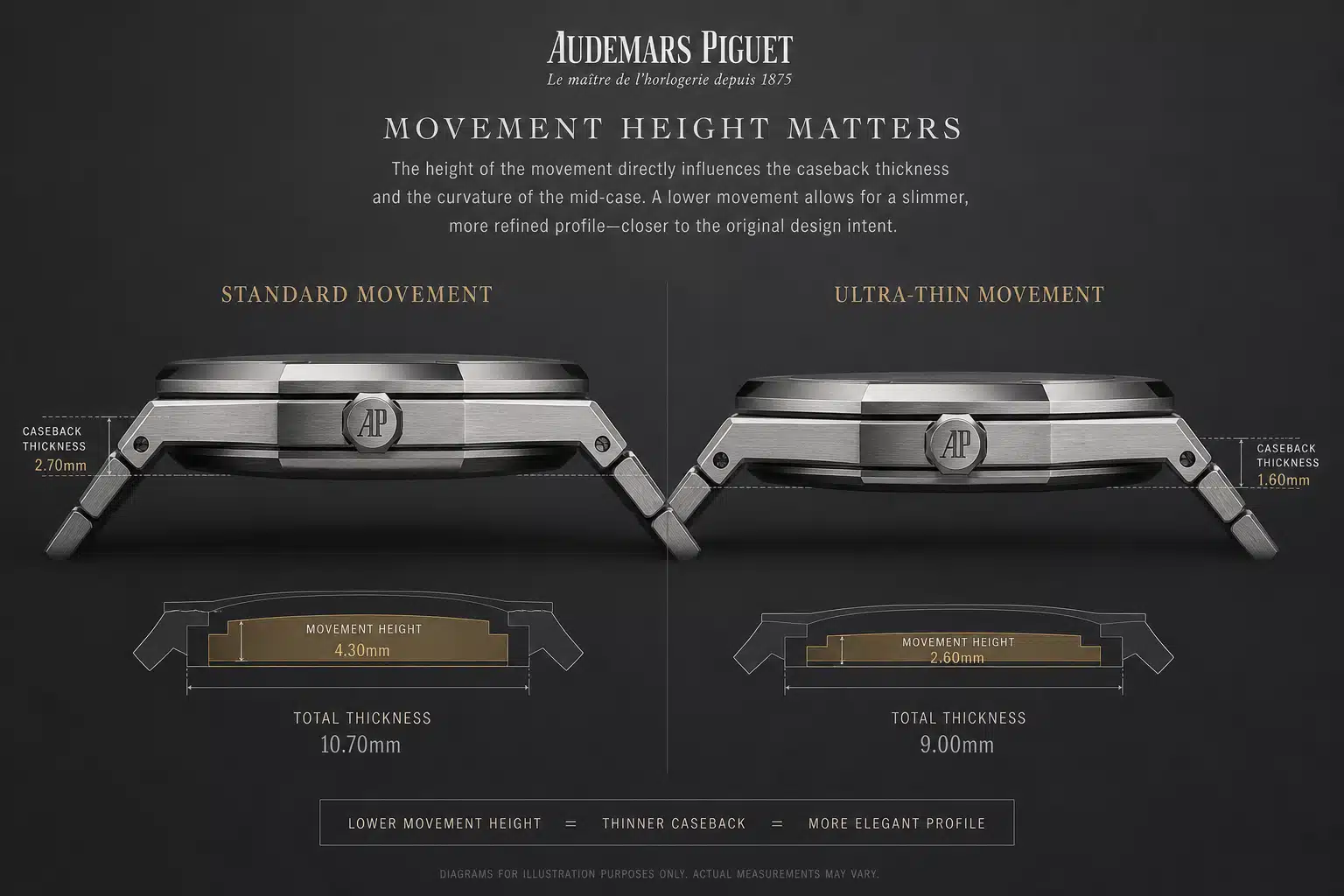
The Thickness Problem: How 3.9mm Movement Height Changes Patek Case Profiles
Miyota 9015 thickness is the point where a practical movement becomes a visual compromise. At 3.9mm, the movement is not unusually thick in general watchmaking. The problem is context. Patek-style watches often rely on a slim case, a restrained mid-case, and a flat side profile. In that environment, even a small increase in movement height can push the finished watch into a different visual category.[1]
Patek replica case thickness should never be judged only from the listed movement height. A 3.9mm movement height does not mean the finished watch will be thin. The dial, hands, movement holder, caseback, crystal, gaskets, and decorative construction all add height. If a factory uses extra plates or a thicker caseback to make the movement route work, the final watch may look heavier than the front photo suggests.
The non-obvious issue is proportion, not just measurement. A case can be only slightly thick on paper but still look wrong if the caseback bulges, the mid-case appears slab-like, or the lugs lose their natural downward flow. Thin watch replica buyers should pay attention to how the parts relate from the side, because that is where the Miyota compromise often becomes visible.
Movement Height Versus Finished Case Thickness
Movement height is only one layer of the finished construction; in DD324 and DD330 movement comparisons, a factory still needs room for the dial, hand clearance, stem alignment, spacer ring, automatic rotor clearance, caseback structure, and crystal. If the internal stack is not carefully managed, the case grows upward or downward. Sometimes the watch becomes thicker through the caseback. Sometimes the mid-case becomes taller. Sometimes the bezel and crystal sit higher to keep the proportions balanced from the front.
This is why exact thickness claims require verification by factory, batch, and model. A listing may say Miyota 9015, but two factories can package that movement very differently. One version may hide the height reasonably well, while another may look swollen from the side. The buyer should not assume the movement name tells the whole story.
Why Side-Profile Accuracy Matters on Patek Designs
On many Patek-style replicas, side-profile accuracy matters as much as dial printing. The brand’s design language is built around elegance, flatness, and controlled case geometry. If the watch looks too tall on the wrist, the dial can be accurate and the overall impression can still feel off.
This is especially important because front-facing photos flatter almost every replica. A watch can look clean from above while hiding a thick caseback, awkward mid-case, or raised crystal. Side profile accuracy is where a buyer sees whether the movement route has been absorbed cleanly or simply accommodated with more metal.
The practical judgment is simple: if thinness is part of why the watch appeals to you, do not buy from front photos alone. A Miyota-based Patek replica can be reliable and still be the wrong watch if the case profile does not match your expectation.
Side Profile Photos to Check
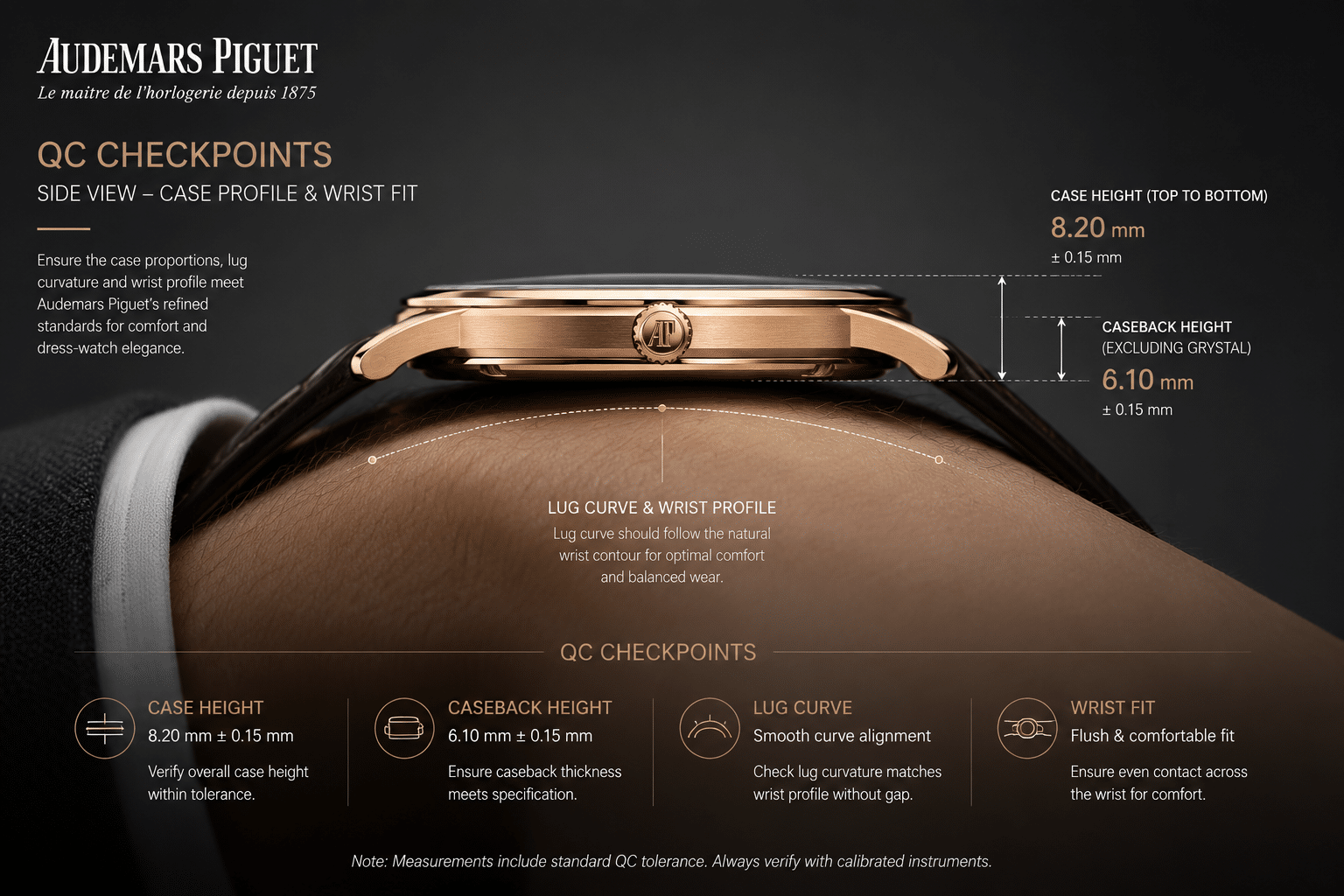
Before deciding, ask for neutral side-view QC photos rather than only angled glamour shots. The useful views are a straight case flank photo, a caseback view, and a wrist-angle photo that shows how high the watch sits. These do not prove long-term reliability or water resistance, but they help reveal whether the case thickness problem is acceptable.
Look at the caseback height first, then the mid-case, then the transition into the lugs or strap. If the back looks overly domed, the side wall looks too vertical, or the watch appears to float above the wrist, the movement route may be driving the shape more than the original design language does. That is the point where a cheaper, serviceable movement may no longer be the better value.
Nautilus Replicas: Where Miyota Thickness Is Most Noticeable
A Miyota Nautilus replica is where the thickness tradeoff becomes hardest to ignore. The Nautilus is not a chunky sports watch that can hide extra height behind a tall bezel or aggressive caseback. Its whole design depends on a broad, flat porthole case, slim case ears, and a bracelet that appears to flow out of the case rather than attach to it as a separate part. Add too much height in the mid-case or caseback, and the watch can still look decent from the dial side while losing the low, stretched stance that makes a Nautilus convincing on the wrist.
This is why Nautilus replica thickness matters more than many buyers expect. A clean dial, aligned markers, and acceptable date position do not solve a swollen side profile. On a 5711 replica or 5811-style build, the eye reads the case as one horizontal object. If the caseback drops too far below the case flank, or the mid-case looks like a thick slab between bezel and bracelet, the watch starts to feel heavier and less refined even before anyone studies the dial.
The Flat Case Problem
The Nautilus case is visually unforgiving because it is wide, flat, and simple. The bezel line, mid-case, case ears, and caseback are all part of the same silhouette. A movement route that requires more internal height can push the finished watch toward a taller side wall or a more prominent caseback, and that changes the proportions in a way front-facing photos often hide.
The key point is not whether the Miyota 9015 is thick by normal automatic movement standards. It is whether the finished replica still preserves the Nautilus profile. A thick Nautilus replica does not usually fail because one number is wrong on a spec sheet. It fails because the case no longer sits with that thin, flat, slightly architectural feel that buyers associate with the model.
Bracelet Integration Can Expose a Thick Mid-Case
Bracelet integration makes the problem more visible. On a normal watch with lugs and a strap, the strap can distract from case height. On a Nautilus, the first bracelet links continue the geometry of the case. If the case body is too tall, the bracelet may look like it is dropping away from the watch instead of flowing from it. That small change affects wrist presence more than many macro dial flaws.
Buyers comparing a Miyota Nautilus replica should look closely at the side where the bracelet meets the case. The question is not only whether the bracelet fits tightly, but whether the case-to-bracelet transition looks natural. A tall mid-case with a flat bracelet can make the watch appear top-heavy. A caseback that protrudes too much can also make the watch sit higher on the wrist, which is especially noticeable because the Nautilus is expected to wear low and wide.
When Miyota Still Makes Sense in a Nautilus Build
Miyota can still make sense in a Nautilus build if the buyer is honest about priorities. If the goal is a casual daily-wear Patek Philippe replica with a reliable movement route, easier replacement, and less concern about display-back architecture or exact side-profile accuracy, Miyota is not automatically a bad choice. It can be the more practical option for someone who wants to wear the watch rather than chase the thinnest possible case.
The caution is for accuracy-focused buyers. If the main reason you want a Nautilus replica is the thin integrated case and elegant wrist profile, a Miyota version should be inspected more critically than almost any other Patek sport model. The better movement route for Nautilus replica buyers is not a universal answer; it depends on whether reliability or profile accuracy matters more. For a Nautilus, though, the profile deserves extra weight in the decision.
Aquanaut Replicas: More Forgiving, but Not Immune
A Miyota Aquanaut replica is usually more forgiving than a Nautilus because the design has a sportier attitude and a rubber strap that visually softens the case-to-wrist transition. The Aquanaut does not rely on a fully integrated metal bracelet in the same way, so a small increase in case thickness may not look as awkward. For buyers asking whether Miyota is acceptable for Aquanaut, the answer is often yes for daily wear, provided the case does not become visibly slab-sided.
This does not mean Aquanaut replica movement choice can be ignored. The 5167-style case still has a relatively slim, casual profile, and the watch should not sit like a thick diver. If the caseback is too deep or the mid-case lacks taper, the watch loses the easy, lightweight feel that makes the Aquanaut appealing in the first place.
Why the Strap Can Hide Some Proportion Issues
The rubber strap helps because it creates a softer visual break between the case and the wrist. Unlike the Nautilus bracelet, it does not continue the case geometry as a hard metal line. That gives the Aquanaut more tolerance for a Miyota-based build, especially when the strap seats closely against the case and bends naturally downward.
Strap fit matters more than buyers sometimes realize. A well-shaped strap can make a slightly thicker case feel more balanced, while a stiff or poorly seated strap can exaggerate height. If the strap flares away from the case or leaves the watch perched above the wrist, the added thickness becomes much easier to notice.
Where Thickness Still Shows
The danger zone is the side profile. A Miyota Aquanaut replica can look convincing from above but less convincing from the side if the caseback bulges too far or the mid-case looks vertical and heavy. The Aquanaut has a sportier identity, but it is still a Patek-style sports watch, not a tool watch built around bulk.
Buyers should pay attention to how the watch sits on the wrist in angled photos. If there is a visible gap under the caseback, or if the strap curves down sharply because the case is sitting high, the thickness is no longer just a technical detail. It becomes a comfort and proportion issue.
What This Means for Daily Wear
For daily wear, the Aquanaut is probably the most forgiving of the three model families discussed here. A Miyota-based version can be a sensible choice for buyers who want a reliable automatic movement, practical serviceability, and a casual Patek Philippe replica that does not demand the strictest thin-case execution.
The balanced judgment is simple: Miyota is more acceptable in an Aquanaut than in the most profile-sensitive Nautilus builds, but it still needs a side-view check. If the watch looks too tall for its strap and case shape, the movement advantage does not fully rescue the wearing experience.
Calatrava Replicas: Dress-Watch Thinness Makes Miyota Harder to Hide
A Miyota Calatrava replica faces a different problem from the Nautilus or Aquanaut. The issue is not bracelet integration or sporty case architecture. It is restraint. A Calatrava-style dress watch depends on a slim case, clean bezel-to-case balance, gentle lug curvature, and the ability to sit quietly under a cuff. When the case becomes too thick, the entire character of the watch changes.
This is where Calatrava replica thickness can be more damaging than buyers expect. A simple dial does not hide proportion flaws; it exposes them. With fewer design elements competing for attention, the caseback profile, bezel height, and lug shape become the main signals of quality. A thick automatic Calatrava replica can look less like a refined dress watch and more like a generic round watch wearing a Patek-style dial.
Simple Dials Put More Pressure on the Case
On a Calatrava-style replica, the dial may be clean enough from the front, but the case has to do more of the visual work. If the bezel is too tall, the mid-case is too straight, or the caseback protrudes heavily, the watch loses the thin, disciplined presence that makes the design work. This is not a macro-photo issue. It is visible in normal wear because dress watches are judged by silhouette and proportion.
The non-obvious risk is that a Miyota-based Calatrava can be mechanically sensible and visually compromised at the same time. The Miyota 9015 may offer a reliable, serviceable movement route, but if the finished case is too thick for dress-watch expectations, the buyer may end up with a watch that works well yet never feels quite right on the wrist.
Why Dress-Watch Buyers Should Ask for Side Views
For a dress watch replica, side views are not optional. Buyers should ask for neutral profile photos that show caseback height, lug curvature, and how the watch sits when viewed from wrist level. A front photo can make almost any clean Calatrava dial look acceptable. The side photo tells you whether the watch still has the thin Patek-style character that the model depends on.
Accuracy-focused buyers should be especially careful with Miyota-based Calatrava builds. That does not mean every Miyota Calatrava replica is the wrong choice, but the standard should be stricter than it is for a casual sports model. If the buyer wants a thin Patek replica that feels understated under a shirt cuff, case execution matters as much as movement reliability.
The practical verdict is that Calatrava buyers should treat Miyota as a tradeoff, not a shortcut to avoid. It may be acceptable when the case is well controlled and the buyer values lower service stress. It becomes the wrong choice when the watch’s identity depends on thinness and the finished profile cannot support that expectation.
Rotor Noise and Hacking Seconds: Ownership Details Buyers Actually Notice
Some Miyota 9015 traits do not show up clearly in listing photos but become obvious once the watch is on the wrist. Two of the most common are Miyota 9015 rotor noise and Miyota 9015 hacking seconds. Neither one should be judged like a dial flaw or case-shape problem. They belong to the ownership experience: what the watch sounds like, how it feels when handled, and how easy it is to set accurately.
The important point is hierarchy. Rotor noise can bother some buyers every time the watch moves. Hacking seconds, by contrast, is mostly a convenience feature when setting the time. Buyers sometimes give both details the same weight because they sound technical, but in daily use the rotor is the trait more likely to affect comfort.
Rotor Noise Is a Comfort Issue, Not Always a Failure
A Miyota 9015 can produce noticeable rotor sound because of its automatic rotor design and the way it winds. In some watches, the rotor can spin freely enough that the movement sound becomes a light whirring or buzzing sensation when the wrist changes direction. This does not automatically mean the movement is defective. It may simply be a normal trait made more obvious by the case construction.
Patek Philippe replicas can make this more noticeable because many cases are relatively thin, broad, or lightly built compared with heavier dive watches. If the caseback, movement holder, or internal damping is not well executed, sound travels more easily. Two Miyota-based watches using the same movement can feel different because the case transmits vibration differently.
The practical judgment is simple: if you are sensitive to mechanical sound, ask about rotor noise before choosing a Miyota-based Patek replica. A little rotor movement is normal. A loud, loose, scraping, or rattling sound is different and should be treated as a QC concern. Buyers should not panic over every whir, but they also should not ignore a movement that sounds rough from the first day.
Hacking Seconds Helps With Time Setting
Hacking seconds means the seconds hand stops when the crown is pulled to the time-setting position. Miyota lists second-hand stop function for the 9015, alongside hand-winding and automatic winding.[1] For a daily-wear replica watch, this is useful because it lets the buyer set the time more precisely. It is especially convenient if the watch is part of a rotation and needs to be reset after sitting for a few days.
The feature should not be overvalued. Hacking seconds improves the user experience, but it does not make the watch more authentic, more premium, or automatically better than another movement route. Some buyers focus on whether the movement hacks because it feels like a checklist item. In practice, it matters much less than winding feel, crown stability, date behavior, and whether the movement runs consistently after delivery.
For a Miyota-based Patek replica, hacking seconds is best understood as a practical benefit. It makes setting the time cleaner. It does not solve rotor noise, case thickness, or movement decoration. A buyer who separates those issues will make a more sensible decision.
Miyota 9015 Versus DD324: Practical Reliability or Better Visual Architecture
The Miyota 9015 vs DD324 decision is not really about which movement sounds more impressive. It is about which compromise fits the watch and the buyer. Miyota is the more familiar workhorse route. DD324 is the more visually ambitious clone movement route, usually chosen because it can support a more Patek-like layout, display-back appearance, and case architecture when the factory execution is good.
That distinction matters because Patek Philippe replicas are not only judged by whether the dial looks correct from the front. The movement route affects case profile, rotor behavior, movement decoration, repair risk, replacement cost, and long-term ownership stress. A DD324 Patek replica may look more convincing in the areas that collectors notice, while a Miyota build may be easier to live with if the owner values repairability over visual architecture.
Where DD324 Usually Has the Visual Advantage
DD324 usually has the advantage when the watch needs a more convincing Patek-style structure. A purpose-built clone movement can help the factory keep the display-back view, bridge layout, rotor shape, and case profile closer to the intended design. This is especially relevant on watches where the case is slim, the back is visible, or the buyer cares about the overall architecture rather than only the front dial.
The visual advantage is not automatic. DD324 quality depends on the version, the factory using it, and the specific batch. A poorly assembled clone movement can create more ownership frustration than a simpler Miyota route. Buyers should avoid thinking of DD324 as a magic upgrade. It is better viewed as a higher-accuracy route with more complexity attached.
For accuracy-focused buyers, DD324 is often worth considering when the model depends heavily on thinness, movement display, and correct proportions, especially where Patek Philippe clone movements become a reference point for assessing visual depth and case architecture. The tradeoff is that the buyer may be accepting more repair risk and less straightforward movement replacement if something goes wrong later.
Where Miyota Usually Has the Ownership Advantage
Miyota usually wins on practical ownership. It is a known automatic movement, many repairers are more comfortable handling it, and replacement is generally less stressful than dealing with a less common clone caliber. That does not make every Miyota-based watch better. It means the movement route is easier to understand and easier to manage if the buyer intends to wear the watch regularly.
This is where many buyers misread the comparison. A more visually accurate movement is not always the better daily-wear movement. If the watch will be worn often, and the buyer does not want complicated service questions, the Miyota route can be rational even when the case profile is less perfect. For a casual Aquanaut-style build, that tradeoff may be acceptable. For a thin Nautilus or dress-style Calatrava, the visual compromise may be harder to forgive.
At Clean VS Factory, we usually separate visual accuracy from ownership comfort when comparing movement routes. A watch can be technically more impressive and still be the wrong choice for a buyer who wants low-stress daily use. The better question is not only “which movement is better,” but “which movement creates the fewer problems for this specific model and expectation.”
Movement Route to Verify
Buyers should confirm the actual movement route for the exact watch being evaluated. Factory names, model names, and old review comments can be reused across versions, and sellers may describe a watch too generally. A listing that says “clone movement” should not automatically be treated as DD324, and a Patek replica with a display caseback should not be assumed to have the more advanced route.
The safest approach is to ask for clear movement confirmation before approval. If possible, compare listing details, QC photos, and current version notes. This is not about proving anything for resale or authentication misuse. It is about making sure the buyer is paying for the movement route they actually want.
Version and Batch Notes Matter More Than Old Reputation
For Miyota versus DD324 comparisons, older reviews can be useful background, but they should not replace current version checking. Replica factories may change dial suppliers, case construction, movement holders, rotor decoration, clasp engraving, or strap fit without changing the model name in a way that is obvious to buyers. A watch praised in one batch may not be identical to the watch being offered later, especially if the seller is using archive photos or a generic factory label.
A practical traceability path is to record the stated factory, model reference, version, movement route, and QC evidence before deciding. That does not make the watch official or risk-free, but it gives the buyer a clearer basis for comparison. If two watches both claim to be Nautilus-style replicas, the better choice may come down to the current side profile, actual movement shown, datewheel placement, bracelet transition, rotor behavior, and whether the seller’s description matches the evidence in the photos.
QC Checks for Miyota-Based Patek Philippe Replicas
Patek replica QC should be stricter when the watch uses a Miyota route because the movement can influence more than timekeeping. The buyer should look at the case shape, side profile, caseback height, dial alignment, date alignment, bracelet fit, strap fit, and whether the stated movement matches the version being sold. The goal is not to chase perfection. The goal is to catch the flaws that will be obvious in daily ownership.
Front-facing photos can make many watches look cleaner than they feel in real life. A Miyota-based Nautilus, Aquanaut, or Calatrava may look acceptable from above while the side view tells a different story. For that reason, Miyota replica QC photos should include angles that show how the watch sits, not only how the dial photographs.
Before making a decision, buyers should review real QC photos where available, including dial printing, hand alignment, datewheel centering, case thickness, caseback shape, bracelet or strap seating, clasp engraving, crown operation, and side-profile height. Factory labels and stock photos alone are not enough for a reliable judgment, especially when the movement route can change the finished case architecture.
Front View Checks Still Matter
The front view still deserves attention. Check dial printing, marker alignment, hand alignment, date position, and overall symmetry. On Patek-style replicas, small errors can stand out because the design language is clean. A date that sits too high or too low, uneven hour markers, or a slightly rotated dial can make the watch feel cheaper than its movement choice suggests.
Do not let the movement discussion distract from basic finishing. A reliable Miyota inside a poorly aligned case is still a poor buy. The front view should look balanced first, then the buyer can move on to the movement-related checks that are more specific to this route.
Side View Checks Matter More Than Usual
The side view is the most important QC angle for Miyota-based Patek replicas. Ask for a neutral side profile photo, not only flattering wrist shots. The caseback height, mid-case thickness, crystal height, and lug transition should look controlled. If the watch appears slab-sided or the caseback protrudes heavily, the movement route may be showing through the design.
The model changes what to inspect. On a Nautilus replica, look at the case-to-bracelet transition and whether the mid-case feels too tall for the flat porthole shape. On an Aquanaut replica, check whether the rubber strap seats naturally against the case and whether the caseback makes the watch ride too high. On a Calatrava-style replica, pay close attention to caseback thickness and lug curve, because dress watches have fewer design elements to hide extra height.
QC photos cannot prove long-term reliability, water resistance, or service life. They can, however, reveal whether the case profile is acceptable before the buyer commits. For this movement route, that is where many bad decisions can be avoided.
What QC Photos Can Show and What They May Hide
QC photos are useful, but they are not final proof of a good watch. They can show dial alignment, date position, case thickness, bracelet seating, obvious scratches, and whether the supplied watch appears to match the stated version. They usually cannot prove amplitude under real use, lubrication quality, rotor stability over time, water resistance, or whether the case construction will feel solid after months of wear.
For Miyota-based Patek replicas, video can be more useful than another polished still photo. A short clip of hand-setting, date change, crown operation, and light wrist movement may reveal rough winding, loose crown feel, rotor scraping, or an unusually loud internal rattle. These details matter more for daily ownership than a macro shot that only confirms the dial looks clean under bright light.
Verification Note: When possible, buyers should review real QC photos and short handling videos for the exact watch rather than relying only on stock images, factory labels, or older reviews. Side-profile height, caseback shape, dial and date alignment, bracelet or strap seating, crown operation, and rotor sound can help reduce uncertainty before approval, although they still do not guarantee long-term performance or water resistance.
Seller Claims, Policies, and Water Resistance Should Be Confirmed Separately
QC approval should not be treated as a warranty, authentication result, waterproof test, or shipping promise. A clean photo set may reduce uncertainty about visible details, but it does not confirm pressure testing, customs outcome, after-sales support, return terms, or future movement performance. Buyers should confirm those seller-specific terms directly before ordering, especially if the listing uses broad language such as “perfect,” “factory guaranteed,” “waterproof,” or “same as genuine.”
Prices can also change by factory label, version, movement route, seller channel, availability, finishing level, and after-sales expectations. Without a dated source and clear context, exact price comparisons should be treated as temporary seller information rather than stable market facts. A Miyota version may be more practical for one buyer and less suitable for another, so the price only makes sense when compared against the actual movement, case profile, QC evidence, and service expectations.
Movement Claims Should Match the Watch You Are Evaluating
Movement confirmation should be tied to the exact watch, not assumed from forum posts, old reviews, or factory reputation. A factory may release more than one version of the same Patek Philippe replica, and the movement route can change across batches. A buyer comparing Miyota and DD324 should verify the version before treating the price or case shape as justified.
The most useful QC question is direct: is this specific watch using Miyota 9015 or DD324? After that, the buyer can judge whether the visible case profile, rotor behavior expectation, and replacement risk match the choice. If the seller cannot clearly explain the movement route, the buyer should be cautious, especially when the watch is priced like a higher-spec clone movement version.
When Miyota Is Acceptable and When It Becomes the Wrong Choice
The practical answer to “is Miyota 9015 good for Patek replicas” is yes, but only under the right expectations. It is a sensible movement route when the buyer wants a watch that is easier to live with, easier to service, and less stressful to replace if something goes wrong. It becomes the wrong choice when the buyer is mainly paying for a slim Patek-style case profile and expects the watch to carry the same visual restraint as the original design language.
This is the key Miyota Patek replica decision: are you buying for low-stress daily wear, or are you buying for profile accuracy? Those are not the same priority. A Miyota-based build can be a better ownership choice than a more delicate clone route for some buyers, but it can also make the wrong Patek model look heavier than it should. The movement is not automatically the weak point. The mismatch appears when the case design has no room to hide it.
Choose Miyota If You Prioritize Low-Stress Ownership
Miyota makes the most sense for a buyer who wants a practical Patek replica movement rather than the most visually ambitious one. The 9015 is familiar, widely used, and generally easier for repairers to understand than many decorative or clone-style movements. If the watch is meant to be worn often, not studied through a loupe, that matters more than many buyers admit.
The ownership advantage is simple: fewer surprises usually create a better daily-wear experience. A common movement can be easier to regulate, easier to replace, and less intimidating if the watch needs attention later. For buyers who care more about stable timekeeping, reasonable serviceability, and lower movement stress than display-back correctness or ultra-thin case architecture, Miyota can be the more rational route.
Aquanaut-style replicas are often the easiest place to accept this compromise. The sportier case, rubber strap, and more casual wrist presence can absorb a little extra thickness better than a flat integrated-bracelet Nautilus or a restrained Calatrava-style dress watch. That does not make every Miyota Aquanaut automatically good, but it does make the movement tradeoff easier to justify if the side profile is not exaggerated.
Be Careful With Miyota If Thinness Defines the Watch
Miyota becomes harder to defend when the model’s identity depends on thinness. Patek design is not only about dial layout or logo placement. Much of the appeal comes from how quietly the case sits on the wrist: the thin mid-case, the restrained caseback, the gentle lug line, and the way the watch disappears under a cuff. If the movement forces a thicker construction, the watch may still look acceptable from the front while feeling wrong from the side.
This is where accuracy-focused Nautilus and Calatrava buyers should be cautious. On a Nautilus, extra height can disturb the flat horizontal flow between case and bracelet. On a Calatrava-style replica, a raised caseback or thick mid-case can make a simple dress watch feel less refined. These are not small details for buyers who care about Patek proportions. They are part of the watch’s basic character.
DD324-based versions may be more attractive for buyers who prioritize case architecture and visual accuracy, especially when the model is profile-sensitive. The tradeoff is ownership complexity. A clone movement route can look more convincing in the right case, but it may not be as simple to repair or replace as a Miyota-based build. The better choice depends on which risk bothers you more: a slightly compromised case profile, or a more complicated movement ownership path.
Water Resistance, Materials, and Legal Claims Need Extra Caution
Do not treat authentic Patek Philippe specifications as proof of replica performance. If an official page lists a strap material, case material, or water-resistance rating for an authentic model, that information identifies the genuine watch only; it does not confirm that a replica uses the same material or can survive the same conditions.[2][3] For Miyota-based replicas in particular, water resistance should be treated as unverified unless the individual watch has been pressure-tested after purchase.
Buyers should also avoid resale or disclosure assumptions. A Patek Philippe-style replica is an imitation product, not an authorized Patek Philippe watch, and trademark or customs issues can vary by jurisdiction and circumstance.[4][5] The safer ownership mindset is practical and transparent: evaluate the watch for personal-use expectations, understand that it is not genuine, and do not rely on seller language that suggests authorization, risk-free import, or authentic equivalence.
The Balanced Buyer Verdict
The cleanest decision framework is this: choose Miyota if you want a wearable, serviceable, lower-stress Patek replica and can accept that the case may not be the thinnest or most elegant version available. Avoid Miyota, or at least inspect it more carefully, if you are buying a Nautilus or Calatrava mainly for slim case realism. In that situation, the side profile deserves more weight than the movement’s reputation for reliability.
At Clean VS Factory, we usually encourage buyers to separate movement reliability from visual suitability. A movement can be dependable and still be poorly matched to a particular case design. That is exactly the Miyota 9015 tradeoff in Patek Philippe replicas: it can be a good movement choice, but not always a good proportion choice.
The final check should be visual, not theoretical. If the caseback height, mid-case thickness, lug flow, and wrist profile look balanced, a Miyota-based build can offer practical daily-wear value. If the watch looks swollen from the side, the serviceability advantage may not matter because the design has already lost the quality that made the model appealing in the first place.
References
[1] Miyota, “Miyota 9015 official movement specifications,” manufacturer specification page for movement dimensions and functions, available at Miyota 9015 Official Movement Specifications.
[2] Patek Philippe, “Nautilus 5811/1G official specifications,” official model page for authentic Nautilus case, dial, and collection information, available at Patek Philippe Nautilus 5811 Official Specifications.
[3] Patek Philippe, “Aquanaut 5167A official specifications,” official model page for authentic Aquanaut case, strap, and display information, available at Patek Philippe Aquanaut 5167A Official Specifications.
[4] United States Patent and Trademark Office, “Counterfeit Goods Basics,” official educational document on counterfeit goods and trademark issues, available at USPTO Counterfeit Goods Basics.
[5] U.S. Customs and Border Protection, “Intellectual Property Rights,” official trade enforcement resource on intellectual property and counterfeit goods, available at U.S. CBP Intellectual Property Rights.
Disclosure: This article is for general educational and comparison purposes only. Replica watches are not genuine products from the original luxury brands, and brand names are used only to identify reference designs or comparison topics. Factory names, movement descriptions, prices, availability, QC details, seller policies, and version information can change, so readers should verify important details with the seller before making a purchase decision. Replica watches should not be represented, resold, or used as genuine watches.