
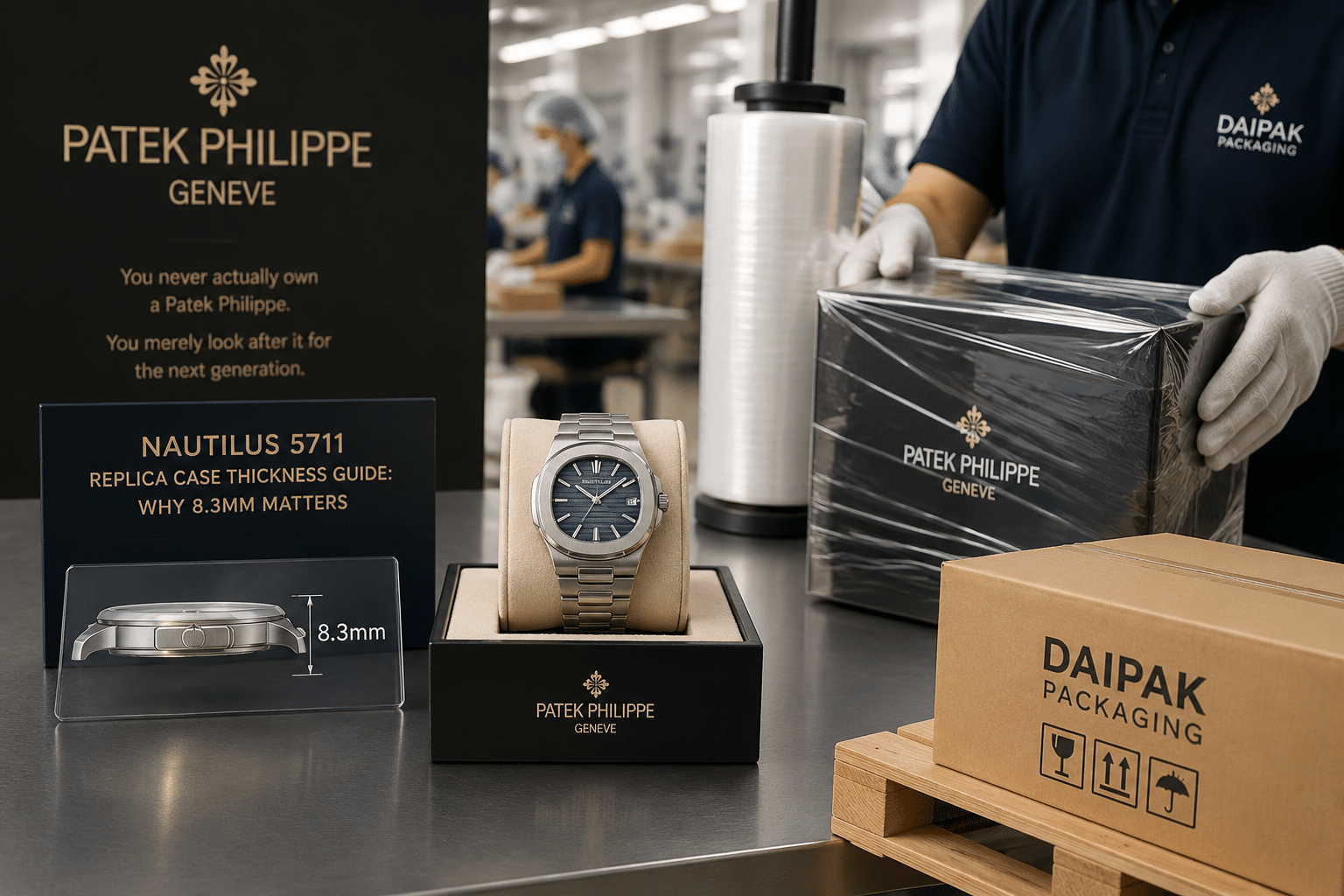
The Nautilus 5711 is one of the few replica watch models where case thickness can change the whole impression of the watch. The original design is known for its very slim 8.3mm profile, so a replica that gains even a few tenths of a millimeter may start to look taller from the side, sit differently on the wrist, and lose some of the bracelet clasp flow that makes the 5711 recognizable.
This guide focuses on how to judge that thickness in a practical buying situation. It explains why movement choice affects case height, why side-profile QC photos matter more than top-down dial shots, and when a slightly thicker build can still make sense for daily wear. The goal is not to chase a single number blindly, but to understand where the compromise becomes visible and which factory or movement route better matches your priority.
For this model, the useful buying question is narrower than “which factory is best.” A factory name can help narrow the shortlist, but it does not prove the actual case height, movement route, bracelet behavior, or batch execution of the watch being offered. A careful buyer should treat factory labels, seller descriptions, and QC photos as signals to verify, not as final proof.
Replica watches should be clearly understood as replica-market products, not genuine watches from the original luxury brands. Brand names are used here for reference and comparison only; they do not imply authorization, endorsement, or affiliation with the original luxury watch brands.
Factory Name Clarification: Factory names in the replica watch market are commonly used buyer-facing labels. They should be treated as practical market references, not as official brand affiliations, audited manufacturer identities, or guarantees of identical quality across every model.
| Buyer Priority | What To Check | Practical Judgment |
|---|---|---|
| Closest side profile | Case near 8.3mm with true side QC | Best for buyers sensitive to Nautilus thinness |
| Movement-driven slimness | DD324-style clone route | Usually supports a thinner, more integrated case |
| Daily-wear convenience | Around 8.5mm with acceptable wrist fit | Can be reasonable if serviceability matters more |
| Avoiding bulky builds | Caseback height and bracelet flow | Above about 8.6mm may lose the 5711 character |
| Factory selection | 3KF, BBF, some DDF, PPF, older versions | Confirm actual version and QC, not just factory name |
| QC photo reliability | Side view under natural angle | Top-down photos hide the most important thickness clues |
Quick Questions Before You Read
Q: Is 8.3mm thickness really that important on a 5711 replica?
Yes, because the 5711’s slim side profile is a major part of its visual identity.
Q: Is a slightly thicker 8.5mm case automatically a bad choice?
No. It can still work for daily wear if the caseback, bracelet flow, and wrist fit remain balanced.
Q: Which photos should be checked before buying?
Ask for clear side-profile QC photos, especially showing caseback height and how the bracelet leaves the case.
Q: Does the movement affect case thickness?
Yes. DD324-style clone builds usually allow a slimmer case than many Miyota-based versions.
Editorial Perspective: For a Nautilus 5711 replica, cleanvsfactory.com treats thickness as a model-specific buying issue, not a general factory-ranking issue. A famous factory name may be useful, but the buyer still needs to verify the actual version, movement route, side profile, caseback shape, bracelet flow, and QC photos of the specific watch. The best choice depends on whether the buyer values visual accuracy, daily-wear convenience, easier servicing, or a lower-risk ownership path.
Evidence Boundary for This Guide
This article discusses imitation watches and buyer inspection logic, not authorized Patek Philippe products. Official brand information can help clarify what the authentic Nautilus family is, but it cannot prove that any replica has the same construction, finishing, water resistance, movement, or service status. For example, Patek Philippe’s own Nautilus 5811 page is useful only as official background on the current Nautilus line and design language, not as evidence that a 5711 replica matches an authentic watch.[1]
Movement references should be read the same way. Official Miyota documentation can confirm the manufacturer’s published specifications for Miyota movements, but it does not prove that a particular replica contains a genuine Miyota movement or that a seller’s movement description is accurate. For a replica purchase, the buyer still needs movement photos, seller transparency, realistic service expectations, and QC evidence from the actual watch being offered.
A traceable reading of this guide means separating three different things: the genuine Nautilus design used as a visual comparison point, the replica-market factory name used by sellers, and the actual watch shown in QC. These categories should not be mixed. A factory name may suggest a likely movement route or case style, but the buyer still needs evidence from the exact version being offered, especially on a model where a small thickness change can alter the whole side profile.
Movement Transparency Note: Movement references in this article describe the replica-market movement type or configuration, not an official Patek Philippe caliber unless explicitly stated with verifiable evidence.
Why the 5711’s Thin Profile Defines the Watch
Nautilus 5711 thickness is not a background specification. It is one of the first reasons the watch looks like a 5711 at all. The genuine reference is known for being a slim sports watch with a flat, integrated stance, not a bulky luxury sports case with a Nautilus-shaped dial. That difference matters because the 5711 is judged from the side almost as much as from the front.
This is where many buyers misread photos. A replica can have a convincing blue dial, acceptable markers, and a clean bracelet finish, yet still look wrong because the case height changes the whole wrist presence. If a buyer is asking “why my replica looks thick,” the answer is often not the dial or bezel. It is the side profile.
The 5711 is less forgiving than many Rolex replica or Audemars Piguet-style sports models because its identity depends on thinness. A Submariner can carry visual mass without feeling off-model. A Royal Oak can tolerate some angular presence because the original design already feels architectural. The 5711 is different. Add too much height, and the elegant silhouette starts to feel heavier, more vertical, and less integrated with the bracelet.
References to Rolex, Audemars Piguet, and Patek Philippe in this comparison are used only to identify genuine reference designs and visual categories. They should not be read as a statement that any replica watch is made, approved, serviced, or authenticated by those brands.
This is also why a photo-friendly replica is not always the same thing as a good daily-wear replica. A watch can photograph well from the front because the dial color, logo placement, hand length, and bezel shape look acceptable under seller lighting. Daily wear exposes different evidence: how high the case sits, whether the bracelet pulls naturally around the wrist, whether the rotor feels intrusive, and whether the caseback changes comfort after a full day.
The genuine 5711 benchmark
The commonly cited genuine 5711 case thickness is about 8.3mm. For a steel integrated-bracelet sports watch, that is unusually thin, and it gives the watch its low, almost flattened stance on the wrist. This number matters because it gives buyers a baseline for judging every Nautilus 5711 replica thickness claim.
A replica does not become convincing simply because the seller says it is a “super clone watch.” For this model, the better question is simple: how close is the 5711 case thickness to the original profile, and does the side view support that number? A watch listed around 8.3mm is aiming at the correct target. A version closer to 8.6mm or 8.8mm may still be wearable, but it is no longer communicating the same thin personality.
The non-obvious point is that 0.3mm can matter more here than it would on a thicker watch. On a 14mm dive watch, a fraction of a millimeter disappears into the overall case mass. On an 8.3mm Nautilus, the same difference changes the proportion between bezel, mid-case, caseback, and bracelet drop. That is why a thickness gap that sounds small on paper can become visible in normal wrist angles.
Buyers should also be cautious about how the number is stated. Some listings may quote a case-only measurement, some may include the crystal, and some may repeat a factory claim without measuring the actual watch. A stated 8.3mm figure is useful only when it is supported by side-profile QC images and a known movement route that makes that height plausible.
Why thickness changes perception faster than dial details
Dial flaws usually require a direct front view. Thickness does not. A slightly tall 5711 case can show itself when the wrist turns, when the watch slides under a cuff, or when the caseback lifts the watch off the wrist. That makes thickness a daily-wear issue, not only a macro-photo issue.
This is why some buyers feel confused after receiving a watch that looked good in top-down QC photos. The dial may look close, the hands may be clean, and the bezel may reflect well, but the side profile can still make the watch feel like a different object. A flatter watch blends into the wrist. A taller one sits on top of it.
For the 5711, side height also affects how the bracelet appears. The original design relies on a smooth transition from case to first links. If the case is too tall, the bracelet can look like it is attached to a block rather than flowing out from the case. That change is more obvious in real use than a slightly imperfect dial shade.
How the 5711’s profile shapes buyer expectations
Most buyers do not consciously say they want an 8.3mm watch. They say they want the replica to “look right.” On the 5711, looking right usually means the watch sits low, the caseback does not visually dominate, and the bracelet drops naturally from the case. The correct 5711 profile is a wearing impression, not just a measurement.
This is also why factory reputation alone can mislead buyers. A factory may be strong overall, but if its 5711 build sits too high, it misses a central part of the reference. At Clean VS Factory, we usually treat the 5711 as a profile-first model: dial quality matters, but thickness decides whether the watch has the right basic shape before smaller details are even considered.
The practical rule is straightforward. If the buyer values the Nautilus because it is slim, elegant, and low on the wrist, case thickness should be a top priority. If the buyer only wants the general Nautilus look and is less sensitive to side-view accuracy, a slightly thicker version may still be acceptable. The mistake is pretending those two expectations are the same.
A useful way to frame the decision is to separate “visible accuracy” from “ownership comfort.” The thinner build may be more visually satisfying, especially for someone who already knows the genuine 5711 profile. A slightly thicker or simpler movement route may be easier to live with for a buyer who mainly wants an attractive daily watch and does not inspect the case from low side angles. Neither priority is wrong, but they lead to different shortlists.
How Movement Height Shapes Case Thickness
The main reason some Nautilus replicas are thin and others look too thick is not mystery finishing. It is movement height. The movement sits inside a limited case envelope, and the builder still needs space for the dial, hands, calendar parts, rotor, caseback, gasket, and crystal structure. If the movement stack is taller, the case usually has to grow with it.
This is why movement choice matters differently on the 5711 than on many other replica watches. In some models, a movement swap is mostly about reliability, beat rate, or decoration. On the 5711, it directly changes the silhouette. A DD324 clone movement route can support a thinner case construction, while a Miyota-based 5711 replica usually needs more vertical clearance.
Buyers often ask which movement makes the case thinner. The answer is not only about the movement’s listed thickness; it is about how well the movement layout fits the 5711 architecture. A movement that fits the dial position, date position, hand stack, rotor profile, and caseback clearance more efficiently gives the factory more room to keep the case low.
Movement choice also affects ownership in ways that are not visible in a seller photo. A thinner clone-style route may help the case profile, but it can be more specialized if parts, service knowledge, or movement replacement become relevant later. A more common movement base may be less visually ideal on this model, but some buyers may prefer the familiarity for daily use. That is the tradeoff many beginner buyers underestimate.
Movement descriptions in the replica market should be checked carefully because they may refer to layout, decoration, clone architecture, or seller terminology rather than an official brand-manufactured caliber. The purpose of factory and movement information is to help readers understand quality and risk, not to represent a replica watch as genuine.
Why DD324-style clone routes help reach 8.3mm
A DD324-style clone route is valued because it is built around the same basic goal as the watch itself: keeping the movement thin enough for the Nautilus case. The genuine 5711’s profile depends on a slim automatic movement architecture. A clone route designed for that space can reduce the need for extra caseback height and helps the finished watch approach the 8.3mm target.
This does not mean every DD324 clone movement is equal, or that every watch using it is automatically the best choice. Assembly quality, batch consistency, rotor behavior, hand setting, and movement decoration still vary. But for case thickness, the architecture gives factories a stronger starting point than a more generic movement route.
The key buying insight is that 8.3mm is usually not achieved by shaving metal randomly from the case. It is achieved by making the whole stack work: movement, dial, hands, rotor, caseback, and gasket. If the movement is already close to the needed height, the case can stay closer to the genuine side profile without looking forced.
Buyers should not confuse movement decoration with movement performance. A movement may look more impressive through a display back, but the more important daily questions are whether it winds smoothly, keeps acceptable time, changes date properly, avoids excessive rotor noise, and fits the case without creating an oversized underside. On the 5711, function and height often matter more than decoration viewed through the caseback.
Movement trust in this category depends on understanding what the movement claim is actually describing. A seller may use a movement name to describe architecture, dial-side layout, rotor decoration, date position, or simply a common market label. For a thickness-focused 5711 replica, the buyer should connect the movement claim to visible evidence: caseback height, date-window position, hand stack, rotor clearance, and any available movement photo. The movement name alone should not be treated as proof of official brand origin or long-term serviceability.
Why Miyota-based builds usually add height
A Miyota-based 5711 replica uses a practical, widely available movement platform, but the movement is typically taller than the DD324-style route. That added height may sound minor, yet it usually pushes the case toward a slightly thicker build. The result can be a watch that looks good from the top but carries extra mass from the side.
Official Miyota specifications show why buyers should separate movement facts from seller claims. Miyota lists the 9015 as a thin automatic movement with a 3.90mm movement height, 24 jewels, 28,800 vibrations per hour, hand-winding, and a stop-second function, while the 8215 is listed with a 5.67mm movement height, 21 jewels, 21,600 vibrations per hour, hand-winding, and no stop-second function.[2][3] Those figures explain why movement height can matter in a slim watch, but they still do not prove what is inside any specific 5711 replica.
Buyer Expectation Note: No replica watch should be judged by factory reputation alone. A better decision usually depends on the specific model, movement version, case thickness, dial accuracy, bracelet quality, service risk, and how closely the watch will be inspected in real use.
The Miyota route has a reason for existing. It can be easier to source, familiar to many repairers, and generally less exotic than a clone movement. For some buyers, that matters. But the cost is visible on this model because the 5711 does not hide extra thickness well. The caseback may appear more pronounced, the mid-case can look taller, and the watch may sit higher on the wrist.
This is the common misunderstanding: buyers sometimes assume a Miyota-based version is simply a more reliable version of the same visual watch. For the 5711, it is not that simple. The movement choice changes the case construction, and the case construction changes the watch’s character.
A Miyota-based option can still be a rational purchase when the buyer accepts the profile compromise before ordering. It becomes a poor match when the buyer expects the same side silhouette as the thinnest clone-movement builds while also expecting the ownership simplicity of a more common movement platform. Those two advantages do not always arrive together in this model.
What thickness tradeoff the movement choice creates
The real decision is not “clone movement good, Miyota bad.” It is profile accuracy versus practical simplicity. A DD324-style clone movement is usually the route for buyers who care most about the thin 5711 silhouette and want the case to sit near the 8.3mm benchmark. A Miyota-based build can be more rational for buyers who accept a slightly thicker case in exchange for a more familiar movement platform.
For a visual purist, the thinner route is usually the more convincing choice, especially when 5711 blue dial gradient details are judged alongside the case profile. The 5711’s flat personality is too important to treat as a secondary detail. For a buyer who wants a daily-wear replica and is not highly sensitive to side-profile accuracy, a slightly thicker version may still be acceptable if the case finishing, bracelet feel, and QC result are strong.
The mistake is paying for the wrong advantage. If the buyer is chasing the closest wrist profile, movement architecture should be part of the decision from the beginning. If the buyer mostly wants easier ownership and does not care about a small thickness increase, then insisting on the thinnest route may not improve the actual experience.
This is also where price can mislead. A higher price may reflect movement complexity, current availability, factory demand, seller margin, or after-sale risk, not automatically a better choice for every buyer. The more useful comparison is whether the movement, case thickness, bracelet feel, and known version behavior fit the buyer’s intended use.
Replica watch prices can vary by factory label, version, movement configuration, finishing quality, seller channel, availability, and after-sales support. Buyers should compare like-for-like details before treating one option as better value.
Factory Thickness Comparison: 3KF, BBF, DDF, PPF, and Older Builds
A factory thickness comparison for the Nautilus 5711 should not be treated like a general factory ranking. The question here is narrower: which versions preserve the thin side profile, and which versions start to look taller on wrist? A factory can have a strong dial, a better bracelet, or a more attractive price, but if its 5711 case height misses the mark, the watch changes character.
Current high-end 5711 replica discussions often center on 3KF, BBF, DDF, and PPF, with older builds used as reference points for how far the market has moved. The most important separation is between versions targeting the 8.3mm-style profile and versions that typically sit a little higher because of movement route or older case construction.
Exact measurements can vary by batch, seller measurement method, gasket seating, and whether the number includes crystal height. So the useful approach is not to memorize one permanent number. It is to understand the thickness tier and then verify the specific watch through version information and side-profile QC photos.
Factory reputation is useful only when it is tied to the specific model and version. A factory that performs well on one watch family may not automatically lead on a Nautilus, and a factory that has a strong 5711 case may still have compromises in movement behavior, bracelet feel, dial tone, or after-sale support. “Best factory” claims should always be narrowed to the reference, batch, movement, and buyer priority.
A more traceable factory comparison moves in order: factory label, current version, movement route, stated thickness, visible side profile, bracelet transition, and actual QC photos. Skipping directly from the factory name to a purchase decision is risky because the same label can be used across different batches, and seller descriptions may not always separate old stock, updated versions, or alternative movement configurations clearly.
Factory names are useful market references, but they do not guarantee identical quality across every model or version. A factory comparison is most useful when it is tied to the specific reference, version, movement configuration, case shape, dial execution, bracelet construction, and available QC evidence.
| Factory Route | Typical Thickness Position | Side-Profile Meaning | Buyer Judgment |
|---|---|---|---|
| 3KF | Often positioned around the 8.3mm target | Low, slim stance when the batch and assembly are good | Strong choice for buyers prioritizing profile accuracy |
| BBF | Also aims near the thin clone-movement range | Competitive side profile, depending on batch execution | Worth comparing directly with 3KF rather than assuming one winner |
| DDF | Usually discussed in the thin or near-thin tier | Can be convincing in case shape, but movement stability claims should be checked carefully | Attractive for profile-focused buyers who accept newer-version uncertainty |
| PPF | Commonly slightly thicker than the 8.3mm benchmark | Still plausible on wrist, but less flat than the thinnest builds | Sensible for buyers who accept the profile compromise |
| Older Builds | Often around the higher 8.8mm to 10mm range | More visibly bulky and less integrated | Usually not ideal if thickness accuracy is the priority |
3KF versus BBF on side profile
3KF 5711 thickness became important because it showed that a replica could aim at the genuine-style 8.3mm profile rather than merely looking like a Nautilus from the front. The attraction is the low case stance. When the caseback is controlled and the bracelet transition is clean, the watch sits closer to the original visual idea: thin, wide, and integrated.
BBF 5711 thickness belongs in the same conversation because newer BBF versions also use a clone-movement route aimed at a slim case. Buyers should not judge BBF only as a cheaper or newer alternative. The right comparison is side profile, caseback presence, and how the first bracelet links leave the case. If those details work, BBF can be a serious option for buyers focused on thickness.
The difference between these two is often less about a dramatic millimeter gap and more about execution around the case edge, underside, and bracelet flow. A nominally thin watch can still look slightly awkward if the caseback protrudes or the bracelet drops poorly. A buyer comparing 3KF and BBF should ask for side-view photos before deciding based on factory name alone.
It is also worth checking whether the seller is describing the current version or repeating older forum language. Factory performance changes by batch, and a comparison that was accurate months earlier may not describe the exact watch now being offered. For this reason, current QC images and movement confirmation matter more than a general statement that one factory is “the 5711 factory.”
DDF and PPF in the middle range
DDF is often discussed as a strong case-focused route, and some versions are positioned close to the thin-profile category. The appeal is obvious: if the case shape and side stance are strong, the watch can look very convincing on wrist. The caution is that newer or more technically ambitious movement claims should be treated carefully. A thin case is valuable only if the movement route is stable enough for the buyer’s expectations.
PPF sits differently in the 5711 thickness conversation. It is usually associated with a slightly thicker profile, often because of its Miyota-based route. That does not make it useless. A well-executed PPF can still look plausible in daily wear, especially for buyers who are not comparing it side by side with an 8.3mm-style build. But for a buyer asking for the best 5711 thickness replica, PPF is usually a compromise rather than the pure profile choice.
This is where buyer expectation matters. If the goal is “closest side profile,” the thinnest clone-movement builds usually have the advantage. If the goal is “good enough on wrist with a familiar movement path,” a slightly thicker build may make more sense. The wrong move is buying a middle-range thickness version while expecting it to wear like the flattest 5711 replicas.
A beginner buyer should be especially careful with versions that sound technically impressive but have limited long-term feedback. A thin case and strong first impression are attractive, but daily ownership also depends on winding feel, date operation, rotor behavior, and how easily problems can be handled if they appear. The most impressive specification is not always the lowest-risk first purchase.
Older factory builds and why they often feel bulkier
Older Nautilus 5711 replica builds often feel bulkier because the case was built around less optimized movement layouts and less refined caseback construction. Some earlier versions looked acceptable from the dial side but lost the Nautilus personality from the side. The watch became taller, more slab-like, and less elegant.
This is especially important for buyers looking at discounted stock or secondhand replica listings. A low price may hide an older case architecture. If the watch is near 9mm or above, it may still be wearable, but it no longer belongs in the same profile category as 8.3mm-style builds. On the 5711, that difference is not just technical; it changes the design language.
An older build can be acceptable only if the buyer understands the compromise. It may satisfy someone who wants the basic Nautilus look at a lower cost. It is not the right choice for someone who keeps asking how thick a 5711 replica should be or why some versions look too tall. For that buyer, case height should eliminate many older options immediately.
Version Details to Confirm
Before judging any 5711 by photos alone, confirm the stated factory, version, movement route, and case height. The same factory name can cover different batches, and sellers may use old photos, mixed terminology, or simplified claims like “latest version” without giving the details that actually affect thickness.
The most useful confirmation is specific, not promotional: factory name, batch or version, DD324-style clone or Miyota-based movement, stated thickness, and a real side-profile QC image of the actual watch. If a seller cannot show the side view, the buyer is being asked to trust the least reliable angle for the most important feature.
For the Nautilus 5711, thickness is not the only quality measure, but it is one of the fastest ways to separate a serious build from a watch that only works in top-down photos. If the side profile is wrong, the rest of the watch has to fight uphill.
A practical confirmation list should also include whether the shown watch is the exact unit being shipped, whether the caseback photo matches the claimed movement route, and whether the bracelet in QC is sized or hanging naturally. These details do not guarantee a perfect outcome, but they reduce the chance of buying from a description that hides the issue most likely to bother a 5711 buyer.
What 0.2–0.6mm Means on Wrist
On a Nautilus 5711 replica, a 0.2mm difference is not automatically a deal-breaker, but it is not meaningless either. This watch is judged by its flat, low stance. A case that moves from an 8.3mm-style profile to roughly 8.5mm can still look acceptable in daily wear, but the side silhouette starts to lose a little of the original 5711’s sharp, wafer-like character.
A 0.6mm difference is a different story. On many thicker sports watches, half a millimeter disappears into the case shape, bezel height, or crystal profile. On the 5711, that extra height often makes the watch feel more raised from the wrist, especially because the design has a wide, flat case and integrated bracelet. The question is not only “does half a millimeter matter?” The better question is whether that extra height changes the wearing impression from slim and integrated to slightly blocky.
The most useful buyer rule is simple: the closer the watch is to the thin benchmark, the more convincing the side profile becomes. A slightly thicker replica can still be a sensible daily-wear choice if the dial, bracelet, and finishing are strong, but buyers who are sensitive to Nautilus proportions should not dismiss small thickness differences as forum obsession. On this model, fractions of a millimeter can change the whole wrist presence.
The buyer’s own tolerance matters here. Someone who has handled a genuine 5711 or a very thin replica will usually notice a taller build faster than someone buying the Nautilus shape for the first time. The same watch can be acceptable for one buyer and disappointing for another because the reference point is different.
When small differences are visible immediately
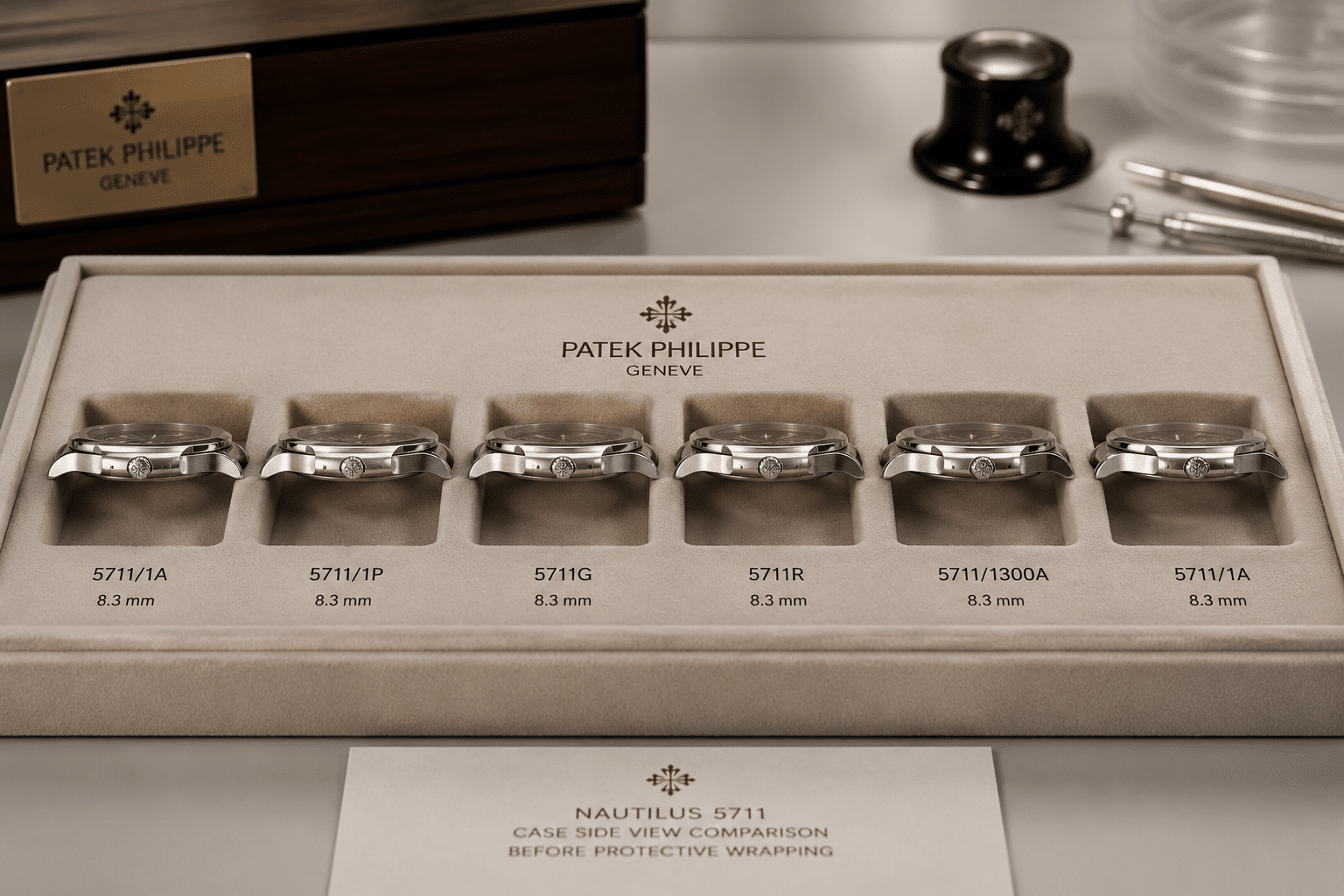
A 0.2mm to 0.3mm change is most noticeable from low side angles, not from a straight top-down view. If the watch is photographed resting on a flat surface, the caseback height, bezel stack, and bracelet drop become easier to read. A slightly taller case may make the mid-case look less compressed, even if the dial and bezel look excellent from above.
The difference also shows when the watch slides under a cuff. A thin 5711-style case tends to slip under a shirt sleeve with very little resistance. A taller build can catch at the cuff edge, not because it is objectively huge, but because the Nautilus is supposed to feel almost flush against the wrist. That small resistance often tells the wearer more than the spec sheet does.
For buyers comparing photos, the first warning sign is a side wall that looks too vertical. The genuine 5711 character depends on a thin horizontal spread, not a tall slab. If the case side looks heavy before the bracelet even begins, the watch may feel thicker in real use than the stated number suggests.
A second warning sign is a caseback that appears to carry the watch rather than disappear under it. If the underside forms a visible step below the mid-case, the watch can feel taller on wrist even when the top case looks clean. For a 5711 replica, the underside deserves the same attention as the dial shot.
When the wrist hides the difference
Not every buyer will notice a 0.2mm difference on the wrist. A larger or flatter wrist can visually absorb small thickness gaps because the case sits more evenly. A looser bracelet can also make the watch drop naturally around the wrist, softening the side profile. In casual wear, especially with short sleeves, a minor increase in case height may not bother most people.
Viewing angle matters as well. Most people see a watch from above or at a diagonal, not from a perfectly level side view. If the bracelet flow is smooth and the caseback does not protrude aggressively, a slightly thicker 5711 replica can still look balanced. This is why a buyer should avoid treating every tenth of a millimeter as equally important.
The mistake is going too far in either direction. Ignoring thickness completely is risky, but obsessing over a tiny difference without considering wrist shape and bracelet fit is also unrealistic. For daily wear, a clean profile and natural bracelet stance often matter more than chasing the thinnest number alone.
Why the 5711 is less forgiving than thicker sports watches
The 5711 is less forgiving because thinness is part of its design language. A Submariner-style watch can carry more case height because the bezel, crown guards, and tool-watch shape already create visual mass. The Nautilus does not have that same cover. Its appeal comes from being a slim sports watch that wears closer to a bracelet than a traditional chunky case.
This is where buyers often misjudge the model. They may accept a thick replica because the dial color looks strong in photos, then feel disappointed once the watch sits on the wrist. Dial details are mostly judged face-on. Thickness is felt every time the watch catches the light from the side, meets a cuff, or tilts during normal movement.
For the 5711, the practical threshold is stricter than on most sports replicas. A 0.2mm difference can be acceptable if the rest of the watch is well executed. A 0.6mm difference needs a more honest compromise: it may still be wearable, but it no longer delivers the same low, integrated Nautilus impression.
This is why a buyer should not borrow standards from another model family. A case-height compromise that feels harmless on a diver or chronograph may matter much more on a Nautilus. Different replica watches have different tolerance levels because case shape, bracelet integration, dial complexity, and movement architecture all affect how flaws appear in normal wear.
How to Read Side-Profile QC Photos Correctly
Side profile QC photos are the only useful way to judge 5711 QC thickness before the watch is in hand. Top-down photos can make almost any Nautilus replica look clean because they hide the caseback, underside, and actual case height. If a seller only provides dial-facing images, the most important thickness evidence is missing.
The goal is not to use QC photos for authentication games. The goal is to understand whether the watch will look slim on the wrist. A good side-profile check shows the relationship between the bezel, mid-case, caseback, and bracelet flow. If those parts stack too tall, the watch can look less convincing even if the measured case height sounds close.
At Clean VS Factory, we usually treat thickness photos as a reality check against factory claims. A stated number can be helpful, but the side view shows whether the case actually wears like a thin 5711-style build or only looks good from the dial side.
QC photos should be read as evidence with limits. They can show obvious case height, bracelet transition, date alignment, dial cleanliness, and some finishing issues, but they cannot fully prove long-term movement stability, water resistance, shock tolerance, or how the watch feels after days of use. A good buyer uses QC to reduce visible risk, not to assume every ownership question is solved.
QC photos can reduce uncertainty, but they do not guarantee perfection. Buyers should still review visible details and confirm seller policies before ordering.
Before making a decision, buyers should review real QC photos where available, including dial printing, hand alignment, datewheel centering, bezel and case finishing, caseback height, bracelet fit, clasp engraving, and side-profile thickness. Factory labels and stock photos alone are not enough for a reliable judgment.
The best photo angles for thickness judgment
The most useful angle is a true side shot taken at case level, with the watch resting flat and the camera aligned with the mid-case. This view shows whether the caseback protrudes, whether the bezel stack looks compressed, and whether the case side has the low, stretched profile buyers expect from a 5711 replica.
A second useful angle is a slight wrist-side shot, not a dramatic beauty angle. The watch should be worn naturally, with the bracelet adjusted close to normal fit. This helps reveal whether the case sits flat or rides high. A watch that looks thin on a table can still feel tall if the underside shape prevents it from settling into the wrist.
The third angle to request is a bracelet-flow shot from the side, showing the first links leaving the case. On an integrated bracelet watch, thickness is not isolated to the center case. If the end links kick outward or the first link sits stiffly, the whole watch can appear taller than the case measurement suggests.
A useful QC set also avoids hiding the watch behind protective stickers, extreme reflections, or tight cropping, especially when applying Patek Nautilus clone guide standards to case finishing and bracelet transition checks. Stickers are normal in QC, but if they obscure the caseback edge or bracelet transition, the buyer may need one more clean side photo before making a decision.
Common QC photo traps
The most common trap is the angled top-down shot. It flatters the dial, hides the caseback, and compresses the side wall. Buyers often approve a watch from these photos because the blue dial, bezel brushing, or date window looks strong, then later realize the watch sits higher than expected.
Lighting can also mislead. Strong reflection along the polished bevel may make the case look thinner by blending the side edge into the background. Harsh shadow under the case can do the opposite, making a normal profile look bulkier. This is why one photo is not enough; the same watch should be judged from at least two side-related angles.
Bracelet position is another quiet trap. If the bracelet is held upward or folded under the case, the watch may appear slimmer because the underside is hidden. If the bracelet is opened naturally and allowed to fall, the real caseback height and lug transition are easier to read. For the 5711, that transition is part of the profile, not a separate bracelet issue.
Seller descriptions can create a similar trap when they use broad terms like “latest version,” “best edition,” or “super clone” without showing the details that matter. Those phrases do not tell the buyer whether the watch uses a DD324-style route, whether the caseback is controlled, or whether the bracelet flow looks natural. The verifiable photo matters more than the label.
QC should also be checked against the seller’s written description. If the description says DD324-style clone movement but the caseback shape, date placement, or visible movement photo does not support that claim, the buyer should ask for clarification before approval. If the description claims a near-8.3mm case but no side image is provided, the most important evidence is still missing. A useful QC process is not about finding a flawless watch; it is about confirming that the actual unit matches the compromise the buyer has chosen.
What to Check Before You Decide
Before approving a 5711 replica based on QC images, confirm that at least one photo shows the full side height from crystal to caseback. The photo should not be cropped at the underside, tilted heavily from above, or hidden by the bracelet. If the side profile is the reason you are choosing a thinner version, do not accept a QC set that avoids showing it.
Also compare the case height to the bracelet thickness in the same image. A case that towers above the bracelet will usually look less integrated on wrist. A convincing 5711 profile should feel low and continuous, with the case and bracelet working together rather than the case sitting like a separate block on top.
It is also useful to check whether the date sits correctly in the window, whether the dial markers are straight, whether the hands are clean, and whether the clasp and bracelet finish look consistent with the factory claim. These checks do not replace thickness judgment, but they help avoid the opposite mistake: choosing a thin case while ignoring visible finishing or assembly issues that will bother the buyer in daily use.
Caseback, Gasket, and Bracelet Flow: The Parts That Affect the Silhouette
Case thickness is not only a mid-case number. On the Nautilus 5711, the visible silhouette is shaped by the caseback thickness, gasket stack, underside profile, and bracelet flow. A replica can claim a respectable height and still feel taller if the caseback bulges or the bracelet does not drop naturally from the case.
This is why buyers should be careful with simple thickness claims. A thin measurement sounds reassuring, but the watch has to distribute that height correctly. The 5711 works visually because the case, bezel, and bracelet form one low horizontal line. If one part interrupts that line, the watch loses some of its elegance even before anyone studies the dial.
The more technically useful question is not only “how thick is it?” but “where is the thickness located?” Extra height under the caseback affects wrist contact. Extra height in the mid-case affects side profile. Poor bracelet slope affects the visual transition. These issues can appear separately, so one number cannot explain the whole wearing impression.
Why caseback bulk changes the whole watch
Caseback thickness matters because it decides how the watch sits against the wrist. Extra height under the case can lift the entire watch, making the upper case appear taller even if the top-side finishing looks refined. The wearer experiences this as a watch that feels perched rather than settled.
This is especially important with exhibition casebacks or decorated movement builds, where the movement, rotor clearance, and gasket space can influence the underside. A small increase under the watch is often more noticeable than the same increase on the bezel side because it changes the contact point with the wrist.
The practical judgment is straightforward: a slightly thicker caseback is acceptable only if it remains visually tucked in. If the underside creates a visible step or makes the watch rock on the wrist, the replica will not deliver the flat 5711 wearing impression.
For daily wear, a buyer should also consider whether the caseback shape creates pressure on the wrist. A replica can be visually acceptable in a short QC video but become annoying after several hours if the underside is too raised or too rounded. Comfort is part of the buying judgment, especially on an integrated bracelet watch that cannot be softened with a leather strap.
How bracelet slope affects perceived thickness
Bracelet flow can either hide or exaggerate thickness. A smooth bracelet slope draws the eye outward from the case and makes the watch look flatter. A stiff first link, poor end-link fit, or awkward lug transition makes the case look taller because the bracelet no longer continues the same low line.
This is one reason the Nautilus is harder to judge than a watch on a strap. With a strap, the case and strap are visually separate. With the 5711, the integrated bracelet is part of the case architecture. If the bracelet drops too late or angles away from the wrist, the case appears heavier than its measurement suggests.
For buyers, bracelet flow should be checked together with thickness. A very thin case with a poor first-link transition can still look wrong. A slightly thicker case with a smoother bracelet descent may wear better than expected. The better choice depends on the full side silhouette, not the number alone.
Why the underside matters as much as the top view
The top view tells you whether the dial, bezel, and case shape look clean. The underside tells you whether the watch will actually wear like a Nautilus. On a thin-profile watch, comfort and visual accuracy meet at the caseback. If the underside is too rounded, too tall, or poorly integrated, the watch feels less refined in daily use.
The gasket also plays a quiet role. Buyers do not need a deep sealing discussion, but they should understand that gasket thickness and caseback seating can add visible height. A poorly seated or overly tall gasket stack may make the watch look slightly swollen from the side, which is exactly where the 5711 has the least tolerance.
Thinness alone is not proof of better quality. A replica still needs stable construction, reasonable fit, and a bracelet that sits naturally. But for this model, the underside and bracelet transition decide whether the case height feels honest on wrist or only looks good as a published measurement.
This is also where water-resistance claims should be treated carefully. A seller may mention sealing or testing, but a replica watch should not be assumed to have official or guaranteed water resistance. For a 5711 buyer, gasket and caseback construction matter first as visible and comfort-related parts of the silhouette; any water exposure should be approached cautiously unless the specific watch has been tested by a competent watchmaker.
Water resistance should not be assumed unless the specific watch has been tested and the seller’s policy is clearly confirmed.
What Thickness Is Acceptable for Different Buyers
The acceptable 5711 thickness depends less on one magic number and more on what kind of buyer you are. If your main goal is side-profile realism, the closer the case gets to the 8.3mm target, the better. If your goal is a daily-wear replica watch that looks good on the wrist and avoids unnecessary ownership frustration, a slightly thicker build can still be rational.
The mistake is treating every extra fraction of a millimeter as a failure. On the Nautilus 5711, thickness matters more than it does on many sports watches, but not every buyer needs the same tolerance level. A visual purist and a practical daily wearer are not shopping for exactly the same compromise.
A first-time buyer should be especially honest about which flaws will actually matter after delivery. If the watch will be worn casually and not compared side by side with a genuine 5711 or a top thin-case build, a moderate thickness compromise may be acceptable. If the buyer already knows the side profile is the reason they like the Nautilus, the safer decision is to prioritize the thinner architecture from the start.
For buyers who care most about profile accuracy
If the side silhouette is your priority, the best thickness for 5711 replica buying is simple: stay as close to 8.3mm as possible. This is the range that preserves the flat, integrated character that makes the 5711 feel like a thin steel sports watch rather than a generic luxury-style case with Nautilus design cues.
For this buyer, a thicker case is not just a technical downgrade. It changes the personality of the watch. The dial may look attractive, the bracelet may photograph well, and the blue tone may be acceptable, but if the case sits too high, the watch loses the low, elegant stance that defines the reference.
This is where buyers should be strict. If you already know you will notice the side profile, do not talk yourself into a thicker version because the top-down photos look strong. A close-enough build for casual wear may not be close enough for someone who specifically wants the 5711’s thin wrist presence.
This buyer should also be willing to reject a watch with weak side QC, even if the factory name is desirable. A strong factory label cannot replace the evidence of the actual unit. If the listing claims a thin case but the QC angle avoids the side, the buyer has not yet seen the detail that justifies choosing that version.
For buyers who want a safer practical build
A slightly thicker version can still be acceptable if the buyer values daily wear, movement convenience, and easier long-term ownership more than absolute profile accuracy. This is especially true for buyers who are not comparing the watch side by side with a genuine 5711 or who mainly care about the overall look on wrist rather than the exact case height.
In practical terms, a build around 8.5mm can still look convincing to many wearers, especially under sleeves or in normal social distance. It is not the purest answer, but it may be the more comfortable budget choice if the movement route is easier to service, less costly to replace, or more familiar to local watch repair options.
At Clean VS Factory, we usually separate visual accuracy from ownership experience in this kind of decision. A thinner super clone watch may win the silhouette test, while a slightly thicker version may be easier to live with if the buyer is realistic about what they are gaining and losing.
For this buyer, the checklist should include rotor noise, hand-setting feel, date change behavior, bracelet comfort, clasp security, and whether local service options are realistic. A better daily watch is not always the one with the most aggressive specification. It is the one whose compromises match how the buyer will actually wear and maintain it.
For buyers deciding between thinness and simplicity
The real decision is not “thin equals good, thick equals bad.” The better question is: which compromise will bother you more after the purchase? If a higher caseback or taller side wall will annoy you every time you look at the watch from the side, choose the thinner 8.3mm-style target. If small profile differences do not bother you but movement risk does, a slightly thicker build may be the more sensible choice.
A practical tolerance framework looks like this:
| Buyer Type | Reasonable Thickness Target | Best Fit | Main Tradeoff |
|---|---|---|---|
| Profile-focused buyer | About 8.3mm | Closest side-profile realism | May involve a more specialized clone movement route |
| Balanced daily wearer | About 8.4mm to 8.6mm | Good wrist impression with more flexibility | Not as crisp from the side as the thinnest builds |
| Budget-sensitive buyer | Above 8.6mm only with realistic expectations | Lower-cost or simpler ownership path | More visual bulk and less true 5711 character |
Once thickness moves much beyond the close range, the buyer should stop pretending the watch is chasing the same profile standard. It may still be enjoyable, but it becomes a different kind of purchase: a Nautilus-style replica for casual wear, not a thickness-focused 5711 replica chosen for side-profile accuracy.
The clearest judgment is this: buyers who came to the 5711 because of its slim elegance should prioritize the 8.3mm target, even if it costs more or requires more careful version selection. Buyers who mainly want the design language and a practical daily watch can accept a slightly thicker case, but they should understand that the compromise shows most clearly from the side.
A careful final decision should combine the measurable and the practical: stated thickness, actual side QC, movement route, bracelet flow, caseback shape, seller description, and the buyer’s own tolerance for visual compromise. That is a stronger method than chasing the loudest factory claim or the lowest price. On the Nautilus 5711, the best replica watch choice is the one whose tradeoffs are understood before the watch is approved, not discovered after it arrives.
A replica watch should be evaluated with realistic ownership expectations. Even a strong super clone can have limits in water resistance, long-term movement stability, servicing convenience, finishing consistency, and close inspection compared with a genuine reference. Buyers should confirm return, repair, shipping, and after-sales terms before ordering.
Legal and Disclosure Caution
Replica watches can raise trademark, customs, import, resale, and disclosure issues, and the risk is not solved by describing a watch as a “super clone” or by buying only one piece. The USPTO explains counterfeit goods in relation to trademark misuse, while U.S. Customs and Border Protection identifies intellectual property rights enforcement as a trade priority.[4][5] This is not legal advice, but it is a reason to treat replica watches as imitation products rather than authorized goods.
Industry-level sources also show why this distinction matters. OECD reporting on counterfeiting and Swiss watches discusses counterfeit Swiss watch activity as part of a broader illicit trade problem, which supports a cautious disclosure approach but does not predict the outcome of any individual shipment, seller, or purchase.[6] For a buyer guide, the practical point is simple: do not resell a replica as authentic, do not imply brand authorization, and do not treat customs or trademark questions as risk-free.
References
[1] Patek Philippe, “Nautilus 5811/1G official specifications,” official product information for the Nautilus collection, available at Patek Philippe Nautilus 5811 官方规格.
[2] Miyota, “Caliber 9015 official movement specifications,” manufacturer specification page for Miyota 9015 dimensions and functions, available at Miyota 9015 官方机芯规格.
[3] Miyota, “Caliber 8215 official movement specifications,” manufacturer specification page for Miyota 8215 dimensions and functions, available at Miyota 8215 官方机芯规格.
[4] United States Patent and Trademark Office, “Counterfeit Goods Basics,” official trademark and counterfeit goods guidance, available at USPTO Counterfeit Goods Basics.
[5] U.S. Customs and Border Protection, “Intellectual Property Rights,” official CBP trade priority page on IPR enforcement, available at U.S. CBP Intellectual Property Rights.
[6] OECD, “Counterfeiting, Piracy and the Swiss Economy 2025: Counterfeiting and Swiss Watches,” OECD report section on counterfeit Swiss watch activity, available at OECD Counterfeiting and Swiss Watches.
Disclosure: This article is for general educational and comparison purposes only. Replica watches are not genuine products from the original luxury brands, and brand names are used only to identify reference designs or comparison topics. Factory names, movement descriptions, prices, availability, QC details, seller policies, and version information can change, so readers should verify important details with the seller before making a purchase decision. Replica watches should not be represented, resold, or used as genuine watches.