
This one-year wearing review looks past first impressions and focuses on what actually matters after a Nautilus-style Patek Philippe super clone has been used regularly. The main question is not whether the watch looks convincing on day one, but whether the bracelet, clasp, movement, case finishing, and daily comfort remain acceptable after months of office and casual wear. For an integrated-bracelet design, small changes in link play, clasp feel, screw security, and wrist fit can affect satisfaction more than a minor dial or case detail.
The review helps buyers judge realistic ownership limits: controlled daily rotation can be enjoyable, but water exposure, rough use, plated finishes, and expectations of worry-free durability create risk. The strongest lesson is to judge the watch by predictable behavior rather than factory claims, especially stable winding, consistent rotor sound, secure clasp action, usable power reserve, and normal aging without loose or uneven-feeling parts.
Replica watches should be clearly understood as replica-market products, not genuine watches from the original luxury brands. Brand names are used here to identify the genuine reference design being discussed, and they do not imply authorization, endorsement, or affiliation with Patek Philippe or any other luxury watch brand.
| What To Check | Good Sign After Use | Warning Sign |
|---|---|---|
| Integrated bracelet | Controlled link play and stable wrist fit | Loose screws, widening gaps, or shifting feel |
| Clasp behavior | Softer action but still snaps securely | Weak closure, uneven release, or poor lockup |
| Movement feel | Predictable timekeeping, smooth winding, steady rotor sound | Worsening drift, rough winding, louder rotor noise |
| Case finishing | Light hairlines with brushing still even | Deep dents, hazy polish, softened edges |
| Finish choice | Steel handles frequent wear more safely | Plated or two-tone edges showing color wear |
| Water exposure | Kept away from showers, steam, and swimming | Moisture marks or use without pressure testing |
Quick Questions Before You Read
Q: Is this kind of Patek Philippe super clone suitable for daily wear?
It can work in controlled office or casual rotation, but it should not be treated as a rough-use or waterproof watch.
Q: What matters most after one year of ownership?
Bracelet stability, clasp security, movement consistency, and moisture avoidance matter more than small cosmetic flaws.
Q: Should buyers worry more about accuracy or reliability?
Predictable behavior is more useful than chasing perfect accuracy; worsening drift, rough winding, or changing rotor noise are bigger concerns.
Q: Is a steel version safer than plated or two-tone models?
For frequent wear, steel is usually safer because plating wear and edge discoloration are harder to hide or repair.
The Watch Being Reviewed: Model Type, Factory Route, and Wearing Pattern
This Patek Philippe super clone review is based on a Nautilus-style bracelet model worn for roughly one year as a regular rotation watch, not as a safe-queen piece kept mostly in a box. It was not worn every single day, but it saw enough real use to expose the areas that fresh QC photos usually hide: bracelet settling, clasp feel, light case wear, rotor behavior, and whether the watch still felt satisfying after the first excitement passed.
The exact factory route matters, but it should be treated carefully. Patek Philippe replicas are often sold with factory shorthand, version claims, and movement descriptions that sound more certain than they really are. Unless the movement has been verified by a competent watchmaker or clearly documented by reliable teardown photos, it is safer to describe the watch by its model family, case construction, bracelet type, and observed behavior. For long-term replica watch ownership, what the watch does on the wrist often matters more than what the seller called it on day one.
Factory names in this article should be understood as replica-market references, not as official Patek Philippe affiliations or proof that every example from the same label will age the same way. A factory route can help buyers compare likely case shape, bracelet construction, dial execution, and movement configuration, but the individual watch still needs to be judged by its actual version, QC photos, handling behavior, and visible finishing. This distinction matters more in a one-year review because long-term comfort and reliability are affected by assembly tolerance as much as by the name used in a listing.
The Model Family and Why It Matters
The reviewed watch sits in the Nautilus-style category, which is important because this is one of the least forgiving Patek Philippe designs to wear long term. A Calatrava-style replica lives or dies mostly by thinness, dial printing, and case elegance. An Aquanaut-style replica depends heavily on strap fit, case shape, and tropical dial texture. A Nautilus-style replica adds another challenge: the integrated bracelet is part of the entire design, not just a removable accessory.
That changes the review standard. On a bracelet model, small looseness at the links, uneven articulation, clasp play, or a slightly awkward end-link fit affects the whole wearing experience. A visually strong dial can still feel less convincing if the bracelet rattles too much or the watch no longer sits centered on the wrist. This is the first practical judgment of the review: for a Nautilus-style Patek Philippe super clone, bracelet integrity is more important over one year than most buyers expect from first-day photos.
This also means the findings should not be applied blindly to every Patek Philippe replica. A complicated calendar-style model, a dress watch on leather, and a simple steel bracelet model age in different ways. The bracelet model is usually more revealing because every day of desk work, sleeve contact, and clasp use slowly tests the tolerances.
Wearing Frequency and Real-Life Conditions
The watch was used as a regular office and casual rotation piece. In practical terms, that means several days per week during normal work weeks, with occasional weekend use, but not as a hard-use sports watch. Most wear came from desk work, keyboard contact, commuting, light outdoor time, and normal sleeve friction. This is a realistic daily wear pattern for many U.S. buyers considering a Patek Philippe replica: not construction-site abuse, but not showroom handling either.
That usage pattern matters because scratches and bracelet aging are not only about factory quality. A watch worn under a shirt cuff in an office will age differently from one worn in hot weather, during travel, or around water. The clasp on this type of watch also sees repeated opening and closing, which becomes more important after months of wear than it seems during the first week.
Moisture exposure was kept conservative. The watch was not treated as waterproof, not worn in the shower, and not intentionally used for swimming. It did experience normal daily-risk situations such as hand washing nearby, humid weather, and brief exposure to light rain. That distinction is important because surviving ordinary life is not the same as proving water resistance.
Factory and Movement Details to Treat Carefully
The reviewed watch was sold as a higher-tier factory version with an automatic movement route, but this review does not rely on the factory name alone as proof of quality. A factory label can be useful, especially when comparing version families, but it does not guarantee bracelet tolerance, movement cleanliness, rotor quietness, or long-term stability. Batch variation and assembly quality still matter.
At Clean VS Factory, we usually separate first-day visual accuracy from ownership quality. A Patek Philippe super clone can photograph well and still become annoying if the bracelet loosens quickly, the clasp feels weak, or the rotor becomes noticeably louder. That is why this one-year wearing review focuses on behavior after repeated use, not only dial texture, logo placement, or caseback decoration.
The movement route should also be approached with restraint. Many Patek Philippe replica watches use decorated automatic movements, modified base movements, or claimed clone-style calibers depending on model and factory version. The buyer should verify what is inside before purchase if movement serviceability matters. A decorated rotor visible through a caseback can look impressive, but it does not automatically prove architecture, reliability, or parts availability.
Movement trust in the replica market depends on understanding what the movement claim actually describes: architecture, decoration, layout, reliability expectation, or simply a market name used by sellers. A movement may look closer through a display back but be less familiar to service, while a less decorative movement route may be easier to regulate or repair. For long-term ownership, buyers should separate appearance from practical serviceability and should not treat a decorated movement as an official brand-manufactured caliber.
Evidence Boundary: This review is based on observed ownership behavior, not a laboratory teardown, pressure test, or factory audit. That means it can speak usefully about bracelet feel, visible aging, crown feedback, rotor sound, clasp confidence, and day-to-day predictability, but it should not be read as proof of the movement architecture, case material grade, coating thickness, gasket performance, or exact factory production method. Claims about those areas need direct inspection or reliable documentation for the individual watch, and this review avoids treating seller descriptions as technical proof.
Editorial Perspective: For a long-term Patek Philippe super clone review, the most useful judgment is not “which factory is best” in a general sense. A factory name can help narrow the shortlist, but it should be checked against the specific model version, movement route, bracelet construction, and intended use. A watch that looks excellent in seller photos may still be the wrong daily-wear choice if the movement is difficult to service, the clasp tolerance is weak, or the integrated bracelet begins to feel loose after repeated sizing and desk use.
How to Read Factory Claims Before Buying
Factory reputation matters, but it does not transfer evenly across every Patek Philippe-style model. A maker that performs well on a simple three-hand Nautilus may not handle a complicated calendar, moonphase, chronograph, or ultra-thin case with the same consistency. The more complex the dial layout, case thickness, movement modification, and display-back decoration become, the more risk there is that a strong photo impression hides practical ownership compromises.
For this category, the buyer should treat factory labels, QC photos, and seller descriptions as useful signals rather than final proof. QC photos can show dial alignment, hand placement, obvious case marks, bracelet gaps, and clasp fit, but they rarely reveal long-term rotor noise, winding smoothness, screw security, weak gaskets, or whether the bracelet will develop uneven play after months of use. A seller calling a model “latest version” or “best factory” is less useful than clear photos of the case profile, clasp, bracelet articulation, movement side, date window, and any known weak areas for that exact version.
A factory comparison is most useful when it is tied to the specific reference, version, movement configuration, case shape, dial execution, bracelet construction, and available QC evidence. Factory names are useful market references, but they do not guarantee identical quality across every model or version.
Before making a decision, buyers should review real QC photos where available, including dial printing, logo placement, hand alignment, datewheel centering, case thickness, bezel and case-edge finishing, bracelet fit, clasp engraving, and movement-side photos when relevant. Factory labels and stock photos are weaker evidence than photos of the exact watch being supplied.
Factory Name Clarification: Factory names in the replica watch market are buyer-facing reference labels, not official brand affiliations or audited guarantees. For a Patek Philippe super clone, buyers should judge the exact version by visible QC details, bracelet tolerance, clasp fit, case thickness, movement route, and real product photos rather than assuming identical quality from a factory name alone.
The First Three Months: The Honeymoon Phase and Early Warning Signs
The first three months of a replica watch are deceptive because the watch still feels new, the dial still catches attention, and most buyers are comparing the purchase against QC photos rather than against real ownership. During this period, the Patek Philippe daily wear review was mostly positive, but it also showed the first clues that would matter later: bracelet settling, polished-surface scratches, clasp break-in, and rotor character.
This is the period where buyers often ask, “does it feel good after purchase?” The honest answer is yes, if the watch was selected well and sized correctly. But the more useful question is whether the early comfort comes from actual quality or from new-watch excitement. A watch can feel impressive during the first week and still reveal weak clasp tolerance or movement roughness after repeated wear.
Visual Accuracy Versus Daily-Wear Priorities
A Patek Philippe super clone can be strong visually and still be only average as a daily object. Dial color, logo placement, hand length, date font, and caseback decoration are easy to compare in photos, so buyers naturally focus there first. After several months, however, the daily-wear priorities become more tactile: whether the bracelet stays centered, whether the clasp closes with confidence, whether the crown feels fragile, whether the rotor distracts in quiet rooms, and whether the case thickness feels natural under a cuff.
This distinction matters because a photo-focused buyer may choose the most visually accurate version even if another version has a more serviceable movement or a better bracelet feel. For a display piece or occasional-wear watch, that tradeoff may be acceptable. For a regular rotation watch, reliability and comfort usually matter more than a tiny dial texture advantage that only appears under macro comparison. The better question is not “which one looks closest in the listing,” but “which version will still feel pleasant and predictable after the novelty fades.”
Visual accuracy should be judged through specific details rather than broad replica-market phrases. Case thickness, lug shape, bezel contour, dial texture, hand length, date placement, bracelet taper, clasp profile, and caseback finishing all affect how convincing the watch feels in normal use. A watch can look impressive in one front-facing photo while still feeling wrong if the case is too thick, the bracelet articulation is uneven, or the date window sits poorly in relation to the dial.
Comfort Before the Bracelet Fully Settled
During the first few weeks, the bracelet felt more structured than loose. The watch sat flat enough on the wrist, and the integrated bracelet gave the familiar wide, low-slung Nautilus-style presence that attracts many buyers in the first place. The weight balance was good for office wear; it did not feel top-heavy, and the case did not roll around the wrist when sized properly.
The bracelet did need time to settle. Link articulation became smoother after repeated wear, and the clasp action softened slightly. This was not a problem by itself. A little break-in is normal on many replica bracelets, especially where links are tightly machined or where finishing leaves slight resistance at contact points. The difference between normal settling and a defect is direction: smoother articulation is acceptable, while fast-growing side play or a clasp that loses snap is more concerning.
One non-obvious comfort issue with Nautilus-style replicas is sizing sensitivity. Because the bracelet is integrated and visually continuous with the case, one link too loose can make the watch feel sloppy, while one link too tight can make the case sit awkwardly high. Micro-adjustment is usually limited compared with sportier bracelet systems, so buyers should not expect the same easy fit tuning they might get from a Rolex-style clasp.
Small Scratches That Appeared Quickly
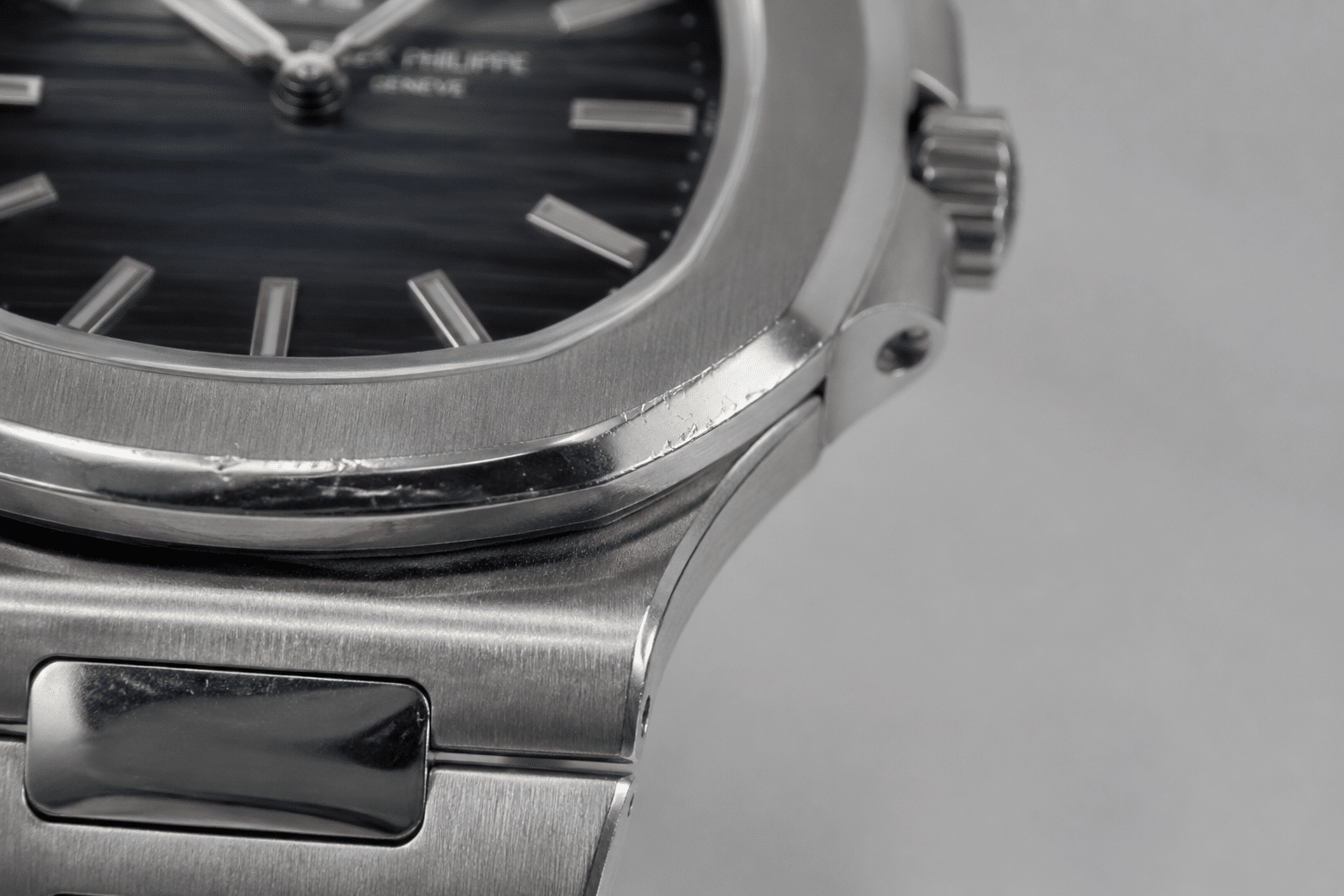
The first visible wear appeared on polished surfaces, especially the bezel edge, clasp exterior, and high-contact bracelet areas. These were hairline marks, not dents or deep scratches. On a watch with mixed brushed and polished finishing, this is expected. The polished zones show desk-diving marks much faster than buyers usually imagine from clean product photos.
The brushing helped hide light wear on flatter surfaces, but polished bevels and case edges caught marks quickly under direct light. This is not unique to replica watches; polished luxury-sport designs are naturally scratch-prone. The practical difference is that replica finishing may not always have the same depth, crispness, or refinishing tolerance as the genuine article, so buyers should be more cautious about aggressive polishing later.
The important judgment is that early hairline scratches should not ruin the ownership experience. They are normal for a bracelet model worn in real life. What matters more is whether scratches expose poor plating, uneven finishing, soft edges, or inconsistent brushing. In the first three months, normal surface marks were acceptable; they made the watch look worn, not failed.
Early Movement Behavior
The movement was stable enough for casual daily wear during the first three months. It did not behave like a certified chronometer, and it should not be judged that way. The more relevant test was whether it remained predictable across several days, restarted normally after sitting, and kept time within a range that did not become irritating in ordinary use.
Winding feel was acceptable but not luxurious. There was a mechanical texture through the crown, with enough resistance to feel connected but not enough refinement to mistake it for a high-end Swiss movement. This is one area where buyers should manage expectations. A Patek Philippe replica movement can be practical, but it does not automatically deliver the same crown feel, winding smoothness, or silent rotor behavior as the genuine brand-manufactured watch it visually references.
Rotor noise was present but not alarming in the early period. A soft whirr during wrist movement is common in many replica movements. The warning sign is not simply hearing the rotor; the warning sign is a scraping, grinding, or sudden increase in noise that suggests contact, dryness, or poor assembly. During the first three months, the rotor sound was noticeable in quiet rooms but not enough to make the watch unpleasant.
Early Red Flags Worth Taking Seriously
Some early issues should not be dismissed as “break-in.” Crown grinding, hands that feel loose during setting, a date that hangs halfway through changeover, dramatic time loss, or a rotor that sounds like it is scraping the caseback deserve attention quickly. These are not normal signs of settling.
Bracelet screws also need attention early. If a screw begins backing out within the first few wears, the buyer should not keep wearing the watch and hope it fixes itself. A lost screw can become a lost bracelet link, and on an integrated bracelet model that can create a much bigger problem than a simple strap replacement.
The clasp is another early warning area. A clasp that starts firm and becomes slightly easier is normal. A clasp that fails to snap shut cleanly, opens with light pressure, or feels misaligned should be treated as a real issue. On this style of watch, clasp security is not a minor detail; it controls whether the watch can be trusted during daily wear.
Six-Month Changes: Bracelet Looseness, Clasp Feel, and Link Wear
By the six-month mark, the bracelet became the clearest long-term quality signal. The dial still looked good in normal use, and the case still had the same basic wrist presence, but the Patek Philippe replica bracelet began to show whether the watch was merely attractive in photos or genuinely wearable over time. This is where many long-term replica watch ownership reviews become more useful than first impressions.
The key question is not simply “does the bracelet get loose?” A little extra movement after months of wear is normal. The better question is whether the looseness remains controlled or starts changing the way the watch sits, sounds, and feels. On an integrated bracelet model, bracelet looseness after six months affects the entire watch more than it would on a leather-strap dress watch.
Link Play and Bracelet Stretch Feel
After six months, the bracelet developed slightly more side-to-side play between links. It was not severe bracelet stretch in the vintage-watch sense, but the watch no longer had the same tight, fresh feel it had during the first month. The change was most noticeable when holding the watch off the wrist and letting the bracelet hang. On the wrist, it translated into a softer, more relaxed drape.
This change was acceptable, but it was also the first sign that long-term satisfaction depends heavily on tolerance quality. A bracelet can become more comfortable as it loosens slightly, yet feel cheaper if the links begin to rattle. The reviewed watch stayed on the acceptable side: more flexible than new, but not sloppy enough to feel unstable.
The non-obvious point is that some buyers mistake stiffness for quality. A bracelet that is too rigid can feel impressive in the hand but uncomfortable on the wrist. The better target is controlled articulation: links should move smoothly, with even gaps and no sharp clicking or uneven binding. By six months, this watch had improved in comfort but lost a little of its first-day solidity.
Clasp Security After Repeated Opening
The clasp softened after repeated use. The initial snap became less sharp, but it still closed securely and did not open accidentally. That is the acceptable version of clasp break-in. The release feel was easier, the edges felt less aggressive against the wrist, and the closing action became more familiar.
There was minor clasp wiggle when handled off the wrist, which is common on many replica bracelet systems after months of opening and closing. On the wrist, it was not distracting. If the clasp had started clicking unevenly, failing to seat fully, or requiring pressure at an odd angle, the judgment would change. A loose-feeling clasp is annoying; an unreliable clasp is a reason to stop wearing the watch until it is adjusted or repaired.
Sharp edges were less of an issue after the bracelet had been worn in. This does not mean the finishing improved; it means the owner became used to the contact points and the clasp surfaces had naturally smoothed through use. Buyers should be careful here. Getting used to a flaw is not the same as the flaw being gone.
Bracelet Screws and Sizing Stability
The bracelet screws remained stable, but they were checked periodically. That matters more than many buyers think. On a Patek Philippe-style integrated bracelet, a single screw backing out can create a real wearing risk because the bracelet structure is central to the watch. It is not like swapping a damaged rubber strap in two minutes.
Buyers should avoid over-tightening bracelet screws or using a poor screwdriver. Stripped screw heads make future sizing and maintenance more difficult, and rough tool marks are easy to create on polished or brushed link surfaces. If a screw repeatedly loosens, a proper small amount of suitable thread-locking compound may help, but careless application can create a different problem by making later removal difficult.
The fit remained stable because the sizing was conservative from the beginning. It was not worn overly loose. This likely reduced stress on the clasp and link joints. A bracelet worn too loose tends to swing, twist, and knock against desks more often, which accelerates both scratches and perceived looseness.
What to Check at the Six-Month Mark
At six months, the practical inspection should focus on the bracelet before obsessing over tiny dial details. Hold the watch by the case and let the bracelet hang naturally. Look for uneven link gaps, excessive side-to-side movement, or one section that droops differently from the rest. A little movement is normal; uneven movement is more suspicious.
Check the clasp closure several times. It should close with a consistent snap and release only when intended. If the clasp feels vague, clicks halfway, or can be opened with light accidental pressure, that is no longer just bracelet aging. It is a security issue.
Also check bracelet screws, end-link fit, and whether the watch still sits centered on the wrist. If the case constantly rotates toward the outside of the wrist after sizing was previously correct, the bracelet may have loosened enough to affect wearability. That is the point where the watch starts feeling less like a satisfying super clone watch and more like a piece that needs adjustment before continued daily use.
Case and Finishing After One Year: Scratches, Edges, and Plating Changes
After one year, the case tells a more honest story than fresh QC photos ever can. A new Patek Philippe super clone can look clean, sharp, and impressively refined under seller lighting, but regular wear exposes how the brushed finishing, polished bezel, case edges, and coating choices actually hold up. The important point is not whether the watch stays mark-free. It will not. The useful question is whether the wear looks like normal use or whether the finishing starts to break down in a way that makes the watch feel cheaper than it did on day one.
On a steel Nautilus-style or Aquanaut-style replica, most Patek Philippe super clone case scratches fall into the predictable category: sleeve marks, desk-diving lines, small polished-edge scuffs, and faint contact marks around the bezel or case flank. These are not automatically defects. In fact, a completely unworn-looking case after months of use usually means the watch was barely worn. What matters more is the pattern. Light, even wear is acceptable. Deep dents, uneven brushing, cloudy polished surfaces, or color loss around exposed edges suggest either harder use or weaker finishing.
Normal Hairline Scratches Versus Damage
Normal hairline scratches are shallow, directional, and usually visible only when the light catches the surface at an angle. On a polished bezel or case side, they can appear quickly even with careful office wear. This surprises many buyers because Patek-style cases often look softer and more elegant than Rolex-style sports cases, but the broad polished planes can actually show fine marks faster.
Damage is different. A sharp nick on a bezel edge, a dent near the lug area, or a scratch that cuts across brushed grain is not just normal aging. These marks interrupt the geometry of the case, and on a design that depends on clean lines, they stand out more than they would on a busier watch. If the case edge becomes visibly rounded after only light use, that is also worth noticing. Some replicas leave the factory with softer transitions than the genuine reference, and one year of wear can make that softness more obvious.
The clear judgment here: do not reject a one-year replica watch because it has hairlines, but be cautious if the wear makes the case shape look less defined. A Patek Philippe super clone depends heavily on proportion and finishing discipline. Once the edges lose visual control, the watch feels less convincing even if the dial still looks good.
Brushed and Polished Surfaces Over Time
Brushed finishing is more forgiving than buyers expect, but only when the grain is even. Fine scratches that follow the brushing direction usually blend into the surface. Marks that run against the grain are more obvious and harder to ignore. This is why desk contact, laptop edges, door frames, and metal bracelets on the same wrist can age the watch faster than casual wear alone.
Polished areas are less forgiving. A polished bezel, polished case flank, or polished bevel will show swirl marks quickly. On some Patek Philippe replicas, the polished bevels look impressive in photos because they catch light sharply, but after a year they can become the first place where the watch looks used. This is not always a quality failure. It is partly the nature of high-polish finishing. The difference is whether the polish remains clear and reflective or turns hazy and uneven.
For daily wear, brushed surfaces carry the watch visually; polished edges create the luxury impression. If the brushing stays consistent and the polished lines only show light hairlines, the case still holds up well. If the polished bezel is covered in random scratches while the brushing looks patchy or over-soft, the watch starts to feel tired. That is the point where case condition affects daily confidence, not just macro-photo accuracy.
Plated or Two-Tone Models Need Extra Caution
Replica watch plating wear deserves more caution than ordinary steel scratches. On gold-tone, rose-gold-tone, or two-tone Patek Philippe super clones, the long-term risk is not only scratching. It is color change, edge wear, and uneven tone between high-contact and low-contact areas. A watch may look warm and attractive when new, but after a year the case edges, crown area, clasp-side contact zones, and bezel corners can start showing a slightly different tone.
This does not mean every plated model will fail quickly. Wear depends heavily on coating thickness, factory batch, skin chemistry, climate, wrist habits, and how often the watch contacts desks, sleeves, bags, or jewelry. Still, plating changes over time are a real ownership risk. Steel models age through scratches. Plated models age through both scratches and color behavior, which is harder to correct cleanly.
My practical advice is simple: if this is meant to be a frequent-wear Patek Philippe replica, steel is usually the safer long-term choice. A plated or two-tone version can be more visually dramatic, but it asks the buyer to accept more uncertainty. Once gold-tone plating wears through at an edge, it cannot be treated like a normal polish mark. It becomes a visible material compromise.
Movement Stability After One Year: Timekeeping, Rotor Noise, and Power Reserve
The movement is where the one-year review becomes less romantic and more practical. A Patek Philippe replica movement does not need to perform like a certified Swiss movement to be enjoyable, but it does need to remain predictable. After one year, the key questions are straightforward: does it keep time consistently enough, does the rotor sound worse than before, does winding still feel controlled, and does the power reserve behave normally?
This is also where buyers should be careful with factory descriptions. A decorated rotor photo does not tell you much about long-term movement stability after one year. Some Patek Philippe super clone watches use more common automatic movement bases with decorative plates. Others use more model-specific clone-style routes. The outside may look similar in QC photos, but the ownership risk can be different, especially when parts availability and service familiarity enter the picture.
Timekeeping Consistency in Real Use
In real ownership, the useful standard is not laboratory precision. The useful standard is predictability. If the watch gains or loses a modest amount each day and behaves similarly from week to week, most casual wearers can live with it. If the rate changes dramatically depending on position, wrist activity, or power level, the watch becomes annoying because you stop trusting it.
After one year, a stable Patek Philippe super clone should not suddenly start losing minutes per day, stopping overnight with enough wrist wear, or changing behavior after a simple hand-setting. Those are not “normal replica things” to ignore. They suggest the movement may be dry, dirty, magnetized, poorly regulated, or developing a mechanical issue.
The judgment I would make after a year is this: acceptable timekeeping drift is tolerable if it is consistent; worsening drift is a service warning. Buyers often focus too much on the exact daily number and not enough on whether the number is changing. A movement that becomes less predictable over time deserves attention sooner rather than later.
Rotor Noise and Winding Feel
Some rotor noise is common in many replica movements, especially in thinner luxury-sports designs where the case does not hide sound well. A light spinning sound or occasional freewheel noise may be part of the movement route. What matters after one year is whether the sound changed. A rotor getting louder, rougher, or more metallic is more concerning than a rotor that sounded the same from the beginning.
Winding feel is equally important. Smooth but slightly light winding is usually acceptable. Gritty winding, slipping sensation, crown wobble, or a grinding feel through the crown should not be dismissed as break-in. On a Patek Philippe-style watch, the crown is often small and delicate-feeling anyway, so poor winding feedback can quickly reduce confidence in the whole watch.
At Clean VS Factory, we usually treat movement feel as part of the buying decision, not just a hidden technical detail. A visually strong replica can still become frustrating if the rotor sounds unstable or the crown feels fragile after months of use. Long-term satisfaction depends on how the watch behaves in the hand, not only how it photographs on the wrist.
Power Reserve and Date Behavior
Power reserve is another area where real use exposes exaggeration. If the watch is worn during the day and stops early the next morning, that may indicate weak winding efficiency, low reserve, or insufficient wrist activity. If it reliably runs through the night and behaves similarly each week, it is usually serviceable for casual ownership even if it does not match advertised figures.
Date behavior should also remain consistent. A date that changes around midnight within a reasonable window is acceptable. A date that hangs halfway, refuses to advance, changes at random times, or feels rough when quick-set is used is more serious. Buyers should avoid forcing the date mechanism, especially near the changeover period, because a small mistake can create a larger repair problem.
For a one-year replica watch review, the movement passes the practical test if it remains predictable: stable timekeeping, familiar rotor sound, normal winding feel, usable power reserve, and no date-change drama. It does not need to be perfect. It does need to avoid new symptoms.
Movement Route to Verify
Before buying, the movement route should be verified with more than seller shorthand. Terms like “clone movement,” “custom movement,” or “same layout” can mean different things depending on the model and factory version. A display caseback with a decorated rotor is not proof of serviceability, stability, or architecture.
The safer question is not simply “does it look like the genuine movement?” The better question is: can this movement be serviced, are parts likely to be available, and does the movement support the correct case thickness without creating reliability problems? For long-term ownership, a slightly less impressive-looking but more common and serviceable movement can be more rational than a decorative route that is difficult to maintain.
Movement descriptions in the replica market should be checked carefully because they may refer to layout, decoration, clone architecture, or seller terminology rather than an official brand-manufactured caliber. A movement name should not be treated as proof that the watch contains a genuine Patek Philippe movement, a brand-approved caliber, or a movement with the same service pathway as an authentic watch.
Movement Transparency Note: Movement references in this review describe replica-market movement routes or configurations, not an official Patek Philippe caliber unless independently verified for the individual watch. Buyers should check the stated movement version, serviceability, rotor behavior, date layout, and power-reserve behavior rather than relying only on decorative plates or seller movement names.
Movement Verification Note: Movement language in replica listings should be read narrowly. A seller may describe a watch as using a clone-style, decorated, modified, or upgraded movement, but those terms do not automatically establish beat rate, power reserve, jewel count, service compatibility, or long-term parts availability. The most defensible approach is to ask for clear movement-side photos, compare the stated route with the exact case thickness and date layout, and assume that a watchmaker inspection is the only practical way to confirm what is actually inside the individual watch.
Water-Resistance Reality: What One Year of Wear Does Not Prove
Water resistance is the area where a one-year ownership review should stay conservative. A Patek Philippe super clone may survive rain, hand washing, humid weather, or accidental splashes, but that does not prove it is safe for swimming, showering, or repeated water exposure. Surviving one year is not the same as passing a pressure test.
Replica watch water resistance varies because the crown seal, gasket quality, crystal seating, caseback fit, and assembly consistency can vary by batch and individual watch. Even if the case design looks tight and the crown feels secure, there is no responsible way to treat that as a guarantee. Moisture damage can be sudden, and once it reaches the dial, hands, or movement, the repair may cost more than the buyer expected.
Accidental Moisture Is Not the Same as Water Resistance
Many owners confuse accidental survival with verified protection. A watch that handled light rain did not necessarily prove it can handle a pool. A watch that survived hand washing did not prove it can handle shower steam. Heat, soap, pressure changes, and repeated exposure create very different risks from a few drops of water on the case.
This distinction matters because Patek Philippe-style replicas are often worn as lifestyle watches, not tool watches. Their appeal is slimness, elegance, and wrist presence. They are not the best category for water-confidence experiments. Even genuine dress-leaning luxury watches are not always treated casually around water by careful owners; a replica should be treated with even more restraint.
The most useful answer to “can I wear it in water?” is: not unless it has been properly tested by a qualified watchmaker and you still accept the risk. Without a pressure test, assume daily moisture caution, not water resistance.
Crown and Caseback Confidence After Wear
After one year, the crown can tell you something about condition, but it cannot prove sealing. If the crown threads feel clean, the crown seats evenly, and there is no grinding or looseness, that is reassuring from a handling standpoint. If the crown feels wobbly, cross-threaded, gritty, or inconsistent, the watch should be kept away from moisture and inspected before the problem becomes worse.
The caseback is similar. A clean, tight-looking caseback is better than one showing gaps, residue, corrosion, or tool damage, but visual inspection is not a pressure test. Some moisture problems happen because a gasket was dry, pinched, missing, or poorly seated from the beginning. Others develop after wear, impact, or repeated opening.
Water resistance after one year should be judged as unknown unless tested. That may sound cautious, but it is the only sensible position. A replica watch can look fine externally while still having weak sealing at the crown, crystal, or caseback.
Moisture Habits That Reduce Risk
The safest daily habit is to remove the watch before showers, swimming pools, hot tubs, saunas, beach use, and heavy water exposure. Steam is especially risky because heat can affect seals and condensation can appear later. Soap and chlorinated water also create more risk than clean tap-water splashes.
For normal daily wear, wipe the case dry after accidental moisture, avoid operating the crown when the watch is wet, and do not store it in a damp bathroom overnight. If the crystal ever fogs, the dial shows spotting, the hands discolor, or the movement begins acting strangely after moisture exposure, stop wearing the watch and have it checked quickly.
The one-year verdict on water is simple: no visible moisture damage is good news, but it is not proof. A Patek Philippe super clone can be enjoyable as a regular rotation watch, but it should not be treated like a tested dive watch. Careful moisture habits protect the watch far more than optimism does.
What Still Felt Good After the Excitement Faded
After a year, the most useful question was not whether the watch still looked impressive in photos. It was whether I still reached for it when the first-week excitement was gone. For this daily wear Patek Philippe super clone, the answer was yes, but with a narrower kind of satisfaction than the first month promised. It became less of a “new watch thrill” and more of a comfortable rotation piece that worked best in normal, low-risk settings.
The long-term replica watch ownership experience changed once the small flaws stopped being surprises. I no longer studied the dial every time I put it on. I noticed the way it sat under a cuff, how the bracelet balanced the case, whether the clasp bothered me during desk work, and whether the watch felt like something I could wear without thinking about it every five minutes. That is where the watch still had value. It remained visually satisfying on the wrist, even though it no longer felt untouched or perfect.
Comfort and Wrist Presence in Normal Life
The strongest long-term quality was still the wrist presence. A Patek Philippe-style sports watch, especially a Nautilus-style or Aquanaut-style replica, depends heavily on proportion. If the case shape, bracelet flow, and thickness are close enough, the watch can remain enjoyable even after the novelty fades. In office wear, casual weekends, and short errands, it still looked balanced rather than loud. That matters more after one year than the tiny details that dominate fresh QC photos.
Comfort also held up better than expected. The watch was not as carefree as a simple Rolex-style replica with a more forgiving Oyster bracelet, but it was not tiring either. The flatter case profile helped under sleeves, and the integrated-bracelet look still gave the watch its appeal. The one caveat is sizing: if the bracelet is even slightly too loose or too tight, ownership fatigue appears quickly. A watch like this needs to sit centered. If it slides toward the wrist bone all day, the elegance disappears and the bracelet wear becomes more noticeable.
After a year, I would not call it a true “wear anywhere” watch. I was more cautious with it than with tougher daily pieces. I avoided rough travel days, gym bags, beach trips, and situations where the case could take a hard hit. Within that realistic lane, it remained satisfying. The watch still felt worth wearing daily if “daily” means controlled daily use, not careless all-condition use.
Flaws That Became Less Important
Some flaws became less important because they were only noticeable when I was actively looking for them. Slight dial texture differences, small printing limitations, and minor hand-finishing shortcomings mattered far less during normal wear than they did during the first week. Under indoor lighting, at wrist distance, the overall design carried the watch. This is the part many buyers underestimate: not every flaw has the same emotional weight after months of ownership.
The same applied to light case scratches. Early hairlines felt disappointing because the watch was still new. Later, they became part of the object. A polished bezel or case flank on this style of watch will show use quickly, whether genuine or replica, and a few desk marks did not make it feel cheap. In fact, the watch became easier to wear once I stopped treating every faint mark as a crisis.
The biggest shift was psychological. At first, I wanted the watch to prove itself. After a year, I cared more about whether it still worked in my rotation. The answer was mostly yes. The subtle flaws faded into the background when the watch was worn with realistic expectations and not treated as a genuine-level substitute.
Flaws That Became More Annoying
The flaws that grew more annoying were the tactile ones. A small visual imperfection can disappear on the wrist, but a slightly loose clasp, sharper bracelet edge, or more noticeable rotor sound follows you through the day. This is why a long-term review is different from a photo review. The defects that matter most after one year are usually the ones you feel or hear, not the ones you circle in macro images.
Clasp feel was the clearest example. If the clasp action softens but still closes securely, it is acceptable. If it develops wiggle, uneven pressure, or a weaker snap, it starts to affect trust. Even if the watch looks good, you become more aware of it every time you put it on or remove it. That kind of annoyance grows slowly, then becomes part of your overall judgment of the watch.
Rotor noise also became harder to ignore on quiet days. Some movement sound is normal in many replica watches, especially depending on the movement route, but sudden loudness or a rough spinning sound changes the ownership mood. It makes the watch feel less refined, even if timekeeping remains acceptable. The same is true for fragile finishing on high-contact areas. If plating, polished edges, or clasp surfaces age poorly, the watch begins to feel more delicate than enjoyable.
My clear judgment after a year is this: a Patek Philippe super clone remains enjoyable only if its comfort and tactile stability survive the novelty period. Visual accuracy gets the buyer excited, but bracelet feel, clasp confidence, and movement sound decide whether the watch stays in rotation.
Normal Wear Versus Real Problems: How to Judge the Watch After One Year
After one year, the useful question is not whether the watch still looks new. It should not. The better question is whether the aging looks controlled and whether the mechanical behavior remains predictable. This is where many buyers misjudge replica watch long-term problems. They worry too much about harmless hairline scratches and not enough about symptoms that suggest future service trouble.
For a Patek Philippe clone, wear issues should be divided into two categories: cosmetic aging that comes with use, and functional decline that changes confidence. The first category is expected. The second should change how often you wear the watch, whether you service it, or whether you would buy the same type again.
Wear That Should Not Surprise You
Hairline scratches on polished surfaces are normal. A Patek-style case, especially with polished bevels or a polished bezel edge, will not stay showroom-clean if it is worn regularly. Desk work, shirt cuffs, laptop edges, door frames, and jacket zippers all leave marks. This is not automatically a sign of poor quality. The real concern is uneven finishing, deep dents from light contact, or coating wear that appears far sooner than expected.
Light bracelet settling is also normal. After repeated wear, links may articulate more freely than they did in the first month. The clasp may lose some of its initial stiffness. A little bracelet rattle does not mean the watch is failing. On an integrated-bracelet model, however, the tolerance is smaller because the bracelet is part of the watch’s entire identity. If the bracelet starts feeling hollow, unstable, or visibly uneven, that is no longer just normal break-in.
Reduced novelty is another form of normal wear. The watch may not feel as exciting after one year, and that does not mean it was a bad purchase. Long-term satisfaction is quieter. If the watch still looks balanced, wears comfortably, and does not create mechanical anxiety, it has aged acceptably for regular rotation use.
Problems That Should Change Your Decision
Movement instability matters more than cosmetic aging. If timekeeping becomes unpredictable, the watch stops overnight despite normal winding, or the hands feel loose during setting, those are not “character” issues. They are signs that service or retirement from regular wear may be sensible. A replica movement does not need to perform like a certified chronometer, but it should behave consistently enough that you trust it for casual daily use.
Crown trouble should be taken seriously. A crown that grinds, fails to screw down smoothly, slips during setting, or feels loose after one year is a practical warning sign. The crown is one of the main contact points between the owner and the movement, and it is also part of the moisture-risk picture. If it feels wrong, do not keep forcing it and hoping it improves.
Moisture signs are a stop-wearing issue, not a wait-and-see issue. Fogging under the crystal, dial discoloration, rust-colored residue, or sudden movement problems after humidity exposure should be treated as real damage risk. Surviving one year of normal wear does not prove water resistance, and a watch showing moisture symptoms should not be worn until inspected.
Clasp failure is another line I would not ignore. A clasp that no longer locks securely, opens with light pressure, or feels misaligned turns the watch from imperfect into risky. The same applies to excessive bracelet looseness. If the bracelet no longer holds the watch centered or if screws start backing out repeatedly, the watch may still look fine in photos but no longer works as a dependable daily object.
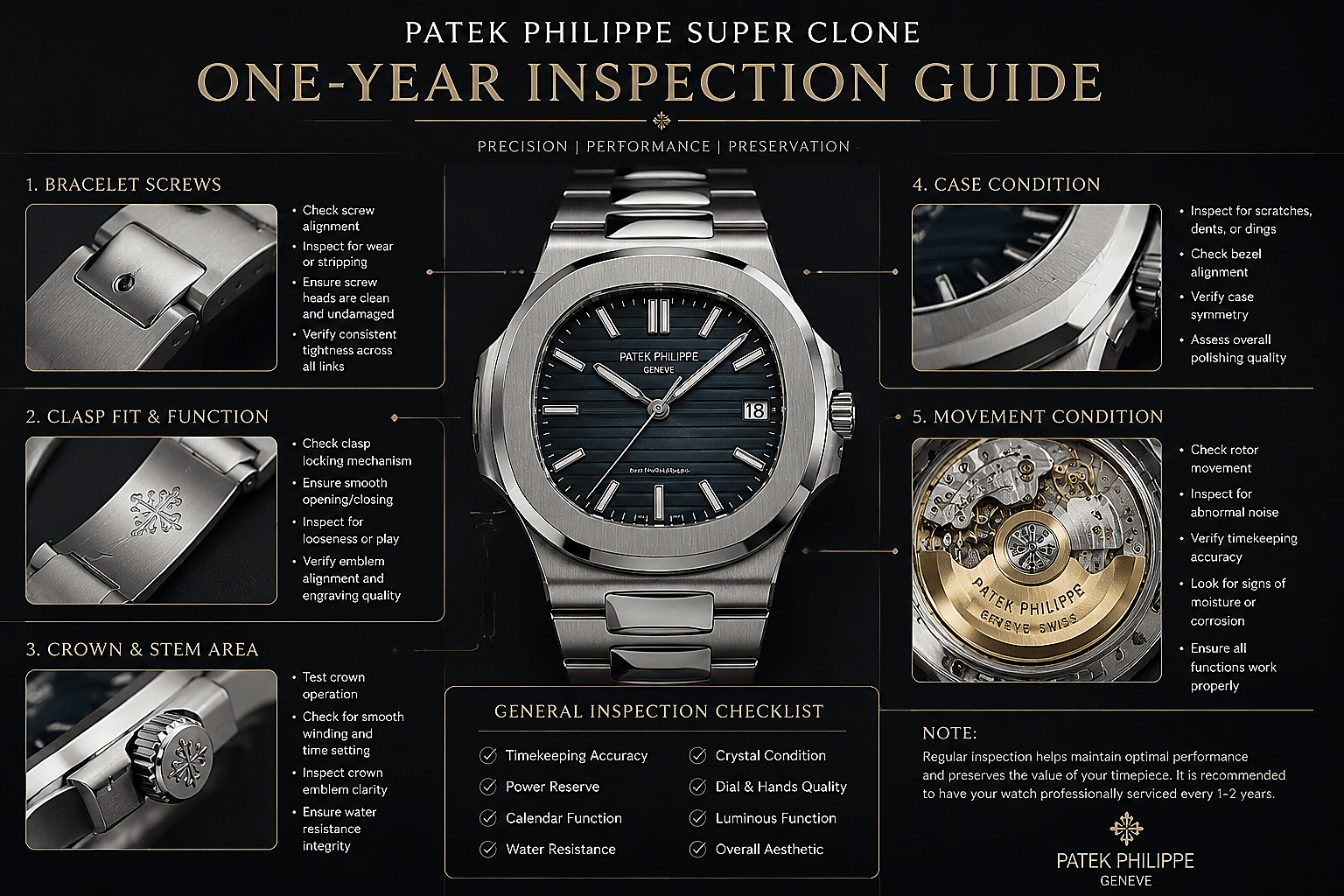
One-Year Inspection Checklist
A one-year inspection does not need to be complicated. It should focus on the areas that affect ownership confidence, not on trying to judge the watch like a professional authentication exercise. The goal is to decide whether the watch remains safe and satisfying to wear.
- Bracelet screws: Check whether any screws have shifted, loosened, or sit unevenly after repeated wear.
- Clasp snap: Open and close the clasp several times and confirm that it locks with consistent pressure.
- Crown feel: Wind and set the watch gently, watching for grinding, slipping, or thread roughness.
- Rotor sound: Listen for a normal light spin versus a sudden grinding, scraping, or metallic sound.
- Timekeeping consistency: Track whether the watch behaves predictably over several days, not just one afternoon.
- Crystal and dial condition: Look for fogging, dust movement, strange marks, or moisture-related changes.
- Case and plating wear: Separate normal scratches from deep impact marks, edge discoloration, or rapid coating loss.
At Clean VS Factory, we usually encourage buyers to separate appearance aging from ownership risk. A scratched case can still be acceptable. A failing clasp, unstable movement, loose crown, or moisture sign should change the decision immediately.
A useful one-year check also creates a traceable baseline for the next six months. Take clear photos of the bracelet gaps, clasp contact points, bezel edges, crown position, caseback, and any plated areas, then compare them later instead of relying on memory. This helps separate normal gradual wear from sudden changes such as a screw backing out, a clasp losing tension, a rotor sound changing, or coating wear appearing in one concentrated area.
The purpose of this inspection is ownership awareness, not authentication deception. A strong super clone may look convincing in normal wear, but close inspection can still reveal differences in finishing, movement architecture, case proportions, bracelet feel, dial details, or service compatibility, and a replica watch should not be represented, resold, or used as a genuine watch.
Would I Choose the Same Patek Philippe Super Clone Again?
Yes, but not as a careless daily beater and not for a buyer expecting zero compromise. That is the honest answer after this one-year replica watch review. The watch remained enjoyable, but the reasons were more practical than emotional by the end of the year. It still delivered the design, the wrist presence, and enough refinement to stay in rotation. It did not deliver genuine-level finishing durability, guaranteed water confidence, or maintenance-free ownership.
So, is a Patek Philippe super clone worth it after one year? It can be, if the buyer understands what the value actually is. The value is not perfection. It is access to a design language and wearing experience that can be satisfying under realistic conditions. The risk is that the watch asks more from the owner than a simpler replica: more care with scratches, more caution around moisture, more attention to bracelet condition, and more acceptance that service may eventually be needed.
Price, Service, and After-Sale Risk Should Shape the Decision
Price differences in this category should not be read as a simple quality ranking. A higher price may reflect a more expensive movement route, a newer version, tighter bracelet finishing, limited availability, seller margin, or the seller taking more after-sale risk. It may also reflect hype around a factory name. Before paying more, the buyer should ask what the extra cost actually changes: movement serviceability, case thickness, bracelet feel, clasp security, dial execution, or access to replacement parts if something goes wrong.
This is especially important for a one-year daily wear buyer. A watch that costs more because it has better visual movement decoration may not be the better ownership choice if that movement is harder to service. Likewise, a slightly less dramatic version with a common automatic base may be easier to live with if it keeps time predictably and a local watchmaker is more likely to understand it. A better ownership choice is not always the most expensive version; it is the version whose compromises match the way the owner will actually wear the watch.
Buyers should also confirm practical terms before ordering, including return, repair, shipping, and after-sales arrangements, because these details can vary by seller and model. This review does not treat those terms as assumed protections. For a long-term daily wear purchase, the more responsible approach is to combine version research with clear pre-purchase questions, real QC photo review, and realistic expectations about servicing, water exposure, and replacement parts.
Replica watch prices can vary by factory label, version, movement configuration, finishing quality, seller channel, availability, and after-sales support. Buyers should compare like-for-like details before treating one option as better value, and exact price comparisons should be verified at the time of purchase rather than assumed from older listings or general factory reputation.
Best Fit: The Buyer Who Understands the Tradeoff
The best fit is a buyer who values the Patek Philippe design but does not expect the replica to behave like a genuine watch over decades. This buyer wears the watch in a controlled rotation, avoids water exposure, accepts normal scratches, and pays attention to early mechanical symptoms. For that person, the watch can remain satisfying after one year because the expectations are aligned with the product.
It is also a good fit for someone who cares about wrist presence more than macro-level perfection. Many small visual flaws become less important during real use. What matters more is whether the case proportion works, the bracelet sits comfortably, the clasp remains secure, and the movement feels stable enough for casual wear. If those elements hold, long-term satisfaction is possible.
This is especially true for buyers who already understand replica watch ownership. They know a factory name or fresh QC photo is only the beginning. The real test is how the watch feels after months of wear, after the first scratches, after the clasp has broken in, and after the owner no longer treats it like a new toy.
Wrong Fit: The Buyer Expecting Zero Compromise
The wrong buyer is someone who wants a maintenance-free luxury object. If you expect perfect finishing, guaranteed water resistance, silent movement behavior, flawless plating, and a bracelet that ages exactly like a genuine Patek Philippe, this type of watch will probably disappoint you. A super clone watch can be visually strong, but it is still a replica with assembly, movement, and durability variables.
It is also the wrong choice for someone who is rough on watches. If you swim with watches, wear them in gyms, toss them into bags, or expect them to survive travel abuse without concern, a Patek-style super clone is not the safest category. A simpler sports replica with a more robust bracelet and less delicate finishing may be a more rational daily-wear value.
The most common mistake is buying this kind of watch for the first-day impression only. The dial, case shape, and bracelet may look excellent in photos, but one-year satisfaction depends on the parts that age: clasp, screws, case edges, rotor behavior, crown feel, and finishing durability. If those concerns sound irritating rather than manageable, the model choice is probably wrong.
Disclosure and Comparison Boundary: This article discusses an imitation watch as a long-term wearing object, not an authorized Patek Philippe product and not a substitute for the original brand’s warranty, service network, materials control, or quality assurance. Official brand information can help a buyer understand the design being referenced, but it cannot prove replica execution. The most responsible comparison is therefore limited: how the replica feels, ages, and behaves in ordinary ownership, while accepting that movement refinement, finishing tolerance, service path, legal status, and long-term durability are not equivalent to an authentic watch.
The Final One-Year Verdict
I would choose the same Patek Philippe super clone again, but only with realistic boundaries. It is still worth considering for a careful owner who wants the look and feel of the design in regular rotation and accepts that long-term ownership involves some risk. I would not recommend it as a first replica watch for someone who expects a worry-free daily piece.
The final judgment is clear: the watch remained enjoyable after one year, but not because it stayed perfect. It remained enjoyable because the core wearing experience survived the scratches, the mild bracelet settling, and the fading novelty. The case still looked elegant at normal distance, the comfort was still good, and the flaws were manageable rather than deal-breaking.
If the bracelet had become unstable, the clasp unreliable, the movement erratic, or moisture had appeared under the crystal, the verdict would change. That is the real lesson. With a Patek Philippe super clone, long-term satisfaction is not decided by how close it looks on day one. It is decided by whether the watch still feels trustworthy, comfortable, and worth reaching for after the excitement has faded.
Disclosure: This article is for general educational and comparison purposes only. Replica watches are not genuine products from the original luxury brands, and brand names are used only to identify reference designs or comparison topics. Factory names, movement descriptions, prices, availability, QC details, seller policies, and version information can change, so readers should verify important details with the seller before making a purchase decision. Replica watches should not be represented, resold, or used as genuine watches.