
Richard Mille replicas command some of the highest prices in the replica market, with sellers routinely marketing mid-tier builds as “V3 super clones” for $1,600 or more. The critical deception lies in case architecture: genuine RM055 watches measure approximately 11.5mm thick, while RM11-03 models range 13.5-14.5mm. When replicas exceed these measurements significantly, the excess bulk indicates compromised mid-tier movement architecture hiding inside claimed premium cases.
This article teaches you to stop trusting factory labels and marketing jargon, and instead demand physical proof—specifically straight side-profile photos with caliper measurements showing case thickness excluding the crystal. You will learn to verify three construction elements that separate true high-end builds from overpriced mid-tier watches: layered Carbon TPT cases versus printed patterns, integrated titanium dial bridges versus brass bases, and proper spline-screw strap integration versus spring bars. Without this verification, you cannot justify prices above $1,200.
| Verification Focus | Super Clone Evidence | Mid-Tier Red Flag |
|---|---|---|
| Case Thickness | Caliper reading 11.5mm (RM055) or 13.5-14.5mm (RM11-03) excluding crystal; within 0.5mm of genuine | 13mm+ (RM055) or 15mm+ (RM11-03); indicates thick movement housing hidden in bulk |
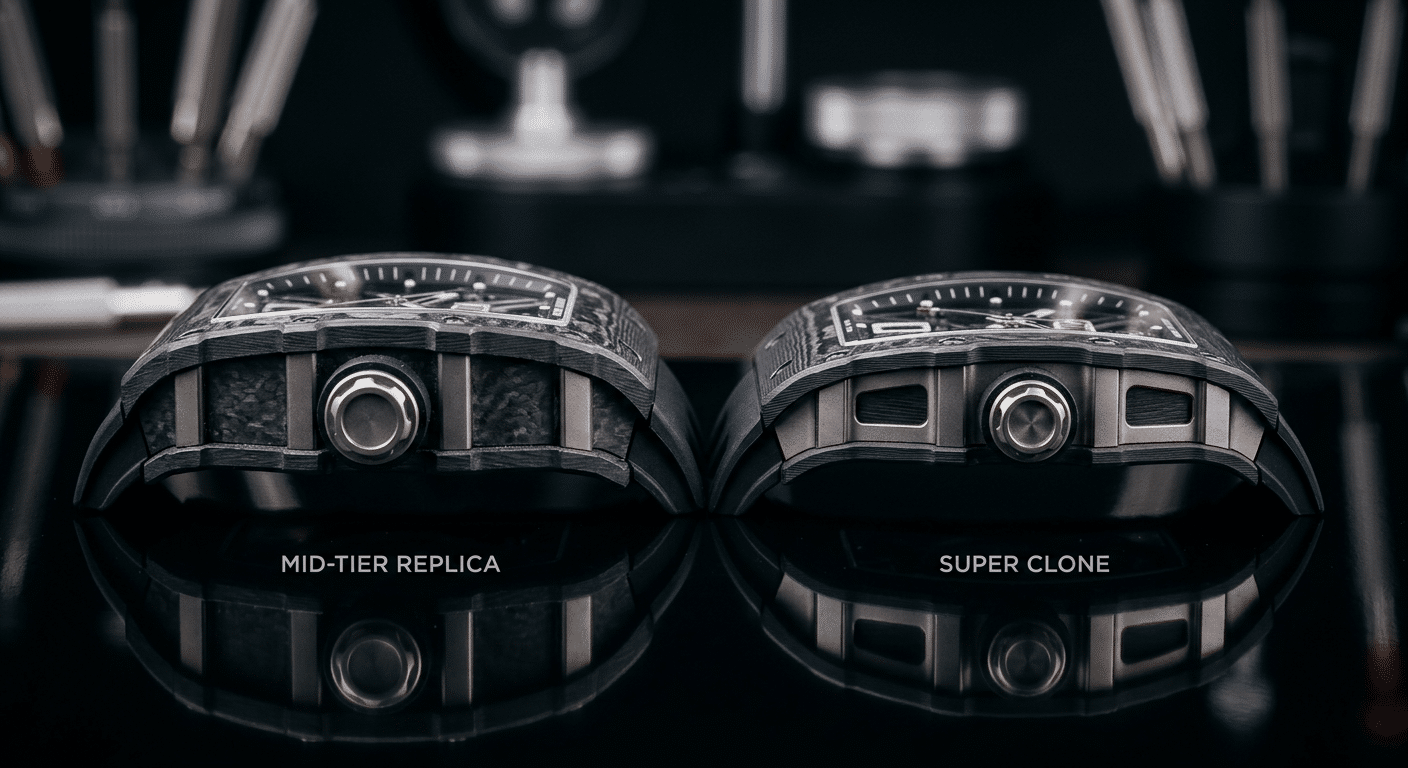
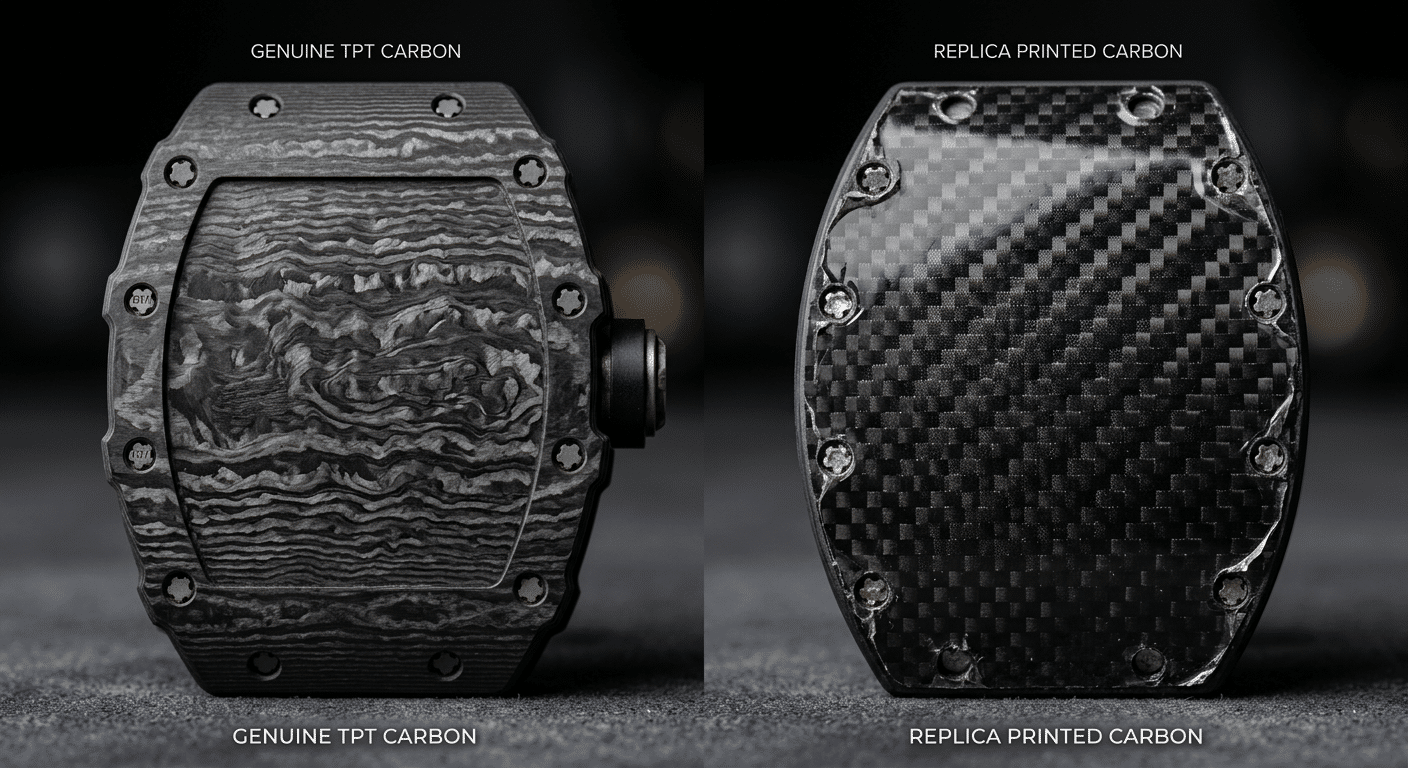
| Carbon TPT Case | Continuous fiber layers visible in screw hole walls; natural surface porosity; layered construction throughout | Printed carbon patterns on surface only; solid metal core revealed at screw holes; uniform texture without depth |
| Skeleton Dial Base | Integrated bridges with steel or titanium base plates; organic perlage finishing; structural continuity | Brass-colored base plates with applied decorative plates on top; separate components mimicking integrated construction |
| Strap Integration | Spline screws matching case hardware; continuous curvature between strap and case; no visible gaps | Spring bar attachment; visible gaps between strap end and case; mismatched or standard screws |
| Seller Photography | Straight 90-degree side profiles with visible calipers; macro dial shots with flat even lighting; measurement transparency | Dramatic angled shots hiding thickness; moody or low lighting; refusal to provide specific caliper readings |
Quick Questions Before You Read
Q: Why does case thickness matter more than dial details for Richard Mille replicas?
Case thickness reveals the underlying movement architecture. Mid-tier movements require thicker housings, making the watch exceed genuine dimensions regardless of dial finishing quality. A thick case indicates compromised internal construction that cannot be fixed with better surface details.
Q: How do I verify the Carbon TPT case is real layered construction and not printed?
Examine the screw holes—authentic layered Carbon TPT shows continuous fiber layers throughout the hole depth with natural porosity. Printed patterns only sit on the surface and reveal uniform metal or solid composite material when viewed through screw holes or case flanks.
Q: Should I trust “V3” or “upgraded batch” claims from sellers?
No. Factory names and version numbers prove unreliable for Richard Mille replicas due to significant batch variation. Claims like “V3 super clone” without measurement proof usually indicate mid-tier builds with inflated pricing. Demand physical evidence, not marketing labels.
Q: What price range actually indicates legitimate super clone quality for RM replicas?
Mid-tier builds with case thickness exceeding genuine specs by more than 0.5mm should not command prices above $1,200. Prices of $1,600+ are only justified when case thickness matches genuine specifications and construction details (Carbon TPT layers, titanium dial bases) are verified with photos.
The Round Watch Evaluation Trap: Why RM Replicas Require Architectural Thinking
Buyers migrating from Rolex or Cartier replicas often apply evaluation logic that fails catastrophically in the Richard Mille segment. Round watches like Submariners or Datejusts prioritize dial printing precision, bezel action crispness, and bracelet feel—qualities where mid-tier factories can approach super-clone visual fidelity through surface finishing alone. This round watch bias creates a dangerous blind spot when evaluating tonneau-shaped RM replicas, where case architecture and movement integration matter more than surface cosmetics.
The fundamental difference lies in what constitutes “accuracy.” For a Rolex replica, a slightly thick case may go unnoticed because the round profile accommodates variation visually; the eye focuses on the cyclops magnification or rehaut engraving. In Richard Mille replicas, case thickness directly compromises the tonneau silhouette—the defining visual element of the brand. A 2mm thickness increase transforms the elegant barrel shape into a bulky block, destroying the “floating” wrist presence that defines genuine RM aesthetics. This architectural sensitivity means structural accuracy trumps visual detailing in this segment.
Factory reputation operates differently here as well. In the Rolex replica market, certain factories maintain consistent dominance through standardized production lines and established component supply chains. For Richard Mille replicas, lower production volumes and higher component specialization mean factory names like ZF, APSF, or BBR function as unreliable proxies. Unlike Rolex replicas where certain factories maintain multi-year dominance through consistent investment, the RM segment experiences higher volatility. This means factory reputation decays faster and proves less predictive of current batch quality.
At cleanvsfactory.com, this distinction shapes how buying guidance is structured: the evaluation framework treats Richard Mille as a category requiring model-specific architectural verification rather than factory-brand loyalty. The buyer must prioritize case geometry, movement route efficiency, and tonneau proportion accuracy over surface finishing quality—a reversal of the logic that serves well for round watches. Understanding this inversion prevents the specific overpayment pattern where buyers pay super-clone prices for watches that photograph like high-end pieces but wear like mid-tier builds due to case thickness and structural shortcuts.
The Richard Mille Price-Quality Mismatch Problem
Consider the buyer who encounters professional studio photos of an RM11-03 or RM055 replica. The listing shows crisp carbon layering, a skeletonized dial with seemingly intricate architecture, and a price tag of $2,200 justified as the “ultimate super clone” or “latest V3 batch.” The enthusiast hesitates, wondering whether this Richard Mille replica pricing reflects genuine super clone construction or simply inflated positioning. Without a forensic framework to verify structural quality, the decision becomes a gamble on marketing language rather than physical evidence.
This confusion is endemic to the RM replica market because Richard Mille watches resist the evaluation shortcuts that work for round watches like Submariners or Datejusts. The genuine articles achieve their presence through complex tonneau case machining, layered Carbon TPT construction, and skeletonized movements that sit within remarkably thin profiles. These architectural elements create quality gaps that are wider and more expensive to bridge than the simple case profiles of Rolex or Cartier. A mid-tier builder can apply excellent surface finishing—convincing carbon texture, sharp printing, clean screws—to a fundamentally flawed case that is 3mm too thick or milled from a solid block rather than layered construction. The result is a watch that photographs like a super clone but wears like a mid-tier build, creating the exact price-quality mismatch that separates informed buyers from overcharged ones.
The market roughly sorts into three tiers: entry-level builds ($600–900) that use standard movements and printed carbon patterns; mid-tier constructions ($1,000–1,400) that may feature real forged carbon and decorated movements but hide thicker cases; and claimed super clone territory ($1,600+) where the price demands correct case architecture, proper movement routes, and genuine material execution. In the RM segment, however, these price boundaries blur because sellers routinely apply super clone pricing to mid-tier builds, trusting that buyers will evaluate the watch as they would a Rolex—judging dial printing, bezel action, and bracelet feel—while ignoring the tonneau case complexity that actually determines value.
Here is the hierarchy that matters: in RM replicas, case thickness and architecture are king; finishing is secondary. A watch with perfect dial printing but a 15.5mm case thickness is not a super clone; it is a mid-tier build with good cosmetics. Similarly, factory names like ZF, APSF, or BBR function as unreliable proxies in this segment. Unlike Rolex replicas where certain factories maintain consistent dominance, RM production involves lower volumes, batch variation, and shared component suppliers that mean even reputable names can produce variable quality depending on the specific reference and production run. Trusting the factory name alone without verifying the specific case dimensions for that specific batch is precisely how buyers end up paying $2,000 for a watch that should command $1,200.
Decoding Seller Language Against Physical Evidence
Sellers justify RM super clone value through a vocabulary designed to imply structural improvement without specifying it: “latest batch,” “upgraded V2 case,” “real Carbon TPT,” “factory direct,” “1:1 exact.” These phrases function as pricing anchors, each suggesting a $300–500 increment over previous versions. The critical skill for buyers is translating this marketing language into concrete verification requirements, establishing a burden of proof where high prices must be tied to measurable structural improvements rather than cosmetic refinements.
When a seller claims “V2 upgraded,” the proper response is not acceptance but inquiry: what specifically changed in case thickness, carbon layering integrity, or movement route visibility? If the answer references only “better dial color” or “improved finishing,” the price jump is unsubstantiated. Super clone marketing operates as a pricing tier rather than a protected standard; it describes a level of construction that requires physical evidence, not a label that guarantees quality. Similarly, “factory direct” claims carry limited weight in the RM segment. Because production involves dispersed component suppliers and assembly points, direct sourcing does not eliminate batch variation or ensure that a specific unit received the latest case molds.
The bridge between seller language and physical reality is selective photography. Listings that justify super clone pricing through “latest version” claims should provide specific evidence: straight side profiles showing case thickness with measurement tools, macro shots of carbon layering at screw holes to verify depth rather than surface printing, and videos of skeleton movements showing gear rotation. If a seller cannot produce a straight side-profile photo with a caliper visible, they are likely hiding case bulk that contradicts the super clone claim. Selective photography allows mid-tier builds to appear top-tier by using 45-degree angles that conceal thickness, dramatic lighting that masks carbon texture flaws, or artistic bezel shots that avoid showing strap integration gaps.
The operative principle is this: if a seller cannot provide specific measurement evidence for a specific claim, the claim cannot justify the price. A “real tourbillon” claim requires video of the cage rotating, not just static photos. A “thinner V3 case” claim requires measurement photos, not just comparison charts. In the RM market, where low production volume creates information asymmetry between sellers and buyers, the buyer must shift from trusting version numbers to demanding architectural proof.
Factory Names and Version Numbers: Limited Reliability in the RM Segment
In the Rolex replica ecosystem, factory names function as reliable quality shorthand—”Clean” or “VSF” carry consistent implications about build standards. Buyers attempting to apply this factory loyalty logic to Richard Mille replicas encounter a fundamentally different market structure where these labels prove unreliable proxies for quality. Understanding why factory names matter less for RM replicas prevents the specific overpayment scenario where buyers pay premium prices based on factory reputation rather than batch-specific evidence.
The production economics of Richard Mille replicas differ sharply from high-volume Rolex clones. RM replica batches run smaller, component suppliers shift between assemblers, and case molds see less consistent refinement than their round-watch counterparts. A factory that produced excellent RM055 cases six months ago may deliver inferior batches today due to mold wear, material supplier changes, or workforce shifts. Unlike Rolex replicas where certain factories maintain multi-year dominance through consistent investment, the RM segment experiences higher volatility. This means factory reputation decays faster and proves less predictive of current batch quality.
Version numbers compound this reliability problem. In Rolex replicas, “V2” or “V3” often document specific, measurable improvements—datewheel thickness corrections, rehaut engraving depth, or crown guard reshaping. For Richard Mille replicas, version claims frequently function as pricing psychology tools rather than engineering documentation. A “V3” claim may reflect only dial color adjustments or bezel printing changes while the underlying case thickness, carbon layering, or movement architecture remains identical to “V2” or even “V1” batches. Sellers use version inflation to justify $300–500 price increases without structural improvements.
At cleanvsfactory.com, the guidance treats factory names and version numbers as starting points for investigation rather than decision endpoints. The recommended approach involves requesting batch-specific evidence—case thickness measurements, carbon layering photos, and movement videos—rather than accepting factory reputation as proxy for quality. This proves particularly crucial for Richard Mille purchases where the gap between factory reputation and batch reality runs wider than in higher-volume replica categories. The buyer who verifies specific architectural evidence rather than trusting factory labels avoids the common overpayment pattern where $2,000 purchases receive $1,200 construction simply because the seller invoked a respected factory name.
When evaluating specific Richard Mille batches, buyers should treat factory designations as initial reference points requiring immediate verification rather than quality guarantees. The practical reality of RM replica production involves dispersed component sourcing and assembly variability that factory names cannot capture. A specific ZF or APSF batch may have produced excellent cases six months ago while current inventory shows mold wear or material supplier changes that alter thickness specifications. This means the factory label on the listing provides only a starting point for investigation.
Factory Name Clarification: Factory names in the replica watch market are commonly used buyer-facing labels. They should be treated as practical market references, not as official brand affiliations, audited manufacturer identities, or guarantees of identical quality across every model.
Instead of relying on factory reputation, buyers should request batch-specific evidence that supersedes the factory designation. This includes caliper measurements for the specific unit being sold, macro photography of carbon layering at screw holes, and video documentation of movement function. The factory name may indicate the general source of the components, but only physical evidence from the specific batch can confirm whether that particular unit meets the architectural standards required for the asking price. This shift from factory loyalty to batch verification prevents the common scenario where buyers pay premium prices based on outdated factory reputation rather than current build quality.
Factory names in the replica watch market are useful buyer-facing references, but they should not be treated as official luxury-brand affiliations or automatic guarantees of quality across every model. In super clone watch comparisons, the safer judgment is usually version-specific. A factory may be strong on one model and weaker on another because case shape, dial printing, bracelet construction, bezel action, and movement layout are not equally difficult across every reference. Traceability in this context means tracking how a specific batch performs on a specific RM model rather than assuming a factory label guarantees consistent excellence across the entire lineup.
Replica Market Positioning and Brand Boundary Awareness
Before evaluating construction tiers or pricing models, it is essential to establish a clear boundary regarding what a Richard Mille replica represents in the buyer landscape. Replica watches, regardless of construction level or finishing quality, are replica-market products. They are not genuine watches from the original luxury brand, nor are they affiliated with, endorsed by, or produced under the authorization of Richard Mille or any other luxury watch manufacturer. Brand names in this context serve strictly as reference points for design comparison and aesthetic evaluation. Understanding this distinction prevents misaligned expectations regarding materials sourcing, official servicing compatibility, and long-term brand-backed support.
Factory names and version labels frequently used in replica listings function as market shorthand rather than official designations. Terms like “super clone,” “1:1,” or “V3 batch” describe seller-facing marketing categories and visible finishing ambitions, not audited manufacturing standards or certified quality tiers. Because replica production operates outside official brand oversight, quality consistency varies by batch, component supplier shifts, and assembly practices. Buyers should treat these labels as starting points for verification rather than guarantees of performance, durability, or architectural precision. The safest use of factory and movement information is to avoid overpaying or misunderstanding quality, not to misrepresent a replica watch as genuine.
Case Thickness and Tonneau Geometry – The Primary Diagnostic
Authentic Richard Mille watches achieve remarkable thinness despite their tonneau shapes and complex complications. An RM055 measures approximately 11.5mm in genuine form; an RM11-03 sits around 13.5–14.5mm. These dimensions are not arbitrary styling choices but the result of integrated case and movement architecture where every millimeter serves structural purpose. This is why RM case thickness serves as a clear indicator for whether a replica justifies super clone pricing.
Mid-tier replicas often rely on thicker base movements—Miyota 9015 derivatives or standard Seagull calibers—that require case thickness increases of 2–4mm to accommodate the movement height and rotor clearance. An RM055 measuring 13.5mm or an RM11-03 measuring 15.5mm is not a “slight variance”; it is mid-tier architecture hiding beneath carbon fiber and finishing upgrades. This bulk destroys the wrist presence and visual proportions that define the genuine article, regardless of how convincing the surface carbon texture appears. The diagnostic rule remains clear: if an RM11-03 measures over 15mm or an RM055 measures over 13mm, it is mid-tier architecture regardless of price, carbon quality, or dial finishing.
Sellers of thick cases rely on photographic angles to hide this flaw. The 45-degree front angle, popular in listing photos, visually compresses the case profile, making a 16mm-thick mid-tier case appear closer to the 13.5mm genuine specification. Side views with hands positioned to obscure the case edge, or extreme close-ups of the dial that avoid the case flank entirely, serve the same purpose. Buyers must demand straight side-profile photos—90 degrees to the case side—with a measurement ruler or caliper visible at the case center. Thickness measurement should exclude crystal dome height and caseback screw protrusions; it captures the case band itself.
Thickness Measurement Protocol
Request a straight side-profile photograph with the watch resting on a flat surface. The ruler or digital caliper should be visible against the case flank, measuring from the caseback plane to the top of the case band (not including the crystal dome). Acceptable variance is ±0.5mm from genuine specifications; anything exceeding 1mm indicates compromised case architecture. If the seller provides angled shots, artistic compositions, or refuses this specific measurement, assume the thickness exceeds mid-tier standards and negotiate price accordingly. This single measurement reveals more about movement route and construction quality than any description of “upgraded finishing.”
Case Layering vs Solid Construction
Top-tier RM cases employ complex layered tonneau construction with distinct front bezels, case bands, and casebacks assembled with spline screws. This tripartite structure creates visible case band detailing and proper weight distribution. Mid-tier builds often mill the entire case from solid blocks of carbon composite or metal, creating monolithic construction that adds unnecessary thickness and wrong visual weight. Examine photos of the case flanks: genuine-style construction shows clear layering lines and material transitions at the screw holes, while solid-block construction appears uniform and bulky. The case profile should show elegant lug curves flowing from the case band; solid-milled cases often look slab-sided and heavy. This distinction between layered and solid construction explains why two watches with identical carbon surface texture can sit so differently on the wrist—one achieving the RM’s characteristic “floating” presence, the other feeling like a heavy block.
While case thickness serves as the primary architectural diagnostic, comprehensive quality assessment requires examining additional visible control points that reveal construction tier. Mid-tier builders can achieve correct thickness while still compromising on dial printing precision, bezel alignment tolerances, or clasp engraving depth. These secondary indicators become particularly important when thickness measurements fall into ambiguous ranges—within 1mm of genuine specifications but not precisely matching them. In these borderline cases, the presence or absence of fine finishing details often determines whether the build represents acceptable mid-tier value or overpriced positioning.
Quality Control Note: For replica and super clone watches, buyer confidence depends on visible quality-control details such as case finishing, dial printing, bezel alignment, bracelet fit, clasp engraving, datewheel position, and movement configuration. These details should be checked model by model rather than assumed from a factory name alone.
The practical application of this multi-point inspection approach involves correlating specific quality observations with price tier expectations. When evaluating a claimed super clone priced above $1,800, buyers should verify not only the case thickness but also the alignment of bezel screws with carbon fiber layers, the continuity of printing on the inner bezel scale, and the precision of datewheel positioning at three o’clock. If these secondary details show misalignment, smearing, or uneven spacing while the seller maintains super clone pricing, the discrepancy indicates mid-tier construction attempting premium positioning. This comprehensive QC approach—treating thickness as necessary but not sufficient for quality verification—protects buyers from the specific overpayment risk where architectural metrics alone might suggest acceptable construction while finishing details reveal cost-cutting.
Carbon TPT and Material Execution Verification
High-price Richard Mille listings often lean heavily on “Carbon TPT” or “forged carbon” claims to justify super-clone pricing. The problem is that not all carbon is created equal, and mid-tier factories have become skilled at applying superficial carbon aesthetics over standard metal cases. Learning to distinguish layered carbon construction from printed patterns or thin veneers is essential to avoid paying premium prices for standard builds.
Authentic Carbon TPT—exclusive to Richard Mille via North Thin Ply Technology—uses precisely layered carbon sheets rotated 45 degrees between layers, creating distinctive striations that shift direction at case edges. This material shows surface porosity (tiny micro-voids), matte finishing, and visible fiber direction changes at curves. Mid-tier replicas often use printed hydro-dipped patterns on steel or aluminum cases, or apply thin carbon sheets over metal substrates, lacking the depth, layering continuity, and machining evidence of genuine TPT construction.
Reading Carbon Evidence
The most reliable verification method is examining how carbon layers behave at screw holes and case flanks. Genuine layered carbon shows continuous fiber direction through drilled holes—evidence of solid block machining rather than surface application. Request macro photos of case flanks at 45-degree angles showing screw hole edges; mid-tier builds often reveal metal substrates, sticker-like edges, or pattern interruptions at these critical junctions.
Weight also tells the story. Carbon TPT cases should feel substantial but not heavy—lighter than steel but denser than plastic. If a “carbon” RM feels unusually heavy (suggesting steel underneath) or suspiciously light (suggesting hollow plastic), the material execution likely doesn’t match the price tier.
- Layer continuity: Real carbon shows organic, wavy striations that change direction at curves; printed patterns repeat uniformly
- Surface texture: Authentic forged carbon has microscopic porosity; fakes often look too smooth or plastic-like
- Screw hole evidence: Cross-sections should show fiber layers, not metal cores or sticker edges
- Bezel alignment: Top-tier builds align carbon patterns across bezel, case, and caseback; mid-tier often mismatches direction
What to Check Before You Decide
Request three specific photos: (1) macro case flank at 45-degree angle showing screw hole edge to reveal layering, (2) caseback edge showing carbon continuity at the perimeter, and (3) bezel insert close-up showing fiber direction. If the seller cannot provide these—or if the carbon appears to wrap around edges like a sticker rather than machined from solid layered material—treat the build as mid-tier regardless of the “super clone” asking price.
Movement Architecture and Realistic Service Expectations
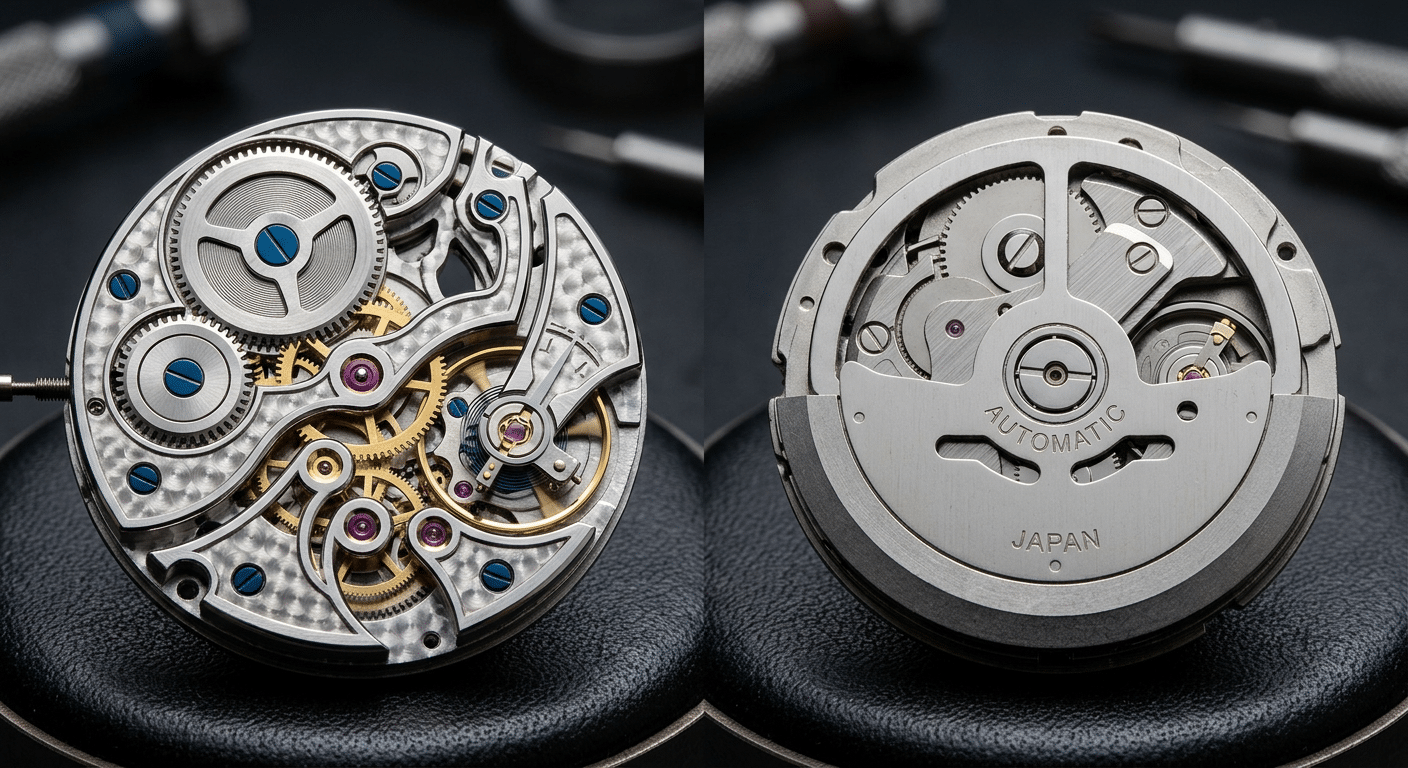
When sellers describe a replica movement using names associated with luxury calibers or specific technical layouts, these references typically indicate clone architecture, decorative finishing, or modified Asian base designs rather than official brand-manufactured components. The replica market relies heavily on modified movements such as Seagull derivatives, Miyota-adapted platforms, or custom-decorated automatic calibers. While some versions incorporate skeletonized plates, blued screws, or perlage patterns to mimic high-end aesthetics, the underlying gear train, jewel configuration, and rotor mechanics remain distinct from genuine luxury calibers.
Movement names in the replica market often describe layout, decoration, clone architecture, or seller terminology rather than an official brand-manufactured caliber. Buyers should distinguish between movement layout, decoration, reliability expectations, and actual serviceability. A decorated Asian base movement may visually mimic a high-end architecture, but its internal components, tolerances, and long-term wear characteristics differ from original designs. Evaluating movement claims requires looking past surface finishing to understand the actual configuration, potential servicing risks, and ownership boundaries specific to that movement route.
This architectural reality directly impacts long-term service expectations. Unlike genuine watches that benefit from manufacturer-backed servicing networks, genuine parts compatibility, and certified watchmaker training, replica watches require independent watchmakers familiar with Asian movement configurations. Routine maintenance, lubrication schedules, and repair turnaround times depend entirely on the specific movement route used, the availability of compatible replacement components, and the expertise of independent technicians. Buyers should plan accordingly and avoid assuming that a decorated skeleton movement will deliver the same service lifecycle, accuracy stability, or repair accessibility as a brand-manufactured caliber. Movement configurations should always be verified through video and macro photography before purchase, as cosmetic finishing alone cannot guarantee mechanical consistency.
Movement Transparency and Daily Ownership: What the Skeleton Dial Reveals About Reliability
The skeletonized dial that defines Richard Mille aesthetics creates a unique ownership paradox: the open architecture provides immediate visual verification of movement quality while simultaneously exposing the mechanism to environmental risks that closed-case watches avoid. For buyers evaluating whether a $1,800 price tag reflects genuine super-clone engineering or merely decorated mid-tier construction, understanding this transparency tradeoff proves essential for predicting long-term ownership satisfaction.
Mid-tier RM replicas often employ standard automatic movements—Miyota 9015 variants or Seagull calibers—that were never designed for open-dial exposure. These movements rely on closed casebacks for dust protection and structural stability. When skeletonized for RM aesthetics, they lose this protection while gaining no additional sealing. The result is a movement that may display acceptable finishing under initial inspection but suffers accelerated wear from dust ingress and moisture exposure during daily wear. A visually impressive skeleton dial using applied decorative plates over standard movements often indicates not engineering sophistication but increased maintenance liability.
The ownership reality differs significantly between true calibre construction and decorated base movements. Integrated movements designed specifically for skeleton exposure—like those attempting to replicate RM’s titanium base plate architecture—offer better sealing around the perimeter and more robust bridge structures that resist flexing during wrist movement. Mid-tier applied-plate constructions, by contrast, introduce additional failure points where decorative components may loosen or misalign under vibration. For daily wearers rather than occasional collectors, this structural reliability gap manifests as hands falling out of alignment, increased service intervals, or complete movement failures that surface finishing cannot predict.
At cleanvsfactory.com, this distinction shapes buying recommendations toward verifying movement architecture rather than movement decoration. The question is not whether the bridges show attractive perlage, but whether the base plate material (steel/titanium versus brass), bridge integration method (machined continuity versus applied plates), and sealing design suggest the movement can survive daily exposure. For buyers prioritizing daily wear over collection display, mid-tier skeleton movements often represent poor value regardless of surface finishing, as the transparency that enables visual verification simultaneously accelerates mechanical wear. This reality check prevents the common overpayment scenario where buyers pay super-clone prices for watches that impress in photos but prove unsuitable for the intended wearing context.
Skeleton Dial Architecture and Movement Route Evidence
The skeletonized dial is where Richard Mille replicas most aggressively claim “super clone” status while potentially hiding mid-tier construction. Unlike closed-dial watches where movement quality remains hidden, RM’s openworked architecture exposes the calibre to immediate scrutiny—making it both the primary visual attraction and the most revealing diagnostic point. Understanding the difference between properly engineered skeleton architecture and decorated base movements with applied plates is essential to evaluating whether a high price reflects genuine calibre work or merely cosmetic finishing.
Mid-tier RM skeletons typically employ standard automatic movements—Miyota 9015, Seagull ST16, or similar—stripped of their automatic winding modules and fitted with skeletonized decorative plates that mimic the appearance of an integrated calibre. These applied plates sit atop the base movement, creating a “stacked” visual effect where gears appear to float above the actual mechanism rather than integrating with it. Top-tier attempts, by contrast, aim for calibre architecture where bridges flow organically from the base plate, with proper depth, alignment, and finishing that suggests engineered integration rather than cosmetic overlay.
Bridge Design vs Applied Plates
The most telling distinction lies in how movement components relate to the base structure. In genuine RM calibres and high-quality clones, integrated bridges emerge seamlessly from the main plate, creating continuous surfaces with proper anglage (beveled edges) and perlage (circular graining) that flows naturally across components. The gears, balance wheel, and escapement appear to occupy specific architectural positions dictated by the calibre design.
Mid-tier applied-plate constructions, by contrast, show visual stacking: decorative plates sit atop a standard movement, often creating misalignment where hands meet gears, or where the balance wheel appears to float unnaturally above the base plate. The finishing—perlage patterns, blued screws, jewel settings—often looks stamped or printed rather than machined, with uniform patterns that lack the organic variation of genuine hand-finishing. Color reveals quality too: brass-colored base plates visible through gaps indicate mid-tier construction, while properly engineered movements show steel or titanium-colored components.
- Base plate color: Steel/titanium tones suggest proper architecture; yellow brass indicates decorated standard movement
- Perlage quality: Genuine machining shows organic, slightly irregular circular graining; stamped plates look mechanically uniform
- Hand alignment: Check that hour/minute hands align precisely with visible gears beneath; misalignment suggests applied plates
- Bridge flow: Look for continuous surfaces from base to bridge; visible gaps or “floating” components indicate overlay construction
Tourbillon Verification Protocol
For models claiming tourbillon complications—RM 052, RM 027, RM 57-01—verification requires video evidence of cage rotation. Static photos cannot prove tourbillon function; a cage that appears positioned correctly in a still image may be fixed decoration. Request video showing the cage completing at least one full rotation, preferably with the watch held in various positions to demonstrate mechanical operation rather than gravity-dependent decoration.
Be wary of “flying tourbillon” claims that lack bridge support—genuine flying tourbillons require exceptional engineering to maintain positional stability. Mid-tier replicas often use fixed decorative cages or standard balance wheels modified to resemble tourbillons. The EUR Factory RM 052 and RM 027 represent the current standard for functional tourbillon replicas, using genuine tourbillon movements rather than decorated automatic bases—but even these require video verification before purchase.
Strap-to-Case Integration – The Hidden Cost-Cutting
While case materials and dial finishing receive most attention in replica listings, the strap-to-case integration often reveals where mid-tier builds cut costs to maintain margin. Richard Mille’s distinctive tonneau architecture requires complex case band curvature and proprietary mounting systems—typically spline screws rather than standard spring bars—that mid-tier factories frequently simplify or omit entirely. This section focuses specifically on how strap integration serves as a diagnostic for whether a high asking price reflects proper case architecture or merely surface finishing upgrades.
Authentic RM cases feature integrated case bands with complex curvature that flows continuously from the tonneau body. The strap mounting uses specific hardware—often titanium spline screws identical to those securing the case tripartite construction—creating a flush, gap-free junction. Mid-tier replicas frequently employ standard spring bar mounts inserted into simplified case bands, creating visible gaps, poor strap articulation, and a “floating” appearance where the strap fails to follow the case curve naturally.
The Spline Screw Standard
Proper RM strap integration requires spline screws—the same 12- or 20-spline titanium screws used throughout the case construction—rather than standard spring bars or pins. These screws create a flush, secure mount that follows the case band curvature precisely. Mid-tier builds often substitute visible spring bars, simple pins, or screws that lack the distinctive spline pattern and sit proud of the case surface.
When evaluating listing photos, check specifically for strap mounting hardware at the 6 and 12 o’clock positions. The screws should match the case screws in finish and pattern (typically black-coated or titanium-colored with visible splines). If the hardware appears to be standard spring bars, simple cylindrical pins, or lacks the distinctive multi-spline pattern, the build uses mid-tier mounting regardless of case finishing quality.
- Hardware match: Strap screws should match case screws in finish, size, and spline pattern; mismatched finishes indicate cost-cutting
- Flush mounting: Proper integration shows no visible spring bars, pins sitting proud, or gaps between strap end and case band
- Curve continuity: The strap should follow the case band’s natural arc without visible forcing or misalignment
- Screw visibility: Spline screws should be clearly visible and accessible; hidden or covered mounting hardware suggests simplified construction
Strap Material and Articulation
Beyond mounting hardware, the strap material quality and articulation reveal build tier. Genuine RM straps use high-grade fluoroelastomer or specially compounded rubber that articulates smoothly while maintaining structure. Mid-tier replicas often use lower-grade silicone or generic rubber that feels plasticky, lacks proper flexibility, and fails to drape naturally from the case.
Proper strap integration allows the watch to sit flat and stable on the wrist without tilting or floating. Mid-tier builds with poor strap mounting often cause the watch to sit too high, tilt toward the 12 o’clock position, or feel unstable during movement. When evaluating QC photos, request images of the watch lying flat on a surface to observe how the strap drapes from the case—natural, continuous curves indicate proper integration; awkward angles or gaps suggest simplified mounting.
QC Photos to Request
Specific angles required to verify strap integration: (1) Straight-on side view of the strap-to-case junction at both 6 and 12 o’clock positions, clearly showing mounting hardware and any gaps; (2) Macro detail of the strap mounting screw or hardware, verifying spline pattern and finish match to case screws; (3) Flat lay photo of the watch lying on its side showing how the strap naturally drapes from the case band—look for continuous curvature without forcing or floating.
If the seller cannot provide these specific angles, or if the photos reveal spring bars instead of spline screws, visible gaps at the strap junction, or poor strap articulation, treat the build as mid-tier regardless of the asking price. Proper strap integration is not a finishing upgrade—it is fundamental case architecture that cannot be corrected after production, and its absence definitively indicates a build level below super-clone claims.
Model-Specific Risk Assessment: Which References Forgive Imperfections and Which Demand Perfection
Not all Richard Mille references present equal replication difficulty, yet sellers often apply uniform “super clone” pricing across models with vastly different architectural tolerances. Understanding which models allow for mid-tier construction forgiveness—and which demand flawless execution—prevents the specific overpayment error where buyers pay premium prices for references that cannot tolerate the thickness variations or finishing shortcuts present in their specific batch.
The RM055 (Bubba Watson) represents perhaps the most forgiving reference for mid-tier construction, not because low quality is acceptable, but because its simpler three-hand movement and absence of a date complication reduce the architectural complexity that typically forces case thickness increases. The genuine RM055 measures approximately 11.5mm thick; mid-tier replicas achieving 12.5–13mm may still present acceptable wrist presence due to the model’s relatively simple case band geometry. However, this forgiveness disappears when thickness exceeds 13.5mm, where even this simpler reference begins to look bulky. For the RM055, mid-tier builds may suffice for buyers prioritizing visual aesthetics over perfect proportion, provided thickness stays within 1mm of genuine and carbon layering remains convincing.
The RM11-03 (Felipe Massa) presents a stricter standard. Its integrated chronograph movement—typically the greatest challenge in RM replication—demands thicker case architecture that mid-tier builders struggle to contain within genuine 13.5–14.5mm specifications. Chronograph pushers add case height complexity, and the dial’s layered aesthetic reveals applied-plate construction more readily than simpler three-hand models. For the RM11-03, thickness tolerance tightens to 0.5mm; exceeding 15mm destroys the model’s specific wrist presence, and chronograph function reliability becomes suspect in mid-tier builds using decorated base movements rather than integrated chronograph calibres. This reference rarely forgives mid-tier shortcuts; its complexity demands top-tier architecture to achieve acceptable proportions and function.
The RM35-02 (Rafael Nadal) and similar automatic models with variable-geometry rotors occupy a middle ground. The genuine models use specific free-sprung balances and variable-rotor systems that mid-tier replicas rarely replicate functionally, often substituting standard automatic movements with decorative rotor bridges. For these models, functional rotor geometry matters less than thickness control—the specific Nadal models achieve remarkable thinness (around 11mm) that mid-tier builds rarely approach. Buyers evaluating RM35-02 replicas should prioritize case thickness verification over rotor function claims, as the model’s specific value lies in its slender profile rather than complication complexity.
Tourbillon-bearing references—the RM052, RM027, and RM57-01—represent the highest risk category where mid-tier construction proves least acceptable. These models depend entirely on the functional credibility of their tourbillon mechanisms; a static decorative cage represents a fundamental failure regardless of case finishing. Genuine RM tourbillons operate in extremely thin profiles (the RM027 weighs mere grams with polymer case construction), making thickness control even more critical. For tourbillon models, video evidence of cage rotation is non-negotiable, and thickness should approach genuine specifications within 0.5mm—any bulk indicates decorative rather than functional tourbillon construction. These references never forgive mid-tier shortcuts; the complication itself demands top-tier execution to achieve even basic functional credibility.
Price Transparency, Verification Limits, and Ownership Reality
Pricing in the replica watch market fluctuates based on factory labeling, version claims, movement configuration, seller channel, inventory availability, and the level of QC documentation provided. Exact figures should always be treated as reference points rather than fixed market values, as they can shift rapidly without formal notice. When evaluating a high-priced replica, buyers should verify that the asking price aligns with visible structural evidence—case thickness measurements, carbon layering continuity, strap integration hardware, and movement documentation—rather than relying on version numbers or promotional terminology. Prices that significantly exceed $1,500–$1,800 require proportionally higher levels of verifiable architectural proof and transparent seller communication.
Additionally, buyers must recognize the inherent limitations of replica ownership regarding water resistance, durability under impact, and long-term environmental exposure. Replica cases and seals are not subjected to the same standardized pressure testing, material fatigue analysis, or official certification processes as genuine luxury watches. Even when gaskets appear intact or screw-down casebacks are present, water resistance should never be assumed. Buyers should confirm whether the specific watch has been tested, and even then, replica watches should be treated more cautiously around water than genuine watches serviced through official channels. Exposure to moisture, temperature extremes, or physical shocks carries a higher risk of internal damage, movement degradation, or seal failure. Treating a replica watch as a display piece or casual accessory rather than a performance instrument aligns expectations with practical ownership boundaries and reduces the likelihood of preventable mechanical issues.
Before ordering, buyers should confirm return terms, repair options, water-resistance testing expectations, shipping timelines, and after-sales support directly with the seller. Unverified guarantees regarding customs clearance, waterproof performance, or long-term accuracy should be viewed cautiously. The replica market operates on transactional transparency rather than institutional policy, making direct seller communication and independent verification the most reliable risk-management tools available.
Reading Selective Photography and Listing Angles
The gap between a $1,800 price tag and a mid-tier build often hides inside the camera lens. Sellers of Richard Mille replicas have refined the art of selective photography to a precise science, using specific angles, lighting conditions, and depth-of-field tricks to disguise the very flaws this guide has outlined—thickness discrepancies, carbon texture shortcuts, and strap integration gaps.
Understanding these techniques transforms you from a passive viewer into an active investigator. When a listing presents only artistic 45-degree front shots with dramatic side lighting, the seller is often concealing case thickness. The 45-degree angle visually compresses the case profile, making a 16mm-thick mid-tier case appear closer to the 13.5mm genuine specification. Similarly, dark or moody lighting with warm color temperatures masks poor carbon fiber texture by creating shadows that suggest depth where the surface is actually flat or printed.
Angle Red Flags
Specific photographic compositions should trigger immediate suspicion. The extreme top-down shot eliminates the case profile entirely, hiding thickness while showcasing the dial. The bezel-dominant 45-degree shot draws attention to the crystal and bezel finish while the strap-to-case junction disappears into shadow or blur. Side views where the hour hand strategically covers the case edge obscure the true thickness measurement. Extreme close-ups of only the dial center, achieved through shallow depth of field, hide printing alignment errors and datewheel positioning issues.
Professional photography in replica listings often signals the opposite of quality. Highly stylized images with perfect bokeh and dramatic lighting indicate the seller invested more in photography equipment than QC documentation. When sellers possess the capability to produce macro shots but choose not to show specific angles—straight side profiles, case flanks, strap joints, or movement views—the absence becomes evidence of concealment.
The Mandatory Photo Checklist
For any Richard Mille replica priced above $1,600, demand these specific images before considering payment: a straight side profile with a ruler or caliper visible showing case thickness at the center point; a macro shot of the dial with flat, even lighting that reveals printing sharpness and alignment; a case flank photo at 45 degrees showing carbon layering continuity through screw holes; a direct view of both strap-to-case junctions at 6 and 12 o’clock showing mounting hardware and gap presence; and for skeleton models, a movement photo with sufficient depth of field to show bridge construction versus applied plates.
If a seller refuses any of these specific requests while maintaining super clone pricing, the refusal itself constitutes diagnostic evidence. Professional dealers of legitimate top-tier builds possess these images as standard QC documentation; their absence suggests the physical watch cannot support the asking price. Treat photographic opacity as a structural flaw equivalent to incorrect case thickness—it indicates a mid-tier build attempting to command premium positioning through marketing rather than engineering.
Editorial Perspective: At cleanvsfactory.com, we approach Richard Mille replica evaluation as a model-specific architectural assessment rather than a factory-ranking exercise. The replica watch market often treats factory names as quality guarantees, but for low-volume, high-complexity categories like Richard Mille, batch variation and shared component suppliers mean that factory reputation provides limited predictive value. The most reliable E-E-A-T signal in this segment is not the factory label on the case, but the buyer’s ability to verify case thickness, carbon layering continuity, and movement architecture against specific reference requirements. A $1,800 price tag can only be justified when the specific batch evidence—caliper measurements, screw hole macro photography, and movement videos—supports the structural claims. When sellers invoke factory names or version numbers without this physical documentation, the article treats such claims as marketing signals requiring verification, not as proof of build quality. This approach prioritizes buyer protection over factory loyalty, recognizing that in the Richard Mille replica market, the gap between claimed factory reputation and actual batch quality often determines whether a purchase represents fair value or significant overpayment.
Before making a decision, buyers should review real QC photos where available, including dial printing, hand alignment, bezel position, datewheel centering, bracelet fit, clasp engraving, case thickness, and overall finishing. Factory labels and stock photos alone are not enough for a reliable judgment.
CleanVSFactory’s editorial approach is to make replica watch decisions more traceable by connecting factory claims to visible details, movement behavior, version differences, and practical QC checks. For Richard Mille replicas, this means treating each purchase as a model-specific evaluation rather than a blind trust in market terminology. Buyers who align their verification process with actual physical evidence—thickness measurements, carbon layering photos, and movement documentation—naturally filter out overpriced mid-tier builds and establish realistic ownership expectations.
The Price-to-Build Correlation Framework
Translating diagnostic evidence into purchasing decisions requires a clear correlation between price tiers and non-negotiable structural requirements. The Richard Mille replica market operates on a version-number illusion—sellers increment “V2” to “V3” while the underlying case architecture remains mid-tier. To avoid overpaying, buyers must cross-reference asking prices against specific physical evidence rather than marketing terminology.
Structure your evaluation around three evidence tiers rather than price points, since market prices fluctuate while physical requirements remain constant. This framework allows you to evaluate whether a $1,800 asking price matches the evidence requirements for that tier, or whether the seller is positioning mid-tier construction at super clone prices.
Tier 1: Entry Evidence Requirements
Watches in this category show case thickness exceeding genuine specifications by more than 1.5mm, indicating standard Miyota or Seagull base movements requiring bulky encasement. Carbon fiber presentation shows printed patterns or superficial layering without depth continuity at screw holes. Strap integration uses standard spring bars rather than the proprietary spline screw systems found in genuine RM construction. Skeleton dials reveal standard movements with skeletonized plates rather than integrated calibre architecture. These characteristics generally align with entry-level pricing; any price significantly above $1,000 for this construction level warrants careful scrutiny.
Tier 2: Mid-Tier Evidence Requirements
This level shows improved finishing while maintaining fundamental architectural compromises. Case thickness exceeds genuine by approximately 0.8-1.2mm, suggesting decorated but still bulky movement routes. Carbon fiber shows actual layered construction visible at case flanks, though texture uniformity may vary between bezel and case components. Strap integration improves with better rubber quality and reduced gap presence, though mounting hardware may still use simplified screw systems. Skeleton movements show decorated bridges with improved finishing, though base plate materials may still reveal brass coloring rather than titanium. Prices in the $1,200-1,600 range can align with this evidence profile, but sellers often position this tier at $1,800-2,200 by emphasizing “latest version” marketing rather than structural evidence.
Tier 3: Claimed Super Clone Evidence Requirements
This tier demands near-correct case thickness—variance limited to 0.5mm or less from genuine specifications—indicating proper movement route engineering and case architecture. Carbon fiber must show consistent NTPT-style layering with pattern continuity through screw holes and across case components, demonstrating genuine composite construction rather than surface application. Strap integration requires proprietary mounting systems with spline screws, flush case band junctions, and articulation matching genuine wrist presence. For skeleton models, calibre architecture must show integrated bridge design with steel or titanium base plates, proper perlage finishing, and functional tourbillon operation evidenced through video documentation when applicable. Prices above $1,800 require this evidence profile; without it, the asking price constitutes an inflated mid-tier positioning that this framework identifies as the primary overpayment risk in the RM replica market.
Evaluating Version Claims Against Evidence
Seller terminology like “V3 super clone” or “latest batch upgrade” carries no independent value. When encountering such claims, demand specific correlation between the version number and physical evidence. If a seller claims “V3 upgraded case,” the response must specify: what measurement changed in case thickness, what improved in carbon layering, what changed in strap mounting hardware. Without these specifications, version numbers function as pricing psychology rather than engineering documentation. The framework treats such claims as empty until evidenced, preventing the version-inflation tactic from justifying super clone prices for mid-tier builds.
Decision Protocol – When to Walk Away
Translating diagnostic knowledge into purchasing protection requires a systematic protocol that removes emotion from high-stakes transactions. The Richard Mille replica market exploits buyer enthusiasm for complex engineering and status symbolism; this protocol provides the structural discipline to resist psychological pressure and identify when a seller’s offering fails to justify their pricing.
Implement this four-step verification sequence before releasing payment for any RM replica priced above $1,600. Treat any seller refusal to participate in this protocol as automatic disqualification—the transparency required for legitimate super clone transactions makes compliance standard practice among reputable dealers.
Step 1: Request Thickness Measurement First
Before examining dial details, carbon texture, or movement finishing, demand a straight side profile photograph with a caliper or ruler visible against the case center. Specify that the measurement must exclude crystal domes and caseback screw protrusions, capturing the true case band thickness. For an RM 11-03 reference, acceptable measurement ranges between 13.5-14.5mm; for an RM 055, between 11.5-12.5mm. Variance exceeding 1.5mm from genuine specifications immediately categorizes the build as mid-tier regardless of surface finishing quality. If the seller provides angled shots, artistic compositions, or refuses this specific measurement, assume the case exceeds acceptable thickness parameters and negotiate price accordingly to Tier 1 or 2 levels.
Step 2: Request Specific Diagnostic Photos
Following thickness verification, demand four additional images that mid-tier sellers typically avoid: a macro dial photograph with flat, even lighting (not artistic side-lighting) revealing printing sharpness and alignment; a case flank shot at 45 degrees showing carbon layering continuity through screw holes; a direct strap-to-case junction view at both 6 and 12 o’clock positions revealing mounting hardware and gap presence; and for skeleton models, a movement photograph with sufficient depth of field to distinguish integrated bridge architecture from applied decorative plates. Each photo request serves a specific diagnostic purpose: the dial image reveals printing quality that selective focus hides; the flank image exposes carbon construction shortcuts; the strap image identifies integration cost-cutting; the movement image verifies calibre sophistication claims.
Step 3: Verify Version Claims Against Physical Evidence
When sellers reference “V3 super clone,” “latest batch upgrade,” or “2025 version,” demand specific correlation between the marketing terminology and physical measurements. Ask: what specific thickness reduction occurred between V2 and V3? What changed in carbon layering construction? What improved in strap mounting hardware? Legitimate version upgrades document specific engineering changes; marketing inflation uses version numbers as pricing psychology without structural improvement. If the seller cannot specify measurement differences between claimed versions, treat the version number as empty marketing language and evaluate the watch solely on current physical evidence against the Tier framework. A “V3” watch with 16mm case thickness remains a mid-tier build regardless of version claims.
Step 4: Cross-Reference Price Against Evidence Checklist
Finally, map the gathered evidence against the price tier framework. If the seller asks $1,800+ but the case thickness exceeds genuine specifications by 1mm+, the carbon shows printed rather than layered construction, the strap uses standard spring bars rather than spline screws, and the movement shows applied plates rather than integrated bridges, the price constitutes a Tier 3 ask for Tier 2 (or lower) construction. This mismatch—mid-tier architecture at super clone pricing—represents the specific overpayment risk this protocol prevents. When this mismatch occurs, the correct response is not negotiation but walking away. The RM replica market contains sufficient inventory that accepting mismatched price-to-build ratios is unnecessary; the discipline to reject inflated positioning protects both your capital and your expectations.
Red Flags Before Buying
Seller refuses thickness measurement; only provides artistic angles; claims “super clone” but case thickness exceeds known mid-tier standards; cannot explain what changed between versions; price exceeds $1,800 but cannot show tourbillon video or proper carbon layering; uses vague language like “best on market” without specific evidence.
[1] Technical specifications and dimensional data referenced in this article are based on commonly available replica market information and should be verified against official Richard Mille documentation where possible. Official manufacturer specifications may vary by reference and production year.
Disclosure: This article is for general educational and comparison purposes only. Replica watches are not genuine products from the original luxury brands, and brand names are used only to identify reference designs or comparison topics. Factory names, movement descriptions, prices, availability, QC details, seller policies, and version information can change, so readers should verify important details with the seller before making a purchase decision. Replica watches should not be represented, resold, or used as genuine watches.