
Panerai Replica Thickness: The Definitive Dress Shirt Cuff Clearance Guide
For many watch enthusiasts, the Panerai aesthetic is undeniably compelling: bold, distinctive, and instantly recognizable. But for those who also navigate the world of tailored shirts and professional attire, a crucial question looms large regarding women’s replica sizing advice: will that super clone Panerai actually slide under a cuff, or will it perpetually snag and announce its presence to every observant eye? This isn’t just about personal preference; it’s about practical wearability.
This guide deconstructs the critical dimension of watch thickness in Panerai super clones and its direct, often underestimated, relationship to dress shirt wearability. We’re moving beyond mere aesthetics to the tactile reality of how these watches interact with your wardrobe.
The Critical Dimensions: Case Thickness vs. Lug-to-Lug
Panerai’s design language is defined by distinct case shapes: the cushion-like Luminor with its iconic crown guard, the more classic rounded Radiomir, and the robust, often oversized Submersible. Each contributes differently to a watch’s overall wrist presence and, crucially, its thickness. While lug-to-lug measurements dictate how a watch sits across the width of your wrist, case thickness is the primary determinant of whether it will comfortably clear a shirt cuff.
Replica factories, especially top-tier ones like VS Factory and XF Factory, invest heavily in replicating these dimensions with precision. Their breakthrough P.9000/P.9010 clone movements, for instance, were a game-changer not just for accuracy and power reserve, but because they allowed for case thickness to closely mirror genuine specifications. Before these clones, many replicas relied on modified ETA-based movements, often requiring thicker cases—sometimes 16mm or more—to house them, fundamentally compromising the watch’s intended proportions and making cuff clearance nearly impossible. Modern super clones, thanks to these purpose-built movements, can now achieve thicknesses closer to the genuine 14.5mm for many Luminor models, a significant improvement.
Dress Shirt Cuff Anatomy: Standard Openings and Variations
To understand cuff clearance, you first need to understand the cuff itself. A typical single-button dress shirt cuff, when buttoned, usually offers an internal height of about 2 to 2.25 inches (approximately 50-57mm) and an internal circumference that allows for a watch up to about 1.5 inches (38mm) in height if it’s perfectly cylindrical. Double cuffs (or French cuffs), by their nature of folding back, often provide a slightly wider and more flexible opening, typically around 2.5 to 2.75 inches (63-70mm) in height, making them inherently more accommodating.
Variations abound. Custom-tailored shirts can be specified with larger cuff openings to accommodate watches, while off-the-rack options often have tighter, less forgiving dimensions. Fabric stiffness also plays a role; a crisp poplin shirt will offer less give than a softer twill or flannel, affecting the perceived clearance even if the measurements are similar. This dynamic interaction between a watch’s dimensions and the shirt’s material is key to real-world wearability.
The Snag Factor: Why Thickness Dominates Over Diameter
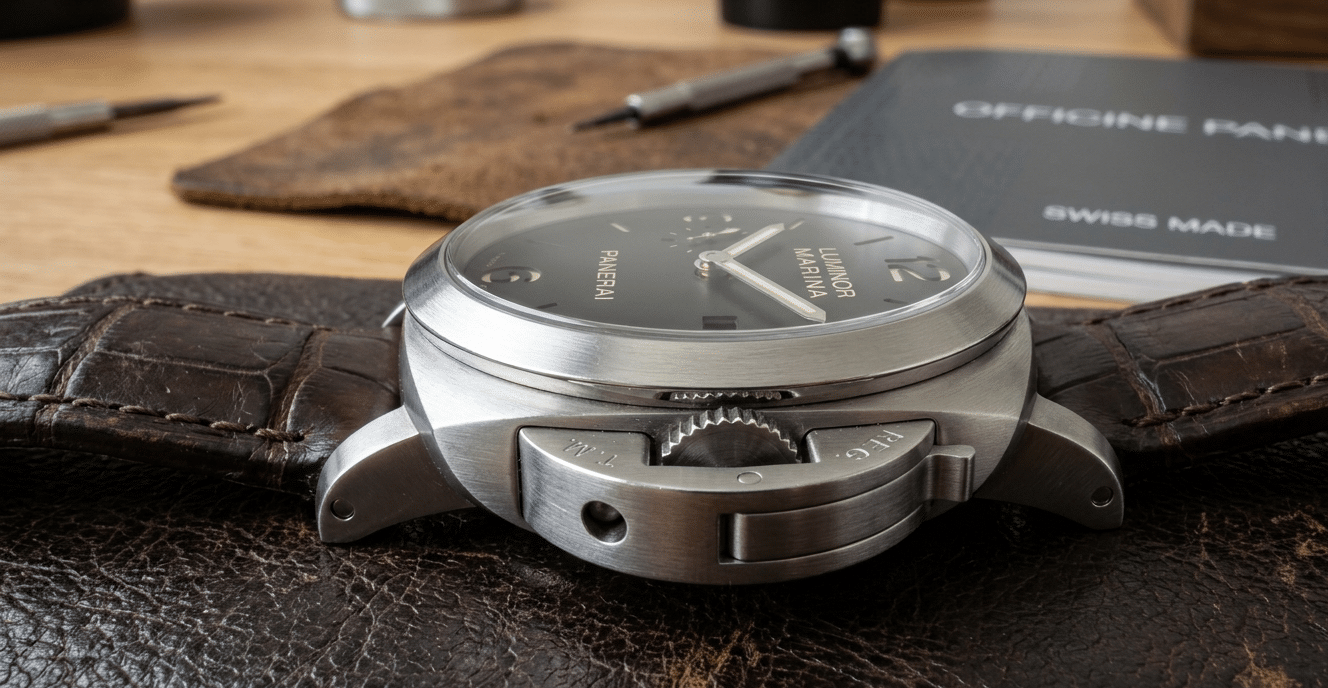
When a watch snags on a cuff, it’s almost always a vertical clearance issue, not a horizontal one. While a watch’s diameter dictates its overall footprint on your wrist, it’s the vertical height—the case thickness combined with the crystal’s dome—that presents the primary obstacle to sliding smoothly under a cuff. Panerai’s often-tall case profiles, accentuated by their distinctive domed sapphire crystals, are particularly prone to this “snag factor.”
Imagine trying to slide a brick under a low-hanging shelf. The width of the brick might fit, but if its height exceeds the shelf’s clearance, it gets stuck. The same principle applies here. A 44mm Luminor might technically fit the width of your wrist, but if its combined case and crystal height exceeds the cuff’s vertical opening, it will consistently catch, bunch up your sleeve, and generally frustrate your attempts at a discreet fit. This is why a watch that’s “only” 40mm in diameter but 15mm thick can be a worse offender than a 42mm watch that’s a svelte 11mm thick.
Expert Authentication Insight
For a definitive assessment of a Panerai replica’s cuff compatibility, a digital caliper is your best friend. Measure the exact overall height of the watch at its thickest point, including any crystal dome or caseback protrusion. Compare this measurement directly to published genuine specifications for the model. Deviations greater than +/- 0.2mm from the genuine’s listed thickness can be a significant indicator. For instance, if a replica Luminor Marina (gen spec ~14.5mm) measures 15.5mm or more, it’s likely housing a less accurate, thicker movement (e.g., an older ETA-based clone) or features a poorly replicated crystal, both of which will severely impact cuff fit. This 0.2mm threshold often represents the difference between a watch that slides smoothly and one that catches every time you reach for your coffee.
Key Panerai Super Clone Models: Thickness Breakdown & Compatibility Ratings
Understanding general principles is one thing; applying them to specific models is another. Here, we break down the thickness profiles of popular Panerai super clone models and assess their real-world likelihood of fitting under standard dress shirt cuffs. Remember, these are general guidelines, and individual wrist shape and shirt fit will always play a role.
Luminor Marina & Luminor Due Super Clones: On-Wrist Realities
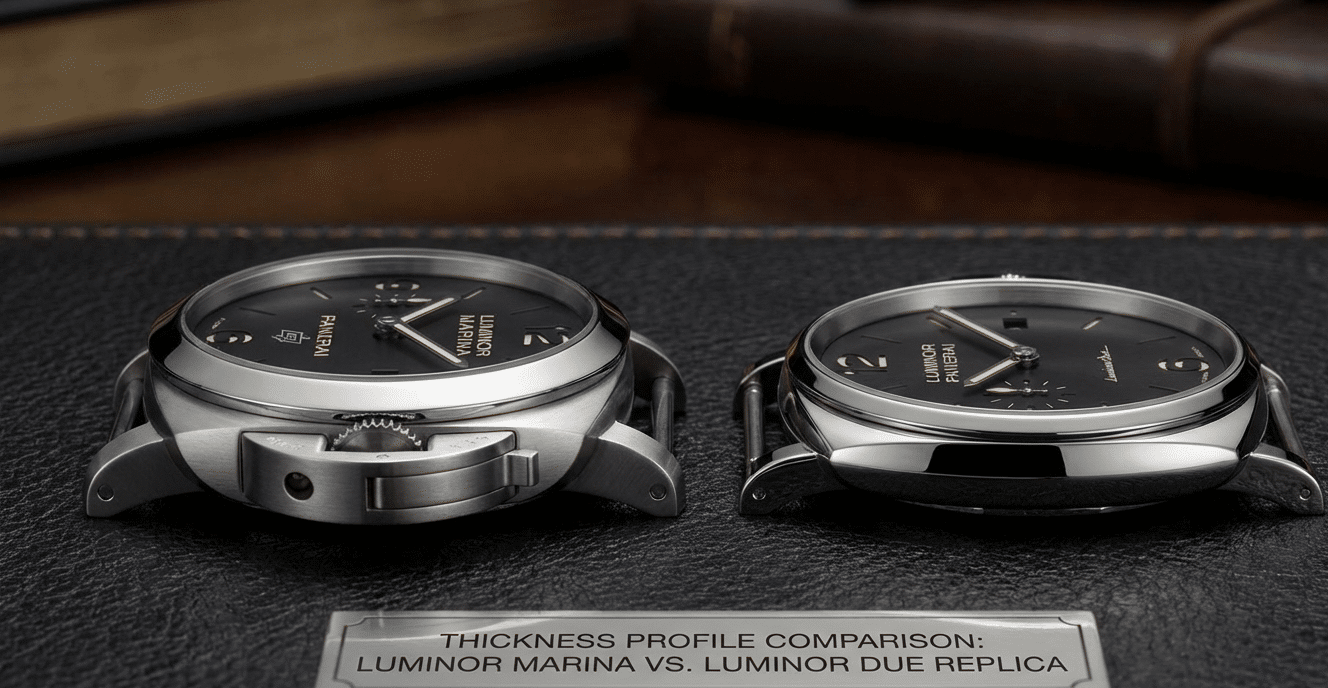
The classic Luminor cases, such as the PAM1312, PAM00312, and PAM00000, are archetypal Panerai: bold, substantial, and often quite thick. Genuine Luminor Marina models typically hover around 14.5mm to 15.5mm in thickness. Top-tier super clones from VS Factory, leveraging their P.9000/P.9010 clone movements, replicate this thickness with remarkable accuracy, usually landing in the 14.5mm to 15mm range. While this is a significant achievement in replication, it still means these models are on the thicker side for dress shirt compatibility. They can fit under looser cuffs or French cuffs, but will likely struggle with snugly tailored single cuffs.
The Luminor Due series (e.g., PAM00904, PAM00927) was explicitly designed by Panerai to be thinner and more wearable. This is where super clones truly shine for dress wear. VS Factory’s Luminor Due replicas, especially those with the P.4000 clone movement, achieve an impressive 10.8mm case thickness, remarkably close to the genuine’s 10.3mm. This makes the Luminor Due super clone arguably the most “cuff-friendly” Panerai replica available, often cited by the community as “the only Panerai replica I’d wear with a suit.” The choice of movement directly influences this; a Miyota-based or older ETA-based replica, even if marketed as a Due, will almost certainly be thicker, negating the entire point of the Due’s design.
Radiomir & Radiomir 1940 Super Clones: The “Dressier” Panerai?”
The Radiomir line, with its wire lugs and often simpler case, is generally considered the “dressier” Panerai. Models like the PAM00210 (a classic 45mm Radiomir) and PAM00687 (a Radiomir 1940 with a more integrated case) offer a slimmer profile than many Luminors. Genuine Radiomir models can range from 12mm to 14mm thick, depending on the movement and specific design. XF Factory, known for its expertise in Radiomir and older Luminor models, often achieves excellent thickness tolerances here. Their XF P.3000 clone movement, a manual-wind caliber, contributes to these slimmer profiles.
However, the Radiomir 1940 models, while lacking the crown guard, can still be quite robust. Replicating the distinct wire lugs of classic Radiomirs or the integrated case of the 1940s models accurately, while maintaining correct thickness, presents its own set of manufacturing challenges for replica factories. Ensuring a comfortable wear experience, which often involves detailed Panerai replica strap comfort comparison, adds another layer of complexity. Minor deviations in case construction or lug thickness can still make them catch on a cuff, even if the raw case height is acceptable.
Submersible Super Clones: The Unlikely Professional Contender
Let’s be clear: Submersible models (e.g., PAM00683, PAM01389) are purpose-built dive watches. They are inherently chunky, robust, and designed for extreme environments, not for sliding under a tailored shirt. Genuine Submersibles often exceed 16mm, sometimes even reaching 18mm+ in thickness. Replica factories, like V6 Factory and VS Factory, face immense challenges in replicating these robust designs, including their unidirectional bezels and water resistance, without adding even more thickness.
While a Submersible replica might be a phenomenal piece of engineering for its category, considering it for consistent dress shirt wear is largely a non-starter. Even with the best super clones, their sheer volume and height mean they will almost always snag and bunch a cuff. If your professional environment allows for a visibly large, rugged timepiece, then a Submersible might work, but it’s not a watch you’d expect to disappear discreetly under a sleeve.
Expert Authentication Insight
When evaluating a Panerai replica for cuff compatibility, pay close attention to the caseback, particularly its engraving depth and crispness. In lower-tier or poorly constructed replicas, the caseback might be noticeably thicker or flatter than genuine to accommodate a movement that’s too tall for the mid-case. This shortcut directly adds crucial millimeters to the watch’s overall profile, often making it protrude more from the wrist and thus exacerbating cuff clearance issues. A well-made super clone from VS or XF will have a caseback that integrates smoothly with the mid-case, with deep, precise engravings that don’t suggest a compromise in internal movement housing.
Factors Beyond Raw Thickness: Case Geometry and Wrist Dynamics
Raw thickness, measured in millimeters, tells a significant part of the story, but it’s not the whole narrative. How a Panerai replica’s case is shaped, how its crystal is formed, and even how its lugs are angled all profoundly influence its perceived and actual fit under a shirt cuff. These nuances can make a seemingly “thin” watch wear thick, or a moderately thick watch surprisingly manageable.
The Dome Effect: Crystal Curvature and Its Impact
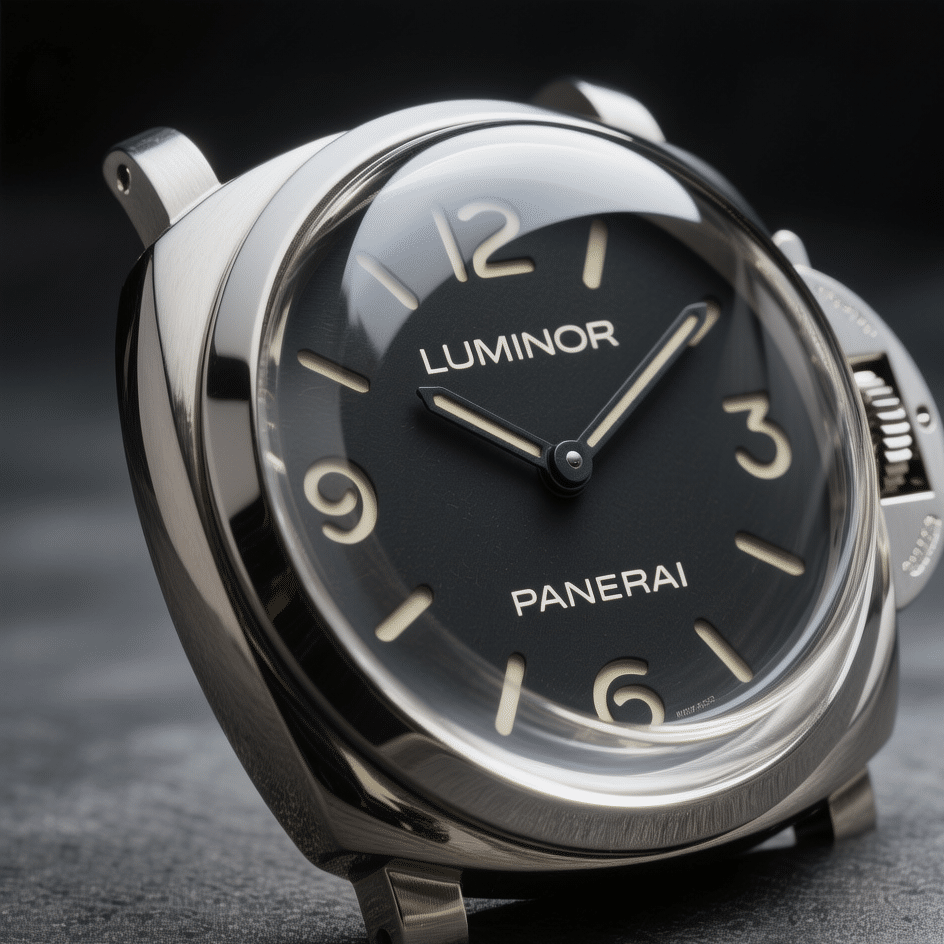
Panerai’s vintage-inspired models often feature beautifully domed sapphire crystals. While aesthetically pleasing, this dome significantly adds to the watch’s effective height, even if the case itself is relatively slim. Replica factories strive to reproduce this dome, but not all succeed equally. A highly domed crystal, especially one with an incorrect curvature or excessive height compared to the genuine, can transform a moderately thick case into a cuff-snagging monster.
Common replica crystal flaws include using a generic, overly tall dome or one with an incorrect radius, which alters the watch’s intended silhouette and, more importantly, pushes its highest point further from the wrist. This directly worsens cuff clearance. For example, while VS Factory has achieved excellent interior-only AR coating on some Luminor Due models, older or budget replicas might apply AR to both sides or use a crystal with a noticeably steeper dome, making it more prone to catching.
Lug Behavior: Flat vs. Curving Lugs and Cuff Interaction
The lugs of a watch, particularly their angle and how they integrate with the case, play a surprisingly critical role in cuff interaction. Many Luminor models feature relatively straight, stout lugs that extend horizontally before curving downwards. If these lugs are too thick or incorrectly angled on a replica, they can create a “shelf” that catches the cuff. In contrast, the more integrated, often thinner lugs of a Radiomir or the Radiomir 1940 models (like XF Factory’s PAM00572) tend to flow more smoothly onto the wrist, reducing potential snag points.
Replicas with poorly angled or overly thick lugs can exacerbate clearance issues, even if the mid-case thickness is accurate. For instance, some XF Factory Radiomir 1940 replicas have been noted for wire lug thickness running approximately 0.3mm over genuine specifications. While seemingly minor, this can be enough to create an undesirable friction point with a tailored cuff.
Strap & Buckle Considerations: Adding Bulk Where It Matters Least
It’s easy to overlook, but the strap and buckle are not just aesthetic choices; they are critical components that add crucial millimeters to a watch’s overall wrist height. A thick, padded leather strap, especially one that doesn’t taper significantly, can elevate the watch off the wrist. Similarly, bulky deployant clasps, common on many replicas, can create a significant protrusion on the underside of the wrist, making the watch feel thicker and more likely to catch.
Many replica straps, particularly those included with the watch, are often thicker or stiffer than their genuine counterparts. While a robust strap might initially feel premium, a poorly chosen or overly thick one can negate the “cuff-friendly” qualities of even a relatively thin case. The goal is to minimize bulk everywhere, and the strap and buckle are often the easiest places to make a practical difference.
Expert Authentication Insight
When assessing a Panerai replica’s crystal, don’t just look at it head-on; examine its profile from the side. Compare its dome height and curvature against high-resolution images of the genuine article. A common manufacturing shortcut in replicas is to use a generic, taller crystal that might fit the case opening but doesn’t match the genuine’s precise dome or height. This seemingly small deviation adds significant effective thickness to the watch, altering its intended silhouette and making it far more prone to catching on a cuff. If the crystal appears disproportionately tall or has an unnatural curve compared to the mid-case, it’s a red flag for compromised cuff clearance.
Practical Strategies for Maximizing Panerai Replica Cuff Compatibility
Even the thickest Panerai replica doesn’t have to be a non-starter for dress shirt wear. With a few strategic adjustments to your wardrobe and wearing habits, you can significantly improve cuff clearance and reduce that annoying “snag factor.” This section offers actionable advice for replica owners looking to integrate their bold Panerai into a professional setting.
Shirt Selection: The Right Cuff Style and Fabric
The most direct approach to accommodating a thicker watch is to choose the right shirt. Not all dress shirt cuffs are created equal when it comes to watch clearance. For Panerai replicas, especially the chunkier Luminor and Submersible models, considering a replica Panerai size guide is essential to think about both the internal circumference and the height of the cuff.
- Adjustable Cuffs: Many off-the-rack shirts come with two or three buttons on the cuff, allowing you to select a looser fit. Always opt for the widest setting when wearing a Panerai.
- French Cuffs (Double Cuffs): Often considered the most formal, French cuffs are also surprisingly accommodating. Because they fold back on themselves and are secured with cufflinks, they offer a wider, more flexible opening than a standard button cuff. This extra room can be a game-changer for a watch that typically struggles to slide under.
- Custom Tailoring: If you frequently wear dress shirts and Panerai replicas, investing in custom-tailored shirts with specific watch-friendly cuff measurements is the ultimate solution. A good tailor can add an extra half-inch or so to the cuff’s circumference without affecting the shirt’s overall fit.
- Fabric Stiffness: The material of your shirt also plays a role. A crisp poplin, while elegant, offers less give than a softer twill or oxford fabric. A fabric with a bit more drape and flexibility can more easily conform around a watch, reducing the sensation of being “stuck.” Consider fabrics with some stretch if available, though these are less common in formal dress shirts.
Wrist Position and Watch Placement: Optimizing Your Wear
How you wear your watch, and where it sits on your wrist, can dramatically impact cuff interaction. This isn’t just about comfort; it’s about making a large watch feel less obtrusive.
- Higher on the Wrist: The classic advice for wearing any larger watch is to position it slightly higher on your forearm, above your wrist bone (the ulnar styloid process). This part of your arm is typically narrower, allowing the watch to sit more snugly and often giving it a few extra millimeters of clearance from the cuff. It also prevents the watch from constantly sliding down and catching.
- Adjusting During Wear: Don’t be afraid to subtly adjust your watch’s position throughout the day. If you’re reaching for something or need to check the time discreetly, a slight rotation or nudge can help it slide under the cuff more smoothly.
- Replica Caseback Considerations: While top-tier Panerai replicas from factories like VS or XF strive for accurate caseback profiles, minor deviations can still occur. A replica with a slightly flatter or thicker caseback than its genuine counterpart might sit differently on your wrist, affecting perceived clearance. Experiment with strap tightness—sometimes a slightly looser strap allows the watch to settle more comfortably above the bone, while too tight can push it into a less ideal position.
Strap Choices: Thinning Down Without Compromising Style
The case itself isn’t the only culprit for bulk. The strap and buckle can add crucial millimeters, especially when it comes to sliding under a cuff. Optimizing these components is a simple yet effective strategy.
- Thinner Leather or Fabric Straps: Replace overly padded or thick leather straps with thinner alternatives. Many aftermarket strap makers offer slim-profile leather, canvas, or even high-quality synthetic straps that can significantly reduce the overall bulk around your wrist. Avoid straps with excessive padding near the lugs.
- Aggressive Tapering: Look for straps that taper aggressively from the lug width down to the buckle. A 24mm strap that tapers to 20mm or 18mm at the buckle will feel less bulky than one that maintains its full width.
- Tang Buckles Over Deployant Clasps: While deployant clasps can be convenient, many replica versions are notoriously bulky. They often create a thick, rigid lump of metal on the underside of your wrist, directly where it needs to be thinnest to slide under a cuff. A simple, flat tang buckle is almost always the better choice for cuff compatibility.
- Replica Strap Quality: Be aware that stock straps on many Panerai replicas can vary widely in quality and thickness. Some are perfectly fine, but others might be unnecessarily thick or stiff. Exploring aftermarket options (often available for $50-$150) can provide a significant upgrade in both comfort and cuff clearance.
Expert Authentication Insight
Physical diagnostic: When evaluating a replica Panerai for potential strap changes, pay close attention to the spring bar holes and the strap lug width. In some lower-tier or even mid-tier replicas, misaligned or poorly drilled spring bar holes can lead to the strap sitting awkwardly, either too close to the case or at an incorrect angle. This can create unnecessary bulk, especially where the strap meets the case, directly impacting overall cuff clearance. Similarly, an inconsistent lug width (e.g., 24.2mm instead of a true 24mm) can force the strap to bunch up slightly, adding a fraction of a millimeter that can make a difference. Always ensure the strap fits flush and flat against the case, without any bulging or gaps.
Common Misconceptions and What to Avoid When Buying Panerai Replicas for Dress Wear
The pursuit of a “dressy” Panerai replica often leads buyers down paths paved with common misconceptions. Understanding these pitfalls is crucial for making informed decisions and avoiding buyer’s remorse, especially when cuff compatibility is a priority.
The “Just Buy a Smaller Panerai” Fallacy
It’s a natural inclination: if a watch is too big, buy a smaller one. While reducing diameter certainly helps with overall wrist presence, for Panerai replicas and dress shirt compatibility, simply choosing a smaller diameter doesn’t automatically guarantee success. This is a critical distinction.
- Thickness Remains Paramount: A 42mm Luminor (like a PAM00000 or PAM00312) might have a smaller diameter than a 44mm, but its case thickness, especially with a domed crystal and the iconic crown guard, can still be substantial. Many 42mm Luminors remain in the 14-16mm thickness range, which is still challenging for standard dress cuffs.
- Luminor Due Exception: The Luminor Due line (e.g., PAM00904, PAM00927) was specifically designed by Panerai to be thinner. A 42mm Luminor Due (often around 10.5-11mm thick in replica form) is genuinely more cuff-friendly. But this is due to its reduced thickness*, not just its smaller diameter. Don’t confuse a standard 42mm Luminor with a Luminor Due; they wear very differently under a cuff.
- Case Geometry Over Diameter: The overall shape and profile of the case, including the height of the crown guard and the curvature of the crystal, often dictate cuff clearance more than the simple case diameter. A 40mm watch with a very tall, flat case can snag more than a 44mm watch with a well-integrated, curved profile.
Specs vs. Real-World Wear: The Deceptive Numbers
The replica community often obsesses over published specifications, and for good reason—they indicate factory accuracy. However, even accurate specs don’t always translate perfectly to real-world comfort and cuff clearance. The devil is often in the subtle, unquantifiable details.
- Subtle Deviations in Replicas: While a replica might list a thickness of 15.5mm (matching gen), subtle differences in lug angle, the exact curvature of the caseback, or the proportion of the mid-case to the bezel can alter how the watch feels* on the wrist and how it interacts with a cuff. A replica with slightly flatter lugs might sit higher off the wrist, even if its raw thickness measurement is accurate.
- Perceived Thickness: A watch’s perceived thickness can be influenced by how much it “flows” onto the wrist. A well-designed case will have lugs that curve down, hugging the wrist. If a replica’s lugs are too straight or thick, it creates a visual and physical gap between the watch and your arm, making it appear and feel thicker, and thus more prone to snagging.
- Crystal Integration: The way the crystal integrates with the bezel also plays a role. Even if a crystal is the correct height, if it has a sharp, protruding edge or an incorrect dome profile, it can catch on fabric more easily than a smoothly integrated crystal.
Overlooking Strap Integration: A Hidden Source of Bulk
Many buyers focus almost exclusively on the watch head when considering cuff compatibility, often overlooking the critical role of the strap and buckle. These components are not merely aesthetic choices; they are integral to the watch’s overall profile on the wrist.
- Deployant Clasp Issues: Replica deployant clasps, especially those on thicker rubber or leather straps, can be notoriously bulky. Unlike a simple tang buckle which lies relatively flat, a deployant clasp creates a rigid, multi-layered metal structure that adds significant height to the underside of your wrist. This is precisely the area that needs to be as slim as possible for smooth cuff clearance.
- Strap Thickness and Padding: Many replica straps, particularly those mimicking OEM designs, can be overly thick or heavily padded. While this might look robust, it adds unnecessary bulk. A padded strap, combined with a bulky deployant, can negate any cuff-friendliness the case might offer.
- Spring Bar Placement: The way the strap attaches to the case (via spring bars) can also contribute to bulk. If the spring bars are positioned too high within the lugs, or if the strap itself is too stiff, it can prevent the strap from draping smoothly around the wrist, creating a more rigid and thicker profile.
Expert Authentication Insight
Physical diagnostic: When assessing a Panerai replica for dress wear, measure the caseback profile and how it integrates with the mid-case. Replicas sometimes employ a flatter or thicker caseback than the genuine article. This is often a manufacturing shortcut to simplify the housing of a clone movement, or to make it easier to achieve water resistance goals with less precise machining. While the mid-case dimensions might be close to gen, a caseback that protrudes an extra 0.5mm or 1mm can add crucial height to the overall thickness, pushing the watch firmly into “cuff-snagging” territory, despite what the headline thickness number might suggest.
The Ultimate Panerai Replica Dress Shirt Compatibility Checklist
Navigating the world of Panerai replicas for dress shirt compatibility requires a systematic approach. This checklist consolidates the key findings into actionable steps, empowering you to assess models and make informed purchasing decisions.
Prioritizing Key Thickness Metrics: Beyond the Headline Number
Don’t just look at the single “case thickness” number often advertised. A watch’s overall height is a composite of several critical dimensions, each impacting cuff clearance.
- Overall Height (Including Crystal Dome): This is the most crucial measurement. Use a digital caliper to measure the watch from the absolute highest point of the crystal to the lowest point of the caseback. This holistic number gives you the true vertical footprint. Aim for under 13mm for optimal compatibility, and ideally under 12mm for true “dress watch” behavior.
- Mid-Case Height: Measure the height of the case itself, excluding the crystal and caseback protrusion. This tells you how much of the bulk is in the main body of the watch.
- Crystal Height/Dome: Assess how much the crystal protrudes above the bezel. A highly domed crystal, while aesthetically pleasing, adds significant effective height. Replicas often use generic, taller crystals.
- Caseback Protrusion: Measure how much the caseback extends beyond the mid-case. A thick or flat caseback can add crucial millimeters.
- Verification: If purchasing online, ask your trusted dealer for these specific measurements for the exact model and factory you’re interested in. Compare these to verified genuine specs if possible, noting any deviations.
Assessing Case Shape and Lug Profile for Snag Reduction
Beyond raw numbers, the geometry of the case and lugs dictates how smoothly a watch interacts with fabric.
- Smooth Transitions: Visually inspect the watch for smooth, flowing transitions between the case, bezel, and lugs. Sharp edges or abrupt angles are more prone to catching on shirt fabric. Look for chamfering and polished edges that allow fabric to glide over.
- Lug Curvature and Angle: The lugs should ideally curve downwards, hugging the contour of the wrist. Lugs that are too straight or thick will cause the watch to sit higher off the wrist, increasing its effective height and snag potential. This is particularly relevant for Luminor models with their distinct lug structure.
- Crown Guard Integration: Panerai’s iconic crown guard is a major snag point. Assess its height and how smoothly it integrates with the case. While it’s a signature feature, a poorly replicated or overly bulky crown guard will exacerbate cuff issues.
- Integrated vs. Wire Lugs: Radiomir models, especially those with wire lugs, often have a more minimalist profile, which can be advantageous for cuff clearance. The Radiomir 1940’s cushion case also tends to be more svelte than many Luminors.
Evaluating Strap and Buckle Dimensions for Minimal Bulk
The accessories you choose can either complement or compromise your watch’s cuff compatibility.
- Strap Material and Thickness: Prioritize thinner, more flexible materials like quality calfskin leather (unpadded), canvas, or thin rubber. Avoid excessively padded leather or thick, stiff materials that add bulk.
- Tapering: Opt for straps that taper aggressively from the lug width to the buckle. This reduces bulk around the underside of the wrist.
- Buckle Type: Always choose a flat tang buckle over a bulky deployant clasp for optimal cuff clearance. If a deployant is a must, seek out the slimmest, lowest-profile options available.
- Aftermarket Options: Be prepared to invest in a quality aftermarket strap. Many replica stock straps are thick and generic. A well-chosen aftermarket strap can make a significant difference in comfort and wearability under a cuff.
Expert Authentication Insight
Physical diagnostic: Examine the consistency of finishing and chamfering on the case edges and lugs of the replica. Poorly executed replicas often have sharper, less refined edges, or inconsistent chamfers, particularly where the case meets the bezel or the lugs meet the case band. These manufacturing shortcuts not only detract from the watch’s aesthetic quality but also create literal snag points. A sharp, unpolished edge is far more likely to catch and fray a dress shirt cuff than a smoothly chamfered and polished one, indicating that the factory prioritized speed over wearability and fine detail.