
I’ve got the article structure now. Next I’m adding a few compliance-focused sections that keep the original flow but make the replica/genuine boundary and the buyer checks more explicit, then I’ll clean the references and disclaimer at the end.I’m patching in the new compliance sections now. The additions are focused on the parts that most often cause confusion here: genuine-reference comparison, QC/photo limitations, and the boundaries around water resistance and service expectations.I’m at the edit step now. After this, I’ll do one quick pass for any remaining overclaims and make sure the references still line up with the citation markers in the body.I’m applying the content additions in place, keeping the placeholders exactly where they are and leaving the existing article structure intact.I’ve got the insertion points chosen. The new blocks will sit next to the current fit-analysis sections rather than replacing them, so the article stays readable while gaining the missing compliance framing.
The Aquanaut is one of those watches where the listed diameter only tells part of the story. Its rounded-square case, bezel width, thickness, crown position, and integrated strap all change how it actually wears on the wrist. A piece can measure modestly on paper and still look broad or tall if the side profile is heavy, the crown projects too far, or the strap does not flow cleanly from the lugs, and serious buyers compare the Aquanaut super-clone construction profile against the wrist rather than against the number alone.
Brand names in this article identify the genuine reference design only. Replica-market Aquanaut watches are comparison objects, not genuine Patek Philippe products, and they should not be represented or resold as authentic watches.
This guide focuses on the details that matter before you judge fit: how low the case sits, how the lug transition affects the visual width, whether the crown and guard area look balanced, and why wrist shape changes the result more than a spec sheet suggests. The practical question is not just whether the watch is the right size, but whether its geometry will wear compact, stable, and natural in daily use.
| Fit Check | What to Look At | Practical Reading |
|---|---|---|
| Thickness | Side profile and caseback height | Lower profiles usually wear flatter and clear cuffs more easily |
| Lug transition | How the strap meets the case | Smoother flow makes the watch look more integrated and less wide |
| Crown area | Crown projection and guard fit | A tighter crown sits cleaner; extra projection can add visual bulk |
| Bezel balance | Bezel width versus case height | Too much vertical emphasis can make the watch feel top-heavy |
| Wrist shape | Side and three-quarter wrist photos | These reveal fit better than straight-on shots or measurements alone |
Quick Questions Before You Read
Q: Does the Aquanaut wear mainly by diameter?
No. Thickness, strap angle, and case shape have a bigger effect on how it sits.
Q: What detail should I check first?
Start with the side profile. It tells you more about comfort and balance than a front view.
Q: Is a taller case always a bad sign?
Not always, but extra height can make the watch feel less settled and more noticeable on wrist.
Q: Why do wrist photos matter so much?
They show how the lugs, crown, and strap actually sit together, which measurements cannot predict.
Editorial Perspective: For an Aquanaut, factory reputation is useful only when it is tied to a specific reference and version. At cleanvsfactory.com, this kind of comparison is treated as a model-level buying decision, not a simple factory ranking. A better watch for daily wear is usually the one with the cleaner case thickness, more natural strap angle, and more controlled crown side, even if another listing looks stronger in macro photos or carries a louder factory label.
How to Read Aquanaut Case Geometry as a Replica Buyer
For replica buyers, the first mistake is assuming the factory name settles the decision. It does not automatically do that on an Aquanaut, because case architecture can vary in ways that affect wear more than the brand of the movement sticker or the seller’s headline. A factory with a good reputation on one model may still produce an Aquanaut that feels too tall, too broad at the corners, or too stiff in the strap transition. The comparison only becomes useful when it is narrowed to the exact reference and the exact buying goal.
Movement choice also matters more than many beginners expect. A configuration that keeps the case slimmer and the watch more stable on the wrist may be the better daily-wear option, even if another version appears closer in seller photos. Visual accuracy and ownership reliability are not the same priority. If the watch is mainly for photos or occasional wear, a buyer may tolerate a little extra height. If it is for daily use, a flatter profile and quieter wear often matter more than a tiny improvement in dial-side resemblance.
Why the Aquanaut Looks Larger or Smaller Than Its Specs Suggest
The Aquanaut is one of those watches that punishes spec-sheet thinking. On paper, two references can look close enough to treat as the same size. On the wrist, they can land very differently. That is because Aquanaut case geometry is doing more work than raw diameter: the rounded-square outline, the way the bezel reads from above, and the amount of visual mass concentrated at the edges all affect how large the watch feels.
This is why the question is not simply “what size is the Aquanaut?” It is “how does this case shape distribute size?” A round watch can hide a few millimeters better than people expect because the eye reads it as continuous and compact. The Aquanaut is less forgiving. Its corners, flat sections, and integrated strap make the footprint more legible, so small differences in proportion show up faster. That is good news if the architecture is balanced, because the watch looks intentional. It is bad news if the case is wide in the wrong places, because it starts to feel broader than the diameter suggests.
Diameter Is Only the Starting Point
Diameter gives a baseline, but it does not tell you how much wrist the watch actually occupies. With the Aquanaut, the important question is not just how wide the case measures, but how that width is expressed. A rounded-square watch uses its corners and side planes differently from a circular sports watch, so the eye does not read every millimeter equally. The same nominal size can look restrained on one wrist and more assertive on another because the shape itself adds visual footprint.
The practical mistake buyers make is assuming that a smaller printed number always means a smaller-looking watch. That is not reliable here. A compact diameter with broad shoulders or a wide bezel can still feel more present than a slightly larger watch with softer transitions. For the Aquanaut, proportion matters more than raw size because the design is built around balance, not minimal visible area.
Why Two Aquanauts With Similar Numbers Can Wear Differently
Even close measurements can wear differently if the visual distribution is different. One Aquanaut may have softer edge treatment and a cleaner transition from bezel to case, which makes the watch feel more integrated and less abrupt. Another may have a more pronounced perimeter, where the square form reads harder and expands visually across the wrist. The numbers may be similar, but the perception changes because the eye is following contour, not a ruler.
There is also a subtle thickness-to-diameter relationship at play. A watch that has enough thickness to support its shape can look composed. A watch that is too tall for its footprint or too flat for its outline can feel awkward, even if the size is technically correct. That is why the Aquanaut often looks best when the case and strap behave as one piece. The watch wears as a unit, not as a case with a strap attached afterward.
Thickness and Caseback Height: The Vertical Dimension You Feel First
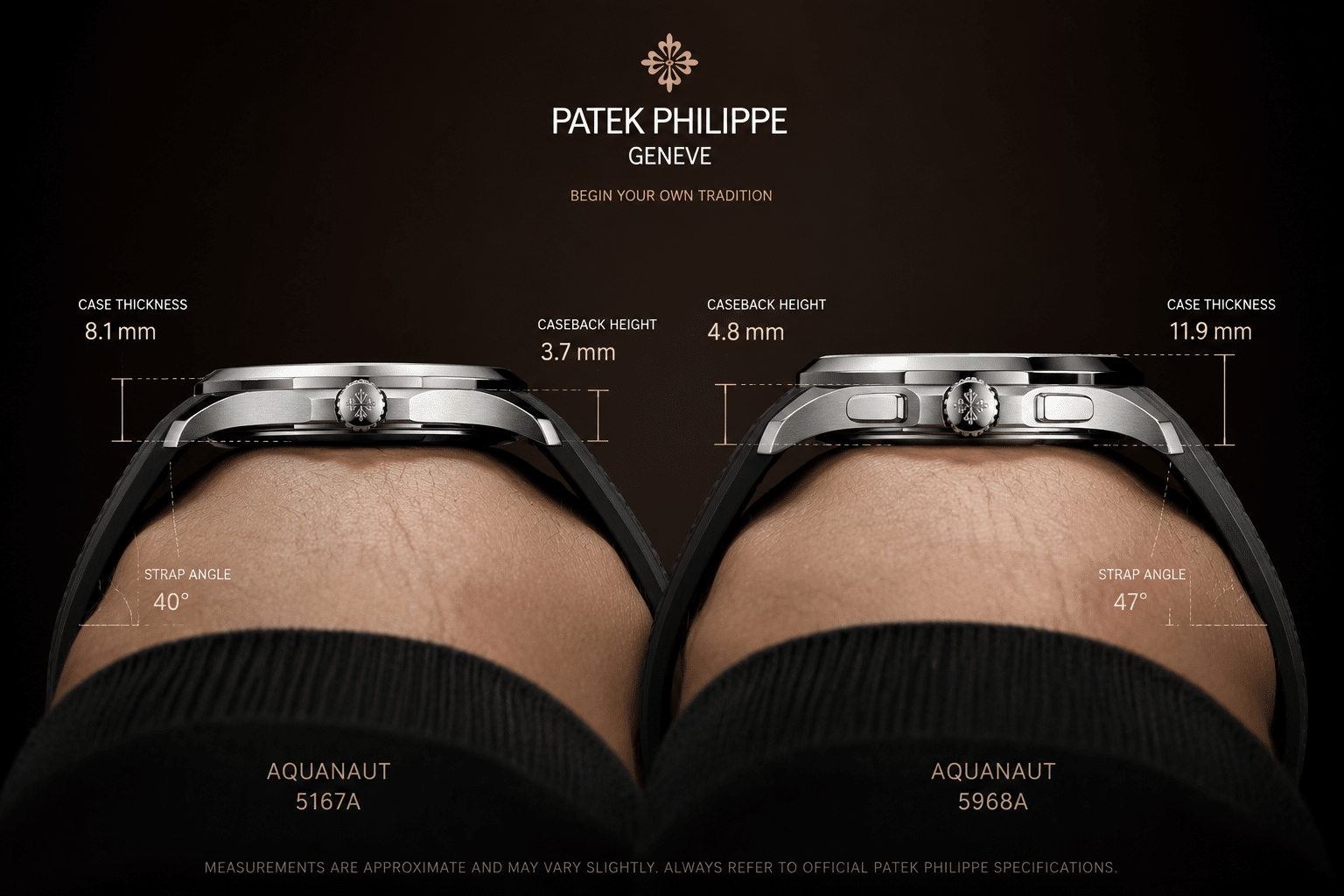
Thickness is the part of Aquanaut case geometry that buyers underestimate most often. People tend to focus on width because width is easy to compare. In daily wear, vertical height is usually the first thing you feel. A watch can be nominally compact and still sit too high, catch cuffs, or look top-heavy once it is on the wrist. That is why Aquanaut thickness and Aquanaut caseback height deserve separate attention rather than being treated as one number in a listing.
Measured thickness matters, but perceived thickness matters more. Two watches can share a similar spec and still present differently because the mid-case is shaped differently, the caseback rises differently, and the watch settles into the wrist at a different angle. On the Aquanaut, the side profile is a bigger part of the wearing story than buyers usually expect.
Where the Extra Height Actually Shows Up
Extra height is not only about the midpoint of the case. It shows up where the caseback begins to lift, where the mid-case transitions into the bezel, and where the watch creates clearance above the wrist. If that rise is abrupt, the watch feels thicker than the spec suggests. If the rise is more controlled, the same number can wear lower and feel easier to live with.
This becomes obvious under a cuff. A watch that is technically within a normal range can still feel bulky if the profile has too much shoulder or too much visual stacking between the case layers. The Aquanaut rewards a profile that looks compressed and deliberate. When the vertical lines are clean, the watch feels more refined. When they are clumsy, it starts to read as overbuilt.
Why the Side Profile Changes Comfort More Than the Spec Sheet Does
Comfort is not just about thickness in isolation. It is about how the case distributes that height across the wrist. A lower, smoother side profile lets the Aquanaut settle more naturally and reduces the sensation that the watch is sitting on top of the arm. A taller or more stepped profile may still be wearable, but it will draw attention every time the wrist bends or the cuff slides over it.
That is why the side silhouette matters as much as the number itself. Some watches are thick but still feel manageable because the profile is controlled. Others are only a little thicker on paper and yet feel more intrusive because the height is concentrated in the wrong places. For the Aquanaut, the best case architecture is the one that keeps the watch visually low and physically stable, not the one that simply wins a measurement comparison.
What the Authentic Aquanaut Baseline Tells You
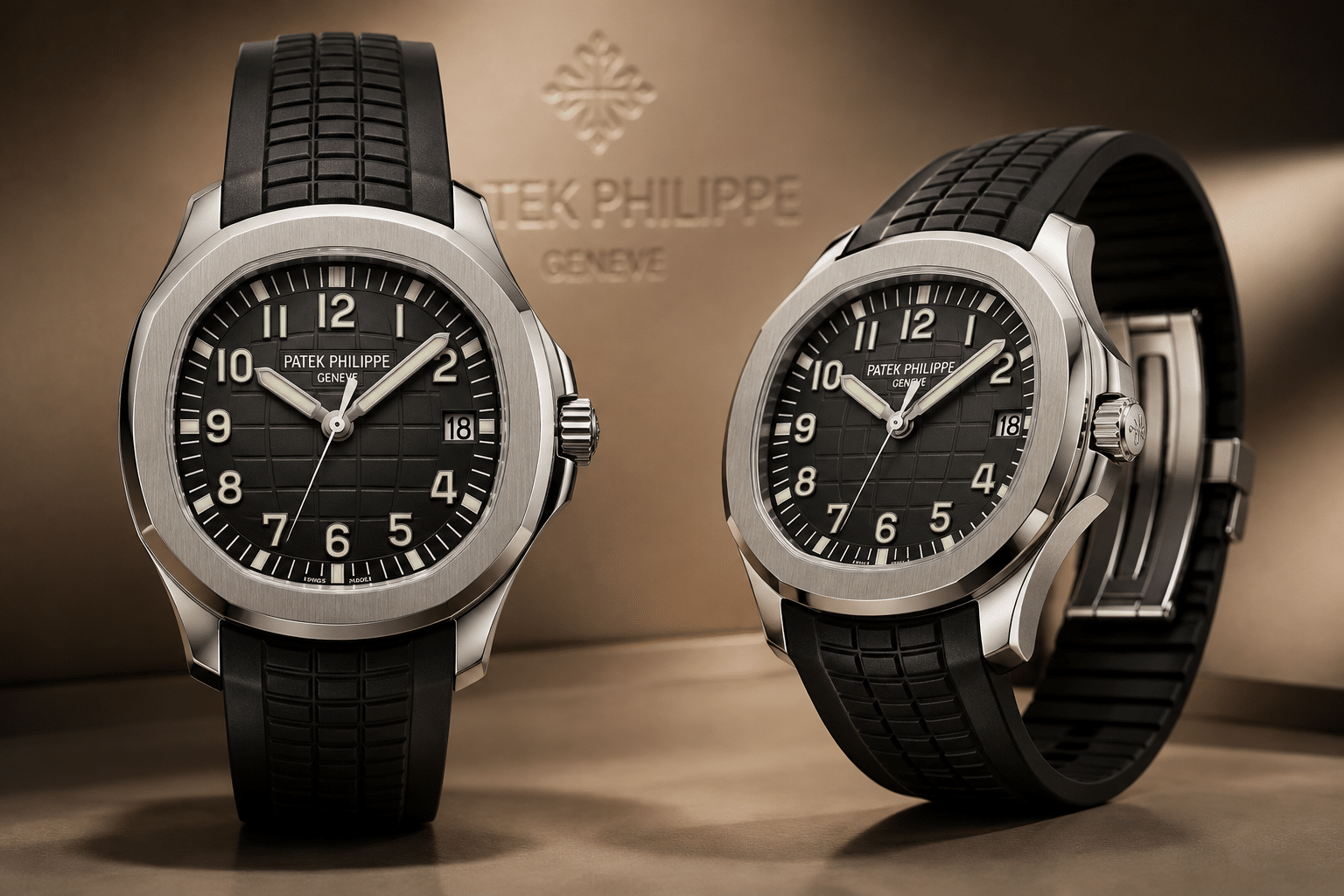
Patek Philippe’s Aquanaut 5167A uses a steel case, a rubber strap, a date display, and central seconds, so the authentic watch already depends on the relationship between case, strap, and dial layout rather than on a heavy case silhouette alone.[1] That matters for replica buyers because any extra thickness, awkward strap departure, or overly aggressive crown side is easier to notice on a design that is supposed to feel restrained and integrated.
The practical takeaway is simple: when you compare photos, judge the whole side profile before you judge the dial. A watch can copy the front layout reasonably well and still miss the real wear character if the case is too tall or the strap does not follow the wrist cleanly. The authentic baseline is useful here because it shows how much of the Aquanaut’s identity comes from proportion, not ornament.
Replica vs Genuine Reference: How to Use the Baseline
Brand names in this article identify the genuine reference design only. Replica-market Aquanaut watches are comparison objects, not genuine Patek Philippe products, and they should not be represented or resold as authentic watches.
The reason to keep the genuine reference in view is practical. It gives you a standard for case proportion, strap flow, and right-side balance, but it does not prove that any replica-market version matches the original in movement architecture, material behavior, or long-term service expectations.
In other words, the genuine watch is a visual and architectural benchmark, not a shortcut to authenticity claims. When a listing uses brand language too freely, the safer reading is that the seller is borrowing a reference point, not establishing equivalence.
Rounded-Square Case and Lug Transition: Where the Shape Starts to Wear Well
The Aquanaut’s case shape is not just a styling detail. It is the reason the watch can look sporty and restrained at the same time, and it is also the reason the fit can go wrong when the geometry is off. The rounded-square outline spreads visual mass differently from a true round case, so the watch can appear larger, flatter, or more structured depending on how the corners and shoulders are handled. That is a big part of the Aquanaut case shape discussion that buyers miss when they focus only on width.
The lug transition is just as important. On this watch, the strap does not simply disappear under the case. It leaves the lugs in a way that either completes the architecture or breaks it. If the transition is smooth, the watch feels integrated and coherent. If it is stiff or abrupt, the whole case starts to look heavier than it should.
How the Rounded Corners Affect Perceived Mass
Soft corners make a watch feel more intentional, but they do not make it invisible. The Aquanaut’s rounded-square bezel has enough structure to define the footprint, which gives it presence even at moderate sizes. That presence can be a strength because it prevents the watch from looking generic. It can also work against the wearer if the corner treatment is too sharp or the perimeter is too visually dense, because then the eye reads the watch as broader and more assertive than the dimensions suggest.
The useful distinction is between soft and truly round. A truly round watch tends to flow outward evenly, so the size is distributed in a predictable way. The Aquanaut concentrates more of its identity in the perimeter. That means the shape itself becomes part of the sizing equation. A good Aquanaut looks balanced because the case edges frame the dial without making the watch feel oversized. A poor one looks heavy because the shape announces itself before the proportions settle.
Why Lug-to-Strap Flow Changes the Whole Watch
The Aquanaut wears well when the strap flow feels like a continuation of the case. The strap angle matters because it controls how quickly the watch drops away from the case and how naturally it follows the wrist. If the strap exits at the wrong angle, the watch can look like it is hovering or bending unnaturally at the sides. That is often more distracting than a minor difference in diameter.
Buyers often assume the strap is secondary because it is removable. On the Aquanaut, that is a mistake. The strap is part of the architecture. It affects whether the case feels planted or floating, whether the silhouette reads sleek or blocky, and whether the watch looks like it belongs on the wrist. A clean lug transition helps the watch feel smaller and more composed. A poor one makes the same case appear abruptly large.
That is the real lesson with Aquanaut case geometry: the watch does not succeed because one number is right. It succeeds when the rounded-square shape, the corner treatment, and the strap integration all work together. When they do, the Aquanaut looks balanced even if the spec sheet is not doing anything dramatic. When they do not, the watch can feel wider and more forceful than expected, even before you start comparing exact measurements.
Crown Proportion and Bezel Profile: How the Right Side Changes the Silhouette
The Aquanaut’s right side does more work than it first appears. A watch with the same nominal diameter can look calm and composed or slightly busy depending on how the crown sits, how far it projects, and how the bezel steps down into the case. That is why Aquanaut crown proportion matters: the eye reads the crown side as part of the whole silhouette, not as a separate functional detail.
On paper, the crown is small. On the wrist, small changes in its placement change the watch’s attitude. If the crown guards are well integrated and the crown does not extend too far, the right side looks balanced and intentional. If it sits tighter to the case, the outline looks cleaner and the profile feels more resolved. Neither is automatically better, but the difference is easy to notice because the Aquanaut’s case is already defined by soft geometry. A watch like this does not have a lot of visual noise to hide behind.
What the Crown Does to the Watch’s Silhouette
The crown sets the tone for the side profile because it interrupts the case line where the rounded-square shape is otherwise smooth. If the crown guards are well integrated and the crown does not extend too far, the right side looks balanced and intentional. The silhouette reads as one object rather than a case with an accessory attached to it. That is the refined outcome most buyers respond to, even if they cannot explain it in technical terms.
The opposite problem is not just “a big crown.” It is a crown that seems to sit outside the architecture instead of inside it. That makes the watch feel busier from the side and can make the case appear thicker or less elegant than the measurement alone suggests. This is why crown projection is a real proportion issue, not a finishing detail.
When the Bezel or Crown Side Feels Visually Heavy
Bezel profile matters because it changes where the eye lands first. A bezel with too much visual height can make the front view feel top-heavy, especially if the crown side is also pronounced. Then the watch stops looking compact and starts looking stacked, as if each layer is competing for attention. The Aquanaut works best when the bezel and case body feel like one continuous form, with the crown side remaining quiet enough that the design does not tilt visually to the right.
That is the judgment point: a good Aquanaut silhouette is not simply thin or small. It is balanced. If the crown, guards, and bezel height all stay in proportion, the watch looks cleaner from a glance and more deliberate from the side. If one of those elements grows too dominant, the whole watch loses some of the calm that makes the design work.
Version-Specific Judgment Matters More Than Factory Rank
Factory names in the replica watch market are useful buyer-facing references, but they should not be treated as official brand affiliations or automatic proof of quality. The more reliable comparison is version-specific: the exact reference, the exact batch or update, the movement configuration, the caseback height, and the strap geometry all matter more than a single factory label.
For CleanVSFactory, the practical goal is to make those comparisons traceable. The relevant question is whether the listing can be tied back to visible details such as dial printing, marker alignment, crown projection, side profile, and real QC photos. A strong factory name should narrow the search, not end it.
Claims such as “perfect,” “same as genuine,” or “guaranteed to pass inspection” should be treated with caution. A more reliable comparison looks at the actual version, movement configuration, case proportions, and QC evidence.
What Seller Photos Can Prove, and What They Cannot
QC photos are useful for checking dial printing, marker alignment, bezel symmetry, and obvious case shape errors, but they do not prove how the watch will feel after it is on the wrist. A front photo can hide a lot: a crown that projects too far, a caseback that rises more than expected, or a strap that exits at an awkward angle. Those are the details that change whether the watch feels compact or bulky in daily wear.
For that reason, seller labels and QC images should be treated as evidence, not conclusions. If the listing calls something the “best” version without showing side and wrist photos, the claim is incomplete for this model. A better question is whether the watch’s geometry is visible from a three-quarter angle and whether the profile looks consistent with how you plan to wear it. That is a more reliable filter than chasing the most confident description.
Common Geometry Traps in Listing Photos
Aquanaut listings can look better than they wear because camera angle compresses thickness and softens the crown side. A straight-on image may hide a caseback rise, while a slightly tilted wrist shot can make the strap look cleaner than it really is. That is why the same watch can seem compact in a sales gallery and noticeably taller once it is on the wrist.
Macro photos are also easy to overread. They may show sharp printing and polished surfaces while leaving the actual wearing geometry unresolved. For this model, a polished dial shot is less useful than a plain side view taken at wrist height. If the side view is missing, treat the listing as incomplete.
What to Verify in QC Photos Before You Commit
For this model, the most useful QC set is not a front-facing glamour shot. It is a small group of practical images that show the case from the side, the crown side, the strap exit, and one wrist shot at a natural angle. That combination helps you judge whether the watch sits low, whether the right side looks balanced, and whether the strap follows the wrist without a visible kink.
Pay attention to three things first: whether the caseback appears taller than the seller claimed, whether the crown projects beyond the line of the case, and whether the bezel or mid-case looks uneven when the watch is viewed in profile. Those details are more useful than macro sharpness. A bright, polished photo can hide proportion issues that show up immediately in an ordinary wrist shot.
If the seller only provides dial close-ups, treat the listing as incomplete. The Aquanaut is a geometry-driven watch, so the model should be judged from shape, not from isolated components. That approach reduces the chance of choosing a version that looks fine on a desktop screen but feels awkward in daily wear.
Before making a decision, buyers should review real QC photos where available, including dial printing, hand alignment, bezel position, datewheel centering, bracelet fit, clasp engraving, case thickness, and overall finishing. Factory labels and stock photos alone are not enough for a reliable judgment.
Movement Labels and Case Height Should Be Read Separately
When a seller advertises a specific movement family, treat that as a mechanical clue rather than a proof of overall quality. Miyota’s official specifications show the 9015 at 3.90 mm and the 8215 at 5.67 mm.[2][3] That difference can matter when a listing tries to explain case thickness or wrist feel.
That does not prove what is inside any specific replica watch. It only shows why two watches that look similar in photos can land differently once the movement package, caseback height, and crown stack are all counted together. If the seller is vague about the movement, the safest assumption is that the final wearing profile is still unverified.
Why Factory Names and Movement Labels Should Stay Secondary
Replica-market factory names are useful shorthand, but they are not a substitute for model-level checking. The same label can cover different case batches, different strap behavior, and different finishing outcomes depending on reference and version. For an Aquanaut, the question is not which name sounds strongest. It is whether the specific watch being offered has the proportions and side profile you actually want.
The same caution applies to movement descriptions. A movement label can help you understand thickness, winding feel, and service risk, but it does not settle the broader fit problem on its own. If the case architecture is off, a stronger-sounding movement claim will not fix the wrist feel.
For that reason, the safest buying process is to treat factory reputation, movement label, and QC photos as separate inputs. When all three point in the same direction, confidence rises. When they conflict, the QC photos should usually win because they show the actual watch in front of you.
Ownership Limits Worth Checking Up Front
A replica watch should be evaluated with realistic ownership expectations. Even a strong super clone can have limits in water resistance, long-term movement stability, servicing convenience, and close inspection compared with a genuine reference. That is not a reason to ignore the watch; it is a reason to judge it by the standards it can actually meet.
Buyers should confirm repair terms, water-resistance testing, and after-sales support before ordering, because those details can vary by seller and model. The safest use of factory and movement information is to avoid overpaying or misunderstanding quality, not to misrepresent a replica watch as genuine.
Water Resistance and Service Expectations
Water resistance should not be assumed from the model name or appearance. Buyers should confirm whether the specific watch has been tested, and even then a replica watch should be treated more cautiously around water than a genuine watch serviced through official channels.
The same caution applies to servicing. Movement descriptions in the replica market can refer to layout, decoration, clone architecture, or seller terminology rather than an official brand-manufactured caliber, so repair expectations should be kept realistic and confirmed before purchase.
Counterfeit and Disclosure Boundaries
U.S. Customs and Border Protection states that it enforces intellectual property rights and may detain or seize infringing goods at the border.[4] For replica watches, that means legal and customs risk is separate from case geometry, even though both affect the buying decision.
For a buyer, the word “replica” is a disclosure term, not a guarantee that every downstream issue disappears. Resale, shipping, customs handling, and the way a listing is described can all matter, so the practical standard is caution rather than assumption.
Wrist Fit by Wrist Size: Small Wrists, Larger Wrists, and Strap Angle
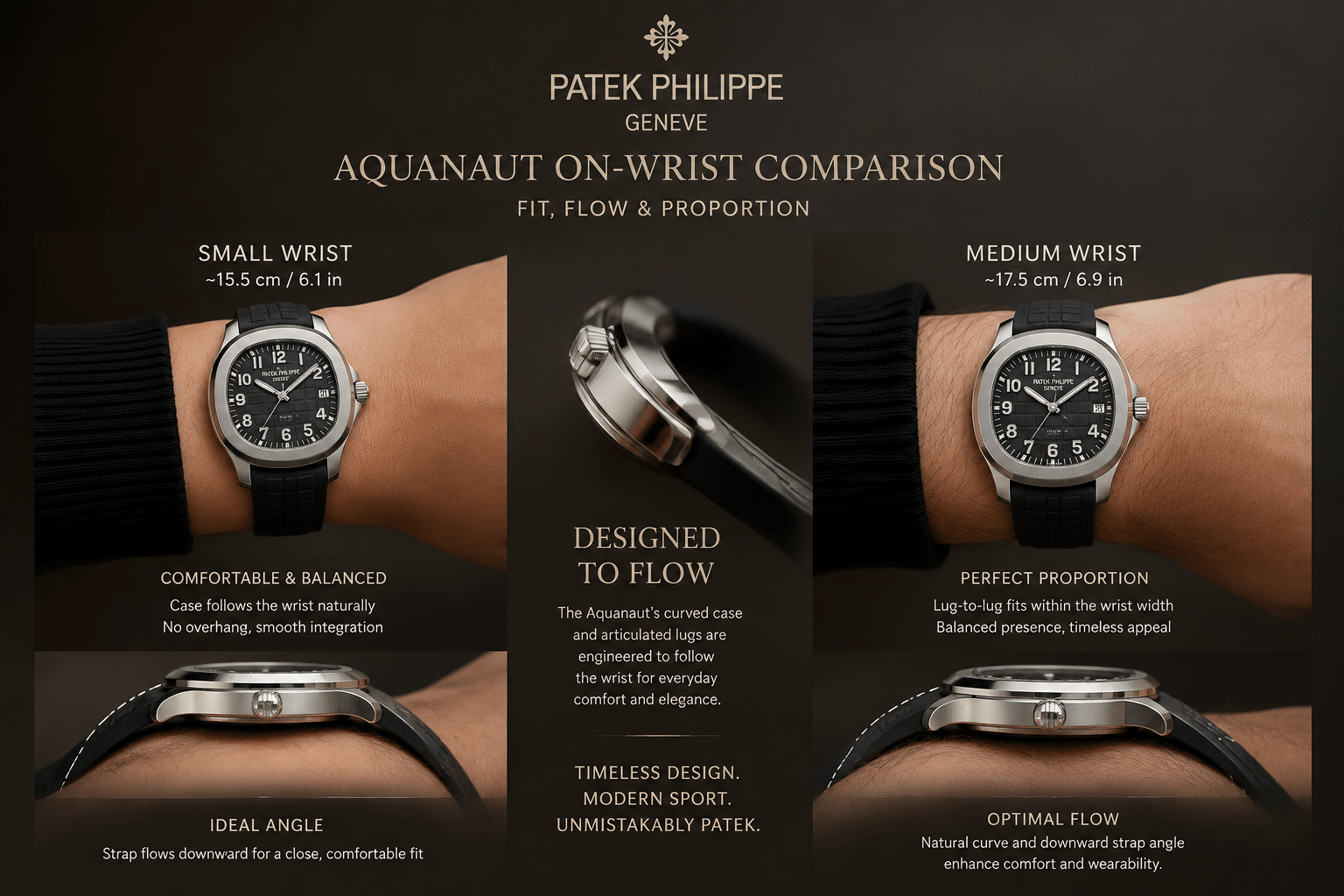
Aquanaut wrist fit is not just about whether the case “fits” a wrist by measurement. The watch behaves differently depending on how the strap drops, how the wrist curves, and how much flat space the case has to settle on. Two people can wear the same Aquanaut and get completely different results even if the case width is unchanged. One wrist lets the watch sink in and look natural. Another leaves it sitting high enough to feel more present than intended.
The mistake buyers make is treating circumference as the only variable. It is not. Wrist curvature matters just as much because the Aquanaut’s integrated layout asks the strap and case to follow the wrist instead of simply resting on top of it. A wrist with more curve can make the watch look smaller and more integrated. A flatter wrist can make the same watch feel broader and more architectural.
Small-Wrist Fit: When the Watch Sits Cleanly
On a smaller wrist, the Aquanaut tends to work best when the case settles near the center and the strap drops away without a hard break. That is the point where the watch feels compact rather than cramped. The rounded-square shape helps here because it spreads the visual mass without demanding the visual length of a more rectangular case. If the crown side is restrained and the bezel profile is not overly tall, the watch usually reads as tidy rather than oversized.
The downside for small wrists is not necessarily width. It is the combination of height and strap behavior. If the strap pulls the case upward or the wrist is very flat, even a sensible diameter can start to look less settled. In that situation, the Aquanaut can still fit physically, but it may not look as composed as the specs suggest.
Larger Wrists: When the Watch Needs More Presence
On a larger wrist, the Aquanaut can begin to look contained rather than dominant. That is not automatically a problem. Some buyers want exactly that effect: a sports watch that stays controlled and does not shout across the wrist. But if the wrist is broad and the case sits too neatly in the middle, the watch can lose some presence and feel visually modest.
This is where proportion judgment matters more than pure size. A larger wrist can handle a more assertive silhouette, but the Aquanaut’s case architecture is still relatively restrained. If you want a strong statement piece, the Aquanaut may need the right reference and the right strap behavior to avoid looking a little too polite.
How Strap Angle Changes the Result More Than Diameter
Strap angle is one of the most overlooked parts of Aquanaut fit. A watch with an excellent diameter can still wear awkwardly if the strap exits at the wrong angle or drops too abruptly. The reason is simple: the strap controls how the case meets the wrist. When the angle is natural, the watch looks planted. When it is forced, the case can seem to float above the wrist or flare away from it.
That is why buyers should not judge Aquanaut wrist fit by case size alone. The strap angle can make the watch feel longer, shorter, flatter, or more upright than the number sheet implies. For this model, the fit conversation is really about how the case and strap work together as a single system.
Choosing the Safer Reference for First-Time Buyers
Some Aquanaut references are more forgiving than others because the case, dial, and strap system have less visual complexity. Simpler versions usually hide small imperfections better and are easier to evaluate from photos. Once complications or added visual layers enter the picture, proportion errors become easier to notice and harder to ignore. That does not make the more complex versions bad, but it does make them less forgiving for a first purchase.
For a first-time buyer, the more practical choice is often the reference that already looks balanced in ordinary wrist shots, not the one that depends on the longest spec list or the strongest factory claim. On a watch like this, the right decision is usually the one that matches the intended use: daily wear, occasional rotation, or photo accuracy. Those are not interchangeable priorities, and the watch should be judged accordingly.
A Practical Decision Rule
If the watch looks right in side profile, sits low on the wrist, and keeps the crown side quiet, it is usually closer to the Aquanaut wearing character buyers want. If it only looks good in a front photo but grows awkward in profile, the case geometry is probably doing too much work.
For first-time buyers, the safest approach is to weigh proportion, strap flow, and QC visibility ahead of factory reputation. Factory names and movement labels can narrow the field, but they should never replace a direct read of the actual watch being offered.
Reading Aquanaut Proportion From Photos and Measurements Before You Choose a Size
If you cannot try an Aquanaut on in person, the best way to judge fit is to read the watch like a shape problem rather than a spec sheet. Front-on glamour shots are the least useful. They flatten the watch, hide the side profile, and make nearly every proportion look cleaner than it feels on the wrist. What matters is whether the case sits low, whether the strap drops naturally, and whether the right side looks controlled or crowded.
The most useful images are side profile shots and three-quarter wrist photos taken in neutral light. Those angles show the things that decide whether the watch wears well: thickness relative to wrist height, crown projection, and how much the bezel stands off the case. A flat catalog shot tells you almost nothing about that. It may show the dial clearly, but it does not tell you how the watch will behave in motion or how much visual weight the case carries once it is actually worn.
Which Photos Tell the Truth
Three-quarter wrist shots are usually the most honest because they show the front, side, and strap exit point at once. That is where proportion reveals itself. A clean photo from that angle will show whether the watch hugs the wrist or rides too high, and whether the right side feels busy once the crown and bezel are visible together.
Side profile photos are just as useful, but only if the camera is not tilted or stretched. A low angle can make the bezel look heavier than it is, while a high angle can hide thickness. If the image looks too polished or too centered, be skeptical. The best fit clues usually come from ordinary photos taken by owners, not from the most perfect shot in a seller listing.
What Dimensions Can and Cannot Predict
Dimensions are helpful, but only as a starting point. Diameter gives a rough sense of footprint. Thickness tells you something about vertical presence. Neither number explains how the watch will feel once the strap bends and the case settles into the wrist. That is why two Aquanaut models with close measurements can still wear differently: one may look more compact because the strap drops cleanly, while another may appear more prominent because the side profile is taller or the crown side is busier.
The practical rule is simple. Use measurements to eliminate bad candidates, not to pick the winner by themselves. A good Aquanaut sizing guide should narrow the field, then let photos and strap behavior make the final call. When dimensions and real wrist photos disagree, believe the wrist photos.
What to Check Before You Decide
Before choosing a size, look for four things: the side profile, the strap angle, the caseback rise, and crown projection. Then ask one final question: does the watch sit across the wrist, or does it perch on top of it? That answer matters more than any single number on the listing. If the silhouette looks balanced from the side and the strap exits naturally, the watch is more likely to feel right in daily wear. If the right side looks heavy or the case appears to hover above the wrist, the fit probably is not as good as the dimensions suggest.
References
[1] Patek Philippe, “Aquanaut 5167A official specification,” official product page for the genuine Aquanaut reference, available at Patek Philippe Aquanaut 5167A.
[2] Miyota Movement, “Miyota 9015 official movement specification,” official movement page with basic technical data, available at Miyota 9015.
[3] Miyota Movement, “Miyota 8215 official movement specification,” official movement page with basic technical data, available at Miyota 8215.
[4] U.S. Customs and Border Protection, “Intellectual Property Rights,” official enforcement guidance on counterfeit and infringing goods, available at U.S. CBP Intellectual Property Rights.
Disclosure: This article is for general educational and comparison purposes only. Replica watches are not genuine products from the original luxury brands, and brand names are used only to identify reference designs or comparison topics. Factory names, movement descriptions, prices, availability, QC details, seller policies, and version information can change, so readers should verify important details with the seller before making a purchase decision. Replica watches should not be represented, resold, or used as genuine watches.