
I’m tightening the comparison language and adding a couple of compliance-focused sections near the end so the article stays useful without drifting into authenticity or guarantee claims. I’m also checking the existing citations against the allowed source list so the references remain consistent.I’m locating the article in the workspace so I can patch the actual source rather than reconstructing from the prompt. After that I’ll add the new compliance sections and tighten a few absolute claims.
The hardest part of choosing an Aquanaut replica is not finding a familiar factory name. It is matching the right production route to the exact reference, because the 5167A, 5164A, and 5968A punish different mistakes. The 5167A lives or dies on case shape, dial texture, and strap integration. The 5164A adds Travel Time complexity, so corrector feel, dial balance, and functional reliability start to matter more. The 5968A is a chronograph first, which means thickness, pusher alignment, and reset behavior can matter more than a clean photo.
This article is useful if you want a practical way to judge which version is worth the money and which compromises are acceptable. It focuses on the decision points that actually change ownership: how a watch wears, how well the layout holds together, and whether a more complex route is worth the extra risk. The main idea is simple: the right choice is the one that fits the reference and complication level, not the one with the strongest name in isolation.
| Reference | What Matters Most | Buying Takeaway |
|---|---|---|
| 5167A | Case geometry, dial texture, strap integration | Often the most practical starting point when overall proportions matter more than complication depth |
| 5164A | Travel Time function, corrector feel, dial balance | Worth it only if the added complication is important enough to justify more ownership risk |
| 5968A | Chronograph thickness, pusher alignment, reset precision | Judge it by how it operates and wears, not just by how strong it looks in photos |
| Factory choice | Reference-specific execution, not overall reputation | The same maker can make more sense on one model than another |
| Simpler vs. more complex route | Daily wear reliability and service risk | Simpler builds usually suit first-time buyers and repeat wear better |
| Higher price | Thickness, proportion, and functional stability | Pay more only when the upgrade improves the parts you will actually notice |
Quick Questions Before You Read
Q: Is the 5167A the safest choice for most buyers?
Usually yes, because its value depends more on shape and balance than on complicated mechanics.
Q: Does the 5164A justify the extra complexity?
Only if you want the Travel Time function enough to accept more risk in setup and reliability.
Q: Why is the 5968A harder to buy well?
Because chronograph feel, reset behavior, and case thickness can go wrong even when photos look strong.
Q: Should factory reputation matter more than the reference?
No. This article treats reference fit first, because the same maker can perform differently across models.
Editorial Perspective: The safest way to read an Aquanaut replica is not by factory name alone. The editorial framing used across the broader watch coverage here at cleanvsfactory.com’s Aquanaut super-clone comparison treats this as a model-specific buying question: the 5167A is mostly about case proportion and dial texture, the 5164A adds real function risk through Travel Time, and the 5968A should be judged like a chronograph first and a sport watch second. Seller photos and QC images are useful signals, but they do not prove that a watch will wear well, reset cleanly, or stay easy to live with over time.
Evidence Boundaries for This Aquanaut Comparison
This guide discusses replica-market watches, not authorized Patek Philippe products. Official Patek Philippe information is useful for understanding the authentic Aquanaut 5167A as a steel watch with a composite strap, date display, and center seconds, but that official specification does not prove that any replica has the same case quality, strap material, movement, finishing, water resistance, or service standard.[1]
Factory names in the replica market should be treated as buyer shorthand rather than official certification. Claims about VSF, Clean, 3KF, ZF, or any other production route are often based on seller listings, buyer discussion, and QC experience, so this article avoids saying that one factory is universally best. The more defensible method is to compare the reference, the visible execution, the function route, and the seller’s ability to provide clear QC evidence.
A useful traceability habit is to separate four different claims before making a decision: the factory label, the exact reference, the version or batch being offered, and the movement configuration inside that specific watch. If any one of those pieces is vague, the buyer should slow down. A familiar factory name can help narrow the search, but it cannot replace real watch photos, function checks, and model-specific judgment.
Legal and disclosure language also needs restraint. The USPTO describes counterfeit goods as products that use another party’s trademark without authorization, and that framework is relevant when discussing branded replica watches.[2] Customs agencies may enforce intellectual property rights at the border, so buyers should not treat replica watch import, resale, or disclosure questions as risk-free or universally settled.[3]
Why Aquanaut Factory Choice Changes by Reference
The first mistake buyers make with the Aquanaut is assuming the family behaves like a single project. It does not. The 5167A, 5164A, and 5968A stress different parts of the replica build, so the factory that looks strong on one reference can be the wrong answer on another. That is the real reason a simple factory ranking falls apart here.
On the 5167A, the question is mostly whether the watch gets the shape, dial texture, and strap integration right enough to feel convincing on the wrist. On the 5164A, the travel-time complication adds a second layer of scrutiny because the watch now has to look right and function cleanly under more mechanical pressure. On the 5968A, chronograph layout and movement architecture raise the bar again, and the tolerance for sloppy execution drops fast.
The useful way to read Aquanaut factory comparison is not “which factory is best overall,” but “which production route matches the reference I actually want.” That shift matters because buyer trade-offs change with complexity. The more the watch asks from the movement, the less you should care about a factory’s reputation in the abstract and the more you should care about whether its specific route handles that reference without adding avoidable thickness, noisy operation, weak pusher feel, or fragile function behavior.
Factory Name Clarification: Factory names in the replica watch market are commonly used buyer-facing labels. They should be treated as practical market references, not as official brand affiliations, audited manufacturer identities, or guarantees of identical quality across every model, batch, or reference.
A factory comparison is most useful when it is tied to a specific reference and version rather than treated as a universal ranking. For Aquanaut replicas, that means asking whether the production route solves the main weakness of the chosen model: case thinness and strap flow on the 5167A, Travel Time control and dial balance on the 5164A, or chronograph stability and pusher alignment on the 5968A.
What stays constant across the Aquanaut family is the basic visual language. You are still buying a sport-luxury Patek with an integrated rubber strap, a structured dial, and a case that has to feel refined rather than bulky. The case should sit low and balanced. The bezel should not look heavy. The strap transition should feel like part of the watch, not an afterthought. Those shared traits are why the family is attractive in the first place, and they are also why bad replicas stand out so quickly.
The shared problem is that the Aquanaut looks simple only from a distance. Up close, the reference depends on proportion more than decoration. If the case profile is off, the watch loses its character. If the dial texture is too flat or too coarse, the watch stops reading as an Aquanaut even if the rest of the part set is decent. If the strap integration is clumsy, the whole design feels less cohesive than it should. That is why a model with fewer complications can still be hard to clone convincingly.
What changes once complication level goes up is the kind of mistake that matters. On the 5167A, most flaws are visual and proportional. On the 5164A, you now have to worry about how the Travel Time system behaves, whether the corrector action feels clean, and whether the extra functionality creates awkward dial balance or unreliable setup behavior. On the 5968A, chronograph layout, reset behavior, and movement thickness become central, not secondary. At that point, a watch can look promising in photos and still be the wrong buy if the movement route is too compromised.
The practical judgment is simple: reference complexity should control your factory expectations. The simpler the Aquanaut, the more weight you should place on case geometry, dial execution, and strap fit. The more complicated the reference, the more weight you should place on reliability, function consistency, and whether the factory’s version actually supports the case proportions it is trying to imitate. That is the framework that keeps buyers from overpaying for the wrong kind of accuracy.
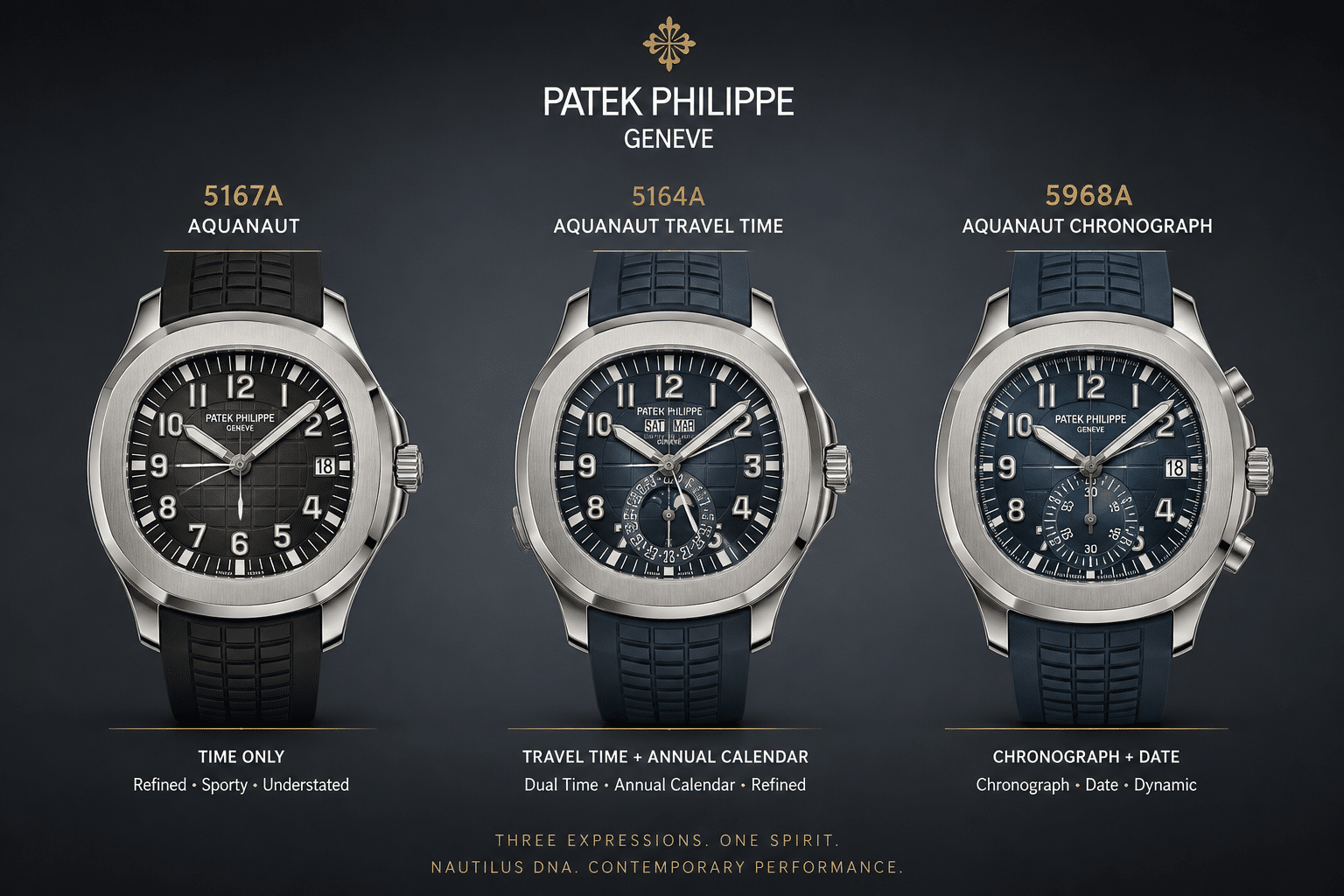
5167A: The Simple Reference Where Dial Texture and Case Geometry Matter Most
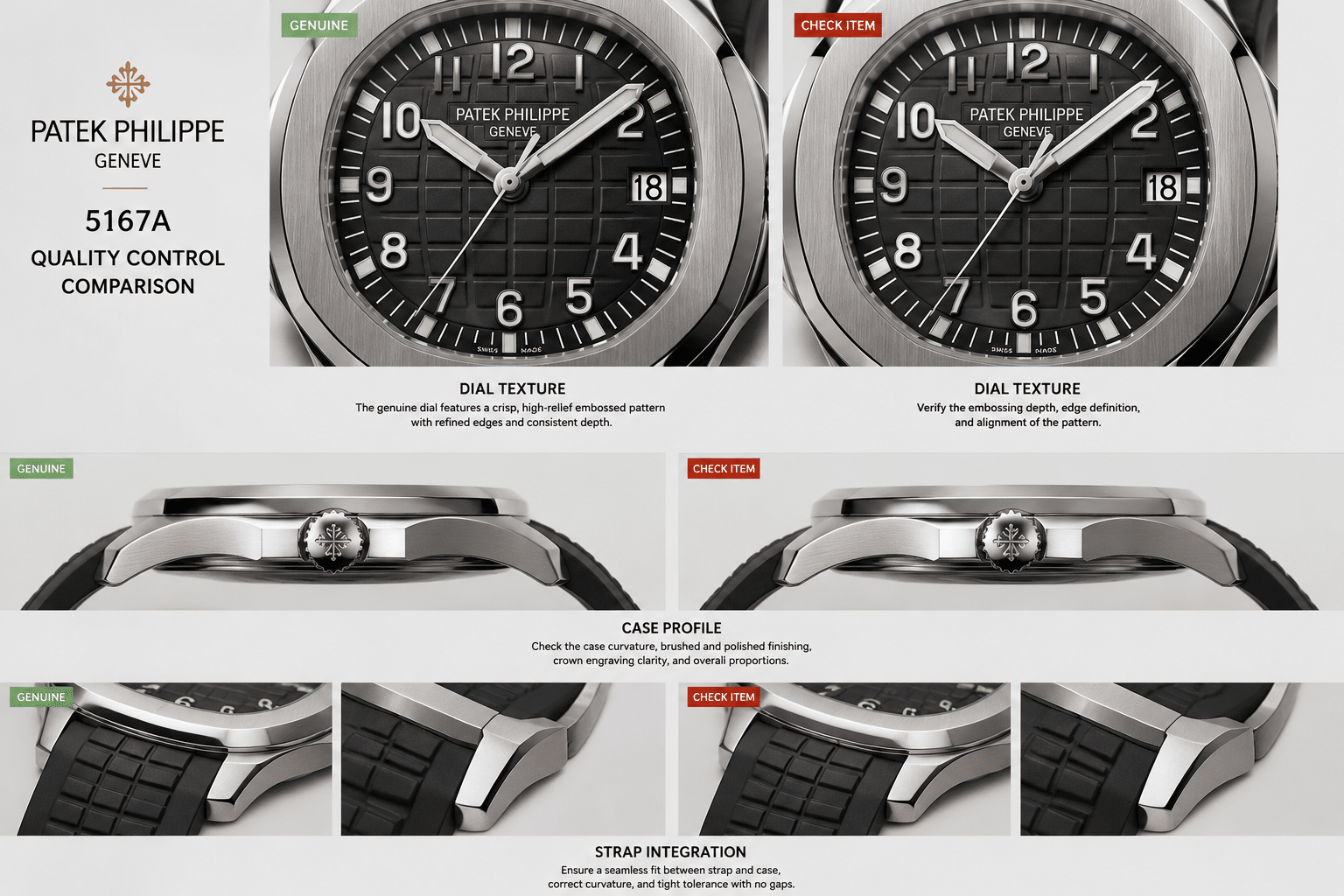
The 5167A is the reference where factory judgment should be most disciplined. Because it does not rely on complication drama, it exposes the basics: dial texture, case profile, bezel shape, lug geometry, and the way the strap meets the case. A factory can look impressive on paper and still miss the 5167A in ways that become obvious on the wrist. That is why the simple Aquanaut is not the easy option; it is the one that punishes proportion mistakes the fastest.
For this reference, a practical factory route is usually the one that gets the overall shape and dial behavior right without introducing unnecessary compromises elsewhere. A watch that has the correct visual depth, a believable embossed dial, and a case that does not look overbuilt will usually beat a more expensive route that solves one problem while creating another. That is the part many buyers miss. They assume a higher-end movement route automatically produces a better 5167A, but on this reference the dial and case often decide the outcome before the movement does.
Factory traits that matter most for 5167A are consistency and restraint. The dial should have enough relief to look structured, but not so much that it appears coarse or exaggerated. The bezel should read sharp without looking thick. The case should feel compact and low rather than top-heavy. The strap integration matters more than it does on many other sport watches because the Aquanaut’s identity depends on the case-and-strap flow being believable as a single design. A factory that gets those elements aligned is usually the smarter route, even if the movement choice is less exciting.
Because the authentic 5167A is a relatively clean three-hand date watch, the replica version has fewer visible complications to distract from proportion problems.[1] That is why small errors in bezel width, case thickness, dial embossing, date framing, and strap contour can feel larger on this reference than they would on a busier chronograph. A buyer should not use the official Patek listing as a checklist for replica equivalence; it is only a reference point for the authentic model’s layout and design baseline.
Batch consistency matters more here than most buyers think. A 5167A can vary in the way the dial embossing catches light, how the date window sits, or how neatly the strap meets the lugs. Those are not trivial details. They change the way the watch wears in normal use. A buyer looking at QC photos should care less about abstract movement claims and more about whether the front view looks balanced and whether the side profile suggests the right thickness and curvature. On a three-hand Aquanaut, that is where value is won or lost.
There is still a place for cheaper 5167A routes, but only for the buyer who is honest about what matters. If you want a watch that looks good at arm’s length, wears comfortably, and does not require obsessing over every microscopic finish transition, a lower-cost route can be perfectly rational. The mistake is buying down and then expecting the watch to survive close scrutiny as if it came from the top end of the market. It will not. The better decision is to decide whether you care about wrist realism or inspection-level refinement before you choose the route.
The 5167A also has a narrow line between “good enough” and “obviously off.” Too much thickness changes the profile. A weak date window ruins the face. Sloppy strap fit makes the whole watch feel less integrated. That is why this reference rewards buyers who read photos carefully rather than those who chase the loudest factory name. On the 5167A, the cleaner-looking execution is usually the more sensible choice.
QC Photos to Confirm
Front shots should show a dial with believable texture and even printing. Side profiles should confirm that the case does not look bloated or flat. The date window should sit cleanly, with no obvious misplacement or awkward framing. Strap fit deserves close attention, because poor integration is one of the easiest ways for a 5167A to lose its identity. If any one of those areas looks off, the watch will feel wrong even if the movement is acceptable.
Before making a decision, buyers should review real QC photos where available, including dial printing, hand alignment, datewheel centering, case thickness, lug shape, strap fit, clasp engraving, and overall finishing. Factory labels and stock photos alone are not enough for a reliable judgment.
One useful rule: if a 5167A looks fine only because the photo angle is forgiving, treat that as a warning. This reference should hold together from normal viewing angles. If it needs too much visual help, the factory route is probably working against the model rather than with it.
5164A: Travel Time Adds a Different Set of Factory Risks
The 5164A changes the decision because it is no longer just a cleaner or more expensive-looking Aquanaut. Travel Time introduces a functional layer that can be visually convincing yet mechanically awkward if the route is weak. That makes this reference less forgiving than the 5167A. You are now judging whether the factory can handle complication behavior without disturbing the watch’s balance, thickness, or day-to-day ease of use.
On paper, the 5164A looks like the 5167A with extra usefulness. In practice, it is a different buying problem. The Travel Time system adds corrector action, dual-time logic, and more movement layout pressure. The buyer should care less about whether the complication sounds impressive and more about whether it feels stable and coherent. A weak Travel Time replica can look busy in photos and still be a poor daily-wear watch because the complication route introduces more places for inconsistency to show up.
Why Travel Time narrows the list of serious factories is straightforward: once you add extra function control, not every production route keeps the same level of confidence. The practical candidates are the ones that preserve dial balance, keep the pushers aligned well, and do not make the watch feel mechanically strained. A factory that is acceptable on the 5167A can become much less attractive here if the added complexity produces awkward corrector behavior or a layout that looks crowded. This is where factory reputation becomes reference-specific in a very practical sense.
For the 5164A, movement trust depends on understanding what the movement claim actually describes. Some listings may describe a clone-style layout, a decorated movement, or a modified Asian movement route, but those descriptions should not be read as official Patek Philippe caliber claims. The buyer should ask what functions are actually supported, how the correctors operate, whether the date and travel indications advance cleanly, and whether the specific watch being offered has QC evidence that supports the claim.
Travel Time also changes what counts as a visible flaw. On a simple three-hand Aquanaut, a small misalignment might be tolerable if the watch still wears well. On the 5164A, the same kind of small problem can draw more attention because the dial already has more going on. If the sub-layout is uneven, if the function indications feel crowded, or if the pusher positions do not sit naturally in the case, the whole watch can lose the restrained character that makes the Aquanaut work.
The buyer should also understand that complication risk is not only about failure. It is about how much confidence you have in normal use. A Travel Time watch that looks great but feels finicky when setting or adjusting is not a strong purchase for most people. This is why the 5164A should be treated as a function-first decision. If the movement route or assembly quality makes the complication feel delicate, the watch may be less satisfying than a simpler model that executes the core design better.
QC photos matter more on the 5164A than many buyers realize because they can show whether the complication layout is coherent before the watch ever ships. The reader should look for balance in the dial openings, correct spacing around the pushers, and a date display that does not feel disconnected from the rest of the face. Those details tell you more about the route than marketing language does. A neat front view is not proof of long-term reliability, but a messy one is usually enough reason to walk away.
The practical takeaway is that the 5164A deserves more skepticism than the 5167A, not because it is inherently flawed, but because it creates more opportunities for a factory to get something subtly wrong. If your tolerance for risk is low, that matters. If you specifically want Travel Time functionality and you are willing to accept stricter QC and more ownership complexity, the reference can make sense. The wrong mistake is treating it like a cosmetic upgrade. It is not.
5968A: The Chronograph Version Where Movement Route Becomes the Main Decision
The 5968A is the Aquanaut reference that stops being a simple appearance contest. On paper, it still has the same family language as the 5167A and the same sporty wrist profile, but the chronograph stack changes what actually matters. Once you add pushers, subdials, reset behavior, and a thicker movement layout, a factory can no longer hide behind a good dial or a decent strap. That is why the factory comparison for the 5968A is not “who makes the prettiest Aquanaut,” but “whose chronograph route stays stable, wears correctly, and behaves well over time.”
The hard part is that the 5968A is often the most convincing in photos and the least forgiving in use. A clean front shot can make several versions look close enough, but the moment the chronograph is started, stopped, and reset, weaker routes usually show their limits. Poor hand return, inconsistent pusher feel, slightly off subdial spacing, or a case that feels thicker and less settled on the wrist matters more here than a marginal improvement in dial finishing. For this reference, movement architecture is the real filter. A more expensive piece is not automatically the better buy if the function stack is less stable.
Movement Transparency Note: Movement references in this article describe replica-market movement types, layouts, or configurations. They should not be read as official Patek Philippe calibers or Swiss-manufactured movements unless a specific watch is supported by clear, verifiable evidence.
What the chronograph adds to factory evaluation
The chronograph changes the judgment criteria in a very practical way. On the 5968A, buyers should care less about whether the dial print is sharp enough under macro and more about whether the layout reads naturally at a glance, whether the pushers sit cleanly in the case flank, and whether the reset returns both hands exactly to zero without drifting. Those are the details that separate a chronograph replica watch you can enjoy from one that looks strong only when idle.
For this reference, the most useful QC evidence is not only a still photograph. A short function video or sequential photo set can be more informative because it shows start, stop, reset, and hand return behavior on the actual watch being offered. That evidence still cannot guarantee long-term stability, but it gives the buyer a better way to distinguish a merely photogenic chronograph from one with a more coherent movement route.
Subdial spacing also becomes more important than many buyers expect. On a simple Aquanaut, slight differences in printing or date framing may be the most visible issue. On a chronograph, the relationship between the center hand, subdials, and pusher geometry tells you whether the movement route supports the case properly. If the layout looks cramped, or if the subdials sit in a way that makes the face feel visually crowded, that is usually not a cosmetic quirk. It is often a sign that the internal stack is doing too much work to fit the reference.
Thickness is another decision point that is easy to underrate until the watch is on wrist. A chronograph Aquanaut should feel like a sport-luxury watch, not a slab. If the case is too tall, the watch loses the easy, low-profile wearability that makes the Aquanaut family convincing in the first place. In this reference, a fraction of a millimeter can change the wrist feel more than a small difference in logo crispness. Buyers who focus only on finishing tend to miss that.
There is also a serviceability angle that matters more here than on the other references. A chronograph route that is visually strong but mechanically awkward can become a long-term headache. Rotor feel, winding behavior, and reset consistency are not academic details; they are the early warning signs of whether the movement is the kind you can live with, or the kind you will be nervous to operate. For the 5968A, the steadier choice is usually the route that behaves more predictably, even if it gives up a little visual finesse under magnification.
When the 5968A makes sense and when it does not
The 5968A makes sense for a buyer who wants the most dramatic Aquanaut silhouette and accepts that the chronograph is the part that creates the risk. If the goal is wrist presence, a complex dial, and a more interesting interaction with the watch, this reference delivers more than the simple time-only version. It is also the one that rewards a buyer who is willing to inspect function photos carefully and reject a watch if the pusher action or reset behavior looks vague.
It does not make sense for a first-time buyer who mainly wants a low-drama daily wearer. The chronograph adds failure points, and those failure points are not always obvious in dealer photos. A watch can look excellent while still being a poor ownership choice if the movement route is temperamental or if the case thickness makes it wear taller than expected. That is the main trap with the 5968A: buyers assume complexity automatically means a better replica. In practice, complexity often just means more things to verify before you say yes.
The smarter way to think about the 5968A is this: pay for stability first, then visual accuracy. If a route demonstrates cleaner reset behavior in QC and holds its layout without obvious thickness penalties, the extra cost is easier to justify. If the higher-priced option only improves cosmetics while leaving the chronograph stack less trustworthy, the cheaper, steadier route may be the more rational buy.
What Price Usually Reflects
Price differences in Aquanaut replicas are often a mix of movement route, finishing, availability, seller margin, and after-sale risk. A higher price can mean a better-thickness case, more careful assembly, or a more convincing function stack, but it does not automatically mean the watch is better for the buyer’s actual use. On the 5167A, paying more only makes sense if the added cost improves the case profile, dial texture, or strap integration. On the 5164A, the premium is more defensible when it improves Travel Time stability rather than only the front view. On the 5968A, price should mainly be justified by chronograph behavior and wearable thickness, not by a louder claim or a prettier listing page.
That is why price should be read as a clue, not a verdict. Sometimes it reflects a genuinely better route. Sometimes it reflects scarcity or seller markup. Sometimes it reflects the cost of sourcing a version that is harder to get, while the practical difference on wrist is smaller than the number suggests. The useful comparison is whether the premium buys something you will notice every day. If it does not, the more expensive watch is not automatically the better decision.
Exact pricing claims should be treated carefully because replica watch pricing can change by seller channel, version, movement route, shipping method, and after-sales support. Broader Swiss watch and counterfeit-watch data can describe industry pressure and illicit trade context, but it cannot prove the fair price, current availability, or quality level of a specific Aquanaut replica from a specific seller.[4]
How to Read Factory Claims Without Falling for a Universal Winner
Factory reputation matters, but only after you attach it to a reference. That is the part many buyers get wrong. A name that looks strong on one Aquanaut can be merely average on another because the watch is asking different things from the build. A factory that does a good job on the 5167A case shape may not be the one you want for a chronograph where pusher alignment, reset action, and movement thickness become the real test. Once the complication changes, the ranking can change with it.
The phrase to keep in mind is reference fit. The buyer is not really choosing a factory in the abstract. The buyer is choosing a factory, batch, and movement route for a specific watch with specific weaknesses. Batch variation makes that even more important. One run can look clean enough to earn praise, while a later run from the same source may show different dial balance, looser function feel, or a less convincing case profile. That is why factory claims should be treated as a starting point, not a verdict.
Why the same factory can rank differently on each reference
A factory’s strength often comes from what it can simplify. On a simple Aquanaut, strong case machining and decent dial execution can carry the watch a long way. On the 5968A, those same strengths help, but they are not enough if the movement route is unstable or the chronograph hand stack sits awkwardly. The factory that looks excellent on a time-only piece can look less impressive once the watch has to support extra function layers.
This is also why the most expensive option is not always the most practical one for the buyer. Higher pricing can reflect better assembly attention, but it can also reflect a more ambitious movement route that looks impressive in a sales listing and creates more risk in ownership. If the extra money mostly buys complexity, the buyer should ask whether that complexity improves the watch on wrist or just makes it harder to service. For Aquanaut chronograph replicas, the answer is not always flattering.
The best judgment here is to compare factories by what they do well on the specific reference. If a route can show steadier chronograph behavior in the actual QC material, that matters more than whether the factory has a broader reputation for premium finishing. Surface quality is easy to advertise. A chronograph that starts, stops, and resets correctly in the watch being offered is harder to fake and more valuable to the buyer.
Which claim deserves the most skepticism
The most overused claim is universal best. It sounds useful and usually isn’t. A factory that is the right answer for one Aquanaut reference can be the wrong answer for another, especially once complication depth changes. The second claim to be skeptical of is “same batch, same quality.” That is rarely true in practice. Even within respected production routes, assembly consistency can shift enough to change the buying decision.
Claims such as “perfect,” “same as genuine,” or “guaranteed to pass inspection” should be treated with caution. A more reliable comparison looks at the actual model version, movement configuration, finishing details, and available QC evidence. The safest use of factory and movement information is to avoid overpaying or misunderstanding quality, not to represent a replica watch as genuine.
Be careful with claims that sound technical but do not tell you what the watch actually does. A dealer may emphasize a better-looking dial, stronger engraving, or a more expensive route label, while avoiding the more important questions: does the chronograph reset cleanly, does the case wear too thick, and does the watch feel settled when operated? Those are the questions that separate a smart buy from a visually convincing mistake.
The safest reading of factory claims is simple. Treat reputation as evidence, not proof. Then check whether the factory’s known strength matches the exact problem the reference creates. That is the only way the Aquanaut comparison stays useful instead of turning into a fan club ranking.
QC Checks That Matter Across All Three References
QC photos are where the buying decision gets real, but they only work if you know what each angle can actually tell you. A front shot can show dial balance, marker placement, and overall proportion. A side profile can show case height, bezel behavior, and whether the watch sits with the right visual weight. Movement or function shots can confirm more than a static image, but even then they do not prove long-term stability. A clean photo set can still hide a weak route if the buyer does not ask the right questions.
What matters most is separating what you can verify from what you cannot. QC can tell you whether a watch looks aligned, whether the dial is centered, and whether the case appears to have the right shape. It cannot tell you how a movement will age, how much resistance a pusher will develop after normal use, or whether the seller’s listing photo came from a particularly good sample. A buyer who reads QC as proof of ownership quality is taking on more risk than the photos justify.
Water resistance belongs in the same category of claims that need individual verification. An authentic model’s water-resistance specification should not be copied onto a replica listing as if it proves the imitation watch has the same sealing, testing, or warranty standard. Unless the exact watch has been pressure-tested after purchase by a competent watchmaker, buyers should treat swimming, showering, and sports use as avoidable risk.
The main judgment here is to separate cosmetic flaws from structural ones. A small misalignment in a printed detail may be annoying but liveable. A chronograph hand that does not return precisely, a pusher that looks awkward in profile, or a case that appears too thick is a different issue. Those are not just finish imperfections. They are signs that the watch may not wear or function the way the reference should.
Front shots versus side profiles
Front shots are best for checking what the eye sees first: dial centering, subdial symmetry on the 5968A, hand alignment, date framing where applicable, and whether the overall face looks balanced. They are less useful than buyers think for judging thickness or case shape. A slightly deceptive angle can make a watch look slimmer, flatter, or more refined than it really is.
Side profiles are more valuable than many QC buyers realize. They show whether the case has the right vertical presence, whether the pushers on the chronograph version sit cleanly, and whether the Aquanaut’s sporty profile still feels restrained. If the side view looks heavy or awkward, that usually matters more on the wrist than a minor dial imperfection visible only under macro.
Strap and clasp fit should be checked in both views because they affect how the watch wears as a whole. On the Aquanaut family, the strap is not just an accessory. It is part of the visual architecture. If the strap connection looks forced or the clasp sits poorly, the whole watch loses credibility quickly.
What dealer photos can hide
Dealer photos usually show the watch in the best lighting and from the best angle. That is useful for checking sharp flaws, but it can hide the things that matter most for ownership. A dial can look balanced while the side profile is too tall. A chronograph can look clean while the reset behavior is uncertain. A Travel Time watch can look orderly while the corrector feel is awkward. None of that is visible from a polished front shot alone.
This is why photos should be used to narrow the shortlist, not to finish the decision. A good listing can still hide a heavy case, a noisy rotor, or a pusher stack that feels less stable than the price suggests. The buyer who treats photos as a final answer often pays for the wrong kind of confidence.
Red flags that matter more on the complicated references
The more complex the reference, the more scrutiny the function photos deserve. On the 5968A, a buyer should be stricter about pusher alignment, hand reset behavior, and whether the chronograph stack looks naturally integrated rather than crowded into the dial. If the pushers appear uneven in the case side, that is a warning sign worth taking seriously. If the chronograph hands do not settle exactly where they should, the watch is not ready, no matter how nice the dial looks.
Another red flag is a mismatch between polished appearance and mechanical confidence. A chronograph replica can have very good printing and still be the weaker purchase if the movement route is touchy or the case thickness feels exaggerated. On simpler references, some cosmetic imperfections are easier to forgive. On the 5968A, function issues should be treated as the priority because they will shape ownership more directly than surface detail.
What to Check Before You Decide
- Front dial symmetry, especially subdial spacing and overall balance on the 5968A.
- Side profile thickness and whether the watch still looks slim enough to wear like an Aquanaut.
- Pusher placement and whether the chronograph controls sit cleanly in the case flank.
- Chronograph reset photo or video showing the hands returning exactly to zero.
- Strap integration and clasp fit so the watch wears as one coherent object.
- Any sign that the listing is emphasizing cosmetics while avoiding movement behavior.
- Batch consistency clues, especially if the seller’s photos differ from the QC watch in small but important ways.
The final rule is simple: judge the 5968A like a chronograph first and an Aquanaut second. If the function route is weak, the watch is a compromise no matter how convincing the exterior looks. If the function behavior is stable and the case still wears correctly, then the factory claim starts to matter in a more meaningful way.
Which Buyer Fits Which Aquanaut Reference and Factory Route
The cleanest way to choose an Aquanaut replica is not to ask which factory is strongest in the abstract. It is to ask which reference creates the fewest problems for the way you actually plan to wear the watch. That is where the real decision sits. The 5167A rewards buyers who care about case shape, dial texture, and wrist feel. The 5164A asks for tolerance around function and layout because Travel Time adds real ownership risk. The 5968A pushes even harder on movement route, thickness, and long-term confidence, so it makes sense only for buyers who accept that complexity is part of the price.
A replica watch should be evaluated with realistic ownership expectations. Even a strong super clone can have limits in water resistance, long-term movement stability, servicing convenience, and close inspection compared with a genuine reference. Buyers should confirm return, repair, shipping, and after-sales terms before ordering, because those terms can vary by seller and should not be assumed from the factory name alone.
That is the part many buyers miss. A more expensive route does not automatically make the watch smarter to own. On the 5167A, paying up for a better-thickness, better-proportioned build can be rational because the watch is judged mostly on external execution. On the 5164A, extra spend can reduce some visual compromises, but it cannot erase the reality that the complication stack creates more things that can feel off, stick, or age badly. On the 5968A, higher price can buy a more convincing presentation, yet it also increases the number of reasons the watch may disappoint after the novelty wears off. Complexity is not free, even in replica form.
First-time buyer
If you are buying your first Aquanaut replica, the 5167A is usually the sensible starting point. It gives you the clearest read on what the family is supposed to feel like without adding complication noise. The comparison is easier, the QC process is easier, and the ownership risk is lower. A first-time buyer learns more from a clean 5167A than from a flashy chronograph with extra moving parts.
The route to avoid first is the one that looks exciting but hides the most tradeoffs. That usually means jumping straight to the 5968A because the price or function count feels more impressive. The problem is not that the watch is invalid. The problem is that it can be harder to judge, harder to service, and easier to buy badly if you do not already know what the Aquanaut should look and feel like.
Buyer who wants useful function depth
If you want the watch to do more than tell time, the 5164A is the better middle ground. It adds purpose without becoming as demanding as the chronograph. That said, the added function only helps if the route is stable. A good 5164A should feel coherent in the dial, reasonable in thickness, and calm in operation. If it feels crowded or hesitant, the extra complication has stopped being an advantage.
This is the reference where buyers should be most honest about how often they will actually use the extra function. If the answer is rarely, the premium is harder to justify. The value of the 5164A is not that it looks busier. It is that the watch offers a real travel function while still keeping the Aquanaut identity intact, provided the factory execution is disciplined.
Buyer who values low-friction ownership
If your main goal is a watch you can wear often without thinking about the mechanism, a straightforward 5167A route is still the strongest choice. It is the least likely to punish normal use, and it leaves the buyer with the clearest set of things to inspect before purchase. That matters because the most useful replica buying decisions are usually the ones that remove uncertainty, not the ones that chase the most complicated spec sheet.
For daily wear, the most useful question is not which option has the most features. It is which option will still feel right after the novelty fades. On that measure, simple often wins. The 5167A with the cleaner build path usually gives the most predictable result, while the 5164A and 5968A only become better buys when the buyer specifically wants the added function and accepts the extra scrutiny that comes with it.
What pays off on the 5167A
On this reference, paying more is usually justified when the higher price is buying a better case profile, a more convincing dial, or a cleaner strap-to-case transition. Those gains matter every time you put the watch on. Paying more is less justified if the premium mostly buys complication-like marketing or a movement route you do not need. The 5167A does not need theatrics. It needs proportion, restraint, and consistency. That is why it often ends up being the most practical Aquanaut for buyers who want the watch to feel believable without becoming a maintenance project.
Where the cheaper route can still be good enough is when the buyer’s standard is straightforward daily wear, not close comparison to genuine. If you wear the watch casually, value reliability over near-perfect profile matching, and do not inspect the case from every angle, the lower-friction route can make sense. The mistake is paying for a complication philosophy you do not need while ignoring the quality level that would actually improve your experience. On the 5167A, visual confidence matters more than spec-sheet ambition.
Best fit for the complication-focused buyer
If you are drawn to the Aquanaut because you want the watch to do more than tell the time, the 5164A and 5968A become the real decision points. The key is to understand that the complication itself is the tradeoff. The moment you move past the 5167A, you are no longer choosing only between factories. You are choosing how much risk you are willing to accept in exchange for added function and visual interest.
The 5164A is the better complication choice for most serious buyers because its Travel Time layout adds purpose without making the watch feel overbuilt. It is still a harder replica decision than the 5167A, though, because you are now asking the movement route to support more than a clean three-hand layout. That means the wrong route can feel fine in photos and still be annoying in use. If you want the watch to serve as an everyday piece, not a shelf piece, the 5164A only makes sense when you are comfortable checking more carefully and accepting a little more uncertainty.
The 5968A is where the buyer needs the most discipline. It looks like the most exciting Aquanaut because it has the strongest visual presence, but that is exactly why it can be the easiest one to buy badly. The chronograph version exposes weakness faster. Thickness is more noticeable. Layout mistakes are harder to forgive. Function feel matters more. A premium route can improve the impression, but it does not turn the 5968A into a low-risk purchase. For many buyers, the price jump on this reference buys complexity more than it buys confidence.
That is why the 5968A only makes sense if you actually want a chronograph Aquanaut, not just the image of one. If you plan to wear it often, use the functions, and accept that service and QC scrutiny matter more than they do on the 5167A, it can be a satisfying choice. If your real goal is simply to own the most striking Aquanaut replica, you are better off stopping at the 5167A or 5164A. The chronograph route is where buyers most often pay for drama they did not need.
As a rule, the simpler route is the smarter one when your priority is daily wear and low regret. The more complex route is smarter only when the complication itself is part of the appeal and you are prepared to inspect it with more caution. That is the right way to read Aquanaut factory claims. Not which factory sounds strongest. Which reference and movement route actually match the way you plan to own the watch.
Boundary Checks Before Ordering
Replica watches should be understood as replica-market products, not genuine watches from the original luxury brands. Brand names in this article are used only to identify the genuine reference design being compared, and they do not imply authorization, endorsement, or commercial affiliation.[1][2][3]
Factory names and movement descriptions are market shorthand, not proof of official source or identical quality. In this category, a buyer-facing label is only useful when it is tied to the exact reference, version, movement layout, and visible QC evidence for the specific watch being offered.
QC photos can reduce uncertainty, but they do not guarantee perfection or future reliability. Water resistance should not be assumed from the model name or the seller’s wording, and buyers should confirm shipping expectations, return terms, repair options, and any other after-sales details directly before ordering.
The practical goal of this comparison is to help a reader understand quality and risk, not to help anyone represent a replica watch as genuine. That is why the reference-specific approach matters more than any universal factory ranking.
References
[1] Patek Philippe, “Aquanaut 5167A official specifications,” official brand reference for the authentic Aquanaut 5167A model, available at Patek Philippe Aquanaut 5167A official specifications.
[2] United States Patent and Trademark Office, “Counterfeit Goods Basics,” government educational resource on counterfeit goods and trademark boundaries, available at USPTO Counterfeit Goods Basics.
[3] U.S. Customs and Border Protection, “Intellectual Property Rights,” official customs guidance on intellectual property enforcement and import risk context, available at U.S. CBP Intellectual Property Rights.
[4] OECD, “Counterfeiting, Piracy and the Swiss Economy 2025: Swiss Watches,” institutional report section on counterfeit Swiss watch trade context, available at OECD Counterfeiting and Swiss Watches.
Disclosure: This article is for general educational and comparison purposes only. Replica watches are not genuine products from the original luxury brands, and brand names are used only to identify reference designs or comparison topics. Factory names, movement descriptions, prices, availability, QC details, seller policies, and version information can change, so readers should verify important details with the seller before making a purchase decision. Replica watches should not be represented, resold, or used as genuine watches.