
I’m reading the article structure and adding the missing compliance layer in a way that keeps the comparison useful. The main work is to introduce explicit replica-vs-genuine boundaries, tighten the risk language around factory and movement claims, and finish with a concise disclosure block.
The real choice between the Aquanaut 5167A and 5168G is not about which one looks more impressive on paper. It is about how much size, height, and visual presence you are willing to carry every day. The 5167A is the easier watch to live with: lighter on the wrist, less dominant under sleeves, and usually the more natural fit for long wear. The 5168G brings a stronger wrist statement, but that bigger impression comes with more visible mass and a fit that can feel less forgiving if the strap or wrist shape is not right.
This article helps separate the spec sheet from the on-wrist result. It focuses on what actually changes your buying decision: proportions, weight balance, strap behavior, and how each version reads on different wrists. If you are trying to choose the more practical daily option, or you want the larger model only if the fit still works, the comparison below gives you the right lens.
Editorial Perspective: For a replica watch comparison like this, the useful question is not which factory name sounds stronger or which listing photo looks cleaner. It is which version matches the buyer’s actual use case: everyday comfort, sleeve clearance, movement behavior, and how much visual presence the wrist can support. At cleanvsfactory.com, this kind of choice is treated as model-specific, so the reader should treat the Patek Philippe Aquanaut super clone comparison as a practical filter rather than a universal factory ranking. A factory label can narrow the shortlist, but it does not automatically settle the decision. The movement, case profile, strap feel, and known model weaknesses matter more than broad factory reputation, especially when the buyer wants a watch that is practical to wear rather than just convincing in pictures.
| Decision Point | 5167A | 5168G |
|---|---|---|
| Daily wear | More discreet and easier to forget on wrist | More noticeable through the day |
| Under cuff | Usually easier to slide under sleeves | More likely to feel bulky with narrow cuffs |
| Visual presence | Balanced and restrained | Bolder and more wrist-dominant |
| Fit sensitivity | More forgiving for routine wear | More dependent on strap feel and wrist shape |
| Best use case | Low-friction everyday watch | Statement piece with more presence |
Quick Questions Before You Read
Q: Which version is easier to wear every day?
The 5167A is usually the safer daily choice because it feels lighter and less intrusive.
Q: Does the 5168G only differ in size?
No. Its proportions, openness, and overall wrist presence make it feel bigger than the number alone suggests.
Q: Is a larger Aquanaut always the better-looking option?
Not necessarily. On some wrists, the 5168G looks intentional; on others, it can feel overstated.
Q: What should I check first before choosing between them?
Check how each case size and strap shape sits on your wrist in real photos, not just the listed dimensions.
Before choosing between the 5167A and 5168G, buyers should compare real QC photos or wrist shots where available, then check dial printing, hand alignment, datewheel centering, case thickness, strap fit, and clasp engraving. Factory labels and stock photos are not enough to predict how the watch will wear.
Replica vs Genuine Boundary
Replica watches should be clearly understood as replica-market products, not genuine watches from the original luxury brands. Brand names in this article are used only to identify the genuine reference design being discussed. They do not imply authorization, endorsement, affiliation, or official production from Patek Philippe or any other luxury watch brand.
Factory names are buyer-facing market references, not proof of official source, and they do not guarantee identical quality across every model or version. A factory can look strong for one Aquanaut version and still be less convincing on another, so the useful comparison stays model-specific rather than universal.
USPTO describes counterfeit goods as unauthorized goods that use protected marks without permission, and CBP notes that infringing imports can be detained or seized at the border.[2][3] That background matters here because it explains why replica-market wording has to stay careful. It is not a claim that any one order will be treated in the same way.
Which Aquanaut Wears Better in Real Life?
The short answer in an Aquanaut 5167A vs 5168G wearability comparison is simple: the 5167A is the safer everyday choice for most wrists, while the 5168G is the better pick only if you specifically want more wrist presence and can live with a larger visual footprint. That is the real decision here. If you want the watch to disappear into normal daily use and feel easy in more situations, the 5167A is usually the more practical replica watch. If you want the Aquanaut to look more assertive and more noticeable from the first glance, the 5168G does that better.
That does not make the 5168G the wrong answer. It just means the buyer is accepting a tradeoff. The larger reference gives you a stronger first impression, but that extra impression is exactly why some wrists will find it less natural over a full day. Buyers often focus on which reference looks more impressive in photos and overlook which one they will actually reach for more often. For most people, that is where the mistake happens.
There is also a separate buyer issue here that is easy to miss: the right watch for daily wear is not always the one that wins the factory discussion. Two listings can both be described as “top quality” and still serve different goals. One may be the better choice for comfort and long wear. The other may be the better choice if your main concern is the visual read at a glance. For a model like the Aquanaut, the buyer should not let a factory name or seller headline outrank the more practical checks: case thickness, strap drop, clasp feel, and whether the watch sits centered on your wrist instead of hanging off one side.
When the 5167A Feels Like the Easier Answer
The 5167A tends to work better when the buyer wants a watch that sits quietly, moves easily with the wrist, and does not dominate the whole forearm. In practical terms, that means fewer situations where the watch feels like it is announcing itself. It works better with casual clothes, office wear, and anything that calls for a cleaner, lower-friction daily watch. The smaller profile also makes it easier for the dial and strap to stay visually balanced instead of feeling like they are pushing against the edges of the wrist.
This is why the 5167A is the better starting point for most buyers, especially if they are new to the Aquanaut family. It is the safer choice when you do not already know that you like a larger watch presence. The 5167A is not the flashier answer, but it is usually the more livable one. On a replica watch, that matters because comfort problems get noticed faster than small visual gains. A watch that looks slightly more impressive but feels slightly less natural is still the worse ownership decision.
It is also the more forgiving version if you are not buying from a seller who provides strong QC photos or if the listing details are vague. The simpler, smaller watch is easier to judge from straight-on photos because proportion errors are less likely to become an immediate fit problem. That does not mean the 5167A should be chosen blindly. It means the model gives the buyer a little more room to recover from imperfect information, which is valuable in the replica market where listing language can overstate what the wrist will actually feel.
When the 5168G Makes More Sense
The 5168G makes more sense when the buyer already wants the watch to have a stronger personality on wrist. If your taste runs toward a bolder Aquanaut, the larger reference gives you that effect without needing to rely on loud styling. It feels more deliberate. It looks more intentional. For buyers with larger wrists or a preference for watches that carry more visual weight, the 5168G can actually be the better fit because the extra presence feels like part of the design rather than a compromise.
This is also the version that tends to suit buyers who care more about the statement the watch makes than about making it vanish under a sleeve. The 5168G is not the subtle answer. That is the point. It is the one you choose when you want a more noticeable profile and are comfortable with the fact that it will read that way in normal wear, not just in dealer photos.
In buyer terms, the 5168G is the watch that rewards a more intentional purchase. If you know you want the larger impression, it can be the right answer. If you are only hoping that the bigger model will look “better” by default, that is a weaker reason. Larger replica watches can become more sensitive to fit mistakes because the visual footprint is bigger and the strap angle has more effect on how the whole watch reads. That is why a larger reference can be more rewarding for the right wrist and more frustrating for the wrong one.
Buyer Expectation Note: No replica watch should be judged by factory reputation alone. A better decision usually depends on the specific model, movement version, case thickness, dial accuracy, bracelet quality, service risk, and how closely the watch will be inspected in real use.
Why the 5168G Reads Larger Before It Feels Larger
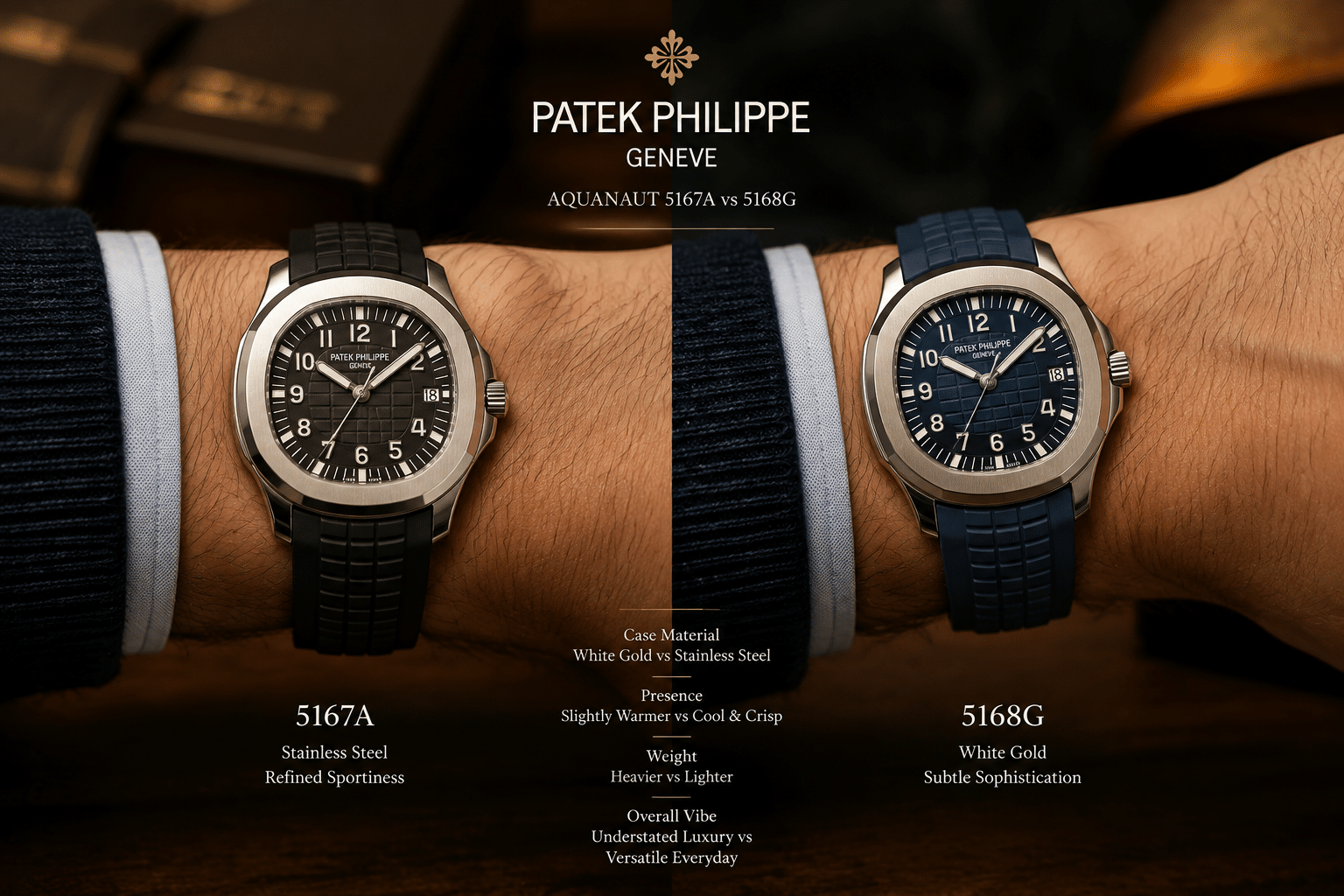
The 5168G size question is easy to misunderstand because the watch does not just look bigger in a simple measurement sense. Its Aquanaut proportions create a broader visual read before the wearer even notices how it sits physically. The dial opening, case outline, and the way the integrated strap carries the case all work together to make the watch feel more substantial than the number on paper suggests. That is why some buyers try it on and say it looks more serious than expected, even before they think about comfort.
Measured size only tells part of the story. What matters more is how much dial is visible, how much of the case surface is exposed, and how the watch sits against the wrist line. A reference can be only modestly larger on paper and still feel much bigger because the visual mass is distributed differently. On the 5168G, that broader read is part of the appeal. It gives the watch more authority. But it also means the watch is less forgiving if you prefer a balanced, low-profile look.
This is where many replica watch buyers overrate factory photos. A clean front-on image can make the watch look controlled, sharp, and perfectly scaled, but it cannot show how the case will sit when the wrist bends, or how far the strap ends flare out once the watch is actually worn. Those details matter more here than a dealer’s marketing line. The Aquanaut is not a model where the dial alone tells the story. The whole silhouette does.
Visual Size Is Not the Same as Measured Size
The biggest mistake buyers make is treating a millimeter difference as if it automatically explains the whole result. It does not. A watch can measure only slightly larger and still look much more open because the dial window feels wider and the case edges frame the wrist differently. In the Aquanaut family, that matters more than many people expect. The 5168G does not merely sit larger; it reads larger.
That is why the same reference can look right on one wrist and a little too assertive on another, even when the measured fit seems acceptable. The case profile and strap integration change how the eye interprets the watch. If you only compare dimensions, you miss the part that actually affects daily wear: the first impression from arm’s length.
For a careful buyer, the better comparison is not “which one is larger?” but “which one still looks composed once it is actually worn?” That distinction matters because some watches are easy to admire in isolation and harder to live with in motion. A larger Aquanaut can be attractive if it keeps its shape on the wrist. If it starts looking stretched, crowded, or too dominant, the measured difference becomes less relevant than the visual imbalance.
How Color Behavior Changes the Impression
The 5168G also has a stronger color personality, and that changes how large it feels. A more reflective or more saturated tone tends to pull attention to the watch head instead of letting the overall shape blend into the wrist. That makes the piece look more formal and more deliberate, but also more noticeable. A steel Aquanaut usually reads flatter and easier to live with because the visual tone is quieter.
Color behavior is one of the least discussed reasons buyers feel differently about these two references. People assume the issue is only size, but the finish can make a watch feel heavier in the eye even when the physical difference is not dramatic. On the 5168G, that effect is useful if you want presence. It is a drawback if you were hoping for something more discreet.
This also affects how seller photos should be read. Lighting can flatten the steel model and make the larger reference look more refined than it will appear in ordinary daylight. The opposite can happen too, where harsh lighting makes the more subtle watch look busier than it is in real use. A practical buyer should treat listing photos as a clue, not a verdict. The color and finish may be accurate, but the watch’s actual daily presence still depends on wrist size, sleeve width, and how reflective the case looks outside controlled lighting.
Why Wrist Shape Matters as Much as Wrist Size
Flat wrists, wider wrists, and wrists that carry a watch low all tend to make the larger reference work better. A wrist can measure large and still not suit the watch if the case sits high or the edges fall awkwardly. The reverse is also true: a smaller wrist can sometimes wear the larger model better than expected if the shape lets the case settle naturally. So the real question is not just wrist circumference. It is how the watch sits, how much of it visually spills beyond the wrist, and whether the overall silhouette still looks composed.
That is why on-wrist photos matter more than a spec sheet. Look at the amount of dial that dominates the wrist, the balance between case and strap, and whether the watch looks planted or overscaled. If the watch head is doing all the visual work, the larger reference may be too much. If the shape still looks controlled, the 5168G can be the stronger choice.
For buyers comparing replica listings, this is where QC images become useful without becoming decisive. QC photos can show alignment, printing, and whether the watch head is centered, but they cannot fully explain how the watch will look after a full day of wear on your wrist. The final call still depends on body proportions and how you plan to wear it. That is why the model should be judged as a complete wearing object, not just as a dial-and-case close-up.
What to Check in On-Wrist Photos
Use on-wrist photos to judge proportion first, not just size. The useful questions are whether the dial feels centered, whether the strap drops naturally, and whether the case dominates the wrist or sits as part of a clean line. That is more important than a catalog measurement because it shows how the watch will actually read in daily life.
Also check where the watch ends in relation to the wrist bone. If the lugs or strap shoulders visually overrun the wrist, the model can feel larger than expected even when the diameter sounds manageable. If the case nestles neatly and the strap flow stays clean, the larger reference may be the better visual match. The difference is subtle in photos but obvious in motion.
Steel Versus White-Gold-Style Feel: Weight, Balance, and Presence
On the wrist, the difference between the two references is not just about how much they weigh. It is about weight feel and precious-metal-style feel, which are related but not identical. The 5168G should feel more substantial in the hand and more present on wrist. The 5167A is usually the easier all-day piece because it feels lighter, less committed, and less likely to remind you it is there. That is the tradeoff buyers should care about most.
A watch can feel more premium without being more comfortable. In fact, the two often move in opposite directions. A more substantial feel can be satisfying when you first pick up the watch, but that same sensation can become tiring if you wear it for long stretches or switch between watches often. The better replica watch choice depends on whether you want the feeling of presence or the feeling of ease. Those are not the same thing.
This is also where movement choice deserves more attention than many beginners give it. On a model like the Aquanaut, the movement is not just a technical detail. It affects rotor sound, winding feel, power reserve behavior, and how confident the watch feels if it sits unused for a day or two. A movement that keeps time well but feels rough to wind can become annoying. A movement that is slightly less flashy in description but more stable in daily use can be the better ownership decision. Factory reputation only helps if it is attached to the specific movement and version the buyer is actually considering.
Perceived Heft Versus Real Wearing Fatigue
Perceived heft is the feeling that a watch has material substance and sits with confidence on the wrist. Wearing fatigue is what happens after hours of movement, desk time, and casual wear. A lot of buyers confuse the two because they try the watch on for a minute and judge it from that first feeling. That is not enough. The heavier-feeling option can be more satisfying in hand, yet still the one you take off sooner.
The 5168G leans toward that more substantial impression. It feels like a watch you chose on purpose, not one that happened to disappear under your sleeve. The 5167A leans toward the opposite: easier, lighter, and less demanding. If your normal routine involves long wear or you do not want to think about the watch all day, the lighter-feeling answer is often the smarter one.
That is especially true for first-time replica buyers, who sometimes assume that “more substantial” automatically means “better made.” It does not. A watch can feel heavier because it has the right amount of material, or because the case and strap proportions ask more from the wrist. The buyer has to separate the sensation of quality from the experience of comfort. Those are related, but they do not always point to the same watch.
How the Clone Construction Shapes the Feel
In a super clone watch, the case and bracelet construction shape the experience as much as the reference itself. If the build feels hollow, too light, or poorly balanced, the watch loses some of the substance the buyer expected. If the bracelet articulation and case integration are convincing, the watch feels more planted and more coherent on wrist. That matters a lot in this family because the Aquanaut relies on clean transitions and a calm overall feel rather than flashy surface details.
What buyers often notice first is whether the watch settles naturally or feels like it wants attention. A better-judged build feels controlled. A weaker one can feel top-heavy or too easy to notice every time the wrist moves. That does not just affect comfort. It affects whether the watch feels like a believable daily piece or like something you are always evaluating while wearing it.
In practical sourcing terms, this is also why “best factory” claims should be narrowed to the model and version, not treated as universal truth. One factory may be the better choice for one Aquanaut variant because of case shaping, strap finishing, or movement execution, while another factory can be stronger on a different reference. The factory name is useful context, not final proof. For a buyer at cleanvsfactory.com, the right question is whether the specific version has the movement, finish, and wear behavior that match the intended use.
What the Weight Difference Means in Daily Use
In daily use, the lighter-feeling 5167A is easier for desk work, commuting, and long periods of ordinary movement because it stays out of the way. The 5168G is better if you like to feel the watch with you and want the ownership experience to have more substance. That can be satisfying, but only if you actually enjoy noticing the watch. Some buyers do. Others get tired of it faster than they expect.
The practical rule is simple. Choose the 5167A if you want the more relaxed wear experience. Choose the 5168G if you want more presence and do not mind a watch that feels more deliberate on wrist. That is the real decision, and it matters more than any abstract idea of which one is “better.”
Price should be read in the same practical way. A higher price may reflect stronger finishing, a more desirable movement, lower availability, or simply a seller markup based on demand. It does not automatically prove the watch is better for you. If two listings differ in price, the buyer should ask what the price is actually buying: quieter rotor behavior, cleaner printing, more consistent case finishing, or just a more aggressive sales listing. That question is more useful than assuming the expensive option is the correct one.
Thickness, Strap Behavior, and How Each One Sits Under Clothing
The real comfort difference between the 5167A and 5168G is not just how each one looks on a bare wrist. It is how the watch behaves once a sleeve comes down, the wrist bends, and the strap has to work with your hand instead of sitting still for a photo. That is where the 5167A usually wins. It is the easier watch to forget about during the day, which is a more useful standard than simply asking which one looks more impressive at a glance.
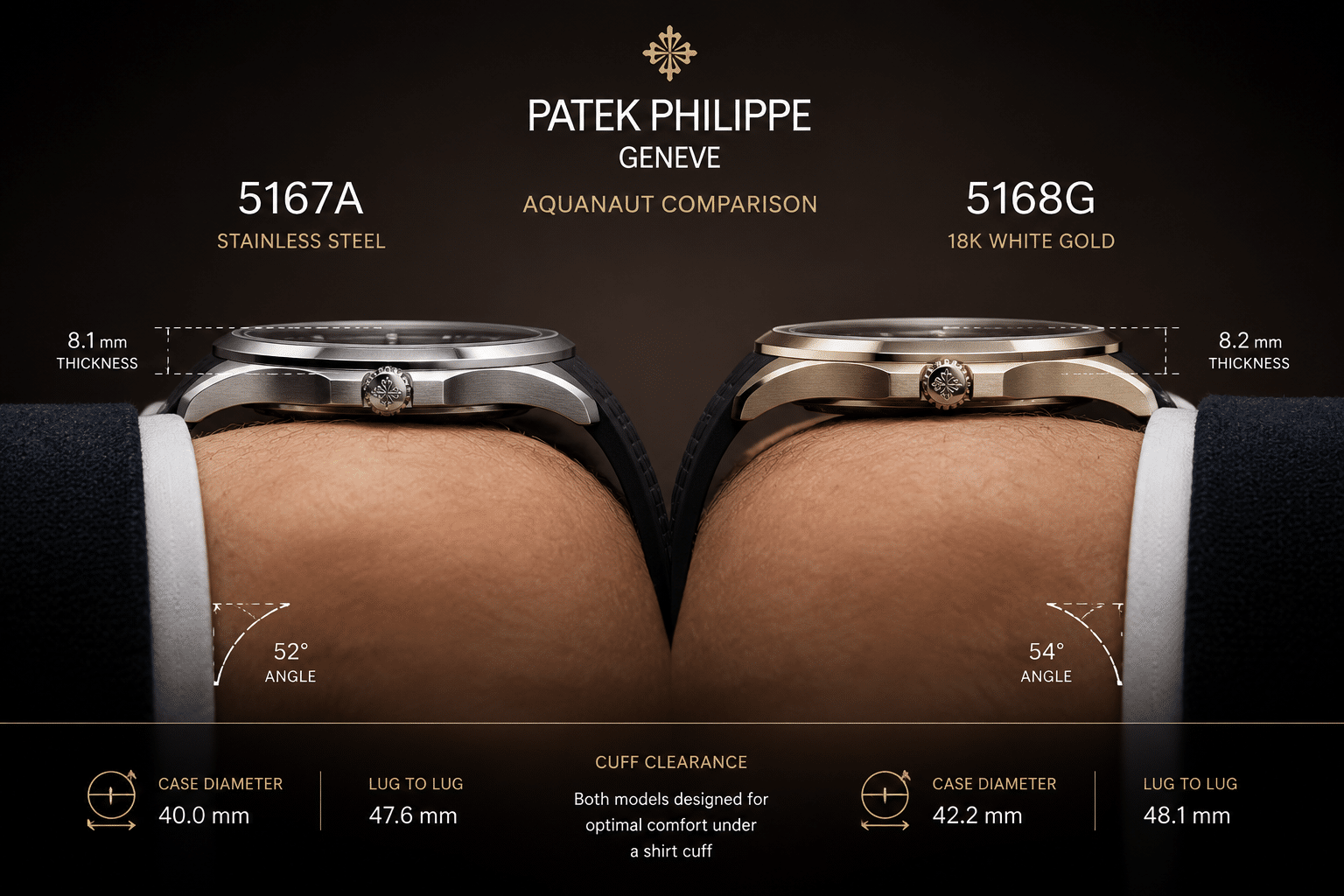
Case thickness matters because it changes how the Aquanaut enters your daily routine. A thinner watch slides under cuffs with less resistance, catches less at the edge of a sleeve, and feels more natural when your wrist is flexed at a keyboard or steering wheel. The 5167A has the better comfort profile for that reason. It does not demand attention from your clothing. The larger 5168G can still be wearable, but it is less forgiving. It asks for more space, and that extra physical presence becomes noticeable long before you are consciously thinking about size.
That is the practical point buyers miss when they only compare photos. A watch can look balanced in an overhead shot and still feel busy in motion. Once the case sits higher, the strap angle changes, and the watch begins to project farther from the wrist, the experience shifts. The 5168G is not simply a bigger version of the same feeling. It has more visual authority, but that authority comes with more friction in daily use.
Another useful detail is that case thickness and strap stiffness tend to amplify each other. A slightly taller case with a stiffer strap can make the whole package feel less settled even if the wrist size is technically acceptable. That is why buyers who only look at the headline dimensions sometimes end up disappointed. The better comparison is not just case height; it is how the case, strap, and clasp interact once the watch is worn for several hours.
Why Thickness Changes the Wear Impression
Thickness affects more than clearance. It changes how secure and calm the watch feels. A slimmer Aquanaut tends to sit flatter, which makes the strap wrap more naturally around the wrist. That flatness helps the watch disappear under a shirt cuff and keeps the silhouette clean when you move your hand. The 5167A benefits from that kind of behavior. It is the safer choice for buyers who value low interruption over drama.
The 5168G can still be comfortable if the wrist is broad enough and the wearer does not mind a stronger profile, but it is a more committed wear. It reads more like an object on the wrist and less like part of the wrist. For some buyers that is the appeal. For others it becomes tiring after a few hours, especially if they spend a lot of time at a desk or in clothing that does not leave much room around the cuff.
The judgment here is straightforward: if the watch has to disappear often, thickness is not a secondary detail. It is one of the main deciding factors. A slightly more assertive profile may look stronger in isolation, but the thinner reference is the one that usually survives real use with fewer annoyances.
Strap Feel Is Part of the Decision
The Aquanaut design depends heavily on the rubber strap, so comfort is not only about the case. Strap behavior shapes the entire wearing experience. A softer, more flexible strap settles into the wrist faster, bends more cleanly at the lugs, and reduces the sense that the watch is fighting your movement. A stiffer strap can make even a well-sized watch feel less natural, especially in the first days of ownership.
That matters more on the larger reference. If the strap does not break in well, the 5168G can feel top-heavy or overly present because the case already has more visual mass. The 5167A is more forgiving here. Even if the strap is not perfect out of the box, the overall package is easier to live with because the watch is not asking as much from the wrist to begin with.
Another point buyers underestimate is how strap tension changes over a full day. A watch that feels fine for ten minutes can become annoying after a long workday if the strap presses too hard at one point or if the clasp sits in a way that keeps reminding you it is there. For daily wear, that small annoyance matters more than a stronger first impression. The 5167A is the better bet if you want a piece you can put on in the morning and stop thinking about.
Movement choice also sits underneath this comfort discussion. A more complicated or less mature movement can add winding friction, service concerns, or rotor noise that becomes more obvious on a watch you wear often. A simpler, more stable movement may not sound exciting in a listing, but it can matter more after months of ownership. This is why the movement line in a seller description should be verified, not assumed. The buyer is not just choosing a case shape; they are choosing how the watch will behave after the sale is over.
Movement Transparency Note: Movement references in this article describe the replica-market movement type or configuration, not an official Patek Philippe caliber unless explicitly stated with verifiable evidence. Buyers should confirm the exact movement version, winding feel, and service expectations rather than assuming a listing label fully describes what is inside.
When Daily Comfort Matters More Than Wrist Presence
There are plenty of situations where the more modest watch is the smarter one. If you wear fitted cuffs, move between office and casual settings, or prefer a watch that stays out of the way, the 5167A is the easier answer. It is also the better first choice for buyers who are still learning how much watch they actually want to feel during the day. Many people think they want a bigger statement until they live with it for a week and realize that comfort is what keeps a watch in rotation.
The 5168G makes more sense when the buyer has already decided that a stronger wrist presence is part of the goal. If the watch is meant to be noticed, if the wearer has a broader wrist, or if the outfit is usually more relaxed, the larger reference can be justified. But the reason should be deliberate. Choosing it only because it looks more dramatic in photos is a weak reason. The daily-wear compromise is real, and it shows up fast once the watch stops being a fresh comparison piece and starts being part of a routine.
A useful self-check is to ask whether the watch needs to fit your lifestyle or your mood. If the goal is a watch you can wear in more situations without thinking about it, the 5167A is the more practical answer. If the goal is to feel the watch as part of the outfit, the 5168G can deliver that. The wrong choice is usually the one made from a photo comparison alone, before the buyer has thought through how often the watch will actually be on wrist.
Which Buyer Profile Fits Each Reference Best?
The cleanest way to choose between the 5167A and 5168G is to stop treating them as two equally attractive versions of the same idea. They serve different buyers. The 5167A is the low-friction Aquanaut, the one most people can wear for long stretches without thinking about it. The 5168G is for the buyer who wants the Aquanaut to read more boldly and is willing to accept that the watch will be a more visible part of the outfit.
If you want the least likely disappointment, start with your wearing habits, not with the photo that looks more impressive. The wrong choice here is usually not a bad watch. It is a watch that becomes slightly annoying because it does not fit the way you actually live.
Best Fit for the Discreet Daily Wearer
The 5167A is the better fit for buyers who want a watch that can move through an ordinary day without calling attention to itself. It works better for smaller wrists, more formal clothing, and anyone who wants a replica watch that feels easy rather than assertive. It is also the more rational choice for a first replica watch in this family because it is easier to judge on the wrist and less likely to feel excessive after the novelty wears off.
This is the version to choose if your standard is simple: comfortable, balanced, and easy under clothing. The smaller reference usually gives you that with fewer compromises. It does not try so hard to be noticed, which is exactly why it is easier to live with.
That ease also makes it easier to verify against seller images. When the watch is meant to be subtle, the buyer can focus on the practical cues that matter most: dial alignment, strap integration, clasp finishing, and whether the case looks clean from the side. It is not the reference that depends most on dramatic photos. It is the one where small execution details add up into a better ownership experience.
Best Fit for the Presence-First Buyer
The 5168G suits buyers who want the Aquanaut to have more visual authority. If you like a watch that reads as a statement piece, if your wrist can support a larger profile, and if you do not expect it to vanish under every cuff, the bigger reference makes sense. It has a more assertive personality, and for some buyers that is the whole appeal.
It is also the better match if you tend to wear open cuffs, casual clothes, or looser sleeves where the watch has room to exist. In that setting, the larger model can feel more intentional and more substantial. The key is accepting that you are buying presence, not just size.
The buyer should also think about how much visual attention they actually want from a replica watch. A larger, more noticeable piece can be satisfying, but it can also draw more scrutiny from people who notice watches. That does not make it a bad choice. It just means the buyer should be confident in the size and finish rather than assuming the watch will blend in as easily as the smaller version.
Where Buyers Often Misjudge the Tradeoff
The most common mistake is assuming that the more impressive-looking watch is automatically the better ownership choice. That is rarely true. Buyers often focus on first impression and then discover that the bigger reference is more noticeable than they wanted, less convenient under clothing, or simply less natural for all-day wear. The reverse mistake happens too, where a buyer chooses the safer option but later wishes for more visual impact. Both are avoidable if you decide based on routine rather than excitement.
A better filter is to ask which version you will still like after the first week. If subtle wear, cuff clearance, and comfort matter most, the 5167A is the smarter pick. If you are specifically chasing a stronger wrist statement and accept the extra presence that comes with it, the 5168G is the right way to go. That is the whole decision in plain terms.
In CleanVSFactory terms, the useful comparison is not “which factory is universally better,” but “which version is better for this reference and this wrist.” A watch can look convincing in a factory photo set and still wear less naturally once strap drop, case height, and cuff space are involved.
When a seller description leans heavily on factory labels or listing language, it can distract from this practical question. “Best factory” is not a complete answer unless it is tied to the model and the buyer’s actual use. In this category, a watch that photographs well is not automatically the same as a watch that wears well. The buyer needs both pieces of information, but wearability should stay in the lead if the goal is an everyday piece.
What to Confirm Before You Decide
Check your wrist size honestly, but do not stop there. Think about sleeve width, how often you wear fitted cuffs, whether you spend long hours at a desk, and how much visual attention you want the watch to attract. The best Aquanaut choice is the one that matches your daily use, not the one that looks strongest in isolation.
Also verify the movement and version details before relying on the listing. For a watch that may be worn often, movement behavior matters more than many beginners expect. Rotor noise, winding feel, power reserve consistency, and serviceability all affect ownership in ways that a dealer photo cannot show. A clean listing can still hide a movement choice that is less attractive for a long-term wearer. That is why the buyer should treat QC photos as evidence, not final proof.
Quality Control Note: For replica and super clone Aquanaut watches, buyer confidence depends on visible quality-control details such as dial printing, date window alignment, bezel finishing, strap fit, clasp engraving, and case symmetry. These details should be checked model by model rather than assumed from a factory name alone.
How to Read Factory and Movement Claims Safely
Movement descriptions in the replica market should be checked carefully because they may refer to layout, decoration, clone architecture, or seller terminology rather than an official brand-manufactured caliber. A label can narrow the version, but it does not settle the ownership experience on its own.
The most useful way to read those claims is to ask what they change in practice. Does the watch wind smoothly? Does the rotor sound acceptable? Does the power reserve fit your wearing habits? Can the movement be serviced with reasonable expectations later? Those questions are more valuable than treating a movement name as a final answer.
The same logic applies to factory names. A factory reference can help you compare visible execution, but it should never be treated as proof of official brand affiliation, universal quality, or identical results across every model. That is especially true when the listing is trying to sell certainty with broad language instead of showing the exact version you will receive.
What to Verify Before Ordering
The cleaner way to buy either reference is to treat the listing as a starting point and the QC evidence as the actual decision layer. The watch should be judged against the reference, the version, and the seller’s photos, not just the factory name. A buyer who can line up those three pieces of information usually makes a more defensible choice than someone who focuses only on the brand of the replica-market factory.
- Confirm the exact reference and version being offered.
- Ask whether the photos are stock images or the actual watch.
- Review the dial, hands, datewheel, and clasp for visible alignment issues.
- Check strap curvature and case thickness against the wrist profile you plan to wear.
- Verify the movement description before assuming the listing text is exact.
- Confirm return, repair, shipping, and after-sales terms before ordering.
This is a practical filter, not a promise. It reduces the chance of buying the wrong version, but it does not remove the need to inspect the watch carefully when it arrives.
QC photos reduce uncertainty, but they do not remove it. A buyer still needs to check the exact reference, the version being offered, and the seller’s visible evidence before treating any factory label as final proof.
What the Official Baseline Can Actually Prove
Patek lists the Aquanaut 5167A with a steel case, rubber strap, date, and central seconds, so that official page is the cleanest authentic baseline for the smaller reference in this comparison.[1] That matters because a replica listing should be judged against the real watch’s configuration first, before the buyer starts thinking about factory labels or seller adjectives.
The official page is still useful because it tells you the design intent, the reference layout, and the intended complication set. It does not tell you how a replica-market version handles dial printing, case sharpness, strap stiffness, or long-term wear. Those are still watch-by-watch questions.[1]
That baseline also helps keep the discussion honest. The official page can tell you what the authentic model is supposed to be, but it cannot tell you whether a specific replica has the same case geometry, movement behavior, finishing consistency, or long-term service profile. Those are separate questions, and buyers should treat them separately.
Replica Risk, Trade Marks, and Border Issues
Replica watches are not just a styling choice. USPTO treats counterfeit goods as unauthorized goods that use protected marks without permission, and CBP warns that infringing goods can be detained or seized at the border.[2][3] That is why any discussion of a super clone should stay careful about legality, customs, resale, and disclosure instead of sounding as if the watch is routine merchandise.
The practical takeaway is narrow: do not assume that a watch being sold online makes the underlying trademark or import issue disappear. Replica buyers should understand that they are dealing with imitation products, not authorized goods from the brand, and the risk picture changes with jurisdiction and how the watch enters the market.
What This Comparison Is For
The purpose of factory and movement information is to help readers understand size, wear, and risk more clearly. It is not to help a replica watch be represented as genuine, passed off as authentic, or described as an original luxury watch when it is not.
A convincing super clone may look good in normal wear, but close inspection can still reveal differences in finishing, movement architecture, case proportions, bracelet feel, dial details, or service compatibility. Buyers should not assume that a strong visual match removes the need for honest disclosure or careful checking.
How to Read Movement Claims
If a listing names a movement such as the Miyota 9015 or Sellita SW200-1, the official specs define that movement family’s technical baseline, including its core operating characteristics and dimensions.[4][5] That is useful context, but it does not prove that a particular replica watch actually contains that caliber. For the buyer, the movement line in the description is a claim to verify, not a fact to assume.
When a seller uses names like Miyota 9015 or Sellita SW200-1, the safest reading is that the listing is describing a movement family or configuration, not proving the exact caliber in the watch. The official specs define the baseline characteristics of those movements, but they do not verify a replica listing on their own.[4][5]
This is also where the wearability discussion connects back to ownership. Movement behavior affects winding feel, rotor noise, power reserve handling, and service expectations, so a cleaner-looking listing is not automatically the better long-term choice. A buyer who cares about daily wear should ask for movement confirmation as part of QC, not after the watch is already in hand.
Bottom Line
If you want the easier daily watch, the 5167A remains the better answer because it is the more restrained, less demanding Aquanaut. If you want more wrist presence and accept the tradeoffs that come with a larger profile, the 5168G is the better fit. The right choice is the one that matches your routine, not the one that looks strongest in a listing photo.
References
[1] Patek Philippe, “Patek Philippe Aquanaut 5167A official specifications,” official Aquanaut 5167A collection page used as the baseline reference for the steel Aquanaut in this comparison, available at Patek Philippe Aquanaut 5167A official specifications.
[2] USPTO, “USPTO Counterfeit Goods Basics,” guidance on counterfeit goods and trademark boundaries, available at USPTO Counterfeit Goods Basics.
[3] U.S. Customs and Border Protection, “U.S. CBP Intellectual Property Rights,” official guidance on IP enforcement and infringing imports, available at U.S. CBP Intellectual Property Rights.
[4] Miyota, “Miyota 9015 official movement specifications,” official movement specifications for the 9015 caliber, available at Miyota 9015 official movement specifications.
[5] Sellita, “Sellita SW200-1 official technical documentation,” official technical document for the SW200-1 caliber, available at Sellita SW200-1 official technical documentation.
Disclosure: This article is for general educational and comparison purposes only. Replica watches are not genuine products from the original luxury brands, and brand names are used only to identify reference designs or comparison topics. Factory names, movement descriptions, prices, availability, QC details, seller policies, and version information can change, so readers should verify important details with the seller before making a purchase decision. Replica watches should not be represented, resold, or used as genuine watches.