
I’m reading the article against the compliance module and adding a few new sections that tighten the replica-vs-genuine boundary, factory/movement interpretation, and QC limitations without flattening the piece. I’ll keep the existing placeholders in place and preserve the article’s structure while appending the new material where it fits.
The Patek Philippe Aquanaut 5968A is easy to underestimate because the dial looks restrained, but that restraint makes the buying decision more exacting. With so little visual clutter, any issue in subdial alignment, hand position, or dial balance shows up immediately. This article focuses on the checks that matter most: whether the chronograph layout sits cleanly, whether the pushers feel deliberate instead of vague, and whether the watch wears with the right balance rather than just the right dimensions on paper.
It also looks beyond photos. For this model, case height, wrist presence, rotor noise, and service risk can matter more than a clean movement shot or a low asking price. The goal here is to help you judge when a 5968A example is coherent enough for regular wear, when a cosmetic flaw is minor, and when the mechanical trade-off is too much for a watch that should feel sporty, not fragile.
For orientation, Patek Philippe’s Aquanaut 5167A shows the authentic family baseline: a steel sports watch with a rubber strap, date, and central seconds. That helps anchor the comparison, but it does not prove anything about replica execution, movement route, or wrist feel.[1]
| Decision Point | What to Check | Why It Matters |
|---|---|---|
| Subdial alignment | Centering, spacing, and symmetry head-on | Small errors stand out on this open dial |
| Pusher feel | Firmness, reset response, and consistency | Weak or vague action lowers confidence |
| Case height | How the watch sits and drops from the lugs | Height affects comfort more than width alone |
| Movement behavior | Rotor noise, chronograph operation, serviceability | Mechanical risk matters more than a clean photo |
| Wear profile | Balanced fit versus top-heavy feel | Some examples look fine but wear poorly |
| Buyer tolerance | Acceptance of cosmetic versus mechanical compromises | This model suits careful buyers, not casual ones |
Editorial Perspective: For a model like the 5968A, factory reputation is only a starting point. The more useful buying question is whether the specific version, movement route, case thickness, and chronograph behavior fit the way you plan to wear it. A factory name can narrow the shortlist, but it does not by itself prove that the watch will wear well, reset cleanly, or hold up under daily use. At cleanvsfactory.com, this kind of comparison is treated as model-specific and use-case-specific, because the same factory can be a better or worse choice depending on the version and the buyer’s priorities.
Quick Questions Before You Read
Q: Is the 5968A better judged by photos or by wrist feel?
Wrist feel matters more. Photos can hide height and balance issues.
Q: What detail should I check first on this model?
Start with subdial alignment and overall dial symmetry. They are hardest to ignore.
Q: Does pusher feel really matter on a super clone chronograph?
Yes. It is one of the clearest signs of whether the watch feels coherent in use.
Q: Is this a good beginner pick?
Only if you are comfortable weighing mechanical risk and doing careful QC.
Why the Aquanaut 5968A Is Harder Than It Looks
The Aquanaut 5968A super clone works because the watch looks easy to understand at a glance. It has a clean sport-watch profile, a straightforward dial layout, and enough visual breathing room that it does not feel overloaded the way some chronographs do. That is exactly why buyers underestimate it. The 5968A chronograph replica does not ask for attention in the same way a busy complication watch does, but it still carries the ownership burden of a chronograph: more moving parts, more chances for uneven feel, and more ways for a good-looking watch to disappoint once it is actually worn.
The important judgment is this: the 5968A is not difficult because it is visually dramatic. It is difficult because its visual calm hides mechanical and wearability tradeoffs. A buyer can be impressed by the first photo, approve the watch quickly, and only later discover that the real question was never “does it look close?” but “does it still feel coherent once the chronograph is part of daily use?” That difference matters more here than it does on a simpler Aquanaut or a basic three-hand replica watch.
There is also a buyer-behavior issue that comes up often with this model. People sometimes treat a clean factory label or a confident seller description as if it settles the decision. It does not. For a complicated replica like the 5968A, the factory name can help frame expectations, but the real question is whether the watch being offered matches the intended use. A piece that looks strong in QC can still be the wrong choice if the buyer wants a lower-risk daily wearer rather than a more delicate chronograph experience.
That is why the more useful comparison is not simply “which factory is best” but “which version is most sensible for the buyer’s purpose.” On a watch with this much mechanical and visual sensitivity, that distinction matters more than broad rankings do.
Factory Name Clarification: Factory names in the replica watch market are commonly used buyer-facing labels. They should be treated as practical market references, not as official brand affiliations, audited manufacturer identities, or guarantees of identical quality across every model.
The visual appeal buyers notice first
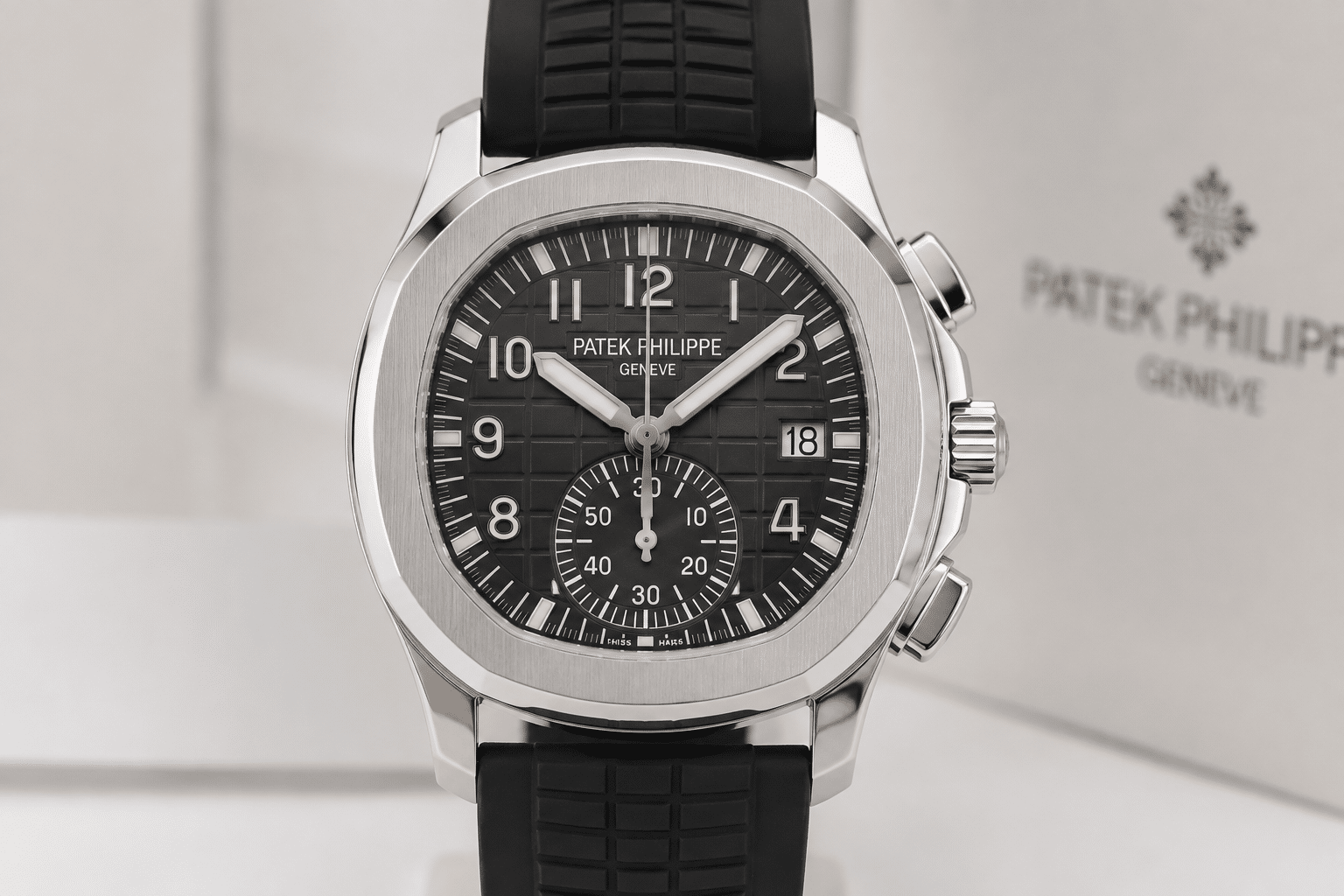
The first thing the 5968A gets right is the balance between an athletic case and a dial that does not feel crowded. The shape is modern enough to look current, but restrained enough that it still reads as a luxury sports watch rather than a loud chronograph. That is a strong starting point for a super clone watch because the design itself does some of the work. If the case lines are decent and the dial is centered well, the watch can look convincing in normal photos before the buyer has even started worrying about smaller details.
That visual simplicity is also why many buyers assume it will be an easy purchase. It is not. Against a detailed Patek Philippe Aquanaut super clone execution review, a sporty replica watch with an open dial can look forgiving from across the room, but the same openness also makes proportion errors easier to notice once you are used to the watch. The 5968A does not have the visual clutter that can hide mistakes. If the case wears too tall, the dial feels off-center, or the front side looks a little strained, there is less decoration to distract from it. In practice, the watch has to earn its appeal through proportion, not ornament.
In practical terms, that means photos should be read as a filter, not a verdict. A good factory image or a polished seller shot may confirm that the watch is directionally right, but it does not prove the example is the right one to buy. The buyer still has to decide whether the visible strengths outweigh the specific weaknesses in the version on offer. That is a more careful standard than simply accepting that a familiar factory badge means the watch is automatically the correct choice.
Why chronograph complexity changes the ownership equation
Chronograph architecture changes the buyer’s experience even when the watch looks clean in photos. A time-only watch mainly asks whether the case shape, dial printing, and bracelet feel are convincing. A chronograph adds another layer: the watch must also behave like a coherent instrument when the start, stop, and reset functions are used. That means the ownership test is broader from the beginning. The 5968A can pass a visual check and still leave the owner with a watch that feels less satisfying than expected on the wrist.
That is the main reason this model is harder than it looks. The buyer is not just paying for appearance. They are accepting a daily wear tradeoff where the chronograph function, case height, and wrist balance all matter at the same time. Even if the watch looks sporty and refined in a product photo, the real-world question is whether those traits survive movement on the wrist. On a simpler replica, you can often separate visual accuracy from comfort. On the 5968A, they are tied together. If the watch feels bulky or awkward, the visual appeal loses some of its value immediately.
For that reason, the 5968A is best treated as a model that rewards realistic expectations. It is more demanding than it appears, and the buyer who understands that early is less likely to overrate a clean first impression. The right way to judge it is not by asking whether it looks premium in isolation, but by asking whether the overall package still makes sense once chronograph complexity is part of the equation.
Dial Layout: Subdial Alignment, Hand Position, and Symmetry Checks
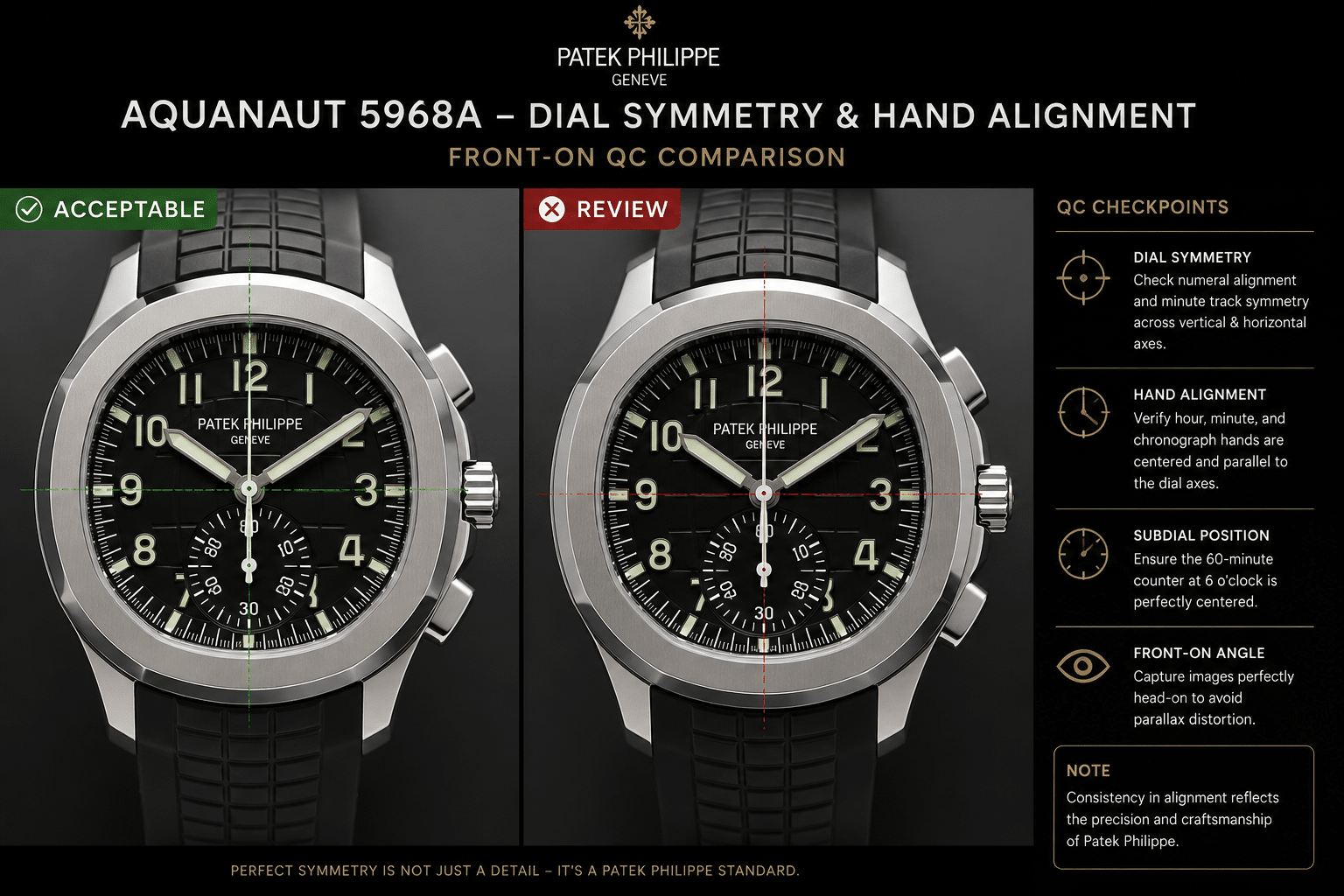
On the 5968A, the front of the watch does a lot of the persuasive work. If the subdials sit correctly, the hands land cleanly, and the whole dial feels calm rather than compressed, the watch immediately looks more expensive than a casual replica. That makes dial symmetry the first meaningful QC filter. Before worrying about anything mechanical, the buyer should ask a simple question: does the front view feel naturally balanced, or does it look slightly strained in a way that is hard to ignore once noticed?
The mistake many buyers make is judging the watch from a flattering angle or a narrow crop. A dial can look excellent in a close photo and still feel wrong when viewed straight-on. That is especially true with a chronograph, where register placement, hand position, and the spacing around the center all need to work together. The 5968A does not have much visual noise, so the eye goes directly to alignment. If something is off, it tends to stay off.
One practical point that matters more than model-name hype: replica quality is often more about execution on the individual watch than about the logo on the caseback or the factory name in the listing. Two examples from the same factory can feel different if one has cleaner alignment, better hand setting, and less visible tension in the dial. For that reason, QC photos should be read as evidence about the exact piece, not as proof that a factory always produces the same result.
What a clean dial layout should feel like
A clean dial layout is less about perfect symmetry in the abstract and more about whether the eye moves across the face without stopping. On the 5968A, the subdials should feel integrated into the dial rather than pasted onto it. The registers need to look like they belong in the available space, not squeezed into it. Marker spacing should feel even, and the hands should sit in a way that does not crowd the center or make one side feel heavier than the other.
The practical sign of a good layout is calmness. When the watch is viewed head-on, nothing should seem to pull the eye awkwardly left or right. The date window, if present in the version being inspected, should not dominate the right side of the dial or fight with the chronograph registers for attention. This is one of those details that buyers often underestimate because it sounds minor on paper. On the wrist, it is not minor. A dial that feels balanced is far easier to live with than one that is technically acceptable but visually tense.
The best 5968A examples do not look busy. They look controlled. That distinction matters because the model’s appeal depends heavily on the sense that the dial has room to breathe. If the layout feels crowded, the whole watch loses the easy sport-luxury character that draws buyers to it in the first place.
Which alignment issues matter most in QC photos
The flaws that deserve the most attention are the ones you can see without hunting for them. A subdial that looks visibly off-center, a hand that does not settle cleanly, or a register that appears to sit at an odd angle are not small issues. Those are the kinds of problems that remain visible after the watch is taken out of the QC photo and worn in normal light. They affect first impressions because the eye keeps returning to them.
Smaller issues deserve less emotional weight. Slight variations in camera angle, exposure, or reflections can make a dial look asymmetrical when it is not. Buyers get tripped up when they treat every photo artifact as a defect. The better approach is to look for repeated patterns across straight-on images. If the same register, marker, or hand position looks questionable from multiple angles, that is worth treating as a real issue. If it only looks odd in a tilted or shadowed shot, it may be a photography problem rather than a watch problem.
The core rule is simple: judge the dial by how it reads head-on, not by how dramatic it looks in a single image. The 5968A is unforgiving in that sense. Because the face is relatively open, the buyer does not have much visual camouflage. Good alignment produces a watch that feels composed. Weak alignment produces a watch that feels slightly off even before the mechanical side enters the discussion.
QC Photos to Request
Ask for a straight-on shot, not just a angled glamour photo. The best QC images for this model show the dial centered in frame, the hands positioned so their alignment can actually be read, and lighting that does not wash out the spacing between subdials and markers. If the photo is too dark, too reflective, or too tilted, it becomes easier to miss the very problems you are trying to catch.
Pusher Feel and Reset Behavior: The Mechanical Test That Exposes Quality
The pusher feel is where the 5968A stops being a photo exercise and becomes an ownership question. A chronograph can look tidy from the front and still feel wrong the moment the buttons are used. That is not a small concern. The pushers are the part of the watch that turn the visual object into a working mechanism, and on a super clone watch, that transition is often where quality differences become obvious fastest.
For the buyer, this is the most practical test of whether the watch feels convincing. If the pushers respond cleanly, the chronograph starts and stops with confidence, and the reset action lands in a way that feels deliberate, the watch has a much better chance of feeling coherent day to day. If the buttons feel vague, too stiff, or inconsistent, the watch may still look good but it will not feel settled in use. That distinction matters more than many buyers expect because the hands-on experience is where a chronograph proves itself.
A useful way to think about this is that pusher behavior tells you whether the watch is merely assembled or actually integrated. The watch can have the right shape and still fail the practical test if the chronograph interaction feels disconnected. This is where movement choice and build quality start to matter more than seller adjectives. A listing can call something “top quality,” but the buttons are what tell you whether the claim has any practical meaning.
How a good chronograph response should feel
A good chronograph response feels controlled. The pusher travel should not feel loose or vague. There should be a clear point where the button engages, and the action should not seem to hesitate or grind on the way down. When the chronograph starts, the response should feel immediate enough that the watch seems intentional rather than fussy. When it stops, the hand should not appear to wobble or lag in a way that breaks the sense of precision.
The best way to think about this is in terms of mechanical feedback. A solid chronograph gives the wrist useful information through the pushers. The buttons should feel like they are connected to a real mechanism, not like they are operating a decorative function hiding behind the dial. That does not mean every press has to feel identical to a genuine Patek Philippe, but it does mean the watch should avoid the sloppy, rubbery, or over-tight behavior that makes a chronograph feel artificial.
Owners often focus on whether the chronograph works at all. That is too low a bar. Function alone is not enough here. The 5968A needs to feel stable in the hand, and the pushers are where that stability becomes obvious. A good pusher action can make the whole watch feel more complete. A weak one can make even a visually convincing piece feel compromised within seconds of handling it.
Why reset quality matters more than casual buyers think
Reset behavior is not just a technical detail. It is one of the clearest signs of how confident the chronograph feels. A clean return-to-zero gives the impression that the hands, levers, and pushers are working together as a system. A weak or imperfect reset does the opposite. Even if the watch still functions, the owner immediately feels that the mechanism is less refined than it should be.
This matters because reset is the moment when a chronograph reveals whether it is organized or merely operational. A watch that resets crisply gives the buyer reassurance that the function is usable without constant second-guessing. A watch that returns unevenly, or seems to settle with a little uncertainty, creates doubt every time it is used. That is a real ownership penalty. It does not show up in a still photo, but it absolutely changes how the watch is perceived after purchase.
The larger judgment here is that reset quality is not a minor cosmetic issue. It is a stress test. If the chronograph cannot return cleanly, it is harder to trust the rest of the experience. On a model like the 5968A, where the appeal depends partly on the credibility of the chronograph function, that credibility matters a great deal.
What pusher behavior can hint about long-term risk
Poor pusher behavior does not automatically prove a future failure, and it would be wrong to claim that from a single sample. But it can point to a watch that is less comfortable to own over time. If the buttons feel inconsistent, if the action seems unusually stiff, or if the response changes from one press to the next, that is a warning sign worth taking seriously. It suggests that the chronograph is not as settled as it should be.
That is especially relevant for a replica chronograph because the buyer is already taking on a more complex ownership profile than with a time-only watch. Extra complexity is manageable when the function feels clean and predictable. It becomes harder to justify when the tactile experience itself raises questions. The issue is not only whether the watch works today. It is whether the current buyer is likely to trust it enough to use it without hesitation.
For that reason, the pusher test should be treated as more than a novelty check. It is one of the clearest ways to judge whether the 5968A feels like a serious object or just a visually convincing one. On this model, that distinction is worth paying attention to.
Case Height, Wrist Balance, and the Wearability Penalty
The 5968A is easy to misread from photos. Flat-on, it still looks like a compact Aquanaut with a clean shape and a sporty dial. On the wrist, though, the chronograph changes the whole character of the watch. The case is not just thicker in a technical sense; it carries more visual weight, sits with more presence, and asks more from the strap and lugs to keep the watch feeling balanced.
That is the part many buyers underestimate. A simple Aquanaut replica can look slim enough to disappear under normal wear. A chronograph version can look similar in a front shot and still feel noticeably taller in daily use. On this model, case height is not a spec to admire. It is the main reason the watch may feel sporty and substantial rather than light and effortless.
The best way to judge it is not by reading a number in isolation, but by imagining how the watch moves when your wrist bends. If the case stands up too far from the wrist line, the watch starts to feel top-heavy. That does not just affect comfort. It also changes the way the Aquanaut bracelet integration reads from the side, because the whole watch-body relationship becomes more obvious. A well-fitted 5968A should still feel cohesive. A poor one will feel like the case and strap are working against each other.
Wrist balance matters more here than raw size. If the watch sits centered and the strap drops cleanly from the lugs, a little extra thickness is manageable. If the case rides high, the chronograph pushers and side profile become more noticeable than the dial, and the watch starts to feel heavier than its footprint suggests. That is the wearability penalty: the 5968A asks for tolerance that a simpler sports watch does not.
One non-obvious point: a slightly imperfect dial can be easier to live with than a watch that wears awkwardly. Buyers often fixate on front-facing symmetry because it is easy to judge in QC photos, but the wrong case height is the flaw you will notice every time you put the watch on. Comfort is not secondary on a daily piece. It decides whether the watch feels convincing after the first week.
For a replica buyer, this is where price alone becomes misleading. A more expensive listing does not automatically mean the watch will wear better. Some of the added cost may reflect movement route, case finishing, seller margin, or inventory scarcity rather than a meaningful improvement in fit. The practical question is not whether the price looks premium. It is whether the watch solves the wearing problem better than a cheaper alternative.
Why the Chronograph Changes the Aquanaut’s Feel
The Aquanaut line works because it usually wears with clean proportions and a relaxed profile. The 5968A adds a chronograph layer that makes the watch feel more engineered and less minimal. That can be a strength if you want presence. It becomes a weakness if you wanted the easygoing feel of a simpler sporty watch.
The buyer mistake is assuming the 5968A will wear like a standard Aquanaut with extra functions. It does not. It wears like a more committed watch, and that commitment shows up first in how much it occupies the wrist.
What Makes a Good Fit vs. a Tiring Fit
A good fit lets the watch stay visually compact even when viewed from the side. The strap follows the wrist naturally, the case does not feel perched, and the added height reads as intentional. A tiring fit is the opposite: the watch stays noticeable even when you are not looking at it, because the balance is off and the case does too much visual work.
The practical judgment is simple. If you already know you like watches with some thickness and you wear them as statement sports pieces, the 5968A can make sense. If you buy with comfort first and clean proportions second, the chronograph penalty is harder to ignore.
Movement Route, Rotor Noise, and Long-Term Service Risk
The movement side of the 5968A is where the ownership decision becomes less forgiving. A chronograph replica can look convincing from the front and still carry a movement route that affects how it feels to wind, how much noise it makes, how confidently it resets, and how much trouble it may become later. That is why movement photos matter here, but only as a starting point. A decorated bridge or familiar layout does not prove the watch will be pleasant to own.
What the buyer really needs to know is whether the movement route supports stable daily use or merely helps the watch look right in QC. Those are not the same thing. A chronograph mechanism adds moving parts, more potential friction, and more opportunities for poor finishing or inconsistent assembly to show up over time. On a watch like the 5968A, that risk matters more than on a simple three-hand sports replica.
This is also the section where the common “best factory” idea becomes too blunt to be helpful. A factory that performs well on one model may not be the sensible answer on another, especially when movement construction and thickness targets change. The question for the buyer is not which name sounds strongest in general. It is which version gives the best balance of look, reliability, and service practicality for this specific chronograph.
Movement Transparency Note: Movement references in this article describe the replica-market movement type or configuration, not an official Patek Philippe caliber unless the seller can support the claim with clear and verifiable evidence.
Movement descriptions in the replica market should be read as configuration references, not as official brand-caliber claims unless there is clear, verifiable evidence. Buyers should distinguish between movement layout, decoration, reliability, and actual serviceability. A clean bridge finish or a familiar rotor shape may help you understand the route, but it does not tell you how the movement will hold up after repeated chronograph use.
Why Rotor Noise Is Worth Paying Attention To
Rotor noise is one of the quickest clues to movement character. A muted rotor can make the watch feel more refined in hand, even if the movement is not perfect. A louder rotor is not automatically a dealbreaker, but it usually means the watch will never fully disappear in quiet daily use. You may notice it when lifting your wrist, adjusting the watch, or wearing it in a silent room.
That matters because the 5968A is a watch people often buy for the experience as much as the look. If the movement announces itself every time it moves, the ownership experience becomes more mechanical than elegant. That is acceptable for some buyers. For others, it is exactly the sort of annoyance that turns a promising replica into one they stop wearing.
What Serviceability Changes for a Chronograph
A chronograph is simply harder to keep healthy than a simpler replica watch. More parts need to work together, the start-stop-reset sequence puts more stress on the system, and the movement usually gives a watchmaker more to diagnose if something starts to feel off. That does not mean every 5968A is fragile. It does mean the repair path is less forgiving than buyers often assume.
The key ownership issue is not whether the watch can run today. It is whether the current movement route is realistic to live with after normal wear, minor shock, or eventual maintenance. If the answer depends on rare parts, uncertain labor quality, or a movement architecture that is awkward to service, the price premium starts to look less like quality and more like exposure.
For that reason, the buyer should compare the movement not only to the original watch, but also to the intended use case. If the goal is occasional wear and visual satisfaction, a more delicate route may be acceptable. If the goal is regular rotation and fewer surprises, the same route may be a poor fit even if the seller’s description sounds impressive.
What Movement Photos Can and Cannot Prove
Movement photos can confirm that a watch is not completely empty or crudely built. They can also show whether the route is broadly aligned with the style of the original. What they cannot prove is the part that matters most: how the chronograph will behave after repeated use.
A clean photo does not tell you whether the winding feel is consistent, whether the reset is crisp, or whether the watch will stay smooth after months of wear. It also does not reveal whether the movement is easy to service locally. For this model, those are the questions that matter more than decorative presentation.
It is worth separating two different ideas that are often blurred in listings: visual similarity and operational quality. A movement can be built to look convincing in a photo while still being a less practical ownership choice than a simpler route with fewer complications. For cleanvsfactory.com style buyer analysis, that distinction is central, because it stops the discussion from turning into a factory ranking contest and keeps it focused on what the watch will actually do after the sale.
Movement Route to Verify
Before treating the 5968A as a serious buy, verify the exact movement route for the batch you are considering, how the chronograph is built into it, and what the seller is actually promising about thickness and operation. If those answers are vague, the risk is not theoretical. It is part of the purchase.
How to Read Factory, Version, and Batch Claims
A factory name can be a useful starting point, but it should never be treated as proof that every watch from that source is equally good. On chronograph replicas, the better judgment is usually version-specific. One batch may have cleaner dial printing, a more convincing case profile, or better pusher action than another batch from the same factory. That is why the model, version, and visible execution matter more than a label in isolation.
Before making a decision, buyers should review real QC photos where available, including dial printing, hand alignment, bezel position, datewheel centering, bracelet fit, clasp engraving, case thickness, and overall finishing. Factory labels and stock photos alone are not enough for a reliable judgment.
QC photos reduce uncertainty, but they do not remove every risk. They help buyers judge visible execution before shipment, especially when factory names or stock photos do not show the exact watch being supplied. That makes QC useful as evidence, not as a promise. For a complicated watch like the 5968A, this is the right level of confidence to aim for.
Replica, Factory, and Movement Boundaries
Replica watches should be clearly understood as replica-market products, not genuine watches from the original luxury brands. Brand names are used here for reference and comparison only; they do not imply authorization, endorsement, or affiliation with the original luxury watch brands.
Factory names are useful market references, but they do not guarantee identical quality across every model or version. On a chronograph like the 5968A, a better comparison usually comes from the exact reference, version, movement route, case height, dial spacing, and QC evidence rather than from a universal factory ranking.
Movement descriptions in the replica market should be checked carefully because they may refer to layout, decoration, clone architecture, or seller terminology rather than an official brand-manufactured caliber. That is especially important when a listing sounds precise but does not provide enough detail to verify what is actually inside the watch.
QC photos can reduce uncertainty, but they do not guarantee perfection or future reliability. The most useful images are straight-on dial shots, side profiles, and close views that let you compare subdial spacing, hand position, pusher alignment, and case height on the exact watch being offered.
Water resistance should not be assumed from the model name, the caseback, or a polished listing. Buyers should confirm whether the specific watch has been tested, and even then replica watches should be treated more cautiously around water than genuine watches designed and serviced through official channels.
The purpose of factory and movement information is to help readers understand quality and risk, not to represent a replica watch as genuine. That boundary stays important even when the watch looks convincing in photos.
- A “perfect 1:1” claim should be treated as marketing language unless it is backed by specific, verifiable details.
- A factory label is only a starting point; the exact batch and visible QC matter more.
- Movement names should be read as configuration clues, not as proof of genuine brand manufacture.
- Any promise about inspection, authentication, shipping, or water resistance should be confirmed directly with the seller.
When the 5968A Is Worth the Risk, and When It Is Not
The 5968A is worth considering only if you accept that the watch is a compromise between visual appeal and mechanical caution. That is the central judgment. If you want the Aquanaut look with chronograph presence and you are comfortable treating the watch as a higher-maintenance sports piece, the model has a real case for itself. If you want a low-drama daily watch, this is probably the wrong place to spend your money.
The problem is not one flaw in isolation. It is the combination. A slightly imperfect dial can be tolerated. A bit of extra height can be tolerated. Even some rotor character can be tolerated. What becomes hard to justify is when all of those issues stack together and the watch still asks you to accept more mechanical risk than you would with a simpler replica.
Price deserves the same kind of discipline. On this model, a higher listing price may reflect a better movement route, tighter assembly, stronger demand, or simply a seller charging more because the watch is difficult to source. It does not automatically mean the watch is the better wear. A careful buyer should compare what the extra money is buying: lower noise, better pusher feel, cleaner dial execution, or just a more confident sales pitch.
When Small Visual Issues Are Acceptable
Small dial imperfections are easier to forgive if the watch otherwise wears well and the chronograph action feels controlled. Slight spacing differences, minor print variation, or small cosmetic asymmetries do not automatically ruin the watch. On a chronograph replica, the front end should be judged in context. If the watch is coherent on the wrist and the movement behaves well enough, modest visual flaws become secondary.
That said, this only works if the flaws stay modest. Once the visual issues start compounding with poor fit or mechanical roughness, the watch stops feeling like a smart compromise and starts feeling like a collection of excuses.
When the Mechanical Tradeoff Is Too High
The line gets crossed when the watch feels tall, noisy, or uncertain enough that you begin thinking about it while wearing it. That is usually the point where the pusher feel, rotor sound, thickness, or service risk has become too much for the money. A chronograph should add enjoyment, not create hesitation every time you press a button or set the watch down.
For buyers who want a set-it-and-forget-it experience, that tradeoff is usually not worth it. The 5968A may still look good in hand, but it no longer behaves like the easy sporty watch its shape suggests.
Which Buyer This Watch Suits Best
The right buyer for the 5968A is someone who values the design, understands that the chronograph adds real complexity, and accepts that the watch may be best enjoyed as a deliberate wear piece rather than a carefree daily driver. That buyer can live with moderate height, some mechanical caution, and the possibility that service will matter more than expected.
The wrong buyer is the one who wants the Aquanaut silhouette but expects simple ownership. If you are sensitive to thickness, annoyed by audible movement behavior, or unwilling to think about maintenance, this model will probably frustrate you. The cleaner choice in that case is a simpler replica with fewer mechanical compromises.
This is also where a model-specific comparison is more useful than a broad “top factory” claim. A factory that makes a stronger case on a different sports model may not be the right answer here if the buyer values lower risk and easier wear more than raw visual resemblance. The best option depends on whether the watch is meant for rotation, occasional use, or close visual comparison.
Replica watches are imitation products, not authorized goods from the original brand, and they can raise trademark, customs, import, resale, and disclosure issues depending on jurisdiction.[2][3] That is why seller confidence should be treated as a sales signal, not as a substitute for documentation or clear disclosure.
Buyer Expectation Note: No replica watch should be judged by factory reputation alone. A better decision usually depends on the specific model, movement version, case thickness, dial accuracy, bracelet quality, service risk, and how closely the watch will be inspected in real use.
Red Flags Before You Treat It as a Daily Wear Watch
If the seller cannot clearly explain the movement route, if the watch feels unusually tall in wrist shots, if the chronograph action sounds rough or vague, or if the case-to-strap transition looks awkward from the side, do not rationalize it. Those are not minor details. They are the signs that the watch is closer to a display piece than a comfortable everyday one.
The 5968A makes sense when the buyer values the look enough to accept the extra burden. It does not make sense when the buyer wants the watch to disappear into daily life. That distinction decides the purchase more than any front-facing photo ever will.
A practical QC workflow before payment
The most useful way to handle a 5968A purchase is to slow the process down into visible checks rather than relying on general confidence. Start with straight-on dial photos, then move to side shots, then ask for clear pusher and crown images, then ask how the watch behaves when the chronograph is started, stopped, and reset. That sequence matters because it separates visual correctness from mechanical behavior. A watch can pass one and still fail the other.
Do not let a polished sales description short-circuit that process. The watch should be treated as a specific object with specific strengths, not as a category label. Ask whether the subdials appear centered, whether the hands return to a sensible resting position, whether the case seems to sit evenly, and whether the strap integration looks natural from the side. Each question removes a little uncertainty. Taken together, they tell you whether the piece deserves to move from “interesting” to “acceptable.”
It also helps to compare the listing against the actual model behavior rather than against a seller’s language. If the seller says “top quality,” that phrase is not useful unless it is paired with evidence you can inspect. If the seller says the watch is “close to the reference design,” that is still not enough. The useful part is the visible detail: does the watch show the dial logic, thickness, and pusher behavior you would expect from the reference you had in mind?
For any replica or super clone purchase, the goal is not to prove authenticity. It is to reduce avoidable disappointment. That is a more honest standard and a more practical one. Buyers should keep in mind that counterfeit goods create legal and import exposure beyond the watch itself, and that disclosure and documentation matter because the risk follows the object, not just the webpage.[2][3]
How to read seller photos and descriptions
Seller photos often emphasize the parts that look best at a distance. That is normal, but it means the buyer has to read them with discipline. A dramatic angle can hide case height. Strong lighting can hide printing issues. A narrow crop can hide how the watch wears across the wrist. For the 5968A, the best photos are the least glamorous ones: straight-on, side profile, and a clear close-up of the pushers and crown.
The description language deserves the same skepticism. Words like “premium,” “high grade,” or “super clone” can be helpful only if they are tied to visible detail and clear movement information. If the seller cannot explain what is actually different about the version being offered, then the language is just noise. The buyer should ask simple follow-up questions and expect direct answers. If the answers are vague, that is information.
One practical habit is to compare multiple examples side by side rather than deciding from a single listing. The 5968A rewards comparison because the design is restrained. Differences in dial balance, case thickness, and hand position become easier to see when two examples are set against each other. That does not guarantee the better piece, but it makes weak pieces easier to reject.
It is also worth keeping a record of the exact claims made before purchase. If the seller described a specific movement route, pusher action, or thickness target, that description becomes part of the evaluation later. It is much easier to judge whether a watch matched the listing when the claims were written down before payment rather than remembered after the fact.
What to inspect after it arrives
Once the watch is in hand, the first pass should focus on behavior, not excitement. Start the chronograph, stop it, reset it, and repeat the cycle more than once. Listen to the rotor in a quiet room. Check whether the hands clear the subdials cleanly and whether any part of the dial looks more awkward under natural light than it did in QC images. Early handling can reveal issues that were not visible in static photos.
Wrist time matters because some flaws only show up after the watch has been worn for several hours. A case that seemed fine in a photo can feel too prominent once you have moved through a normal day. A pusher that felt acceptable at the desk may seem less convincing when used repeatedly. The watch should be judged as a working object, not as a brief unboxing experience.
If the watch feels too tall, too loud, or too uncertain during that first week, do not talk yourself into ignoring it. That initial discomfort usually does not disappear on its own. It either becomes familiar enough to accept or it becomes the reason the watch stops getting worn. The 5968A is a model where early honesty saves time later.
And if the watch does work for you, keep the assessment practical. A good example is not one that solves every concern. It is one that stays coherent enough that the dial, pushers, height, and movement behavior do not fight each other every time you put it on. That is a realistic standard and the right one for this model.
Buyer Checklist Before Payment
- Confirm the exact version and do not assume one factory label tells you everything about the watch.
- Request straight-on dial photos, side profiles, and close images of the pushers and crown.
- Check subdial spacing, hand position, and whether the dial feels balanced head-on.
- Ask what movement route is inside the watch and what the description actually refers to: layout, decoration, or operational behavior.
- Compare the case height and wrist balance against the way you plan to wear the watch.
- Decide whether you are buying for occasional wear, rotation, or daily use, because the same watch can fit one use case and miss another.
Buyers should also confirm return, repair, shipping, and after-sales terms before ordering, because those details vary by seller and are separate from the watch itself. That does not reduce replica risk to zero. It only keeps product evaluation, seller terms, and buyer expectations from getting mixed together.
References
[1] Patek Philippe, “Patek Philippe Aquanaut 5167A official specifications,” official Aquanaut collection page, available at Patek Philippe Aquanaut 5167A.
[2] USPTO, “Counterfeit Goods Basics,” U.S. Patent and Trademark Office, available at USPTO Counterfeit Goods Basics.
[3] U.S. CBP, “Intellectual Property Rights,” U.S. Customs and Border Protection, available at U.S. CBP Intellectual Property Rights.
Disclosure: This article is for general educational and comparison purposes only. Replica watches are not genuine products from the original luxury brands, and brand names are used only to identify reference designs or comparison topics. Factory names, movement descriptions, prices, availability, QC details, seller policies, and version information can change, so readers should verify important details with the seller before making a purchase decision. Replica watches should not be represented, resold, or used as genuine watches.