
Patek Philippe replica pricing is difficult to judge because watches that look similar in seller photos can be very different on the wrist. A lower-priced piece may capture the basic shape, while still missing the slim case profile, dial texture, bracelet comfort, date alignment, or movement behavior that make models like the Nautilus, Aquanaut, and Calatrava harder to replicate convincingly.
This guide helps separate budget replicas, stronger super clone options, and expensive Franken builds by asking a practical question: does the extra money fix a weakness you can actually see, feel, wear, or service later? The article focuses on where higher spend may be justified, where it becomes unnecessary complexity, and why a well-executed super clone can sometimes be a more sensible daily-wear choice than a costly parts-upgraded build.
Replica watches should be clearly understood as replica-market products, not genuine watches from the original luxury brands. Brand names are used here to identify the genuine reference design being discussed, but they do not imply authorization, endorsement, partnership, or affiliation with Patek Philippe or any other luxury watch brand.
The dollar examples in this guide should be read as practical tier markers, not fixed market quotes. Replica pricing can shift by seller channel, factory claim, movement route, shipping method, QC standard, after-sales support, availability, and buyer location. A watch described as a budget tier, mid-tier super clone, or high-cost build still needs model-specific checking before the price says anything useful about quality.
| Price Tier | What To Check First | Buyer Judgment |
|---|---|---|
| Budget replica | Case thickness, date position, dial texture, bracelet comfort | Accept only if compromises are mostly visual and the movement is simple enough to maintain |
| Mid-tier super clone | Side profile, bezel shape, dial execution, QC photos | Often a stronger value range when the factory version solves visible proportion and handling issues |
| High-cost Franken build | Verified parts, fitting work, movement route, service plan | Worth considering only when upgrades fix clear flaws rather than adding vague prestige |
| Nautilus models | Bracelet feel, case thinness, bezel shape, dial depth | Usually benefits from a higher budget because weak construction is easy to notice |
| Complicated models | Function reliability, case thickness, repair risk | Approach carefully; attractive photos may hide fragile or difficult-to-service mechanics |
Quick Questions Before You Read
Q: Is a more expensive Patek replica always better?
No. A higher price only makes sense when it improves proportions, finishing, movement behavior, or service confidence in a way you can verify.
Q: When is a super clone more practical than a Franken build?
For daily wear, a well-executed super clone may be easier to own if it avoids custom fitting risks and has a clearer service path.
Q: Which Patek models usually justify spending more?
Nautilus models often do, because case thinness, bracelet feel, bezel shape, and dial texture are central to the watch’s appearance.
Q: What should buyers ask for before trusting a seller’s price?
Ask for side photos, movement information, QC images, bracelet or strap details, and proof that any upgrade solves a real weakness.
Editorial Perspective: For Patek Philippe replicas, cleanvsfactory.com treats price as a starting signal, not final proof of quality. A higher quote should be checked against the specific model, movement route, case thickness, dial execution, bracelet or strap feel, and realistic service path. Factory names, QC photos, and seller descriptions are useful clues, but they do not replace model-specific judgment, especially on thin or complicated Patek-style designs where visual accuracy and daily reliability can point in different directions.
Why Patek Philippe Replica Prices Vary So Widely
A Patek Philippe replica price can look confusing because the first photo often hides the most expensive differences. Two Nautilus or Aquanaut replicas may show the same blue dial, same case shape, and same general bracelet style from the front, yet they can be completely different watches once you handle them. One may use a simple generic movement in a thick case with loose bracelet tolerances. Another may use a more model-specific movement route, a slimmer case profile, sharper dial texture, and a bracelet that actually drapes instead of feeling like stamped metal.
This is why Patek replica tiers should not be judged by seller adjectives alone. “Top version,” “super clone,” and “best edition” do not mean much unless the watch shows real improvement in movement layout, case thickness, dial execution, bracelet finishing, and QC consistency. With Patek-style replicas, the price difference is usually paying for risk reduction and better proportions, not perfection.
Exact pricing changes by dealer channel, version, factory source, movement availability, and market supply. A low-cost budget replica, a mid-tier super clone, and a Franken build may all carry the same model name, but they are not solving the same problem. The budget version is usually trying to deliver the recognizable look. The stronger super clone is trying to correct the proportions and tactile feel. A Franken build is usually trying to fix specific visible weaknesses through upgraded parts or custom work, which can increase both cost and repair complexity.
The Same Model Can Hide Very Different Builds
The Nautilus is the easiest example. In a straight-on seller photo, a cheap Nautilus-style replica can appear surprisingly close because the case outline, horizontal dial pattern, and integrated bracelet do most of the visual work. The problem appears from the side and in the hand. A thicker mid-case, bulky caseback, soft bezel edge, flat dial texture, and stiff bracelet immediately change the impression. Patek designs are not very forgiving because they rely on thinness, clean surfaces, and controlled finishing rather than heavy bezels or busy dials.
Aquanaut-style replicas create a different trap. Buyers often assume the rubber strap makes the watch easier and cheaper to replicate. It does remove the integrated bracelet challenge, but it does not remove the case profile, dial texture, date window, and movement-thickness problem. A low-cost Aquanaut may look acceptable in a wrist photo, then feel wrong because the case sits too tall or the dial pattern looks shallow and printed rather than molded with depth.
The movement route also affects more than the caseback view. A thicker or poorly matched movement can force the factory to build a deeper case, alter the crown position, or compromise the side profile. This is one reason a higher Patek Philippe replica price can be justified even when the front photo does not look dramatically different. The extra money may be inside the proportions, not in an obvious decorative feature.
Evidence Boundaries for Replica Price Claims
Official brand information can help buyers understand the authentic model family, design language, and general configuration being imitated, but it cannot prove the quality of a replica. A genuine Patek Philippe specification, when available from an official brand context, should not be treated as evidence that a replica has the same case thickness, material quality, movement construction, water resistance, finishing tolerance, or service standard. Those points must be judged on the individual watch being offered.
Replica-factory claims require the same restraint. Names used in buyer communities can be useful shorthand, but they are not independent proof of movement origin, steel grade, crystal quality, waterproof construction, or long-term durability. The defensible way to compare price tiers is to connect the seller’s claim to visible evidence: side-profile photos, dial and date alignment, bracelet finishing, clasp construction, movement images, and clear after-sales expectations.
A traceable comparison should also separate three different questions: what the seller says the watch is, what the photos show, and what the construction is likely to mean in ownership. A factory label may help identify the expected version, but the actual watch still needs to be checked for case thickness, dial printing, datewheel centering, bracelet fit, clasp finishing, crown feel, and movement configuration. This is especially important with Patek-style replicas because a small dimensional change can affect both visual accuracy and comfort.
Price Is a Risk Signal, Not a Quality Guarantee
A higher price can mean better construction, but it does not automatically mean the better buy. It may reflect a more accurate case, a more convincing dial, a more expensive clone-style movement, tighter bracelet finishing, or lower batch inconsistency. It can also reflect scarcity, seller positioning, a fashionable dial color, or a complicated build that will be harder to repair later.
This distinction matters most with Patek replicas because expensive-looking does not always mean easier to own. A complicated calendar-style or chronograph-style Patek replica may cost more because it is harder to build, but that same complexity can increase the chance of movement problems or poor long-term serviceability. A simpler model with a proven movement route may be the more rational daily-wear choice, even if it is not the most expensive option in the catalog.
At Clean VS Factory, we usually separate visual accuracy from ownership experience when comparing price tiers. A watch can look impressive in QC photos and still be a poor match for a buyer who wants low repair anxiety, stable winding feel, and practical daily use. The smarter question is not simply “is a higher tier worth it?” but “what problem does the higher tier actually solve?”
Factory Names and Price Labels Need Model-Specific Reading
A factory label can help narrow the shortlist, but it should not be treated as a universal answer across all Patek-style models. A maker that performs well on one Nautilus version may not have the same advantage on an Aquanaut, Calatrava, or calendar-style piece because each model stresses different skills. The Nautilus exposes bracelet articulation and side profile. The Aquanaut exposes dial texture and case height. A dress model exposes thinness and printing restraint. A complicated model exposes movement architecture and repair risk.
This is why “best factory” claims should be narrowed to a specific reference style, version, and buyer goal. For a photo-focused buyer, the most important upgrade may be dial color and marker alignment. For daily wear, the better choice may be the version with a less dramatic movement claim but more stable winding, easier service options, and a case thickness that wears comfortably. The factory name, seller description, and QC set are useful signals, but the final judgment still depends on whether that exact watch solves the weaknesses of that exact model.
Factory Name Clarification: Factory names in the replica watch market are commonly used buyer-facing labels. They should be treated as practical market references, not as official brand affiliations, audited manufacturer identities, or guarantees of identical quality across every Patek-style model, price tier, or production batch.
What Buyers Should Compare First
Before discussing rarity, prestige, or factory reputation, compare the parts of the watch that change the ownership experience. Movement type comes first because it affects reliability, case thickness, date behavior, winding feel, rotor noise, and repair options. Case thickness comes next because Patek designs expose bulky proportions quickly. Dial execution matters because clean Patek dials leave little room for sloppy printing, weak texture, or misaligned markers.
Bracelet finishing should not be treated as a minor detail, especially on Nautilus-style replicas. Link articulation, brushing direction, polished bevels, clasp snap, and end-link fit often reveal the tier faster than the dial does. A watch that looks good in a flat photo but feels loose, sharp, or rattly on the wrist will not feel like a higher-tier build in real use.
The basic comparison path is simple: confirm the movement route, check the side profile, inspect dial alignment and texture, evaluate bracelet or strap quality, then judge whether the price premium is supported by visible or mechanical improvement. If the seller cannot show enough evidence to support the claim, the price is just a claim.
The Budget Tier: What Low-Cost Patek Replicas Usually Sacrifice
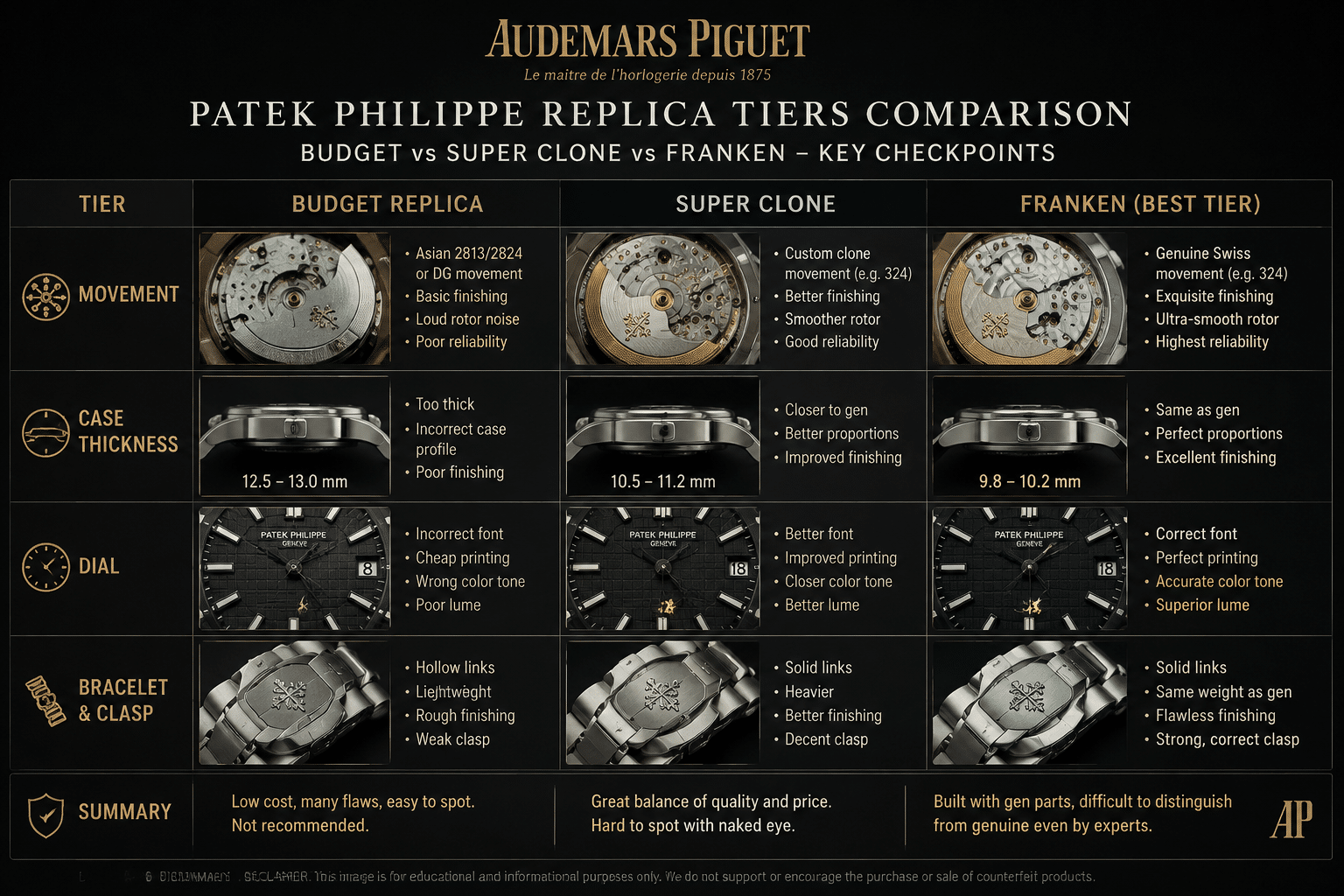
A budget Patek replica is usually built around recognition, not refinement. It gives the general idea of a Nautilus, Aquanaut, or Calatrava, but it often sacrifices the qualities that make Patek designs difficult to copy: slimness, clean dial work, polished case transitions, bracelet comfort, and quiet mechanical behavior. That does not make every cheap Patek Philippe replica useless, but it does mean the buyer must keep expectations low.
The first-time buyer mistake is assuming that a simple-looking Patek should be cheap to replicate well. In reality, simple designs are often less forgiving. A thick case on a dive-style watch may disappear under a large bezel and heavy case architecture. A thick case on a Calatrava-style dress watch looks bulky immediately. A flat or poorly printed dial on a busy chronograph may be less obvious at a glance. On a clean Patek-style dial, bad printing, uneven markers, and wrong spacing have nowhere to hide.
The budget tier can make sense for curiosity, casual styling, or a buyer who mainly wants the silhouette without caring about close visual accuracy. It is a poor choice for someone who is sensitive to case profile, bracelet feel, dial texture, or movement behavior. If the buyer already knows those details will bother them, starting too cheap usually creates a second purchase later.
Movement Shortcuts in the Lowest Tier
Low-cost Patek replicas commonly use basic automatic movements or quartz movements because they are inexpensive, available, and easy to fit into mass-market cases. A quartz route can be practical in some watch categories, but it becomes less convincing when the original model is expected to have a mechanical sweep or a specific caseback presentation. A basic automatic route may look more appropriate at first, but it can bring its own issues: louder rotor noise, rough winding feel, inconsistent power reserve, and less refined date behavior.
The date is one of the small details buyers often overlook. On cheaper automatic movements, the date change may be slow, poorly aligned, or positioned slightly wrong in the window because the movement architecture does not match the dial layout well. A datewheel that sits too high, too low, or too deep can make a watch look cheaper even if the case and dial color seem acceptable in photos.
Service appeal is limited at this level. Many local watchmakers will not want to spend time diagnosing a low-cost replica movement, especially if replacement is cheaper than repair or if the case construction is poor. For a budget watch, the practical assumption should be replacement-level ownership, not long-term mechanical investment.
Why Thin Patek Cases Are Hard to Fake Cheaply
Case thickness is one of the most important compromises in the budget tier. Patek Philippe’s design language often depends on controlled thinness: the Nautilus needs a slim side profile and clean bezel transition, the Aquanaut needs a balanced case that does not sit like a puck, and the Calatrava needs dress-watch restraint. Cheap manufacturing works against all three.
A factory can make a case thicker to fit a generic movement, simplify assembly, and reduce rejection rates. That may be efficient for production, but it changes the watch on the wrist. The lugs may sit higher, the caseback may bulge more, and the crown position may feel slightly off. These are not just measurement problems. They affect how the watch wears under a cuff, how the case catches light, and whether the design still feels elegant.
This is why the cheapest Patek-style replicas often look better in front-view photos than they do in real life. The side profile tells the truth. If a seller avoids side shots or only shows angled wrist photos, assume the thickness is one of the compromises.
Dial and Bracelet Details That Usually Give the Tier Away
Budget dials often miss the difference between pattern and texture. A Nautilus-style dial may have horizontal lines, but the grooves can look flat, too wide, too shallow, or too uniform. An Aquanaut-style dial may show the expected grid, but lack the depth and clean edge definition that gives the design its character. On Calatrava-style pieces, the problem is usually printing: logo weight, minute track spacing, marker placement, and hand finishing become very easy to notice because the dial is so open.
Applied markers are another common tell. On cheaper replicas, markers may be slightly uneven, too thick, poorly polished, or filled with weak lume. The lume itself may not matter to every buyer, but uneven color between hands and markers can make the watch feel lower grade even in daylight. Font weight also matters more than beginners expect. Patek-style branding and date numerals should look restrained; heavy printing makes the dial feel cheap quickly.
Bracelets reveal the tier through handling. Loose link tolerances, sharp edges, weak brushing, hollow-feeling clasp action, and poor end-link fit are difficult to hide once the watch is on the wrist. A budget Nautilus-style bracelet may look fine in one photo, but if it does not articulate smoothly or the clasp feels tinny, the overall impression drops fast. For buyers asking whether a cheap Patek replica is worth it, this is the dividing line: acceptable as a casual design object, risky if tactile quality matters.
The Mid-Tier Super Clone Range: Where the Value Usually Improves
The mid-tier super clone range is where many Patek Philippe replica buyers start to see practical value, not because the watch becomes perfect, but because the most obvious budget-tier weaknesses are usually reduced. Better versions tend to improve case profile, dial texture, marker placement, bracelet finishing, clasp quality, and movement layout. For Patek-style watches, those improvements matter more than extra decorative language in a sales listing.
A Patek Philippe super clone should be judged as a construction upgrade rather than a magic category. The stronger-value Patek replica tier is often the one that gets the proportions and daily handling close enough without pushing the buyer into fragile custom work or unnecessary expense. This is especially true for models like the Nautilus and Aquanaut, where better case shape and dial execution can change the entire wrist presence.
The important warning is that this range is not universally strong across every model. Some Patek designs benefit heavily from the jump because the cheaper versions are visibly too thick or poorly finished. Other models may show only smaller gains, especially if the design itself is less demanding or if the available factory versions are inconsistent. QC photos still matter because a better factory version can reduce common flaws, but it does not remove batch variation.
In this tier, version-specific judgment matters more than broad ranking language. A newer or higher-priced version should be checked against the actual reference style, movement route, side profile, dial texture, date position, bracelet construction, and clasp finishing. One factory-market version may be strong on a Nautilus bracelet but less persuasive on an Aquanaut dial or a thin dress case, so the useful question is not which name sounds strongest, but which specific version solves the visible weaknesses of that model.
Better Case Shape and More Convincing Wrist Presence
The biggest improvement in this range is often the case. A stronger super clone usually has a more controlled mid-case, cleaner bezel definition, better caseback integration, and less awkward thickness. On a Nautilus-style replica, the rounded-octagonal bezel needs to look crisp without becoming too sharp or too bulky. On an Aquanaut-style case, the shape needs to stay flat and casual rather than tall and blocky.
Wrist presence is not only about dimensions on paper. A watch can measure close enough and still feel wrong if the side wall is too slab-like, the lugs do not flow correctly, or the crown sits in an awkward position. Better super clone construction usually improves these transitions, which is why the price jump may be more obvious in person than in a front-facing product photo.
This is also where buyers should stop thinking of weight as a simple “heavier is better” test. A convincing Patek replica should feel balanced. Too light can feel cheap, but unnecessary heaviness can also feel wrong for a design that was meant to wear slim and refined. Good case construction is about proportion, not just mass.
Photo Accuracy and Daily-Wear Value Are Not the Same
A watch can be the stronger choice for photographs without being the stronger choice for regular wear. A very glossy dial, dramatic movement decoration, or sharp-looking macro finish may help a listing look persuasive, but daily ownership depends more on crown feel, bracelet comfort, rotor noise, clasp security, date behavior, and whether the movement route can be serviced if something goes wrong. This distinction matters in the mid-tier range because buyers are often choosing between a visually impressive version and a more conservative build that may be easier to live with.
For Patek-style replicas, the better middle-tier choice is usually the one that balances both priorities. If the buyer mainly wants wrist photos and occasional wear, dial color and front-facing accuracy may carry more weight. If the watch will be worn several days a week, movement stability, case comfort, strap or bracelet durability, and repair options deserve more attention. A higher price is easier to defend when it improves the ownership experience, not just the first impression in seller lighting.
Dial Texture, Markers, and Date Window Improvements
Dial quality is where the middle tier often separates itself from low-cost versions. Nautilus-style dials should show cleaner horizontal texture, more controlled color, and better interaction with light. The texture should not look like a printed stripe pattern placed under glossy lacquer. It needs enough depth to avoid looking flat, even though it will still have limits under close inspection.
Markers and hands usually improve as well. Better finishing gives applied markers cleaner edges and more consistent alignment. Hand length, polish, and lume application tend to look more intentional. These are small details, but on a Patek-style watch they shape the whole impression because the design is not visually noisy.
The date window deserves special attention. A stronger Patek super clone price is easier to justify when the date is centered, the font is not too heavy, and the window position works with the dial layout. A misaligned date can make an otherwise decent watch feel lower tier every time the buyer checks the time. It is one of the most practical QC points because it is visible in normal use, not only in macro photos.
Bracelet and Clasp Feel Become More Important
Once the case and dial improve, the bracelet becomes the next major test. On a Nautilus-style replica, bracelet articulation is not optional. The links need to drape naturally, the brushing should follow the correct direction, and polished transitions should look clean rather than rounded or uneven. A stiff bracelet makes the watch feel cheaper even if the dial is attractive.
Clasp quality also changes the perceived tier. A better clasp should close with a more confident snap, avoid excessive play, and show cleaner finishing inside and outside. Engraving depth, edge finishing, and the feel of the release mechanism all affect daily ownership more than buyers expect. This is the part of the watch the owner touches constantly, so weak clasp action becomes annoying faster than a small macro-level dial flaw.
The strongest reason to consider this range is not that every detail becomes correct. It is that the watch usually becomes more coherent. Case profile, dial texture, bracelet feel, and movement route start working together instead of fighting each other. For many buyers, that is the point where a Patek replica stops feeling like a disposable curiosity and starts feeling like a more serious daily-wear option, provided the specific model and QC sample support the price.
Franken Patek Builds: Why the Price Can Jump So Much
A Franken Patek replica is not simply a more expensive super clone watch. It is usually a Franken watch build that mixes a replica base with selected upgraded components, custom fitting, movement work, or sometimes claimed genuine parts where they are available, disclosed, and compatible. The price jumps because the buyer is no longer paying only for factory production. They are paying for sourcing, compatibility risk, labor, and the builder’s ability to make several parts behave like they belonged together from the start.
This is where many buyers make the wrong assumption. A Franken Patek replica can correct specific flaws, but it does not automatically become the safest or most sensible version to own, and it does not become a genuine Patek Philippe watch. In some cases, the upgrade is visible and useful. In others, the buyer pays heavily for a hidden part, a vague claim, or a fragile modification that makes future repair harder. The higher tier reduces certain visual compromises but often increases ownership complexity.
What Usually Drives Franken Cost
The largest cost driver is rarely one single part. It is the combination of parts sourcing, custom dial work, hand fitting, movement modification, case modification, and the risk that something will not fit cleanly. Patek Philippe designs are especially sensitive because the watches often depend on slim cases, clean dial spacing, polished surfaces, and precise hand height. A tiny compatibility issue can create visible problems, such as hands sitting too high, a date window that no longer aligns, or a caseback that needs extra depth.
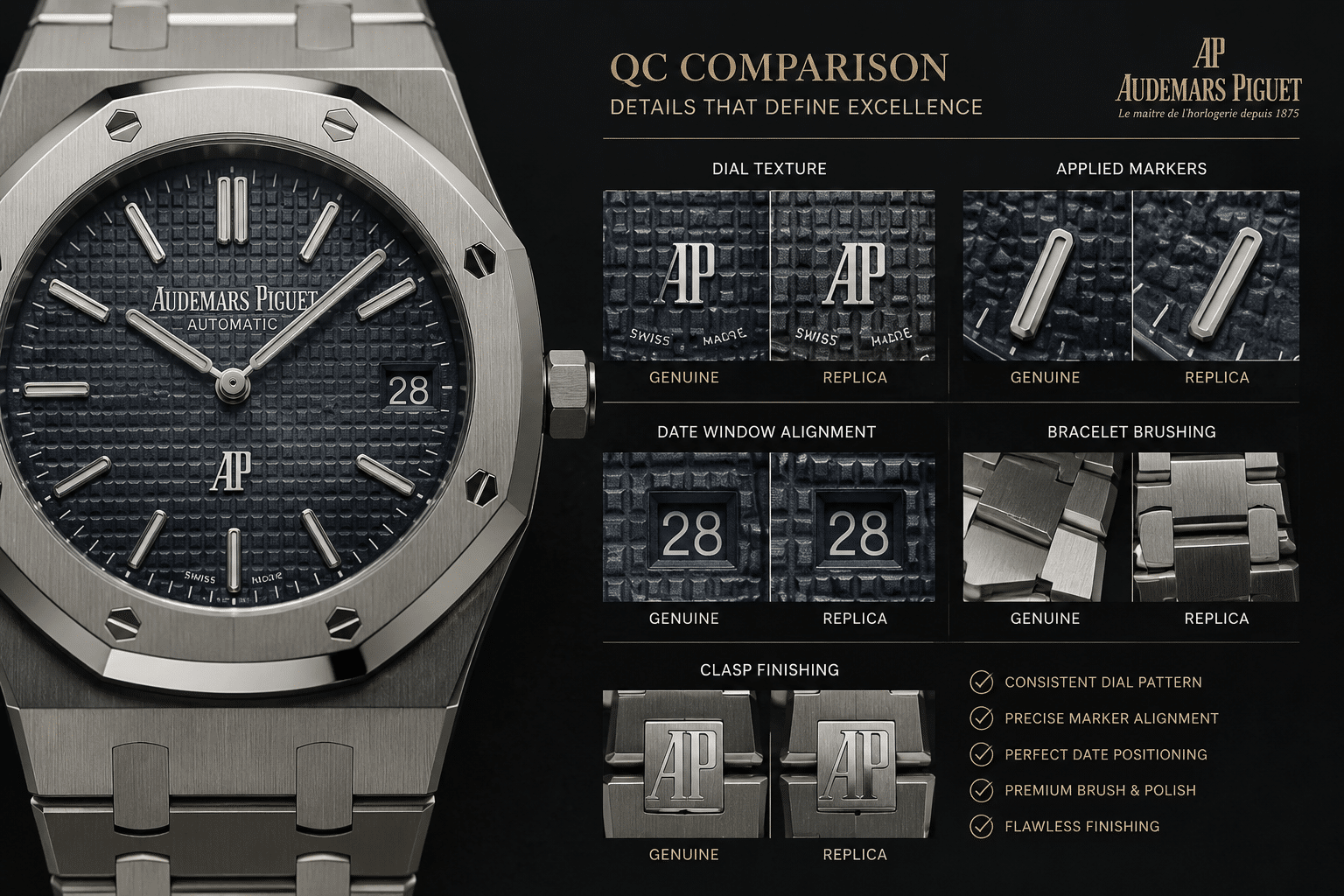
Dial upgrades are one of the most common reasons a Franken build becomes expensive. A better dial can improve logo sharpness, marker shape, printing weight, texture, and date aperture finish. But the dial also has to match the case, movement stem height, date position, and hand set. A dial that looks excellent on its own can still be a poor upgrade if it creates alignment problems after installation.
Movement-related work is another cost driver, but buyers should be careful here. A modified movement may support a thinner case profile or a more correct visual layout, yet the modification can reduce serviceability. If the builder uses custom spacers, altered bridges, nonstandard hand heights, or a reworked calendar system, the watch may depend on that builder for future repair. That is a real Franken build risk, not a small technical footnote.
Where Franken Upgrades Can Actually Matter
The most useful Franken upgrades are usually the ones the buyer sees and feels every time the watch is worn. On a Nautilus-style replica, dial texture, marker finish, hand quality, datewheel alignment, crystal clarity, bracelet brushing, and clasp feel can change the entire impression of the watch. These upgrades matter more than a hidden part that only looks impressive in a movement photo.
On an Aquanaut-style watch, a better dial and date window can be more important than many buyers expect. The rubber strap makes the watch look simpler, but the large embossed dial surface leaves little room for weak texture or sloppy printing. A high-cost upgrade that does not improve the dial, date, crystal, or case profile may not create much real value on the wrist.
For Calatrava-style dress models, thinness and dial cleanliness matter most. A premium dial with better printing may help, but if the case remains too thick or the lugs look heavy, the watch still misses the design logic. This is why Franken spending should be judged by the specific flaw it solves. Paying more only makes sense when the upgrade corrects a flaw that is actually visible or damaging to wearability.
Why Franken Is Not Always the Smartest Daily-Wear Choice
A Franken Patek replica can be impressive, but it is often not the most practical daily-wear choice. The more custom the build becomes, the more the buyer depends on nonstandard parts, a specific builder, and uncertain future service options. If a hand comes loose, a date mechanism sticks, or a modified movement needs work, a local watchmaker may not want to touch it. Even if they agree, parts availability can become the real problem.
Water resistance should also be treated cautiously. Case modification, crystal swaps, crown work, or repeated opening can affect sealing. A seller or builder may describe the watch as tested, but buyers should not treat a Franken build as guaranteed waterproof. For daily wear, especially in humid or wet conditions, a more conventional super clone with fewer modifications may be less stressful to own.
The strongest judgment is simple: Franken is best for buyers who know exactly which flaw they are paying to improve. It is not the right tier for someone who only thinks “more expensive means safer.” For many buyers, a well-executed super clone with a proven movement route and cleaner service path is more rational than an expensive custom build with marginal visual gains.
Documentation to Confirm Before Paying More
Before paying a Franken premium, buyers should ask for clear documentation of what was actually changed. The important points are component origin, build scope, movement route, dial source, hand set, crystal change, datewheel work, bracelet or clasp upgrades, and any case modification. Vague phrases like “fully upgraded,” “genuine spec,” or “custom top version” are not enough.
Photos should support the claim. A buyer should be able to see the dial, hands, date window, side profile, caseback, bracelet, clasp, and movement view when relevant. If the price is based on claimed genuine parts, the seller should be able to explain which parts are claimed, how they were fitted, and whether the modification affects future service. Without that clarity, the buyer is not evaluating a Franken watch build; they are buying a story.
For Franken builds, traceability should be practical rather than dramatic. A credible explanation should connect each claimed part or modification to a visible or functional result, such as improved dial printing, corrected datewheel position, better crystal clarity, thinner case profile, smoother bracelet fit, or a clearer movement route. If the explanation only relies on prestige wording and does not show how the upgrade changes the watch, the higher price should be treated cautiously.
Movement Type and Repair Difficulty Across Price Tiers
The Patek replica movement is one of the biggest hidden reasons prices separate. Two watches can look similar in front-view photos while using very different movement routes. One may rely on a simple automatic movement that is easier to replace or service. Another may use a clone-style movement or modified architecture that looks more correct, supports better proportions, or improves the caseback view, but also raises the repair difficulty.
Movement descriptions in the replica market should be checked carefully because they may refer to layout, decoration, clone architecture, or seller terminology rather than an official brand-manufactured caliber. A replica-market movement should not be described or understood as an original Patek Philippe caliber unless there is specific, verifiable evidence and the context clearly refers to a genuine brand-manufactured watch.
Buyers often ask which movement is safer. The better question is safer for what purpose. A movement that looks closer to the intended Patek layout may be better for visual accuracy and case proportion. A simpler movement may be better for daily reliability, parts availability, and lower repair anxiety. At Clean VS Factory, we usually treat movement choice as part of the ownership decision, not just a specification line.
Movement Specifications Versus Movement Proof
Movement names can create false confidence if they are not verified against the specific watch. A seller may describe a movement as automatic, decorated, clone-style, thin, modified, or based on a familiar architecture, but those words do not prove the actual caliber, condition, lubrication, regulation, parts compatibility, or long-term service outlook. A movement photo can narrow the possibilities, yet it still cannot prove performance or durability by itself.
When a buyer sees a specification such as beat rate, jewel count, thickness, or power reserve, it should be treated as a baseline for the claimed movement family, not proof that the replica in hand performs to that figure. The more important ownership questions are practical: does the movement support the correct case profile, does the date sit properly, does winding feel stable, can the watch be serviced, and is the seller clear about what happens if the movement fails?
Generic Movements Versus Clone-Style Movements
Generic automatic movements are common in lower and some middle price tiers because they are affordable, available, and relatively familiar to watch repairers. They can be a practical choice if the buyer accepts the tradeoff: the movement may not match the original layout, may require a thicker case, and may have a less refined winding feel. Rotor noise, short or inconsistent power reserve, and rough crown action are common complaints at this level.
A clone movement Patek replica usually costs more because the movement route is designed to look more correct or fit the case more convincingly. That can improve case thickness, date placement, hand stack, and sometimes the display caseback appearance. But “clone-style” does not automatically mean low-risk. Some clone calibers are more mature than others, and version claims need verification. A movement photo can help confirm the route, but it cannot prove cleanliness, lubrication, shock history, or long-term stability.
The practical tradeoff is clear. Generic movements are less romantic but often easier to deal with. Clone-style movements can make the watch more convincing, but repair may depend on specialized parts or a watchmaker willing to work on replica-specific architecture. Buyers who want low-stress ownership should not choose a movement only because it looks better through the caseback.
How Movement Thickness Affects the Case
Movement thickness directly affects the case, especially on Patek Philippe designs. Nautilus, Aquanaut, and Calatrava-style watches do not hide extra height well. If the movement is too tall, the factory may compensate with a deeper caseback, thicker mid-case, higher crystal, or altered side profile. The watch can still look acceptable from the front but feel wrong from the side.
This matters more on Patek than on many bulkier sports watches. A Submariner-style case can absorb some extra thickness because the design already has a strong bezel, crown guards, and tool-watch mass. A Calatrava-style case cannot. If the dress case becomes too thick, the watch loses its elegance immediately. On a Nautilus-style model, extra thickness affects how the case flows into the bracelet and how flat the watch sits on the wrist.
This is why a movement worth paying for is not always about decoration. Sometimes the value is dimensional. A thinner movement route can allow a more convincing case profile, better caseback depth, and more natural wrist presence. If the upgraded movement does not improve those things, the premium may be less meaningful than the seller suggests.
Serviceability May Matter More Than Visual Accuracy
For long-term ownership, serviceability can matter more than a perfect-looking movement bridge. A visually impressive movement becomes frustrating if it has poor parts support, rough calendar behavior, weak winding efficiency, or a rotor that becomes noisy after a few months. Buyers should pay attention to how the movement behaves, not only how it is decorated.
Date-change behavior is one useful signal. A clean, predictable date change is better than a movement that hangs between dates or feels fragile during setting. Winding feel also matters. Gritty winding, slipping resistance, or an unusually loud rotor can indicate a movement route that may need attention earlier than expected. Power reserve should be treated realistically; advertised numbers may not match the actual unit on the wrist.
The smartest buyer does not automatically choose the most complicated movement. A simpler automatic movement with known service options may be a better daily choice than a more accurate-looking clone movement that few watchmakers will service. This is especially true for buyers who plan to wear the watch regularly rather than keep it as an occasional comparison piece.
Movement Route to Verify
Before comparing prices, buyers should verify the movement type, claimed caliber route, date behavior, winding feel, rotor noise expectations, and whether the movement is commonly serviceable. If a seller claims a specific clone caliber, the buyer should ask for a movement photo and compare it with known examples, while remembering that a photo only confirms appearance, not condition.
It also helps to ask what happens if the movement needs repair. Can the movement be serviced locally? Are replacement parts realistic? Is the movement a common automatic route, a decorated movement, a thin movement solution, or a modified clone-style architecture? A higher price is easier to justify when the movement improves proportions and remains serviceable. It is harder to justify when it only adds complexity.
Movement Transparency Note: Movement references in this article describe replica-market movement types, configurations, or claimed routes, not official Patek Philippe calibers unless supported by specific verifiable evidence. Buyers should check the actual movement photo, case thickness effect, date behavior, winding feel, service options, and version details before treating any movement label as meaningful.
Case Thickness, Dial Quality and Bracelet Finishing: The Visible Price Gap
The most visible price gap in a Patek replica is not usually one dramatic feature. It is the way case thickness, dial quality, bracelet finishing, and weight balance work together. Patek Philippe designs are unforgiving because they rely on proportion and restraint. There is no oversized bezel or busy tool-watch layout to distract from a bulky side profile, flat dial texture, weak marker finishing, or rough bracelet edge.
This is why the question “what makes a Patek replica look cheap?” usually has a different answer than it would for a louder sports watch. On a Patek-style design, cheapness often shows through thickness, stiffness, misaligned details, and finishing that feels too harsh in the hand. Better tiers do not only look cleaner in photos; they usually feel more coherent when the watch is worn.
Why Case Profile Matters More on Patek Than Many Sports Watches
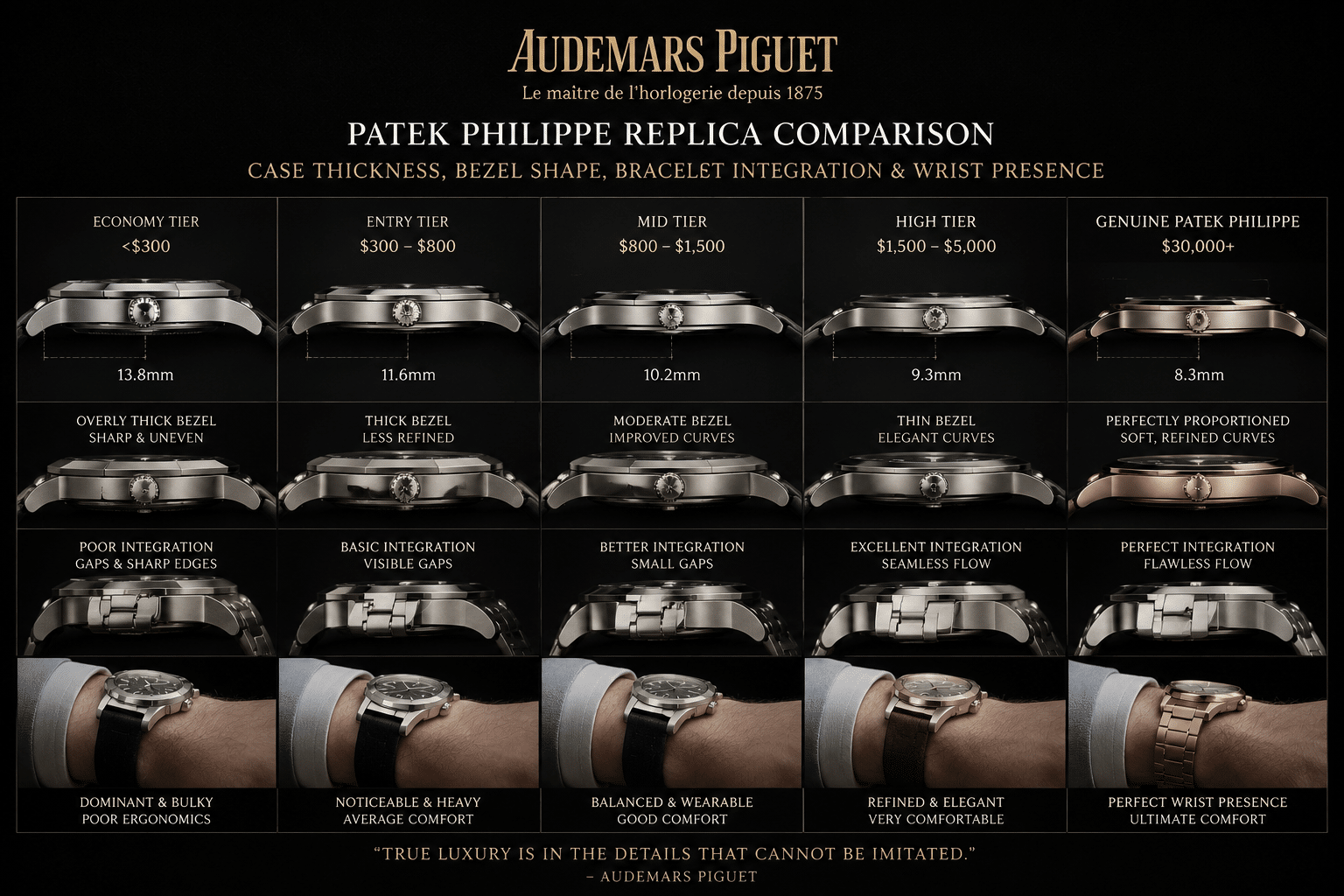
Patek replica case thickness is one of the first details buyers should check because the brand’s design language depends heavily on slimness. On a Nautilus-style model, the mid-case, bezel transition, caseback depth, and bracelet integration need to create a flat, flowing shape. If the caseback is too deep or the side wall too heavy, the watch loses the low, elegant profile that makes the design work.
Aquanaut-style cases look simpler, but they still expose thickness problems. The rounded case and rubber strap can make a thick case stand out even more because there is less bracelet mass to balance it visually. A watch that looks fine in a straight-on seller photo may sit tall and blocky on the wrist.
Calatrava-style dress models are the least forgiving. A slightly thick case, heavy lugs, or high crystal can make the entire watch look like a generic dress watch rather than a slim Patek-inspired design. For these models, spending more is often justified only if the better tier actually improves the thin case profile, not just the dial logo or caseback decoration.
Dial Details That Improve With Better Tiers
Patek replica dial quality usually improves in quieter ways as the price rises. The texture becomes less flat, the logo placement is more controlled, the font weight looks less heavy, and applied markers are more evenly shaped. These details are not always obvious in harsh seller lighting, but they become noticeable in normal wear because the dial is what the eye returns to most often.
On Nautilus-style models, horizontal dial texture is a major tier separator. Budget versions can look printed or shallow, while stronger versions show more depth and cleaner transitions across the surface. On Aquanaut-style models, the embossed pattern must look structured rather than rubbery or soft. On Calatrava-style models, the dial has almost nowhere to hide; logo weight, minute track printing, hand length, and marker alignment all matter.
The date window is another practical checkpoint. A better-tier watch should show cleaner datewheel centering, more consistent font weight, and a date aperture that sits naturally within the dial design. A slightly wrong date position can make the whole dial feel off, even if the logo and markers look acceptable.
Bracelet Finish Is Where Daily Handling Reveals Quality
Bracelet finishing often separates a watch that photographs well from one that feels convincing in daily use. On a Nautilus-style bracelet, brushing direction, polished bevels, link articulation, clasp finishing, and end-link fit all matter. A low-cost bracelet may look passable from above but feel loose, sharp, rattly, or uneven when handled.
Weight should also be judged carefully. Heavier is not automatically better. A convincing Patek-style bracelet should feel balanced across the wrist, not simply dense for the sake of sounding premium. Poor weight distribution can make the watch feel top-heavy, especially if the case is already too thick.
Clasp feel is a useful everyday test. A cleaner clasp should close with a more confident snap, show less roughness around the edges, and avoid overly shallow or messy engraving. Sharp inner edges, loose links, uneven brushing, and stiff articulation are not just cosmetic flaws. They affect comfort every time the watch is worn, which is why bracelet and clasp quality can justify a higher tier more than a hidden upgrade many buyers will rarely notice.
Which Patek Models Deserve a Higher Budget
There is no single best Patek replica model for every buyer because the right budget depends on how unforgiving the design is. A higher price is easier to justify when the model exposes case geometry, dial texture, bracelet finishing, or movement thickness in normal wear. It is harder to justify when the upgrade only improves details that most owners will notice only under macro photos.
The practical question is not “which model is worth more” in a general sense. It is whether the model punishes cheap construction. Nautilus and Aquanaut replicas usually reward a stronger tier because their shapes are simple enough to look familiar but precise enough to reveal weakness quickly. Calatrava-style dress watches can be even less forgiving because a thick case or slightly clumsy dial has nowhere to hide. Complicated Patek replica models are a different problem: they may look attractive in photos, but the movement route can make them less sensible as daily watches.
Nautilus: When Bracelet and Case Shape Justify More Scrutiny
The Nautilus replica is one of the clearest examples of a Patek model where spending more can make sense. The design depends on a thin case profile, soft but defined bezel shape, horizontal dial texture, and an integrated bracelet that should flow from the case rather than hang from it. A low-cost version can show the general Nautilus outline, but it often fails in the areas that give the watch its character.
The bracelet is the first place to be skeptical. On a better Nautilus-style build, the links should articulate smoothly, the brushing should run cleanly, and the polished edges should not feel randomly rounded or sharp. Budget bracelets often look acceptable from the front but feel light, loose, or stiff on the wrist. That tactile difference matters because the Nautilus is not just a dial-and-case watch; the bracelet is half the design.
Case shape is the second reason this model deserves more scrutiny. If the side profile is too thick, the bezel transition is too blunt, or the caseback sits too deep, the watch loses the flat, elegant wrist presence that makes the Nautilus convincing. This is why a mid-tier or stronger super clone Nautilus often offers better Patek replica value than a cheaper version, even if the seller photos appear similar at first glance.
The judgment is simple: avoid the lowest tier if you care about the Nautilus as a design object rather than just a recognizable silhouette. A cheap Nautilus replica may satisfy curiosity, but it is rarely the safest Patek replica choice for buyers who notice bracelet feel, case thickness, and dial texture.
Aquanaut: Rubber Strap Simplicity Does Not Remove Dial and Case Risk
The Aquanaut replica can look like the easier choice because it usually comes on a rubber strap and has a sportier, less jewelry-like appearance than the Nautilus. That can be partly true. A strap-based watch removes some bracelet finishing pressure, and for casual wear it may tolerate a slightly less refined build. But the Aquanaut is not automatically safe at the budget tier.
The main risk is that the simplicity of the design makes the remaining flaws more visible. The dial texture needs enough depth to avoid looking flat. The applied markers need to sit cleanly. The date window should be centered and not crowded against the dial edge. The case should still carry a slim, rounded profile rather than feeling like a generic sports watch case wearing an Aquanaut-style dial.
Movement route also matters more than some buyers expect. If the movement forces extra thickness, the Aquanaut loses the casual thinness that makes the original design comfortable. A rubber strap will not hide a tall caseback or awkward side profile. For buyers choosing between a lower-cost Aquanaut-style watch and a higher-tier Nautilus, the Aquanaut may be the more rational affordable Patek replica only if the case thickness and dial execution are still acceptable.
For daily wear, a well-chosen mid-tier Aquanaut-style replica can be more practical than an expensive complicated build. But the budget tier should still be checked carefully. The strap makes the watch easier to wear; it does not make poor dial texture, bad date alignment, or clumsy case proportions disappear.
Calatrava and Dress Models: Thinness Is the Main Challenge
Calatrava and other Patek dress-style replicas create a different kind of price problem. They do not have integrated bracelets, bold bezels, or sporty case architecture to distract the eye. The whole watch depends on a clean dial, polished case, slim profile, and balanced proportions. That sounds simple, but it is difficult to fake cheaply.
Lower-tier dress replicas often become too thick because the movement is not thin enough or the caseback is built with generous tolerances. On a sports watch, a little extra thickness may be tolerable. On a Calatrava-style watch, it can make the entire piece feel wrong. A dress watch that should slide under a cuff but sits tall and rounded loses much of its point.
Dial cleanliness is just as important. Small printing errors, heavy logo text, uneven markers, or a slightly awkward seconds subdial can stand out because there is so much empty space around them. This is where buyers often misjudge value: a plain dial is not necessarily easier. It gives the factory fewer places to hide mistakes.
A higher budget is justified only if it actually buys a thinner case, cleaner dial printing, better hands, and more refined polishing. If a premium version still uses a bulky case or mediocre dial, the extra price is not solving the main Calatrava problem. For dress Patek replicas, thinness and restraint matter more than impressive specifications.
Complicated Patek Models: Photos Can Be Misleading
Complicated Patek replica models attract buyers because they look expensive even in a small photo. Annual calendar layouts, chronographs, moonphase windows, power reserve displays, and multi-register dials create instant visual drama. That same complexity is why they require the most caution.
The risk is not only whether the dial looks close. The movement underneath has to support the display layout, calendar behavior, hand positions, case thickness, and long-term service needs. A complicated Patek replica can look more convincing in seller photos than a simple Calatrava because the busy dial distracts from small spacing issues. In ownership, the same watch may become frustrating if the functions are fragile, difficult to set, or hard to repair.
Chronograph-style and calendar-style replicas are especially sensitive to movement architecture. If the movement is too thick, the case grows. If the calendar works through a workaround rather than a stable mechanism, the owner may face setting limitations or repair difficulty. If the moonphase or subdials are decorative or poorly synchronized, the watch may satisfy the first impression but disappoint over time.
For most buyers, complicated Patek-style replicas are better treated as experienced-buyer watches, not automatic upgrades. They may deserve a higher budget only when the movement route, case thickness, and function behavior are clearly understood. Paying more for complication alone is not value; paying more to reduce mechanical and dimensional risk can be.
When a Cheaper Patek Replica May Be Enough
Not every buyer needs to chase the most expensive Patek replica available. A cheaper or mid-tier watch can be enough when the buyer wants the general design language, plans to wear it casually, and does not expect refined finishing under close inspection. The mistake is assuming that “more expensive” always means a better ownership fit. Sometimes the premium buys details the buyer does not care about, or a movement route that is harder to maintain.
A sensible Patek replica budget choice starts with the use case. If the watch will be worn occasionally with casual outfits, a clean-looking affordable Patek replica may satisfy the purpose. If it will be a frequent daily watch, the buyer should care more about comfort, movement stability, clasp behavior, strap quality, and whether the watch feels solid enough to wear without constant worry.
The Casual Wear Scenario
Consider a buyer who likes the Aquanaut look and wants a casual rubber-strap watch for weekends. That buyer may not need an expensive build with every movement decoration or the most aggressive dial upgrade. If the case is not obviously thick, the date is reasonably centered, the strap feels comfortable, and the movement behaves predictably, a lower or mid-tier option can be rational.
This is where “good enough replica” has a legitimate meaning. It does not mean the watch is close under expert inspection. It means the watch meets the buyer’s real use case without forcing them into unnecessary cost or repair anxiety. For some buyers, a cheaper Aquanaut-style watch is more enjoyable than a higher-tier Nautilus-style build that they are afraid to scratch, service, or wear often.
Acceptable flaws depend on distance and context. A slightly imperfect dial texture may not matter much in casual wear. A bracelet that rattles, a crown that feels rough, or a movement that stops unpredictably matters immediately. The cheaper choice is only sensible when the compromise stays mostly visual and does not damage daily usability.
The Detail-Sensitive Buyer Scenario
The buyer who notices case profile, dial texture, bracelet finishing, and date alignment should avoid the lowest tier. This is not about snobbery. It is about knowing your own tolerance. If you already compare side-profile photos or care how a Nautilus bracelet drapes around the wrist, a budget watch will probably bother you quickly.
Detail-sensitive buyers usually get better value from fewer watches at a stronger tier than from several cheap versions. On a Nautilus replica, the visible gap between budget and better-tier construction is not limited to macro details. It appears in the bracelet feel, bezel shape, case thickness, and how balanced the watch feels in hand. These are daily-use differences, not just forum-photo differences.
At Clean VS Factory, we usually encourage buyers to separate visual curiosity from ownership expectations. If someone only wants to try the look, a lower tier may be acceptable. If they expect the watch to feel refined on the wrist, the cheaper tier often becomes false economy.
When Not to Stretch the Budget
Do not stretch the budget when the premium does not solve the flaw you actually care about. If a more expensive version still has a thick case, poor dial color, weak bracelet feel, or a movement that local watchmakers are unlikely to touch, the higher price may only create the feeling of an upgrade without improving the experience.
It is also unwise to overpay for a complicated model if the main attraction is the dial layout but the movement route is uncertain. A simpler Patek replica with stable behavior can be a better daily-wear choice than a more dramatic watch that becomes difficult to set, service, or repair.
The better reason to spend more is risk reduction: better proportions, better finishing, better QC consistency, and a movement route that fits the case. If the extra money mostly buys vague claims, scarce-stock pressure, or small hidden upgrades you cannot verify, staying with a more modest tier may be the smarter decision.
Pre-Purchase Checklist for Comparing Patek Replica Price Tiers
A Patek replica checklist should help the buyer separate confirmed evidence from seller language. Price alone does not prove tier. A watch described as a super clone may still have a generic movement, a thick case, or weak finishing. A Franken-style claim may sound expensive but mean very little if the actual parts and work are not documented.
Before comparing price tiers, treat every claim as something that needs support. The goal is not to demand perfection. The goal is to understand what the price is paying for and whether the upgrade addresses the weaknesses of that specific model.
Before making a decision, buyers should review real QC photos where available, including dial printing, marker alignment, hand alignment, datewheel centering, case thickness, side profile, bracelet fit, clasp engraving, strap fit, and movement photos when relevant. Factory labels, stock photos, and price tier language alone are not enough for a reliable judgment.
Information to Confirm Before Comparing Prices
- Model and reference style: Confirm whether the watch is a Nautilus, Aquanaut, Calatrava-style dress model, or complicated Patek-style replica, because each model family exposes different flaws.
- Factory or maker claim: Record the claimed factory, maker, or build source, but do not treat the name alone as proof of quality.
- Version details: Ask what version or batch is being offered when available, since small updates can affect dial color, case thickness, bracelet fit, or movement route.
- Movement route: Confirm whether the watch uses a generic automatic, quartz, decorated movement, clone-style movement, or modified build. This affects thickness, reliability expectations, and repair difficulty.
- Case thickness: If thickness is listed or measurable, compare it to the model’s design logic. A dress watch or Nautilus-style case should not be judged like a bulky sports watch.
- Bracelet or strap construction: Check whether the watch comes on bracelet, rubber strap, or leather strap, and whether the clasp, end links, and link articulation match the claimed tier.
- Included QC photos: Confirm what images are available before judging price. A single front-facing photo is not enough for a serious comparison.
How to Read Seller Claims Without Overreacting
Seller descriptions can be useful, but they often compress several different issues into one confident phrase. “Latest version” may refer to a dial update, a movement change, a clasp revision, or simply current stock. “Best edition” may mean the seller’s preferred option, not the best fit for every buyer. “Clone movement” may describe appearance, architecture, decoration, or a modified route, so the buyer should ask what it changes in practical terms: case thickness, date position, winding feel, serviceability, or only the caseback view.
The safest way to read a listing is to translate every claim into a verifiable checkpoint. If the price is higher because of the factory, ask what that factory version improves on this specific Patek model. If the price is higher because of the movement, ask whether it improves proportions and ownership reliability or mainly visual similarity. If the price is higher because of scarce stock, ask whether scarcity changes the watch itself. This keeps the comparison grounded in evidence rather than marketing pressure.
Claims such as “perfect,” “same as genuine,” or “guaranteed to pass inspection” should be treated with caution because they replace evidence with absolutes. A more responsible comparison looks at the exact model version, movement configuration, case and bracelet execution, dial details, available QC evidence, and realistic ownership limits. The purpose of this information is to avoid overpaying or misunderstanding quality, not to represent an imitation watch as authentic.
Photos That Help Reveal the Real Tier
Patek replica QC photos are most useful when they show the areas that cheap builds usually hide. A straight front dial photo helps check logo placement, marker alignment, date position, hand alignment, and dial texture. It does not show whether the case is too thick or whether the bracelet feels cheap.
A side-profile photo is essential for Nautilus, Aquanaut, and Calatrava-style replicas. It reveals case height, caseback depth, bezel transition, crown position, and whether the watch carries the slimness expected from the design. Many lower-tier watches look acceptable from the front and fail from the side.
Clasp and bracelet photos matter for Nautilus-style models. Look for brushing direction, polished bevels, link gaps, screw finishing, clasp engraving, and whether the bracelet articulates naturally. For Aquanaut-style watches, strap fit and clasp quality deserve the same attention because a poor strap can make the watch feel cheaper than the dial suggests.
Movement photos can help confirm the claimed route, especially when a seller describes a clone movement or decorated caliber. They do not prove long-term reliability. A clean-looking movement can still be dry, noisy, poorly regulated, or difficult to service. Use movement photos as evidence of configuration, not as a guarantee of durability.
QC photos can reduce uncertainty, but they do not guarantee perfection. Buyers should still review visible details, ask how current the photos are, and confirm seller policies before ordering. If a seller cannot provide enough images to support a price-tier claim, the buyer should treat the tier label as unverified.
Questions That Protect Long-Term Value
- What problem does the higher price solve? The premium should improve a real weakness such as case thickness, dial execution, bracelet finishing, movement layout, or QC consistency.
- Can the movement be serviced? A visually impressive movement may be less practical if parts are hard to source or local watchmakers are unwilling to work on it.
- Does the case profile match the design goal? Patek-style watches depend on thinness and balance, so side photos matter as much as front photos.
- Are the bracelet and clasp acceptable? A strong dial cannot fully compensate for sharp links, weak articulation, or an insecure clasp.
- Are water-resistance claims clear? Water resistance should not be assumed unless the specific watch has been tested and the seller’s policy is clearly confirmed.
- Are return, repair, and shipping terms confirmed? Buyers should confirm these details directly with the seller rather than relying on broad listing language.
- Is the watch being evaluated as a replica? The watch should not be represented, resold, or used as a genuine Patek Philippe watch.
How to Compare Budget, Super Clone, and Franken Tiers Without Overpaying
The most practical way to compare Patek replica price tiers is to match the spend to the weakness being corrected. Budget pieces are often about shape recognition. Mid-tier super clones are usually about reducing visible compromises in thickness, dial texture, bracelet feel, and movement fit. Franken builds are about targeted correction, but only when the claimed upgrade is documented and creates a visible or functional improvement.
A buyer should be especially cautious when a seller uses a price tier as a substitute for evidence. Higher pricing can be reasonable, but it should be tied to the exact watch: current QC photos, side profile, dial texture, date position, movement route, bracelet or strap construction, and a clear explanation of any upgraded parts. Prices can change by factory label, version, movement, seller channel, and availability, so exact comparisons should be verified at the time of purchase.
The safest use of factory and movement information is to avoid overpaying or misunderstanding quality, not to misrepresent a replica watch as genuine. A strong super clone may look convincing in normal wear, but close inspection can still reveal differences in finishing, movement architecture, case proportions, bracelet feel, dial details, or service compatibility.
A Practical Tier Decision Framework
| Buyer Priority | Tier Usually Worth Reviewing | Risk to Watch |
|---|---|---|
| Trying the general Patek-style look | Budget or lower mid-tier | Do not overpay for hidden details if casual use is the only goal |
| Daily wear with better comfort | Mid-tier super clone | Prioritize case profile, bracelet feel, movement stability, and seller clarity |
| Nautilus bracelet and case accuracy | Stronger super clone or documented upgrade build | Require side photos, bracelet photos, clasp details, and dial checks |
| Dress-style thinness | Version-specific mid-tier or higher | Do not pay more unless the case is actually thinner and cleaner |
| Franken detail correction | Only documented high-cost builds | Confirm parts, compatibility, service path, and visible benefit |
Final Buying Judgment
A Patek Philippe replica price guide is useful only if it prevents lazy conclusions. Cheap does not always mean unusable, expensive does not always mean practical, and Franken does not automatically mean better. The correct tier depends on the model, movement route, case thickness, dial execution, bracelet or strap feel, QC evidence, and how the buyer plans to use the watch.
For many buyers, the best balance is a well-executed super clone that fixes obvious budget-tier weaknesses without introducing heavy custom-build risk. For buyers who only want the general look, a cheaper replica may be enough if the movement is stable and the visible compromises are acceptable. For buyers considering Franken builds, the premium should be tied to documented, model-specific upgrades that improve real flaws rather than vague prestige.
CleanVSFactory’s buyer-facing approach is to make replica watch comparison clearer by connecting factory names, movement claims, visible QC details, version differences, and realistic ownership limits. That approach is educational rather than official: factory names are market references, brand names identify genuine reference designs, and every replica watch should be evaluated as a replica-market product rather than a genuine luxury watch.
Disclosure: This article is for general educational and comparison purposes only. Replica watches are not genuine products from the original luxury brands, and brand names are used only to identify reference designs or comparison topics. Factory names, movement descriptions, prices, availability, QC details, seller policies, and version information can change, so readers should verify important details with the seller before making a purchase decision. Replica watches should not be represented, resold, or used as genuine watches.