
Choosing between a Patek Philippe super clone and an Audemars Piguet super clone is not just a matter of which design looks more recognizable. Nautilus, Aquanaut, and Royal Oak replicas expose different weaknesses: the Royal Oak depends on sharp case geometry and bracelet finishing, the Nautilus relies on slim proportions and smooth case flow, while the Aquanaut is more forgiving for daily wear but still needs careful strap, clasp, and dial checks.
This article helps buyers judge the real trade-off behind these models: wrist presence versus tolerance for flaws. A strong front-facing photo is not enough. Side thickness, bezel execution, bracelet or strap integration, date alignment, movement logic, and QC consistency often decide whether a watch feels convincing and wearable. The safest choice is not always the most expensive or newest version, but the best-executed model that fits your use case.
Replica watches should be clearly understood as replica-market products, not genuine watches from the original luxury brands. Brand names in this guide are used to identify the genuine reference designs being discussed, not to suggest authorization, endorsement, official production, or service compatibility with Patek Philippe, Audemars Piguet, or any original luxury watch brand.
| Model Type | Main Buying Risk | What To Check First |
|---|---|---|
| Royal Oak | Sharp geometry leaves little room for finishing errors | Bezel screws, brushing, bevels, bracelet flow |
| Nautilus | Wrong thickness or case flow can spoil the profile | Side view, case ears, bracelet integration |
| Aquanaut | Strap hides some risks but fit can still look weak | Strap texture, case thickness, clasp quality |
| Factory Choice | Reputation may not match the exact reference or batch | Current version photos and specific QC details |
| Movement Choice | Impressive claims may add thickness or service risk | Reference match, reliability, practical daily use |
| Price Difference | Higher cost is not always tied to visible improvement | Finishing, comfort, thickness, batch consistency |
Quick Questions Before You Read
Q: Is the Royal Oak the hardest choice for beginners?
Usually yes. Its bezel, case edges, dial texture, and bracelet finishing make small flaws easier to notice.
Q: Is the Aquanaut the safest daily-wear option?
It is often the most forgiving because of the strap, but strap fit, clasp quality, and thickness still matter.
Q: Should I choose by factory name first?
No. Use factory reputation as a filter, then judge the exact reference, version, movement, and QC photos.
Q: When is paying more justified?
Only when it clearly reduces visible or ownership risks, such as poor thickness, weak finishing, or unreliable movement logic.
Editorial Perspective: At cleanvsfactory.com, this comparison is treated as a model-specific buying question rather than a simple Patek-versus-AP ranking. Factory labels, seller photos, and movement names are useful signals, but they are not final proof. For these watches, the more practical judgment is whether the exact reference, case thickness, bracelet or strap execution, movement route, and QC photos support the buyer’s intended use—daily wear, occasional wrist presence, or careful collecting.
Evidence Boundaries for This Comparison
This article discusses imitation watches and buyer decision logic, not authorized products from Patek Philippe or Audemars Piguet. Official brand information can help clarify what an authentic Nautilus, Aquanaut, or Royal Oak is meant to represent, but it cannot prove that a replica has the same finishing, materials, movement construction, water resistance, serviceability, or legal status. For that reason, this guide avoids treating brand names, factory nicknames, or movement labels as proof of equivalence.
Factory names such as PPF, 3KF, ZF, and APSF are best treated as marketplace shorthand rather than independently verified manufacturing claims. Buyers may use those labels to organize options, but the defensible evidence for a purchase is still the exact watch shown in QC photos, the seller’s specific movement description, the visible case and bracelet execution, and the buyer’s own tolerance for risk. A claim like “best factory” is only useful when narrowed to a specific reference, version, and visible result.
Factory Name Clarification: Factory names in the replica watch market are commonly used buyer-facing labels. They should be treated as practical market references, not as official brand affiliations, audited manufacturer identities, or guarantees of identical quality across every model.
Movement and material claims also need restraint. A decorated rotor, clone-style bridge layout, 316L or 904L steel claim, sapphire claim, or water-resistance claim should not be accepted as conclusive unless the individual watch is supported by clear photos, credible inspection, or direct testing. In replica buying, the safer assumption is that specifications are marketing signals until they are checked against the specific piece being purchased.
Why Nautilus, Aquanaut, and Royal Oak Super Clones Get Compared
The comparison between a Patek Philippe super clone vs Audemars Piguet super clone usually starts with the same buyer instinct: all three watches sit in the thin luxury sports watch category, and all three have a shape that looks more distinctive than a standard round dress watch. A Nautilus super clone, Aquanaut replica, and Royal Oak super clone can all feel like alternatives for someone who wants a recognizable integrated sports watch without choosing a Rolex-style case. But they are not difficult for the same reasons, and that is where many buyers make the wrong comparison.
The Nautilus vs Royal Oak replica debate is the main direct fight because both depend heavily on a metal bracelet flowing from the case. The Aquanaut belongs in the same decision set because it offers the Patek design language in a more casual, strap-based form. For many buyers, especially those considering a first high-end replica choice, the question is not simply which brand name feels stronger. The better question is which design gives the most convincing result for the buyer’s wrist, tolerance, and daily use.
A factory name matters, but it does not erase the architecture of the watch. A strong factory version can still struggle if the model exposes case thickness, bracelet stiffness, bezel geometry, or dial proportion too easily. At Clean VS Factory, we usually treat this as a model-family decision first and a factory decision second. The safest choice is often not the most famous name, but the watch whose construction risks match the buyer’s expectations.
These models are compared because they all promise a slim, modern, high-recognition wrist presence. The case is not separate from the bracelet or strap; the whole watch is judged as one continuous shape. That is why a small error in case shape, bracelet design, or strap fit can affect the entire impression more than a minor dial-printing flaw would on a simpler watch.
The Royal Oak is the most architectural of the three, with a strong octagonal bezel, exposed screw layout, flat planes, and a bracelet that becomes part of the case design. The Nautilus is softer and more fluid, with a rounded-square case, side ears, and a bracelet that should look relaxed rather than mechanical. The Aquanaut removes much of the integrated bracelet pressure and replaces it with a sportier rubber-style strap, which can make it easier to wear but also shifts attention to strap texture, cut, and case fit.
This shared design space is why buyers often ask which one is easier to wear or which replica looks more convincing. In practice, the answer changes depending on whether the buyer values wrist impact, comfort, lower visual risk, or a more restrained daily-wear profile.
The Royal Oak tends to reveal flaws through sharpness. Its bezel, screws, brushed surfaces, polished bevels, and bracelet articulation create many visible checkpoints. If the brushing direction is inconsistent, the bracelet feels stiff, the bezel screws look uneven, or the case edges are too soft, the watch loses the crisp mechanical character that makes the Royal Oak appealing in the first place.
The Nautilus is less aggressive, but not automatically easier. Its flaws often appear through case profile, dial balance, side thickness, and the way the bracelet flows from the case. A Nautilus replica can look attractive in a straight seller photo and still feel too bulky from a wrist-level side view. The softer shape hides some finishing issues, but it also makes proportion more important.
The Aquanaut is the most forgiving in casual use, but it is not a free pass. The embossed dial, Arabic markers, date placement, strap integration, and clasp feel still matter. Its advantage is that the rubber-style strap reduces some bracelet-finishing risk, which makes it a sensible route for buyers who want a relaxed Patek-style replica watch without the same integrated-bracelet pressure.
The practical judgment is simple: Royal Oak gives the strongest visual punch but demands the strictest execution; Nautilus gives a more elegant integrated look but depends heavily on thinness and case flow; Aquanaut is usually the easiest daily-wear choice if the buyer accepts the more casual character.
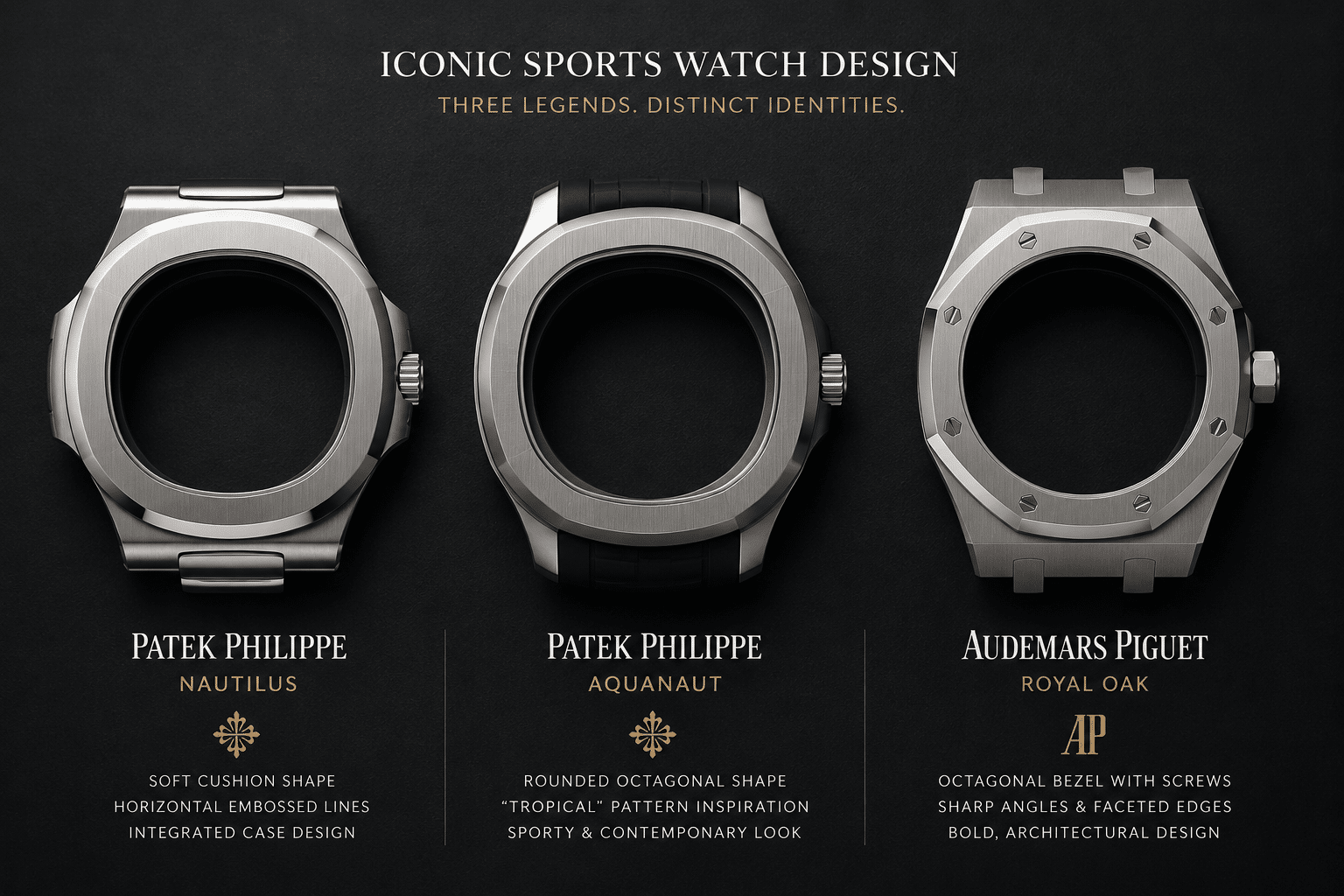
A Practical Decision Order Before Comparing Factories
Before comparing PPF, 3KF, ZF, APSF, or any other factory route, buyers should decide what problem they are actually trying to solve. If the goal is daily comfort, the Aquanaut may deserve attention before a Royal Oak even if the Royal Oak looks more impressive in photos. If the goal is a dressier integrated sports watch, a Nautilus with correct side profile may be more satisfying than a louder AP with weaker bracelet finishing.
The second decision is whether visual accuracy or ownership reliability matters more. A movement with a more convincing display-back layout can improve the watch visually, but it may also add service uncertainty, rotor noise, or thickness if the factory route is not mature. For daily wear, a stable movement and comfortable case can be more valuable than a more ambitious movement claim that only looks better in seller descriptions.
The third decision is flaw tolerance. Royal Oak buyers should be prepared to reject pieces for finishing and alignment issues that may be less noticeable on an Aquanaut. Nautilus buyers should be stricter about side thickness and bracelet flow than about tiny macro-level printing differences. Aquanaut buyers should not ignore strap fit, because a poor strap can make the whole watch feel cheaper than a small dial flaw would.
This order keeps the buying process realistic: choose the wearing purpose first, then the model family, then the reference and movement route, and only then the factory version shown in the actual QC photos. Factory reputation helps narrow the shortlist, but it does not automatically prove that the specific piece is the best choice for the buyer’s wrist or use case.
Before making a decision, buyers should review real QC photos where available, including dial printing, hand alignment, bezel position, datewheel centering, bracelet fit, clasp engraving, case thickness, and overall finishing. Factory labels and stock photos alone are not enough for a reliable judgment.
QC photos can reduce uncertainty, but they do not guarantee perfection or prove that a replica watch is equivalent to the genuine reference. They are most useful for checking whether the specific piece matches the seller’s description, whether the visible finishing supports the claimed factory version, and whether the buyer can accept the remaining risks before ordering.
Case Shape and Thickness: Where the Replica Difficulty Starts
Case shape is where the comparison becomes serious. These watches are not judged only by dial photos. A replica can look clean from the front and still fail from the side if the case is too tall, the bezel sits too high, or the transition into the bracelet or strap looks forced. For this category, super clone case shape and replica watch thickness are not minor technical details; they control whether the watch feels like a slim luxury sports watch or a bulky imitation of one.
This is especially important because Nautilus, Aquanaut, and Royal Oak designs all rely on low, controlled wrist presence. The case should not feel like a tall movement container with a famous bezel attached. If the mid-case thickness is too obvious or the side profile looks slab-like, the flaw is easier to spot from the side than from a straight-on QC photo.
Buyers should be cautious with any listing that only shows front-facing images. Side-profile photos, angled wrist photos, and case-to-bracelet or case-to-strap views often reveal more about the watch than the dial shot. Exact thickness depends on reference, factory version, and movement route, so the smarter approach is not to chase a generic number but to judge whether the case shape makes sense for that specific model.
Royal Oak: sharp geometry leaves less room for error
The Royal Oak case is difficult because it is built from obvious geometry. The octagonal Royal Oak bezel, flat upper surfaces, exposed screw positions, angular case flanks, and integrated lug transition all need to work together. If one plane looks soft, one edge looks rounded, or the bezel height feels excessive, the watch loses the controlled tension that defines the design.
This is why a Royal Oak super clone can be more demanding than it first appears. The case is not just a steel shell; it is part of a continuous visual structure that runs into the bracelet. A slightly bulky mid-case may not sound dramatic on paper, but on wrist it can make the watch sit higher and feel less refined. For buyers who want the Royal Oak because of its sharp architecture, case geometry should be a top priority, not a secondary detail.
Nautilus: softer shape, but harder than it looks
The Nautilus case profile is more rounded and fluid, which makes some buyers assume it is easier to clone. That is only partly true. The softer rounded-square bezel, side ears, slim mid-case, and bracelet transition require careful shaping because the design depends on relaxed proportion rather than hard edges. If the case gets too thick, the Nautilus loses its quiet elegance quickly.
The main risk is that a Nautilus replica may look acceptable in a front photo while feeling too heavy from the side. The side ears should not look swollen, the bezel should not appear stacked too high, and the case should flow naturally into the bracelet. Buyers who want a dressier, more business-friendly replica watch should pay close attention here because thickness affects the whole wearing character.
Aquanaut: simpler profile, more forgiving casual character
The Aquanaut case is generally more forgiving because the design is sportier and less dependent on a full metal bracelet. The rubber-style strap softens the visual transition and makes the watch easier to wear casually. This is one reason an Aquanaut replica can be a more rational choice for buyers who want comfort and lower daily-use pressure.
That does not mean the Aquanaut case can be ignored. The case still needs controlled thickness, a clean bezel profile, and a strap fit that does not leave awkward gaps. If the case looks too tall or the strap does not sit close to the lugs, the watch can feel cheaper than the model’s simple design suggests. The Aquanaut is forgiving, but only when the factory keeps the proportions disciplined.
Side Profile Checks That Matter
The most useful QC angle for these models is often the side view. Buyers should look at overall case thickness, bezel height, mid-case shape, crown guard form where relevant, and the way the case meets the bracelet or strap. A watch that looks too thick on the wrist will usually remain noticeable in daily wear, even if the dial and hands look strong.
For Royal Oak, check whether the bezel and case stack look flat and controlled rather than chunky. For Nautilus, check whether the side ears and case body look smooth without becoming swollen. For Aquanaut, check whether the strap sits naturally against the case and whether the watch keeps a casual low-profile feel. If the side silhouette feels wrong, a better dial will not fully save the watch.
Visual accuracy should be judged through specific details rather than broad claims. Case thickness, lug shape, dial texture, bezel tone, hand length, date position, bracelet construction, and clasp finishing can affect how convincing a Nautilus, Aquanaut, or Royal Oak feels in real use. Close inspection may still reveal differences from the genuine reference design, so the practical goal is to understand visible execution clearly rather than assume equivalence.
Water resistance should not be assumed from a model name, sports-watch appearance, screw-down crown claim, or factory label. Buyers should confirm whether the specific watch has been tested and should treat replica watches more cautiously around water than genuine watches designed, tested, and serviced through official brand channels.
Integrated Bracelet and Strap Execution: The Biggest Wearing Difference
The bracelet or strap is where these three watches separate most clearly in daily use. A Royal Oak replica bracelet is not just an accessory attached to the case; it is one of the main reasons people choose the watch. A Nautilus replica bracelet needs a smoother, more relaxed flow. The Aquanaut rubber strap avoids some of the hardest bracelet problems but creates its own fit and comfort checks.
This is the section many buyers underestimate. Dial texture and logo printing get a lot of attention in photos, but bracelet execution affects what the watch feels like every time it is worn. Link brushing, bracelet articulation, clasp quality, end-link fit, and edge comfort can decide whether a replica feels premium or irritating after a few hours on the wrist.
The strongest judgment here is that Royal Oak bracelet quality can make or break the entire watch more than many small dial details. Nautilus bracelet quality is also important, but its smoother visual language is less aggressive. Aquanaut is often safer for buyers who want comfortable daily wear with fewer metal-link variables, provided the strap and clasp are not treated as afterthoughts.
Royal Oak bracelet: beautiful, recognizable, and unforgiving
The Royal Oak bracelet is one of the hardest parts of any super clone watch to execute convincingly. Each link has to taper correctly, articulate smoothly, carry consistent brushed surfaces, and show polished bevels that do not look either dull or rough. If the bracelet feels cheap, too stiff, too loose, or sharp in the wrong way, the whole Royal Oak impression weakens immediately.
Poor bracelet execution is easy to notice because the Royal Oak bracelet is always visible. It catches light from multiple angles, and the finishing continues directly from the case. Uneven link gaps, weak brushing, soft bevels, or a clasp that closes without confidence all reduce the sense of precision. For buyers choosing a Royal Oak, the bracelet should be inspected as seriously as the dial and bezel.
Comfort also matters. Some sharpness is part of the Royal Oak’s character, but rough edges and poor articulation are not. A good version should feel solid and structured without becoming unpleasant. Buyers who are sensitive to bracelet feel should avoid chasing only the boldest wrist presence and should prioritize a version with proven bracelet finishing.
Nautilus bracelet: smoother but still highly dependent on finishing
The Nautilus bracelet has a different job. It should look smooth, continuous, and relaxed as it leaves the case. The link shape, end-link fit, clasp construction, and overall flow matter more than dramatic edge sharpness. If the bracelet looks detached from the case or feels too rigid, the Nautilus loses the easy elegance that makes it appealing.
A Nautilus replica bracelet can be more forgiving than a Royal Oak bracelet under harsh light, but it is not automatically easy. Overly rounded links, weak brushing, uneven gaps, or a clasp that feels thin can make the watch feel less convincing in hand. This matters especially for buyers who want the Nautilus as a business or smart-casual watch, because the bracelet needs to look refined rather than flashy.
The practical choice depends on tolerance. If a buyer wants a cleaner, less aggressive integrated-bracelet watch, the Nautilus may be easier to live with than the Royal Oak. But the buyer should still check the bracelet flow from case to clasp, not just the front dial photo.
Aquanaut strap: more casual, but not automatically risk-free
The Aquanaut’s strap-based design is its biggest daily-wear advantage. A rubber-style strap reduces the risk of poor link finishing, stiff bracelet articulation, and uneven metal gaps. For many buyers, this makes the Aquanaut replica the easiest of the three to wear casually, especially with relaxed clothing and frequent daily use.
The tradeoff is that strap quality becomes more visible than buyers expect. The texture should look clean, the cut should be even, and the strap should sit close to the case without awkward spacing. A poor strap can make the watch feel toy-like even when the case and dial are acceptable. Clasp feel also matters because a weak clasp undermines the practical comfort that makes the Aquanaut attractive in the first place.
For buyers who care more about comfort than bracelet drama, the Aquanaut is often the sensible route. It gives up some of the integrated-bracelet impact of the Royal Oak and Nautilus, but it also avoids some of their most difficult construction risks. That makes it especially appealing for buyers who want a lower-maintenance wearing experience rather than the most visually demanding replica watch in the category.
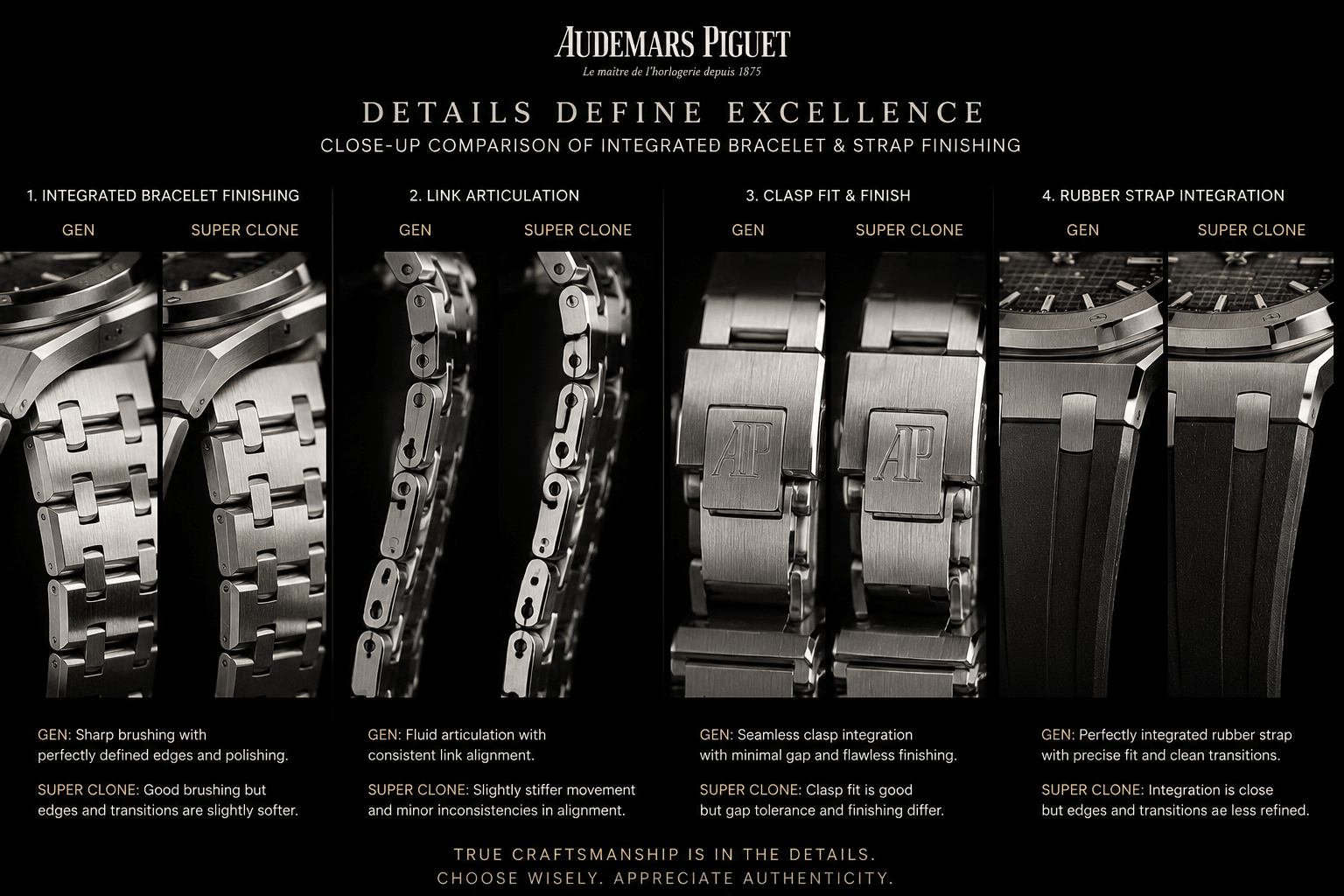
Brushing, Polishing, and Edge Definition: Which Finish Is Harder to Clone?
Finishing is not just about whether a replica watch looks shiny. On a Nautilus, Aquanaut, or Royal Oak super clone, the more important question is whether the brushed surfaces, polished bevels, and edge transitions control light the way the design expects. Seller photos often flatten these details. A watch can look clean in a front-facing photo but look soft, cloudy, or over-polished once it catches office lighting or sunlight from the side.
The Royal Oak is the most demanding of the three because its design exposes finishing mistakes everywhere. The Nautilus is less aggressive, but it needs smoothness and proportion to avoid looking bulky. The Aquanaut has fewer metal surfaces, especially on strap versions, so it is more forgiving in daily wear, but weak case brushing or a cheap-looking clasp still lowers the overall impression. The practical judgment is simple: Royal Oak finishing needs precision; Nautilus finishing needs flow; Aquanaut finishing needs balance.
Royal Oak finishing depends on crisp transitions
Royal Oak brushing is unforgiving because the watch is built around flat planes and sharp changes of direction. The octagonal bezel, case flank, bracelet links, and polished bevels all need to look connected. If the brushing direction changes randomly, if the bevels are too wide, or if the edges look rounded instead of defined, the watch loses the architectural character that makes the Royal Oak recognizable.
This is why the Royal Oak can feel more “expensive” or more disappointing than its photos suggest. A strong Royal Oak replica should show satin brushing that runs evenly across flat surfaces, with polished bevels that catch light as thin, controlled highlights. If those highlights look wavy or blurred, the finishing looks too soft. If the edges feel harsh or rough, the watch may look sharp in photos but become uncomfortable or cheap-feeling on wrist.
The bracelet increases the risk. Each link has its own brushed top, polished chamfer, and side surface. Poor link bevels create uneven reflections as the wrist moves, and that is more visible in real life than in a single QC photo. For a Royal Oak super clone, finishing quality can matter more than a minor dial text difference because the bracelet and bezel are constantly visible in motion.
Nautilus finishing is judged by smoothness and case flow
The Nautilus uses a softer shape, so buyers sometimes assume finishing is easier. It is easier than the Royal Oak in one sense: there are fewer hard geometric planes demanding razor-like transitions. But the Nautilus has a different problem. Its rounded-square bezel, side “ears,” and integrated bracelet flow need to look relaxed without becoming mushy.
Weak Nautilus replica watch finishing usually shows up as overly rounded edges, dull brushing, or polished areas that look too thick. The genuine design language is thin and controlled. If a replica has a bulky polished bezel edge or case sides that reflect light unevenly, the watch starts to look heavier than it should. This is especially noticeable on wrist-level angles, where the case and bracelet should appear to flow as one continuous line.
For Nautilus buyers, the best finishing is not the sharpest finishing. The goal is controlled smoothness. A Nautilus super clone with slightly softer transitions may still work well if the brushing is even, the case profile is slim, and the bracelet does not visually break away from the case. Chasing the most aggressive bevels can actually be the wrong instinct for this model.
Aquanaut finishing has fewer metal surfaces but still needs balance
The Aquanaut is the most forgiving of the three because the rubber-style strap reduces the amount of exposed metal finishing. There is no full integrated bracelet with dozens of brushed and polished link surfaces. That makes the Aquanaut a more sensible choice for buyers who want the Patek Philippe look without the same bracelet-finishing burden as a Nautilus or Royal Oak.
Still, the case cannot be ignored. Poor brushing on the bezel or case flank can make the watch look flat in photos and less refined in person. The Aquanaut also depends on proportion: if the polished areas look too bright, the brushing too weak, or the clasp too crude, the casual design starts to feel like a shortcut rather than a deliberate sports watch.
The non-obvious point is that fewer finishing surfaces do not automatically mean lower quality standards. They simply shift the buyer’s attention. On an Aquanaut replica, the metal finishing does not need to carry the whole watch, but it must not clash with the strap texture, dial pattern, or clasp feel. A balanced Aquanaut is often more convincing for casual wear than a poorly finished Royal Oak that tries to do too much.
Dial and Bezel Visibility: Which Replica Is Easier to Spot?
If the question is which replica is easier to spot in normal viewing, the Royal Oak usually carries the highest visible risk. Not because every Royal Oak replica is weak, but because the design gives the eye too many checkpoints: bezel screws, octagonal proportions, tapisserie-style dial texture, marker placement, date window, bracelet finishing, and edge definition. A small flaw has fewer places to hide.
Royal Oak vs Nautilus replica accuracy is not a simple winner-and-loser comparison. The Nautilus tends to reveal flaws through balance: dial texture, date placement, case thickness, and the way the bracelet continues from the case. The Aquanaut hides some problems because its casual strap-based design is less formal, but its embossed dial, Arabic numerals, and strap fit can still expose weak execution. Buyers should treat “easier to spot” as a risk-management question, not as a way to misrepresent a watch.
Royal Oak: bezel screws and dial texture are high-risk checkpoints
The Royal Oak bezel is one of the most recognizable shapes in modern watch design, which means poor bezel execution is immediately distracting. The eight visible screw heads need consistent position, depth, and alignment. If one screw looks rotated differently, sits too high, or appears too large against the bezel, the whole front view feels off. This matters more than many buyers expect because the bezel is the frame for the entire watch.
The tapisserie dial adds another layer of difficulty. A strong dial should have depth and controlled texture, not just a printed or stamped grid that looks harsh under macro photos. Some replica dials look impressive under direct seller lighting but appear flat or overly crispy in natural light. Marker placement and date window execution also matter because the Royal Oak dial is highly structured. If the date sits low, the hour markers are slightly uneven, or the dial texture lacks depth, the front of the watch becomes busy in the wrong way.
The clear judgment: a Royal Oak super clone is best for buyers willing to inspect details carefully. It can look excellent when the bezel, dial, and bracelet work together, but it is less forgiving than the Nautilus or Aquanaut when one visible element is wrong.
Nautilus: dial balance and case thickness carry the risk
The Nautilus does not have bezel screws, so its flaws tend to appear more quietly. The horizontal dial pattern, marker spacing, hands, date window, and case profile need to feel balanced. If the dial color is slightly off, the date window sits poorly, or the hands look too heavy, the watch may not look obviously wrong at first glance, but it loses the calm elegance that makes the Nautilus work.
Case thickness also affects dial perception. A Nautilus replica can have a decent dial in a straight-on photo, yet look less convincing from the side if the mid-case is too thick or the bezel sits too tall. This is why buyers should not judge a Nautilus super clone only from front photos. The dial and case are connected visually: if the case looks bulky, the dial no longer feels refined.
The Nautilus is more forgiving than the Royal Oak in terms of exposed checkpoints, but less forgiving than many buyers assume. Its risk is not one dramatic flaw. It is the accumulation of small proportion errors that make the watch feel heavier, flatter, or less elegant than expected.
Aquanaut: casual design hides some flaws but exposes others
The Aquanaut is often the easiest of the three to wear casually because the strap and sportier dial language reduce the pressure of formal finishing. It does not rely on a full integrated bracelet or an octagonal screw bezel. That makes it a safer visual choice for buyers who want a lower-maintenance daily replica watch.
But the Aquanaut still has its own traps. The embossed dial must look clean and evenly textured. The Arabic markers need proper spacing and proportion. The date window should sit naturally within the dial rather than appearing too low, too high, or cramped. Strap fit is also visible because the strap meets the case directly; if the gap is uneven or the strap texture looks cheap, the casual character becomes a weakness.
The Aquanaut hides bracelet-finishing risk, but it exposes material harmony. Dial, strap, case brushing, and clasp need to feel like they belong together. A weak strap can make even a decent case look less convincing.
QC Photos to Review Carefully
For all three model families, buyers should ask for more than one flattering front photo. A straight-on dial shot helps reveal marker placement, hand alignment, date position, and dial texture. An angled dial shot is useful because it shows how the surface reacts to light, especially on tapisserie-style and horizontal-pattern dials.
Side-profile photos matter because thickness can change the entire impression of a Nautilus, Aquanaut, or Royal Oak. Bracelet or strap fit should be checked from both top and side angles. For the Royal Oak, close-ups of bezel screws and bracelet links are especially important. For the Nautilus, pay attention to case flow, date placement, and bracelet integration. For the Aquanaut, look closely at strap-to-case fit, dial embossing, clasp finish, and whether the date window looks centered and clean.
Movement Logic: AP 3120 and 4302 Style Routes vs Patek 324 Style Routes
Movement choice in these super clone watches is not only a technical detail. It affects case thickness, winding feel, rotor noise, date behavior, display-back appearance, service expectations, and buyer confidence. A replica can look strong from the front but still be a poor daily-wear choice if the movement route is noisy, unstable, poorly matched to the case, or misrepresented by the seller.
The practical comparison is not “which movement is identical,” because none should be treated as authentic-equivalent. The better question is which movement route makes sense for the specific model. AP 3120-style and 4302-style routes are usually discussed around Royal Oak references, while Patek 324-style routes matter for Nautilus and Aquanaut replicas. Each route involves tradeoffs between visual architecture, thickness control, reliability expectations, and serviceability.
AP 3120-style routes: familiar but version-dependent
The AP 3120 clone movement discussion usually matters most for older Royal Oak-style references. In better versions, the appeal is straightforward: the movement route can support a more appropriate case thickness and a more convincing display-back layout than older plate-modified solutions. That matters because Royal Oak cases are thin and flat enough that extra movement height quickly becomes visible.
Buyers should still be careful with the phrase “3120-style.” It can mean different things depending on the model, factory, and version. Some watches may use a more integrated clone route, while others may use a base movement with decorative work intended to look closer through the caseback. The ownership difference can be real: rotor noise, winding feel, date behavior, and long-term service options may not be the same even if the seller uses similar wording.
The safer approach is to verify the movement route against the exact Royal Oak reference. A 3120-style claim is useful only if it matches the model generation, supports the correct case thickness, and has a track record for daily use. For buyers who want reliable daily wear, a proven and slightly less glamorous route may be better than an ambitious movement that has limited real-world feedback.
AP 4302-style routes: newer-generation expectations
AP 4302-style movement routes are usually tied to newer Royal Oak generations, where buyers expect a different movement layout, different display-back appearance, and often a different case profile. Because these references are more recent, the movement claim can carry more marketing noise. A seller may emphasize the name of the movement, but the buyer still needs to ask whether the watch actually benefits in case thickness, date function, rotor behavior, and overall stability.
The 4302-style route matters because a newer Royal Oak replica should not only look modern from the dial side. If the caseback is visible, the bridge layout, rotor design, and movement positioning need to make visual sense. But visual architecture is only half the issue. Some movement routes may look more impressive while still needing cautious expectations around power reserve consistency, winding efficiency, or service familiarity.
This is where buyers often misunderstand “upgrade.” A newer movement route is not automatically safer. It may be more correct for a specific Royal Oak reference, but it should be judged by version maturity, buyer feedback, and whether the movement helps the watch maintain the right thickness. If the movement makes the case thicker or introduces reliability uncertainty, the upgrade may be less useful than it sounds.
Patek 324-style routes: thinness and display-back appearance matter
For Nautilus and Aquanaut replicas, Patek 324 clone movement claims should be judged through thinness and overall presentation. These watches depend heavily on a slim case impression. If the movement route forces extra case height, the watch may lose the quiet, flat elegance that defines the Nautilus and the relaxed wearability that makes the Aquanaut appealing.
Display-back appearance also matters, especially on models where the movement is visible. Rotor shape, bridge layout, engraving quality, and finishing style can affect buyer satisfaction, but they should not be confused with genuine-level watchmaking. A decorated movement can look attractive while still having different service needs, winding feel, and durability expectations.
Date behavior is another practical point. Buyers should check whether the date changes cleanly, whether the crown positions feel reasonable, and whether the movement operates smoothly during setting. A beautiful dial photo does not tell you whether the movement feels rough at the crown or whether the date mechanism is likely to become annoying in daily use.
Movement Route to Verify
Before choosing between a Patek Philippe super clone and an Audemars Piguet super clone, confirm the claimed movement type, the factory version, and whether that route matches the exact reference being copied. Ask whether the movement affects case thickness, whether the caseback layout is consistent with the model, and whether the date function behaves correctly during setting and midnight changeover.
At Clean VS Factory, we usually treat movement choice as part of the ownership decision, not just a specification line. The best movement route is not always the most complicated-sounding one. It is the one that supports the correct case profile, has reasonable daily-wear expectations, and does not create avoidable service or reliability risk for the buyer’s intended use.
Movement Transparency Note: Movement references in this article describe the replica-market movement type or configuration, not an official Patek Philippe or Audemars Piguet caliber unless explicitly stated with verifiable evidence. Buyers should judge movement claims by the specific version, case thickness, setting behavior, rotor sound, and realistic service risk rather than by movement names alone.
Movement descriptions in the replica market should be checked carefully because they may refer to layout, decoration, clone architecture, base movement family, or seller terminology rather than an official brand-manufactured caliber. A movement that looks closer through a display back may still differ from the genuine reference in architecture, materials, regulation, parts compatibility, and service options.
How to Treat Movement and Specification Claims
Movement labels in replica listings should be read as claims to verify, not as final technical proof. Terms such as 3120-style, 4302-style, 324-style, clone movement, decorated movement, or upgraded movement can describe very different constructions depending on the factory route and batch. A buyer should ask what the claim changes in practical terms: thickness, crown feel, date setting, display-back appearance, rotor sound, service access, and long-term comfort in daily use.
The same caution applies to stated materials and durability. A listing may mention sapphire crystal, stainless steel grade, ceramic parts, improved rotor, better clasp, or water resistance, but those statements do not automatically prove the condition of the individual watch. Water resistance should be treated as unverified unless the specific watch has been pressure-tested after purchase, and genuine-brand water-resistance expectations should not be transferred to a replica by assumption.
Movement trust in the replica market depends on understanding what the movement claim actually describes: architecture, decoration, layout, reliability, or simply a market name used by sellers. A display-back movement that looks closer to the genuine reference design may still differ in construction, parts availability, lubrication quality, winding efficiency, and future service options. Buyers should separate appearance from ownership practicality before paying extra for a more ambitious movement route.
Factory Options and Version Claims: Why Model Context Matters More Than Brand Names
The search for the best factory for Patek Philippe super clone or the best factory for Audemars Piguet super clone usually starts with the wrong question. Factory names matter, but they do not solve the whole decision. A PPF Nautilus, 3KF Aquanaut, ZF Royal Oak, or APSF Royal Oak should be judged by the exact reference, version, movement route, case profile, bracelet or strap execution, and the actual QC photos in front of the buyer.
The mistake is assuming that one factory reputation transfers cleanly across an entire brand. It does not. A factory can be strong on one Nautilus reference and less convincing on another dial color or bracelet version. The same applies to Audemars Piguet replicas: a Royal Oak factory route that looks excellent on a 15500-style model may not automatically be the safest choice for a thinner Jumbo-style reference, a chronograph, or a different case size.
Why “best factory” depends on the exact reference
For Patek-style replicas, Nautilus and Aquanaut decisions are not identical. A Nautilus super clone puts more pressure on bracelet flow, case “ear” shape, dial balance, and thinness. An Aquanaut replica shifts the risk toward strap fit, embossed dial texture, clasp quality, and whether the case still wears slim enough. A factory that handles the Nautilus bracelet well may not necessarily produce the best Aquanaut strap integration or the most convincing dial layout.
Royal Oak replicas create a different problem. The factory has to manage the octagonal bezel, visible screw positions, tapisserie-style dial, sharp case transitions, integrated bracelet articulation, and movement thickness at the same time. ZF and APSF are often discussed because they have strong AP routes, but the better choice can change by model generation, dial, bracelet update, and movement claim. The Royal Oak is too exposed to buy by factory name alone.
At Clean VS Factory, we usually treat factory reputation as a starting filter, not the final answer. The practical question is not “which factory is best,” but “which factory version is strongest for this specific reference, and do the QC photos support the claim?” That distinction prevents many expensive wrong choices.
A factory comparison is most useful when it is tied to the specific reference, version, movement, and visible execution details rather than treated as a universal ranking. For these Patek Philippe and Audemars Piguet replica-market options, the same factory label can mean different practical results depending on case size, dial color, bracelet update, strap fit, movement route, and batch consistency. Buyers should use factory names to organize research, not to replace model-by-model verification.
Version updates can change the buying logic
Old forum comments can be useful, but they can also mislead buyers when a factory has changed the dial, bracelet, movement route, or case profile since that discussion was written. In this category, version updates are not cosmetic trivia. A better bracelet update on a Royal Oak can matter more than a small dial print improvement. A thinner case on a Nautilus can change the whole wrist impression. A revised Aquanaut strap fit can make the watch feel more natural even if the dial change is minor.
Buyers should ask about the factory version, not just the factory label. For a Patek Philippe super clone, that means confirming whether the current batch has the expected case thickness, dial texture, date position, bracelet or strap fit, and movement route. For an Audemars Piguet super clone, the key questions are usually bezel screw alignment, tapisserie-style dial quality, bracelet finishing, clasp action, case thickness, and whether the claimed movement route matches the reference.
The non-obvious point is that a newer version is not automatically better for every buyer. Some updates improve visual accuracy but introduce a less proven movement route. Others improve dial texture while leaving bracelet feel unchanged. A buyer choosing for daily wear should give more weight to stable construction and comfortable wearing character than to a single advertised upgrade.
QC consistency may matter more than the factory label
A well-executed piece from a less-hyped route can be a smarter buy than a poorly aligned piece from a famous factory. This is especially true with Royal Oak replicas, where a slightly crooked bezel screw, uneven bracelet gap, weak clasp closure, or inconsistent brushing can be obvious on the wrist. The factory label may explain the potential ceiling, but QC photos show the actual watch.
For Nautilus and Aquanaut replicas, QC consistency often appears in quieter details: date centering, dial texture, marker placement, strap-to-case fit, bracelet flow, and side-profile thickness. These are not always dramatic in seller photos, but they affect how convincing the watch feels in normal use. A buyer who ignores these checks because the factory name sounds strong is giving up the main advantage of reviewing QC in the first place.
The safest approach is to compare model, version, and batch together. Factory names such as PPF, 3KF, ZF, and APSF are useful only when tied to a specific watch and a specific set of photos. Without that context, “best factory” becomes a shortcut that can hide the very flaws the buyer is trying to avoid.
Wearing Character: Business, Casual, Young, and Low-Profile Buyers
The Nautilus, Aquanaut, and Royal Oak may all sit in the luxury sports watch category, but they do not wear with the same personality. A Royal Oak super clone has stronger architecture and more wrist presence. A Nautilus super clone feels smoother, dressier, and more restrained. An Aquanaut replica is usually the most relaxed of the three, especially for buyers who want casual wear without the weight and visual complexity of a full integrated bracelet.
This is where the technical details become personal. Case thickness, bracelet comfort, strap feel, dial color, and finishing sharpness all affect whether the watch fits the buyer’s actual life. The best replica watch for daily wear is not always the one with the strongest name recognition. It is the one whose visual impact, comfort, and QC risk match the buyer’s tolerance.
Business wear: Nautilus usually feels more restrained
For office wear, the Nautilus often makes more sense than the Royal Oak if the buyer wants a luxury sports profile without maximum visual sharpness. The rounded-square case, horizontal dial pattern, and smoother bracelet line sit more easily with shirts, jackets, and business-casual clothing. A Nautilus super clone daily wear choice still needs careful attention to thickness and dial balance, but its overall language is less aggressive than a Royal Oak.
The risk is assuming “restrained” means invisible. A Nautilus is still recognizable to watch-aware people, and poor case proportions can weaken the effect quickly. A thick side profile or awkward bracelet transition makes the watch feel less elegant, which is exactly where this model cannot afford to fail.
Casual wear: Aquanaut is often the easiest fit
The Aquanaut is usually the easiest Patek route for casual outfits because the rubber-style strap lowers the formality and reduces the integrated-bracelet pressure. It works better with polos, T-shirts, travel clothing, and weekend use than many buyers expect. For someone who wants Aquanaut casual wear without constantly thinking about bracelet scratches or sharp link finishing, it can be the most practical choice in this comparison.
That does not make the Aquanaut risk-free. The strap must sit cleanly against the case, the embossed dial should not look flat or toy-like, and the clasp should feel secure enough for daily use. Still, for buyers who value comfort and a lower-maintenance wearing experience, a well-executed Aquanaut can be more rational than chasing the most visually dramatic Royal Oak.
Younger buyers: Royal Oak delivers stronger wrist impact
The Royal Oak appeals strongly to buyers who want a bolder integrated-bracelet look. The octagonal bezel, exposed screws, broad bracelet, and sharp brushing create immediate wrist impact. For younger buyers or anyone who wants the watch to feel architectural and noticeable, Royal Oak super clone daily wear can be more satisfying than the softer Nautilus or the more relaxed Aquanaut.
The tradeoff is higher scrutiny. A Royal Oak asks more from the replica: sharper brushing, cleaner bevels, better bracelet articulation, stronger dial texture, and tighter bezel execution. If the buyer is not willing to inspect QC carefully, the Royal Oak’s biggest strength becomes its biggest weakness. It shows off both good execution and poor execution very quickly.
Low-profile buyers: avoid the loudest configuration
Low-profile buyers should not choose only by fame. A bright blue Royal Oak or highly recognizable bracelet configuration may be satisfying in photos but too loud in daily life. A restrained Nautilus dial, a clean Aquanaut on strap, or a less attention-grabbing color can be easier to wear without feeling overexposed.
The best low-profile replica is usually the one with controlled thickness, comfortable fit, and fewer dramatic visual checkpoints. In practice, that often means prioritizing the version that wears naturally over the version that gets the most forum attention. A quieter watch with better proportions is usually more convincing than a famous model with obvious case or bracelet issues.
Price and Value Logic: When Paying More Actually Reduces Risk
Patek Philippe replica price and Audemars Piguet replica price should be read as risk signals, not simple quality labels. A higher price can be justified when it reflects a better factory version, improved case profile, stronger bracelet finishing, more convincing movement route, or better batch consistency. But a higher price can also be just a claim wrapped around old stock, vague movement language, or a factory name being used too loosely.
The value question is different for each model family. Royal Oak replicas are expensive to execute well because the bracelet, bezel, dial texture, and finishing transitions all matter at once. Nautilus replicas need thinness, case flow, dial balance, and bracelet integration. Aquanaut replicas can offer stronger practical value if the buyer wants comfort and casual usability more than complex bracelet finishing.
Prices can change by factory label, version, movement, seller channel, availability, finishing quality, and after-sales support, so exact comparisons should be verified at the time of purchase. A price difference is most meaningful when the seller can connect it to a specific reference, current version, visible QC evidence, movement configuration, and clear ordering terms.
Paying more can make sense when the extra cost reduces visible or ownership risk. On a Royal Oak, that usually means cleaner bracelet brushing, better link articulation, more even bevels, stronger clasp feel, improved tapisserie-style dial execution, and a movement route that supports the correct case thickness. Cheap Royal Oak versions often look acceptable from one front photo but fall apart in bracelet feel and side profile.
For a Nautilus, premium value usually comes from case thinness, smoother bracelet flow, more balanced dial texture, cleaner date placement, and a movement route that does not force the case to wear too tall. For an Aquanaut, the buyer may be paying for better strap molding, cleaner case finishing, stronger clasp quality, and a dial that has enough depth without looking exaggerated.
The key judgment is simple: paying more is reasonable when it buys fewer compromises in the areas the model exposes most. It is less reasonable when the seller cannot explain the version, movement route, or specific improvement behind the price difference.
Where higher price can be misleading
A higher price becomes weak value when the factory claim is unclear. If the listing only says “latest version” without confirming the actual factory route, batch, movement type, or visible updates, the buyer is being asked to pay for confidence without evidence. This is especially risky with models that have had multiple updates, because old-version stock can still circulate under newer language.
Movement descriptions also deserve caution. A decorated movement, a clone-style bridge, or a display-back layout may improve appearance, but it does not automatically mean better reliability or easier ownership. If the movement route increases thickness, produces more rotor noise, or has limited service familiarity, it may not improve the daily-wear experience despite sounding more premium.
The same applies to dial color and special configurations. A harder-to-source color or a more dramatic version may cost more, but it can also be less consistent. If the dial shade, screw alignment, bracelet gaps, or date position are weak in QC, the higher price does not rescue the watch.
Mid-tier choices can be smarter for certain buyers
A mid-tier replica can be the smarter choice when the model is less visually demanding or when the buyer values comfort over mechanical ambition. An Aquanaut-style watch with good strap fit and clean proportions may serve daily wear better than a more expensive Royal Oak-style replica with stiff bracelet links, uneven brushing, or a questionable movement claim.
This does not mean buyers should chase the cheapest option. Very low-cost versions usually compromise too much in case shape, finishing, clasp feel, and movement stability. The smarter middle ground is choosing a model whose design is more forgiving and then buying the version that handles the most visible details well.
For value-focused buyers, the most rational choice is not always the highest-priced Patek Philippe or Audemars Piguet super clone. It is the version where the price matches the actual risks being reduced: thickness, bracelet comfort, dial execution, movement logic, and QC consistency. If those areas are not clearly better, paying more is just paying for a name.
Legal, Disclosure, and Ownership Caution
Replica watches can raise trademark, customs, import, resale, and disclosure issues depending on jurisdiction, so buyers should avoid treating any article or seller statement as legal advice. These watches are imitation products and should not be described, resold, or represented as authentic Patek Philippe or Audemars Piguet watches. A careful buyer should also avoid assuming that a successful purchase by another person proves that every shipment, resale, or local situation is risk-free.
Disclosure matters beyond legal risk. If a buyer later sells, trades, gifts, photographs, or discusses the watch, the safest and most ethical approach is to be clear that it is a replica. This article’s comparison language is intended to help buyers evaluate construction quality and wearing character, not to encourage misrepresentation or imply authorization, endorsement, or affiliation with any original watch brand.
A replica watch should also be evaluated with realistic ownership expectations. Even a strong super clone can have limits in water resistance, long-term movement stability, servicing convenience, bracelet durability, and close inspection compared with a genuine reference. Buyers should confirm return, repair, shipping, and after-sales terms before ordering, because those practical terms can vary by seller and should not be assumed from the watch model or factory name.
QC Risk Map: What to Check Before Choosing PP or AP
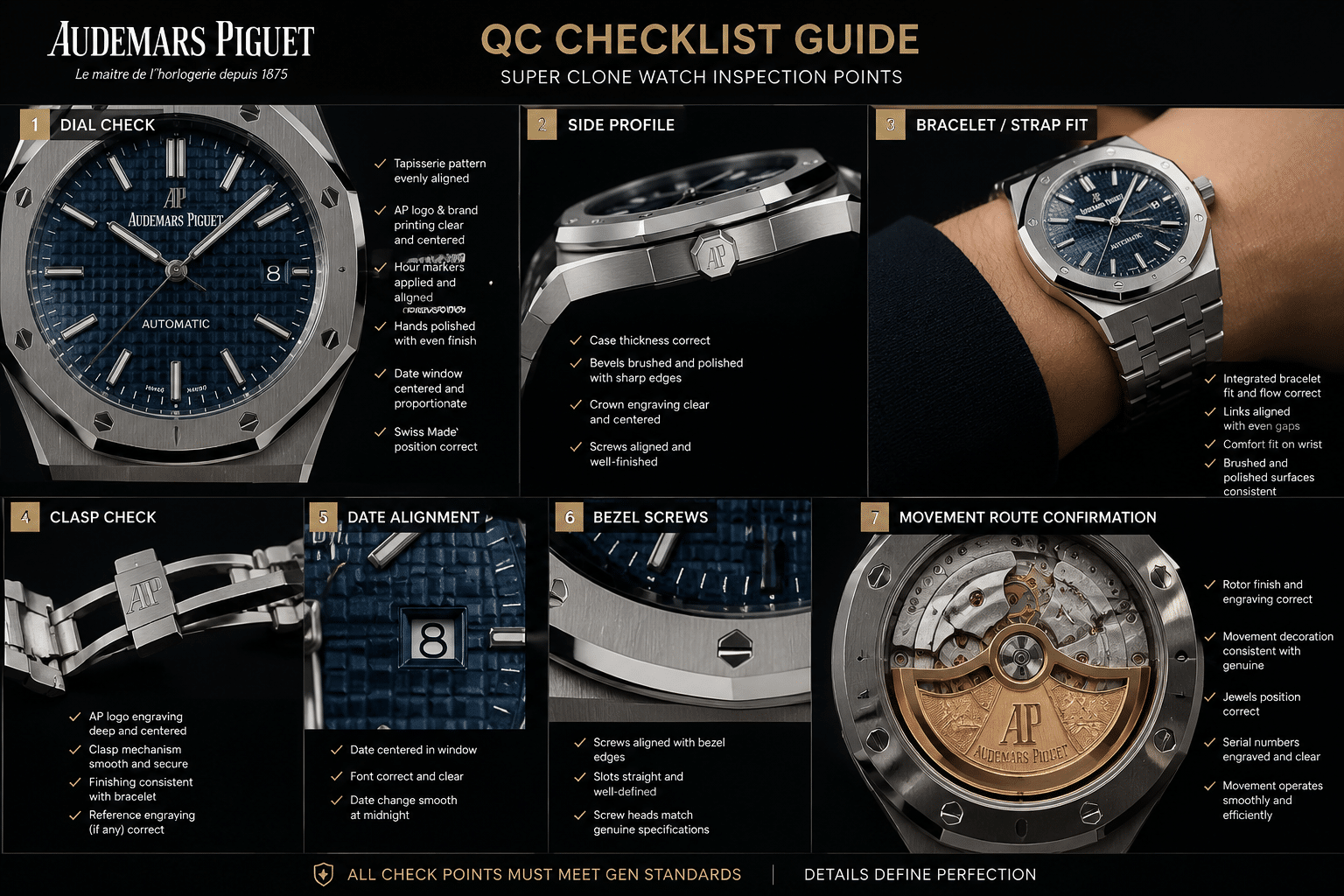
Good replica watch QC photos do not need to prove that a super clone is perfect. They need to show whether the specific piece has the type of flaw that will bother you every time you wear it. For Patek Philippe and Audemars Piguet super clones, the most useful inspection order is simple: front dial first, side profile second, bracelet or strap fit third, clasp and date alignment after that, then movement-route confirmation if the watch has a display back or a movement claim that affects thickness.
The mistake is treating every small imperfection as equal. A tiny printing difference that only appears under macro photos may be tolerable. A crooked date, uneven bracelet gap, badly seated Royal Oak bezel screw, or case that looks too thick from the side is a different problem. Those flaws affect the watch’s normal wrist presence, not just a forum close-up.
Royal Oak QC priorities
The Royal Oak needs the strictest super clone QC checklist because the design has more exposed checkpoints than the Nautilus or Aquanaut. Start with the bezel screws. They should sit evenly, look flush, and maintain consistent spacing around the octagonal bezel. A slightly imperfect screw angle may not ruin the watch in daily wear, but a visibly uneven screw position or one screw sitting higher than the others is a clear warning sign.
Next, check the tapisserie-style dial. The grid should look even across the dial, not stretched near the date window or visually soft in one area. Hour markers should sit straight, the hands should align cleanly, and the date should not appear low, high, or pushed too far to one side. On a Royal Oak replica, the dial and bezel talk to each other visually; if one is crooked, the whole front view feels unstable.
The bracelet deserves equal attention. Look for even link gaps, consistent brushing direction, clean polished bevels, and natural articulation at the first links near the case. A Royal Oak bracelet that looks stiff, rough, or uneven will feel cheaper than the dial photo suggests. Clasp closure also matters: it should sit flat and close securely without looking misaligned or bulky.
Side profile is the final reality check. Some Royal Oak super clones look strong in straight-on photos but lose the design from the side because the mid-case, bezel, or caseback looks too tall. If the watch appears blocky instead of flat and architectural, the buyer should think carefully before accepting it.
Nautilus QC priorities
For a Nautilus replica, the front dial is important, but the side profile often decides whether the watch feels convincing. The case should not look inflated. Check the bezel height, case “ear” shape, and the way the bracelet leaves the case. A Nautilus can tolerate a softer visual character than a Royal Oak, but it cannot tolerate a bulky side silhouette.
The horizontal dial texture should run evenly and stay balanced around the hour markers and date window. Misaligned hands, tilted markers, or a date that sits visibly off-center are worth rejecting because the Nautilus dial has a calm, open layout. Small errors have fewer places to hide.
Bracelet flow is another key point. The first links should look integrated with the case rather than attached as an afterthought. Uneven end-link spacing, rough clasp finishing, or a bracelet that does not drape naturally weakens the Nautilus more than many buyers expect. The watch depends on smoothness, not sharp drama, so poor bracelet behavior breaks the design language quickly.
Aquanaut QC priorities
The Aquanaut is more forgiving than the Royal Oak and usually easier to live with than a full-bracelet Nautilus, but it is not risk-free. The first QC check should be strap-to-case fit. The rubber-style strap should sit close to the case without large gaps, twisting, or awkward tension. If the strap looks poorly cut or does not follow the case shape, the casual character starts to look cheap.
The embossed dial pattern should appear centered and consistent, with Arabic markers placed cleanly. Because the Aquanaut dial is more graphic than the Nautilus, crooked numerals or uneven printing can stand out quickly. The date window also needs attention; a low or tilted date is one of the fastest ways for the watch to feel poorly assembled.
Clasp quality matters more than buyers often assume. A weak clasp can turn an otherwise decent Aquanaut replica into a frustrating daily watch. Check that it closes flat, does not show obvious rough edges, and matches the strap’s casual but clean feel. Also ask for a side photo, because even on a strap model, excessive case thickness can make the watch look less relaxed and more generic.
Red Flags Before You Decide
Rejecting a watch should not be based on perfectionism. It should be based on whether the flaw changes the wearing experience. The clearest red flags are visibly crooked date wheels, badly misaligned Royal Oak bezel screws, uneven bracelet gaps, a Nautilus case that looks too thick from the side, an Aquanaut strap that does not sit cleanly against the case, or a clasp that fails to close securely.
Also be careful when seller claims conflict with the QC photos. If a watch is described as a newer version but the movement layout, dial update, bracelet construction, or case thickness does not match that claim, trust the photos over the description. In practice, the safer choice is not the watch with the strongest factory label; it is the piece whose QC photos support the version being claimed.
The purpose of factory, QC, and movement information is to help readers understand visible quality and ownership risk, not to represent a replica watch as genuine. A strong super clone may look convincing in normal wear, but close inspection can still reveal differences in finishing, movement architecture, case proportions, bracelet feel, dial details, or service compatibility.
Final Recommendation: Which Super Clone Fits Which Buyer?
The Patek Philippe super clone vs AP super clone decision should not be settled by brand prestige. It should be settled by how much visual drama you want, how much QC risk you are willing to manage, and how the watch will actually be worn. A Royal Oak replica gives the strongest integrated-bracelet impact, a Nautilus replica offers a more restrained luxury-sports profile, and an Aquanaut replica is usually the easiest to wear casually.
The best super clone for daily wear is not always the most famous model. It is the model where the case shape, bracelet or strap, movement route, and QC result all support the same purpose. If one of those parts is weak, the watch may still look attractive in photos but feel less convincing on the wrist.
Choose Royal Oak if bracelet impact matters most
Choose the Royal Oak if you want the boldest wrist presence and the most architectural integrated-bracelet look. It is the most visually powerful option in this comparison, but it also demands the strictest inspection. Bezel screw alignment, tapisserie-style dial quality, bracelet brushing, link articulation, clasp fit, and side thickness all matter.
This is not the lowest-risk first choice for buyers who dislike QC work. A strong Royal Oak super clone can be very satisfying, but a weak one is easier to notice because the design exposes every edge, screw, link, and finishing transition. It suits buyers who care about wrist impact and are willing to reject a piece that does not meet the basic visual standard.
Choose Nautilus if restrained elegance matters most
Choose the Nautilus if you want a slimmer, more business-friendly luxury sports watch character. It is still recognizable, but it does not shout in the same way as the Royal Oak. The Nautilus works best for buyers who want a polished, versatile look and are willing to pay close attention to case thickness, dial balance, date placement, and bracelet flow.
The main risk is assuming the softer shape makes it easy to clone. It does not. A Nautilus replica can look wrong if the case is too thick, the ears are poorly shaped, or the bracelet does not leave the case smoothly. For buyers who value elegance over sharpness, a well-executed Nautilus is often the more mature choice.
Choose Aquanaut if comfort and casual wear matter most
Choose the Aquanaut if you want the most relaxed option among the three. The strap-based design reduces some integrated-bracelet risk and makes the watch easier to wear with casual clothing. For buyers who want a lower-profile replica that does not demand constant bracelet inspection, the Aquanaut is often the most practical route.
The tradeoff is that the Aquanaut still needs clean execution. Strap fit, embossed dial pattern, Arabic marker placement, date alignment, clasp quality, and case thickness should not be ignored. It is the most forgiving model family here, not a free pass for poor QC.
The safest choice is the best-executed version, not the biggest name
If the buyer asks, “which one should I choose,” the honest answer is conditional. Choose Royal Oak for maximum bracelet presence and accept higher QC demands. Choose Nautilus for restrained elegance and watch the side profile carefully. Choose Aquanaut for comfort, casual use, and fewer bracelet complications.
The safest first choice is usually the model that matches your lifestyle and arrives with convincing QC photos, a sensible movement route, and realistic thickness. Factory reputation helps, but it does not override the individual watch. A well-executed, properly checked version is always smarter than choosing only by the louder brand name or the most hyped factory claim.
Disclosure: This article is for general educational and comparison purposes only. Replica watches are not genuine products from the original luxury brands, and brand names are used only to identify reference designs or comparison topics. Factory names, movement descriptions, prices, availability, QC details, seller policies, and version information can change, so readers should verify important details with the seller before making a purchase decision. Replica watches should not be represented, resold, or used as genuine watches.