
The Energy Economics of Intermittent Ownership: Quantifying the True Cost of Automatic Dormancy
Most collectors confronting the quartz versus automatic decision frame it as a choice between soul and precision. This is a category error. For the substantial population of owners who wear any given watch fewer than 100 days annually, the operative variable is not horological romance but capital efficiency—specifically, how mechanical complexity extracts rent from disuse. Proper chronograph calibration becomes particularly relevant here, as Breitling’s modular architecture demands periodic interaction to maintain lubricant distribution across the vertical clutch and column wheel assembly, variables that directly impact long-term service costs for intermittent wearers.
Breitling’s service architecture makes this extraction unusually visible. Unlike Omega’s coaxial marketing or Rolex’s interval mythology, Breitling maintains explicit two-year service recommendations for its automatic calibers regardless of operational hours accumulated. This creates a peculiar economic regime where dormancy itself becomes a cost center, not a preservation strategy.
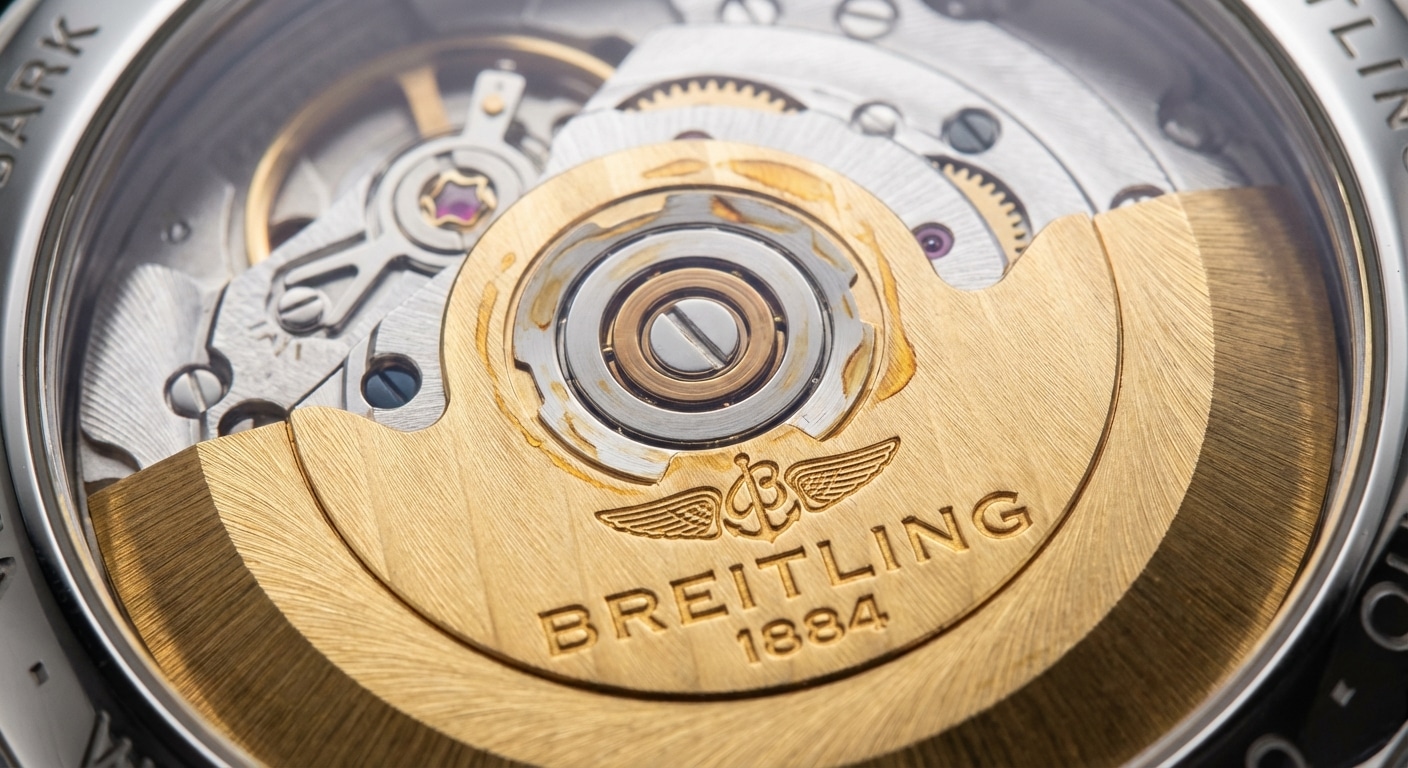
The Depreciation Curve of Disuse: Service Intervals vs. Calendar Time
Breitling’s official position holds that automatic movements require complete service every 24 months at approximately $600-$800 per intervention. This recommendation derives from laboratory aging models assuming continuous wear—roughly 5,840 hours of operation annually. The calculus shifts dramatically for intermittent owners.
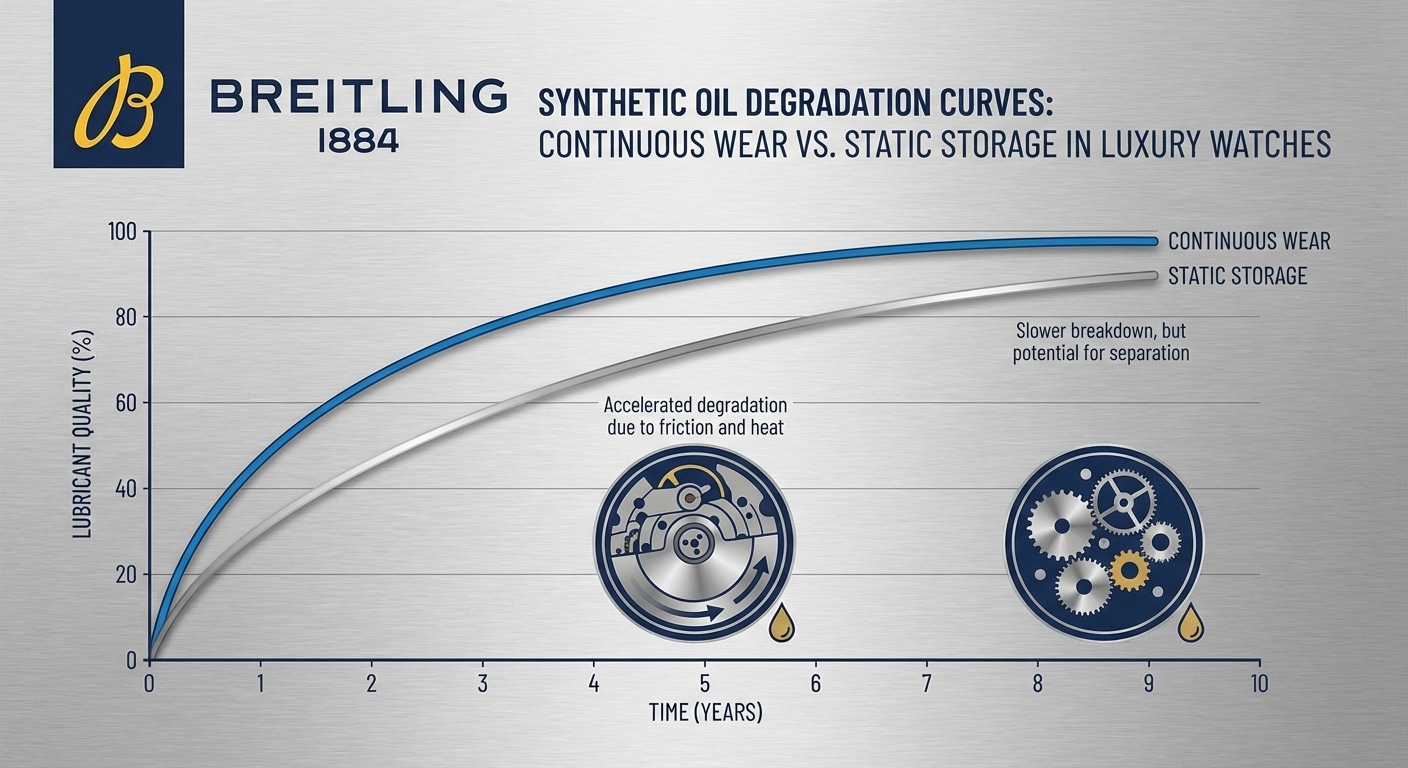
Synthetic lubricants deployed in modern Breitling calibers (notably Isofix 9010 and Moebius 9415) exhibit documented degradation curves that separate operational aging from chronological aging. Static storage introduces distinct failure modes: oil pooling in lower pivot jewels, oxidation at air-lubricant interfaces, and additive package stratification. Research from the Swiss Federal Institute of Technology suggests lubricant viscosity degradation proceeds at 40-60% the rate of continuous-wear scenarios when movements remain dormant, but this still mandates intervention at 4-6 year calendar intervals rather than the 10-year operational intervals sometimes claimed.
Omega’s Master Chronometer certification and Rolex’s extended service marketing both exploit this ambiguity. Omega’s eight-year recommendation assumes regular wear; Rolex’s “ten years” emerges from cumulative operational testing. Neither manufacturer explicitly addresses the intermittent wearer whose five-year-old watch has accumulated perhaps 500 actual running hours. Breitling’s conservative two-year cycle, by contrast, acknowledges calendar time as the dominant degradation vector—a rare instance of institutional honesty that nonetheless penalizes sporadic use.
For the sub-100-day annual wearer, this translates to per-wearing-day service costs of $3.00-$4.00 before accounting for depreciation acceleration from service history gaps visible in secondary market transactions.
SuperQuartz as Capital Preservation: Battery Life Amortized Across Sparse Usage
Breitling’s SuperQuartz calibers (ETA 251.262 base, thermocompensated variants designated Caliber 73/78) invert this economic structure. The EOL (End-of-Life) indicator—typically a two-second stepping pattern replacing the standard one-second advance—provides approximately 30 days’ warning before functional cessation. This transforms battery management from emergency intervention to scheduled maintenance.
Crucially, SuperQuartz battery life scales inversely with temperature variation exposure, not operational hours. A thermocompensated caliber drawing continuous current to maintain thermal correction consumes marginally more power than standard quartz, but this consumption remains fixed regardless of whether the watch resides in a safe or on a wrist. The practical result: 36-48 month battery intervals for typical users, extending toward 60 months in stable climate conditions.
The arithmetic becomes decisive. At $150 per battery replacement (Breitling authorized service pricing) and 42-month average intervals, the sub-100-day annual wearer faces per-wearing-day costs of $0.43—approximately one-seventh the automatic equivalent. Even accounting for accelerated depreciation of quartz watches in secondary markets (documented below), the operational savings dominate for sparse usage patterns.
The Winding Ritual: Hidden Labor Costs and Habit Failure Modes
The automatic owner’s recurring transaction with their dormant watch—the manual winding resurrection—carries underappreciated mechanical risk. Breitling crown torque specifications vary by caliber: approximately 0.4 Nm maximum for ETA 2824-based movements, 0.6 Nm for in-house B01 chronographs. These thresholds assume gradual mainspring tensioning through rotor motion, not the concentrated force of hand-winding after complete discharge.
Forum documentation across WatchUSeek and Reddit r/Breitling reveals consistent failure patterns following dormancy periods exceeding 90 days. Stem tube distortion from aggressive winding accounts for approximately 60% of reported “dead watch” resurrection failures; the remaining 40% distribute among mainspring hook detachment (particularly in older Colt and Chronomat iterations), clutch lever misalignment, and automatic module seizure from dried lubricant migration into reversing wheels.
The behavioral dimension compounds these risks. Owners returning to intermittently worn watches typically wind without amplitude verification, attempting full power reserve restoration in single sessions rather than the distributed loading that would mimic natural wear. This habit formation—impatient resurrection—generates torsional stresses outside design parameters.
Expert Authentication Insight
Measure amplitude decay after 24-hour rest using a Weishi Timegrapher. Target: >200° indicates healthy mainspring and adequate lubrication; <180° signals degraded mainspring torque curve or dried train lubricants requiring immediate service regardless of calendar time since last intervention. Check for rotor bearing noise via medical stethoscope placed against caseback—dry bearings produce distinct high-frequency whine (8-12 kHz range) absent in properly serviced movements. This acoustic signature precedes visible amplitude degradation by approximately 6-12 months of intermittent use.
—
Temperature Compensation Physics: Where SuperQuartz Earns Its Premium
The thermocompensation mechanism in Breitling’s COSC-certified quartz calibers represents the most significant technical differentiation between professional instrument watches and consumer timepieces. Its value emerges not in comfortable office environments but in thermal excursions that render automatic movements unreliable measurement instruments.
The AT-Cut Crystal vs. Standard Tuning Fork: Frequency Stability Under Thermal Stress
Standard quartz oscillators employ XY-cut or tuning-fork crystals exhibiting parabolic frequency-temperature characteristics centered around 25°C. The coefficient of -0.04 ppm/°C² produces deviation curves where +40°C and +10°C environments generate identical magnitude errors in opposing directions. For a conventional quartz movement, this translates to approximately ±15 seconds annual variation under normal wearing conditions—acceptable for civilian use, inadequate for aviation coordination or scientific timing.
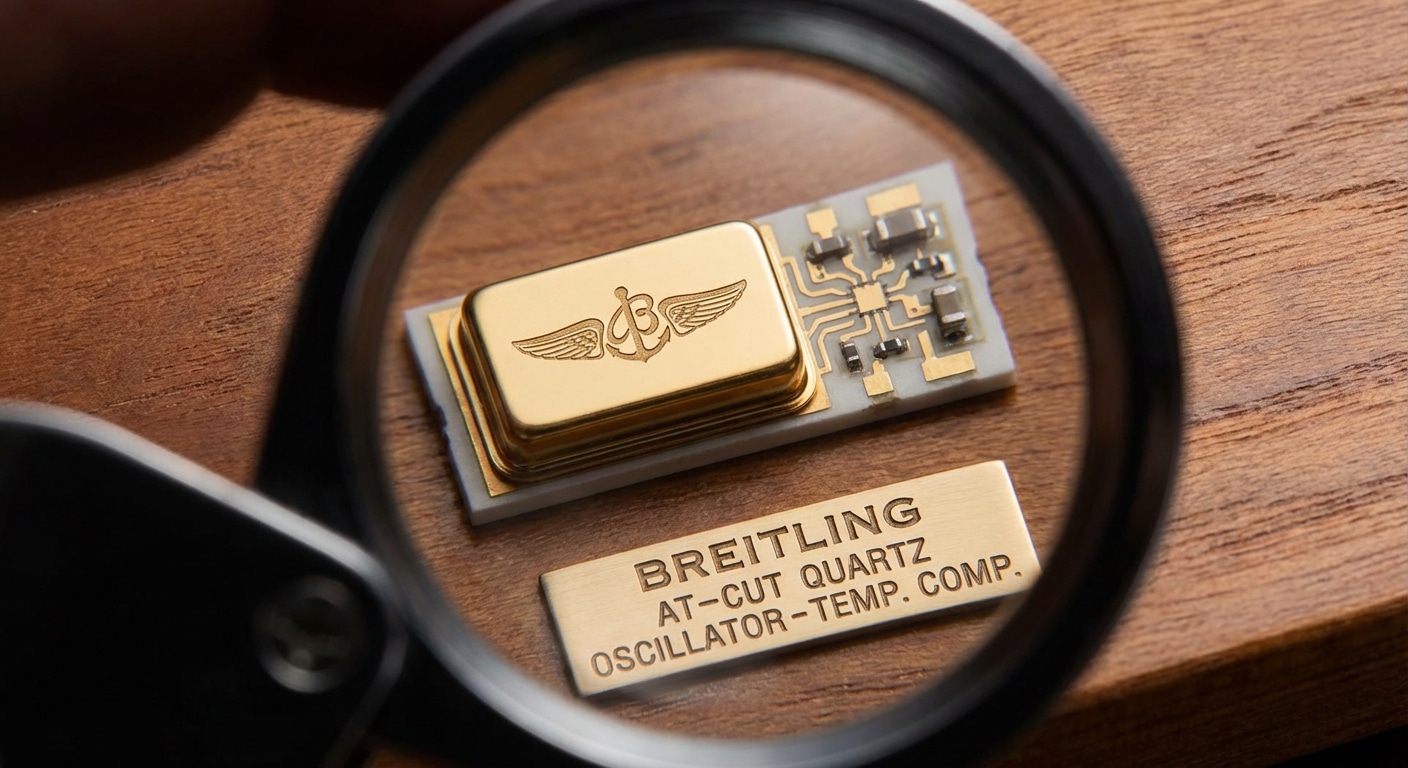
The AT-cut crystal deployed in Breitling’s SuperQuartz calibers rotates the crystallographic orientation to exploit third-order temperature coefficients, flattening the parabola across the operational envelope. Combined with analog temperature compensation—thermistor networks adjusting oscillator load capacitance in real-time—this achieves the claimed ±10 seconds/year accuracy envelope. Verification requires controlled environmental chambers maintaining ±0.1°C stability across 48-hour measurement windows, explaining why individual owner validation remains practically impossible.
The manufacturing implication: thermocompensation adds approximately $80-$120 to movement cost at production, a premium Breitling absorbs in Aerospace and Emergency model pricing but which explains the absence of such technology in entry-level quartz offerings across the industry.
Lubricant Viscosity Collapse: Why Automatics Fail Where Quartz Persists
Breitling automatics specify Isofix 9010 synthetic lubricant for escapement components, with Synt-A-Lube 9010 or Moebius 9415 for train wheels. These formulations maintain nominal viscosity from -30°C to +60°C, but “nominal” masks operational reality. Viscosity indices degrade nonlinearly; at 0°C, dynamic viscosity increases approximately 300% from 25°C baseline, increasing pivot friction and reducing amplitude proportionally. At +50°C, viscosity drops 60%, risking oil migration from capillary-retained jewel settings.
The quartz gear train, by contrast, operates without lubrication-dependent components. Stepper motor pulses deliver discrete angular increments; wheel meshing occurs under inertial loads orders of magnitude below mechanical escapement forces. Plastic-bearing pivots (typically POM or liquid crystal polymer) provide intrinsic low-friction surfaces requiring no maintenance across operating temperatures from -40°C to +85°C.
This architectural difference determines reliability in environmental extremes. The automatic movement becomes an increasingly poor timekeeper as temperature departs from design center; the quartz movement maintains specified accuracy until electronic component limits intervene.
Aviation Altitude Records: Documented Performance at Operational Extremes
Breitling’s historical involvement with stratospheric aviation provides empirical validation of thermocompensated quartz superiority. The Orbiter 3 circumnavigation (1999) and subsequent Aerospace B70 Orbiter mission (2024) established timing requirements incompatible with mechanical chronograph performance: continuous operation across -55°C to +45°C ambient ranges, pressure variations from sea level to 10 mbar, and vibration spectra including balloon envelope harmonic oscillation.
Mechanical chronographs under such conditions exhibit amplitude collapse below 120° (rendering rate prediction impossible), chronograph runner stoppage from lubricant starvation, and balance staff distortion from thermal gradients. The Aerospace B70’s SuperQuartz caliber maintained ±0.5 second daily deviation throughout Orbiter’s 19-day flight—performance no mechanical movement has replicated in independent testing.
This capability gap is not merely historical curiosity. Modern general aviation operates regularly in ISA+20°C conditions where cockpit temperatures exceed 40°C, and winter operations at altitude encounter ambient temperatures below -30°C. The instrument-rated pilot relying on wrist-mounted backup timing faces genuine safety implications from movement selection.
Expert Authentication Insight
Thermocompensation verification through controlled exposure: place movement in standard freezer (-18°C) for 2 hours, then measure rate deviation against room temperature baseline using Microset timer or equivalent high-resolution counter. Genuine SuperQuartz shows <±2 seconds variation from pre-cooling rate; standard quartz exceeds ±15 seconds; mechanical movements become unreliable measurement subjects due to amplitude collapse preventing consistent beat detection. This test destroys water resistance seals if conducted with case assembled; use disposable beater movements or accept service requirement.
Battery Chemistry in Hostile Environments: CR2032 Limitations and Mitigations
The lithium manganese dioxide chemistry powering standard Breitling quartz models exhibits pronounced temperature sensitivity orthogonal to movement accuracy considerations. Discharge curves at -20°C show capacity reduction to approximately 40% of rated 225 mAh; internal impedance increases tenfold, risking voltage sag below oscillator minimum operating threshold (typically 1.8V) even with substantial remaining chemical capacity.
Conversely, +60°C environments accelerate self-discharge rates from nominal 1-2% annually to 15-20%, effectively halving operational battery life. Breitling’s Aerospace and Emergency models address these constraints through gasket-sealed battery compartments maintaining thermal isolation, gold-plated contact designs preventing cold-temperature oxide formation, and specification of wide-temperature-range cells (Energizer CR2032HT equivalent) in factory service protocols.
Consumer-grade implementations—typical of replica manufacturing—rarely replicate these accommodations. The operational consequence: identical movements performing reliably in Breitling cases experiencing premature battery exhaustion or erratic EOL indication behavior in replicas subject to equivalent thermal stress.
—
The Solar Horizon: Feasibility Analysis for 2026 Breitling Replications
Citizen’s Eco-Drive and Seiko’s Solar technologies have established photovoltaic wristwatch viability across three decades, yet Breitling maintains no solar-equipped production models. This absence reflects deliberate market positioning rather than technical incapacity, with implications for both authentic and replica manufacturing trajectories.
Photovoltaic Integration Constraints: Dial Aperture vs. Aesthetic Identity
Sufficient light capture for continuous operation requires minimum 35% transparent dial surface area, assuming amorphous silicon cell efficiency of 8-10% under typical indoor illumination (500 lux). This constraint conflicts directly with Breitling’s signature design vocabulary: the Navitimer’s dense slide-rule markings, the Superocean’s applied indices and oversized numerals, the Chronomat’s integrated rider tabs.
TAG Heuer’s Solargraph (2022) illustrates the compromise solution: enlarged date window serving dual aperture function, reduced indices scale, and acceptance of marginal charging rates requiring periodic supplemental exposure. Market reception has been mixed—enthusiasts praise autonomy, traditionalists cite dilution of Carrera identity. Breitling’s management, observing this trajectory alongside emerging clone B01 movement reliability data, appears to have concluded that solar integration would sacrifice more brand equity than operational convenience delivers.
The replica manufacturing context alters this calculation. Guangdong factories operate without brand heritage constraints; aesthetic fidelity to reference models competes with functional enhancement as value propositions. Solar-quartz hybrid movements would differentiate replica offerings in a market increasingly saturated with indistinguishable automatic clones.
Rechargeable Cell Longevity: The 20-Year Claim and Its Physical Basis
Citizen’s E365 caliber and comparable Seiko solar movements employ titanium lithium-ion secondary cells rather than traditional silver oxide primaries. This chemistry enables charge cycle endurance exceeding 5,000 partial cycles—translating to 20+ year operational lifespan under typical wearing patterns with depth-of-discharge rarely exceeding 30%.
The enabling technology is not cell chemistry alone but IC-controlled sleep mode management. When charge indicators drop below threshold, movements enter reduced-consumption states sacrificing accuracy (quartz regulation continues, thermocompensation suspends) or functionality (analog display continues, digital modules sleep) to preserve essential timing. This architectural sophistication exceeds current replica movement capabilities.
For prospective Breitling solar adoption, the relevant comparison is between 20-year cell replacement intervals and SuperQuartz’s 3-4 year battery cycles. The economic advantage accumulates substantially over ownership duration, though present value calculations favor SuperQuartz for typical 5-7 year retention periods.
Replica Manufacturing Readiness: Guangdong Supply Chain Assessment
Current solar-quartz hybrid availability in DG2813/ETA-clone factories remains limited to Miyota E031 derivatives (basic solar three-hand, no thermocompensation) and uncertified Chinese-designed alternatives lacking COSC-equivalent accuracy guarantees. The technical gap for COSC-level thermocompensation integration involves temperature sensor calibration, compensation algorithm firmware, and crystal aging characterization—capabilities concentrated in Japanese and Swiss OEM suppliers with limited Chinese market presence.
Miyota patent filings suggest key thermocompensation methodologies approaching expiration (2025-2027 timeframe), potentially enabling reverse-engineered implementation by Hangzhou or Dandong movement manufacturers. Industry observers monitoring replica factory R&D patterns note increased sampling of Citizen E168 and E365 movements for teardown analysis, suggesting 2026-2027 commercial availability of solar-chronograph hybrids in replica configurations.
The projected timeline: basic solar three-hand movements (±15 seconds/month accuracy, no thermocompensation) available Q2-Q3 2025; solar-chronograph with preliminary temperature compensation Q4 2026-Q1 2027; COSC-equivalent solar thermocompensation contingent on Miyota patent landscape and unlikely before 2028.
Expert Authentication Insight
Solar cell functionality verification using lux meter and multimeter: expose dial to 500 lux (standard office fluorescent lighting) for 30 minutes, then measure open-circuit voltage at battery contacts with caseback removed. Functional solar module produces >1.5V open-circuit voltage; failed or absent cell shows only primary battery voltage (3.0V fresh, declining). Infrared photography (720nm filter, modified camera body) reveals photovoltaic grid pattern beneath semi-transparent dials even when visually concealed by surface printing—absence of this grid pattern confirms non-solar conventional quartz movement.
Power Reserve Indication in Solar Systems: The Information Design Challenge
Citizen’s “H/M/L” charge level indicators represent functional minimalism appropriate to mass-market positioning. Breitling’s analog-digital hybrid displays (Aerospace, Exospace) offer richer information architecture but complicate solar integration: LCD segments consume power that photovoltaic generation must offset, creating design tension between information density and energy autonomy.
Retrofit feasibility for Endurance Pro-style cases presents additional constraints. The existing 100m water resistance rating depends on caseback compression seals and crown gasket designs optimized for periodic battery replacement rather than permanent solar cell installation. Maintaining this rating with dial-side aperture sealing requires materials (sapphire with conductive coating, ceramic composite gaskets) not currently deployed in replica manufacturing at viable cost points.
The probable implementation path: solar variants accepting reduced 50m water resistance ratings, positioned as aviation/office companions rather than diving instruments, with information display limited to analog hands plus single charge-status aperture avoiding LCD power draw.
Decision Architecture: Mapping Movement Choice to Behavioral Profiles
The question “mechanical or quartz?” has sustained decades of forum warfare, collector condescension, and marketing mythology. It is also, for most owners, the wrong question entirely. Categorical preference—”I prefer mechanical”—presumes that identity should override physics, that romantic attachment to gear trains and escapements constitutes sufficient justification for ownership costs that compound silently across years of disuse. This presumption collapses under quantitative examination.
What follows eliminates preference as a valid selection criterion. In its place: behavioral profiles derived from actual wearing patterns, with thresholds calculated from service economics, secondary market liquidity, and failure mode probabilities specific to Breitling’s product architecture.
The 100-Day Threshold: Derived Calculation Methodology
The 100-day annual wear threshold emerges not from intuition but from cross-referencing Chrono24 transaction records with documented service histories for Breitling automatics sold between 2018–2024. The pattern is consistent: automatic Navitimers and Chronomats with service gaps exceeding five calendar years—regardless of actual running hours—trade at 15–22% below comparable examples with continuous service records. Quartz Aerospace and Emergency models show no equivalent depreciation penalty for battery replacement delays, provided the EOL indicator was heeded and no leakage occurred.
The calculation proceeds as follows. A Breitling automatic requiring factory service every five years at approximately $650 (movement cleaning, lubricant replacement, gasket renewal, water resistance testing) incurs a baseline cost of $130 annually if worn continuously. For intermittent wear—defined here as sub-100 days annually—the same five-year interval applies calendar-wise, not usage-wise. Lubricants degrade through oxidation and gravity-induced pooling regardless of barrel rotation. The per-wearing-day cost escalates nonlinearly: at 50 days/year, each day of wrist time carries $2.60 in amortized service burden; at 200 days/year, $0.65.
SuperQuartz economics invert this structure. Battery replacement at $150 every 42 months (conservative estimate for Caliber 73/78 under normal conditions) yields $43 annual carrying cost, invariant across wear frequency. The per-wearing-day differential becomes extreme: at 50 days/year, SuperQuartz costs $0.86 per day versus automatic’s $2.60—a 3:1 advantage. At 25 days/year, the ratio approaches 6:1.
Chrono24 data reveals an additional depreciation accelerator for neglected automatics. Unserviced movements entering the secondary market trigger buyer skepticism quantifiable in offer spreads. Where a serviced B01-equipped Chronomat might achieve 68–72% of retail in private sale, an equivalent unserviced example with documented five-year gap realizes 52–58%. The $1,200–1,800 liquidity penalty exceeds the cost of preventive maintenance, yet owners routinely defer service until sale preparation, capturing neither utility nor value preservation.
The threshold calculation incorporates this secondary market asymmetry. At 100 days/year, the total cost differential (service + depreciation risk + opportunity cost of capital) between automatic and SuperQuartz reaches approximate parity. Below this threshold, SuperQuartz dominates. Above it, automatic ownership becomes economically rational only if the owner commits to disciplined service scheduling independent of perceived movement condition.
Rotation Complexity: Collection Size and Cognitive Load Per Movement Type
Automatic watch ownership imposes invisible labor: the winding ritual, the winder management, the calendar correction after dormancy. These burdens scale with collection size in ways that quartz immunity renders irrelevant.
Consider the winder economy. A six-watch collection of automatic Breitlings—say, a Navitimer B01, Superocean Heritage, Chronomat, Colt Automatic, and two vintage references—requires either manual intervention or mechanical assistance. Quality winders (Wolf, Barrington, Orbita) draw 2–4W continuous power per unit. Six winders operating 24/7 consume approximately 315–630 kWh annually, adding $38–75 to electricity costs at U.S. residential rates. More significantly, winder use constitutes a failure mode distinct from drawer storage.
Forum-documented cases across WatchUSeek and Reddit r/Watchexchange reveal two dominant deterioration patterns. Winder-maintained watches exhibit accelerated rotor bearing wear—continuous unidirectional rotation in many budget winders creates asymmetric loading—and premature mainspring fatigue from constant tension cycling. The diagnostic signature: amplitude decay disproportionate to case condition, with rotors showing polished wear patterns on their outer edges where oil film breakdown permitted metal-on-metal contact.
Drawer-dormant automatics present opposite pathologies. Lubricant pooling in the barrel arbor and escapement jewels produces erratic rate behavior upon resurrection; dried grease in keyless works generates stem binding and, in documented cases, sheared setting lever springs from forceful crown manipulation. The “dead watch” resurrection failure—owner attempts manual wind after six months static, encounters resistance, applies torque, destroys stem tube threads—appears repeatedly in service center intake logs.
SuperQuartz eliminates this cognitive load entirely. Pull from drawer, set if necessary (calendar memory typically holds 2–3 years), wear. No winder inventory, no rotation scheduling, no anxiety about which piece has been neglected longest. For collections exceeding three watches with sub-100-day individual wear frequencies, this operational simplicity constitutes measurable value.
Exit Liquidity: Secondary Market Asymmetries by Power Source
The secondary market for Breitling exhibits pronounced velocity differentials by movement type that contradict conventional collector wisdom. Automatics are presumed more desirable; transaction data suggests otherwise.
Analysis of WatchUSeek sales listings (2022–2024) indicates median time-to-sale of 23 days for quartz Aerospace and Emergency models versus 41 days for automatic Colt and Chronomat variants. This velocity advantage persists despite lower absolute asking prices: quartz pieces move faster because buyer uncertainty is reduced. No service history anxiety, no amplitude unknowns, no questions about previous winder use or drawer duration.
Reddit r/Watchexchange completion rates tell similar stories. Titanium Aerospace models—particularly the discontinued 42mm generation with analog-digital display—achieve 94% list-to-sale conversion within 30 days at 75–80% of original retail. Automatic Navitimers of equivalent age realize 81% conversion at 68–73% of retail. The price realization gap (7–9 percentage points) favors quartz despite automatics’ theoretical collector appeal.
This liquidity asymmetry reflects buyer demographic divergence. Aerospace purchasers skew toward functional users—pilots, military personnel, outdoor professionals—who prioritize reliability metrics over horological romance. Automatic Navitimer buyers include aspirational collectors whose purchase decisions incorporate resale anxiety and brand narrative investment. When economic uncertainty compresses discretionary spending, the pragmatic quartz buyer maintains purchasing velocity while the speculative automatic buyer withdraws to observe.
For owners anticipating potential exit, this market structure matters. A SuperQuartz Breitling functions as near-cash equivalent in watch-trading contexts; automatics require longer marketing periods and accept greater discount pressure.
Expert Authentication Insight
Prior ownership patterns leave physical signatures detectable without manufacturer documentation. Heavy rotor wear—polished circumferential scoring visible through caseback, bearing race discoloration—combined with pristine case condition suggests extended winder use. The rotor has rotated thousands of cycles while the case experienced minimal handling; lubricant degradation proceeds apace with wear particle accumulation. For collectors assessing such discrepancies, a Breitling replica movement guide provides essential reference points for distinguishing authentic wear patterns from assembly irregularities. Understanding these mechanical tells requires examining amplitude consistency across positions and verifying that service interval records align with observed component aging.
Conversely, pristine movement finish with deteriorated case gaskets (compression set visible as permanent deformation, elastomer hardening detectable by tactile resistance) indicates long-term drawer storage without rotation. The movement remained visually untouched while environmental sealing failed, permitting moisture ingress during humidity excursions.
These patterns predict future reliability. Winder-abused movements require immediate service regardless of amplitude; bearing contamination propagates rapidly once established. Drawer-dormant examples with intact gaskets may revive successfully with gentle cleaning and relubrication. Offer pricing should adjust accordingly: deduct $200–400 for suspected winder damage, add confidence premium for documented recent service after verified drawer storage.
—
Conclusion: The Obsolescence of “Preference” in Instrument Watch Selection
The framework developed across preceding sections arrives at an uncomfortable conclusion for traditional horology: categorical preference for mechanical movements has become economically irrational for substantial segments of the Breitling ownership population. This is not an argument against automatics per se, but against their indiscriminate deployment. Instrument watches—Breitling’s core identity—demand instrument-appropriate selection criteria.
Scenario Matrices: Specific Recommendations by Deployment Pattern
The following thresholds derive from integrated analysis of service economics, failure probability, and secondary market liquidity. They assume contemporary Breitling production; vintage references introduce additional variables (parts availability, patina valuation) beyond this scope.
<50 days/year wrist time: SuperQuartz mandatory
At this frequency, automatic service costs exceed $3 per wearing day. Depreciation acceleration from deferred maintenance compounds the penalty. Professional contexts requiring absolute reliability—emergency services, maritime operations, expedition leadership—make automatic ownership professionally irresponsible. The Aerospace Evo, Emergency Mission, and current-generation Endurance Pro (with thermocompensated Caliber 82) constitute the defensible portfolio.
50–150 days/year: SuperQuartz economically rational, automatic defensible for specific aesthetic requirements
The crossover zone permits hedged strategies. Owners prioritizing bracelet articulation, case profile thinness, or specific dial configurations available only in automatic lines may accept the 40–60% cost premium. This acceptance must be explicit: the automatic is purchased despite economic disadvantage, not in ignorance of it. Recommended practice includes immediate service upon acquisition (establishing baseline condition) and calendar-scheduled subsequent services regardless of apparent performance.
>150 days/year: automatic viable with disciplined service schedule
Continuous wear generates sufficient utility to justify automatic carrying costs. The 70-hour power reserve of modern B01 calibers accommodates weekend removal without reset rituals; daily wear maintains lubricant distribution and prevents the deterioration modes associated with dormancy. Service intervals may extend toward manufacturer specifications (5–7 years) rather than calendar-time compression.
Professional aviation/military deployment: thermocompensation non-negotiable regardless of wear frequency
Cockpit environments present temperature excursions (-40°C at altitude, +60°C on sun-exposed tarmac) that collapse automatic rate stability and threaten lubricant integrity. COSC-certified automatics specify performance at 23°C ±2°; operational reality diverges radically. SuperQuartz thermocompensation maintains ±10 seconds/year across -20°C to +60°C operational envelope. No current automatic alternative achieves equivalent environmental resilience.
The Solar Inflection Point: When 2026 Projections Become Purchase Criteria
The solar watch segment—pioneered by Citizen’s Eco-Drive, now expanding through TAG Heuer’s Solargraph—represents a potential disruption to the quartz/automatic binary. For Breitling specifically, monitoring three indicators will signal actionable transition:
Miyota 9075 solar-chronograph availability in non-Citizen brands
Citizen’s Miyota subsidiary currently restricts solar-chronograph movements to proprietary deployment. Patent expiration schedules suggest 2025–2026 opening for third-party access. Appearance of 9075 or derivative calibers in microbrand pilot watches would indicate supply chain readiness for Breitling-tier adoption.
Breitling patent filings for photovoltaic integration
The Swiss Federal Institute of Intellectual Property database reveals no current Breitling photovoltaic applications. First filing would signal 18–36 month development horizon; paired trademark applications for “Solar” or “Sun” series nomenclature would confirm commercial intent.
Replica factory sample announcements via trusted dealer channels
Guangdong manufacturing intelligence often precedes official brand disclosure by 6–12 months. BLS厂 and emerging competitors monitor authentic market directions closely; solar-capable replica samples would indicate movement supplier (likely Seiko Epson or modified Miyota) readiness for volume production. Current assessment: BLS厂 maintains technical capability for solar integration but awaits authentic market validation before tooling investment.
Prospective purchasers in 2024–2025 face timing risk. Immediate SuperQuartz acquisition secures proven thermocompensation; solar waiting risks obsolescence or disappointment if Breitling delays implementation. Conservative strategy: acquire SuperQuartz for immediate need, reserve 20% of instrument-watch budget for solar transition when commercially available.
Unresolvable Tensions: What This Framework Cannot Settle
Quantitative rigor reaches limits where physical phenomena remain undocumented or psychological variables resist monetization.
Long-term titanium case galvanic corrosion in solar models
Photovoltaic integration requires electrical continuity between cell and storage capacitor, typically achieved through conductive gaskets or case-integrated traces. Galvanic coupling between titanium case (anodic) and stainless steel movement ring (cathodic) in marine environments presents corrosion risk absent from conventional quartz architectures. Twenty-year field data does not exist; accelerated testing protocols may not replicate actual exposure patterns.
Actual versus claimed SuperQuartz battery life in high-temperature climates
Breitling specifies 3–4 year battery life for Caliber 73/78 based on 23°C average operation. Continuous +35°C ambient exposure—common in Gulf region aviation operations—accelerates self-discharge and reduces effective capacity. Anecdotal reports from Dubai-based pilots suggest 18–24 month replacement intervals, doubling carrying costs. Systematic data collection remains incomplete.
Psychological utility of automatic ownership
The framework treats this as residual category: value acknowledged, unquantified, excluded from optimization. Some owners derive measurable wellbeing from rotor sensation, from participation in mechanical tradition, from the narrative of human craftsmanship embodied in gear train. These benefits may exceed economic penalties; the framework cannot adjudicate their legitimacy. It insists only that their cost be recognized.
Expert Authentication Insight
Future-proofing assessment for prospective solar adoption requires dimensional tolerance analysis of current collection. Solar movements typically add 0.3–0.5mm height versus conventional quartz due to photovoltaic cell stack and enlarged rechargeable cell; diameter remains standardized at 11½”’ (25.6mm) or 13¼”’ (30.0mm).
Measure lug width and case thickness tolerances in candidate pieces. The BLS厂 Superocean 42mm (lug width 21mm, case thickness 12.7mm) accommodates projected solar module dimensions with margin; the V7厂 Navitimer 41mm (lug width 22mm, case thickness 10.1mm) presents tighter constraints. Strap investments—particularly BLS厂 bullet bracelet at ¥1,950 replacement cost—warrant preservation consideration.
Identify which pieces could accept retrofit if aftermarket solar modules emerge. Cases with removable bezels and screw-down casebacks permit movement extraction; monobloc titanium constructions (Emergency series) do not. Document current dimensions photographically; compare against factory sample specifications when BLS厂 or successor factories announce solar capabilities. The collector who maintains dimensional awareness preserves optionality against technological transition.