The Unspoken Rules of Replica Disputes: Setting Realistic Expectations
Brief investigative focus: This section establishes the unique, high-risk context of replica transactions, outlining the fundamental power imbalance and the need for a tailored dispute strategy.
The Asymmetry of Risk: Why You’re Already Disadvantaged
When you purchase a Panerai replica, you step outside the traditional consumer protection landscape. There are no legal recourse mechanisms, no consumer rights organizations to appeal to, and often, no clear legal identity for the seller. These transactions occur in a “gray market” where trust is built on community reputation, not regulatory oversight. The moment money changes hands, you’re operating on an implicit agreement, not a legally binding contract. This fundamental lack of formal recourse means that any dispute resolution relies heavily on negotiation, evidence, and the dealer’s willingness to maintain their reputation within the enthusiast community.
The anonymity of many replica sellers, while offering them protection, also leaves buyers vulnerable. If a dealer decides not to honor a claim, your options are severely limited. Understanding this power imbalance from the outset is crucial; it shapes every aspect of a dispute, from how you communicate to what outcomes you can realistically expect.
Dealer Perspectives: Profit Margins, Customs, and Reputation
Dealers of Panerai replicas operate in a precarious balance. Their primary motivations are profit and maintaining a positive reputation within the niche community. However, they also face significant risks, particularly concerning customs seizures and potential legal action from intellectual property holders. When you initiate a dispute, a dealer weighs several factors:
- Profit Margins: While replicas offer healthy margins, a full refund or reshipment can erase that profit, especially for lower-priced models.
- Customs Risk: Reshipping a seized item means double the customs risk and double the shipping cost. Returning a watch from a buyer can be even riskier, as the dealer then has to import a known replica back into their jurisdiction.
- Reputation: A dealer’s long-term viability hinges on positive reviews and recommendations. A public dispute, especially one handled poorly, can quickly damage their standing. Conversely, resolving issues fairly reinforces trust and generates future sales.
- Operational Costs: Handling disputes requires time, communication, and potentially re-stocking or re-shipping. Dealers factor these costs into their decision-making.
Understanding these internal calculations can help you frame your dispute in a way that aligns with their interests, making a resolution more likely.
Identifying Your Goal: Full Refund, Partial, Replacement, or Repair?
Before engaging a dealer, define what a successful outcome looks like for you. Your desired resolution should be proportionate to the issue and realistic given the circumstances. Consider the following:
- Full Refund: Typically sought for complete non-delivery, severe “wrong factory” errors, or watches that are entirely dead on arrival (DOA) with no easy fix. This is often the hardest to secure due to the dealer’s reluctance to absorb the full loss and customs risk.
- Partial Refund: A common compromise for minor aesthetic flaws, slight factory discrepancies, or functionality issues that are repairable at a local watchmaker. This acknowledges the watch’s diminished value while avoiding costly returns or reshipments.
- Replacement (Reshipment): Often offered for lost or seized parcels, or significant “wrong factory” issues. This means the dealer sends a new watch. Be prepared for potential customs risks on the second shipment.
- Repair: For minor functional issues, a dealer might offer to cover the cost of a local repair or provide specific parts. This is usually the least disruptive option for both parties.
Your goal should be clear and justifiable. Aiming for a full refund on a minor scratch is unlikely to succeed, but accepting a small partial refund for a significant factory misrepresentation might leave you feeling shortchanged. Align your expectations with the severity of the problem.
Expert Authentication Insight
Begin by meticulously reviewing all pre-sale communications, the dealer’s website, and any stated policies. Did the dealer explicitly guarantee a specific factory (e.g., “VS Factory P.9000 movement”)? Was a “customs guarantee” offered for reshipment? These details form your initial points of leverage. Compare these stated policies against the common industry practice within the replica community. For instance, most reputable dealers offer reshipment for customs seizures, but few offer full refunds for minor aesthetic flaws. If a dealer has a long-standing reputation on forums like RWI, they are often more inclined to resolve disputes fairly to protect their standing. Documenting these initial guarantees and the dealer’s reputation provides a strong foundation for your negotiation.
Payment Method Leverage: PayPal, Wise, and Cryptocurrency Outcomes
Brief investigative focus: This section dissects the specific dispute mechanisms and limitations inherent to each common payment method used in replica transactions.
PayPal’s Buyer Protection: Opportunities and Critical Limitations
PayPal offers what appears to be a robust buyer protection program, but its efficacy in the replica market is highly nuanced. The critical distinction lies in how you sent the money:
- “Goods and Services” (G&S): This is your best, albeit still limited, option. If you paid via G&S, you can open a dispute claiming the item was “not as described” or “item not received.” PayPal generally sides with the buyer if sufficient evidence is provided. However, a major limitation is PayPal’s strict policy against counterfeit items. If you explicitly state you purchased a replica, PayPal may close the dispute in favor of the seller, or even freeze your account for violating their terms of service. The key is to frame your claim purely on the basis of the item’s condition or description (e.g., “watch arrived broken,” “received a different watch than pictured”) without mentioning “replica” or “counterfeit.”
- “Friends and Family” (F&F): If you used this option, you have virtually no buyer protection. PayPal explicitly states that F&F payments are for personal transfers between trusted individuals and offer no recourse if something goes wrong. Dealers often push for F&F to avoid fees and bypass dispute mechanisms. If you used F&F, your dispute options are almost nonexistent through PayPal.
Even with G&S, success isn’t guaranteed. If PayPal requires you to return the item, you face the customs risks and costs associated with shipping a replica internationally. Many buyers abandon disputes at this stage due to the high risk of the return parcel being seized and the dealer denying receipt.
Wise (TransferWise) Transfers: The “Friends & Family” Trap and Recourse
Wise (formerly TransferWise) is another popular payment method among replica dealers, primarily because it functions much like a direct bank transfer, offering speed and lower fees than traditional wire transfers. However, like PayPal’s F&F option, Wise transfers offer almost no buyer protection.
Wise is designed for international money transfers, not for commercial transactions with built-in escrow or dispute resolution. Once a transfer is completed and the funds are received by the recipient, reversing the transaction is extremely difficult, if not impossible, without the recipient’s cooperation. There is no “buyer protection” program akin to PayPal G&S. If a dealer requests payment via Wise, understand that you are essentially sending cash, and your ability to recover funds is solely dependent on the dealer’s goodwill. Any recourse would typically involve legal action in the dealer’s jurisdiction, which is impractical and cost-prohibitive for a replica watch purchase.
Cryptocurrency Transactions: The Immutable Reality
Cryptocurrency payments (Bitcoin, Ethereum, USDT, etc.) are increasingly common in the replica market due to their anonymity and irreversible nature. From a buyer’s perspective, this is the riskiest payment method for disputes.
Blockchain transactions are designed to be immutable; once confirmed, they cannot be reversed or recalled. There is no central authority, bank, or payment processor to appeal to. If you send cryptocurrency to a dealer and an issue arises, your funds are gone unless the dealer voluntarily agrees to a refund or replacement. This makes cryptocurrency the “complete absence of third-party dispute resolution” option. Dealers often offer discounts for crypto payments precisely because it eliminates their risk of chargebacks or disputes. If you choose to pay with crypto, you are accepting the highest level of risk, and your success in any dispute will be entirely at the dealer’s discretion.
Expert Authentication Insight
Before initiating any contact with a dealer regarding a dispute, pinpoint the exact payment method and its specific terms. For PayPal, confirm if it was “Goods and Services” or “Friends and Family.” If G&S, review the transaction details for any specific notes or descriptions that could be used in a “not as described” claim. For Wise, check the transfer type and any associated messages. For cryptocurrency, retrieve the transaction ID and confirm the transfer address. This forensic analysis of your payment details will immediately tell you how much leverage you actually* have. A PayPal G&S payment, despite its flaws, offers some procedural recourse, while a crypto transfer places you entirely at the mercy of the dealer’s ethics. This understanding dictates your entire negotiation strategy.
“Wrong Factory” & “Bait-and-Switch” Disputes: Proving Deception
Brief investigative focus: This section provides a methodical approach to identifying and documenting discrepancies when the received watch does not match what was advertised or agreed upon.
Identifying the Discrepancy: Factory Tells and QC Photo Mismatches
The replica market is complex, with numerous factories producing Panerai models at varying quality levels. A “wrong factory” or “bait-and-switch” dispute arises when the watch you receive is not from the factory you ordered, or it doesn’t match the specific QC (Quality Control) photos you approved. Proving this requires meticulous comparison. For Panerai replicas, specific “tells” often differentiate factories:
- Movement Engravings: The VS Factory P.9000 clone movement, for example, has distinctive bridge designs and rotor engravings that differ significantly from an older Asian 2824-based movement from PF Factory. Compare the movement through the display caseback (if applicable) against known images of the factory’s movement you expected.
- Dial Fonts and Finishing: XF Factory is known for superior sandwich dial construction and accurate dial printing. If you received a watch with misaligned lume, blurry text, or incorrect font styles for “Luminor Panerai,” it might indicate a lower-tier factory.
- Case Finishing and Crown Guards: Panerai’s cushion cases and iconic crown guards have specific brushing patterns and precise machining. Budget factories might show minor rounding on edges, visible tool marks, or incorrect proportions on the crown guard compared to top-tier VS or XF.
- Bezel Alignment: For Submersible models, check bezel action and alignment. V6 Factory is known for accurate carbotech cases and bezel action.
- QC Photo Mismatches: The most direct evidence is a discrepancy between the watch you received and the QC photos you approved. Look for differences in serial numbers, minor imperfections, or even the strap.
A “bait-and-switch” often involves a dealer showing you QC photos of a high-tier watch (e.g., VS Factory) but shipping a lower-tier one (e.g., PF Factory) that looks similar but has critical differences in movement or finishing.
Documenting the Evidence: High-Resolution Photos and Video
To build an unassailable case, you need concrete, undeniable evidence. This goes beyond a quick snapshot:
- High-Resolution Photos: Capture clear, well-lit, in-focus images of the watch from multiple angles. Pay special attention to the areas of discrepancy: movement through the caseback, dial printing, crown guard, case finishing, and any specific serial numbers or markings. Use macro mode if your camera has it to highlight fine details.
- Video Documentation: A continuous, uninterrupted video is invaluable. Start by showing the shipping label and tracking number, then the unboxing, and finally, a detailed tour of the watch, highlighting the discrepancies. If the issue is functional (e.g., a non-winding movement), demonstrate it clearly in the video. Timestamping the video (either via a physical clock in the frame or through software) adds further credibility.
- Side-by-Side Comparisons: Take photos of your received watch directly alongside the QC photos you approved, or known reference images of the factory model you ordered. This visually highlights the differences.
The goal is to leave no room for doubt. The more precise and objective your evidence, the harder it is for the dealer to deny your claim.
The “Not as Described” Claim: Framing Your Argument Effectively
Once you have your evidence, the way you frame your argument to the dealer is critical. Avoid emotional language, accusations, or threats. Stick to facts and objective observations:
- Reference Specifics: Instead of saying “the watch is fake,” state “The movement in the received watch (serial XXXX) does not match the VS Factory P.9000 movement shown in QC photo #3, specifically the bridge engraving at the 6 o’clock position.”
- Compare Against Agreement: “I ordered the XF Factory Radiomir 1940 PAM00572, as confirmed in our chat log (screenshot attached), and approved QC photos showing its distinctive sandwich dial. The watch I received has a solid dial with painted markers, indicating it is not the XF model.”
- Quantify Discrepancies: If possible, use measurements. “The crown guard on the received watch measures 1.2mm thick, while the QC photos of the ordered VS Factory model clearly show a 1.0mm thickness.”
- Attach All Evidence: Provide a clear, organized package of evidence: high-res photos, video links, screenshots of communication, and the original order details.
Your argument should be concise, factual, and leave the dealer with little room to maneuver. It’s about demonstrating undeniable deception, not just expressing dissatisfaction.
Expert Authentication Insight
The most persuasive evidence in a “wrong factory” or “bait-and-switch” dispute is a direct, side-by-side photographic comparison. For instance, open two browser windows: one with the dealer’s advertised QC photos or a known reference image of the correct factory’s Panerai (e.g., a VS Factory Luminor Marina PAM005 with its specific P.9000 movement details), and the other with a high-resolution image of the watch you received. Point out specific, undeniable identifiers: the font used for “OFFICINE PANERAI” on the dial, the depth and crispness of the caseback engravings, the precise shape of the crown guard, or the decoration of the movement bridges. If the QC photos showed a “VS P.9000 clone” with its distinct 72-hour power reserve and you received a watch with a 38-hour movement, that’s a clear, objective discrepancy that is hard to refute.
Dead on Arrival (DOA) & Immediate Functionality Issues: Proving Fault
When your eagerly awaited Panerai replica arrives non-functional, or “Dead on Arrival” (DOA), the immediate priority is to clearly document the issue. Unlike a simple cosmetic flaw, a DOA watch represents a complete failure of the core product. This section outlines how to methodically prove fault and build a strong case for resolution.
Documenting the Unboxing: Video Evidence of Malfunction
The single most powerful piece of evidence for a DOA watch is an uninterrupted unboxing video. This isn’t about capturing the excitement of a new watch; it’s about establishing a clear timeline and proving the watch was defective before* it was handled by you. Start filming before you even touch the package. The video should clearly show:
- The shipping package’s external condition (no damage, or damage if present).
- The process of opening the package.
- Removing the watch and its internal packaging.
- A clear, close-up view of the watch itself, showing its initial appearance.
- Your first attempt to function the watch: trying to wind it, set the time, or activate any complications.
Crucially, the video must not cut or pause. Any break in continuity can be used by a dealer to argue that the damage occurred off-camera. While timestamping is ideal, simply showing the continuous process is often sufficient. This video serves as an objective record of the watch’s condition at the moment of receipt.
Common DOA Issues: Loose Rotors, Non-Winding Movements, Misaligned Hands
Replica watches, even high-quality ones, can suffer from various defects straight out of the box due to rough handling during shipping or inadequate quality control. For Panerai replicas, common DOA issues often include:
- Loose Rotors: In automatic movements, the oscillating weight (rotor) should spin freely but without excessive wobble or grinding sounds. A loose rotor might rattle loudly, get stuck, or fail to wind the mainspring, leading to the watch stopping.
- Non-Winding Movements: Whether automatic or manual-wind, the movement should respond to winding. If an automatic watch doesn’t start after a few shakes or manual turns, or a manual-wind watch resists winding or feels completely disconnected, the winding mechanism is faulty.
- Misaligned Hands: While less critical than a non-functional movement, hands (especially minute and hour) that are clearly misaligned at 12 o’clock, or a seconds hand that is completely detached, indicate a significant assembly error.
- Stuck Crown/Pushers: The crown should pull out smoothly to different positions for setting time/date. Chronograph pushers (if present) should activate and reset crisply. Any sticking or complete lack of function indicates a problem.
- Chronograph Malfunctions: For watches with chronograph functions (e.g., PAM00601), common DOA issues include pushers not activating the stopwatch, hands not resetting to zero, or sub-dials failing to move.
Identifying these specific issues allows you to articulate the problem clearly to the dealer.
Initial Troubleshooting: When to Attempt a Simple Fix vs. Dispute
Before initiating a dispute, it’s wise to perform a few basic, non-invasive checks. This demonstrates good faith and rules out simple user error:
- Ensure the Crown is Pushed In: For water resistance and proper function, the crown must be fully pushed in (and screwed down on most Panerais). If it’s pulled out to a setting position, the watch won’t run.
- Attempt Manual Winding: Even automatic watches benefit from manual winding. Give an automatic watch 20-30 full turns of the crown (clockwise) and see if it starts. For manual-wind watches, wind until you feel resistance.
- Check Power Reserve: If your Panerai replica has a power reserve indicator, check if it shows any charge. If it’s at zero, it simply needs winding.
- Gentle Tap: A very gentle tap on the caseback (not the crystal) can sometimes dislodge a microscopic piece of dust or free a momentarily stuck balance wheel. This is a last-resort, extremely mild measure.
However, if the watch still doesn’t function after these basic steps, or if the issue is clearly mechanical (e.g., a rattling rotor, detached hand, grinding noise), do not attempt further “fixes.” Opening the caseback yourself or forcing components can void any potential for resolution with the dealer and potentially cause further damage. At this point, the problem is clearly beyond user-fixable, and a dispute is warranted.
Expert Authentication Insight
To objectively confirm a DOA watch’s malfunction, especially for a dealer, a filmed sequence of functional tests is paramount. Start by filming the watch’s face, then attempt to manually wind the watch, clearly showing the crown turning. Next, pull the crown to the time-setting position and demonstrate if the hands move correctly. If there’s a date function, attempt to quick-set it. For a chronograph, press the start/stop and reset pushers, showing whether the chronograph hands respond. If the watch has an open caseback, film the movement, showing whether the balance wheel oscillates or if any gears are visibly stuck or broken. Listen for unusual sounds like grinding or excessive rattling, which can be picked up by a phone microphone. This systematic, filmed diagnostic leaves little room for a dealer to dispute the initial non-functionality.
Shipping Catastrophes: Lost Parcels, Customs Seizures, & Damaged Goods
Beyond the watch itself, the journey from factory to your wrist is fraught with its own set of risks. Lost parcels, customs seizures, and transit damage are unfortunate realities of the replica market. Navigating these requires a meticulous approach to tracking and an understanding of liability.
Tracking Data Forensics: Identifying the Point of Failure
When a parcel goes missing or gets delayed indefinitely, the tracking number is your primary tool. However, relying solely on the dealer’s tracking link is often insufficient. You need to become a tracking data forensic expert:
- Utilize Multiple Trackers: Input your tracking number into several platforms. Start with the dealer’s provided link, then use the national postal service website for the origin country (e.g., China Post) and your destination country (e.g., USPS, Canada Post, Royal Mail). Crucially, also use third-party universal trackers like 17Track or ParcelsApp, which aggregate data from many carriers.
- Analyze Status Updates: Look for patterns or anomalies. “In transit” for weeks without updates might indicate a stalled parcel. “Held by customs” is a clear red flag. “Delivered” when you haven’t received it points to a delivery error or theft.
- Pinpoint the Last Scan: The last active scan location and status update are critical. Was it last seen leaving the origin country, entering your country, or at a local distribution center? This helps determine where the failure occurred.
- Note Dates and Times: Keep a record of all status changes, including dates and times. This timeline is vital for any dispute with the dealer or shipping carrier (if applicable).
The more comprehensive your tracking data, the clearer the picture of what happened, and the harder it is for a dealer to disclaim responsibility without investigation.
Customs Seizures: Understanding the Importer’s Risk and Dealer Liability
The vast majority of replica watch transactions operate under the implicit understanding that the buyer* assumes the risk of customs seizure. Importing counterfeit goods is illegal in most countries, and customs authorities have the right to inspect and seize such items without compensation.
- Buyer’s Risk: In most cases, if your parcel is seized by customs, you will receive a notification letter (often months later) informing you of the seizure and your options (usually to abandon the goods or contest the seizure, which is rarely advisable for replicas). The dealer is generally not legally obligated to compensate you.
- Dealer’s Goodwill/Policy: However, many reputable “Trusted Dealers” (TDs) in the replica community offer a “customs guarantee” or “reshipment policy.” This means if your parcel is seized, they will reship a replacement at no additional cost (or sometimes a partial cost). This is a goodwill gesture and a competitive differentiator, not a legal obligation.
- Verify Policy Pre-Purchase: It is absolutely critical to clarify the dealer’s specific customs guarantee policy before* placing your order. Do they offer a one-time reshipment? A full refund? No recourse? This information should influence your purchasing decision.
Even with a customs guarantee, remember that you are still taking a risk, and reshipment means waiting longer and potentially facing another seizure.
Damaged in Transit: Packaging Evidence and Carrier Claims (If Applicable)
If your watch arrives physically damaged, proving it happened during transit requires a detailed examination of the packaging.
- Document External Damage First: Before you even open the box, photograph or video any visible damage to the outer packaging (crushes, tears, water damage). This establishes that the package was compromised.
- Internal Packaging: Once opened, document the internal packing materials. Was the watch adequately protected with bubble wrap, foam, or other cushioning? Poor internal packing strengthens your claim that the dealer failed to secure the item properly.
- Watch Condition: Immediately after unboxing, photograph and video the damaged watch from multiple angles, highlighting the specific damage (e.g., shattered crystal, bent crown, deep scratches).
- Carrier Claims (Highly Unlikely for Replicas): While you might normally file a claim with the shipping carrier for damaged goods, this is almost impossible for replica watches. Carriers are unlikely to process claims for illegal goods, and even if they did, you would be admitting to importing counterfeit items. Therefore, your efforts should focus solely on providing evidence to the dealer for a resolution.
The more thoroughly you document the packaging and the watch’s condition, the stronger your argument that the damage occurred during shipment due to carrier negligence or insufficient packing.
Expert Authentication Insight
When dealing with shipping issues, the physical diagnostic shifts from the watch itself to the journey. For lost parcels, meticulously cross-reference the tracking number across your dealer’s provided link, the origin country’s postal service (e.g., China Post), the destination country’s postal service (e.g., USPS), and a global aggregator like 17Track. Look for inconsistencies or the last point of activity. For customs seizures, identify the specific customs code or notification text received (e.g., “prohibited item,” “held for inspection”). This detail helps determine if it’s a general customs stop or a targeted seizure. For transit damage, photograph the external package from all sides before* opening, then document the internal packing materials and the watch’s damaged state. This comprehensive visual record, combined with tracking data, forms an unassailable record of the shipping failure.
Strategic Negotiations: Partial Refunds, Reshipments, and Returns
Once you’ve identified and documented a problem with your Panerai replica order, the next step is negotiation. This is where strategic thinking and a clear understanding of your options are crucial. The goal is to secure the best possible outcome while minimizing further risk and cost.
The Partial Refund Offer: Calculating Fair Compensation for Defects
A partial refund is often the most pragmatic resolution for minor to moderate defects. It allows you to keep the watch and potentially fix it locally, avoiding the risks of return shipping. Calculating a fair partial refund requires assessing the diminished value of the defective watch:
- Cost of Local Repair: If the defect is repairable by a local watchmaker (e.g., misaligned hands, simple movement regulation, minor crystal scratch), research the estimated cost. Present this as a concrete figure for your partial refund request. For example, a basic service on a VS P.9000 clone might cost $150-$250.
- Diminished Aesthetic Value: For cosmetic flaws that are not easily repairable (e.g., a scratch on the case that can’t be polished out, incorrect dial font), estimate how much less you would have paid if you had known about the flaw upfront. This is more subjective but can be framed as a percentage of the original purchase price (e.g., a 10-20% reduction for a visible but non-critical flaw).
- Severity of Defect: A non-functional feature (like a broken date wheel) warrants a higher refund than a purely cosmetic blemish. A watch that is completely DOA might warrant a refund covering the cost of a replacement movement or a significant percentage of the original purchase price.
Present your partial refund request clearly, backed by your evidence, and state a specific dollar amount. This shows you’ve thought it through and aren’t just making an emotional demand.
Reshipment Agreements: Mitigating Customs Risk and Tracking New Shipments
Reshipment is a common solution for lost parcels or customs seizures, especially when a dealer offers a “customs guarantee.” It can also be offered for DOA watches if repair isn’t feasible. When agreeing to a reshipment:
- Confirm No Additional Cost: Ensure the dealer will cover all costs associated with the second shipment, including the watch itself and shipping fees.
- New Tracking Number: Demand a new tracking number for the replacement watch. Do not accept a reshipment without one.
- Different Shipping Method/Route: If the original parcel was seized, ask if the dealer can use a different shipping method or route to minimize the risk of a second seizure. While they may not always comply, it shows you are proactive.
- Manage Expectations: Understand that reshipment means starting the shipping process over, with associated delays and renewed customs risk. Be patient but vigilant in tracking the new parcel.
While reshipment is often the only way to get the product you paid for after a shipping catastrophe, it’s not without its own set of risks.
The Return Dilemma: Why Sending Back Can Be a Costly Mistake
Returning a replica watch to the dealer, especially internationally, is almost always a last resort and often a net-negative decision. The risks are substantial:
- High Customs Seizure Risk (on Return): Just as importing replicas is risky, so is exporting* them. Customs authorities in the origin country (e.g., China) are increasingly vigilant about intercepting outgoing counterfeit goods. If your return parcel is seized, the dealer will never receive it, and you’ll be out the watch and potentially the money.
- International Shipping Costs: You will almost certainly be responsible for the international shipping costs, which can be significant (often $30-$60 or more), and these are non-recoverable if the parcel is lost or seized.
- Dealer Denying Receipt or Claiming Further Damage: Even if the watch makes it back, there’s a risk the dealer could deny receiving it, or claim it was further damaged in transit (even if it wasn’t). This leaves you in a worse position, having sent the watch back without getting a refund or replacement.
- Long Delays: International returns can take weeks or even months to process, prolonging the dispute and tying up your funds.
Unless the dealer explicitly guarantees the return process (which is rare for replicas) and covers all associated risks and costs, you are usually better off pursuing a partial refund or reshipment than attempting a return. The financial and logistical friction makes it an unattractive option for most buyers.
Expert Authentication Insight
When formulating a negotiation strategy, objectively evaluate the monetary impact of the defect. For instance, if a VS P.9000 movement (costing around $180-$280 wholesale) is DOA, and a local watchmaker quotes $200 for repair, requesting a partial refund of $200-$250 is reasonable. If the watch cost $500, this represents a 40-50% refund, allowing you to keep and repair the watch. Compare this to the risk profile of a reshipment: another 3-6 weeks of waiting, plus the inherent customs risk. For returns, consider the cost of international shipping (potentially $40-$60), plus the near-certainty of customs seizure on the return journey, meaning you’d likely lose both the watch and the money. The strongest offer is one that is specific, directly tied to verifiable costs or diminished value, and clearly avoids the high-risk, low-reward proposition of international returns.
Evidence Standards & Communication Tactics: Building an Unassailable Case
In the high-stakes, low-recourse world of replica watches, your ability to recover funds or secure a replacement hinges almost entirely on the quality of your evidence and the professionalism of your communication. Unlike traditional retail, there’s no consumer protection agency to call. Your case is only as strong as the documentation you present and your ability to articulate it factually. This section consolidates best practices for maximizing your chances of a successful dispute resolution.
The Power of Documentation: Screenshots, Videos, and Timestamped Photos
Think of yourself as building a legal brief, even if it’s just for a dealer over WhatsApp. Every claim needs concrete, verifiable support. What constitutes good evidence in the replica world?
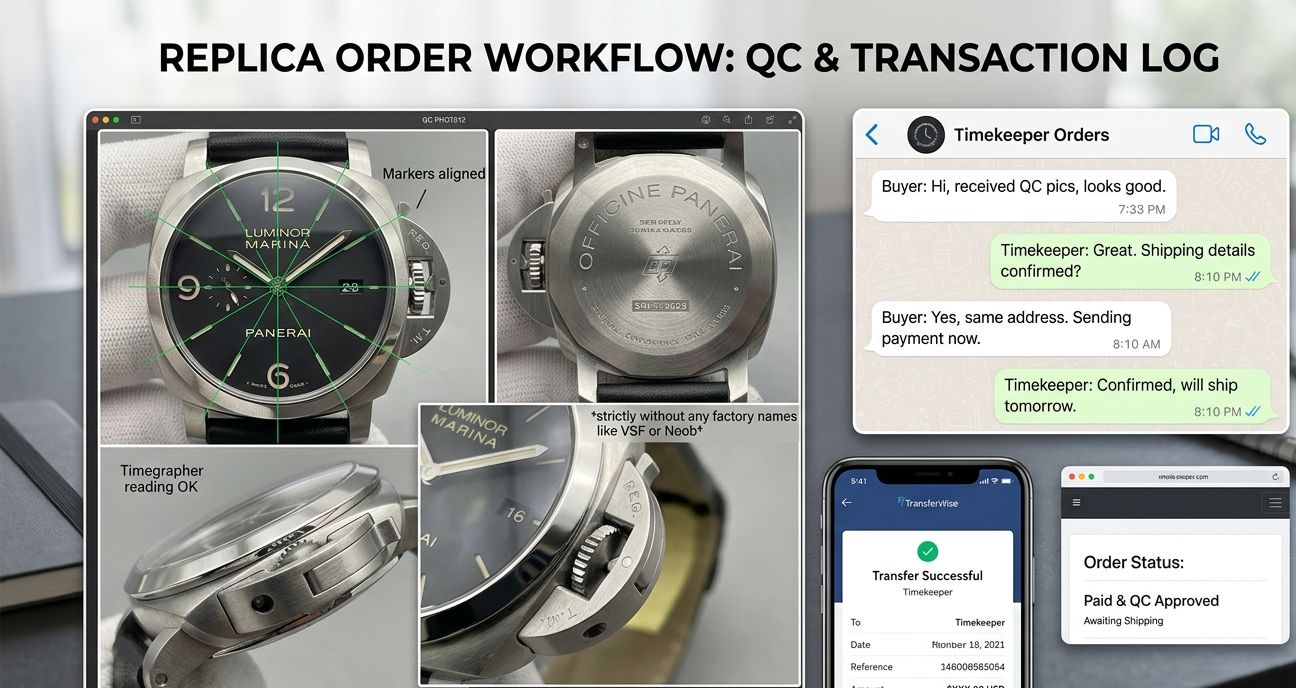
- QC Photos: These are your baseline. Ensure you save all QC (Quality Control) photos provided by the dealer. Critically, these are your* reference point for what was promised. If the watch you receive differs, the QC photos are the definitive comparison. They should be high-resolution enough to spot details like dial printing, movement finishing (if visible), and case proportions.
- Order Details: Keep a clear record of your order. This includes the specific model name, factory (e.g., VS Factory Panerai PAM00674), movement type, and any specific requests or agreements made (e.g., “waterproof tested to 50m”). This proves what you intended* to buy.
- Payment Confirmations: Screenshots or transaction IDs from PayPal, Wise, or your crypto wallet are vital. They confirm the amount paid, the date, and the recipient. This is the paper trail that proves the transaction occurred.
- Communication Logs: Every message exchanged with the dealer – whether via email, WhatsApp, Telegram, or forum PMs – is evidence. Screenshot entire conversations, including dates and timestamps. This captures promises made, agreements reached, and the dealer’s responses (or lack thereof).
- Unboxing Videos: This is arguably the single most powerful piece of evidence for DOA (Dead on Arrival) or damaged goods. The video must be uninterrupted* from the moment you receive the package, showing its exterior condition, through the unsealing, removal of packaging, and the first examination of the watch. Crucially, if the watch is dead or damaged, the video needs to clearly show this *immediately* upon unboxing. Attempt to wind it, set the time, or demonstrate the malfunction on camera.
- Detailed Defect Photos/Videos: Beyond the unboxing, take multiple high-resolution photos and short videos specifically targeting the alleged defect. For a “wrong factory” claim, this means side-by-side shots comparing your received watch’s movement engravings, dial fonts, or crown guard shape to known genuine or advertised factory examples, and also to the QC photos. For a scratch, ensure clear, well-lit close-ups. For a functional issue, a video demonstrating the problem is far more effective than a description. Timestamping photos (many phone cameras do this automatically) adds an extra layer of credibility.
Communication Etiquette: Keeping Records and Avoiding Emotional Escalation
When you’re frustrated, it’s easy to let emotion creep into your communication. Resist this impulse. Dealers handle many orders and disputes; a calm, factual, and well-documented approach sets you apart and increases your chances of a positive outcome.
- Be Polite and Factual: State the problem clearly and objectively. “The watch I received (serial/order number XYZ) has a misaligned bezel at the 12 o’clock position by approximately 0.5mm, as shown in the attached photos, which differs from the QC photos you provided.” is far more effective than “You sent me a piece of junk! Fix it now!”
- Avoid Accusations: Instead of accusing the dealer of deception, focus on the discrepancy. “The movement in the watch I received appears to be an Asian 2824, whereas the QC photos and our prior conversation indicated a VS P.9000 clone movement.” This frames it as an objective difference, not a personal attack.
- Maintain a Written Record: Always communicate in writing. If a phone call is necessary, follow up with an email or message summarizing the discussion and confirming any agreements. This ensures you have a traceable record of everything said and agreed upon.
- Be Persistent, Not Aggressive: Follow up if you don’t hear back, but do so politely. “Following up on my message from [Date] regarding order [Number]. I’m still awaiting an update on the proposed resolution.”
- Know When to Escalate (Internally): If initial contact with a customer service rep isn’t fruitful, you might politely ask to speak with a manager or someone with more authority, always reiterating your factual case.
Setting Deadlines and Follow-Ups: Maintaining Control of the Process
A dispute without a timeline can drag on indefinitely. You need to guide the process, not just react to it. This demonstrates you’re serious and organized.
- Propose Clear Timelines: When you present your case, you can suggest a reasonable timeframe for a response or resolution. “I would appreciate it if you could review this evidence and propose a resolution within 48 hours.” This creates an expectation.
- Consistent, Polite Follow-Ups: If a deadline passes without a response, follow up. Don’t spam them, but a polite nudge every 24-48 hours after your proposed deadline is reasonable. Refer back to your previous communication. “Just following up on my message from [Date] regarding the issue with order [Number]. Please let me know the status of your review.”
- Document Follow-Ups: Just like initial communications, record all your follow-up messages. This shows a pattern of diligent pursuit on your part.
- Be Ready to Re-evaluate: If a dealer consistently misses deadlines or becomes unresponsive, you need to re-evaluate your strategy. This might mean escalating the dispute with your payment processor (if applicable) or reconsidering your desired outcome.
Expert Authentication Insight
When reviewing your collected evidence, the goal is to pinpoint the single most damning or clarifying piece that supports your claim unequivocally. Imagine a watchmaker examining your watch. What would they immediately spot as a definitive tell? For a “wrong factory” claim, it might be a specific movement engraving that can only belong to a lower-tier factory, or a crown guard shape that precisely matches a known tell for a different manufacturer, directly contradicting the QC photos. For a DOA, an uninterrupted unboxing video showing the watch failing to wind or start is hard to refute. This “smoking gun” piece of evidence becomes the focal point of your argument, making it difficult for the dealer to deny your claim without directly contradicting undeniable visual or functional proof. The specific terms of your original order and the explicit images from QC are your strongest allies here. Cross-referencing these against the received watch and then highlighting the most glaring, undeniable discrepancy is key.
You’ve gathered your evidence, communicated clearly, and presented your case. Now comes the moment of truth: what’s the best path forward? The “best” resolution in the replica market is rarely the ideal one; it’s the one that minimizes your further risk, cost, and frustration. This framework helps you decide whether to pursue a partial refund, accept a reshipment, or, sometimes, simply cut your losses.
Step 1: Assess Your Payment Method’s Leverage
- If you used PayPal (Goods & Services): You have the most leverage. If your evidence is strong (especially for “not as described”), you have a good chance of winning a dispute. Your goal is often a full refund, but be prepared for PayPal to potentially side with the dealer if the evidence is ambiguous or if the dealer offers a partial refund.
- If you used Wise or PayPal (Friends & Family): Your leverage is extremely limited. These are essentially bank transfers. Your only recourse is the dealer’s goodwill. Treat any offer from them as a bonus, not an entitlement.
- If you used Cryptocurrency: You have virtually no leverage. Crypto transactions are irreversible. Your entire case rests on the dealer’s reputation and their willingness to resolve the issue.
Step 2: Evaluate the Type and Severity of Failure
- “Wrong Factory” / “Bait-and-Switch” (High Severity): If you explicitly ordered a VS Factory Panerai and received a PF Factory, this is a significant breach.
- With PayPal G&S: Pursue a full refund.
- With Wise/Crypto (Goodwill Dealer): Push for a reshipment of the correct factory at no additional cost, or a substantial partial refund (e.g., 50-70% of the difference in market value between the two factories).
- DOA / Critical Functionality Issue (High Severity): The watch doesn’t work out of the box or has a major defect making it unusable.
- With PayPal G&S: Strong case for a full refund or a full replacement.
- With Wise/Crypto (Goodwill Dealer): Push for a reshipment. A partial refund might be offered, but a non-functional watch has little value.
- Shipping Catastrophe (Lost Parcel / Customs Seizure – Dealer’s Policy Dependent):
- If Dealer Offered Customs Guarantee: They should reship. Your leverage is their stated policy.
- If No Guarantee / Lost Parcel (PayPal G&S): You may have a case for “item not received,” but proof of shipment from the dealer can complicate it. Focus on the tracking’s failure to deliver.
- If No Guarantee / Lost Parcel (Wise/Crypto): You’re largely at the mercy of the dealer’s goodwill. A partial reshipment cost or a discount on a new order might be offered.
- Minor Defects / Aesthetic Issues (Low-Medium Severity): A small scratch, slightly misaligned dial, or a movement running a bit fast/slow (within acceptable replica tolerances).
- With PayPal G&S: A partial refund is the most likely and reasonable outcome. Aim for 10-25% of the purchase price, depending on the defect’s impact.
- With Wise/Crypto (Goodwill Dealer): A small partial refund (5-15%) or a discount on a future order is a reasonable ask. Reshipment for minor issues is rarely cost-effective for either party, especially given customs risks.
Step 3: Consider the “Return Dilemma”
- Never return a replica watch to China unless explicitly instructed and you have a guaranteed refund/reshipment upon proof of shipment. The risk of customs seizure on the return journey is extremely high, and you’ll often bear the shipping cost. If it’s seized returning to the dealer, you’ll have neither the watch nor your money. A partial refund or reshipment (with the original watch kept by you) is almost always preferable to an international return.
Decision Framework Summary:
- If PayPal G&S & High Severity Issue (Wrong Factory, DOA): Pursue full refund via PayPal dispute. Be firm.
- If PayPal G&S & Minor Issue: Negotiate partial refund with dealer first. If no agreement, pursue partial refund via PayPal dispute.
- If Wise/Crypto & High Severity Issue (Goodwill Dealer): Push for reshipment. If not possible, negotiate a significant partial refund.
- If Wise/Crypto & Minor Issue (Goodwill Dealer): Ask for a small partial refund or future discount.
- If Customs Seizure (with Guarantee): Demand reshipment per dealer policy.
- If Unresponsive Dealer / No Leverage / High Customs Risk on Return: Be prepared to cut your losses. Sometimes, the cost and stress of continued pursuit outweigh the potential recovery, especially for lower-value replicas or minor issues with payment methods offering no protection.
The best outcome is often not the ideal one, but the one that leaves you least exposed. Understand your leverage, document everything, and make calculated decisions to minimize your overall risk and cost in the treacherous landscape of replica watch purchases.