
Why Factory Matters More Than “Model” in Richard Mille Replicas
In the Richard Mille replica space, the factory matters more than the model because RM is not a design-led watch, but a manufacturing-led object. Most luxury replicas can survive on surface accuracy: dial printing, bezel shape, or case finishing. Richard Mille cannot. Its identity is built around layered case construction, non-traditional materials, skeletonized movement architecture, and extreme tolerances that punish shortcuts immediately.
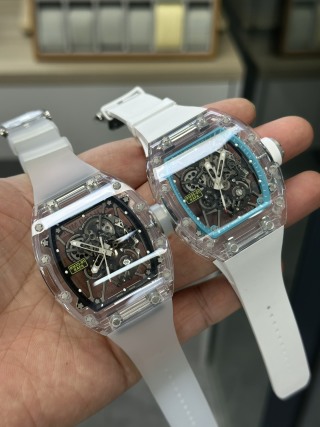
A Richard Mille replica is either structurally coherent or it fails outright. The case is not a shell; it is an engineered assembly. The movement is not hidden; it is the watch. This makes manufacturing consistency the core variable. Two factories producing the same RM reference can result in watches that feel fundamentally different on the wrist, even if the model name matches.
This is why RM replicas are factory-driven rather than model-driven. Not every factory has the tooling, material control, or movement integration capability to execute RM properly. Many can copy a reference photo. Very few can reproduce the interaction between case layers, movement height, skeleton depth, and wear balance. The result is that serious RM buyers evaluate the factory first, then decide which models that factory is actually capable of making well.
Factories like VS and APS exist precisely because RM cannot be treated as an add-on category. Their relevance is not about branding or marketing presence, but about whether a factory has committed enough resources to solve RM’s structural problems at the manufacturing level. In Richard Mille replicas, the factory defines the ceiling long before the model does.
Factory-Anchored Technical Appendix: Movements, Model Codes, and Structural Scope by Manufacturer
This appendix reframes technical detail around factories rather than movements. In the Richard Mille replica space, movements, materials, and model codes only make sense when read through the factory that assembles them. The same reference number behaves very differently depending on who builds it. What follows is a factory-first technical map intended for readers who want concrete identifiers without losing structural context.
APS Factory: Case Engineering and Visual Mass
APS Factory builds outward from the case rather than inward from the movement. Its technical identity is tied to carbon architecture, layered case construction, and visual density.
| Category | APS Factory Technical Scope |
|---|---|
| Primary Movement Architecture | RMUL2-derived skeleton movements (multiple internal revisions) |
| Secondary Movement Types | Modified manual skeleton layouts |
| Core Model Codes | RM 055, RM 35-01, RM 35-02, RM 61 variants |
| Typical Case Thickness | Often slightly thinner than peers in equivalent models |
| Case Materials | Forged carbon, layered carbon composites, ceramic bezels |
| Structural Behavior | Strong wrist presence, pronounced depth, high visual contrast |
| Known Trade-Offs | Increased mechanical complexity, higher sensitivity to assembly variance |
APS performs best on references where case structure defines the watch more than movement nuance. RM 055 and RM 35 series benefit from APS’s carbon layering and edge definition, while slimmer references like RM 61 test APS’s ability to balance profile and rigidity. APS watches tend to feel immediate and dramatic, but they demand acceptance of complexity as part of ownership.
KV Factory: Early Market Legacy
KV Factory represents an earlier generation of RM replication, where visual approximation outweighed structural integrity.
| Category | KV Factory Technical Scope |
|---|---|
| Primary Movement Architecture | Miyota-based automatics with decorative skeleton plates |
| Secondary Movement Types | Early 7750 adaptations |
| Core Model Codes | RM 055 (early), RM 011 (early) |
| Typical Case Thickness | Often exceeds 16–17 mm |
| Case Materials | Basic carbon composites, early ceramic attempts |
| Structural Behavior | Tall profile, static visual elements |
| Known Trade-Offs | Obvious mechanical shortcuts, aging issues |
KV’s relevance today is historical. Its RM references illustrate how quickly RM designs expose manufacturing shortcuts. These pieces are useful as comparison points rather than viable modern options.
BBR Factory: Experimental Integration
BBR occupies an experimental middle ground. Its technical identity is defined by ambition and iteration rather than containment.
| Category | BBR Factory Technical Scope |
|---|---|
| Primary Movement Architecture | Integrated skeleton movements (factory-specific builds) |
| Secondary Movement Types | Modified manual skeleton systems |
| Core Model Codes | RM 055, RM 35 variants |
| Typical Case Thickness | Comparable to VS and APS on paper |
| Case Materials | Carbon composites, ceramic elements |
| Structural Behavior | Strong visual motion, variable long-term stability |
| Known Trade-Offs | Batch inconsistency, higher service sensitivity |
BBR often solves one RM problem at the cost of another. Certain batches can be impressive, but predictability remains lower than Tier-1-focused factories.
JB Factory: Complexity-Driven Builds
JB Factory anchors its RM output around complexity rather than wear logic. Its technical decisions prioritize spectacle.
| Category | JB Factory Technical Scope |
|---|---|
| Primary Movement Architecture | True tourbillon movements (Shanghai / Sea-Gull base) |
| Secondary Movement Types | Custom manual skeleton layouts |
| Core Model Codes | RM 52, RM 27, select specialty references |
| Typical Case Thickness | Model-dependent, often secondary to visual goals |
| Case Materials | Carbon composites, titanium, specialty cases |
| Structural Behavior | High visual impact, demanding maintenance profile |
| Known Trade-Offs | Serviceability, durability under frequent wear |
JB’s RM references function as technical demonstrations rather than daily watches. Model codes like RM 52 act as extreme stress tests, amplifying both JB’s strengths and its risks.
Reading Factory Data Correctly
In Richard Mille replicas, factories define the meaning of model codes. RM 055 from VS, APS, or BBR are not interchangeable experiences, even when dimensions and reference numbers align. Factory capability sets the boundaries within which movements, cases, and materials can behave coherently.
For technical readers, the correct question is not which movement is used, but which factory can sustain that movement within a given RM reference. When those elements align, the watch feels intentional. When they do not, the reference code becomes cosmetic.
How Richard Mille Super Clone Factories Are Classified
Richard Mille super clone factories do not separate cleanly by price or reputation. They separate by intent and specialization. The real dividing line is whether RM is treated as a primary manufacturing focus or as a side project adapted from existing replica infrastructure.
Tier 1: Specialized Richard Mille Super Clone Factories
Tier 1 factories are defined by structural commitment rather than volume. These are dedicated RM-focused manufacturers that build their processes around Richard Mille’s engineering demands instead of forcing RM designs onto generic frameworks.
Their defining characteristics are consistent case geometry across batches, controlled carbon or composite layering, and movement architectures designed specifically for RM skeleton layouts rather than decorated base calibers. The case, movement, and assembly logic are developed as a single system. Thickness is managed, not tolerated. Visual depth is intentional, not accidental.
In practice, Tier 1 factories treat RM as a long-term platform. They revise movement layouts, adjust case lamination, and iterate assembly tolerances over time. Failures are corrected structurally, not cosmetically. This is the tier where RM replicas begin to behave like engineered watches instead of visual approximations.
This category exists because RM requires it. Without specialization, the watch simply collapses under its own design complexity. VS and APS naturally emerge from this tier not because of branding, but because their production philosophy aligns with what RM demands.
Tier 2: General Replica Factories Attempting RM Models
Tier 2 factories approach Richard Mille as an extension of their existing catalog. These are generic replica factories that primarily focus on mainstream models and attempt RM using modified cases, adapted movements, or visual shortcuts.

The result is usually an RM-inspired watch rather than a true RM replica. Case proportions may look acceptable in isolation but fail in hand. Movement components are often static, mispositioned, or overly thick. Carbon cases rely on surface texture rather than layered structure. Assembly tolerances vary widely from piece to piece.
This is not a matter of incompetence. It is a matter of suitability. Richard Mille is not a watch that can be produced “alongside” other models. It demands dedicated tooling, repeatable material control, and movement solutions that most general factories are not designed to support.
For buyers, the risk is not that these watches are unwearable, but that they reveal their limitations quickly with use. Thickness imbalance, visual flatness, and mechanical inconsistency tend to appear over time. RM is unforgiving in this way. Factories that do not specialize eventually expose that gap, regardless of how accurate the watch looks at first glance.
VS Factory Richard Mille Overview
VS Factory Background & Position in the RM Market
VS Factory’s position in the Richard Mille replica space is defined less by visibility and more by operational discipline. VS does not compete on visual shock or aggressive model rollout. Its strength lies in system stability: movement architecture that survives daily wear, consistent assembly tolerances, and quality control that prioritizes repeatability over novelty.
In the RM context, this matters more than surface refinement. Richard Mille designs expose every mechanical compromise. A visually impressive but unstable build will reveal itself quickly once worn. VS approaches RM as a mechanical problem first, not a styling exercise. The result is a narrower model range, but one where outcomes are predictable. Watches arrive with fewer surprises, fewer alignment issues, and fewer long-term failures.
VS Factory’s role in the RM market is therefore conservative but credible. It appeals to buyers who value reliability over experimentation and who understand that RM replicas reward restraint more than excess ambition.
VS Factory Movement Strategy for Richard Mille
VS Factory’s RM strategy is built around movement coherence rather than visual imitation. Instead of forcing generic calibers into skeleton layouts, VS focuses on movement structures that can support RM’s open architecture without collapsing mechanically over time.
RMUL2-Based Skeleton Movements
The RMUL2-based skeleton movement used by VS is not defined by how closely it copies the genuine caliber, but by how logically it behaves within the RM design language. Gear placement, bridge spacing, and load distribution are engineered to remain stable under regular winding and wear.
VS prioritizes predictable torque transmission and consistent hand behavior over extreme visual depth. This reduces the risk of stoppage, misalignment, or uneven wear. The skeletonized layout remains readable and mechanically honest, even if it sacrifices some visual drama compared to more aggressive interpretations.
Stability is the end goal. VS accepts that RM skeleton watches are mechanically exposed and builds its movement strategy around minimizing the risks that exposure creates.
RM 055 / RM 11 Integrated Solutions
VS performs best when the case and movement can be treated as a single system. RM 055 and RM 11 suit this approach well. These models allow VS to implement integrated solutions rather than layered compromises.
In RM 055, the balance between case thickness, skeleton depth, and hand clearance remains controlled. The watch wears flat, avoids top-heavy imbalance, and maintains consistent winding feel. In RM 11, VS favors a movement solution that prioritizes reliability over aggressive calendar or chronograph theatrics.
These models work for VS because they reward structural discipline. The factory avoids overextension and focuses on configurations it can execute repeatedly without quality drift.
Best Richard Mille Models Made by VS Factory
VS Factory is not a brand for collectors seeking variety. Its strength lies in a small number of mature models that have been refined over multiple production cycles.
RM 055 remains the most dependable option. It represents the cleanest expression of VS’s integrated approach, combining manageable complexity with long-term stability. RM 11 follows closely, especially for buyers who prefer a more technical aesthetic without pushing the movement beyond its comfort zone.
These models are not perfect, but they age well. Wear patterns remain consistent, and mechanical behavior stays predictable, which matters more than marginal visual gains over time.
VS Factory vs APS Factory (High-Level Comparison)
The difference between VS Factory and APS Factory is directional rather than hierarchical. VS prioritizes mechanical restraint, consistency, and long-term reliability. APS leans toward structural boldness, case engineering, and visual impact.
VS tends to perform better when the movement must carry the watch quietly over extended use. APS often excels when case construction and material presence define the experience. Neither approach is universally superior. The right choice depends on the specific RM reference and the wearer’s tolerance for complexity.
In practice, VS suits buyers who want their RM replica to behave like a watch first. APS suits those who want it to feel like a statement object. The model, not the logo, ultimately decides which philosophy works better.
Clean Factory and Richard Mille: Clearing Common Misconceptions
Is Clean Factory a Main Player in Richard Mille Replicas?
Clean Factory is not a primary force in the Richard Mille replica space. This is not a criticism of Clean’s overall capability, but a recognition of where its strengths actually lie. Clean is a highly competent factory with proven results in other categories, yet Richard Mille has never been one of its core manufacturing priorities.
RM demands sustained specialization. Clean’s approach favors precision finishing, tight tolerances, and refinement within familiar movement and case systems. That skillset translates exceptionally well to certain watch families, but it does not automatically extend to RM’s unconventional architecture. As a result, Clean’s presence in RM remains limited, selective, and peripheral rather than foundational.
This distinction matters because many buyers assume factory reputation transfers evenly across brands. With RM, it does not. Clean remains a strong factory overall, but it is not a central reference point for serious Richard Mille replicas.
Why Clean Focuses Less on Richard Mille Models
The reason Clean Factory allocates fewer resources to Richard Mille is structural, not strategic hesitation. RM requires disproportionate investment in case tooling, composite material control, and movement layouts that do not overlap with Clean’s primary production systems.
Factories operate within finite capacity. Clean’s decision to concentrate on areas where its engineering pipeline delivers consistent returns reflects discipline rather than limitation. RM is not well suited to a generalized factory model. It resists standardization and punishes partial commitment.
In practical terms, Clean would need to divert substantial resources away from its strongest categories to compete seriously in RM. The factory has chosen not to do so. That choice preserves Clean’s strengths while leaving RM to manufacturers built specifically around its demands.
Major Richard Mille Replica Factories and Their Representative Builds
KV Factory: Early Entry, Structural Limitations
KV Factory was one of the earliest manufacturers to enter the Richard Mille replica space. At a time when few factories were willing or able to attempt RM designs, KV carried most of the market’s supply. That early presence gave KV historical relevance, but it also defines its limitations today.
KV’s most recognizable work centers on RM 011 chronograph models and early RM 055 variants. The RM 011 relied on modified 7750 chronograph movements to deliver functional timing and double-date displays, while RM 055 versions used Japanese automatic movements with decorative skeleton plates. These constructions achieved visual resemblance, but structural compromises were unavoidable. Case thickness on early RM 055 builds often approached 17 mm, noticeably exceeding genuine proportions, and movement behavior remained basic, limited to time-only operation beneath a decorative façade.
KV’s output reflects its era. The watches succeed at outline accuracy but fall short in mechanical depth and long-term authenticity. Today, KV pieces are best understood as transitional products rather than competitive modern solutions.
ZF Factory: Integrated Skeleton Architecture as a Turning Point
ZF Factory marked a decisive shift in RM replication standards. Its breakthrough came with the RM 35-02, where successive iterations demonstrated that Richard Mille replicas could move beyond decorative assemblies into structurally coherent builds.
ZF’s later work on RM 055 introduced a fully integrated RMUL2-based manual skeleton movement, paired with NTPT carbon and ceramic case construction that closely matched genuine dimensions. At approximately 49.9 × 42.7 mm with a thickness near 13 mm, the case proportions aligned with original specifications rather than approximations. The layered carbon structure, sapphire crystals, crown sealing components, and titanium clasp geometry reflected a higher level of tooling precision than earlier generations.
Between 2021 and 2023, ZF refined this platform through multiple revisions, focusing on movement reliability and dimensional accuracy rather than radical redesign. The result positioned ZF as a benchmark for high-end RM replicas, particularly for RM 035 and RM 055 references, albeit at a higher price tier.
BBR Factory: Aggressive Integration and Rapid Iteration
BBR Factory entered the RM space from a background in complex tourbillon replicas, bringing an aggressive engineering approach rather than a conservative one. Its focus quickly narrowed to the RM 055 Bubba Watson line and select RM 35 variants.
BBR’s defining contribution was the introduction of a fully integrated skeleton movement that abandoned static decorative plates. In its later V3 configuration, the movement allowed visible gear transmission, an active balance assembly, and functional features such as hacking seconds. Case thickness was reduced to roughly 13 mm, consistent with genuine RM 055 dimensions, and the use of layered NTPT carbon gave the case a more authentic structural appearance. The inclusion of dual mainspring barrels further aligned power delivery with original design intent.
Earlier BBR builds suffered from stability concerns, but later revisions improved reliability. Positioned below ZF and APS in price, BBR occupied a performance-driven, value-oriented segment, appealing to buyers prioritizing visible mechanical activity over absolute refinement.
JB Factory: True Tourbillon Replication as a Specialty
JB Factory operates in a different category altogether. Its reputation is built on genuine tourbillon replication rather than skeleton simulation. JB’s Richard Mille projects concentrate on highly complex references such as RM 001, RM 52-01 Skull, RM 53-01, and RM 56.
These builds employ true manual-wind tourbillon movements developed in collaboration with established Chinese movement manufacturers. The tourbillon assemblies occupy the correct structural positions, delivering real rotational behavior rather than decorative motion. Case construction follows original data closely, with dimensions approaching factory specifications and extensive use of titanium and carbon composite layers. Visual elements—such as gemstone placement, skeleton bridges, and engraved movement plates—reflect deliberate attention to original detailing.
JB’s approach prioritizes mechanical authenticity over wear convenience. The resulting watches are visually striking and technically impressive, but their complexity and cost place them firmly in enthusiast territory rather than everyday wear.
APS Factory: Refinement Through Structural Detail
APS Factory represents a later evolutionary step in RM replication, focusing narrowly on RM 055 as a platform for refinement rather than expansion. Its work centers on incremental but meaningful improvements to integrated skeleton architecture.
APS builds utilize an upgraded RMUL2 movement configuration with revised structural cut-outs, improved gear linkage, and refined surface treatment on movement bridges. Visual accuracy increased through corrected geometry around the balance assembly and improved interaction between visible gears during winding and setting. Case construction emphasized NTPT carbon layering clarity, reduced overall thickness compared to earlier ZF executions, and improved tactile quality in straps and clasps, including functional screw assemblies.
APS largely confines its production to RM 055 variants, prioritizing depth of execution over breadth. Pricing reflects this focus, placing APS at the upper end of the RM replica spectrum and earning its reputation as a ceiling-level RM 055 interpretation.
Peripheral and Limited-Run Producers
Beyond the primary factories, several smaller manufacturers and independent teams have attempted RM replicas. Some, such as Sonic and T+, briefly produced RM 35 variants before withdrawing due to cost and quality constraints. Others, like YS Factory, specialize in niche tourbillon references such as RM 47 or RM 53, operating at low volume with acceptable quality but limited availability.
There are also independent “RM-named” projects producing highly experimental tourbillon replicas for references like RM 27-02 or RM 12-01, often using unconventional materials such as full carbon or sapphire-style cases. These pieces function more as custom engineering exercises than mainstream replicas and are priced accordingly.
In the current Guangzhou market landscape, long-term recognition and consistency remain concentrated among KV, ZF, BBR, JB, and APS, with each occupying a clearly differentiated role rather than competing on equal terms.
How to Choose the Right Richard Mille Factory for Your Needs
There is no universally “best” Richard Mille factory, because RM replicas are not lifestyle-neutral objects. They behave differently depending on how, where, and why they are worn. Choosing the right factory is less about ranking and more about alignment with real usage scenarios.
If the watch is meant to be worn regularly, under sleeves, across meetings, travel, and long days, stability becomes the dominant factor. In this context, factories like VS make sense. The watches tend to sit flatter, behave predictably, and draw less mechanical attention to themselves over time. They reward owners who want RM aesthetics without constant adjustment or concern.
If the watch is worn more selectively, as a statement piece in social or high-visibility environments, then case presence and material expression carry more weight. APS appeals here. Its strength lies in carbon layering, case depth, and visual intensity. These watches are felt immediately on the wrist and noticed instantly by others. They suit owners who accept higher complexity in exchange for stronger visual impact.
Clean Factory fits a different profile altogether. It is suitable for buyers who already understand Clean’s strengths in other categories and are exploring RM out of curiosity rather than commitment. Clean RM pieces are not wrong, but they are not optimized. They work best for short-term ownership or rotational wear, not as a primary RM experience.
The key decision point is honesty about use. Daily wear versus occasional wear. Understated confidence versus deliberate presence. RM replicas amplify these choices. The factory should serve the lifestyle, not challenge it.
Additional Richard Mille Movements and Model Codes Worth Understanding
Not all Richard Mille replica decisions revolve around RMUL2 or a handful of flagship references. Beyond the core VS and APS strengths, there exists a secondary layer of movements and model codes that frequently appear in the market and shape buyer expectations, often without being clearly explained.
On the movement side, many RM-style replicas rely on adapted automatic calibers rather than integrated skeleton architectures. Modified Miyota 9015 or NH-based movements are commonly used in RM-inspired builds, especially for visually complex references where true structural replication would be cost-prohibitive. These movements prioritize accessibility and basic reliability but fundamentally alter how the watch behaves. Thickness increases, balance shifts upward, and the skeleton layout becomes decorative rather than functional. They can be wearable, but they no longer reflect the mechanical logic that defines genuine RM construction.
Chronograph-based RM replicas, most notably RM 011 variants, typically depend on 7750-derived movement clones. These solutions allow functional chronograph operation and calendar displays, but they impose strict constraints on case thickness and subdial positioning. Factories capable of integrating these movements cleanly are rare, and even then, compromises remain visible over time. This is why RM 011 outcomes vary widely by factory, despite sharing the same reference code.
From a model-code perspective, certain RM references consistently expose factory capability limits. RM 055 and RM 35 succeed because their architecture allows controlled skeleton depth without overwhelming the movement. In contrast, models such as RM 27, RM 52, or RM 61 demand extreme case engineering, unconventional materials, or complex three-dimensional layouts that magnify any manufacturing shortcut. These references often look impressive in photos but reveal imbalance, excess thickness, or static components once worn.
Understanding these codes is not about memorization. It is about recognizing which references reward structural discipline and which amplify factory weaknesses. When movement architecture and case construction fall out of sync, the RM aesthetic collapses quickly. This is why experienced buyers treat model codes as stress tests rather than trophies.
Final Thoughts: Factory First, Model Second
In the Richard Mille replica world, factories like VS and APS define what is realistically achievable, Clean represents disciplined restraint, and platforms like cleanvsfactory.com exist precisely to help readers navigate these distinctions by putting factory capability ahead of model temptation.