
Why the Movement Defines a Richard Mille Replica
If you do not look at the movement, you are not really buying a Richard Mille replica. You are buying a shaped object that borrows the outline of a watch without engaging with what makes Richard Mille fundamentally different.What makes Richard Mille so special is the combination of a transparent case and a tourbillon.

Richard Mille is not a case-first brand. It never has been. From the earliest RM001, the architecture of the movement dictated the shape, thickness, curvature, and even the way the strap integrates into the case. The case exists to protect and display the movement, not to decorate it. This is the opposite of how most traditional watches are designed, where a standardized movement is placed inside a stylistic shell.
That difference becomes unforgiving in replicas. With Rolex or Patek replicas, a strong case and dial can sometimes compensate for a generic movement hidden behind a closed caseback. With Richard Mille, the movement is exposed, suspended, and visually dominant. A fake or compromised movement is not a minor flaw; it collapses the entire illusion.
This is why “case looks right” is meaningless in the RM world. You can machine carbon fiber, ceramic, or titanium to near-perfect dimensions, but if the movement underneath is wrong, the watch fails structurally, visually, and conceptually. The highest level of Richard Mille replicas has always been defined by movement breakthroughs, not by dial printing or case finishing.
Every major jump in RM replica quality over the past decade followed the same pattern: first the movement changed, then everything else became worth upgrading. The ceiling of RM replicas is not set by how close the case looks, but by how faithfully the movement replicates the original architecture.
The Three Real Categories of RM Replica Movements
Most people try to classify RM replica movements as “good” or “bad.” That framing is useless. What actually matters is structural integrity. Once you look at movements through structure rather than branding or price, the market becomes much easier to understand, and much harder to be fooled by marketing language.
Type 1: Decorative Skeleton Movements (Entry-Level Replicas)
This category is not a lower-tier option. It is a conceptual mistake.
Decorative skeleton movements are built around a standard automatic movement, often a Miyota or similar base, with non-functional bridges and plates added on top to simulate a skeletonized appearance. The watch may look busy at first glance, but almost nothing you see is doing real work.
The gears do not form a complete torque path. Many wheels are static. The balance wheel is either hidden, incorrectly positioned, or artificially relocated behind cutouts. What appears to be skeletonization is often just surface-level plating or stamped overlays.
To someone unfamiliar with RM mechanics, these watches may look complex. To anyone who understands Richard Mille, they are immediately disqualified. RM movements are defined by exposed logic: you should be able to visually trace energy from the mainspring to the escapement. Decorative skeleton movements break that logic completely.
This is why experienced buyers reject these movements instantly. They are not “basic.” They are wrong.
Type 2: Modified Movements with Structural Compromise
This is the most dangerous category, because it is the easiest to market as high-end.
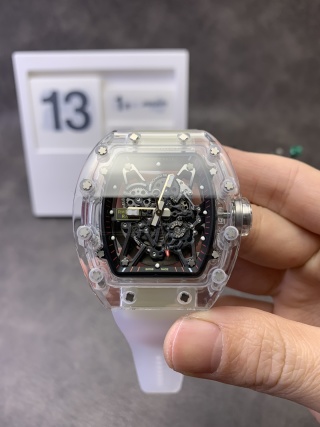
Modified movements start with a standard base movement and then undergo heavy reworking to expose the balance wheel, add visible gearing, or mimic the layout of an RM caliber. Unlike decorative skeletons, some components do move. You may see gears turning and a balance oscillating in roughly the right place.
The problem is what had to be sacrificed to make that happen.
To expose the balance wheel, manufacturers often remove or thin structural supports that were never meant to be altered. Gear trains are re-routed visually but not mechanically optimized. The torque path is partial, interrupted, or inefficient. These movements often look aggressive and impressive on video, yet suffer from poor long-term stability.
This is why watches in this category tend to have higher return rates. Regulation is difficult. Shock resistance is compromised. Power delivery is inconsistent. On the wrist, they feel impressive for a short time and frustrating over ownership cycles.
They are not scams, but they are compromises, and the compromises matter.
Type 3: Integrated Skeleton Movements (True RM Super Clone Core)
This is where real Richard Mille replication begins.
An integrated skeleton movement is designed as a skeleton movement from the ground up. There is no base movement hiding underneath. Bridges, plates, and gear positions are defined by the skeleton architecture itself, not adapted after the fact.
In these movements, the torque path is complete and visible. The mainspring barrel drives the gear train in a coherent sequence. The escapement and balance sit where they are supposed to sit, both visually and mechanically. Shock absorbers, bridge geometry, and wheel spacing are aligned with the original RM layout, even if manufacturing methods differ.
These movements are not Swiss, and they do not need to be. Richard Mille’s own calibers are not traditional ETA derivatives either. What matters is architecture, not geography. When the structure is correct, performance, stability, and visual legitimacy follow.
This is currently the upper limit of RM replica engineering. Everything above it is refinement; everything below it is compromise.
Inside a True RM Super Clone Movement: What Actually Moves
A true RM skeleton movement does not ask you to admire complexity. It invites you to follow energy.
Start at the mainspring barrel. In a legitimate integrated skeleton movement, the barrel is not decorative, oversized, or frozen in place. When you wind the crown, the barrel turns with resistance that feels progressive, not hollow. More importantly, that rotation visibly feeds torque into the gear train. If the barrel turns but nothing downstream responds, you are looking at theater, not mechanics.
From the barrel, energy should move through a clearly defined gear train. The center wheel, third wheel, and fourth wheel do not exist to fill space. They exist to transmit power at controlled ratios. In a real RM super clone movement, these wheels rotate in sequence, with consistent directionality and proportional speed. You can observe this during winding, during setting, and during normal operation. If gears only move when shaken, or only one wheel spins endlessly while others remain static, the structure is broken.
The escapement is where many replicas expose themselves. In correct architecture, the escape wheel interacts rhythmically with the pallet fork, releasing energy in precise increments. This interaction should be visible and continuous. Fake movements often replace this with a visually spinning wheel that has no regulating function. It looks alive, but it governs nothing.
Finally, the balance wheel. In Richard Mille design, the balance is not hidden or symbolically referenced. It is central, exposed, and structurally supported. In a true super clone, the balance oscillates with stable amplitude, responds immediately to motion, and remains visually connected to the escapement. If the balance is buried, offset, or floating without clear mechanical linkage, the illusion collapses.
This is why visual complexity means nothing on its own. A watch can look busy and still be mechanically dead. Correct RM skeleton movements are not defined by how many things move, but by whether everything that must move actually does.
Common Myths About Richard Mille Replica Movements
“Swiss Movement = Best” Is the Wrong Question
Richard Mille movements were never built on traditional Swiss logic, so judging replicas through a Swiss-versus-non-Swiss lens misses the point entirely.
Original RM calibers are purpose-built skeleton architectures. They do not descend from ETA ebauches, nor do they follow conventional three-quarter plate layouts. Their identity comes from spatial design, load distribution, and visualized mechanics, not from geography.
In replicas, this matters even more. A Swiss movement placed inside an RM-shaped case does not become more correct simply because of its origin. If the layout is wrong, the movement is wrong. A well-engineered integrated clone that respects RM architecture will always be closer in spirit and function than a Swiss movement forced into a role it was never designed to play.
In the RM replica world, layout beats location every time.
“More Moving Parts Means Better Quality” Is a Trap
One of the most common tricks in fake skeleton movements is motion inflation. Extra gears are added purely for visual noise. Wheels spin without load. Components move independently rather than as part of a controlled system.
This creates the impression of complexity, but it actively undermines reliability. Unloaded gears introduce friction without purpose. Decorative motion disrupts regulation. Shock tolerance drops. Over time, these movements wear unevenly because their architecture was never designed to manage energy flow coherently.
What matters is not how many parts move, but whether they move because they must.
A correct RM skeleton movement has fewer unnecessary motions, not more. Every visible component earns its place by transmitting, regulating, or stabilizing energy. When you learn to look for paths instead of parts, fake complexity becomes obvious, and real structure becomes unmistakable.
Movement vs Price: Why Real RM Super Clone Movements Are Expensive
A real RM super clone movement is expensive for the same reason the genuine watch is expensive: the movement is the project.
The first cost is development. An integrated skeleton movement cannot be adapted from an existing platform. It must be designed around negative space, bridge geometry, and visible load paths from the beginning. Every bridge is structural. Every opening changes stress distribution. That kind of design work does not scale cheaply, especially when tolerances must hold under shock and long-term wear.
Then comes yield. Skeleton movements expose every mistake. A bridge that would be hidden in a closed movement becomes visually unacceptable here. Gear alignment that might pass in a conventional caliber fails immediately when everything is on display. As a result, rejection rates are high. Many parts never make it into finished watches, and that loss is built into the price.
Assembly is slower and riskier. Integrated skeleton movements cannot be rushed. Screws are smaller, tolerances tighter, and access angles limited. One slip during assembly can damage visible components permanently. This is not modular work; it requires experience and patience.
Regulation takes time. Skeleton movements are more sensitive to imbalance and shock. Proper adjustment requires multiple cycles of testing, rest, and readjustment. This labor does not show up in spec sheets, but it determines whether a watch feels stable or temperamental on the wrist.
This is why, in high-end RM replicas, the movement often costs more than the case. The case can be machined, finished, and replaced. The movement defines whether the watch deserves to exist at all.
How to Identify a Fake RM Movement Without Opening the Watch
You do not need to remove the caseback to identify a fake RM movement. You need to know where to look and what behavior to expect.
Start from the dial side. In a correct RM skeleton movement, the balance wheel should be visible, properly positioned, and visually connected to the escapement. If it is hidden, poorly centered, or isolated from surrounding components, something is wrong.
Wind the watch slowly. Watch what moves. The barrel should turn with resistance, and that motion should propagate through multiple gears. If winding only spins one isolated wheel, or if motion appears disconnected, the structure is decorative.
Set the time. A true integrated skeleton movement will stop the balance when the crown is pulled, or at least show a clear change in behavior. If nothing changes, regulation control is likely absent or compromised.
Wear the watch and move your wrist. A correct RM movement has a balanced center of gravity. It feels stable, not top-heavy or hollow. Cheap movements often betray themselves through awkward weight distribution and delayed response to motion.
Finally, listen to the seller. Claims like “Swiss movement inside,” “same movement as original,” or “more gears than other versions” are red flags when not accompanied by structural explanation. Sellers who understand RM movements talk about layout, torque paths, and architecture. Sellers who do not talk about origin and noise.
Who Should Care Deeply About the Movement — and Who Shouldn’t
Buyers Who Will Appreciate a True RM Super Clone Movement
People with engineering, manufacturing, or construction backgrounds tend to understand RM immediately. They recognize load paths, structural honesty, and functional minimalism. They do not need the watch to impress others. They care that what they see makes sense.
These buyers enjoy watching the movement work. They notice whether energy flows logically. They feel when a watch is stable rather than fragile. For them, the movement is not hidden value. It is the entire experience.
Buyers Who Will Never Feel the Difference
Some buyers only care about shape, size, or weight. They compare watches by appearance alone. They do not trace structure through the dial or question why something moves.
There is nothing wrong with this, but these buyers will never benefit from a true RM super clone movement. To them, the extra cost will feel unnecessary, because the value lies in details they do not engage with.
Final Judgment: In Richard Mille Replicas, the Movement Is the Watch
If you judge a Richard Mille replica without understanding its movement, you are not choosing between versions — you are choosing blindly.
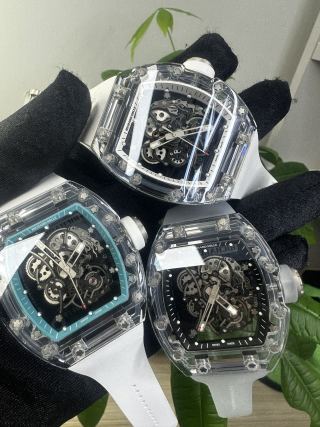
Richard Mille Replica Movements — Factory & Structure Comparison Table
| Factory / Line | Movement Type | Structural Integrity | What Actually Moves | Typical Price Range (USD) | Realistic Restoration Level | Core Verdict |
|---|---|---|---|---|---|---|
| Entry-Level No-Name / Small Workshops | Decorative skeleton (base auto + fake plates) | ❌ None | Balance often hidden or fake, gears mostly static | $800 – $1,500 | ~50–60% | Looks busy, mechanically meaningless |
| KV / Early RM Replicas | Decorative / lightly modified | ❌ Very low | Limited motion, incorrect balance position | $1,800 – $2,800 | ~60–65% | Outdated logic, visually exposed flaws |
| Mid-Tier Modified Lines (various) | Modified base movement | ⚠ Partial | Some gear linkage, compromised torque path | $2,500 – $3,800 | ~70–75% | Impressive on video, unstable in use |
| BBR (V3 Integrated Line) | Integrated skeleton movement | ✅ High | Full visible torque path, real escapement & balance | $4,000 – $5,000 | ~88–92% | First level where RM logic truly appears |
| ZF (RMUL2 Integrated) | Integrated skeleton movement | ✅ Very high | Coherent barrel → gear train → escapement | $5,000 – $6,000 | ~90–94% | Stable, mature, proven architecture |
| APS (Latest Integrated V2) | Integrated skeleton movement (refined) | ✅✅ Near-complete | Correct layout, improved bridge geometry | $7,000 – $9,000 | ~95–98% | Current ceiling of RM replica movements |
| JB (True Tourbillon Lines) | Integrated + real tourbillon | ✅✅ (model-dependent) | Full mechanical logic incl. tourbillon | $8,000 – $12,000+ | ~93–97% | Functional complexity, niche audience |