
Introduction: The Version Number Game in the RM Replica Market
You’re scrolling through a trusted dealer’s site, eyeing a Richard Mille RM 055. You see it listed three times: “V2 Super Clone,” “V3 Ultimate Edition,” and “Latest Version with Updated Movement.” The descriptions are nearly identical, the prices vary by hundreds of dollars, and the only thing that’s clear is your growing confusion. To navigate this landscape, a detailed Richard Mille replica movement reality check becomes essential. Is this a genuine progression of engineering, or a clever marketing strategy to create value tiers and justify price hikes?
This is the core dilemma in the high-stakes world of Richard Mille super clones. Version numbers like V2, V3, and labels like “Ultimate” are thrown around with abandon, often with little to no explanation of what actually changed. Paying a premium for a “V4” only to receive a watch that’s functionally identical to the “V2” is a real risk. This article cuts through the noise. We’re not here to chronicle every incremental claim; we’re here to give you a forensic toolkit. We’ll dissect the typical patterns behind these labels, teaching you to distinguish between a meaningful, measurable upgrade and pure marketing fluff. Consider this your buyer’s defense manual against opaque sales tactics.
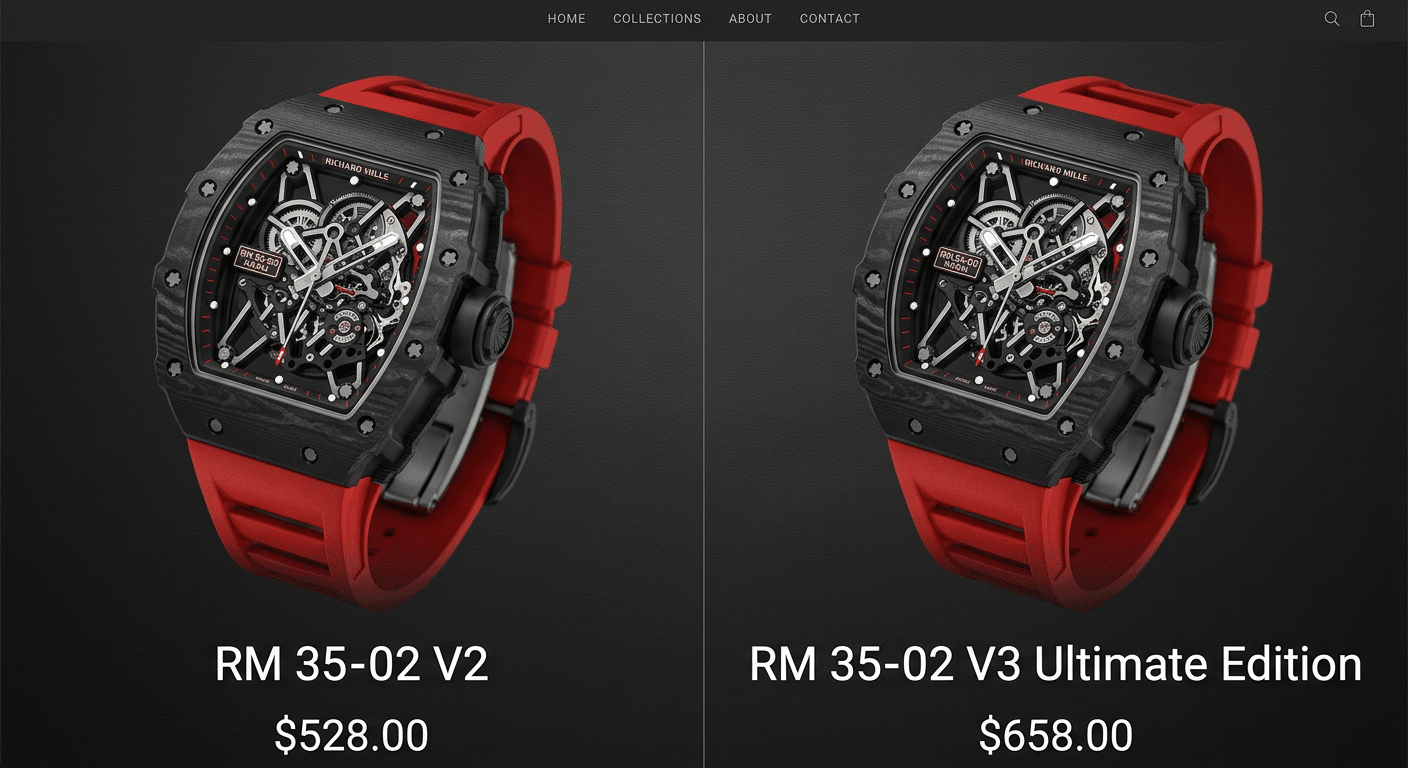
First, a critical caveat: not all “V3” labels are created equal. A “V3” for an RM 035 Rafa Nadal might signify a crucial reduction in case thickness, while a “V3” for an RM 011 could be little more than a new strap color. The value of a version claim is entirely dependent on the specific model and the factory behind it. Let’s decode the language.
Decoding the Language: V2, V3, “Updated,” and “Ultimate”
In the replica market, terminology is a weapon of persuasion. Each label carries an implied promise, but the reality is often shaped more by commercial necessity than horological progress. Understanding this gap is the first step to making an informed purchase.
What “V2” Really Promises (and What It Often Delivers)
The jump from V1 to V2 is usually the most substantial and honest upgrade in a model’s lifecycle. This is when factories address the glaring, often embarrassing flaws of the initial release. For the RM 055 Bubba Watson, “V2” typically meant correcting the NTPT carbon’s overly blue or anodized hue to a more accurate gray/black weave pattern. For the RM 035, “V2” often involved the first serious attempt to shave down the case thickness from a bloated initial profile.
The promise of “V2” is a product that has learned from its mistakes. The delivery is usually a watch that fixes one or two major, deal-breaking issues. It’s a signal that the factory has invested in new tooling or materials based on market feedback. If you’re buying a model that’s been out for a while, the “V2” is frequently the safest, most value-stable bet—the major flaws are resolved without the inflated price of later “editions.”
The “Updated Movement” Claim: The Most Important One to Verify
This is the claim that separates a worthwhile investment from an expensive mistake. “Updated movement” is the most potent—and most abused—term in a seller’s arsenal. It can mean two radically different things:
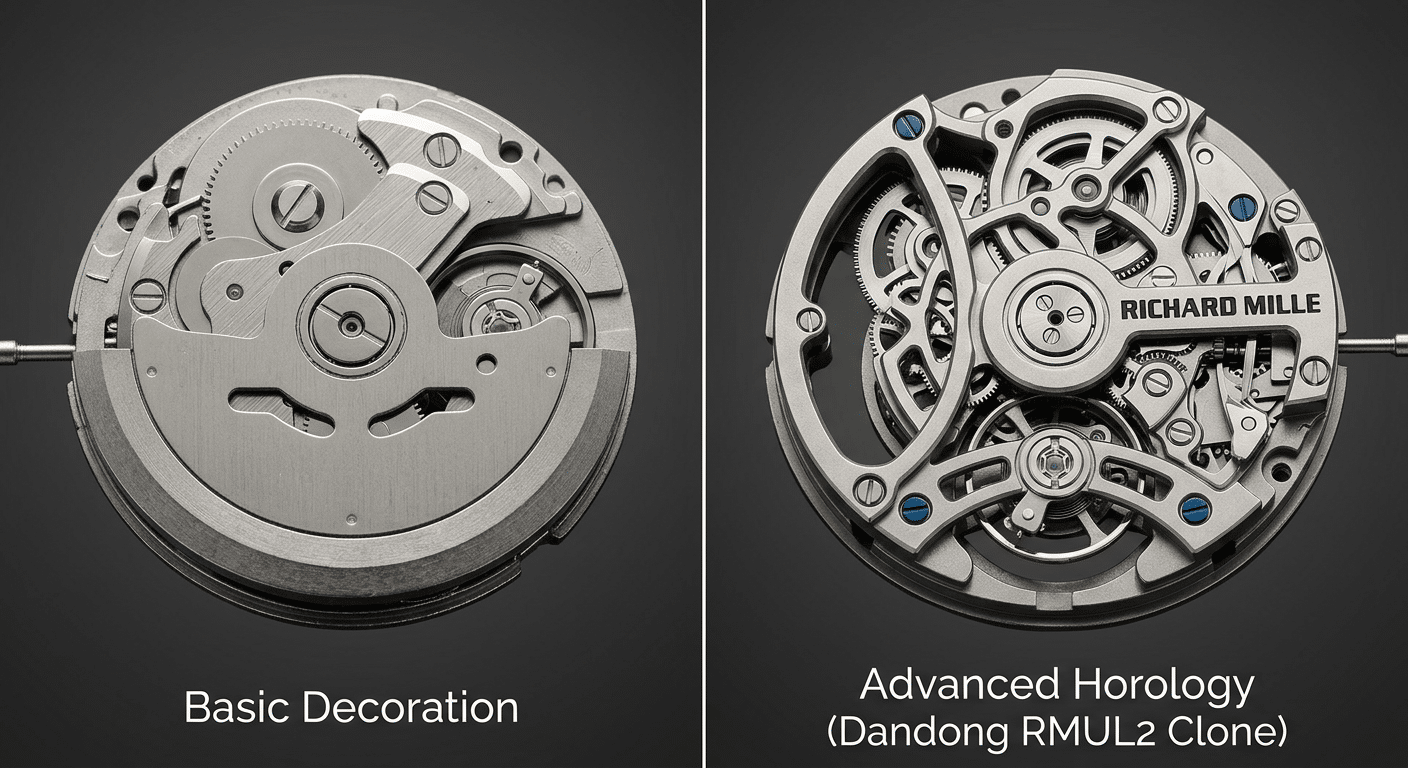
- A genuine, hardware-level upgrade: Swapping a problematic, decorated Chinese automatic for a more reliable Seiko VK quartz mecha-movement in a skeleton model. Or, more significantly, moving from a basic Shanghai clone to the integrated Dandong RMUL2 caliber. This is a costly change for the factory and a major value-add for you.
- A cosmetic or software-level tweak: A new decorative rotor engraving, a re-regulated balance wheel, or a fresh application of perlage on the same old base movement. This is a low-cost change that offers no improvement in longevity, accuracy, or function.
The burden of proof is on the seller. A claim of an updated movement without photographic evidence is just noise.
Expert Authentication Insight
Physical diagnostic: To verify a true movement update, you must go beyond the seller’s description. Request a high-resolution, macro-level photo of the movement through the caseback. Don’t just look at the decoration; compare the fundamental architecture. Identify the balance wheel location, the layout of the gear train, and the shape of the bridges. Cross-reference this with known, confirmed photos of the movement they claim to be using (e.g., a genuine Dandong RMUL2, a Miyota 9015, a Seiko VK63). A change from a golden rotor to a black rotor is not an update. A change in the underlying movement’s design is.
As for terms like “Ultimate Edition” or “Final Version,” treat them with maximum skepticism. They are almost pure marketing, designed to create a sense of finality and peak quality to halt version comparison and justify a price ceiling. Sometimes they coincide with a legitimate “V3” or “V4,” but often, they are just the current stock with a new, authoritative-sounding label. It’s a red flag that should prompt your most rigorous investigation.
The Hallmarks of a Meaningful “Version” Upgrade
So, what should you actually be looking for? When a factory spends real money on a new version, the upgrades fall into specific, tangible categories that directly impact the watch’s appearance, feel, and reliability. These are the changes that justify opening your wallet.
Case Geometry and Finishing: Where Millimeters Matter
For Richard Mille replicas, case thickness is the single most important metric for authenticity. A reduction of even 0.5mm, especially if it brings the watch closer to genuine specifications, represents a significant engineering investment in new case molds and machining. This is a non-negotiable hallmark of a meaningful upgrade. For example, the journey of the RM 035 replica from early versions over 15mm thick down to versions claiming ~14.2mm was a major, value-adding evolution.
Beyond thickness, look for improvements in bezel screw finish (more accurate shape, better polishing, correct color), tighter alignment between the caseband and bezel, and a more complex, multi-layer sapphire crystal with effective anti-reflective coating. Better finishing—cleaner edges, sharper anglage on case contours—is good, but remember: finishing can vary batch-to-batch. Geometry requires new tooling. A change in shape or proportion is a clearer signal of a true revision than a slightly nicer polish.
Expert Authentication Insight
Physical diagnostic: The caliper doesn’t lie. During your quality control (QC) process, specifically request a side-profile photo of the watch head (without the strap) on a flat surface, with a digital caliper or precise ruler clearly measuring the case thickness. Compare this measurement to the known specifications of the genuine watch and, if possible, to documented measurements of the previous version. This objective data is your strongest evidence for a meaningful chassis upgrade.
Movement Evolution: From Decoration to True Function
This is the heart of the watch and the costliest area for a factory to improve. A meaningful movement upgrade is not a new sticker on the rotor. It is one of two things:
- A change to a more reliable or accurate base caliber: Moving from a fragile, decorated Chinese movement to a robust Seiko VK mecha-quartz for a skeleton model, or from an early, problematic clone to the more stable Dandong RMUL2.
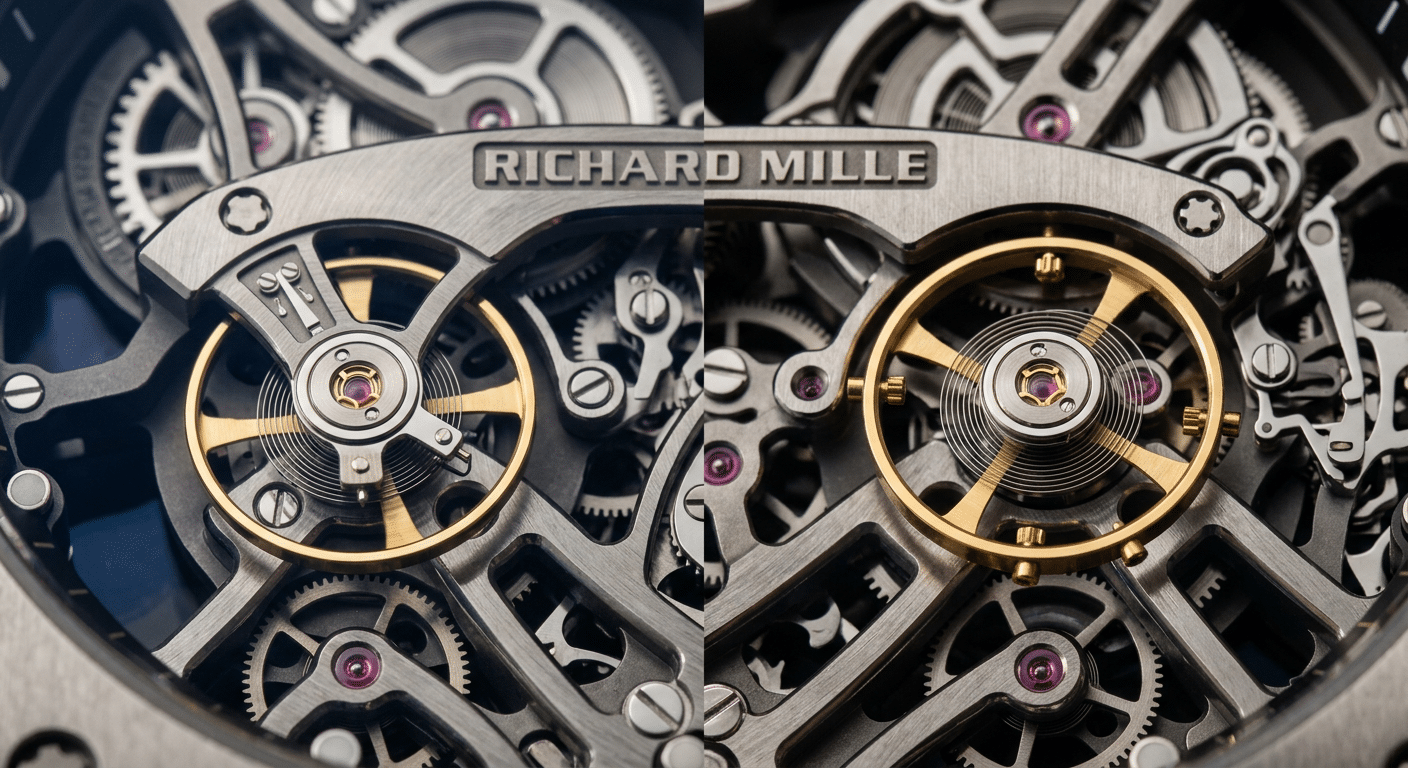
- A fundamental improvement within the same movement family: The recent introduction of a free-sprung balance in some “UMI” factory RM clones, moving from a standard regulator arm to a system that mimics the genuine RM’s variable-inertia balance. This is a major functional and visual step forward.
These changes improve timekeeping stability, power reserve, serviceability, and bring the visual skeleton layout closer to genuine. They are expensive for the factory to implement, which is why they are the most convincing sign of a legitimate new version.
The “Fake” Upgrade: Changes That Don’t Justify a New Version
In the high-stakes game of RM super clones, not every version bump is a step forward. Often, it’s a sideways shuffle dressed as progress—a tactic to clear old inventory, create artificial scarcity, or simply command a higher price for minimal effort. Recognizing these “fake” upgrades is your first line of defense against paying a premium for nothing, a principle well illustrated by the complex replica factory network, where collaborative production explains why singular quality leaps are rare. Here’s what to dismiss as marketing fluff.
Cosmetic Variants vs. Technical Revisions
The most common sleight of hand is repackaging a cosmetic change as a technical revision. If a seller announces a “V3” and the only difference is a new dial color—say, a green bezel screw set instead of red—you’re not looking at an upgraded version. You’re looking at a new variant. Factories run batches in different colors to tap into new markets; this is a business decision, not an engineering breakthrough. A true version upgrade should improve the watch’s fundamental architecture, accuracy, or finish, not just its palette.
Similarly, be wary of hype around new packaging or a “premium” travel pouch. The box it comes in has zero bearing on the watch on your wrist. It’s a peripheral accessory, often used to inflate the perceived value of the same old product.
Expert Authentication Insight
Physical diagnostic: To spot a cosmetic rebrand, conduct a side-by-side pixel comparison. Take high-resolution photos of the “old” and “new” version, focusing on a single, small component like a bezel screw head or the edge of a movement bridge. Zoom in. If the machining patterns, finish, angles, and proportions are identical, and the only change is color or a superficial texture, you’ve caught a case of version laundering. The underlying tooling hasn’t changed; the marketing has.
Other low-value “upgrades” include minor lume adjustments (unless it’s a correction from a glaringly wrong color to a gen-spec one) and claims of “re-tested” or “re-regulated” movements. This often means the same Dandong or Shanghai movement has been given a slight tweak at the regulator—a five-minute job that doesn’t address long-term reliability or fundamental design. The most hollow claim of all is vague “improved quality control.” Unless a seller can specify what improved—“fewer misaligned bezel screws,” “consistent torque on caseback screws”—treat it as empty noise.
The rule is simple: if the change doesn’t affect how the watch wears, functions, or fundamentally appears in dimension and construction, it doesn’t justify a new version number or a price hike.
Model-by-Model Analysis: RM 055, RM 035, RM 011
General principles are useful, but the real test is in the specifics. The version history of each popular RM model is a unique story of progress, stagnation, and marketing. Let’s apply the framework to three icons of the replica world.
RM 055: The Battle for the Right Shade of Gray
The RM 055 Bubba Watson replica journey is a masterclass in incremental correction. The earliest versions from factories like KV had a fatal flaw: the NTPT-style carbon pattern had a distinct, anodized blue tint under light, a dead giveaway. The move to “V2,” primarily by ZF and later BBR, was significant—it aimed to correct this to a more accurate, grayscale carbon appearance. This was a meaningful visual upgrade.
Later iterations focused on movement integration and case thickness. The shift from a heavily decorated generic movement to a more coherent skeletonized clone (like the Dandong RMUL2) in later ZF and APSF versions was a substantive change. However, claims of new versions sometimes merely reflected batch differences in carbon layering or a new source for the rubber strap. The key for the 055 is to distinguish between the major fixes (color, movement) and the minor, batch-to-batch variations that get labeled as new versions.
RM 035: Chasing the Elusive Thin Case
If the RM 055’s war was about color, the RM 035 Rafa Nadal’s has been about millimeters. The genuine 035 is an exercise in lightweight, thin construction. Early replicas were famously chunky. Thus, the entire version history for this model from factories like ZF and BBR has been a relentless pursuit of shedding thickness.
A “V2” or “V3” on an RM 035 that doesn’t bring a measurable reduction in case height is arguably not a true version upgrade. The community consensus tracks ZF’s iterations from V3 through V7, with notable jumps in how the movement was cased and the mid-case geometry to shave off precious tenths of a millimeter. The move to a “free-sprung balance” version by APSF is another technically meaningful step, even if its practical performance gain is debated. For the 035, the version number should correspond directly to a slimmer profile.
Expert Authentication Insight
Physical diagnostic: For the RM 035, arm yourself with digital calipers. The single most telling upgrade is case thickness. Measure from the caseback to the highest point of the domed crystal. A claimed “V3” or “V4” should be demonstrably thinner than its predecessors, ideally pushing toward or under 14mm. For the RM 055, the test is visual. Examine the carbon pattern under strong, direct light. Early versions exhibit a bluish hue; genuine and corrected replicas show a complex, gray/black weave without the synthetic blue cast.
The RM 011 Felipe Massa tells a different story. Its version history is less about incremental refinement and more about managing the limitations of the Shanghai 7750 chronograph movement. “Updates” often pertain to sub-dial spacing alignment or pusher shape, but the elephant in the room—the ~18mm case thickness versus gen’s ~16.15mm—remains largely unaddressed because it’s rooted in the movement architecture. Here, a new version number rarely signifies a fundamental fix; it often denotes a new batch with slightly better (or sometimes worse) quality control on the same flawed platform.
How to Investigate Version Claims Before You Buy
You don’t have to take a seller’s word for it. With a methodical approach, you can verify—or debunk—any version claim yourself. Turn from a passive buyer into an active investigator.
The Photo Request That Separates Truth from Hype
Your most powerful tool is a specific photo request. Don’t ask for “more pictures.” Ask for comparison pictures. When a dealer claims a new “V4,” immediately ask: “Can you provide a side-by-side photo of your V4 and V3 of the same model, focusing on the case profile (side view), the movement through the caseback, and a close-up of the dial/skeleton?”
This forces the issue. A legitimate factory upgrade will have visible differences in these key areas. If they send you stock photos or vague shots of just the new watch, push back. Insist on photos of the actual watch they will ship to you. A refusal or evasion is a massive red flag.
Forum Research: Finding the Signal in the Noise
Dealer announcements are advertisements. Forum reviews, especially from established members with photo-heavy posts, are field reports. Before buying, search replica forums like RWI for the exact model and version number. Look for threads titled “Model XYZ V4 Hands-On Review” or “Comparison: V3 vs. V4”.
Pay attention to the date. A “V4” announced last week won’t have any real-user reviews yet; any hype is just that—hype. Wait for the community to get the watch, tear it down, and report back. Look for consensus on what actually changed, often detailed in a comprehensive Richard Mille super clone guide. Is everyone talking about a thinner case, or just a new sticker on the rotor?
Expert Authentication Insight
Physical diagnostic: During your Quality Control (QC) phase, go beyond checking for scratches. To verify the most critical claim—case thickness—make a specific request. Ask your dealer: “Please provide a QC photo of the watch head (without strap) lying perfectly on its side on a flat surface, with a ruler or digital caliper clearly visible in the frame showing the thickness measurement.” This objective data point is the ultimate arbiter of one of the most meaningful possible upgrades.
Finally, ask direct questions. “What are the three main improvements over the previous version?” “Is the base movement caliber the same?” Vague, marketing-speak answers like “better quality” or “more stable” are worthless. Concrete answers like “case is 0.3mm thinner,” “balance wheel is now free-sprung,” or “carbon pattern is less blue” are what you’re paying for. Your money should only follow evidence.
The Value Decision: When to Pay for a “New Version”
After dissecting the claims and the reality, you’re left with the only question that matters: should you spend more money? The answer isn’t found in a seller’s marketing copy. It’s found in a simple, ruthless framework that separates engineering from decoration, and substance from smoke.
Forget the version number. Focus exclusively on the type of change being advertised. Your wallet’s fate depends on it.
The Non-Negotiable Upgrades: Thickness and Movement
These are the only two changes that should make you reach for your credit card without a second thought. They alter the fundamental nature of the watch.
1. A Reduction in Case Thickness: For Richard Mille replicas, thickness is the single greatest tell. A watch that’s 2mm thicker than the genuine article doesn’t just look wrong—it feels wrong on the wrist, losing the sleek, integrated profile that defines the brand. When a factory retools to shave even half a millimeter off the mid-case or crystal, it represents a significant capital investment and a direct attack on the most obvious flaw. If a “V3” or “Updated” edition brings the thickness closer to gen spec—verified with a caliper measurement in QC photos—that upgrade is almost always worth a premium. It’s a correction to the watch’s core architecture.
2. A Genuine Movement Upgrade: This doesn’t mean a new decoration on the same old Seagull. This means a shift to a fundamentally better base caliber. The most celebrated example is the shift from a decorated Miyota 8215 to the integrated Dandong RMUL2 clone in models like the RM 035-02. This changed everything: the functionality, the reliability, the power reserve, and the visual authenticity through the caseback. Another is the recent introduction of a true free-sprung balance in some “UMI” factory pieces, directly addressing the most glaring mechanical tell. An upgrade that moves the movement from a liability to a strength is not an option; it’s the foundation.
Expert Authentication Insight
Physical diagnostic: The resale market doesn’t care about color variants. It rewards foundational correctness. A version with a corrected case profile and a stable, well-regarded movement (like the Dandong V2) will retain its value and desirability in the replica community far better than a “V4” that merely swapped to a green dial. Collectors and second-hand buyers pay for engineering, not aesthetics. Prioritize the upgrades that affect the watch’s bones, not its clothes.
The Aesthetic Upgrades: A Matter of Personal Priority
This is the gray area. These changes can be meaningful, but their value is entirely subjective and situational. Proceed with caution and a clear understanding of what you’re actually buying.
Worth Considering: A major fix to a glaring, first-glance visual flaw. The classic example is the RM 055’s NTPT carbon color. Early versions had a distinct blue tint that was an instant tell. A later version that corrected this to a proper charcoal gray directly addressed a major authenticity issue. Similarly, a significant leap in the quality of skeletonization—sharper anglage, deeper brushing, more three-dimensional depth—can transform the watch’s face from a flat facsimile to a compelling illusion.
The Judgment Call: The price delta is everything here. If the fix for the blue NTPT or the improved dial finishing comes with a $30-$50 increase over the old version, it might be a justifiable expense for the peace of mind. If the factory is asking for an extra $150 for the same tweak, they’re capitalizing on hype, not delivering proportional value.
Not Worth It (Save Your Money): This category is where most version inflation lives. Be merciless in dismissing:
- Pure Cosmetic Variants: A new dial color (e.g., “V3 now in Ice Blue!”) is a new model, not an upgraded version of the old one. It doesn’t make the watch better; it makes it different.
- Accessory Upgrades: “Now includes a wooden box” or “improved travel pouch.” This has zero impact on the watch on your wrist.
- Vague, Unverifiable Claims: “Improved quality control,” “smoother rotor,” “better feeling.” These are empty phrases unless backed by specific, photographic evidence comparing old and new.
- “Final,” “Ultimate,” or “Edition” Labels: These are marketing terms, not technical specifications. They mean nothing without a concrete list of changes.
The rule is simple: if the change doesn’t affect the watch’s dimensions, mechanics, or a major visual flaw, it’s not a version upgrade. It’s a sales tactic.
The Practical Calculus: Making the Call
When you see a new version advertised, run through this filter:
- What is the actual change? Demand specifics: “What are the three main improvements over the previous version?” If the seller can’t list them, the upgrade doesn’t exist.
- What is the price increase? A $20 premium for a corrected lume color? Possibly worth it. A $150 premium for a new box and the word “Ultimate”? A hard pass.
- Can it be verified in QC? If the upgrade is real, you should be able to confirm it in your quality control photos. Thickness can be measured. Movement can be photographed. A new color is obvious. If the upgrade is about “feel” or “QC,” it’s unverifiable and therefore worthless as a selling point.
Often, the smartest money is on the last version before the hype cycle peaks—the “V2” that fixed the major flaws of the “V1,” but before the “V3” added a fancy name and a 25% price hike for marginal gains. This is where you get 95% of the genuine improvement for 70% of the cost.
In the high-stakes game of RM super clones, a version number is a question, not an answer. Your job is to interrogate it. The only upgrades that justify opening your wallet are those you can measure with calipers, verify in a high-resolution movement shot, or see as a clear correction to a once-glaring fault. Never pay for a story. Never pay for potential. Only pay for a documented, photographic, tangible improvement. Let that principle guide you, and you’ll never overpay for a digit on a sales page again.