
The 2026 Dress Code Matrix and Wrist Signaling Mechanics
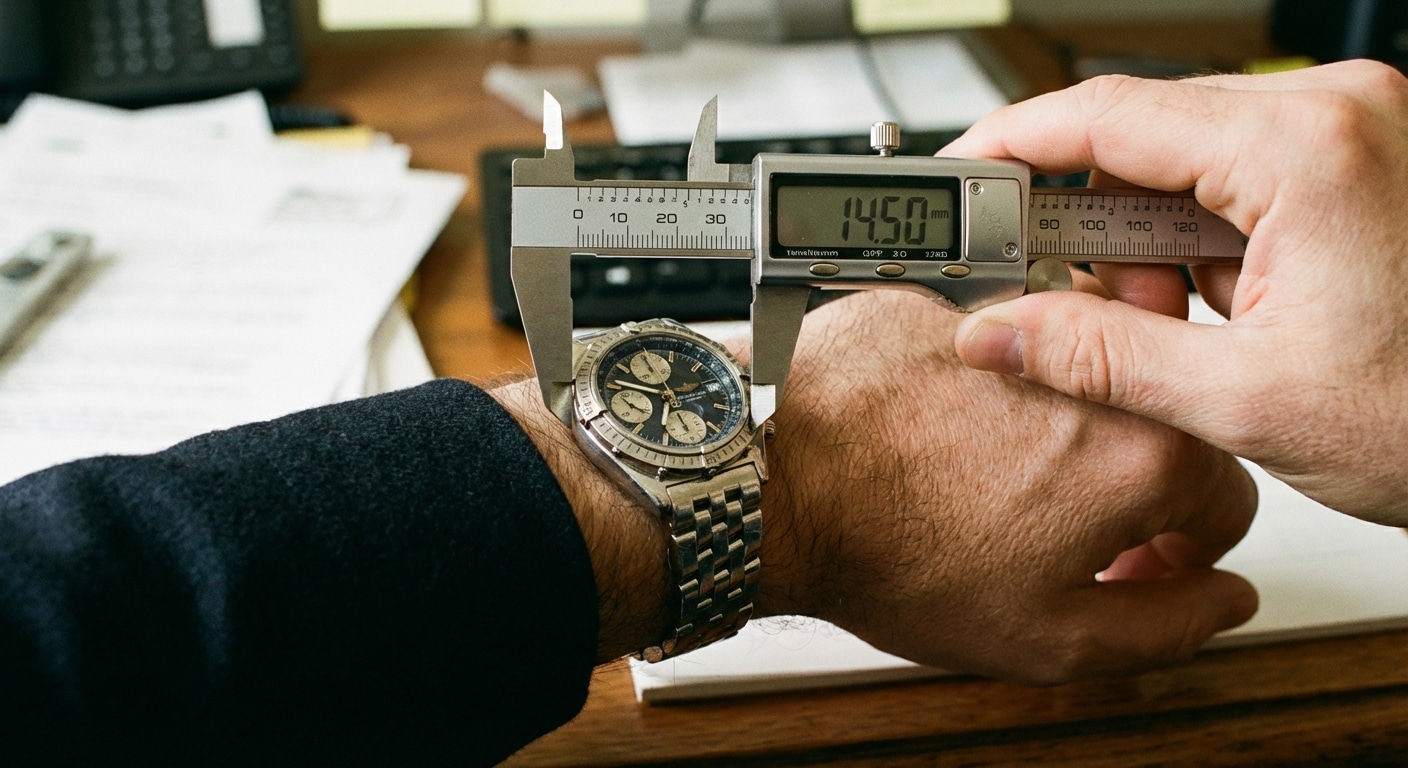
The collapse of traditional workplace dress codes has not made getting dressed easier; it has simply replaced obvious rules with a minefield of subtle social signals. In the 2026 hybrid work environment, where a boardroom presentation might be followed by a remote deep-work session in a local coffee shop, your watch is often the only rigid, engineered element on your body. When you pair a heavy Swiss chronograph with a modern, unstructured wardrobe, the specific deployment clasp vs tang buckle profile becomes a critical point of contact. Understanding how a Breitling interacts with this new matrix of fabrics and environments requires abandoning marketing brochures and looking closely at physical geometry.
The Death of the “One Watch” Myth
The concept of a “Go Anywhere, Do Anything” timepiece is a fundamental misrepresentation of physical reality, particularly when dealing with modern Breitling cases. The brand’s architectural DNA inherently resists the versatile label. Take a standard modern diver, such as the 44mm Superocean. When you combine a 14.5mm case thickness (often expanding by an additional 0.5mm to 1.0mm when housing robust chronograph calibers like the 7750) with the standard 9.5-inch circumference of a modern tailored jacket sleeve, you create an immediate geometric clash.
The “one watch” myth ignores basic physics. A watch engineered with the visual and literal density required for 300 meters of water resistance will inevitably overwhelm fine textiles. It does not slip under a cuff; it arrests the fabric, causing the sleeve to bunch at the forearm and exposing the wrist bone. This lack of proportional balance signals that the wearer is prioritizing the display of their luxury good over the harmony of their attire.
Remote Work Casualization vs. Intentional Dressing
We are currently operating in an era where up to sixty percent of the workweek is spent in merino wool quarter-zips, heavy cotton tees, and high-definition Zoom calls. In this context, the high-polish facets of a Navitimer bezel read entirely differently on a 4K webcam than they do under in-person fluorescent office lighting.
When you pair ultra-casual fleece with highly reflective, complex dial geometries, the watch acts as a glaring “try-hard” signal. It is a mismatch of intent. The extreme thermal retention of a heavy steel case against the wrist during a long day of keyboard typing only adds to the physical wear fatigue, making the watch feel increasingly intrusive as the hours pass. Intentional dressing in a remote environment requires scaling down the visual noise of the wrist to match the relaxed drape of modern casual wear.
Expert Authentication Insight
To determine if a watch physically belongs on your wrist before even considering the wardrobe, you must measure the lug-to-lug distance using digital calipers against the flat dorsal surface of your arm. For example, if you have a flat wrist spanning 55mm, a watch with a 50.5mm lug-to-lug span is the absolute maximum limit. Authentication of a proper fit requires a minimum 2mm clearance on both sides before the wrist begins to curve downward. If the lugs overhang or sit perfectly flush with the edge of your wrist, the watch case will act as a structural wedge against your shirt cuff, permanently compromising the drape of your sleeve.
Scenario 1: The High-Stakes Business Meeting (Boardroom Protocol)

Formal corporate environments are unforgiving of ergonomic errors. In high-stakes meetings, every element of your attire should communicate competence, restraint, and situational awareness. Bringing the wrong horological armor into a boardroom does not just ruin your shirt cuff; it broadcasts a lack of refinement. We must deconstruct the exact physical reasons why certain aggressive models fail here, and identify the specific architectures that succeed.
Why the Chronomat Rouleaux Fails the Formal Test
The Rouleaux (bullet) bracelet is undeniably an engineering marvel of articulation, but its physical design is fundamentally hostile to formalwear. The cylindrical links create a continuous 3.5mm raised profile that wraps around the entire wrist. When paired with a delicate, 120-thread-count dress shirt, these raised cylinders act like a rasp. Every time you extend your arm, the bracelet catches the inner edge of the cuff, creating a highly visible snag.
Socially, the aggressive, light-catching geometry of the Chronomat signals casual opulence. It is a loud, kinetic piece of hardware whose sheer density—often analyzed in stainless steel Breitling clones—directly clashes with the subdued, matte uniformity expected in a boardroom. Forcing it into a formal setting demonstrates a reliance on brute financial force rather than an understanding of sartorial nuance.
The Premier B09 as the Ultimate Corporate Armor
If you must wear Breitling in a strict corporate setting, the Premier B09 Chronograph 40mm represents the brand’s most mathematically sound option. At exactly 13.0mm thick, featuring a stepped bezel and aggressively downward-angled lugs, it is engineered to slide seamlessly under a standard 2.5-inch cuff opening.
The social signaling of the Premier is entirely different from the Chronomat. Its vintage-inspired syringe hands and the deliberate absence of a bulky external rotating bezel communicate historical literacy and intentionality. It provides the mechanical satisfaction of a chronograph without the disruptive visual scale, allowing your tailored clothing to maintain its intended silhouette.
Expert Authentication Insight
To authenticate true formal compatibility, you must utilize the “Drop Test.” Stand with your arm completely relaxed at your side. A properly fitted dress shirt cuff must naturally fall over the watch without any manual adjustment or shaking of the wrist. If the watch case prevents the cuff from covering at least 70% of the crystal, the thickness-to-cuff-diameter ratio is fundamentally incorrect for formal wear. No amount of adjusting will fix a watch that is simply too tall for your tailoring.
Scenario 2: Hybrid Office and Casual Fridays (Smart Casual)
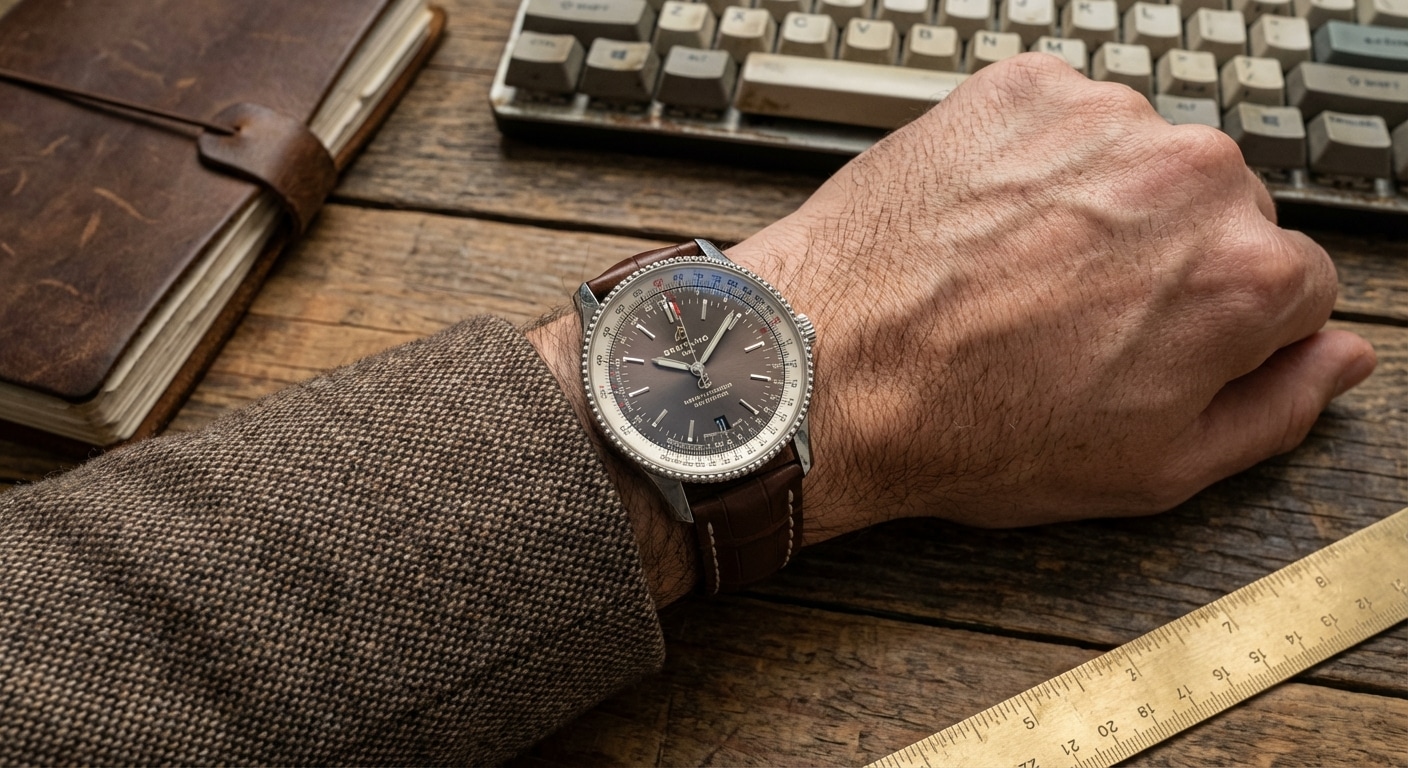
Smart casual is arguably the most dangerous dress code of the modern era because it lacks rigid boundaries. It requires balancing the unstructured nature of premium knitwear and soft-shouldered blazers with accessories that still convey professional competence. Navigating this space successfully relies entirely on matching specific strap materials and dial layouts to the texture of your clothing.
The 41mm Navitimer mounted on a matte alligator strap—specifically one tapering from 22mm at the lugs to 18mm at the deployant clasp—is the apex of smart-casual signaling. The extreme visual density of the slide rule dial acts as a necessary conversational focal point, but the leather strap fundamentally alters how the watch wears.
By removing the heavy steel bracelet, you eliminate the aggressive glare and drastically reduce the overall weight. This lack of heavy metal on the wrist pairs exceptionally well with the tactile, matte fabrics of an unstructured linen suit or a tweed blazer. It signals creative competence and a nuanced approach to style, proving you understand how to temper a complex dial with a subdued, organic material.
The Superocean Heritage paired with a Milanese mesh bracelet offers a highly specific thermal and visual advantage for warmer casual Fridays. The tight weave of the mesh, measuring a precise 3.2mm in thickness, provides excellent breathability and a flexible bracelet drape that conforms tightly to the wrist bone. It maintains a structured, mid-century aesthetic that elevates a simple polo-and-chinos combination.
However, you must account for the friction coefficient of the steel mesh. Over an eight-hour workday, variations in wrist tension outlined in any comprehensive replica size wearing guide dictate how the microscopic edges of the Milanese weave can act as a subtle abrasive against the fine knit hem of a long-sleeve polo or cashmere sweater. It is a visually perfect pairing that requires mindful monitoring of your left sleeve’s condition.
Expert Authentication Insight
When evaluating a mesh bracelet for smart casual wear, inspect the articulation tolerance where the Milanese weave meets the straight spring bar tube. A structurally sound pairing will exhibit zero lateral play at this lug junction. This rigid connection is critical; it ensures that the heavy watch head (which often exceeds 90 grams on its own) does not droop off-center when your wrist is pronated during extended keyboard typing, preventing uneven clasp pressure points from forming on the underside of your wrist.
Scenario 3: Weekend Outdoors and Aggressive Leisure
When Friday’s unstructured blazer is traded for technical shell jackets and performance synthetics, the physical demands placed on a timepiece shift entirely. The transition from office aesthetics to aggressive leisure requires a fundamental reassessment of weight distribution and material behavior. Wearing a 200-gram steel diver to a weekend trail run does not signal rugged capability; it signals a lack of practical awareness. In active environments, horological mass becomes a functional liability.
Endurance Pro vs. Aerospace: The Weight of Athleisure
Social signaling on the weekend demands matching your watch’s structural material to the specific physical activity. Consider the Breitling Endurance Pro. Utilizing Breitlight—a proprietary polymer engineered to be 3.3 times lighter than titanium—the case alone weighs a mere 35 grams. When strapped to a 17.5cm wrist during high-impact movement, the watch practically disappears from the wearer’s sensory radar. We can contrast this with the titanium Aerospace EVO. While titanium offers an excellent strength-to-weight ratio for daily wear, the ultra-lightweight polymer of the Endurance Pro communicates dedicated athletic intent. A heavy watch head creates kinetic drag and uncomfortable wrist-bone impacts during a runner’s arm swing; a 35-gram polymer case eliminates that wear fatigue entirely.
Rubber Straps and Thermal Expansion in Active Scenarios
The case material is only half the equation; the strap must manage the biological realities of exertion. Breitling’s Diver Pro rubber straps are engineered with specific channel molding on the underside. During a rigorous hike in 85°F heat, these 1.5mm deep channels become critical infrastructure for sweat displacement. More importantly, they accommodate an inevitable physiological shift: human wrists can swell and increase in circumference by up to 4mm during sustained cardiovascular activity in warm climates. If you wear a tightly fitted steel bracelet in this scenario, it rapidly transforms into a tourniquet, biting into the skin and restricting circulation. The rubber strap, conversely, actively manages thermal expansion, maintaining ergonomic integrity without requiring mid-activity adjustments.
Expert Authentication Insight
To verify the functional baseline of a sports strap, we perform a thermal expansion simulation. By fastening the rubber strap to a 17cm circumference testing mandrel and applying 1.5 lbs of lateral tension—simulating the wrist flexion experienced during a steep mountain scramble—we can observe the material’s failure points. The deployant clasp’s micro-adjustment mechanism must engage cleanly without binding under pressure. Furthermore, the rubber itself must exhibit a minimum of 2% elastic stretch. Without this precise elasticity, the strap will fail to absorb shock, transferring the full force of impact directly into the spring bars and the wearer’s wrist.
Stop buying watches based on how they look isolated in a highly edited macro photograph, and start buying them based on the specific geometry of your wardrobe. The myth of the “Go Anywhere, Do Anything” watch is a marketing fabrication designed to sell heavy steel to men wearing fine textiles. If you spend five days a week in tailored worsted wool, purchasing a 44mm Chronomat on a steel Rouleaux bracelet is an $8,000 ergonomic error. It will bunch your sleeve, expose your wrist bone, and telegraph an awkward misunderstanding of proportional balance.
Before your next purchase, put on your most frequently worn jacket or tailored shirt. Take digital calipers and measure the exact diameter of the left cuff opening. Observe how the fabric drapes over your bare wrist. Refuse to buy any timepiece that requires you to physically alter your clothing, stretch your cuffs, or endure constant sleeve friction just to accommodate its bulk. A watch should live seamlessly within the architecture of your life, not force your life to stretch around it.