
A “super clone Rolex” lives or dies by what you feel on the wrist, not what you see in photos. The dial can look right, the case can measure right, and the bracelet can drape nicely—then you set the time, wind it, run a chronograph, or live through a few weeks of daily wear and the truth shows up.
This replica Rolex mechanical guide focuses on that truth: the movement. I’ll explain how super clone Rolex movements are engineered, what “clone movement accuracy” actually means in real life, and how the main clone caliber families map to the Rolex models people care about (3135, 3235, 3230, 3285, 4130, 4131). I’ll also keep the factory talk (VS, Clean, ZF, QF) short and technical—only where it affects what’s inside.
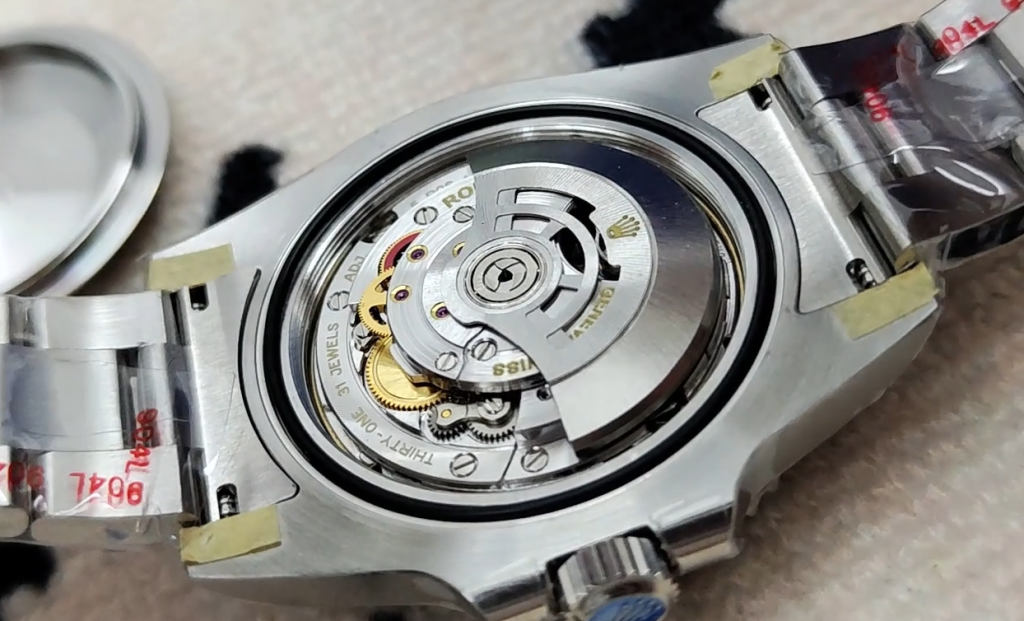
Why Movements Are the Core of a Super Clone Rolex
Not All Clones Are Equal — Movement Hierarchy Explained
When sellers say “super clone movement,” they often lump very different things into one label. In practice, there’s a hierarchy.
At the bottom, you’ll see movements that are basically generic engines wearing a Rolex costume. The watch runs, but the layout, parts geometry, and service behavior don’t match the genuine architecture. It’s like printing a high-resolution photo of a car’s dashboard. From a distance, it looks convincing. The moment you touch it, you know it’s not the same machine.
In the middle are movements that copy some functional ideas—beat rate, hand stack, maybe a date mechanism that behaves similarly—but still rely on an internal design that isn’t truly “Rolex-shaped.” These can be fine for casual wear, but they tend to reveal themselves when you start caring about winding feel, date change behavior, or long-term maintenance.
At the top is what enthusiasts usually mean by a true “super clone Rolex movement”: a build that aims to mirror the mechanical architecture closely enough that it behaves like the genuine movement, and in some cases can accept certain gen-spec parts or service procedures. That last point—compatibility and servicing—is where “super clone” stops being marketing and starts becoming engineering.
What “Mechanical Accuracy” Really Means
People hear “accuracy” and think only of seconds gained or lost per day. That’s part of it, but it’s not the whole story.
Real mechanical accuracy includes how stable the watch stays through your normal week. If you wear the watch Monday through Friday, leave it on a dresser Saturday, then pick it up Sunday morning, the watch’s behavior tells you more than a one-time timegrapher photo.
Here’s what matters in daily life:
- Rate stability: Does it hold a similar gain/loss pattern across positions and activity?
- Beat consistency: Does the seconds hand sweep smoothly without “micro-stutters” that show up when the movement is under strain?
- Hacking (stop-seconds): Does the seconds hand stop cleanly when you pull the crown, and does it restart without a jump?
- Date behavior: Does the date change with a crisp transition near midnight, or does it creep for hours?
Most Rolex calibers run at 28,800 vibrations per hour (vph), a 4Hz beat rate. That’s not just a spec. It changes how the seconds hand looks, how the escapement manages energy, and how tolerant the system is of small shocks. When a clone matches 28,800 vph and has a well-built escapement and stable regulation, you get the kind of smooth, predictable wear people expect from a modern Rolex-style movement.
Anatomy of a Super Clone Rolex Movement
The Key Components and Their Roles
A movement is a chain of energy and control. If any link is sloppy, you feel it.
Balance Wheel & Escapement System
This is the watch’s heartbeat. The balance oscillates, the escapement meters energy, and the entire system decides whether your watch feels calm and steady—or twitchy and inconsistent.
In day-to-day wear, escapement quality shows up in a simple moment: you check the time every morning and notice the watch is always off in the same direction by a small amount, instead of swinging wildly. Stable behavior usually means the balance assembly, hairspring behavior, and beat are doing their jobs predictably.
Gear Train & Power Transmission
The gear train transfers power from the mainspring to the hands. When tolerances are tight and lubrication is correct, the seconds hand looks smooth and the minute hand advances with that quiet confidence you expect.
When tolerances are rough, you can sometimes feel it while setting the time. The minute hand may “drag” slightly, or you might notice a faint unevenness as you rotate the crown. It’s subtle, but once you notice it, it’s hard to un-feel.
Rotor & Automatic Winding Mechanism
Automatic winding is one of the most revealing parts of a clone. Two watches can keep similar time, but the rotor can give one away instantly.
In real wear, pay attention to two things: sound and feedback. A good rotor system feels controlled. You might hear movement in a quiet room, but it shouldn’t sound like a loose spinner. When you hand-wind, the crown should feel smooth with steady resistance, not gritty or hollow.
Power Reserve and Real-World Performance
Power reserve is easy to sell and hard to explain honestly. Yes, longer reserve is convenient. But the bigger story is how the watch behaves as the mainspring winds down.
On paper, many modern Rolex families target around 60–70 hours. In practice, what you feel is whether the watch stays consistent on day two and day three. A movement can claim a long reserve yet lose stability as torque drops. That’s when you see the watch drift more overnight, or the amplitude drop enough to affect the sweep and rate.
If you’re the kind of person who rotates watches, power reserve stops being a bragging point and becomes a lifestyle detail. If you leave the watch off on Friday night and it’s still running Monday morning, that changes how “set-and-go” the watch feels. But it only counts if the last 20 hours are still stable.
Compatibility & Servicing — What It Really Means
“Part compatibility” is one of the most misunderstood phrases in this niche.
Some super clone Rolex movements are built to closely follow gen geometry in major assemblies. That can make servicing more straightforward and can sometimes expand parts options. But compatibility is rarely universal. It can vary by component group—think in terms of “some parts may fit,” not “everything swaps.”
The practical question is simple: if you actually keep the watch for years, can a competent watchmaker service it without treating it like a fragile novelty? Movements that follow a known architecture, use consistent tolerances, and avoid purely decorative tricks tend to age better. Even if you never swap a single part, serviceability is a form of durability.
Common Clone Movement Categories (Model-Centric Mapping)
This section keeps it grounded: movement family → what Rolex models it’s trying to replicate → what you should expect.
3135 Super Clone Movement — What You Really See When You Tear It Down
When you open a 3135-style super clone, the first thing you notice isn’t a dramatic “night and day” difference. Most of the big shapes look familiar. The layout is close enough that, from a normal viewing distance, it can feel like the same architecture. The real gap shows up in places most people never look—tiny surfaces where friction, wear, and long-term stability are decided.

The Main Plate: Where Swiss Finishing Quietly Wins
On a genuine Swiss 3135, the areas where gears rotate—those contact zones that actually carry load—tend to get more careful finishing. You’ll often see a cleaner, brighter polish around the working surfaces, and small parts like spring components look more deliberately refined. That kind of finishing isn’t just “pretty.” It reduces stray roughness that can shed micro-debris over time when a spring flexes back and forth.
On a super clone 3135, you’ll usually see more tool marks and a more “industrial” surface in the same zones. It’s not that the movement can’t run well. It’s that the finishing looks like it was done to meet function first, not to eliminate every small imperfection the way Swiss does.
A second detail is the holes and edges. Swiss 3135 plates often show subtle chamfers around certain openings. On a clone plate, those hole edges can look sharper and less dressed. The same story happens on the wheel train edges: Swiss work may include tiny beveling you can’t really catch with the naked eye. Under macro magnification it becomes obvious—those micro-chamfers exist, but they’re too small to “impress” you at a glance.
The Backside Texture: Geneva Waves vs “Good Enough” Patterning
Flip the plates over and the difference becomes more visual. Swiss finishing tends to look finer and more controlled. The “fish scale” or wave-like textures appear tighter and more uniform, and the engraving usually reads cleaner and deeper.
On a super clone, you may still see decorative striping, but it can look rougher or wider, as if the pattern was added to suggest finishing rather than to achieve the same refinement. If you’re inspecting with a loupe or macro lens, this is one of the easiest places to spot the difference.
The Mainspring / Train Bridge: Chamfers, Cleanliness, and That “Track” Look
On the main transmission bridge (the area that supports key parts of the drive train), Swiss parts often show a smoother overall surface. You’ll also see more consistent chamfering around holes and along certain edges.
On the clone side, the geometry is usually there, but the detail finishing often stops short. Some edges look like they were left closer to raw machining, and chamfers may be missing in places where the Swiss version is clearly beveled. Sometimes you’ll also notice “track-like” polishing marks that look a little dirty or uneven. It’s not always a functional problem—but it tells you where effort was saved.
Jewels and the “Gold Bushing” Detail
One interesting part you’ll sometimes see replicated is the gold-colored bushing or jewel-setting element that higher-end movements use to make jewel replacement easier. Seeing that feature present in a clone is a sign that the builder is paying attention to real construction cues, not only surface cosmetics.
But there’s still a difference in the texture and order of the finishing around it. On the clone, the pattern can look more mechanically regular but slightly harsh. On Swiss, the same finishing often looks more refined—still controlled and systematic, just softer and cleaner in how it catches light.
Hand-Winding Bridge: Surprisingly Close—Until You Go Macro
In the hand-winding bridge area, the gap can feel smaller. Some clone screws even look rounder at first glance, while the Swiss screw heads may not look “more rounded” in a way you’d immediately notice. The difference is usually in the consistency of how things sit and how surfaces blend—Swiss finishing tends to look smoother as a whole, not necessarily “flashier” in one isolated spot.
If the rotor has rubbed the bridge on a used piece, you may also see scuffing. Swiss engraving typically remains clearer and bolder. Clone engraving can look thinner—enough to “show it exists,” but not cut with the same confidence.
Gear Train and Barrel: Functionally Close, Visually Different
When you compare the wheel train and the barrel area, the basic functional build can be fairly close. Internally, both can show machining marks that come from how the components are produced. The biggest visual difference tends to be on the backside: Swiss finishing is more deliberate and cleaner, while the clone side can look more like raw machining with simpler decorative intent.
The Hairspring: The One Difference You Can See Without Trying
If you want one “instant” visual tell—one thing you can often notice even without macro—it’s the hairspring assembly.
On a Swiss 3135, the hairspring system is designed with strong anti-corrosion performance and careful material behavior. The structure tends to look more substantial and purpose-built. You’ll also see a regulation approach that reflects fine control—details that exist because the movement is meant to hold stable performance over long service intervals.
On a 3135 super clone, the hairspring assembly is usually the most obvious place where the build feels different. The spring may look slightly different in size or tension characteristics, and the regulating hardware can appear simpler. A clone can still be well regulated and run acceptably, but visually—and often in how it ages—this is where Swiss engineering shows the most “quiet advantage.”
The Honest Take
When you lay everything out on a bench, the difference isn’t one huge dramatic flaw. It’s a collection of small decisions: chamfers that are missing, textures that are rougher, polishing that stops early, engraving that’s lighter. Most of those details don’t jump out in normal wear. They show up under magnification, and they matter more to long-term refinement than to day-one appearance.
If your goal is to spot a difference with your bare eyes, the hairspring is usually the clearest place to start. If your goal is understanding why Swiss movements feel more “settled” over time, the answer lives in those tiny finishing choices you only notice when you slow down and look.
Caliber Group: 31xx Series (e.g., 3135 / VS3135 / VR3135)
Genuine reference point: Rolex 3135 powered many of the older generation date models that people still buy and clone heavily—especially Submariner Date and Datejust variants from the 5-digit and 6-digit era.
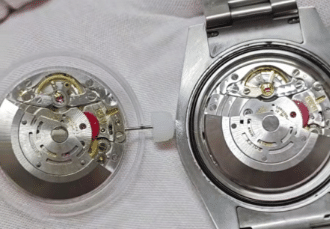
Where you’ll see it (genuine model examples):
- Submariner Date 116610 (3135 family era)
- Datejust 36 references from the same generation that rely on 31xx architecture
What it’s known for: a mature, widely-understood design with a practical service history. In the clone world, “3135-style” often becomes a benchmark because it’s been cloned and iterated on for a long time.
What to watch for in clones: naming doesn’t guarantee architecture. One “3135 clone” can be a close structural copy, and another can be a looser interpretation that only mimics the layout visually. If the seller talks about smooth setting, stable date behavior near midnight, and consistent beat at 28,800 vph—and can show real movement footage—that’s more meaningful than a label.
Caliber Group: 32xx Series (e.g., 3235 / VS3235 / VR3235 / SH3235/3255)
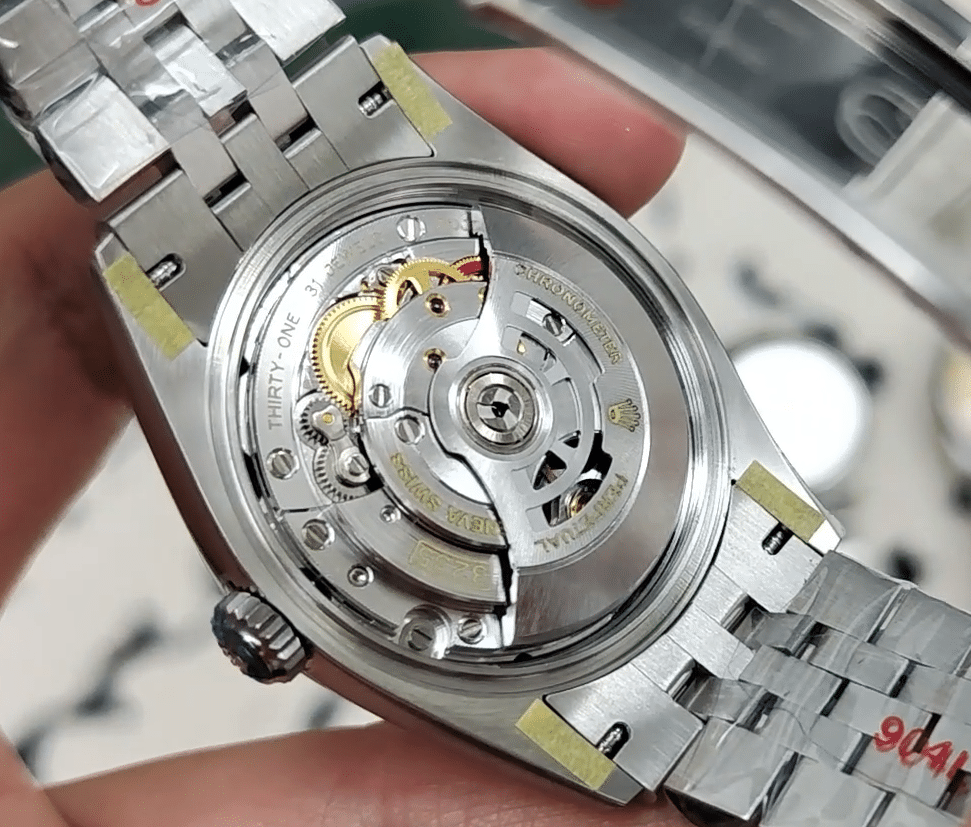
Genuine reference point: Rolex 3235 is the modern date movement family used in many current production models. It’s also the reason many buyers expect both strong power reserve and a certain “tight” crown feel.
Where you’ll see it (genuine model examples):
- Submariner Date 126610
- Datejust 41 126334 (and many modern Datejust configurations)
What changes in daily life: the movement is designed for modern wear expectations—longer reserve, strong efficiency, and a crisp, controlled feel when adjusting time and date.
Here’s a real scenario that exposes quality fast: you change the date around midnight because you forgot earlier. A well-behaved 3235-style build should feel predictable. A weaker build might feel hesitant, or the date transition may look messy—especially if the date system isn’t engineered cleanly.
Caliber Group: 3230 (No-Date Modern Three-Hand)
Genuine reference point: Rolex 3230 is the modern no-date three-hand family.
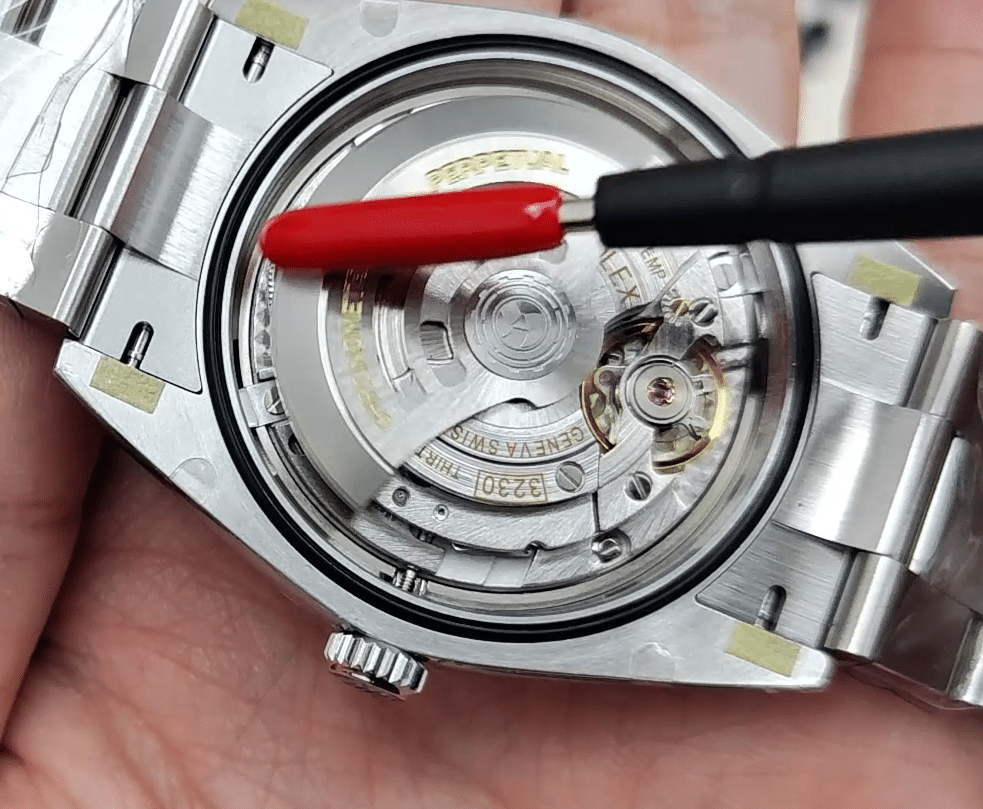
Where you’ll see it (genuine model examples):
- Submariner No-Date 124060
- Explorer 124270
Why it matters: no-date watches are deceptively tough to “get right” because you can’t hide behind a date complication. The watch becomes about winding feel, setting feel, and rate stability. If you want a simple daily wearer with fewer moving parts, 3230-style is often the cleanest lane—assuming the build quality is there.
Caliber Group: 3285 (GMT)
Genuine reference point: Rolex 3285 powers modern GMT-Master II references.
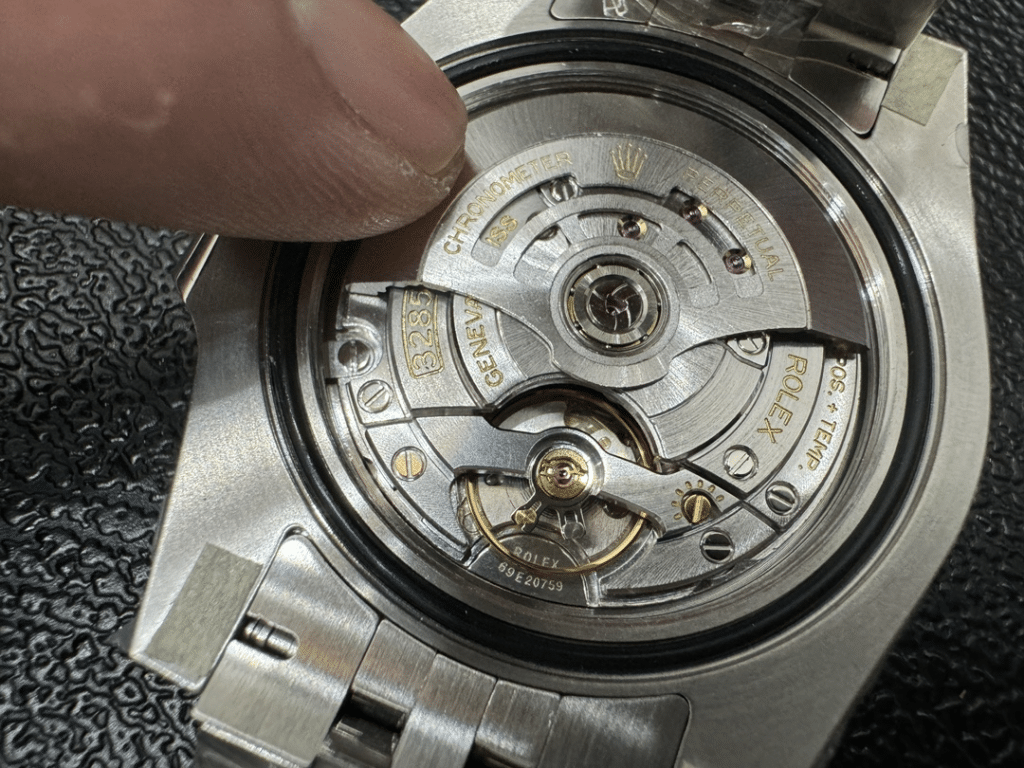
Where you’ll see it (genuine model examples):
- GMT-Master II 126710 (e.g., “Pepsi” on Jubilee, depending on configuration)
- GMT-Master II 126711 (Rolesor variations)
What makes it special in use: the GMT system isn’t just “an extra hand.” It’s a behavior. Travelers care about whether the local-hour adjustment feels crisp, whether the jumping mechanism behaves cleanly, and whether the watch stays stable after repeated timezone changes.
In clones, GMT is where shortcuts show up. If the jumping hour feels mushy or inconsistent, or if the hand alignment drifts after adjustments, that’s not a cosmetic issue. It’s a mechanical integrity issue.
Chronograph Movements: 4130 Clones (Daytona Era)
Genuine reference point: Rolex 4130 is the classic modern Daytona chronograph movement family.
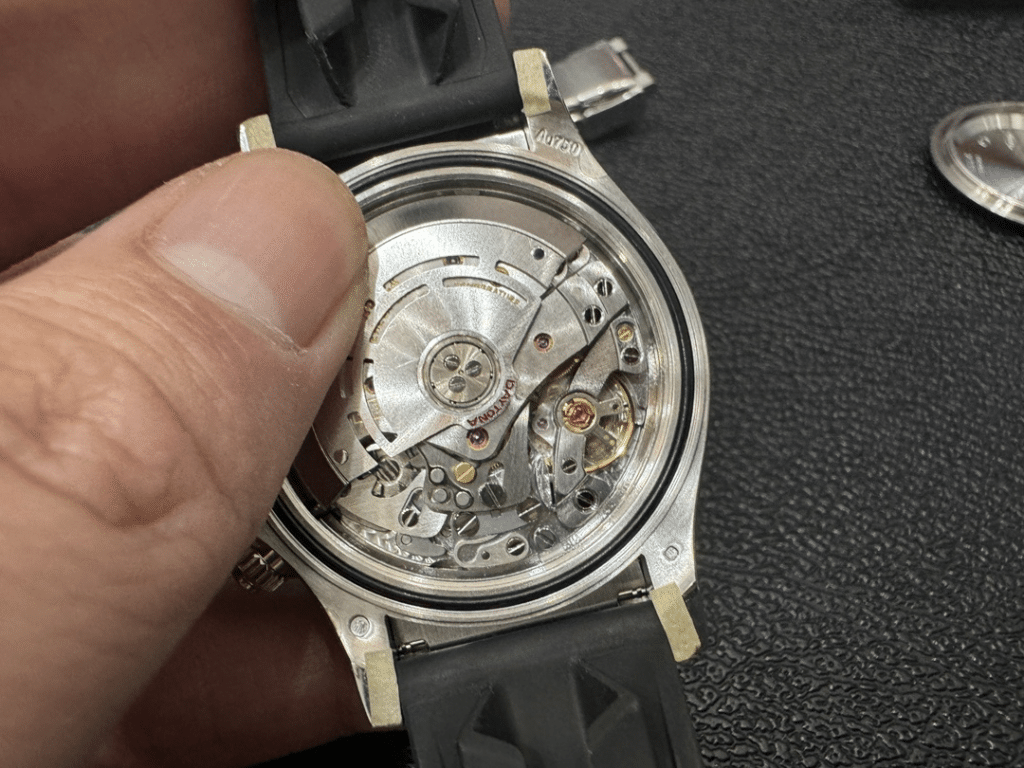
Where you’ll see it (genuine model examples):
- Daytona 116500LN (and other 1165xx references)
What “good” feels like: the chronograph start should feel clean, not gritty. The reset should snap back with confidence. The watch should not feel like it’s “struggling” when the chrono is running.
A replica chronograph movement explanation often misses the point: it’s not about counting features. It’s about whether the chrono function behaves like a tool you can actually use, not a complication you’re afraid to touch.
Chronograph Movements: 4131 Clones (New Daytona Era)
Genuine reference point: Rolex 4131 arrived with the newer Daytona generation.
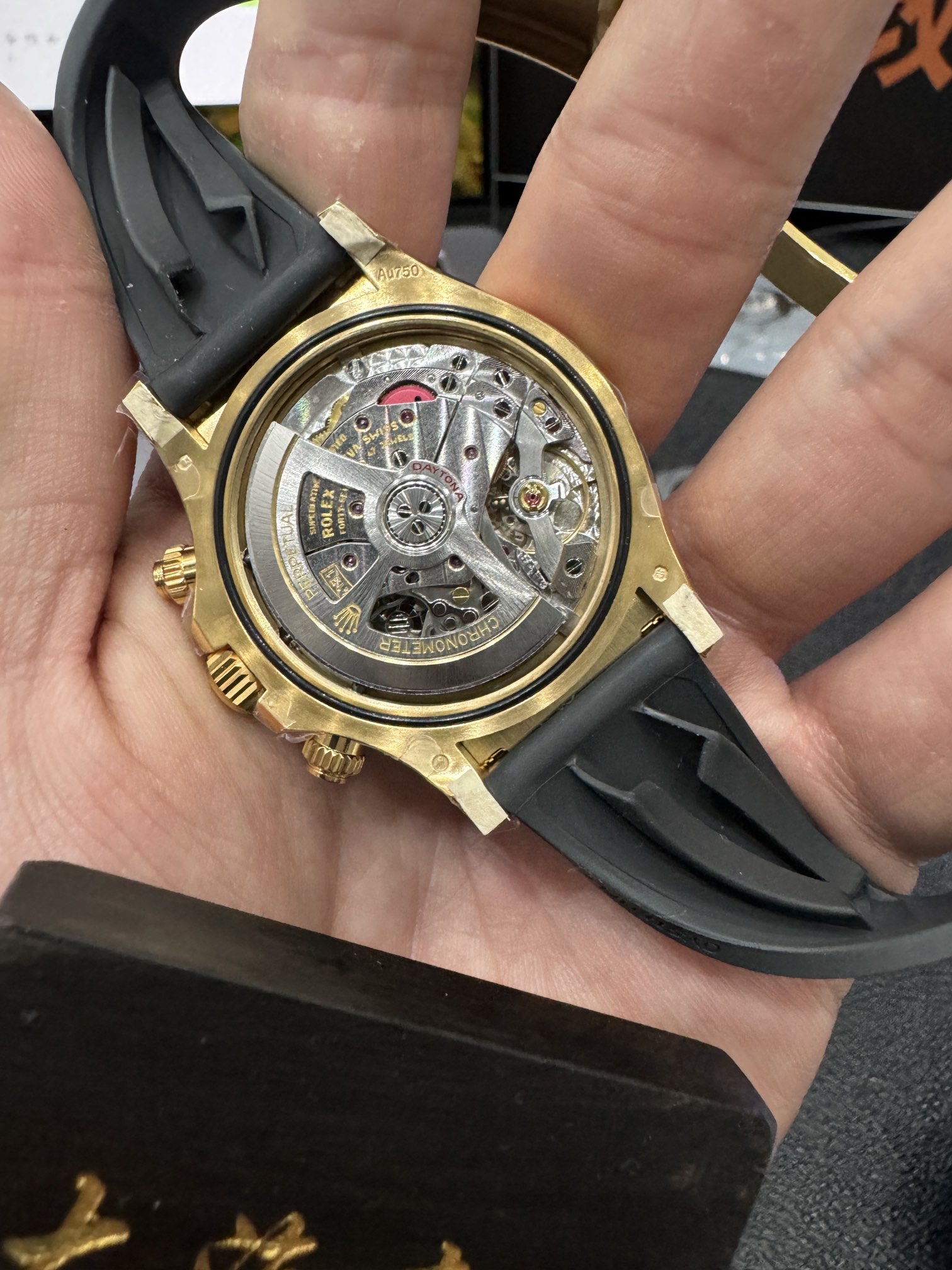
Where you’ll see it (genuine model examples):
- Daytona 126500LN (new generation)
What to expect in clones: 4131-style clones are newer, and that matters because “newer” usually means fewer years of real-world servicing history in the replica ecosystem. The best approach here is to evaluate with your hands and ears: pusher feel, reset behavior, winding feel, and stable running with the chrono engaged.
Real-World Technical Pitfalls & What They Mean for You
Timing Variance vs Genuine Rolex
Let’s be honest about expectations. Even a strong super clone Rolex movement can run well, but consistency is the whole game.
If your watch gains 5 seconds today, loses 2 tomorrow, and gains 8 the next day, that’s not “accuracy.” That’s volatility. A watch that gains a steady 3–6 seconds daily can feel more trustworthy than one that occasionally nails perfect time but swings around.
Also, your lifestyle matters. Desk work, driving, gym sessions, temperature swings—these all affect how a mechanical watch behaves. The question isn’t “Is it perfect?” The question is “Is it predictable in my week?”
Durability & Failure Modes
Most movement failures don’t happen dramatically. They start as feel.
A rotor that gets louder over months is often a warning. A crown that becomes rougher to wind is a warning. A date that starts changing later and later is a warning.
Common wear points tend to cluster around the parts that take repeated stress: winding system components, rotor bearings or axles, and areas where friction is high and lubrication matters. The movement doesn’t need to be fragile to need maintenance. It just needs to be mechanical.
Noise, Rotor Behavior & Winding Feel
This is the easiest place to be fooled by photos, and the easiest place to be honest with yourself.
If you’re sitting in a quiet room and the watch sounds like a spinning toy every time you move your wrist, that’s not “character.” It’s usually a sign the winding system isn’t as controlled as it should be.
Winding feel is equally revealing. A good movement gives you steady resistance. It feels like gears engaging cleanly. A weak movement can feel hollow, scratchy, or inconsistent as you turn the crown.
How to Evaluate a Movement Before You Buy (Technical Checklist)
Visual Movement Inspection Tips
Don’t treat movement photos like a beauty contest. Look for functional clues.
Ask for a clear, close shot of the balance area and the finishing around key bridges. You’re not hunting for luxury decoration. You’re hunting for signs of care: clean edges, legible engraving where it should be, and no obvious debris or tool marks.
If the seller only shows one polished angle with dramatic lighting, that’s not helpful. A real inspection view looks a little boring. That’s a good thing.
Functional Performance Tests
If you can only do a few checks, make them the ones that reflect real ownership.
Test the date change around midnight, not just at 2PM. Track power reserve by setting it down and checking it later, not by trusting a claim. Pay attention to whether the beat stays consistent when you wear it actively versus leaving it still.
These tests aren’t about “catching flaws.” They’re about learning how the watch behaves when it becomes part of your routine.
When to Trust Technical Data vs Seller Claim
Specs are easy to copy-paste. Behavior is hard to fake.
If a seller claims a certain power reserve, ask what that looks like in practice. Does the watch stay stable near the end of the reserve? If they claim a certain movement family, ask for movement footage and functional demonstrations. A seller who understands the mechanics can usually explain it plainly. A seller who doesn’t will hide behind labels.
Brief, On-Topic Note on Factories (VS, Clean, ZF, QF)
Factory names matter only because they often signal where the effort went.
Enthusiasts commonly associate VS with movement-focused builds in certain families, while Clean often gets attention for exterior execution on popular models. ZF is often discussed around specific model lines where finishing and overall balance are strong. QF appears frequently in certain niches where case/bracelet presence and model availability drive interest.
But here’s the technical truth: factory reputation is a shortcut, not a guarantee. Two batches can feel different. Two “same-named” movements can behave differently. If you care about the movement, judge it like a movement: winding feel, date behavior, chrono behavior, noise, and stability.
Conclusion: Movement Truths & Reader Decision Path
If you remember one idea from this guide, make it this: the movement is the part you live with every day. It’s the difference between a watch that feels calm and reliable, and a watch that looks right but slowly irritates you.
My own bias is simple. I trust hands-on behavior more than labels. I’d rather own a watch with a movement that feels stable, winds smoothly, and stays predictable across a normal week—even if the marketing story is quieter. But you might value something else, like GMT function behavior, a specific chronograph feel, or long reserve for rotation.
In the end, choose the internal engine that matches the kind of experience you want. I can tell you what the mechanics tend to mean, but you’re the one who has to live with the watch.
FAQ
What makes a super clone movement different from a cheap replica?
A super clone movement usually tries to replicate the genuine architecture and real-world behavior—winding feel, date function, stability, and serviceability—rather than just looking similar under a display caseback.
Does clone movement accuracy matter for everyday wear?
Yes, but “accuracy” means predictability. A watch that stays steady across your week feels better than one that occasionally hits perfect time but drifts unpredictably.
Can gen Rolex parts fit onto a clone movement?
Sometimes, certain parts may fit on movements that closely follow gen geometry, but compatibility is rarely universal. Treat “part compatibility” as component-by-component, not a blanket promise.
Which Rolex models map to 3135, 3235, 3230, 3285, 4130, and 4131?
In genuine Rolex terms: older Submariner Date and many older Datejust families map to 3135-era architecture; modern Submariner Date and modern Datejust commonly map to 3235; modern no-date three-hand models like Submariner 124060 and Explorer 124270 map to 3230; modern GMT-Master II maps to 3285; Daytona 1165xx maps to 4130; and the newer Daytona 1265xx maps to 4131.
For a broader movement overview, see the Super Clone Movement & Technology Hub.