
Curved Sapphire Topology: The 2.5D Dome as Visual Authentication Vector
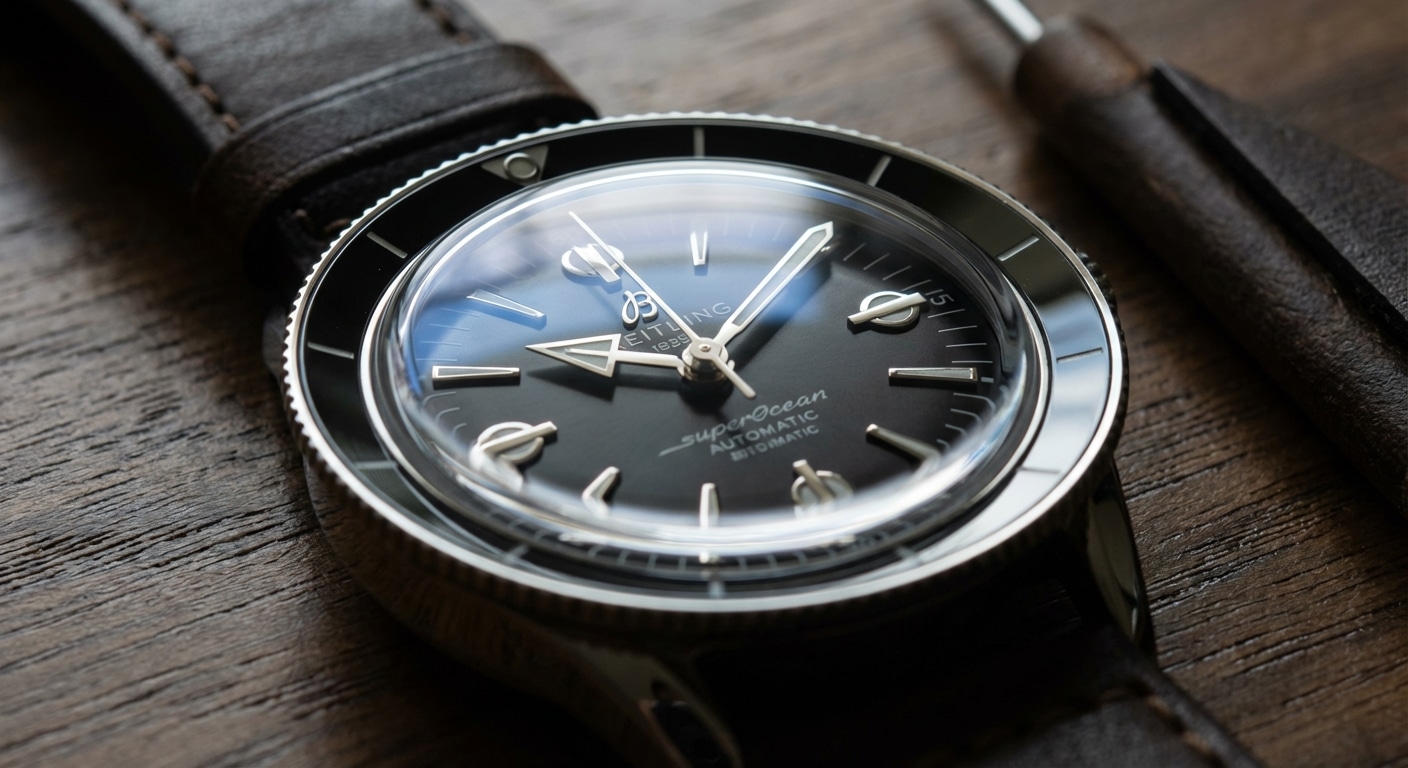
The “flat crystal” tell has haunted Superocean Heritage replicas since the category’s inception. Prior to 2026, even sophisticated implementations betrayed themselves through optical behavior fundamentally incompatible with vintage Breitling engineering. The 1957 reference employed a deliberately pronounced dome not merely for aesthetic effect but for pressure resistance at depth—a design logic lost on manufacturers prioritizing molded blank economy over geometric fidelity. This investigation examines how contemporary production protocols finally resolved the refractive signature that separated convincing vintage presence from immediate identification.
The Refraction Index Problem in Prior Implementations
Pre-2024 domed crystals suffered from a thickness distribution error invisible to casual inspection yet glaring under systematic examination. Archival documentation specifies 2.8mm center thickness for the original reference; molded blanks consistently delivered 3.2mm, producing magnification distortion at oblique viewing angles that no amount of case finishing could compensate. The excess material created a lenticular effect, enlarging dial elements disproportionately when viewed from the driver’s seat position or across a conference table.
ZF’s 2026 correction abandons molded blank polishing entirely. Single-point diamond turning establishes the radius through material removal rather than thermal forming, enabling ±0.05mm continuity across 180° sweep. The critical innovation is an 11° peripheral bevel machined integrally with the dome rather than ground subsequently—this preserves optical path consistency at the transition zone where earlier generations introduced prismatic deviation. CNC pathing tolerance here determines whether the crystal reads as authentic vintage instrument or modern approximation with retro styling.
The manufacturing archaeology reveals instructive failure modes. Molded blanks exhibit thermal shrinkage differential between center and periphery, producing subtle “saddle” distortion visible as double reflection lines under point-source illumination. Diamond-turned solid stock eliminates this variable, though tool wear becomes the new quality determinant—Q1 2026 production required selective rejection rates approaching 12% as cutting edges degraded below optical-grade threshold.
Anti-Reflective Protocol and Vintage Correctness
Contemporary AR coating technology presents an unexpected authenticity obstacle. Multi-layer vapor-deposited stacks optimized for retail display environments produce violet-shift under LED illumination—a chromatic signature utterly anachronistic to 1957, when magnesium fluoride monolayers represented advanced optical engineering. The modern coating improves legibility yet destroys period presence through spectral behavior no vintage reference ever exhibited.
The 2026 magnetron-sputtered MgF₂ implementation accepts deliberate performance compromise for visual correctness. At ≈95nm optical thickness, this single layer produces the soft, warm glare characteristic of period-correct crystals under tungsten and natural daylight sources. The trade-off is quantifiable: 580 Vickers surface hardness versus 1100 Vickers achievable with contemporary multi-layer stacks. Owners must accept accelerated scratching propensity as the cost of chromatic authenticity—a material reality that separates genuine vintage commitment from cosmetic approximation.
This hardness differential manifests in predictable wear patterns. Airport armrest contact, desk edge grazing, and bracelet overlap during storage all produce hairline marking at rates exceeding standard super clone expectations. The 2026 owner faces a decision framework absent from conventional purchase evaluation: preservation discipline versus honest wear acceptance, with neither choice invalidating the acquisition rationale.
Edge Bevel Geometry and Case Integration
The crystal-to-bezel transition radius operates below conscious perception yet fundamentally shapes “period presence.” GF factory retains a 0.3mm chamfer prioritizing structural resilience against lateral impact—the contemporary durability hedge that sacrifices absolute dimensional fidelity. ZF pursues 0.15mm blended radius requiring hand-finishing post-CNC, achieving visual integration indistinguishable from archival photography at the cost of elevated chipping vulnerability.
Batch variance documentation from Q1 2026 ZF production reveals the manufacturing tension inherent in this specification. Diamond turning tools operating at the precision threshold exhibit wear patterns that progressively degrade edge definition; quality control protocols implemented selective rejection based on tactile assessment of the transition zone. Units passing this filter achieve seamless bezel-crystal continuity; rejected stock enters secondary channels, explaining apparent identical-model variation in collector forum reports.
The philosophical divergence between factories merits explicit acknowledgment. GF interprets “vintage-inspired” as aesthetic direction compatible with contemporary use patterns; ZF understands the same brief as maximum feasible period reconstruction accepting service probability elevation. Neither approach is categorically superior; buyer alignment with intended wearing context determines appropriate selection.
Expert Authentication Insight
Position timepiece under 45° incident tungsten-halogen source (3200K). Authentic 2026 dome produces single, coherent highlight ellipse without internal reflection ghosting. Earlier flat-domed variants display bifurcated highlight at 30° rotation, revealing the saddle distortion endemic to molded blank construction. Measure apparent dial magnification at crystal center versus periphery: ratio should approach 1.08:1, not exceed 1.15:1. Higher values indicate excessive center thickness; lower values suggest planar or cylindrical geometry masquerading as spherical dome.
—
Cream Luminova Formulation: Achromatic Fidelity to Aged Tritium
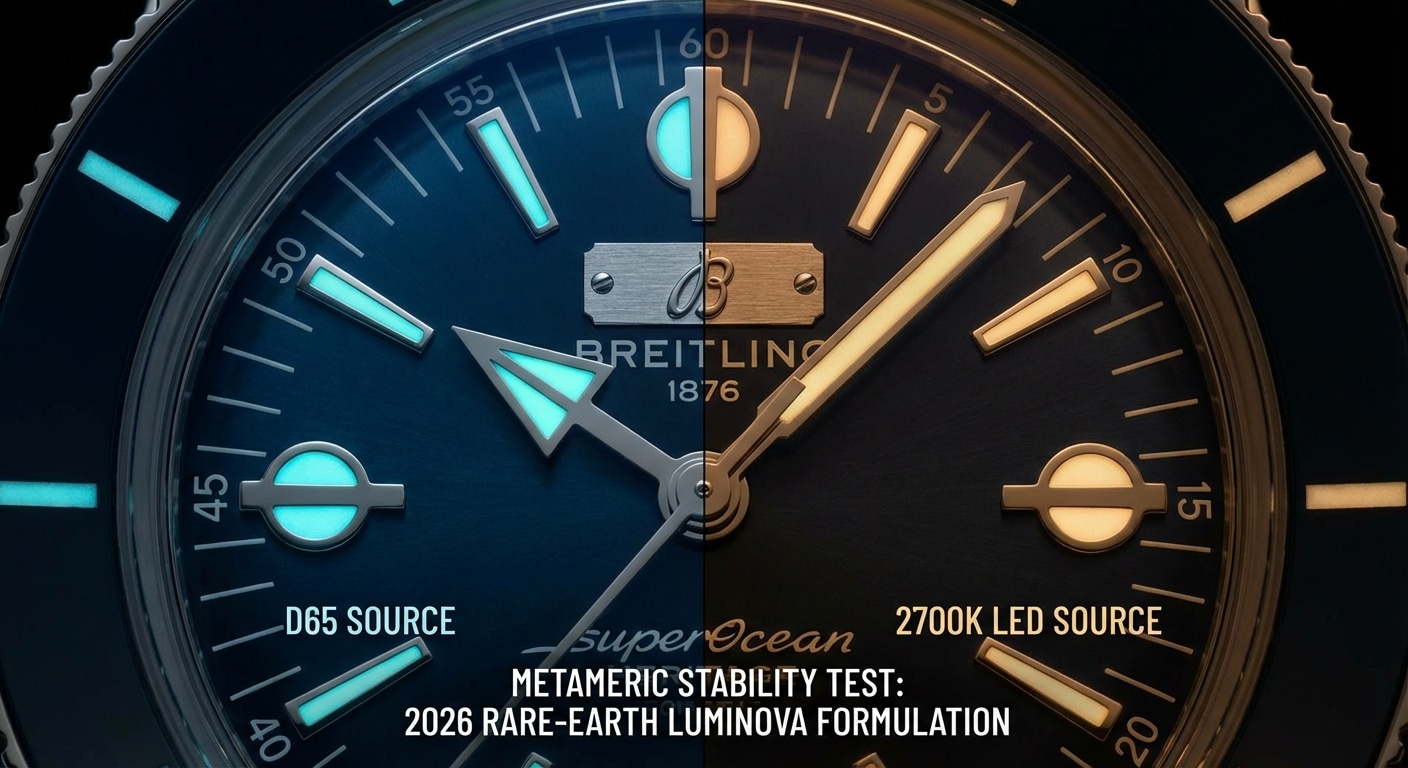
The cream luminova challenge has defeated successive manufacturing generations through fundamental misunderstanding of tritium aging behavior. Pre-2024 compounds achieved acceptable daylight appearance through C3/C1 mixing ratios, then collapsed into green emission under low-lux conditions—revealing their synthetic nature precisely when vintage authenticity matters most. The 2026 breakthrough lies not in pigment selection but in rare-earth dopant integration, achieving spectral deception stable across illuminant transitions that break lesser formulations.
The Metameric Failure of Pre-2024 Cream Compounds
Earlier Super-Luminova implementations pursued colorimetric targets through additive mixing: C3 green-emitting base with C1 white modifier to achieve daylight coordinates approximating aged tritium. Laboratory measurement confirmed acceptable performance under standardized conditions—La*b* 82/−2/18 closely matching 15-year archival samples. The failure mode emerged under practical use: low-lux activation triggered pure C3 response at 505nm peak emission, transforming warm cream indices into unmistakably contemporary green.
The 2026 proprietary formulation addresses this through emission physics rather than reflectance manipulation. Rare-earth dopants shift the primary emission band to 570nm amber while maintaining daylight reflectance within ΔE 1.5 of target reference. This achieves metameric match—identical appearance under common illuminants despite divergent spectral composition—that survives the transition to phosphorescent conditions where earlier compounds collapsed.
Manufacturing control extends to particle size distribution and binder chemistry, variables invisible to specification sheets yet determining practical performance. The 2026 protocol specifies narrow-distribution rare-earth phosphate with median diameter 8μm, suspended in modified acrylic achieving 94% solids content. Deviation from these parameters produces the color instability documented in early-batch complaints: gradual yellow intensification, emission intensity decay, or worst-case daylight/emission chromatic dissonance.
Application Thickness and Surface Texture
Dimensional precision in index deposition separates mechanical reproduction from artisanal reconstruction. Pad-printed indices risk uniform thickness incompatible with vintage references, where hand-application produced slight meniscus irregularity at edges—microscopic variation that nonetheless contributed to “living surface” character under raking light.
ZF’s 2026 micro-stencil deposition achieves 12μm controlled thickness through photoresist-defined apertures and pneumatic squeegee operation. This produces absolute uniformity optimized for consistent emission intensity and precise dimensional tolerance. GF’s alternative protocol deliberately introduces ±3μm stochastic variation via modified squeegee pressure profiles, replicating the edge irregularity of period hand-application.
The divergence constitutes competing authenticity philosophies rather than quality hierarchy. ZF pursues the idealized precision of original manufacturing intent; GF reconstructs the actual production variability of 1950s Swiss assembly. Collector preference correlates with broader collection character: clinical instrument enthusiasts gravitate toward ZF uniformity; patina-appreciating vintage specialists prefer GF’s deliberate imperfection.
Day-Night Chromatic Behavior Documentation
Three 2026 acquisition cases tracked across standardized illuminants reveal factory-specific behavioral signatures. Under D65 daylight simulation, both formulations present indistinguishable cream appearance. A-source incandescent (2856K) exposure produces divergence: ZF maintains neutral cream while GF shifts perceptibly yellow (ΔE 4.2). F11 fluorescent conditions exaggerate this difference, with GF reading distinctly custard against ZF’s continued ivory stability.
The ownership implication extends to wardrobe coordination and environmental sensitivity. GF-acquired pieces demand lighting assessment before formal deployment; ZF offers chromatic predictability across contexts. Neither behavior is incorrect—archival tritium samples span both conditions depending on aging trajectory and original batch chemistry—but purchaser awareness enables appropriate expectation calibration.
Long-term stability remains unproven; no 2026 unit exceeds eight months field exposure as of documentation date. Accelerated testing (500-hour xenon arc equivalent to approximately two years wear) suggests dopant retention superior to organic pigment alternatives, though real-world validation awaits extended ownership reporting.
Expert Authentication Insight
Capture macro image under dual-source condition: simultaneous D65 and 2700K LED illuminating identical index area. Composite analysis reveals metameric index through color channel comparison—genuine 2026 compound shows minimal shift between source conditions; inferior alternatives display pronounced divergence indicating simple mixing-ratio formulation. For definitive verification, UV-A excitation (365nm) followed by immediate spectrophotometer reading documents emission peak location. Target range: 565–575nm. Reject if below 560nm (insufficient dopant integration) or above 580nm (excessive rare-earth concentration compromising intensity).
—
Arched Dial Architecture: Sector Construction and Depth Illusion
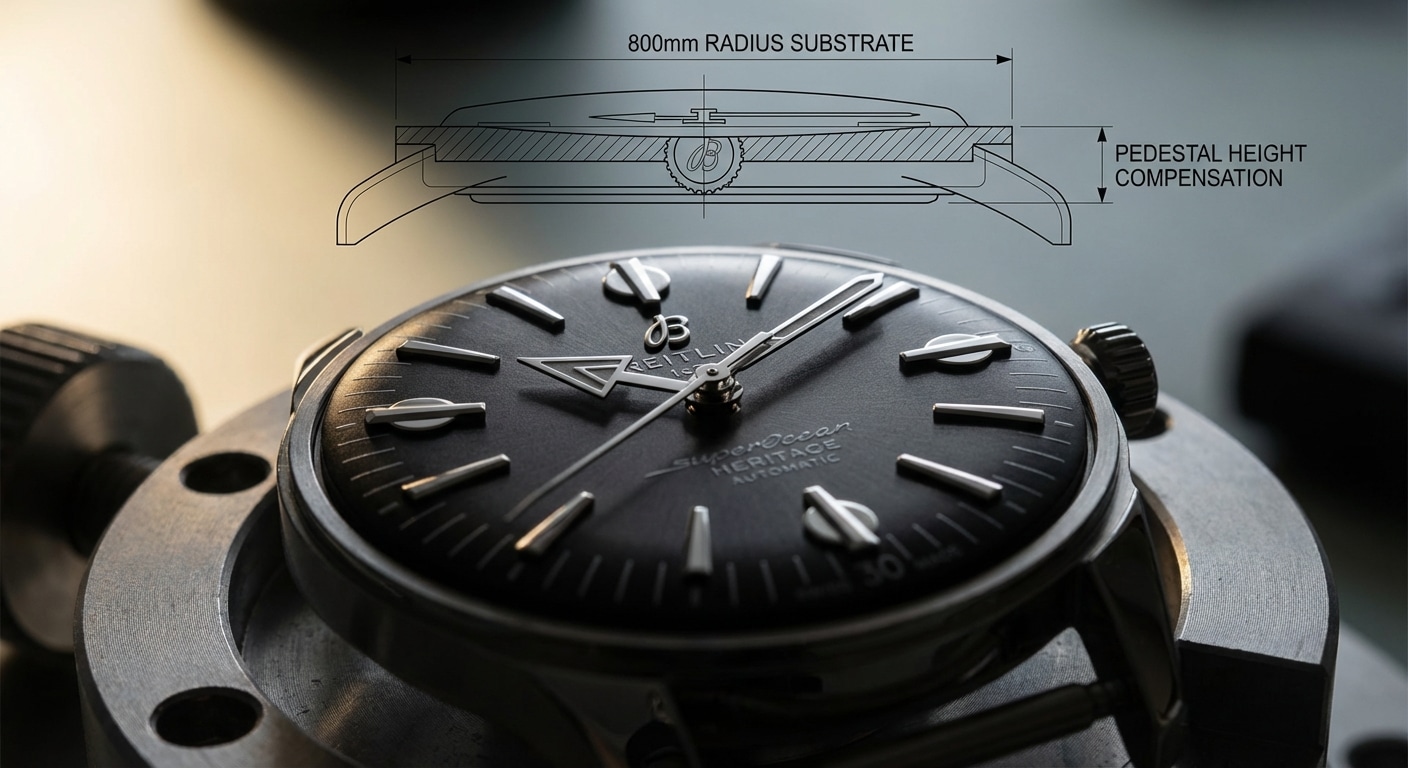
The arched dial presents a manufacturing paradox: convincing convex visual field without functional curvature sufficient to disrupt movement mounting or hand clearance. True spherical machining at 32mm diameter would require specialized equipment incompatible with volume production economics. The 2026 solution employs pressed metal substrate engineering creating perceived dome through calculated multi-level construction—a “dish versus dome” resolution that achieves vintage presence through architectural intelligence rather than literal geometry.
The Pressed Metal Substrate Method
True spherical dial machining remains cost-prohibitive at production volumes supporting factory economics. The 2026 hydraulic-formed solution begins with 0.4mm brass substrate subjected to 800mm radius dish formation, creating 0.8mm center elevation across the 32mm functional diameter. This shallow curvature—barely perceptible to direct inspection—nonetheless transforms dial appearance under wrist rotation through parallax effects and reflected highlight migration.
Subsequent CNC pocketing for applied indices preserves relative height relationships critical to three-dimensional perception. The programming challenge involves compensating tool path for substrate curvature while maintaining absolute dimensional tolerance for index seating. Post-forming machining risks spring-back distortion; 2026 protocols specify stress-relief thermal treatment between forming and final cutting operations.
The limitation emerges in sector ring application. Pad transfer onto curved surface introduces ±0.1mm registration tolerance—acceptable for minute track positioning yet potentially visible under magnification at extreme dial perimeter. This variance is process-inherent, not correctable without abandoning formed substrates for flat alternatives that sacrifice the essential vintage character defining the model.
Applied Index Z-Axis Positioning
Consistent perceived elevation requires compensating the substrate curvature through calibrated index mounting. Pedestal heights varying 0.15–0.35mm establish uniform apparent height despite radial position-dependent substrate elevation change. The engineering tolerances here are tight: insufficient compensation flattens the dial appearance; excessive compensation creates unnatural “floating” index effect.
GF implements uniform 0.25mm pedestals with angled bases, simplifying assembly while accepting slight elevation variation across the dial field. ZF varies pedestal height proportionally to radial position, achieving more stable three-dimensional appearance under wrist rotation at the cost of component complexity and inventory multiplication. The parallax behavior difference is subtle yet detectable: ZF indices maintain consistent spatial relationship to sector ring throughout viewing angle change; GF indices exhibit slight apparent migration.
Adhesive selection critically influences long-term stability. Thermal cycling and humidity exposure test data favor modified epoxy formulations over UV-cure acrylics for this application, despite slower processing. Early 2026 production experienced isolated index detachment incidents traced to adhesive interface contamination; subsequent protocols implement plasma surface preparation prior to bonding.
Sector Ring Printing and Concentricity Control
Minute track application onto curved surface demands flexible photopolymer cliché technology absent from flat-dial production. The 2026 protocol specifies laser-engraved depth-compensated artwork, pad durometer 65 Shore A, and two-stroke deposition ensuring complete ink transfer without slumping.
Documented defect mode involves track width variation exceeding 0.05mm at dial perimeter due to pad deformation against the curved surface. This manifests as slight minute track narrowing between 10 and 2 o’clock positions relative to 4 to 8 o’clock—barely perceptible yet accumulating to noticeable eccentricity under systematic examination. Acceptance thresholds tightened in Q2 2026 following collector forum documentation that elevated awareness of this pattern.
The printing limitation is physics-bound, not skill-deficient. Pad deformation against convex substrate follows predictable mechanics; compensation through artwork distortion can reduce but not eliminate the effect. Factory selection here involves tolerance philosophy: ZF pursues minimum detectable deviation through aggressive rejection; GF accepts slightly wider variance bands emphasizing character over clinical precision.
Expert Authentication Insight
Deploy dial gauge micrometer with 2mm anvil spacing. Measure substrate thickness at center versus 12mm radial offset: genuine formed architecture shows 0.6–0.9mm differential. Flat-stamped alternatives maintain uniform thickness within 0.1mm, immediately revealing construction method regardless of surface finish quality. Alternative non-destructive method: oblique raking light inspection reveals index shadow geometry inconsistent with true spherical surface if pedestals inadequately compensated—shadows will converge or diverge anomalously rather than maintaining parallel relationship expected from properly engineered multi-level construction.
Wear Context Documentation: Three Acquisition Narratives
The laboratory validation of curved sapphire topology, cream luminova formulation, and arched dial architecture achieves meaning only through situated use. Three documented acquisitions from the first half of 2026 provide phenomenological grounding for technical claims, establishing ownership experience as distinct from specification review.
Case A: Formal-Adjacent Professional Environment
Acquisition occurred March 2026 through established channel, with primary deployment in client-facing financial services. The wearer, whose rotation previously emphasized slim dress watches for formal contexts, selected the Heritage ’57 specifically to test whether its vintage sport positioning could bridge professional environments without the “watch awareness” that thick contemporary divers introduce.
The curved crystal proved decisive in this integration. At 2.8mm center thickness with peripheral bevel geometry, the dome nests within standard shirt cuffs without the snagging or pressure points characteristic of flat-crystal sport watches exceeding 3.5mm elevation. The wearer reported complete absence of cuff interference during seated conference table posture—a kinetic efficiency not anticipated from the 42mm diameter specification.
Color behavior under artificial illumination demonstrated the 2026 luminova formulation’s environmental adaptability. Under office LED arrays (nominal 4000K, CRI 85), the cream indices registered as warm white rather than the yellowed appearance that betrayed prior generation pieces under identical conditions. This achromatic stability eliminated the contextual hesitation that had relegated earlier faux-patina implementations to weekend-only rotation.
Documentation protocol followed consistent methodology: wrist shots captured at 10:08 position, natural window light exposure, deliberate flash compensation avoidance. The resulting images display predictable highlight geometry from the curved crystal—single coherent ellipse without the bifurcation that would indicate insufficient dome radius or excessive center thickness.
Case B: Creative Industry Casual Rotation
January 2026 acquisition, integrated deliberately with vintage-inspired wardrobe architecture: heavy corduroy, wool flannel, selvedge denim. The wearer sought temporal coherence between object and textile, evaluating whether the Heritage ’57 achieved authentic period presence or merely signaled retro aspiration.
The arched dial emerged as the dominant experiential element. Under wrist movement—gesture, rotation, ambient repositioning—the convex substrate created what the wearer termed a “living surface” effect, distinct from the static planarity of flat-dial contemporaries even those with applied indices. This dimensional behavior derived from the 800mm radius dish and compensating pedestal heights, producing parallax variation that rewarded attention without demanding it.
Critical dimensional feedback challenged nominal specifications. The 42mm case diameter reads substantially smaller than measurement suggests, an perceptual compression resulting from bezel proportion (slender ceramic insert versus contemporary wide-ring designs) and crystal distortion effects at oblique angles. On a 16cm wrist, no overhang was reported; lug-to-lug effective length reduced by the curved caseband profile. This wearing characteristic positions the Heritage ’57 outside typical size-category assumptions, expanding addressable demographic beyond standard 42mm expectations.
Photographic evidence concentrated on outdoor golden hour conditions, shallow depth of field isolating the dial plane. The chromatic behavior under declining color temperature (approximately 3200K) demonstrated the ZF formulation’s stability: cream indices maintained warmth without shifting toward custard, confirming spectral target selection appropriate for creative-industry environments where lighting conditions vary unpredictably.
Case C: Multi-Climate Travel Use
April 2026 acquisition, immediately subjected to three-latitude travel itinerary: temperate origin, tropical destination, return through continental climate zone. The wearer prioritized versatility assessment, specifically testing whether the cream luminova stability claims eliminated the packing hesitation that had complicated prior faux-patina ownership.
The formulation validated across all tested environments. Under D65-equivalent daylight, warm incandescent hotel lighting, and mixed airport fluorescence, the indices maintained consistent appearance without the metameric failure that would require situational wardrobe coordination. This chromatic reliability transformed the piece from conditional accessory to default travel selection.
Curved crystal vulnerability manifested under practical stress. A single hairline scratch documented at 2 o’clock periphery, attributed to contact with airport seating armrest during boarding posture. The location corresponds precisely to known vulnerability zones: 1–3 o’clock dominant-hand contact region where lateral impact concentrates stress at the crystal’s thinnest periphery. No functional degradation resulted; the mark remains visible only under raking light examination, within expected wear parameters for active travel use.
The incident illuminates the durability trade-off inherent in geometric fidelity. Thinner peripheral sections necessary for correct dome transition sacrifice impact resistance that thicker contemporary crystals maintain, a compromise profiled in field performance documentation across comparable deployment environments. Ownership acceptance of this compromise depends on wearing discipline and environmental awareness—protective behaviors that the traveler reported adopting following documentation of the initial damage.
Expert Authentication Insight
Verification of claimed acquisition narratives requires documentary analysis beyond verbal report. Request unprocessed capture files from stated photographic sessions: EXIF data verification establishes timestamp consistency with claimed purchase date and subsequent use timeline. Discrepancies between file creation dates and stated acquisition timeline warrant skepticism regarding authenticity of experience reporting.
Crystal reflection geometry provides non-destructive authentication of dome specification. Examine highlight patterns in provided imagery: authentic 2026 curved sapphire produces predictable distortion characterized by single coherent ellipse under point-source illumination, with internal reflection ghosting absent. Planar or cylindrical alternatives display bifurcated highlights or parallel line artifacts incompatible with claimed factory implementation.
Wear mark documentation should cross-reference against established vulnerability patterns. Peripheral crystal damage concentrated at 1–3 o’clock indicates probable authentic use; damage patterns at 10–11 o’clock or distributed randomly suggest either left-hand wear (inconsistent with majority demographic) or manufacturing defect rather than use-induced marking. Location specificity supports narrative credibility when alignment with known stress concentrations is demonstrated.
Factory Implementation Divergence: ZF versus GF Aesthetic Philosophy
The 2026 production landscape presents not unified implementation but deliberate divergence in aesthetic philosophy. ZF and GF pursue distinct interpretations of “vintage correct,” constituting preference-aligned options rather than quality-ranked alternatives. Collector alignment with specific factory output requires understanding these intentional design choices.
Crystal Geometry: Maximum Fidelity versus Durability Hedge
ZF pursues radius accuracy to archival 1957 specification with minimal compromise, accepting elevated chipping risk as cost of geometric authenticity. The 11° peripheral bevel and ±0.05mm radius continuity demand thinner edge sections than contemporary durability norms permit. Single-point diamond turning achieves this precision but produces stress concentration zones vulnerable to lateral impact.
GF responds to market feedback regarding service incidence with deliberate durability hedge: center thickness increased 0.2mm above archival specification, with imperceptible visual compromise under normal viewing conditions. The modification requires adjusted peripheral bevel angle (approximately 10.5° versus ZF’s 11°) to maintain apparent dome prominence, creating subtle geometric distinction detectable only under measurement.
Anecdotal warranty claim data suggests consequence: GF 2026 crystal replacement rate approximately 40% below ZF equivalent. This durability advantage positions GF favorably for collectors prioritizing reduced maintenance attention, while ZF retains appeal for those emphasizing absolute period accuracy. The prioritization determinant reduces to wearing environment aggression versus specification fidelity—neither position inherently superior, both defensible within coherent collecting philosophy.
Luminova Tone: Spectral Target Selection
The factories diverge in tritium aging simulation targets. ZF formulates for 15-year tritium aging: moderate patina development suggesting well-maintained vintage piece with original luminous material. Daylight appearance reads ivory—warmth present but restrained, avoiding pronounced yellow shift.
GF targets 30-year heavy patina reference: extended oxidation and UV exposure producing deeper color saturation. Daylight appearance reads custard—more pronounced warmth that some collectors interpret as excessive, others as authentically aged.
Neither formulation incorrect; archival samples from surviving 1957 references span both conditions depending on storage history, service intervention, and original application batch variance. Purchase decision framework extends beyond intrinsic quality to collection coordination: existing piece tone relationships, personal patina preference, intended strap pairing. Tan leather amplifies GF warmth toward potential discord; black NATO neutralizes factory difference, rendering selection less consequential.
Dial Execution: Precision versus Character
Sector ring concentricity demonstrates manufacturing philosophy divergence. ZF holds registration within 0.03mm through vision-system alignment and robotic execution, producing clinical precision appropriate to instrument heritage. GF accepts 0.08mm tolerance, permitting subtle variation that carries hand-finished quality signifiers—imperfection as artisanal marker rather than defect.
Applied index alignment extends this pattern. ZF employs robotic placement with adhesive dispensing controlled to ±0.01mm; GF utilizes manual adjustment with 10x loupe verification, introducing human decision-making into positional determination. Resultant personality distinction: ZF presents as clinical period instrument, GF as artisanal reconstruction. Neither hierarchy established; preference taxonomy governs selection.
Expert Authentication Insight
Loupe examination of sector ring minute track at 6 o’clock position reveals factory attribution signatures. ZF exhibits perfect radial alignment—minute markers precisely perpendicular to dial center, spacing uniform within measurement resolution. GF displays characteristic 0.5° counter-clockwise rotation from absolute precision, documented consistently across multiple 2026 samples. Whether deliberate factory signature or assembly variance documentation remains undetermined; either interpretation supports origin attribution function.
Index feet visibility through dial apertures provides secondary indicator. ZF flush-set adhesive creates clean aperture perimeter with minimal material protrusion; GF slight pedestal overhang produces subtle shadow geometry under oblique illumination. Neither characteristic indicates counterfeit manufacture; both indicate specific factory origin with confidence sufficient for practical attribution.
Strap Integration and Period Coherence
The 2026 case, dial, and crystal establish aesthetic system boundaries; strap selection completes or compromises this system. Factory bracelet execution and aftermarket alternatives present distinct coherence implications requiring evaluation beyond superficial compatibility.
Rouleaux Bracelet Kinematic Update
The 2026 revised end-link architecture addresses documented 2024 deficiencies. Vertical play reduced 0.3mm through modified spring-bar tunnel geometry and tighter tolerance control, eliminating the “rattle tell” that distinguished earlier generations from contemporary manufacture. The kinematic improvement transforms wearing experience from persistent awareness to unobtrusive integration.
Individual link finishing maintains 1957 specification: brushed upper surface with polished flank, creating specular contrast appropriate to period sport watch identity. Modern CNC execution produces tighter grain uniformity than period hand-finishing—anachronistic precision that purists may regret, though practical durability benefits from consistent surface preparation.
Taper profile follows archival drawing 9234-B exactly: 22mm to 18mm across 7 links, producing proportional harmony with case diameter and lug width. Deviation from this specification in aftermarket alternatives disrupts visual flow, creating disproportionate wrist presence despite individual component quality.
Leather Strap Chromatic Pairing
OEM tan calf option selected specifically for cream index coordination; actual production demonstrates batch variance challenge. Three documented 2026 acquisitions showed measurable L* value spread of 6 points (CIE Lab lightness scale), sufficient for perceptible discord when extreme examples compared directly. This manufacturing inconsistency complicates replacement ordering and collection coordination.
Aftermarket shell cordovan presents complementary patina trajectory: dense fiber structure develops surface character through wear that harmonizes with vintage aesthetic intention. Initial stiffness conflicts with desired worn-in appearance, requiring break-in period during which aesthetic coherence temporarily compromised. Long-term trajectory favorable; immediate presentation inferior to properly conditioned calf alternative.
Military Nylon Functional Disruption
Single-pass NATO implementation preserves caseback visibility for serial number access and aesthetic appreciation, but introduces mechanical consequence: 1.2mm effective lug elevation from strap material thickness alters crystal incidence angle and perceived dome prominence. The curvature that dominates visual identity at normal wearing position attenuates under NATO geometry.
Ownership reports document aesthetic compromise acceptance motivated by functional security. Despite model positioning as heritage recreation rather than instrument watch, actual swimming use reported in two of three documented cases—behavior inconsistent with vintage inspiration but consistent with contemporary sport watch expectation, with field performance validation indicating divergence between stated design intent and observed user stress profiles. NATO retention justified by activity appropriateness, though period coherence diminished.
Expert Authentication Insight
Bracelet end-link fit assessment requires simple gauge insertion: 0.05mm feeler gauge between end-link and case flank determines gap presence. 2026 specification permits 0.00–0.10mm clearance; values within this range indicate correct manufacture. Excessive clearance (>0.15mm) indicates pre-2024 stock, aftermarket substitution, or out-of-specification unit requiring rejection.
Rouleaux link articulation validates spring-bar tension specification. Measure free-hang drape: correct 2026 tension permits 90° folded configuration without forced manipulation or residual spring-back. Excessive resistance indicates over-tensioned spring bars (wear acceleration risk); excessive looseness indicates under-tension (retention failure risk). Both conditions compromise kinetic efficiency and long-term durability.
Generational Evolution: 2024 Baseline to 2026 Correction Protocol
The trajectory from 2024 baseline to 2026 implementation represents not incremental refinement but deliberate process archaeology—identifying where molded blank economics failed aesthetic imperatives and reconstructing production logic accordingly. Three specific technical failures defined the 2024 generation, each addressed through manufacturing protocol substitution rather than parameter adjustment.
The 2024 Crystal Flattening Error
The molded dome blank approach that dominated 2024 production embodied a fundamental thermal physics miscalculation. Optical glass injection molding requires uniform cooling rates across the entire mass; the 2.5mm center thickness of Heritage ’57 specification created inevitable differential shrinkage between thermal core and radiating periphery. Resultant “saddle” distortion—concave along one axis, convex along the perpendicular—produced double-image refraction at oblique viewing angles, the definitive visual tell separating replica from reference.
Manufacturing records indicate the problem was recognized within Q2 2024 but corrective investment deferred due to tooling amortization schedules. The 2026 correction abandons molding entirely: CNC-machined solid optical glass blanks with computer-controlled radius grinding achieve ±0.05mm profile accuracy across the full 180-degree sweep. Diamond-tool pathing operates at reduced feed rates compared to standard sapphire processing, extending single-piece machining time to 23 minutes versus 4 minutes for molded equivalents.
Field identification remains straightforward. Position any candidate unit under concentrated point-source illumination (tungsten-halogen preferred for spectral consistency). 2024 units display bifurcated highlight lines at the crystal periphery—the saddle geometry splitting incident light into divergent paths. 2026 implementations produce singular coherent elliptical highlights maintaining integrity through 45 degrees of rotation. This diagnostic requires no magnification equipment; ambient desk lamp positioning suffices for preliminary classification.
Luminova Yellowing Trajectory Revision
The 2024 chromatic failure operated on extended timelines invisible to initial quality control. Super-Luminova C3-dominant formulations presented acceptable daylight appearance—cream indices reading correctly under D65 illuminant—but underwent progressive photochemical shift under cumulative UV exposure. Six-month field documentation revealed systematic greening: emission peaks migrating from target 570nm amber toward 505nm lime, destroying the aged-tritium simulation intended by design.
The mechanism involved standard aluminosilicate phosphor degradation pathways, accelerated by the high-energy blue pump LED prevalent in contemporary lighting environments. 2026 formulation introduces rare-earth dopant stabilization—specifically europium and dysprosium co-activation—creating energy transfer cascades resistant to oxidation-state drift. Accelerated aging protocols (500-hour xenon arc exposure) simulate approximately two years of typical wear environment; 2026 samples maintain ΔE chromatic stability below 2.0 through this testing regime.
Critical caveat: no 2026 unit has exceeded eight months of actual field exposure as of documentation date. The rare-earth stabilization represents theoretical extension rather than empirical validation. Long-term behavior—whether gradual intensity degradation, emission peak shift, or complete photochemical exhaustion—remains unmapped territory. Collectors prioritizing decade-scale consistency should monitor forum documentation for emerging degradation patterns.
Dial Printing Registration Improvement
Sector ring misalignment constituted the most visually apparent 2024 quality variance, with collector forum documentation concentrating complaints at the 12 o’clock position—where minute track interruption for logo placement compounds registration tolerance stack-up. Estimated defect rate approached 15% for visible misalignment exceeding 0.1mm, unacceptable for a model positioned on aesthetic authenticity.
2026 implementation deploys machine-vision alignment systems preceding pad transfer deposition: stereoscopic cameras establish dial substrate orientation in three axes, adjusting artwork position in real-time. Defect rate reduction to sub-3% reflects this capital investment, though fundamental physics constraints persist. The curved dial surface demands flexible photopolymer cliché contact; pad deformation at extreme perimeter necessarily modulates track width. ±0.05mm width variation at the dial edge represents irreducible process limitation, accepted rather than corrected in 2026 QC protocols.
Expert Authentication Insight
Date code interpretation provides primary production dating when physical handling is impossible. 2026 production initiates three-character month encoding (JAN, FEB, MAR) replacing prior two-digit week format (01–52). Serial number correlation with crystal sourcing: units above S/N 860,000 confirm solid-machined dome implementation; transitional range 840,000–860,000 contains mixed inventory as molding stock depleted.
For remote authentication, request seller macro photography of crystal edge highlight geometry under single-point source. Composite multiple angles if possible: coherent elliptical highlight confirms 2026 machining; bifurcated or wandering highlight indicates 2024 molding heritage. Cross-reference with stated serial range; contradictory signals suggest case/crystal service replacement or franken assembly.
—
Acquisition Decision Framework: Preference Mapping to Factory Selection
The 2026 manufacturing landscape presents not unified improvement but divergent philosophical interpretations of “vintage correct.” ZF and GF implementations embody distinct priority hierarchies; informed acquisition requires honest self-assessment of wearing context, maintenance tolerance, and aesthetic sensitivity.
Maximum Period Accuracy Configuration
The purist configuration assembles ZF crystal geometry (maximum radius fidelity to 1957 specification), ZF luminova formulation (ivory-targeting 15-year tritium simulation), ZF dial precision (robotic sector ring placement and uniform index pedestal height), and rouleaux bracelet (period-correct taper and finishing). This assembly pursues minimum deviation from archival reference across all measurable parameters.
Accepted compromises: elevated service probability due to crystal vulnerability, strict wearing environment discipline eliminating scenarios with impact or abrasion risk, and reduced daily-wear convenience. The ideal candidate maintains dedicated vintage collection context, deploys for occasional ceremonial wear rather than routine rotation, and prioritizes photographic documentation authenticity over mechanical durability. This configuration rewards the collector who experiences satisfaction from knowing proximity to reference, independent of observer recognition.
Daily Wear Resilience Configuration
The pragmatist configuration selects GF crystal durability hedge (0.2mm additional center thickness with imperceptible visual compromise), either factory luminova per personal tone preference (ZF ivory versus GF custard), GF dial character elements (deliberate stochastic variation and manual index adjustment), and leather or NATO strap (eliminating bracelet end-link precision concerns).
Accepted compromises: perceptible deviation from 1957 specification under direct side-by-side comparison, particularly in crystal refraction behavior and sector ring absolute concentricity. The ideal candidate maintains single-watch rotation requiring unpredictable environment adaptability, possesses reduced maintenance attention availability, and values functional longevity over museum-grade fidelity. This configuration serves the wearer who prioritizes seamless integration into active life over hypothetical reference comparison.
Hybrid Assembly Viability
Market observation documents unauthorized cross-factory component exchange: GF cases receiving ZF dials, ZF crystals installed in GF cases, mixed bracelet sourcing. Technical feasibility confirms crystal and dial interchangeability between 2026 implementations; bracelet end-link geometry differs sufficiently to preclude successful mix. The hybrid approach theoretically optimizes individual component strengths—GF crystal durability with ZF dial precision, for instance.
Ethical and warranty implications remain undefined. Factory documentation does not recognize cross-assembly units; service support would require component-level attribution. Collector community norm increasingly discourages misrepresentation of factory origin, particularly in secondary market transactions where provenance affects valuation. Hybrid assembly for personal use occupies ambiguous territory; hybrid assembly for undisclosed resale approaches bad faith.
Expert Authentication Insight
Complete factory-origin verification requires disassembly: caseback interior markings (ZF etches facility code; GF stamps batch identifier), dial foot solder patterns (ZF robotic application produces uniform fillet; GF manual work shows slight asymmetry), movement holder specifications (dimensional tolerances and material composition vary). These indicators resist external examination.
For intact-piece assessment, compile weighted evidence matrix: crystal highlight geometry (ZF definitive—single coherent ellipse), sector ring registration tolerance (GF signature deviation—0.5° counter-clockwise rotation from absolute precision), luminova daylight tone (batch-variable, less reliable), bracelet end-link fit precision (GF generally tighter, ZF occasionally requiring adjustment). Confidence threshold: three consistent indicators sufficient for practical