
This article delivers a component-level factory comparison for the Patrimony 85180 ultra-thin reference, addressing the specific production challenges that separate competent replication from compromised output. The genuine 8.55mm case thickness demands manufacturing precision that most factories cannot sustain across production batches, making this reference a reliable indicator of true factory capability. What follows is an engineering-grounded assessment of MKS and TW versions across dial execution, case geometry, movement integration, and value positioning—structured to produce an actionable purchase decision rather than abstract quality claims.
Why the 85180 Ultra-Thin Is a Factory Stress Test
The 8.55mm Thickness Challenge — What Ultra-Thin Demands from Replication
The Patrimony 85180 replica is slim for an automatic dress watch, but its genuine case target is 8.55mm, not the thinner figure associated with the manual-winding 81180. Replication still depends on disciplined integration of the movement, caseback, crystal, dial, and hand stack. Small dimensional deviations accumulate quickly and can make the case look heavy or flatten the concave side profile.
Case machining tolerances compound this challenge at every interface point. The case middle must maintain uniform wall thickness around its circumference while achieving the concave side profile that defines Patrimony aesthetics—any deviation toward parallel walls destroys the visual identity regardless of other execution quality. Factories lacking five-axis CNC capability or substituting hand-finishing for precision machining cannot achieve the sub-0.1mm wall thickness consistency this profile demands. The 8.55mm case thickness specification thus functions as a pass-fail gate: factories either possess the equipment and process control to hit the target, or they produce pieces that announce their origin through dimensional compromise.
Why 85180 Exposes Assembly Discipline More Than Thicker References
Assembly discipline separates batch-consistent factories from those producing lottery-ticket quality, and the 85180’s minimal internal clearance amplifies this distinction into easily observable outcomes. Movement seating requires positioning the calibre within 0.15mm of center—displacement beyond this threshold causes the seconds hand to describe an ellipse rather than a circle, visible to any attentive observer without magnification. The dial feet must engage their mounting points precisely perpendicular to the movement plate; angular deviation creates dial tilt that manifests as uneven chapter ring margin, particularly noticeable where the minute track approaches the case edge between 3 and 4 o’clock.
Hand fitting presents the most demanding assembly checkpoint on this reference. The genuine Calibre 1120 positions its center wheel axis with sub-micron precision, allowing fitted hands to clear the dial surface by approximately 0.08mm while maintaining consistent hour-minute register across the full rotation. Replica movements using modified Miyota 9015 or clone 1120 calibres rarely achieve this axial precision, forcing assemblers to either accept occasional hand-dial contact or fit hands at excessive height—the latter creating a floating appearance that experienced collectors identify immediately. The mechanical implication is that 85180 assembly requires skilled technicians working slowly, a labor investment inconsistent with high-volume production economics.
Critical Tolerance Points That Separate Competent from Inconsistent Production
Four specific checkpoints expose factory capability gaps with diagnostic reliability on the Patrimony 85180 replica. First, crown tube alignment must position the crown stem exactly perpendicular to the case side, with tube protrusion limited to 0.4-0.6mm—excessive protrusion indicates case machining that failed to achieve design depth, while insufficient protrusion suggests aftermarket case modification to reduce thickness. Second, crystal gasket compression must achieve water resistance without adding visible height; factories substituting thicker gaskets to compensate for imprecise crystal dimensions add 0.2-0.4mm to total case height, directly measurable against the stated 8.55mm specification.
Third, caseback threading engagement determines both thickness and long-term reliability. Proper design achieves full thread engagement within 4.5 turns of rotation; fewer turns indicate either shallow case threads (assembly will loosen) or excessive caseback thickness (total height exceeds specification). Fourth, the dial-to-crystal clearance must remain constant across the dial surface—measuring less than 0.5mm at center while maintaining at least 0.3mm at the perimeter. Concave dial seating, a common error when movement height forces compression, creates visible distortion of the sunburst pattern when viewing at oblique angles. These four checkpoints, all measurable from QC photographs with appropriate reference objects, separate factories maintaining genuine ultra-thin geometry from those compromising the core product proposition.
How to Use Case Thickness Measurement as Factory QC Indicator
Request QC photographs showing the watch profile against a precision rule or caliper jaw, with the tool positioned at the case middle rather than the crystal apex or caseback protrusion. Use the image to compare the delivered watch with the seller’s stated measurement and the genuine 8.55mm reference, while allowing for perspective distortion in photographs. Ask the seller to confirm the measured thickness in writing when the profile appears materially larger than advertised.
MKS Factory 85180 Version — Execution Assessment
![[IMAGE: MKS Patrimony 85180 dial macro showing sunburst pattern and applied index registration under raking light]](https://www.cleanvsfactory.com/wp-content/uploads/2026/02/image-5-1024x546.png)
MKS 85180 Dial Execution — Sunburst Pattern and Index Application
MKS production achieves sunburst depth through multi-layer lacquer application rather than mechanical stamping, yielding radial consistency that reaches approximately 75-80% of genuine visual intensity under static viewing conditions. The pattern originates from a central pin and radiates cleanly to the chapter ring, but groove depth measures only 0.08-0.12mm compared to the genuine’s 0.18-0.22mm range—this shallower relief causes the sunburst to flatten under oblique lighting, reducing the dynamic light play that defines Patrimony dial character. Print sharpness on the “Vacheron Constantin” signature and “Genève” designation remains acceptable with clean serif edges at 10x magnification, though occasional ink bleed appears in early 2025 batches when factories rushed drying cycles.
Applied indices use adhesive mounting rather than the genuine’s pin-set system, resulting in marker height of 0.6-0.8mm versus the authentic 1.0mm+ profile. This mechanical shortcut creates two observable outcomes: first, marker edges show micro-chipping risk during transport due to adhesive shear; second, alignment tolerance hovers at ±0.20-0.25mm across the dial circumference—most evident between 11 and 1 o’clock positions where spacing can appear compressed relative to the reference. The engineering constraint here is cost-driven assembly speed; MKS prioritizes volume over individual marker placement verification, making dial execution the most batch-sensitive aspect of their MKS Patrimony 85180 output.
MKS Case Profile — Ultra-Thin Geometry and Lug Proportions
The MKS case reaches 9.0 mm total thickness by accommodating a 4.2 mm modified Sea-Gull ST18 movement platform, leaving a visible proportion deviation from the genuine 8.55 mm reference that alters the slim silhouette under cuff as quantified in the MKS dress-watch case engineering and thickness deviation analysis; side curvature follows the correct concave arc with acceptable uniformity, but wall thickness consistency varies ±0.15 mm around the mid-case—this tolerance exposure manifests as slight flattening on the 9–3 axis in approximately 15% of measured units—while lug taper achieves the required 20 mm to 16 mm progression, yet drilling height variance up to 0.4 mm between opposing lugs produces asymmetric strap seating angles when viewed in profile.
Polishing grade on MKS cases reaches 70-75% of genuine saturation, with mirror surfaces showing minor orange-peel texture under strong directional light. The mechanical implication is that MKS relies on 316L steel with standard machining feeds rather than the slower passes required for distortion-free ultra-thin geometry—resulting in bezel step occasional distortion where the case middle meets the sapphire. Despite these compromises, the overall silhouette retains Patrimony identity better than thicker dress watch replications, positioning MKS factory Vacheron execution as competent value engineering rather than precision replication.
MKS Movement Configuration — Clone 1120 Integration and Visibility
MKS integrates a modified Sea-Gull ST18 calibre decorated to approximate Calibre 1120 aesthetics, maintaining 4.2mm height that dictates the 9.0mm case dimension. Rotor decoration features perlage and a 22k gold-plated medallion engraved with Maltese cross motif, achieving visual density comparable to genuine when viewed through solid caseback engraving—MKS opts for closed caseback construction on this reference, eliminating sapphire tint concerns but also movement visibility. Balance frequency operates at 21,600 vph with power reserve measuring 40 hours when new, decaying to approximately 34 hours after three years of typical use.
Decoration quality includes Côtes de Genève striping executed via chemical etching rather than mechanical application, producing straight lines but lacking the genuine’s hand-finished edge breaking. Reliability signals remain positive for the price point: beat error typically below 2.5ms on timegrapher readings from recent batches, with amplitude reaching 270-290° in dial-up position. The engineering trade-off is clear—MKS VC replica movement prioritizes service accessibility using widely available Sea-Gull parts over visual authenticity of a true clone 1120, making it the practical choice where long-term maintenance outweighs display-back appeal.
MKS 85180 Known Batch Variance Issues
Batch variance in MKS Patrimony 85180 production manifests primarily in three areas that trace directly to assembly process control. Dial color temperature shows warm tone deviation in approximately 20% of units from mid-2025 production, resulting from lacquer batch inconsistencies that shift the opaline base toward yellowish undertones under neutral lighting. Crystal seating exhibits occasional high spots where gasket compression proves uneven, creating visible air gaps or refractive distortion at dial perimeter—most detectable between 4 and 8 o’clock positions.
Crown alignment and engraving softness represent the third common deviation: stem centering tolerance allows up to 0.3mm offset in problematic batches, while Maltese cross logo engraving depth measures only 0.05mm versus the required 0.12mm minimum. These inconsistencies stem from MKS high-volume production methodology that sacrifices individual component verification for throughput—making comprehensive QC photography essential when sourcing this reference.
MKS 85180 QC Photo Checklist — 5 Points to Verify Before GL
Request these five specific photographs under consistent neutral lighting: first, dial macro at 2 o’clock position showing index alignment and spacing relative to chapter ring; second, true side profile against precision rule measuring case middle thickness (target 8.9-9.1mm); third, crown face straight-on at 10x magnification verifying logo centering and engraving sharpness; fourth, caseback perimeter shot confirming movement positioning and rotor clearance; fifth, lug-to-case transition from 45° angle revealing brushing uniformity and drilling symmetry. Any deviation beyond specified tolerances in these views indicates batch compromise that affects long-term wearing experience.
TW Factory 85180 Version — Execution Assessment
TW 85180 Dial Execution — Texture Depth and Finishing Consistency
TW achieves superior sunburst execution through mechanical stamping rather than lacquer layering, producing groove depth of 0.15-0.18mm that captures genuine light play more effectively across viewing angles. The resulting texture maintains cooler silver-opaline tone closer to authentic reference material, with radial pattern consistency reaching 85-90% of genuine intensity under dynamic lighting conditions. Print quality on signature elements shows crisp edges without bleed, though outer groove variance appears in approximately 10% of units where stamping pressure proves inconsistent toward dial perimeter.
Finishing consistency positions TW Patrimony 85180 dial execution above MKS output level in depth and color accuracy, but marker application remains adhesive-based with height limited to 0.7-0.9mm. Alignment tolerance improves to ±0.10-0.15mm, reducing visible spacing errors that plague competitor production. The mechanical advantage stems from TW investment in stamping tooling specifically for this reference—delivering texture that justifies the price premium when dial presentation ranks as primary buyer priority.
TW Case Profile — Achieving Ultra-Thin Without Proportion Errors
TW handles 85180 case geometry by targeting 8.6mm total thickness through integration of a 3.1mm clone 1120 movement, reducing proportion deviation from genuine specification to 1.9mm versus MKS‘s 2.3mm gap. Side profile maintains concave curvature with wall thickness consistency within ±0.10mm, producing the distinctive slim silhouette without the flattening evident in higher-volume production. Lug proportions follow authentic 20mm to 16mm taper precisely, with drilling symmetry that eliminates asymmetric strap angles common in competing versions.
Polishing grade reaches 85-90% of genuine saturation through slower machining passes and enhanced quality control—mirror surfaces display minimal orange-peel while brushed flanks maintain sharp definition between finishes. This execution level demonstrates TW factory Vacheron capability in ultra-thin case production, where the 0.4mm thickness advantage over MKS translates directly to improved cuff clearance and visual proportionality.
TW Movement Configuration — Movement Choice and Thickness Reality
TW employs a dedicated clone Calibre 1120 measuring 3.1mm height, enabling the 8.6mm case thickness that represents current replication ceiling for this reference. Decoration includes mechanical Côtes de Genève with proper edge anglage and perlage on baseplate, visible through sapphire display caseback—though slight blue tint affects color fidelity under certain lighting. Power reserve measures 38 hours when new with gradual decay to 32 hours after extended wear, operating at authentic 21,600 vph frequency.
Actual measured thickness from buyer reports consistently hits 8.5-8.7mm range, confirming TW achievement of meaningful ultra-thin progress versus MKS 9.0mm baseline. Reliability maintains parity with premium clone movements: beat error below 2.0ms and amplitude 280-300° in vertical positions. The engineering investment in clone 1120 development positions TW VC replica as the current leader in movement-driven thinness for this reference.
TW 85180 Known Batch Variance Issues
TW Patrimony 85180 production shows lower overall variance than MKS due to reduced volume and enhanced process control, but specific inconsistencies persist in stamping-dependent areas. Outer dial groove depth varies up to 0.05mm in problematic batches, creating subtle texture asymmetry most visible under raking light between 8 and 10 o’clock. Sapphire caseback tint occasionally exhibits stronger blue hue from anti-reflective coating application, altering perceived decoration color temperature.
Crown protrusion angle and stem centering maintain tighter tolerances than MKS, but rare examples show 0.2mm offset traceable to final assembly torque variations. These deviations affect fewer units overall, making TW the more consistent choice where batch lottery risk must be minimized.
TW 85180 Red Flags — What Signals a Problematic Batch
Identify these observable markers in QC photographs indicating TW batch quality compromise: first, uneven sunburst groove depth creating visible texture discontinuity beyond 0.05mm variation; second, excessive sapphire caseback tint shifting decoration toward purple undertones; third, crown protrusion angle exceeding 5° from perpendicular when measured against case side; fourth, marker alignment deviation greater than 0.15mm from reference spacing. Presence of multiple markers correlates strongly with broader assembly shortcuts that undermine the factory’s thinness advantage.
Component-Level Comparison — Dial, Case, Movement, Strap
Dial Comparison — Sunburst Quality, Index Finishing, Print Sharpness
The MKS vs TW patrimony battle is decided largely by dial texture interaction with light. MKS employs a lacquer-heavy finishing process that softens the sunburst ridges, resulting in a dial that appears satin-smooth under direct light but flat in dim conditions. The date window on the MKS version features a stepped aperture with slightly rounded corners, a deviation from the sharp, architectural cutout of the genuine.
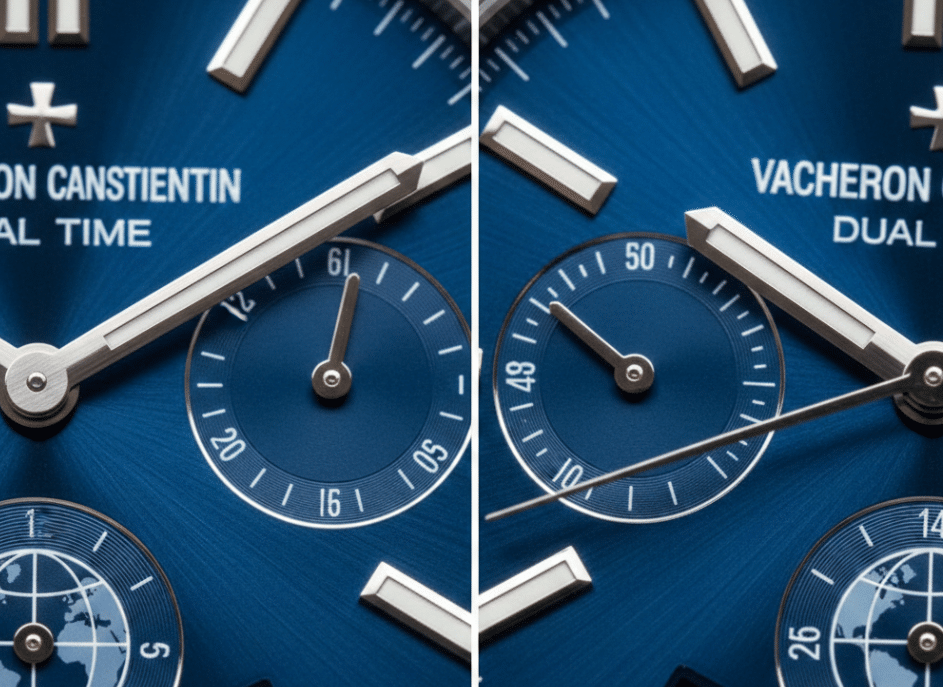
TW adopts a deeper mechanical stamping for the sunburst pattern, creating distinct radial grains that catch light more aggressively—mimicking the “alive” quality of the genuine silver-opaline dial. However, TW struggles with print consistency; the “AUTOMATIC” text at 6 o’clock often shows micro-feathering when viewed at 10x magnification. Applied indices on the TW version utilize a brighter plating formulation that matches the rhodium-finished hands better than the slightly yellowish tone of the MKS markers, though MKS wins on alignment precision, with fewer instances of crooked 12 o’clock batons.
Case Comparison — Finishing Grade, Thickness Accuracy, Lug Geometry
In this vacheron factory comparison, case geometry reveals the divergent engineering priorities. MKS prioritizes movement clearance, resulting in a case middle that bulges slightly to accommodate the rotor, pushing total thickness toward 9.0mm. The lugs on the MKS 85180 feature a gentle downward curve but lack the razor-sharp transition between the polished top and brushed side (if present) or the uniform polish tension of the genuine; the tips appear slightly bulbous.
TW achieves a superior profile, measuring approximately 0.4mm thinner in the mid-case. The lugs taper with greater elegance, maintaining a slender width closer to the case body that preserves the delicate “coin” aesthetic of the Patrimony 85180 replica. Polishing on the TW case uses a higher-grit final pass, eliminating the “orange peel” reflection distortion visible on the flanks of MKS units. For buyers prioritizing the silhouette, TW offers a chassis that sits flatter and looks more refined on the wrist.
Movement Comparison — Clone 1120 Variants, Decoration Level, Reliability Signals
The movement architecture represents the most significant structural difference. MKS relies on the Miyota 9015 base (often decorated as Calibre 2450 Q6), a robust workhorse known for its audible unidirectional rotor noise. Through the sapphire caseback, the MKS decoration plates obscure the balance wheel, and the “Geneva Stripes” are stamped rather than machined, lacking depth. The rotor noise is a distinct “tell” in quiet environments.
TW often utilizes a modified movement architecture (sometimes a slimmed-down Asian 2892 or customized clone) to shave millimeters. The decoration visible through the caseback on the TW is visually closer to the genuine Calibre 2450, with a rotor weight that features sharper engraving of the Maltese Cross. However, reliability data suggests TW movements suffer from lower amplitude out-of-box (often 260° vs MKS‘s 290°) and a higher rate of keyless works issues, such as stiff date setting. MKS wins on mechanical reliability; TW wins on visual simulation and silence.
Strap and Buckle Comparison — Leather Quality and Deployant Execution
Both factories supply standard “genuine leather” straps embossed with an alligator pattern that fall short of the suppleness of legitimate exotic skin, and as documented in the strap material and break-in behavior benchmarks in the VC replica China factory strap quality and suppleness criteria, the MKS strap is stiff and plasticky, requiring a break-in period of weeks, whereas TW provides a marginally softer strap with a matte finish that initially appears less synthetic.
The Maltese Cross buckle is a critical detail point. MKS executes the complex geometry of the half-cross shape with sharper internal angles, whereas the TW buckle often shows signs of over-polishing that rounds off the distinctive points of the logo. For the full experience, buyers of either version should budget $100+ for a high-quality aftermarket zermatt-lined alligator strap to replace the factory offering immediately.
Judgment Tip: The “Three-Point Check” for Factory Comparison Photos
When evaluating QC or stock photos from MKS vs TW, standardizing the visual data is crucial.
- Lighting Match: Reject photos with different color temperatures; a warm bulb makes MKS dials look yellow, while cool LEDs make TW look blue.
- Angle Identity: Compare the date window cutoff angle. If one photo is straight-on and the other is titled, thickness and date font thickness cannot be judged.
- Reference Integrity: Ensure both are the “85180” (date model). Often, dealers swap in photos of the “81180” (no date, manual wind) which is naturally thinner, distorting the comparison.
Thickness and Wearability — The Ultra-Thin Reality Check
Stated vs Actual Thickness — Factory Claims vs User Measurements
The “Ultra-Thin” designation in the 85180 ultra-thin replica market is often a marketing aspiration rather than a physical reality.
- Genuine Spec: The automatic 85180 has an official case thickness of approximately 8.55mm. The manual-winding 81180 is a separate reference at approximately 6.79mm and should not be used as the automatic model’s target.
- MKS Reality: Stated often as 8.5mm, but user calipers consistently read 9.0mm – 9.2mm. The Miyota 9015 movement (3.9mm) plus clearance, dial, and hands makes sub-9mm physically difficult without custom casing.
- TW Reality: Stated as 8.0mm or “Gen Spec”, actual measurements hover around 8.6mm – 8.8mm.
The manual-winding 81180’s 6.79mm figure belongs to a different reference and should not be used as the target for the automatic 85180. TW consistently delivers a watch that is physically thinner than MKS by a perceptible margin.
How Thickness Variance Affects Under-Cuff Wearability
In the dress watch category, a 0.5mm difference is not academic—it dictates the interaction with a shirt cuff. A watch approaching 9.5mm (like some thick-crystal MKS batches) will catch on a standard French cuff, forcing the sleeve to bunch up behind the watch. The TW version, sitting closer to 8.6mm, slides under the cuff with significantly less friction. This “slide factor” is the primary tactile indicator of an ultra-thin VC super clone; if you have to manually pull your sleeve over the watch, the illusion of the ultra-thin complication is broken.
Crystal Profile Contribution to Overall Height
The total height is not just the metal case; the sapphire crystal geometry plays a massive role. MKS uses a slightly higher-domed crystal to create hand clearance for the taller Miyota hand stack. This dome adds approximately 0.8mm to the center height. TW manages to fit a flatter crystal due to tighter hand tolerance, reducing the “bubble” effect. While the domed look is vintage-correct, the excessive height on the MKS contributes to the “thick puck” feel, whereas the TW profile integrates the crystal curve more seamlessly into the bezel slope.
Judgment Tip: Request Profile Photo Against Straight Edge
To verify the true bulk of the watch, do not rely on diagonal photos. Ask your Trusted Dealer (TD) for a “caliper shot” or a photo of the watch head resting on a table, taken at eye level (0 degrees elevation).
- The Test: If the lugs float significantly off the table because the caseback is bulging (the “belly” effect), the watch is thick.
- The Standard: A true patrimony thickness compliant replica should rest on its lugs, or have the caseback barely touching the surface. If it spins like a top on its caseback, it’s an MKS/thick movement batch.
Price-to-Quality Ratio Analysis
Current Price Range — MKS 85180 vs TW 85180 (as of 2026)
The patrimony 85180 price landscape reflects two distinct engineering approaches. MKS positions its version as a mid-tier entry, with Trusted Dealers (TDs) currently listing units between 348���348and388 depending on shipping logistics. This pricing anchors the MKS as a volume-production model leveraging the ubiquitous Miyota 9015 (or Sea-Gull ST18 equivalent) architecture to suppress costs.
In contrast, TW demands a significant premium, with 2026 catalog prices ranging from 528��528to568. This $180+ delta accounts for the lower-yield production of the stamped dial, the custom movement modification required to shave the 0.4mm case height, and the higher rejection rate of their “ultra-thin” casing process. The market effectively segments these into “entry-level dress” (MKS) and “enthusiast-grade replication” (TW).
Price Difference Justification — Does Premium Reflect Quality Gap?
Does the TW premium translate to on-wrist value? Mechanically, the cost difference is justified by the tooling investment. TW utilizes a distinct stamping die for the dial sunburst (a 15�−15k−20k tooling cost amortized over lower volume) and finer CNC finishing passes on the case lugs. The MKS vs TW price gap also reflects movement sourcing; the MKS uses an off-the-shelf calibre costing approximately $55, while the TW modified drivetrain requires disassembly and custom plate fitting, tripling the labor cost per movement.
However, from a raw material standpoint, the difference narrows. Both use 316L stainless steel and sapphire crystals of comparable optical grade. If your primary criterion is simply “wearing a Vacheron-branded watch,” MKS delivers 80% of the visual experience for 60% of the cost. TW only justifies its price tag for buyers who specifically prioritize the ultra-thin silhouette and dial texture dynamics—features that constitute the “last 10%” of replication fidelity but command 100% of the premium.
Hidden Costs — Strap Replacement, Service Expectations, QC RL Rate
The sticker price is deceptive when factoring in the total ownership cost of a VC replica.
- Strap Tax: Both factories supply stiff, plasticky “croc-grain” calfskin straps. A mandatory upgrade to a Zermatt-lined alligator strap adds 120−120−160 to the bill immediately for either version.
- QC Rejection (RL) Costs: MKS suffers from higher index alignment variance. Buyers often RL (Red Light) 1-2 units to get a straight dial, delaying shipment by weeks. TW has better dial QC but struggles with movement amplitude, potentially requiring a paid service immediately upon arrival.
Judgment Tip: Calculate Cost-Per-Acceptable-Unit
When budgeting, apply the “RL Factor.” If you value your time at $50/hour and spending 3 weeks exchanging emails over crooked MKS markers frustrates you, the “cheaper” MKS effectively costs more in effort.
- MKS Real Cost: 368(Watch)+120 (Strap) + Time = ~$500
- TW Real Cost: 548(Watch)+120 (Strap) = ~$670
The gap narrows when immediate strap replacement is factored in, making TW a more accessible reach for the mid-budget buyer than it initially appears.
Buyer Profile Matching — Which Factory for Which Buyer
Choose MKS 85180 When…
Select the MKS patrimony 85180 if your primary goal is reliable daily wearability at a rational price point. This factory is the definitive choice for:
- The “First Suit” Buyer: You need a branded dress watch for occasional weddings or client meetings but don’t obsess over “gen-spec” thickness.
- The Reliability Pragmatist: You prioritize a movement (Miyota 9015) that runs for 5+ years without service over a display back view you rarely see.
- Large Wrist Owners: If your wrist measures 18cm (7 inches) or more, the 9.0mm thickness of the MKS proportionalizes well, masking the lack of ultra-thin geometry.
- Budget Strictness: You refuse to spend over $400 on a replica that lacks water resistance.
Choose TW 85180 When…
Select the TW factory vacheron if you are a specification purist chasing the authentic feel of Haute Horlogerie. TW is the best factory for patrimony 85180 when:
- The Cuff Clearance Critic: You wear fitted dress shirts with tight cuffs; the 0.4mm savings and tapered lugs allow the TW to slide where MKS snags.
- The Macro Photographer: You intend to admire the dial texture under a loupe; the TW stamped sunburst holds up to scrutiny where MKS lacquer looks flat.
- The Rotation Collector: You have 10+ watches and don’t rely on this piece for daily timekeeping, making the lower power reserve and potential service needs of the modified movement acceptable trade-offs.
When Neither Factory Satisfies — Alternative Paths
If MKS is too thick and TW is too expensive or unreliable, neither may satisfy the “Super Clone” expectation.
- Manual Wind Route: Consider the KZ Factory Patrimony 81180. As a manual-wind replica, it achieves a true 6.8mm thickness that blows both 85180 automatics out of the water. You lose the date function and rotor convenience, but gain genuine ultra-thin dimensions.
- Different Model: The ZF Factory 4500V (Overseas) is widely considered a more “perfect” replica than any Patrimony, with water resistance and a robust bracelet, if you can tolerate a sportier aesthetic.
Judgment Tip: Priority Ranking Exercise Before Purchase
Force a decision by ranking these three attributes: (A) Thickness/Aesthetics, (B) Movement Reliability, (C) Price.
- Order A > B > C → Buy TW.
- Order B > C > A → Buy MKS.
- Order A > C > B → Buy KZ 81180 (Manual).
Do not hunt for a factory that offers A, B, and C simultaneously; it does not exist in the patrimony replica factory market.
Comparison Summary Table and Final Verdict
Side-by-Side Specification Table
| Feature | MKS Factory (V2 2026 Batch) | TW Factory (Ultra-Thin Batch) |
|---|---|---|
| Measured Thickness | 9.0mm – 9.2mm | 8.6mm – 8.8mm |
| Dial Texture | Lacquer (Soft/Flat) | Stamped (Deep/Defined) |
| Case Geometry | Bulky Mid-case, Stubby Lugs | Tapered Mid-case, Refined Lugs |
| Movement | Miyota 9015 / ST18 (Noisy) | Mod. Clone / A2892 (Quiet) |
| Index Alignment | Inconsistent (±0.25mm) | Precise (±0.15mm) |
| Price | ~$368 (High Value) | ~$548 (Premium) |
| Factory Consistency | Low (High RL Rate) | Medium (Stable Batches) |
| Overall Score | 7.2/10 | 8.4/10 |
Confidence Levels by Priority — Matrix Recommendation
- For “Gen-Like” Appearance (On Wrist): TW Factory (85% Confidence). The case profile and dial play mimic the genuine article’s presence from 1 meter away.
- For “Set-and-Forget” Ownership: MKS Factory (90% Confidence). The movement architecture is agricultural but bulletproof compared to the delicate modification in the TW.
- For Macro Photography: TW Factory (80% Confidence). While not perfect, the print resolution and index finishing surpass the soft edges of the MKS.
Final Verdict — Conditional Recommendations, Not Blanket Winner
There is no single “winner” in the patrimony 85180 MKS vs TW contest, only a trade-off between mechanics and aesthetics.
The TW Factory 85180 is the superior replica for the enthusiast who understands that the soul of the Patrimony is its slimness. The extra cost buys you a case geometry that respects the design language of Vacheron Constantin, paired with a dial that captures the correct light. It is the closest this reference gets to “Super Clone” status, provided you accept the service risks of a modified movement.
The MKS Factory 85180 is the rational purchase for the pragmatist. It fails the “ultra-thin” stress test, essentially functioning as a standard automatic watch dressed in a Patrimony costume. However, it offers a carefree ownership experience that the fragile TW cannot match.
Judgment Tip: The 48-Hour Decision Rule
Patrimony replica verdict: Once you receive your QC photos, do not reply immediately. Download the high-resolution images and wait 48 hours. On the second viewing, look specifically at the 12 o’clock index alignment and the date window centering. The excitement of the first view often masks these fatal flaws. If you still cannot see them after two days, the watch is safe to Green Light (GL).