
The Vacheron Constantin Traditionnelle 82172 represents the collection’s core expression, utilizing classical round case geometry, a railway minute track, and leaf-shaped hands that demand distinct replication priorities compared to the minimalist Patrimony series. This guide maps the restricted factory landscape for Traditionnelle production, explains how geometric complexity creates specific failure modes in clones, and provides a selection framework for buyers seeking a formal dress watch deployment. Unlike the ultra-thin Patrimony, the 82172’s layered dial architecture requires a focus on alignment and finishing depth rather than simple profile reduction.
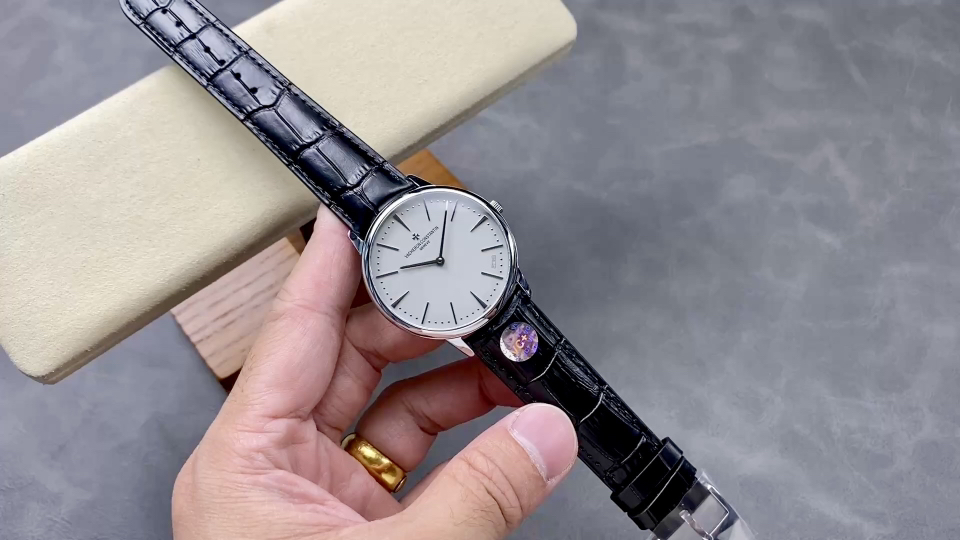
Traditionnelle vs. Patrimony—Why Geometric Philosophy Demands Different Replication Approach
Visual Density Contrast—Patrimony Negative Space vs. Traditionnelle Layered Elements
The primary challenge in replicating the Traditionnelle 82172 lies in its visual density. While the Patrimony relies on expansive negative space where any speck of dust or minor marker misalignment is glaring, the Traditionnelle uses a multi-zone dial. This design features a recessed center, an outer railway track, and applied hour markers that create a busier aesthetic. For the Guangzhou assembly lines, this means the tolerance for “centering” is slightly more forgiving, but the demand for component-to-component alignment—specifically the markers relative to the railway segments—is significantly higher.
Case Profile Philosophy: Patrimony Ultra-Thin vs. Traditionnelle Classical Proportion
The Traditionnelle does not pursue the “extra-flat” records of the Patrimony 81180. Its case profile is more architectural, featuring a stepped case back and a distinct bezel that sits higher than the mid-case. In replica manufacturing, this allows for a more robust construction. Factories do not need to shave down movement bridges to extreme degrees to fit the case, leading to better long-term reliability in the 82172 clones compared to the frequently fragile ultra-thin Patrimony replicas.
Dial Complexity Multiplier: Railway Track, Applied Numerals, Multiple Finishing Zones
A high-quality 82172 replica must manage three distinct finishing zones: the opaline center, the circular-grained hour ring, and the printed railway track. In lower-tier versions, factories often use a single uniform paint finish across the entire dial, which flattens the appearance and fails to capture the light-play of the genuine. Super clone versions from GS Factory attempt to replicate these zones through separate stamping processes, ensuring that the light reflects differently off the center and the periphery.
Why Traditionnelle Tolerates Thickness Variance Better Than Patrimony
While the genuine 82172 is a slim watch, its design language is rooted in 18th-century “remontage manuel” aesthetics which allow for a slightly more substantial wrist presence. If a replica is 0.5mm thicker than the genuine (often due to the use of a modified Miyota or Seagull movement), the visual impact is negligible because the stepped case design masks the height. On a Patrimony, that same 0.5mm variance destroys the “wafer-thin” illusion that defines the watch.
When performing quality control (QC) on Vacheron Constantin replicas, it is important to note that the Traditionnelle’s busier dial composition effectively masks minor centering errors that would be immediately noticeable on the more minimalist Patrimony. According to the Vacheron Constantin Patrimony 85180 replica factory comparison (MKS vs. TW), you should prioritize assessing the consistency of the railway track as the primary metric for evaluation, as it is a more reliable indicator of assembly quality than marker spacing for these specific ultra-thin references.
82172 Reference Specifications and Replication Challenge Mapping
Case Dimensions: 41mm Diameter × 9.25mm Thickness—Achievable Target for Replicas
The specific reference analyzed here features a 41mm diameter, which is a modern sizing for a classical design. With a genuine thickness of 9.25mm, this model sits in a “sweet spot” for Chinese movement integration. Most manual-wind clones, such as the ST36 or thin Hangzhou variants, can fit within a 9.5mm to 10mm case without appearing bulky. This makes the 82172 one of the most accurate Vacheron Constantin replicas in terms of “on-wrist” dimensions.
Dial Architecture: Opaline Center, Railway Minute Track, Applied Arabic/Roman Variants
The 82172 dial is defined by its “Chemin de Fer” (railway) track. The precision of the printing on this track is the single most important factor in the watch’s “face” quality. Applied markers must be hand-aligned; in high-end replicas, these markers feature faceted edges that catch light. Many mid-tier clones fail here, using flat-stamped markers that look dull and lack the three-dimensional “pop” required of a high-end dress watch.
Genuine Cal. 4400 Manual-Wind: 3.6mm Height, 65-Hour Reserve Specification
The genuine movement is a masterpiece of finishing with a 65-hour power reserve. Replicas cannot match this technical spec. Most 82172 clones utilize a manual-wind movement with a 36-42 hour reserve. While the bridge layout of the Cal. 4400 is often mimicked via decorative plates, the functional components (balance wheel position and click-spring) will differ. For a closed-caseback version, this is irrelevant, but for open-back versions, the movement decoration is a primary tells.
Retail Context: Replica Price Positioning
The price gap between the 19,500genuine and the350 average replica is vast, yet the 82172 offers high “perceived value.” Because it lacks the integrated bracelet of the Overseas or the ultra-thin complexity of the Patrimony, the Traditionnelle relies on the quality of its polishing and dial printing. At the $400 mark, a replica can achieve approximately 85-90% of the visual fidelity of the genuine, provided the factory handles the railway track correctly.
Judgment Tip: 82172’s 9.25mm genuine thickness allows replicas to match the profile accurately unlike ultra-thin references; thickness should not be the primary differentiator when evaluating 82172 versions.
Current Factory Landscape—Limited Options Require Adjusted Expectations
Why Top-Tier Factories Bypass Traditionnelle: Lower Demand, Complex Dial Tooling
While ZF and PPF dominate the Vacheron Constantin Overseas market, the Traditionnelle remains a niche product. The dial tooling required for the railway track and faceted markers is expensive to produce relative to the lower sales volume. Consequently, the Traditionnelle 82172 is often neglected by the “Big Two” factories, leaving the market to specialized mid-tier workshops that focus on dress watches.
GS Factory as Primary Source: Batch Production Model and Availability Cycles
GS Factory is currently the most consistent producer of the 82172. They utilize a batch production model, meaning the watch may be out of stock for 3-4 months before a new run is released. Their version is noted for its case finishing and the use of better-quality leaf hands. However, batch-to-batch variance in dial color (silver vs. white opaline) is a known issue that buyers must verify during the QC process.
MKS Factory Occasional Runs: Cross-Production with Patrimony Line
According to the technical comparison of the Vacheron Constantin Patrimony 81180 and 85180 super clones, MKS serves as a “value” entry point in the market, often releasing Traditionnelle batches alongside their Patrimony line at a lower price than GS.
While MKS is noted for its excellent case finishing and structural work, the primary trade-off is found in the finer dial details. Under a macro lens, the printing on the railway track of an MKS version may appear slightly “fuzzy” or less defined compared to the sharper, more precise execution found on GS batches. This makes dial clarity the key differentiator when choosing between these two factory versions.
Unbranded Workshop Versions: Quality Variance and Identification Challenges
The market is also flooded with unbranded or “No-Name” workshop versions of the 82172. These typically retail for under $250. These should generally be avoided for serious collectors, as they often use thick, automatic movements in cases designed for manual winding, resulting in an “inflated” case thickness that ruins the classical geometry of the Traditionnelle.
Judgment Tip: Request production photos with a timestamp before ordering; Traditionnelle’s intermittent production means stock images may show discontinued batch quality levels.
Dial Execution Assessment—Railway Track as Quality Signature
Railway Minute Track Precision: Line Weight Consistency and Radial Alignment
In the 82172, the railway track serves as the geometric anchor. On high-quality replicas, the line weight is uniform—every “sleeper” in the track should be the exact same width as the next. Misalignment is most common at the 6, 9, and 12 positions, where the printing may “drift” toward the edge of the dial. Check that the gap between the track and the bezel is consistent throughout the 360-degree circumference.
Applied Numeral Attachment: Height Uniformity and Vertical Orientation Accuracy
The hour markers on the 82172 are applied, not printed. A frequent failure in Guangzhou assembly is the “leaning” marker, where a baton or numeral is slightly tilted. Because these markers are small and polished, they catch the light; if one is tilted, the reflection will be off-angle compared to its neighbors. Use a straight-edge tool (or a digital line on your screen) to check that the markers align perfectly with the radial center of the dial.
Opaline Center Finishing: Grain Direction and Light Reflection Behavior
The genuine dial has a very subtle “opaline” texture—it is not a flat white. It should have a soft, eggshell-like luster that absorbs light rather than reflecting it harshly. Cheaper replicas use a gloss or semi-gloss white paint that looks like plastic. When viewing QC photos, look for a matte finish that remains legible even under direct high-intensity flash photography.
Sub-Dial Integration (Complications): Small Seconds Register Concentricity
For versions featuring a sub-seconds dial, the “sunken” effect is critical. The transition from the main dial to the sub-dial should be a sharp, clean step, not a rounded or sloped edge. The concentric circles (azurage) within the sub-dial must be fine enough that they appear as a texture rather than individual lines. If the lines are too deep, the sub-dial will look “dirty” as it traps dust and shadows.
Judgment Tip: Photograph the dial at arm’s length under a single overhead light; the railway track should show uniform shadow depth across all 60 segments—variance indicates stamping inconsistency.
Hand Set and Classical Element Execution
Leaf-Shaped Hand Profile: Curvature Accuracy and Tip Sharpness Comparison
The Traditionnelle 82172 uses a modified leaf (feuille) hand that is slightly more elongated than a standard field watch hand. The tips must be needle-sharp. Many replicas use “stumpy” hands that are too short, failing to reach the railway track. The minute hand should ideally overlap the inner edge of the track, while the hour hand should terminate exactly at the tip of the hour markers.
Blued Steel Execution: Heat Treatment Color vs. Painted Blue Assessment
On references using a blue seconds hand, the method of coloring is a primary quality gate. Genuine VC hands are heat-blued steel, producing a deep, iridescent navy that changes hue in the light. Most replicas use chemically blued or painted hands, which look like a static “electric blue.” Painted hands lack the metallic luster and depth of heat-treated steel, making the watch look like a toy under close inspection.
Hand-to-Dial Clearance: Classical Designs Require Tighter Stack Height
A hallmark of high-end watchmaking is a low hand stack—the hands should sit as close to the dial as possible without touching. In replicas using thicker movements, the “pinion” (the center post holding the hands) is often too tall, creating a visible gap between the hands and the dial. This ruins the “flat” aesthetic of the classical design.
Judgment Tip: True blued steel shows a color gradient shift under angle change; painted blue remains uniform—rotate the watch under light to verify heat treatment authenticity.
Case Construction and Finishing Standards
Bezel Profile: Thin Polished Ring Demands Consistent Width Around Circumference
The bezel of the 82172 is remarkably thin. This requires high-precision CNC machining. In poor-quality clones, the bezel may be thicker on one side than the other, or the “step” where it meets the crystal may be uneven. A perfectly symmetrical bezel is the hallmark of a high-tier case factory like the ones GS utilizes.
Lug Shape: Traditionnelle’s Curved Lugs vs. Patrimony’s Straight Taper
The Traditionnelle features “stepped” lugs that curve downward to hug the wrist. These lugs are separate geometric entities from the case mid-section. In cheap replicas, the transition between the lug and the case is “mushy” or rounded off during the polishing process. A high-end clone will have a sharp, defined line where the lug meets the case body, indicating disciplined hand-polishing.
Case Flank Finishing: Polished vs. Brushed Zone Transition Sharpness
While the 82172 is primarily a polished watch, the transitions between different surfaces must be crisp. The vertical flank of the case should be a perfect mirror polish. Any “waviness” in the reflection on the side of the case indicates that the steel was not properly leveled before polishing.
Crown Design: Smaller Diameter Than Patrimony, Maltese Cross Definition Critical
The crown of the 82172 is relatively small and features a deeply embossed Maltese Cross. In many replicas, the cross is “soft” or lacks the sharp points of the Vacheron emblem. Furthermore, the knurling (the grip) should be fine and consistent. If the crown feels “sharp” or “scratchy” to the touch, it indicates poor deburring during the manufacturing stage.
Judgment Tip: Run your fingertip along the bezel edge; the Traditionnelle’s thin bezel makes any width variance immediately tactile—consistent pressure feel indicates quality machining.
Movement Options and Manual-Wind Considerations
Sea-Gull ST36 (Unitas Clone): 5.5mm Height, Robust Platform, Visible Decoration Limitation
Many 82172 replicas utilize the Sea-Gull ST36. While this is an incredibly reliable movement, it is originally designed for pocket watches and is relatively thick (around 5mm+). This often forces the replica case to be thicker than the genuine 9.25mm. However, the ST36 offers a very satisfying, “clicky” winding experience that mimics the feel of high-end manual calibers.
Hangzhou Manual Movement: Lower Cost Alternative, Reduced Finishing Quality
The Hangzhou manual-wind series is a thinner alternative often used in budget “No-Name” Traditionnelle clones. While it allows for a thinner case, the reliability is lower than the Sea-Gull. The bridges are often unfinished and look industrial, which is a significant drawback if the watch has a sapphire caseback.
Why Automatic Conversions Fail: Case Depth and Aesthetic Mismatch
Some factories attempt to put a Miyota 9015 automatic movement into the 82172 by removing the rotor. This is rarely successful. The presence of the automatic winding bridge makes the movement too tall, and the winding feel through the crown becomes “mushy” because you are engaging the reduction gears of an automatic system rather than a direct manual-wind click.
Winding Experience: Crown Engagement Clicks and Full-Wind Stopping Resistance
A manual-wind watch should provide clear tactile feedback. As you wind the 82172 clone, you should feel a consistent series of micro-clicks. When the mainspring is fully wound, there should be a “hard stop.” If the crown continues to spin with a slipping sensation (like an automatic), the movement is either an automatic conversion or the click-spring is failing.
Judgment Tip: A manual movement should provide distinct tactile feedback every 180° crown rotation; mushy or inconsistent resistance indicates worn keyless works—reject the unit.
Deployment Context and Buyer Profile Alignment
Formal Event Deployment: Why Traditionnelle’s Classical Language Suits Conservative Environments
The 82172 is the quintessential “black tie” or “boardroom” watch. Its design is conservative and does not scream for attention like a Royal Oak or a Nautilus. This makes it an ideal choice for buyers who need a “super clone” that can pass inspection in professional environments where an overly flashy watch would be inappropriate.
Wrist Size Calibration: 41mm Case on Various Wrist Circumferences
Despite its formal designation, the 41mm diameter makes the 82172 wear larger than traditional vintage dress watches. It is best suited for wrists between 16.5cm and 19cm. On very small wrists, the straight, stepped lugs may overhang, breaking the silhouette of the cuff.
Strap Selection Impact: Black Alligator Formality vs. Brown Leather Versatility
Most replicas ship with a low-quality “embossed” leather strap that feels like plastic. To truly elevate the 82172, a buyer should immediately budget for an aftermarket genuine matte alligator strap. A black strap reinforces the watch’s formal geometry, while a dark brown “suede” or “Saffiano” leather can move the watch into a more “smart-casual” territory.
Lifestyle Compatibility: Manual-Wind Daily Ritual Requirement Assessment
The 82172 is a manual-wind watch. It requires the owner to engage with it every 40 hours. For some, this is a cherished ritual; for others, it is a nuisance. If you are a “set it and forget it” wearer, the Traditionnelle will likely spend most of its time dead in your drawer.
Judgment Tip: If you are unwilling to wind the watch daily, the 82172 manual-wind is the wrong choice regardless of aesthetic preference; an automatic Patrimony better serves inconsistent wear patterns.
Price Analysis and Purchase Decision Framework
GS Factory Pricing (350−420): Standard Benchmark for Available Quality
At this price range, you are paying for the specialized dial stamping and the thinner case construction. This is the “safe” buy for the 82172. You get a movement that is decorated to resemble the VC Cal. 4400 (even if functionally different) and a case that mirrors the genuine dimensions within 0.5mm.
MKS Occasional Production (300−380): Value Option When Stock Available
The MKS version is a solid alternative if GS is out of stock. You sacrifice a small degree of dial crispness for a slightly lower price point. MKS is known for its “workhorse” approach, meaning the watch is built to last, even if it lacks the final 5% of aesthetic refinement found in GS batches.
Below-$250 Versions: Why Savings Eliminate Classical Dress Watch Credibility
Cheap Traditionnelle clones usually fail on the most basic geometric level. They are too thick, the hands are the wrong shape, and the “Maltese Cross” on the dial often looks like a generic clover. These versions are easily spotted as replicas even by non-experts because they lose the “elegance” that defines Vacheron Constantin.
Alternative Consideration: When Patrimony 81180 Better Serves First VC Replica Purchase
If you are looking for the absolute “thinnest” experience and don’t mind a simpler dial, the Patrimony 81180 from MK or ZF is often a more “perfected” replica because those factories have iterated on the design for years to meet the technical benchmarks for ultra-thin VC dress watch replica architecture, while the Traditionnelle 82172 remains the choice for the collector who specifically wants the complexity of the railway track and the architectural lug design.
Judgment Tip: The Traditionnelle requires a higher tolerance for factory scarcity and batch variance than the Patrimony; buyers needing predictable availability should consider the 81180 as a primary option with the 82172 as a future addition.