
Intro:
This guide serves as the definitive entry-level manual for the Vacheron Constantin Traditionnelle 82172 (Small Seconds), distinguishing it from the ubiquitous Patrimony. We analyze the current replica market landscape—dominated by specific factory efforts—to help formal dress watch enthusiasts determine if this 38mm manual-wind reference offers the right balance of aesthetic discipline and replication value.

The Design Divide: Traditionnelle vs. Patrimony Philosophy
Case Architecture Differences
The primary distinction between the Traditionnelle and the Patrimony lies in the aggression of the case geometry. While the Patrimony relies on a seamless, coin-like curve, the Traditionnelle 82172 utilizes a stepped case design where the bezel, case band, and case back form distinct, sharp tiers. This deviation traces back to the soldering angle of the lugs; the Traditionnelle features straight, welded lugs that protrude aggressively from the case flank, whereas Patrimony lugs curve integrally from the mid-case. Consequently, the 82172 wears with a more rigid, architectural presence on the wrist compared to the fluid ergonomics of its sibling.
Dial Layout Logic
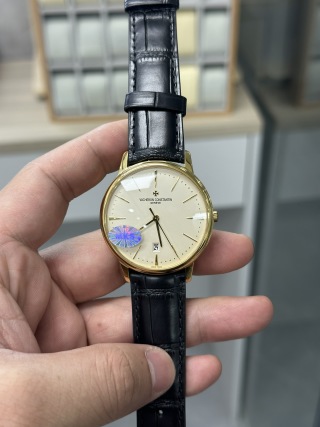
Visual identification relies heavily on the minute track execution, which fundamentally alters the dial’s negative space. The Traditionnelle utilizes a “Railway” minute track located on the outer perimeter, providing a technical, instrument-like boundary that constrains the dial elements. In contrast, the Patrimony employs a pearl minute track (minute dots) that floats more freely, creating a minimalist expanse. Furthermore, the 82172 employs faceted Dauphine hands which capture light on two planes, differing mechanically from the flat, stick-like Baton hands found on the Patrimony series.
Visual Presence
The cumulative effect of the stepped case and railway track makes the 82172 read as a strictly “horological” instrument rather than a piece of jewelry. The sharp angles of the case steps catch light differently than a rounded pebble shape, creating high-contrast shadows that emphasize the watch’s thickness profile. This results in a visual footprint that feels denser and more engineered. Ideally, this separates the buyers seeking technical precision from those seeking softness, as the Traditionnelle refuses to blend into the wrist in the way the Patrimony does.
Judgment Tip: Case Profile Tactile Test
If you prefer a completely clean, rounded “pebble” shape, you are looking for a Patrimony 81180; if you want architectural steps and sharp angles, you want the Traditionnelle 82172.
Anatomy of the Gen 82172: The “Purist’s Choice” Baseline
The Golden Ratio
The genuine Traditionnelle 82172 is governed by strict dimensional constraints: a 38mm diameter paired with a scant 7.77mm thickness. This thickness is not merely a design choice but a mechanical mandate imposed by the case construction, leaving zero room for unnecessary spacers or thick movement holders. Replicas frequently fail this specific tolerance, often bloating to 8.5mm or 9mm to accommodate standard base movements and decorative plates. The disruption of this ratio instantly compromises the “cuff slide” capability that defines the genuine ownership experience.
Caliber 4400 AS Context
The heart of the genuine model is the Caliber 4400 AS, a massive manual-wind movement measuring 28.6mm in diameter. This large footprint means the movement virtually fills the case back from edge to edge, leaving almost no metallic spacer ring visible through the sapphire. This creates a significant replication challenge, as most base movements (like the Miyota 9015 or Seagull variants) are significantly smaller (around 25-26mm). Consequently, factories must use decorative distinct spacer rings or “deck plates” to hide the empty space, which often breaks the illusion of a dedicated manufacture caliber.
Market Positioning
Within the broader horological landscape, the 82172 represents the entry-level “Grail” for dress watch collectors who prioritize manual winding interaction. It eschews the rotor noise and thickness of automatic movements for a tactile connection with the mainspring. For the replica market, this positioning raises the stakes; the buyer is not looking for a “daily beater” like an Overseas 4500V, but a refined object of scrutiny where case profile continuity and dial plane truth are judged against an established inspection baseline articulated in Patrimony 81180 vs 85180 dial and case-profile inspection reference, so flaws in dial printing or case finishing that might pass on a sport watch are magnified under the dress watch lens.
Judgment Tip: Movement Fill Ratio
The genuine 82172 is defined by the massive movement visible through the back; replicas often struggle to fill this space without decoration plates—check the movement-to-case ratio.
The Replica Landscape: Current Factory Options
The Market Leaders
Currently, the market for the Traditionnelle 82172 is dominated by MKS Factory, which has established itself as the standard-bearer for Vacheron Constantin dress references outside the Overseas line. MKS prioritizes case geometry and dial print fidelity, often achieving a crisper “Swiss Made” print and clearer railway tracks than competitors. While other factories like 8F or ZF focus heavily on the complex Overseas 4500V and 5500V models, MKS has cornered the niche for the simpler, yet more unforgiving, dress complications. Their version typically offers the best balance of component finish and movement reliability available.
Low-Tier Traps
A critical hazard in this specific sector is the prevalence of generic “AAA” versions that utilize automatic movements in what should be a manual-wind watch. These lower-tier productions often leave the rotor attached or simply remove the rotor weight while leaving the automatic bridge structure visible. This mechanical incongruity is a dead giveaway, as the genuine 82172 has no central rotor pivot or reverser wheels. Furthermore, these versions often suffer from “phantom date” positions on the crown, where pulling the stem to the first position engages a date wheel that does not exist on the dial.
Version Iterations
The MKS version has undergone subtle iterations, primarily addressing the “pink” hue of the Rose Gold (5N) plating and the depth of the sub-dial grooves. Early V1 samples often featured a gold tone that was too coppery, deviating from the warmer, paler genuine rose gold alloy. Current V2 batches have largely corrected this color temperature disparity and improved the definition of the azurage (concentric circles) on the small seconds sub-dial. However, buyers should confirm stock batches with dealers, as older inventory may still circulate.
Judgment Tip: Movement Architecture Check
Currently, there is no “Super Clone” with a functional clone movement for this specific reference; the best options use reliable modified movements (Miyota/Seagull) with decorative plates.
Execution Analysis: Case Profile and Stepped Bezel
The “Stepped” Reality
The defining feature of the Traditionnelle is the sharp, 90-degree transition between the bezel and the mid-case, a detail that requires precise CNC machining. On the genuine article, this step is crisp enough to catch a fingernail, creating a definitive visual break that slims the watch’s profile. Lower-quality replicas often polish this transition too aggressively, softening the edge into a slope rather than a step. This manufacturing shortcut destroys the light-catching property of the case, making the watch appear amorphous and lacking in definition.
Thickness Management
Achieving the genuine 7.77mm thickness is technically impossible for replicas using modified movements with decorative plates. Most high-end replicas, including the MKS, settle in the 8.5mm to 9.2mm range. This deviation traces back to the vertical clearance needed for the hand stack and the added height of the “Geneva Seal” decoration bridges placed over the base movement. While a 1mm difference sounds negligible, it represents a 12% increase in bulk, which is perceptible when the watch is viewed from the side profile against a shirt cuff.
Lug Geometry
The straight lugs of the 82172 present a unique soldering challenge; they must appear to be applied to the case rather than flowing from it. Genuine lugs feature a sharp, distinct line where they meet the case band, simulating a historic welding technique. Replicas often struggle with the “notch” at the lug insertion point, sometimes leaving a gap that is too wide or filling it with uneven solder/polishing residue. Correct lug geometry is critical, as it dictates the effective lug-to-lug length and how the strap creates the “overhang” on the wrist.
Judgment Tip: Tactile Case Inspection
Run your finger over the side of the case; the Traditionnelle should feel “tiered” with distinct steps, not smooth or rounded like the Patrimony.
Dial & Hands: Analyzing the “Eton” Indices and Finishing
The Dauphine Hands
The Traditionnelle’s Dauphine hands require bistable faceting—one side polished, the other often frosted or brushed in specific lighting—to ensure legibility against the opaline dial. Replicas frequently cut corners here, using stamped hands that lack the sharp central ridge found on the genuine gold hands. A loupe inspection often reveals rough edges or “burrs” on the sides of the hands where they were punched from the sheet metal. This lack of anglage on the hands causes them to look flat and washed out under direct overhead lighting.
Sub-dial Concentricity
The small seconds display at 6 o’clock features a guilloché pattern known as azurage, consisting of incredibly fine concentric circles, and on the genuine dial this texture is deep enough to create a “sunburst” interference pattern but fine enough to appear matte from a distance; in contrast, common replica failures in execution and alignment can be systematically understood through the dress watch replica inspection criteria and azurage execution standards, because replica dials sometimes execute this with ridges that are too coarse, creating a “vinyl record” look that is visibly distracting and, in such cases, the printed seconds track must align perfectly with these grooves or else misalignment here indicates poor dial pad printing registration.
The Maltese Cross Applique
The applied Maltese Cross logo at 12 o’clock serves as the anchor for the entire dial layout. The genuine applique is dimensional, with faceted arms that slope downward from the center point. Replica factories often use a flatter, stamped piece of metal that lacks this 3D geometry, appearing more like a sticker than an applied index. Furthermore, the alignment of the cross relative to the double-baton index at 12 o’clock is a common failure point; any tilt or off-center placement here immediately signals a replica.
Judgment Tip: 6 O’Clock Text Alignment
Inspect the “Swiss Made” text at 6 o’clock; on top-tier replicas, it should be perfectly centered below the railway track, not touching the minute lines.
Movement Reality: The Manual Wind Experience
The Base Movement
Top-tier replicas typically utilize a modified Miyota 9015 (with rotor removed and automatic winding works disabled) or a manual-wind Seagull ST series movement. The use of the Miyota 9015 offers reliability and a high beat rate (28,800 vph) which matches the smooth sweep of modern luxury watches, but it suffers from a distinct winding feel. Winding a modified automatic movement manually often feels “gritty” or overly resistant compared to the dedicated manual architecture of the Caliber 4400 AS, which is designed for daily interaction.
Decoration vs. Function
To mimic the 28mm breadth of the Caliber 4400 AS, factories apply a large decorative plate over the smaller base movement. While this plate often features laser-etched “Côtes de Genève” and gold-filled engravings, it remains a static cover. The visible jewels on this plate are often non-functional glued-on rubies, and the “Geneva Seal” stamp is usually chemically etched rather than stamped. This facade falls apart under loupe inspection, as the depth of the anglage (beveling) on the bridges is non-existent, revealing the planar nature of the decorative sheet.
Winding Feel
The tactile experience of the Traditionnelle is defined by the daily ritual of winding the mainspring. The genuine 4400 AS offers a crisp, clicking feedback with substantial torque resistance as the large barrel reaches capacity. In contrast, replicas using converted automatic movements often have a “slipping” feel due to the declutching mechanism inherent to automatics, or a loose, ratchety feel common in basic Seagull movements. This disconnect between the visual luxury and the mechanical feedback is the most significant compromise of the replica ownership experience.
Judgment Tip: Balance Wheel Position
Be aware of the “blind spots” in the display back; replicas often have balance wheels in slightly different positions than the genuine 4400 AS.
Suitability Analysis: Who Should Buy the 82172?
The Formal Purist
The 82172 targets the “Black Tie” or strict business formal demographic that finds the Overseas too industrial and the Patrimony too plain. It is designed to slide under a French cuff without friction, serving as a discreet timekeeper rather than a conversation starter. This watch fails mechanically and aesthetically when paired with casual wear; its polished steps and alligator strap clash violently with denim or sportswear. It requires a sartorial context—specifically a suit jacket or structured blazer—to frame its geometric discipline correctly.
Wrist Size Compatibility
Despite the modest 38mm diameter, the straight, elongated lugs extend the effective lug-to-lug distance, causing the watch to wear larger than the paper specs suggest. A wrist circumference of at least 16.5cm (6.5 inches) is recommended to prevent the lugs from hanging over the wrist edges, which destroys the “tailored” look of a dress watch. Unlike the curved Patrimony which hugs smaller wrists, the flat caseback of the Traditionnelle demands a flatter wrist surface to sit stable.
Age and Maturity Profile
The aesthetic language of the Traditionnelle leans heavily towards traditional conservatism, devoid of the “hype” factors like integrated bracelets or green dials. It appeals to a mature collector who values legibility and classical proportion over trend adherence. Consequently, it creates a dissonance when worn by younger enthusiasts whose style leans towards streetwear; it is a watch that signals tenure and established status rather than new money flash.
Judgment Tip: Wardrobe Synchronization
If your daily attire is T-shirt and jeans, the 82172 will look out of place; it requires at least a button-down shirt/polo to look coherent.
Styling & Ownership: Strap Strategy
The “Stock Strap” Problem
Factory-supplied leather straps on replicas, even from top tiers like MKS, are notoriously plasticky and stiff. They are often made of low-grade leather embossed with an alligator pattern, resulting in a shiny, unnatural finish that refuses to break in comfortably. This stiff strap creates a gap between the watch and wrist (the “hula hoop” effect), causing the watch head to rotate unnecessarily. Replacing this component is not optional; it is a mandatory step to achieving a passable replica experience.
Crocodile vs. Alligator
To match the genuine MSRP class of the Traditionnelle, an aftermarket strap must be genuine American Alligator or Nile Crocodile, focusing on the large square scales for the main surface. The texture of real exotic leather absorbs light rather than reflecting it like the cheap vinyl coating on factory straps. A high-quality matte scale pattern adds a layer of organic complexity that complements the sterile, mechanical precision of the railway dial track.
Color Theory
For the 82172, conservative strap colors are the only “safe” options to maintain the illusion of authenticity. A semi-matte black is the standard pairing for the white gold/silver dial models, while a deep espresso brown complements the 5N rose gold references. deviating into bright blues or contrast stitching immediately cheapens the aesthetic, pulling the watch out of its formal lane. The hardware—specifically the Maltese Cross buckle—must be transferred to the new strap to complete the look.
Pricing & Value Proposition
Factory Price Range
Prospective buyers should anticipate a price range of 350 to 450 for a high-quality MKS production of the 82172. This pricing reflects the cost of the modified movement plates, the sapphire crystals, and the complex CNC case machining. Deviations significantly below this range (150−250) usually indicate a lower-tier factory using standard alloy cases (instead of 316L/904L steel) and off-the-shelf mineral glass, compromising the entire value proposition.
Gold Plating Factor
Choosing the Rose Gold (5N) version introduces a cost and durability variable; reputable dealers charge a premium for thicker (5-micron) plating which resists oxidation and scratches. The cost delta is typically 30−50 over the stainless steel model, but it is an investment in longevity. Cheap plating on budget versions will reveal base metal at the sharp edges of the stepped lugs within months of wear, instantly rendering the watch unwearable.
Value vs. Patrimony
While the Patrimony 81180 replica is often slightly cheaper due to its simpler case construction, the Traditionnelle offers higher replication value per dollar. The complexity of the 82172’s stepped case and the detailed railway dial make it a more expensive watch to manufacture genuinely, meaning the replica captures more “perceived value.” You are effectively paying for the advanced case machining and dial pad printing, which are objectively more labor-intensive on the Traditionnelle than the minimalist Patrimony.
Judgment Tip: Minimum Investment Threshold
Avoid any listing below $300 for this model; decent manual wind movements and correct case finishing cannot be achieved at budget tier prices.