
Richard Mille watches represent extreme engineering and exotic materials, making their aesthetic highly desirable yet financially inaccessible. At the $500 price tier, entry-level replicas offer visual access to this distinctive look but demand a clear-eyed understanding of significant compromises in case dimensions, movement quality, and material authenticity; the 1000 to 2000 upgrade details the precise improvements in thickness, weight distribution, and surface finishing that occur when advancing to super clone tiers. These watches photograph convincingly and appear acceptable from a distance, yet reveal obvious deviations in these exact areas upon handling.
This article examines what actually separates a $500 RM super clone from both genuine pieces and higher-tier replicas, focusing on practical wear experience rather than marketing claims. You will learn to evaluate whether the dimensional inaccuracies, basic Miyota movements, and plated base metals align with your intended use—whether as a disposable statement piece for occasional events or an ill-advised daily wearer—while identifying specific QC checkpoints to verify before any purchase.
| Evaluation Point | Entry-Level Reality | Buyer Judgment |
|---|---|---|
| Case Dimensions | 16mm+ thick, slab-sided vs 13.5mm genuine; flattened barrel shapes | Acceptable for photos/distance; obvious under scrutiny |
| Movement Mechanics | Basic Miyota/Seagull with cosmetic plates; noisy rotor; 30-40hr reserve | Suitable for occasional wear; expect 6-month functional lifespan |
| Materials & Weight | Plated base metal; hollow “clink” sound; 15-20g movement vs 4.3g genuine | Top-heavy wrist feel; plating wears at contact points within months |
| Wear Context | Unstable “floating” fit due to thick case and generic strap gaps | Viable for events/social media; unsuitable for daily wear or enthusiast handling |
| Pre-Purchase Verification | Request side profiles, macro screw shots, date window alignment | Verify flush hex screws, centered date, hand clearance, rehaut finish |
| Long-Term Value | Disposable fashion accessory; unpredictable mechanical failure | Purchase for temporary aesthetic access; budget as consumable, not investment |
Quick Questions Before You Read
Q: Can I wear a $500 RM replica every day?
No. The plating wears quickly at contact points, the thick case creates an unstable “floating” fit, and movement failure is likely within six months. Treat it as an occasional event piece.
Q: Will it look real in person?
From two feet away or in photos, possibly. Under scrutiny, the excessive thickness (16mm+ vs 13.5mm), flattened case shape, and hollow “clink” sound reveal it immediately to knowledgeable observers.
Q: What photos should I request before buying?
Side profile shots to verify thickness, macro images of hex screws for flush alignment, and close-ups of the date window to check wheel centering and hand clearance.
Q: Is the skeleton dial functional?
No. The dial uses etched plates with non-functional decorative gears. The actual movement is a basic automatic hidden beneath cosmetic plates.
Replica vs. Genuine: Maintaining Clear Boundaries
Richard Mille replica watches, including those discussed in this guide, are manufactured within the replica watch ecosystem and are not genuine products from Richard Mille SA. The genuine references mentioned—including the RM 055, RM 11-03, and other models—represent the authentic engineering achievements of Richard Mille, utilizing proprietary materials such as Carbon TPT, grade 5 titanium, and in-house calibers developed through years of research and investment. Replica watches at any price point, including $500 entry-level models or higher-tier super clones, remain distinct from these genuine articles in terms of material composition, movement architecture, manufacturing tolerances, and brand provenance.
The purpose of factory comparison, quality control verification, and technical analysis in this article is to help buyers understand the practical differences between various replica offerings and to set realistic ownership expectations. These discussions should not be interpreted as suggesting that replica watches can pass as genuine articles, nor should they be used to misrepresent replica watches as authentic Richard Mille timepieces. The visual similarities achievable at higher price tiers may reduce immediate visual tells in casual passing, but close inspection by knowledgeable observers, watchmakers, or authentication services will reveal differences in case finishing, movement architecture, material density, and construction details.
Buyers should understand that factory names—whether VS Factory, Clean Factory, ZF, or others—function as market references within the replica ecosystem, not as official brand affiliations, authorized manufacturer designations, or guarantees of specific quality standards. These names help buyers identify particular production batches or sourcing channels, but they do not imply that the resulting watches are produced under license from, or with approval by, Richard Mille SA or any other luxury brand.
The $500 Price Tier: Defining Entry-Level Richard Mille Replicas
A $500 Richard Mille replica occupies a specific niche in the clone market: it represents the entry threshold where the tonneau shape and skeleton aesthetic become available, but not the engineering integrity that defines higher-tier super clones. At this entry level RM super clone price point, factories prioritize visual impact over structural authenticity, allocating limited budgets toward components that photograph well rather than those that withstand close physical scrutiny.
The manufacturing approach at this tier follows what buyers might recognize as “photo-first” engineering. Rather than machining complex compound curves from solid blocks, producers use simpler barrel-shaped cases with flattened profiles that approximate the RM silhouette from frontal angles. Budget tonneau replica construction typically involves base metal alloys plated to simulate titanium or carbon fiber composites, with machining tolerances that prioritize speed over precision. The component shortcuts are systematic: case walls are thinner, lug integration is simplified, and casebacks often use press-on designs rather than the tripartite screw assemblies found in authentic references.
For buyers researching what this entry price point actually delivers, the reality is straightforward: $500 purchases visual access to the Richard Mille aesthetic, not functional equivalence to its engineering. The dial may present the correct color scheme and screw placement; the case may capture the general tonneau outline. However, the buyer accepts significant compromises in case geometry, material density, movement architecture, and long-term durability. This tier serves buyers who prioritize the statement value of the RM look for occasional wear or social media presentation, provided they understand that cheap RM replica quality involves tradeoffs visible within minutes of handling the physical object.
Authentic Reference Baselines: What Genuine Specifications Reveal
Understanding the compromises inherent to $500 Richard Mille replicas requires establishing baseline specifications against which these budget versions are measured. Genuine Richard Mille timepieces utilize grade 5 titanium, Carbon TPT, or quartz TPT cases engineered to specific dimensional tolerances that contribute to their wearing characteristics. For example, the authentic RM 055 Bubba Watson measures approximately 49.9mm x 42.7mm with a thickness of 13.5mm and utilizes a titanium case and baseplate, weighing significantly less than stainless steel equivalents while maintaining structural rigidity[1]. Similarly, the RM 11-03 McLaren employs a Carbon TPT case with dimensions of 49.94mm x 44.50mm x 16.23mm, incorporating a flyback chronograph caliber RMAC3 with variable inertia rotor[2].
These specifications highlight the engineering chasm separating genuine articles from $500 replicas. Where authentic RM cases achieve thicknesses of 13.5mm–16.2mm depending on complication, budget replicas often exceed 16mm even for simple three-hand designs due to movement constraints and case construction shortcuts. The weight distribution differs fundamentally: genuine RM movements weigh approximately 4–5 grams with titanium construction, while $500 replicas house standard automatic calibers weighing 15–20 grams, creating the top-heavy wearing experience described throughout this guide. Material authenticity presents perhaps the starkest contrast: where genuine pieces utilize medical-grade titanium or layered carbon composites, $500 equivalents rely on plated base metals that reveal their composition through acoustic resonance and thermal conductivity differences detectable within minutes of handling.
Factory Names and the Richard Mille Exception
Buyers familiar with the round-watch replica market often approach Richard Mille purchases with the same factory-ranking logic: assuming that a “VS Factory” or “Clean Factory” badge guarantees superior execution regardless of model. This assumption fails at the $500 RM tier. The major factories known for Rolex and Omega clones often treat Richard Mille as a peripheral product line, allocating minimal CNC resources to tonneau cases while focusing their precision engineering on high-volume round models. Consequently, a factory with stellar Submariner credentials may produce RM replicas with thicker cases and noisier movements than smaller workshops that specialize exclusively in tonneau shapes but lack brand recognition.
At this price point, the factory label functions more as a batch identifier than a quality guarantee. A $500 “VSF” Richard Mille does not undergo the same component scrutiny as a $500 VSF Submariner. The movements may come from the same Miyota supplier, but the case machining, dial fitting, and quality control rely on secondary subcontractors who vary by production run. This means two watches with identical factory stickers can exhibit different case thicknesses, strap fit, and movement alignment depending on which anonymous case-maker processed the batch. For Richard Mille specifically, the more useful inquiry is not “which factory?” but “which case batch?”—asking the seller for side-profile measurements and movement video rather than relying on factory reputation as a shortcut to quality assessment.
This distinction matters because factory marketing often obscures model-specific performance. A factory that excels at the RM 055 (solid dial) may produce inferior RM 035 skeletons due to different subcontractor capabilities. At cleanvsfactory.com, this comparison is treated as a model-specific buying question rather than a simple factory ranking. The factory name helps narrow the shortlist, but the final decision still depends on the movement, case profile, dial execution, bracelet feel, and how the buyer plans to wear the watch—factors that can vary significantly even within the same factory’s RM offerings at the $500 tier.
Factory names in the replica watch market serve as practical buyer-facing references rather than official brand affiliations or audited manufacturer identities. A factory label helps narrow the search, but it cannot guarantee identical quality across every model or batch. In the Richard Mille segment specifically, the same factory may produce varying results between a solid-dial RM 055 and a skeletonized RM 035 due to different subcontractor capabilities or tooling refresh cycles. The safer evaluation treats factory names as starting points for comparison rather than proof of specific execution, always verifying the particular reference, version, and visible details against real QC evidence.
Factory Name Clarification: Factory names in the replica watch market are commonly used buyer-facing labels. They should be treated as practical market references, not as official brand affiliations, audited manufacturer identities, or guarantees of identical quality across every model.
Practical Verification Beyond Factory Labels
Given that factory names in the Richard Mille replica market function as fluid identifiers rather than audited quality certifications, buyers must develop verification habits that transcend factory labels. Rather than asking “which factory is best,” the more productive inquiry focuses on specific component verification: request video evidence of the crown being pulled to check for hacking seconds (most $500 Miyota-based movements lack this feature present in genuine RM calibers), ask for side-profile measurements with a caliper visible in the frame to confirm thickness claims, and require macro photography of the date wheel alignment specific to the reference number you intend to purchase.
This component-specific approach protects buyers from the common trap of factory label inflation, where sellers apply prestigious factory names to batches that did not undergo that factory’s typical QC processes. Because the Richard Mille replica market lacks the centralized quality control seen in round-watch segments, a “VSF” label on an RM 055 may indicate different case tolerances than a “VSF” label on an RM 035, depending on which subcontractor machined the cases that month. The verification focus should shift from pedigree (factory name) to phenotype (visible physical characteristics): Does the hex screw seating match the bezel curvature? Do the hands clear the crystal when the watch is tilted 30 degrees? Does the rotor spin without audible grinding?
When sellers cannot provide specific component evidence, buyers should treat factory names as unverified claims rather than proof of specification. This skeptical approach aligns with the reality that $500 replica production involves multiple anonymous subcontractors, and the factory sticker represents the final assembler rather than a vertically integrated manufacturing guarantee.
Where Visual Illusion Succeeds: Front-Facing Photo Appeal
The RM replica photos vs reality gap begins with an acknowledgment that $500 replicas excel specifically in frontal, flat-lit photography. Factories at this tier understand Richard Mille clone visual accuracy from a two-dimensional perspective: they replicate the hexagonal screw patterns, the general skeletonized aperture layout, and the color-coded accents that define the brand’s visual language. When photographed head-on with diffused lighting, these elements create a convincing first impression that satisfies casual observers and performs well in social media contexts.
The technical reasons for this photographic success are specific. Dial printing quality at $500 tier has improved sufficiently to reproduce the stark white indices, red torque indicators, and other RM signature markings with adequate sharpness for digital display. The skeleton dial appearance benefits from printed or shallowly etched metal plates that simulate depth when viewed straight-on, creating the illusion of layered mechanical complexity. Bezel screws are positioned at roughly correct intervals, and while the hexagonal heads may lack the precise chamfering of genuine articles, they read correctly in thumbnail-sized images.
However, the “two-foot rule” defines the boundary of this visual success. At conversational distance—approximately 60 centimeters—these watches can appear convincing to observers unfamiliar with genuine Richard Mille construction. The color matching of case to strap, the general tonneau silhouette, and the busy dial composition create the intended “high-complication” impression. Yet this social media replica watches appeal collapses under closer inspection or angled viewing, where the lack of true dial depth, the flatness of printed skeleton details, and the simplified case curvature become apparent. The buyer must recognize that at $500, they are purchasing a looks good in photos aesthetic object rather than a dimensionally accurate reproduction of RM architecture.
Model Difficulty and Reference Selection
Not all Richard Mille references present equal replication difficulty, and at $500, this variance determines whether the watch remains wearable for months or becomes an immediate drawer dweller. The RM 055 Bubba Watson (solid dial, no date) represents the most forgiving entry-level option: the lack of skeletonization hides the movement’s humble origins, the absence of a date wheel eliminates alignment failures, and the simpler case profile reduces the visual impact of thickness discrepancies. Conversely, the RM 035 Rafael Nadal skeleton or any RM 11-03 chronograph variant demands precision that $500 manufacturing cannot reliably deliver—the exposed gears and date wheels amplify every assembly flaw.
For buyers constrained to the $500 budget, the strategic choice favors references with fewer visual complexity points. The RM 010 (automatic, simple date) or RM 029 (solid dial variants) offer more structural forgiveness than tourbillon-equipped references or split-seconds chronographs. At this price, complications function as defect multipliers: each additional sub-dial, date window, or exposed gear train introduces another potential misalignment or functional failure. A $500 RM 055 with a solid dial and simple three-hand movement may provide six months of acceptable wear; a $500 RM 11-03 chronograph often arrives with non-functional pushers, misaligned sub-dials, or a movement that stalls under the mechanical load of decorative but non-functional chronograph plates.
The case material claims also vary by reference. At $500, references marketed as “carbon fiber” or “NTPT” are typically printed or layered composites rather than structural carbon—acceptable on the solid-dial RM 055 where the case shape is simpler, but problematic on complex tonneau shapes where the material must flex and settle. Buyers should recognize that at this price, a simpler reference executed adequately outperforms a complicated reference executed poorly. The “best” $500 RM replica is often the least complicated one, not the most visually impressive.
Case Geometry Failures: Where the Tonneau Shape Breaks Down
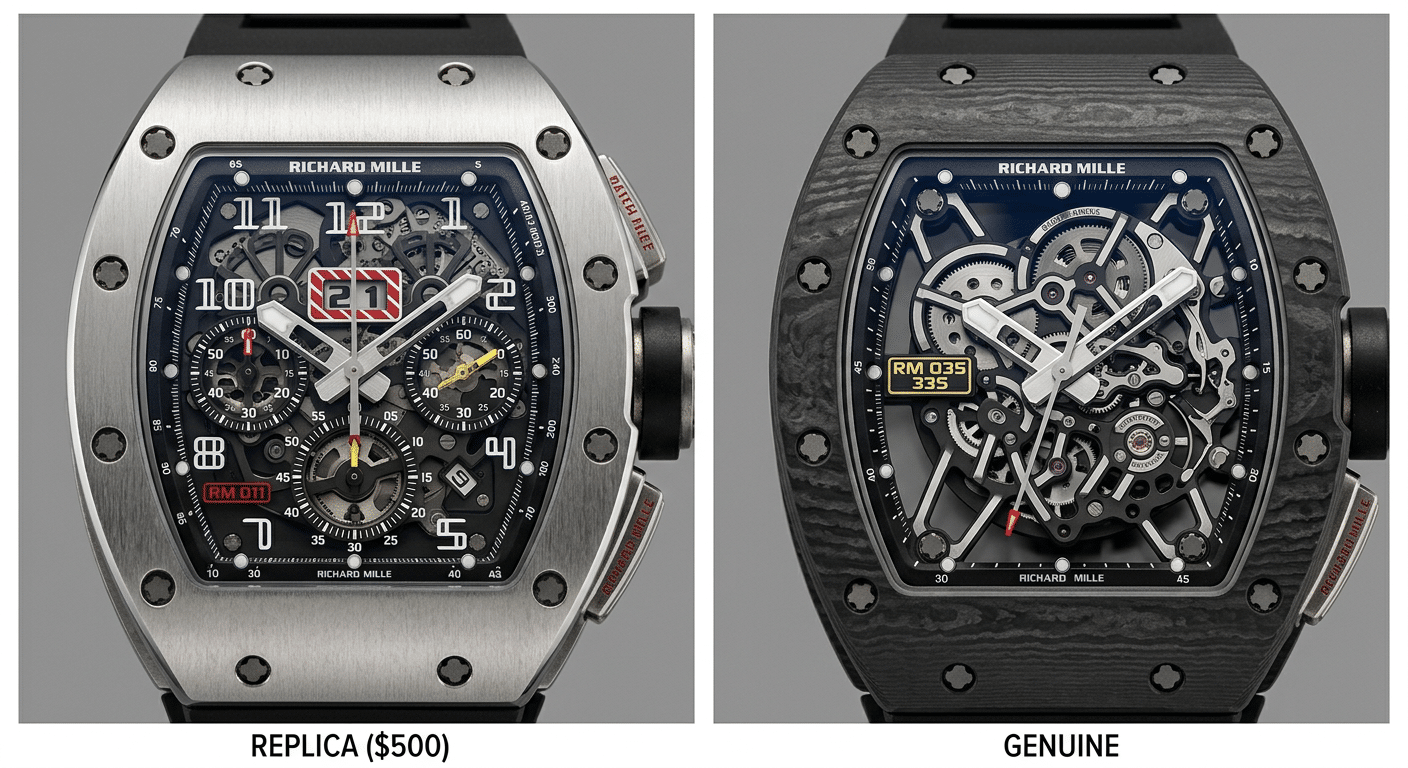
The RM case geometry replica problem defines the most persistent limitation of $500 Richard Mille clones. While frontal photography captures the general tonneau silhouette, the physical reality of these cases reveals systematic deviations in curvature, proportion, and dimensional accuracy. The tonneau case accuracy required to replicate genuine RM architecture involves complex compound curves that taper in multiple planes—a geometry that $500 manufacturing budgets cannot reliably execute. Instead, budget replicas typically employ simplified barrel shapes with flattened profiles or cylindrical sections that approximate, but do not achieve, the fluid ergonomics of authentic cases.
Richard Mille case thickness represents the most immediate tactile giveaway at this price tier. Genuine RM cases maintain specific thickness-to-diameter ratios that keep the watch wearable despite its footprint; budget versions are almost universally excessively thick due to movement constraints and simplified case construction. Where an authentic reference might measure 13.5mm, a $500 equivalent often exceeds 16mm or more, creating a “tall” wearing position that sits awkwardly on the wrist. This blocky profile disrupts the intended elegant stance of the tonneau shape, transforming what should be a sleek architectural object into a cumbersome block.
The case curvature suffers similarly. Authentic RM cases flow continuously from lug to caseband to bezel, with subtle radii that accommodate wrist movement. Budget replicas exhibit abrupt transitions—flattened planes meeting at sharp angles rather than gradual curves. The lug shape often appears tacked-on rather than integrated, creating visible gaps or misalignment where the strap meets the case. These side view deficiencies become immediately apparent when the watch is handled, revealing that the tonneau barrel shape has been approximated through rudimentary machining rather than precision-engineered architecture.
Side Profile and Thickness Issues
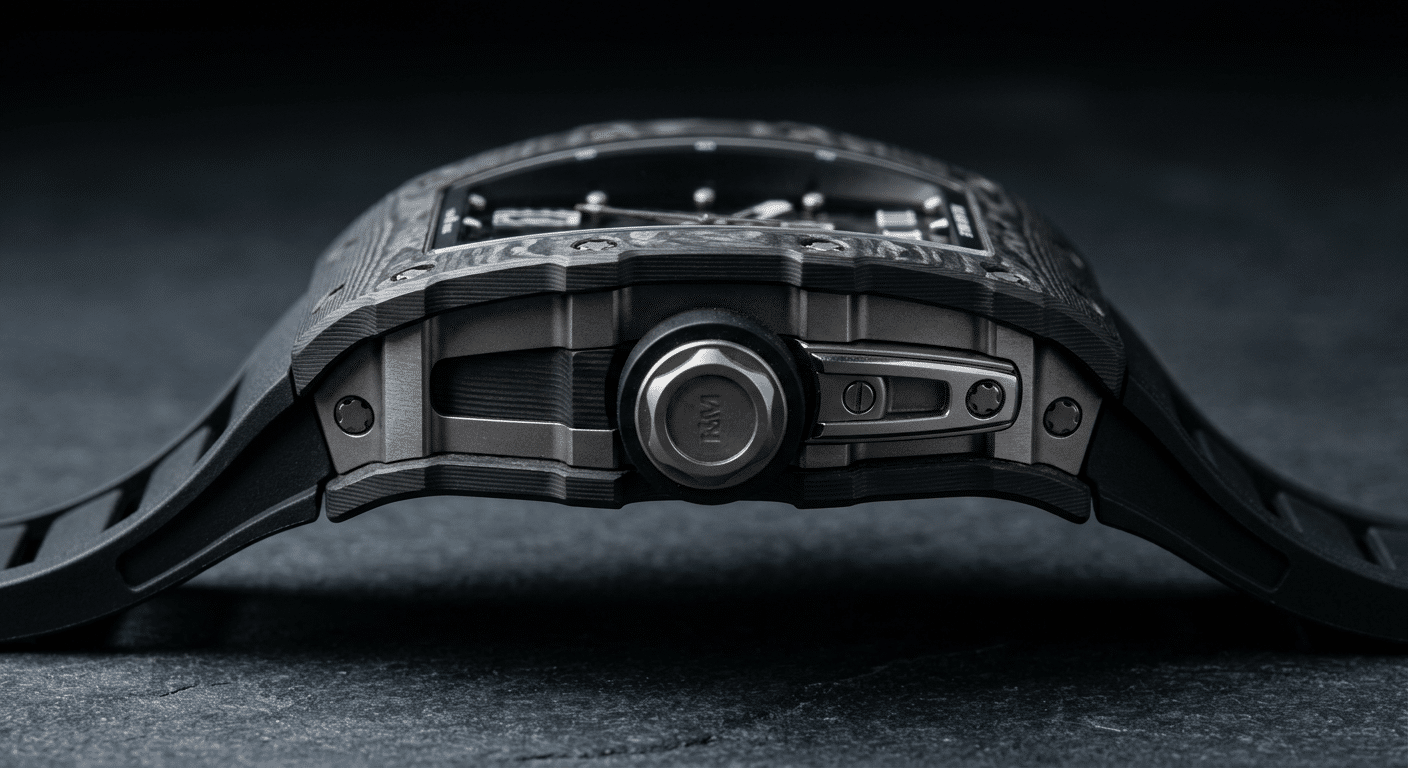
The side profile exposes the most glaring dimensional compromises hidden in frontal marketing images. Where genuine RM cases exhibit a graceful taper from the crystal edge to the caseback, creating a balanced visual mass, $500 replicas often display a uniform thickness or an awkward stepped profile. The case flanks may appear slab-sided and vertical rather than angled inward, contributing to the perception of excessive bulk. The junction between the bezel and caseband often reveals machining marks or gaps where the components meet imperfectly, lacking the seamless flush fit of authentic construction. This side-view awkwardness transforms the watch from an elegant curved object into a geometrically confused assemblage when viewed from any angle other than straight-on.
Screw Placement and Case Back Shortcuts
The hexagonal spline screws that define RM aesthetics become telltale indicators of cost-cutting upon close inspection. On $500 replicas, these screws often sit at inconsistent depths—some flush with the surface, others recessed or protruding—indicating imprecise drilling and tapping during case machining. The screw heads themselves may use generic hex patterns rather than the specific spline geometry of genuine RM screws, and the titanium nitride coating often appears too yellow or too pale compared to the warm gunmetal tone of authentic hardware.
The case back reveals perhaps the most significant construction shortcuts. Rather than the integrated tripartite architecture of genuine RM cases, according to replica tier comparison, $500 replicas typically employ simple press-on case backs or basic screw-down designs that compromise the watch’s structural integrity and water resistance. The display window, if present, may use mineral glass rather than sapphire, and the edges often show rough machining or sharp burrs where the case back meets the caseband. These rear-facing shortcuts matter because they affect daily wear—sharp edges catch on clothing, press-on backs may pop loose, and the lack of proper sealing makes these watches vulnerable to moisture intrusion despite their ostensibly sporty aesthetic.
Dial Depth and Skeletonization: Decorative Surface vs Structural Reality
Authentic Richard Mille dials achieve their visual impact through genuine architectural depth—multiple layers of sapphire crystal and titanium that create actual voids, shadows, and dimensional complexity. At the $500 tier, factories reverse-engineer this effect through surface decoration rather than structural engineering, creating a convincing illusion that collapses under angled light or three-dimensional viewing.
The $500 approach typically involves a single metal plate—often brass or steel—covered with chemically etched patterns that suggest gear teeth and bridge shapes. These plates sit flat against the movement, sometimes with minimal relief, creating what amounts to a two-dimensional photograph of a skeleton movement rather than an actual exposed mechanism. When viewed head-on under flat studio lighting, this can appear impressively complex; when tilted even slightly, the surface reveals its uniform flatness as light fails to create the shifting shadows and depth cues that characterize genuine skeletonization.
Richard Mille’s authentic dials use sapphire crystal rings and titanium bridges suspended at varying heights, creating actual physical depth measured in millimeters rather than microns. Light plays through these layers, creating natural vignetting and shadow gradients. The $500 replica cannot replicate this light behavior because there are no physical layers for light to traverse—only a decorated surface that reflects light uniformly regardless of viewing angle. This becomes immediately apparent in natural daylight, where the dial appears “printed” or sticker-like rather than architecturally excavated.
The “gear” visual elements on $500 replicas often present particular tells. Genuine RM movements expose actual working gears—wheels with depth, tooth profiles, and mechanical function. Budget replicas frequently use non-functional decorative wheels screwed onto the surface plate, sometimes even painted silver circles with black “teeth” printed around the circumference. These never rotate or interact with the actual movement beneath, serving purely as visual placeholders. When the crown is turned, these fake gears remain stationary while the real movement winds below them—a detail visible upon close inspection or when the watch stops but the “gear” shows no corresponding mechanical behavior.
What to Check Before You Decide
Request angled dial photos that show side views of the dial opening. Look for shadows between layers indicating actual depth. Flat, uniform lighting across the dial suggests printed surface decoration rather than cutout depth. Ask for a video of the crown being turned—genuine skeletonization allows you to see the actual winding wheels engage and rotate; decorative plates will show static, non-moving visual elements while the crown turns.
Movement Reality: Automatic Solutions at the Budget Tier
The $500 Richard Mille replica typically houses a standard Japanese or Chinese automatic movement—most commonly the Miyota 8215 or basic Seagull calibers—onto which factories screw decorative “skeleton plates” to create the visual impression of an exposed, high-complication movement. This approach prioritizes photography over horology: the watch photographs convincingly but behaves mechanically like the entry-level automatic it actually is, with all the limitations that implies for daily wear.
Movement Architecture: Technical Specifications vs. Marketing Claims
The Miyota 8215 caliber frequently encountered in $500 Richard Mille replicas operates according to specifications established by Citizen Watch Co.’s Miyota division. This automatic movement operates at 21,600 vibrations per hour (3 Hz), providing a beat rate of 6 ticks per second on the seconds hand—a visibly slower cadence than the 28,800 vph (4 Hz) or 36,000 vph (5 Hz) frequencies common in genuine high-horology calibers[1]. The 8215 offers a stated power reserve of approximately 40 hours when fully wound, though in practice within oversized tonneau replica cases with heavy decorative plates attached, owners often experience 30–35 hours of reserve[2]. The movement utilizes a unidirectional winding system via a ball-bearing rotor, which produces the characteristic rotor noise frequently reported by $500 RM replica owners—a clicking sound during wrist movement as the rotor engages the winding gears in a single direction while freewheeling in the reverse direction.
Technical documentation reveals additional constraints relevant to tonneau-case adaptation. The 8215 measures 26mm in diameter with a thickness of 5.67mm—dimensions designed for conventional round watches. When forced into tonneau cases requiring movements to sit at specific angles or within constrained heights, the 8215’s relatively tall profile (compared to genuine RM ultra-thin calibers measuring under 3mm) necessitates the case thickness compromises previously detailed[3]. Furthermore, the 8215 lacks hacking seconds (the seconds hand continues moving when the crown is pulled to set time), a feature standard in genuine RM calibers, creating an additional functional discrepancy visible during time-setting. These technical specifications confirm that the $500 tier’s movement limitations stem from fundamental caliber architecture rather than factory-specific quality failures—no amount of regulation can transform a 21,600 vph Miyota 8215 into a 28,800 vph flyback chronograph with variable geometry rotor.
These movements were never engineered for tonneau-shaped cases or skeletonized display. The Miyota 8215, a reliable but basic workhorse, runs at 21,600 vibrations per hour (3 Hz) rather than the genuine RM’s 28,800 vph (4 Hz), creating a visibly slower sweep of the seconds hand that reveals the movement’s humble origins to informed observers. The power reserve typically measures 30–40 hours maximum—sometimes less as the movement ages—meaning the watch requires daily wearing or regular manual winding to maintain time. This contrasts sharply with genuine RM movements offering 55+ hours of autonomy.
The physical installation of these movements into $500 cases creates specific ownership compromises. Because the tonneau case shape differs fundamentally from the round movements designed for standard watches, rotors often scrape against case backs or sit slightly misaligned, generating audible rotor noise—a persistent clicking or whirring sound during wrist movement that betrays the watch’s budget construction. The winding efficiency suffers from this misalignment as well; the rotor may not achieve optimal swing angles within the tonneau cavity, requiring more frequent manual winding than the movement would need in its native round case.
The “skeletonization” visible through the dial typically consists of brass or steel plates screwed atop the base movement, with cutout windows revealing the actual movement beneath. These plates add weight and thickness while serving no mechanical function—they exist purely to create visual complexity when photographed. The actual movement visible through cutouts remains a standard automatic caliber with standard finishing, not the architectural titanium bridges and free-sprung balances of genuine RM construction. When the crown is pulled to set the time, these decorative plates may shift slightly if screws have loosened, creating a disconcerting visual instability that genuine skeleton movements never exhibit.
Movement descriptions in the replica market should be read as configuration references rather than claims of official brand-caliber origin. When a listing describes an “RM-style automatic movement” or “clone caliber,” this typically indicates a replica-market adaptation—often a decorated or plated standard automatic—rather than a genuine Richard Mille manufactured component. Buyers should distinguish between movement layout (the visual arrangement of bridges and wheels), decoration (the finishing applied to visible surfaces), and actual mechanical architecture (the underlying gear train and escapement design). Understanding that a $500 replica uses a standard automatic caliber adapted to the tonneau case—rather than an integrated proprietary movement—helps set appropriate expectations for reliability, serviceability, and long-term performance.
Winding Feel and Crown Interaction
The tactile experience of winding a $500 RM replica reveals the mechanical compromise inherent in repurposing round movements for tonneau cases. The crown stem often enters the movement at a slight angle due to case geometry constraints, creating a gritty, imprecise winding sensation—sometimes described as “crunchy” or “gravelly” compared to the smooth, liquid precision of luxury watch winding mechanisms. The crown may wobble slightly when pulled to the setting position, and the date change (if present) often occurs gradually over several hours rather than snapping cleanly at midnight. These characteristics do not necessarily indicate immediate failure, but they confirm that the watch houses a standard automatic movement adapted to an exotic case shape rather than an integrated architectural movement designed specifically for the tonneau form.
Functional Priorities Over Visual Decoration
The skeletonized dial creates a specific evaluation trap at $500: buyers prioritize the visual density of gears, plates, and “technical” aesthetics while overlooking functional behaviors that determine daily wearability. The critical distinction lies between decoration that moves and mechanics that function. A $500 RM replica may display impressive visual complexity through stacked metal plates and non-functional gear wheels, yet suffer from rotor scraping against the caseback, seconds hand stutter due to clearance issues, or crown wobble that makes time-setting imprecise. These functional defects create daily friction—audible rotor noise in quiet rooms, the need to reset the time daily due to poor power reserve, or the fear of shearing the crown stem—while the decorative gears provide only occasional visual satisfaction.
The practical buyer at this tier should invert the typical evaluation hierarchy. Before admiring the skeleton pattern, verify that the rotor spins without contacting the caseback (request a video with the watch held to the ear). Before praising the “finishing” on visible bridges, check that the hands clear the crystal and each other when the watch is tilted. Before assessing the color of the torque indicator printing, confirm that the date wheel (if present) changes within 15 minutes of midnight rather than drifting for hours. These functional checks reveal whether the watch can survive as a wearable object; the decorative checks only reveal whether it can survive as a photograph. At $500, a watch with a simpler dial but quiet, smooth mechanical operation provides more ownership satisfaction than a visually busy watch with grinding rotor bearings and misaligned hands.
This prioritization matters because seller photos emphasize decorative elements—macro shots of gears and plates—while hiding functional flaws like rotor noise or hand wobble. The buyer must specifically request evidence of functional behavior: a video of the crown being pulled and turned, an audio clip of the rotor spinning, or a time-lapse of the date change. These requests often reveal assembly issues that static beauty shots conceal. In many cases, a $500 RM with less elaborate dial decoration but correct movement installation height and quiet operation represents the superior purchase, even if it appears “less authentic” in photos, because it can actually be worn without mechanical anxiety.
Understanding Movement Claims: Clone Architecture vs. Genuine Calibers
Interpreting movement terminology in the replica market requires careful distinction between visual layout, mechanical architecture, and brand origin. When a $500 Richard Mille replica is described as having an “RM-style movement” or “clone caliber,” this terminology refers to the visual arrangement of bridges, plates, and wheels designed to mimic the appearance of genuine Richard Mille calibers such as the RMUL1 or RMAS7. These descriptions do not indicate that the movement contains genuine Richard Mille manufactured components, official brand engineering, or equivalent performance specifications to in-house calibers.
The technical reality at the $500 tier typically involves standard Japanese or Chinese automatic movements—commonly the Miyota 8215 or Seagull ST16 series—that have been modified with decorative plates and bridge arrangements to create a skeletonized visual effect. These base movements operate at 21,600 vibrations per hour (3 Hz) rather than the 28,800 vph (4 Hz) or higher frequencies common in genuine high-horology calibers, and they lack the advanced features of authentic RM movements such as variable geometry rotors, free-sprung balances, or grade 5 titanium construction. The “clone” designation in replica marketing refers primarily to cosmetic appearance and general layout inspiration, not mechanical equivalence.
Buyers should interpret movement claims carefully: a “decorated Miyota” indicates a standard caliber with visual modifications; a “skeletonized automatic” suggests the base movement is visible through cutaway plates; and “RM-style” typically means the bridge shapes vaguely echo genuine RM architecture. None of these terms imply that the movement will fit genuine RM service specifications, maintain chronometric standards equivalent to the authentic reference, or contain the advanced materials (titanium, carbon composite) used in genuine Richard Mille movements. This distinction matters for long-term ownership: these movements require standard automatic watch servicing by general watchmakers, not the specialized Richard Mille service centers equipped to handle genuine calibers. Furthermore, any claim that a replica movement is “Swiss made” or “genuine Swiss” should be treated with extreme skepticism at the $500 price point, as this would indicate either misrepresentation or a different price tier entirely.
Weight Balance and Material Authenticity
At the $500 tier, Richard Mille replicas rely on plated base metals—typically stainless steel or zinc alloys—rather than the grade 5 titanium or Carbon TPT composites found in genuine pieces. This material substitution creates an immediate tactile disconnect. Where an authentic RM feels surprisingly dense for its size, settling onto the wrist with a low center of gravity, budget replicas often feel hollow or “tinny,” lacking the reassuring mass that signals genuine luxury engineering.
The weight distribution problems run deeper than simple heft. Genuine RM movements weigh approximately 4.3 grams thanks to titanium construction, contributing to a balanced, neutral wrist presence. $500 replicas use standard automatic movements—often Miyota or basic Chinese calibers—weighing 15 to 20 grams or more. This excess mass sits high in the case, creating a top-heavy feel that causes the watch to “wobble” or shift during wrist movement rather than staying planted.
Plating quality at this price point introduces additional compromises. The base metal usually remains visible at lug ends, crown guards, and caseback edges—areas where plating wears through within weeks of regular use, revealing the dull gray substrate beneath. This “two-tone” effect, with bright plating giving way to dark base metal at contact points, signals the watch’s budget origins more reliably than any visual detail visible in photographs.
The sensory experience extends to sound. Genuine RM cases, built from advanced composites and titanium, produce a muted, solid “click” when tapped or when the crown engages. Budget alloys create a higher-pitched, resonant “clink”—the acoustic signature of thinner walls and less dense material. This auditory tell becomes apparent within days of ownership, betraying the visual confidence the watch may project in still images.
QC Red Flags Specific to Budget Richard Mille Replicas
Evaluating a $500 Richard Mille replica requires scrutiny of specific architectural elements that separate acceptable compromises from assembly failures. Unlike round watches where minor misalignments hide easily, the RM’s exposed hex screws, skeletonized dial, and complex case geometry amplify any deviation. Knowing which flaws represent normal $500-tier limitations versus unacceptable shortcuts prevents costly disappointments.
Hex Screw Alignment and Seating
The hexagonal screws securing the bezel and case represent the most immediate quality indicator. On genuine RM watches, these screws sit perfectly flush with the bezel surface, their hexagonal edges aligned precisely with the case geometry. At the $500 tier, acceptable examples show screws sitting nearly flush with minimal height variation. Unacceptable examples display screws tilted at angles, sitting at noticeably different depths, or showing stripped hex edges from poor tooling. If screws protrude significantly above the bezel plane or show random rotational alignment, the case machining falls below even entry-level standards.
Date Wheel Positioning and Printing
For models featuring date complications, the wheel’s placement within the skeletonized dial reveals assembly precision. Acceptable $500 examples position the date numerals roughly centered in their window apertures, with legible if not perfect font matching. Red flags include dates sunk too deeply into the dial creating shadowed, barely visible numerals, or wheels sitting so high they nearly touch the underside of the crystal. Crooked date displays—where the numbers tilt visibly relative to the dial architecture—indicate poor movement seating or incorrect dial spacer installation. While slight font variations from genuine are expected at this price, illegible or mechanically misaligned dates suggest rushed assembly.
Hand Clearance and Alignment
The skeletonized dial exposes the relationship between hands, crystal, and movement bridges. Critical checks include: minute and hour hands clearing the crystal interior without scraping (visible as dust accumulation or scratches on the crystal underside), hands clearing any exposed movement screws or bridges without contact, and all three hands (including seconds if present) sharing a common center point without visible wobble. At $500, minor height variations between hour and minute hands are acceptable, but any hand actually contacting the crystal or catching on visible movement components indicates incorrect movement installation height or wrong crystal specification. A seconds hand that stutters or stops intermittently while the watch runs otherwise normally suggests insufficient hand clearance creating friction.
Rehaut and Case Edge Finishing
The rehaut—the inner ring between dial and crystal—provides finishing quality cues. Acceptable examples show relatively even machining marks or consistent brushing. Unacceptable examples display rough milling marks, visible tool chatter patterns, or sharp edges where the rehaut meets the crystal seat. The junction between case bezel and caseband should show minimal gaps; visible light leaks between these components indicate poor case machining tolerances or incorrect gasket seating. While minor finishing inconsistencies are expected at $500, raw, unfinished metal edges or gaps large enough to see through indicate assembly below acceptable standards.
QC Photos to Request
Before committing to a $500 RM replica, request specific angles that reveal these common failure points. Side profile shots showing the full case thickness and lug curvature help identify geometry problems hidden in frontal views. Angled dial photographs taken from 45 degrees above reveal whether skeletonization has actual depth or merely printed surface decoration. Close-up macro shots of three to four bezel screws show whether hex edges remain crisp and whether screw heads sit uniformly flush. Case back photographs showing the movement perimeter verify whether the caliber sits securely in the case or floats with visible gaps. Finally, a straight-on date window shot checks alignment and depth. These six image angles provide sufficient information to reject examples with major assembly flaws while accepting the minor imperfections characteristic of the $500 tier.
When reviewing QC photos for a Richard Mille replica, focus verification efforts on dimensional accuracy and assembly integrity rather than surface finishing alone. Request a straight-on side profile shot with a ruler or reference object visible to confirm case thickness claims—entry-level replicas often exceed 16mm even when listed as “thin.” Ask for a video of the crown being pulled and turned to check for grittiness or wobble that indicates stem misalignment. For skeleton models, request a lume shot to verify that dial markers are applied rather than printed, and a tilted angle showing the dial at 45 degrees to reveal whether the skeletonization has actual depth or merely printed surface texture. These specific checks reveal assembly quality and dimensional honesty that stock factory photos cannot convey.
Quality Control Note: For replica and super clone watches, buyer confidence depends on visible quality-control details such as case finishing, dial printing, bezel alignment, bracelet fit, clasp engraving, datewheel position, and movement configuration. These details should be checked model by model rather than assumed from a factory name alone.
The Limits of Visual Verification: What QC Photos Cannot Prove
Quality control photography serves as a risk-reduction tool in replica purchasing, but buyers must maintain realistic expectations about what these images can verify. Detailed photos of the dial printing, bezel screw alignment, hand centering, and case finishing can reveal obvious assembly flaws—crooked date wheels, misaligned bezel inserts, or scratched crystals—before shipment. However, QC photos cannot certify that a replica watch will pass as genuine, survive long-term wear, or maintain water resistance. The two-dimensional nature of photography flattens perspective, often concealing case thickness discrepancies, dial depth limitations, or the tactile “feel” of materials that distinguish replicas from genuine articles upon handling.
Specifically, QC photos rarely capture the acoustic signature of the case (the hollow “clink” of plated base metal versus the solid “thud” of genuine titanium composites), the thermal conductivity differences detectable when handling the watch, or the weight distribution that creates the top-heavy wearing experience common in budget replicas. Macro photography can verify that screws appear seated, but cannot confirm that they are functional (some decorative screws are glued in place) or that the caseback sealing will prevent moisture ingress. Video evidence of the crown operation, rotor spinning, and hand movement provides more information than still images, yet even comprehensive QC documentation cannot transform a replica into a genuine watch or guarantee that it will withstand scrutiny by knowledgeable observers.
The appropriate use of QC verification is to confirm that the specific unit you will receive meets the assembly standards acceptable for your intended use—checking that the date wheel is centered, the hands clear the crystal, and the finishing matches the tier’s expectations—rather than to verify “authenticity” or “genuine equivalence.” A $500 replica with perfect QC photos remains a $500 replica, super clone vs cheap replica, with the material, mechanical, and dimensional limitations inherent to that price point. Furthermore, QC photos represent the watch’s condition at the moment of inspection; they cannot predict rotor bearing wear, plating degradation, or gasket failure that may occur within weeks of receipt.
Legal and Regulatory Context: Trademark and Customs Considerations
Purchasing and importing $500 Richard Mille replicas involves navigating complex intellectual property and customs enforcement frameworks that vary significantly by jurisdiction. Richard Mille SA holds trademark protections for its distinctive case shapes, dial configurations, and brand identifiers across major intellectual property registries including the USPTO (United States Patent and Trademark Office) and EUIPO (European Union Intellectual Property Office)[6]. These trademark protections extend beyond literal logo copying to encompass trade dress—the overall visual appearance of the product that identifies its source. Consequently, replicas that reproduce the tonneau case shape, hexagonal screws, and skeletonized dial aesthetic may constitute trademark infringement regardless of whether the “Richard Mille” name appears on the dial, creating legal exposure for both sellers and, in certain jurisdictions, purchasers.
Customs enforcement agencies actively intercept replica timepieces at international borders. In the United States, U.S. Customs and Border Protection (CBP) operates under authority from the Lanham Act (15 U.S.C. § 1114) to seize goods bearing counterfeit trademarks, with specific provisions for watches and jewelry[7]. Similar enforcement mechanisms exist within the European Union through EU Regulation 608/2013 concerning customs enforcement of intellectual property rights, and in the United Kingdom under the Trade Marks Act 1994 and customs regulations post-Brexit. Importantly, these regulations typically treat replica watches as counterfeits rather than “homages” when they reproduce protected trade dress elements, regardless of whether the purchaser intends personal use versus resale. While individual customs seizures vary by port and shipment method, buyers should recognize that importing a $500 RM replica carries measurable risk of confiscation without compensation, and potentially additional scrutiny of future shipments.
Final Assessment: Who Should Consider a $500 RM Replica
A $500 Richard Mille replica occupies a specific niche in the watch ecosystem: it is a fashion accessory that delivers immediate visual impact without engineering authenticity. This price tier makes sense only for buyers who prioritize the aesthetic statement over mechanical integrity, tactile satisfaction, or long-term durability. If you understand that your $500 buys access to a look rather than ownership of a timepiece, this tier might align with your expectations.
When This Tier Makes Sense
The entry-level RM super clone fits three specific buyer profiles. First, occasional wearers who need a statement piece for specific events—dinners, photoshoots, or social gatherings—where the watch serves as costume rather than daily tool. Second, fashion-focused buyers who view watches as jewelry and care primarily about wrist presence and brand association rather than horological merit. Third, curious experimenters who want to test whether the Richard Mille aesthetic suits their style before considering more substantial investments in higher-tier replicas or genuine pieces.
For these users, the compromises—thicker cases, decorative rather than functional skeletonization, and limited lifespan—matter less than the immediate visual payoff. If you treat this purchase as a fashion watch with a six-month to two-year lifespan, the value proposition becomes intellectually honest.
When to Avoid This Tier Entirely
Do not purchase a $500 RM replica if you require daily-wear reliability. The strap integration issues, case thickness discrepancies, and movement fragility make these watches poor companions for consistent use. If you plan to wear this watch more than twice weekly, you will likely encounter strap cracking, accuracy drift, or case finish degradation within months.
Similarly, avoid this tier if you are a collector or enthusiast seeking tactile authenticity. The “tinny” feel of plated base metals, the hollow sound of the case, and the gritty winding experience betray the replica nature immediately upon handling. If you derive satisfaction from engineering quality, material integrity, or horological history, this tier will disappoint you regardless of how convincing the photos appeared.
Finally, avoid this purchase if you feel any psychological discomfort wearing a “compromise.” If you will constantly worry about detection, feel inauthentic, or find yourself making excuses for the watch’s limitations, the $500 savings will not justify the mental overhead.
The Honest Value Equation
At $500, you are purchasing aesthetic access, not engineering satisfaction. This price buys you the silhouette, the color scheme, and the general wrist presence of a Richard Mille, delivered through materials and methods that prioritize photographic impact over physical refinement. You are paying for the look—the ability to participate visually in the RM aesthetic—while accepting that the substance (case engineering, movement architecture, material authenticity) remains fundamentally absent.
This is not necessarily a poor transaction, provided your expectations align with this reality. If you need a statement piece for occasional deployment, accept its disposable nature, and find genuine satisfaction in the visual effect alone, the $500 RM replica delivers exactly what you paid for: temporary aesthetic access to an otherwise inaccessible design language. Just understand that when the strap cracks, the plating wears through, or the movement stops, you are not experiencing a defect—you are reaching the natural end of this product’s designed lifespan.
Setting realistic ownership expectations is essential for satisfaction with a $500 Richard Mille replica. Even when the initial QC photos appear acceptable, buyers should understand that these watches function as temporary aesthetic accessories rather than durable mechanical instruments. Water resistance claims should be treated skeptically—despite sporty appearances, these watches typically lack proper gaskets and case sealing, making them vulnerable to moisture even from hand washing. The movement, while functional initially, operates without the shock protection and regulation stability of genuine calibers, meaning accuracy will drift and mechanical failure becomes increasingly likely after six months of regular wear. Servicing these movements often costs more than replacement, as few watchmakers will work on non-standard tonneau adaptations of base calibers. By accepting these limits—treating the watch as a consumable fashion item with a finite lifespan rather than an investment or heirloom—buyers can align their expectations with the practical reality of the $500 tier.
Editorial Perspective: This guide reflects the practical reality that $500 Richard Mille replicas occupy a distinct category separate from both genuine watches and higher-tier super clones. The assessments here are based on the mechanical constraints of tonneau-case adaptation, the material limitations of plated base metals, and the ownership patterns observed across entry-level RM clones. The value judgment presented—that these watches function as temporary aesthetic accessories rather than durable instruments—stems from the technical reality of Miyota movements in oversized cases, not from depreciation fears or authenticity debates. At cleanvsfactory.com, this comparison is treated as a model-specific buying question rather than a simple factory ranking. The factory name helps narrow the shortlist, but the final decision still depends on the movement, case profile, dial execution, bracelet feel, and how the buyer plans to wear the watch—factors that can vary significantly even within the same factory’s RM offerings at the $500 tier.
Price Interpretation and Tier Jumping
Understanding what the $500 price represents requires clarity about what changes when budgets increase to $800–$1,200. At the higher tier, factories invest in RM-specific cloned movements (such as the RMUL1 or RMAS7 calibers) rather than repurposed Miyota bases, resulting in correct hand-stacking, functional chronograph modules where applicable, and power reserves approaching genuine specifications. Case construction shifts from plated steel to actual carbon fiber composites or grade 5 titanium, reducing thickness from 16mm+ toward the genuine 13.5mm and eliminating the top-heavy wearing experience. Sapphire crystals replace mineral glass, and straps transition from generic rubber to fluoroelastomer compounds with proper lug integration.
For buyers considering the $500 tier, the relevant question is whether the aesthetic access justifies the functional compromises, or whether saving for the $1,200 tier provides better long-term value. The math favors tier-jumping if the intended use exceeds occasional event wear. A $500 replica requiring replacement within six months (strap, movement service, plating wear) represents a $1,000 annual cost if purchased twice yearly. A $1,200 replica with a serviceable movement and durable case materials may function for two to three years with only strap replacement, reducing the annualized cost while providing a wearing experience closer to the genuine article. However, this calculation only holds if the buyer actually intends to wear the watch regularly; for pure photography or single-event use, the $500 tier remains the economically rational choice.
Price at $500 also reflects seller risk allocation rather than component quality. Much of the $500 price covers the seller’s after-sales support buffer, shipping insurance, and margin for QC failures—not the watch’s intrinsic manufacturing cost. This explains why two identical $500 RM replicas from different sellers may exhibit different QC standards or packaging quality despite identical factory origins. The price does not automatically correlate with component upgrades at this tier; it often reflects the seller’s confidence in their own QC process and willingness to handle returns. Buyers should treat price as a signal of seller risk tolerance rather than a guarantee of specification improvements, verifying whether the cost difference between two $500 listings represents actual component upgrades or merely different margin structures.
The Ownership Timeline: When $500 RM Issues Emerge
Purchasing a $500 Richard Mille replica initiates a predictable deterioration timeline that buyers should understand before committing. These watches typically provide a functional “honeymoon period” lasting days or weeks, followed by gradual degradation of components and wearing experience. Understanding this lifecycle helps set appropriate expectations—treating these pieces as consumable fashion accessories rather than durable instruments.
Week 1: The Honeymoon Phase
During the first seven to ten days, most $500 RM replicas function as advertised. The movement keeps time within acceptable ranges (typically losing or gaining 15–30 seconds daily), the strap feels stiff but serviceable, and the visual impact remains satisfying. This period represents the watch at its peak performance state. Any major defects—complete movement failure, crystal fogging, or hand detachment—usually appear within these first few days if quality control missed critical assembly errors. If the watch survives week one without catastrophic failure, it typically enters the gradual degradation phase rather than sudden death.
Month 1–3: Accumulating Compromises
Between weeks two and twelve, the shortcuts inherent to $500 construction become physically apparent. The rubber or synthetic strap—often made from generic compounds rather than fluoroelastomer—stiffens further and may develop surface cracking near the lug attachment points where constant flexing occurs. Strap keeper loops often stretch or tear first, rendering the watch difficult to secure comfortably. Simultaneously, the plating on case edges, crown, and clasp begins wearing through at contact points, revealing the dull base metal beneath—typically most visible on the underside of the clasp where it meets desk surfaces or the crown where fingers grip daily.
Mechanically, the movement’s initial accuracy often drifts during this period. The basic automatic calibers used at this price point lack the regulation stability of higher-tier clones, meaning daily variance may increase from ±20 seconds to ±40 seconds or more. Rotor noise—often present from day one—typically becomes more pronounced as lubrication breaks down or rotor bearings loosen. The winding feel may grow gritty or inconsistent as the stem and keyless works settle into their loosely machined tolerances.
Month 6 and Beyond: The Consumable Reality
Beyond the six-month mark, $500 RM replicas enter a phase where continued function becomes increasingly precarious. The rubber strap often requires replacement due to complete cracking at the lugs or loss of elasticity that prevents secure fitting. Movement failures become more likely as the basic automatic calibers—never designed for the torque requirements of large skeleton hands or the shock of daily tonneau-case wear—begin showing signs of escapement wear or mainspring fatigue. Crystal fogging may develop as case gaskets degrade and lose water resistance, though these watches were never suitable for water exposure regardless of gasket condition.
Crucially, the degradation is not uniform. Some $500 replicas continue functioning for two years or more with only strap replacement and tolerance for increased timing variance. Others experience complete movement failure within four months. This unpredictability stems from the inconsistent component quality at this price point—movements from the same factory batch may contain bearings from different suppliers, and case machining tolerances vary significantly based on when the tooling was last replaced. Buyers should understand they are purchasing a lottery ticket with weighted odds rather than a guaranteed instrument.
The appropriate framework for understanding these watches is consumable fashion rather than mechanical timepiece. Like a pair of fashion sneakers or a seasonal jacket, the $500 RM replica delivers aesthetic value for a limited duration before replacement becomes necessary. Buyers who accept this framework—budgeting for potential strap replacement within three months and understanding the watch may become non-functional within a year—can extract satisfactory value from these pieces. Those seeking a durable daily instrument or a “forever watch” will find the $500 tier fundamentally mismatched to their expectations, regardless of how convincing the initial photographs appeared.
Ownership Boundaries: Use, Disclosure, and Legal Risk
Owning a Richard Mille replica for personal use, collection, or aesthetic enjoyment falls within a different legal and ethical category than representing that replica as a genuine article. The technical discussions in this guide—regarding factory differences, movement types, and quality verification—are intended to help buyers make informed purchases and set realistic expectations for their own use. They are not intended to assist in misrepresentation, resale fraud, or authentication deception. A replica watch, regardless of visual quality or price tier, should never be presented, sold, or used as a genuine Richard Mille timepiece.
The boundary between permissible personal ownership and problematic misrepresentation becomes particularly relevant in social contexts, resale situations, and insurance claims. Wearing a replica to a dinner party may involve personal aesthetic choices; claiming it is a $200,000 genuine article involves deception. Similarly, selling a replica—even at a loss—without clear disclosure of its replica status constitutes fraud in most jurisdictions. Buyers should understand that the “super clone” terminology refers to the relative visual sophistication of the replica compared to lower-tier fakes, not to any legal or commercial equivalence with genuine luxury watches.
This distinction matters for practical risk management. Customs seizures, discussed previously, represent a civil enforcement matter regarding trademark infringement and importation. Criminal liability typically attaches only when individuals attempt to pass replicas as genuine in commercial contexts, commit insurance fraud, or engage in resale deception. By maintaining clear boundaries—purchasing for personal use, avoiding claims of authenticity, and understanding that these watches are homage objects rather than genuine luxury goods—buyers navigate the legal landscape more safely while avoiding the ethical complications of misrepresentation. The safest use of factory and movement information is to avoid overpaying or misunderstanding quality, not to misrepresent a replica watch as genuine.
[1] Miyota, “Caliber 8215 Specifications,” Citizen Watch Co., Ltd., Miyota Division.
[2] Richard Mille, “RM 055 Bubba Watson Technical Specifications,” Richard Mille SA.
[3] Richard Mille, “RM 11-03 McLaren Automatic Flyback Chronograph Technical Specifications,” Richard Mille SA.
[4] International Organization for Standardization, “ISO 22810:2010 Horology — Water-resistant watches,” ISO.
[5] U.S. Customs and Border Protection, “Intellectual Property Rights: Seizures and Penalties,” referencing 15 U.S.C. § 1114 (Lanham Act) and 19 U.S.C. § 1526.
[6] European Union Intellectual Property Office (EUIPO), “Trade Mark Database,” and U.S. Patent and Trademark Office (USPTO), “Trademark Electronic Search System (TESS),” Richard Mille SA trademark registrations.
[7] European Commission, “Regulation (EU) No 608/2013 concerning customs enforcement of intellectual property rights,” Official Journal of the European Union.
Disclosure: This article is for general educational and comparison purposes only. Replica watches are not genuine products from the original luxury brands, and brand names are used only to identify reference designs or comparison topics. Factory names, movement descriptions, prices, availability, QC details, seller policies, and version information can change, so readers should verify important details with the seller before making a purchase decision. Replica watches should not be represented, resold, or used as genuine watches.