
Richard Mille replica prices span from roughly $300 to over $3,000, creating a confusing landscape where identical-looking listings may represent entirely different construction tiers. This article clarifies why certain models command significantly higher prices than others, per the replica tier comparison, examining how forged carbon layering, sapphire crystal molding, and movement architecture create genuine manufacturing floors that reflect material costs rather than arbitrary markup. Brand names are used here solely to identify the genuine reference designs being discussed; replica watches are not genuine products from the original luxury brands and should not be represented as authentic watches.
Instead of navigating dealer markup claims, you will learn to reverse-calculate value by verifying case thickness tolerances, carbon texture depth, and bridge construction. Whether you require a visual impression piece or a construction-accurate super clone, understanding these material and mechanical distinctions prevents paying premium-tier prices for entry-level manufacturing.
| Decision Factor | Entry Tier Reality ($300–$600) | Mid/Premium Comparison ($800+) |
|---|---|---|
| Case Material | Steel base with printed carbon film | Forged carbon layering (mid) or Grade 5 titanium/sapphire (premium) |
| Thickness Tolerance | 15–18mm (excessively thick) | 14–16mm (mid) or sub-8mm (premium) |
| Crystal Type | Mineral glass prone to scratching | Molded sapphire with seamless case integration |
| Movement Construction | Decorative fake bridges, non-functional | Functional Dandong movements (mid) or custom tourbillons (premium) |
| Price Floor Reality | $600 maximum reasonable value | Below $1,200 indicates sapphire impossibility; significant discounts signal carbon alignment issues |
Quick Questions Before You Read
Q: Why do Richard Mille replica prices vary from $300 to over $3,000?
The gap reflects real manufacturing tiers: entry-level uses steel with printed carbon patterns and mineral glass, while premium tiers employ forged carbon layering, molded sapphire crystals, and custom tourbillon movements with bridge reconstruction. Replica watches are not genuine products from the original luxury brands.
Q: How can I verify I’m getting forged carbon rather than printed steel?
Request specific case thickness measurements: 15–18mm indicates entry-level steel construction, while 14–16mm suggests genuine forged carbon. Also verify carbon texture shows dimensional depth under lighting rather than flat printed appearance.
Q: Are sapphire crystal Richard Mille replicas available under $1,200?
No. Complex sapphire crystal molding and case integration involve 30–40% manufacturing rejection rates, creating genuine price floors. Significant discounts below $1,200 typically indicate older batches with carbon alignment issues or mineral glass substitution.
Q: What thickness measurement indicates premium tier construction?
Premium Richard Mille replicas achieve sub-8mm thinness through custom movements and advanced case materials. If a dealer claims premium construction but lists thickness above 10mm, the piece likely contains mid-tier components rather than high-end architecture.
The Price Ladder: Mapping the $300 to $3000 Spectrum
The Richard Mille replica price range spans nearly an order of magnitude, from roughly $300 to over $3,000. This spread is not arbitrary. It reflects a manufacturing depth ladder where each price tier corresponds to specific technical capabilities, material processing difficulties, and production yield economics. Understanding this RM super clone cost structure requires looking past dealer markup and recognizing how carbon fiber layering, sapphire crystal molding, movement architecture, and dimensional accuracy drive costs upward.
We can map the market into three distinct pricing tiers. The Entry Tier ($300–$600) represents visual imitation without structural fidelity. These pieces prioritize the “three-foot rule”—appearing convincing in photos or at arm’s length—but use surface-printed carbon patterns, steel cases with cosmetic treatments, and decorative movement masks rather than credible architecture. The Mid/High Tier ($800–$1,600) introduces genuine manufacturing complexity. Here, forged carbon layering replaces printed vinyl, tonneau-shaped sapphire crystals are molded (not flat), and case thickness approaches genuine specifications. Factories like APS and ZF operate primarily in this band, where dimensional accuracy and material credibility become achievable. The Premium Tier ($1,800–$3,000+) represents movement architecture sophistication and production yield selectivity. These pieces feature custom bridge layouts, credible skeletonization depth, and hand-selection from high-yield batches. EUR’s tourbillon pieces and custom Vaucher-clone builds occupy this space, where price reflects not just materials but the economic reality of manufacturing rejection rates.
This is a manufacturing outcome ladder, not merely a “quality” scale. A $900 replica is not simply “better” than a $400 one in abstract terms; it is the result of different carbon fiber processing, sapphire molding capabilities, and movement architecture investments. As we examine case construction, movement tiers, and production economics in subsequent sections, the specific technical thresholds that separate these price points will become clearer.
Entry Tier: Visual Imitation Without Structural Fidelity
In the $300–$600 entry level Richard Mille replica segment, buyers receive visual impression without structural accuracy. These pieces are engineered for the “social media distance”—photographing convincingly on wrists or in car interiors, but failing the moment they encounter close inspection or knowledgeable handling. Understanding what this tier actually delivers requires looking past the surface to the specific manufacturing shortcuts that enable such low pricing.
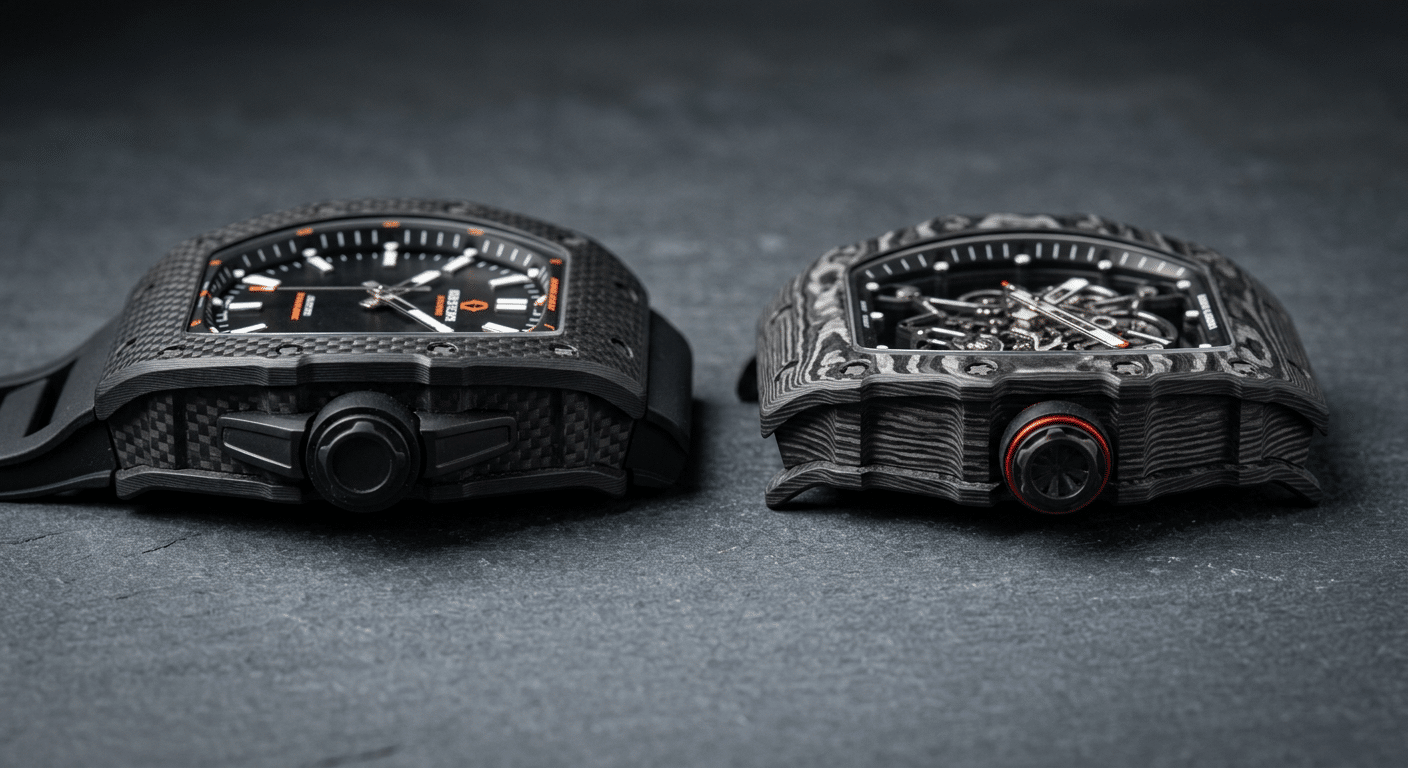
The case construction at this level relies on mimicry rather than material fidelity. Rather than compression-molded carbon fiber layers, entry-tier pieces use steel or resin cases with carbon-look surface treatments—vinyl wraps, hydro-dipped patterns, or printed decals that simulate the woven texture of genuine NTPT material. Under magnification or angled light, these surfaces reveal their artificial nature: the “weave” sits flat on the surface rather than showing the depth of layered fibers, and the pattern repeats with mechanical regularity unlike the organic variation of genuine forged carbon. Cases are thicker than genuine specifications—often 15–18mm versus the 13mm of authentic references—because they must accommodate generic movements without the sophisticated case engineering of higher tiers.
The cosmetic skeleton dial treatment represents another significant shortcut. Rather than actual bridge architecture cut from plate material, entry-tier movements receive decorative metal masks—laser-cut plates applied over standard undecorated bases like the Miyota 8215 or basic Chinese automatics. These masks create the silhouette of skeletonization when viewed head-on, but lack the three-dimensional depth of genuine bridges. The “gears” visible through the dial often include non-functional decorative wheels that do not engage with the actual gear train, and the finishing—where present—is limited to rudimentary brushing rather than the anglage and polishing found on genuine RM calibers.
Crystals at this level use standard mineral glass rather than molded sapphire. The tonneau shape is approximated through simple bending or flat crystal installation with visible gaps between the crystal edge and case bezel, rather than the complex curved sapphire molding that integrates seamlessly in higher tiers. Printed indices replace applied hour markers, and the rubber straps—while visually similar—use generic compounds that stiffen and crack faster than the fluoroelastomer used in premium replicas.
For buyers asking whether a $400 RM replica is worth it, the answer depends entirely on use case. These pieces serve adequately for social media photography, brief encounters at arm’s length, or as “fashion accessories” where detection risk is minimal. However, they carry high entry tier replica risks for wrist-level inspection, handling by knowledgeable observers, or extended wear where strap degradation and movement inaccuracy become apparent. They are visual imitations, not structural replicas, and buyers should align their expectations—and their social contexts—accordingly.
Beyond the Factory Label: Why the Same Name Delivers Different Results
Buyers often enter the market with factory rankings derived from Rolex or Omega discussions, assuming that a factory’s reputation for round steel sports watches automatically translates to Richard Mille excellence. This assumption carries significant financial and expectation risk. The manufacturing competencies required for a round steel case with a standard three-hand movement differ fundamentally from those needed for a tonneau-shaped forged carbon case with skeletonized architecture and complex crystal integration.
Consider that a factory like ZF may produce a respected Rolex Daytona but struggle with RM-specific challenges like carbon weave alignment consistency or bridge architecture depth. The tooling for a round case with flat sapphire differs entirely from that required for tonneau molding. Conversely, a factory with lower overall brand recognition in the broader replica market might have invested heavily in RM-specific CNC programming and carbon compression techniques for a particular reference, delivering superior execution for that specific model while lagging on mainstream round watches. The factory name serves as a starting filter, not a guarantee of competence across all case geometries.
This variability means that batch-specific verification matters more than factory reputation alone. A “V2” from a mid-tier factory that recently addressed specific case thickness issues may outperform a “V1” from a famous name that has not yet refined its carbon layering process for that specific reference. At cleanvsfactory.com, we typically advise treating factory claims as batch-specific propositions rather than permanent hierarchies. Buyers should request recent QC from the specific batch they will receive, verifying that the factory’s general reputation matches the execution of that particular reference and version number.
Factory Name Clarification: Factory names in the replica watch market are commonly used buyer-facing labels. They should be treated as practical market references, not as official brand affiliations, audited manufacturer identities, or guarantees of identical quality across every model.
Factory Names as Market References: Understanding Traceability Limits
Factory names like ZF, APS, BBR, and EUR function as practical market references within the replica watch ecosystem, but buyers should understand their limitations as traceability indicators. These labels represent production intentions and batch groupings rather than certified manufacturing standards or audited quality guarantees. A factory name alone cannot prove the specific construction tier, movement configuration, or carbon layering quality of the individual watch you will receive.
This traceability gap becomes particularly relevant when comparing different batches or versions. A “V2” designation from a given factory might indicate updated case thickness, improved bridge finishing, or merely a different dial supplier—without external verification, the version number describes the factory’s internal iteration but does not guarantee specific technical improvements. Similarly, two watches bearing identical factory labels may originate from different production batches with varying carbon weave alignment success rates or movement reliability.
For CleanVSFactory, the goal is to make replica watch decisions more traceable by connecting factory names to visible details, movement behavior, version differences, and practical QC checks. Buyers should treat factory claims as starting points for verification rather than proof of quality. Requesting batch-specific QC photos, verifying case thickness measurements against genuine specifications, and confirming movement architecture through macro photography provide more reliable traceability than factory labels alone. This verification approach acknowledges that factory names serve as useful market references while recognizing that ultimate quality assessment depends on the specific watch in hand rather than the reputation of the production source.
Factory Names and Movement Terminology: Compliance Disclosure
Factory designations such as ZF, APS, BBR, EUR, Clean, VS, or any other market labels function solely as buyer-facing references within the replica watch marketplace. These names should be understood as practical shorthand for production groupings or version identifiers, not as official manufacturing certifications, audited quality standards, or authorized brand affiliations. A factory name cannot guarantee identical quality across every model, nor does it imply any official relationship with Richard Mille or any other luxury watch brand.
Similarly, movement descriptions within the replica market—terms like “Dandong RMUL2,” “custom tourbillon,” “Vaucher-clone,” or “free-sprung balance”—describe replica-market movement configurations, layout architectures, or decorative treatments. These descriptions should not be interpreted as claims regarding genuine Swiss manufacture, official brand-produced calibers, or identical performance to authentic movements. Such terminology refers to the replica’s internal mechanism type, base architecture, or finishing style rather than official brand-manufactured movements. Buyers should verify specific movement specifications through QC photography rather than relying on nomenclature alone.
Factory Claim Verification: Why Documentation Trumps Reputation
The replica watch market operates with minimal standardization, meaning factory names like ZF, APS, or BBR function as loose descriptors rather than certified manufacturing guarantees. When a dealer advertises an “APS Factory RM 35-02,” the label indicates intended production standards but not necessarily the specific batch characteristics you will receive. Effective verification requires treating factory claims as hypotheses to be tested rather than facts to be accepted.
Batch-specific documentation matters more than factory reputation. Request timestamped QC photos that show the specific movement installed—not just the decorated rotor visible through the dial, but the base movement caliber number stamped on the plate beneath. For Richard Mille replicas, verify that the case thickness measurement in the QC report matches the claimed specification using digital calipers shown in the photo, not merely stated in text. A discrepancy of even 1mm between claimed and actual thickness often indicates case substitution or version misrepresentation.
Movement architecture claims require particular scrutiny. Dealers may advertise “Dandong RMUL2” or “custom tourbillon” movements, but without macro photography of the balance assembly, gear train, and mainspring barrel, these claims remain unverified. Request video of the hand-winding mechanism—genuine skeleton architecture demonstrates smooth, consistent resistance as the mainspring winds, while decorative masks often exhibit gritty, uneven feel or visible plate flexing under torque. Similarly, rotor operation should be visible in video to confirm bidirectional winding claims; unidirectional rotors produce distinct clicking sounds and single-direction rotation that betray lower-tier bases despite decorative finishing.
Case Construction Tiers: Carbon Layering, Sapphire Molding, and Dimensional Accuracy
The jump from entry-level to mid/high-tier RM replica case construction represents the single most significant technical threshold in the price ladder. In the $800–$2,000 range, factories like APS and ZF deliver case construction credibility through genuine carbon fiber layering, complex sapphire crystal integration, and dimensional accuracy that approaches genuine specifications. Understanding these manufacturing achievements requires examining the specific technical challenges of carbon TPT layering replica simulation, tonneau-shaped sapphire molding, and the persistent difficulty of achieving correct case thickness.
The carbon fiber processing at this tier represents a fundamental departure from entry-level surface printing. Rather than vinyl wraps or hydro-dipped patterns, mid-tier factories use compression-molded forged carbon or carbon fiber compression techniques that create actual layered structures. The material consists of chopped carbon fiber strands or small sheets suspended in resin, pressed under heat and pressure to create solid blocks that are then CNC-machined into case components. While not identical to genuine NTPT’s 45-degree layer rotation and autoclave curing, this forged carbon approach produces visible weave texture with depth and organic pattern variation that holds up under magnification—unlike the flat, repetitive patterns of printed alternatives. The result is layered case aesthetics that convincingly simulate the visual complexity of genuine Richard Mille cases, even if the specific fiber architecture differs microscopically.
The sapphire crystal molding required for tonneau cases represents another significant cost driver in this tier. Unlike round watches that can use flat or simple domed crystals, Richard Mille’s tonneau shape requires complex curved sapphire that follows the case’s arc in multiple axes. Machining these crystals involves grinding and polishing curved surfaces to precise tolerances—a process with high rejection rates due to cracking, optical distortion, or imperfect curvature matching. The crystals must then integrate seamlessly with the case bezel without visible gaps or height misalignment. This tonneau case accuracy requirement explains why mid-tier replicas command prices significantly above entry-level alternatives: the yield rates for acceptable sapphire components are substantially lower than for flat mineral glass, and the machining time per piece is considerably longer.
Perhaps the most persistent technical challenge across all tiers is achieving correct case thickness tolerance. Genuine Richard Mille cases often measure under 13mm in height—even for complex automatic models—with the ultra-thin RM 67-01 measuring just 7.80mm. Replicas struggle to achieve these dimensions because they must accommodate movements that are often thicker than genuine calibers, while maintaining water resistance and structural integrity in the tonneau shape. The entry-tier approach—using bulky generic movements—results in cases 15–18mm thick, immediately detectable to knowledgeable observers. Mid-tier factories employ several strategies to approach genuine thickness: using the thinner Dandong RMUL2 clone movements (approximately 3.15mm height), skeletonizing baseplates to reduce stack height, and optimizing caseback construction. Even so, many mid-tier replicas measure 14–16mm rather than the genuine 13mm, representing a compromise between movement reliability and dimensional accuracy. The rare replicas that achieve sub-8mm thickness for models like the RM 67-02 represent exceptional manufacturing achievements that command premium pricing due to the extreme difficulty of maintaining structural integrity at such thinness.
For buyers evaluating RM replica case quality, several inspection points reveal which construction tier a piece represents. The carbon layering should show organic, non-repeating patterns with visible depth when viewed at angles—flat, mechanically regular patterns indicate surface printing. The sapphire crystal should curve smoothly into the case bezel without visible gaps or sharp edges, and should not distort the dial view significantly when viewed from angles. The case thickness should be measured with digital calipers if possible—anything over 15mm for standard automatic models (RM 35-02, RM 055) — RM model price differences — indicates entry-tier construction, while 13–14mm suggests mid-tier achievement. Finally, the carbon TPT real versus fake distinction requires magnification: genuine and high-tier forged carbon shows fiber strands with clear layering; low-tier printed surfaces show ink patterns on a flat substrate.
The Ownership Divide: Skeleton Aesthetics Meet Daily Reality
The visual appeal of a skeletonized Richard Mille—gears and bridges visible through the dial, mechanical ballet on display—creates a specific ownership reality that buyers often underestimate. The same architecture that impresses in photos introduces daily compromises that closed-dial watches avoid. Understanding these tradeoffs before purchase prevents the common scenario where a buyer receives their skeletonized tourbillon, wears it for two weeks, then relegates it to a drawer due to practical frustrations.
Rotor noise and winding efficiency present the most immediate daily concerns. The unidirectional or bidirectional winding rotors in RM replicas—particularly those based on Miyota 9015 or custom Dandong architectures—often generate audible sounds during wrist movement. In quiet office environments or during meetings, the periodic whir or click of the winding mechanism proves distracting to the wearer and potentially noticeable to others. This “rotor wobble” phenomenon, combined with the skeletonized case offering no sound dampening, creates an acoustic signature distinctly different from the muted operation of luxury watches with enclosed cases or micro-rotor designs.
Serviceability concerns compound the ownership equation. When a standard three-hand movement requires repair, most watchmakers can service the ETA or Sellita base. The custom skeletonized movements in RM replicas—often with modified bridges, non-standard gear train layouts, and specific decorative screws—require specialized knowledge and parts availability. A broken balance staff or damaged jewel setting on a decorative skeleton movement may render the watch irreparable by local watchmakers, forcing the owner to either ship the piece back to Asian service centers or accept the loss. This risk particularly impacts buyers choosing complex tourbillon or chronograph modules, where the mechanical complexity exceeds the service infrastructure available to most owners.
At cleanvsfactory.com, we typically distinguish between “garage queens”—watches purchased for occasional wear, photography, or collection display—and “daily beaters” intended for regular rotation. For daily wear, we often advise buyers to consider whether a closed-dial or simpler skeleton design might serve them better than the most visually complex tourbillon, despite the latter’s photographic appeal. The “best” replica is not always the one with the most impressive skeletonization, but rather the one whose mechanical complexity aligns with the owner’s tolerance for maintenance, noise, and service risk.
Movement Architecture: From Decorative Plates to Credible Skeletonization
In the $1500–3000+ tier, the price escalation shifts from case materials to movement architecture—the internal mechanical landscape visible through Richard Mille’s signature skeletonized dials. This is where replica manufacturing encounters its most stubborn technical barriers, and where buyer discernment becomes essential. The critical distinction lies between watches that wear a decorative mask over a standard movement and those that reconstruct actual bridge architecture to simulate genuine caliber layouts.
The Decorative Plate Trap
Entry and mid-tier skeletonized replicas typically employ a stamped or laser-cut metal mask—often brass or nickel-plated steel—mounted atop a standard undecorated movement base such as the Miyota 8215 or Seiko NH series. These masks feature pierced patterns that suggest gear trains and bridges, but the visual effect remains flat. Under lateral viewing angles, the mask reveals its true nature as a superficial appliqué, and the actual functional components beneath bear no geometric relationship to the visible “architecture.” This approach dominates watches priced below $800, where the skeleton aesthetic serves photography rather than mechanical credibility.
Credible Architecture: Bridge Reconstruction
The $1500+ tier introduces movements that modify or replace base calibers to create genuine bridge structures. Manufacturers begin with higher-grade bases—typically the Miyota 9015 for its thinner profile and superior winding efficiency—or construct custom modules. Rather than masks, these movements feature actual machined bridges that support functional components: the gear train pivots, barrel arbors, and balance assemblies anchor to these structures.
The finishing quality separates acceptable from exceptional examples. Premium-tier bridges receive anglage (beveled edges with polished surfaces), perlage (circular graining on base plates), and black PVD or ruthenium coating to simulate the titanium-nitride appearance of genuine RM movements. Jewel settings progress from simple pressed chatons to properly countersunk, polished settings that catch light authentically. These details create visual depth—the bridges appear to float at different planes within the caliber, creating the three-dimensional architecture that defines Richard Mille’s aesthetic.
Functional Reliability Markers
Beyond visual accuracy, the $1500+ tier must resolve functional characteristics that affect ownership experience. Rotor noise and winding efficiency become critical differentiators. Standard Miyota 8215 movements exhibit notorious “rotor wobble” and audible winding sounds that betray the watch’s budget origins. The 9015 base and custom modules in premium tiers feature smoother, quieter bidirectional winding systems.
Power reserve represents another distinguishing factor. Genuine Richard Mille calibers typically offer 55+ hours. Entry-level replicas with standard bases deliver 40–42 hours. The $1500+ tier, through optimized mainsprings and reduced friction in modified gear trains, extends this toward 45–50 hours—still short of genuine specifications, but functionally adequate for daily wear without the anxiety of frequent winding.
Inspection Guidance
When evaluating movement architecture in this price tier, request specific angle shots in QC photography: lateral views that reveal whether bridges have genuine thickness or appear as flat masks; macro shots of jewel settings showing proper countersinking; and views of the balance wheel area to confirm the regulator mechanism matches the claimed caliber specification. At Clean VS Factory, we typically advise buyers to verify that visible screws actually secure functional components rather than serving merely as decorative rivets—a detail that separates credible architecture from cosmetic imitation.
Movement Transparency Note: Movement references in this article describe the replica-market movement type or configuration, not an official Rolex, Cartier, Richard Mille, or Swiss-manufactured caliber unless explicitly stated with verifiable evidence.
Reference Complexity: Why Some RM Models Defy Standard Pricing
Buyers frequently assume that pricing within the Richard Mille replica market follows a linear scale based solely on factory prestige or material choice. However, specific reference complexity creates significant price divergences that standard tier explanations cannot justify. A simple three-hand RM 67-01 ultra-thin may command higher replica pricing than a complicated RM 11-03 chronograph in certain batches, while limited-edition art pieces like the RM 52-05 require manufacturing approaches that invalidate standard cost comparisons. Understanding these reference-specific challenges prevents buyers from misinterpreting price gaps as mere dealer markup.
The ultra-thin challenge presents a counterintuitive pricing reality. Genuine RM ultra-thin references like the RM 67-01 (7.80mm thickness) or RM 67-02 (7.20mm) require movement heights below 3mm and case construction that maintains structural integrity at extreme thinness. In replica production, achieving sub-8mm thickness while housing a reliable automatic movement demands custom baseplates, ultra-thin rotor designs, and case engineering that eliminates any excess material. This manufacturing precision often proves more difficult than adding chronograph modules to thicker cases. Consequently, high-quality ultra-thin replicas may price above their thicker chronograph counterparts, despite the latter’s apparent complexity, because the thinness tolerance represents a rarer manufacturing achievement.
Skeleton bridge architecture varies dramatically by reference, affecting both manufacturing cost and long-term reliability. The RM 055 Bubba Watson, with its relatively simple baseplate and minimal bridge complexity, allows factories to achieve credible skeletonization with existing Dandong or Miyota bases. By contrast, references like the RM 35-02 Rafael Nadal or RM 27-03 require specific bridge layouts that support the movement while exposing maximum mechanics—a geometry that often necessitates custom CNC’d baseplates and hand-finished anglage. The cost difference between machining a simple three-bridge layout versus a complex multi-tier skeleton architecture can exceed $200 in manufacturing costs alone, explaining why seemingly similar “skeleton RM” references carry divergent pricing.
Limited editions and artistic dial treatments introduce variables that standard tier pricing cannot capture. The RM 52-05 Pharrell Williams, with its intricate titanium dial depicting an astronaut helmet, requires laser-etching or CNC-machining precision on titanium plates that standard models avoid. Similarly, references with hand-painted dials, sapphire dial plates with metallization, or ceramic inserts demand batch-specific tooling that factories may not amortize across large production runs. When evaluating pricing for these references, buyers should recognize that “limited edition” replica pricing often reflects genuine manufacturing complexity—custom dial work, special case treatments, and low-yield finishing processes—rather than merely capitalizing on the reference’s exclusivity.
At cleanvsfactory.com, we typically advise buyers to research the specific reference’s technical challenges before evaluating price reasonableness. A $1,800 quote for an RM 67-02 ultra-thin may represent better manufacturing value than a $1,400 RM 11-03 chronograph, depending on which factory achieved the thinness tolerance versus which simply installed a chronograph module on a thick base. The reference-specific difficulty often matters more than the absolute price point when judging manufacturing authenticity.
Production Realities: Yield Rates, Rejection Costs, and Batch Consistency
The price variations within identical Richard Mille replica models often puzzle buyers. Two watches from the same factory, bearing the same reference number, may differ by $200–400 depending on when and where they appear on the market. These discrepancies rarely reflect arbitrary dealer greed. Instead, they emerge from manufacturing economics—specifically the yield rates, rejection costs, and batch consistency challenges inherent to complex tonneau-shaped cases with carbon layering and sapphire integration.
The Yield Problem in Complex Geometry
Traditional round watch cases enjoy relatively forgiving manufacturing tolerances. A cylindrical case blank can be turned, milled, and finished with predictable material behavior. Richard Mille’s tonneau shape—curved in multiple planes, with complex lug integration and minimal flat reference surfaces—introduces stress concentrations at every machining stage. When combined with carbon fiber composites, the difficulty compounds. Carbon fiber behaves anisotropically; it possesses tremendous strength along fiber axes but vulnerability to delamination or fiber pull-out during machining.
In replica production, achieving consistent carbon weave alignment across curved tonneau surfaces generates substantial rejection rates. A case may machine correctly for 90% of its geometry, then delaminate at a critical lug radius, rendering the entire unit scrap. Unlike steel cases, which can be melted and recycled, carbon fiber composites represent lost material investment once rejected. These losses distribute across the production batch, forcing higher unit costs to maintain margin.
Sapphire Crystal Economics
The integration of sapphire crystals with tonneau cases presents another yield challenge. Standard flat or domed sapphire crystals for round watches benefit from established hot-forming and machining processes. Complex tonneau curvature requires either molding from solid sapphire blanks or extensive CNC grinding and polishing. Both approaches risk catastrophic cracking during the final stages—after significant labor and material investment.
High-tier replica manufacturers report sapphire rejection rates of 30–40% for complex RM-style crystals. Each failed crystal represents not just the material cost, but the accumulated machining time that cannot be recovered. Factories must price successful units to cover these losses, creating a direct link between yield rates and final pricing. Watches appearing in later “V2” or “V3” batches often reflect improved yield through better molds or machining protocols, allowing stable pricing despite earlier batches requiring heavy discounting to move defective stock.
Batch Consistency and Market Pricing
The reality of manufacturing variance means that even within a single production batch, individual watches exhibit different quality levels. Some cases emerge with perfect carbon alignment, crystal fit, and dimensional accuracy. Others show minor but acceptable deviations—slight weave misalignment, barely perceptible case thickness variations, or bezel fit tolerances at the edge of specification. A third category fails entirely, scrapped or sold at clearance through secondary channels.
This distribution creates the pricing spectrum buyers encounter. “Perfect” examples—those passing the strictest QC with optimal visual alignment—command premiums from knowledgeable dealers who understand their rarity. “Standard” examples, meeting basic specifications without standout characteristics, trade at market median prices. “B-stock” or older batch versions, known within dealer networks to have higher defect rates or dimensional drift, appear at discounts that attract budget buyers willing to accept elevated risk.
At Clean VS Factory, we typically advise buyers to view significant price discrepancies between identical models not as negotiation opportunities, but as indicators of batch provenance and yield economics. A $300 discount on a current-reference RM replica rarely represents dealer generosity; more often, it signals older stock with known carbon alignment issues or dimensional tolerances that newer batches have resolved.
Material Processing: The Technical Cost of Carbon TPT, Titanium, and Sapphire
Behind the pricing tiers of Richard Mille replicas lies a fundamental materials gap. While entry-level watches simulate luxury through surface treatments—printed patterns, plated coatings, and standard mineral glass—the $800+ tier introduces materials that resist easy simulation. Carbon TPT layering, grade 5 titanium machining, and complex sapphire crystal molding each impose genuine processing costs that cannot be eliminated through clever engineering. Understanding these material realities explains why certain price floors exist and why shortcuts at these levels produce immediate detection risks.
Carbon TPT: Layering Versus Surface Printing
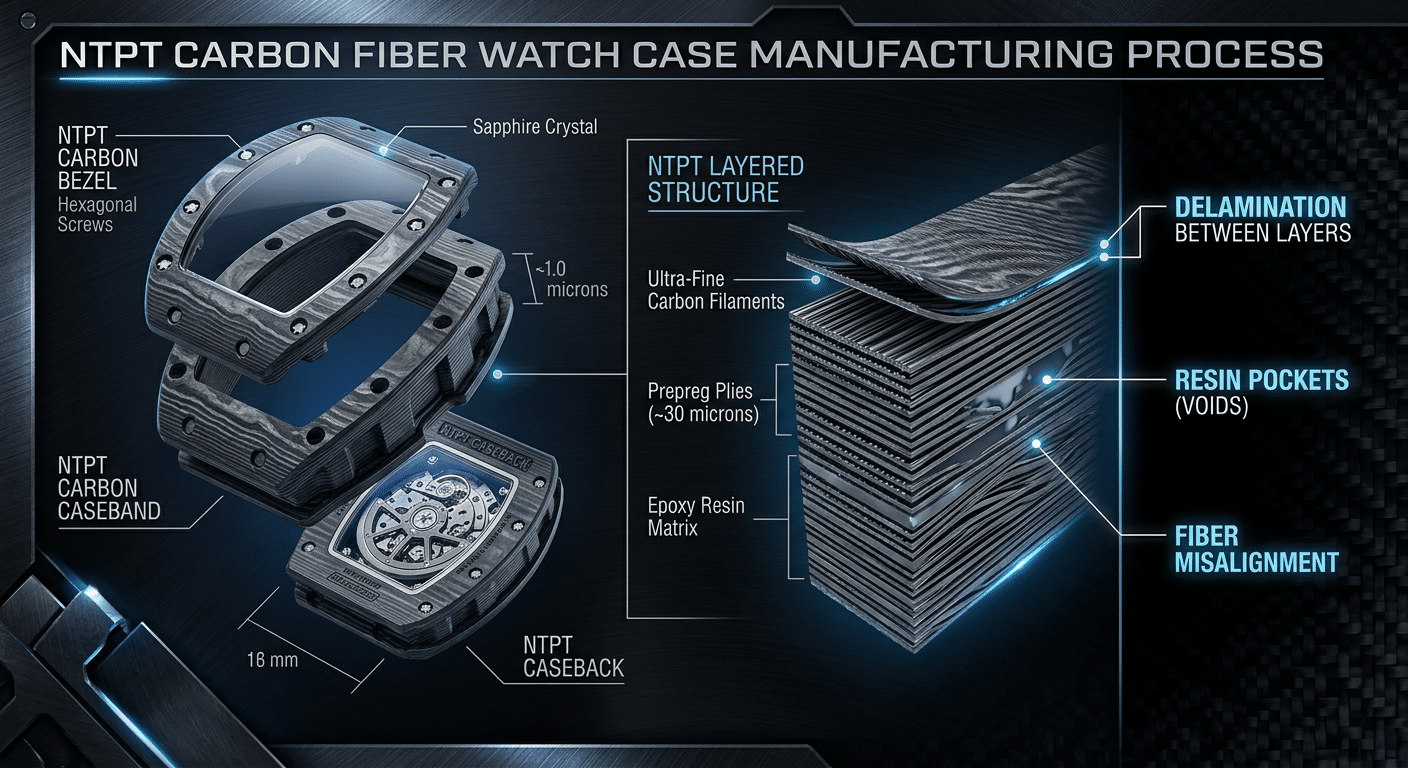
Genuine Richard Mille Carbon TPT (Thin Ply Technology) consists of hundreds of carbon fiber layers, each approximately 30 microns thick, rotated 45 degrees between layers and fused under heat and pressure. This creates the distinctive undulating, wood-grain appearance that shifts under light. Replicating this effect requires actual carbon fiber composite processing—not surface decoration.
Entry-level replicas ($300–600) typically employ vinyl wraps, painted patterns, or printed decals on steel or resin cases. These surfaces appear flat under magnification, lack dimensional depth, and often betray themselves through overly regular patterns or incorrect color tones—sometimes appearing too dark, too bright, or exhibiting a plastic-like sheen.
The $800–1500 tier introduces forged carbon or compressed carbon fiber composites. Factories machine these from solid blocks, revealing genuine fiber layers as material is removed. However, the weave structure typically shows shorter, more randomly oriented fibers compared to genuine TPT’s long, parallel layers. The visual effect approaches authenticity at conversational distance but reveals different light-reflection properties under close inspection.
Premium-tier replicas ($1500+) attempt closer simulation through finer-ply carbon prepreg materials and more precise layer orientation. Some manufacturers import carbon fiber materials claiming closer specifications to genuine TPT. However, even at this level, the exclusive North Thin Ply Technology manufacturing process—using specialized autoclave curing and proprietary resin systems—remains unattainable. The result is a high-quality carbon composite that simulates the aesthetic but cannot replicate the specific mechanical properties (fracture resistance, screw retention, weight distribution) of genuine TPT.
Titanium Machining: Hardness and Tool Wear
Genuine Richard Mille cases utilize grade 5 titanium (Ti-6Al-4V), an alloy containing 6% aluminum and 4% vanadium. This material offers exceptional strength-to-weight ratio and corrosion resistance but presents significant machining challenges. Titanium’s hardness rapidly dulls cutting tools, generates heat that can work-harden surfaces, and requires specialized coolant systems to prevent combustion of titanium chips.
Replica manufacturers face a choice: use actual titanium with its associated processing costs, or substitute 316L stainless steel with surface treatments. Steel machines easily with standard CNC equipment and costs significantly less per kilogram. However, steel’s density (approximately 8.0 g/cm³) exceeds titanium’s (4.4 g/cm³), creating an immediate weight discrepancy. A steel case replica may weigh 40–60% more than its titanium equivalent—a telltale difference detectable immediately upon handling.
Factories producing $1000+ replicas increasingly utilize actual titanium, accepting the higher machining costs and slower production rates. The material itself costs more, and tool replacement frequency increases substantially—carbide inserts that might machine hundreds of steel cases require replacement after dozens of titanium cases. These accumulated costs directly impact final pricing, creating a material threshold below which genuine titanium construction becomes economically unfeasible.
Surface finishing compounds the complexity. Genuine Richard Mille titanium cases exhibit specific surface treatments—sandblasted matte finishes, polished bevels, or Titalyt® coatings—that require additional processing steps. Achieving the correct color tone (genuine grade 5 titanium possesses a subtle warmth distinct from steel’s cooler gray) necessitates precise blasting media, pressure control, and sometimes proprietary chemical treatments. Lower-tier replicas often miss these nuances, presenting surfaces that appear either too bright (polished steel-like) or improperly textured (rough sandblasting rather than refined matte).
Sapphire crystal molding requires stringent control over curvature to preserve optical integrity, as any deviation can cause distortion. The quality of the molded crystal often reflects the overall manufacturing standards, a factor critically assessed in Richard Mille super clone comparison. These evaluations examine dome shaping, AR coating application, and edge polishing to distinguish between high-fidelity reproductions and inferior copies. Such analysis is essential for understanding the material science behind premium watchmaking.
Perhaps no material challenge better illustrates the technical cost divide than sapphire crystal processing for Richard Mille’s tonneau cases. Standard flat or gently domed sapphire crystals for round watches involve established hot-forming and polishing techniques. The complex compound curves of RM tonneau cases—curving in multiple axes while maintaining precise optical clarity—require either molding from massive sapphire blanks or extensive CNC grinding and polishing.
Sapphire (aluminum oxide, Mohs hardness 9) presents extreme processing difficulty. Grinding requires diamond-impregnated wheels, and achieving optical-grade polish involves multiple stages of progressively finer abrasive compounds. For complex tonneau shapes, manufacturers face high catastrophic failure rates—crystals may crack during the final polishing stages after hours of machining, or optical distortion may render the piece unusable for watch applications.
Entry-level replicas ($300–600) universally substitute mineral glass or hardened acrylic. These materials mold easily to complex shapes but scratch readily (mineral glass ranks ~5–6 on Mohs scale) and lack sapphire’s optical clarity and scratch resistance. The weight difference is immediately apparent—mineral glass weighs significantly less than sapphire of equivalent volume.
The $800–1500 tier introduces genuine sapphire, but often with compromises. Some manufacturers utilize flat or simply domed crystals that do not follow the case curvature precisely, creating visible gaps or stepped interfaces where the crystal meets the bezel. Others employ sapphire but with simpler radius curves that approximate, but do not precisely replicate, the genuine case profile. These compromises reduce manufacturing rejection rates and costs but create detection points for knowledgeable observers.
Premium-tier replicas ($1500+) attempt full tonneau-curved sapphire crystals with complex bevels and proper case integration. Even at this level, rejection rates remain high—manufacturers may produce three crystals to obtain one acceptable piece. The sapphire material itself costs significantly more than mineral glass, and the machining time (often 8–12 hours per crystal) represents substantial labor investment. These accumulated costs create a genuine material floor—below approximately $1200–1400, genuine tonneau-shaped sapphire crystal construction becomes economically impossible without accepting catastrophic loss margins.
Optical treatments add further complexity. Genuine Richard Mille crystals often feature anti-reflective (AR) coating on both interior and exterior surfaces—sometimes specific blue or purple tints that reduce glare while maintaining clarity. Applying these coatings to complex curved surfaces requires vacuum deposition technology and precise thickness control. Lower-tier replicas often omit AR coating entirely or apply it only to interior surfaces, creating visible reflectivity that differs from genuine examples under lighting.
Evidence Verification: Technical Cross-Checking Methods
Objective verification methods protect buyers against specification inflation common in Richard Mille replica listings. While dealer-provided QC photos establish baseline expectations, independent testing upon receipt confirms whether the physical watch matches the documented claims. Several low-cost verification methods can expose discrepancies between advertised tiers and actual construction without requiring specialized equipment.
Case Thickness and Material Verification: Digital calipers provide immediate validation of thickness claims. Measure the case at the thickest point (typically the center of the tonneau curve) and compare against the genuine reference specifications. Richard Mille lists the RM 67-01 at 7.80mm thickness and the RM 055 at approximately 13.00mm; significant deviations (3mm or more) indicate entry-tier construction regardless of dealer claims. For carbon fiber verification, apply a small amount of acetone to an inconspicuous case area—printed vinyl wraps or hydro-dipped patterns will dissolve or discolor, while compression-molded carbon fiber shows no reaction. Weight measurement similarly exposes material substitutions: titanium and carbon construction should produce total weights 30–40% lighter than steel equivalents of identical dimensions.
Crystal and Movement Authentication: Sapphire crystals exhibit distinct thermal conductivity and hardness properties. Touching the crystal to your cheek or wrist reveals sapphire’s rapid thermal transfer (feeling immediately cool), while mineral glass or acrylic warms quickly to body temperature. For scratch resistance, sapphire resists steel implements (Mohs hardness 9 versus steel’s 5–6), though this test risks damage if the crystal is actually mineral glass. Movement verification requires observing the balance wheel oscillation—use a slow-motion video function (240fps or higher) to count beats per hour. Claimed Miyota 9015 movements should exhibit 28,800 vibrations per hour (8 beats per second visible as smooth sweep), while slower stuttering indicates 8215 or lower-grade bases despite decorative treatment.
Practical Traceability: QC Verification and Detail Inspection
Verifying a Richard Mille replica before shipment requires systematic examination of QC (Quality Control) photographs that go beyond general impressions to inspect specific technical details. While stock photos and factory marketing images establish baseline expectations, real QC photos of the actual watch being shipped provide the only reliable method for confirming construction tier, movement configuration, and finishing quality before delivery.
Buyers should request macro photography of several critical zones. Dial printing requires inspection for crisp edges on text, correct font weights, and proper alignment with applied indices. The datewheel, if present, should show clean printing and proper centering within the aperture. Hand alignment should be verified at 12:00 and 6:00 positions to ensure proper clearance and parallel alignment. For skeletonized models, lateral views reveal whether bridges possess genuine thickness and three-dimensional structure or appear as flat masks applied over base movements.
Case construction verification requires specific angle shots showing the carbon fiber weave pattern under magnification—genuine layering displays organic fiber variation and depth, while printed surfaces show mechanical regularity. Bezel alignment and crystal integration should be visible from side angles to confirm seamless fitting without gaps. Crown guards and lug profiles require inspection for correct geometry and finishing. For movement verification, request photos showing the balance wheel, regulator mechanism, and any visible caliber markings that can be cross-referenced against claimed specifications.
Before finalizing a purchase, buyers should confirm that QC photos represent the actual watch to be shipped rather than stock images from a previous batch. Visible details such as dial printing, datewheel position, bezel alignment, bracelet fit, clasp engraving, case thickness, and movement finishing should be reviewed model by model. Factory names and stock photos alone provide insufficient traceability for assessing the specific construction tier of the individual unit.
Price Interpretation: Separating Manufacturing Value from Dealer Markup
When you receive a quote for a Richard Mille replica ranging from $400 to $2,800 for what appears to be the same model reference, the price spread often reflects more than just manufacturing tiers. In practice, we usually look at three distinct cost components: the base production cost (materials, labor, yield), the complexity premium (movement architecture, case construction difficulty), and the dealer positioning margin (market scarcity claims, service bundling, and profit markup).
Understanding how to reverse-calculate these elements protects you from both underpriced junk and overhyped premium positioning. A $900 RM 35-02 quote from one dealer and a $1,400 quote for the identical APS Factory version from another often represent the same production batch with different margin structures rather than different technical specifications.
The Dealer Margin Variable
Trusted Dealers (TDs) in the replica watch ecosystem typically operate on 15–35% margins above their acquisition costs from Chinese factory networks. However, pricing psychology varies significantly between dealers. Some maintain consistent markup percentages across all models, while others apply “scarcity premiums” to recently released versions or factory models experiencing temporary production delays.
When evaluating whether a price reflects manufacturing value or dealer positioning, compare quotes across three or more established sellers for the identical factory version (e.g., APS V2 RM 35-02). If one dealer quotes $850 while others quote $1,100–$1,200, the lower price likely represents competitive positioning rather than inferior product—provided the factory version and movement specification are identical.
Recognizing Artificial Scarcity
The replica watch market frequently employs “batch psychology” to justify price premiums. Terms like “V2 sold out,” “limited batch,” or “factory temporarily closed” create urgency that often exceeds actual production constraints. While genuine yield limitations exist—particularly for complex movements like the Dandong RMUL2 with free-sprung balances—many scarcity claims serve primarily to maintain price floors.
When a dealer emphasizes urgency through scarcity language, verify whether the price premium corresponds to documented technical improvements (movement version updates, case construction refinements) or merely reflects inventory positioning. A $200 premium for “last V2 batch” rarely represents $200 in additional manufacturing value unless accompanied by specific technical improvements over previous versions.
Reverse-Calculating Technical Value
To determine whether a quoted price aligns with technical content, apply a component-based estimation framework. Base manufacturing costs for RM replicas typically break down as follows: entry-tier visual imitations ($300–$600) represent stamped steel cases with surface treatments and standard Miyota movements; mid-tier structural credibility ($800–$1,400) indicates forged carbon or titanium cases with Dandong RMUL2 movements and sapphire crystal molding; premium-tier movement architecture ($1,600–$2,800+) requires custom bridge finishing, free-sprung balance implementations, and NTPT-style carbon layering with titanium chassis.
When evaluating a $1,500 quote, verify that the technical components match the price tier: does the movement feature genuine bridge architecture rather than decorative plates? Does the case demonstrate carbon fiber layering rather than printed patterns? If the technical specifications align with lower tiers while the price suggests premium positioning, the quote likely reflects dealer markup rather than manufacturing complexity.
Legal and Trademark Boundaries: Disclosure and Import Considerations
Richard Mille replicas exist in a complex legal landscape where trademark infringement, customs enforcement, and resale disclosure obligations intersect. While this article discusses technical manufacturing distinctions, buyers must understand that these items constitute unauthorized copies protected by trademark law in most jurisdictions. The Richard Mille name, case shape trademarks, and dial designs remain intellectual property of the brand, regardless of replica manufacturing quality.
Importation risks vary significantly by jurisdiction. Customs agencies in the United States, European Union, and United Kingdom routinely seize counterfeit watch shipments, defined broadly as items bearing trademarks without authorization. Even personal-use quantities face confiscation, with potential civil penalties for repeat importation. The legal distinction between “counterfeit” (bearing genuine trademarks) and “replica” (imitation without trademark) varies by country, but Richard Mille’s distinctive case shapes and dial layouts often trigger enforcement regardless of dial text accuracy. Buyers should assume that international shipment carries seizure risk and that no dealer “customs guarantee” eliminates this possibility.
Resale and disclosure obligations present additional legal considerations. Selling a Richard Mille replica, even secondhand, constitutes trademark infringement if the transaction implies authenticity or fails to clearly disclose the item’s imitation status. Online marketplaces increasingly cooperate with brand enforcement teams to identify and delist replica sales. Ownership carries no “right” to resell equivalent to authentic goods; each transfer potentially exposes the seller to civil liability for counterfeiting. These legal realities underscore why replicas should be treated as personal consumption items with terminal value, not investment assets or tradable commodities.
Ownership Boundaries: Realistic Expectations for Long-Term Use
Understanding the practical limitations of Richard Mille replicas prevents costly misconceptions about durability, serviceability, and legal use. While high-tier replicas achieve impressive visual and mechanical fidelity, they remain unauthorized copies with inherent constraints that distinguish them from genuine luxury timepieces. Buyers should approach ownership with realistic expectations regarding water resistance, movement longevity, servicing options, and legal boundaries.
Water resistance represents a critical limitation rarely matching genuine specifications. Genuine Richard Mille watches undergo rigorous pressure testing and sealing with specialized gaskets. Replica cases, even those achieving dimensional accuracy, often use standard gasket materials and assembly processes that cannot guarantee rated water resistance. A replica rated for “30 meters” might survive hand washing but should not be exposed to swimming or submersion. Buyers should treat replicas as splash-resistant only unless specifically tested by a watchmaker, regardless of case construction tier.
Movement serviceability poses long-term challenges. While standard movements like the Miyota 9015 can be serviced by most watchmakers, the custom skeletonized architectures and modified bridges in high-tier RM replicas often require specialized knowledge and replacement parts that may not be readily available. A damaged jewel setting or broken balance staff in a decorative skeleton movement might prove irreparable outside of the original manufacturing region, effectively rendering the watch a total loss after mechanical failure. Buyers should consider the movement’s complexity relative to their local service infrastructure.
Legal boundaries require clear understanding. These watches are not authorized products and should never be represented as genuine Richard Mille timepieces. Resale as authentic constitutes fraud in most jurisdictions. Importation may violate customs regulations regarding trademark infringement. Ownership for personal use resides in a legal gray area in some regions, but commercial activity—selling, trading, or representing as genuine—carries significant legal risk. Buyers should purchase with the understanding that these items have no resale value as authentic goods and limited legal protection as consumer products.
For CleanVSFactory, the goal is to make replica watch decisions more traceable by helping buyers understand these boundaries clearly. A strong super clone may look convincing in normal wear, but close inspection can still reveal differences in finishing, movement architecture, case proportions, bracelet feel, or dial details. Buyers should evaluate replicas based on their suitability for personal use within these realistic limits, rather than expecting genuine-equivalent performance, durability, or social acceptance. The decision to purchase should account for the possibility of mechanical failure, the absence of warranty service, and the legal constraints surrounding ownership and use.
Representation Boundaries and Legal Use Parameters
Ownership of Richard Mille replicas carries specific responsibilities regarding representation, disclosure, and legal use. These timepieces constitute unauthorized reproductions of protected intellectual property, and their possession for personal use resides in distinctly different legal and ethical categories than ownership of genuine luxury watches. Buyers must understand that these items should never be represented, presented, or sold as genuine Richard Mille products, regardless of construction quality or visual similarity.
The practical implications of this boundary extend to social, professional, and commercial contexts. Wearing a replica in environments where it might be perceived as genuine—particularly in business negotiations, social gatherings with watch enthusiasts, or professional settings where authenticity might influence perception—carries ethical considerations. While personal use for aesthetic enjoyment remains the primary legitimate purpose, using replicas to signal wealth, status, or business credibility that would not exist with a disclosed imitation raises misrepresentation concerns. Buyers should evaluate their specific social and professional contexts to determine whether wearing a recognizable luxury watch replica aligns with their personal ethics and risk tolerance.
Commercially, strict boundaries apply. Selling a replica, even with disclosure, may violate trademark laws in many jurisdictions. Online marketplace platforms actively remove replica listings and may suspend accounts attempting to sell such items. Private sales carry similar legal risks regarding trademark infringement. Unlike genuine watches, replicas possess no investment value, cannot be legitimately traded as collectibles, and should be considered consumption items with terminal value only. Any expectation of resale value, regardless of purchase price, misunderstands the legal and market reality of these products.
For CleanVSFactory, the guidance emphasizes clear understanding: these replicas serve as personal aesthetic objects and mechanical curiosities, not status symbols, investments, or substitutes for genuine luxury goods. The ethical use boundary requires honest self-assessment about why one purchases and wears such items. If the motivation includes deceiving others about financial status, business success, or watch collection authenticity, buyers should reconsider the purchase. The compliant ownership model treats replicas as privately enjoyed mechanical objects—appreciated for their construction, admired for their aesthetic, but never deployed as tools of social or professional misrepresentation.
Disclosure: This article is for general educational and comparison purposes only. Replica watches are not genuine products from the original luxury brands, and brand names are used only to identify reference designs or comparison topics. Factory names, movement descriptions, prices, availability, QC details, seller policies, and version information can change, so readers should verify important details with the seller before making a purchase decision. Replica watches should not be represented, resold, or used as genuine watches.
Last updated: September 2025