
The Foundation Problem: Monobloc vs. Architectural Assembly
To understand why one watch is easier to fake than the other, you have to start with the physical reality of how they’re built. This isn’t about better machining or more expensive materials. It’s about a fundamental clash between a design philosophy and an industry’s entire manufacturing paradigm, a complexity often detailed in analyses of the Richard Mille replica factory network where specialized production is fragmented.
The replica watch ecosystem, centered in Guangzhou’s industrial clusters, is built for a certain kind of object. It excels at taking a block of metal and carving it into a recognizable shape. This is why a Rolex Submariner, at its core, is a gift to replicators. Its Oyster case is essentially a monobloc—a dominant, central mass from which the lugs are carved, with a bezel and caseback screwed or pressed on. The entire process is subtractive: start with a solid piece, mill away what you don’t need. It’s a process that plays directly into the strengths of decentralized CNC machining. Tolerances matter, but they’re largely about the final shape of a single, primary component.
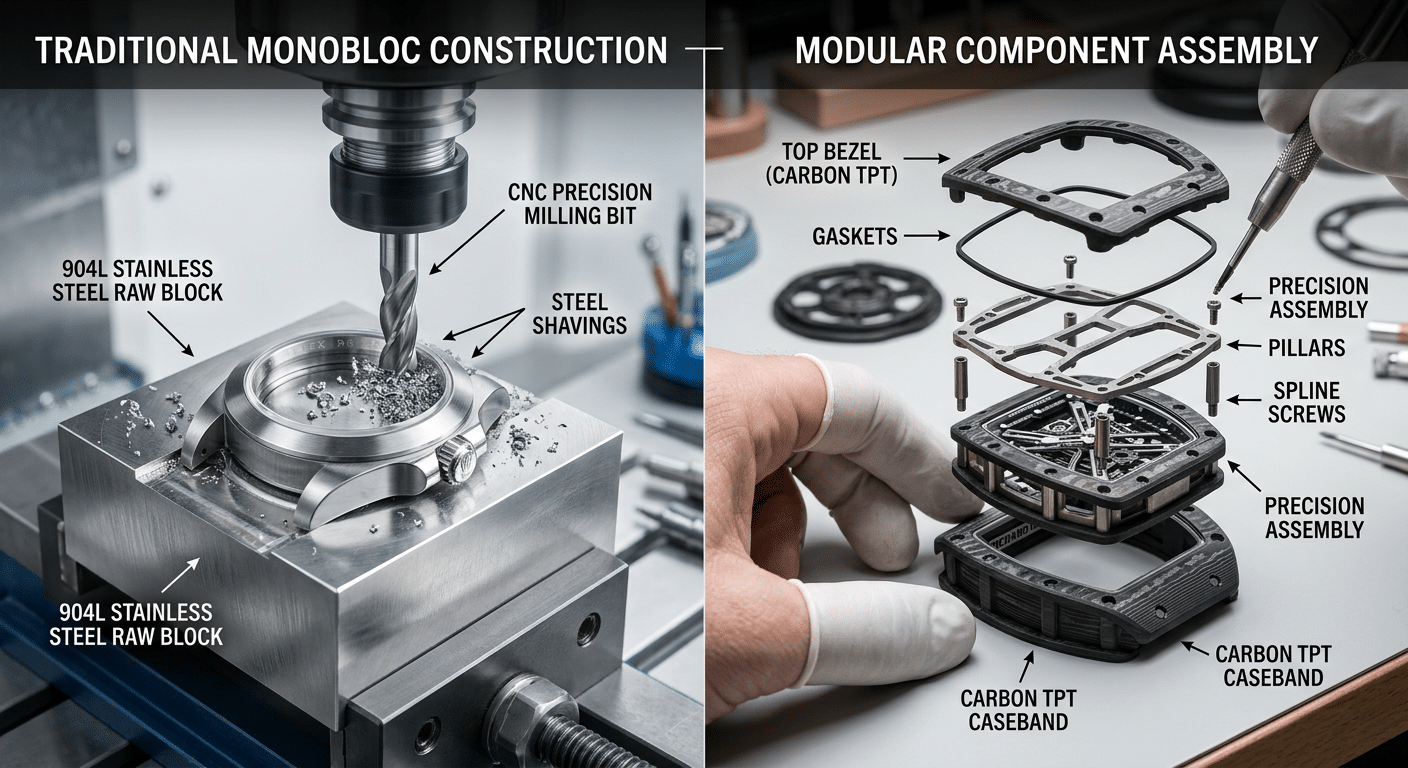
The Oyster Doctrine: Replica-Friendly Monolithic Design
Rolex’s design language, intentionally or not, is replication-optimized. Think of the Submariner, the GMT-Master II, the Datejust. The case is a solid, forgiving canvas. The lines are broad, the surfaces are large, and the construction is straightforward. A replica factory’s job is to sculpt that single block of 316L steel or ceramic into the right silhouette. The gasket channels are simple grooves. The crown guards are part of the main body. Even when components are separate, like a bezel insert, they are additive elements placed onto a stable, monolithic foundation. This allows for incredible iteration and refinement. Factories like Clean and VSF have honed this process to a science, achieving near-perfect external geometry because they’re solving a single, well-defined problem: carve this shape accurately.
The RM Puzzle: When The Seams Are The Design
Now, consider a Richard Mille. Its iconic tonneau shape isn’t carved from a block; it’s assembled like a precision instrument. The case is typically a three-part structure: a bezel, a central caseband, and a caseback, all secured by numerous exposed screws. These seams and junctions aren’t hidden; they are integral to the aesthetic. The design celebrates the assembly. This changes everything for a replicator.
The challenge shifts from “is the shape right?” to “is the assembly perfect?” Every interface—where the bezel meets the caseband, where the caseband meets the caseback—must be flawless. The tolerances are not just for individual parts, but for their interaction in three dimensions. A gap of a few hundredths of a millimeter, invisible on a Rolex’s seamless mid-case, becomes a glaring fault line on an RM. The dozens of visible screw heads must be perfectly aligned, with immaculately machined slots. This requires coordination across multiple specialized suppliers (one for the bezel, one for the caseband, one for the screws) and a final assembly process of exceptional precision. It’s a level of supply chain harmony the replica industry, built on agile, independent workshops, struggles to achieve consistently.
Expert Authentication Insight
The most telling test requires only a 10x loupe. Examine the seams and screw heads. On a genuine Richard Mille, the joins are laser-precise, with no perceptible light gap or misalignment. The screw slots are crisp, uniform, and perfectly centered. On even the best replicas from APS or ZF, you will often find minute inconsistencies: a seam that varies in width by a hair, a slight bevel mismatch between components, or a screw slot that’s slightly rough or off-center. These tiny errors don’t exist in isolation; they collectively betray an assembly process, not a forged instrument. They are the root cause of that subtle “cheap feel” that plagues even high-end RM replicas—it’s not the material’s look, but the architecture’s execution.
The judgment here is systemic. A “good” Rolex case is an expected outcome of a mature industrial process. A “good” Richard Mille case is a minor miracle of replica logistics and coordination. One is a solved equation; the other is a persistent, structural disadvantage.
The Dial & Skeleton: A War of Perception vs. A War of Mechanics
If the case is the first battle, the dial is where the war is lost. Here, the difference isn’t just technical; it’s perceptual. Our brains are wired to detect depth, symmetry, and structural harmony intuitively. This is where a replica’s flaw stops being a “detail” and becomes a fundamental break in the object’s reality.
A Rolex dial is a surface to be decorated. It’s a two-dimensional canvas upon which print, lume, and applied indices are placed. The replication challenge is one of color matching, texture replication, and sharpness. Is the sunburst finish correct? Is the lume color exact? Is the printing crisp? These are difficult, but they are additive and iterative processes. A factory can source a better dial printer, improve its lume mixture, or tweak the plating on an index. A flaw here is a flaw *on* the watch.
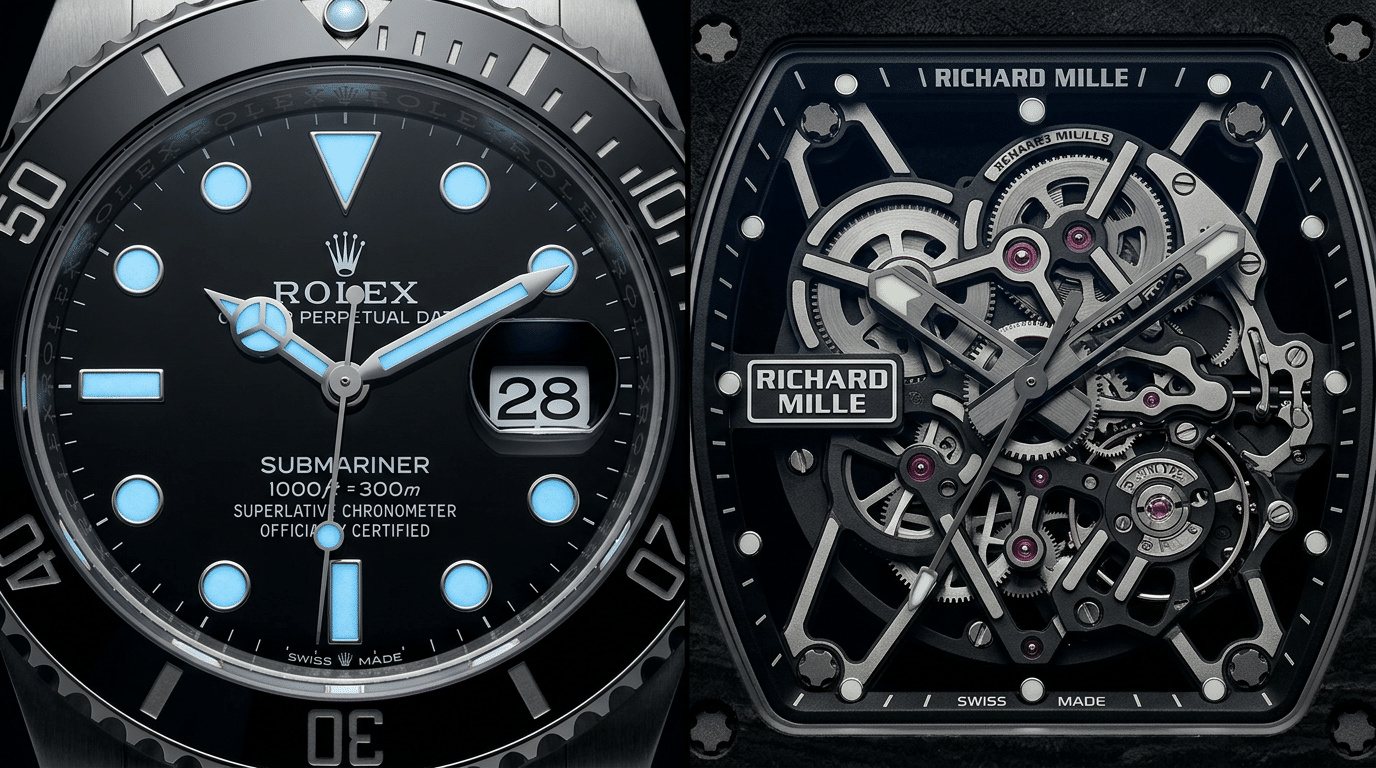
Rolex Dial Replication: The Battle of Surface Details
The focus for a Rolex replica dial is on surface-level authenticity. The “black hole” effect of a crystal gasket, the sharpness of the coronet, the perfect pearliness of the lume plots, the cyclops magnification over the date—these are the frontiers. Super clone factories have gotten alarmingly good at this. A VS Factory Submariner dial, in isolation, can be visually indistinguishable from genuine to all but the most trained eyes under a loupe. The battle is fought with printers, paints, and applied metallurgy. It’s a war of decoration.
RM Skeleton Replication: The Battle of Depth and Structure
A Richard Mille doesn’t have a dial in the traditional sense. It has a movement whose bridges and base plate are the face of the watch. This isn’t decoration; it’s architecture. The challenge is three-dimensional: the depth of skeletonization, the precise geometry of each bridge, the quality of the anglage (the polished bevel on the edges of each component), and the harmonious balance between metal and negative space.
Replicating this is a subtractive and structural nightmare. It’s not about adding something to a surface; it’s about carving a complex, three-dimensional sculpture out of a movement plate and ensuring every facet interacts with light correctly. A bridge that is a fraction of a millimeter too thick, a bevel angle that’s off by a few degrees, or a depth of cut that’s slightly shallow—these aren’t mere inaccuracies. They destroy the visual harmony and the sense of layered depth that defines the RM look. The replica movement appears flat, “cut out,” and clumsy. It lacks the architectural integrity of the genuine article.
Expert Authentication Insight
Forget magnification for a moment. The simplest test is to hold the watch and slowly tilt it in the light, observing from a sharp, oblique angle. On a genuine Richard Mille, the skeletonized elements create a captivating, three-dimensional landscape. Every bevel catches and throws light consistently, creating a play of reflections that gives the watch a dynamic, alive quality. On a replica, this effect often falls flat. The depth perception collapses; bevels are poorly defined or inconsistent, making the structure look stamped rather than carved. The light doesn’t dance—it just lays there. This is why an RM rep can look convincing in a flat, straight-on product shot but feel utterly hollow in person. The dial isn’t a component; it’s the watch’s soul. Getting it wrong isn’t a mistake—it’s a fatal flaw.
The Movement Mirage: Hiding vs. Showcasing the Heart
The final, and perhaps most decisive, front in this war of replication is the movement. Here, the design philosophies of Rolex and Richard Mille impose completely opposite demands on the counterfeiter, defining not just authenticity but also reliability, a topic explored in depth regarding what a super clone means in Richard Mille replicas. This movement guide reveals why the quest for “11 perfect” is often a marketing claim rather than a technical reality.
Rolex designs its watches to hide and protect its mechanics. The Oyster case is a sealed vault. Even with a display caseback, the movement is secondary to the dial. The goal for a replica movement, like a clone of the Caliber 3235, is twofold: look correct (finishing, engraving) and function reliably (timekeeping, date change). It’s a “black box” that prioritizes operational integrity. The massive, sustained demand for Rolex replicas has funded the development of remarkably robust clone movements from facilities like Dandong. They are known quantities.
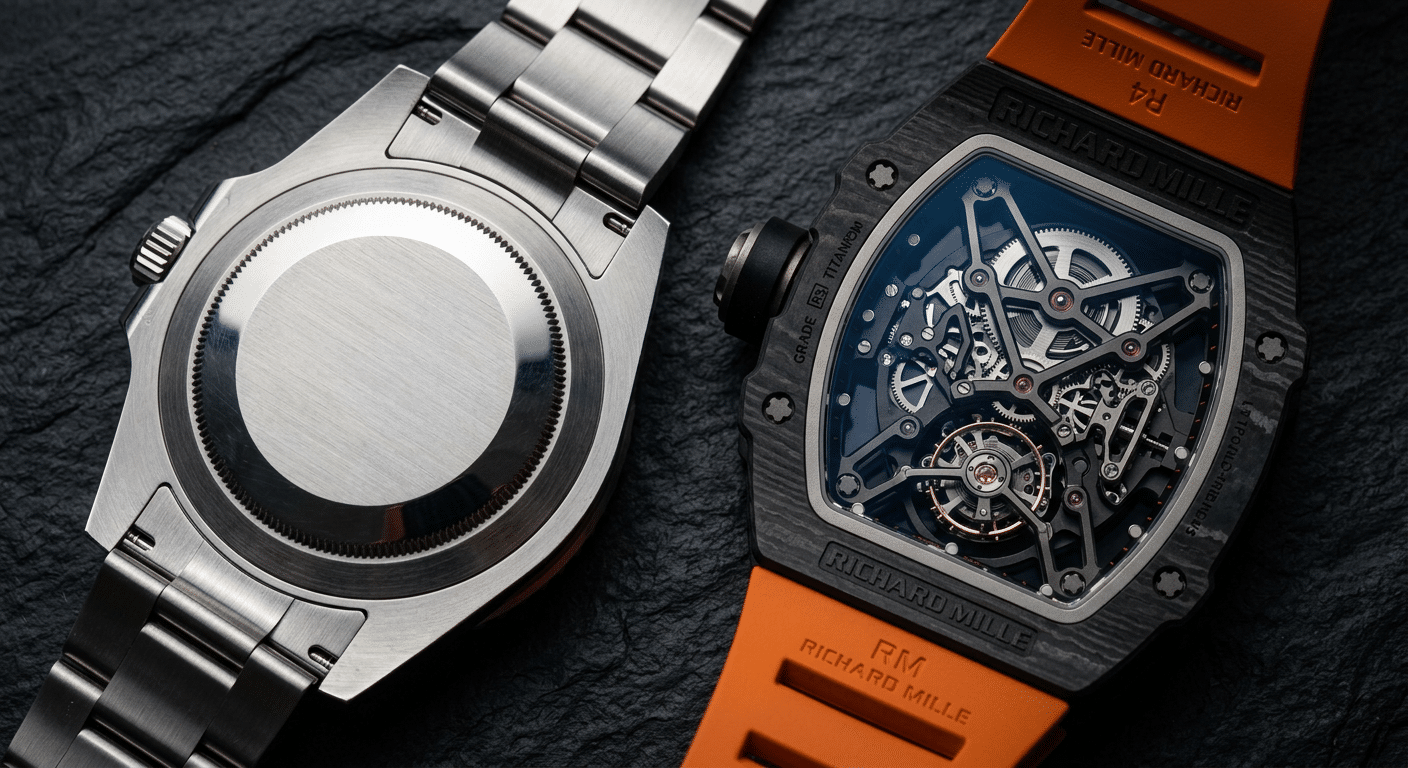
The Rolex “Black Box”: Reliability Over Display
The replica ecosystem thrives on standardization. The Rolex 3135 and 3235 clone movements are products of intense, focused R&D. Because they don’t need to be art, they can be engineered. Their purpose is to be durable, accurate, and interchangeable. A VS3235 movement is prized because it’s a reliable drop-in unit that will last for years with proper service. The closed caseback of most models offers a further reprieve; even a decorated but less reliable movement can pass muster if it ticks. The priority is mechanical fidelity, not visual theater.
The RM “Glass Box”: When The Movement Is The Face
Richard Mille turns this logic inside out. The movement is the main event, visible from both the front and back. A replica must therefore house a mechanism that, above all else, *looks* like an RM caliber. Since cloning the actual, micron-level-finished, grade 5 titanium RM movements is economically impossible, factories resort to radical modification of existing base calibers, like the Seagull ST2555.
This process involves stripping down the movement, cutting its plates into a skeletal facsimile of the RM bridge design, adding decorative but non-functional gears, and often integrating a faux tourbillon cage that doesn’t actually rotate. Every modification is a point of potential failure. The movement is stretched, drilled, and skeletonized far beyond its original design parameters, sacrificing stability and longevity for the sake of appearance. The movement in a high-end RM rep isn’t an engine; it’s a stage prop that also happens to tell time, often poorly and not for long.
Expert Authentication Insight
Wind the watch and watch the balance wheel. On a genuine automatic RM, the motion is a rapid, smooth blur—28,800 vibrations per hour (4 Hz). On a replica with a heavily modified base movement, the beat is often visibly slower and less fluid, typically 21,600 vph (3 Hz). This difference in “visual rhythm” is immediate. Furthermore, peer through the skeletonized front. On a genuine piece, the finishing of every visible component, even non-critical ones, is exemplary. On a replica, the skeletonization often reveals rough machining marks, unfinished edges, and poorly polished surfaces on the movement’s interior architecture—parts the original base movement never intended to be seen. The conflict is absolute: the movement must prioritize looking complex over being robust, which is the antithesis of sound watchmaking.
This explains the market reality. You buy a top-tier Rolex super clone for its proven, reliable mechanics. You buy a top-tier Richard Mille replica despite its movement—a necessary compromise to achieve the visual effect, always with the understanding that it is the most fragile part of a fragile illusion.
The Wrist Game: Weight, Balance, and the “Feel” Factor
You can spot a flaw in a photo. You can measure a thickness discrepancy with calipers. But the most visceral, immediate failure of a replica happens not in front of your eyes, but in your hand and on your wrist. This is where the intellectual understanding of a “good fake” meets the physical reality of wearability. For Rolex, this final exam is passable. For Richard Mille, it’s often the first and most damning quiz the watch fails.
The difference isn’t about effort; it’s about physics. A replica’s success is judged first by sight, but its authenticity is ultimately confirmed by heft, balance, and the subconscious signals it sends through your arm. This is the uncanny valley of watch replication—where something can look 90% right but feel 100% wrong.
Rolex: The Forgiving Physics of Steel
A stainless steel Rolex Submariner has a specific, familiar density. It’s a solid, purposeful weight—around 155 grams on a bracelet—that speaks to its tool-watch heritage. The replica watch feel for a Rolex is a game of approximation within a known material paradigm. Super clone factories use 904L or 316L steel, achieving a weight and balance that, while not identical, lands in the same experiential ballpark. The center of gravity is predictable, the Oyster case is a monolithic mass, and the bracelet links articulate in a way that can be convincingly mimicked.
The goal here is to get “close enough.” When you pick up a top-tier VSF or Clean Factory Submariner, its weight doesn’t raise an immediate alarm. It feels like a solid, heavy watch. The replication challenge is one of precision engineering within a forgiving, traditional framework. The materials are similar, the construction logic is the same, and the wearer’s expectation is for substance. A replica can deliver that substance.
RM: The Physics-Defying Lightness
Richard Mille’s entire identity is built on inverting that expectation. The genuine article feels like a betrayal of physics—a large, complex instrument that weighs less than a passport. This isn’t an aesthetic choice; it’s the core experiential product. A genuine RM 027 Rafael Nadal weighs about 20 grams with its strap. An RM 67-02 weighs 32 grams.
This Richard Mille weight is achieved through an obsessive, expensive material science that replicas cannot access. Cases are milled from proprietary NTPT carbon, a layered composite exclusive to RM. Movement plates and bridges are made from grade 5 titanium, not brass. Screws are titanium. The result is a watch that feels both incredibly light and unnervingly solid, like a piece of advanced aerospace debris.
Replicas universally fail to replicate this. They substitute forged carbon for NTPT, which is denser. They use brass or steel for movement components, adding 10-20 grams of sheer mass. They use stainless steel for case screws and crowns, which is a key point of differentiation detailed in any comprehensive Richard Mille super clone guide. The consequence is a replica that often weighs 40, 60, or even 80 grams—double or triple the weight of the genuine article. The materials difference isn’t just visual; it’s gravitational. The replica feels like a toy model made of cheaper, heavier stuff, because that’s exactly what it is. The “feather-light, rock-solid” sensation that defines a real RM is the first thing sacrificed.
Expert Authentication Insight
The most telling test requires no loupe. Perform the “wrist flip.” Gently shake your wrist with the watch on. A genuine RM, due to its minimal mass and integrated strap, moves with a quick, damped, almost nervous response. A replica, burdened by its heavier case and movement, has a slower, more pendulous, clumsier motion. Listen as well. A genuine RM’s rotor and components make a quiet, precise “click.” A replica often produces a louder, hollower “clack” or a gritty whirring, betraying looser tolerances and heavier internal parts. The feel is the tell.
The Market Reality: Why Factories Succeed With One and Struggle With The Other
This disparity in outcome isn’t a reflection of intelligence or effort between factories. It’s a brutal lesson in economics, risk, and scalable engineering. The replica market is ruthlessly efficient at allocating resources where the return is clearest. For Rolex, the conditions for perfection exist. For Richard Mille, they fundamentally do not.
The Rolex Replication Ecosystem: Scale Breeds Perfection
The journey to today’s Rolex super clone factory dominance is a story of market forces. The demand for Submariners, GMT-Masters, and Daytonas is colossal and evergreen. This massive, consistent demand justifies enormous R&D investment. A factory like VS or Clean can sink millions into perfecting a single movement architecture—the 3135/3235—knowing it will be used across hundreds of thousands of watches for years.
They operate on a stable platform. The case design of a Submariner hasn’t changed meaningfully in decades. This allows for iterative, linear improvement: Noob laid the groundwork, ARF improved the bracelet, VSF perfected the movement and crystal, Clean refined the bezel. Each version built on the last, driven by a competitive but focused market chasing a singular, well-understood benchmark. The ROI is clear, and the path to 95%+ fidelity is a solvable engineering problem. The result is a product so good it genuinely threatens the brand’s anti-counterfeiting narrative.
The RM Replication Quagmire: Complexity Stifles Progress
Contrast this with the Richard Mille factory landscape. The market is a fraction of the size, making massive R&D investment risky. More critically, the technical goalposts are a moving target. Richard Mille releases multiple new models and materials each year—NTPT, Quartz TPT, Graph TPT, various colored ceramics, new case shapes. There is no single “RM 035” platform to perfect for a decade.
Furthermore, perfecting an RM replica isn’t just about machining one part better. It requires a vertically integrated mastery over advanced composite case fabrication, ultra-complex multi-part case assembly, and the complete transformation of a base movement into a convincing skeletonized display—all at micron-level tolerances. The supply chain for a top-tier Rolex rep is streamlined. The supply chain for a top-tier RM rep is a fragile coalition of specialists, an “initiator” coordinating case, movement, dial, and strap factories. Consistency is the first casualty.
This is why there is no “VS Factory” for Richard Mille. You have flashes of brilliance—APSF’s improved movement, ZF’s carbon work, EUR’s tourbillons—but no sustained, linear evolution. For a model like the RM 35-02, the “best version” has bounced between ZF, BBR, and APSF. This indicates a market of passionate attempts, not cumulative mastery. The factories are always playing catch-up on a harder game, with less money, and a shifting finish line.
Expert Authentication Insight
To understand the market maturity, research the factory lineage. For a Rolex Submariner, the genealogy is clear and public: Noob -> ARF -> VSF/CF. It’s an evolutionary tree. For a Richard Mille RM035, the history is a tangled web. ZF’s V3, V4, V5, V6, V7… but also BBR’s V3 with a different movement, and now APSF claiming the crown. There’s parallel development, dead ends, and rebrands. This fragmentation is a symptom of the underlying problem: the technical and economic challenges of cloning an RM prevent any one factory from establishing lasting dominance. The ecosystem is one of experimentation, not evolution.
The Final Verdict: A Buyer’s Framework, Not a Summary
This isn’t about which replica is “better.” It’s about understanding that you are engaging in two fundamentally different types of purchases, governed by different rules.
For the Rolex buyer, the central question is: “How close to gen perfection do I need, and what’s my budget for those final percentage points?” You are shopping on a spectrum of refinement for a largely solved problem. You’re choosing between a 95% solution and a 98% solution. Your decision is about scaling quality against cost.
For the Richard Mille aspirant, the question is starkly different: “Which of this watch’s core, defining attributes am I willing to sacrifice: the visual architecture of the skeleton dial, the long-term reliability of the movement, the authentic feather-light material feel, or the balanced on-wrist presence?” You are not choosing a point on a spectrum of mastery. You are choosing which compromise to accept in a product that is, by its very nature, a compromise. You are funding an ongoing experiment.
Understanding this chasm—between incremental refinement and fundamental compromise—is more valuable than any price list or factory ranking. It reshapes your expectation from the ground up. It clarifies why a near-perfect Submariner replica exists for under $600, while a deeply flawed RM 035 still costs over $800. One is a product of a mature, efficient ecosystem. The other is a testament to how difficult true horological innovation is to copy, even when you’re not playing by the rules.