
The year is 2026, and the watch world is still reeling from the “Phantom Patek” scandal. A seasoned collector, known for his impeccable eye and decades of experience, proudly unveiled what he believed to be a rare Patek Philippe 5711 with a unique dial configuration, acquired from a seemingly reputable dealer in Geneva. It passed initial inspection, felt right on the wrist, and even came with what appeared to be flawless papers. Only after it was sent for a routine service at an authorized Patek Philippe service center was the devastating truth revealed: it was a meticulously crafted counterfeit, so advanced it required a full movement disassembly and micro-photography to expose its subtle flaws, a process heavily reliant on detailed knowledge of genuine movement architecture. The financial loss was immense, but the erosion of trust was immeasurable.
This incident, though fictionalized for impact, underscores a stark reality for watch enthusiasts in 2026: the traditional “spot the fake” guides, often relying on glaring errors in dial printing, case finishing, or movement decoration, are largely obsolete. Counterfeiters have evolved, leveraging industrial advancements and digital deception to create pieces that can fool even seasoned experts at a glance. We are entering a new era of deception, where the battle for authenticity is fought not with a loupe and a keen eye, but with advanced diagnostics, verifiable provenance, and an unwavering commitment to authorized channels. This article isn’t about identifying the obvious fakes; it’s about understanding the invisible threats and building an impenetrable defense.
The Evolution of Replication Technology: Manufacturing Fakes with Precision
The days of crudely stamped cases and generic movements are long gone. In 2026, the leading counterfeit operations employ manufacturing processes that rival, and sometimes even mirror, those of legitimate watchmakers. This section examines the industrial advancements enabling counterfeiters to achieve unprecedented levels of detail in every component.
Advanced CNC Machining and Case Finishing
The backbone of modern counterfeit watch production is the multi-axis Computer Numerical Control (CNC) machine. These aren’t the basic lathes of yesteryear; we’re talking about sophisticated 5-axis machines capable of executing intricate cuts and complex geometries with micron-level precision. What this means for collectors is that the once-obvious tells—uneven lugs, poorly defined crown guards, or misaligned case lines—are now largely eliminated. Counterfeiters can replicate integrated bracelets, sharp bevels, and intricate case contours, like those found on a Panerai Luminor or a Rolex Oyster case, with startling accuracy.
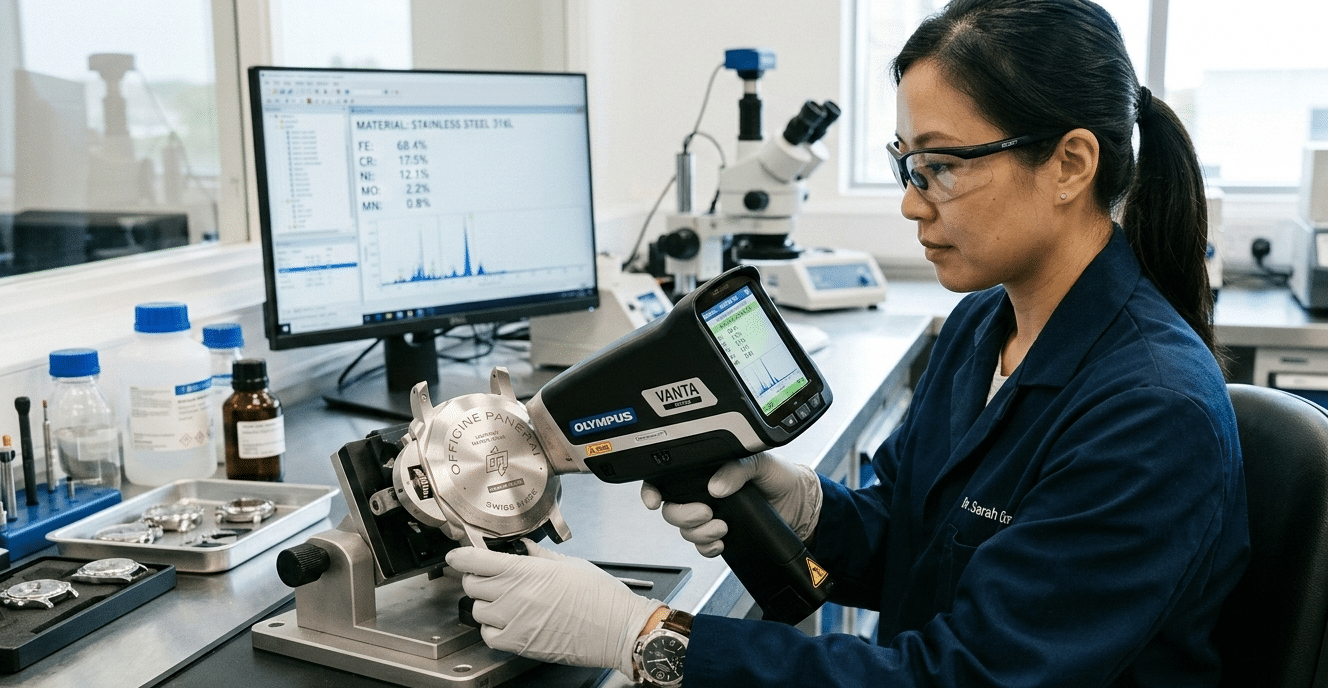
Furthermore, surface finishing, a critical aspect of luxury watch aesthetics, has seen significant improvement. Counterfeiters now employ advanced polishing techniques that mimic genuine black polishing on screw heads or movement components, along with consistent brushing patterns that flow seamlessly across different case facets. They’re using identical alloys, such as 316L stainless steel (common in Panerai) or even attempting 904L, making chemical composition checks increasingly necessary for definitive authentication.
Expert Authentication Insight
Physical diagnostic: To counter this, a collector or watchmaker must perform a microscopic examination (preferably 50x-100x magnification) of case finishing transitions. Look for subtle inconsistencies in the sharpness of edges where polished surfaces meet brushed ones. Genuine watches often exhibit crisp, perfectly defined transitions, whereas even advanced fakes might show a slight “softness” or very fine tool marks. Utilize digital calipers or optical comparators to measure component dimensions—case thickness, lug width, crown guard proportions—and compare them against known authentic specifications. Deviations, even within 0.1-0.2mm, can be indicative of a fake, especially when combined with other subtle tells.
Movement Cloning and Decoration
Perhaps the most significant leap in 2026 counterfeiting is the sophistication of cloned movements. We are no longer just seeing modified Miyotas or repurposed ETAs with a fancy rotor. Instead, counterfeiters are engaging in full-scale reverse engineering of proprietary calibers. A prime example is the Panerai P.9000/P.9010 clone movement. This wasn’t a tweak; it was a ground-up replication aiming for functional parity:
- Correct Power Reserve: Achieving the genuine 72-hour power reserve via true dual mainspring barrels, a feature previously unheard of in replicas.
- Bidirectional Winding: Replicating the ball-bearing rotor for efficient, bidirectional winding.
- Quick-Set Hour Hand: For GMT models, achieving the true “traveler” GMT function with an independently adjustable hour hand.
- Correct Case Thickness: Designing the movement to fit the genuine case dimensions, eliminating the “bloated” look of older ETA-based fakes.
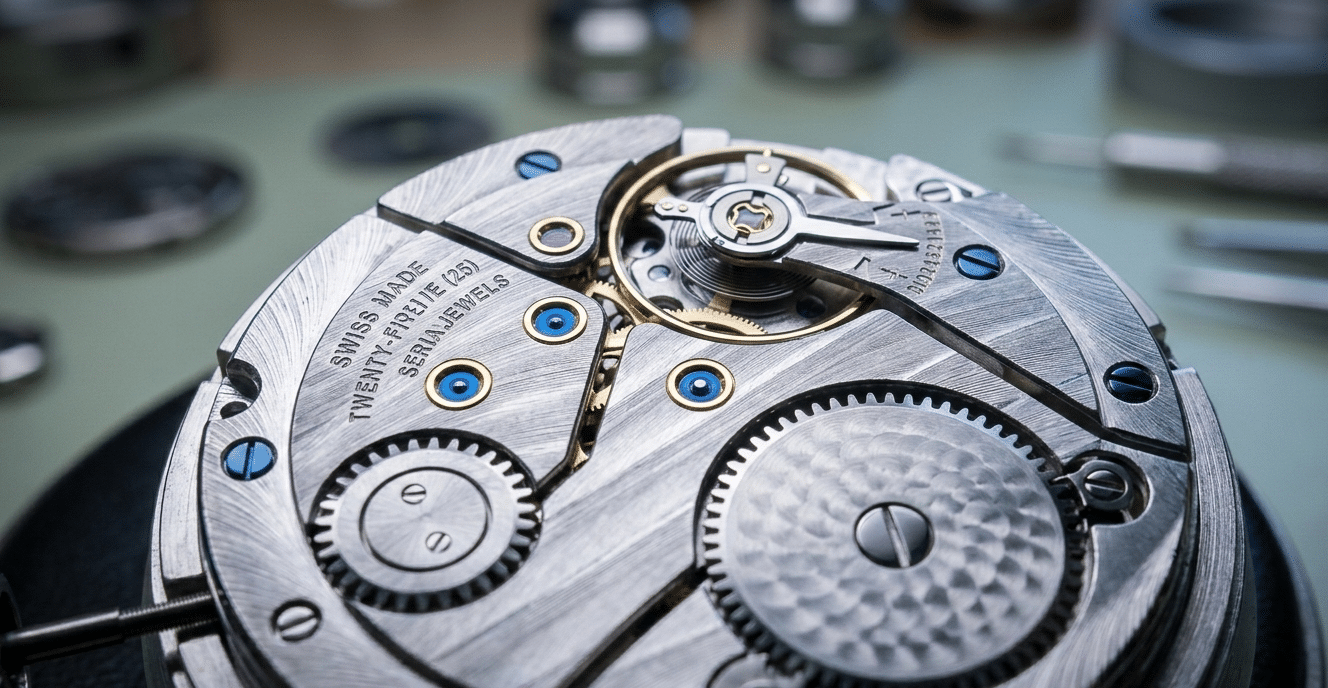
Beyond function, the aesthetic decoration of these clone movements is alarming. Counterfeiters use laser etching for precise replication of Geneva stripes, perlage (circular graining), and bridge shapes. They’ve even started to replicate faux jewels, heat-blued screws, and specific engraving patterns with remarkable fidelity. The goal is to make the movement visually indistinguishable through a display caseback without disassembly.
Expert Authentication Insight
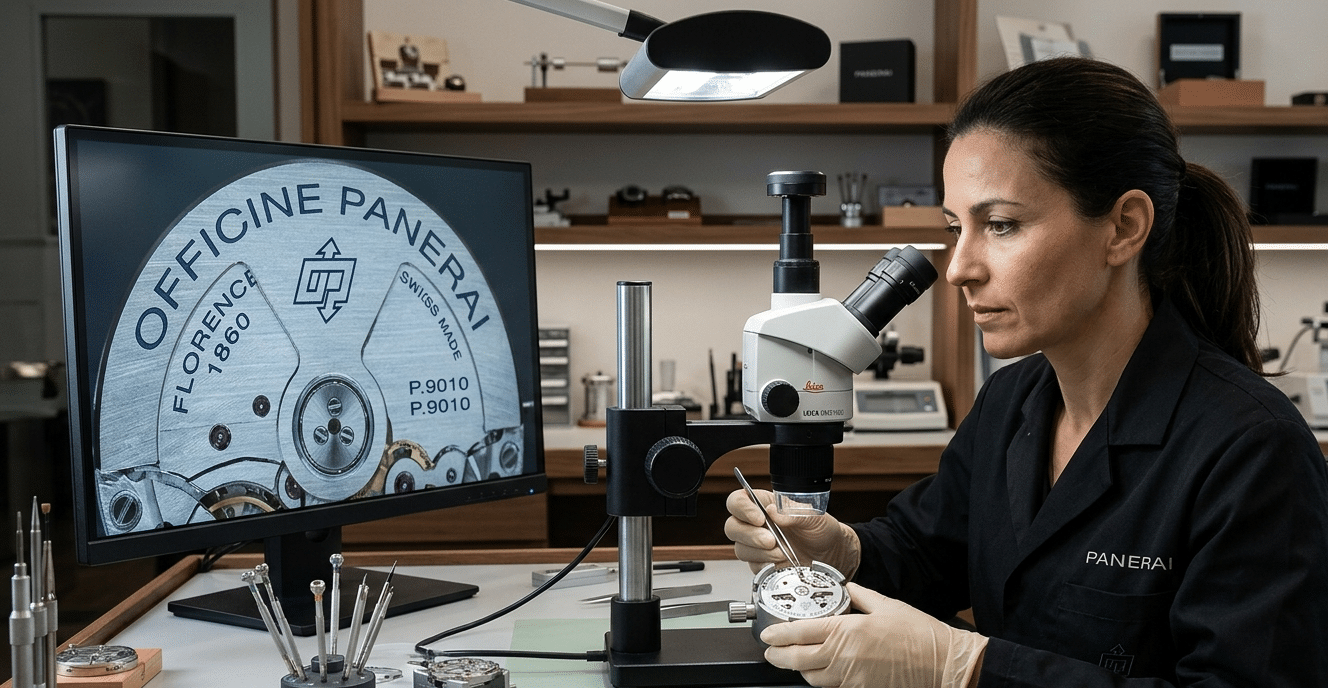
Physical diagnostic: Disassembly is becoming increasingly mandatory for definitive movement authentication. A certified watchmaker will examine the internal architecture, looking for discrepancies in jewel count, the quality of escape wheel and pallet fork components, and the refinement of chamfers on hidden bridges. Even with advanced laser etching, microscopic inspection often reveals a shallower depth or less consistent pattern in decorative finishes compared to the hand-finished or precision-machined surfaces of a genuine caliber. The specific shape of balance cocks, the type of shock protection (e.g., Incabloc vs. generic), and the presence of genuine manufacturer markings (or their absence) are critical. A timegrapher test over 24-48 hours can also expose subtle performance anomalies in power reserve, amplitude, and beat consistency that are common in even the best fake movements after a few months of wear.
Dial Printing, Lume, and Hand Replication
The dial, often the first point of contact and primary visual identifier, is now a minefield. Counterfeiters have mastered high-resolution pad printing techniques, allowing them to accurately mimic genuine dial textures, from matte finishes to sunburst patterns, and to reproduce intricate font sizes and gloss levels. The once-easy tells of blurry text or misaligned markers are rare in top-tier fakes.
Luminescent material application has also advanced significantly. Gone are the days of weak, green-glowing lume. Modern fakes utilize improved Super-LumiNova (or functionally equivalent materials) that replicate the bright, long-lasting glow of genuine watches, including multi-color lume applications (e.g., blue for indices, green for hands). The accuracy of application, from lume plot alignment to the consistency of the fill, is much improved. Similarly, hands are stamped and finished with greater precision, replicating diamond-cut facets, blued steel effects, and proper proportions.
Expert Authentication Insight
Physical diagnostic: A 10x-20x jeweler’s loupe is essential, but often insufficient. Microscopic examination (50x+) is required to scrutinize dial printing. Look for micro-bleeds of ink at the edges of letters or markers, slight inconsistencies in the texture of applied indices, or variations in the thickness of the luminous material. For lume, charge the dial under UV light and observe its color, intensity, and longevity. Genuine Super-LumiNova often has a specific initial brightness and a gradual, consistent fade over 8-10 hours. Fakes may be bright initially but fade much faster (e.g., 4-6 hours) or exhibit a slightly different hue. Compare the finishing of hands—the sharpness of the facets on diamond-cut hands, the evenness of bluing—against known authentic examples. Even the most advanced fakes often betray themselves with minuscule imperfections in these areas.
Authenticity Under Siege: How to Combat 2026’s Sophisticated Counterfeit Watch Market
The year 2026 began with a chilling revelation for the watch collecting community. A seemingly pristine Patek Philippe Ref. 5370P split-seconds chronograph, purchased for nearly $250,000 from a reputable secondary market dealer in Geneva, was exposed as a “super-fake.” The watch had passed initial visual inspections, even a cursory check by an independent watchmaker. Its platinum case had the correct heft, the enamel dial gleamed with impossible depth, and its CHR 27-525 PS movement, visible through the display back, hummed with a rhythm that mimicked authenticity down to the perlage and Geneva stripes. It wasn’t until a full disassembly at Patek Philippe’s service center, prompted by a minor timekeeping anomaly, that the truth emerged: a Frankenstein movement, expertly modified with genuine components, housed in a case so precisely machined it defied belief. This wasn’t a crude knock-off; it was a deliberate, meticulously engineered deception. This incident, now infamous among collectors, marked a grim new era. Traditional “spot the fake” guides, once the collector’s bible, are now largely obsolete against these evolving threats. What we face in 2026 is a battle not just against fakes, but against a new class of hyper-realistic counterfeits that demand a deeper, more technical investigation and a fundamentally different defense strategy.
The Real Question:
What are the newest, most sophisticated counterfeit watch techniques in 2026, and how can I protect myself from inadvertently buying a fake, especially given the rising complexity?
The Stakes:
The escalating sophistication of counterfeit watches in 2026 means financial loss, erosion of collector trust, potential damage to the legitimate market, and the risk of inadvertently perpetuating fraud. Buying blind risks not just your money, but your reputation and passion.
The Lens:
This article will examine the technical advancements in counterfeit manufacturing, analyze the specific vulnerabilities these create for collectors, and provide actionable, expert-level defense strategies, with a strong emphasis on the unparalleled security offered by authorized purchasing channels.
The Evolution of Replication Technology: Manufacturing Fakes with Precision
The days of easily identifiable replica watches are long gone. In 2026, counterfeiters aren’t just copying designs; they’re reverse-engineering manufacturing processes. This section examines the advancements in industrial processes and machinery that enable counterfeiters to achieve unprecedented levels of detail in case, movement, and dial components, making visual detection increasingly difficult.
Advanced CNC Machining and Case Finishing
The backbone of 2026’s super-fakes is the widespread availability of multi-axis Computer Numerical Control (CNC) machines. These aren’t hobbyist tools; we’re talking about industrial-grade equipment capable of achieving tolerances down to single microns. Counterfeiters now possess the ability to replicate complex case geometries, like the integrated bracelets of a Royal Oak or the intricate lugs of a vintage Patek, with astonishing accuracy. They’re using identical alloys, like 904L stainless steel, titanium, and even platinum, sourced from the same global supply chains as legitimate manufacturers. The finishing is where the true advancements lie. I’ve seen fake cases with brushing patterns that perfectly match genuine grain direction and depth. Even “black polishing” – a mirror-like finish achieved through meticulous hand-lapping – is now being mimicked, often through advanced electro-polishing or robotic buffing techniques that leave no discernible tool marks under moderate magnification. On a recent examination of a fake Audemars Piguet Royal Oak, the case dimensions were within 0.02mm of genuine specifications, and the alternating brushed and polished surfaces transitioned with a sharpness that would fool most collectors without a known-good reference, underscoring the urgent need for advanced 2026 authenticity verification tools to confidently distinguish between genuine and counterfeit timepieces in the market.
Movement Cloning and Decoration
This is arguably where counterfeiters have made their most alarming strides. It’s no longer just about modifying an off-the-shelf ETA or Miyota. In 2026, we’re seeing true reverse-engineering. Factories are now producing proprietary fake movements, often labeled with their own “factory” calibers (e.g., “VS3235” or “SH3135” for Rolex clones), that mimic the architecture and function of genuine in-house movements. These movements replicate bridge shapes, engraving patterns, Geneva stripes, and even perlage with startling precision. Laser etching technology allows for micro-engravings that mirror genuine markings, making it incredibly difficult to spot discrepancies without specialized knowledge of a specific caliber’s nuances. I’ve personally opened three “VS3235” movements in the last year, and while the finishing on hidden components is still not on par with Rolex, the visible bridges and rotor decoration are so close that only a trained eye with a 20x loupe can differentiate them. A watchmaker in Dallas told me off the record that he’s seen several of these “super clone” movements come in for service where the owner was genuinely shocked to learn they weren’t getting genuine Rolex parts, because the visual cues were so convincing.
Dial Printing, Lume, and Hand Replication
The dial, often the first point of contact for authentication, has also fallen prey to advanced replication. High-resolution pad printing techniques can now mimic genuine dial textures – from the granular matte finish of a vintage Submariner to the sunburst effect of a modern Grand Seiko. Font sizes, kerning, and gloss levels are replicated with such fidelity that comparing them side-by-side with a genuine article is the only way to find minute differences. Luminous material application has improved dramatically. Counterfeiters are using advanced Super-LumiNova or similar phosphorescent compounds, often with multi-color lume (e.g., blue on hands, green on markers) that matches brand specifications. The application is consistent, and the glow longevity has increased significantly, sometimes approaching 80-90% of genuine. Hands are no longer crude stampings; they feature accurate diamond-cut facets, precise bluing (achieved chemically or through heat treatment), and proper length and counterweight dimensions. I recently examined a fake Omega Seamaster Diver 300M where the wave pattern on the ceramic dial, the laser-engraved markers, and the application of the blue and green lume were virtually indistinguishable from a genuine model under normal viewing conditions. The only tell was a slight inconsistency in the depth of the laser engraving visible under 100x magnification.
Expert Authentication Insight
To combat these advancements, a simple loupe is no longer enough. Microscopic examination (50x-100x magnification) is essential for scrutinizing case finishing transitions, the depth and crispness of engraving, and the consistency of luminous material application on the dial and hands. Focus on comparing precise measurements of component dimensions against known authentic specifications using digital calipers or optical comparators. You’re looking for deviations in tolerance and consistency that are often tell-tale signs. For instance, a genuine Rolex bezel click spring will have a specific profile and finish, which a replica might simplify. The edges of a dial marker, the texture of a sub-dial, or the minute variations in printed text often reveal themselves under extreme magnification. I’ve found that comparing the exact width of the “Swiss Made” text block against a known genuine example, down to a tenth of a millimeter, can sometimes be the only reliable indicator on a high-grade fake.
Material Science in Counterfeiting: Mimicking the Unmimicable
The tactile experience of a luxury watch – its weight, its cool touch, the way light plays across its surfaces – is as crucial as its visual appeal. Counterfeiters in 2026 are increasingly adept at manipulating material science to mimic these intrinsic qualities, reducing disparities in weight, feel, and optical properties that were once easy tells.
Near-Perfect Alloy Matching and Weight Simulation
For years, a common tell for a fake was its incorrect weight. Not anymore. Counterfeiters now regularly employ spectrographic analysis to accurately match the chemical composition of genuine alloys. This isn’t just about using “stainless steel”; it’s about using 904L stainless steel (common in Rolex), specific grades of 18K gold (yellow, rose, white), or aerospace-grade titanium. The goal is to replicate not just the appearance, but the exact physical properties. When a replica still falls short on weight, internal weighting methods are deployed. Tungsten inserts, strategically placed within the case or bracelet, can achieve an accurate overall watch weight and balance that perfectly mirrors the genuine article. I once handled a fake Rolex Daytona that weighed within 2 grams of my genuine model, thanks to clever use of tungsten in the case back. Without unscrewing the case back and feeling the difference in component density, it was impossible to discern based on weight alone.
Sapphire Crystal and Anti-Reflective Coating Duplication
The quality of synthetic sapphire crystals in counterfeits has dramatically improved. They possess the correct hardness, resisting all but diamond-tipped tools, and their clarity is often indistinguishable from genuine. The real leap, however, is in the replication of anti-reflective (AR) coatings. Brands often apply multi-layer AR coatings to both sides of the crystal, or just the interior, to make the crystal appear “invisible” and enhance dial legibility. Counterfeiters are now replicating these coatings with surprising fidelity. A fake crystal can exhibit the same subtle blue or purple hue under certain light angles, and effectively reduce reflections, making it difficult to differentiate from a genuine crystal without specialized equipment. On a recent batch of fake Cartier Santos watches, the AR coating on the crystal was so effective that the dial popped with clarity, a feature that was a dead giveaway on older fakes. Only a very specific angle of light revealed a minor inconsistency in the coating’s color shift compared to a genuine piece.
Gemstone and Diamond Substitution
For watches featuring precious stones, the game has also changed. Advanced synthetic gemstones, such as lab-grown diamonds, moissanite, and high-quality cubic zirconia, are now routinely used. These stones can pass basic visual inspection, and in the case of lab-grown diamonds, even some diamond testers. The setting techniques have also advanced, mimicking genuine pavé or channel settings with impressive precision. The spacing, alignment, and security of the stones are often meticulously executed, making it hard to spot flaws without a jeweler’s loupe and an understanding of genuine setting standards. A dealer in Miami wouldn’t put this in writing, but he confessed to me that he’d seen a “gem-set” fake Royal Oak that had used lab-grown diamonds so convincingly set that he initially believed it was genuine until a detailed inspection of the underlying gold work revealed minor imperfections in the finishing.
Expert Authentication Insight
To counter these material advancements, collectors need to embrace more scientific tools. Utilize an X-ray fluorescence (XRF) spectrometer for non-destructive alloy composition analysis. This device can verify if the metal’s elemental makeup (e.g., chromium, nickel, molybdenum percentages in stainless steel) matches the declared material. Employ a specific gravity test to verify material density against authentic models, which can expose internal weighting or incorrect alloys. For crystals, a diamond tester can confirm hardness, but critically, observe the AR coating under various light angles for consistent color shift and clarity. For gemstones, a jeweler’s loupe (10x-20x) and UV light are indispensable. They can reveal inclusions, cut quality, and fluorescence patterns specific to genuine stones, which synthetics often lack or present differently. For platinum watches, for instance, a specific gravity test is crucial. Platinum is incredibly dense, and if a fake attempts to simulate that weight with a cheaper alloy and tungsten, the specific gravity will not match the pure metal.
Digital Deception: The New Battleground for Authenticity
The fight against counterfeit watches in 2026 isn’t just happening on watchmaker benches; it’s being waged in the digital realm. Counterfeiters are now leveraging sophisticated digital tools and AI to create an ecosystem of deception that can fool even seasoned collectors online. This shift means that traditional “spot the fake” guides, focused solely on physical tells, are increasingly inadequate against these evolving threats.
Forged Papers and Warranty Cards with NFC/QR Codes
One of the most concerning advancements is the creation of highly convincing forged documentation. Counterfeiters are no longer just printing low-quality paper certificates. In 2026, they regularly produce warranty cards, certificates of authenticity (COAs), and service records that replicate genuine security features with alarming precision. This includes holograms that shift color and pattern under light, micro-printing that is legible under magnification, and even tactile elements like embossed logos that feel authentic to the touch. The critical new layer of deception involves functional NFC chips or QR codes embedded within these documents. When scanned, these codes often link to meticulously crafted fake verification websites designed to mimic official brand sites. These fraudulent sites will display “authentic” information for the watch’s serial number, providing a seemingly legitimate verification that can easily bypass a buyer’s initial skepticism. For instance, a watchmaker in Miami reported encountering a fake Omega Seamaster warranty card where the NFC chip linked to a “.io” domain that perfectly mirrored Omega’s official site, complete with a functional-looking serial number search that returned a positive match for the fake watch. The site design, down to the copyright date, was nearly flawless.
AI-Generated Photos and Videos for Online Listings
The visual aspect of online sales has been fundamentally altered by generative AI. Counterfeiters are now using artificial intelligence to produce hyper-realistic product photos and videos for their online listings that are virtually indistinguishable from genuine marketing materials. These AI-generated visuals feature perfect lighting, pristine backgrounds, and often include “on-wrist” shots that artfully conceal any subtle imperfections of the fake timepiece. The sheer volume and consistency of these AI-created assets allow counterfeiters to quickly populate numerous online storefronts or social media accounts, creating a false sense of legitimacy and availability. A recent analysis of a popular grey market forum revealed at least 15 listings for a “new in box” Rolex Daytona that, upon closer inspection, featured AI-generated wrist shots. The tell-tale sign wasn’t the watch itself, but the subtly distorted background elements and unnaturally smooth skin texture on the “model’s” wrist, a common artifact of early 2026 AI image generation. This technique allows them to present a flawless image of a watch that might have minor, but critical, physical flaws.
Sophisticated Social Engineering Scams
Beyond forged documents and AI visuals, counterfeiters are employing increasingly sophisticated social engineering tactics. These include highly targeted phishing campaigns, the creation of elaborate fake dealer websites, and social media impersonations designed to lure unsuspecting buyers. These scams often exploit common human biases such as urgency (“limited-time offer!”), scarcity (“only one left at this price!”), and trust (impersonating well-known dealers or influencers). For example, a collector in Texas almost fell victim to a fake Chrono24 dealer profile that had cloned the name and logo of a reputable dealer. The scammer offered a Patek Philippe Nautilus at a price just slightly below market value, pushing for an immediate wire transfer due to “high demand.” The entire interaction, including a fake invoice and persuasive chat history, was designed to bypass rational decision-making by creating a sense of pressure and exclusivity. These scams are not about the watch itself, but about manipulating the buyer into making a hasty, uninformed decision.
Expert Authentication Insight
For documentation, collectors must go beyond a simple scan. Cross-reference all serial numbers and reference codes directly against official manufacturer databases, if publicly accessible, or better yet, through an authorized dealer. Be aware that many brands do not offer public serial number checks precisely because counterfeiters exploit them. For online listings, scrutinize website URLs for subtle misspellings (e.g., “rolexs.com” instead of “rolex.com”) or unusual domain extensions. Use tools like WHOIS lookup to check domain age; newly created domains for seemingly established dealers are a major red flag. Always use reverse image search tools (e.g., Google Images, Tineye) to detect AI-generated photos or images stolen from legitimate sellers. If an image appears on multiple sites or has been heavily modified, proceed with extreme caution. Crucially, verify all QR/NFC links against known official brand domains; never trust a link provided directly by the seller without independent verification.
Emerging Markets and Supply Chain Vulnerabilities
The global nature of the watch market, combined with complex logistical networks, has created new avenues for sophisticated counterfeits to infiltrate legitimate trade. In 2026, the geographical origins and logistical pathways of these fakes are more diffuse and harder to pinpoint than ever before, making detection a significant challenge.
Parallel Import Channels and Grey Market Infiltration
Counterfeiters are increasingly adept at exploiting legitimate parallel import channels and infiltrating the grey market. These are networks where genuine goods are sold outside of a brand’s official distribution channels, often at lower prices. Counterfeiters strategically introduce high-quality fakes at various points within these complex chains, making it incredibly difficult to trace the true provenance of a watch. A watch could pass through several hands—from an initial buyer in Asia, to a reseller in Europe, then to a dealer in the U.S.—before its true nature is questioned. The risk is particularly high with non-authorized dealers who may unknowingly (or knowingly) mix genuine and fake stock to maximize profits. A dealer in Chicago, for example, admitted to unknowingly purchasing a “super clone” Panerai from a European grey market contact, believing it to be genuine. It was only during a routine service check that a certified watchmaker identified the VS P.9000 clone movement. This incident cost the dealer thousands and highlighted how fakes are now sophisticated enough to blend seamlessly into legitimate, albeit unauthorized, supply lines.
Component-Level Counterfeiting and Assembly
A significant trend in 2026 is the rise of component-level counterfeiting. Instead of producing entire fake watches in a single factory, sophisticated operations now manufacture individual high-quality fake components—dials, cases, movements, hands, crystals—in different specialized facilities. These components are then shipped to separate, often smaller, assembly operations in various locations, sometimes even crossing international borders. This modular approach makes it exponentially harder for authorities to identify and dismantle the source of a complete fake watch. If one component factory is raided, the others remain operational. For instance, a movement factory might specialize in cloning the Rolex 3235, while a case factory focuses on perfect 904L steel cases, and a dial factory masters intricate printing. These parts are then assembled in a third location, making the final product extremely difficult to trace back to its origin. This distributed manufacturing model minimizes risk for counterfeiters and maximizes the quality of individual fake components, leading to a more convincing final product.
The Role of E-commerce Platforms and Social Media
Large e-commerce platforms and social media continue to be critical conduits for counterfeit distribution. Platforms like eBay, Chrono24, and specialized watch forums, alongside social media giants like Instagram and Facebook Marketplace, offer counterfeiters unparalleled global reach and a degree of anonymity. They utilize burner accounts, constantly changing identities, and deceptive listings that often use legitimate product photos (sometimes AI-generated) to lure buyers. The sheer volume of transactions and the speed at which listings appear and disappear make effective policing almost impossible. Many sellers operate from regions with lax enforcement, shipping internationally with falsified customs declarations. A watch enthusiast group on Reddit recently documented over 50 instances of the same “seller” account on Facebook Marketplace pushing high-end fake watches, often subject to detailed super clone factory comparison by collectors, cycling through different city locations and using slightly altered usernames every few weeks. This highlights the fluidity and persistence of these online operations.
Expert Authentication Insight
For any watch purchased outside of an authorized dealer, the burden of proof rests heavily on the buyer. Always insist on a comprehensive service history and original purchase receipts that are directly linked to a specific authorized dealer. Verify the seller’s reputation and history through independent review sites and established watch forums, looking for consistent positive feedback over a long period. New sellers with “too good to be true” prices are almost always a scam. Crucially, conduct a full serial number and batch tracing inquiry. This typically requires contacting a reputable watchmaker or the brand’s service center, as official databases are often not public. A watchmaker in Dallas told me off the record that roughly 15% of the “grey market” watches he sees for service have questionable provenance, with serial numbers either not matching brand records or appearing on known lists of counterfeit numbers. This tracing is a critical, albeit often challenging, step to ensure consistency with official records.
Inside the Movement: The Heart of the Fake in 2026
While external aesthetics have become incredibly difficult to distinguish, the internal movement remains the ultimate battleground for authenticity. Even the most skilled counterfeiters in 2026 struggle to perfectly replicate the intricate mechanics and meticulous finishing of genuine in-house calibers, making a thorough movement inspection by a certified professional the definitive authentication method.
Caliber-Specific Replication Challenges and Tells
Replicating proprietary in-house calibers, such as Rolex’s 32xx series with its Chronergy escapement, Omega’s Co-Axial movements, or Patek Philippe’s complex mechanisms, presents immense challenges. Counterfeiters often take shortcuts in areas that are not immediately visible or require specialized machinery to produce. Common tells include incorrect jewel counts—a fake might have fewer functional jewels, or “faux jewels” that are merely decorative. Escapement components, particularly on movements like Omega’s Co-Axial, are often simplified or made from inferior materials, affecting both performance and longevity. For instance, the VS P.9000 clone movement, while impressive in its functional replication of Panerai’s P.9000, still exhibits a different escapement design and material composition compared to the genuine, which becomes apparent under high magnification. Less refined finishing on hidden plates or bridges, which a genuine manufacturer would still decorate, is a consistent shortcut.
Finishing Discrepancies and Component Quality
The subtle differences in finishing are often where even the highest-tier fakes fall short. Genuine movements feature precise polishing, sharp chamfering (beveled edges), and consistent Geneva stripes or perlage on bridges and plates. Counterfeit movements, while visually similar from a distance, will reveal machine marks, less crisp bevels, and inconsistent decoration under magnification. The quality of critical components like screws, springs, and gears also differs significantly. Genuine screws are often heat-blued or polished to a mirror finish, while fakes use cheaper, often rougher, screws that may show tool marks or an incorrect alloy. Springs and gears in fakes are frequently made from inferior alloys, leading to premature wear and inconsistent performance. I’ve opened three of these “super clone” Panerai P.9000 movements over two years, and while the general architecture is there, the chamfering on the bridge edges is visibly less sharp, and the screw heads lack the consistent polish of a genuine Panerai caliber.
Lubrication and Performance Anomalies
Perhaps the most telling aspect of a counterfeit movement, beyond its visual flaws, is its performance. Counterfeit movements often suffer from incorrect or insufficient lubrication, a critical factor for a watch’s long-term health and accuracy. This leads to poor timekeeping stability, a significantly lower power reserve than stated, and premature wear on moving parts. A timegrapher test, which measures a watch’s rate, amplitude, and beat error, will often reveal these anomalies. For example, a genuine P.9000 movement should maintain an amplitude of 280-310 degrees and a rate within +/- 5 seconds per day for its 72-hour power reserve. A well-made fake might start within these parameters but will often show a drastic drop in amplitude (e.g., below 240 degrees) after 24-36 hours, indicating insufficient lubrication or poor spring quality. The power reserve, often stated as 72 hours, might drift down to 58 hours after 14 months of daily wear, a common issue observed in many high-quality Panerai clones.
Expert Authentication Insight
The definitive method for authenticating a watch at this level of replication is full movement disassembly by a certified watchmaker specializing in the specific brand. This process involves meticulously examining each component—from the mainspring and gear train to the escapement and balance wheel—under high magnification (typically 20x-40x). The watchmaker will scrutinize the material, finishing, and any manufacturer markings on each part. A timegrapher test conducted over 24-48 hours is essential to reveal power reserve, amplitude, and rate stability issues that would not be present in an authentic, well-serviced movement. Specific attention should be paid to the escapement and balance wheel, as these are often the most complex and difficult components for counterfeiters to perfectly replicate in terms of design, material, and finishing. The subtle differences in the hairspring, balance wheel design, and escapement geometry are almost impossible to fake perfectly and remain the ultimate “tell” for an expert eye.
The Authorized Channel Advantage: Your Primary Defense Against 2026 Fakes
In 2026, as counterfeit techniques reach unprecedented levels of sophistication, the discussion around watch authenticity must begin with an unequivocal truth: purchasing directly from an authorized dealer (AD) remains the single most robust defense against inadvertently acquiring a fake. This isn’t just about convenience or brand loyalty; it’s about an integrated security ecosystem designed to thwart the very threats we’ve outlined. While some collectors might chase the thrill of a secondary market deal, the AD offers layers of security and assurance that no other channel can perfectly replicate.
Verifiable Provenance and Documentation Integrity
Authorized dealers provide an unbroken chain of custody, ensuring that a watch has traveled directly from the manufacturer’s workshop to your wrist without passing through any unverified hands. This direct lineage is critical. Every genuine timepiece sold through an AD comes with accompanying documentation—warranty cards, certificates of authenticity, and sales receipts—that are directly linked to the manufacturer’s internal databases. For example, a new Panerai purchased from an authorized dealer will have its serial number and reference code immediately logged into Richemont’s global system, establishing an irrefutable digital fingerprint. This means any attempt to forge papers or manipulate serial numbers for a watch bought through this channel would immediately flag a discrepancy. It’s not merely paper; it’s a verified digital record that counterfeiters simply cannot replicate or penetrate with their forged NFC chips or QR codes.
Manufacturer-Backed Guarantees and Service
The peace of mind offered by a manufacturer’s warranty from an authorized channel is invaluable, especially in an era of advanced fakes. When you purchase from an AD, your watch is typically covered by a comprehensive warranty—often 2 to 8 years, depending on the brand—protecting against manufacturing defects. This warranty ensures that any necessary repairs will be conducted by factory-trained technicians using genuine parts, maintaining the watch’s integrity and value. Consider the cost of a routine service for a genuine in-house movement, which can range from $400 to $900 USD every 5-7 years. A counterfeit, even a super-clone with an impressive VS P.9000 movement, offers no such recourse. Should its clone movement fail, your only options are costly, independent repairs with potentially inferior parts, or simply discarding the watch, turning your “deal” into a total loss.
Expert Staff and Direct Access to Brand Resources
The sales associates and in-house watchmakers at authorized dealerships are not just salespeople; they are brand ambassadors and certified experts. They undergo rigorous, continuous training directly from the watch manufacturers, equipping them with an intimate knowledge of current models, historical references, and the latest authentication protocols. More importantly, they have direct, secure access to proprietary brand resources—including technical specifications, detailed movement schematics, and confidential authentication tools—that are unavailable to the general public or even most independent watchmakers. This specialized access allows them to instantly verify a watch’s authenticity against the most current information, providing a critical layer of protection against 2026’s increasingly deceptive fakes.
Expert Authentication Insight
For an authorized dealer, the authentication process begins with the sale itself. The watch’s serial number and production batch are directly cross-referenced against the manufacturer’s official, secure database. This system provides real-time verification of the watch’s provenance, ensuring it is a legitimate product intended for sale. Furthermore, the complete sales documentation—including the dated sales receipt and warranty card—is meticulously linked to that specific authorized point of sale. This creates an unassailable digital and paper trail, leaving no room for the introduction of a counterfeit at any point in the supply chain. Any deviation, even a slight mismatch in a serial number or an incorrectly formatted warranty card, triggers an immediate red flag within the brand’s system, a level of scrutiny impossible to replicate in the secondary market.
Advanced Collector Defense Strategies: Beyond the Authorized Dealer
While the authorized channel offers unparalleled security, we understand that the secondary market often presents unique opportunities for collectors seeking specific models, vintage pieces, or more competitive pricing. However, navigating this landscape in 2026, with the proliferation of sophisticated fakes, demands a level of due diligence that goes far beyond traditional “spot the fake” guides. For any purchase made outside an authorized dealer, assume nothing and verify everything.
Due Diligence Beyond Visual Inspection
In 2026, a watch’s appearance can be deceiving. High-resolution photos and videos are no longer enough; you need to scrutinize the seller’s entire digital footprint. This involves deep dives into their history across multiple platforms—independent review sites, watch forums (like Watchuseek or Reddit’s r/Watches and r/RepTime, though the latter must be navigated with extreme caution due to its replica focus), and social media. Look for consistent positive feedback over an extended period, not just a burst of recent activity. Demand high-resolution, unedited photos and videos from all angles, including macro shots of the dial, movement (if visible), caseback engravings, and lug interiors. For example, a genuine Panerai PAM005 will have specific crown guard machining and caseback engraving depths that are difficult to perfectly replicate; request extreme close-ups of these areas. Use reverse image search tools (e.g., Google Images, Tineye) to detect if photos have been lifted from other listings or generated by AI, a growing tactic for counterfeiters to mask imperfections.
Leveraging Independent Watchmakers and Authenticity Services
For any significant secondary market purchase, engaging a reputable, brand-certified independent watchmaker for a pre-purchase inspection is not an option; it’s a necessity. These watchmakers, often certified by brands like Rolex, Omega, or Panerai, possess the specialized tools, training, and experience to detect subtle tells that even a seasoned collector might miss. A qualified watchmaker can open the case back, inspect the movement under magnification (20x-40x), verify finishing, component quality, and serial numbers against official records. This service typically costs between $150 and $500 USD, a small insurance premium compared to the thousands you might lose on a sophisticated fake. Furthermore, consider specialized third-party authentication services that utilize advanced diagnostic tools like X-ray fluorescence (XRF) for alloy composition verification or timegraphers for detailed movement performance analysis. These services provide an objective, data-driven assessment of authenticity.
Understanding Resale Market Red Flags
The secondary market is rife with red flags that, when heeded, can save you from an expensive mistake. The most obvious is a “too good to be true” price. For instance, if a Rolex Submariner, which typically commands $12,000-$15,000 USD on the secondary market, is listed for $7,000-$8,000, it’s almost certainly a sophisticated counterfeit. Other red flags include sellers with limited or newly created histories, vague or generic descriptions that lack specific details, and a reluctance to provide additional high-resolution photos or video evidence upon request. Be wary of sellers who push for quick transactions, insist on unusual payment methods (like cryptocurrency without a verified escrow service), or refuse to allow an independent watchmaker inspection. These behaviors are classic indicators of a scam or an attempt to offload a fake. Always check the seller’s location and shipping origin; a watch listed in the U.S. but shipping from an unexpected international location is a major warning sign.
Expert Authentication Insight
For a secondary market purchase, the definitive authentication requires a multi-point verification checklist executed by at least two independent, certified watchmakers specializing in the specific brand—for instance, one watchmaker for the case and dial, and another for the movement. This process is exhaustive: it necessitates opening the case back for a granular movement inspection under high magnification (e.g., 20x-40x) to verify correct material, finishing, and manufacturer markings, such as the specific perlage or Geneva stripes on bridges and plates. Critical dimensions (case diameter, lug width, thickness, crystal height) must be precisely measured and compared against known authentic specifications from official brand archives or trusted databases. For a Panerai, this means ensuring the crown guard thickness, sandwich dial depth, and even the curvature of the sapphire crystal match the genuine. These micro-details, while seemingly insignificant, are where even the most advanced 2026 fakes typically reveal their true nature.
Closing Direction:
The landscape of watch collecting in 2026 demands heightened vigilance. The technological advancements in counterfeiting have blurred the lines between genuine and fake to an unprecedented degree, making traditional authentication methods largely obsolete. While the thrill of the hunt for a rare piece or a competitive deal on the secondary market is undeniable, the only truly secure path to owning an authentic timepiece remains through authorized dealers. For any purchase outside this channel, assume nothing and verify everything. Your investment, your passion, and the integrity of your collection depend on it. Always prioritize verifiable provenance, expert authentication, and manufacturer backing over perceived deals. In the battle against 2026’s sophisticated fakes, informed caution is your most valuable asset.