
The Cartier Design Mandate: Why Thickness is a Crime Against Elegance
Cartier didn’t build its legacy on water resistance or shock absorption. It built it on an idea of elegance—a visual and tactile ideal where a watch becomes an extension of the wrist, not an object perched on top of it. This isn’t abstract. For Cartier’s dress and elegance pieces, thinness isn’t a feature; it’s the foundational principle. The entire design language—from the curved lugs of a Tank to the floating illusion of a Ballon Bleu—is predicated on a specific, slender proportion, a standard often misunderstood in the context of fake Cartier 1847 MC movement claims and replica authenticity.
When you buy a replica of these watches, you are not buying a tool. You are buying a silhouette. You are paying for a specific wrist feel. A thick replica doesn’t just miss the mark; it commits a fundamental crime against the design’s intent. It swaps the intended glide for a clunk, the intended hug for a perch. This is the non-negotiable starting point. If your priority is “getting a Cartier look,” thickness is your primary enemy. The movement decision that follows is purely about how to defeat it.
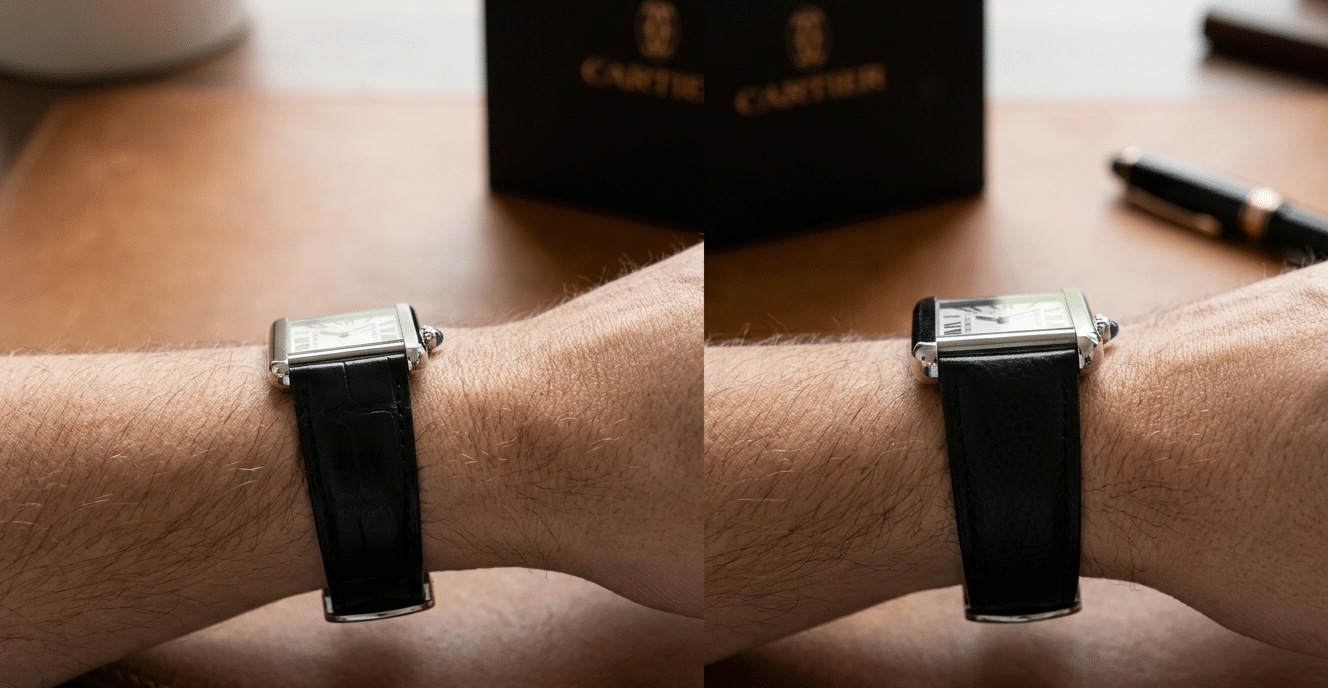
The “Slip Under the Cuff” Test: More Than a Cliché
The phrase is overused because it’s the ultimate functional test. A genuine Cartier dress watch is engineered to disappear under a shirt cuff without a bulge. It’s a clean, seamless transition. A replica built on a common, thicker movement like a Seagull 2824 or Miyota 9015 fails this test immediately. It catches. It creates a visible, awkward lump under fine fabric. This isn’t a minor inconvenience; it’s a dead giveaway that breaks the illusion of elegance the moment you move. The watch announces its presence through friction, not finesse.
Visual Mass vs. Delicacy: How Thickness Changes the Silhouette
Look at a watch from the side. Thickness adds visual mass, making the case look tall and top-heavy. On a design like the Tank Louis or Santos-Dumont, which are essentially elegant lines drawn in steel, extra millimeters transform a delicate rail track into a stout block. The curved caseback that’s meant to nestle into your wrist arc instead sits proud, creating a gap. On the wrist, a 12mm thick Tank Solo replica doesn’t just look wrong; it feels like a polished hockey puck compared to the gen’s 8-9mm glide. The design loses its grace and becomes jewelry with the wrong proportions.
Expert Authentication Insight
For professional authenticators, case profile is a first-glance, telltale sign. While they use loupes for microscopic details, the overall silhouette—the height and the curvature of the caseback—is assessed instantly. A watch that stands too tall off the wrist is flagged immediately. In the replica world, achieving the correct profile is the single hardest mechanical challenge because it’s dictated by the movement inside. A factory can perfect the dial and case finish, but if they start with a movement that’s 1.5mm too tall, the entire watch is structurally compromised from the outset. The quest for thinness isn’t about specs; it’s about architectural integrity.
Meet the Contenders: 2824/9015 Bulk vs. 2892-Style Slimness
To understand why a 2892-style movement commands a premium, you need to see the machinery. This isn’t about vague “better quality.” It’s a straightforward engineering problem: bulk versus slimness. The common alternatives force compromises that directly contradict Cartier’s design mandate.
The 2824 Compromise: Reliability at the Cost of Profile
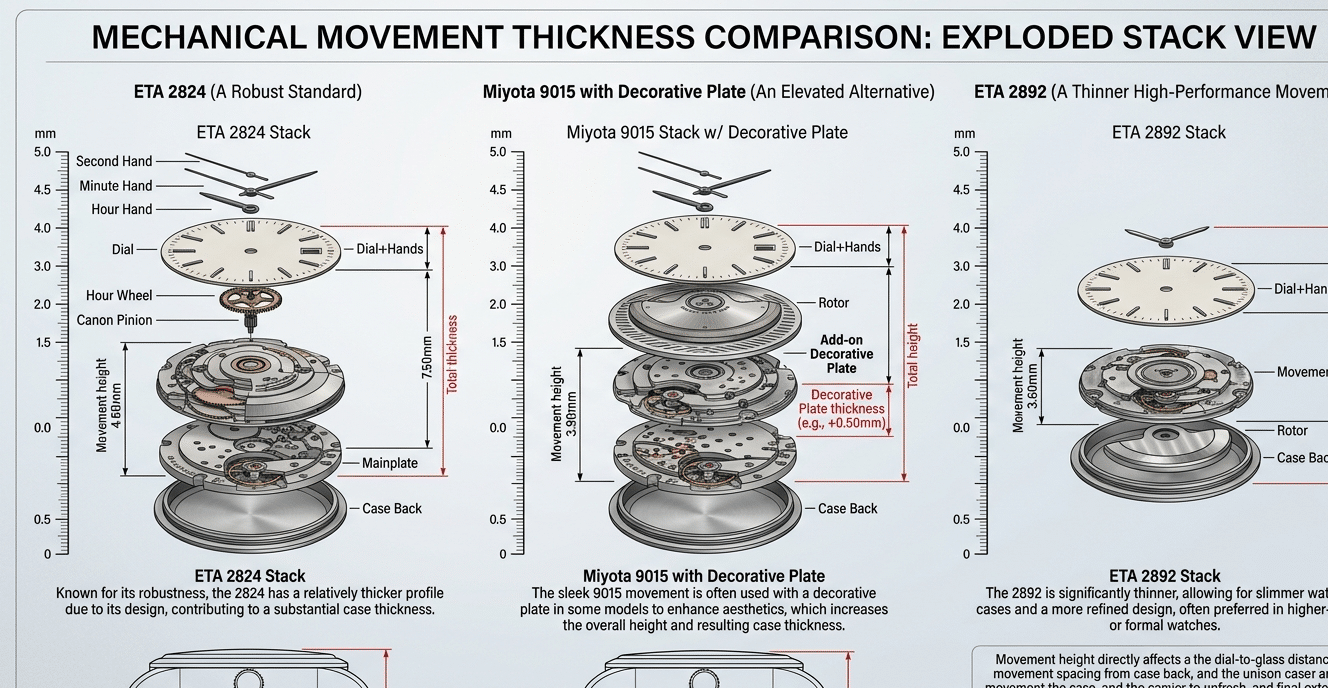
The Seagull ST2130 (a clone of the ETA 2824) is the workhorse of the replica industry. It’s robust, easily serviceable, and affordable. But it’s tall. Its architecture, including the rotor design and the height of the gear train, results in a movement that’s typically around 4.6mm thick. When you add a caseback and a crystal, you’re locked into a minimum case thickness of about 10.5-11.5mm. For a watch designed to be 8mm, that’s a disaster. Factories using the 2824 have to stretch the mid-case and often flatten the caseback curve, destroying the intended silhouette. This is why so many entry-level Tank replicas feel wrong on the wrist—they’re built around the wrong engine.
The Miyota 9015 Illusion: Slim Movement, Fattened Case
The Miyota 9015 seems like the perfect solution: a thin, reliable Japanese automatic movement. And it is thin—at just 3.9mm. But here lies the replica industry’s ironic twist. The 9015 is notoriously noisy, with a rotor that sounds like a frantic whisper. To mask this, factories almost universally add a thick, decorative metal plate between the movement and the caseback. This “silencer” plate can add 1.5mm or more, completely negating the movement’s slim advantage. You end up with a watch that’s often just as thick as a 2824-based version, but with a more annoying rotor noise dampened by extra metal. It’s a pyrrhic victory for thinness.
The 2892 Family Blueprint: Built for Thin from the Ground Up
This is where the 2892 and its clones (like the Hangzhou 6460 or Seagull ST1812) differ. This movement family was designed from the outset to be slim. Its architecture places the rotor closer to the movement’s center, and its gear train is arranged more efficiently. The result is a base movement height around 3.6mm. This foundational 1mm difference (compared to a 2824) is everything. It allows the factory to use a properly curved, gen-spec caseback and a slimmer mid-case while still housing a reliable automatic movement. Think of it this way: the 2824 is an SUV drivetrain—durable but tall. The 2892 is a sports car engine—lower, wider, and designed for a specific, sleek application.
Expert Authentication Insight
The choice of movement clone has a domino effect on case construction. A factory committed to a 2892-style movement isn’t just swapping parts; it’s investing in a different, more expensive case construction from the start. The tolerances are tighter, the milling of the mid-case is more precise to save every fraction of a millimeter, and the curvature of the caseback can mirror the genuine article. This is why a “super clone” with a 2892 isn’t just about the movement; it’s about an entire watch built to a different, more demanding profile standard. The movement enables the form.
The Tiered Reality: Which Cartier Models Demand a 2892-Style Movement
Not every Cartier replica needs to go on a diet. The value of a slimmer movement is entirely dependent on the model’s original design ethos. Paying a $200-$400 premium only makes sense if the thinness fundamentally changes the wearing experience. Here’s the decisive breakdown.
Tier 1: The Thinness Purists (Tank, Santos-Dumont)
For these models, anything beyond genuine specification is a failure. The design is the thinness.
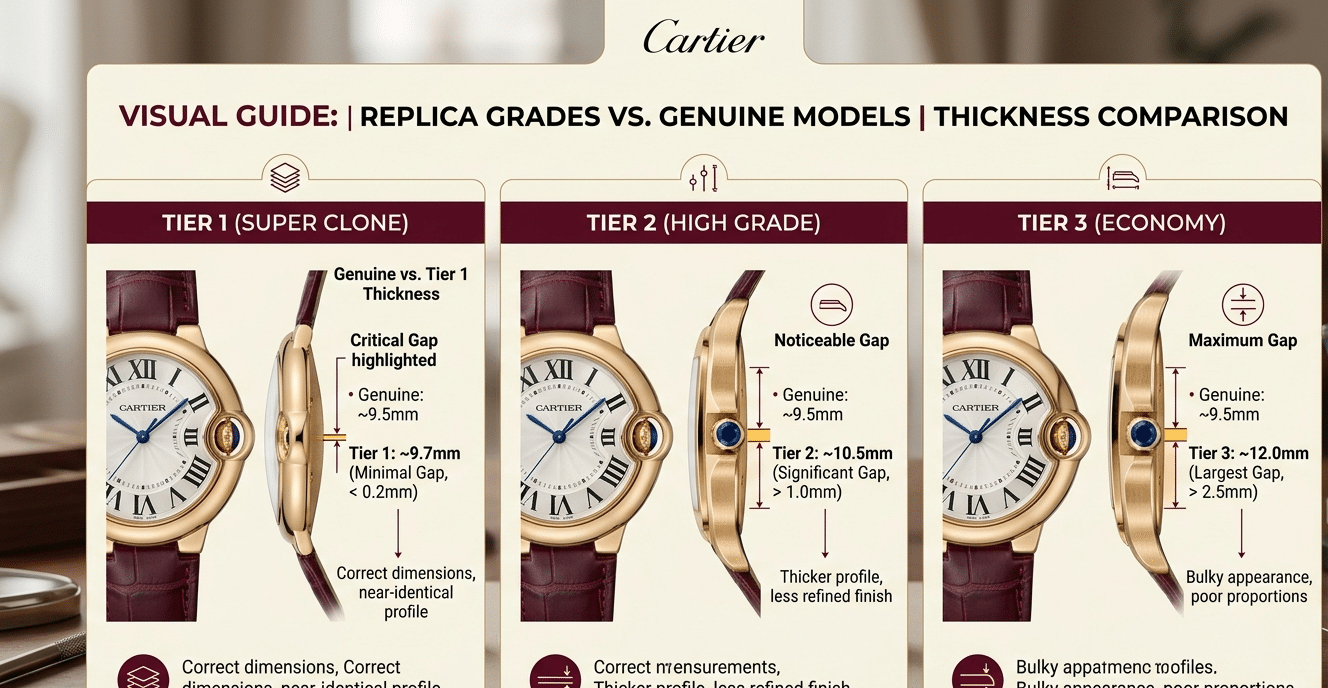
- Tank Solo/Louis/Must: Genuine: ~7-9mm. Standard Rep (2824/9015): 10.5-12mm. With 2892: 8.5-9.5mm. The difference is transformative. The standard rep feels like a slab; the 2892 version begins to capture the elegant, flat ribbon-of-metal effect.
- Santos-Dumont (the flat, quartz-inspired model): Genuine: ~7-8mm. This watch is practically two-dimensional. A thick automatic replica betrays its entire Art Deco spirit. A 2892 clone is the only way to approximate its delicate presence with an automatic movement.
The Verdict: Non-negotiable. If you are buying a replica of these, the 2892-style movement isn’t an upgrade; it’s the cost of entry. For a deeper technical justification of this standard, the Miyota 9015 super clone movement analysis provides essential context. Without it, you have a watch that visually and physically contradicts its own reason for existing.
Tier 2: The Elegance Enhancers (Ballon Bleu, Clé)
Here, thinness is a key elegance factor, but the design has more volume to play with, allowing for slight compromise.
- Ballon Bleu 36mm/33mm: Genuine: ~9-10mm. Standard Rep: 11-12mm. With 2892: 10-10.5mm. The Ballon’s curved case and crystal can mask some thickness, but a slimmer profile enhances its “floating” illusion and makes it more comfortable for all-day wear.
- Clé de Cartier: Genuine: ~11mm. Standard Rep: 12.5-13mm+. With 2892: ~11.5mm. Getting closer to gen spec here improves the watch’s sophisticated, fluid feel significantly.
The Verdict: Significant benefit. The 2892 version is noticeably more authentic and refined. The premium is justifiable if your budget allows and elegance is a top priority.
Tier 3: The Profile-Agnostic Models (Large Santos, Pasha)
These are sportier, more substantial watches where an extra millimeter gets lost in the overall wrist presence.
- Santos de Cartier (Large, 39.8mm): Genuine: 9.08mm. Standard Rep (with 9015): ~10-10.5mm. The Santos’s square case, bezel screws, and integrated bracelet create a bold, architectural look. The 1-1.5mm difference is virtually imperceptible on the wrist. The standard GF/V6 factory version with a Miyota 9015 is already excellent.
- Pasha, Roadster: These are chunky, sport-luxury designs. Their character isn’t defined by razor-thin elegance.
The Verdict: Negligible difference. Save your $300. The premium for a 2892 in these models is for bragging rights only, with no tangible improvement in aesthetics or wearability. The standard replica is essentially correct.
Expert Authentication Insight
This tiered analysis reflects a fundamental principle in horology: design intent dictates technical necessity. A watch designed as an “objet d’art” for the wrist, like the Tank, has no tolerance for proportional error. A watch designed as a “sporting elegance” piece, like the large Santos, has built-in visual mass that absorbs minor dimensional variances. The smart buyer matches their movement investment to the model’s design sensitivity. Pouring money into a slimmer movement for a Pasha is like putting racing tires on a luxury SUV—a costly exercise that provides no real-world benefit for its intended use.
The Price of Millimeters: Breaking Down the “Super Clone” Premium
So, you’ve decided that thinness matters. The next question is the inevitable one: how much more does it cost to get it right? A Cartier replica built around a 2892-style movement—often marketed as a “super clone” or “ultimate edition”—typically commands a premium of $200 to $400 over its standard 2824-powered sibling. This isn’t pocket change. The key is to dissect that premium and ask what you’re actually buying. Is it just the millimeter, or is it something more?
Movement Cost vs. Case Engineering Cost
The premium starts with the movement itself. A reliable clone of an ETA 2892 or its Chinese derivatives (like the Hangzhou 6460 or Seagull ST1812) is inherently more expensive to produce than a 2824 clone. The architecture is more complex, the tolerances are tighter to maintain performance in a slimmer package, and the economies of scale are smaller. But the cost doesn’t stop there. The real engineering challenge—and expense—lies in the case.
A factory can’t just drop a slimmer movement into a standard case and call it a day. To achieve a genuine reduction in overall thickness, the entire case architecture must be re-engineered. The case back must be thinner yet still maintain structural integrity and water resistance (however minimal). The mid-case walls and crystal seating need recalculation. This requires more precise CNC machining, better-quality materials to avoid flex, and often a complete redesign of the case tube and crown assembly. You’re paying for precision engineering, not just a different component.
The “Super Clone” Bundle: Thinness Plus Finishing
This is where the marketing term “super clone” often does some heavy lifting. In many instances, the 2892-style movement isn’t sold as a standalone upgrade. It’s packaged within a top-tier factory’s best effort. This means the premium you pay often bundles several improvements: the slim movement, the re-engineered case, and a higher standard of finishing.
Compare a standard factory’s Cartier Tank with a 2824 to a “super clone” version from a factory like KOR or BVF for the Santos-Dumont. The difference isn’t just thickness. The “super clone” will likely have sharper, more refined case polishing, a dial with better-applied print and a more authentic color tone, and a bracelet or strap with superior edge finishing. You’re buying into the factory’s flagship product line. The thinness is the headline feature, but the overall execution is what justifies the full price jump.
Diminishing Returns: The Last Millimeter is the Most Expensive
Here’s the critical reality check. The relationship between cost and thinness isn’t linear; it’s exponential. Getting from a chunky 11mm down to a respectable 9.5mm might be a $200 leap. But shaving that last half-millimeter to hit a true 9mm—matching the genuine article—could cost another $150-$200. You’re paying for extreme marginal gains.
The question becomes: are you paying for the millimeter, or for the bragging rights of a perfect measurement? For a watch worn on the wrist, the visual and tactile difference between 9mm and 9.5mm is subtle, often negligible in daily wear. The difference between 11mm and 9.5mm, however, is transformative. A savvy buyer must identify their own threshold, which can be informed by a detailed Cartier super clone movements explained guide covering factory comparisons and movement specifications. If the goal is an elegant silhouette that captures the spirit of the design, a $500-$600 rep with a 2892 might get you 95% of the way there. The $800 “ultimate” version gets you that final 5%—perfect for the obsessive, but arguably superfluous for most.
Expert Authentication Insight
The premium for thinness creates a curious side effect for authentication. A superbly executed, slim 2892-based replica of a model like the Tank Louis is often more dangerous to authenticate at a glance than a thicker version. The standard, thicker rep immediately fails the “proportion test” for a trained eye. The slim super clone, however, passes that initial, crucial visual sniff test. It forces the evaluator to look for secondary tells—the polish of the caseback, the sharpness of the dial printing, the click of the crown—which are inherently more subjective and difficult to spot without direct comparison. The investment in thinness, therefore, isn’t just about aesthetics; it’s about bypassing the most immediate and reliable visual filter used to spot a replica.
The Compromises You Can’t Ignore: Service, Noise, and Longevity
Choosing the 2892 path isn’t a pure victory. You’re making a trade, exchanging one set of virtues for another. The common 2824 is the Honda Civic of replica movements: ubiquitous, tough, and easy for any competent watchmaker to fix. The 2892-style movement is more like a precision sports car engine: elegant and efficient, but requiring a more specialist touch and potentially less forgiving of neglect.
Serviceability: The 2824’s Ultimate Advantage
This is the 2824’s killer feature. Its parts are everywhere. If it breaks, any local watchsmith likely has a donor movement or a drawer full of compatible components. Service is quick and cheap. The 2892 and its clones are less common in the replica ecosystem. While parts exist, finding a watchsmith familiar with its specific layout and willing to work on a replica is harder. You may need to seek out a specialist or send it back to your dealer, which means more downtime, higher cost, and more hassle. For a watch you plan to wear daily for years, this is a non-trivial consideration.
Rotor Whine vs. Silky Silence: The Acoustic Trade-off
Thin movements often mean thinner rotors and different bearing systems. A well-finished 2892 clone can be remarkably quiet, a whisper compared to the sometimes-grindy Miyota 9015. However, not all clones are created equal. Some can develop a faint, high-frequency whir or rotor noise. The 2824, by contrast, typically has a reassuring, muted rotor sound that’s consistent and rarely intrusive. It’s a matter of preference: do you value near-silence, or do you prefer the predictable, solid feel of the 2824’s operation? It’s a small detail that becomes very apparent in a quiet room.
Is Delicate a Deal-Breaker? Assessing Your Wear Style
The 2892’s design prioritizes thinness over brute-force resilience. It can be slightly more sensitive to sharp shocks—a hard knock on a door frame, for instance. The 2824 is famously robust. This isn’t to say a 2892 clone is fragile; it’s perfectly suitable for normal wear. But if your definition of “normal wear” includes hiking, manual labor, or sports, the 2824 is the objectively safer choice. For a watch destined for office wear, dinners, and weekends—the natural habitat of a Cartier dress watch—this compromise is almost irrelevant.
Expert Authentication Insight
From a service perspective, watchmakers note a distinct pattern. Replica 2824 movements, due to their simplicity and parts commonality, are often easier to regulate to a stable, decent accuracy (+/- 10 seconds a day) and keep running with basic maintenance. The 2892 clones, while capable of excellent performance, sometimes exhibit less consistency in timekeeping across different examples from the same factory. When they are good, they are very good. But the variance can be higher. This isn’t a flaw of the design but a reflection of the tighter manufacturing tolerances required and the varying quality control between clone movement producers.
The Verdict Framework: A Flowchart for Your Wallet
Let’s cut through the noise. Your decision isn’t about movements; it’s about matching a technical choice to your personal priorities for a specific watch. Follow this logic.
Step 1: What Model Are You Buying?
This is your non-negotiable starting point. Refer back to the tiers. If you’re buying a Tank Solo, Tank Louis, or Santos-Dumont, you are now in the high-stakes zone. The design is the thinness. For a Ballon Bleu 36mm or Clé de Cartier, you’re in the enhancement zone—it will look and feel better slimmer. For a large Santos de Cartier or Pasha, you are in the agnostic zone; save your money.
Step 2: What’s Your Priority: Profile or Peace of Mind?
Be brutally honest with yourself. Is achieving the most authentic, elegant silhouette your absolute top goal? Or is long-term reliability, easy service, and proven ruggedness more important? If it’s the former, the 2892 path calls. If it’s the latter, the 2824 is your friend. There is no wrong answer, only a wrong answer for you.
Step 3: Applying the Budget Filter
Now, layer in reality. If you’re in the “Profile” camp for a Tier 1 watch, can your budget stretch to the $600-$800 super clone tier? If yes, and you accept the service trade-offs, the 2892-style is your only correct choice. If your budget is tighter, you face a harder decision: save up, or accept a thicker watch. For a Tier 2 watch, the calculation is softer. The 2892 is a nice-to-have luxury, not a necessity. If the budget is tight, the standard version will still look good.
Expert Authentication Insight
The final, unspoken filter is your own psychology. An expert collector once framed it this way: “The flaw you know will eventually be the only thing you see.” If you buy the thicker, more reliable 2824 Tank but you are a person who values perfect proportion, that extra millimeter will haunt you. Every time it catches on your cuff, you’ll notice it. Conversely, if you buy the slim 2892 version but constantly worry about it being more delicate, you’ll never enjoy it fully. The most expensive watch is the one you regret buying. The right choice aligns the technical specs with your personal tolerance for compromise.
The 2892-style movement in a Cartier replica isn’t a luxury upgrade; it’s a design preservation tool. For models where elegance is measured in millimeters, it’s not an extra cost—it’s the cost of entry. It’s the price of buying back the silhouette that defines the watch. For all other models, it remains an expensive detail, a pursuit of marginal perfection. Your decision, therefore, has nothing to do with movement hype. It has everything to do with how faithfully you want to wear an idea. Choose the tool that matches your vision.