
The “1847 MC” Mirage: Why This Caliber is a Marketing Bullseye
In the world of luxury watches, the movement is the soul. For Cartier, the in-house Calibre 1847 MC is that soul—a modern, reliable workhorse designed for slimness and durability, powering entry-level models like the Santos and Ballon Bleu. This leads to the nuanced question of does a better Cartier replica movement make a better super clone watch, as the original movement represents Cartier’s technical legitimacy beyond jewelry, a statement of true watchmaking intent. This is precisely why, in the replica market, its name is plastered onto watches it will never inhabit.
The obsession is no accident. For a buyer navigating the murky waters of replica purchases, the movement is the ultimate black box of quality anxiety. The case can look perfect, the dial flawless, but a cheap, rattling movement inside turns the whole endeavor into a hollow charade. Sellers exploit this perfectly. By invoking “1847 MC,” they tap into a powerful psychological trigger: the desire for authentic engineering. It promises the buyer they’re not just getting a shell, but the genuine article’s beating heart. It transforms a purchase from a gamble on aesthetics into an investment in perceived mechanical integrity.
It’s the perfect buzzword. It sounds specific, technical, and legitimate. To most buyers, it’s a string of numbers and letters that signifies “real Cartier.” They don’t know its architecture, its dimensions, or its finishing. They just know it’s supposed to be good. This gap in understanding is the seller’s entire playing field.
What the Real 1847 MC Actually Is (And Isn’t)
Introduced in 2015, the genuine Cartier 1847 MC is an automatic movement built for robustness and thinness. It’s not a haute horlogerie masterpiece; it’s a practical, efficient engine. Key to its identity is its construction: it often utilizes a micro-rotor or a specific, compact bridge layout to achieve its slim profile. This is a critical detail. Its architecture is fundamentally different from the standard, off-the-shelf movements used in 99.9% of replicas. The 1847 MC isn’t just a name; it’s a specific physical layout that cannot be faked with a sticker or a custom rotor.
The Replica Buyer’s Insecurity: Movement as a Quality Proxy
The fear is simple: paying a premium for a “super clone” only to discover the insides are a $50 timebomb. The movement becomes a proxy for overall build quality. If the seller went to the trouble of sourcing a “real 1847 MC clone,” the logic goes, surely the case and dial must be excellent too. This is the emotional sale. The claim isn’t selling a component; it’s selling peace of mind and the illusion of a complete, coherent package. It justifies a price tag that can climb toward $800, making the replica feel like a technical achievement rather than a cosmetic copy.
Expert Authentication Insight
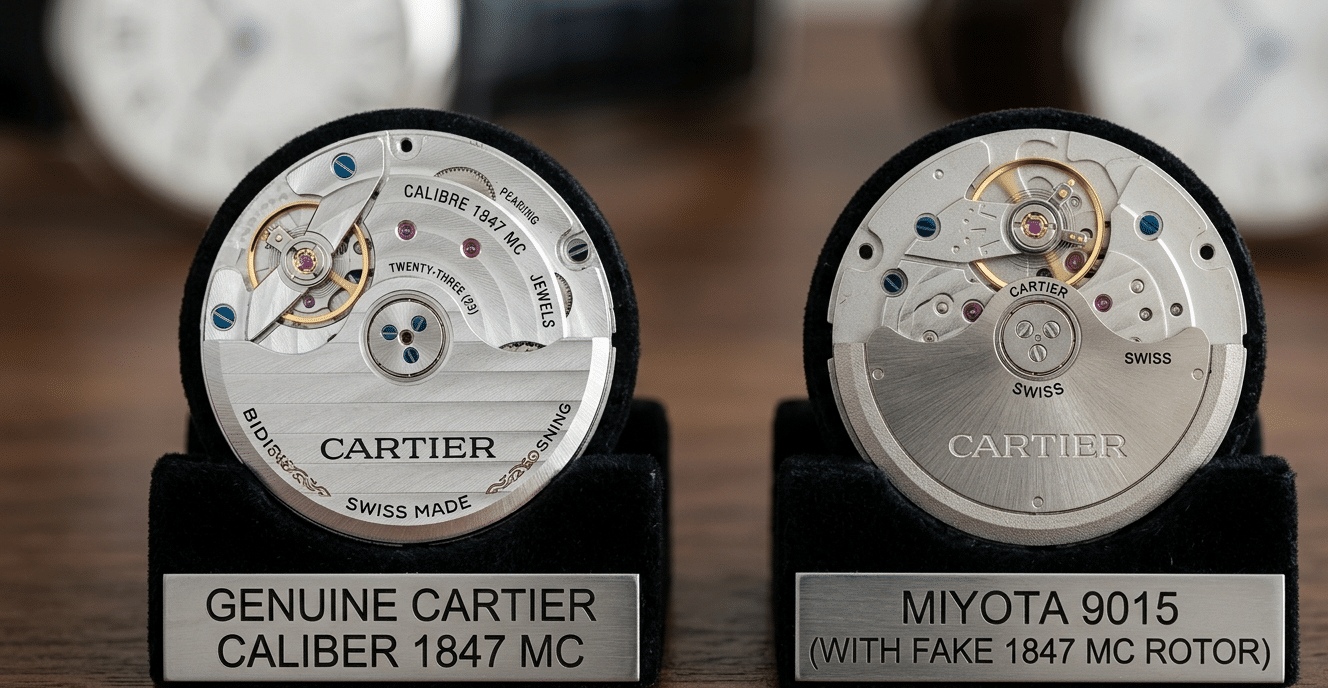
The most immediate way to shatter the “1847 MC clone” myth is visual. A genuine 1847 MC has a distinct, clean layout with a centrally mounted balance wheel and specific bridge shapes. The common base movements used in replicas—like the Miyota 9015 or Seagull ST2130—have a completely different architecture, with the balance wheel at a different position and a bulkier, more industrial bridge structure. Even with a rotor stamped “1847 MC,” a single glance at the naked movement (the mainplate and bridges, not just the spinning weight) reveals the truth. They share zero mechanical DNA. A seller offering a “true clone” who cannot or will not provide a clear, uncased movement photo is telling you everything you need to know.
Decoding the Dictionary: A Glossary of Misleading Movement Claims
Seller listings are a minefield of technically worded half-truths and outright fabrications. Learning this language is your first line of defense. Think of it as translating marketing poetry into mechanical prose.
The “Swiss” Lie
Claim: “Swiss 1847 MC” or “Swiss Made Movement.”
Literal Translation: This movement is of Swiss origin and is a true Cartier 1847 MC caliber.
Real-World Translation: This is almost always one of two things. First, and most deceptively, it could be a standard Swiss ebauche movement—like a Sellita SW200 or an old ETA 2824—that has been decorated with perlage and a rotor engraved with “Cartier” and “1847 MC.” It’s a Swiss movement, yes, but it is categorically not an 1847 MC. Second, and more commonly, it’s a total fiction. The watch contains a Japanese or Chinese movement, and the “Swiss” claim is pure fantasy designed to command a 50-100% price premium. The word “Swiss” is the single most powerful—and most abused—term in replica marketing.
The “Clone” Ambiguity
Claim: “Asian Clone 1847 MC,” “1:1 Clone Movement,” “Super Clone Caliber.”
This is a dedicated, functionally identical replica of the Cartier 1847 MC movement, manufactured in Asia, which aligns with the principles of **2892-style replica movements** where thinness and specification accuracy are paramount.
Real-World Translation: This almost universally refers to a cosmetic modification, not a mechanical one. A standard Miyota 9015 or Seagull movement is fitted with a custom rotor that has been stamped or engraved with “1847 MC” and perhaps some decorative perlage on the visible plates. The “clone” refers solely to the aesthetic approximation of the rotor decoration when viewed through a case back. The actual movement mechanics—the gear train, balance, and bridges—remain completely unchanged and bear no resemblance to the genuine article. It’s a costume, not a conversion.
The Meaningless Functionality Claim
Claim: “Same Functions as Genuine” or “All Functions Working.”
Literal Translation: This watch performs all the same operations as the genuine Cartier watch.
Real-World Translation: This is a tautology designed to sound impressive while conveying zero useful information. A basic time-and-date watch has, by definition, the “same functions” as another basic time-and-date watch. It tells the hours, minutes, seconds, and the date. This phrase is used to pad listings with technical-sounding fluff, often sandwiched between other false claims to lend them an air of credibility. It is a red flag for a seller relying on buzzwords over specifics.
Bonus Decoder: “High-Beat 28,800 VPH Movement”
This one is often the only true specification in the entire listing. It’s a factual descriptor for movements like the Miyota 9015 or its clones. Sellers include it to add a layer of technical legitimacy, making the surrounding lies about “Swiss 1847 MC” seem more plausible. It’s a truth used as a Trojan horse for fiction.
Expert Authentication Insight
The single most powerful question you can ask any seller is: “Can you send a photo of the naked movement, outside of the case?” Refuse to accept a photo of just the rotor spinning inside the watch. Demand to see the mainplate and bridges. Then, pull up a reference image of a genuine Cartier 1847 MC movement. Compare the layout. The genuine movement will look organized, with a distinct, often symmetrical bridge structure. The replica’s base movement (Miyota, Seagull, Sellita) will look completely different—more cluttered, with a different balance wheel location. If the seller avoids this request or sends a blurry, cased shot, you have your answer.
The Three Real Movement Scenarios in a “1847 MC” Cartier Replica
Forget the marketing lexicon. When you order a Cartier replica advertised with any variation of an “1847 MC” movement, you are almost certainly getting one of three physical things. Your goal is to figure out which one, and at what price.
Scenario 1: The Miyota 9015 Reality
Prevalence: >90% of cases. This is the standard.
What it is: A standard Miyota 9015 automatic movement. A reliable, thin, high-beat Japanese workhorse. The “1847 MC” treatment involves a custom-made oscillating weight (rotor) engraved with the Cartier branding and sometimes superficial perlage decoration on the visible mainplate.
The Pros: You’re getting a known quantity. The Miyota 9015 is accurate, robust, and easily serviceable by any competent watchmaker. It’s the engine inside countless microbrand watches. Its reliability is its best feature.
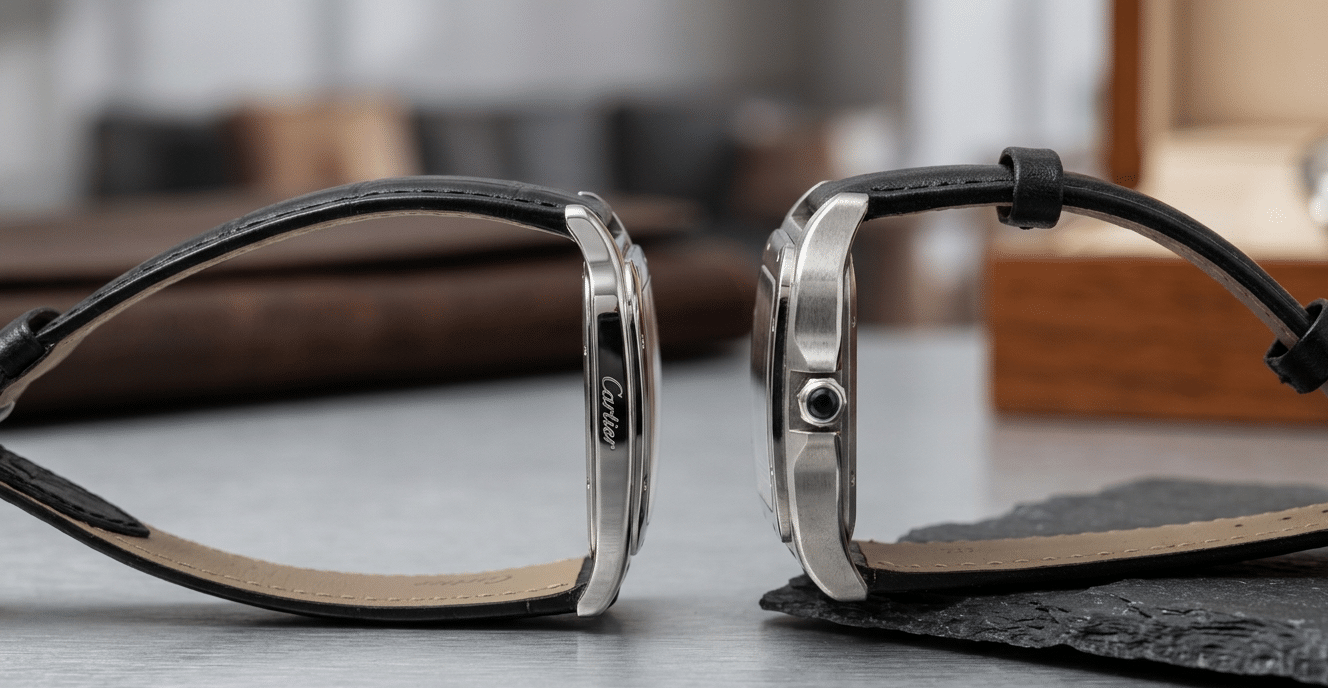
The Cons: The movement architecture is wrong. This has direct consequences: First, thickness. The Miyota 9015, while thin for its class, is not the same ultra-thin architecture as the true 1847 MC. This often forces replica cases to be 1-2mm thicker than the genuine watch, ruining the sleek profile. Second, rotor noise. The 9015 rotor is notoriously audible—a distinct, high-speed whirring that a genuine Cartier does not have. Third, visual tell. Anyone who knows movements will instantly recognize the 9015 layout if they see it.
Scenario 2: The “Swiss Made” Illusion
Prevalence: ~5-8% of cases, typically in higher-priced listings (~$700+).
What it is: A Swiss Sellita SW200 or (less commonly now) an ETA 2824-2. These are the generic, high-quality Swiss automatic movements that power thousands of genuine watches. Like the Miyota, they receive a custom “1847 MC” rotor and decoration.
The Pros: The movement itself is excellent. It has a slightly longer power reserve than the Miyota (38 vs. 42 hours), a smoother winding feel, and the intangible cachet of “Swiss Made.” It is the most reliable mechanical option available in the replica space.
The Cons: You are paying a massive premium—often double the price of a Miyota-based replica—for a movement that is still visually and dimensionally incorrect. The Sellita/ETA architecture is no closer to a real 1847 MC than the Miyota is. You are buying Swiss reliability, not Swiss authenticity. Furthermore, you are financially endorsing a more elaborate deception, as this is the movement most often disingenuously sold as a “Swiss 1847 MC.”
Scenario 3: The Mythical True Clone
Prevalence: <<1%. Effectively zero for standard production models.
What it is: A theoretical, heavily modified base movement where the plates and bridges have been machined to somewhat resemble the layout of the genuine 1847 MC. This is not a mass-produced item. It would be a bespoke, custom project for a specific, ultra-high-end “build,” costing many thousands of dollars.
The Reality: If you see this advertised in a standard TD (Trusted Dealer) listing for a Cartier Santos or Ballon Bleu at a “normal” super clone price ($400-$800), it does not exist. It is a fantasy used to justify a top-tier price tag. The R&D and machining costs to create such a movement for a closed-case-back watch make zero economic sense for replica factories. They will always choose the path of least resistance: a decorated Miyota 9015.
Expert Authentication Insight
The most practical, at-home test to debunk an “1847 MC” claim is the thickness check. Before buying, find the official thickness of the genuine Cartier model you’re interested in. For a comprehensive analysis of replica caliber specifications, including the key differences between cloned and generic movements, the detailed Cartier super clone movements explained guide is an essential resource. For example, a Cartier Santos-Dumont in large is about 7.3mm thick. A replica claiming an “1847 MC” but housing a Miyota 9015 will likely measure over 9mm. A discrepancy of more than 1.5mm is a huge red flag. That extra bulk is the physical proof of the movement lie. Always ask the seller for the exact case thickness specification. If they won’t provide it, or if the number is significantly larger than the gen, you know the movement inside cannot be what’s advertised.
Why the Movement Claim Often Doesn’t Matter (And When It Absolutely Does)
After dissecting the marketing fiction, the most important question becomes: how much should you actually care? The counterintuitive answer is that for most buyers, the fake “1847 MC” engraving is the least of your concerns. Obsessing over it is like worrying about the brand of paint on a car’s engine block while ignoring dents in the door. The movement claim is a distraction from what genuinely determines your satisfaction: the parts you see and feel every day.
Prioritize the Visible: Case, Dial, Bracelet
In a replica watch, the movement is a black box. Your goal isn’t to find a unicorn—a perfect mechanical clone—but to avoid a donkey. What matters is that the movement inside is a known, reliable workhorse that won’t die in a month. A Miyota 9015 or a Seagull ST2130 fits that bill perfectly. They are the industry’s standard engines for a reason: they are affordable, accurate enough, and repairable by most watchmakers.
Your money and scrutiny are far better spent on the exterior. This is where the illusion of luxury is built or broken. A poorly finished case with sharp edges, a dial with misaligned printing or the wrong shade of silver, a bracelet with poorly fitted screws and a hollow feel—these are the flaws you will notice every time you glance at your wrist. No amount of “Swiss 1847 MC” fantasy engraving will compensate for a dial that looks cheap in daylight. The movement’s job is to tick reliably in the dark. The case, dial, and bracelet’s job is to convince you and anyone else that you’re wearing a Cartier. Focus your energy on the latter.
The True Cost of the Movement Lie: Thickness and Price Gouging
This is where the movement claim stops being a harmless fairy tale and starts costing you real money and comfort. The deception has two tangible consequences.
First, physical wearability. The genuine Cartier 1847 MC is a slim movement, often around 3.6mm thick. The Miyota 9015, the most common base, is about 3.9mm thick. That difference, combined with the replica case maker’s less refined engineering, can result in a watch that is 1.5mm to 2mm thicker than the genuine article. On a dress watch like a Santos or a sleek Ballon Bleu, that extra bulk is palpable. It sits higher on the wrist, catches on cuffs more easily, and destroys the elegant silhouette you’re paying for. The “1847 MC” claim, when it masks a Miyota, is a direct promise of a proportion that the watch cannot physically keep.
Second, financial exploitation. This is the big one. A seller slapping “Swiss 1847 MC Super Clone” on a listing for a standard $400 Miyota-based replica isn’t just lying—they’re creating a pretext to charge $800 or more. They are monetizing your hope for mechanical authenticity. You are not paying for a better movement; you are paying a premium for more convincing lies. In this scenario, the movement claim is the central pillar of a price-gouging scheme.
Expert Authentication Insight
The most immediate, non-visual tell is sound. A genuine Cartier 1847 MC, or a well-finished Swiss automatic like a Sellita, has a rotor that is virtually silent in operation. The most common replica base movement, the Miyota 9015, has a distinct, high-speed rotor whirr that is audible in a quiet room. It’s a dead giveaway. Before you ever open the case back, give the watch a gentle shake next to your ear. That buzzing, grinding sound is the real “1847 MC” talking.
Forget deciphering marketing poetry. Your interaction with a seller should be a clinical interrogation. Follow this protocol to bypass the fiction and get to the facts.
- Assume All Caliber Names Are Fiction. This is your starting point. “1847 MC,” “Super Clone,” “Swiss Made” on the movement—treat these as decorative text, not technical data. This mindset saves you from emotional marketing traps.
- Demand a Naked Movement Photo. Do not accept a photo of just the decorated rotor. You need a clear, well-lit image of the entire movement, out of the case. This is non-negotiable. A genuine 1847 MC has a distinct micro-rotor and bridge layout. A Miyota 9015 or Seagull movement looks completely different. If a seller refuses or only shows rotor shots, walk away.
- Ask for the Base Movement by Name. Phrase the question to cut through ambiguity: “What is the base movement inside? Is it a Miyota 9015, a Seagull ST2130/2824, or a Sellita SW200?” A trustworthy seller will give you a straight answer. Vague replies like “high-quality automatic clone” are red flags.
- Verify Case Thickness. Ask for the exact case thickness in millimeters. Then, look up the thickness of the genuine model. If the replica is more than 1.2mm thicker, you are almost certainly not getting a movement architecture that mimics the genuine watch’s slim profile. This number doesn’t lie.
- Decode the Price. Correlate the price to the reality. A Cartier replica priced around $350-$500 is almost certainly powered by a Miyota or Seagull. A watch priced at $800+ that claims a “Swiss 1847 MC” is either using a (likely old or refurbished) Sellita SW200 or is grossly overcharging you for a standard movement. Ask yourself: is the exterior finish so exceptionally perfect that it justifies that premium, or are you paying for a story?
- Focus Your QC on the Exterior. When you receive Quality Control photos, spend 90% of your time on the visible parts. Scrutinize the dial print for sharpness and alignment. Check the date wheel for font and centering. Examine the case finish for polishing and brushing consistency. Look at the crystal for clarity and any distortion. The fake engraving on the rotor is the last thing you should worry about.
Expert Authentication Insight
The most authentic thing about a replica Cartier movement is usually its timekeeping performance. A well-regulated Miyota 9015 can keep time within a perfectly acceptable +/- 10 seconds per day. Judge the watch by its face and its feel on the wrist, not by the fairy tale engraved on its rotor. The movement’s primary function is to be reliable and serviceable, not to be a museum piece. In the replica world, that’s the only truth that matters.

The Final Verdict
The “1847 MC” in a replica listing isn’t a specification; it’s a mood. It’s a seller’s attempt to inject technical legitimacy into a product where the greatest legitimacy comes from a well-finished case and a reliable timekeeping heart. Your goal isn’t to find a real 1847 MC clone—that’s a unicorn. Your goal is to avoid overpaying for the fantasy of one. Buy the watch for its exterior, tolerate its interior, and let the “1847 MC” on the rotor serve as a private reminder that in the replica game, the most persuasive stories are often the ones worth reading with the most suspicion.