
The Cartier Conundrum: When Movement “Upgrades” Break the Watch
In the world of replica watches, the pursuit of a “better” movement is often treated as an unqualified good. It’s a clear, marketable spec—a Swiss or Japanese automatic is objectively more sophisticated than a basic Chinese manual-wind, right? For most watch brands, this logic holds. But with Cartier, it’s a trap. The central paradox, as detailed in the best Cartier replica movement guide, is this: chasing a theoretically superior movement can completely destroy the very thing that makes a Cartier a Cartier. The brand’s value isn’t rooted in technical prowess; it’s rooted in a design philosophy where the movement is a servant to form, not the master of it. A “better” movement that compromises the watch’s silhouette, comfort, or elegance isn’t an upgrade. It’s a fundamental design failure.
The Cartier Design Doctrine: Thinness, Elegance, and Coherence
Forget chronometer certifications and power reserve races. Cartier’s core identity is that of the jeweler who makes watches. The movement’s job is not to impress with its engineering but to disappear, enabling an object of refined elegance. This creates non-negotiable pillars that any faithful replica must prioritize. First is thinness—not just a number on a spec sheet, but a visual and tactile slenderness that makes the watch feel like a second skin, not a wrist-mounted device. Second is the case profile and lug-to-lug comfort; a Cartier should hug the wrist, with no sharp edges or awkward overhangs. Third is dial symmetry and visual balance—the famous Roman numerals, the railroad minute track, the blued steel hands—all must exist in perfect harmony. The overall “feel” is one of a discreet, integrated accessory. When any of these pillars is compromised, the watch ceases to be a Cartier in spirit, regardless of what’s ticking inside.
The Replica Industry’s False Proxy for Quality
Factories and sellers love to push “upgraded movements” because it’s an easy sell. Telling a buyer they’re getting a Seagull ST2130 (a clone of the robust ETA 2824) instead of a standard Miyota 8215 sounds like a major technical leap. It’s a concrete, impressive-sounding specification that justifies a higher price tag. However, this framing ignores the integrated design cost. Cartier’s cases are often engineered to micron-level tolerances around specific, often very thin, movements. Swapping in a different caliber, even a “better” one, frequently requires altering the case. This usually means making it thicker, changing the curvature of the caseback, or both. The industry uses movement pedigree as a simple proxy for overall quality, but for Cartier replicas, this metric is dangerously misleading. You might be paying more for a movement that actively makes the watch worse.
Expert Authentication Insight
The most revealing test is often the simplest. Take a digital caliper and measure the case thickness. A genuine Cartier Santos-Dumont, for example, is a manual-wind watch with a profile of approximately 7mm. A replica that boasts an “upgraded” automatic movement but measures 9.5mm thick has failed its primary mission. The difference isn’t just on paper; it’s visually and physically obvious. The elegant, wafer-thin profile of the original is gone, replaced by a chunky slab. No amount of movement decoration or branding can fix that. The profile is wrong, and therefore, the watch is wrong.
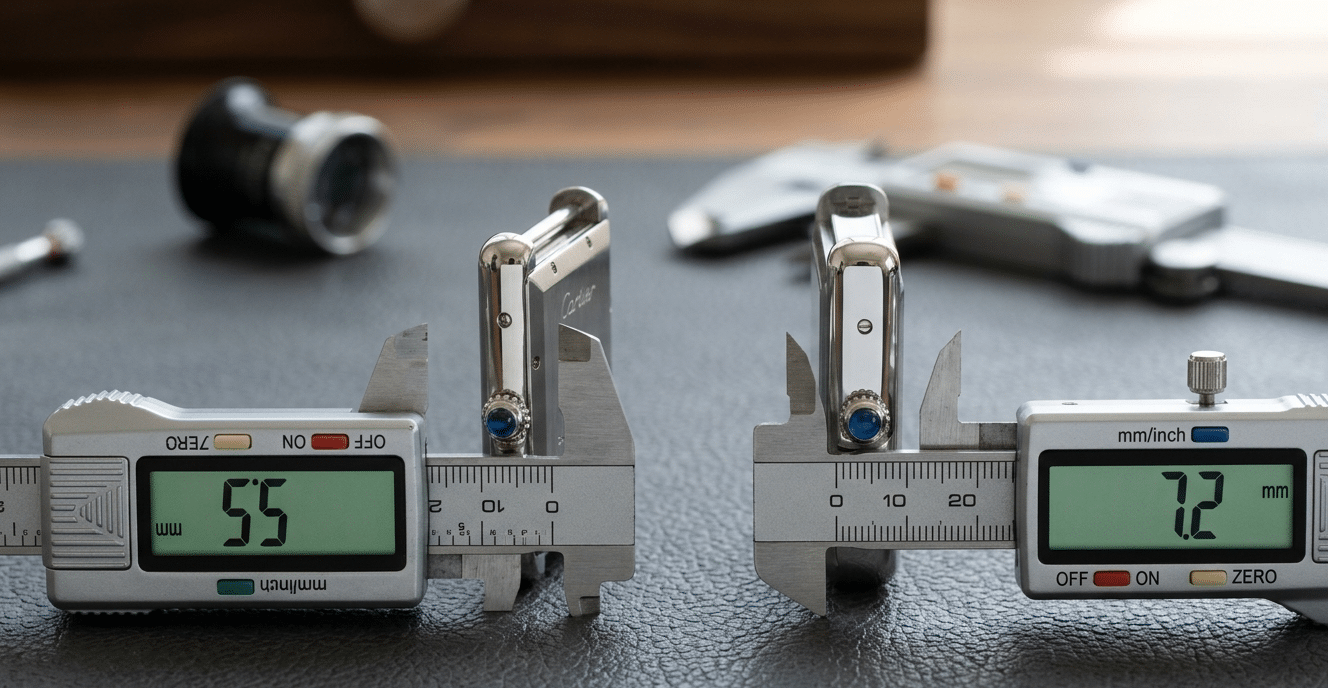
Case Study 1: The Santos-Dumont – Sacrificing Soul for “Automatic”
No model better illustrates this conundrum than the Santos-Dumont. It is the purest expression of Cartier’s design-over-complication ethos, and the replica market’s obsession with automatic movements betrays a fundamental misunderstanding of what the watch is supposed to be.
The Genuine Article: A Manual-Wind Dress Watch Masterpiece
The Santos-Dumont is a historical piece, a direct descendant of one of the first wristwatches ever made. Its entire raison d’être is elegance and thinness. The genuine watch, often housing a caliber like the 430 MC, is a manual-wind marvel. This is not a cost-saving measure; it’s a deliberate choice. A manual movement allows for an incredibly svelte case—often under 7mm thick—that slips effortlessly under a shirt cuff and sits with period-correct grace on the wrist. The act of winding it each morning is part of the ritual, connecting the wearer to a century-old tradition of refined, personal timekeeping. The movement is an enabler of the form.
The Replica Mistake: Forcing an Automatic Where It Doesn’t Belong
Eager to cater to a market that equates “automatic” with “quality,” many replica factories make a critical error. They take the Santos-Dumont’s elegant case and try to jam an automatic movement inside—often a Miyota 9015, which is a fine movement in the right context. The result is a design disaster. To accommodate the rotor and extra height of the automatic mechanism, the case must be significantly thickened. A watch meant to be 7mm balloons to 10mm or more. It loses its defining slenderness, sits tall and awkwardly on the wrist, and completely betrays the historical essence of the original. You get a watch that tells time automatically but has sacrificed its soul to do so.
The Smarter Replica Path: Embracing the “Simple” Manual Movement
The path to a true “super clone” Santos-Dumont is counterintuitive to the spec-sheet crowd: embrace a simple, reliable, and thin manual movement. A Chinese manual caliber like the Seagull ST3620, while not glamorous, can be engineered to fit within the correct, gen-spec case dimensions. This replica will wind manually, just like the original. It will be the correct, elegant thickness. It will sit on the wrist with the same graceful presence. For this specific model, a replica that nails the 7mm profile with a basic manual movement is a far higher-fidelity reproduction than any automatic version, regardless of the automatic movement’s prestige. It correctly replicates the experience, which is what matters.
Expert Authentication Insight
Pay close attention to the winding action. A genuine manual-wind Cartier has a smooth, refined, and almost silent wind—a tactile pleasure. A low-tier replica manual movement will feel gritty, noisy, and loose. However, if you find a Santos-Dumont replica that is the correct thickness and has a surprisingly smooth, quiet winding feel, you’ve likely found a thoughtfully constructed piece. The factory invested in proper tolerances and finishing for that “simple” movement to serve the design. That’s a sign of true quality in a Cartier context.
Case Study 2: The Ballon Bleu – When a Thicker Movement Kills Comfort
If the Santos-Dumont fails on silhouette, the Ballon Bleu fails on comfort. The magic of the Ballon Bleu isn’t just in its distinctive “balloon” shape; it’s in how that shape feels during all-day wear. A movement change that disrupts this is a critical flaw.
Anatomy of Comfort: The Integrated Case and Crystal Design
The genuine Ballon Bleu’s legendary comfort comes from its seamless, organic architecture. The highly domed sapphire crystal flows without a hard edge into the rounded case middle, which then curves to meet a deeply curved caseback. This creates a low, rounded profile that hugs the wrist like a pebble. The movement inside—often Cartier’s Caliber 1847 MC—is specifically shaped and thinned to fit within this curvaceous enclosure. Every component is designed as part of a whole. The comfort is not an accident; it’s the result of integrated engineering where the movement’s dimensions are a primary constraint.
The Thickness Trap: How “Upgraded” Movements Protrude
The standard, reliable workhorse for many mid-tier Ballon Bleu replicas is the Miyota 8215. It’s not glamorous, but it’s thin enough to often allow for a decent approximation of the caseback curvature. The problem arises when a factory, seeking a marketing edge, swaps in a “superior” movement. A heavily decorated clone movement or a swap to a slightly different base caliber can add crucial millimeters of height. To fit this taller movement, the caseback’s curvature must be flattened or, worse, the entire case module must be made taller. The watch no longer nestles into your wrist. Instead, it sits on top of it like a flat-backed slab, creating pressure points and destroying the fluid, comfortable feel that defines the genuine article. You’ve “upgraded” the engine but ruined the car’s suspension.
Expert Authentication Insight
Conduct the “wiggle test.” Place a genuine Ballon Bleu on a flat surface. Gently press on one edge of the case. Because of its deeply curved back, it will pivot or rock slightly. Now, try the same with a replica that uses a thicker, poorly integrated movement. It will sit flat and firm, with little to no rock, a clear sign of flawed Cartier replica movement claims from sellers. This isn’t just a party trick; it’s direct, tangible proof that the case geometry—and therefore the wearing comfort—is incorrect. The movement has dictated a form that betrays the design.
The True Movement Upgrade: When It Actually Matters for Cartier
After arguing so strongly against chasing movements, it’s only fair to define the narrow, specific scenarios where a movement upgrade is not only legitimate but essential. For Cartier replicas, these are the exceptions that prove the rule. The upgrade is never about the movement’s brand name; it’s about solving a specific functional or aesthetic problem that the standard movement creates.
Scenario 1: Improving Timekeeping in a Sports Model (e.g., Pasha)
This is the clearest case. For a chunkier, sportier Cartier like the Pasha or a larger Calibre de Cartier, the design brief is different. Case thickness is less of a sacred cow. The watch is meant to have more wrist presence and durability. Here, the primary failure of a base movement isn’t its dimensions, but its performance.
If the standard offering uses a poorly regulated, noisy, or unreliable Japanese or Chinese movement that gains or loses significant time daily, an upgrade to a well-tuned and decorated Seagull ST2130 (a clone of the ETA 2824) is a genuine improvement. You’re paying for better accuracy, smoother winding, and potentially better shock resistance. The key is that the upgraded movement must still fit within the case’s design parameters without distorting its proportions. The benefit is tangible: you get a watch that keeps better time, which is a core function after all.
Scenario 2: Replicating a Complication’s Function (e.g., Chronograph, GMT)
This is non-negotiable. When the genuine watch has a specific complication, the replica’s movement must accurately replicate its function. A “better” movement here has nothing to do with prestige and everything to do with mechanical fidelity.
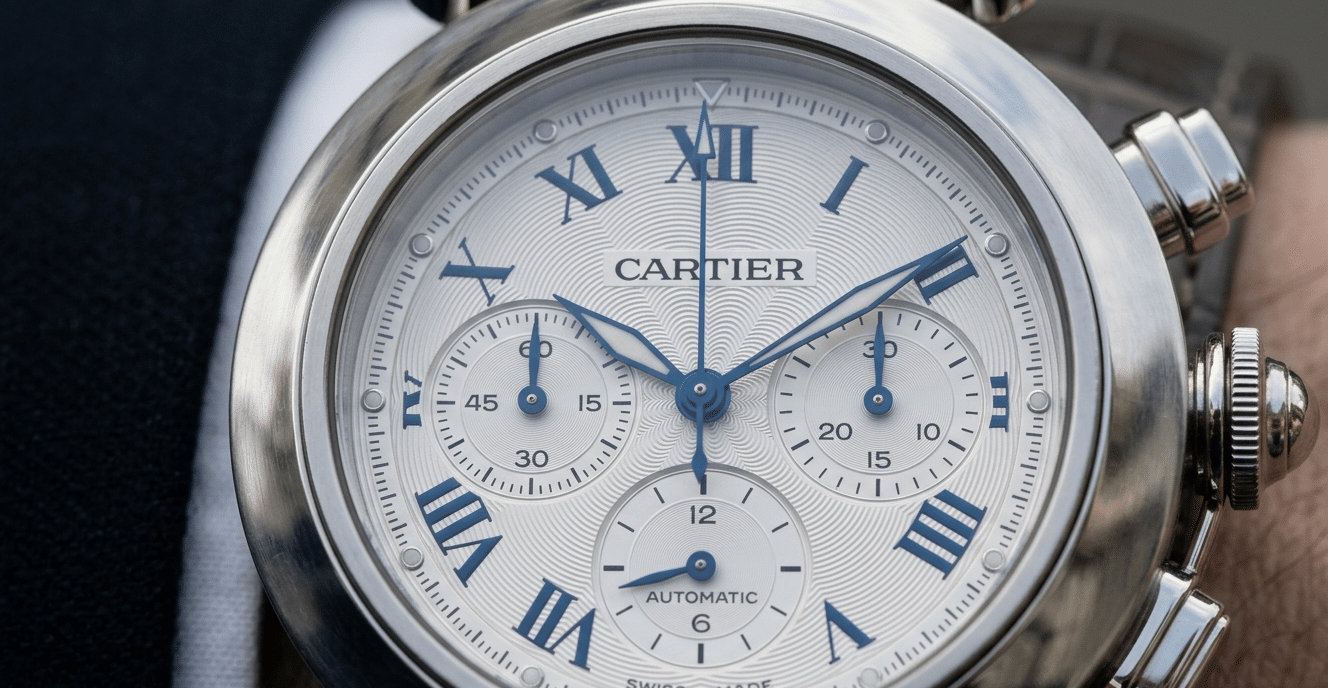
Take a Cartier Calibre de Cartier Chronograph. The genuine watch has a specific sub-dial layout and hand stack. A cheap replica might use a standard three-hand movement with frozen, non-functional sub-dials. This is a complete deal-breaker. The true upgrade is to a movement that actually drives a chronograph function with the correct sub-dial spacing and hand reset behavior. This could be based on a Seagull ST19 (column wheel) or a modified Shanghai 7750. The “upgrade” is from a fake watch to a functioning one.
The same logic applies to a GMT. A watch with a GMT hand that doesn’t independently jump is not a GMT replica; it’s a dress watch with an extra, useless hand. The upgrade to a true GMT function is the entire point of the purchase.
Expert Authentication Insight
For chronographs, the reset is the tell. Press the reset pusher on a genuine Cartier chronograph. The central seconds hand should snap back to zero instantly and crisply, with the sub-dial hands following in perfect alignment. A replica with a poorly modified or low-grade chronograph movement will have a sluggish, hesitant reset. The seconds hand may stutter or land slightly off zero. Sub-dial hands may not reset perfectly. A correct-function clone movement, even if it’s a Seagull and not a Valjoux, is a massive, legitimate upgrade over a decorative faux chrono. It transforms the watch from a static prop into a working machine.
The Buyer’s Decision Framework: Asking the Right Questions
Armed with this philosophy, you need a filter to cut through the marketing noise. Before you pay a premium for a “better” movement, stop and ask these three questions.
Question 1: Does This Change the Case Thickness or Profile?
This is your first and most important check. Obtain the thickness specification for the best standard replica of your model (often from factories like AF or V6). Then, ask the seller for the exact thickness of the version with the “upgraded” movement. If the upgrade adds more than 0.5mm to the total case thickness, it is almost certainly compromising the design. For a watch like the Santos-Dumont or a Tank, where 7-8mm is the target, even an extra 0.8mm is a 10-15% increase in bulk—a deal-breaking distortion of the original silhouette.
Question 2: Does This Improve the Wearing Experience or Just the Spec Sheet?
Be brutally honest. Are you buying a spec or a watch? A Miyota 9015 might have a higher beat rate than a Miyota 8215 on paper, but if it’s noisier and makes the watch wear thicker, the wearing experience is worse. Conversely, if you’re moving from a gritty, unreliable movement to a smooth, accurate one in a model where thickness isn’t critical, the wearing experience improves dramatically. Judge the upgrade by how the watch feels on your wrist over time, not by a line item in a dealer’s catalog.
Question 3: Am I Paying for Decoration I’ll Never See?
This is a classic trap. Dealers love to upsell “fully decorated rotors” and “Geneva stripes on the plates” for watches with solid case backs. You are literally paying for artwork hidden inside a sealed vault. That $100-$200 premium would be far better spent on a version with a better-quality sapphire crystal, a more accurate dial print, or a better-finished bracelet. Always allocate your budget to what you see and touch every day.
Expert Authentication Insight
Never buy a movement-upgraded replica blind. Insist that your trusted dealer (TD) provide a clear, straight-on side-profile photo of the actual watch they will ship to you. Compare this photo to a known genuine profile (readily available on watch forums or the brand’s website). Look for the crown’s relationship to the case. On a correctly proportioned watch, the crown sits proud. If the case mid-section looks swollen or the crown appears sunken into a thicker case side, the movement is wrong. For a deeper technical breakdown of how movements affect these proportions, a comprehensive resource on Cartier super clone movement analysis can be invaluable. The visual proportion doesn’t lie, no matter how fancy the movement’s name is.
Beyond the Movement: The Real Hallmarks of a Cartier Super Clone
If the movement isn’t the star, what is? Shift your focus and your budget to these three areas. This is where the top-tier factories separate themselves from the mid-tier, and where your money actually buys a better experience.
Dial & Print: The Soul of the Face
This is what you stare at all day. The difference between a $800 super clone and a $400 mid-tier rep is almost entirely here. Examine the hidden “Cartier” script in the VII numeral. Is it crisp, laser-sharp, and perfectly filled? Or is it blurry, poorly defined, or even missing? Look at the guilloché pattern on a Tank or a Clé de Cartier. Does it have a fine, subtle depth, or does it look stamped and flat? On a silvered dial, is the sunburst finish even and refined, or does it have a cheap, greasy sparkle? These are the details that scream quality or fraud from a foot away.
Crystal & Crown: The Details in the Hand
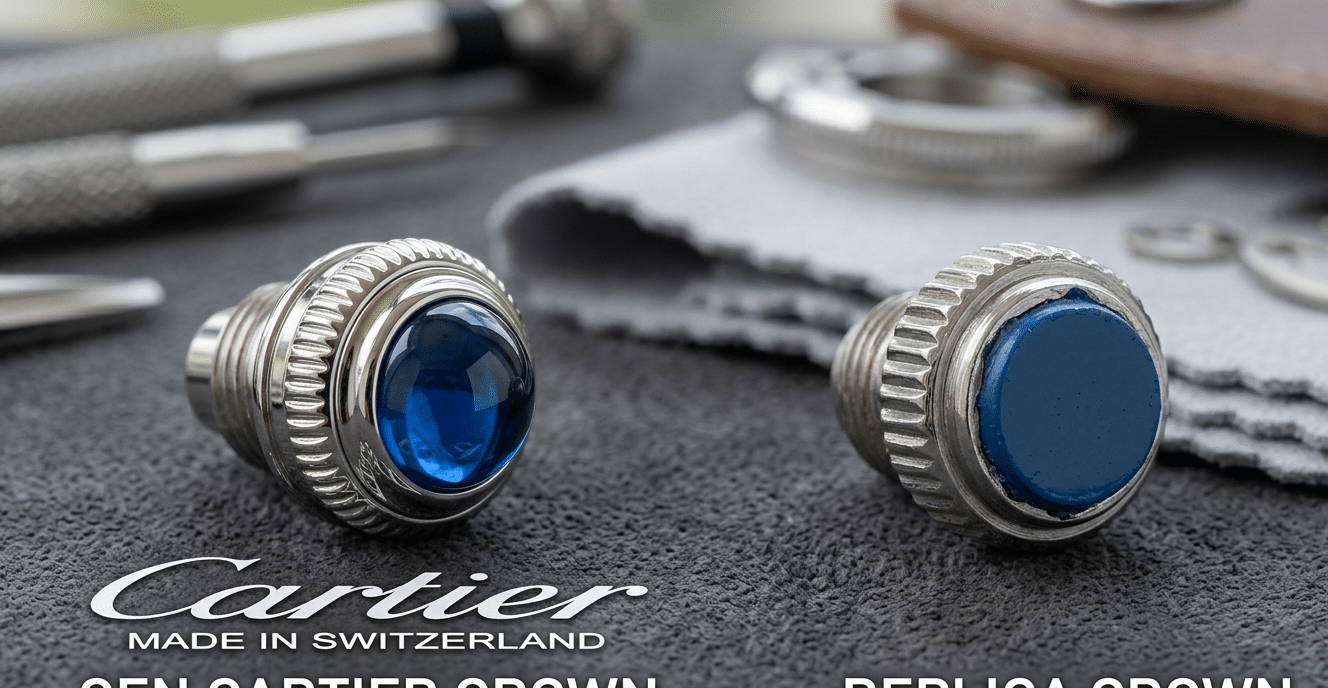
These are your points of physical interaction. A top-tier sapphire crystal has virtually no distortion, exceptional clarity, and a finely beveled edge that catches the light. A cheap one will have a slight green or blue tint, visible distortion at the edges, and a sharp, unfinished feel. The crown is even more critical. The winding action should be smooth, not gritty. The blue cabochon is a Cartier signature—its quality is a direct proxy for the factory’s commitment.
Bracelet & Clasp: The Feel on the Wrist
Especially for the Santos, the bracelet is half the watch. A super clone bracelet has links that articulate smoothly, with no pinch or pull on arm hair. The weight and balance feel substantial, not hollow. The clasp opens and closes with a precise, authoritative click*, not a vague, mushy snap. The screws are perfectly flush. A cheap replica bracelet feels jangly, sharp-edged, and insubstantial. It’s the difference between wearing jewelry and wearing a toy.
Expert Authentication Insight
The crown cabochon is a masterclass in detail. Under magnification, a genuine blue spinel cabochon has a deep, saturated, almost “liquid” color. It’s perfectly smooth, highly polished, and seamlessly set. A poor replica will use a piece of painted glass, plastic, or poorly finished synthetic sapphire. The color will be flat and milky, the surface may be slightly pitted or uneven, and the setting might be crude. This tiny detail is so difficult to get right that factories that nail it almost always get the rest of the watch right, too. It’s a single point of failure that reveals the entire build philosophy.
The Verdict: A Hierarchy of Priorities for the Cartier Replica Buyer
Forget the spec sheet. Choosing the right Cartier replica isn’t about collecting features; it’s about enforcing a hierarchy. The goal is not to buy a watch with the “best” components, but to buy the watch that most convincingly becomes a Cartier. To do that, you must prioritize ruthlessly.
Priority 1: Proportion and Wearability (Non-Negotiable)
This is the foundation. If it’s wrong, everything else is irrelevant. A Cartier is an object of wear, a piece of designed jewelry meant to feel elegant and unobtrusive on the wrist. A replica that gets the thickness, case shape, and lug-to-lug distance wrong has failed at the most fundamental level. It doesn’t matter if it has a decorated Swiss movement or a perfect dial. A Santos-Dumont that’s 2.5mm too thick is a clumsy brick, not a dress watch. A Ballon Bleu with a flat case back that doesn’t hug your wrist is a disc, not a sphere. Before you look at anything else, verify the dimensions against the genuine article. If the profile is off, reject it. No amount of internal “upgrade” can compensate for a broken silhouette.
Priority 2: Dial, Crystal, and Finishing Fidelity (The Visual Payoff)
This is where your money should go. This is the daily experience—what you see every time you check the time and what others perceive. The dial’s color, the crispness of the printing (especially the hidden “Cartier” in the VII), the sunburst texture, the exact shape and polish of the hands—these are the soul of the watch. The crystal: is it the correct, subtly domed shape with clean, beveled edges? The crown: is the blue cabochon a deep, liquid spinel or a flat, painted lump? The case and bracelet finishing: does it have that seamless blend of polished and brushed surfaces? These elements define quality in your hand and on your wrist. A watch that nails Priority 1 and Priority 2 will feel and look like a Cartier from two feet away and two inches away. This is your visual return on investment.
Priority 3: Movement Suitability, Not Just Pedigree (The Supporting Actor)
The movement has one job: to enable the first two priorities without getting in the way. Its role is entirely supportive. It must be reliable enough to keep decent time, quiet enough not to sound like a rattlesnake on your wrist, and—critically—thin enough to allow for the correct case profile. Its “name” (Seagull, Miyota, “Swiss”) is meaningless if it forces a compromise on thickness or comfort. For a Santos-Dumont, a simple, slim manual-wind movement is a better choice than a thicker automatic, even if the automatic has a more prestigious base. For a closed-case-back watch, paying a premium for a decorated rotor you’ll never see is a waste; that budget is far better spent on a better dial or crystal. The movement is a means to an end, not the end itself.
Expert Authentication Insight
The ultimate, inescapable test is not on a timegrapher or under a loupe; it’s on your wrist. Wear the watch for a full day. Does it sit flat and comfortable, feeling like a natural extension of your attire? Or does it feel top-heavy, bulky, or awkward? Does it operate with a quiet, refined feel, or does the rotor whir and the crown action grind? Your subconscious reaction—that feeling of elegance or intrusion—is the final arbiter. A so-called “better” movement that makes the watch wear worse is, by definition, a downgrade. Period.
You are not shopping for a movement. You are shopping for a Cartier. The true super clone is the one that understands this distinction—the watch that prioritizes becoming the object it mimics over boasting about the machinery inside. Choose the replica that best disappears and lets the design speak, even if its heart bears a less glamorous name. That is the only upgrade that truly matters.